Poission Distribution
Presented By:
K.Sai Aashritha
23P61A6798
CSD-B
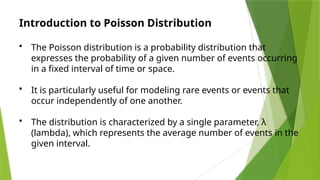
Introduction to Poisson Distribution
• The Poisson distribution is a probability distribution that
expresses the probability of a given number of events occurring
in a fixed interval of time or space.
• It is particularly useful for modeling rare events or events that
occur independently of one another.
• The distribution is characterized by a single parameter, λ
(lambda), which represents the average number of events in the
given interval.
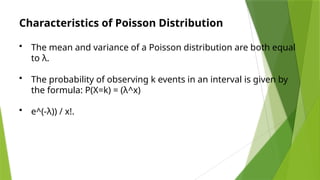
Characteristics of Poisson Distribution
• The mean and variance of a Poisson distribution are both equal
to λ.
• The probability of observing k events in an interval is given by
the formula: P(X=k) = (λ^x)
• e^(-λ)) / x!.
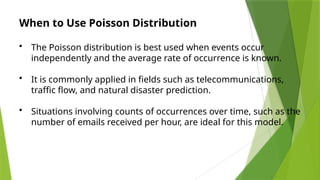
When to Use Poisson Distribution
• The Poisson distribution is best used when events occur
independently and the average rate of occurrence is known.
• It is commonly applied in fields such as telecommunications,
traffic flow, and natural disaster prediction.
• Situations involving counts of occurrences over time, such as the
number of emails received per hour, are ideal for this model.
Limitations of Poission Distribution:
While the Poisson Distribution is powerful, it has limitations. It
assumes events occur independently and at a constant rate, which
may not always be the case. Understanding these limitations is
crucial for accurate application, especially in fields where While the
Poisson Distribution is powerful, it has limitations. It assumes
events occur independently and at a constant rate, which may not
always be the case. Understanding these limitations is crucial for
accurate application, especially in fields where event correlation
exists.
Conclusion
• The Poisson distribution is a powerful tool for modeling the
occurrence of events in a fixed interval.
• Its applications are vast, ranging from telecommunications to
healthcare and beyond.
• Mastery of this distribution can provide valuable insights into
predicting and managing real-world phenomena.

Poission Distribution aashritha mat.pptx

  • 1.
  • 2.
    Introduction to PoissonDistribution • The Poisson distribution is a probability distribution that expresses the probability of a given number of events occurring in a fixed interval of time or space. • It is particularly useful for modeling rare events or events that occur independently of one another. • The distribution is characterized by a single parameter, λ (lambda), which represents the average number of events in the given interval.
  • 3.
    Characteristics of PoissonDistribution • The mean and variance of a Poisson distribution are both equal to λ. • The probability of observing k events in an interval is given by the formula: P(X=k) = (λ^x) • e^(-λ)) / x!.
  • 4.
    When to UsePoisson Distribution • The Poisson distribution is best used when events occur independently and the average rate of occurrence is known. • It is commonly applied in fields such as telecommunications, traffic flow, and natural disaster prediction. • Situations involving counts of occurrences over time, such as the number of emails received per hour, are ideal for this model.
  • 6.
    Limitations of PoissionDistribution: While the Poisson Distribution is powerful, it has limitations. It assumes events occur independently and at a constant rate, which may not always be the case. Understanding these limitations is crucial for accurate application, especially in fields where While the Poisson Distribution is powerful, it has limitations. It assumes events occur independently and at a constant rate, which may not always be the case. Understanding these limitations is crucial for accurate application, especially in fields where event correlation exists.
  • 7.
    Conclusion • The Poissondistribution is a powerful tool for modeling the occurrence of events in a fixed interval. • Its applications are vast, ranging from telecommunications to healthcare and beyond. • Mastery of this distribution can provide valuable insights into predicting and managing real-world phenomena.