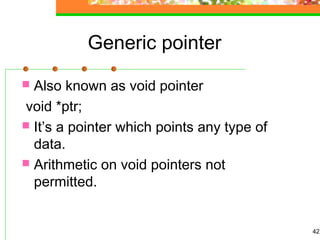
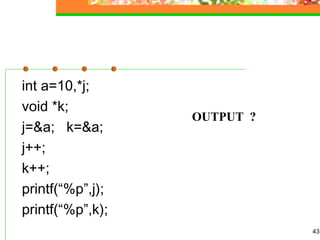
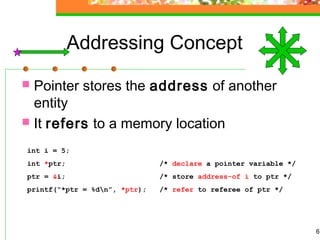
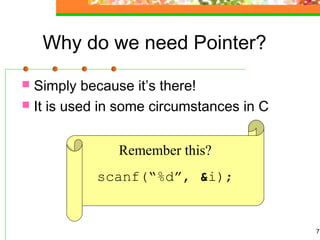
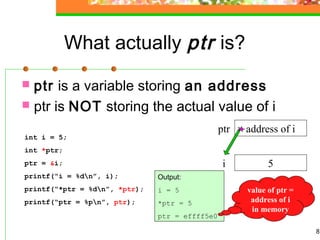
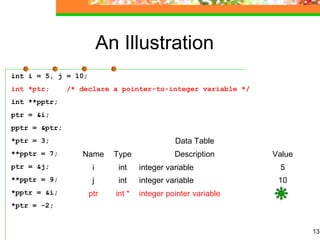
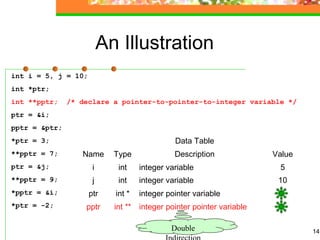
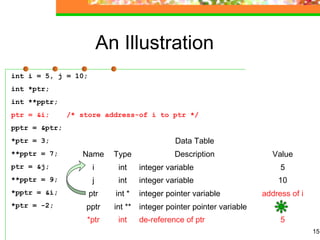
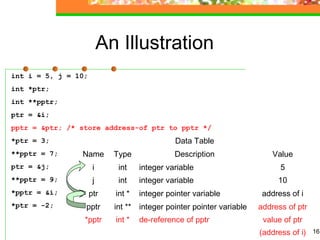
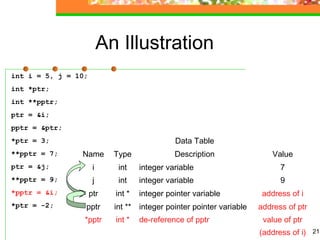
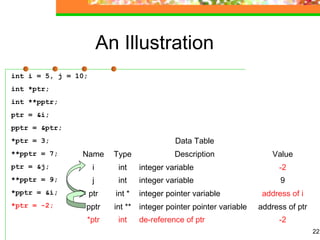
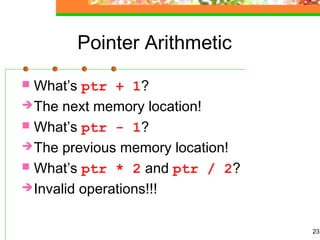
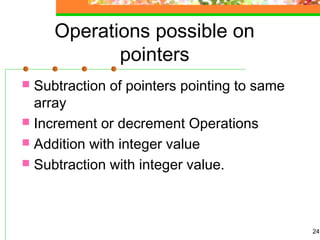
The document discusses pointers in C. It explains that pointers store memory addresses and can be used to indirectly access and modify values in memory. The document provides an example that declares a float array, initializes a pointer to an element in the array, and then uses pointer arithmetic and dereferencing to modify different array elements. It demonstrates how pointers can be incremented, decremented, added to, and subtracted from to access successive or previous memory locations dynamically.
![4
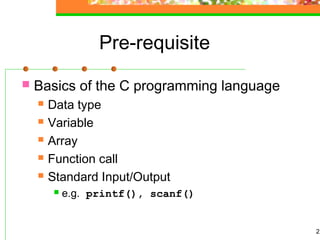
Computer Memory Revisited
Computers store data in memory slots
Each slot has an unique address
Variables store their values like this:
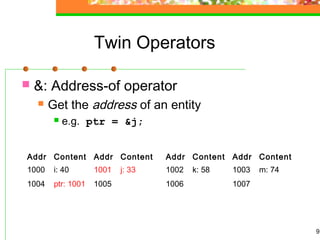
Addr Content Addr Content Addr Content Addr Content
1000 i: 37 1001 j: 46 1002 k: 58 1003 m: 74
1004 a[0]: ‘a’ 1005 a[1]: ‘b’ 1006 a[2]: ‘c’ 1007 a[3]: ‘0’
1008 ptr: 1001 1009 … 1010 1011](https://image.slidesharecdn.com/cpointers-170127115617/85/C-pointers-4-320.jpg)
![5
Computer Memory Revisited
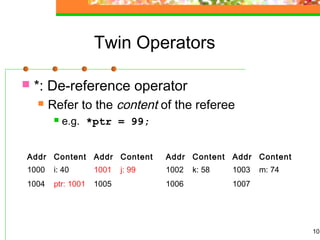
Altering the value of a variable is indeed
changing the content of the memory
e.g. i = 40; a[2] = ‘z’;
Addr Content Addr Content Addr Content Addr Content
1000 i: 40 1001 j: 46 1002 k: 58 1003 m: 74
1004 a[0]: ‘a’ 1005 a[1]: ‘b’ 1006 a[2]: ‘z’ 1007 a[3]: ‘0’
1008 ptr: 1001 1009 … 1010 1011](https://image.slidesharecdn.com/cpointers-170127115617/85/C-pointers-5-320.jpg)
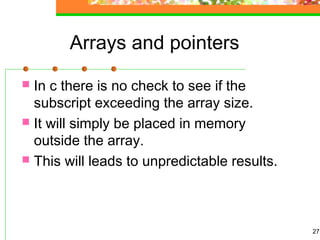
![Arrays and pointers
An array is a collection of similar elements .It
is also known as a subscripted variable.
Before using an array its type and size must
be declared.
int arr[10]
float a[60];
However big an array may be, its elements
are always stored in contiguous memory
locations.
26](https://image.slidesharecdn.com/cpointers-170127115617/85/C-pointers-26-320.jpg)
![29
Pointer Arithmetic and Array
float a[4];
float *ptr;
ptr = &(a[2]);
*ptr = 3.14;
ptr++;
*ptr = 9.0;
ptr = ptr - 3;
*ptr = 6.0;
ptr += 2;
*ptr = 7.0;
Data Table
Name Type Description Value
a[0] float float array element (variable) ?
a[1] float float array element (variable) ?
a[2] float float array element (variable) ?
a[3] float float array element (variable) ?
ptr float * float pointer variable
*ptr float de-reference of float pointer
variable
?](https://image.slidesharecdn.com/cpointers-170127115617/85/C-pointers-29-320.jpg)
![30
Pointer Arithmetic and Array
float a[4];
float *ptr;
ptr = &(a[2]);
*ptr = 3.14;
ptr++;
*ptr = 9.0;
ptr = ptr - 3;
*ptr = 6.0;
ptr += 2;
*ptr = 7.0;
Data Table
Name Type Description Value
a[0] float float array element (variable) ?
a[1] float float array element (variable) ?
a[2] float float array element (variable) ?
a[3] float float array element (variable) ?
ptr float * float pointer variable address of a[2]
*ptr float de-reference of float pointer
variable
?](https://image.slidesharecdn.com/cpointers-170127115617/85/C-pointers-30-320.jpg)
![31
Pointer Arithmetic and Array
float a[4];
float *ptr;
ptr = &(a[2]);
*ptr = 3.14;
ptr++;
*ptr = 9.0;
ptr = ptr - 3;
*ptr = 6.0;
ptr += 2;
*ptr = 7.0;
Data Table
Name Type Description Value
a[0] float float array element (variable) ?
a[1] float float array element (variable) ?
a[2] float float array element (variable) 3.14
a[3] float float array element (variable) ?
ptr float * float pointer variable address of a[2]
*ptr float de-reference of float pointer
variable
3.14](https://image.slidesharecdn.com/cpointers-170127115617/85/C-pointers-31-320.jpg)
![32
Pointer Arithmetic and Array
float a[4];
float *ptr;
ptr = &(a[2]);
*ptr = 3.14;
ptr++;
*ptr = 9.0;
ptr = ptr - 3;
*ptr = 6.0;
ptr += 2;
*ptr = 7.0;
Data Table
Name Type Description Value
a[0] float float array element (variable) ?
a[1] float float array element (variable) ?
a[2] float float array element (variable) 3.14
a[3] float float array element (variable) ?
ptr float * float pointer variable address of a[3]
*ptr float de-reference of float pointer
variable
?](https://image.slidesharecdn.com/cpointers-170127115617/85/C-pointers-32-320.jpg)
![33
Pointer Arithmetic and Array
float a[4];
float *ptr;
ptr = &(a[2]);
*ptr = 3.14;
ptr++;
*ptr = 9.0;
ptr = ptr - 3;
*ptr = 6.0;
ptr += 2;
*ptr = 7.0;
Data Table
Name Type Description Value
a[0] float float array element (variable) ?
a[1] float float array element (variable) ?
a[2] float float array element (variable) 3.14
a[3] float float array element (variable) 9.0
ptr float * float pointer variable address of a[3]
*ptr float de-reference of float pointer
variable
9.0](https://image.slidesharecdn.com/cpointers-170127115617/85/C-pointers-33-320.jpg)
![34
Pointer Arithmetic and Array
float a[4];
float *ptr;
ptr = &(a[2]);
*ptr = 3.14;
ptr++;
*ptr = 9.0;
ptr = ptr - 3;
*ptr = 6.0;
ptr += 2;
*ptr = 7.0;
Data Table
Name Type Description Value
a[0] float float array element (variable) ?
a[1] float float array element (variable) ?
a[2] float float array element (variable) 3.14
a[3] float float array element (variable) 9.0
ptr float * float pointer variable address of a[0]
*ptr float de-reference of float pointer
variable
?](https://image.slidesharecdn.com/cpointers-170127115617/85/C-pointers-34-320.jpg)
![35
Pointer Arithmetic and Array
float a[4];
float *ptr;
ptr = &(a[2]);
*ptr = 3.14;
ptr++;
*ptr = 9.0;
ptr = ptr - 3;
*ptr = 6.0;
ptr += 2;
*ptr = 7.0;
Data Table
Name Type Description Value
a[0] float float array element (variable) 6.0
a[1] float float array element (variable) ?
a[2] float float array element (variable) 3.14
a[3] float float array element (variable) 9.0
ptr float * float pointer variable address of a[0]
*ptr float de-reference of float pointer
variable
6.0](https://image.slidesharecdn.com/cpointers-170127115617/85/C-pointers-35-320.jpg)
![36
Pointer Arithmetic and Array
float a[4];
float *ptr;
ptr = &(a[2]);
*ptr = 3.14;
ptr++;
*ptr = 9.0;
ptr = ptr - 3;
*ptr = 6.0;
ptr += 2;
*ptr = 7.0;
Data Table
Name Type Description Value
a[0] float float array element (variable) 6.0
a[1] float float array element (variable) ?
a[2] float float array element (variable) 3.14
a[3] float float array element (variable) 9.0
ptr float * float pointer variable address of a[2]
*ptr float de-reference of float pointer
variable
3.14](https://image.slidesharecdn.com/cpointers-170127115617/85/C-pointers-36-320.jpg)
![37
Pointer Arithmetic and Array
float a[4];
float *ptr;
ptr = &(a[2]);
*ptr = 3.14;
ptr++;
*ptr = 9.0;
ptr = ptr - 3;
*ptr = 6.0;
ptr += 2;
*ptr = 7.0;
Data Table
Name Type Description Value
a[0] float float array element (variable) 6.0
a[1] float float array element (variable) ?
a[2] float float array element (variable) 7.0
a[3] float float array element (variable) 9.0
ptr float * float pointer variable address of a[2]
*ptr float de-reference of float pointer
variable
7.0](https://image.slidesharecdn.com/cpointers-170127115617/85/C-pointers-37-320.jpg)
![38
Pointer Arithmetic and Array
Type of a is float *
a[2] *(a + 2)
ptr = &(a[2])
ptr = &(*(a + 2))
ptr = a + 2
a is a memory address
constant
ptr is a pointer variable
float a[4];
float *ptr;
ptr = &(a[2]);
*ptr = 3.14;
ptr++;
*ptr = 9.0;
ptr = ptr - 3;
*ptr = 6.0;
ptr += 2;
*ptr = 7.0;](https://image.slidesharecdn.com/cpointers-170127115617/85/C-pointers-38-320.jpg)
![39
More Pointer Arithmetic
What if a is a double array?
A double may occupy more memory slots!
Given double *ptr = a;
What’s ptr + 1 then?
Addr Content Addr Content Addr Content Addr Content
1000 a[0]: 37.9 1001 … 1002 … 1003 …
1004 a[1]: 1.23 1005 … 1006 … 1007 …
1008 a[2]: 3.14 1009 … 1010 … 1011 …](https://image.slidesharecdn.com/cpointers-170127115617/85/C-pointers-39-320.jpg)
![40
More Pointer Arithmetic
Arithmetic operators + and – auto-adjust
the address offset
According to the type of the pointer:
1000 + sizeof(double) = 1000 + 4 = 1004
Addr Content Addr Content Addr Content Addr Content
1000 a[0]: 37.9 1001 … 1002 … 1003 …
1004 a[1]: 1.23 1005 … 1006 … 1007 …
1008 a[2]: 3.14 1009 … 1010 … 1011 …](https://image.slidesharecdn.com/cpointers-170127115617/85/C-pointers-40-320.jpg)
![Increment & Decrement
int a[]={1,2,3,4,5,6,7,8,9,10};
int *p1,*p2;
p1=&a[0];
p2=&a[5];
*p1++;
++*p2;
printf(“%d”,*p1);
printf(“%d”,*p2); 41](https://image.slidesharecdn.com/cpointers-170127115617/85/C-pointers-41-320.jpg)