Pointers
By
Minal Kumar Soni
MCA 3-B
LNCT
Topics
➔
Pointers
✔
Memory addresses
✔
Declaration
✔
Dereferencing a pointer
✔
Pointers to pointer
✔
Pointer Arithmetic
✔
Pointers and Arrays
Computer Memory
➔
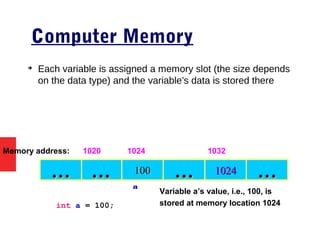
Each variable is assigned a memory slot (the size depends
on the data type) and the variable’s data is stored there
Variable a’s value, i.e., 100, is
stored at memory location 1024
100100…… …… 10241024 ……
Memory address: 1024 1032
int a = 100;
……
1020
a
Pointers
➔
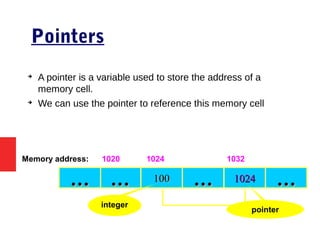
A pointer is a variable used to store the address of a
memory cell.
➔
We can use the pointer to reference this memory cell
100100…… …… 10241024 ……
Memory address: 1024 1032
……
1020
integer
pointer
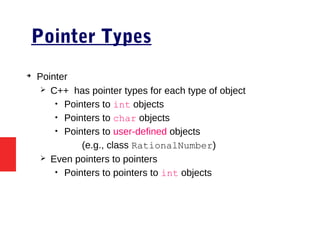
Pointer Types
➔
Pointer
➢ C++ has pointer types for each type of object

Pointers to int objects

Pointers to char objects

Pointers to user-defined objects
(e.g., class RationalNumber)
➢ Even pointers to pointers

Pointers to pointers to int objects
Pointer Variable
➔
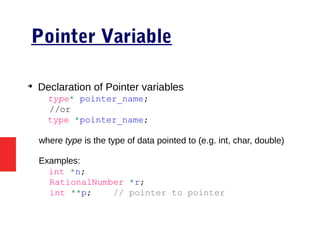
Declaration of Pointer variables
type* pointer_name;
//or
type *pointer_name;
where type is the type of data pointed to (e.g. int, char, double)
Examples:
int *n;
RationalNumber *r;
int **p; // pointer to pointer
Address Operator &
➔
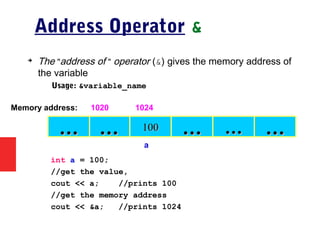
The "address of " operator (&) gives the memory address of
the variable
– Usage: &variable_name
100100…… …… …… ……
Memory address: 1024
int a = 100;
//get the value,
cout << a; //prints 100
//get the memory address
cout << &a; //prints 1024
……
1020
a
Address Operator &
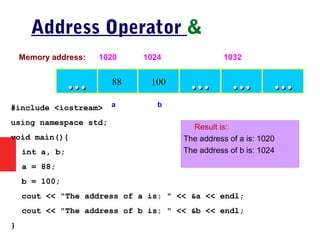
1001008888 …… …… ……
Memory address: 1024 1032
a
……
1020
b#include <iostream>
using namespace std;
void main(){
int a, b;
a = 88;
b = 100;
cout << "The address of a is: " << &a << endl;
cout << "The address of b is: " << &b << endl;
}
Result is:
The address of a is: 1020
The address of b is: 1024
➔
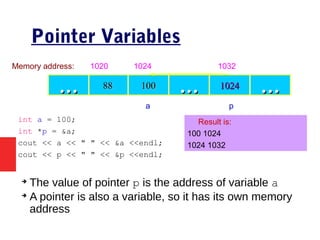
The value of pointer p is the address of variable a
➔
A pointer is also a variable, so it has its own memory
address
Pointer Variables
1001008888 …… 10241024 ……
Memory address: 1024 1032
……
1020
a p
int a = 100;
int *p = &a;
cout << a << " " << &a <<endl;
cout << p << " " << &p <<endl;
Result is:
100 1024
1024 1032
Dereferencing Operator *
➔
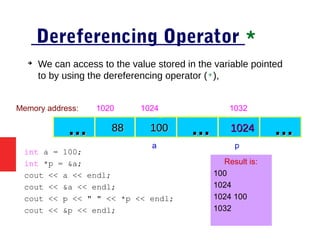
We can access to the value stored in the variable pointed
to by using the dereferencing operator (*),
1001008888 …… 10241024 ……
Memory address: 1024 1032
……
1020
int a = 100;
int *p = &a;
cout << a << endl;
cout << &a << endl;
cout << p << " " << *p << endl;
cout << &p << endl;
Result is:
100
1024
1024 100
1032
a p
Don’t get confused
➔
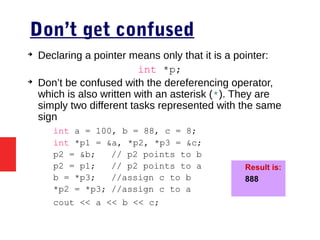
Declaring a pointer means only that it is a pointer:
int *p;
➔
Don’t be confused with the dereferencing operator,
which is also written with an asterisk (*). They are
simply two different tasks represented with the same
sign
int a = 100, b = 88, c = 8;
int *p1 = &a, *p2, *p3 = &c;
p2 = &b; // p2 points to b
p2 = p1; // p2 points to a
b = *p3; //assign c to b
*p2 = *p3; //assign c to a
cout << a << b << c;
Result is:
888
A Pointer Example
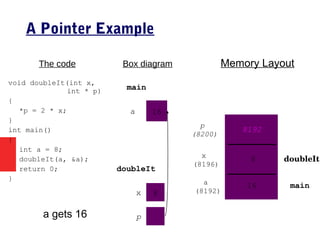
The code
void doubleIt(int x,
int * p)
{
*p = 2 * x;
}
int main()
{
int a = 8;
doubleIt(a, &a);
return 0;
}
Box diagram Memory Layout
8x
p
(8200)
x
(8196)
16a
main
doubleIt
p
a
(8192)
16
8
8192
main
doubleIt
a gets 16
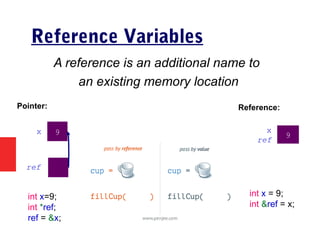
Reference Variables
A reference is an additional name to
an existing memory location
9x
ref
Pointer:
9
x
ref
Reference:
int x=9;
int *ref;
ref = &x;
int x = 9;
int &ref = x;
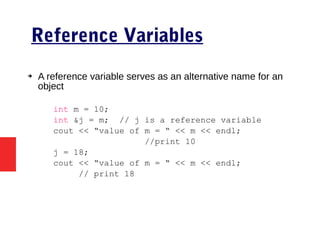
Reference Variables
➔ A reference variable serves as an alternative name for an
object
int m = 10;
int &j = m; // j is a reference variable
cout << “value of m = “ << m << endl;
//print 10
j = 18;
cout << “value of m = “ << m << endl;
// print 18
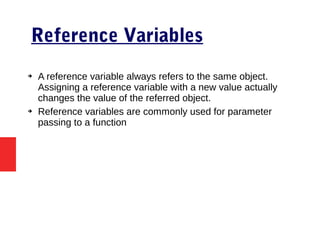
Reference Variables
➔ A reference variable always refers to the same object.
Assigning a reference variable with a new value actually
changes the value of the referred object.
➔ Reference variables are commonly used for parameter
passing to a function
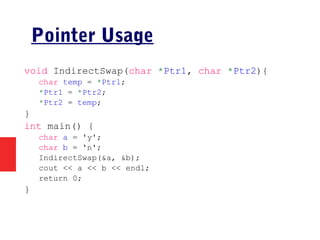
Pointer Usage
void IndirectSwap(char *Ptr1, char *Ptr2){
char temp = *Ptr1;
*Ptr1 = *Ptr2;
*Ptr2 = temp;
}
int main() {
char a = 'y';
char b = 'n';
IndirectSwap(&a, &b);
cout << a << b << endl;
return 0;
}
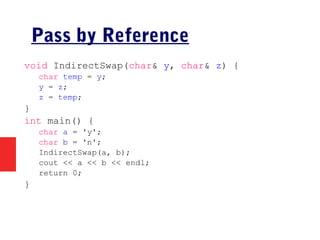
Pass by Reference
void IndirectSwap(char& y, char& z) {
char temp = y;
y = z;
z = temp;
}
int main() {
char a = 'y';
char b = 'n';
IndirectSwap(a, b);
cout << a << b << endl;
return 0;
}
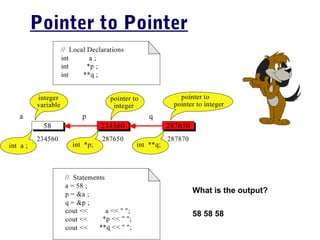
Pointer to Pointer
What is the output?
58 58 58
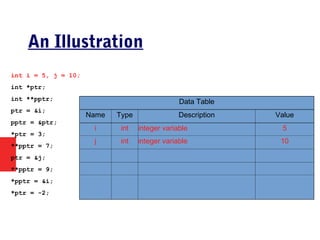
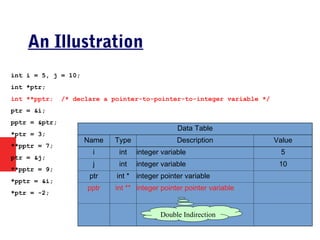
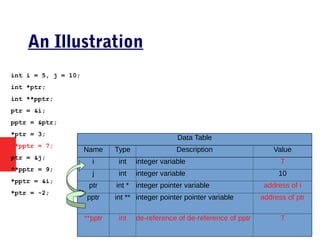
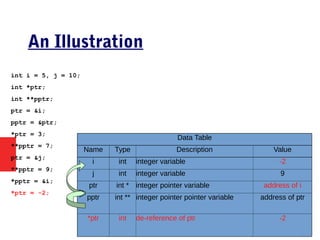
An Illustration
int i = 5, j = 10;
int *ptr;
int **pptr;
ptr = &i;
pptr = &ptr;
*ptr = 3;
**pptr = 7;
ptr = &j;
**pptr = 9;
*pptr = &i;
*ptr = -2;
Data Table
Name Type Description Value
i int integer variable 5
j int integer variable 10
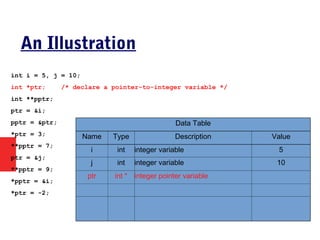
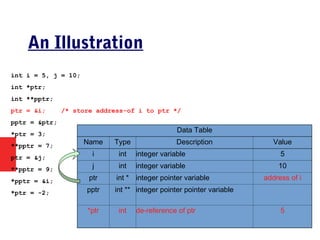
int i = 5, j = 10;
int *ptr; /* declare a pointer-to-integer variable */
int **pptr;
ptr = &i;
pptr = &ptr;
*ptr = 3;
**pptr = 7;
ptr = &j;
**pptr = 9;
*pptr = &i;
*ptr = -2;
Data Table
Name Type Description Value
i int integer variable 5
j int integer variable 10
ptr int * integer pointer variable
An Illustration
An Illustration
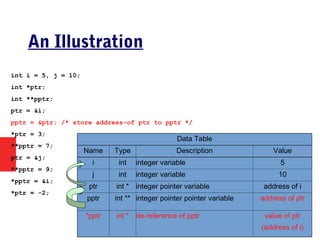
int i = 5, j = 10;
int *ptr;
int **pptr; /* declare a pointer-to-pointer-to-integer variable */
ptr = &i;
pptr = &ptr;
*ptr = 3;
**pptr = 7;
ptr = &j;
**pptr = 9;
*pptr = &i;
*ptr = -2;
Data Table
Name Type Description Value
i int integer variable 5
j int integer variable 10
ptr int * integer pointer variable
pptr int ** integer pointer pointer variable
Double Indirection
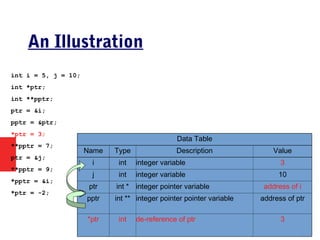
An Illustration
int i = 5, j = 10;
int *ptr;
int **pptr;
ptr = &i; /* store address-of i to ptr */
pptr = &ptr;
*ptr = 3;
**pptr = 7;
ptr = &j;
**pptr = 9;
*pptr = &i;
*ptr = -2;
Data Table
Name Type Description Value
i int integer variable 5
j int integer variable 10
ptr int * integer pointer variable address of i
pptr int ** integer pointer pointer variable
*ptr int de-reference of ptr 5
An Illustration
int i = 5, j = 10;
int *ptr;
int **pptr;
ptr = &i;
pptr = &ptr; /* store address-of ptr to pptr */
*ptr = 3;
**pptr = 7;
ptr = &j;
**pptr = 9;
*pptr = &i;
*ptr = -2;
Data Table
Name Type Description Value
i int integer variable 5
j int integer variable 10
ptr int * integer pointer variable address of i
pptr int ** integer pointer pointer variable address of ptr
*pptr int * de-reference of pptr value of ptr
(address of i)
An Illustration
int i = 5, j = 10;
int *ptr;
int **pptr;
ptr = &i;
pptr = &ptr;
*ptr = 3;
**pptr = 7;
ptr = &j;
**pptr = 9;
*pptr = &i;
*ptr = -2;
Data Table
Name Type Description Value
i int integer variable 3
j int integer variable 10
ptr int * integer pointer variable address of i
pptr int ** integer pointer pointer variable address of ptr
*ptr int de-reference of ptr 3
An Illustration
int i = 5, j = 10;
int *ptr;
int **pptr;
ptr = &i;
pptr = &ptr;
*ptr = 3;
**pptr = 7;
ptr = &j;
**pptr = 9;
*pptr = &i;
*ptr = -2;
Data Table
Name Type Description Value
i int integer variable 7
j int integer variable 10
ptr int * integer pointer variable address of i
pptr int ** integer pointer pointer variable address of ptr
**pptr int de-reference of de-reference of pptr 7
An Illustration
int i = 5, j = 10;
int *ptr;
int **pptr;
ptr = &i;
pptr = &ptr;
*ptr = 3;
**pptr = 7;
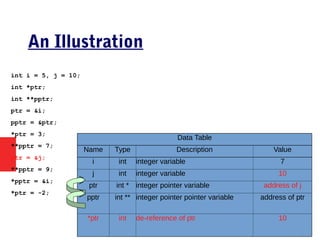
ptr = &j;
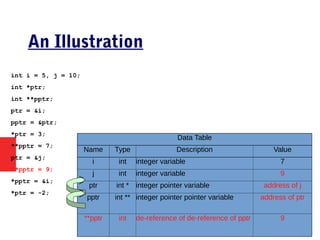
**pptr = 9;
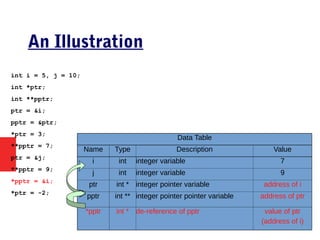
*pptr = &i;
*ptr = -2;
Data Table
Name Type Description Value
i int integer variable 7
j int integer variable 10
ptr int * integer pointer variable address of j
pptr int ** integer pointer pointer variable address of ptr
*ptr int de-reference of ptr 10
An Illustration
int i = 5, j = 10;
int *ptr;
int **pptr;
ptr = &i;
pptr = &ptr;
*ptr = 3;
**pptr = 7;
ptr = &j;
**pptr = 9;
*pptr = &i;
*ptr = -2;
Data Table
Name Type Description Value
i int integer variable 7
j int integer variable 9
ptr int * integer pointer variable address of j
pptr int ** integer pointer pointer variable address of ptr
**pptr int de-reference of de-reference of pptr 9
An Illustration
int i = 5, j = 10;
int *ptr;
int **pptr;
ptr = &i;
pptr = &ptr;
*ptr = 3;
**pptr = 7;
ptr = &j;
**pptr = 9;
*pptr = &i;
*ptr = -2;
Data Table
Name Type Description Value
i int integer variable 7
j int integer variable 9
ptr int * integer pointer variable address of i
pptr int ** integer pointer pointer variable address of ptr
*pptr int * de-reference of pptr value of ptr
(address of i)
An Illustration
int i = 5, j = 10;
int *ptr;
int **pptr;
ptr = &i;
pptr = &ptr;
*ptr = 3;
**pptr = 7;
ptr = &j;
**pptr = 9;
*pptr = &i;
*ptr = -2;
Data Table
Name Type Description Value
i int integer variable -2
j int integer variable 9
ptr int * integer pointer variable address of i
pptr int ** integer pointer pointer variable address of ptr
*ptr int de-reference of ptr -2
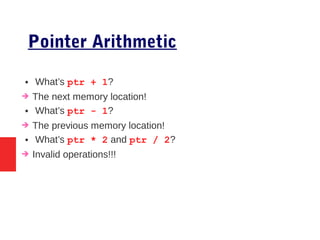
Pointer Arithmetic
● What’s ptr + 1?
 The next memory location!
● What’s ptr - 1?
 The previous memory location!
● What’s ptr * 2 and ptr / 2?
 Invalid operations!!!
Pointers and Arrays
● The concept of array is very similar to the concept of pointer. The
identifier of an array actually a pointer that holds the address of
the first element of the array.
● Therefore if you have two declarations as follows:
– “int a[10];” “int* p;” then the assignment “p = a;” is perfectly valid
– Also “*(a+4)” and “a[4]” are equivalent as are “*(p+4)” and “p[4]” .
– The only difference between the two is that we can change the value
of “p” to any integer variable address whereas “a” will always point to
the integer array of length 10 defined.
Pointer Arithmetic and Array
float a[4];
float *ptr;
ptr = &(a[2]);
*ptr = 3.14;
ptr++;
*ptr = 9.0;
ptr = ptr - 3;
*ptr = 6.0;
ptr += 2;
*ptr = 7.0;
Data Table
Name Type Description Value
a[0] float float array element (variable) ?
a[1] float float array element (variable) ?
a[2] float float array element (variable) ?
a[3] float float array element (variable) ?
ptr float * float pointer variable
*ptr float de-reference of float pointer
variable
?
Pointer Arithmetic and Array
float a[4];
float *ptr;
ptr = &(a[2]);
*ptr = 3.14;
ptr++;
*ptr = 9.0;
ptr = ptr - 3;
*ptr = 6.0;
ptr += 2;
*ptr = 7.0;
Data Table
Name Type Description Value
a[0] float float array element (variable) ?
a[1] float float array element (variable) ?
a[2] float float array element (variable) ?
a[3] float float array element (variable) ?
ptr float * float pointer variable address of a[2]
*ptr float de-reference of float pointer
variable
?
Pointer Arithmetic and Array
float a[4];
float *ptr;
ptr = &(a[2]);
*ptr = 3.14;
ptr++;
*ptr = 9.0;
ptr = ptr - 3;
*ptr = 6.0;
ptr += 2;
*ptr = 7.0;
Data Table
Name Type Description Value
a[0] float float array element (variable) ?
a[1] float float array element (variable) ?
a[2] float float array element (variable) 3.14
a[3] float float array element (variable) ?
ptr float * float pointer variable address of a[2]
*ptr float de-reference of float pointer
variable
3.14
Pointer Arithmetic and Array
float a[4];
float *ptr;
ptr = &(a[2]);
*ptr = 3.14;
ptr++;
*ptr = 9.0;
ptr = ptr - 3;
*ptr = 6.0;
ptr += 2;
*ptr = 7.0;
Data Table
Name Type Description Value
a[0] float float array element (variable) ?
a[1] float float array element (variable) ?
a[2] float float array element (variable) 3.14
a[3] float float array element (variable) ?
ptr float * float pointer variable address of a[3]
*ptr float de-reference of float pointer
variable
?
Pointer Arithmetic and Array
float a[4];
float *ptr;
ptr = &(a[2]);
*ptr = 3.14;
ptr++;
*ptr = 9.0;
ptr = ptr - 3;
*ptr = 6.0;
ptr += 2;
*ptr = 7.0;
Data Table
Name Type Description Value
a[0] float float array element (variable) ?
a[1] float float array element (variable) ?
a[2] float float array element (variable) 3.14
a[3] float float array element (variable) 9.0
ptr float * float pointer variable address of a[3]
*ptr float de-reference of float pointer
variable
9.0
Pointer Arithmetic and Array
float a[4];
float *ptr;
ptr = &(a[2]);
*ptr = 3.14;
ptr++;
*ptr = 9.0;
ptr = ptr - 3;
*ptr = 6.0;
ptr += 2;
*ptr = 7.0;
Data Table
Name Type Description Value
a[0] float float array element (variable) ?
a[1] float float array element (variable) ?
a[2] float float array element (variable) 3.14
a[3] float float array element (variable) 9.0
ptr float * float pointer variable address of a[0]
*ptr float de-reference of float pointer
variable
?
Pointer Arithmetic and Array
float a[4];
float *ptr;
ptr = &(a[2]);
*ptr = 3.14;
ptr++;
*ptr = 9.0;
ptr = ptr - 3;
*ptr = 6.0;
ptr += 2;
*ptr = 7.0;
Data Table
Name Type Description Value
a[0] float float array element (variable) 6.0
a[1] float float array element (variable) ?
a[2] float float array element (variable) 3.14
a[3] float float array element (variable) 9.0
ptr float * float pointer variable address of a[0]
*ptr float de-reference of float pointer
variable
6.0
Pointer Arithmetic and Array
float a[4];
float *ptr;
ptr = &(a[2]);
*ptr = 3.14;
ptr++;
*ptr = 9.0;
ptr = ptr - 3;
*ptr = 6.0;
ptr += 2;
*ptr = 7.0;
Data Table
Name Type Description Value
a[0] float float array element (variable) 6.0
a[1] float float array element (variable) ?
a[2] float float array element (variable) 3.14
a[3] float float array element (variable) 9.0
ptr float * float pointer variable address of a[2]
*ptr float de-reference of float pointer
variable
3.14
Pointer Arithmetic and Array
float a[4];
float *ptr;
ptr = &(a[2]);
*ptr = 3.14;
ptr++;
*ptr = 9.0;
ptr = ptr - 3;
*ptr = 6.0;
ptr += 2;
*ptr = 7.0;
Data Table
Name Type Description Value
a[0] float float array element (variable) 6.0
a[1] float float array element (variable) ?
a[2] float float array element (variable) 7.0
a[3] float float array element (variable) 9.0
ptr float * float pointer variable address of a[2]
*ptr float de-reference of float pointer
variable
7.0
Advice and Precaution
● Pros
– Efficiency
– Convenience
● Cons
– Error-prone
– Difficult to debug
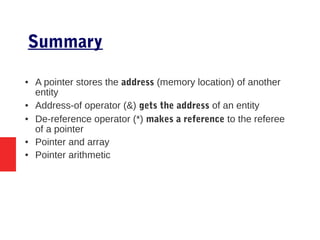
Summary
● A pointer stores the address (memory location) of another
entity
● Address-of operator (&) gets the address of an entity
● De-reference operator (*) makes a reference to the referee
of a pointer
● Pointer and array
● Pointer arithmetic
Thank You !
Query Time

Pointers in c++ by minal

  • 1.
  • 2.
    Topics ➔ Pointers ✔ Memory addresses ✔ Declaration ✔ Dereferencing apointer ✔ Pointers to pointer ✔ Pointer Arithmetic ✔ Pointers and Arrays
  • 3.
    Computer Memory ➔ Each variableis assigned a memory slot (the size depends on the data type) and the variable’s data is stored there Variable a’s value, i.e., 100, is stored at memory location 1024 100100…… …… 10241024 …… Memory address: 1024 1032 int a = 100; …… 1020 a
  • 4.
    Pointers ➔ A pointer isa variable used to store the address of a memory cell. ➔ We can use the pointer to reference this memory cell 100100…… …… 10241024 …… Memory address: 1024 1032 …… 1020 integer pointer
  • 5.
    Pointer Types ➔ Pointer ➢ C++has pointer types for each type of object  Pointers to int objects  Pointers to char objects  Pointers to user-defined objects (e.g., class RationalNumber) ➢ Even pointers to pointers  Pointers to pointers to int objects
  • 6.
    Pointer Variable ➔ Declaration ofPointer variables type* pointer_name; //or type *pointer_name; where type is the type of data pointed to (e.g. int, char, double) Examples: int *n; RationalNumber *r; int **p; // pointer to pointer
  • 7.
    Address Operator & ➔ The"address of " operator (&) gives the memory address of the variable – Usage: &variable_name 100100…… …… …… …… Memory address: 1024 int a = 100; //get the value, cout << a; //prints 100 //get the memory address cout << &a; //prints 1024 …… 1020 a
  • 8.
    Address Operator & 1001008888…… …… …… Memory address: 1024 1032 a …… 1020 b#include <iostream> using namespace std; void main(){ int a, b; a = 88; b = 100; cout << "The address of a is: " << &a << endl; cout << "The address of b is: " << &b << endl; } Result is: The address of a is: 1020 The address of b is: 1024
  • 9.
    ➔ The value ofpointer p is the address of variable a ➔ A pointer is also a variable, so it has its own memory address Pointer Variables 1001008888 …… 10241024 …… Memory address: 1024 1032 …… 1020 a p int a = 100; int *p = &a; cout << a << " " << &a <<endl; cout << p << " " << &p <<endl; Result is: 100 1024 1024 1032
  • 10.
    Dereferencing Operator * ➔ Wecan access to the value stored in the variable pointed to by using the dereferencing operator (*), 1001008888 …… 10241024 …… Memory address: 1024 1032 …… 1020 int a = 100; int *p = &a; cout << a << endl; cout << &a << endl; cout << p << " " << *p << endl; cout << &p << endl; Result is: 100 1024 1024 100 1032 a p
  • 11.
    Don’t get confused ➔ Declaringa pointer means only that it is a pointer: int *p; ➔ Don’t be confused with the dereferencing operator, which is also written with an asterisk (*). They are simply two different tasks represented with the same sign int a = 100, b = 88, c = 8; int *p1 = &a, *p2, *p3 = &c; p2 = &b; // p2 points to b p2 = p1; // p2 points to a b = *p3; //assign c to b *p2 = *p3; //assign c to a cout << a << b << c; Result is: 888
  • 12.
    A Pointer Example Thecode void doubleIt(int x, int * p) { *p = 2 * x; } int main() { int a = 8; doubleIt(a, &a); return 0; } Box diagram Memory Layout 8x p (8200) x (8196) 16a main doubleIt p a (8192) 16 8 8192 main doubleIt a gets 16
  • 13.
    Reference Variables A referenceis an additional name to an existing memory location 9x ref Pointer: 9 x ref Reference: int x=9; int *ref; ref = &x; int x = 9; int &ref = x;
  • 14.
    Reference Variables ➔ Areference variable serves as an alternative name for an object int m = 10; int &j = m; // j is a reference variable cout << “value of m = “ << m << endl; //print 10 j = 18; cout << “value of m = “ << m << endl; // print 18
  • 15.
    Reference Variables ➔ Areference variable always refers to the same object. Assigning a reference variable with a new value actually changes the value of the referred object. ➔ Reference variables are commonly used for parameter passing to a function
  • 16.
    Pointer Usage void IndirectSwap(char*Ptr1, char *Ptr2){ char temp = *Ptr1; *Ptr1 = *Ptr2; *Ptr2 = temp; } int main() { char a = 'y'; char b = 'n'; IndirectSwap(&a, &b); cout << a << b << endl; return 0; }
  • 17.
    Pass by Reference voidIndirectSwap(char& y, char& z) { char temp = y; y = z; z = temp; } int main() { char a = 'y'; char b = 'n'; IndirectSwap(a, b); cout << a << b << endl; return 0; }
  • 18.
    Pointer to Pointer Whatis the output? 58 58 58
  • 19.
    An Illustration int i= 5, j = 10; int *ptr; int **pptr; ptr = &i; pptr = &ptr; *ptr = 3; **pptr = 7; ptr = &j; **pptr = 9; *pptr = &i; *ptr = -2; Data Table Name Type Description Value i int integer variable 5 j int integer variable 10
  • 20.
    int i =5, j = 10; int *ptr; /* declare a pointer-to-integer variable */ int **pptr; ptr = &i; pptr = &ptr; *ptr = 3; **pptr = 7; ptr = &j; **pptr = 9; *pptr = &i; *ptr = -2; Data Table Name Type Description Value i int integer variable 5 j int integer variable 10 ptr int * integer pointer variable An Illustration
  • 21.
    An Illustration int i= 5, j = 10; int *ptr; int **pptr; /* declare a pointer-to-pointer-to-integer variable */ ptr = &i; pptr = &ptr; *ptr = 3; **pptr = 7; ptr = &j; **pptr = 9; *pptr = &i; *ptr = -2; Data Table Name Type Description Value i int integer variable 5 j int integer variable 10 ptr int * integer pointer variable pptr int ** integer pointer pointer variable Double Indirection
  • 22.
    An Illustration int i= 5, j = 10; int *ptr; int **pptr; ptr = &i; /* store address-of i to ptr */ pptr = &ptr; *ptr = 3; **pptr = 7; ptr = &j; **pptr = 9; *pptr = &i; *ptr = -2; Data Table Name Type Description Value i int integer variable 5 j int integer variable 10 ptr int * integer pointer variable address of i pptr int ** integer pointer pointer variable *ptr int de-reference of ptr 5
  • 23.
    An Illustration int i= 5, j = 10; int *ptr; int **pptr; ptr = &i; pptr = &ptr; /* store address-of ptr to pptr */ *ptr = 3; **pptr = 7; ptr = &j; **pptr = 9; *pptr = &i; *ptr = -2; Data Table Name Type Description Value i int integer variable 5 j int integer variable 10 ptr int * integer pointer variable address of i pptr int ** integer pointer pointer variable address of ptr *pptr int * de-reference of pptr value of ptr (address of i)
  • 24.
    An Illustration int i= 5, j = 10; int *ptr; int **pptr; ptr = &i; pptr = &ptr; *ptr = 3; **pptr = 7; ptr = &j; **pptr = 9; *pptr = &i; *ptr = -2; Data Table Name Type Description Value i int integer variable 3 j int integer variable 10 ptr int * integer pointer variable address of i pptr int ** integer pointer pointer variable address of ptr *ptr int de-reference of ptr 3
  • 25.
    An Illustration int i= 5, j = 10; int *ptr; int **pptr; ptr = &i; pptr = &ptr; *ptr = 3; **pptr = 7; ptr = &j; **pptr = 9; *pptr = &i; *ptr = -2; Data Table Name Type Description Value i int integer variable 7 j int integer variable 10 ptr int * integer pointer variable address of i pptr int ** integer pointer pointer variable address of ptr **pptr int de-reference of de-reference of pptr 7
  • 26.
    An Illustration int i= 5, j = 10; int *ptr; int **pptr; ptr = &i; pptr = &ptr; *ptr = 3; **pptr = 7; ptr = &j; **pptr = 9; *pptr = &i; *ptr = -2; Data Table Name Type Description Value i int integer variable 7 j int integer variable 10 ptr int * integer pointer variable address of j pptr int ** integer pointer pointer variable address of ptr *ptr int de-reference of ptr 10
  • 27.
    An Illustration int i= 5, j = 10; int *ptr; int **pptr; ptr = &i; pptr = &ptr; *ptr = 3; **pptr = 7; ptr = &j; **pptr = 9; *pptr = &i; *ptr = -2; Data Table Name Type Description Value i int integer variable 7 j int integer variable 9 ptr int * integer pointer variable address of j pptr int ** integer pointer pointer variable address of ptr **pptr int de-reference of de-reference of pptr 9
  • 28.
    An Illustration int i= 5, j = 10; int *ptr; int **pptr; ptr = &i; pptr = &ptr; *ptr = 3; **pptr = 7; ptr = &j; **pptr = 9; *pptr = &i; *ptr = -2; Data Table Name Type Description Value i int integer variable 7 j int integer variable 9 ptr int * integer pointer variable address of i pptr int ** integer pointer pointer variable address of ptr *pptr int * de-reference of pptr value of ptr (address of i)
  • 29.
    An Illustration int i= 5, j = 10; int *ptr; int **pptr; ptr = &i; pptr = &ptr; *ptr = 3; **pptr = 7; ptr = &j; **pptr = 9; *pptr = &i; *ptr = -2; Data Table Name Type Description Value i int integer variable -2 j int integer variable 9 ptr int * integer pointer variable address of i pptr int ** integer pointer pointer variable address of ptr *ptr int de-reference of ptr -2
  • 30.
    Pointer Arithmetic ● What’sptr + 1?  The next memory location! ● What’s ptr - 1?  The previous memory location! ● What’s ptr * 2 and ptr / 2?  Invalid operations!!!
  • 31.
    Pointers and Arrays ●The concept of array is very similar to the concept of pointer. The identifier of an array actually a pointer that holds the address of the first element of the array. ● Therefore if you have two declarations as follows: – “int a[10];” “int* p;” then the assignment “p = a;” is perfectly valid – Also “*(a+4)” and “a[4]” are equivalent as are “*(p+4)” and “p[4]” . – The only difference between the two is that we can change the value of “p” to any integer variable address whereas “a” will always point to the integer array of length 10 defined.
  • 32.
    Pointer Arithmetic andArray float a[4]; float *ptr; ptr = &(a[2]); *ptr = 3.14; ptr++; *ptr = 9.0; ptr = ptr - 3; *ptr = 6.0; ptr += 2; *ptr = 7.0; Data Table Name Type Description Value a[0] float float array element (variable) ? a[1] float float array element (variable) ? a[2] float float array element (variable) ? a[3] float float array element (variable) ? ptr float * float pointer variable *ptr float de-reference of float pointer variable ?
  • 33.
    Pointer Arithmetic andArray float a[4]; float *ptr; ptr = &(a[2]); *ptr = 3.14; ptr++; *ptr = 9.0; ptr = ptr - 3; *ptr = 6.0; ptr += 2; *ptr = 7.0; Data Table Name Type Description Value a[0] float float array element (variable) ? a[1] float float array element (variable) ? a[2] float float array element (variable) ? a[3] float float array element (variable) ? ptr float * float pointer variable address of a[2] *ptr float de-reference of float pointer variable ?
  • 34.
    Pointer Arithmetic andArray float a[4]; float *ptr; ptr = &(a[2]); *ptr = 3.14; ptr++; *ptr = 9.0; ptr = ptr - 3; *ptr = 6.0; ptr += 2; *ptr = 7.0; Data Table Name Type Description Value a[0] float float array element (variable) ? a[1] float float array element (variable) ? a[2] float float array element (variable) 3.14 a[3] float float array element (variable) ? ptr float * float pointer variable address of a[2] *ptr float de-reference of float pointer variable 3.14
  • 35.
    Pointer Arithmetic andArray float a[4]; float *ptr; ptr = &(a[2]); *ptr = 3.14; ptr++; *ptr = 9.0; ptr = ptr - 3; *ptr = 6.0; ptr += 2; *ptr = 7.0; Data Table Name Type Description Value a[0] float float array element (variable) ? a[1] float float array element (variable) ? a[2] float float array element (variable) 3.14 a[3] float float array element (variable) ? ptr float * float pointer variable address of a[3] *ptr float de-reference of float pointer variable ?
  • 36.
    Pointer Arithmetic andArray float a[4]; float *ptr; ptr = &(a[2]); *ptr = 3.14; ptr++; *ptr = 9.0; ptr = ptr - 3; *ptr = 6.0; ptr += 2; *ptr = 7.0; Data Table Name Type Description Value a[0] float float array element (variable) ? a[1] float float array element (variable) ? a[2] float float array element (variable) 3.14 a[3] float float array element (variable) 9.0 ptr float * float pointer variable address of a[3] *ptr float de-reference of float pointer variable 9.0
  • 37.
    Pointer Arithmetic andArray float a[4]; float *ptr; ptr = &(a[2]); *ptr = 3.14; ptr++; *ptr = 9.0; ptr = ptr - 3; *ptr = 6.0; ptr += 2; *ptr = 7.0; Data Table Name Type Description Value a[0] float float array element (variable) ? a[1] float float array element (variable) ? a[2] float float array element (variable) 3.14 a[3] float float array element (variable) 9.0 ptr float * float pointer variable address of a[0] *ptr float de-reference of float pointer variable ?
  • 38.
    Pointer Arithmetic andArray float a[4]; float *ptr; ptr = &(a[2]); *ptr = 3.14; ptr++; *ptr = 9.0; ptr = ptr - 3; *ptr = 6.0; ptr += 2; *ptr = 7.0; Data Table Name Type Description Value a[0] float float array element (variable) 6.0 a[1] float float array element (variable) ? a[2] float float array element (variable) 3.14 a[3] float float array element (variable) 9.0 ptr float * float pointer variable address of a[0] *ptr float de-reference of float pointer variable 6.0
  • 39.
    Pointer Arithmetic andArray float a[4]; float *ptr; ptr = &(a[2]); *ptr = 3.14; ptr++; *ptr = 9.0; ptr = ptr - 3; *ptr = 6.0; ptr += 2; *ptr = 7.0; Data Table Name Type Description Value a[0] float float array element (variable) 6.0 a[1] float float array element (variable) ? a[2] float float array element (variable) 3.14 a[3] float float array element (variable) 9.0 ptr float * float pointer variable address of a[2] *ptr float de-reference of float pointer variable 3.14
  • 40.
    Pointer Arithmetic andArray float a[4]; float *ptr; ptr = &(a[2]); *ptr = 3.14; ptr++; *ptr = 9.0; ptr = ptr - 3; *ptr = 6.0; ptr += 2; *ptr = 7.0; Data Table Name Type Description Value a[0] float float array element (variable) 6.0 a[1] float float array element (variable) ? a[2] float float array element (variable) 7.0 a[3] float float array element (variable) 9.0 ptr float * float pointer variable address of a[2] *ptr float de-reference of float pointer variable 7.0
  • 41.
    Advice and Precaution ●Pros – Efficiency – Convenience ● Cons – Error-prone – Difficult to debug
  • 42.
    Summary ● A pointerstores the address (memory location) of another entity ● Address-of operator (&) gets the address of an entity ● De-reference operator (*) makes a reference to the referee of a pointer ● Pointer and array ● Pointer arithmetic
  • 43.

Editor's Notes

  • #13 &amp;lt;number&amp;gt; Note the signature of main() – it’s an array parameter. And, like other examples we’ve given, it takes the number of elements as a parameter. Why?
  • #14 &amp;lt;number&amp;gt; References fix some of those pointer problems. If we wanted something called “ref” to point to a variable x, we’d declare a pointer variable and assign the address of x into it. With references, we’d attach an additional name – ref – to the same memory location as x. Note how the pointer necessitates an extra variable, whereas the reference didn’t