Prose 
By: Jasmin Diwata Pascual
Prose 
• The essay is a short literary composition in 
prose dealing with a single matter usually 
from a personal point of view. Thus, it is 
revelatory of the author’s state , opinions, 
prejudices, moods, and , in general, his 
personality. 
• Essays may either be formal or informal but 
there are more specific subdivisions
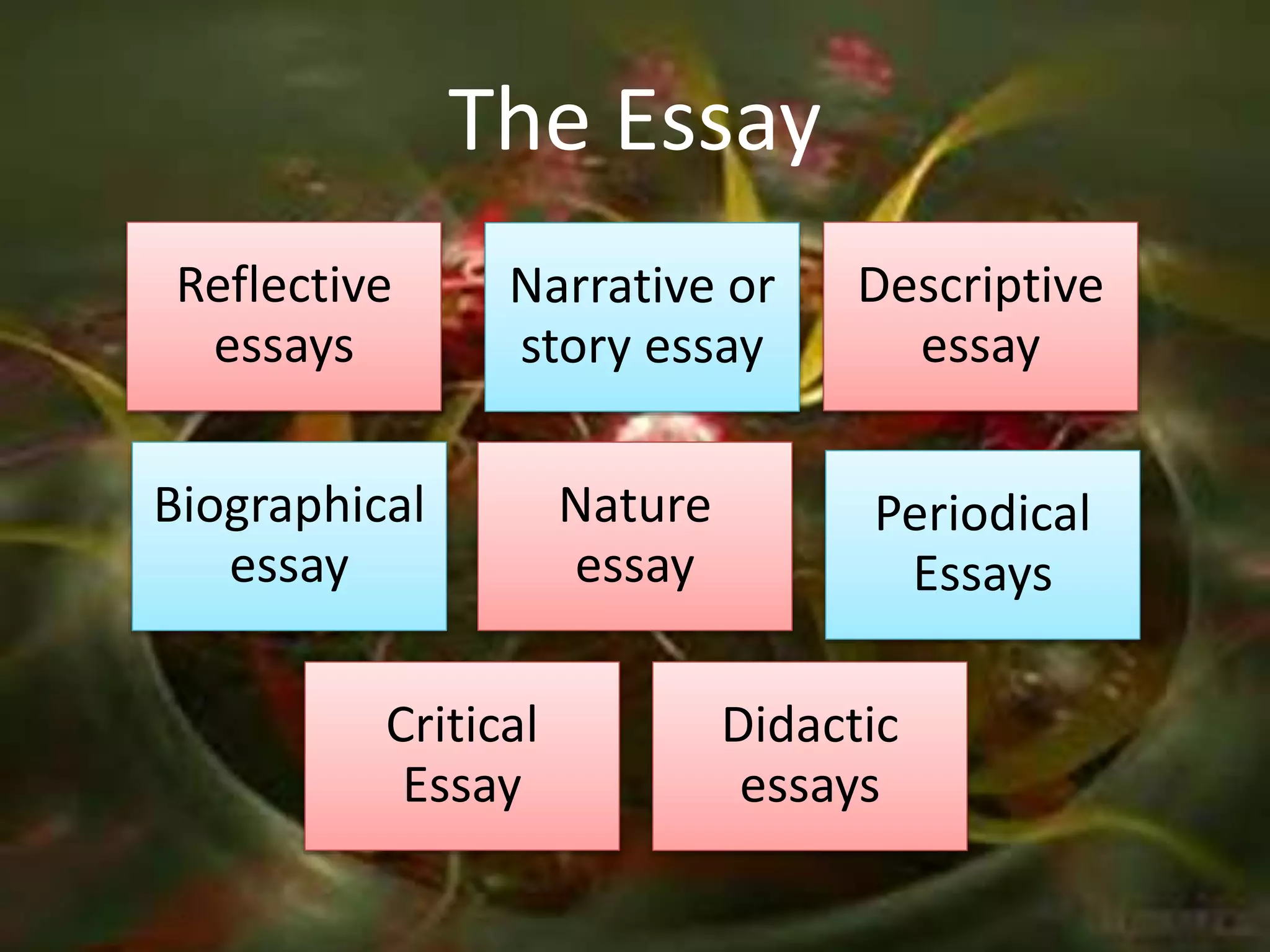
The Essay 
Reflective 
essays 
Narrative or 
story essay 
Descriptive 
essay 
Biographical 
essay 
Nature 
essay 
Periodical 
Essays 
Critical 
Essay 
Didactic 
essays
• Reflective Essays are serious 
and dignified and usually employ 
aphorisms, i.e., wisdom couched 
in memorable sentences.
• Narrative or story essay make 
use of an incident to illustrate an 
idea or a theme.
• Descriptive essay has some narrative 
elements as well as color, vividness, 
and realistic portrayals.
• Biographical essay sketches life or 
presents character analysis.
• Nature essay attempts to picture the 
world of God’s creation and may do so in 
a graphic, pictorial vein or a more 
thoughtful, philosophical manner.
• Critical Essay includes biographical 
criticism, literary criticism, and book 
reviews. It is a record of an analytical 
mind weighing the virtues and faults 
of a literary piece, for instance, 
which it fully understands.
• Periodical essays are generally 
published in periodicals, hence, they 
are also called journalistic.
• Didactic essays enforce a moral and, 
therefore, the tone is serious and 
didactic (instructive).
Fiction 
• Is a literary production of man’s 
imagination finding shape in 
stories of people or events.
Types of Fiction 
• Prose Allegory is a prose form in which 
the characters, ideas, and actions stand 
for something else or for a system of 
ideas with meaning implied. Concrete 
characters are personifications of 
abstract ideas.
Example of Prose Allegory 
• > Fable is a short allegorical tale conveying a 
moral or principle of behavior. The characters 
are usually animals talking like human beings 
but keeping their animals traits. Often, the 
moral is appended in the form of a proverb in 
the form of a proverb.
> Myths are traditional tales common 
to the members of a tribe,race,or 
nation usually involving the 
supernatural and serving to explain 
natural phenomena or suggest a 
religious or moral truth.
> Legends are stories of some wonderful 
events popularly believed to have some 
historical basis and passed down through 
the ages.
Prose romances 
• Prose romances are types of stories 
in which some supernatural or 
magical events , fantastic, and 
unrealistic, occur.
Example of Prose Romances 
> Fairy Tales, which make use of folklore motifs, 
commonplace expressions, and typical themes 
are those which develop from stock characters 
such as cruel king, cruel stephmother,naughty 
sister, substituted bride , magic, supernatural 
changes, and restorations.
> Fairy tales, once the strange element 
in the situation is accepted, fairy tales 
assume a reality of their own .Virtue is 
rewarded and fairy tales always end 
happily.
• Folk tales are part of folklore (traditions 
transmitted through memory and 
practice rather than by the printage 
page.)
• A folk tales easily pass from language 
and spread all over the world; hence 
they are sometimes called “ 
migratory tales.“.
Prose satires 
• Are stories in which human vices and 
follies are held up to ridicule.
Example of Prose satires 
> Fabliau (Plural: Fabliaux) is a short, amusing 
tale often bawdy or obscene, cynically and slyly 
satirical directed against women, the clergy, and 
marriage. The humor arises from the plot, an 
intrigue, or practical joke told in a rapid 
succession of events that form a single episode. 
Among standard characters are the jealous, 
stupid husband, the braggart, and the unfaithful 
wife. Boccaccio’s Decameron contains brilliant 
illustrations of this type.
Novels 
• Are prose narratives on a large scale (book length) and 
can be divided into three types, fantasy,love,and 
adventure novels. They are further broken down into 
such varieties as: 
• Epistolary detective religious 
• Picaresque science-fiction sociological 
• Gothic naturalistic romantic 
• Utopian psychological sentimental 
• Western stream-of- consciousness surrealistic 
The novel is a dominant literary form at present, both in 
quality and quantity.
Short story 
• Is a prose narrative of limited length which 
must have characterization,unity,cumulative 
interest, climax, and a resolution. 
• In a less exclusive sense, short stories should 
include the earliest forms of short narratives-stories 
of gods and demons, 
anecdotes,fables,mythical tales, lives of saints 
(hagiography),parables, and folk tales.
Novelettes 
• Are prose narratives that are intermediate 
between the short story and the novels. 
• It is about 50 to 150 ordinary pages long, but 
no exact limits can be given as to length. It is 
more elaborate than a short story but can be 
read in a single sitting and can produce a 
single, concentrated effect. Hemingway’s The 
Old Man and the Sea (1952) is an excellent 
example of a novelette
Prose drama 
• is a literary work written in dialogue and 
intended for presentation by actors. The 
essence of drama is the make –believe by 
which an actor impersonates a character of 
the play. Dramas of any period have their 
different sets of conventions and the playgoer 
must be conscious of them. The same 
divisions under poetic plays apply to prose 
drama:
Examples of Prose Drama 
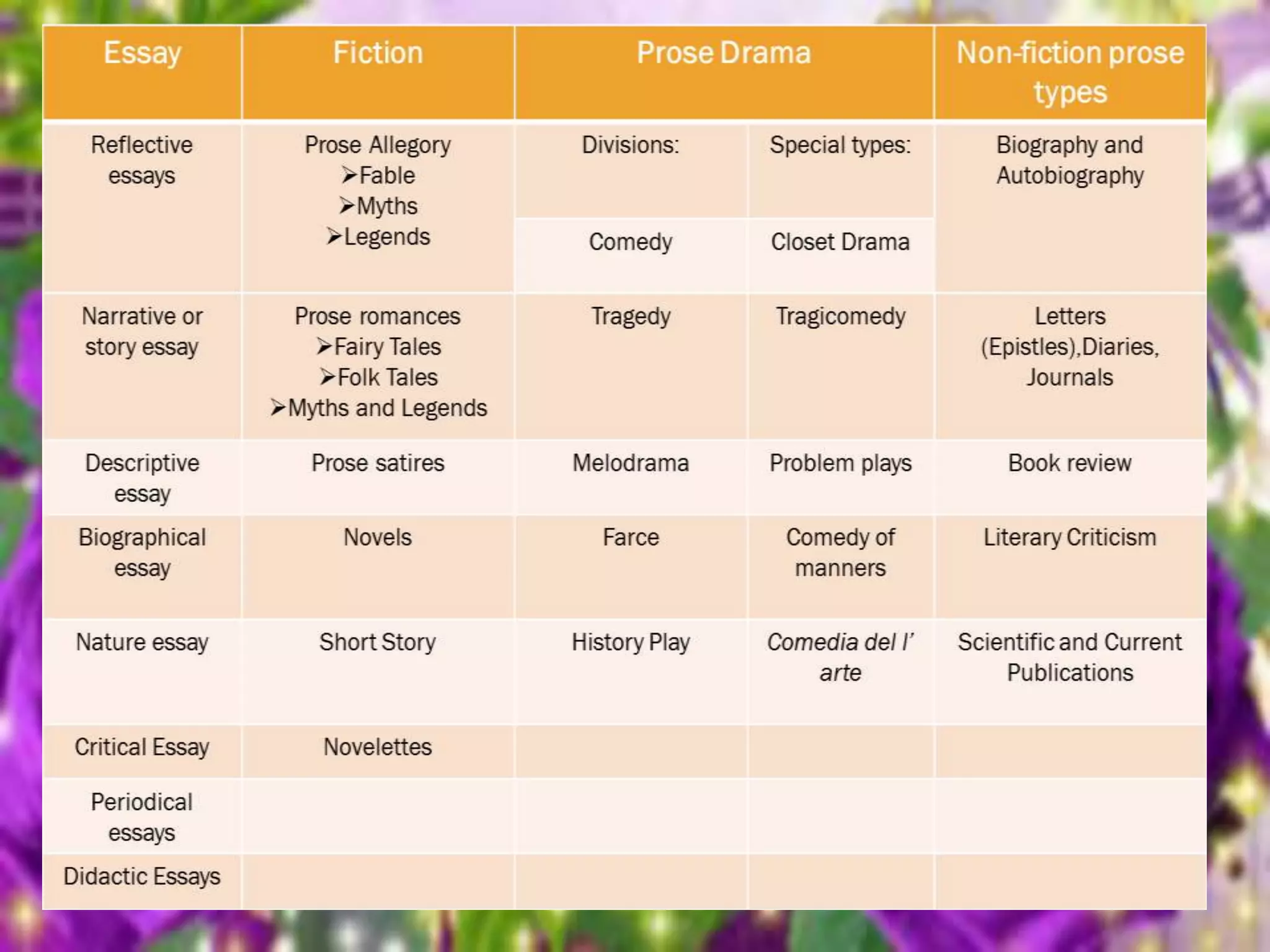
Comedy 
Tragedy 
Melodrama 
Farce 
 History 
Special Types: 
Closet Drama 
Tragicomedy 
Problem Plays 
Comedy of manners 
Comedia del l’ arte
Special types of prose drama 
• Closet drama which , though written 
in dramatic form, is intended for 
private reading rather than stage 
performance
• Tragicomedy is a combination of the 
elements of tragedy and comedy
• Problem plays are neither comedies nor 
tragedies but deal with middle –class life 
problems.
• Comedy of manners is a type of play 
which satirizes the extreme of 
fashion and manners- the acquire 
follies of a highly sophisticated 
society.
• Comedia de l’ arte was a type of comedy 
developed in 16th –century Italy and its 
essential characteristics was that it was based 
on a ploy (scenario) outlined in advance, but 
the dialogue was improvised during 
performance. Characters who wore masks 
were stock types as the silly old man, the 
pedant, the lover,etc.
Non – fiction prose types: 
Biography and Autobiography 
Letters (Epistles), Diaries, Journals 
Book review 
Literary Criticism 
Scientific and Current Publications
PROSE. jdfp

PROSE. jdfp

  • 1.
    Prose By: JasminDiwata Pascual
  • 2.
    Prose • Theessay is a short literary composition in prose dealing with a single matter usually from a personal point of view. Thus, it is revelatory of the author’s state , opinions, prejudices, moods, and , in general, his personality. • Essays may either be formal or informal but there are more specific subdivisions
  • 4.
    The Essay Reflective essays Narrative or story essay Descriptive essay Biographical essay Nature essay Periodical Essays Critical Essay Didactic essays
  • 5.
    • Reflective Essaysare serious and dignified and usually employ aphorisms, i.e., wisdom couched in memorable sentences.
  • 6.
    • Narrative orstory essay make use of an incident to illustrate an idea or a theme.
  • 7.
    • Descriptive essayhas some narrative elements as well as color, vividness, and realistic portrayals.
  • 8.
    • Biographical essaysketches life or presents character analysis.
  • 9.
    • Nature essayattempts to picture the world of God’s creation and may do so in a graphic, pictorial vein or a more thoughtful, philosophical manner.
  • 10.
    • Critical Essayincludes biographical criticism, literary criticism, and book reviews. It is a record of an analytical mind weighing the virtues and faults of a literary piece, for instance, which it fully understands.
  • 11.
    • Periodical essaysare generally published in periodicals, hence, they are also called journalistic.
  • 12.
    • Didactic essaysenforce a moral and, therefore, the tone is serious and didactic (instructive).
  • 13.
    Fiction • Isa literary production of man’s imagination finding shape in stories of people or events.
  • 14.
    Types of Fiction • Prose Allegory is a prose form in which the characters, ideas, and actions stand for something else or for a system of ideas with meaning implied. Concrete characters are personifications of abstract ideas.
  • 15.
    Example of ProseAllegory • > Fable is a short allegorical tale conveying a moral or principle of behavior. The characters are usually animals talking like human beings but keeping their animals traits. Often, the moral is appended in the form of a proverb in the form of a proverb.
  • 16.
    > Myths aretraditional tales common to the members of a tribe,race,or nation usually involving the supernatural and serving to explain natural phenomena or suggest a religious or moral truth.
  • 17.
    > Legends arestories of some wonderful events popularly believed to have some historical basis and passed down through the ages.
  • 18.
    Prose romances •Prose romances are types of stories in which some supernatural or magical events , fantastic, and unrealistic, occur.
  • 19.
    Example of ProseRomances > Fairy Tales, which make use of folklore motifs, commonplace expressions, and typical themes are those which develop from stock characters such as cruel king, cruel stephmother,naughty sister, substituted bride , magic, supernatural changes, and restorations.
  • 20.
    > Fairy tales,once the strange element in the situation is accepted, fairy tales assume a reality of their own .Virtue is rewarded and fairy tales always end happily.
  • 21.
    • Folk talesare part of folklore (traditions transmitted through memory and practice rather than by the printage page.)
  • 22.
    • A folktales easily pass from language and spread all over the world; hence they are sometimes called “ migratory tales.“.
  • 23.
    Prose satires •Are stories in which human vices and follies are held up to ridicule.
  • 24.
    Example of Prosesatires > Fabliau (Plural: Fabliaux) is a short, amusing tale often bawdy or obscene, cynically and slyly satirical directed against women, the clergy, and marriage. The humor arises from the plot, an intrigue, or practical joke told in a rapid succession of events that form a single episode. Among standard characters are the jealous, stupid husband, the braggart, and the unfaithful wife. Boccaccio’s Decameron contains brilliant illustrations of this type.
  • 25.
    Novels • Areprose narratives on a large scale (book length) and can be divided into three types, fantasy,love,and adventure novels. They are further broken down into such varieties as: • Epistolary detective religious • Picaresque science-fiction sociological • Gothic naturalistic romantic • Utopian psychological sentimental • Western stream-of- consciousness surrealistic The novel is a dominant literary form at present, both in quality and quantity.
  • 26.
    Short story •Is a prose narrative of limited length which must have characterization,unity,cumulative interest, climax, and a resolution. • In a less exclusive sense, short stories should include the earliest forms of short narratives-stories of gods and demons, anecdotes,fables,mythical tales, lives of saints (hagiography),parables, and folk tales.
  • 27.
    Novelettes • Areprose narratives that are intermediate between the short story and the novels. • It is about 50 to 150 ordinary pages long, but no exact limits can be given as to length. It is more elaborate than a short story but can be read in a single sitting and can produce a single, concentrated effect. Hemingway’s The Old Man and the Sea (1952) is an excellent example of a novelette
  • 28.
    Prose drama •is a literary work written in dialogue and intended for presentation by actors. The essence of drama is the make –believe by which an actor impersonates a character of the play. Dramas of any period have their different sets of conventions and the playgoer must be conscious of them. The same divisions under poetic plays apply to prose drama:
  • 29.
    Examples of ProseDrama Comedy Tragedy Melodrama Farce  History Special Types: Closet Drama Tragicomedy Problem Plays Comedy of manners Comedia del l’ arte
  • 30.
    Special types ofprose drama • Closet drama which , though written in dramatic form, is intended for private reading rather than stage performance
  • 31.
    • Tragicomedy isa combination of the elements of tragedy and comedy
  • 32.
    • Problem playsare neither comedies nor tragedies but deal with middle –class life problems.
  • 33.
    • Comedy ofmanners is a type of play which satirizes the extreme of fashion and manners- the acquire follies of a highly sophisticated society.
  • 34.
    • Comedia del’ arte was a type of comedy developed in 16th –century Italy and its essential characteristics was that it was based on a ploy (scenario) outlined in advance, but the dialogue was improvised during performance. Characters who wore masks were stock types as the silly old man, the pedant, the lover,etc.
  • 35.
    Non – fictionprose types: Biography and Autobiography Letters (Epistles), Diaries, Journals Book review Literary Criticism Scientific and Current Publications