The technique behind the words
Recognizing Figurative Language
The opposite of literal language is figurative language.
Figurative language is language that means more than
what it says on the surface.
It usually gives us a feeling about its subject.
Poets use figurative language almost as frequently as
literal language. When you read poetry, you must be
conscious of the difference. Otherwise, a poem may
make no sense at all.
Recognizing Literal Language
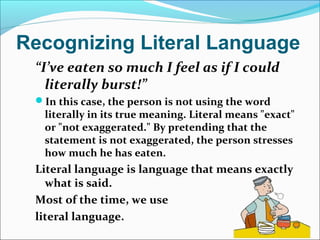
“I’ve eaten so much I feel as if I could
literally burst!”
In this case, the person is not using the word
literally in its true meaning. Literal means "exact"
or "not exaggerated." By pretending that the
statement is not exaggerated, the person stresses
how much he has eaten.
Literal language is language that means exactly
what is said.
Most of the time, we use
literal language.
What is figurative language?
Whenever you describe something by
comparing it with something else,
you are using figurative language.
Types of Figurative Language
Imagery
Simile
Metaphor
Alliteration
Personification
Onomatopoeia
Hyperbole
Idioms
Imagery
Language that appeals to the senses.
Descriptions of people or objects stated
in terms of our senses in the reader’s
mind.
• Sight
• Hearing
• Touch
• Taste
• Smell
sight: the rose is bright red
hearing: it sounds like the chirping of
several birds, with their high voices.
smell: the air smells like going to the
countryside. fresh and green. no smell
of smoke but the fresh waters and the
leaves.
touch: it feels bumpy yet gives off a
welcoming warmth
taste: it tastes sweet yet spicy at once,
with a tinge of orange taste.
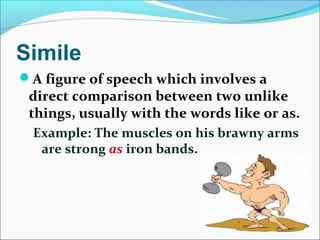
Simile
A figure of speech which involves a
direct comparison between two unlike
things, usually with the words like or as.
Example: The muscles on his brawny arms
are strong as iron bands.
Metaphor
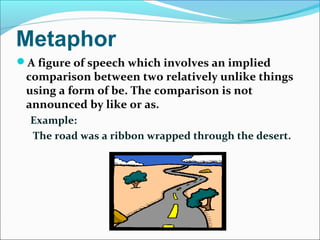
A figure of speech which involves an implied
comparison between two relatively unlike things
using a form of be. The comparison is not
announced by like or as.
Example:
The road was a ribbon wrapped through the desert.
AlliterationRepeated consonant sounds occurring at the
beginning of words or within words.
Example:
1. She was wide-eyed and wondering while
she waited for Walter to waken.
2. She sells seashells by the seashore'.
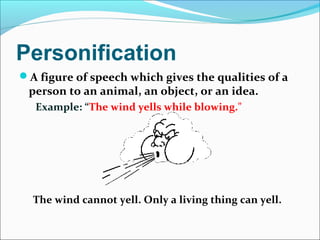
Personification
A figure of speech which gives the qualities of a
person to an animal, an object, or an idea.
Example: “The wind yells while blowing."
The wind cannot yell. Only a living thing can yell.
Hyperbole
An exaggerated statement used to
heighten effect. It is not used to mislead
the reader, but to emphasize a point.
Example: She’s said so on several million
occasions.
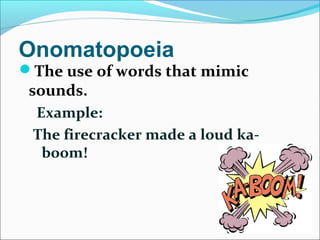
Onomatopoeia
The use of words that mimic
sounds.
Example:
The firecracker made a loud ka-
boom!
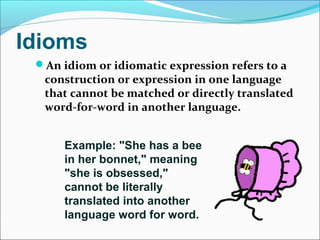
Idioms
An idiom or idiomatic expression refers to a
construction or expression in one language
that cannot be matched or directly translated
word-for-word in another language.
Example: "She has a bee
in her bonnet," meaning
"she is obsessed,"
cannot be literally
translated into another
language word for word.
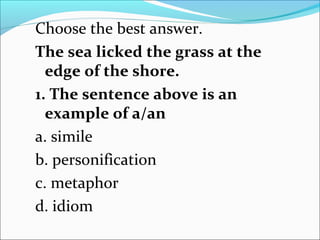
Choose the best answer.
The sea licked the grass at the
edge of the shore.
1. The sentence above is an
example of a/an
a. simile
b. personification
c. metaphor
d. idiom
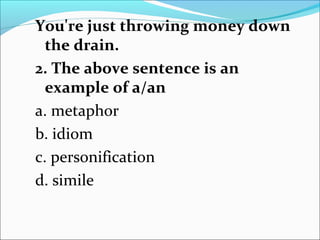
You're just throwing money down
the drain.
2. The above sentence is an
example of a/an
a. metaphor
b. idiom
c. personification
d. simile
These walls have ears.
3. The sentence above is an example
of a/an
a. simile
b. personification
c. metaphor
d. idiom
His room was a junk pile.
4. The sentence above is an
example of a/an
a. simile
b. metaphor
c. personification
d. idiom
The train was an angry animal
roaring down the tracks.
5. The above sentence is an example
of a/an
a. metaphor
b. simile
c. idiom
d. personification
The mother is a tigress in
defending her children.
6. The above sentence is an
example of a/an
a. idiom
b. metaphor
c. simile
d. personification
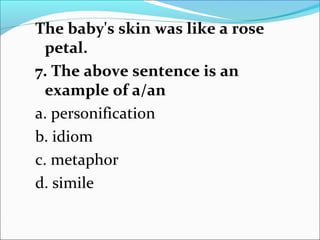
The baby's skin was like a rose
petal.
7. The above sentence is an
example of a/an
a. personification
b. idiom
c. metaphor
d. simile
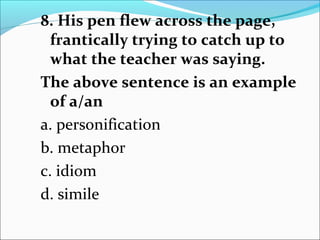
8. His pen flew across the page,
frantically trying to catch up to
what the teacher was saying.
The above sentence is an example
of a/an
a. personification
b. metaphor
c. idiom
d. simile
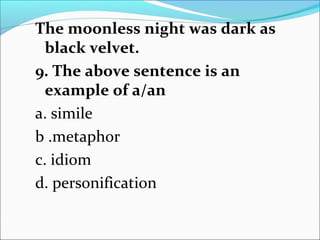
The moonless night was dark as
black velvet.
9. The above sentence is an
example of a/an
a. simile
b .metaphor
c. idiom
d. personification
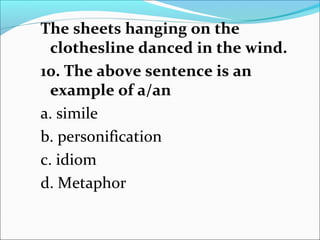
The sheets hanging on the
clothesline danced in the wind.
10. The above sentence is an
example of a/an
a. simile
b. personification
c. idiom
d. Metaphor
The hungry waves grabbed our
sand castle and pulled it into the
foamy sea.
11. The above sentence is an
example of a/an
a. idiom
b. simile
c. metaphor
d. personification
The bacon was sizzling in the frying
pan.
12. The above sentence is an example
of a/an
a. personification
b. hyperbole
c. onomatopoeia
d. Metaphor
Some students would rather eat
dirt and die than have to sit down
and read a book.
13. The above sentence is an
example of a/an
a. onomatopoeia
b. hyperbole
c. idiom
d. personification
Jovial Jake joined Judy for juice.
14. The above sentence is an
example of a/an
a. onomatopoeia
b. hyperbole
c. personification
d. alliteration
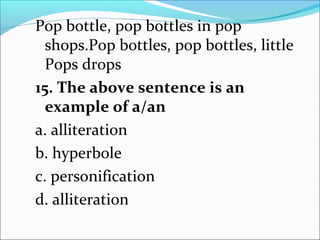
Pop bottle, pop bottles in pop
shops.Pop bottles, pop bottles, little
Pops drops
15. The above sentence is an
example of a/an
a. alliteration
b. hyperbole
c. personification
d. alliteration
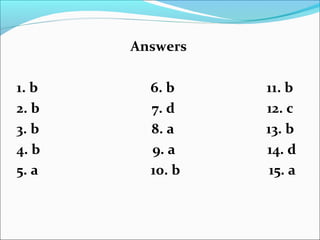
Answers
1. b 6. b 11. b
2. b 7. d 12. c
3. b 8. a 13. b
4. b 9. a 14. d
5. a 10. b 15. a
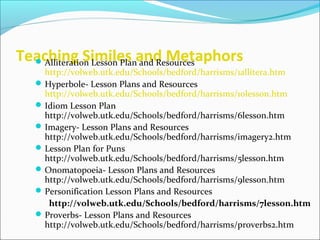
Teaching Similes and MetaphorsAlliteration Lesson Plan and Resources
http://volweb.utk.edu/Schools/bedford/harrisms/1allitera.htm
Hyperbole- Lesson Plans and Resources
http://volweb.utk.edu/Schools/bedford/harrisms/10lesson.htm
Idiom Lesson Plan
http://volweb.utk.edu/Schools/bedford/harrisms/6lesson.htm
Imagery- Lesson Plans and Resources
http://volweb.utk.edu/Schools/bedford/harrisms/imagery2.htm
Lesson Plan for Puns
http://volweb.utk.edu/Schools/bedford/harrisms/5lesson.htm
Onomatopoeia- Lesson Plans and Resources
http://volweb.utk.edu/Schools/bedford/harrisms/9lesson.htm
Personification Lesson Plans and Resources
http://volweb.utk.edu/Schools/bedford/harrisms/7lesson.htm
Proverbs- Lesson Plans and Resources
http://volweb.utk.edu/Schools/bedford/harrisms/proverbs2.htm

Poetic devices

  • 1.
  • 2.
    Recognizing Figurative Language Theopposite of literal language is figurative language. Figurative language is language that means more than what it says on the surface. It usually gives us a feeling about its subject. Poets use figurative language almost as frequently as literal language. When you read poetry, you must be conscious of the difference. Otherwise, a poem may make no sense at all.
  • 3.
    Recognizing Literal Language “I’veeaten so much I feel as if I could literally burst!” In this case, the person is not using the word literally in its true meaning. Literal means "exact" or "not exaggerated." By pretending that the statement is not exaggerated, the person stresses how much he has eaten. Literal language is language that means exactly what is said. Most of the time, we use literal language.
  • 4.
    What is figurativelanguage? Whenever you describe something by comparing it with something else, you are using figurative language.
  • 5.
    Types of FigurativeLanguage Imagery Simile Metaphor Alliteration Personification Onomatopoeia Hyperbole Idioms
  • 6.
    Imagery Language that appealsto the senses. Descriptions of people or objects stated in terms of our senses in the reader’s mind. • Sight • Hearing • Touch • Taste • Smell
  • 7.
    sight: the roseis bright red hearing: it sounds like the chirping of several birds, with their high voices. smell: the air smells like going to the countryside. fresh and green. no smell of smoke but the fresh waters and the leaves. touch: it feels bumpy yet gives off a welcoming warmth taste: it tastes sweet yet spicy at once, with a tinge of orange taste.
  • 8.
    Simile A figure ofspeech which involves a direct comparison between two unlike things, usually with the words like or as. Example: The muscles on his brawny arms are strong as iron bands.
  • 9.
    Metaphor A figure ofspeech which involves an implied comparison between two relatively unlike things using a form of be. The comparison is not announced by like or as. Example: The road was a ribbon wrapped through the desert.
  • 10.
    AlliterationRepeated consonant soundsoccurring at the beginning of words or within words. Example: 1. She was wide-eyed and wondering while she waited for Walter to waken. 2. She sells seashells by the seashore'.
  • 11.
    Personification A figure ofspeech which gives the qualities of a person to an animal, an object, or an idea. Example: “The wind yells while blowing." The wind cannot yell. Only a living thing can yell.
  • 12.
    Hyperbole An exaggerated statementused to heighten effect. It is not used to mislead the reader, but to emphasize a point. Example: She’s said so on several million occasions.
  • 13.
    Onomatopoeia The use ofwords that mimic sounds. Example: The firecracker made a loud ka- boom!
  • 14.
    Idioms An idiom oridiomatic expression refers to a construction or expression in one language that cannot be matched or directly translated word-for-word in another language. Example: "She has a bee in her bonnet," meaning "she is obsessed," cannot be literally translated into another language word for word.
  • 15.
    Choose the bestanswer. The sea licked the grass at the edge of the shore. 1. The sentence above is an example of a/an a. simile b. personification c. metaphor d. idiom
  • 16.
    You're just throwingmoney down the drain. 2. The above sentence is an example of a/an a. metaphor b. idiom c. personification d. simile
  • 17.
    These walls haveears. 3. The sentence above is an example of a/an a. simile b. personification c. metaphor d. idiom
  • 18.
    His room wasa junk pile. 4. The sentence above is an example of a/an a. simile b. metaphor c. personification d. idiom
  • 19.
    The train wasan angry animal roaring down the tracks. 5. The above sentence is an example of a/an a. metaphor b. simile c. idiom d. personification
  • 20.
    The mother isa tigress in defending her children. 6. The above sentence is an example of a/an a. idiom b. metaphor c. simile d. personification
  • 21.
    The baby's skinwas like a rose petal. 7. The above sentence is an example of a/an a. personification b. idiom c. metaphor d. simile
  • 22.
    8. His penflew across the page, frantically trying to catch up to what the teacher was saying. The above sentence is an example of a/an a. personification b. metaphor c. idiom d. simile
  • 23.
    The moonless nightwas dark as black velvet. 9. The above sentence is an example of a/an a. simile b .metaphor c. idiom d. personification
  • 24.
    The sheets hangingon the clothesline danced in the wind. 10. The above sentence is an example of a/an a. simile b. personification c. idiom d. Metaphor
  • 25.
    The hungry wavesgrabbed our sand castle and pulled it into the foamy sea. 11. The above sentence is an example of a/an a. idiom b. simile c. metaphor d. personification
  • 26.
    The bacon wassizzling in the frying pan. 12. The above sentence is an example of a/an a. personification b. hyperbole c. onomatopoeia d. Metaphor
  • 27.
    Some students wouldrather eat dirt and die than have to sit down and read a book. 13. The above sentence is an example of a/an a. onomatopoeia b. hyperbole c. idiom d. personification
  • 28.
    Jovial Jake joinedJudy for juice. 14. The above sentence is an example of a/an a. onomatopoeia b. hyperbole c. personification d. alliteration
  • 29.
    Pop bottle, popbottles in pop shops.Pop bottles, pop bottles, little Pops drops 15. The above sentence is an example of a/an a. alliteration b. hyperbole c. personification d. alliteration
  • 30.
    Answers 1. b 6.b 11. b 2. b 7. d 12. c 3. b 8. a 13. b 4. b 9. a 14. d 5. a 10. b 15. a
  • 31.
    Teaching Similes andMetaphorsAlliteration Lesson Plan and Resources http://volweb.utk.edu/Schools/bedford/harrisms/1allitera.htm Hyperbole- Lesson Plans and Resources http://volweb.utk.edu/Schools/bedford/harrisms/10lesson.htm Idiom Lesson Plan http://volweb.utk.edu/Schools/bedford/harrisms/6lesson.htm Imagery- Lesson Plans and Resources http://volweb.utk.edu/Schools/bedford/harrisms/imagery2.htm Lesson Plan for Puns http://volweb.utk.edu/Schools/bedford/harrisms/5lesson.htm Onomatopoeia- Lesson Plans and Resources http://volweb.utk.edu/Schools/bedford/harrisms/9lesson.htm Personification Lesson Plans and Resources http://volweb.utk.edu/Schools/bedford/harrisms/7lesson.htm Proverbs- Lesson Plans and Resources http://volweb.utk.edu/Schools/bedford/harrisms/proverbs2.htm