By Isaac Scerri
WALT. Understand and use persuasive devices using
                                   deep thinking
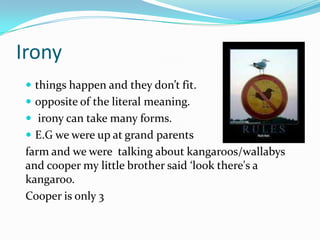
Irony
  things happen and they don’t fit.
  opposite of the literal meaning.
  irony can take many forms.
  E.G we were up at grand parents
 farm and we were talking about kangaroos/wallabys
 and cooper my little brother said ‘look there's a
 kangaroo.
 Cooper is only 3
Hyperbole/Exaggeration
 Hyperbole means the same as exaggeration and is used
  to provoke strong feelings to the audience.
 Exaggeration is used to make things seem really
  important even though it can be a simple matter.
Cliché
 A phrase that has been used heaps and everyone
  knows it.
 An expression, often a figure of speech whose
  effectiveness has been worn out through overuse and
  excessive familiarity.
 What goes up must come down.
Satire
 The use of irony, sarcasm or the like, in exposing,
  denouncing, or deriding vice, folly, etc.
Repetition
 Repetition is when something repeats itself and gets
  stuck in your head like a catchy phrase.
 Repetition can be like there's ads that come on all the
  time. E.G. spam spam spam o lovely spam o wonderful
  spam.
Rhetorical Language
 1. Rhetorical question

 Can we really expect the school to keep paying from its limited resources?

 2. Emotive language

 Imagine being cast out into the street, cold, lonely and frightened.

 3. Parallel structures

 To show kindness is praiseworthy; to show hatred is evil.

 4. Sound patterns

 Alliteration: Callous, calculating cruelty – is this what we must expect?
Rhetorical Language continued
 5. Contrast
 Sometimes we have to be cruel to be kind.

 6. Description and Imagery
 (i.e. using metaphor, simile and personification)

 While we wait and do nothing, we must not forget that the fuse is
   already burning.

 7. The ‘rule of three’
 I ask you, is this fair, is it right, is it just?

 8. Repetition
 Evil minds will use evil means
Anecdotes
 No one knows why, but we do. Certainly, we enjoy relating to and learning
  from stories - and we often can identify with the characters in them.

 If you choose to use a short anecdote in your own writing (and you should give
  it serious consideration), it will engage, involve and interest your reader in ways
  little else can; it will add a human and personal dimension that can be
  irresistible and fascinating.

 But anecdotes need to be believable and lively - and they can also be very
  emotional; and because anecdotes are 'true' stories, they can be very
  convincing indeed, adding authority to what you write.
 Englishbiz.co.uk
 E.G we were up at grand parents
 farm and we were talking about kangaroos/wallabys and cooper my little brother said
  ‘look there's a kangaroo.
 Cooper is only 3

Persuasive devices

  • 1.
    By Isaac Scerri WALT.Understand and use persuasive devices using deep thinking
  • 2.
    Irony  thingshappen and they don’t fit.  opposite of the literal meaning.  irony can take many forms.  E.G we were up at grand parents farm and we were talking about kangaroos/wallabys and cooper my little brother said ‘look there's a kangaroo. Cooper is only 3
  • 3.
    Hyperbole/Exaggeration  Hyperbole meansthe same as exaggeration and is used to provoke strong feelings to the audience.  Exaggeration is used to make things seem really important even though it can be a simple matter.
  • 4.
    Cliché  A phrasethat has been used heaps and everyone knows it.  An expression, often a figure of speech whose effectiveness has been worn out through overuse and excessive familiarity.  What goes up must come down.
  • 5.
    Satire  The useof irony, sarcasm or the like, in exposing, denouncing, or deriding vice, folly, etc.
  • 6.
    Repetition  Repetition iswhen something repeats itself and gets stuck in your head like a catchy phrase.  Repetition can be like there's ads that come on all the time. E.G. spam spam spam o lovely spam o wonderful spam.
  • 7.
    Rhetorical Language  1.Rhetorical question  Can we really expect the school to keep paying from its limited resources?  2. Emotive language  Imagine being cast out into the street, cold, lonely and frightened.  3. Parallel structures  To show kindness is praiseworthy; to show hatred is evil.  4. Sound patterns  Alliteration: Callous, calculating cruelty – is this what we must expect?
  • 8.
    Rhetorical Language continued 5. Contrast Sometimes we have to be cruel to be kind.  6. Description and Imagery  (i.e. using metaphor, simile and personification)  While we wait and do nothing, we must not forget that the fuse is already burning.  7. The ‘rule of three’  I ask you, is this fair, is it right, is it just?  8. Repetition  Evil minds will use evil means
  • 9.
    Anecdotes  No oneknows why, but we do. Certainly, we enjoy relating to and learning from stories - and we often can identify with the characters in them.  If you choose to use a short anecdote in your own writing (and you should give it serious consideration), it will engage, involve and interest your reader in ways little else can; it will add a human and personal dimension that can be irresistible and fascinating.  But anecdotes need to be believable and lively - and they can also be very emotional; and because anecdotes are 'true' stories, they can be very convincing indeed, adding authority to what you write.  Englishbiz.co.uk  E.G we were up at grand parents  farm and we were talking about kangaroos/wallabys and cooper my little brother said ‘look there's a kangaroo.  Cooper is only 3