PNEUMATIC
STRUCTURES
INTRUDUCTION , TYPES ,HISTORY,CONSTRUCTION DETATIL
,BUILDING MATERIALS , ADVANTAGES /DISADVANTAGES ,
ASPECT RATIO.
SUBMITTED BY:-
Rahul Verma 75166027
Shyshant 75166031
SUBMITTED TO:-
AR. Gurdeep Singh
INTRODUCTION
• Membrane structures that are stabilized by pressure of compressed
air.
• Pressure difference between the enclosed space and the exterior
are responsible for giving the building its shape and its stability.
• The pressure should be uniformly distributed for structural integrity.
• TYPES
• Air Supported structures
• Air inflated structures.
• Hybrid structures.
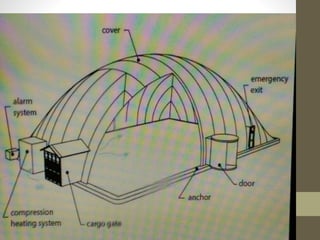
AIR SUPPORTED STRUCTURES
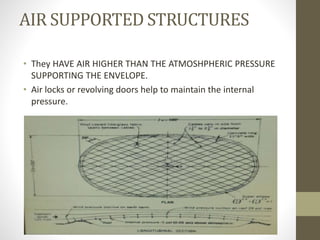
• They HAVE AIR HIGHER THAN THE ATMOSHPHERIC PRESSURE
SUPPORTING THE ENVELOPE.
• Air locks or revolving doors help to maintain the internal
pressure.
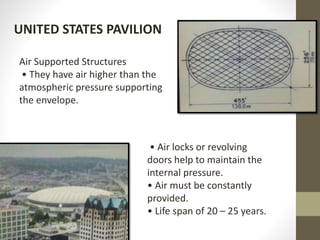
UNITED STATES PAVILION
Air Supported Structures
• They have air higher than the
atmospheric pressure supporting
the envelope.
• Air locks or revolving
doors help to maintain the
internal pressure.
• Air must be constantly
provided.
• Life span of 20 – 25 years.
MODEL DETAILS
• UNITED STATES PAVILION
• The united states pavilion would be the world’s first air
filled structure.
• The architecture firm Davis Brody presented a design,
which consisted of a 30story high.
• Air filled pumpkin to serve as the roof of the pavilion.
• The original idea was to project images and video to the
inner surface.
• The David Geiger was a brilliant man born in 1935. in
Philadelphia,
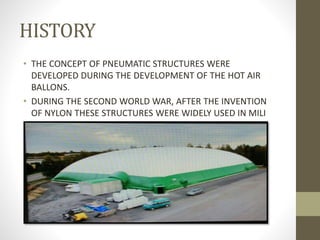
HISTORY
• THE CONCEPT OF PNEUMATIC STRUCTURES WERE
DEVELOPED DURING THE DEVELOPMENT OF THE HOT AIR
BALLONS.
• DURING THE SECOND WORLD WAR, AFTER THE INVENTION
OF NYLON THESE STRUCTURES WERE WIDELY USED IN MILI
Air pressure
• The interior air pressure required for air-supported structures
is not as much as most people expect and certainly not
discernible when inside.
• The amount of pressure required is a function of the weight of
the material - and the building systems suspended on it
(lighting, ventilation, etc.) - and wind pressure. Yet it only
amounts to a small fraction of atmospheric pressure.
• Internal pressure is commonly measured in inches of
water, inAq, and varies fractionally from 0.3 inAq for minimal
inflation to 3 inAq for maximum, with 1 inAq being a standard
pressurization level for normal operating conditions.
• In terms of the more common pounds per square inch, 1 inAq
equates to a mere 0.037 psi (2.54 mBar, 254 Pa)
Materials:-
• The materials used for air-supported structures are similar to
those used in tensile structures, namely synthetic fabrics such
as fibreglassand polyester.
• In order to prevent deterioration from moisture
and ultraviolet radiation, these materials are coated with
polymers such as PVC and Teflon.
• Depending on use and location, the structure may have inner
linings made of lighter materials for insulation or acoustics.
• Materials used in modern air supported structures are usually
translucent, therefore the use of lighting system inside the
structure is not required during the daytime
Advantages:
• Can be engineered to attach to a pre-existing structure[5]
• Considerably lower initial cost than conventional buildings
• Lower operating costs due to simplicity of design (wholly air-
supported structures only)
• Easy and quick to set up, dismantle, and relocate (wholly air-
supported structures only)[6]
• Unobstructed open interior space, since there is no need for
columns
• Able to cover almost any project
• Custom fabric colors and sizes, including translucent fabric, allowing
natural sunlight in
Disadvantages:
• Continuous operation of fans to maintain pressure, often
requiring redundancy or emergency power supply.
• Dome collapses when pressure lost or fabric
compromised
• Cannot reach the insulation values of hard-walled
structures, increasing heating and cooling costs
• Limited load-carrying capacity
• Conventional buildings have longer lifespan

Pneumatic structures (1)

  • 1.
    PNEUMATIC STRUCTURES INTRUDUCTION , TYPES,HISTORY,CONSTRUCTION DETATIL ,BUILDING MATERIALS , ADVANTAGES /DISADVANTAGES , ASPECT RATIO. SUBMITTED BY:- Rahul Verma 75166027 Shyshant 75166031 SUBMITTED TO:- AR. Gurdeep Singh
  • 2.
    INTRODUCTION • Membrane structuresthat are stabilized by pressure of compressed air. • Pressure difference between the enclosed space and the exterior are responsible for giving the building its shape and its stability. • The pressure should be uniformly distributed for structural integrity. • TYPES • Air Supported structures • Air inflated structures. • Hybrid structures.
  • 3.
    AIR SUPPORTED STRUCTURES •They HAVE AIR HIGHER THAN THE ATMOSHPHERIC PRESSURE SUPPORTING THE ENVELOPE. • Air locks or revolving doors help to maintain the internal pressure.
  • 4.
    UNITED STATES PAVILION AirSupported Structures • They have air higher than the atmospheric pressure supporting the envelope. • Air locks or revolving doors help to maintain the internal pressure. • Air must be constantly provided. • Life span of 20 – 25 years.
  • 5.
    MODEL DETAILS • UNITEDSTATES PAVILION • The united states pavilion would be the world’s first air filled structure. • The architecture firm Davis Brody presented a design, which consisted of a 30story high. • Air filled pumpkin to serve as the roof of the pavilion. • The original idea was to project images and video to the inner surface. • The David Geiger was a brilliant man born in 1935. in Philadelphia,
  • 7.
    HISTORY • THE CONCEPTOF PNEUMATIC STRUCTURES WERE DEVELOPED DURING THE DEVELOPMENT OF THE HOT AIR BALLONS. • DURING THE SECOND WORLD WAR, AFTER THE INVENTION OF NYLON THESE STRUCTURES WERE WIDELY USED IN MILI
  • 8.
    Air pressure • Theinterior air pressure required for air-supported structures is not as much as most people expect and certainly not discernible when inside. • The amount of pressure required is a function of the weight of the material - and the building systems suspended on it (lighting, ventilation, etc.) - and wind pressure. Yet it only amounts to a small fraction of atmospheric pressure. • Internal pressure is commonly measured in inches of water, inAq, and varies fractionally from 0.3 inAq for minimal inflation to 3 inAq for maximum, with 1 inAq being a standard pressurization level for normal operating conditions. • In terms of the more common pounds per square inch, 1 inAq equates to a mere 0.037 psi (2.54 mBar, 254 Pa)
  • 9.
    Materials:- • The materialsused for air-supported structures are similar to those used in tensile structures, namely synthetic fabrics such as fibreglassand polyester. • In order to prevent deterioration from moisture and ultraviolet radiation, these materials are coated with polymers such as PVC and Teflon. • Depending on use and location, the structure may have inner linings made of lighter materials for insulation or acoustics. • Materials used in modern air supported structures are usually translucent, therefore the use of lighting system inside the structure is not required during the daytime
  • 10.
    Advantages: • Can beengineered to attach to a pre-existing structure[5] • Considerably lower initial cost than conventional buildings • Lower operating costs due to simplicity of design (wholly air- supported structures only) • Easy and quick to set up, dismantle, and relocate (wholly air- supported structures only)[6] • Unobstructed open interior space, since there is no need for columns • Able to cover almost any project • Custom fabric colors and sizes, including translucent fabric, allowing natural sunlight in
  • 11.
    Disadvantages: • Continuous operationof fans to maintain pressure, often requiring redundancy or emergency power supply. • Dome collapses when pressure lost or fabric compromised • Cannot reach the insulation values of hard-walled structures, increasing heating and cooling costs • Limited load-carrying capacity • Conventional buildings have longer lifespan