Introduction
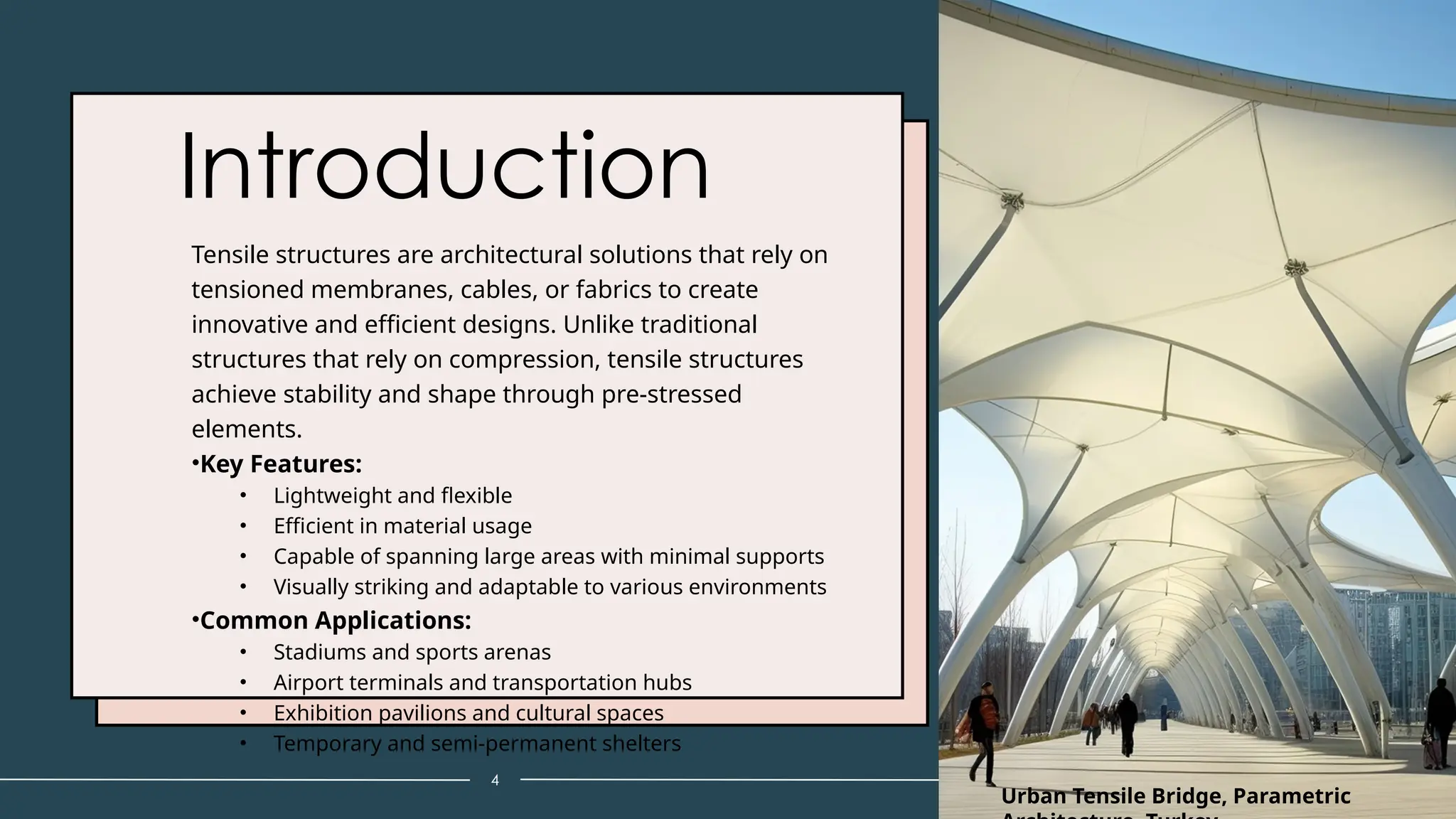
Tensile structures arearchitectural solutions that rely on
tensioned membranes, cables, or fabrics to create
innovative and efficient designs. Unlike traditional
structures that rely on compression, tensile structures
achieve stability and shape through pre-stressed
elements.
•Key Features:
• Lightweight and flexible
• Efficient in material usage
• Capable of spanning large areas with minimal supports
• Visually striking and adaptable to various environments
•Common Applications:
• Stadiums and sports arenas
• Airport terminals and transportation hubs
• Exhibition pavilions and cultural spaces
• Temporary and semi-permanent shelters
4
Urban Tensile Bridge, Parametric
5.
History
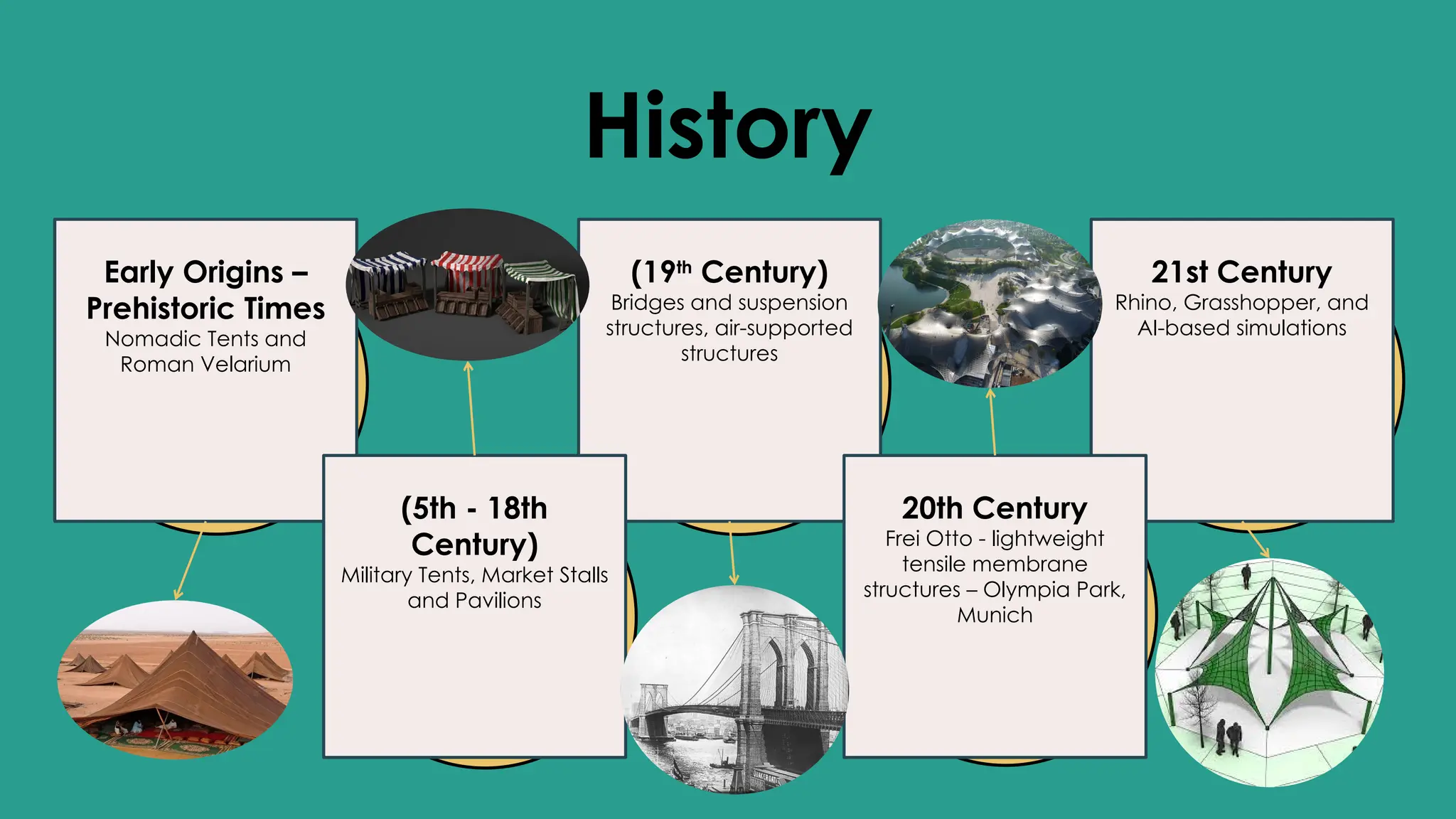
Early Origins –
PrehistoricTimes
Nomadic Tents and
Roman Velarium
(19th
Century)
Bridges and suspension
structures, air-supported
structures
21st Century
Rhino, Grasshopper, and
AI-based simulations
(5th - 18th
Century)
Military Tents, Market Stalls
and Pavilions
20th Century
Frei Otto - lightweight
tensile membrane
structures – Olympia Park,
Munich
6.
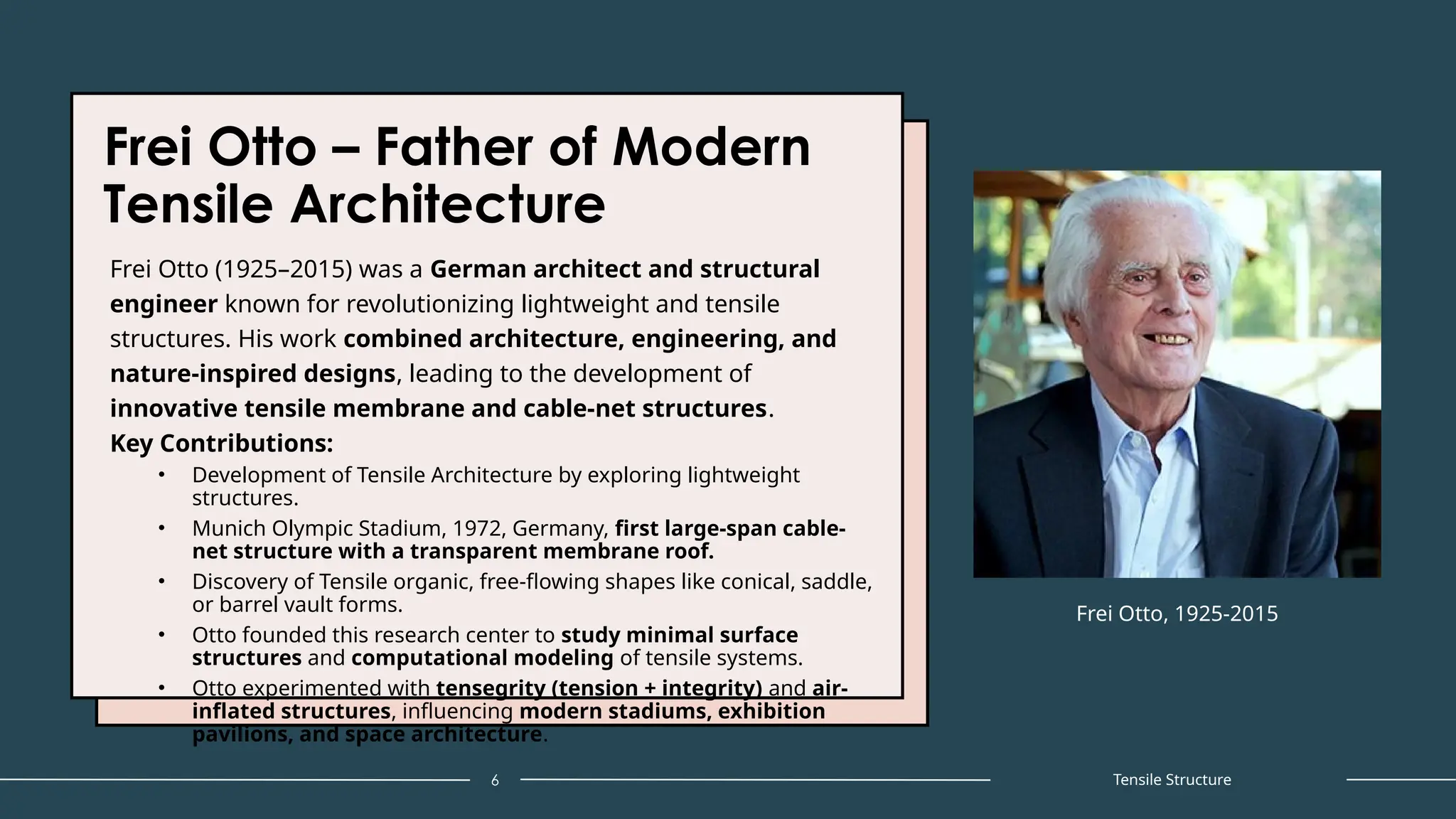
Frei Otto –Father of Modern
Tensile Architecture
Frei Otto (1925–2015) was a German architect and structural
engineer known for revolutionizing lightweight and tensile
structures. His work combined architecture, engineering, and
nature-inspired designs, leading to the development of
innovative tensile membrane and cable-net structures.
Key Contributions:
• Development of Tensile Architecture by exploring lightweight
structures.
• Munich Olympic Stadium, 1972, Germany, first large-span cable-
net structure with a transparent membrane roof.
• Discovery of Tensile organic, free-flowing shapes like conical, saddle,
or barrel vault forms.
• Otto founded this research center to study minimal surface
structures and computational modeling of tensile systems.
• Otto experimented with tensegrity (tension + integrity) and air-
inflated structures, influencing modern stadiums, exhibition
pavilions, and space architecture.
6
Frei Otto, 1925-2015
Tensile Structure
7.
I have builtfor people, not for profit. Our work is a
research, never a finished building. We must learn
to design lightweight structures, as they save
material and energy. My architectural structures
are never new in principle—they follow the existing
laws of nature i.e. Form follows forces.
Frei Otto
2025
Tensile Structure
7
8.
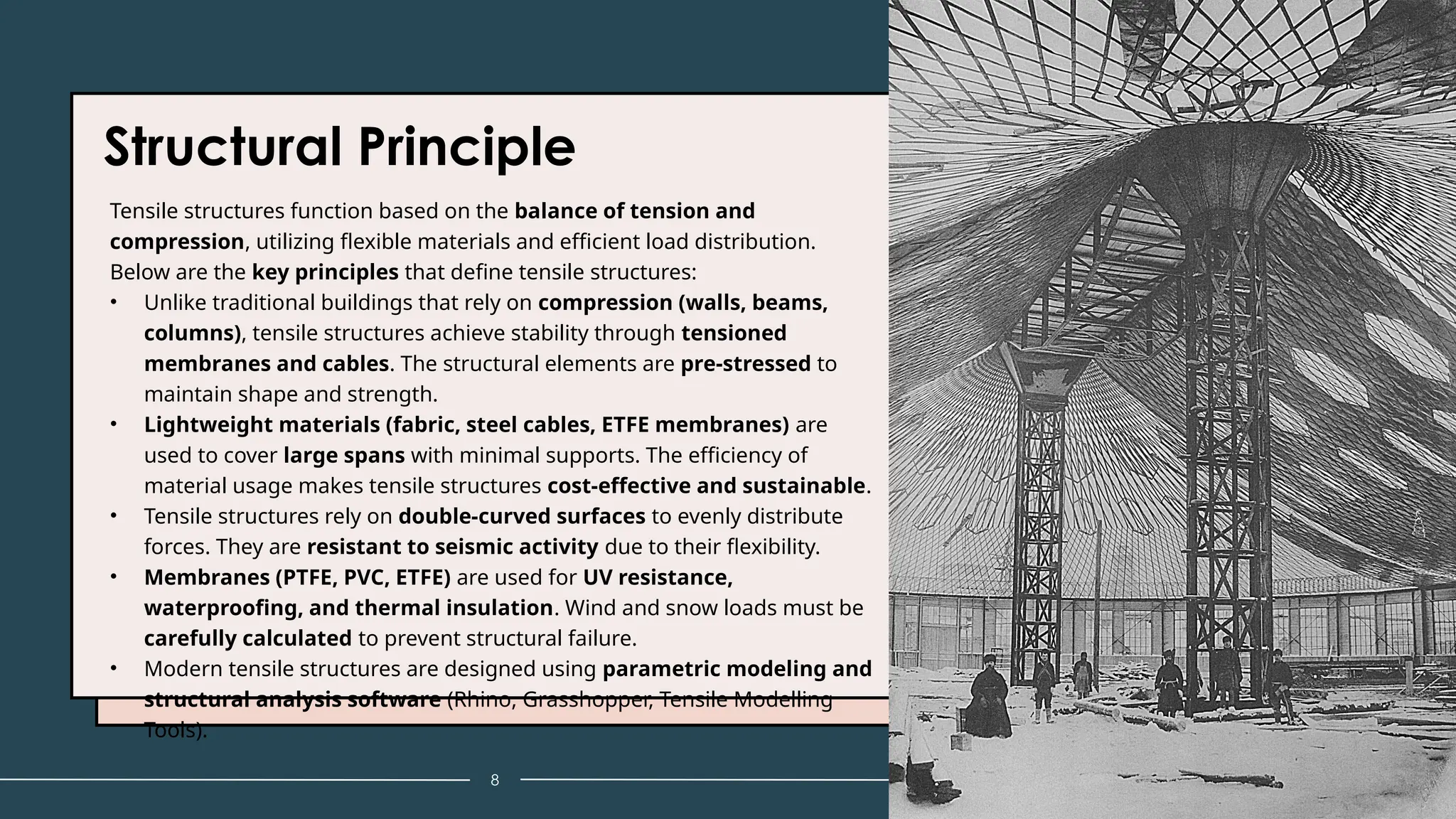
Structural Principle
Tensile structuresfunction based on the balance of tension and
compression, utilizing flexible materials and efficient load distribution.
Below are the key principles that define tensile structures:
• Unlike traditional buildings that rely on compression (walls, beams,
columns), tensile structures achieve stability through tensioned
membranes and cables. The structural elements are pre-stressed to
maintain shape and strength.
• Lightweight materials (fabric, steel cables, ETFE membranes) are
used to cover large spans with minimal supports. The efficiency of
material usage makes tensile structures cost-effective and sustainable.
• Tensile structures rely on double-curved surfaces to evenly distribute
forces. They are resistant to seismic activity due to their flexibility.
• Membranes (PTFE, PVC, ETFE) are used for UV resistance,
waterproofing, and thermal insulation. Wind and snow loads must be
carefully calculated to prevent structural failure.
• Modern tensile structures are designed using parametric modeling and
structural analysis software (Rhino, Grasshopper, Tensile Modelling
Tools).
8 Tensile Structure
9.
Materials
1. Fabric &Membranes
• PVC-coated polyester – Cost-effective, UV-resistant, and widely
used for temporary or semi-permanent structures.
• PTFE (Polytetrafluoroethylene) coated fiberglass – Highly
durable, self-cleaning, and resistant to extreme weather conditions.
Common in long-term installations.
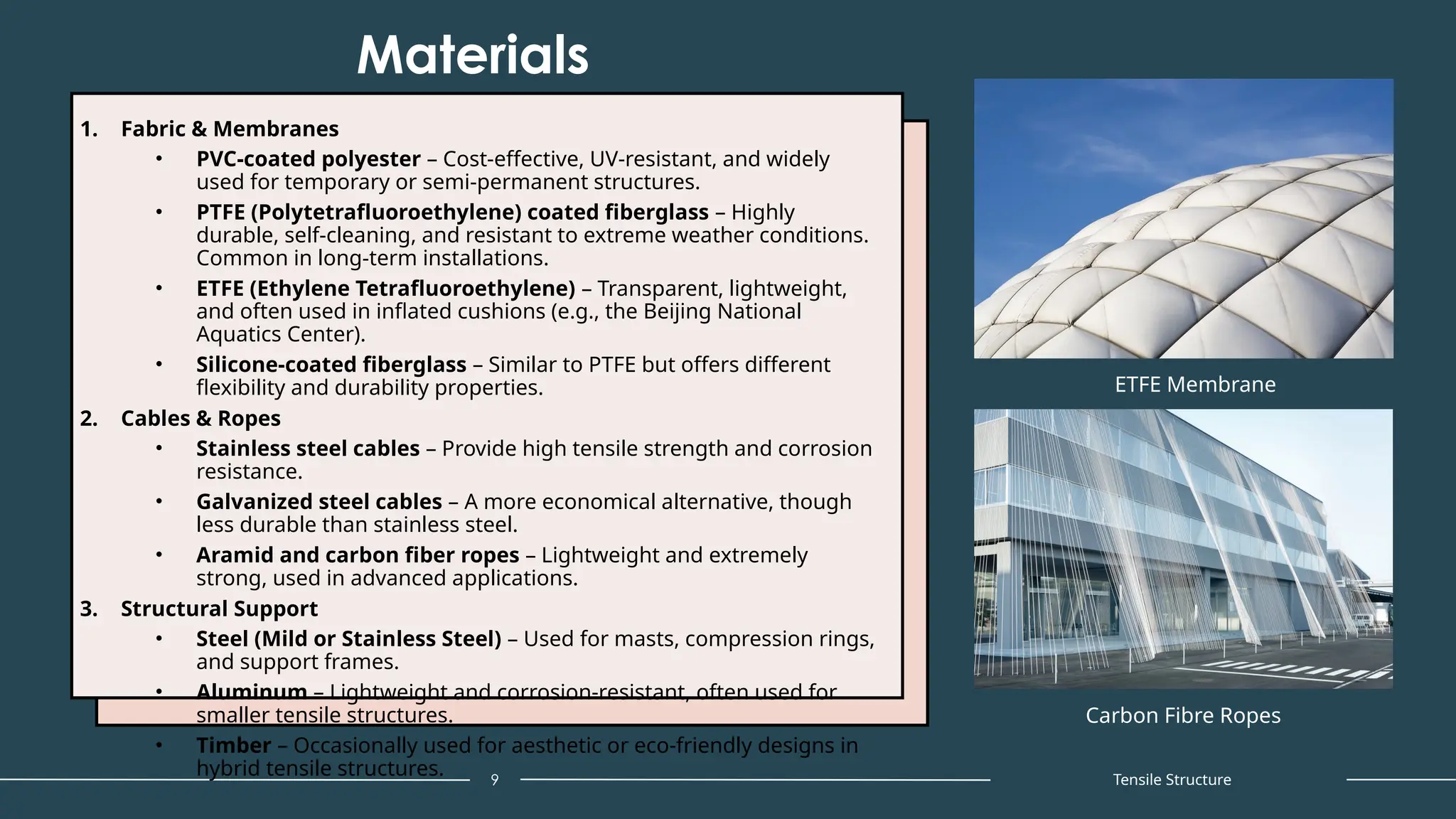
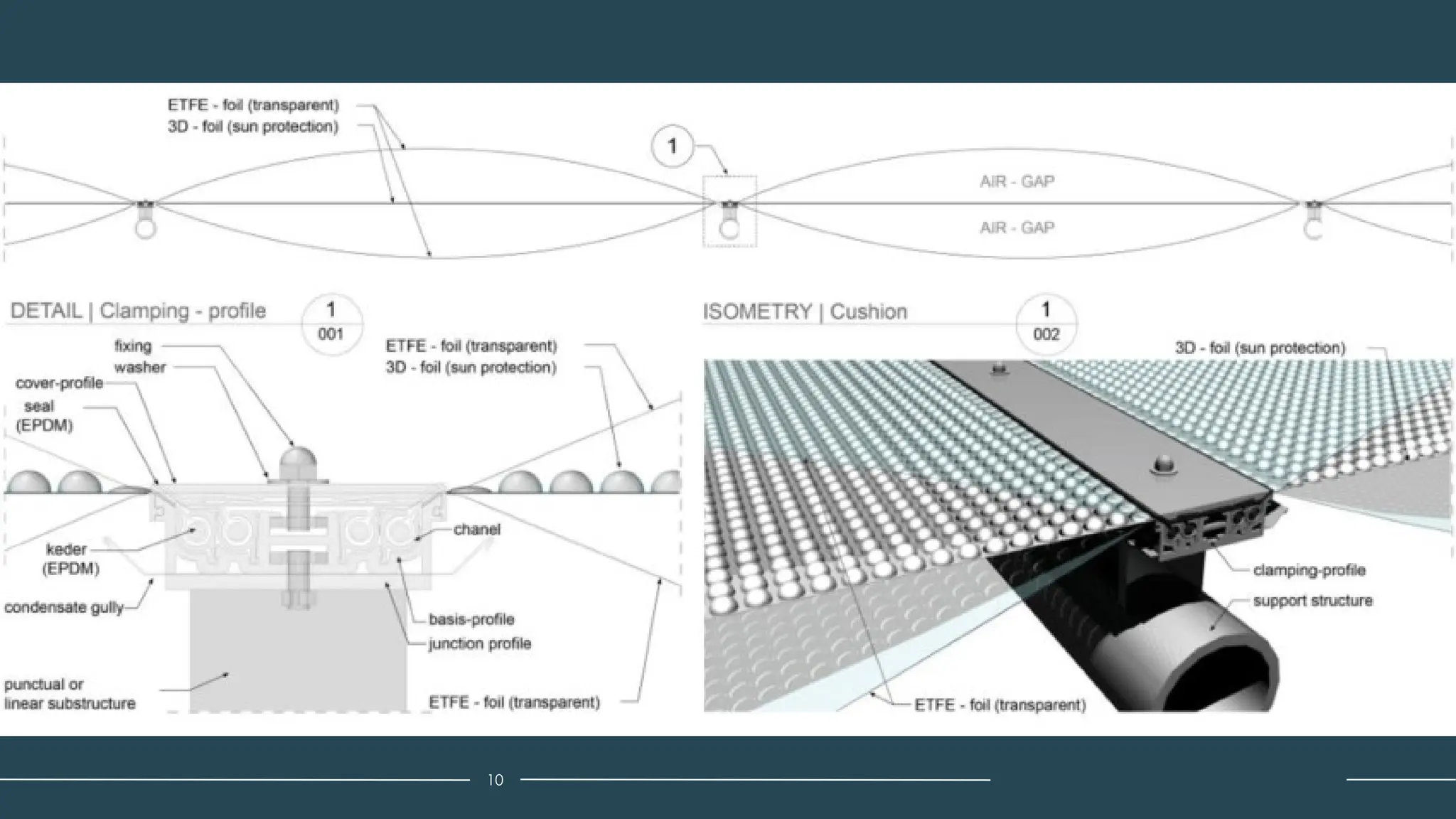
• ETFE (Ethylene Tetrafluoroethylene) – Transparent, lightweight,
and often used in inflated cushions (e.g., the Beijing National
Aquatics Center).
• Silicone-coated fiberglass – Similar to PTFE but offers different
flexibility and durability properties.
2. Cables & Ropes
• Stainless steel cables – Provide high tensile strength and corrosion
resistance.
• Galvanized steel cables – A more economical alternative, though
less durable than stainless steel.
• Aramid and carbon fiber ropes – Lightweight and extremely
strong, used in advanced applications.
3. Structural Support
• Steel (Mild or Stainless Steel) – Used for masts, compression rings,
and support frames.
• Aluminum – Lightweight and corrosion-resistant, often used for
smaller tensile structures.
• Timber – Occasionally used for aesthetic or eco-friendly designs in
hybrid tensile structures. 9 Tensile Structure
ETFE Membrane
Carbon Fibre Ropes
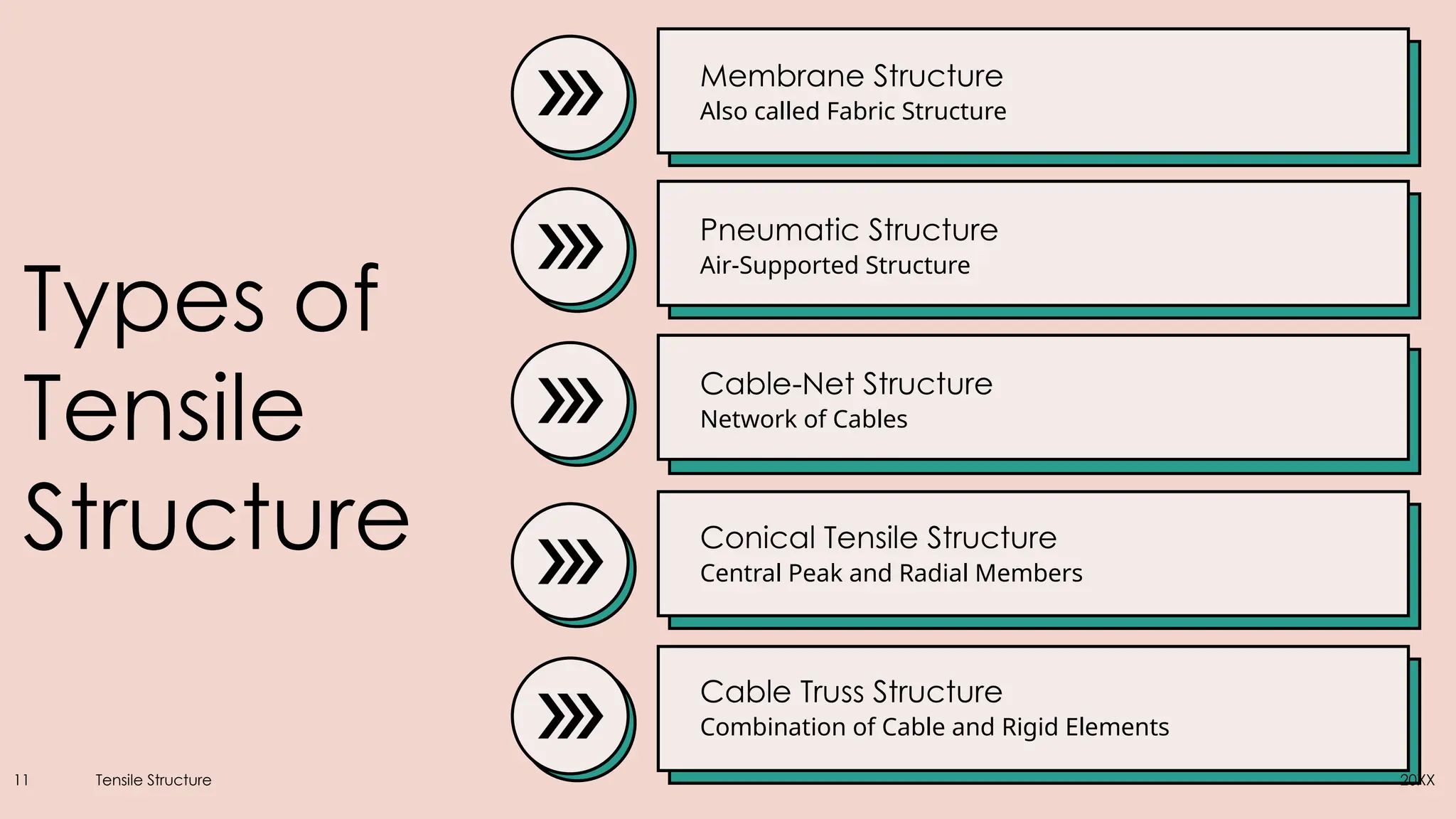
Types of
Tensile
Structure
Membrane Structure
Alsocalled Fabric Structure
Pneumatic Structure
Air-Supported Structure
Cable-Net Structure
Network of Cables
Conical Tensile Structure
Central Peak and Radial Members
Cable Truss Structure
Combination of Cable and Rigid Elements
11 Tensile Structure 20XX
12.
Types of
Tensile
Structure
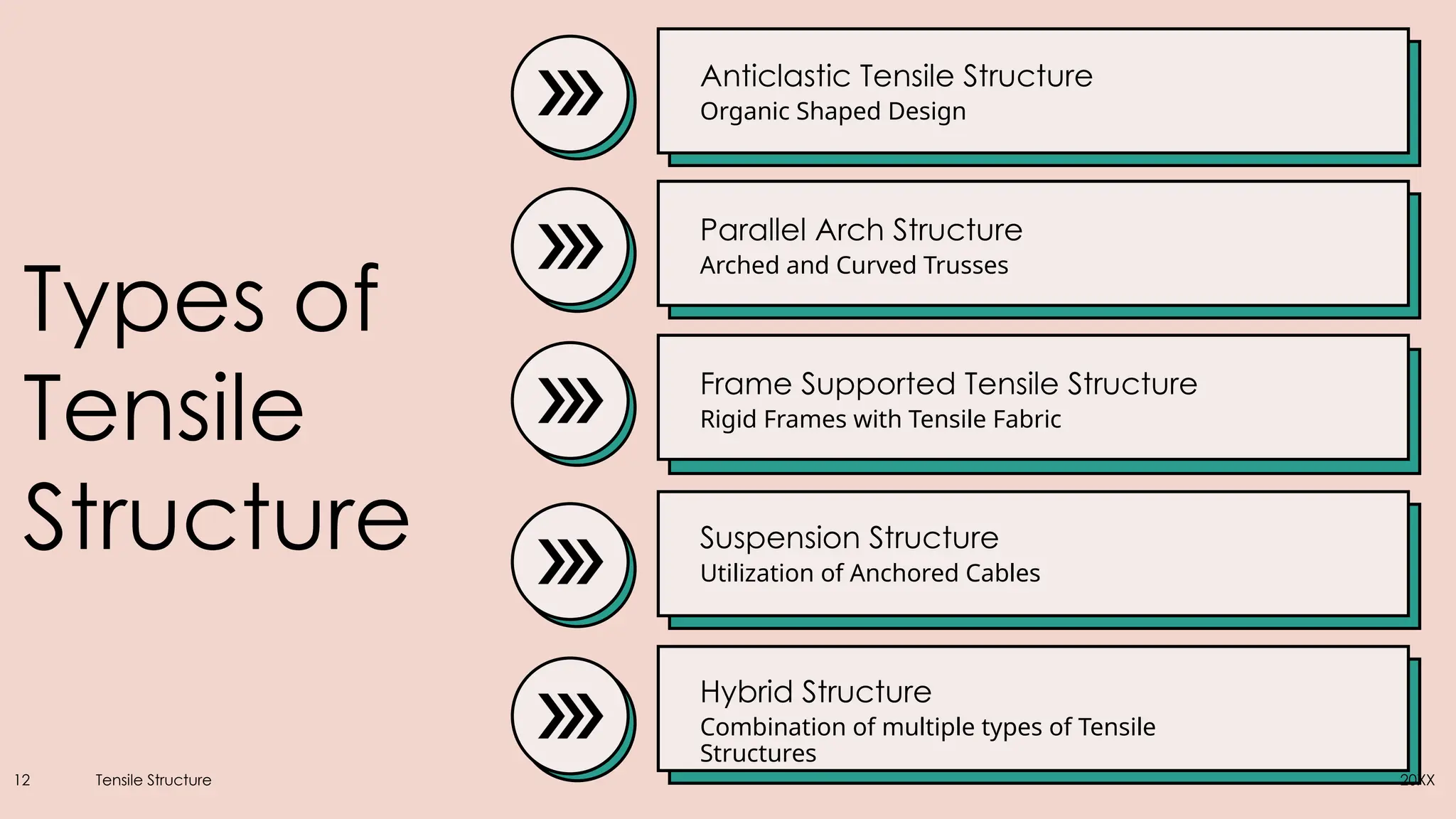
Anticlastic TensileStructure
Organic Shaped Design
Parallel Arch Structure
Arched and Curved Trusses
Frame Supported Tensile Structure
Rigid Frames with Tensile Fabric
Suspension Structure
Utilization of Anchored Cables
Hybrid Structure
Combination of multiple types of Tensile
Structures
12 Tensile Structure 20XX
13.
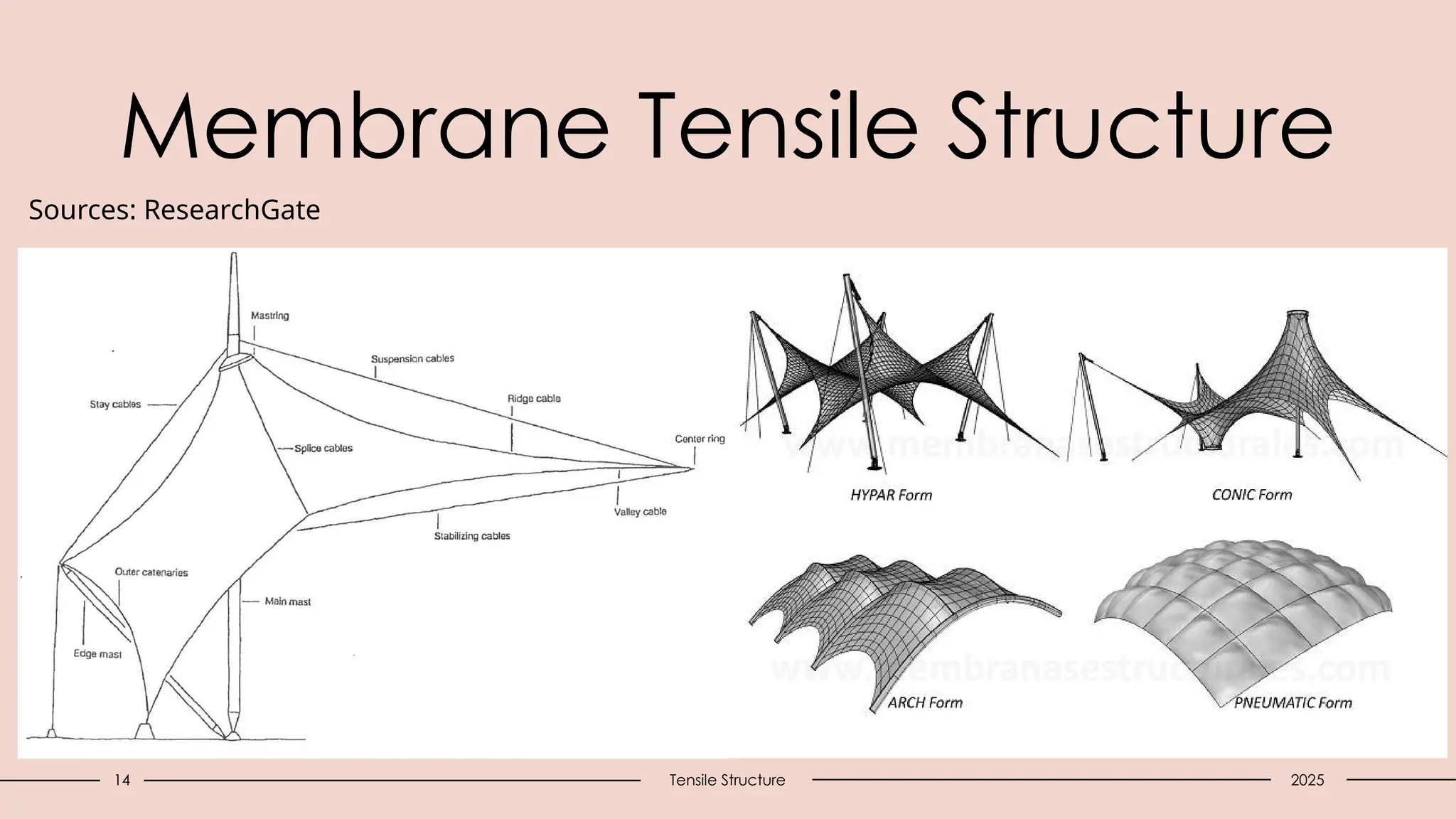
Membrane Structure
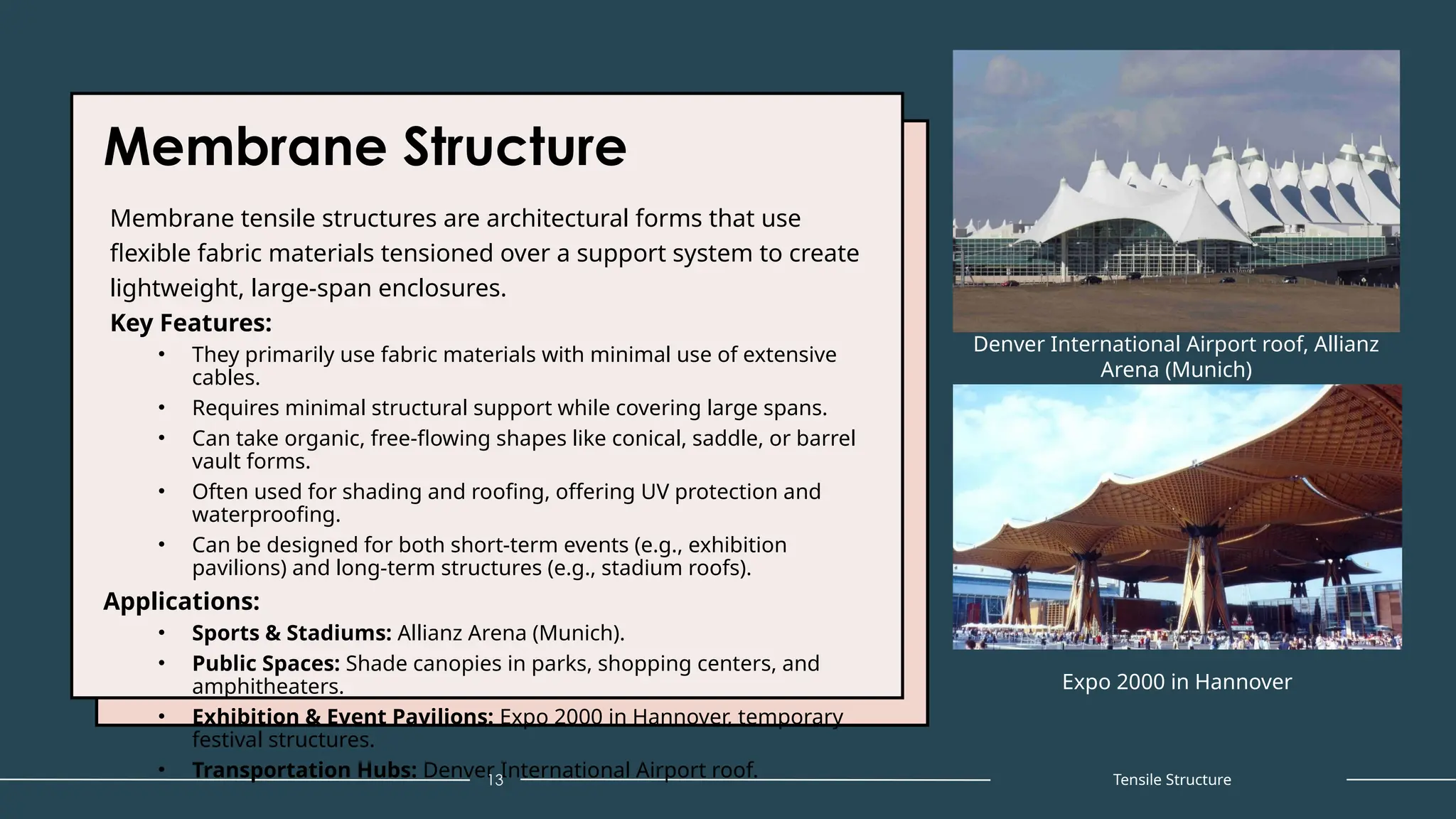
Membrane tensilestructures are architectural forms that use
flexible fabric materials tensioned over a support system to create
lightweight, large-span enclosures.
Key Features:
• They primarily use fabric materials with minimal use of extensive
cables.
• Requires minimal structural support while covering large spans.
• Can take organic, free-flowing shapes like conical, saddle, or barrel
vault forms.
• Often used for shading and roofing, offering UV protection and
waterproofing.
• Can be designed for both short-term events (e.g., exhibition
pavilions) and long-term structures (e.g., stadium roofs).
Applications:
• Sports & Stadiums: Allianz Arena (Munich).
• Public Spaces: Shade canopies in parks, shopping centers, and
amphitheaters.
• Exhibition & Event Pavilions: Expo 2000 in Hannover, temporary
festival structures.
• Transportation Hubs: Denver International Airport roof.
13
Denver International Airport roof, Allianz
Arena (Munich)
Expo 2000 in Hannover
Tensile Structure
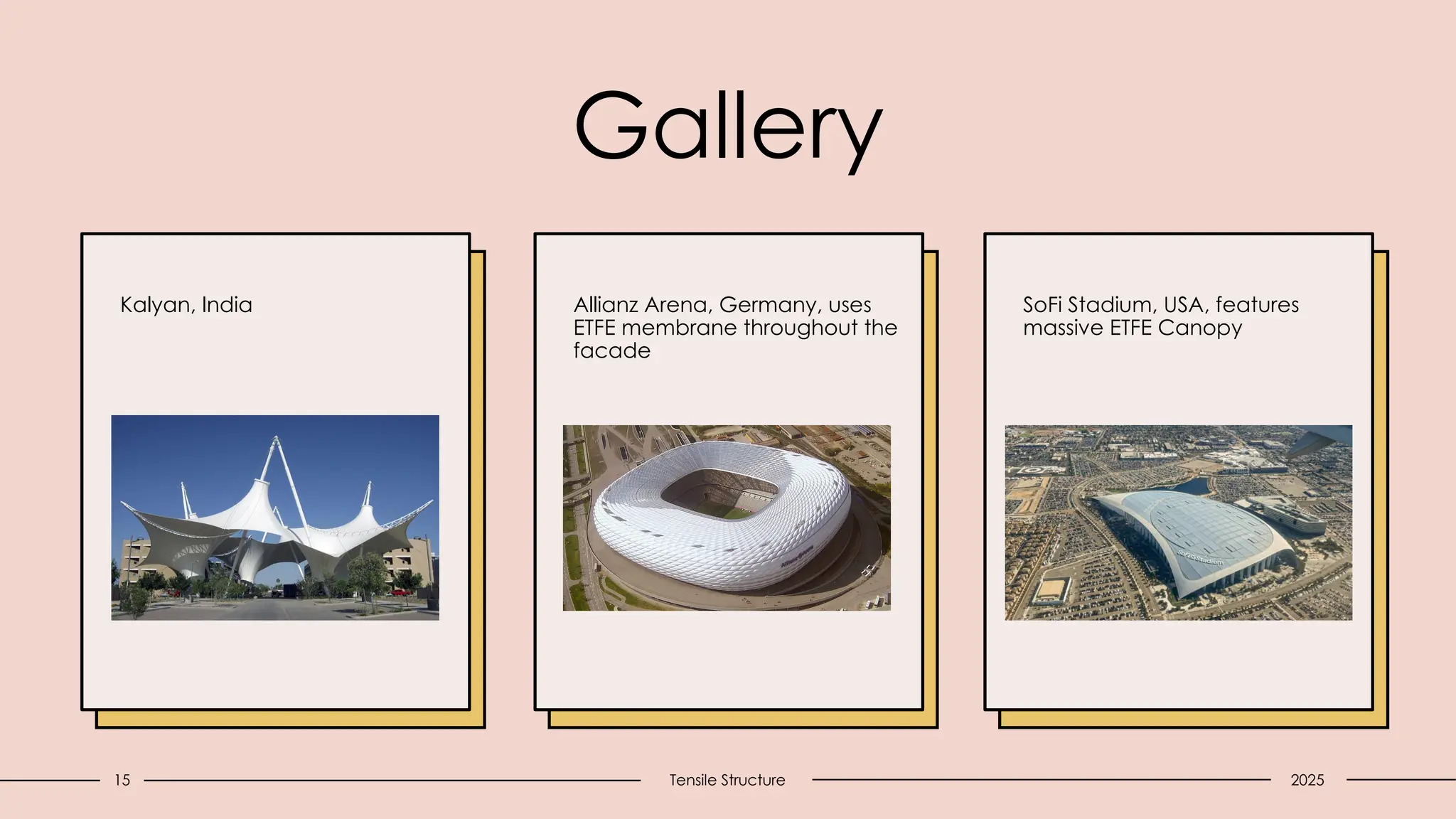
Gallery
Kalyan, India AllianzArena, Germany, uses
ETFE membrane throughout the
facade
SoFi Stadium, USA, features
massive ETFE Canopy
15 Tensile Structure 2025
16.
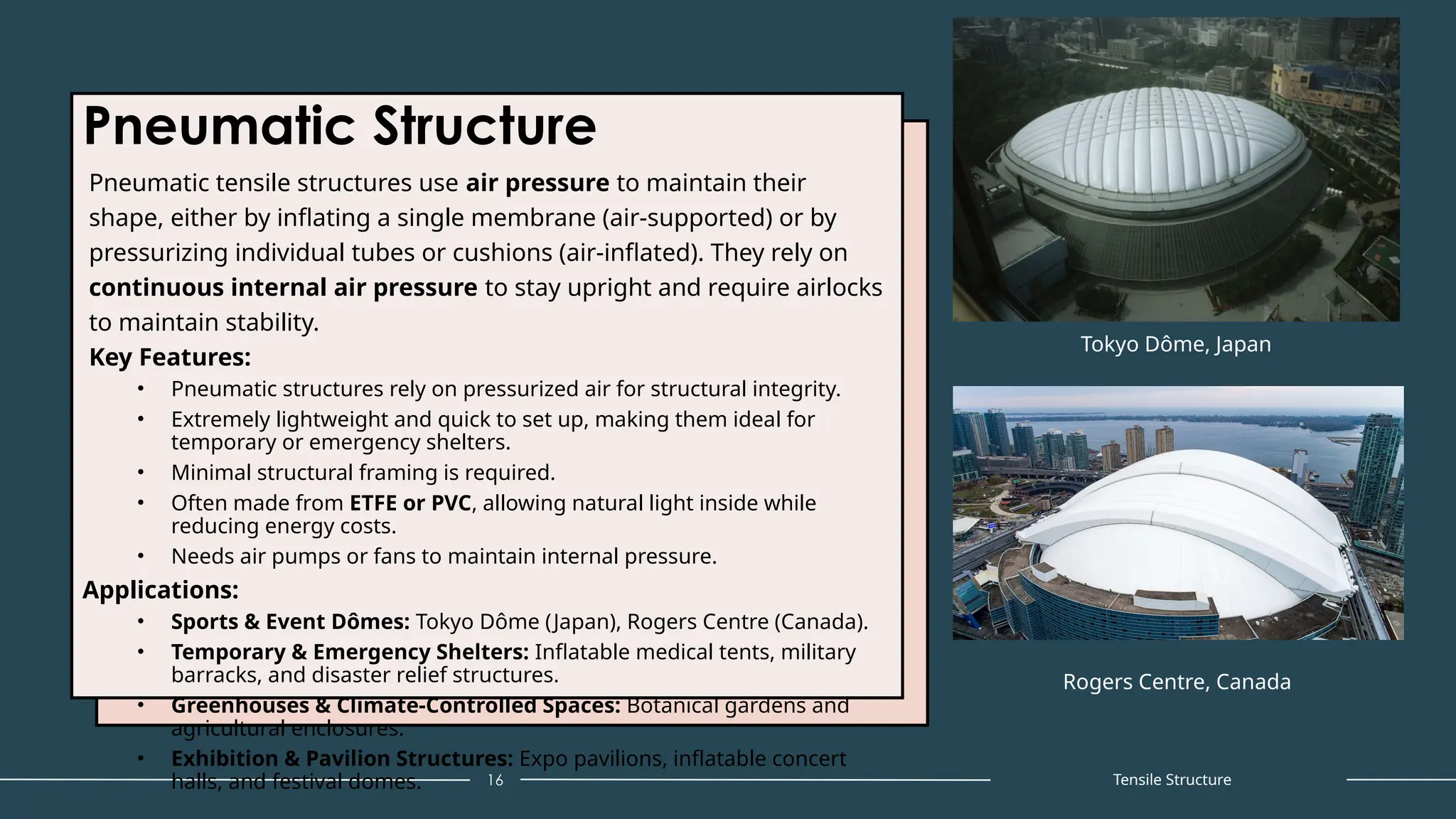
Pneumatic Structure
Pneumatic tensilestructures use air pressure to maintain their
shape, either by inflating a single membrane (air-supported) or by
pressurizing individual tubes or cushions (air-inflated). They rely on
continuous internal air pressure to stay upright and require airlocks
to maintain stability.
Key Features:
• Pneumatic structures rely on pressurized air for structural integrity.
• Extremely lightweight and quick to set up, making them ideal for
temporary or emergency shelters.
• Minimal structural framing is required.
• Often made from ETFE or PVC, allowing natural light inside while
reducing energy costs.
• Needs air pumps or fans to maintain internal pressure.
Applications:
• Sports & Event Dômes: Tokyo Dôme (Japan), Rogers Centre (Canada).
• Temporary & Emergency Shelters: Inflatable medical tents, military
barracks, and disaster relief structures.
• Greenhouses & Climate-Controlled Spaces: Botanical gardens and
agricultural enclosures.
• Exhibition & Pavilion Structures: Expo pavilions, inflatable concert
halls, and festival domes. 16
Tokyo Dôme, Japan
Rogers Centre, Canada
Tensile Structure
17.
17 Tensile Structure
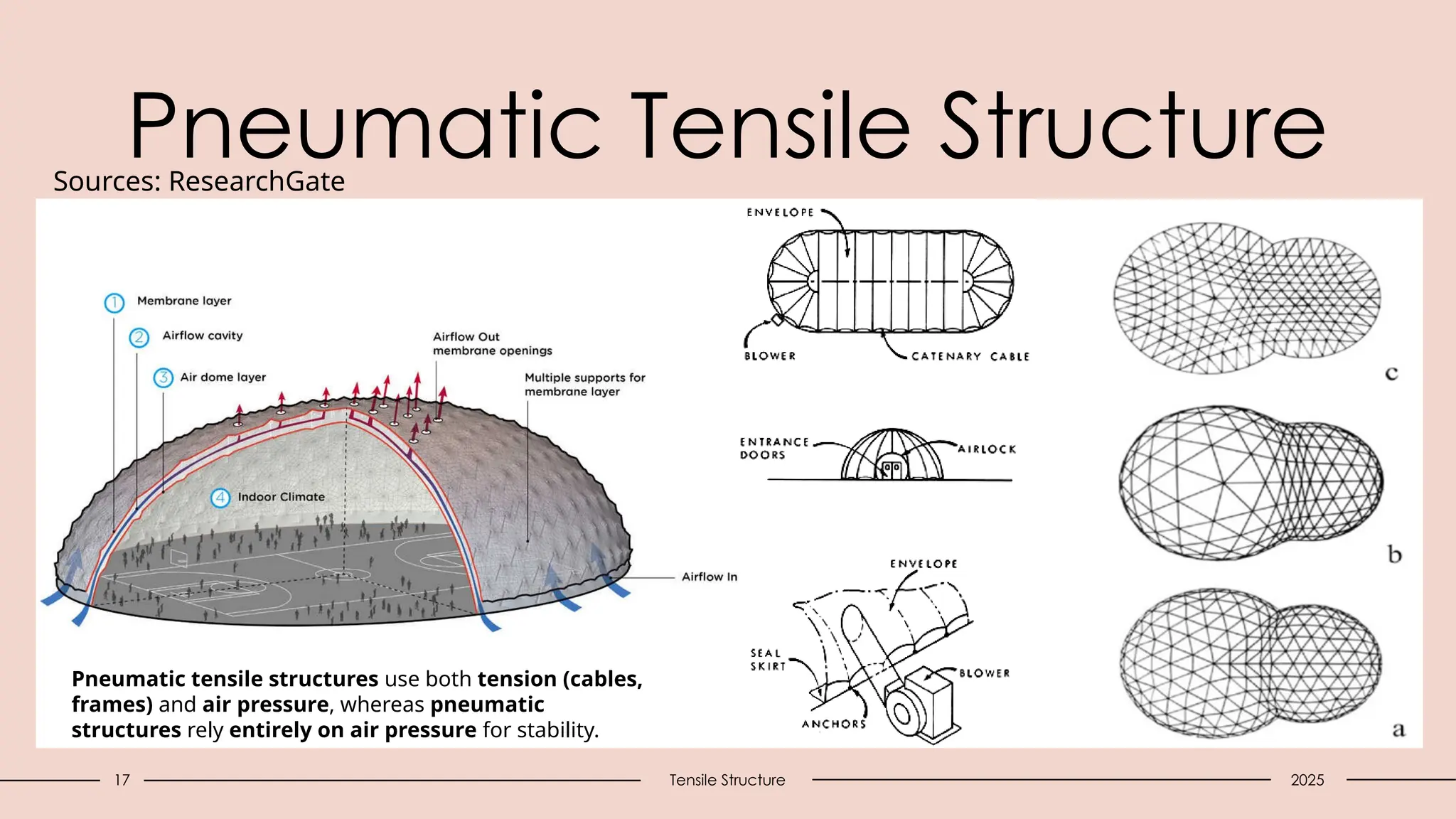
PneumaticTensile Structure
2025
Pneumatic tensile structures use both tension (cables,
frames) and air pressure, whereas pneumatic
structures rely entirely on air pressure for stability.
Sources: ResearchGate
18.
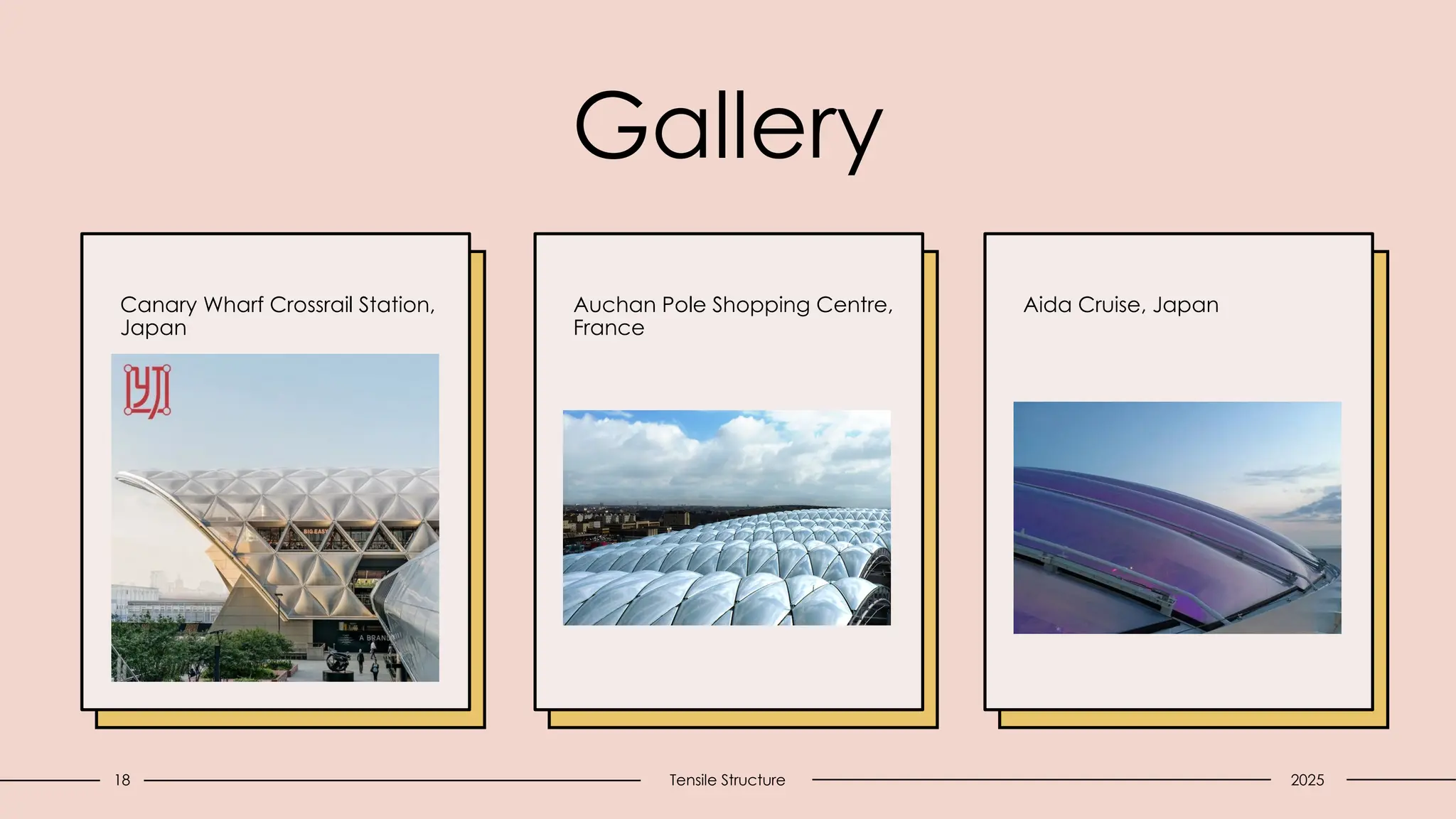
Gallery
Canary Wharf CrossrailStation,
Japan
Auchan Pole Shopping Centre,
France
Aida Cruise, Japan
18 Tensile Structure 2025
19.
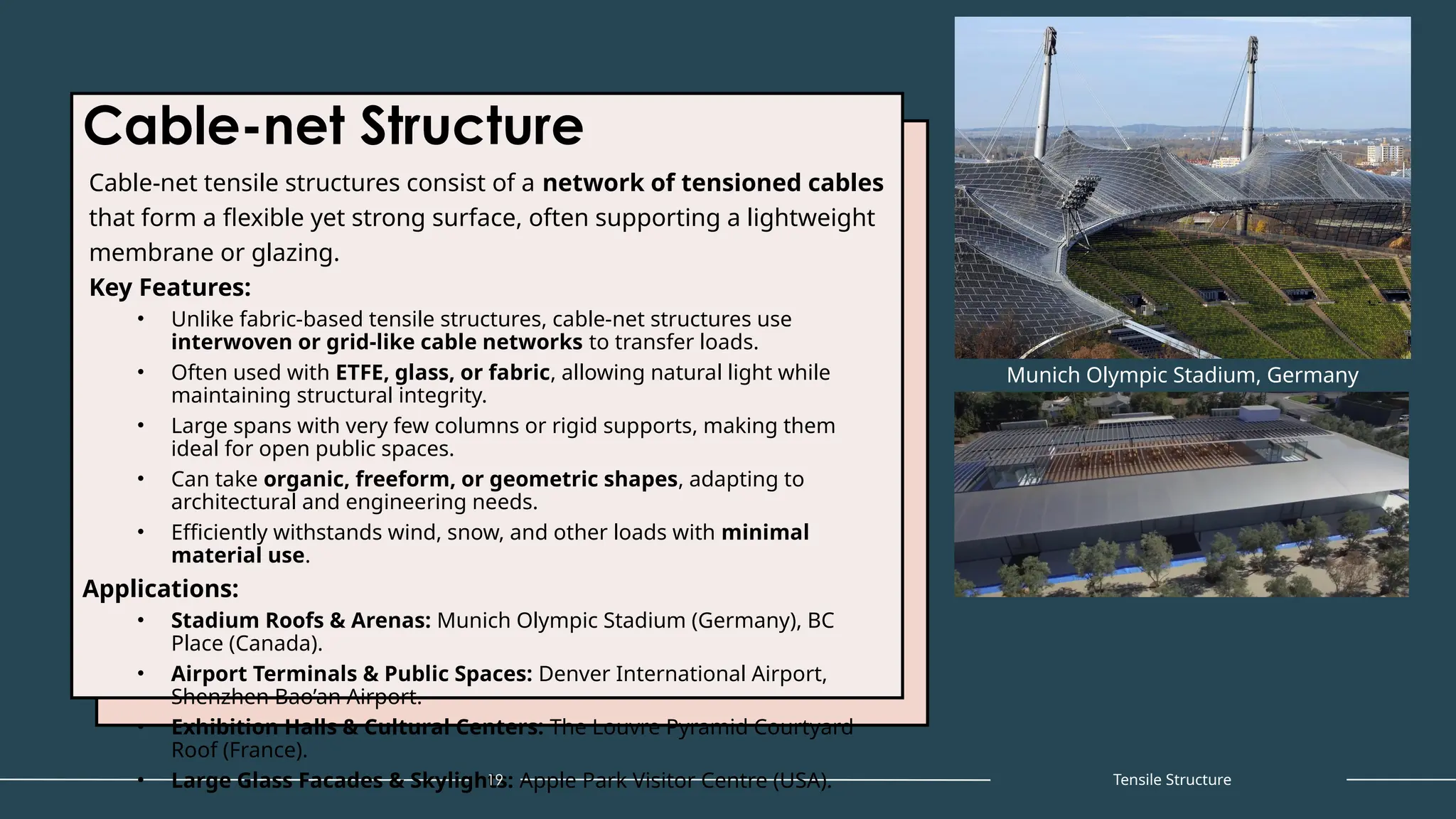
Cable-net Structure
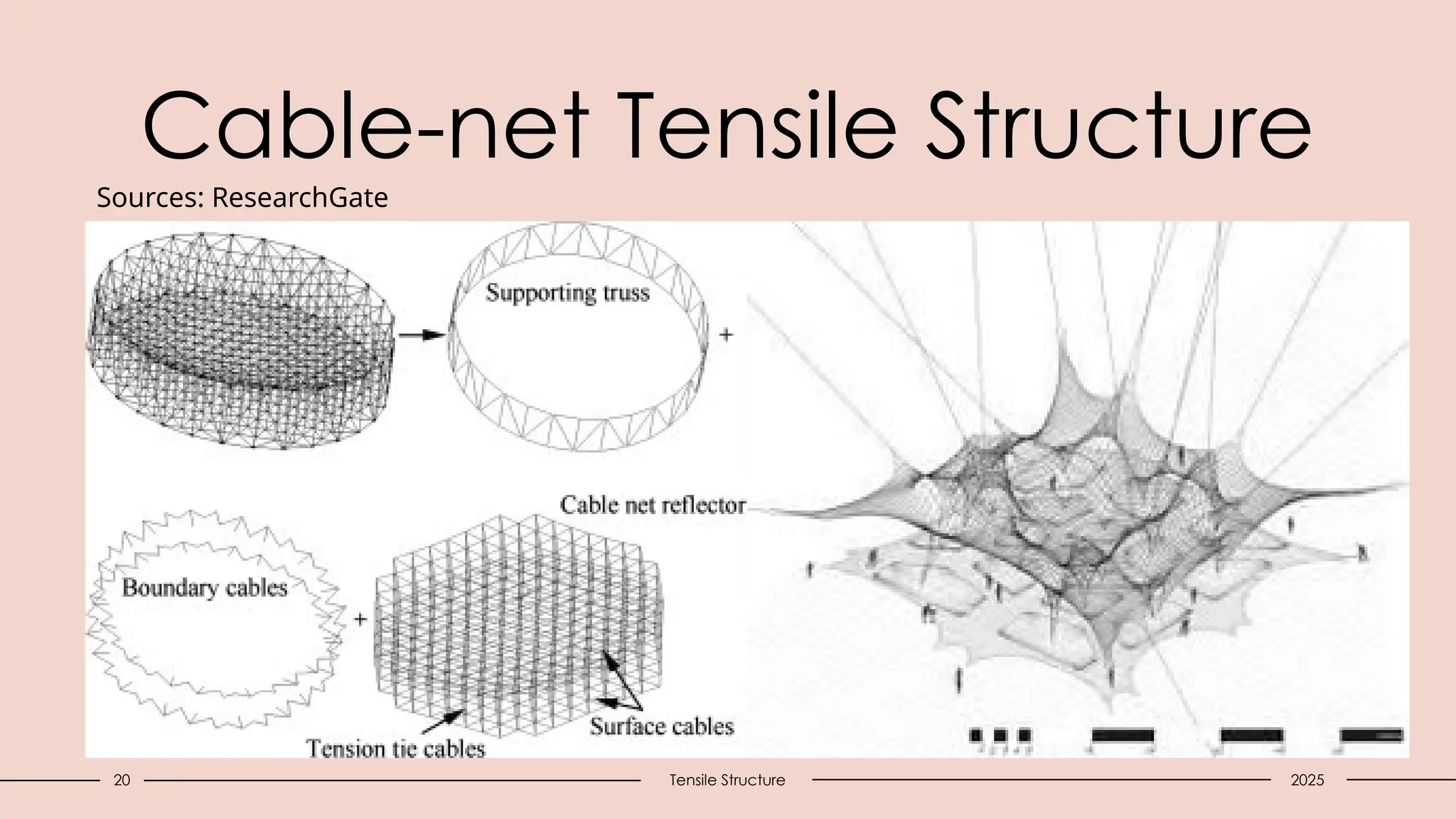
Cable-net tensilestructures consist of a network of tensioned cables
that form a flexible yet strong surface, often supporting a lightweight
membrane or glazing.
Key Features:
• Unlike fabric-based tensile structures, cable-net structures use
interwoven or grid-like cable networks to transfer loads.
• Often used with ETFE, glass, or fabric, allowing natural light while
maintaining structural integrity.
• Large spans with very few columns or rigid supports, making them
ideal for open public spaces.
• Can take organic, freeform, or geometric shapes, adapting to
architectural and engineering needs.
• Efficiently withstands wind, snow, and other loads with minimal
material use.
Applications:
• Stadium Roofs & Arenas: Munich Olympic Stadium (Germany), BC
Place (Canada).
• Airport Terminals & Public Spaces: Denver International Airport,
Shenzhen Bao’an Airport.
• Exhibition Halls & Cultural Centers: The Louvre Pyramid Courtyard
Roof (France).
• Large Glass Facades & Skylights: Apple Park Visitor Centre (USA).
19
Munich Olympic Stadium, Germany
Tensile Structure
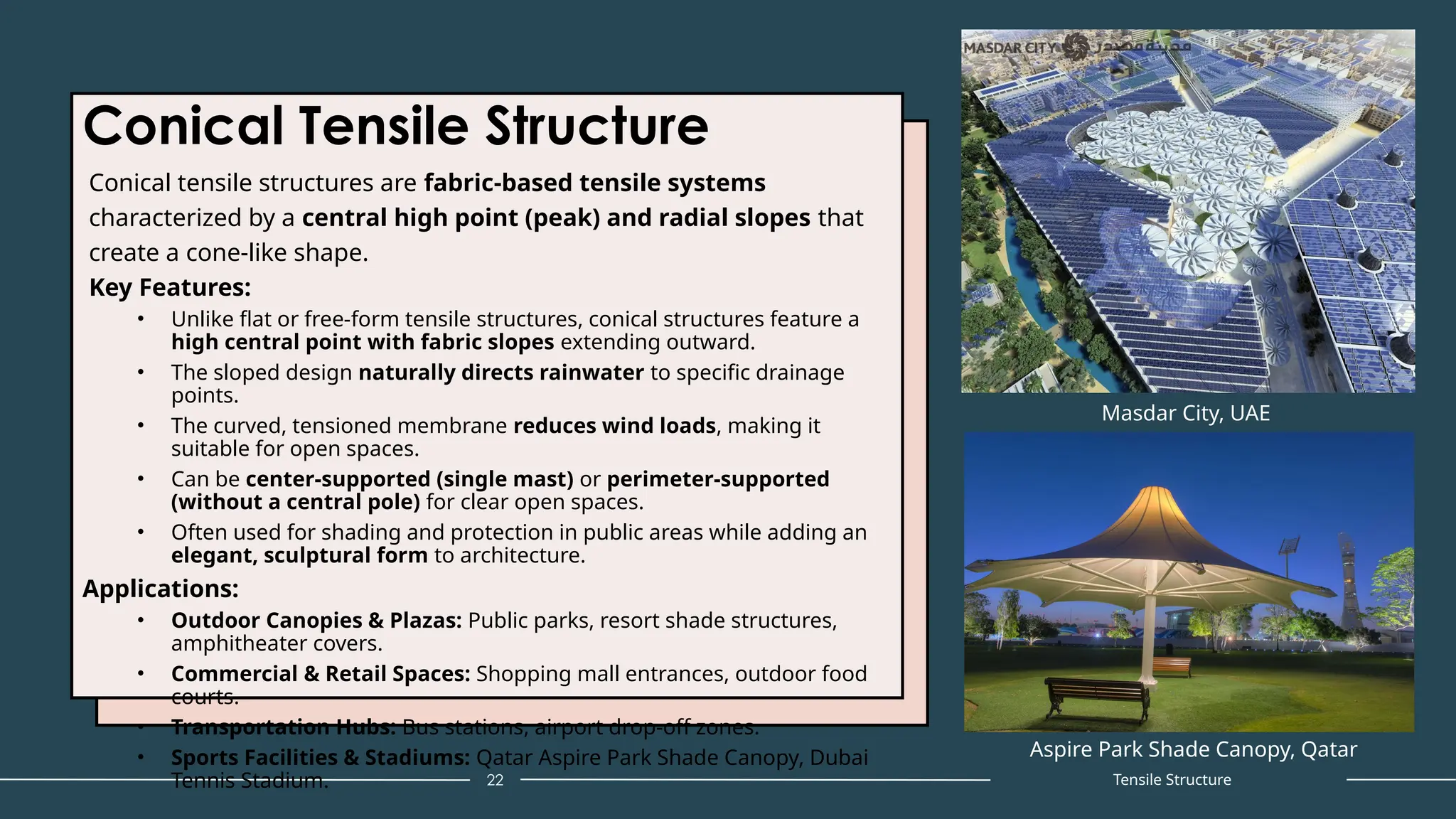
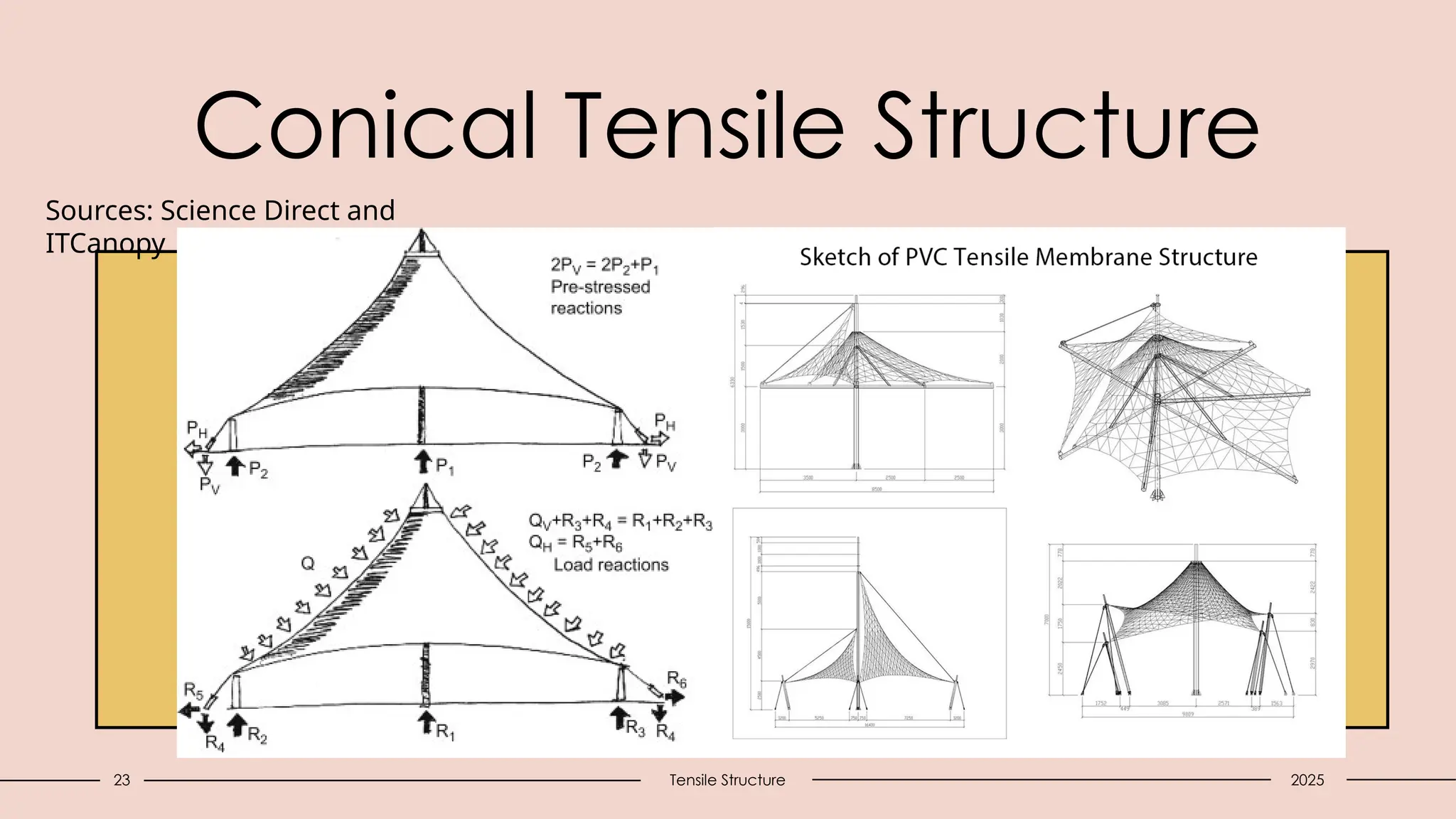
Conical Tensile Structure
Conicaltensile structures are fabric-based tensile systems
characterized by a central high point (peak) and radial slopes that
create a cone-like shape.
Key Features:
• Unlike flat or free-form tensile structures, conical structures feature a
high central point with fabric slopes extending outward.
• The sloped design naturally directs rainwater to specific drainage
points.
• The curved, tensioned membrane reduces wind loads, making it
suitable for open spaces.
• Can be center-supported (single mast) or perimeter-supported
(without a central pole) for clear open spaces.
• Often used for shading and protection in public areas while adding an
elegant, sculptural form to architecture.
Applications:
• Outdoor Canopies & Plazas: Public parks, resort shade structures,
amphitheater covers.
• Commercial & Retail Spaces: Shopping mall entrances, outdoor food
courts.
• Transportation Hubs: Bus stations, airport drop-off zones.
• Sports Facilities & Stadiums: Qatar Aspire Park Shade Canopy, Dubai
Tennis Stadium. 22
Masdar City, UAE
Tensile Structure
Aspire Park Shade Canopy, Qatar
Gallery
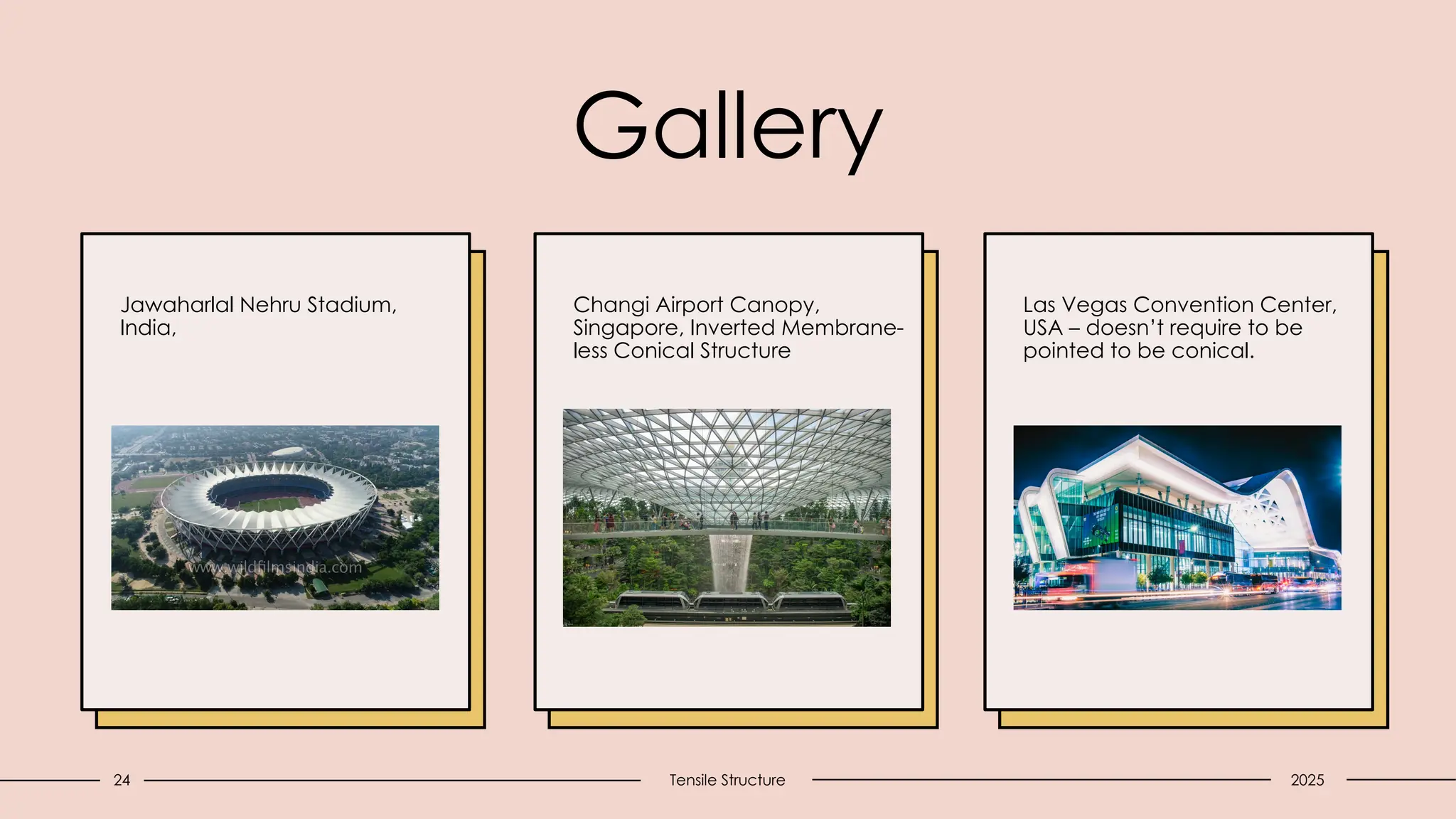
Jawaharlal Nehru Stadium,
India,
ChangiAirport Canopy,
Singapore, Inverted Membrane-
less Conical Structure
Las Vegas Convention Center,
USA – doesn’t require to be
pointed to be conical.
24 Tensile Structure 2025
25.
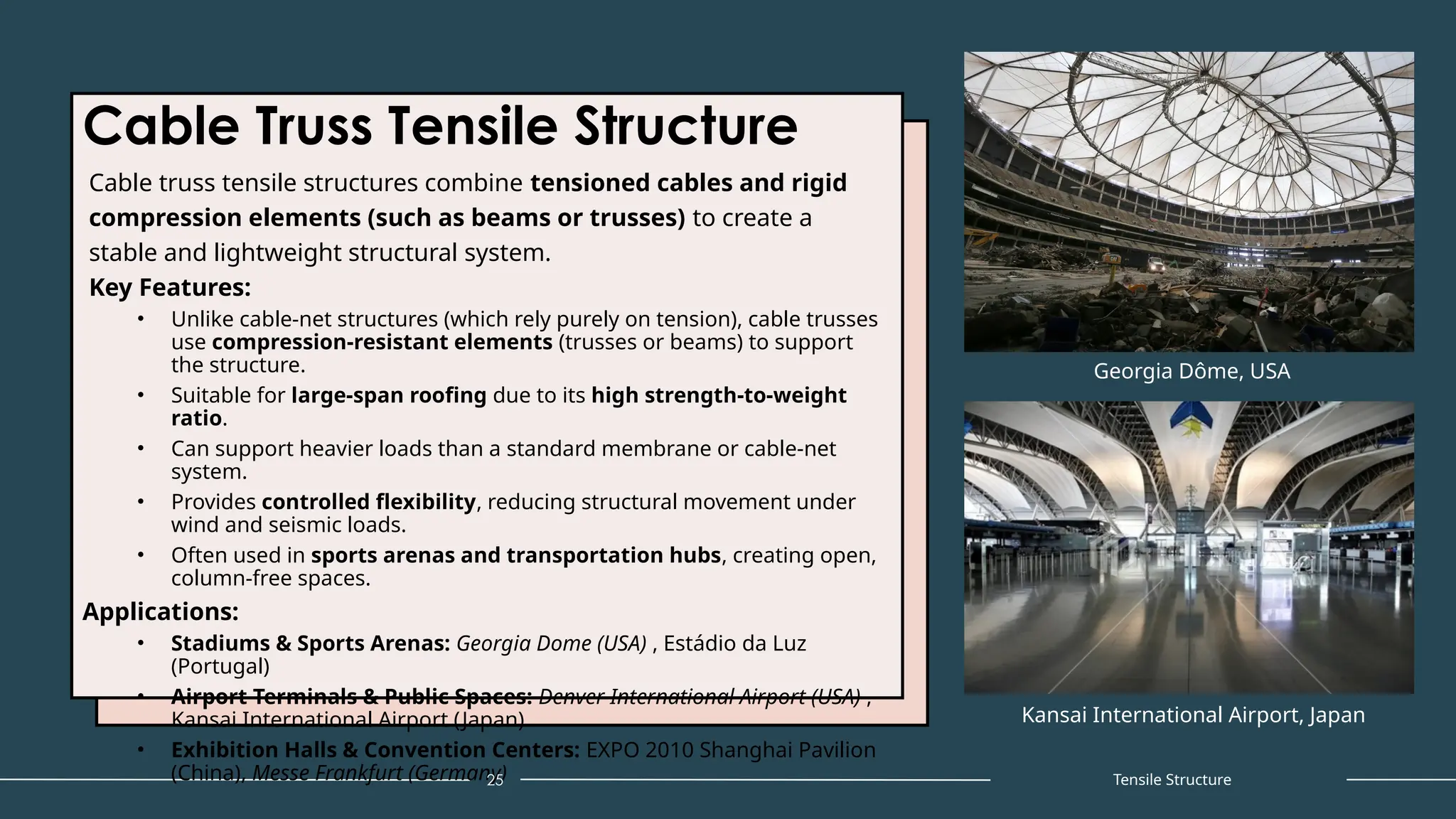
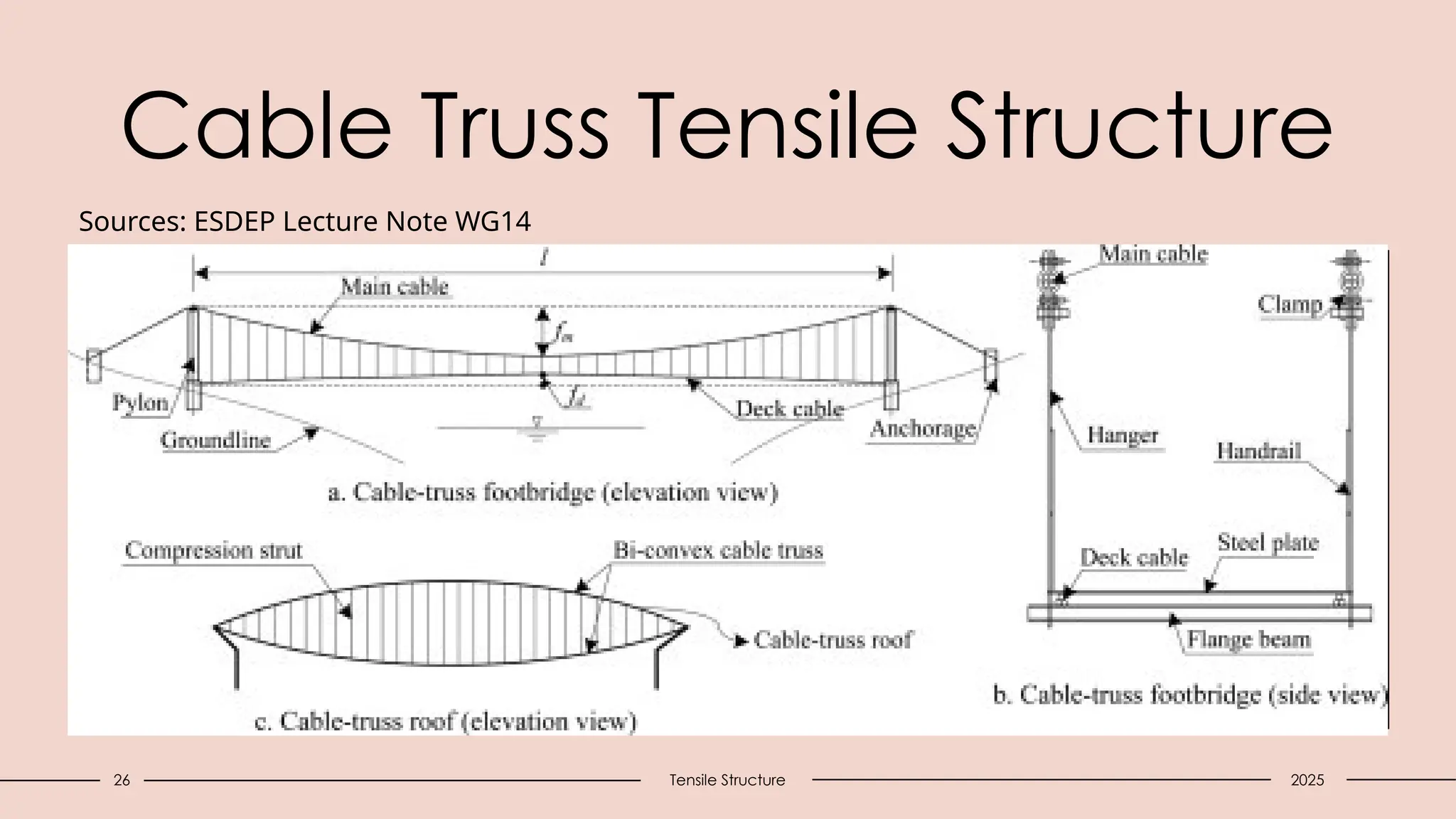
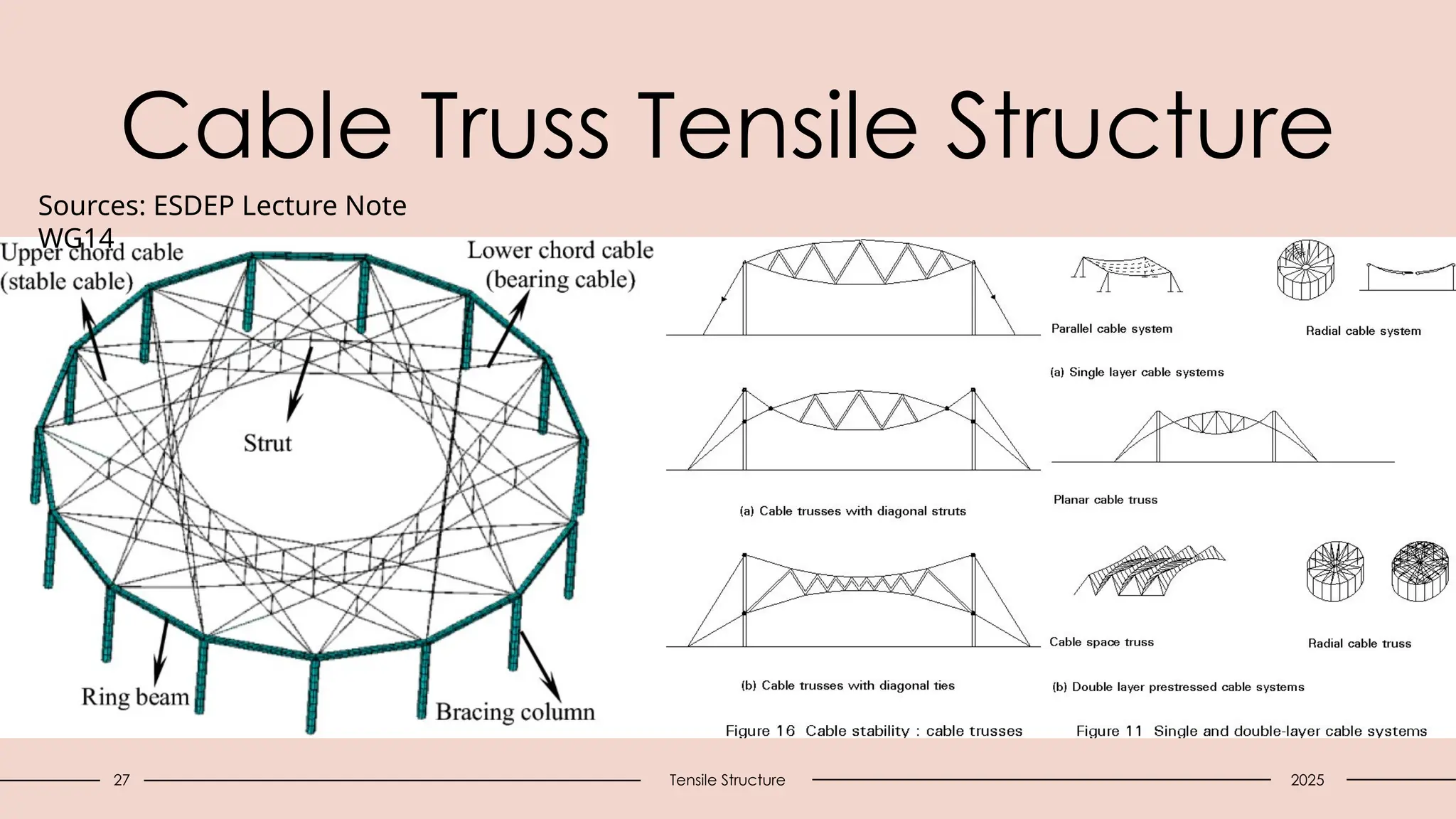
Cable Truss TensileStructure
Cable truss tensile structures combine tensioned cables and rigid
compression elements (such as beams or trusses) to create a
stable and lightweight structural system.
Key Features:
• Unlike cable-net structures (which rely purely on tension), cable trusses
use compression-resistant elements (trusses or beams) to support
the structure.
• Suitable for large-span roofing due to its high strength-to-weight
ratio.
• Can support heavier loads than a standard membrane or cable-net
system.
• Provides controlled flexibility, reducing structural movement under
wind and seismic loads.
• Often used in sports arenas and transportation hubs, creating open,
column-free spaces.
Applications:
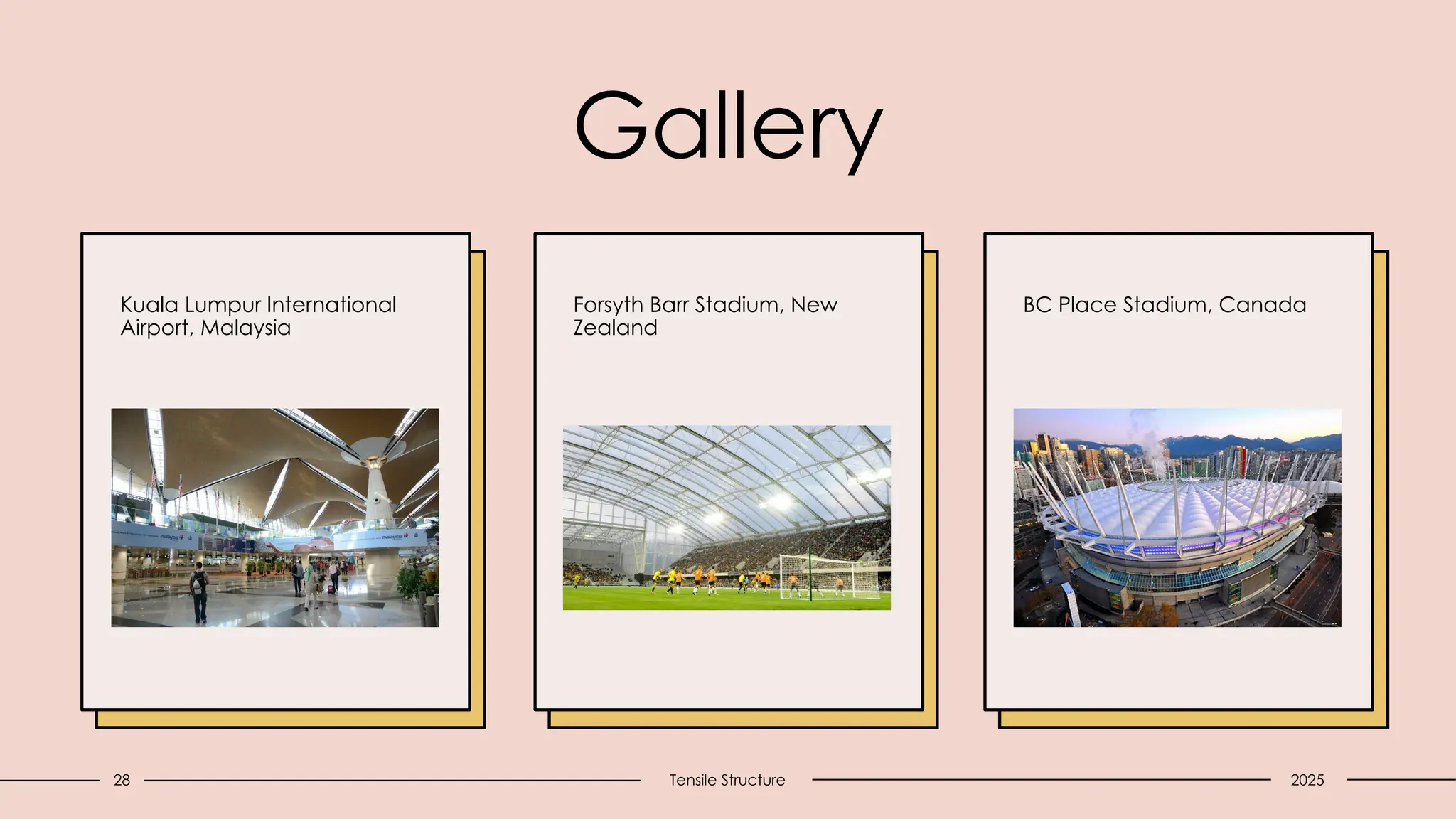
• Stadiums & Sports Arenas: Georgia Dome (USA) , Estádio da Luz
(Portugal)
• Airport Terminals & Public Spaces: Denver International Airport (USA) ,
Kansai International Airport (Japan)
• Exhibition Halls & Convention Centers: EXPO 2010 Shanghai Pavilion
(China), Messe Frankfurt (Germany)
25
Georgia Dôme, USA
Tensile Structure
Kansai International Airport, Japan
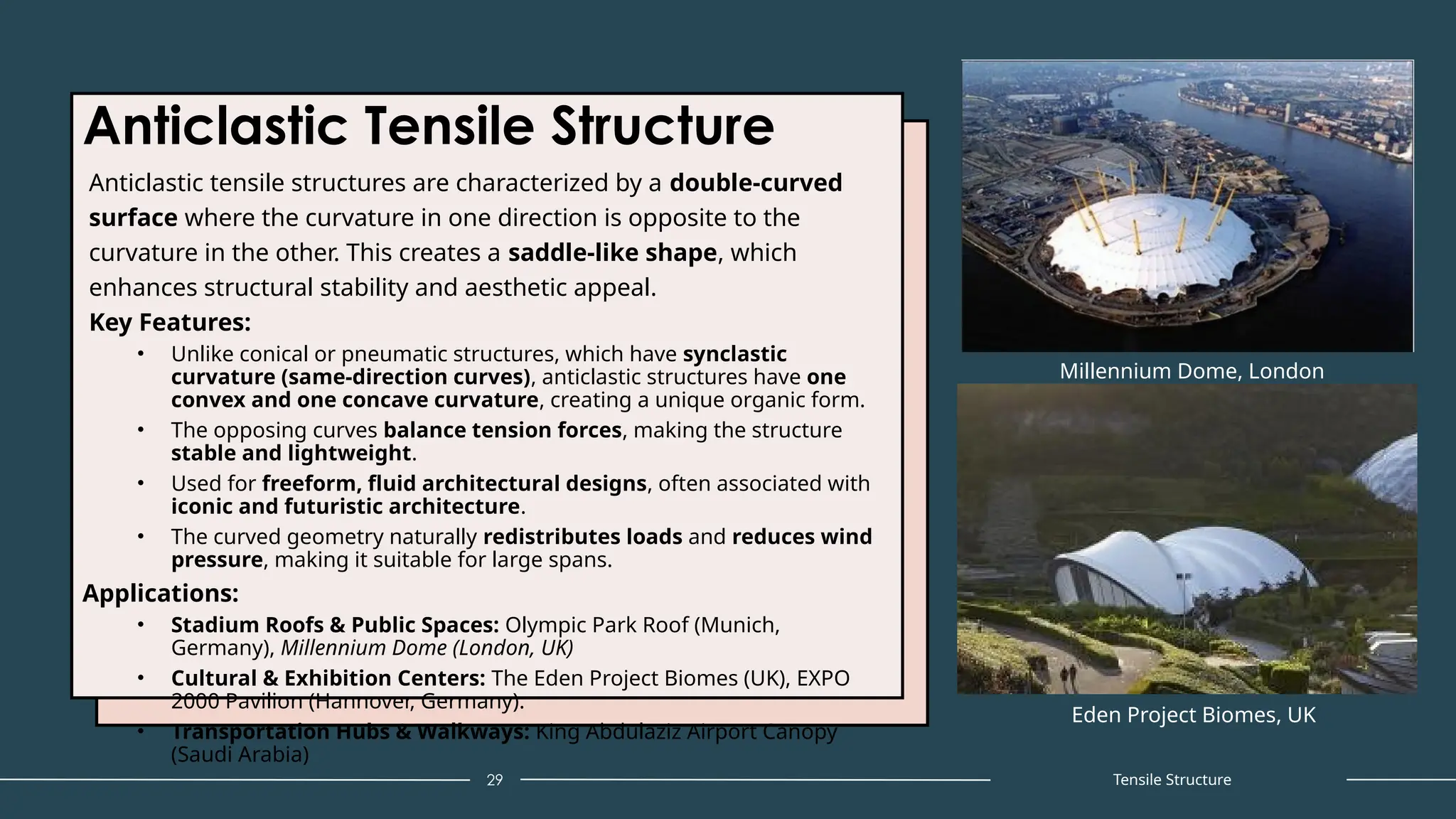
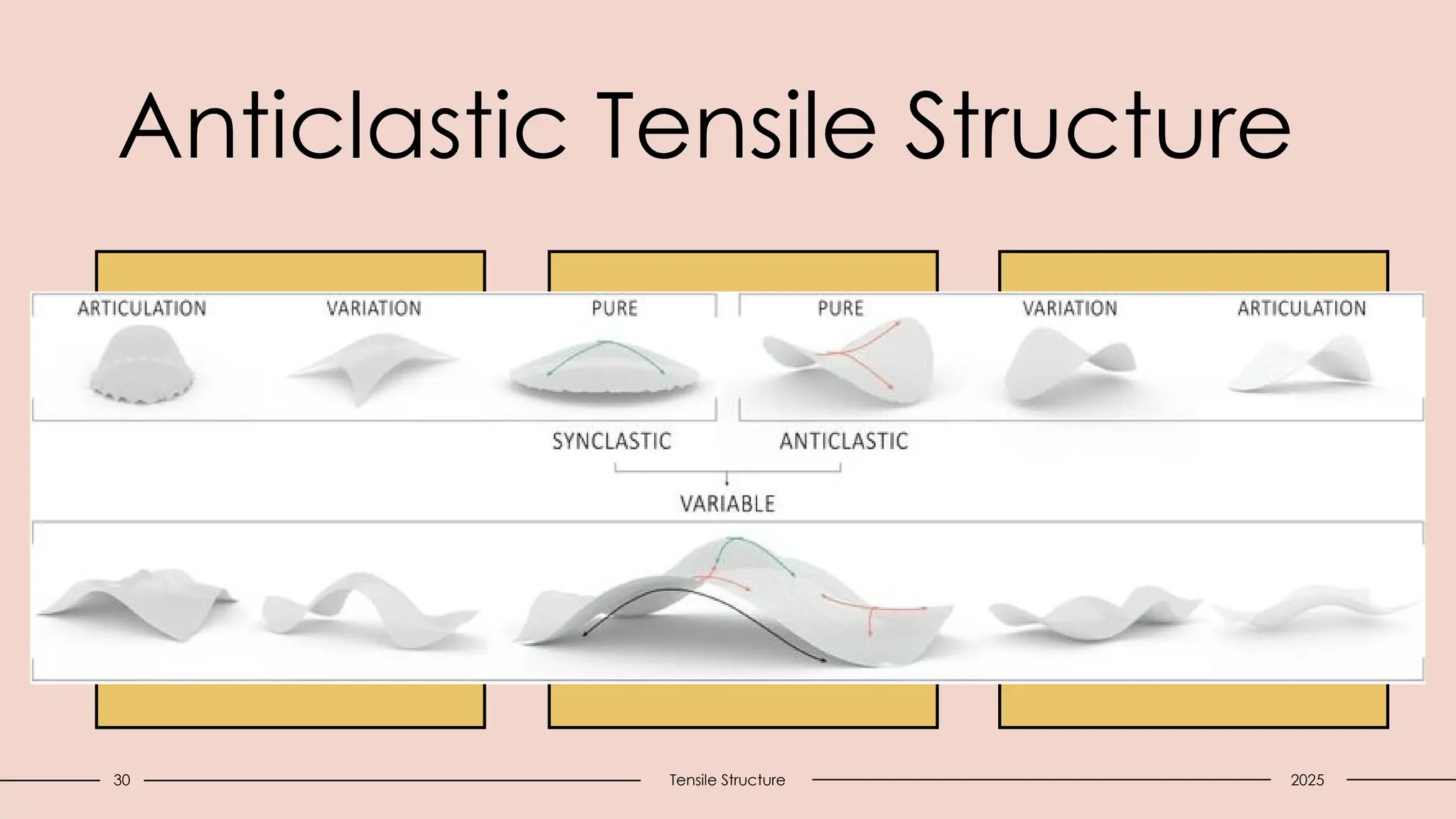
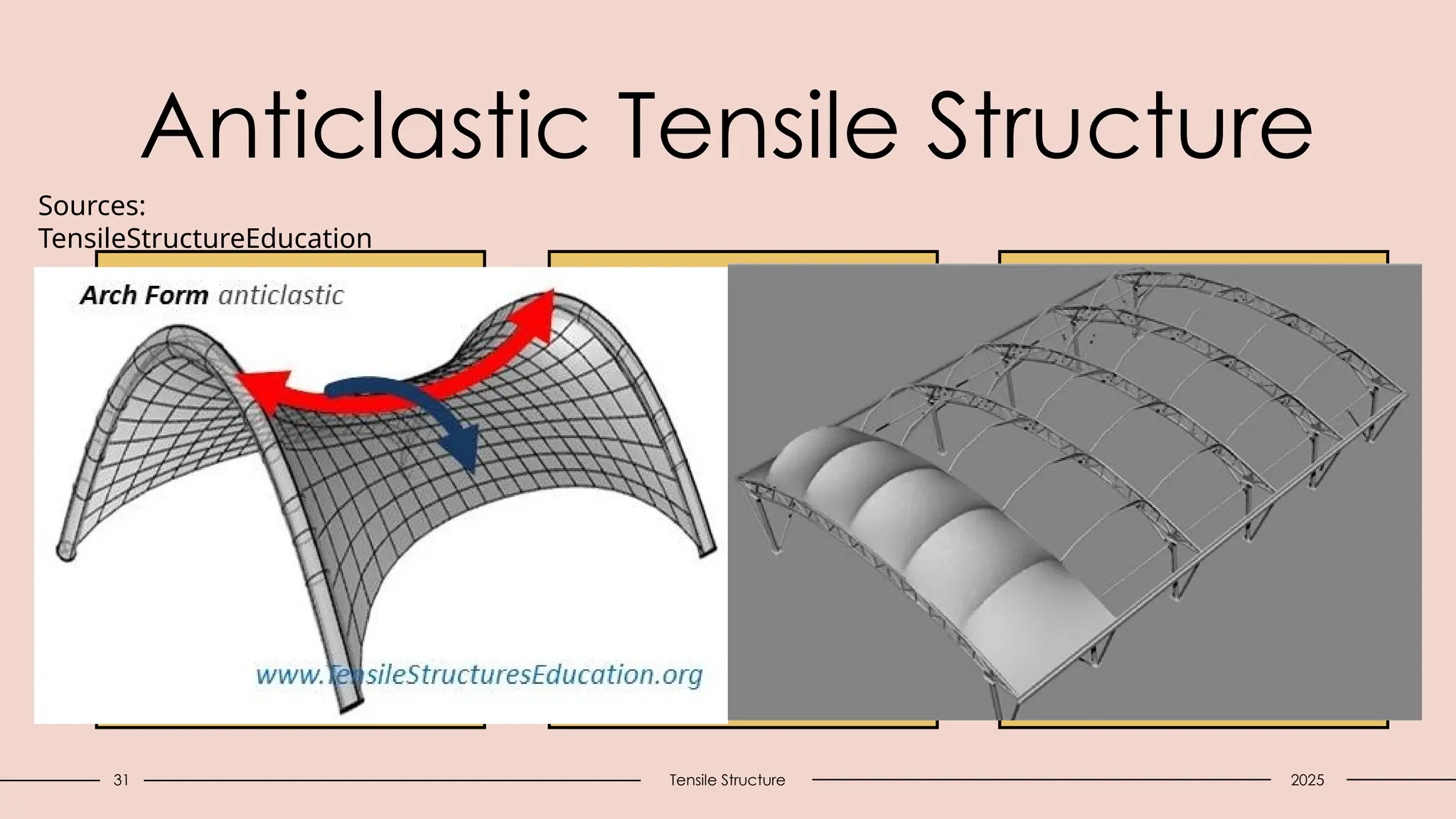
Anticlastic Tensile Structure
Anticlastictensile structures are characterized by a double-curved
surface where the curvature in one direction is opposite to the
curvature in the other. This creates a saddle-like shape, which
enhances structural stability and aesthetic appeal.
Key Features:
• Unlike conical or pneumatic structures, which have synclastic
curvature (same-direction curves), anticlastic structures have one
convex and one concave curvature, creating a unique organic form.
• The opposing curves balance tension forces, making the structure
stable and lightweight.
• Used for freeform, fluid architectural designs, often associated with
iconic and futuristic architecture.
• The curved geometry naturally redistributes loads and reduces wind
pressure, making it suitable for large spans.
Applications:
• Stadium Roofs & Public Spaces: Olympic Park Roof (Munich,
Germany), Millennium Dome (London, UK)
• Cultural & Exhibition Centers: The Eden Project Biomes (UK), EXPO
2000 Pavilion (Hannover, Germany).
• Transportation Hubs & Walkways: King Abdulaziz Airport Canopy
(Saudi Arabia)
29
Millennium Dome, London
Tensile Structure
Eden Project Biomes, UK
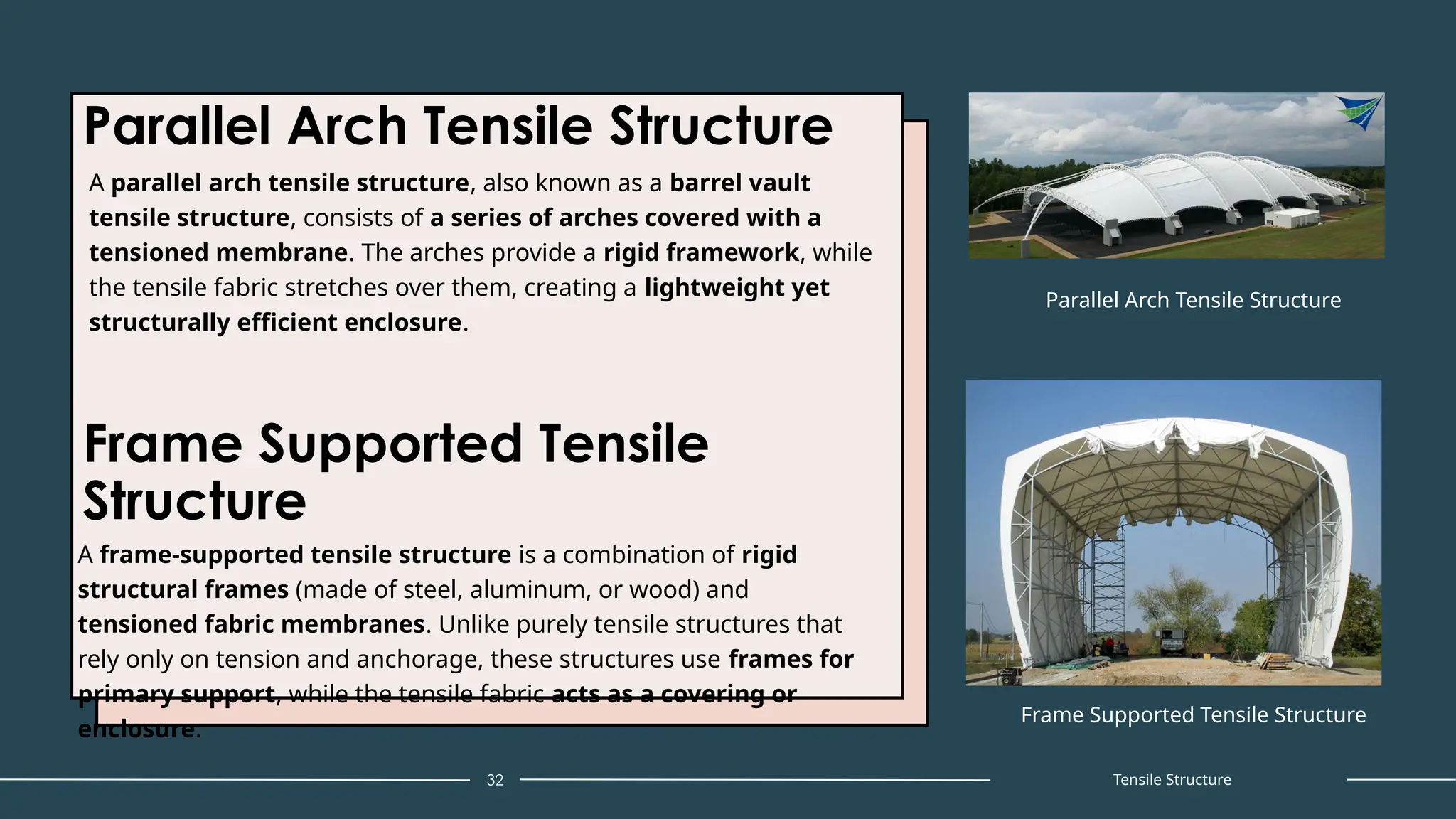
Parallel Arch TensileStructure
A parallel arch tensile structure, also known as a barrel vault
tensile structure, consists of a series of arches covered with a
tensioned membrane. The arches provide a rigid framework, while
the tensile fabric stretches over them, creating a lightweight yet
structurally efficient enclosure.
32
Parallel Arch Tensile Structure
Tensile Structure
Frame Supported Tensile Structure
Frame Supported Tensile
Structure
A frame-supported tensile structure is a combination of rigid
structural frames (made of steel, aluminum, or wood) and
tensioned fabric membranes. Unlike purely tensile structures that
rely only on tension and anchorage, these structures use frames for
primary support, while the tensile fabric acts as a covering or
enclosure.
33.
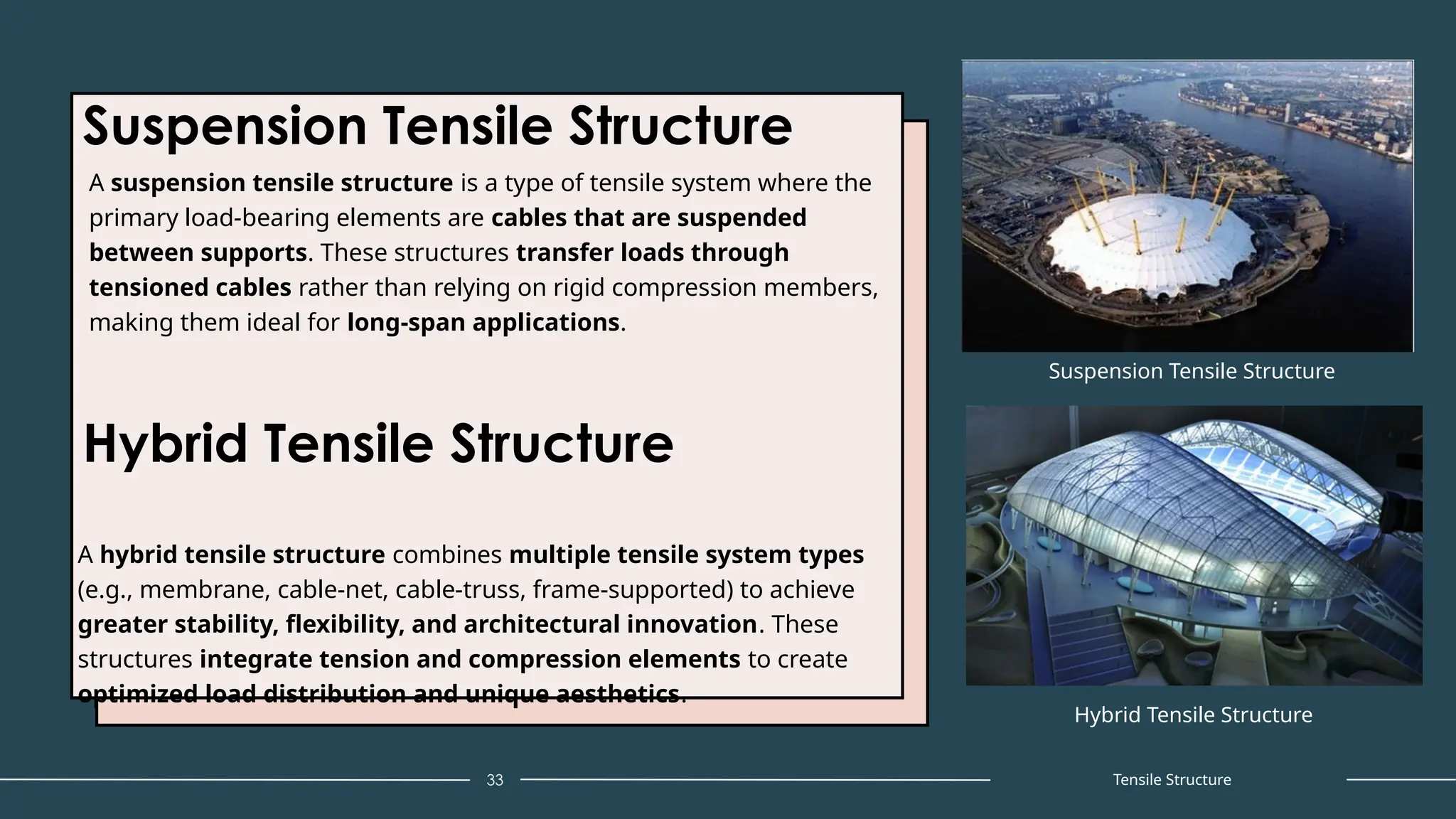
Suspension Tensile Structure
Asuspension tensile structure is a type of tensile system where the
primary load-bearing elements are cables that are suspended
between supports. These structures transfer loads through
tensioned cables rather than relying on rigid compression members,
making them ideal for long-span applications.
33
Suspension Tensile Structure
Tensile Structure
Hybrid Tensile Structure
Hybrid Tensile Structure
A hybrid tensile structure combines multiple tensile system types
(e.g., membrane, cable-net, cable-truss, frame-supported) to achieve
greater stability, flexibility, and architectural innovation. These
structures integrate tension and compression elements to create
optimized load distribution and unique aesthetics.
34.
Pros and Cons
Pros
1.Lightweight and Material Efficient
2. Large Span Coverage with Minimal
Support
3. Aesthetic and Architectural Flexibility
4. Quick Installation and Prefabrication
5. Cost-Effective for Large Spaces
6. Durable and Weather-Resistant
7. Natural Light Transmission
8. Flexible and Earthquake-Resistant
Cons
1. Limited Lifespan
2. Vulnerability to Harsh Weather
3. Higher Maintenance Requirements
4. Limited Fire Resistance
5. Difficult to Modify or Expand
6. Complex Design Process
7. Poor Insulation and Soundproofing
34 Tensile Structure 2025
35.
Conclusion
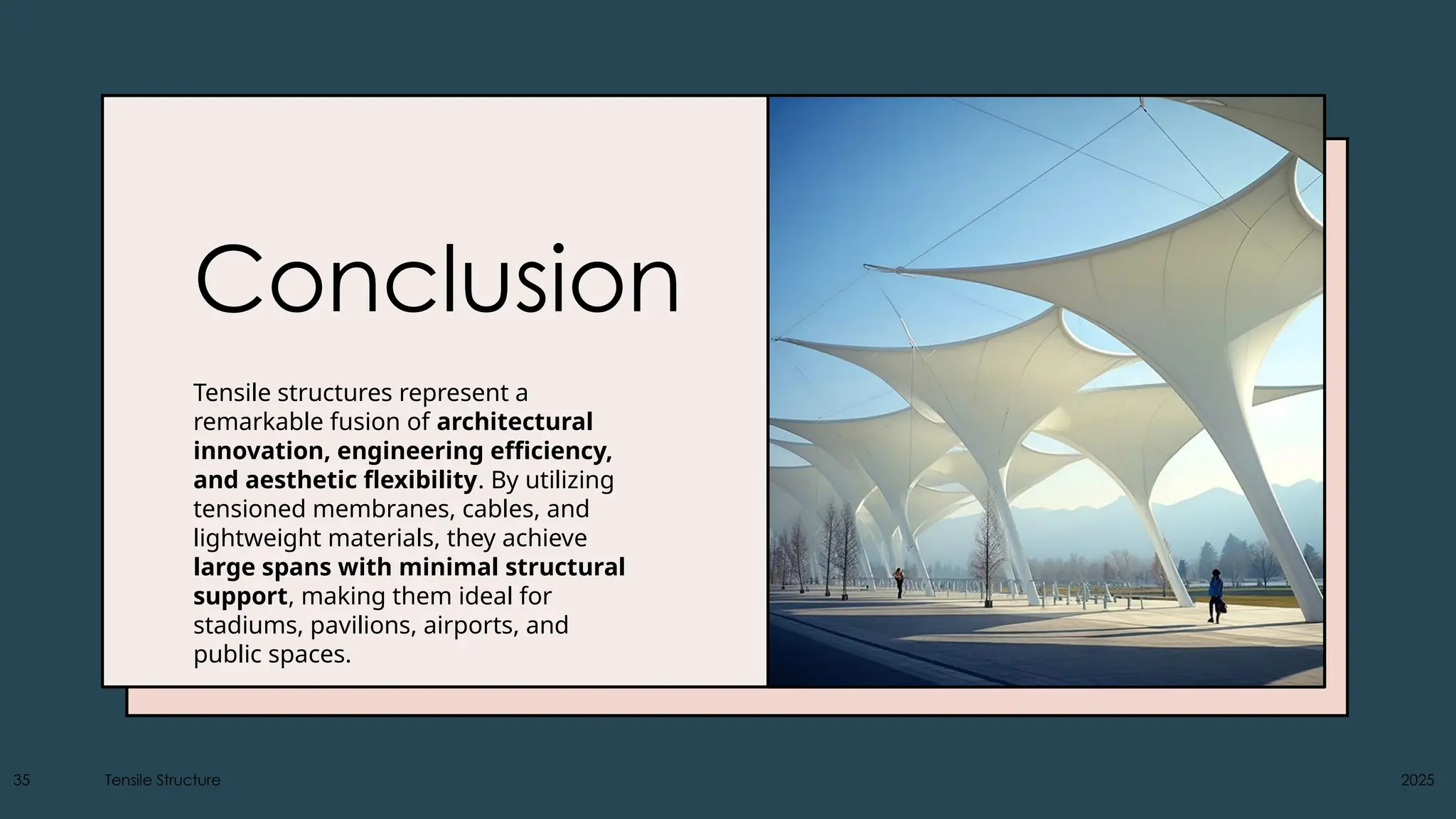
Tensile structures representa
remarkable fusion of architectural
innovation, engineering efficiency,
and aesthetic flexibility. By utilizing
tensioned membranes, cables, and
lightweight materials, they achieve
large spans with minimal structural
support, making them ideal for
stadiums, pavilions, airports, and
public spaces.
35 Tensile Structure 2025