Planning and Managing Software Projects 2011-12
Class 5

Planning Phase – Part 1
Project Phases and Lifecycle Planning


Emanuele Della Valle
http://emanueledellavalle.org
Credits                                                           2

§  This slides are largely based on Prof. John Musser
    class notes on Principles of Software Project
    Management
§  Original slides are available at
    http://www.projectreference.com/
§  Reuse and republish permission was granted


 Planning and Managing Software Projects – Emanuele Della Valle
Today and Next Classes                                            3

§  Today
     •  Phases in Detail
             –  Step-by-step of typical software project
     •  Lifecycles
§  Next Class
     •  Matching Life Cycles to Project
     •  Project plans
§  Next Weeks:
     •  Lots of Project-ish Details: WBS, PERT, CPM, Scheduling
        & Estimation


 Planning and Managing Software Projects – Emanuele Della Valle
Class 3 and 4 Review                                              4

§  PMI Fundamentals
§  PMI Processes
§  Project and Organizations
     •  Functional, Project, Matrix organizations
     •  Role of PM in this type of organizations
§  Project Selection
§  Project Portfolio Management
§  Procurement Management
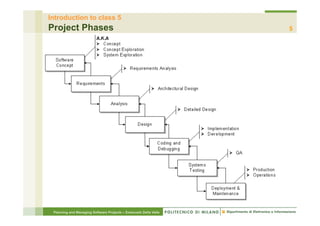
§  Initial documents
     •  Statement of Work (SOW)
     •  Project Charter


 Planning and Managing Software Projects – Emanuele Della Valle
Introduction to class 5
Project Phases                                                    5


 Planning and Managing Software Projects – Emanuele Della Valle
Introduction to class 5
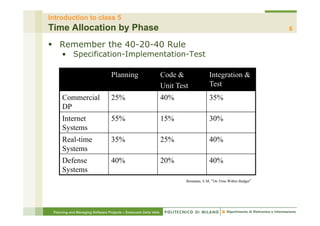
Time Allocation by Phase                                                                                         6

§  Remember the 40-20-40 Rule
     •  Specification-Implementation-Test

                                  Planning                        Code &               Integration &
                                                                  Unit Test            Test
      Commercial                  25%                             40%                  35%
      DP
      Internet                    55%                             15%                  30%
      Systems
      Real-time                   35%                             25%                  40%
      Systems
      Defense                     40%                             20%                  40%
      Systems
                                                                          Bennatan, E.M, On Time Within Budget


 Planning and Managing Software Projects – Emanuele Della Valle
Introduction to class 5
Time Allocation by Phase                                                                                7


           Activity                            Small Project            Large Project
                                               (2.5K LOC)               (500K LOC)
           Analysis                            10%                      30%

           Design                              20%                      20%

           Code                                25%                      10%

           Unit Test                           20%                      5%

           Integration                         15%                      20%

           System test                         10%                      15%

                                                                  McConnell, Steve, Rapid Development


 Planning and Managing Software Projects – Emanuele Della Valle
Introduction to class 5
Activities by % of Total Effort                                                                                        8


                                                                  NASA s Manager s Handbook for Software Development

 Planning and Managing Software Projects – Emanuele Della Valle
Introduction to class 5
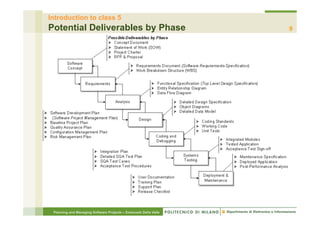
Potential Deliverables by Phase                                   9


 Planning and Managing Software Projects – Emanuele Della Valle
Phases in Detail
Concept Exploration Phase 1/3                                     10

§  The Why phase
§  Not a mandatory formal phase
     •  Sometimes called the pre-project phase
§  Collecting project ideas
     •  Then the funneling process
§  Project Justification
     •  Cost-benefit analysis
     •  Project Portfolio Matrix
     •  ROI
§  Initial planning and estimates


 Planning and Managing Software Projects – Emanuele Della Valle
Phases in Detail
Concept Exploration Phase 2/3                                     11

§  Possibly includes Procurement Management:
     •  RFP Process
     •  Vendor selection
     •  Contract management
§  Gathering the initial team
     •  Including PM if not already on-board
§  Identify the project sponsor
     •  Primary contact for approval and decision making
§  Potential Phase Outputs:
     •  Concept Document, Product Description, Proposal, SOW,
        Project Charter


 Planning and Managing Software Projects – Emanuele Della Valle
Phases in Detail
Concept Exploration Phase 3/3                                            12

§  Characteristics & Issues
     •  Lack of full commitment and leadership
     •  Some frustrations:
             –  Management only getting rough estimates from
                development
             –  Development not getting enough specifics from customer
             –  Finding a balanced team
     •  Budget sign-off may be your 1st major task as PM


§  Achieved via:
     •  Good concept document or equivalent
     •  Demonstration of clear need (justification)
     •  Initial estimates


 Planning and Managing Software Projects – Emanuele Della Valle
Phases in Detail
Requirements Phase                                                13

§  The What phase
§  Inputs: SOW, Proposal
§  Outputs:
     •  Requirements Document (RD)
             –  a.k.a.Requirements Specification Document (RSD)
             –  Software Requirements Specification (SRS)
     •  1st Project Baseline
     •  Software Project Management Plan (SPMP)
     •  Requirements Approval & Sign-Off
             –  Your most difficult task in this phase


 Planning and Managing Software Projects – Emanuele Della Valle
Phases in Detail
More on Requirements Phase                                        14

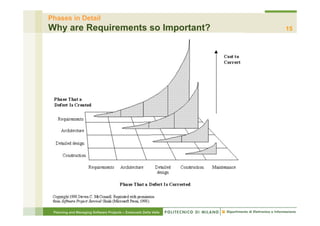
§  Perhaps most important & difficult phase
§  Shortchanging it is a classic mistake
§  Can begin with a Project Kickoff Meeting
§  Can end with a Software Requirements Review (SRR)
     •  For Sponsor and/or customer(s) approval


 Planning and Managing Software Projects – Emanuele Della Valle
Phases in Detail
Why are Requirements so Important?                                15


 Planning and Managing Software Projects – Emanuele Della Valle
Phases in Detail
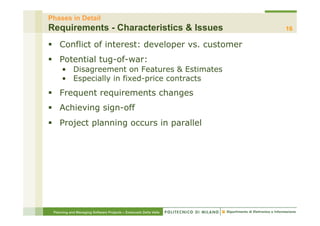
Requirements - Characteristics & Issues                           16

§  Conflict of interest: developer vs. customer
§  Potential tug-of-war:
     •  Disagreement on Features & Estimates
     •  Especially in fixed-price contracts
§  Frequent requirements changes
§  Achieving sign-off
§  Project planning occurs in parallel


 Planning and Managing Software Projects – Emanuele Della Valle
Phases in Detail
Requirements - Definition                                         17

§  Requirements are capabilities and condition to
    which the system – more broadly, the project –
    must conform


 Planning and Managing Software Projects – Emanuele Della Valle
Phases in Detail
2 Types of Requirements                                           18

§  Functional (behavioral)
     •  Features and capabilities
§  Non-functional (a.k.a. technical ) (everything else)
     •  Usability
             –  Human factors, help, documentation
     •  Reliability
             –  Failure rates, recoverability, availability
     •  Performance
             –  Response times, throughput, resource usage
     •  Supportability
             –  Maintainability, internationalization
     •  Operations: systems management, installation
     •  Interface: integration with other systems
     •  Other: legal, packaging, hardware


 Planning and Managing Software Projects – Emanuele Della Valle
Phases in Detail
Requirements                                                          19

§  Other ways of categorizing
     •  Go-Ahead vs. Catch-up
             –  Relative to competition
     •  Backward-looking vs. Forward-looking
             –  Backward: address issues with previous version
             –  Forward: Anticipating future needs of customers

§  Must be prioritized
     •  Must-have
     •  Should-have
     •  Could-have (Nice-to-have: NTH)
§  Must be approved
§  An example I m proud of
     •  http://www.service-finder.eu/attachments/D1.1.pdf
             –  You may find it a bit gold-plated, you may be right


 Planning and Managing Software Projects – Emanuele Della Valle
Phases in Detail
Early Phases Meetings                                             20

§  Project Kickoff Meeting
§  Project Brainstorming Meeting
     •  Clarify goals, scope, assumptions
     •  Refine estimates
§  WBS Meeting


 Planning and Managing Software Projects – Emanuele Della Valle
Phases in Detail
Analysis & Design Phase                                           21

§  The How Phases
§  Inputs: Requirements Document
§  Outputs:
     •      Functional Specification
     •      Detailed Design Document
     •      User Interface Specification
     •      Data Model
     •      Prototype (can also be done with requirements)
     •      Updated Plan (improved estimates; new baseline)


 Planning and Managing Software Projects – Emanuele Della Valle
Phases in Detail
More on Analysis & Design Phase                                   22

§  a.k.a. Top-level design & detailed design
§  Continues process from requirement definition
§  Ends with Critical Design Review (CDR)
     •  Formal sign-off
     •  Can also include earlier Preliminary Design Review (PDR)
        for high level design


 Planning and Managing Software Projects – Emanuele Della Valle
Phases in Detail
Analysis & Design - Characteristics & Issues                      23

§  Enthusiasm via momentum
§  Team structure and assignments finalized
§  Delays due to requirements changes, new information
    or late ideas
§  Issues around personnel responsibilities
§  Unfeasible requirements (technical complexity)
§  Resource Issues
     •  Including inter-project contention


 Planning and Managing Software Projects – Emanuele Della Valle
Phases in Detail
Development Phase                                                 24

§  The Do It phase
§  Coding & Unit testing
§  Often overlaps Design & Integration phases
     •  To shorten the overall schedule
     •  PM needs to coordinate this
§  Other concurrent activities
     •      Design completion
     •      Integration begins
     •      Unit testing of individual components
     •      Test bed setup (environment and tools)
     •      Project plans updated
     •      Scope and Risk Management conducted


 Planning and Managing Software Projects – Emanuele Della Valle
Phases in Detail
Development - Characteristics & Issues                            25

§  Characteristics
     •  Pressure increases
     •  Staffing at highest levels
     •  Often a heads-down operation
§  Issues
     •      Last-minute changes
     •      Team coordination (esp. in large projects)
     •      Communication overhead
     •      Management of sub-contractors


 Planning and Managing Software Projects – Emanuele Della Valle
Phases in Detail
Integration & Test Phase                                          26

§  Evolves from Development Phase
§  Often done as 2 parallel phases
     •  Partial integration & initial test
§  Starts with integration of modules
§  An initial, incomplete version constructed
§  Progressively add more components


 Planning and Managing Software Projects – Emanuele Della Valle
Phases in Detail
Integration & Test                                                27

§  Integration primarily a programmer task
§  Test primarily a QA team task
§  Integration:
     •  Top-down: Core functionality first, empty shells for
        incomplete routines (stubs)
     •  Bottom up: gradually bind low-level modules
     •  Prefer top-down generally
§  Tests
     •      Integration testing
     •      Black & White-box testing
     •      Load & Stress testing
     •      Alpha & Beta testing
     •      Acceptance testing


 Planning and Managing Software Projects – Emanuele Della Valle
Phases in Detail
Integration & Test - Other activities                             28

§  final budgeting
§  risk management
§  training
§  installation preparation
§  team reduced


 Planning and Managing Software Projects – Emanuele Della Valle
Phases in Detail
Integration & Test - Characteristics & Issues                     29

§  Increased pressure
§  Overtime
§  Customer conflicts over features
§  Frustration over last-minute failures
§  Budget overruns
§  Motivation problems (such as burnout)
§  Difficulty in customer acceptance
     •  Especially true for fixed-price contracts


 Planning and Managing Software Projects – Emanuele Della Valle
Phases in Detail
Deployment & Maintenance Phase                                    30

§  Installation depends on system type
     •  Web-based, CD-ROM, in-house, etc.
§  Migration strategy
§  How to get customers up on the system
     •  Parallel operation
§  Deployment typically in your project plan,
    maintenance not


 Planning and Managing Software Projects – Emanuele Della Valle
Phases in Detail
More on Maintenance                                               31

§  Maintenance
     •  Fix defects
     •  Add new features
     •  Improve performance
§  Configuration control is very important here
§  Documents need to be maintained also
§  Sometimes a single team maintains multiple products


 Planning and Managing Software Projects – Emanuele Della Valle
Phases in Detail
Deployment & Maintenance                                          32

§  Lack of enthusiasm
§  Pressure for quick fixes
§  Insufficient budget
§  Too many patches
§  Personnel turnover
§  Regression testing is critical
     •  Preferably through automated tools


 Planning and Managing Software Projects – Emanuele Della Valle
Lifecycle Planning                                                33

§  a.k.a. Lifecycle Management or Systems Development
    Life Cycle (SDLC )
§  Greatly influences your chance of success
§  Not choosing a lifecycle is a bad option
§  Three primary lifecycle model components
     •  Phases and their order
     •  Intermediate products of each phase
     •  Reviews used in each phase


 Planning and Managing Software Projects – Emanuele Della Valle
Lifecycle Planning                                                34

§  Different projects require different approaches
§  You do not need to know all models by name
§  You should know how that if given a certain scenario
    what sort of SDLC would be appropriate
§  There are more than covered here
§  A lifecycle is not a design, modeling or diagramming
    technique
     •  The same technique (UML, DFD, etc) can be used with
        multiple lifecycles


 Planning and Managing Software Projects – Emanuele Della Valle
Lifecycle Planning
Pure Waterfall                                                    35

§  The granddaddy of models
§  Linear sequence of phases
     •        Pure model: no phases overlap
§  Document driven
§  All planning done up-front


 Planning and Managing Software Projects – Emanuele Della Valle
Lifecycle Planning
Waterfall Risk                                                    36

§  Why does the waterfall model invite risk ?
§  Integration and testing occur at the end
     •  Often anyone s 1st chance to see the program


 Planning and Managing Software Projects – Emanuele Della Valle
Lifecycle Planning
Pure Waterfall                                                    37

§  Works well for projects with
     •      Stable product definition
     •      Well-understood technologies
     •      Quality constraints stronger than cost & schedule
     •      Technically weak staff
             –  Provides structure
             –  Good for overseas projects


 Planning and Managing Software Projects – Emanuele Della Valle
Lifecycle Planning
Pure Waterfall                                                    38

§  Disadvantages
     •  Not flexible
             –  Rigid march from start->finish
     •  Difficult to fully define requirements up front
     •  Can produce excessive documentation
     •  Few visible signs of progress until the end


 Planning and Managing Software Projects – Emanuele Della Valle
Lifecycle Planning
Code-and-Fix                                                           39

§          Code-like-Hell
§  Specification (maybe), Code (yes), Release (maybe)
§  Advantages
          •  No overhead
          •  Requires little expertise
§  Disadvantages
          •  No process, quality control, etc.
          •  Highly risky
§  Suitable for prototypes or throwaways


      Planning and Managing Software Projects – Emanuele Della Valle
Lifecycle Planning
Spiral                                                            40


 Planning and Managing Software Projects – Emanuele Della Valle
Lifecycle Planning
Spiral                                                            41

§  Emphasizes risk analysis & mgmt. in each phase
§  A Series of Mini-projects
§  Each addresses a set of risks
     •  Start small, explore risks, prototype, plan, repeat
§  Early iterations are cheapest
§  Number of spirals is variable
     •  Last set of steps are waterfall-like


 Planning and Managing Software Projects – Emanuele Della Valle
Lifecycle Planning
Spiral                                                            42

§  Advantages
     •  Can be combined with other models
     •  As costs increase, risks decrease
     •  Risk orientation provides early warning
§  Disadvantages
     •  More complex
     •  Requires more management


 Planning and Managing Software Projects – Emanuele Della Valle
Lifecycle Planning
Modified Waterfall – Sashimi                                      43

§  Overlapping phases
§  Advantages
     •  Reduces overall schedule
     •  Reduces documentation
     •  Works well if personnel continuity
§  Disadvantages
     •  Milestones more ambiguous
     •  Progress tracking more difficult
     •  Communication can be more difficult


 Planning and Managing Software Projects – Emanuele Della Valle
Lifecycle Planning
Evolutionary Prototyping                                          44

§  Design most prominent parts first
     •  Usually via a visual prototype
§  Good for situations with:
     •  Rapidly changing requirements
     •  Non-committal customer
     •  Vague problem domain
§  Provides steady, visible progress
§  Disadvantages
     •  Time estimation is difficult
     •  Project completion date may be unknown
     •  An excuse to do code-and-fix


 Planning and Managing Software Projects – Emanuele Della Valle
Lifecycle Planning
Staged Delivery                                                     45

§  Waterfall steps through architectural design
§  Then detailed design, code, test, deliver in stages
§  Advantages
     •      Customers get product much sooner
     •      Tangible signs of progress sooner
     •      Problems discovered earlier
     •      Increases flexibility
     •      Reduces: status reporting overhead & estimation error
§  Disadvantages
     •  Requires more planning (for you the PM)
     •  More releases increase effort (and possible feature
        creep)
§  Similar to Evolutionary Prototyping, but guided by a
    strong architectural design

 Planning and Managing Software Projects – Emanuele Della Valle
Lifecycle Planning
V Process Model                                                   46


 Planning and Managing Software Projects – Emanuele Della Valle
Lifecycle Planning
V Process Model                                                   47

§  Designed for testability
     •  Emphasizes Verification & Validation (V&V)
§  Variation of waterfall
§  Strengths
     •  Encourages V&V at all phases
§  Weaknesses
     •  Does not handle iterations
     •  Changes can be more difficult to handle
§  Good choice for systems that require high reliability
    such as patient control systems


 Planning and Managing Software Projects – Emanuele Della Valle
Lifecycle Planning
Commercial Off-The-Shelf software (COTS)                          48

§  Build-vs.-buy decision
§  Advantages
     •  Available immediately
     •  Potentially lower cost
§  Disadvantages
     •  Not as tailored to your requirements
§  Remember: custom software rarely meets its ideal (so
    compare that reality to COTS option)


 Planning and Managing Software Projects – Emanuele Della Valle
Lifecycle Planning
Rapid Application Development                                     49

§  Phases
     1.  Joint Requirements
         Planning (JRP)
     2.  Joint Application
         Design (JAD)
     3.  Construction
             –  Heavy use of tools,
                code generators
             –  Time-boxed,
                many prototypes
     4. Cutover
§  Good for systems with extensive user input available


 Planning and Managing Software Projects – Emanuele Della Valle
Lifecycle Planning
XP: eXtreme Programming                                           50

§  Part of movement called Agile Development
§  A Lightweight methodology
§  A bit counter-culture
§  Currently in vogue
§  Motto: Embrace Change
§  Highly Incremental / Iterative


 Planning and Managing Software Projects – Emanuele Della Valle
Lifecycle Planning
eXtreme Programming                                               51


 Planning and Managing Software Projects – Emanuele Della Valle
Lifecycle Planning
eXtreme Programming                                               52

§  Suitable for small groups
§  Attempts to minimize unnecessary work
§  Uses an on-site customer
§  Small releases
§  Pair programming
§  Refactoring
§  Stories as requirements
§  You want good developers if you use this


 Planning and Managing Software Projects – Emanuele Della Valle
Lifecycle Planning
Other Agile Methodologies                                                      53

§  Agile here means lite , reduced docs, highly iterative
§  Agile Software Development
     •  Alliance , http://www.agilealliance.org/home
     •  their manifesto , http://agilemanifesto.org/
     •  their book
            http://www.amazon.com/exec/obidos/ASIN/0201699699/104-2402656-5403151

§  SCRUM
     •  Features 30-day Sprint cycles
     •  See http://jeffsutherland.org/scrum/
§  Feature Driven Development (FDD)
     •  XP with more emphasis on docs and process


 Planning and Managing Software Projects – Emanuele Della Valle
Lifecycle Planning
 Agile Methodologies                                              54

§  Pros
     •  can reduce process overhead
     •  Responsive to user feedback
     •  Amenable to change
§  Cons
     •  Requires close monitoring by PM
     •  May not scale to large projects
     •  Often requires better quality developers


 Planning and Managing Software Projects – Emanuele Della Valle
Optional Reading                                                  55

§  “Iterative software development process” methods has
    to be “metabolise”
§  If the team, the PM and all the stakeholders do not
    metabolize them, the project risks failing.
§  Reading: “How to Fail with the Rational Unified
    Process: Seven Steps to Pain and Suffering”
     •  http://www.ceng.metu.edu.tr/~gtumuklu/web/SE548/
        Reading%20Material/HowToFailWRational.pdf


 Planning and Managing Software Projects – Emanuele Della Valle

Planning Phase Part I - Project Phases and Lifecycle Planning

  • 1.
    Planning and ManagingSoftware Projects 2011-12 Class 5 Planning Phase – Part 1 Project Phases and Lifecycle Planning Emanuele Della Valle http://emanueledellavalle.org
  • 2.
    Credits 2 §  This slides are largely based on Prof. John Musser class notes on Principles of Software Project Management §  Original slides are available at http://www.projectreference.com/ §  Reuse and republish permission was granted Planning and Managing Software Projects – Emanuele Della Valle
  • 3.
    Today and NextClasses 3 §  Today •  Phases in Detail –  Step-by-step of typical software project •  Lifecycles §  Next Class •  Matching Life Cycles to Project •  Project plans §  Next Weeks: •  Lots of Project-ish Details: WBS, PERT, CPM, Scheduling & Estimation Planning and Managing Software Projects – Emanuele Della Valle
  • 4.
    Class 3 and4 Review 4 §  PMI Fundamentals §  PMI Processes §  Project and Organizations •  Functional, Project, Matrix organizations •  Role of PM in this type of organizations §  Project Selection §  Project Portfolio Management §  Procurement Management §  Initial documents •  Statement of Work (SOW) •  Project Charter Planning and Managing Software Projects – Emanuele Della Valle
  • 5.
    Introduction to class5 Project Phases 5 Planning and Managing Software Projects – Emanuele Della Valle
  • 6.
    Introduction to class5 Time Allocation by Phase 6 §  Remember the 40-20-40 Rule •  Specification-Implementation-Test Planning Code & Integration & Unit Test Test Commercial 25% 40% 35% DP Internet 55% 15% 30% Systems Real-time 35% 25% 40% Systems Defense 40% 20% 40% Systems Bennatan, E.M, On Time Within Budget Planning and Managing Software Projects – Emanuele Della Valle
  • 7.
    Introduction to class5 Time Allocation by Phase 7 Activity Small Project Large Project (2.5K LOC) (500K LOC) Analysis 10% 30% Design 20% 20% Code 25% 10% Unit Test 20% 5% Integration 15% 20% System test 10% 15% McConnell, Steve, Rapid Development Planning and Managing Software Projects – Emanuele Della Valle
  • 8.
    Introduction to class5 Activities by % of Total Effort 8 NASA s Manager s Handbook for Software Development Planning and Managing Software Projects – Emanuele Della Valle
  • 9.
    Introduction to class5 Potential Deliverables by Phase 9 Planning and Managing Software Projects – Emanuele Della Valle
  • 10.
    Phases in Detail ConceptExploration Phase 1/3 10 §  The Why phase §  Not a mandatory formal phase •  Sometimes called the pre-project phase §  Collecting project ideas •  Then the funneling process §  Project Justification •  Cost-benefit analysis •  Project Portfolio Matrix •  ROI §  Initial planning and estimates Planning and Managing Software Projects – Emanuele Della Valle
  • 11.
    Phases in Detail ConceptExploration Phase 2/3 11 §  Possibly includes Procurement Management: •  RFP Process •  Vendor selection •  Contract management §  Gathering the initial team •  Including PM if not already on-board §  Identify the project sponsor •  Primary contact for approval and decision making §  Potential Phase Outputs: •  Concept Document, Product Description, Proposal, SOW, Project Charter Planning and Managing Software Projects – Emanuele Della Valle
  • 12.
    Phases in Detail ConceptExploration Phase 3/3 12 §  Characteristics & Issues •  Lack of full commitment and leadership •  Some frustrations: –  Management only getting rough estimates from development –  Development not getting enough specifics from customer –  Finding a balanced team •  Budget sign-off may be your 1st major task as PM §  Achieved via: •  Good concept document or equivalent •  Demonstration of clear need (justification) •  Initial estimates Planning and Managing Software Projects – Emanuele Della Valle
  • 13.
    Phases in Detail RequirementsPhase 13 §  The What phase §  Inputs: SOW, Proposal §  Outputs: •  Requirements Document (RD) –  a.k.a.Requirements Specification Document (RSD) –  Software Requirements Specification (SRS) •  1st Project Baseline •  Software Project Management Plan (SPMP) •  Requirements Approval & Sign-Off –  Your most difficult task in this phase Planning and Managing Software Projects – Emanuele Della Valle
  • 14.
    Phases in Detail Moreon Requirements Phase 14 §  Perhaps most important & difficult phase §  Shortchanging it is a classic mistake §  Can begin with a Project Kickoff Meeting §  Can end with a Software Requirements Review (SRR) •  For Sponsor and/or customer(s) approval Planning and Managing Software Projects – Emanuele Della Valle
  • 15.
    Phases in Detail Whyare Requirements so Important? 15 Planning and Managing Software Projects – Emanuele Della Valle
  • 16.
    Phases in Detail Requirements- Characteristics & Issues 16 §  Conflict of interest: developer vs. customer §  Potential tug-of-war: •  Disagreement on Features & Estimates •  Especially in fixed-price contracts §  Frequent requirements changes §  Achieving sign-off §  Project planning occurs in parallel Planning and Managing Software Projects – Emanuele Della Valle
  • 17.
    Phases in Detail Requirements- Definition 17 §  Requirements are capabilities and condition to which the system – more broadly, the project – must conform Planning and Managing Software Projects – Emanuele Della Valle
  • 18.
    Phases in Detail 2Types of Requirements 18 §  Functional (behavioral) •  Features and capabilities §  Non-functional (a.k.a. technical ) (everything else) •  Usability –  Human factors, help, documentation •  Reliability –  Failure rates, recoverability, availability •  Performance –  Response times, throughput, resource usage •  Supportability –  Maintainability, internationalization •  Operations: systems management, installation •  Interface: integration with other systems •  Other: legal, packaging, hardware Planning and Managing Software Projects – Emanuele Della Valle
  • 19.
    Phases in Detail Requirements 19 §  Other ways of categorizing •  Go-Ahead vs. Catch-up –  Relative to competition •  Backward-looking vs. Forward-looking –  Backward: address issues with previous version –  Forward: Anticipating future needs of customers §  Must be prioritized •  Must-have •  Should-have •  Could-have (Nice-to-have: NTH) §  Must be approved §  An example I m proud of •  http://www.service-finder.eu/attachments/D1.1.pdf –  You may find it a bit gold-plated, you may be right Planning and Managing Software Projects – Emanuele Della Valle
  • 20.
    Phases in Detail EarlyPhases Meetings 20 §  Project Kickoff Meeting §  Project Brainstorming Meeting •  Clarify goals, scope, assumptions •  Refine estimates §  WBS Meeting Planning and Managing Software Projects – Emanuele Della Valle
  • 21.
    Phases in Detail Analysis& Design Phase 21 §  The How Phases §  Inputs: Requirements Document §  Outputs: •  Functional Specification •  Detailed Design Document •  User Interface Specification •  Data Model •  Prototype (can also be done with requirements) •  Updated Plan (improved estimates; new baseline) Planning and Managing Software Projects – Emanuele Della Valle
  • 22.
    Phases in Detail Moreon Analysis & Design Phase 22 §  a.k.a. Top-level design & detailed design §  Continues process from requirement definition §  Ends with Critical Design Review (CDR) •  Formal sign-off •  Can also include earlier Preliminary Design Review (PDR) for high level design Planning and Managing Software Projects – Emanuele Della Valle
  • 23.
    Phases in Detail Analysis& Design - Characteristics & Issues 23 §  Enthusiasm via momentum §  Team structure and assignments finalized §  Delays due to requirements changes, new information or late ideas §  Issues around personnel responsibilities §  Unfeasible requirements (technical complexity) §  Resource Issues •  Including inter-project contention Planning and Managing Software Projects – Emanuele Della Valle
  • 24.
    Phases in Detail DevelopmentPhase 24 §  The Do It phase §  Coding & Unit testing §  Often overlaps Design & Integration phases •  To shorten the overall schedule •  PM needs to coordinate this §  Other concurrent activities •  Design completion •  Integration begins •  Unit testing of individual components •  Test bed setup (environment and tools) •  Project plans updated •  Scope and Risk Management conducted Planning and Managing Software Projects – Emanuele Della Valle
  • 25.
    Phases in Detail Development- Characteristics & Issues 25 §  Characteristics •  Pressure increases •  Staffing at highest levels •  Often a heads-down operation §  Issues •  Last-minute changes •  Team coordination (esp. in large projects) •  Communication overhead •  Management of sub-contractors Planning and Managing Software Projects – Emanuele Della Valle
  • 26.
    Phases in Detail Integration& Test Phase 26 §  Evolves from Development Phase §  Often done as 2 parallel phases •  Partial integration & initial test §  Starts with integration of modules §  An initial, incomplete version constructed §  Progressively add more components Planning and Managing Software Projects – Emanuele Della Valle
  • 27.
    Phases in Detail Integration& Test 27 §  Integration primarily a programmer task §  Test primarily a QA team task §  Integration: •  Top-down: Core functionality first, empty shells for incomplete routines (stubs) •  Bottom up: gradually bind low-level modules •  Prefer top-down generally §  Tests •  Integration testing •  Black & White-box testing •  Load & Stress testing •  Alpha & Beta testing •  Acceptance testing Planning and Managing Software Projects – Emanuele Della Valle
  • 28.
    Phases in Detail Integration& Test - Other activities 28 §  final budgeting §  risk management §  training §  installation preparation §  team reduced Planning and Managing Software Projects – Emanuele Della Valle
  • 29.
    Phases in Detail Integration& Test - Characteristics & Issues 29 §  Increased pressure §  Overtime §  Customer conflicts over features §  Frustration over last-minute failures §  Budget overruns §  Motivation problems (such as burnout) §  Difficulty in customer acceptance •  Especially true for fixed-price contracts Planning and Managing Software Projects – Emanuele Della Valle
  • 30.
    Phases in Detail Deployment& Maintenance Phase 30 §  Installation depends on system type •  Web-based, CD-ROM, in-house, etc. §  Migration strategy §  How to get customers up on the system •  Parallel operation §  Deployment typically in your project plan, maintenance not Planning and Managing Software Projects – Emanuele Della Valle
  • 31.
    Phases in Detail Moreon Maintenance 31 §  Maintenance •  Fix defects •  Add new features •  Improve performance §  Configuration control is very important here §  Documents need to be maintained also §  Sometimes a single team maintains multiple products Planning and Managing Software Projects – Emanuele Della Valle
  • 32.
    Phases in Detail Deployment& Maintenance 32 §  Lack of enthusiasm §  Pressure for quick fixes §  Insufficient budget §  Too many patches §  Personnel turnover §  Regression testing is critical •  Preferably through automated tools Planning and Managing Software Projects – Emanuele Della Valle
  • 33.
    Lifecycle Planning 33 §  a.k.a. Lifecycle Management or Systems Development Life Cycle (SDLC ) §  Greatly influences your chance of success §  Not choosing a lifecycle is a bad option §  Three primary lifecycle model components •  Phases and their order •  Intermediate products of each phase •  Reviews used in each phase Planning and Managing Software Projects – Emanuele Della Valle
  • 34.
    Lifecycle Planning 34 §  Different projects require different approaches §  You do not need to know all models by name §  You should know how that if given a certain scenario what sort of SDLC would be appropriate §  There are more than covered here §  A lifecycle is not a design, modeling or diagramming technique •  The same technique (UML, DFD, etc) can be used with multiple lifecycles Planning and Managing Software Projects – Emanuele Della Valle
  • 35.
    Lifecycle Planning Pure Waterfall 35 §  The granddaddy of models §  Linear sequence of phases •  Pure model: no phases overlap §  Document driven §  All planning done up-front Planning and Managing Software Projects – Emanuele Della Valle
  • 36.
    Lifecycle Planning Waterfall Risk 36 §  Why does the waterfall model invite risk ? §  Integration and testing occur at the end •  Often anyone s 1st chance to see the program Planning and Managing Software Projects – Emanuele Della Valle
  • 37.
    Lifecycle Planning Pure Waterfall 37 §  Works well for projects with •  Stable product definition •  Well-understood technologies •  Quality constraints stronger than cost & schedule •  Technically weak staff –  Provides structure –  Good for overseas projects Planning and Managing Software Projects – Emanuele Della Valle
  • 38.
    Lifecycle Planning Pure Waterfall 38 §  Disadvantages •  Not flexible –  Rigid march from start->finish •  Difficult to fully define requirements up front •  Can produce excessive documentation •  Few visible signs of progress until the end Planning and Managing Software Projects – Emanuele Della Valle
  • 39.
    Lifecycle Planning Code-and-Fix 39 §  Code-like-Hell §  Specification (maybe), Code (yes), Release (maybe) §  Advantages •  No overhead •  Requires little expertise §  Disadvantages •  No process, quality control, etc. •  Highly risky §  Suitable for prototypes or throwaways Planning and Managing Software Projects – Emanuele Della Valle
  • 40.
    Lifecycle Planning Spiral 40 Planning and Managing Software Projects – Emanuele Della Valle
  • 41.
    Lifecycle Planning Spiral 41 §  Emphasizes risk analysis & mgmt. in each phase §  A Series of Mini-projects §  Each addresses a set of risks •  Start small, explore risks, prototype, plan, repeat §  Early iterations are cheapest §  Number of spirals is variable •  Last set of steps are waterfall-like Planning and Managing Software Projects – Emanuele Della Valle
  • 42.
    Lifecycle Planning Spiral 42 §  Advantages •  Can be combined with other models •  As costs increase, risks decrease •  Risk orientation provides early warning §  Disadvantages •  More complex •  Requires more management Planning and Managing Software Projects – Emanuele Della Valle
  • 43.
    Lifecycle Planning Modified Waterfall– Sashimi 43 §  Overlapping phases §  Advantages •  Reduces overall schedule •  Reduces documentation •  Works well if personnel continuity §  Disadvantages •  Milestones more ambiguous •  Progress tracking more difficult •  Communication can be more difficult Planning and Managing Software Projects – Emanuele Della Valle
  • 44.
    Lifecycle Planning Evolutionary Prototyping 44 §  Design most prominent parts first •  Usually via a visual prototype §  Good for situations with: •  Rapidly changing requirements •  Non-committal customer •  Vague problem domain §  Provides steady, visible progress §  Disadvantages •  Time estimation is difficult •  Project completion date may be unknown •  An excuse to do code-and-fix Planning and Managing Software Projects – Emanuele Della Valle
  • 45.
    Lifecycle Planning Staged Delivery 45 §  Waterfall steps through architectural design §  Then detailed design, code, test, deliver in stages §  Advantages •  Customers get product much sooner •  Tangible signs of progress sooner •  Problems discovered earlier •  Increases flexibility •  Reduces: status reporting overhead & estimation error §  Disadvantages •  Requires more planning (for you the PM) •  More releases increase effort (and possible feature creep) §  Similar to Evolutionary Prototyping, but guided by a strong architectural design Planning and Managing Software Projects – Emanuele Della Valle
  • 46.
    Lifecycle Planning V ProcessModel 46 Planning and Managing Software Projects – Emanuele Della Valle
  • 47.
    Lifecycle Planning V ProcessModel 47 §  Designed for testability •  Emphasizes Verification & Validation (V&V) §  Variation of waterfall §  Strengths •  Encourages V&V at all phases §  Weaknesses •  Does not handle iterations •  Changes can be more difficult to handle §  Good choice for systems that require high reliability such as patient control systems Planning and Managing Software Projects – Emanuele Della Valle
  • 48.
    Lifecycle Planning Commercial Off-The-Shelfsoftware (COTS) 48 §  Build-vs.-buy decision §  Advantages •  Available immediately •  Potentially lower cost §  Disadvantages •  Not as tailored to your requirements §  Remember: custom software rarely meets its ideal (so compare that reality to COTS option) Planning and Managing Software Projects – Emanuele Della Valle
  • 49.
    Lifecycle Planning Rapid ApplicationDevelopment 49 §  Phases 1.  Joint Requirements Planning (JRP) 2.  Joint Application Design (JAD) 3.  Construction –  Heavy use of tools, code generators –  Time-boxed, many prototypes 4. Cutover §  Good for systems with extensive user input available Planning and Managing Software Projects – Emanuele Della Valle
  • 50.
    Lifecycle Planning XP: eXtremeProgramming 50 §  Part of movement called Agile Development §  A Lightweight methodology §  A bit counter-culture §  Currently in vogue §  Motto: Embrace Change §  Highly Incremental / Iterative Planning and Managing Software Projects – Emanuele Della Valle
  • 51.
    Lifecycle Planning eXtreme Programming 51 Planning and Managing Software Projects – Emanuele Della Valle
  • 52.
    Lifecycle Planning eXtreme Programming 52 §  Suitable for small groups §  Attempts to minimize unnecessary work §  Uses an on-site customer §  Small releases §  Pair programming §  Refactoring §  Stories as requirements §  You want good developers if you use this Planning and Managing Software Projects – Emanuele Della Valle
  • 53.
    Lifecycle Planning Other AgileMethodologies 53 §  Agile here means lite , reduced docs, highly iterative §  Agile Software Development •  Alliance , http://www.agilealliance.org/home •  their manifesto , http://agilemanifesto.org/ •  their book http://www.amazon.com/exec/obidos/ASIN/0201699699/104-2402656-5403151 §  SCRUM •  Features 30-day Sprint cycles •  See http://jeffsutherland.org/scrum/ §  Feature Driven Development (FDD) •  XP with more emphasis on docs and process Planning and Managing Software Projects – Emanuele Della Valle
  • 54.
    Lifecycle Planning AgileMethodologies 54 §  Pros •  can reduce process overhead •  Responsive to user feedback •  Amenable to change §  Cons •  Requires close monitoring by PM •  May not scale to large projects •  Often requires better quality developers Planning and Managing Software Projects – Emanuele Della Valle
  • 55.
    Optional Reading 55 §  “Iterative software development process” methods has to be “metabolise” §  If the team, the PM and all the stakeholders do not metabolize them, the project risks failing. §  Reading: “How to Fail with the Rational Unified Process: Seven Steps to Pain and Suffering” •  http://www.ceng.metu.edu.tr/~gtumuklu/web/SE548/ Reading%20Material/HowToFailWRational.pdf Planning and Managing Software Projects – Emanuele Della Valle