Wow…a
Light Bulb
Went On!

How to Use
Analogies in
eLearning
What is learning?
“Learning is the process whereby
knowledge is created through the
transformation of experience.”
David Kolb (1984)
Huh?


         Okay. Let’s use an
       analogy to explain this.
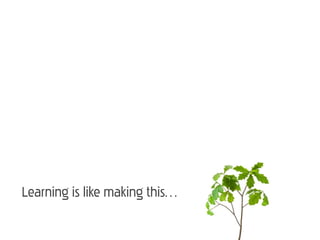
Learning is like making this…
…into this.
Did you just feel a small “Aha!” moment?


   That means a light bulb went on!
              (Nice analogy, huh?)
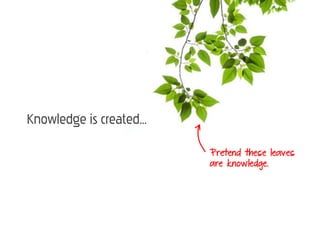
Knowledge is created...

                          Pretend these leaves
                          are knowledge.
…through the transformation of experience.


Collecting sun rays     Absorbing water       Absorbing nutrients


               These experiences helped create the
                knowledge (you know, the leaves).
Just feel another “Aha!” moment?


Great! You must be getting brighter!
                         (sorry for the pun)
Learning is a process…
…and part of this process includes analogies.
                                 (technically, it’s
                               analogical reasoning)
“Learning is the process whereby
knowledge is created through the
transformation of experience.”
David Kolb (1984)
                            Does this make
                            better sense now?
Yes, thanks! So
analogies really
help me learn?


                   Yup.
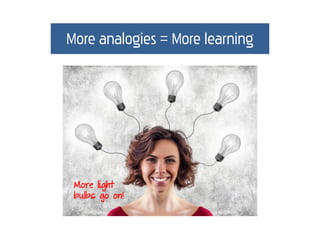
More analogies = More learning


 More light
 bulbs go on!
Analogies link new information to
    your current knowledge.
                  (created from
                past experiences)
Now help your learners’ light bulbs go on by…
…using analogies!
So let’s put the ‘learning’ into eLearning!
When you design an eLearning course, it’s
  easy to assume each learner has a…
blank   mind
THAT’S
FALSE.
(Of course, you knew that.)
Which means YOU have the opportunity to
       use analogies because…
                 in eLearning
… your learners are
LOADED with knowledge!
        (Why not link new
     information to this???)
Got it! So, can I see
some examples of
    analogies?


                        Sure!
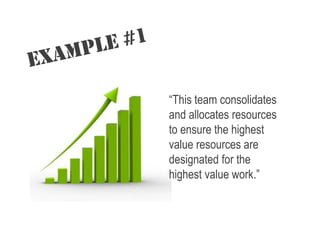
“This team consolidates
and allocates resources
to ensure the highest
value resources are
designated for the
highest value work.”
Say what?
“This team consolidates   “The Supplier Team
and allocates resources   assigns you to tasks with
to ensure the highest     the highest value.”
value resources are
designated for the
highest value work.”        First rewrite this to
                            something simpler.
Then find an analogy. Hmm…mountains?


     Your learners have some
     type of experience with
     mountains, right?
Combine image with text to describe analogy.

                                                …to this task.
    We bring you
 from this task…


 The Supplier Team assigns you to tasks with the highest value.
Thanks…a light
bulb went on!
Cool. Got another
    example?


                    Of course!
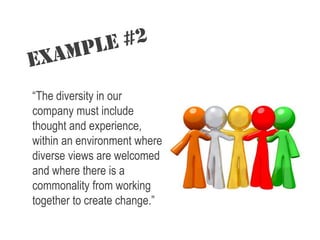
“The diversity in our
company must include
thought and experience,
within an environment where
diverse views are welcomed
and where there is a
commonality from working
together to create change.”
What?!?
“The diversity in our         “We welcome ALL
company must include          people in our company;
thought and experience,       together we make
within an environment where   positive change.”
diverse views are welcomed
and where there is a
commonality from working      First, get to the point.
together to create change.”   Let’s rewrite to make it
                              easier to read.
Then find an analogy. What about buttons?

                                   Your learners
                                   have some
                                   type of
                                   experience
                                   with buttons,
                                   right?
Combine buttons with text to describe analogy.

            Our people with diverse backgrounds...


                                                     …work together
                                                     to make this.

We welcome ALL people in our company; together we make positive change.
That’s great…thanks!
A light bulb went on!
Awesome.
Can I see another
    example?

                     If you insist!
                    How about one
                         more?
“The 3P (Production
Preparation Process) is part of
a Lean manufacturing design
approach that includes QFD,
design reviews, and post-start
up monitoring by a cross-
functional team to Kaizen any
bugs in the new system.”
Zzzzzzzz…
“The 3P (Production                “The 3P (Production
Preparation Process) is part of    Preparation Process) is a
a Lean manufacturing design        mock up design method.”
approach that includes QFD,
design reviews, and post-start
up monitoring by a cross-         Rewrite after you learn what
functional team to Kaizen any     3P “really” is.
bugs in the new system.”
                                  Just keep it simple.
Then find an analogy. How about a house?
                       Your learners have
                       some type of
                       experience being in a
                       house, right?
Combine image with text to describe analogy.
    Your truck                         Put kitchen closest to
with groceries.                        where groceries come in.


             Oops! This
             closet will get                 With 3P, you see what
             in the way of                   you are going to build and
             your van!                       how you’re going to use it!

     The 3P (Production Preparation Process) is a mock up design method.
That’s cool!
A light bulb went on!
Hmm… you got
me thinking more
about analogies.
  Thank you!


                    You’re welcome.
                   Make sure you use
                     effective ones.
Analogies are just part of
the learning process.

Pick them wisely to tap
into learners’ experiences.
Analogies prepare
learners to solve
problems.

Problem solving cannot
occur without analogical
reasoning… because
experience always
intervenes.
Thank you!
            Coming soon….

   Follow me in Slideshare.net to view
upcoming presentations on analogies and
   how they can be used in eLearning.     Oh, and I have one
                                            thing to ask…
Will you contact me?


    Great! Click on my email
Parker.Grant@LearningConnects.com                                        Aww…hope
  and write to me with your                                            you contact me
       analogy ideas!                                                     next time!


                                    By the way, isn’t a decision like what
                                    happens after you see a highway sign??
By: Parker Grant,
        Learning Designer


This slideshow:

How to Use Analogies in eLearning

  • 1.
    Wow…a Light Bulb Went On! Howto Use Analogies in eLearning
  • 2.
  • 3.
    “Learning is theprocess whereby knowledge is created through the transformation of experience.” David Kolb (1984)
  • 4.
    Huh? Okay. Let’s use an analogy to explain this.
  • 5.
    Learning is likemaking this…
  • 6.
  • 7.
    Did you justfeel a small “Aha!” moment? That means a light bulb went on! (Nice analogy, huh?)
  • 8.
    Knowledge is created... Pretend these leaves are knowledge.
  • 9.
    …through the transformationof experience. Collecting sun rays Absorbing water Absorbing nutrients These experiences helped create the knowledge (you know, the leaves).
  • 10.
    Just feel another“Aha!” moment? Great! You must be getting brighter! (sorry for the pun)
  • 11.
    Learning is aprocess…
  • 12.
    …and part ofthis process includes analogies. (technically, it’s analogical reasoning)
  • 13.
    “Learning is theprocess whereby knowledge is created through the transformation of experience.” David Kolb (1984) Does this make better sense now?
  • 14.
    Yes, thanks! So analogiesreally help me learn? Yup.
  • 15.
    More analogies =More learning More light bulbs go on!
  • 16.
    Analogies link newinformation to your current knowledge. (created from past experiences)
  • 17.
    Now help yourlearners’ light bulbs go on by…
  • 18.
  • 19.
    So let’s putthe ‘learning’ into eLearning!
  • 20.
    When you designan eLearning course, it’s easy to assume each learner has a…
  • 21.
    blank mind
  • 22.
  • 23.
    Which means YOUhave the opportunity to use analogies because… in eLearning
  • 24.
    … your learnersare LOADED with knowledge! (Why not link new information to this???)
  • 25.
    Got it! So,can I see some examples of analogies? Sure!
  • 26.
    “This team consolidates andallocates resources to ensure the highest value resources are designated for the highest value work.”
  • 27.
  • 28.
    “This team consolidates “The Supplier Team and allocates resources assigns you to tasks with to ensure the highest the highest value.” value resources are designated for the highest value work.” First rewrite this to something simpler.
  • 29.
    Then find ananalogy. Hmm…mountains? Your learners have some type of experience with mountains, right?
  • 30.
    Combine image withtext to describe analogy. …to this task. We bring you from this task… The Supplier Team assigns you to tasks with the highest value.
  • 31.
  • 32.
    Cool. Got another example? Of course!
  • 33.
    “The diversity inour company must include thought and experience, within an environment where diverse views are welcomed and where there is a commonality from working together to create change.”
  • 34.
  • 35.
    “The diversity inour “We welcome ALL company must include people in our company; thought and experience, together we make within an environment where positive change.” diverse views are welcomed and where there is a commonality from working First, get to the point. together to create change.” Let’s rewrite to make it easier to read.
  • 36.
    Then find ananalogy. What about buttons? Your learners have some type of experience with buttons, right?
  • 37.
    Combine buttons withtext to describe analogy. Our people with diverse backgrounds... …work together to make this. We welcome ALL people in our company; together we make positive change.
  • 38.
  • 39.
    Awesome. Can I seeanother example? If you insist! How about one more?
  • 40.
    “The 3P (Production PreparationProcess) is part of a Lean manufacturing design approach that includes QFD, design reviews, and post-start up monitoring by a cross- functional team to Kaizen any bugs in the new system.”
  • 41.
  • 42.
    “The 3P (Production “The 3P (Production Preparation Process) is part of Preparation Process) is a a Lean manufacturing design mock up design method.” approach that includes QFD, design reviews, and post-start up monitoring by a cross- Rewrite after you learn what functional team to Kaizen any 3P “really” is. bugs in the new system.” Just keep it simple.
  • 43.
    Then find ananalogy. How about a house? Your learners have some type of experience being in a house, right?
  • 44.
    Combine image withtext to describe analogy. Your truck Put kitchen closest to with groceries. where groceries come in. Oops! This closet will get With 3P, you see what in the way of you are going to build and your van! how you’re going to use it! The 3P (Production Preparation Process) is a mock up design method.
  • 45.
  • 46.
    Hmm… you got methinking more about analogies. Thank you! You’re welcome. Make sure you use effective ones.
  • 47.
    Analogies are justpart of the learning process. Pick them wisely to tap into learners’ experiences.
  • 48.
    Analogies prepare learners tosolve problems. Problem solving cannot occur without analogical reasoning… because experience always intervenes.
  • 49.
    Thank you! Coming soon…. Follow me in Slideshare.net to view upcoming presentations on analogies and how they can be used in eLearning. Oh, and I have one thing to ask…
  • 50.
    Will you contactme? Great! Click on my email Parker.Grant@LearningConnects.com Aww…hope and write to me with your you contact me analogy ideas! next time! By the way, isn’t a decision like what happens after you see a highway sign??
  • 51.
    By: Parker Grant, Learning Designer This slideshow: