PMOs and
Complexity
Management
Tathagat Varma
Strategy & Operations,
Walmart Global Tech
Doctoral Scholar,
Indian School of Business
Evolution of PMOs
Darling & Whitty (2016) note the definition of the PMO's function has
evolved over time:
• The 1800s project office was a type of national governance of the
agricultural industry
• 1939 appears as the earliest instance of the term 'project
management office' being published
• The 1950s concept of the PMO is representative of what a
contemporary PMO looks like
• Today the PMO is a dynamic entity used to solve specific issues[1]
https://en.wikipedia.org/wiki/Project_management_office
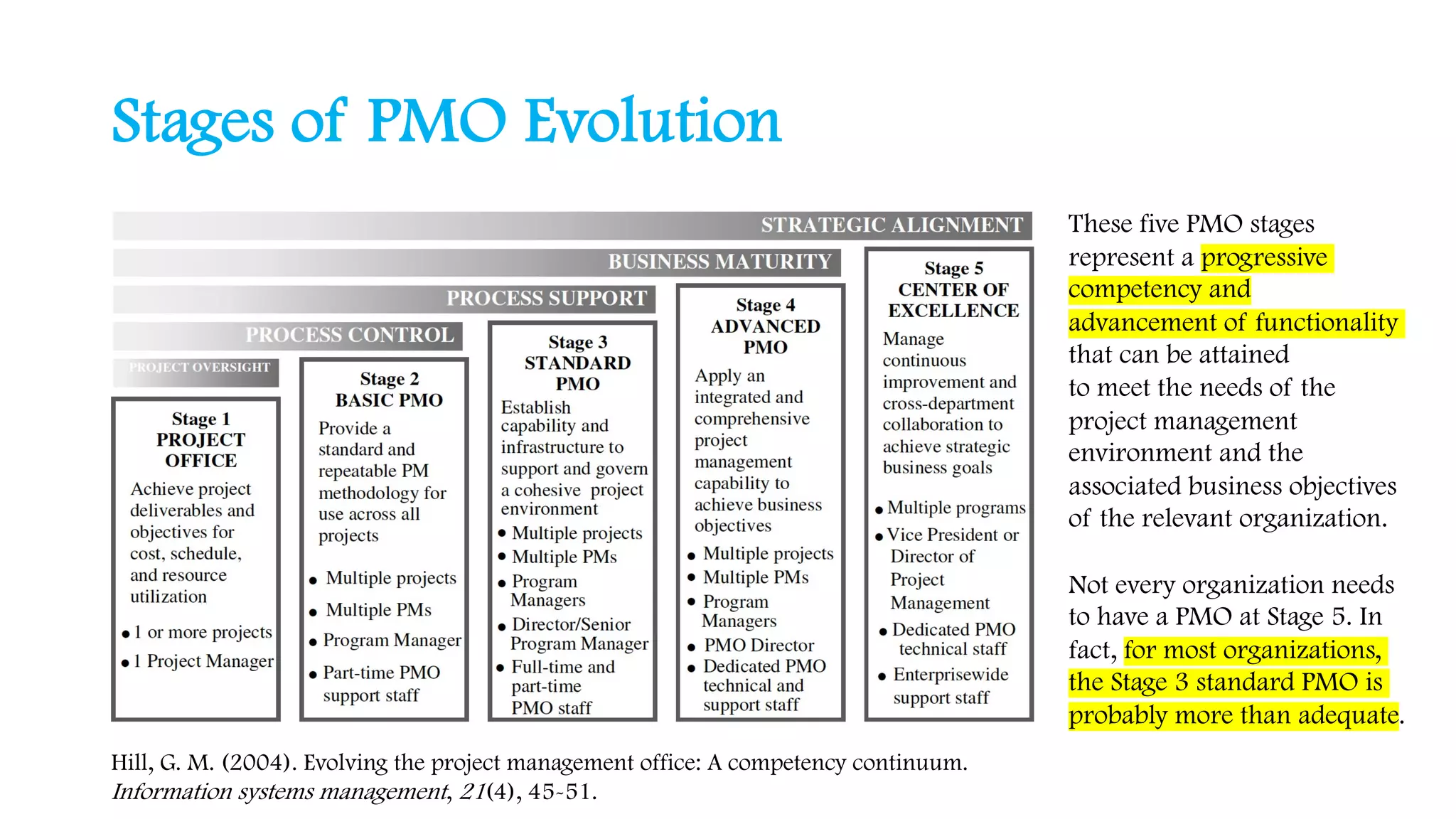
Stages of PMO Evolution
Hill, G. M. (2004). Evolving the project management office: A competency continuum.
Information systems management, 21(4), 45-51.
These five PMO stages
represent a progressive
competency and
advancement of functionality
that can be attained
to meet the needs of the
project management
environment and the
associated business objectives
of the relevant organization.
Not every organization needs
to have a PMO at Stage 5. In
fact, for most organizations,
the Stage 3 standard PMO is
probably more than adequate.
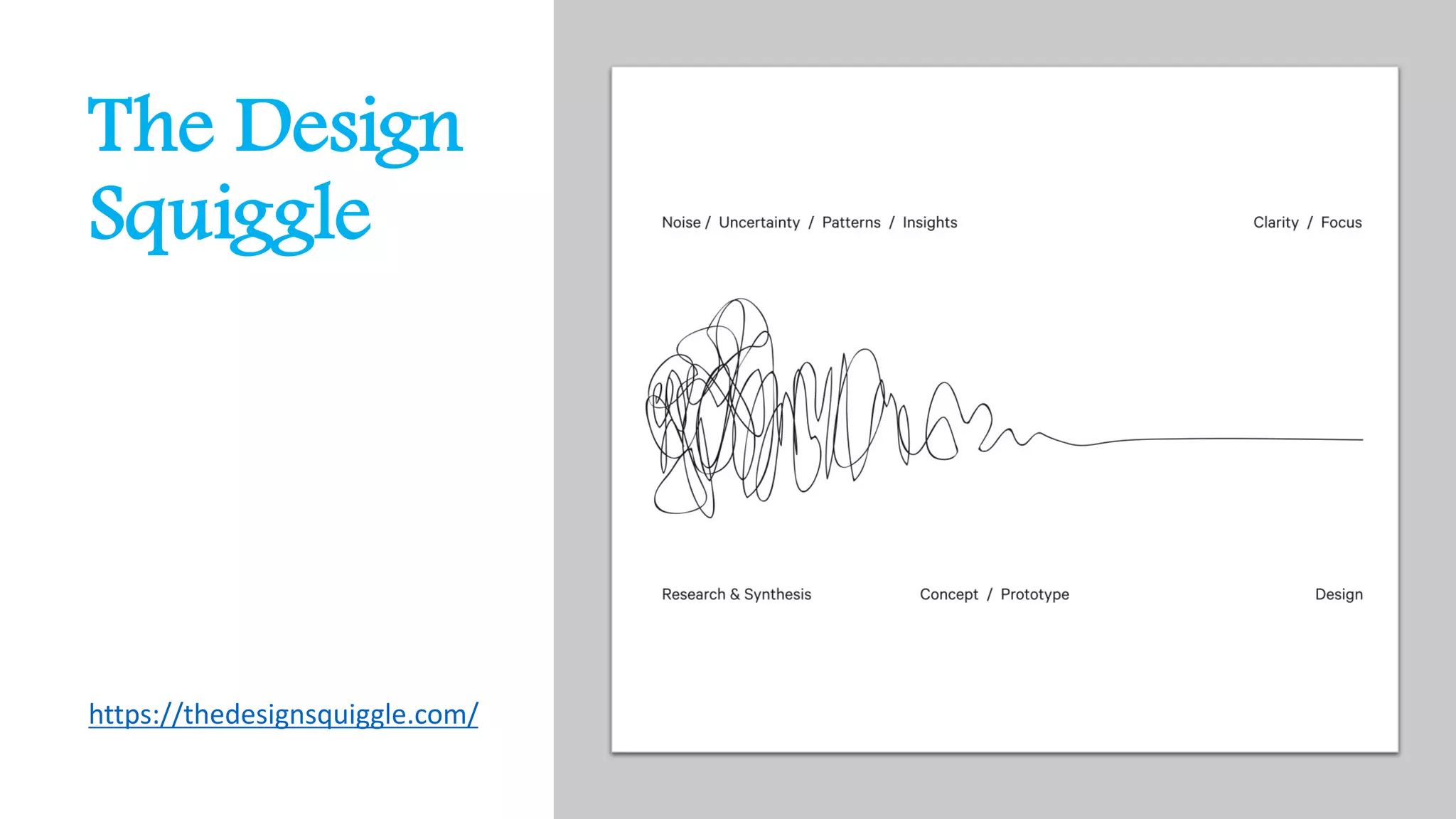
The Design
Squiggle
https://thedesignsquiggle.com/
Limitations of the extant PMO approach
The DNA of Strategy Execution: Next Generation Project Management and PMO – Jack Duggal, 2018
“The conventional approach to implement project
management or PMO is based on the mechanical view
and deterministic methods of classic project
management with a heavy emphasis on the linear
scope, plan, execute, and control (SPEC) processes. But
reductionist plans based on sequential tasks and
dependencies do not seem to hold in a nonlinear,
changing, and unpredictable project reality.”
So, what is the problem?
With a staggering 25% of PMOs shut down after one
year, 50% after two years, and 75% after three years,
organizations must take care in establishing a PMO
that will deliver on its promise and produce the
intended value for the organization. As such, it must
put an emphasis on people skills, leadership, trust
building and motivation, so it becomes and is
perceived to be a trusted partner to all stakeholders
and project managers in particular.
Schibi, O. (2013). Why PMOs do not deliver to their potential. Paper presented at PMI® Global Congress 2013—North America, New Orleans, LA. Newtown Square,
PA: Project Management Institute. https://www.pmi.org/learning/library/project-management-failure-to-deliver-5883
Influence of Complexity on PMO
performance
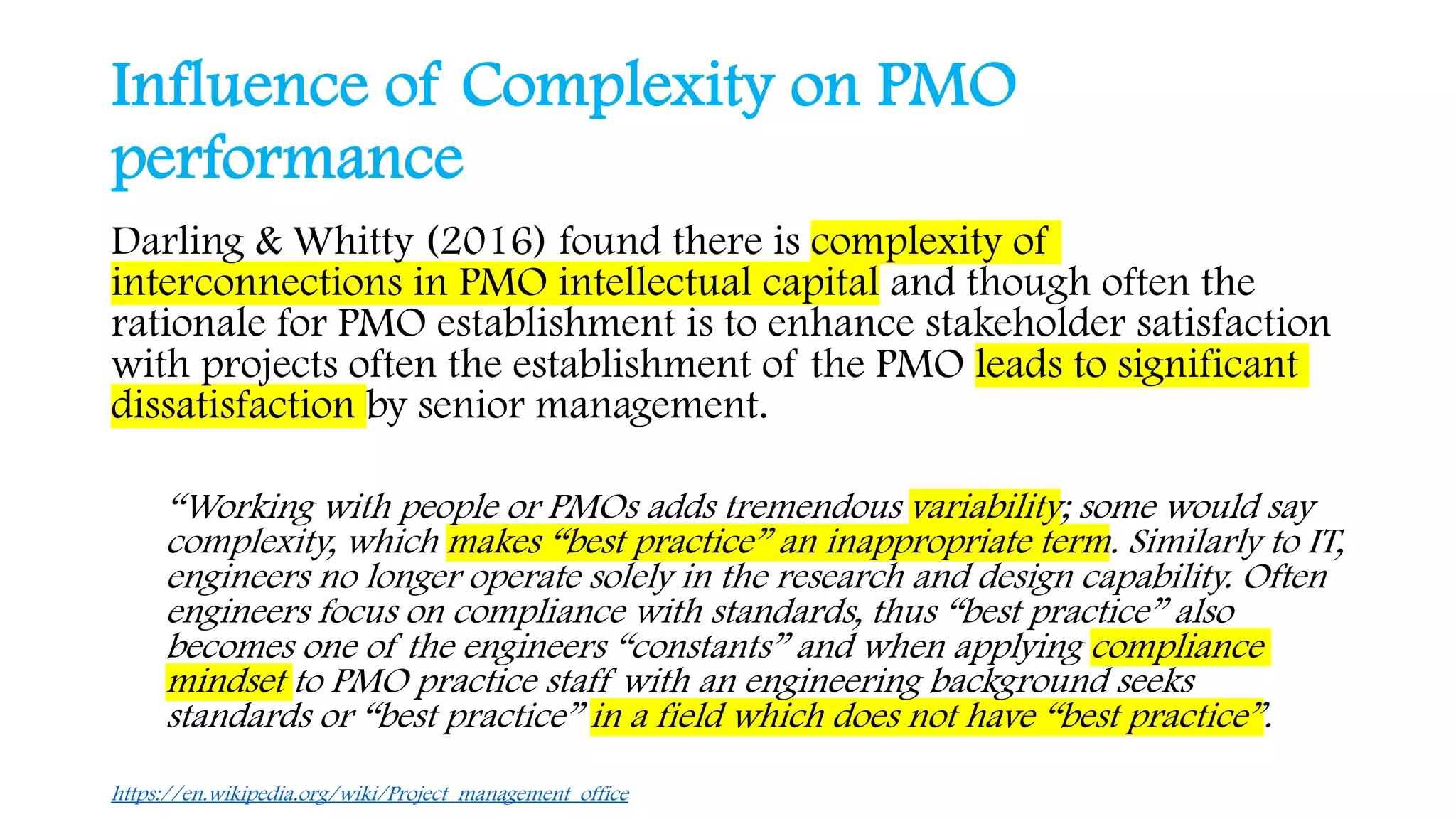
Darling & Whitty (2016) found there is complexity of
interconnections in PMO intellectual capital and though often the
rationale for PMO establishment is to enhance stakeholder satisfaction
with projects often the establishment of the PMO leads to significant
dissatisfaction by senior management.
“Working with people or PMOs adds tremendous variability; some would say
complexity, which makes “best practice” an inappropriate term. Similarly to IT,
engineers no longer operate solely in the research and design capability. Often
engineers focus on compliance with standards, thus “best practice” also
becomes one of the engineers “constants” and when applying compliance
mindset to PMO practice staff with an engineering background seeks
standards or “best practice” in a field which does not have “best practice”.
https://en.wikipedia.org/wiki/Project_management_office
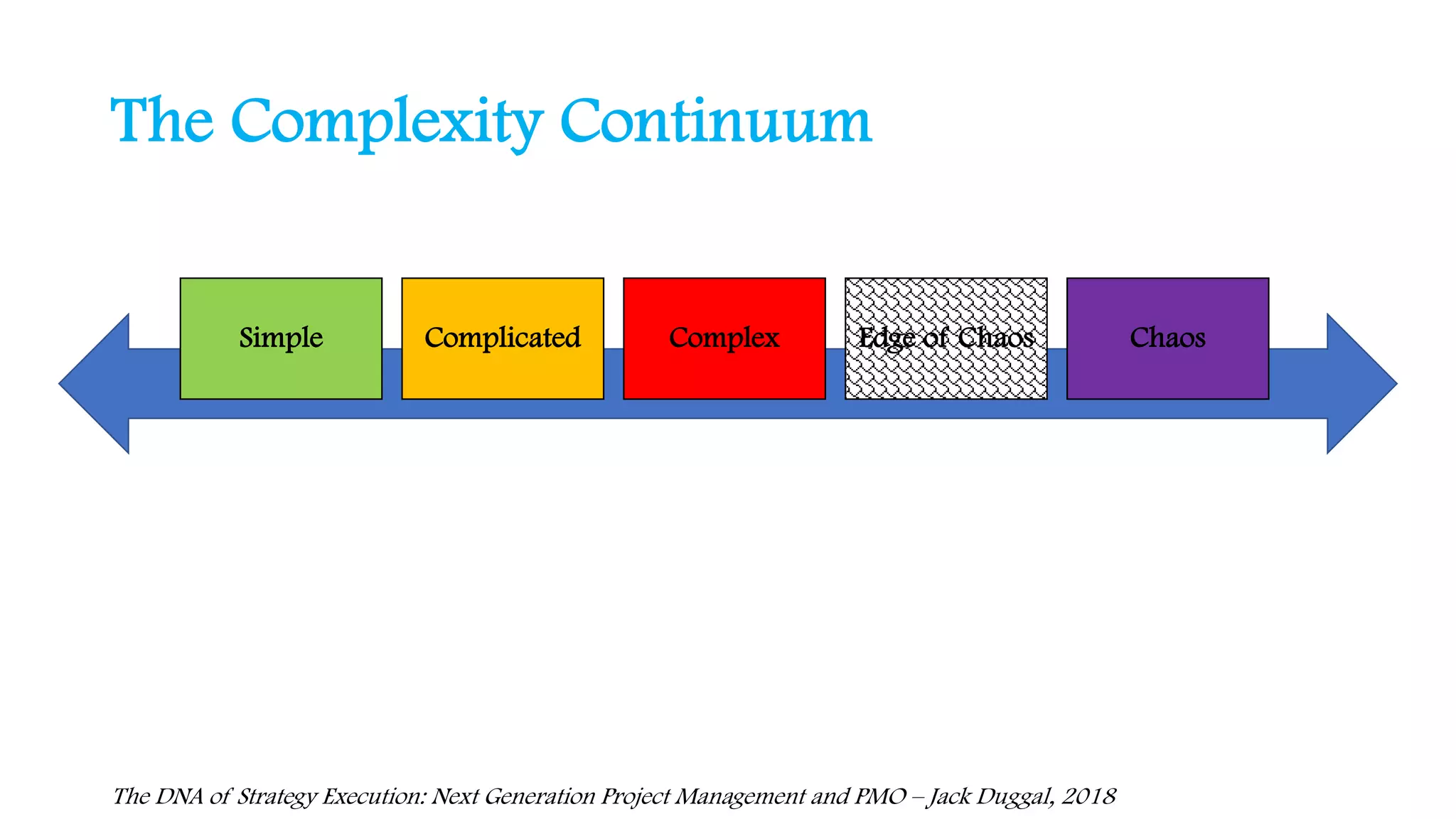
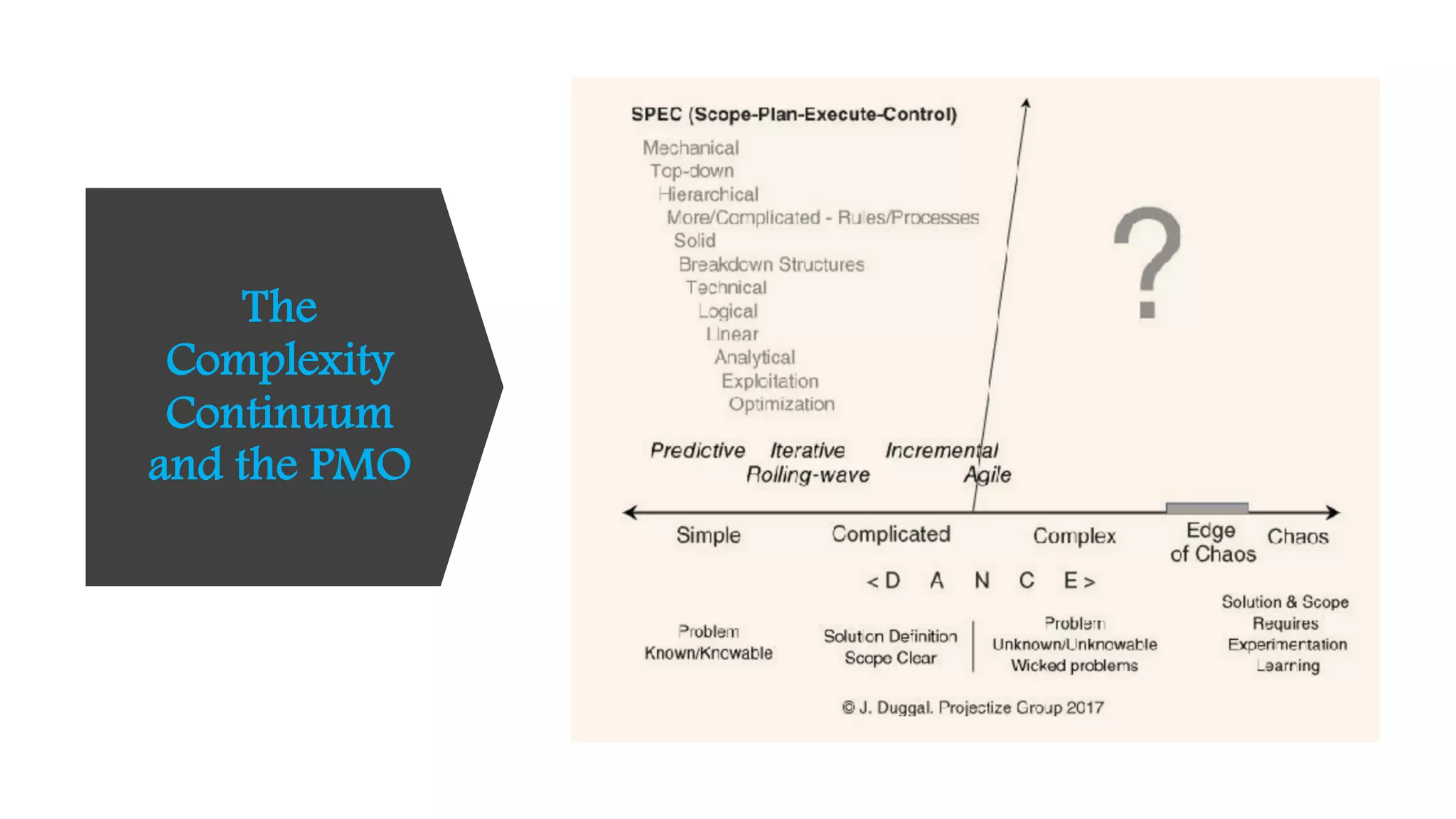
The Complexity Continuum
Simple Complicated Complex Edge of Chaos Chaos
The DNA of Strategy Execution: Next Generation Project Management and PMO – Jack Duggal, 2018
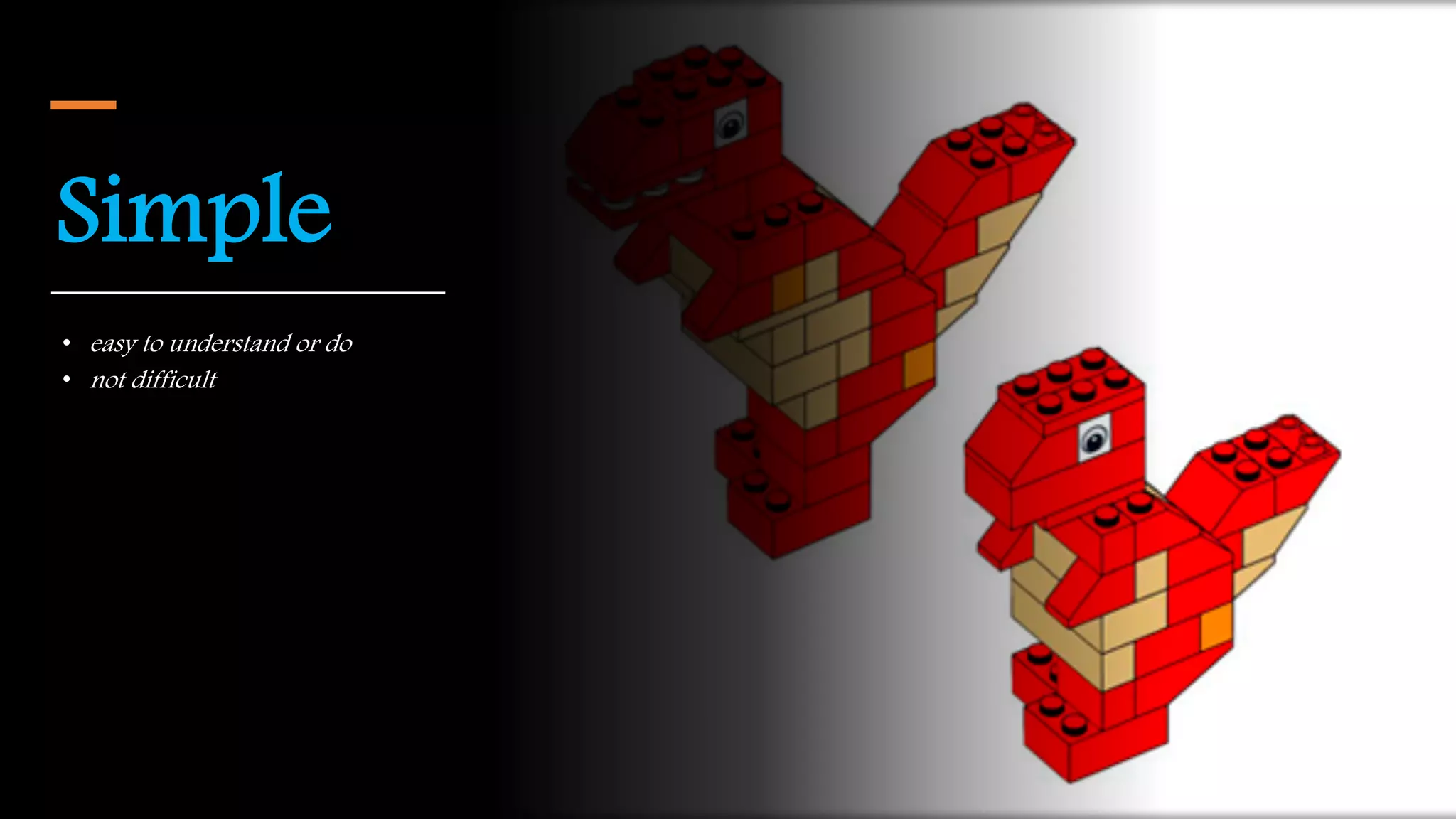
Simple
• easy to understand or do
• not difficult
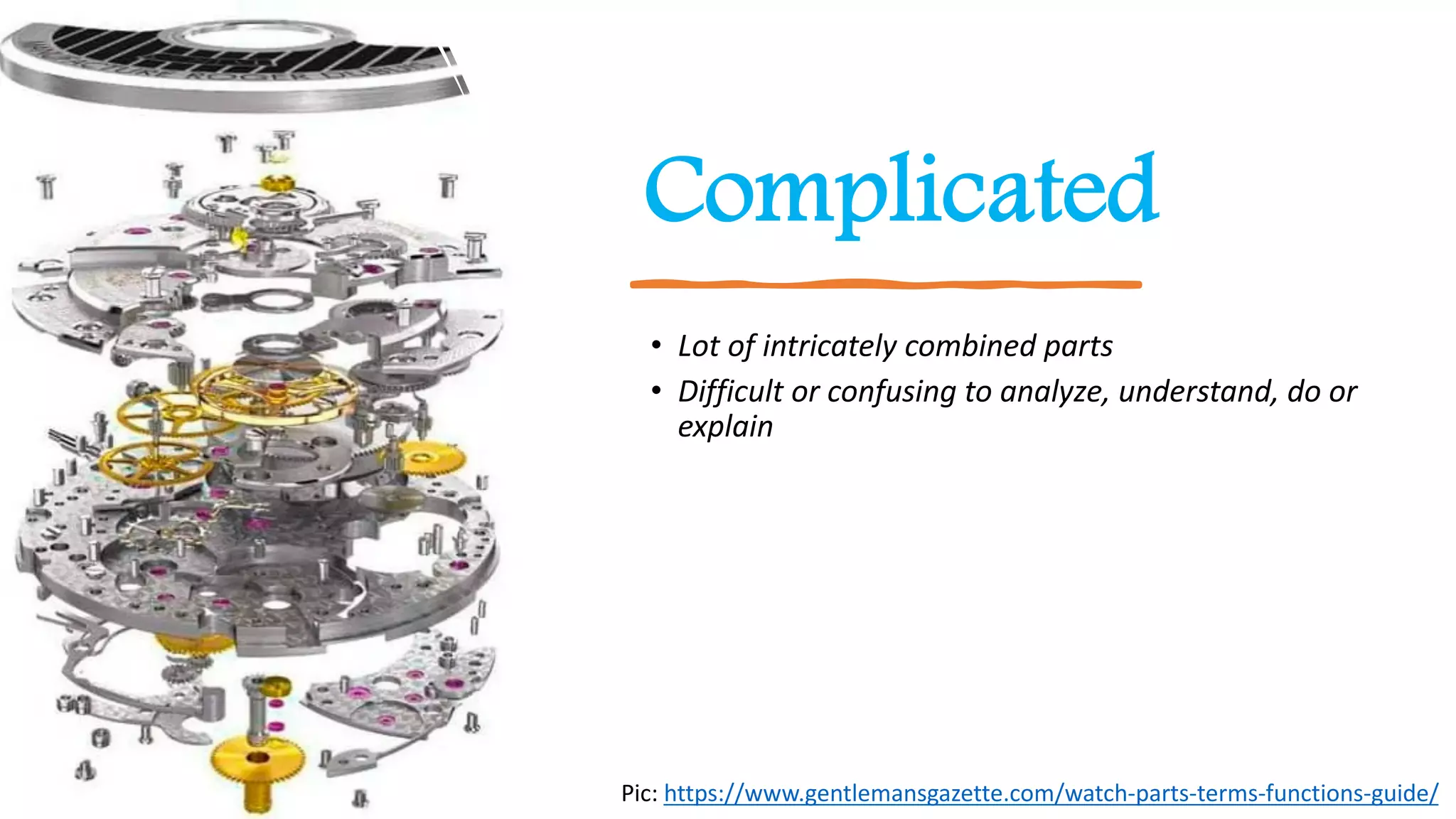
Complicated
• Lot of intricately combined parts
• Difficult or confusing to analyze, understand, do or
explain
Pic: https://www.gentlemansgazette.com/watch-parts-terms-functions-guide/
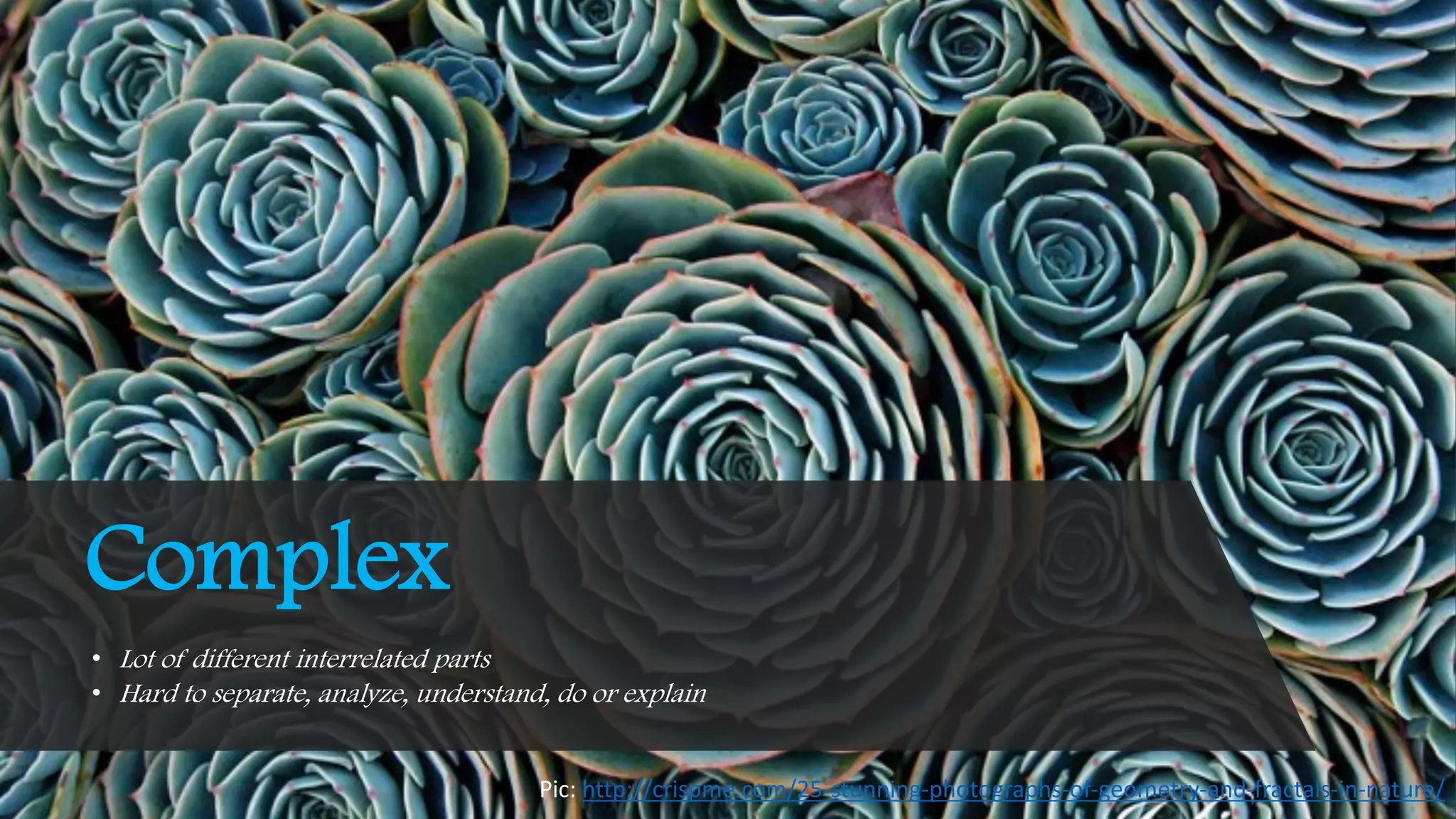
Complex
• Lot of different interrelated parts
• Hard to separate, analyze, understand, do or explain
Pic: http://crispme.com/25-stunning-photographs-of-geometry-and-fractals-in-nature/
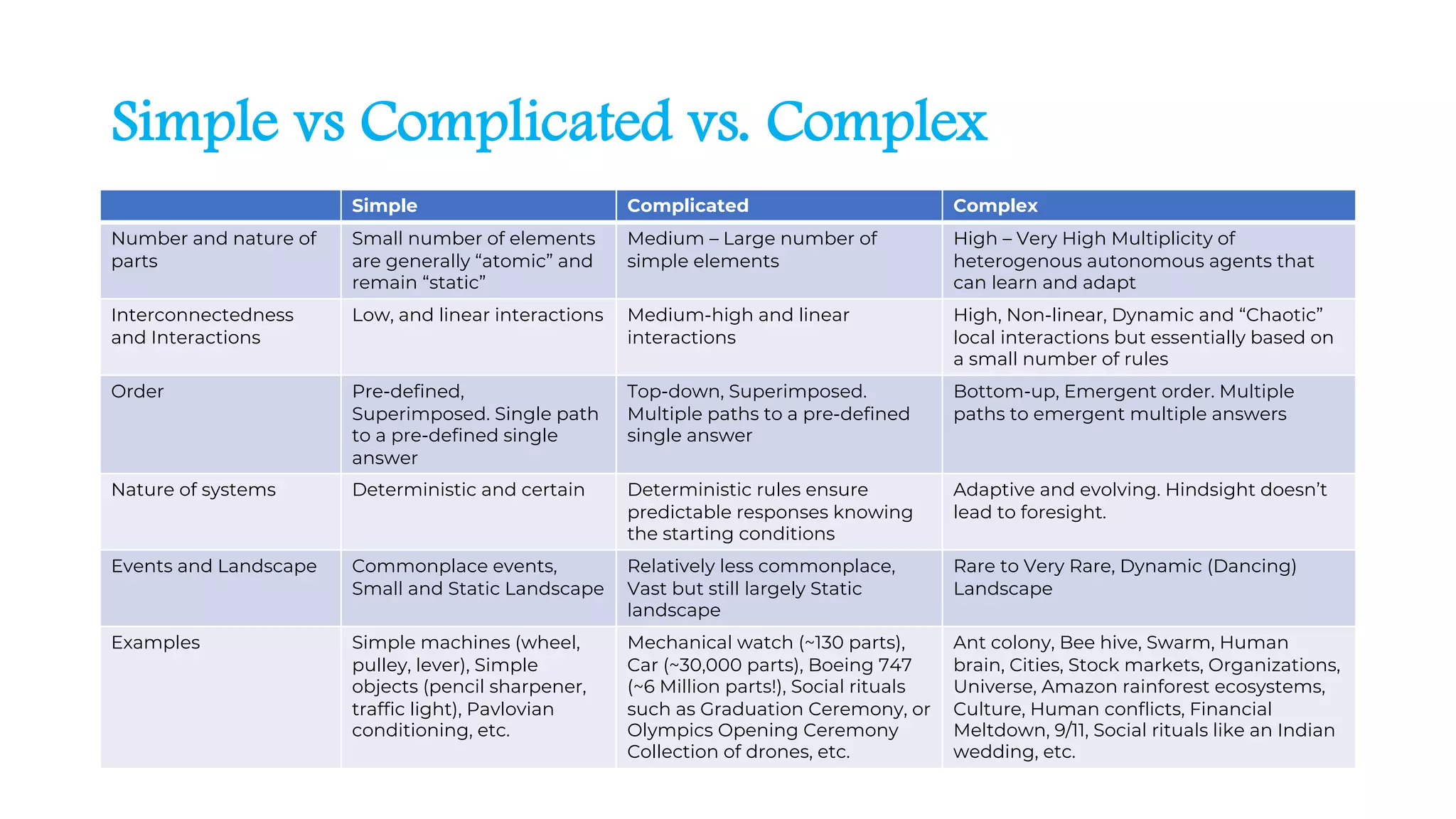
Simple vs Complicated vs. Complex
Simple Complicated Complex
Number and nature of
parts
Small number of elements
are generally “atomic” and
remain “static”
Medium – Large number of
simple elements
High – Very High Multiplicity of
heterogenous autonomous agents that
can learn and adapt
Interconnectedness
and Interactions
Low, and linear interactions Medium-high and linear
interactions
High, Non-linear, Dynamic and “Chaotic”
local interactions but essentially based on
a small number of rules
Order Pre-defined,
Superimposed. Single path
to a pre-defined single
answer
Top-down, Superimposed.
Multiple paths to a pre-defined
single answer
Bottom-up, Emergent order. Multiple
paths to emergent multiple answers
Nature of systems Deterministic and certain Deterministic rules ensure
predictable responses knowing
the starting conditions
Adaptive and evolving. Hindsight doesn’t
lead to foresight.
Events and Landscape Commonplace events,
Small and Static Landscape
Relatively less commonplace,
Vast but still largely Static
landscape
Rare to Very Rare, Dynamic (Dancing)
Landscape
Examples Simple machines (wheel,
pulley, lever), Simple
objects (pencil sharpener,
traffic light), Pavlovian
conditioning, etc.
Mechanical watch (~130 parts),
Car (~30,000 parts), Boeing 747
(~6 Million parts!), Social rituals
such as Graduation Ceremony, or
Olympics Opening Ceremony
Collection of drones, etc.
Ant colony, Bee hive, Swarm, Human
brain, Cities, Stock markets, Organizations,
Universe, Amazon rainforest ecosystems,
Culture, Human conflicts, Financial
Meltdown, 9/11, Social rituals like an Indian
wedding, etc.
Complex System
“A system in which large networks of
components with no central control and
simple rules of operation give rise to
complex collective behavior, sophisticated
information processing, and adaptation via
learning or evolution.” – Complexity,
Melanie Mitchell
From VUCA to DANCE
“The reality of the world and today's business environment can be best characterized by
the acronym DANCE: Dynamic and changing, Ambiguous and uncertain; Nonlinear,
Complex, and Emergent and unpredictable—
• Dynamic and constant change, driven by disruptive factors and shifting stakeholder needs and
priorities.
• There is ambiguity and uncertainty, the situation is ambiguous or not clear and can be
interpreted in different ways, and it is uncertain which way it will go. The direction is not clear,
and there is a lot of uncertainty about the future.
• Unlike stable environments, where things are linear and expected, in a nonlinear world it is hard
to ascertain the cause and effect, the output is not “proportional to the change in the input, and it
is therefore, hard to plan or manage the unexpected.
• The environment is complex because of the multiplicity of stakeholders involved, the number of
interactions, and the sheer number of linkages and dependencies. It is not clear who all the
stakeholders are, and the identified stakeholders are indecisive—they do not know what they
want.
• Scope, requirements, solutions, and stakeholders are emergent and unpredictable ßfrom the
bottom-up, and it can be hard to plan top-down in a continually shifting landscape.”
The DNA of Strategy Execution: Next Generation Project Management and PMO – Jack Duggal, 2018
The
Complexity
Continuum
and the PMO
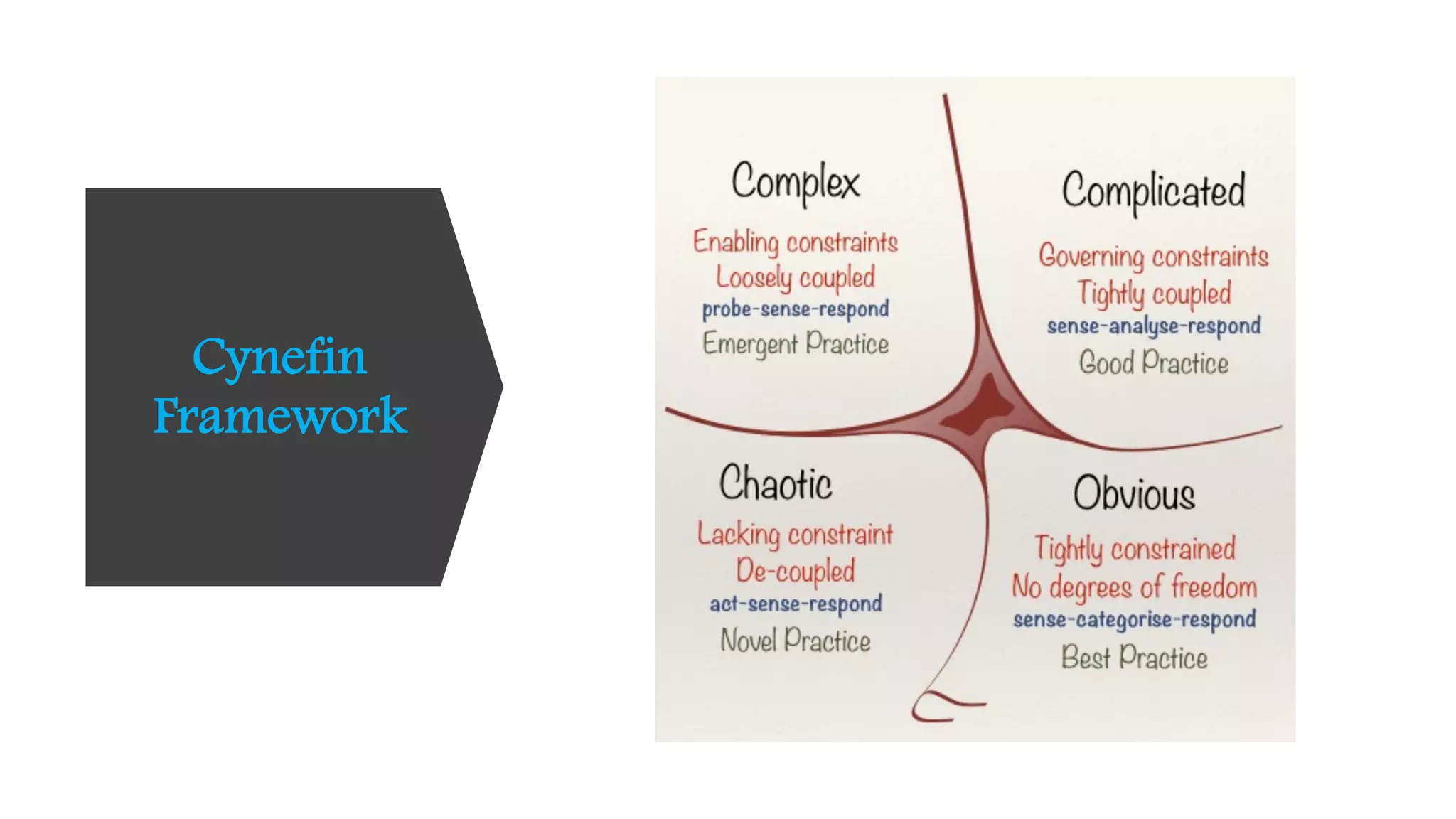
Cynefin
Framework
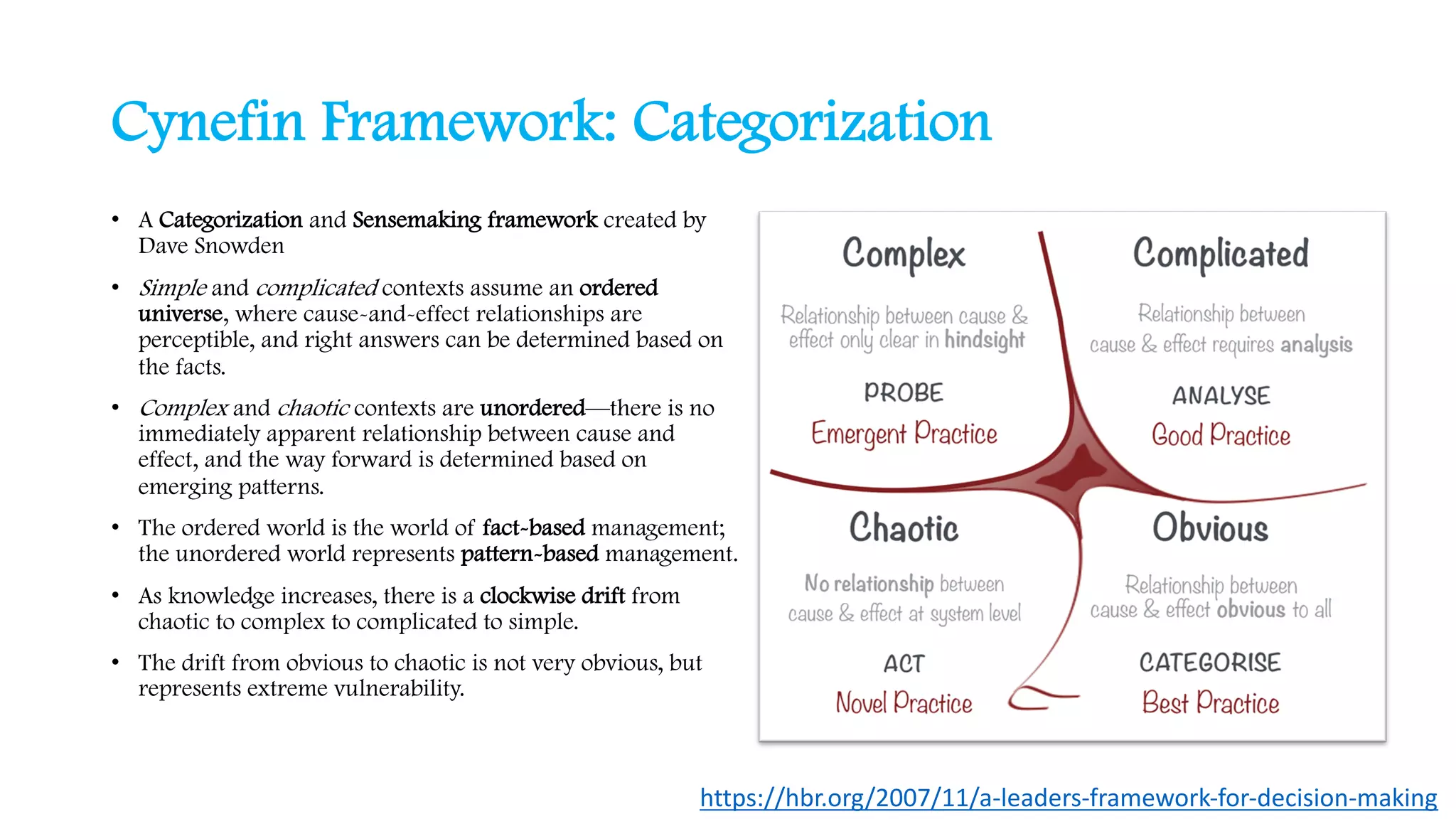
Cynefin Framework: Categorization
• A Categorization and Sensemaking framework created by
Dave Snowden
• Simple and complicated contexts assume an ordered
universe, where cause-and-effect relationships are
perceptible, and right answers can be determined based on
the facts.
• Complex and chaotic contexts are unordered—there is no
immediately apparent relationship between cause and
effect, and the way forward is determined based on
emerging patterns.
• The ordered world is the world of fact-based management;
the unordered world represents pattern-based management.
• As knowledge increases, there is a clockwise drift from
chaotic to complex to complicated to simple.
• The drift from obvious to chaotic is not very obvious, but
represents extreme vulnerability.
https://hbr.org/2007/11/a-leaders-framework-for-decision-making
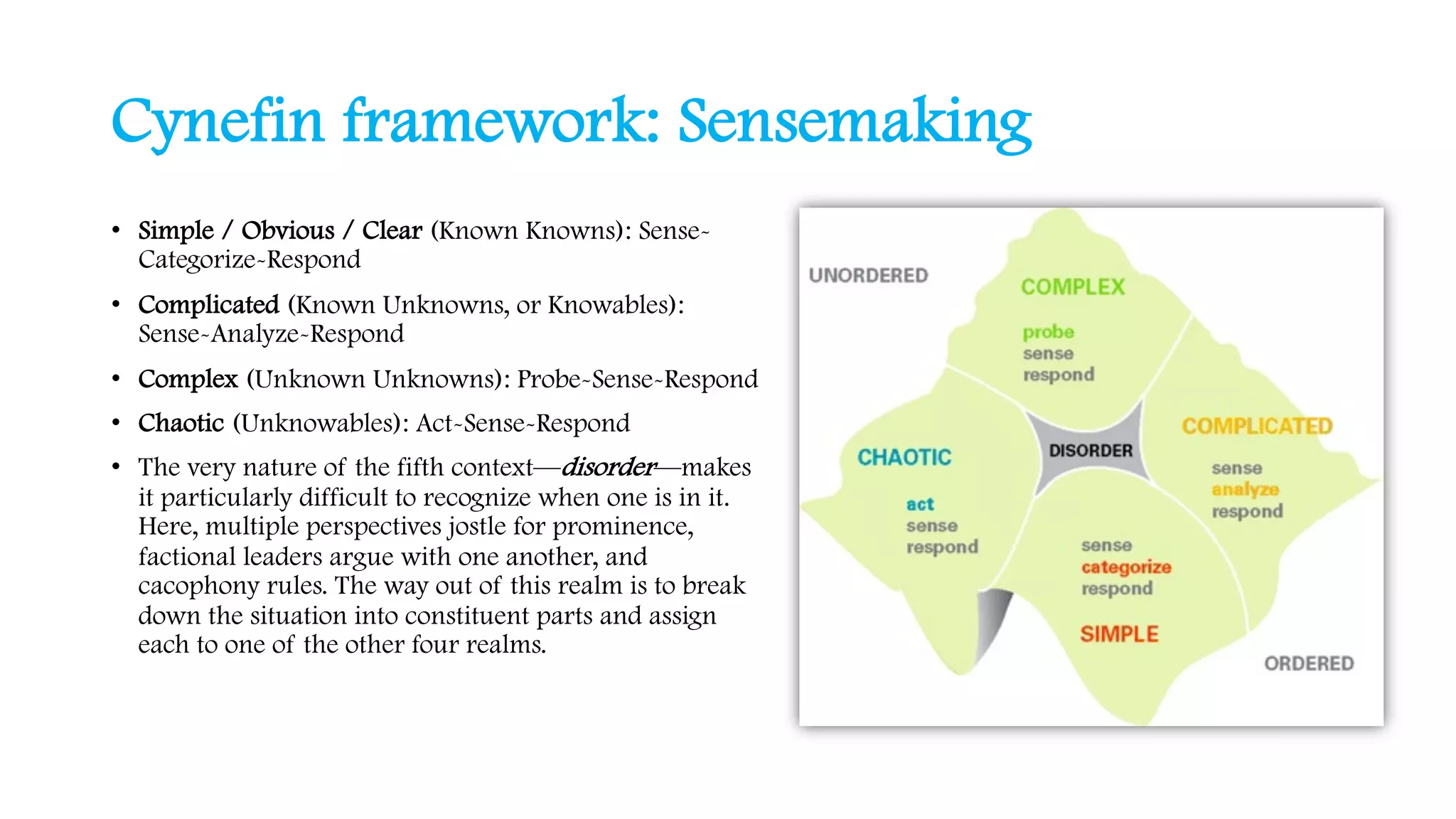
Cynefin framework: Sensemaking
• Simple / Obvious / Clear (Known Knowns): Sense-
Categorize-Respond
• Complicated (Known Unknowns, or Knowables):
Sense-Analyze-Respond
• Complex (Unknown Unknowns): Probe-Sense-Respond
• Chaotic (Unknowables): Act-Sense-Respond
• The very nature of the fifth context—disorder—makes
it particularly difficult to recognize when one is in it.
Here, multiple perspectives jostle for prominence,
factional leaders argue with one another, and
cacophony rules. The way out of this realm is to break
down the situation into constituent parts and assign
each to one of the other four realms.
Recap
RISING COMPLEXITY TRADITIONAL
APPROACH INEFFECTIVE
DESIGN NEW
SOLUTIONS

PMOs and Complexity Management

  • 1.
    PMOs and Complexity Management Tathagat Varma Strategy& Operations, Walmart Global Tech Doctoral Scholar, Indian School of Business
  • 2.
    Evolution of PMOs Darling& Whitty (2016) note the definition of the PMO's function has evolved over time: • The 1800s project office was a type of national governance of the agricultural industry • 1939 appears as the earliest instance of the term 'project management office' being published • The 1950s concept of the PMO is representative of what a contemporary PMO looks like • Today the PMO is a dynamic entity used to solve specific issues[1] https://en.wikipedia.org/wiki/Project_management_office
  • 3.
    Stages of PMOEvolution Hill, G. M. (2004). Evolving the project management office: A competency continuum. Information systems management, 21(4), 45-51. These five PMO stages represent a progressive competency and advancement of functionality that can be attained to meet the needs of the project management environment and the associated business objectives of the relevant organization. Not every organization needs to have a PMO at Stage 5. In fact, for most organizations, the Stage 3 standard PMO is probably more than adequate.
  • 4.
  • 5.
    Limitations of theextant PMO approach The DNA of Strategy Execution: Next Generation Project Management and PMO – Jack Duggal, 2018 “The conventional approach to implement project management or PMO is based on the mechanical view and deterministic methods of classic project management with a heavy emphasis on the linear scope, plan, execute, and control (SPEC) processes. But reductionist plans based on sequential tasks and dependencies do not seem to hold in a nonlinear, changing, and unpredictable project reality.”
  • 6.
    So, what isthe problem? With a staggering 25% of PMOs shut down after one year, 50% after two years, and 75% after three years, organizations must take care in establishing a PMO that will deliver on its promise and produce the intended value for the organization. As such, it must put an emphasis on people skills, leadership, trust building and motivation, so it becomes and is perceived to be a trusted partner to all stakeholders and project managers in particular. Schibi, O. (2013). Why PMOs do not deliver to their potential. Paper presented at PMI® Global Congress 2013—North America, New Orleans, LA. Newtown Square, PA: Project Management Institute. https://www.pmi.org/learning/library/project-management-failure-to-deliver-5883
  • 7.
    Influence of Complexityon PMO performance Darling & Whitty (2016) found there is complexity of interconnections in PMO intellectual capital and though often the rationale for PMO establishment is to enhance stakeholder satisfaction with projects often the establishment of the PMO leads to significant dissatisfaction by senior management. “Working with people or PMOs adds tremendous variability; some would say complexity, which makes “best practice” an inappropriate term. Similarly to IT, engineers no longer operate solely in the research and design capability. Often engineers focus on compliance with standards, thus “best practice” also becomes one of the engineers “constants” and when applying compliance mindset to PMO practice staff with an engineering background seeks standards or “best practice” in a field which does not have “best practice”. https://en.wikipedia.org/wiki/Project_management_office
  • 8.
    The Complexity Continuum SimpleComplicated Complex Edge of Chaos Chaos The DNA of Strategy Execution: Next Generation Project Management and PMO – Jack Duggal, 2018
  • 9.
    Simple • easy tounderstand or do • not difficult
  • 10.
    Complicated • Lot ofintricately combined parts • Difficult or confusing to analyze, understand, do or explain Pic: https://www.gentlemansgazette.com/watch-parts-terms-functions-guide/
  • 11.
    Complex • Lot ofdifferent interrelated parts • Hard to separate, analyze, understand, do or explain Pic: http://crispme.com/25-stunning-photographs-of-geometry-and-fractals-in-nature/
  • 12.
    Simple vs Complicatedvs. Complex Simple Complicated Complex Number and nature of parts Small number of elements are generally “atomic” and remain “static” Medium – Large number of simple elements High – Very High Multiplicity of heterogenous autonomous agents that can learn and adapt Interconnectedness and Interactions Low, and linear interactions Medium-high and linear interactions High, Non-linear, Dynamic and “Chaotic” local interactions but essentially based on a small number of rules Order Pre-defined, Superimposed. Single path to a pre-defined single answer Top-down, Superimposed. Multiple paths to a pre-defined single answer Bottom-up, Emergent order. Multiple paths to emergent multiple answers Nature of systems Deterministic and certain Deterministic rules ensure predictable responses knowing the starting conditions Adaptive and evolving. Hindsight doesn’t lead to foresight. Events and Landscape Commonplace events, Small and Static Landscape Relatively less commonplace, Vast but still largely Static landscape Rare to Very Rare, Dynamic (Dancing) Landscape Examples Simple machines (wheel, pulley, lever), Simple objects (pencil sharpener, traffic light), Pavlovian conditioning, etc. Mechanical watch (~130 parts), Car (~30,000 parts), Boeing 747 (~6 Million parts!), Social rituals such as Graduation Ceremony, or Olympics Opening Ceremony Collection of drones, etc. Ant colony, Bee hive, Swarm, Human brain, Cities, Stock markets, Organizations, Universe, Amazon rainforest ecosystems, Culture, Human conflicts, Financial Meltdown, 9/11, Social rituals like an Indian wedding, etc.
  • 13.
    Complex System “A systemin which large networks of components with no central control and simple rules of operation give rise to complex collective behavior, sophisticated information processing, and adaptation via learning or evolution.” – Complexity, Melanie Mitchell
  • 14.
    From VUCA toDANCE “The reality of the world and today's business environment can be best characterized by the acronym DANCE: Dynamic and changing, Ambiguous and uncertain; Nonlinear, Complex, and Emergent and unpredictable— • Dynamic and constant change, driven by disruptive factors and shifting stakeholder needs and priorities. • There is ambiguity and uncertainty, the situation is ambiguous or not clear and can be interpreted in different ways, and it is uncertain which way it will go. The direction is not clear, and there is a lot of uncertainty about the future. • Unlike stable environments, where things are linear and expected, in a nonlinear world it is hard to ascertain the cause and effect, the output is not “proportional to the change in the input, and it is therefore, hard to plan or manage the unexpected. • The environment is complex because of the multiplicity of stakeholders involved, the number of interactions, and the sheer number of linkages and dependencies. It is not clear who all the stakeholders are, and the identified stakeholders are indecisive—they do not know what they want. • Scope, requirements, solutions, and stakeholders are emergent and unpredictable ßfrom the bottom-up, and it can be hard to plan top-down in a continually shifting landscape.” The DNA of Strategy Execution: Next Generation Project Management and PMO – Jack Duggal, 2018
  • 15.
  • 16.
  • 17.
    Cynefin Framework: Categorization •A Categorization and Sensemaking framework created by Dave Snowden • Simple and complicated contexts assume an ordered universe, where cause-and-effect relationships are perceptible, and right answers can be determined based on the facts. • Complex and chaotic contexts are unordered—there is no immediately apparent relationship between cause and effect, and the way forward is determined based on emerging patterns. • The ordered world is the world of fact-based management; the unordered world represents pattern-based management. • As knowledge increases, there is a clockwise drift from chaotic to complex to complicated to simple. • The drift from obvious to chaotic is not very obvious, but represents extreme vulnerability. https://hbr.org/2007/11/a-leaders-framework-for-decision-making
  • 18.
    Cynefin framework: Sensemaking •Simple / Obvious / Clear (Known Knowns): Sense- Categorize-Respond • Complicated (Known Unknowns, or Knowables): Sense-Analyze-Respond • Complex (Unknown Unknowns): Probe-Sense-Respond • Chaotic (Unknowables): Act-Sense-Respond • The very nature of the fifth context—disorder—makes it particularly difficult to recognize when one is in it. Here, multiple perspectives jostle for prominence, factional leaders argue with one another, and cacophony rules. The way out of this realm is to break down the situation into constituent parts and assign each to one of the other four realms.
  • 19.
    Recap RISING COMPLEXITY TRADITIONAL APPROACHINEFFECTIVE DESIGN NEW SOLUTIONS