Project Management and overview 1
Advanced Project Management-
Introduction
Ghazala Amin
Project Management and overview 2
Agenda
• Introduction
• Meeting Objectives
• Project Oriented Industries
• Project Manager, Power and Authority
• PM Discipline
• Managing your Stake Holders
• Talk the Talk and Walk the Walk
• Communication
• Project Closure
Project Management and overview 3
Meeting Objectives
• Introduce myself
• Share experiences and my personal
perspectives
• Project Management and your insight into
what its all about…
• Informal and Casual Q & A Session
Project Management and overview 4
Introduction
• BS in Computer Engineering
• MS in Electrical Engineering and Software
Management
• Certified Information Specialist, EDS/HP
• Certified Senior Project Manager, IBM Global
Services
• PMI Certified – Project Management
Professional
Project Management and overview 5
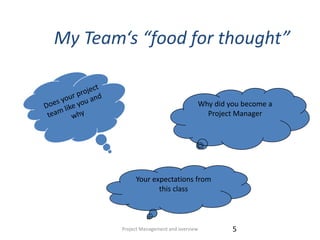
My Team‘s “food for thought”
Why did you become a
Project Manager
Your expectations from
this class
Project Management and overview 6
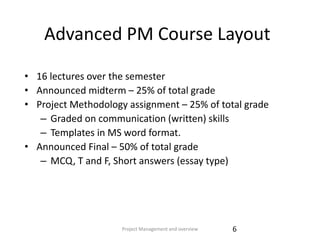
Advanced PM Course Layout
• 16 lectures over the semester
• Announced midterm – 25% of total grade
• Project Methodology assignment – 25% of total grade
– Graded on communication (written) skills
– Templates in MS word format.
• Announced Final – 50% of total grade
– MCQ, T and F, Short answers (essay type)
Project Management and overview 7
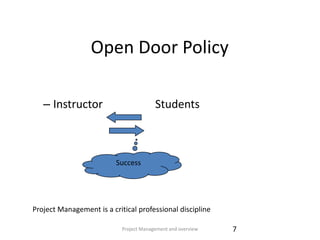
Open Door Policy
– Instructor Students
Success
Project Management is a critical professional discipline
Project Management and overview 8
Advanced PM Course Material
• Reference Materials for Study
– Study Notes and class discussions
– A guide to the Project Management Body of
Knowledge (PMBOK)
– Dr. Harold Kerzner’s book
• Project Management-A Systems Approach To Planning,
Scheduling and Controlling
– The Wisdom of teams, Katzenbach and Smith
– The 7 Habits of Highly Effective People by Stephen R.
Covey
Project Management and overview 9
• To introduce MSPM students to Project Management Fundamentals
and how Project Management has evolved into strict professional
discipline over the past 3 decades.
• To encourage MSPM students to share their professional PM
experiences of how they are managing real life projects in Pakistan.
• To raise the bar of introductory PM education being offered in other
programs and universities. We are targeting experienced PM
Professionals.
Learning Objectives
Project Management and overview 10
• This course would introduce MSPM students with basic
knowledge of PM processes that would help them with PM
certification exams being offered by PMI or other PM
organizations.
• It only provides the basic knowledge of various project
management concepts. It gives the “what is”, the “how to
implement” should be dealt with in other classes in detail.
Learning Objectives
Project Management and overview 11
Who should study Project Management?
• Anyone who is directly or indirectly involved in;
• initiating, planning, implementing, monitoring, evaluating
and/or controlling a project;
• in a position which involves a substantive level of decision-
making, responsibility, communication and coordination,
• should be thoroughly familiar with all the subject areas,
methodology, processes and tools and techniques of
project management.
A good and common project management knowledge platform will increase
the likelihood of the project attaining its goal within time and budget.
Project Management and overview 12
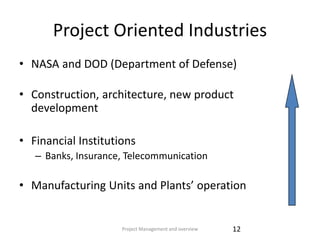
Project Oriented Industries
• NASA and DOD (Department of Defense)
• Construction, architecture, new product
development
• Financial Institutions
– Banks, Insurance, Telecommunication
• Manufacturing Units and Plants’ operation
Project Management and overview 13
Project Manager’s Power and Authority
• Authority
– Right of an individual to make necessary decisions required
to achieve his objectives or responsibility.
• Power
– Granted to an individual by the subordinates and peers
over time and is a measure of their respect for the
individual.
– Builds credibility and respect in the profession.
• Accountability
– Acceptance of success or failure.
Project Management and overview 14
Talk the Talk and Walk the Walk
• Knowing and using industry specific LINGO –
Terms and terminology.
• Award and Reward - Ensure every one
understands the benefit of project completion
on schedule and budget.
• Use cultural influences to your advantage.
Project Management and overview 15
What kind of Project Manager are you?
• Accidental Project Manager
– Usually, this project manager comes up through the ranks. For instance, a
strong programmer becomes the project manager on a development
project. Or a strong network technician becomes the project manager on
a large network upgrade. These people understand the types of projects
that they are managing, they can build a work plan, and they can assign
work to other team members. However, they don't have a lot of project
management discipline.
• Good Project Manager
– The second type of project manager understands that successful
project management requires you to manage issues, scope,
communication, risk, etc.
• Proactive Project Manager
– the third type, is someone who has made the mental transition to
apply his or her discipline on a proactive and ongoing basis.

Lecture 02: Advanced Project Management-Introduction

  • 1.
    Project Management andoverview 1 Advanced Project Management- Introduction Ghazala Amin
  • 2.
    Project Management andoverview 2 Agenda • Introduction • Meeting Objectives • Project Oriented Industries • Project Manager, Power and Authority • PM Discipline • Managing your Stake Holders • Talk the Talk and Walk the Walk • Communication • Project Closure
  • 3.
    Project Management andoverview 3 Meeting Objectives • Introduce myself • Share experiences and my personal perspectives • Project Management and your insight into what its all about… • Informal and Casual Q & A Session
  • 4.
    Project Management andoverview 4 Introduction • BS in Computer Engineering • MS in Electrical Engineering and Software Management • Certified Information Specialist, EDS/HP • Certified Senior Project Manager, IBM Global Services • PMI Certified – Project Management Professional
  • 5.
    Project Management andoverview 5 My Team‘s “food for thought” Why did you become a Project Manager Your expectations from this class
  • 6.
    Project Management andoverview 6 Advanced PM Course Layout • 16 lectures over the semester • Announced midterm – 25% of total grade • Project Methodology assignment – 25% of total grade – Graded on communication (written) skills – Templates in MS word format. • Announced Final – 50% of total grade – MCQ, T and F, Short answers (essay type)
  • 7.
    Project Management andoverview 7 Open Door Policy – Instructor Students Success Project Management is a critical professional discipline
  • 8.
    Project Management andoverview 8 Advanced PM Course Material • Reference Materials for Study – Study Notes and class discussions – A guide to the Project Management Body of Knowledge (PMBOK) – Dr. Harold Kerzner’s book • Project Management-A Systems Approach To Planning, Scheduling and Controlling – The Wisdom of teams, Katzenbach and Smith – The 7 Habits of Highly Effective People by Stephen R. Covey
  • 9.
    Project Management andoverview 9 • To introduce MSPM students to Project Management Fundamentals and how Project Management has evolved into strict professional discipline over the past 3 decades. • To encourage MSPM students to share their professional PM experiences of how they are managing real life projects in Pakistan. • To raise the bar of introductory PM education being offered in other programs and universities. We are targeting experienced PM Professionals. Learning Objectives
  • 10.
    Project Management andoverview 10 • This course would introduce MSPM students with basic knowledge of PM processes that would help them with PM certification exams being offered by PMI or other PM organizations. • It only provides the basic knowledge of various project management concepts. It gives the “what is”, the “how to implement” should be dealt with in other classes in detail. Learning Objectives
  • 11.
    Project Management andoverview 11 Who should study Project Management? • Anyone who is directly or indirectly involved in; • initiating, planning, implementing, monitoring, evaluating and/or controlling a project; • in a position which involves a substantive level of decision- making, responsibility, communication and coordination, • should be thoroughly familiar with all the subject areas, methodology, processes and tools and techniques of project management. A good and common project management knowledge platform will increase the likelihood of the project attaining its goal within time and budget.
  • 12.
    Project Management andoverview 12 Project Oriented Industries • NASA and DOD (Department of Defense) • Construction, architecture, new product development • Financial Institutions – Banks, Insurance, Telecommunication • Manufacturing Units and Plants’ operation
  • 13.
    Project Management andoverview 13 Project Manager’s Power and Authority • Authority – Right of an individual to make necessary decisions required to achieve his objectives or responsibility. • Power – Granted to an individual by the subordinates and peers over time and is a measure of their respect for the individual. – Builds credibility and respect in the profession. • Accountability – Acceptance of success or failure.
  • 14.
    Project Management andoverview 14 Talk the Talk and Walk the Walk • Knowing and using industry specific LINGO – Terms and terminology. • Award and Reward - Ensure every one understands the benefit of project completion on schedule and budget. • Use cultural influences to your advantage.
  • 15.
    Project Management andoverview 15 What kind of Project Manager are you? • Accidental Project Manager – Usually, this project manager comes up through the ranks. For instance, a strong programmer becomes the project manager on a development project. Or a strong network technician becomes the project manager on a large network upgrade. These people understand the types of projects that they are managing, they can build a work plan, and they can assign work to other team members. However, they don't have a lot of project management discipline. • Good Project Manager – The second type of project manager understands that successful project management requires you to manage issues, scope, communication, risk, etc. • Proactive Project Manager – the third type, is someone who has made the mental transition to apply his or her discipline on a proactive and ongoing basis.