Harshit Kumar
Representing:
Me, Myself & I
Product Management workshop
Agenda
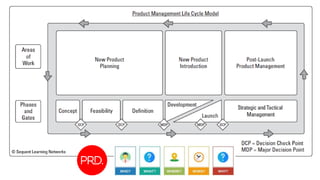
• PM lifecycle
• PM role buckets
• Product opportunity assessment framework
• Understanding target customer & their problems
• Cases
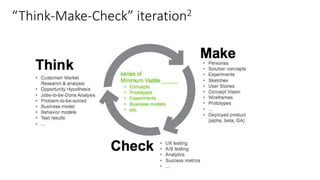
• Think-make-check – product as iterations of MVPs
• Think: Problems, solutions & hypothesis to validate
• Think: Jobs to be done framework
• Make: Personas, wireframes
• Check: Analytics
• Cases
• MVP - details
• Typical PM interviews
• PM case questions approach
• Getting ready
• P
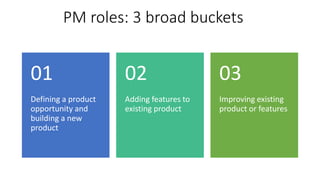
PM roles: 3 broad buckets
Defining a product
opportunity and
building a new
product
01
Adding features to
existing product
02
Improving existing
product or features
03
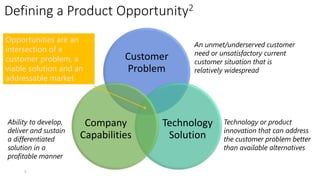
Defining a Product Opportunity2
5
Customer
Problem
Technology
Solution
Company
Capabilities
An unmet/underserved customer
need or unsatisfactory current
customer situation that is
relatively widespread
Technology or product
innovation that can address
the customer problem better
than available alternatives
Ability to develop,
deliver and sustain
a differentiated
solution in a
profitable manner
Opportunities are an
intersection of a
customer problem, a
viable solution and an
addressable market
Product Opportunity Discovery2
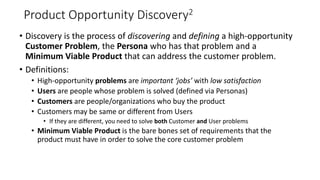
• Discovery is the process of discovering and defining a high-opportunity
Customer Problem, the Persona who has that problem and a
Minimum Viable Product that can address the customer problem.
• Definitions:
• High-opportunity problems are important ‘jobs’ with low satisfaction
• Users are people whose problem is solved (defined via Personas)
• Customers are people/organizations who buy the product
• Customers may be same or different from Users
• If they are different, you need to solve both Customer and User problems
• Minimum Viable Product is the bare bones set of requirements that the
product must have in order to solve the core customer problem
6
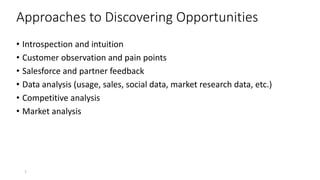
Approaches to Discovering Opportunities
• Introspection and intuition
• Customer observation and pain points
• Salesforce and partner feedback
• Data analysis (usage, sales, social data, market research data, etc.)
• Competitive analysis
• Market analysis
7
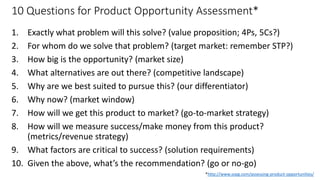
10 Questions for Product Opportunity Assessment*
1. Exactly what problem will this solve? (value proposition; 4Ps, 5Cs?)
2. For whom do we solve that problem? (target market: remember STP?)
3. How big is the opportunity? (market size)
4. What alternatives are out there? (competitive landscape)
5. Why are we best suited to pursue this? (our differentiator)
6. Why now? (market window)
7. How will we get this product to market? (go-to-market strategy)
8. How will we measure success/make money from this product?
(metrics/revenue strategy)
9. What factors are critical to success? (solution requirements)
10. Given the above, what’s the recommendation? (go or no-go)
8
* Marty Cagan, “Assessing Product Opportunities”, *http://www.svpg.com/assessing-product-opportunities/
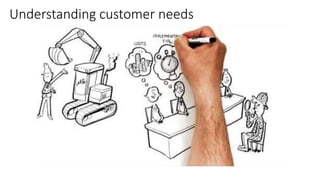
Understanding customer needs
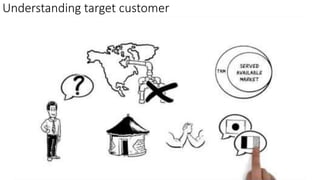
Understanding target customer
Opportunity: for an elevator
• # floors?
• Commercial or residential?
• Area, foot fall
Sharing your suitcase
• Mobile app?
• B2C
• How will get inputs from customers?
• Regulations?
• Uberpool?
“Think-Make-Check” iteration2
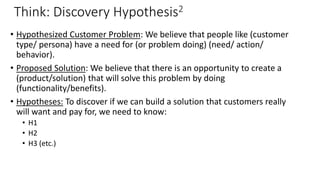
Think: Discovery Hypothesis2
• Hypothesized Customer Problem: We believe that people like (customer
type/ persona) have a need for (or problem doing) (need/ action/
behavior).
• Proposed Solution: We believe that there is an opportunity to create a
(product/solution) that will solve this problem by doing
(functionality/benefits).
• Hypotheses: To discover if we can build a solution that customers really
will want and pay for, we need to know:
• H1
• H2
• H3 (etc.)
Example: Caltrain Mobile App2
Customer Problem: Caltrain is the local train that runs from San Jose to San Francisco.
Riders include daily commuters and occasional train riders. Occasional riders
experience a number of problems. They don’t know how to buy tickets, they don’t
know how to pay for parking, they don’t know which platform to stand on. They don’t
know how to tell what stop they are at or when and where to get off the train. We
believe that if Caltrain tackled some of these problems, they might convert more of
these occasional riders into daily commuters, growing their ridership.
Proposed Solution: We believe that there is an opportunity to build a Caltrain mobile
app that will address some of these usability problems. The app would walk the
occasional train rider through each step of the process of riding the train, starting with
where to park, how to buy a ticket, updates on when the next train is coming, updates
on where you currently are relative to where you want to get off the train. We believe
that Caltrain will pay us $10,000 to build the app and a 5% commission on incremental
bookings made by occasional riders.
Hypotheses underlying the idea:
• H1: Occasional train riders will download a Caltrain mobile app before they ride the train.
• H2: The problems that occasional train riders experience are big enough that they will
remember to use the app they downloaded earlier to help solve their problems.
• H3: The desire to ride the train is great enough that if occasional train riders had help they
would ride the train more frequently.
• H4: Caltrain will be willing to pay for app development as well as a commission on incremental
ticket sales.
IRCTC having flight booking
• I/we believe [target market] will [do this action / use this
solution] for [this reason]
• I believe that people booking train ticket will book flight since they
are not able to get a train ticket. What’s wrong?
• What MVP will you build to test your hypothesis?
• Post launch: How will we measure success of this product?
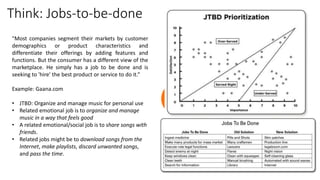
Think: Jobs-to-be-done
"Most companies segment their markets by customer
demographics or product characteristics and
differentiate their offerings by adding features and
functions. But the consumer has a different view of the
marketplace. He simply has a job to be done and is
seeking to 'hire' the best product or service to do it.”
Example: Gaana.com
• JTBD: Organize and manage music for personal use
• Related emotional job is to organize and manage
music in a way that feels good
• A related emotional/social job is to share songs with
friends.
• Related jobs might be to download songs from the
Internet, make playlists, discard unwanted songs,
and pass the time.
Make
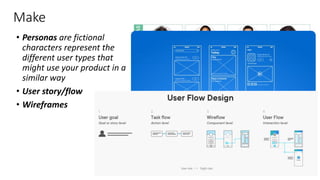
• Personas are fictional
characters represent the
different user types that
might use your product in a
similar way
• User story/flow
• Wireframes
Check: Analytics
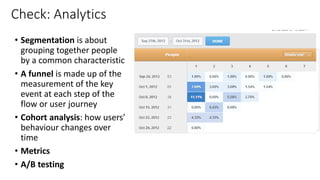
• Segmentation is about
grouping together people
by a common characteristic
• A funnel is made up of the
measurement of the key
event at each step of the
flow or user journey
• Cohort analysis: how users’
behaviour changes over
time
• Metrics
• A/B testing
How would you make IRCTC better?
• What do you mean by better?
• User experience
• What are the current problems?
• No right or wrong answer but avoid faux paus
• Allowing people to choose seat like a plane with Age/Gender displayed on each
booked seat
• How can IRCTC make more money?
20
Uber for senior citizens
• What are current customer problems, which are most painful (prioritize)?
• How would you find out?
• What is competition doing?
• What are the solutions?
• How will you measure success?
21
Bright Wheel
Defining the Minimum Viable Product (MVP)
23
“The minimum viable product (MVP) is that product which has
just those features (and no more) that allows you to ship a
product that resonates with early adopters; some of whom will
pay you money or give you feedback”1
1. Eric Ries, “Startup Lessons Learned” (blog), 3/23/09,
http://www.startuplessonslearned.com/2009/03/minimum-viable-product.html
Developing the MVP is a strategy targeted at avoiding building products that
customers do not want, that seeks to maximize the information learned about the
customer per dollar spent. "The minimum viable product is that version of a new
product which allows a team to collect the maximum amount of validated learning
about customers with the least effort."
Breaking Down the MVP Definition2
• Minimum: There are usually just one or two core problems that
products need to solve.
• The iPod lets you store a bunch of your music and play it on the go
• Facebook lets you find friends and share information with them
• eBay lets you sell used stuff or buy used stuff
• Viable: Two questions to ask -
• Will people use it?
• Will someone pay for it?
• Product: Any artifact such as:
• A commercial product
• A service
• An entire business
24
Dropbox MVP
25
Dropbox
• Biggest risk: making something no one wants
• Not launching -> painful, but not learning -> fatal
• Put something in user hands (doesn’t have to be code) and get real feedback
ASAP
• Know where your target audience hangs out and speak to them
• 1M users in 7 months, 4M in another 15 months
• Went viral:
• 35% from referrals: 2-sided incentives
26
Examples of MVPs2
• Dropbox – The founders of Dropbox, started with a 3
minute video for their MVP. It looks like a normal product
demonstration. And that’s all it is. There is no code. When
they released the video online, however, their waiting list
went from 5,000 people to 75,000 overnight!
• Foursquare – Collects customer feedback using Google
Docs. Nobody has to maintain code.
• Virgin Air – Virgin Air used only one plane and one route to
test their hypothesis. As they worked out the kinks in their
strategy they started adding more planes and routes.
• Groupon – It started out as a simple WordPress blog with a
widget that used AppleScript to send PDFs coupons via
Mail.app.
27
Typical PM interviews
• Behavioral questions/PM role questions
• What excites you about PM role?
• What is the proud moment in your career?
• Product Case study questions
• Test of structured thinking
• Favorite product: Why? What will you improve in that?
• Build a new product to solve a problem
• Add a new feature in existing product
• Uber for senior citizens
• Mobile app for restaurant chain
• Enter a new market for an existing product
• Analytics questions
• Estimation: Estimate the number of autos near IIM
• Estimation: How much money does Google make form Gmail?
• Execution/problem identification: DAU for Instagram stories has dropped by 5% WoW
• Metrics: What north-star metric will you use for Google calendar?
PM Case questions approach
• Ask Clarifying Questions & scope the problem
• Remember, there is no point continuing with an answer if you haven’t fully grasped the
situation
• Communicate Your Answer Outline
• There is nothing worse for an interviewer than trying to follow a candidate’s unstructured
train of thought when responding to a product question
• Identify the Users / Customers and their Use Cases
• Although you might have lightly touched upon this while asking some clarifying questions,
this step is crucial to locking down exactly who the product’s customers and users are and
their use cases.
• Identify Gaps in the Use Cases
• Start thinking about how current products/solutions in the market address these use cases
and whether or not there are any gaps or room for improvement
• Brainstorm Features / Improvements
• Prioritize and Identify Trade-offs
• Based on the most important variable
• Summarize your Recommendation
29
More case questions
• Amazon wants to do drone delivery in India. How would you go about doing that?
• How much money does gmail make for Google?
• How will you launch a credit card loyalty program in India? (Fin)
• How would you make mobile app for tracking weight and calorie consumption?
• How would you design a mobile app to find a good & reliable maid or cook or
driver?
• Flipkart wants to add 2 hours delivery service in India. How would you approach
that?
• You are HUL what product will you build to counter Patanjali products? (FMCG)
• How will you compete with Jio’s product offering? (Telecom)
• How can Maggi rebuild its brand in India, new product launch? (FMCG)
• What is your favorite product? Why do you like it? What one feature will you add
to it and why?
30
Getting ready
IT
• Your resume should showcase experience: product, analytics & domain
• IT services people: If they have worked on product for a client or domain expertise
• Technical: prep on things on your resume: architecture,
Non-IT
• Resume should show domain expertise and some product experience
IT/Non-IT
• Read a lot of stuff
• Techcrunch, Quora, ET, Podcasts: TechNews
• Write a blog atleast once a month
• Sharpen product thinking, Play with products, form opinions
• Apps, websites
• Observe UX
• Products you liked, disliked
• Build on domain
• Keep facts in memory
• Revenues, # downloads
• Discuss, debate, share thoughts with peers
31
MBA Courses that can help
• Marketing
• 4P, 5Cs, STP, Laddering
• B2B marketing
• Brand management
• Marketing research
• Surveys, Segmentation etc.
• UX/Design, Design thinking
• Business analytics
• Regression, Factor analysis etc.
• New product development or Product management
• Ideation to GTM
• Finance
• NPV, projections
• Some strategy
• Competition, M&A, GTM/Market-entry
Resources
• Books:
• Product management handbook
• Cracking PM interview
• Product management desk reference
• Lean start-up: Eric Ries
• Lean analytics
• UX for Lean Startups
• Inspired: How To Create Products Customers Love
• Videos
• The Art of Product Management with Sachin Rekhi, Wharton
https://www.youtube.com/watch?v=huTSPanUlQM
• 16 Killer videos on Product Mgmt. essentials
• https://userbrain.net/blog/12-killer-product-management-videos
• Design thinking by Tim Brown, IDEO
• https://www.youtube.com/watch?v=U-hzefHdAMk&t=152s
• Product school
• https://www.productschool.com/blog/product-management-2/interview/the-ultimate-list-product-manager-interview-questions/
• Others
• KPIs for apps
• Guestimate Q’s
33
More Online resources
• www.productmanagerhq.com
• The Top 12 Product Management Mistakes
• The Product Manager’s Essential Reading List of 2016
• The Famous PM Reading List on Medium
• The Past and Future of Product Management
• http://www.crackingthepminterview.com/
• The Art of Product Management (author Jackie Bavaro’s blog)
• What distinguishes the top 1% of product manager’s from the top 10%?
• Good Product Manager, Bad Product Manager (Ben Horowitz)
• How to Hire a Product Manager (Ken Norton)
• The Art of Decision Making as a Product Manager (Sachin Rekhi)
• 3 Reasons Better Products Don’t Always Win (Sachin Rekhi)
• What I Look For in a Product Manager (David Lifson)
• Be a Great Product Leader (Adam Nash)
• Getting Hired: How to Get a Job in Product Management
• The Product Manager Handbook (Carl Shan, Brittany Cheng)
• The Art of Delivery (Ibrahim Bashir)
• The PM Interview (Raphael Korach)
34
References
• 1: Book: Product management desk reference, Cracking PM interview
• 2: Lecture Notes from Prof. Mohan Sawhney, Kellogs
35
IT PM sample jobs from iimjobs.com
(links might expire)
• PM: Paytm
• PM: Amazon
• PM: Cisco
• PM: AMEX
• PM: Intuit
• PM: Cardekho.com
• PM: Jabong
• PM: Limeroad
• PM: Digital roadmap for Genpact
• PM: Digital business for ABP group
• PM: Banking & Digital payments for Tally
Non-IT PM sample jobs from iimjobs.com
(links might expire)
• PM: General insurance
• PM: Building material industry
• PM: Healthcare
• PM: Home loans & mortgage
• PM: Pharma
• PM: Glass MNC
• PM: Car retail finance
• PM: Equipment manufacturing
• PM: Fintech
• PM: BFSI, MF

PM workshop

  • 1.
    Harshit Kumar Representing: Me, Myself& I Product Management workshop
  • 2.
    Agenda • PM lifecycle •PM role buckets • Product opportunity assessment framework • Understanding target customer & their problems • Cases • Think-make-check – product as iterations of MVPs • Think: Problems, solutions & hypothesis to validate • Think: Jobs to be done framework • Make: Personas, wireframes • Check: Analytics • Cases • MVP - details • Typical PM interviews • PM case questions approach • Getting ready
  • 3.
  • 4.
    PM roles: 3broad buckets Defining a product opportunity and building a new product 01 Adding features to existing product 02 Improving existing product or features 03
  • 5.
    Defining a ProductOpportunity2 5 Customer Problem Technology Solution Company Capabilities An unmet/underserved customer need or unsatisfactory current customer situation that is relatively widespread Technology or product innovation that can address the customer problem better than available alternatives Ability to develop, deliver and sustain a differentiated solution in a profitable manner Opportunities are an intersection of a customer problem, a viable solution and an addressable market
  • 6.
    Product Opportunity Discovery2 •Discovery is the process of discovering and defining a high-opportunity Customer Problem, the Persona who has that problem and a Minimum Viable Product that can address the customer problem. • Definitions: • High-opportunity problems are important ‘jobs’ with low satisfaction • Users are people whose problem is solved (defined via Personas) • Customers are people/organizations who buy the product • Customers may be same or different from Users • If they are different, you need to solve both Customer and User problems • Minimum Viable Product is the bare bones set of requirements that the product must have in order to solve the core customer problem 6
  • 7.
    Approaches to DiscoveringOpportunities • Introspection and intuition • Customer observation and pain points • Salesforce and partner feedback • Data analysis (usage, sales, social data, market research data, etc.) • Competitive analysis • Market analysis 7
  • 8.
    10 Questions forProduct Opportunity Assessment* 1. Exactly what problem will this solve? (value proposition; 4Ps, 5Cs?) 2. For whom do we solve that problem? (target market: remember STP?) 3. How big is the opportunity? (market size) 4. What alternatives are out there? (competitive landscape) 5. Why are we best suited to pursue this? (our differentiator) 6. Why now? (market window) 7. How will we get this product to market? (go-to-market strategy) 8. How will we measure success/make money from this product? (metrics/revenue strategy) 9. What factors are critical to success? (solution requirements) 10. Given the above, what’s the recommendation? (go or no-go) 8 * Marty Cagan, “Assessing Product Opportunities”, *http://www.svpg.com/assessing-product-opportunities/
  • 9.
  • 10.
  • 11.
    Opportunity: for anelevator • # floors? • Commercial or residential? • Area, foot fall
  • 12.
    Sharing your suitcase •Mobile app? • B2C • How will get inputs from customers? • Regulations? • Uberpool?
  • 13.
  • 14.
    Think: Discovery Hypothesis2 •Hypothesized Customer Problem: We believe that people like (customer type/ persona) have a need for (or problem doing) (need/ action/ behavior). • Proposed Solution: We believe that there is an opportunity to create a (product/solution) that will solve this problem by doing (functionality/benefits). • Hypotheses: To discover if we can build a solution that customers really will want and pay for, we need to know: • H1 • H2 • H3 (etc.)
  • 15.
    Example: Caltrain MobileApp2 Customer Problem: Caltrain is the local train that runs from San Jose to San Francisco. Riders include daily commuters and occasional train riders. Occasional riders experience a number of problems. They don’t know how to buy tickets, they don’t know how to pay for parking, they don’t know which platform to stand on. They don’t know how to tell what stop they are at or when and where to get off the train. We believe that if Caltrain tackled some of these problems, they might convert more of these occasional riders into daily commuters, growing their ridership. Proposed Solution: We believe that there is an opportunity to build a Caltrain mobile app that will address some of these usability problems. The app would walk the occasional train rider through each step of the process of riding the train, starting with where to park, how to buy a ticket, updates on when the next train is coming, updates on where you currently are relative to where you want to get off the train. We believe that Caltrain will pay us $10,000 to build the app and a 5% commission on incremental bookings made by occasional riders. Hypotheses underlying the idea: • H1: Occasional train riders will download a Caltrain mobile app before they ride the train. • H2: The problems that occasional train riders experience are big enough that they will remember to use the app they downloaded earlier to help solve their problems. • H3: The desire to ride the train is great enough that if occasional train riders had help they would ride the train more frequently. • H4: Caltrain will be willing to pay for app development as well as a commission on incremental ticket sales.
  • 16.
    IRCTC having flightbooking • I/we believe [target market] will [do this action / use this solution] for [this reason] • I believe that people booking train ticket will book flight since they are not able to get a train ticket. What’s wrong? • What MVP will you build to test your hypothesis? • Post launch: How will we measure success of this product?
  • 17.
    Think: Jobs-to-be-done "Most companiessegment their markets by customer demographics or product characteristics and differentiate their offerings by adding features and functions. But the consumer has a different view of the marketplace. He simply has a job to be done and is seeking to 'hire' the best product or service to do it.” Example: Gaana.com • JTBD: Organize and manage music for personal use • Related emotional job is to organize and manage music in a way that feels good • A related emotional/social job is to share songs with friends. • Related jobs might be to download songs from the Internet, make playlists, discard unwanted songs, and pass the time.
  • 18.
    Make • Personas arefictional characters represent the different user types that might use your product in a similar way • User story/flow • Wireframes
  • 19.
    Check: Analytics • Segmentationis about grouping together people by a common characteristic • A funnel is made up of the measurement of the key event at each step of the flow or user journey • Cohort analysis: how users’ behaviour changes over time • Metrics • A/B testing
  • 20.
    How would youmake IRCTC better? • What do you mean by better? • User experience • What are the current problems? • No right or wrong answer but avoid faux paus • Allowing people to choose seat like a plane with Age/Gender displayed on each booked seat • How can IRCTC make more money? 20
  • 21.
    Uber for seniorcitizens • What are current customer problems, which are most painful (prioritize)? • How would you find out? • What is competition doing? • What are the solutions? • How will you measure success? 21
  • 22.
  • 23.
    Defining the MinimumViable Product (MVP) 23 “The minimum viable product (MVP) is that product which has just those features (and no more) that allows you to ship a product that resonates with early adopters; some of whom will pay you money or give you feedback”1 1. Eric Ries, “Startup Lessons Learned” (blog), 3/23/09, http://www.startuplessonslearned.com/2009/03/minimum-viable-product.html Developing the MVP is a strategy targeted at avoiding building products that customers do not want, that seeks to maximize the information learned about the customer per dollar spent. "The minimum viable product is that version of a new product which allows a team to collect the maximum amount of validated learning about customers with the least effort."
  • 24.
    Breaking Down theMVP Definition2 • Minimum: There are usually just one or two core problems that products need to solve. • The iPod lets you store a bunch of your music and play it on the go • Facebook lets you find friends and share information with them • eBay lets you sell used stuff or buy used stuff • Viable: Two questions to ask - • Will people use it? • Will someone pay for it? • Product: Any artifact such as: • A commercial product • A service • An entire business 24
  • 25.
  • 26.
    Dropbox • Biggest risk:making something no one wants • Not launching -> painful, but not learning -> fatal • Put something in user hands (doesn’t have to be code) and get real feedback ASAP • Know where your target audience hangs out and speak to them • 1M users in 7 months, 4M in another 15 months • Went viral: • 35% from referrals: 2-sided incentives 26
  • 27.
    Examples of MVPs2 •Dropbox – The founders of Dropbox, started with a 3 minute video for their MVP. It looks like a normal product demonstration. And that’s all it is. There is no code. When they released the video online, however, their waiting list went from 5,000 people to 75,000 overnight! • Foursquare – Collects customer feedback using Google Docs. Nobody has to maintain code. • Virgin Air – Virgin Air used only one plane and one route to test their hypothesis. As they worked out the kinks in their strategy they started adding more planes and routes. • Groupon – It started out as a simple WordPress blog with a widget that used AppleScript to send PDFs coupons via Mail.app. 27
  • 28.
    Typical PM interviews •Behavioral questions/PM role questions • What excites you about PM role? • What is the proud moment in your career? • Product Case study questions • Test of structured thinking • Favorite product: Why? What will you improve in that? • Build a new product to solve a problem • Add a new feature in existing product • Uber for senior citizens • Mobile app for restaurant chain • Enter a new market for an existing product • Analytics questions • Estimation: Estimate the number of autos near IIM • Estimation: How much money does Google make form Gmail? • Execution/problem identification: DAU for Instagram stories has dropped by 5% WoW • Metrics: What north-star metric will you use for Google calendar?
  • 29.
    PM Case questionsapproach • Ask Clarifying Questions & scope the problem • Remember, there is no point continuing with an answer if you haven’t fully grasped the situation • Communicate Your Answer Outline • There is nothing worse for an interviewer than trying to follow a candidate’s unstructured train of thought when responding to a product question • Identify the Users / Customers and their Use Cases • Although you might have lightly touched upon this while asking some clarifying questions, this step is crucial to locking down exactly who the product’s customers and users are and their use cases. • Identify Gaps in the Use Cases • Start thinking about how current products/solutions in the market address these use cases and whether or not there are any gaps or room for improvement • Brainstorm Features / Improvements • Prioritize and Identify Trade-offs • Based on the most important variable • Summarize your Recommendation 29
  • 30.
    More case questions •Amazon wants to do drone delivery in India. How would you go about doing that? • How much money does gmail make for Google? • How will you launch a credit card loyalty program in India? (Fin) • How would you make mobile app for tracking weight and calorie consumption? • How would you design a mobile app to find a good & reliable maid or cook or driver? • Flipkart wants to add 2 hours delivery service in India. How would you approach that? • You are HUL what product will you build to counter Patanjali products? (FMCG) • How will you compete with Jio’s product offering? (Telecom) • How can Maggi rebuild its brand in India, new product launch? (FMCG) • What is your favorite product? Why do you like it? What one feature will you add to it and why? 30
  • 31.
    Getting ready IT • Yourresume should showcase experience: product, analytics & domain • IT services people: If they have worked on product for a client or domain expertise • Technical: prep on things on your resume: architecture, Non-IT • Resume should show domain expertise and some product experience IT/Non-IT • Read a lot of stuff • Techcrunch, Quora, ET, Podcasts: TechNews • Write a blog atleast once a month • Sharpen product thinking, Play with products, form opinions • Apps, websites • Observe UX • Products you liked, disliked • Build on domain • Keep facts in memory • Revenues, # downloads • Discuss, debate, share thoughts with peers 31
  • 32.
    MBA Courses thatcan help • Marketing • 4P, 5Cs, STP, Laddering • B2B marketing • Brand management • Marketing research • Surveys, Segmentation etc. • UX/Design, Design thinking • Business analytics • Regression, Factor analysis etc. • New product development or Product management • Ideation to GTM • Finance • NPV, projections • Some strategy • Competition, M&A, GTM/Market-entry
  • 33.
    Resources • Books: • Productmanagement handbook • Cracking PM interview • Product management desk reference • Lean start-up: Eric Ries • Lean analytics • UX for Lean Startups • Inspired: How To Create Products Customers Love • Videos • The Art of Product Management with Sachin Rekhi, Wharton https://www.youtube.com/watch?v=huTSPanUlQM • 16 Killer videos on Product Mgmt. essentials • https://userbrain.net/blog/12-killer-product-management-videos • Design thinking by Tim Brown, IDEO • https://www.youtube.com/watch?v=U-hzefHdAMk&t=152s • Product school • https://www.productschool.com/blog/product-management-2/interview/the-ultimate-list-product-manager-interview-questions/ • Others • KPIs for apps • Guestimate Q’s 33
  • 34.
    More Online resources •www.productmanagerhq.com • The Top 12 Product Management Mistakes • The Product Manager’s Essential Reading List of 2016 • The Famous PM Reading List on Medium • The Past and Future of Product Management • http://www.crackingthepminterview.com/ • The Art of Product Management (author Jackie Bavaro’s blog) • What distinguishes the top 1% of product manager’s from the top 10%? • Good Product Manager, Bad Product Manager (Ben Horowitz) • How to Hire a Product Manager (Ken Norton) • The Art of Decision Making as a Product Manager (Sachin Rekhi) • 3 Reasons Better Products Don’t Always Win (Sachin Rekhi) • What I Look For in a Product Manager (David Lifson) • Be a Great Product Leader (Adam Nash) • Getting Hired: How to Get a Job in Product Management • The Product Manager Handbook (Carl Shan, Brittany Cheng) • The Art of Delivery (Ibrahim Bashir) • The PM Interview (Raphael Korach) 34
  • 35.
    References • 1: Book:Product management desk reference, Cracking PM interview • 2: Lecture Notes from Prof. Mohan Sawhney, Kellogs 35
  • 36.
    IT PM samplejobs from iimjobs.com (links might expire) • PM: Paytm • PM: Amazon • PM: Cisco • PM: AMEX • PM: Intuit • PM: Cardekho.com • PM: Jabong • PM: Limeroad • PM: Digital roadmap for Genpact • PM: Digital business for ABP group • PM: Banking & Digital payments for Tally
  • 37.
    Non-IT PM samplejobs from iimjobs.com (links might expire) • PM: General insurance • PM: Building material industry • PM: Healthcare • PM: Home loans & mortgage • PM: Pharma • PM: Glass MNC • PM: Car retail finance • PM: Equipment manufacturing • PM: Fintech • PM: BFSI, MF

Editor's Notes

  • #7 https://www.youtube.com/watch?v=2C-2v99paQM
  • #11 https://www.youtube.com/watch?v=fmY3-2sOhq4
  • #18 Main jobs to be done, which describe the task that customers want to achieve. Related jobs to be done, which customers want to accomplish in conjunction with the main jobs to be done. Functional job aspects — the practical and objective customer requirements. Emotional job aspects — the subjective customer requirements related to feelings and perception. Finally, emotional job aspects are further broken down into: Personal dimension — how the customer feels about the solution. Social dimension — how the customer believes he or she is perceived by others while using the solution.
  • #19 https://www.youtube.com/watch?v=B23iWg0koi8&feature=youtu.be UX techniques: https://uxmastery.com/resources/techniques/