Best practice of interview preparation
18th Oct 2022
An IIMB NSRCEL & Goldman Sachs Supported Firm
Agenda
1. Different types of interviews
2. Type of interview & how to prepare
• Behavioural
• Situational
• Resume based
• Industry/ functions based
• Case based
• Guesstimates
• Some common questions
3. Type of role & typical line of questioning
Let’s start with understanding you
ü Go to Slido.com
ü Use #8548742
Different types of interviews
• Behavioural
• Situational
• Resume based
• Industry/ functions based
• Case based
• Guesstimates
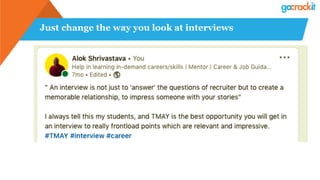
Just change the way you look at interviews
Behavioral questions examples
• Tell me a time when you have to take calculated risk?
• Tell me a time you have take initiative to solve a problem?
• Tell me about a time when you took a decision under pressure
• Tell me about a time when you committed to a team member but
could not live up to their expectations. How did you earn their trust
again?
• Tell me about a time when you had to analyze large amount of data
to solve a problem ?
Behavioral questions examples
• Tell me about a time when you had to analyze large amount of data
to solve a problem ?
• I was working in a boiler and I analyzed a lot of historical data
to reduce its tube leakage. Because of this boiler availability
increased and I recieved GM award for this.
Use a structure approach – STAR framework
• Situation
An event, project or challenged faced
• Task
Your responsibilities, assignment or objective of the project
• Action
Steps taken to relieve or rectify the situation
• Results
Results of action taken. Try to bring out not only specific impacts
but also how it helped the company in their overall business
STAR framework - Example
• Situation
In my last job, we needed to develop a very complex and urgent logistics development
for a client which was launching its operations in UK.
The project was very critical as if do not do this not only our client will loss a lot of
money but we could also may lose our deal.
In this situation I had to work alone as my coworker had a family emergency and
needed to miss work for some days.
STAR framework - Example
• Task
My supervisor instructed me to take on the project alone, and with no
leniency on the deadline, I had few days to complete the project that
originally should have done with two resources.
STAR framework - Example
• Actions (Bring your skills here)
Amongst others, I did three key things:
i) I negotiated with my boss for a reduction in my weekly goals, allotting me
more time to attack the special project.
ii) I delegated my other weekly goals to some of my teammates.
iii) I breakdown the problem into smaller modules and prioritized those
which are “Must Have” as per my analysis
STAR framework - Example
• Results
With the reduction in my daily goals, I was able to dedicate more time to
the special project. This allowed me to finish it 5 days before time, enable
my client to start the operation as planned and with complete accuracy.
My supervisor appreciated my attitude and drive, and I was given
several more projects after that, along with an eventual promotion and
pay raise.
STAR framework - Example
• Executive Summary
I completed a very complex SAP logistics development project within 4 days (as
opposed to 9 days) for a large FMCG clients which was entering in UK market despite
working alone as my coworker got some personal emergency.
Behavioral questions: Common mistakes/ issues
• Choosing a story that is not impactful
• Choosing a story in which you can not explain your role
• Poor communication skill
• Telling a story with too much technicalities
• Telling a story which is too much detailed (use executive summary,
be crisp, sense check in between)
Behavioral interviews – how to prepare?
• Create an ”Interview preparation sheet" in excel and write one line
each of whatever you have done in the past
(Use Amazon 14 principles of leadership as reference)
https://aws.amazon.com/careers/culture/
• In next column describe each instance in detail using STAR format
Situational interviews
• Like a behavioral interview, during situational interview candidates
are asked specific questions about what may happen on a job.
• The candidate is asked to assess a situation and to provide solutions
on how he or she would handle it.
Example
• Your team members are not listening to you, what you will you?
Example
• Your team members are not listening to you, what you will you?
• I will first talk to the team member and find out why he/she is
not listening to me and try to resolve the issue.
Situational interviews – How to prepare
• Try to come up with a similar situation in the past and answer it like
a behavioral question
• Have a structure in mind in order to approach the problem
Situational questions: Common mistakes/ issues
• Not using any structure / examples
• Giving up too early
Situational questions – Examples
Team Dynamics
• What you will do if your team members are not listening to
you?
Customer handling
• How do you deal with an unsatisfied customer?
Decision Making
• What you will do if your team is not able to take decisions?
How to prepare for Situational interviews
• Use “Interview Preparation Sheet”
• Create a sheet with frameworks of motivations, teamwork,
customer satisfaction & delight, conflict, stakeholder management,
change management, decision making framework
(don’t just copy the framework but also understand how had/will
you modify them for the situations)
Resume based interviews
• Be very thorough about your resume
• Not knowing any point written in resume in great detail is strict no-
no
• If you have done lot of job shifts, be ready to answer that
• If you have shown poor academics, be ready to defend that
• If you have travelled across countries/ geographies etc. , be ready to
talk about the difference in culture etc.
• Be prepared with all the details in a structured format
Resume based questions - Example
• You have saved xyz mn in this project, this seems unbelievable can
you explain?
• You have worked in this project tell me some of the learnings from
this project?
• You have worked in this industry how you can convince us that your
experience is relevant to us?
Example
• You have saved xyz mn in this project, this seems unbelievable can
you explain?
• My Manager told me this
How to prepare -Resume based questions
• Use interview preparation sheet and expand each point (including
work ex, academics, EC, Academic projects, Career Summary) of
resume in that sheet
• Ask “But Why” and “So What” to at least 3 levels for each point
Industry/ function knowledge based interviews
• Industry structure, KSF, key players, new trends, disruptions,
future potential
• Knowledge of company/ its products etc.
• Understanding of function and its theoretical/ practical aspects
• Knowing current trends, future projections etc.
Industry/ function knowledge based interviews
• Tell me top 3 competitors of our company?
• We want to enter in African Market, what should we do?
• What is your understanding of the role
How to prepare
• Do a Porter 5 forces analysis of your industry and your target
industry
• Do Firm Analysis of your target company(ies) and its competitors
• Do a PESTLE analysis which affects your/target industry(ies)
• Understand Innovation/ Disruption in your/target industry(ies)
• Read up case studies given in the website of your target
company(ies)
Cases related to emerging technology domain
• Use cases
• Benefits
• Business case (RoI)
• Risks
• What companies are doing to convince clients to adopt emerging
technology
Interviews around MBA courses / Value add from MBA
• At least be ready with two subjects fully
• Know all the important frameworks 5S, 4P, BCG matrix, Porter's
etc.
How to prepare : Value add from MBA
• For preparing for value add from MBA type of question, use your
Interview preparation sheet, in which add one more column and
write how you will do it differently post MBA
Some common questions
• TMAY
• One line about you/ broad profile (years of exp, value chain in
which you worked etc.) (15 second)
• Your achievement showcasing your relevant expertise (30 sec)
• Why you are interested in the job/ role (20 sec)
• Anything you want to highlight or anything you want a recruiter
to ask questions on (10 sec)
Some common questions
• What is your weakness
• Don’t be evasive
• Understand which trait has ‘consistently’ impacted your work performance
• What are you doing to improve and what’s the status
• Use examples/ stories
• Why do you want to join this role
• Tell genuinely how it aligns with your short term/ long term objective
• Talk about learning opportunities, quality peers etc.
• You can reuse some relevant facts/ examples mentioned by them in PPT/
website
Some common questions
• Why MBA
• Why this job/company
• What is your LT/MT/ST goals
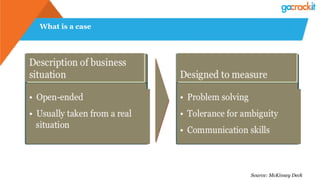
What is a case
Source: McKinsey Deck
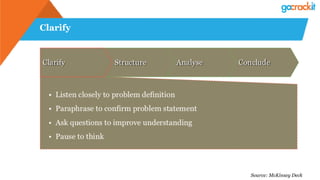
Clarify
Source: McKinsey Deck
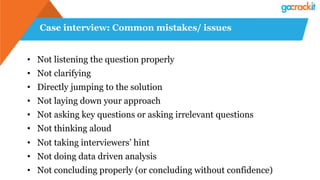
Case interview: Common mistakes/ issues
• Not listening the question properly
• Not clarifying
• Directly jumping to the solution
• Not laying down your approach
• Not asking key questions or asking irrelevant questions
• Not thinking aloud
• Not taking interviewers’ hint
• Not doing data driven analysis
• Not concluding properly (or concluding without confidence)
Guesstimates
• How many 4 wheelers are in Ahmedabad?
Guesstimates
• How many flights take off from Mumbai Airport?
Some interview cases
• A telecom company losing market share, how do you suggest to
improve the market share
• How do you price this pharmaceuticals
• A printer company is losing its ink business against fake ink
providers, how do you arrest this situation
• Estimate the number of autos in Bangalore
• An EPC company wants to digitize, suggest?
• A cement company wants to open a new manufacturing facility in
South, please create the business case for it?
How to prepare for cases
• Read The McKinsey Way
• Understand key frameworks (Profitability, Industry structure, Cost structure,
Market entry etc.)
• Know macro numbers (Population, Internet penetration, literacy rate, income
distribution etc.)
• Form a group of 2 to 3 students and start practicing as early as possible
• In general do a lot of practice, practice, practice
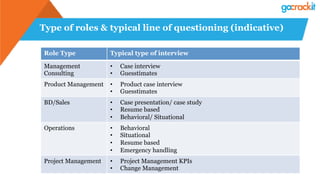
Type of roles & typical line of questioning (indicative)
Role Type Typical type of interview
Management
Consulting
• Case interview
• Guesstimates
Product Management • Product case interview
• Guesstimates
BD/Sales • Case presentation/ case study
• Resume based
• Behavioral/ Situational
Operations • Behavioral
• Situational
• Resume based
• Emergency handling
Project Management • Project Management KPIs
• Change Management
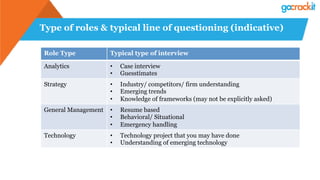
Type of roles & typical line of questioning (indicative)
Role Type Typical type of interview
Analytics • Case interview
• Guesstimates
Strategy • Industry/ competitors/ firm understanding
• Emerging trends
• Knowledge of frameworks (may not be explicitly asked)
General Management • Resume based
• Behavioral/ Situational
• Emergency handling
Technology • Technology project that you may have done
• Understanding of emerging technology
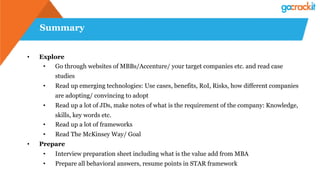
Summary
• Explore
• Go through websites of MBBs/Accenture/ your target companies etc. and read case
studies
• Read up emerging technologies: Use cases, benefits, RoI, Risks, how different companies
are adopting/ convincing to adopt
• Read up a lot of JDs, make notes of what is the requirement of the company: Knowledge,
skills, key words etc.
• Read up a lot of frameworks
• Read The McKinsey Way/ Goal
• Prepare
• Interview preparation sheet including what is the value add from MBA
• Prepare all behavioral answers, resume points in STAR framework
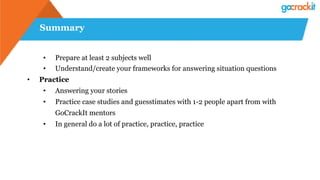
Summary
• Prepare at least 2 subjects well
• Understand/create your frameworks for answering situation questions
• Practice
• Answering your stories
• Practice case studies and guesstimates with 1-2 people apart from with
GoCrackIt mentors
• In general do a lot of practice, practice, practice
Interview Preparation

Interview Preparation

  • 1.
    Best practice ofinterview preparation 18th Oct 2022 An IIMB NSRCEL & Goldman Sachs Supported Firm
  • 2.
    Agenda 1. Different typesof interviews 2. Type of interview & how to prepare • Behavioural • Situational • Resume based • Industry/ functions based • Case based • Guesstimates • Some common questions 3. Type of role & typical line of questioning
  • 3.
    Let’s start withunderstanding you ü Go to Slido.com ü Use #8548742
  • 4.
    Different types ofinterviews • Behavioural • Situational • Resume based • Industry/ functions based • Case based • Guesstimates
  • 5.
    Just change theway you look at interviews
  • 6.
    Behavioral questions examples •Tell me a time when you have to take calculated risk? • Tell me a time you have take initiative to solve a problem? • Tell me about a time when you took a decision under pressure • Tell me about a time when you committed to a team member but could not live up to their expectations. How did you earn their trust again? • Tell me about a time when you had to analyze large amount of data to solve a problem ?
  • 7.
    Behavioral questions examples •Tell me about a time when you had to analyze large amount of data to solve a problem ? • I was working in a boiler and I analyzed a lot of historical data to reduce its tube leakage. Because of this boiler availability increased and I recieved GM award for this.
  • 8.
    Use a structureapproach – STAR framework • Situation An event, project or challenged faced • Task Your responsibilities, assignment or objective of the project • Action Steps taken to relieve or rectify the situation • Results Results of action taken. Try to bring out not only specific impacts but also how it helped the company in their overall business
  • 9.
    STAR framework -Example • Situation In my last job, we needed to develop a very complex and urgent logistics development for a client which was launching its operations in UK. The project was very critical as if do not do this not only our client will loss a lot of money but we could also may lose our deal. In this situation I had to work alone as my coworker had a family emergency and needed to miss work for some days.
  • 10.
    STAR framework -Example • Task My supervisor instructed me to take on the project alone, and with no leniency on the deadline, I had few days to complete the project that originally should have done with two resources.
  • 11.
    STAR framework -Example • Actions (Bring your skills here) Amongst others, I did three key things: i) I negotiated with my boss for a reduction in my weekly goals, allotting me more time to attack the special project. ii) I delegated my other weekly goals to some of my teammates. iii) I breakdown the problem into smaller modules and prioritized those which are “Must Have” as per my analysis
  • 12.
    STAR framework -Example • Results With the reduction in my daily goals, I was able to dedicate more time to the special project. This allowed me to finish it 5 days before time, enable my client to start the operation as planned and with complete accuracy. My supervisor appreciated my attitude and drive, and I was given several more projects after that, along with an eventual promotion and pay raise.
  • 13.
    STAR framework -Example • Executive Summary I completed a very complex SAP logistics development project within 4 days (as opposed to 9 days) for a large FMCG clients which was entering in UK market despite working alone as my coworker got some personal emergency.
  • 14.
    Behavioral questions: Commonmistakes/ issues • Choosing a story that is not impactful • Choosing a story in which you can not explain your role • Poor communication skill • Telling a story with too much technicalities • Telling a story which is too much detailed (use executive summary, be crisp, sense check in between)
  • 15.
    Behavioral interviews –how to prepare? • Create an ”Interview preparation sheet" in excel and write one line each of whatever you have done in the past (Use Amazon 14 principles of leadership as reference) https://aws.amazon.com/careers/culture/ • In next column describe each instance in detail using STAR format
  • 16.
    Situational interviews • Likea behavioral interview, during situational interview candidates are asked specific questions about what may happen on a job. • The candidate is asked to assess a situation and to provide solutions on how he or she would handle it.
  • 17.
    Example • Your teammembers are not listening to you, what you will you?
  • 18.
    Example • Your teammembers are not listening to you, what you will you? • I will first talk to the team member and find out why he/she is not listening to me and try to resolve the issue.
  • 19.
    Situational interviews –How to prepare • Try to come up with a similar situation in the past and answer it like a behavioral question • Have a structure in mind in order to approach the problem
  • 20.
    Situational questions: Commonmistakes/ issues • Not using any structure / examples • Giving up too early
  • 21.
    Situational questions –Examples Team Dynamics • What you will do if your team members are not listening to you? Customer handling • How do you deal with an unsatisfied customer? Decision Making • What you will do if your team is not able to take decisions?
  • 22.
    How to preparefor Situational interviews • Use “Interview Preparation Sheet” • Create a sheet with frameworks of motivations, teamwork, customer satisfaction & delight, conflict, stakeholder management, change management, decision making framework (don’t just copy the framework but also understand how had/will you modify them for the situations)
  • 23.
    Resume based interviews •Be very thorough about your resume • Not knowing any point written in resume in great detail is strict no- no • If you have done lot of job shifts, be ready to answer that • If you have shown poor academics, be ready to defend that • If you have travelled across countries/ geographies etc. , be ready to talk about the difference in culture etc. • Be prepared with all the details in a structured format
  • 24.
    Resume based questions- Example • You have saved xyz mn in this project, this seems unbelievable can you explain? • You have worked in this project tell me some of the learnings from this project? • You have worked in this industry how you can convince us that your experience is relevant to us?
  • 25.
    Example • You havesaved xyz mn in this project, this seems unbelievable can you explain? • My Manager told me this
  • 26.
    How to prepare-Resume based questions • Use interview preparation sheet and expand each point (including work ex, academics, EC, Academic projects, Career Summary) of resume in that sheet • Ask “But Why” and “So What” to at least 3 levels for each point
  • 27.
    Industry/ function knowledgebased interviews • Industry structure, KSF, key players, new trends, disruptions, future potential • Knowledge of company/ its products etc. • Understanding of function and its theoretical/ practical aspects • Knowing current trends, future projections etc.
  • 28.
    Industry/ function knowledgebased interviews • Tell me top 3 competitors of our company? • We want to enter in African Market, what should we do? • What is your understanding of the role
  • 29.
    How to prepare •Do a Porter 5 forces analysis of your industry and your target industry • Do Firm Analysis of your target company(ies) and its competitors • Do a PESTLE analysis which affects your/target industry(ies) • Understand Innovation/ Disruption in your/target industry(ies) • Read up case studies given in the website of your target company(ies)
  • 30.
    Cases related toemerging technology domain • Use cases • Benefits • Business case (RoI) • Risks • What companies are doing to convince clients to adopt emerging technology
  • 31.
    Interviews around MBAcourses / Value add from MBA • At least be ready with two subjects fully • Know all the important frameworks 5S, 4P, BCG matrix, Porter's etc.
  • 32.
    How to prepare: Value add from MBA • For preparing for value add from MBA type of question, use your Interview preparation sheet, in which add one more column and write how you will do it differently post MBA
  • 33.
    Some common questions •TMAY • One line about you/ broad profile (years of exp, value chain in which you worked etc.) (15 second) • Your achievement showcasing your relevant expertise (30 sec) • Why you are interested in the job/ role (20 sec) • Anything you want to highlight or anything you want a recruiter to ask questions on (10 sec)
  • 34.
    Some common questions •What is your weakness • Don’t be evasive • Understand which trait has ‘consistently’ impacted your work performance • What are you doing to improve and what’s the status • Use examples/ stories • Why do you want to join this role • Tell genuinely how it aligns with your short term/ long term objective • Talk about learning opportunities, quality peers etc. • You can reuse some relevant facts/ examples mentioned by them in PPT/ website
  • 35.
    Some common questions •Why MBA • Why this job/company • What is your LT/MT/ST goals
  • 36.
    What is acase Source: McKinsey Deck
  • 37.
  • 38.
    Case interview: Commonmistakes/ issues • Not listening the question properly • Not clarifying • Directly jumping to the solution • Not laying down your approach • Not asking key questions or asking irrelevant questions • Not thinking aloud • Not taking interviewers’ hint • Not doing data driven analysis • Not concluding properly (or concluding without confidence)
  • 39.
    Guesstimates • How many4 wheelers are in Ahmedabad?
  • 40.
    Guesstimates • How manyflights take off from Mumbai Airport?
  • 41.
    Some interview cases •A telecom company losing market share, how do you suggest to improve the market share • How do you price this pharmaceuticals • A printer company is losing its ink business against fake ink providers, how do you arrest this situation • Estimate the number of autos in Bangalore • An EPC company wants to digitize, suggest? • A cement company wants to open a new manufacturing facility in South, please create the business case for it?
  • 42.
    How to preparefor cases • Read The McKinsey Way • Understand key frameworks (Profitability, Industry structure, Cost structure, Market entry etc.) • Know macro numbers (Population, Internet penetration, literacy rate, income distribution etc.) • Form a group of 2 to 3 students and start practicing as early as possible • In general do a lot of practice, practice, practice
  • 43.
    Type of roles& typical line of questioning (indicative) Role Type Typical type of interview Management Consulting • Case interview • Guesstimates Product Management • Product case interview • Guesstimates BD/Sales • Case presentation/ case study • Resume based • Behavioral/ Situational Operations • Behavioral • Situational • Resume based • Emergency handling Project Management • Project Management KPIs • Change Management
  • 44.
    Type of roles& typical line of questioning (indicative) Role Type Typical type of interview Analytics • Case interview • Guesstimates Strategy • Industry/ competitors/ firm understanding • Emerging trends • Knowledge of frameworks (may not be explicitly asked) General Management • Resume based • Behavioral/ Situational • Emergency handling Technology • Technology project that you may have done • Understanding of emerging technology
  • 45.
    Summary • Explore • Gothrough websites of MBBs/Accenture/ your target companies etc. and read case studies • Read up emerging technologies: Use cases, benefits, RoI, Risks, how different companies are adopting/ convincing to adopt • Read up a lot of JDs, make notes of what is the requirement of the company: Knowledge, skills, key words etc. • Read up a lot of frameworks • Read The McKinsey Way/ Goal • Prepare • Interview preparation sheet including what is the value add from MBA • Prepare all behavioral answers, resume points in STAR framework
  • 46.
    Summary • Prepare atleast 2 subjects well • Understand/create your frameworks for answering situation questions • Practice • Answering your stories • Practice case studies and guesstimates with 1-2 people apart from with GoCrackIt mentors • In general do a lot of practice, practice, practice