Design & Process
Delivering Customer Happiness
2
Contents
• Background: “Change Ahead”
• Process Improvement At A Crossroads
• Why Design Matters
• Design Thinking + Process Improvement
• Lean Six Sigma
• Design Thinking
• A Dynamic Duo
• The Road Ahead
3
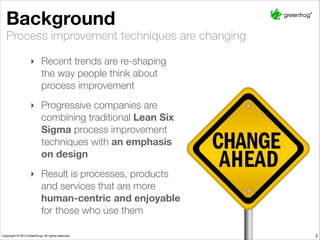
Background
‣ Recent trends are re-shaping the
way people think about process
improvement
‣ Progressive companies are
combining traditional Lean Six
Sigma process improvement
techniques with an emphasis on
design
‣ Result is processes, products and
services that are more human-
centric and enjoyable for those
who use them
Process improvement techniques are changing
4
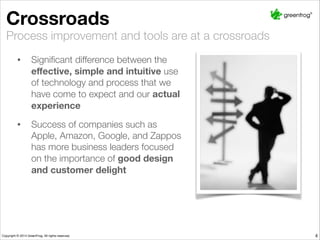
Crossroads
Process improvement and tools are at a crossroads
• Significant difference between the
effective, simple and intuitive use
of technology and process that we
have come to expect and our actual
experience
• Success of companies such as
Apple, Amazon, Google, and Zappos
has more business leaders focused
on the importance of good design
and customer delight
Why Design Matters
• We are in the Age of the Customer
• Customers have more power, choice
and influence than ever before
• What we think and feel about our
interaction with an organization’s
products and services is increasingly
important due to the rise of social
media
• Social media brings a new level of
transparency to what consumers
are thinking and feeling about a brand
Power is in the hands of the customer
5
75%Gartner predicts that by
2015 75% of consumers
will tell their friends about
their bad experiences
using social media (up
from 25% in 2010).
6
Deep Customer Insight
• Lean Six Sigma process improvement helps make processes:
- more efficient, by removing waste
- more predictable, by reducing variation
• Although Lean Six Sigma seeks to capture the “voice of the customer,” it
tends to lack deeper examination, understanding and empathy for customer
needs and desires
• This is where design thinking comes into play
• Design thinking brings a fresh approach and new tools that drive customer
understanding
Design Thinking addresses a gap in Lean Six Sigma
7
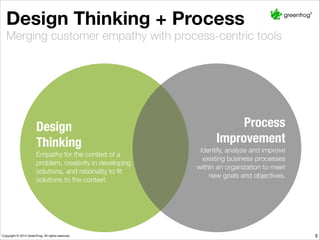
Merging customer empathy with process-centric tools
Design Thinking + Process
Design
Thinking
Empathy for the context of a
problem, creativity in developing
solutions, and rationality to fit
solutions to the context.
Process
Improvement
Identify, analyze and improve
existing business processes
within an organization to meet
new goals and objectives.
8
Design Thinking + Process
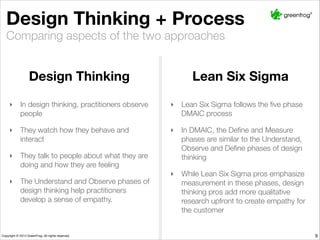
Lean Six SigmaDesign Thinking
‣ Lean Six Sigma follows the five phase
DMAIC process
‣ In DMAIC, the Define and Measure phases
are similar to the Understand, Observe and
Define phases of design thinking
‣ While Lean Six Sigma pros emphasize
measurement in these phases, design
thinking pros add more qualitative research
upfront to create empathy for the customer
In design thinking, practitioners observe
people
They watch how they behave and interact
They talk to people about what they are
doing and how they are feeling
The Understand and Observe phases of
design thinking help practitioners develop
a sense of empathy.
Comparing aspects of the two approaches
9
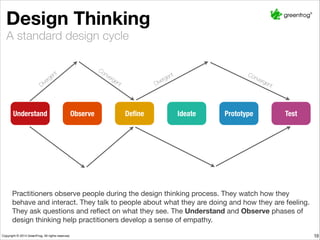
A standard design cycle
Design Thinking
Understand Observe Define Ideate Prototype Test
Divergent
Convergent
ConvergentDivergent
Practitioners observe people during the design thinking process. They watch how they
behave and interact. They talk to people about what they are doing and how they are feeling.
They ask questions and reflect on what they see. The Understand and Observe phases of
design thinking help practitioners develop a sense of empathy.
10
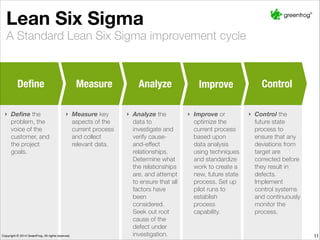
A Standard Lean Six Sigma improvement cycle
Lean Six Sigma
11
Define ControlMeasure Analyze Improve
‣ Define the
problem, the
voice of the
customer, and
the project goals.
‣ Measure key
aspects of the
current process
and collect
relevant data.
‣ Analyze the
data to
investigate and
verify cause-and-
effect
relationships.
Determine what
the relationships
are, and attempt
to ensure that all
factors have
been considered.
Seek out root
cause of the
defect under
investigation.
‣ Improve or
optimize the
current process
based upon data
analysis using
techniques and
standardize work
to create a new,
future state
process. Set up
pilot runs to
establish process
capability.
‣ Control the
future state
process to
ensure that any
deviations from
target are
corrected before
they result in
defects.
Implement
control systems
and continuously
monitor the
process.
12Copyright © 2013 GreenFrog. All rights reserved.
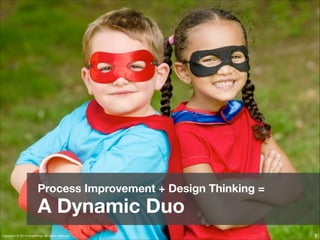
Process Improvement + Design Thinking =
A Dynamic Duo
12
A Dynamic Duo
- Albert Einstein
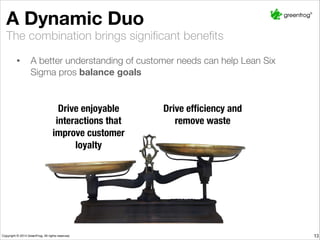
A better understanding of customer needs can help Lean Six Sigma pros balance goals
The combination brings significant benefits
13
Drive enjoyable
interactions that
improve customer
loyalty
Drive efficiency and
remove waste
A Dynamic Duo (cont)
- Albert Einstein
The combination brings significant benefits
14
!
• Design thinking can also benefit from the discipline and structure
that Lean Six Sigma provides
• Business process pros emphasize the ongoing quantitative
measurement of processes and the introduction of controls to help
ensure consistency
• These techniques help ensure that a well-designed process
continues to perform well and delight customers
The Road Ahead
• As this trend gains momentum, we’ll
continue to see strategies for using
design to optimize and transform
business processes
• Is your organization one of the many
embracing design thinking and
sending practitioners to programs
such as Stanford’s d.school?
• Are you noticing more and more Lean
Six Sigma practitioners who
emphasize design?
• Let us know what’s working in
your workplace
A trend that will gain momentum in coming years
15
16
17
Contact Me
!
@DaveBirckhead

www.davebirckhead.com

Design Based Process Improvement

  • 1.
    Design & Process DeliveringCustomer Happiness
  • 2.
    2 Contents • Background: “ChangeAhead” • Process Improvement At A Crossroads • Why Design Matters • Design Thinking + Process Improvement • Lean Six Sigma • Design Thinking • A Dynamic Duo • The Road Ahead
  • 3.
    3 Background ‣ Recent trendsare re-shaping the way people think about process improvement ‣ Progressive companies are combining traditional Lean Six Sigma process improvement techniques with an emphasis on design ‣ Result is processes, products and services that are more human- centric and enjoyable for those who use them Process improvement techniques are changing
  • 4.
    4 Crossroads Process improvement andtools are at a crossroads • Significant difference between the effective, simple and intuitive use of technology and process that we have come to expect and our actual experience • Success of companies such as Apple, Amazon, Google, and Zappos has more business leaders focused on the importance of good design and customer delight
  • 5.
    Why Design Matters •We are in the Age of the Customer • Customers have more power, choice and influence than ever before • What we think and feel about our interaction with an organization’s products and services is increasingly important due to the rise of social media • Social media brings a new level of transparency to what consumers are thinking and feeling about a brand Power is in the hands of the customer 5
  • 6.
    75%Gartner predicts thatby 2015 75% of consumers will tell their friends about their bad experiences using social media (up from 25% in 2010). 6
  • 7.
    Deep Customer Insight •Lean Six Sigma process improvement helps make processes: - more efficient, by removing waste - more predictable, by reducing variation • Although Lean Six Sigma seeks to capture the “voice of the customer,” it tends to lack deeper examination, understanding and empathy for customer needs and desires • This is where design thinking comes into play • Design thinking brings a fresh approach and new tools that drive customer understanding Design Thinking addresses a gap in Lean Six Sigma 7
  • 8.
    Merging customer empathywith process-centric tools Design Thinking + Process Design Thinking Empathy for the context of a problem, creativity in developing solutions, and rationality to fit solutions to the context. Process Improvement Identify, analyze and improve existing business processes within an organization to meet new goals and objectives. 8
  • 9.
    Design Thinking +Process Lean Six SigmaDesign Thinking ‣ Lean Six Sigma follows the five phase DMAIC process ‣ In DMAIC, the Define and Measure phases are similar to the Understand, Observe and Define phases of design thinking ‣ While Lean Six Sigma pros emphasize measurement in these phases, design thinking pros add more qualitative research upfront to create empathy for the customer In design thinking, practitioners observe people They watch how they behave and interact They talk to people about what they are doing and how they are feeling The Understand and Observe phases of design thinking help practitioners develop a sense of empathy. Comparing aspects of the two approaches 9
  • 10.
    A standard designcycle Design Thinking Understand Observe Define Ideate Prototype Test Divergent Convergent ConvergentDivergent Practitioners observe people during the design thinking process. They watch how they behave and interact. They talk to people about what they are doing and how they are feeling. They ask questions and reflect on what they see. The Understand and Observe phases of design thinking help practitioners develop a sense of empathy. 10
  • 11.
    A Standard LeanSix Sigma improvement cycle Lean Six Sigma 11 Define ControlMeasure Analyze Improve ‣ Define the problem, the voice of the customer, and the project goals. ‣ Measure key aspects of the current process and collect relevant data. ‣ Analyze the data to investigate and verify cause-and- effect relationships. Determine what the relationships are, and attempt to ensure that all factors have been considered. Seek out root cause of the defect under investigation. ‣ Improve or optimize the current process based upon data analysis using techniques and standardize work to create a new, future state process. Set up pilot runs to establish process capability. ‣ Control the future state process to ensure that any deviations from target are corrected before they result in defects. Implement control systems and continuously monitor the process.
  • 12.
    12Copyright © 2013GreenFrog. All rights reserved. Process Improvement + Design Thinking = A Dynamic Duo 12
  • 13.
    A Dynamic Duo -Albert Einstein A better understanding of customer needs can help Lean Six Sigma pros balance goals The combination brings significant benefits 13 Drive enjoyable interactions that improve customer loyalty Drive efficiency and remove waste
  • 14.
    A Dynamic Duo(cont) - Albert Einstein The combination brings significant benefits 14 ! • Design thinking can also benefit from the discipline and structure that Lean Six Sigma provides • Business process pros emphasize the ongoing quantitative measurement of processes and the introduction of controls to help ensure consistency • These techniques help ensure that a well-designed process continues to perform well and delight customers
  • 15.
    The Road Ahead •As this trend gains momentum, we’ll continue to see strategies for using design to optimize and transform business processes • Is your organization one of the many embracing design thinking and sending practitioners to programs such as Stanford’s d.school? • Are you noticing more and more Lean Six Sigma practitioners who emphasize design? • Let us know what’s working in your workplace A trend that will gain momentum in coming years 15
  • 16.
  • 17.