Group discussion best practices
An IIMB NSRCEL & Goldman Sachs Supported Firm
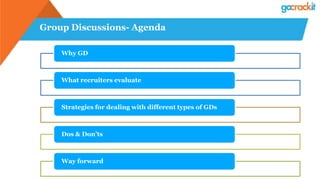
Group Discussions- Agenda
Why GD
What recruiters evaluate
Strategies for dealing with different types of GDs
Dos & Don’ts
Way forward
Why Group Discussions
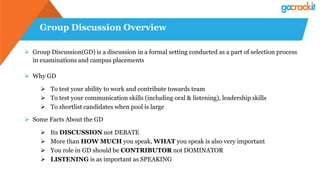
Group Discussion Overview
 Group Discussion(GD) is a discussion in a formal setting conducted as a part of selection process
in examinations and campus placements
 Why GD
 To test your ability to work and contribute towards team
 To test your communication skills (including oral & listening), leadership skills
 To shortlist candidates when pool is large
 Some Facts About the GD
 Its DISCUSSION not DEBATE
 More than HOW MUCH you speak, WHAT you speak is also very important
 You role in GD should be CONTRIBUTOR not DOMINATOR
 LISTENING is as important as SPEAKING
What recruiters evaluate
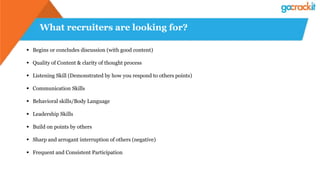
What recruiters are looking for?
 Begins or concludes discussion (with good content)
 Quality of Content & clarity of thought process
 Listening Skill (Demonstrated by how you respond to others points)
 Communication Skills
 Behavioral skills/Body Language
 Leadership Skills
 Build on points by others
 Sharp and arrogant interruption of others (negative)
 Frequent and Consistent Participation
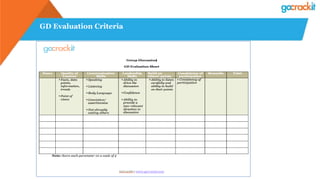
GD Evaluation Criteria
Strategies to deal with different types of GDs
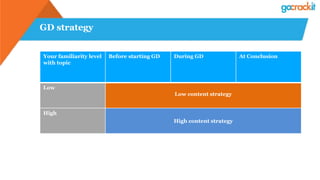
GD strategy
Your familiarity level
with topic
Before starting GD During GD At Conclusion
Low
Low content strategy
High
High content strategy
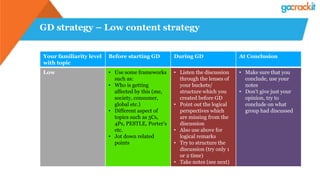
GD strategy – Low content strategy
Your familiarity level
with topic
Before starting GD During GD At Conclusion
Low • Use some frameworks
such as:
• Who is getting
affected by this (me,
society, consumer,
global etc.)
• Different aspect of
topics such as 5Cs,
4Ps, PESTLE, Porter’s
etc.
• Jot down related
points
• Listen the discussion
through the lenses of
your buckets/
structure which you
created before GD
• Point out the logical
perspectives which
are missing from the
discussion
• Also use above for
logical remarks
• Try to structure the
discussion (try only 1
or 2 time)
• Take notes (see next)
• Make sure that you
conclude, use your
notes
• Don’t give just your
opinion, try to
conclude on what
group had discussed
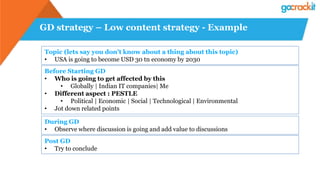
GD strategy – Low content strategy - Example
Topic (lets say you don’t know about a thing about this topic)
• USA is going to become USD 30 tn economy by 2030
Before Starting GD
• Who is going to get affected by this
• Globally | Indian IT companies| Me
• Different aspect : PESTLE
• Political | Economic | Social | Technological | Environmental
• Jot down related points
During GD
• Observe where discussion is going and add value to discussions
Post GD
• Try to conclude
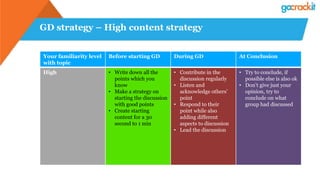
GD strategy – High content strategy
Your familiarity level
with topic
Before starting GD During GD At Conclusion
High • Write down all the
points which you
know
• Make a strategy on
starting the discussion
with good points
• Create starting
content for a 30
second to 1 min
• Contribute in the
discussion regularly
• Listen and
acknowledge others’
point
• Respond to their
point while also
adding different
aspects to discussion
• Lead the discussion
• Try to conclude, if
possible else is also ok
• Don’t give just your
opinion, try to
conclude on what
group had discussed
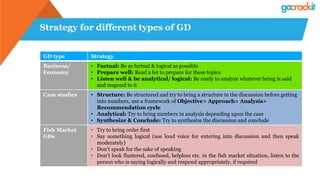
Strategy for different types of GD
GD type Strategy
Business/
Economy
• Factual: Be as factual & logical as possible
• Prepare well: Read a lot to prepare for these topics
• Listen well & be analytical/ logical: Be ready to analyze whatever being is said
and respond to it
Case studies • Structure: Be structured and try to bring a structure in the discussion before getting
into numbers, use a framework of Objective> Approach> Analysis>
Recommendation cycle
• Analytical: Try to bring numbers in analysis depending upon the case
• Synthesize & Conclude: Try to synthesize the discussion and conclude
Fish Market
GDs
• Try to bring order first
• Say something logical (use loud voice for entering into discussion and then speak
moderately)
• Don’t speak for the sake of speaking
• Don’t look flustered, confused, helpless etc. in the fish market situation, listen to the
person who is saying logically and respond appropriately, if required
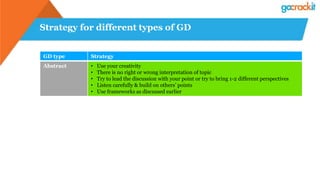
Strategy for different types of GD
GD type Strategy
Abstract • Use your creativity
• There is no right or wrong interpretation of topic
• Try to lead the discussion with your point or try to bring 1-2 different perspectives
• Listen carefully & build on others’ points
• Use frameworks as discussed earlier
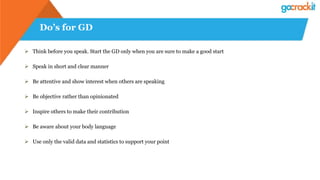
Do’s for GD
 Think before you speak. Start the GD only when you are sure to make a good start
 Speak in short and clear manner
 Be attentive and show interest when others are speaking
 Be objective rather than opinionated
 Inspire others to make their contribution
 Be aware about your body language
 Use only the valid data and statistics to support your point
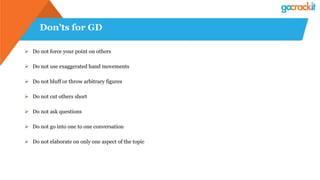
Don’ts for GD
 Do not force your point on others
 Do not use exaggerated hand movements
 Do not bluff or throw arbitrary figures
 Do not cut others short
 Do not ask questions
 Do not go into one to one conversation
 Do not elaborate on only one aspect of the topic
FAQs
1. Should I always start the GD?
If you have good understanding of topic, please try to start or at least speak early in the conversation.
2. What is best time to speak in GD?
As indicated above, try to start as early as possible. Make also sure that you participate consistently in the discussion.
3. Should I support, oppose or take a balance stand?
Take it objectively, cite examples / facts on whatever stand you take. However, if someone else provide an opposing
view which is logical/ factual, acknowledge that don’t be glued to your stand only.
4. I don’t feel confident in GD because of my bad English, what should I do?
Please do practice within groups, practice speaking in front of mirror or video record yourself and improve.
5. What should I do if discussion is losing focus?
Try to bring everyone attention that group is deviating from the topic
FAQs
6. What I can do in a fish market situation?
– Try to bring order first
– Say something logical (use loud voice for entering into discussion and then speak moderately)
– Don’t speak for the sake of speaking
– Don’t look flustered, confused, helpless etc. in the fish market situation, listen to the person who is saying logically
and respond appropriately, if required
7. Is it OK if I encourage others to speak ?
It is OK, but not at the cost of your time. If you have content focus more on participating rather than encouraging
others. In case you don’t have anything to speak, then only you can use this one or two times, post that gather your
thoughts and participate.
Some more examples
– Innovation in healthcare industries
– Black or grey
– How to expand BigFM
– Use of AI in project management
– Cement: A brand or commodity
– How to influence customers while purchasing cement
– Reverse innovation

GD Session

  • 1.
    Group discussion bestpractices An IIMB NSRCEL & Goldman Sachs Supported Firm
  • 2.
    Group Discussions- Agenda WhyGD What recruiters evaluate Strategies for dealing with different types of GDs Dos & Don’ts Way forward
  • 3.
  • 4.
    Group Discussion Overview Group Discussion(GD) is a discussion in a formal setting conducted as a part of selection process in examinations and campus placements  Why GD  To test your ability to work and contribute towards team  To test your communication skills (including oral & listening), leadership skills  To shortlist candidates when pool is large  Some Facts About the GD  Its DISCUSSION not DEBATE  More than HOW MUCH you speak, WHAT you speak is also very important  You role in GD should be CONTRIBUTOR not DOMINATOR  LISTENING is as important as SPEAKING
  • 5.
  • 6.
    What recruiters arelooking for?  Begins or concludes discussion (with good content)  Quality of Content & clarity of thought process  Listening Skill (Demonstrated by how you respond to others points)  Communication Skills  Behavioral skills/Body Language  Leadership Skills  Build on points by others  Sharp and arrogant interruption of others (negative)  Frequent and Consistent Participation
  • 7.
  • 8.
    Strategies to dealwith different types of GDs
  • 9.
    GD strategy Your familiaritylevel with topic Before starting GD During GD At Conclusion Low Low content strategy High High content strategy
  • 10.
    GD strategy –Low content strategy Your familiarity level with topic Before starting GD During GD At Conclusion Low • Use some frameworks such as: • Who is getting affected by this (me, society, consumer, global etc.) • Different aspect of topics such as 5Cs, 4Ps, PESTLE, Porter’s etc. • Jot down related points • Listen the discussion through the lenses of your buckets/ structure which you created before GD • Point out the logical perspectives which are missing from the discussion • Also use above for logical remarks • Try to structure the discussion (try only 1 or 2 time) • Take notes (see next) • Make sure that you conclude, use your notes • Don’t give just your opinion, try to conclude on what group had discussed
  • 11.
    GD strategy –Low content strategy - Example Topic (lets say you don’t know about a thing about this topic) • USA is going to become USD 30 tn economy by 2030 Before Starting GD • Who is going to get affected by this • Globally | Indian IT companies| Me • Different aspect : PESTLE • Political | Economic | Social | Technological | Environmental • Jot down related points During GD • Observe where discussion is going and add value to discussions Post GD • Try to conclude
  • 12.
    GD strategy –High content strategy Your familiarity level with topic Before starting GD During GD At Conclusion High • Write down all the points which you know • Make a strategy on starting the discussion with good points • Create starting content for a 30 second to 1 min • Contribute in the discussion regularly • Listen and acknowledge others’ point • Respond to their point while also adding different aspects to discussion • Lead the discussion • Try to conclude, if possible else is also ok • Don’t give just your opinion, try to conclude on what group had discussed
  • 13.
    Strategy for differenttypes of GD GD type Strategy Business/ Economy • Factual: Be as factual & logical as possible • Prepare well: Read a lot to prepare for these topics • Listen well & be analytical/ logical: Be ready to analyze whatever being is said and respond to it Case studies • Structure: Be structured and try to bring a structure in the discussion before getting into numbers, use a framework of Objective> Approach> Analysis> Recommendation cycle • Analytical: Try to bring numbers in analysis depending upon the case • Synthesize & Conclude: Try to synthesize the discussion and conclude Fish Market GDs • Try to bring order first • Say something logical (use loud voice for entering into discussion and then speak moderately) • Don’t speak for the sake of speaking • Don’t look flustered, confused, helpless etc. in the fish market situation, listen to the person who is saying logically and respond appropriately, if required
  • 14.
    Strategy for differenttypes of GD GD type Strategy Abstract • Use your creativity • There is no right or wrong interpretation of topic • Try to lead the discussion with your point or try to bring 1-2 different perspectives • Listen carefully & build on others’ points • Use frameworks as discussed earlier
  • 15.
    Do’s for GD Think before you speak. Start the GD only when you are sure to make a good start  Speak in short and clear manner  Be attentive and show interest when others are speaking  Be objective rather than opinionated  Inspire others to make their contribution  Be aware about your body language  Use only the valid data and statistics to support your point
  • 16.
    Don’ts for GD Do not force your point on others  Do not use exaggerated hand movements  Do not bluff or throw arbitrary figures  Do not cut others short  Do not ask questions  Do not go into one to one conversation  Do not elaborate on only one aspect of the topic
  • 17.
    FAQs 1. Should Ialways start the GD? If you have good understanding of topic, please try to start or at least speak early in the conversation. 2. What is best time to speak in GD? As indicated above, try to start as early as possible. Make also sure that you participate consistently in the discussion. 3. Should I support, oppose or take a balance stand? Take it objectively, cite examples / facts on whatever stand you take. However, if someone else provide an opposing view which is logical/ factual, acknowledge that don’t be glued to your stand only. 4. I don’t feel confident in GD because of my bad English, what should I do? Please do practice within groups, practice speaking in front of mirror or video record yourself and improve. 5. What should I do if discussion is losing focus? Try to bring everyone attention that group is deviating from the topic
  • 18.
    FAQs 6. What Ican do in a fish market situation? – Try to bring order first – Say something logical (use loud voice for entering into discussion and then speak moderately) – Don’t speak for the sake of speaking – Don’t look flustered, confused, helpless etc. in the fish market situation, listen to the person who is saying logically and respond appropriately, if required 7. Is it OK if I encourage others to speak ? It is OK, but not at the cost of your time. If you have content focus more on participating rather than encouraging others. In case you don’t have anything to speak, then only you can use this one or two times, post that gather your thoughts and participate.
  • 20.
    Some more examples –Innovation in healthcare industries – Black or grey – How to expand BigFM – Use of AI in project management – Cement: A brand or commodity – How to influence customers while purchasing cement – Reverse innovation