PM DeepDive

Project Cost Management
     - Niraj Agarwal


                          May 2011
                            Slide 1
Project Cost Management
Definition

Project Cost Management includes the processes involved in planning
                                                              planning,
estimating, budgeting, and controlling costs so that the project can be
completed within the approved budget.
• Cost Estimating – developing an approximation of the costs of the
monetary resources needed to complete project activities.
• Cost Budgeting – aggregating the estimated costs of individual
activities or work packages t establish a cost b li
  ti iti         k    k     to t bli h       t baseline.
• Cost Control – influencing the factors that create cost variances and
controlling changes to the project budget.


                                                                   May 2011
                                                                     Slide 2
Project Cost Management
Types of Project Costs

• Direct Project Cost - The costs directly attributable to a project
                                                             project,
including all personnel, goods and/or services together with all their
associated costs. E.g. team travel, team wages, training,material,etc.
• Indirect Project Cost - All costs which do not form a part of the final
product, but which are none the less required for the orderly
completion of the project and which may include, but not necessarily be
limited to field administration, direct supervision, incidental tools and
equipment, startup costs, contractor’s fees, insurance, taxes, etc.
• Fixed Project Costs - Those costs which do not change with change in
volume of output E g set-up rental etc
          output. E.g. set-up, rental, etc.

•   Variable Project Costs - Those costs that vary proportionately with
    volume of output. E.g. material cost, supplies, wages, etc.

                                                                    May 2011
                                                                      Slide 3
Project Cost Management
Analogous Estimating

• It means using the actual cost of previous similar projects as the
                                     previous,
basis for estimating the cost of the current project.
• It uses expert judgment.
• This type of estimate is typically done as part of the business case
development or during the early stages of scope planning when there
isn’t a lot of detail on the project.
• An analogous estimate may be done for the project as a whole or for
selected phases or deliverables. It is not typically used to estimate
individual work packages.
• Analogous estimates are the least accurate of all the estimating
techniques but also the least costly.


                                                                       May 2011
                                                                         Slide 4
Project Cost Management
Parametric Estimating

• Same as the technique used in duration estimating
                                         estimating.
• This technique uses a mathematical model to compute costs, and it
most often uses the quantity of work multiplied by the rate.
• Parametric estimating is dependent on the accuracy of the data used
to create the model.


                                                                 May 2011
                                                                   Slide 5
Project Cost Management
Bottom - Up Estimating

• Assigns a cost estimate to each work package on the project
                                                      project.
• The WBS and the project resource requirements are critical inputs
for a bottom - up estimate.
• The idea is that you start at the work package level of the WBS and
calculate the cost of each activity assigned to that work package.
• The sum of all the work package estimates p
                          p    g            provides the estimate of
the total project cost.
• Bottom - up estimates are the most accurate of all the estimating
tec ques,
techniques, but t ey ’re a so t e most t e - consuming to pe o .
                they e also the ost time co su         g perform.


                                                                   May 2011
                                                                     Slide 6
Project Time Management
Three Point Estimates

• Three point estimates used:
  - Most likely(M) : Most likely cost of the schedule activity
  - Optimistic(O) : Activity cost is based on a best-case scenario
  - Pessimistic(P) : Activity cost is based on a worst-case scenario
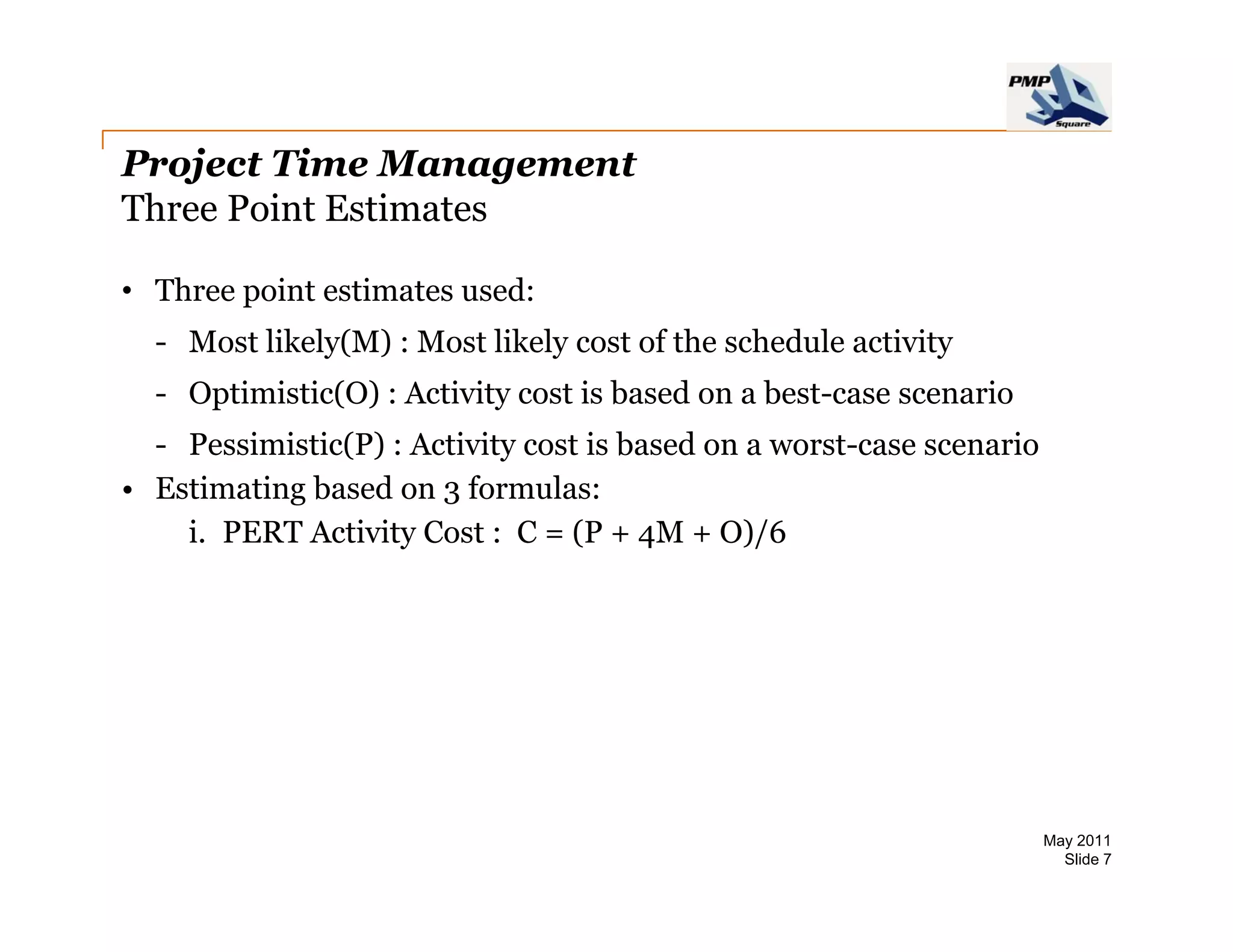
• Estimating based on 3 formulas:
    i.
    i PERT Activity Cost : C = (P + 4M + O)/6


                                                                       May 2011
                                                                         Slide 7
Project Cost Management
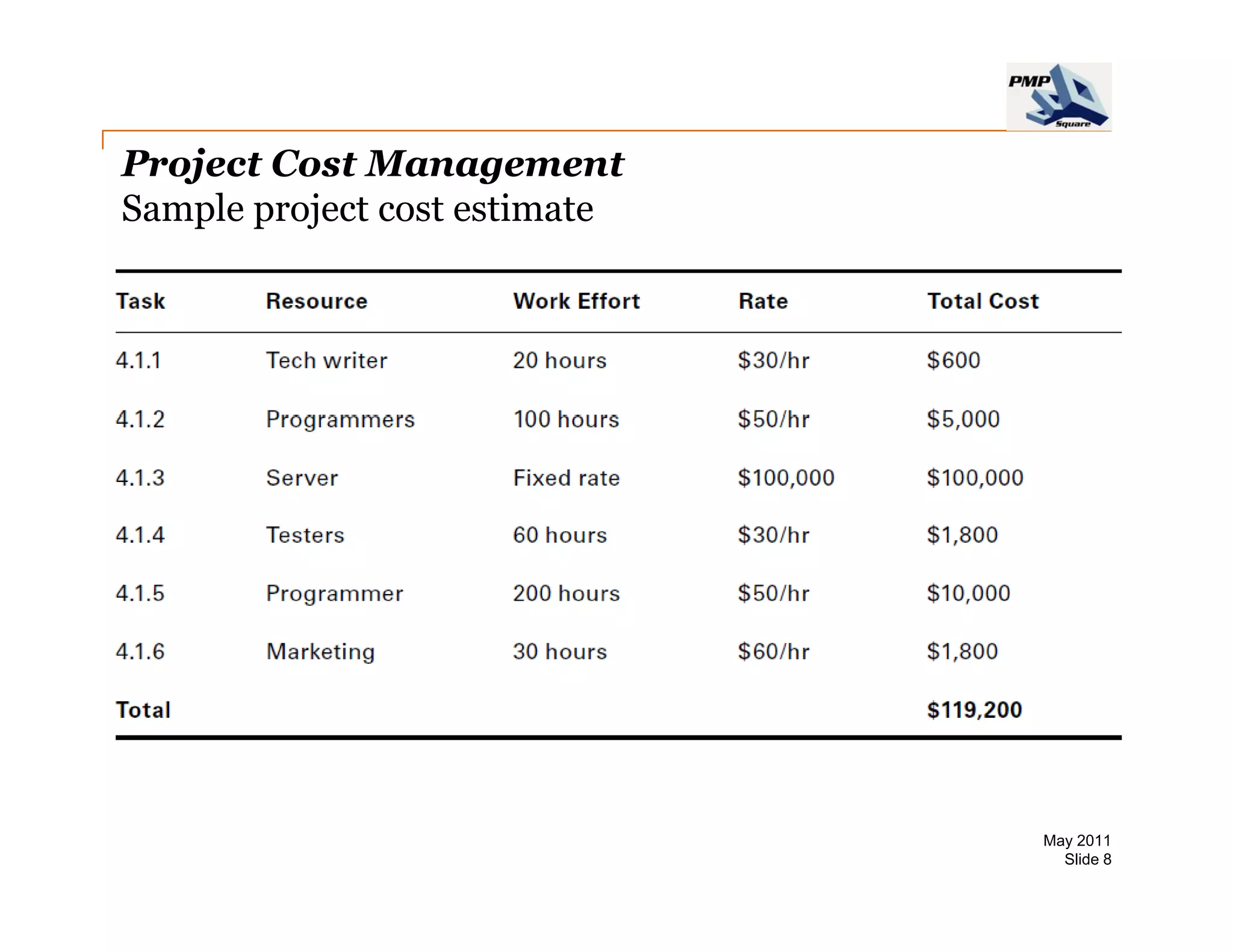
Sample project cost estimate


                               May 2011
                                 Slide 8
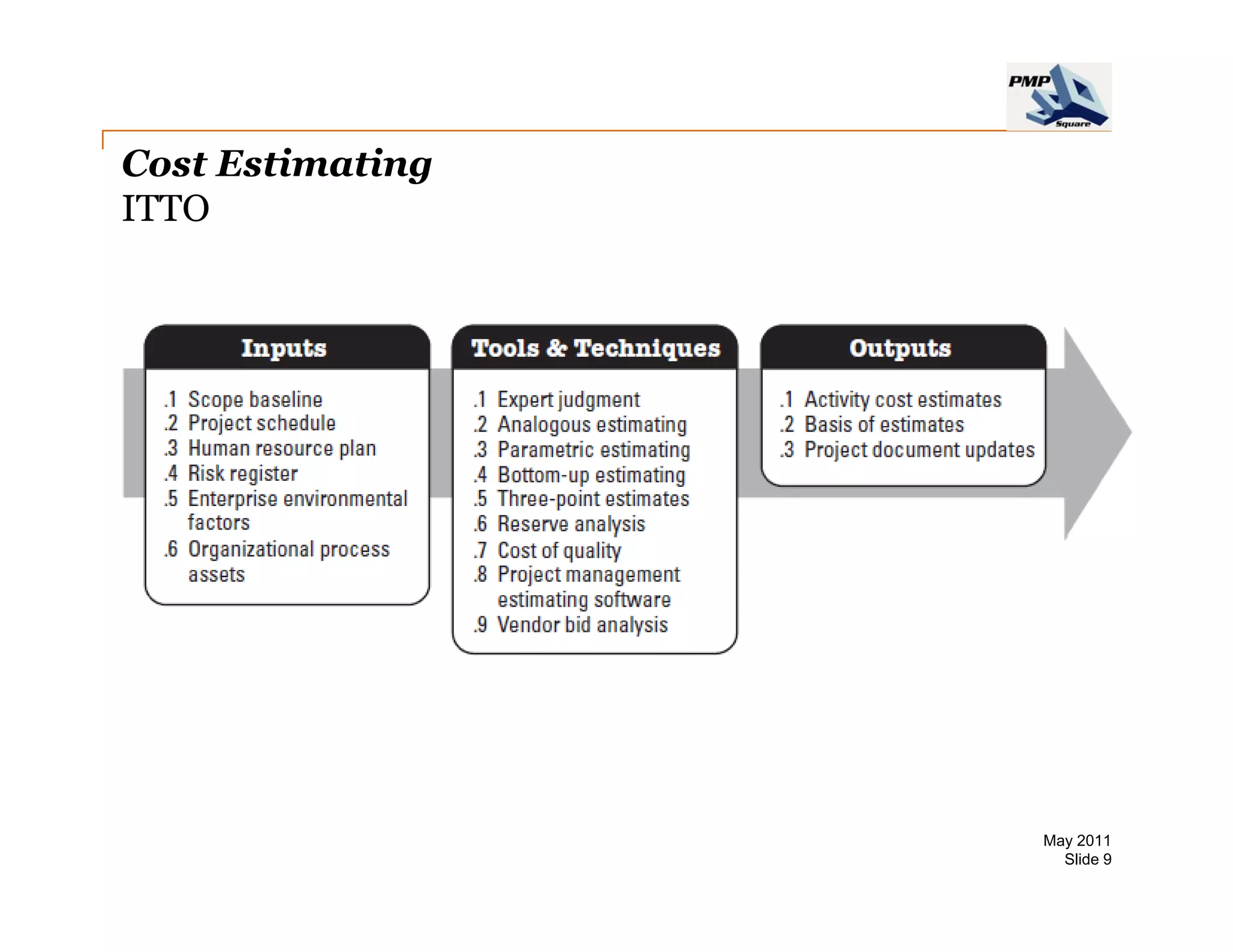
Cost Estimating
ITTO


                  May 2011
                    Slide 9
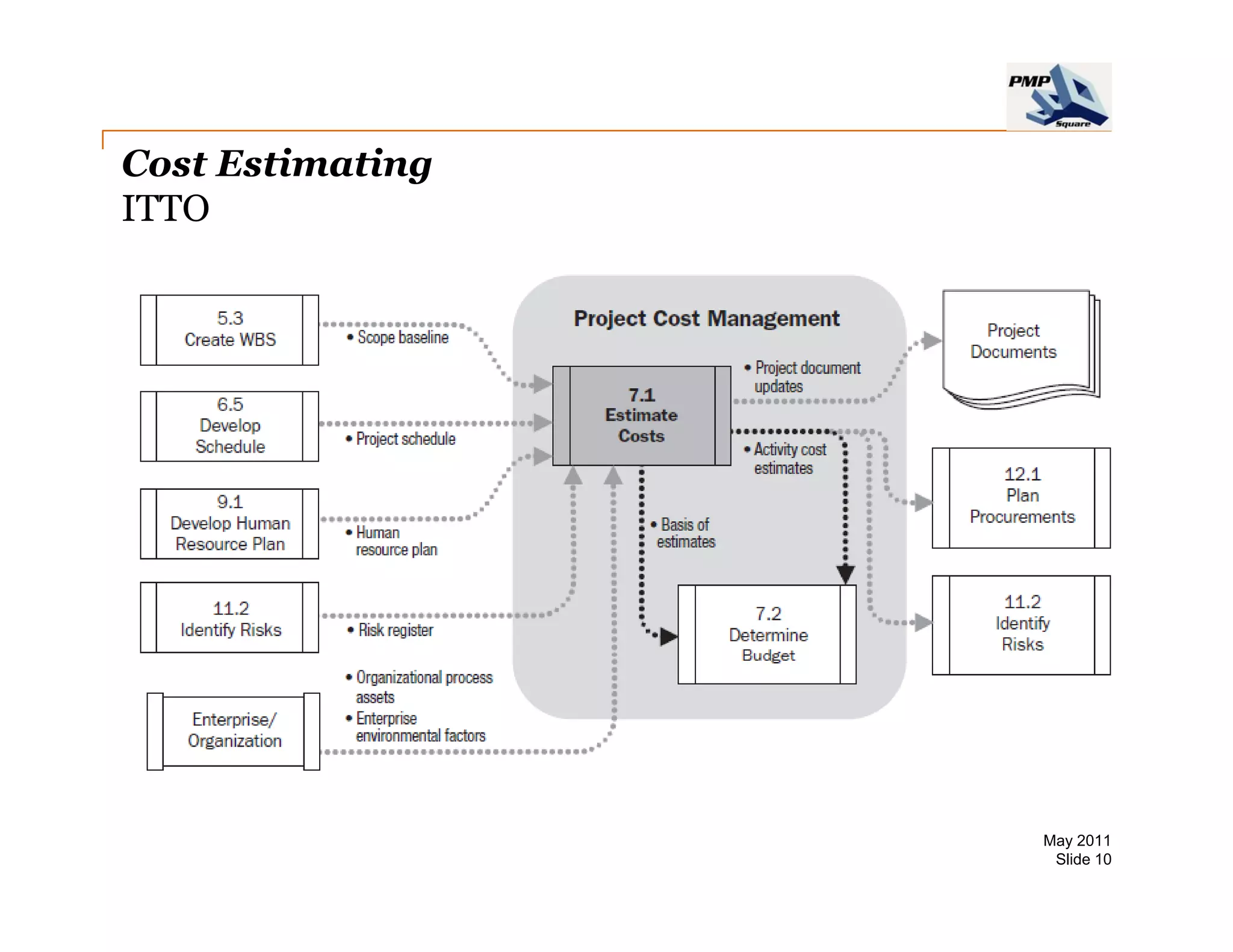
Cost Estimating
ITTO


                  May 2011
                   Slide 10
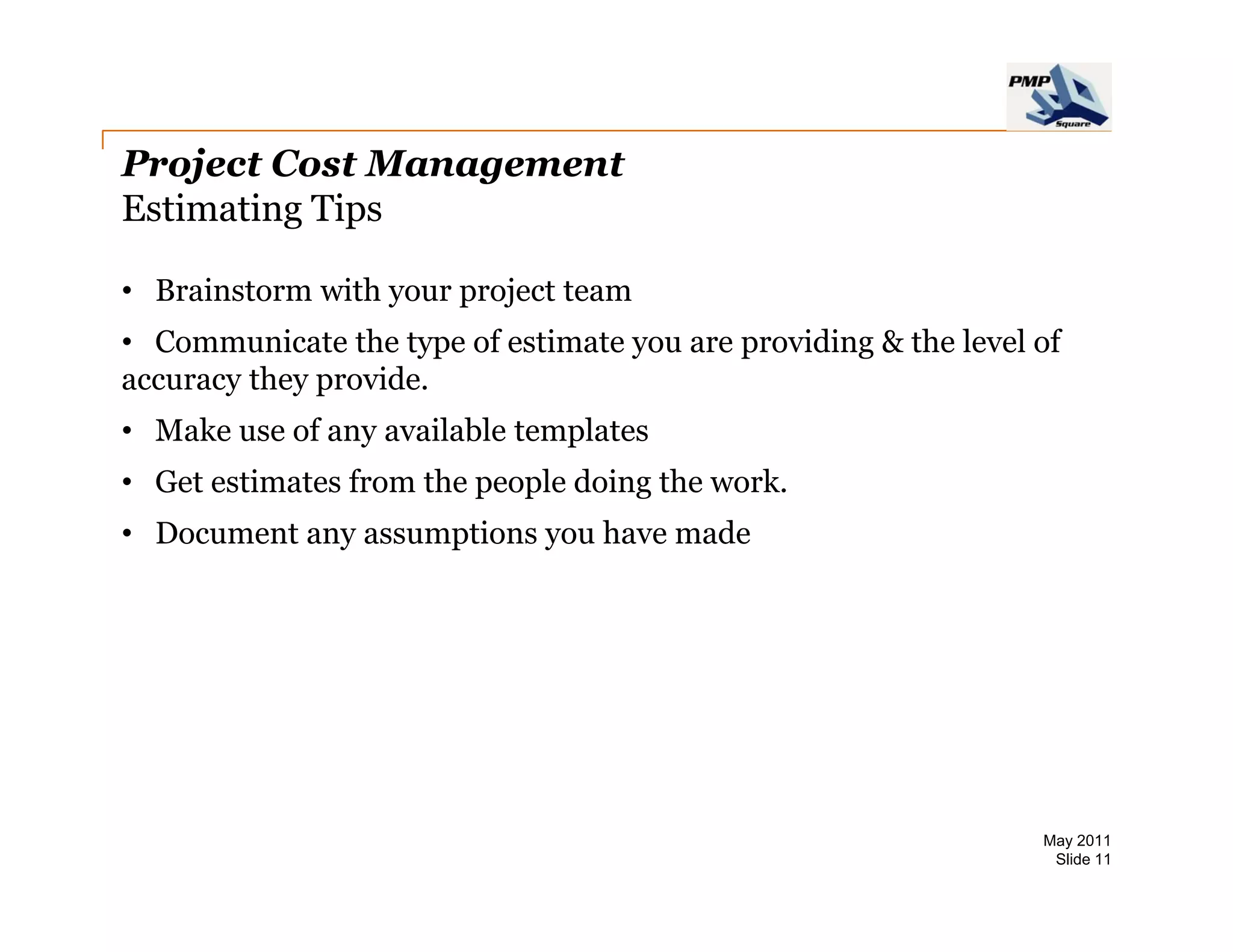
Project Cost Management
Estimating Tips

• Brainstorm with your project team
• Communicate the type of estimate you are providing & the level of
accuracy they provide.
• Make use of any available templates
• Get estimates from the people doing the work.
• Document any assumptions you have made


                                                                 May 2011
                                                                  Slide 11
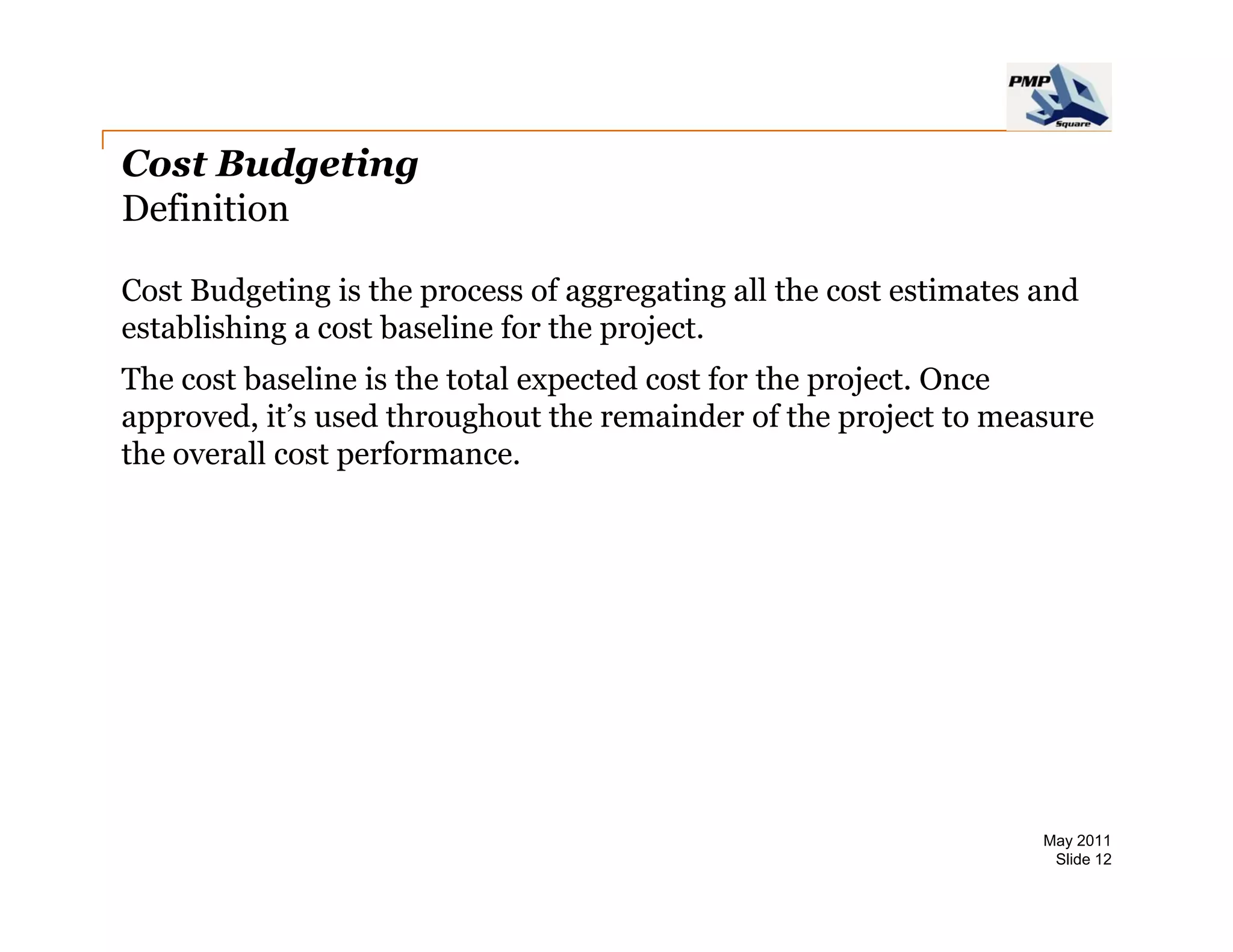
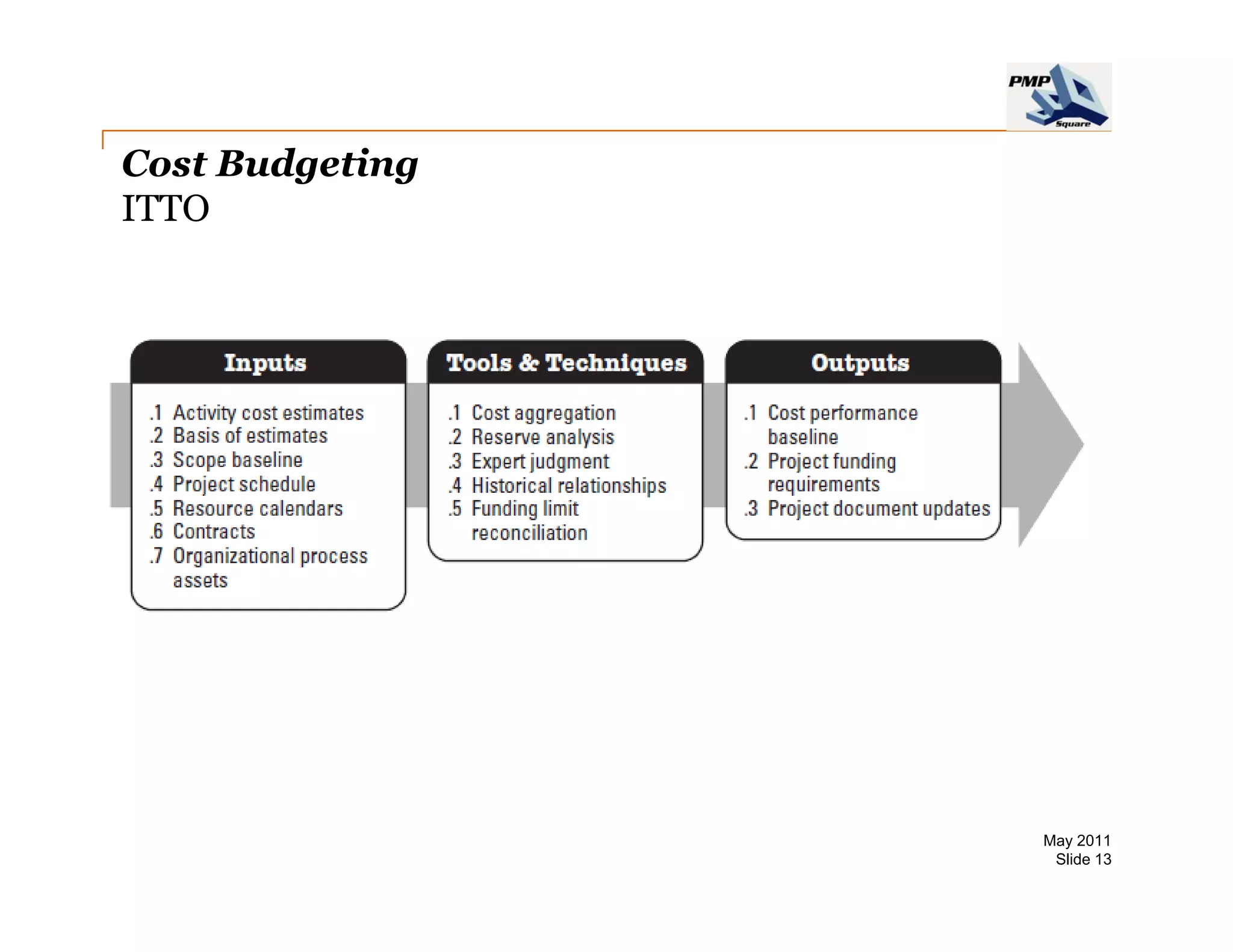
Cost Budgeting
Definition

Cost Budgeting is the process of aggregating all the cost estimates and
establishing a cost baseline for the project.
The cost baseline is the total expected cost for the project. Once
approved, it’s
approved it s used throughout the remainder of the project to measure
the overall cost performance.


                                                                    May 2011
                                                                     Slide 12
Cost Budgeting
ITTO


                 May 2011
                  Slide 13
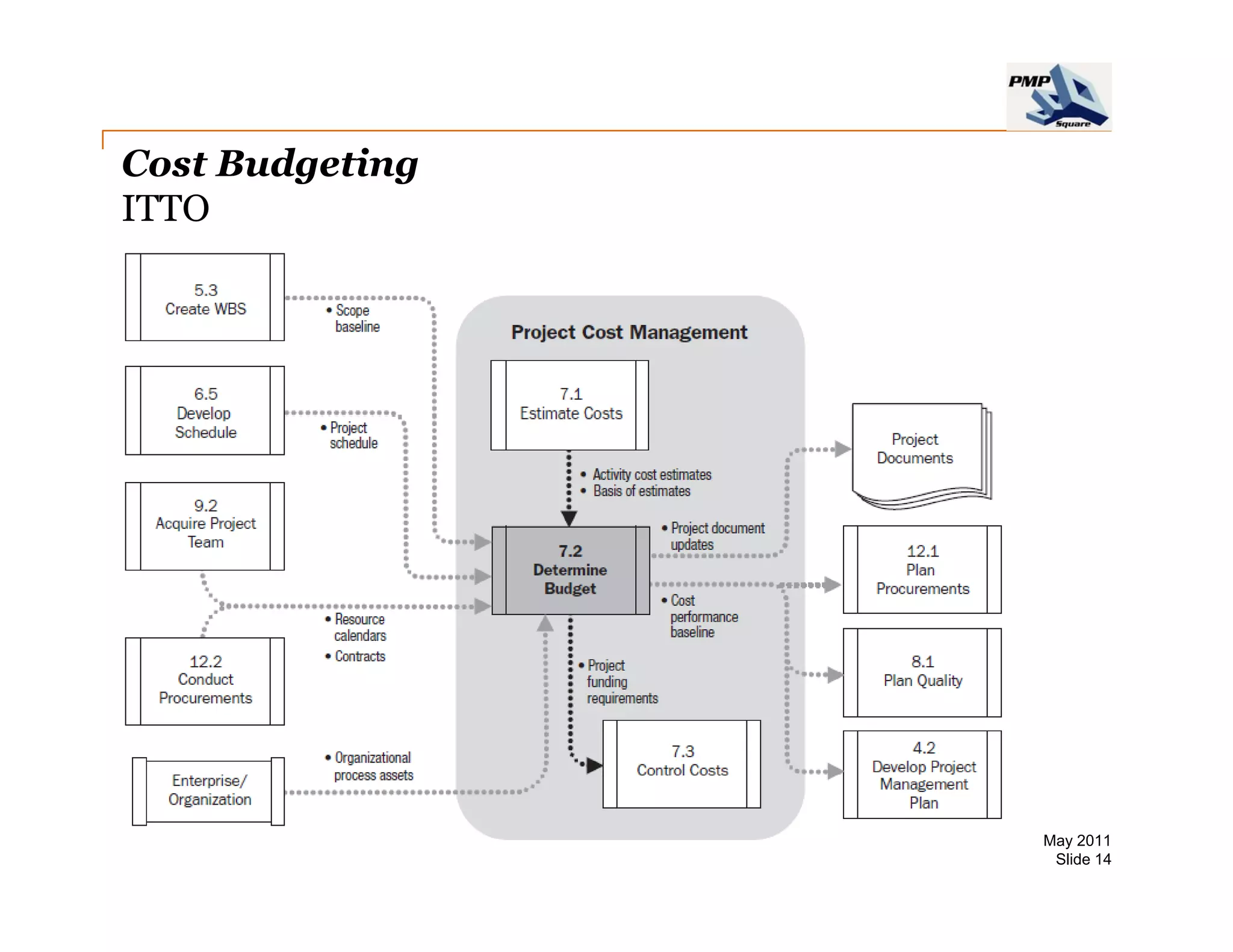
Cost Budgeting
ITTO


                 May 2011
                  Slide 14
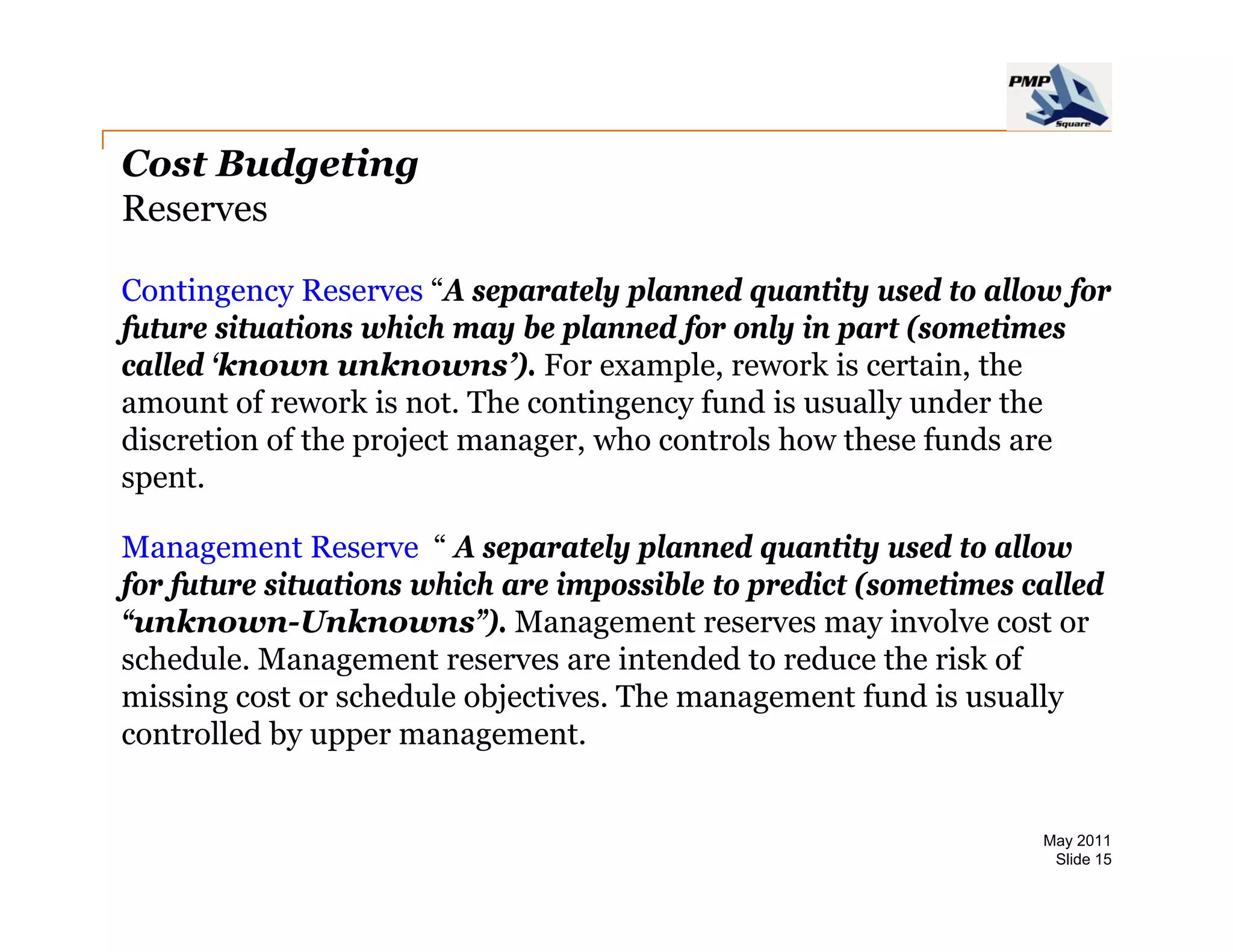
Cost Budgeting
Reserves

Contingency Reserves “A separately planned quantity used to allow for
                         A
future situations which may be planned for only in part (sometimes
called ‘known unknowns’). For example, rework is certain, the
amount of rework is not. The contingency fund is usually under the
                                    g   y              y
discretion of the project manager, who controls how these funds are
spent.

Management Reserve “ A separately planned quantity used to allow
                                    l l      d       i     d    ll
for future situations which are impossible to predict (sometimes called
“unknown-Unknowns”). Management reserves may involve cost or
schedule.
schedule Management reserves are intended to reduce the risk of
missing cost or schedule objectives. The management fund is usually
controlled by upper management.


                                                                  May 2011
                                                                   Slide 15
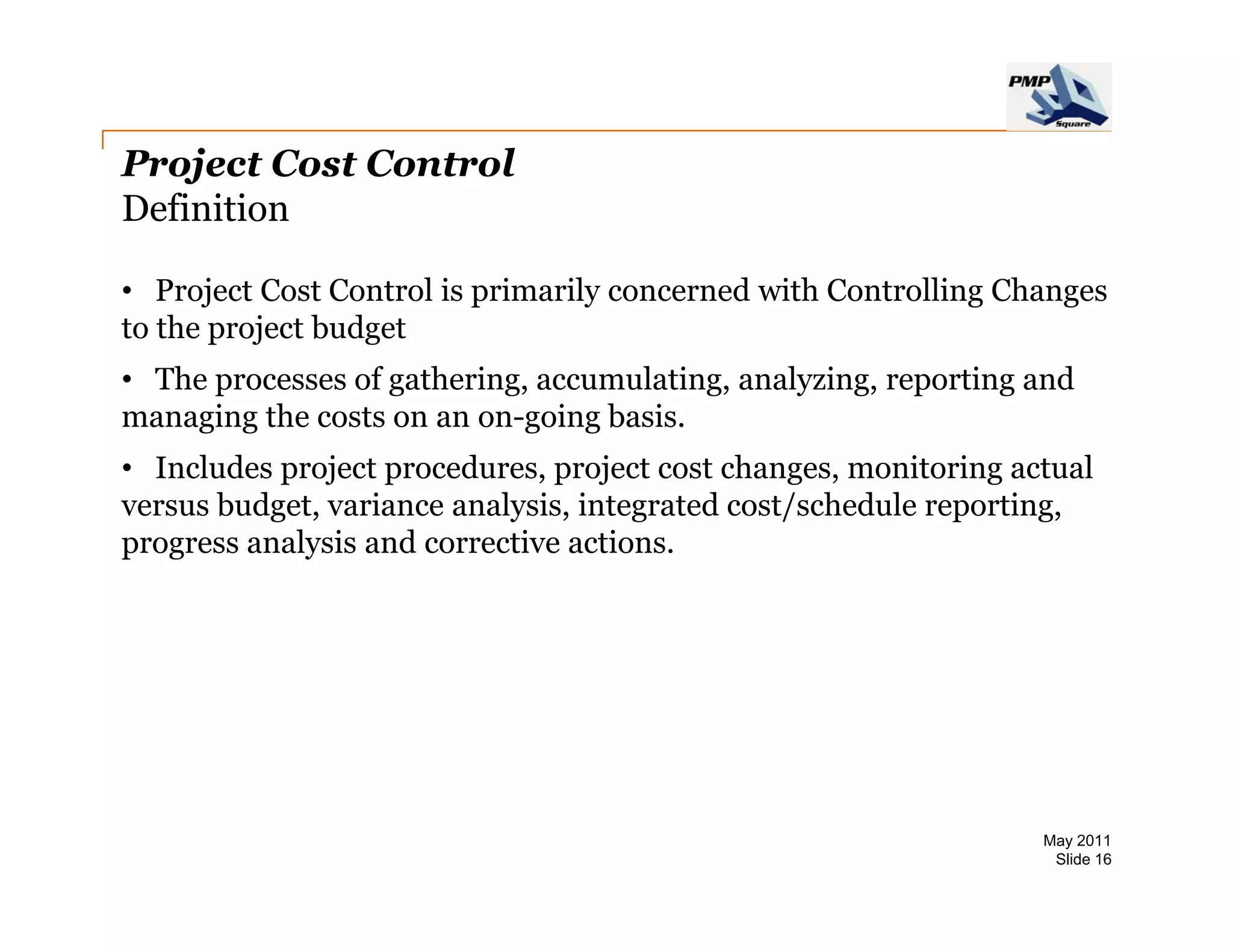
Project Cost Control
Definition

• Project Cost Control is primarily concerned with Controlling Changes
to the project budget
• The processes of gathering, accumulating, analyzing, reporting and
managing the costs on an on going basis
                         on-going basis.
• Includes project procedures, project cost changes, monitoring actual
versus budget, variance analysis, integrated cost/schedule reporting,
progress analysis and corrective actions.
            l i     d       ti      ti


                                                                  May 2011
                                                                   Slide 16
Project Cost Control
Definition

• Project Cost Control is primarily concerned with Controlling Changes
to the project budget
• The processes of gathering, accumulating, analyzing, reporting and
managing the costs on an on going basis
                         on-going basis.
• Includes project procedures, project cost changes, monitoring actual
versus budget, variance analysis, integrated cost/schedule reporting,
progress analysis and corrective actions.
            l i     d       ti      ti


                                                                  May 2011
                                                                   Slide 17
Earned Value Analysis


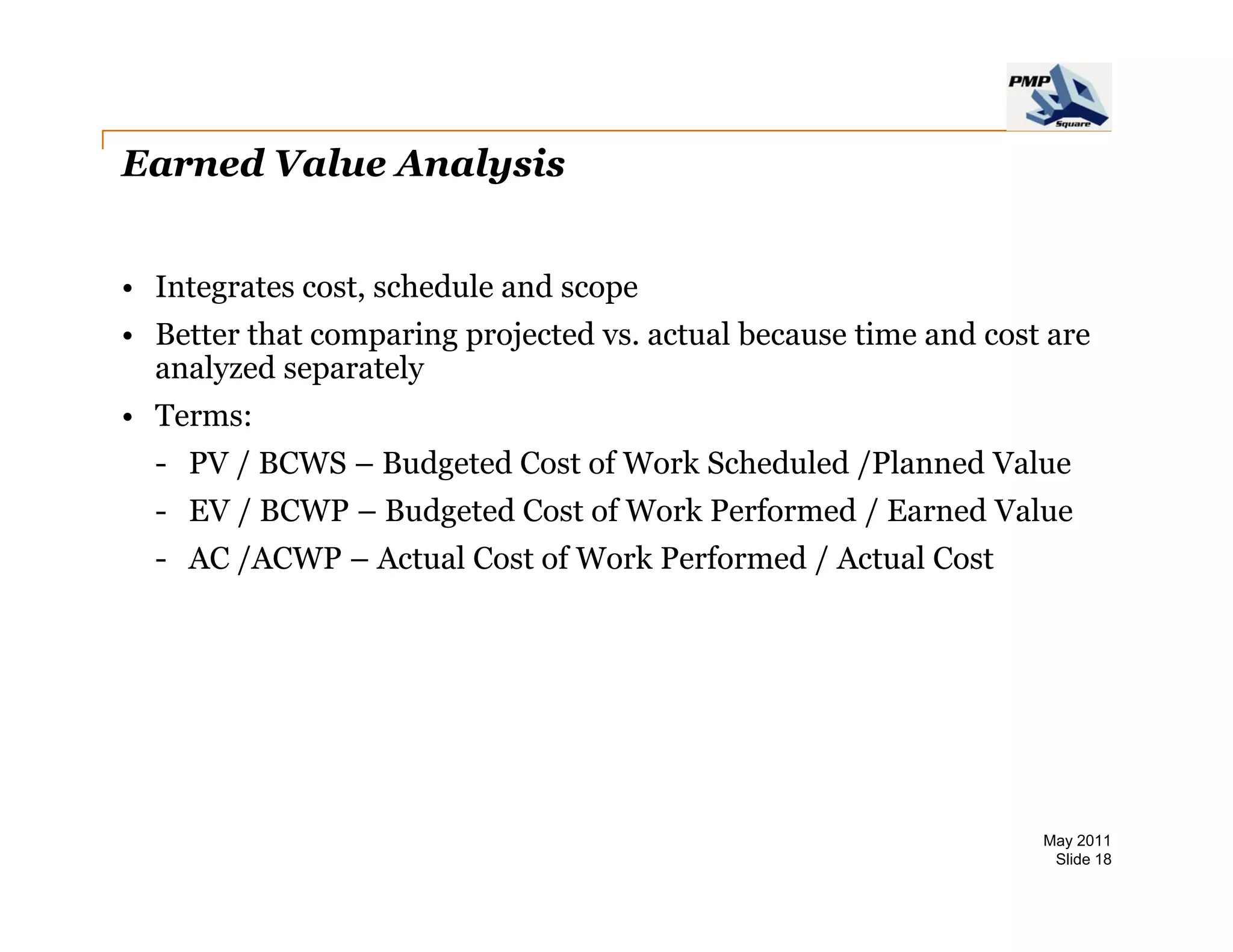
• Integrates cost, schedule and scope
• Better that comparing projected vs. actual because time and cost are
  analyzed separately
• Terms:
  - PV / BCWS – Budgeted Cost of Work Scheduled /Planned Value
  - EV / BCWP – Budgeted Cost of Work Performed / Earned Value
  - AC /ACWP – Actual Cost of Work Performed / Actual Cost


                                                                  May 2011
                                                                   Slide 18
Earned Value Analysis


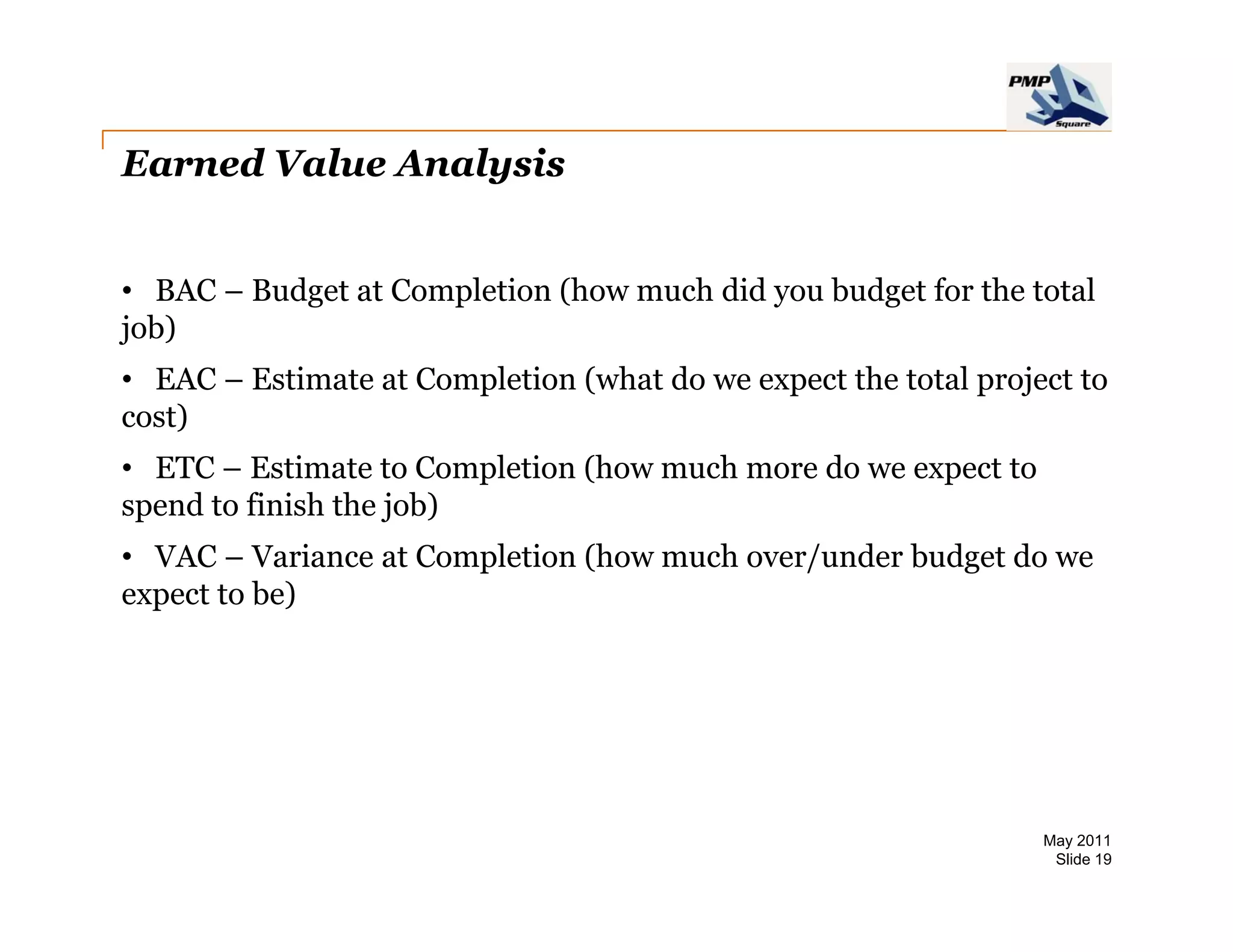
• BAC – Budget at Completion (how much did you budget for the total
job)
• EAC – Estimate at Completion (what do we expect the total project to
cost)
• ETC – Estimate to Completion (how much more do we expect to
spend to finish the job)
• VAC – Variance at Completion (how much over/under budget do we
expect to be)


                                                                 May 2011
                                                                  Slide 19
Earned Value Analysis


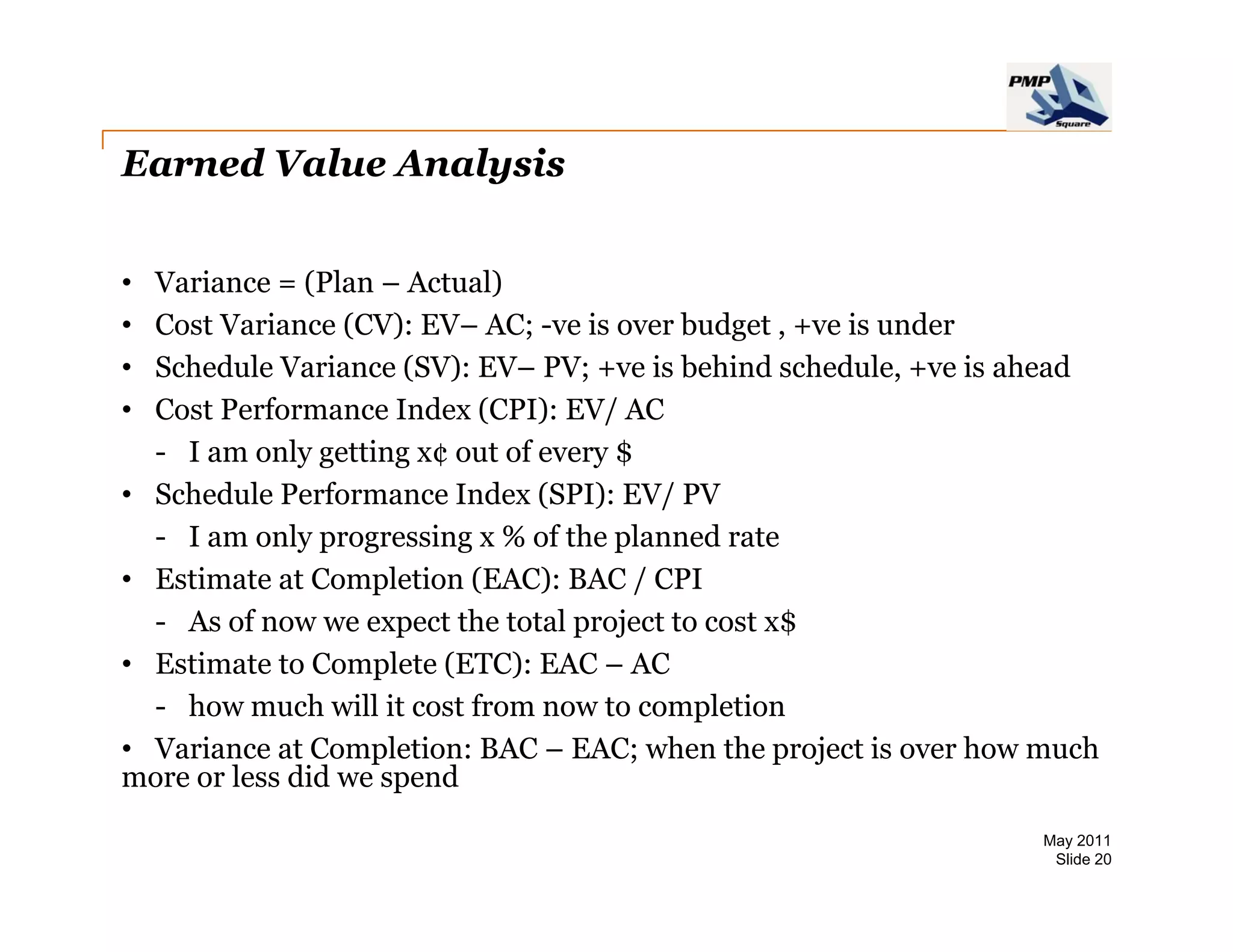
• Variance = (Plan – Actual)
              (             )
• Cost Variance (CV): EV– AC; -ve is over budget , +ve is under
• Schedule Variance (SV): EV– PV; +ve is behind schedule, +ve is ahead
• Cost Performance Index (CPI): EV/ AC
  - I am only getting x¢ out of every $
• Schedule Performance Index (SPI): EV/ PV
  - I am only progressing x % of the planned rate
• Estimate at Completion (EAC): BAC / CPI
  - As of now we expect the total project to cost x$
• E ti t t C
  Estimate to Complete (ETC) EAC – AC
                     l t (ETC):
  - how much will it cost from now to completion
• Variance at Completion: BAC – EAC; when the project is over how much
more or less did we spend
                                                                 May 2011
                                                                  Slide 20
Earned Value Analysis
Question
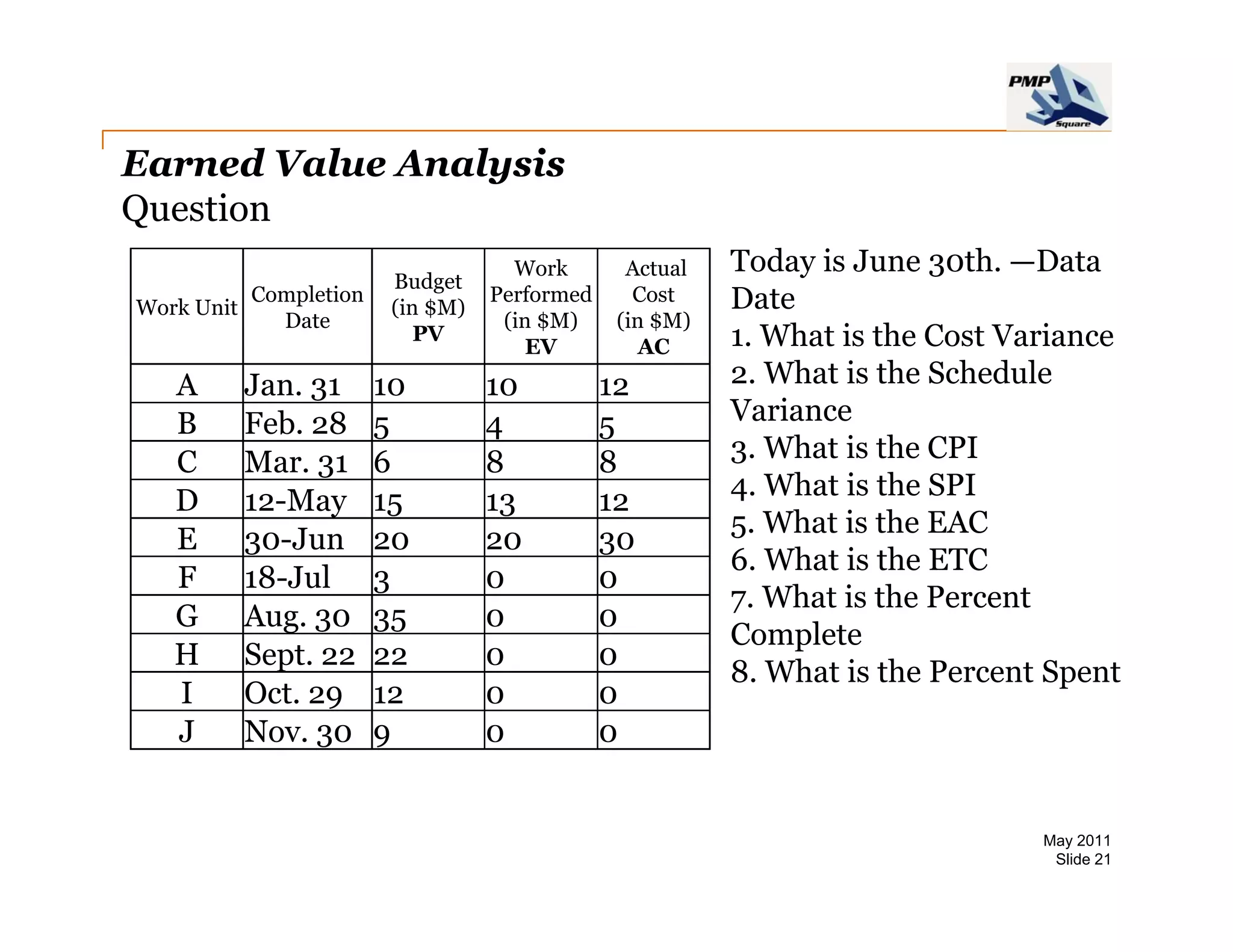
                                     Work       Actual   Today is June 30th. —Data
                         Budget
Work Unit
            Completion
                         (in $M)
                                   Performed     Cost    Date
              Date                  (in $M)    (in $M)
                            PV
                                      EV          AC     1. What is the Cost Variance
   A        Jan. 31      10        10          12        2. What is the Schedule
   B        Feb. 8
            F b 28       5         4           5         Variance
   C        Mar. 31      6         8           8         3. What is the CPI
   D        12-May       15        13          12        4. What is the SPI
                                                         5
                                                         5. What is the EAC
   E        30-Jun
            30 Jun       20        20          30
                                                         6. What is the ETC
   F        18-Jul       3         0           0
                                                         7. What is the Percent
   G        Aug. 30      35        0           0
                                                         Complete
   H        Sept.
            Sept 22      22        0           0
                                                         8. What is the Percent Spent
   I        Oct. 29      12        0           0
   J        Nov. 30      9         0           0


                                                                               May 2011
                                                                                Slide 21
Earned Value Analysis
Question
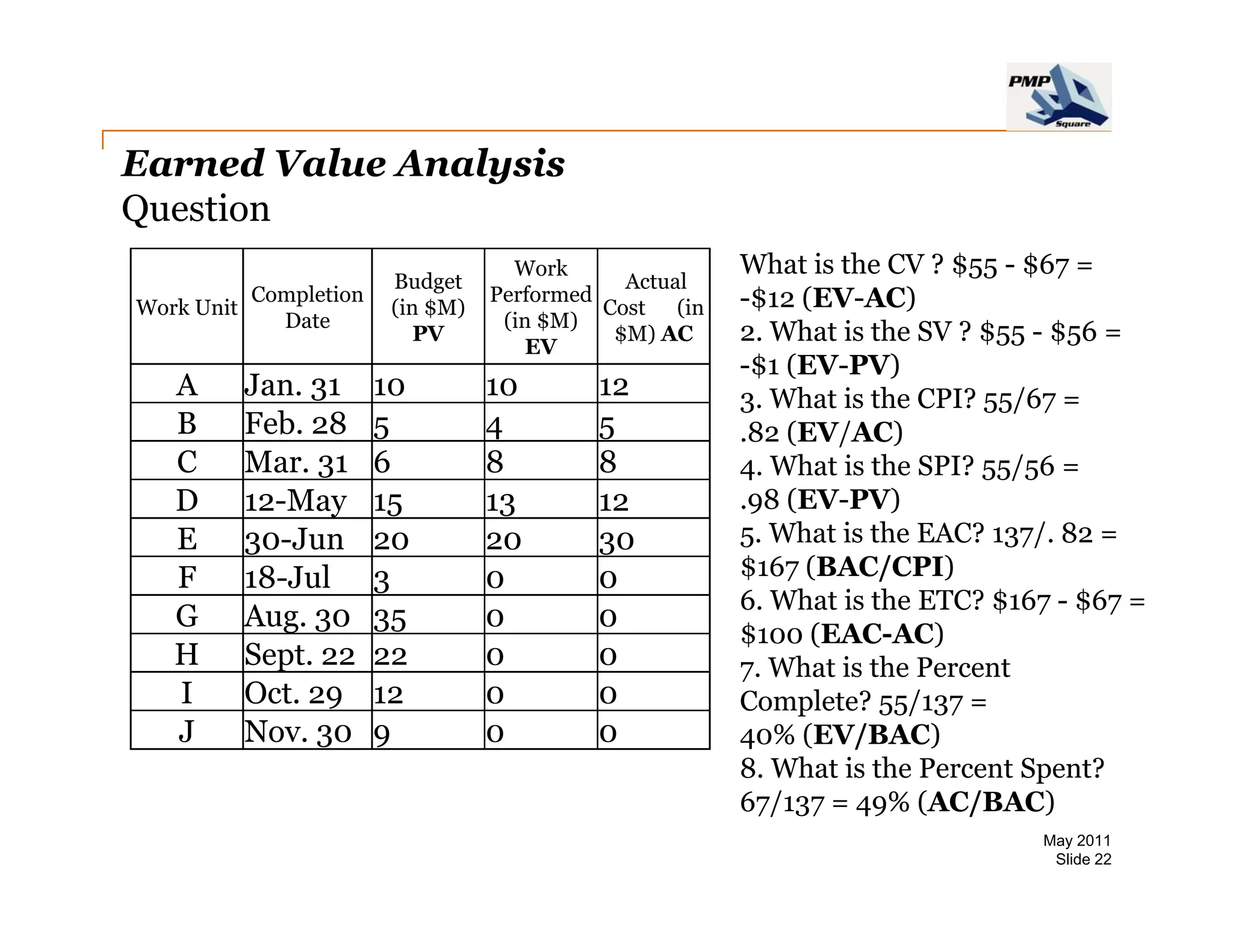
                                     Work               What is the CV ? $55 - $67 =
                         Budget                Actual
Work Unit
            Completion
                         (in $M)
                                   Performed
                                             Cost (in   -$12 (EV AC)
                                                         $12 (EV-AC)
              Date                  (in $M)
                            PV
                                      EV
                                              $M) AC    2. What is the SV ? $55 - $56 =
                                                        -$1 (EV-PV)
   A        Jan. 31      10        10       12          3. What is the CPI? 55/67 =
   B        Feb. 8
            F b 28       5         4        5           .82 (EV/AC)
   C        Mar. 31      6         8        8           4. What is the SPI? 55/56 =
   D        12-May       15        13       12          .98 (EV-PV)
   E        30-Jun
            30 Jun       20        20       30          5.
                                                        5 What is the EAC? 137/ 82 =
                                                                             137/.
   F        18-Jul       3         0        0           $167 (BAC/CPI)
                                                        6. What is the ETC? $167 - $67 =
   G        Aug. 30      35        0        0
                                                        $100 (EAC-AC)
   H        Sept.
            Sept 22      22        0        0           7. What is the Percent
                                                             h      h
   I        Oct. 29      12        0        0           Complete? 55/137 =
   J        Nov. 30      9         0        0           40% (EV/BAC)
                                                        8. What is the Percent Spent?
                                                        67/137 = 49% (AC/BAC)
                                                                               May 2011
                                                                                Slide 22
Pop Quiz
Question 1

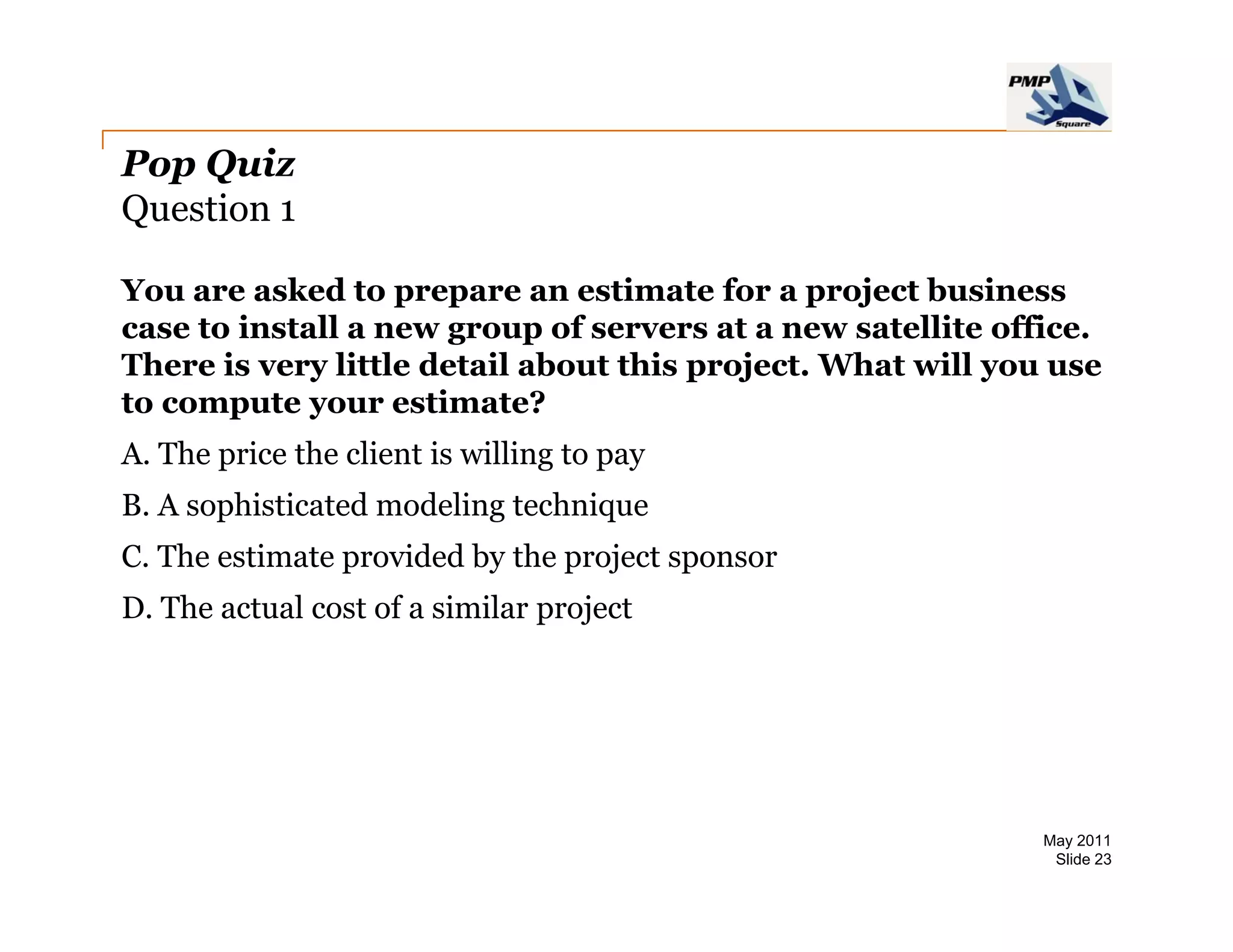
You are asked to prepare an estimate for a project business
case to install a new group of servers at a new satellite office.
There is very little detail about this project. What will you use
to compute your estimate?
       p     y
A. The price the client is willing to pay
B. A sophisticated modeling technique
C. The estimate provided by the project sponsor
D. The actual cost of a similar project


                                                             May 2011
                                                              Slide 23
Pop Quiz
Question 2

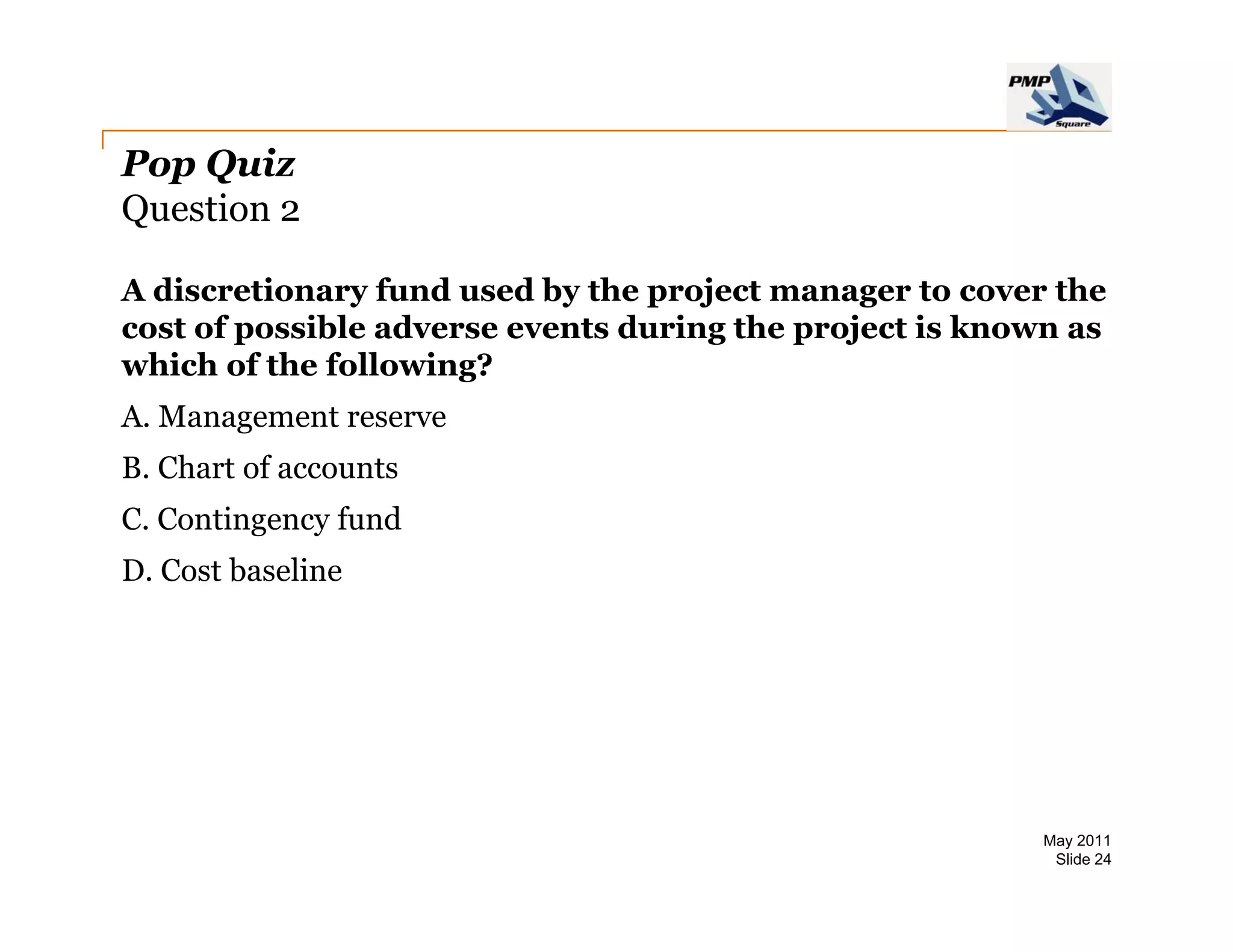
A discretionary fund used by the project manager to cover the
cost of possible adverse events during the project is known as
which of the following?
A.
A Management reserve
B. Chart of accounts
C. Contingency fund
         g   y
D. Cost baseline


                                                          May 2011
                                                           Slide 24
Pop Quiz
Question 3

You are developing a bottom - up estimate for the first phase of your
project. Which of the following is the most important input to complete
this task?
A.
A Historic data from a similar project
B. Schedule
C. The WBS
D. The scope statement


                                                                  May 2011
                                                                   Slide 25
Pop Quiz
Question 4

What is the most accurate estimate?
A. Analogous estimate
B. Bottom - up estimate
C. Estimates based on expert judgment
D. Parametric estimate


                                        May 2011
                                         Slide 26
Pop Quiz
Question 5

You are the project manager for a large IT project. At the time
you performed your cost estimates, the vendor you ’ re
working with provided you with the following estimates:
Programming estimate = 320 hours at $135/hour
                                    $135/hour.
Project management estimate = 320 hours at $155/hour.
Testing estimate = 150 hours at $85/hour.
      g                            /
What type of estimate are these?
A. Analogous
B. Bottom-up
C. Cost benefit
D.
D Parametric
                                                          May 2011
                                                           Slide 27
Thank You!

Pm deep dive cost management

  • 1.
    PM DeepDive Project CostManagement - Niraj Agarwal May 2011 Slide 1
  • 2.
    Project Cost Management Definition ProjectCost Management includes the processes involved in planning planning, estimating, budgeting, and controlling costs so that the project can be completed within the approved budget. • Cost Estimating – developing an approximation of the costs of the monetary resources needed to complete project activities. • Cost Budgeting – aggregating the estimated costs of individual activities or work packages t establish a cost b li ti iti k k to t bli h t baseline. • Cost Control – influencing the factors that create cost variances and controlling changes to the project budget. May 2011 Slide 2
  • 3.
    Project Cost Management Typesof Project Costs • Direct Project Cost - The costs directly attributable to a project project, including all personnel, goods and/or services together with all their associated costs. E.g. team travel, team wages, training,material,etc. • Indirect Project Cost - All costs which do not form a part of the final product, but which are none the less required for the orderly completion of the project and which may include, but not necessarily be limited to field administration, direct supervision, incidental tools and equipment, startup costs, contractor’s fees, insurance, taxes, etc. • Fixed Project Costs - Those costs which do not change with change in volume of output E g set-up rental etc output. E.g. set-up, rental, etc. • Variable Project Costs - Those costs that vary proportionately with volume of output. E.g. material cost, supplies, wages, etc. May 2011 Slide 3
  • 4.
    Project Cost Management AnalogousEstimating • It means using the actual cost of previous similar projects as the previous, basis for estimating the cost of the current project. • It uses expert judgment. • This type of estimate is typically done as part of the business case development or during the early stages of scope planning when there isn’t a lot of detail on the project. • An analogous estimate may be done for the project as a whole or for selected phases or deliverables. It is not typically used to estimate individual work packages. • Analogous estimates are the least accurate of all the estimating techniques but also the least costly. May 2011 Slide 4
  • 5.
    Project Cost Management ParametricEstimating • Same as the technique used in duration estimating estimating. • This technique uses a mathematical model to compute costs, and it most often uses the quantity of work multiplied by the rate. • Parametric estimating is dependent on the accuracy of the data used to create the model. May 2011 Slide 5
  • 6.
    Project Cost Management Bottom- Up Estimating • Assigns a cost estimate to each work package on the project project. • The WBS and the project resource requirements are critical inputs for a bottom - up estimate. • The idea is that you start at the work package level of the WBS and calculate the cost of each activity assigned to that work package. • The sum of all the work package estimates p p g provides the estimate of the total project cost. • Bottom - up estimates are the most accurate of all the estimating tec ques, techniques, but t ey ’re a so t e most t e - consuming to pe o . they e also the ost time co su g perform. May 2011 Slide 6
  • 7.
    Project Time Management ThreePoint Estimates • Three point estimates used: - Most likely(M) : Most likely cost of the schedule activity - Optimistic(O) : Activity cost is based on a best-case scenario - Pessimistic(P) : Activity cost is based on a worst-case scenario • Estimating based on 3 formulas: i. i PERT Activity Cost : C = (P + 4M + O)/6 May 2011 Slide 7
  • 8.
    Project Cost Management Sampleproject cost estimate May 2011 Slide 8
  • 9.
    Cost Estimating ITTO May 2011 Slide 9
  • 10.
    Cost Estimating ITTO May 2011 Slide 10
  • 11.
    Project Cost Management EstimatingTips • Brainstorm with your project team • Communicate the type of estimate you are providing & the level of accuracy they provide. • Make use of any available templates • Get estimates from the people doing the work. • Document any assumptions you have made May 2011 Slide 11
  • 12.
    Cost Budgeting Definition Cost Budgetingis the process of aggregating all the cost estimates and establishing a cost baseline for the project. The cost baseline is the total expected cost for the project. Once approved, it’s approved it s used throughout the remainder of the project to measure the overall cost performance. May 2011 Slide 12
  • 13.
    Cost Budgeting ITTO May 2011 Slide 13
  • 14.
    Cost Budgeting ITTO May 2011 Slide 14
  • 15.
    Cost Budgeting Reserves Contingency Reserves“A separately planned quantity used to allow for A future situations which may be planned for only in part (sometimes called ‘known unknowns’). For example, rework is certain, the amount of rework is not. The contingency fund is usually under the g y y discretion of the project manager, who controls how these funds are spent. Management Reserve “ A separately planned quantity used to allow l l d i d ll for future situations which are impossible to predict (sometimes called “unknown-Unknowns”). Management reserves may involve cost or schedule. schedule Management reserves are intended to reduce the risk of missing cost or schedule objectives. The management fund is usually controlled by upper management. May 2011 Slide 15
  • 16.
    Project Cost Control Definition •Project Cost Control is primarily concerned with Controlling Changes to the project budget • The processes of gathering, accumulating, analyzing, reporting and managing the costs on an on going basis on-going basis. • Includes project procedures, project cost changes, monitoring actual versus budget, variance analysis, integrated cost/schedule reporting, progress analysis and corrective actions. l i d ti ti May 2011 Slide 16
  • 17.
    Project Cost Control Definition •Project Cost Control is primarily concerned with Controlling Changes to the project budget • The processes of gathering, accumulating, analyzing, reporting and managing the costs on an on going basis on-going basis. • Includes project procedures, project cost changes, monitoring actual versus budget, variance analysis, integrated cost/schedule reporting, progress analysis and corrective actions. l i d ti ti May 2011 Slide 17
  • 18.
    Earned Value Analysis •Integrates cost, schedule and scope • Better that comparing projected vs. actual because time and cost are analyzed separately • Terms: - PV / BCWS – Budgeted Cost of Work Scheduled /Planned Value - EV / BCWP – Budgeted Cost of Work Performed / Earned Value - AC /ACWP – Actual Cost of Work Performed / Actual Cost May 2011 Slide 18
  • 19.
    Earned Value Analysis •BAC – Budget at Completion (how much did you budget for the total job) • EAC – Estimate at Completion (what do we expect the total project to cost) • ETC – Estimate to Completion (how much more do we expect to spend to finish the job) • VAC – Variance at Completion (how much over/under budget do we expect to be) May 2011 Slide 19
  • 20.
    Earned Value Analysis •Variance = (Plan – Actual) ( ) • Cost Variance (CV): EV– AC; -ve is over budget , +ve is under • Schedule Variance (SV): EV– PV; +ve is behind schedule, +ve is ahead • Cost Performance Index (CPI): EV/ AC - I am only getting x¢ out of every $ • Schedule Performance Index (SPI): EV/ PV - I am only progressing x % of the planned rate • Estimate at Completion (EAC): BAC / CPI - As of now we expect the total project to cost x$ • E ti t t C Estimate to Complete (ETC) EAC – AC l t (ETC): - how much will it cost from now to completion • Variance at Completion: BAC – EAC; when the project is over how much more or less did we spend May 2011 Slide 20
  • 21.
    Earned Value Analysis Question Work Actual Today is June 30th. —Data Budget Work Unit Completion (in $M) Performed Cost Date Date (in $M) (in $M) PV EV AC 1. What is the Cost Variance A Jan. 31 10 10 12 2. What is the Schedule B Feb. 8 F b 28 5 4 5 Variance C Mar. 31 6 8 8 3. What is the CPI D 12-May 15 13 12 4. What is the SPI 5 5. What is the EAC E 30-Jun 30 Jun 20 20 30 6. What is the ETC F 18-Jul 3 0 0 7. What is the Percent G Aug. 30 35 0 0 Complete H Sept. Sept 22 22 0 0 8. What is the Percent Spent I Oct. 29 12 0 0 J Nov. 30 9 0 0 May 2011 Slide 21
  • 22.
    Earned Value Analysis Question Work What is the CV ? $55 - $67 = Budget Actual Work Unit Completion (in $M) Performed Cost (in -$12 (EV AC) $12 (EV-AC) Date (in $M) PV EV $M) AC 2. What is the SV ? $55 - $56 = -$1 (EV-PV) A Jan. 31 10 10 12 3. What is the CPI? 55/67 = B Feb. 8 F b 28 5 4 5 .82 (EV/AC) C Mar. 31 6 8 8 4. What is the SPI? 55/56 = D 12-May 15 13 12 .98 (EV-PV) E 30-Jun 30 Jun 20 20 30 5. 5 What is the EAC? 137/ 82 = 137/. F 18-Jul 3 0 0 $167 (BAC/CPI) 6. What is the ETC? $167 - $67 = G Aug. 30 35 0 0 $100 (EAC-AC) H Sept. Sept 22 22 0 0 7. What is the Percent h h I Oct. 29 12 0 0 Complete? 55/137 = J Nov. 30 9 0 0 40% (EV/BAC) 8. What is the Percent Spent? 67/137 = 49% (AC/BAC) May 2011 Slide 22
  • 23.
    Pop Quiz Question 1 Youare asked to prepare an estimate for a project business case to install a new group of servers at a new satellite office. There is very little detail about this project. What will you use to compute your estimate? p y A. The price the client is willing to pay B. A sophisticated modeling technique C. The estimate provided by the project sponsor D. The actual cost of a similar project May 2011 Slide 23
  • 24.
    Pop Quiz Question 2 Adiscretionary fund used by the project manager to cover the cost of possible adverse events during the project is known as which of the following? A. A Management reserve B. Chart of accounts C. Contingency fund g y D. Cost baseline May 2011 Slide 24
  • 25.
    Pop Quiz Question 3 Youare developing a bottom - up estimate for the first phase of your project. Which of the following is the most important input to complete this task? A. A Historic data from a similar project B. Schedule C. The WBS D. The scope statement May 2011 Slide 25
  • 26.
    Pop Quiz Question 4 Whatis the most accurate estimate? A. Analogous estimate B. Bottom - up estimate C. Estimates based on expert judgment D. Parametric estimate May 2011 Slide 26
  • 27.
    Pop Quiz Question 5 Youare the project manager for a large IT project. At the time you performed your cost estimates, the vendor you ’ re working with provided you with the following estimates: Programming estimate = 320 hours at $135/hour $135/hour. Project management estimate = 320 hours at $155/hour. Testing estimate = 150 hours at $85/hour. g / What type of estimate are these? A. Analogous B. Bottom-up C. Cost benefit D. D Parametric May 2011 Slide 27
  • 28.