PLUS BRILLIANT 2.0
Bianka Apostolova (S2710714)
Maria Djigovska (S2695146)
Mariam Talakhadze (S2818353)
Weixiang Wang (S2509652)
22/10/14 University of Groningen, Retail Marketing, Tutorial Group 3B4 1
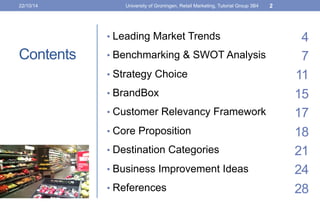
Contents
•  Leading Market Trends
•  Benchmarking & SWOT Analysis
•  Strategy Choice
•  BrandBox
•  Customer Relevancy Framework
•  Core Proposition
•  Destination Categories
•  Business Improvement Ideas
•  References
22/10/14 University of Groningen, Retail Marketing, Tutorial Group 3B4 2
4
7
11
15
17
18
21
24
28
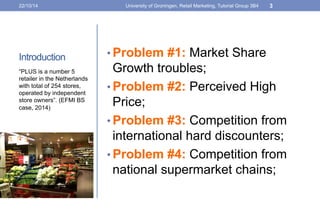
Introduction • Problem #1: Market Share
Growth troubles;
• Problem #2: Perceived High
Price;
• Problem #3: Competition from
international hard discounters;
• Problem #4: Competition from
national supermarket chains;
“PLUS is a number 5
retailer in the Netherlands
with total of 254 stores,
operated by independent
store owners”. (EFMI BS
case, 2014)
22/10/14 University of Groningen, Retail Marketing, Tutorial Group 3B4 3
LEADING TRENDS IN RETAIL
MARKET OF NETHERLANDS
22/10/14 University of Groningen, Retail Marketing, Tutorial Group 3B4 4
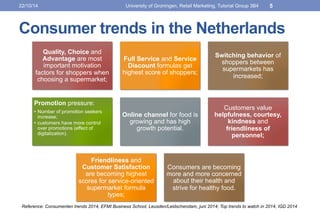
Consumer trends in the Netherlands
Quality, Choice and
Advantage are most
important motivation
factors for shoppers when
choosing a supermarket;
Full Service and Service
Discount formulas get
highest score of shoppers;
Switching behavior of
shoppers between
supermarkets has
increased;
Promotion pressure:
•  Number of promotion seekers
increase;
•  customers have more control
over promotions (effect of
digitalization).
Online channel for food is
growing and has high
growth potential.
Customers value
helpfulness, courtesy,
kindness and
friendliness of
personnel;
Friendliness and
Customer Satisfaction
are becoming highest
scores for service-oriented
supermarket formula
types;
Consumers are becoming
more and more concerned
about their health and
strive for healthy food.
22/10/14 University of Groningen, Retail Marketing, Tutorial Group 3B4 5
Reference: Consumenten trends 2014, EFMI Business School, Leusden/Leidschendam, juni 2014; Top trends to watch in 2014, IGD 2014
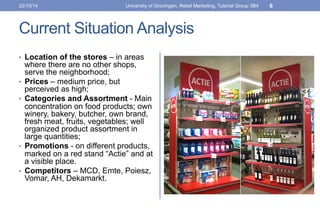
Current Situation Analysis
•  Location of the stores – in areas
where there are no other shops,
serve the neighborhood;
•  Prices – medium price, but
perceived as high;
•  Categories and Assortment - Main
concentration on food products; own
winery, bakery, butcher, own brand,
fresh meat, fruits, vegetables; well
organized product assortment in
large quantities;
•  Promotions - on different products,
marked on a red stand “Actie” and at
a visible place.
•  Competitors – MCD, Emte, Poiesz,
Vomar, AH, Dekamarkt.
22/10/14 University of Groningen, Retail Marketing, Tutorial Group 3B4 6
BENCHMARKING & SWOT
Identification of Possible Strategies
22/10/14 University of Groningen, Retail Marketing, Tutorial Group 3B4 7
Number of Stores & Sales per Square Meter
3131
254
455 379
Albert
Heijn
PLUS JUMBO LIDL
Number of Stores (October,
2014)
Stores
180
145
190
175
Albert
Heijn
PLUS JUMBO LIDL
Sales per Square Meter
(2014)
Sales per Square Meter (2014)
PLUS has the smallest number of stores
compared to its main competitors.
Sales per Square Meter is also the lowest
among competitors.
22/10/14 University of Groningen, Retail Marketing, Tutorial Group 3B4 8
Market Share & Price Level
48%
9%
30%
13%
Market Share, %
(September, 2014)
Albert Heijn
PLUS
JUMBO
(incl. C1000)
LIDL
4%
3%
-4%
-5%
Albert
Heijn
PLUS JUMBO LIDL
Price Level on National
Brands compared to
Industry Standard
22/10/14 University of Groningen, Retail Marketing, Tutorial Group 3B4 9
PLUS has the smallest market share and slow
growth rate.
The price level is only
3% higher than the
industry standard, but
perceived price image is
even higher.
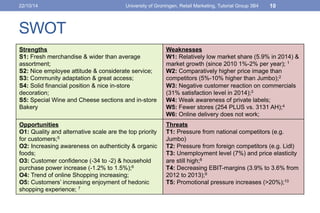
SWOT
22/10/14 University of Groningen, Retail Marketing, Tutorial Group 3B4 10
Strengths
S1: Fresh merchandise & wider than average
assortment;
S2: Nice employee attitude & considerate service;
S3: Community adaptation & great access;
S4: Solid financial position & nice in-store
decoration;
S5: Special Wine and Cheese sections and in-store
Bakery
Weaknesses
W1: Relatively low market share (5.9% in 2014) &
market growth (since 2010 1%-2% per year); 1
W2: Comparatively higher price image than
competitors (5%-10% higher than Jumbo);2
W3: Negative customer reaction on commercials
(31% satisfaction level in 2014);3
W4: Weak awareness of private labels;
W5: Fewer stores (254 PLUS vs. 3131 AH);4
W6: Online delivery does not work;
Opportunities
O1: Quality and alternative scale are the top priority
for customers;5
O2: Increasing awareness on authenticity & organic
foods;
O3: Customer confidence (-34 to -2) & household
purchase power increase (-1.2% to 1.5%);6
O4: Trend of online Shopping increasing;
O5: Customers’ increasing enjoyment of hedonic
shopping experience; 7
Threats
T1: Pressure from national competitors (e.g.
Jumbo)
T2: Pressure from foreign competitors (e.g. Lidl)
T3: Unemployment level (7%) and price elasticity
are still high;8
T4: Decreasing EBIT-margins (3.9% to 3.6% from
2012 to 2013);9
T5: Promotional pressure increases (>20%);10
Internal
External
Strengths
S1: Fresh merchandise & wider than average
assortment;
S2: Nice employee attitude & considerate service;
S3: Community adaptation & great access;
S4: Solid financial position & nice in-store decoration;
S5: Special Wine and Cheese sections and in-store
Bakery
Weaknesses
W1: Relatively low market share (5.9% in 2014) &
market growth (since 2010 1%-2% per year); 1
W2: Comparatively higher price image than
competitors (5%-10% higher than Jumbo);2
W3: Negative customer reaction on commercials
(31% satisfaction level in 2014);3
W4: Weak awareness of private labels;
W5: Fewer stores (254 PLUS vs. 3131 AH);4
W6: Online delivery does not work;
Opportunities
O1: Quality and alternative scale are the top priority
for customers;5
O2: Increasing awareness on authenticity & organic
foods;
O3: Customer confidence (-34 to -2) & household
purchase power increase (-1.2% to 1.5%);6
O4: Trend of online Shopping increasing;
O5: Customers’ increasing enjoyment of hedonic
shopping experience; 7
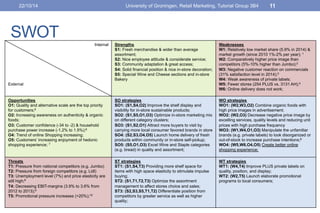
SO strategies
SO1: (S1,S4,O2) Improve the shelf display and
visibility for in-store sustainable products;
SO2: (S1,S5,O1,O3) Optimize in-store marketing mix
on different category clusters;
SO3: (S1,S2,O1) Attract more buyers to visit by
carrying more local consumer favored brands in store
SO4: (S2,S3,O4,O5) Launch home delivery of fresh
products within community or in-store self-pickup;
SO5: (S5,O1,O3) Excel Wine and Staple categories
(e.g. bread) in quality and assortment;
WO strategies
WO1: (W2,W3,O2) Combine organic foods with
high price images in advertisement;
WO2: (W2,O3) Decrease negative price image by
excelling services, quality levels and reducing unit
prices with high purchase frequency
WO3: (W1,W4,O1,O3) Manipulate the unfamiliar
brands (e.g. private labels) to look disorganized or
out-of-stock to increase purchase intentions;8
WO4: (W5,W6,O4,O5) Create better online
shopping experience;
Threats
T1: Pressure from national competitors (e.g. Jumbo)
T2: Pressure from foreign competitors (e.g. Lidl)
T3: Unemployment level (7%) and price elasticity are
still high;8
T4: Decreasing EBIT-margins (3.9% to 3.6% from
2012 to 2013);9
T5: Promotional pressure increases (>20%);10
ST strategies
ST1: (S1,S4,T3) Providing more shelf space for
items with high space elasticity to stimulate impulse
buying;
ST2: (S1,T1,T2,T3) Optimize the assortment
management to affect stores choice and sales;
ST3: (S2,S3,S5,T1,T2) Differentiate position from
competitors by greater service as well as higher
quality;
WT strategies
WT1: (W4,T4) Improve PLUS private labels on
quality, position, and display;
WT2: (W2,T5) Launch elaborate promotional
programs to local consumers;
SWOT
22/10/14 University of Groningen, Retail Marketing, Tutorial Group 3B4 11
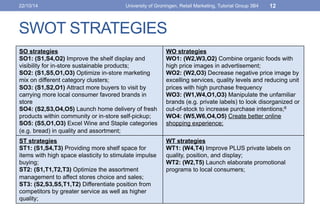
SWOT STRATEGIES
22/10/14 University of Groningen, Retail Marketing, Tutorial Group 3B4 12
SO strategies
SO1: (S1,S4,O2) Improve the shelf display and
visibility for in-store sustainable products;
SO2: (S1,S5,O1,O3) Optimize in-store marketing
mix on different category clusters;
SO3: (S1,S2,O1) Attract more buyers to visit by
carrying more local consumer favored brands in
store
SO4: (S2,S3,O4,O5) Launch home delivery of fresh
products within community or in-store self-pickup;
SO5: (S5,O1,O3) Excel Wine and Staple categories
(e.g. bread) in quality and assortment;
WO strategies
WO1: (W2,W3,O2) Combine organic foods with
high price images in advertisement;
WO2: (W2,O3) Decrease negative price image by
excelling services, quality levels and reducing unit
prices with high purchase frequency
WO3: (W1,W4,O1,O3) Manipulate the unfamiliar
brands (e.g. private labels) to look disorganized or
out-of-stock to increase purchase intentions;8
WO4: (W5,W6,O4,O5) Create better online
shopping experience;
ST strategies
ST1: (S1,S4,T3) Providing more shelf space for
items with high space elasticity to stimulate impulse
buying;
ST2: (S1,T1,T2,T3) Optimize the assortment
management to affect stores choice and sales;
ST3: (S2,S3,S5,T1,T2) Differentiate position from
competitors by greater service as well as higher
quality;
WT strategies
WT1: (W4,T4) Improve PLUS private labels on
quality, position, and display;
WT2: (W2,T5) Launch elaborate promotional
programs to local consumers;
STRATEGY CHOICE
According to IE Matrix Model
22/10/14 University of Groningen, Retail Marketing, Tutorial Group 3B4 13
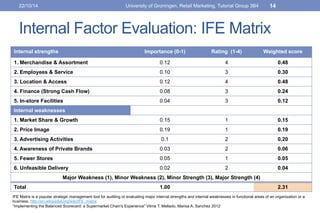
Internal Factor Evaluation: IFE Matrix
Internal strengths Importance (0-1) Rating (1-4) Weighted score
1. Merchandise & Assortment 0.12 4 0.48
2. Employees & Service 0.10 3 0.30
3. Location & Access 0.12 4 0.48
4. Finance (Strong Cash Flow) 0.08 3 0.24
5. In-store Facilities 0.04 3 0.12
Internal weaknesses
1. Market Share & Growth 0.15 1 0.15
2. Price Image 0.19 1 0.19
3. Advertising Activities 0.1 2 0.20
4. Awareness of Private Brands 0.03 2 0.06
5. Fewer Stores 0.05 1 0.05
6. Unfeasible Delivery 0.02 2 0.04
Major Weakness (1), Minor Weakness (2), Minor Strength (3), Major Strength (4)
Total 1.00 2.31
IFE Matrix is a popular strategic management tool for auditing or evaluating major internal strengths and internal weaknesses in functional areas of an organization or a
business. http://en.wikipedia.org/wiki/IFE_matrix
“Implementing the Balanced Scorecard: a Supermarket Chain's Experience” Vilma T. Mellado, Marisa A. Sanchez 2012
22/10/14 University of Groningen, Retail Marketing, Tutorial Group 3B4 14
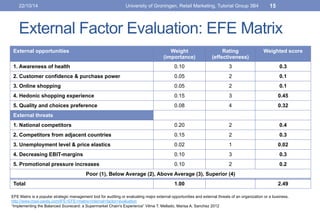
External Factor Evaluation: EFE Matrix
External opportunities Weight
(importance)
Rating
(effectiveness)
Weighted score
1. Awareness of health 0.10 3 0.3
2. Customer confidence & purchase power 0.05 2 0.1
3. Online shopping 0.05 2 0.1
4. Hedonic shopping experience 0.15 3 0.45
5. Quality and choices preference 0.08 4 0.32
External threats
1. National competitors 0.20 2 0.4
2. Competitors from adjacent countries 0.15 2 0.3
3. Unemployment level & price elastics 0.02 1 0.02
4. Decreasing EBIT-margins 0.10 3 0.3
5. Promotional pressure increases 0.10 2 0.2
Poor (1), Below Average (2), Above Average (3), Superior (4)
Total 1.00 2.49
EFE Matrix is a popular strategic management tool for auditing or evaluating major external opportunities and external threats of an organization or a business.
http://www.maxi-pedia.com/IFE+EFE+matrix+internal+factor+evaluation
“Implementing the Balanced Scorecard: a Supermarket Chain's Experience” Vilma T. Mellado, Marisa A. Sanchez 2012
22/10/14 University of Groningen, Retail Marketing, Tutorial Group 3B4 15
IE Matrix
Strong Average Weak
(3.0	
  to	
  4.0) (2.0	
  to	
  2.99) (1.0	
  to	
  1.99)
High I II III
(3.0	
  to	
  3.99) 	
  
Grow	


Grow	
  &	
  Maintain
	
  
Maintain	
  
Medium IV V VI
(2.0	
  to	
  2.99) 	
  
Build
(2.31;	
  2.49)	
  
Build	
  &	
  Harvest	


Harvest	
  
Low VII VIII IX
(1.0	
  to	
  1.99) 	
  
Hold	


Hold	
  &	
  Digest	


Digest	
  
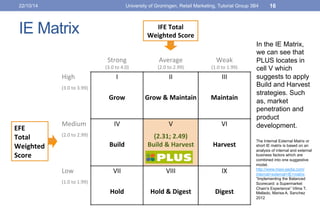
In the IE Matrix,
we can see that
PLUS locates in
cell V which
suggests to apply
Build and Harvest
strategies. Such
as, market
penetration and
product
development.
The Internal External Matrix or
short IE matrix is based on an
analysis of internal and external
business factors which are
combined into one suggestive
model.
http://www.maxi-pedia.com/
internal+external+IE+matrix
“Implementing the Balanced
Scorecard: a Supermarket
Chain's Experience” Vilma T.
Mellado, Marisa A. Sanchez
2012
EFE	
  	
  
Total	
  
Weighted	
  
Score
IFE	
  Total	
  
Weighted	
  Score
22/10/14 University of Groningen, Retail Marketing, Tutorial Group 3B4 16
BRAND	
  BOX	
  –	
  PLUS
What	
  the	
  
customer	
  wants:	


Choice	
  
High	
  quality	
  
Convenience	
  
EmoUonal	
  
experience	
  
Access	
  
Personal	
  
aXtude	
  
What	
  the	
  customer	
  gets:	
  
Broad	
  assortment	
  
Availability	
  and	
  
freshness	
  of	
  products	
  
Surprises	
  every	
  day	
  
InspiraUon	
  and	
  
enjoyment	
  of	
  the	
  
shopping	
  experience	
  
Serving	
  the	
  
neighborhood,	
  online	
  
channel	
  
Customer-­‐friendly	
  
personnel	


Brand	
  essence:	
  
Excellent	
  Service	
  and	
  
Quality	
  
What	
  feelings	
  does	
  the	
  
PLUS	
  brand	
  evoke?	
  
What	
  does	
  the	
  PLUS	
  
brand	
  tell	
  about	
  me?	
  
Cozy	
  
atmosphere	


EmoUonal	
  	
  
SaUsfacUon	
  
InspiraUon	
  
Amiability	
  
Helpfulness	
  
Open-­‐minded	
  
Promise	
   Evidence	
  
Inspiring	
  
experience	
  
Superior	
  
quality	
  
Neighborhood	
  
oriented	
  
Inspiring	
  
environment	
  
Professional	
  
aXtude	
  
High	
  quality	
  
products	
  
EmoUon	
  
seeker	
  
Quality	
  
oriented	
  
Locally	
  
involved	
  
CompeUUon:	
  
High	
  discounts	
  (Lidl,	
  Jumbo);	


  Price-­‐oriented	
  (Lidl)	
  
Introducing	
  on-­‐line	
  shopping	
  (AH);	
  
Customer-­‐oriented	
  (AH);	
  
Licle	
  high	
  emoUonal	
  experience	
  offered	
  to	
  customers	
  as	
  a	
  whole	
  	
  
Target	
  groups:	
  
Explorers	
  –	
  core	
  moUvaUon:	
  discovery,	
  new	
  experiences,	
  ideas,	
  challenge	
  
Succeeders	
  –	
  very	
  organized,	
  self-­‐confident,	
  strong	
  goal	
  orientaUon,	
  
core	
  moUvaUon:	
  control	
  
Reformers	
  –	
  core	
  moUvaUon:	
  enlightenment,	
  have	
  their	
  own	
  judgement,	
  
anU-­‐materialisUc	
  (considered	
  as	
  intellects)	
  
Values	
  of	
  the	
  brand:	
  
High	
  quality	
  performance	
  
Community	
  oriented	
  
responsibility	
  
Reliability	
  	
  
Organized	
  
Customer	
  
insights	
  
Customer	
  
benefits	
  
Reference: Brand box model: http://www.canicas.nl/visie/proposities-en-merk-dna/;
The target groups are made based on Young & Rubicam 4C model for
segmentation (4Cs - Cross cultural consumers characterization in which customers
are divided into 7 groups: explorer, aspirer, succeeder, reformer, mainstream,
struggler, resigned), http://prezi.com/ckjx3qg5k-tw/young-and-rubicam-4-cs/
22/10/14 University of Groningen, Retail Marketing, Tutorial Group 3B4 17
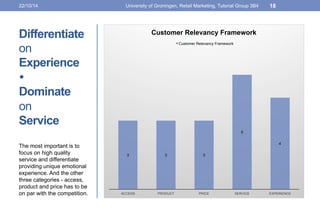
Differentiate
on
Experience
Ÿ
Dominate
on
Service
3 3 3
5
4
ACCESS PRODUCT PRICE SERVICE EXPERIENCE
Customer Relevancy Framework
The most important is to
focus on high quality
service and differentiate
providing unique emotional
experience. And the other
three categories - access,
product and price has to be
on par with the competition.
22/10/14 University of Groningen, Retail Marketing, Tutorial Group 3B4 18
“EXCELLENT SERVICE AND
SUPERIOR QUALITY”
Core proposition - the main brand promise to the customers
22/10/14 University of Groningen, Retail Marketing, Tutorial Group 3B4 19
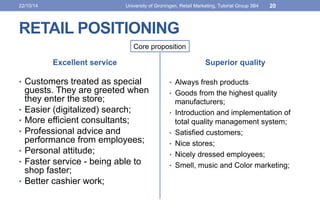
RETAIL POSITIONING
Excellent service
•  Customers treated as special
guests. They are greeted when
they enter the store;
•  Easier (digitalized) search;
•  More efficient consultants;
•  Professional advice and
performance from employees;
•  Personal attitude;
•  Faster service - being able to
shop faster;
•  Better cashier work;
Superior quality
•  Always fresh products
•  Goods from the highest quality
manufacturers;
•  Introduction and implementation of
total quality management system;
•  Satisfied customers;
•  Nice stores;
•  Nicely dressed employees;
•  Smell, music and Color marketing;
22/10/14 University of Groningen, Retail Marketing, Tutorial Group 3B4 20
Core proposition
Unique selling point towards competition
• Unique emotional
experience – ‘celebrating’
while shopping;
• Customers – treated as
special guests, not just
clients;
• Surprises every day
-  Small gifts to the loyal
customers
-  Free food samples
-  Free lunch boxes from time
to time
-  Free coffee and tea
22/10/14 University of Groningen, Retail Marketing, Tutorial Group 3B4 21
Unique selling point towards competition:
Unique “Surprising”
Experience
DESTINATION CATEGORIES
22/10/14 University of Groningen, Retail Marketing, Tutorial Group 3B4 22
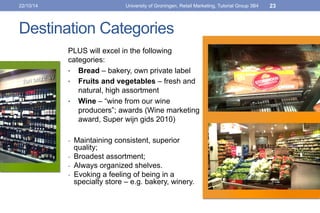
Destination Categories
PLUS will excel in the following
categories:
•  Bread – bakery, own private label
•  Fruits and vegetables – fresh and
natural, high assortment
•  Wine – “wine from our wine
producers”; awards (Wine marketing
award, Super wijn gids 2010)
22/10/14 University of Groningen, Retail Marketing, Tutorial Group 3B4 23
-  Maintaining consistent, superior
quality;
-  Broadest assortment;
-  Always organized shelves.
-  Evoking a feeling of being in a
specialty store – e.g. bakery, winery.
Preferred categories - effective for
increasing sales volume
Promote greater
assortment, manipulate
shelf display and private
label penetration.
•  Cheese – “from our
cheesemonger”
•  Meet - “from our
butcher”
•  Beer
•  Dry food
Convenience categories
(e.g. detergents, office
supplies)
•  encourage multi-point
in-store display and
focus on fewer brands
22/10/14 University of Groningen, Retail Marketing, Tutorial Group 3B4 24
Sustainable categories (e.g. organic foods)
- provide smaller specially decorated shelf
space (small but distinctive, green color),
commercials will target more educated people
Other Categories
BUSINESS IMPROVEMENT
IDEAS
University of Groningen, Retail Marketing, Tutorial Group 3B422/10/14 25
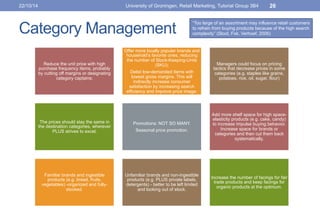
Category Management
Reduce the unit price with high
purchase frequency items, probably
by cutting off margins or designating
category captains;
Offer more locally popular brands and
household’s favorite ones, reducing
the number of Stock-Keeping-Units
(SKU);
Delist low-demanded items with
lowest gross margins. This will
indirectly increase consumer
satisfaction by increasing search
efficiency and improve price image.
Managers could focus on pricing
tactics that decrease prices in some
categories (e.g. staples like grains,
potatoes, rice, oil, sugar, flour)
The prices should stay the same in
the destination categories, wherever
PLUS strives to excel;
Promotions: NOT SO MANY.
Seasonal price promotion,
Add more shelf space for high space-
elasticity products (e.g. cake, candy)
to increase impulse buying behavior.
Increase space for brands or
categories and then cut them back
systematically.
Familiar brands and ingestible
products (e.g. bread, fruits,
vegetables) -organized and fully-
stocked.
Unfamiliar brands and non-ingestible
products (e.g. PLUS private labels,
detergents) - better to be left limited
and looking out of stock.
Increase the number of facings for fair
trade products and keep facings for
organic products at the optimum.
22/10/14 University of Groningen, Retail Marketing, Tutorial Group 3B4 26
“Too large of an assortment may influence retail customers
to refrain from buying products because of the high search
complexity” (Sloot, Fok, Verhoef, 2006)
Service Improvement
Better checkouts:
1. The products - packed by
the cashier or a consultant;
2. Three types of checkouts:
fast, normal and digital self-
checkout (like at IKEA);
Efficient Consultants – if
customers need personal
help, there is a button to press
at each department and a
consultant comes to advise
them;
Finding the products – a
touchscreen machines in
several spots of the
supermarket, keyword
searching; Search results can
refer to the shelf and
department of the store;
Professional advices in the
Destination and Preferred
category departments (wine,
cheese, meat);
To-Go Section in bigger shops
Online Shop and Home
Deliveries (within 30 minutes
if in the neighborhood)
22/10/14 University of Groningen, Retail Marketing, Tutorial Group 3B4 27
THANK YOU FOR YOUR
ATTENTION!
We are ready for your questions!
22/10/14 University of Groningen, Retail Marketing, Tutorial Group 3B4 28

PLUS supermarkets - Case Study Report

  • 1.
    PLUS BRILLIANT 2.0 BiankaApostolova (S2710714) Maria Djigovska (S2695146) Mariam Talakhadze (S2818353) Weixiang Wang (S2509652) 22/10/14 University of Groningen, Retail Marketing, Tutorial Group 3B4 1
  • 2.
    Contents •  Leading MarketTrends •  Benchmarking & SWOT Analysis •  Strategy Choice •  BrandBox •  Customer Relevancy Framework •  Core Proposition •  Destination Categories •  Business Improvement Ideas •  References 22/10/14 University of Groningen, Retail Marketing, Tutorial Group 3B4 2 4 7 11 15 17 18 21 24 28
  • 3.
    Introduction • Problem #1:Market Share Growth troubles; • Problem #2: Perceived High Price; • Problem #3: Competition from international hard discounters; • Problem #4: Competition from national supermarket chains; “PLUS is a number 5 retailer in the Netherlands with total of 254 stores, operated by independent store owners”. (EFMI BS case, 2014) 22/10/14 University of Groningen, Retail Marketing, Tutorial Group 3B4 3
  • 4.
    LEADING TRENDS INRETAIL MARKET OF NETHERLANDS 22/10/14 University of Groningen, Retail Marketing, Tutorial Group 3B4 4
  • 5.
    Consumer trends inthe Netherlands Quality, Choice and Advantage are most important motivation factors for shoppers when choosing a supermarket; Full Service and Service Discount formulas get highest score of shoppers; Switching behavior of shoppers between supermarkets has increased; Promotion pressure: •  Number of promotion seekers increase; •  customers have more control over promotions (effect of digitalization). Online channel for food is growing and has high growth potential. Customers value helpfulness, courtesy, kindness and friendliness of personnel; Friendliness and Customer Satisfaction are becoming highest scores for service-oriented supermarket formula types; Consumers are becoming more and more concerned about their health and strive for healthy food. 22/10/14 University of Groningen, Retail Marketing, Tutorial Group 3B4 5 Reference: Consumenten trends 2014, EFMI Business School, Leusden/Leidschendam, juni 2014; Top trends to watch in 2014, IGD 2014
  • 6.
    Current Situation Analysis • Location of the stores – in areas where there are no other shops, serve the neighborhood; •  Prices – medium price, but perceived as high; •  Categories and Assortment - Main concentration on food products; own winery, bakery, butcher, own brand, fresh meat, fruits, vegetables; well organized product assortment in large quantities; •  Promotions - on different products, marked on a red stand “Actie” and at a visible place. •  Competitors – MCD, Emte, Poiesz, Vomar, AH, Dekamarkt. 22/10/14 University of Groningen, Retail Marketing, Tutorial Group 3B4 6
  • 7.
    BENCHMARKING & SWOT Identificationof Possible Strategies 22/10/14 University of Groningen, Retail Marketing, Tutorial Group 3B4 7
  • 8.
    Number of Stores& Sales per Square Meter 3131 254 455 379 Albert Heijn PLUS JUMBO LIDL Number of Stores (October, 2014) Stores 180 145 190 175 Albert Heijn PLUS JUMBO LIDL Sales per Square Meter (2014) Sales per Square Meter (2014) PLUS has the smallest number of stores compared to its main competitors. Sales per Square Meter is also the lowest among competitors. 22/10/14 University of Groningen, Retail Marketing, Tutorial Group 3B4 8
  • 9.
    Market Share &Price Level 48% 9% 30% 13% Market Share, % (September, 2014) Albert Heijn PLUS JUMBO (incl. C1000) LIDL 4% 3% -4% -5% Albert Heijn PLUS JUMBO LIDL Price Level on National Brands compared to Industry Standard 22/10/14 University of Groningen, Retail Marketing, Tutorial Group 3B4 9 PLUS has the smallest market share and slow growth rate. The price level is only 3% higher than the industry standard, but perceived price image is even higher.
  • 10.
    SWOT 22/10/14 University ofGroningen, Retail Marketing, Tutorial Group 3B4 10 Strengths S1: Fresh merchandise & wider than average assortment; S2: Nice employee attitude & considerate service; S3: Community adaptation & great access; S4: Solid financial position & nice in-store decoration; S5: Special Wine and Cheese sections and in-store Bakery Weaknesses W1: Relatively low market share (5.9% in 2014) & market growth (since 2010 1%-2% per year); 1 W2: Comparatively higher price image than competitors (5%-10% higher than Jumbo);2 W3: Negative customer reaction on commercials (31% satisfaction level in 2014);3 W4: Weak awareness of private labels; W5: Fewer stores (254 PLUS vs. 3131 AH);4 W6: Online delivery does not work; Opportunities O1: Quality and alternative scale are the top priority for customers;5 O2: Increasing awareness on authenticity & organic foods; O3: Customer confidence (-34 to -2) & household purchase power increase (-1.2% to 1.5%);6 O4: Trend of online Shopping increasing; O5: Customers’ increasing enjoyment of hedonic shopping experience; 7 Threats T1: Pressure from national competitors (e.g. Jumbo) T2: Pressure from foreign competitors (e.g. Lidl) T3: Unemployment level (7%) and price elasticity are still high;8 T4: Decreasing EBIT-margins (3.9% to 3.6% from 2012 to 2013);9 T5: Promotional pressure increases (>20%);10
  • 11.
    Internal External Strengths S1: Fresh merchandise& wider than average assortment; S2: Nice employee attitude & considerate service; S3: Community adaptation & great access; S4: Solid financial position & nice in-store decoration; S5: Special Wine and Cheese sections and in-store Bakery Weaknesses W1: Relatively low market share (5.9% in 2014) & market growth (since 2010 1%-2% per year); 1 W2: Comparatively higher price image than competitors (5%-10% higher than Jumbo);2 W3: Negative customer reaction on commercials (31% satisfaction level in 2014);3 W4: Weak awareness of private labels; W5: Fewer stores (254 PLUS vs. 3131 AH);4 W6: Online delivery does not work; Opportunities O1: Quality and alternative scale are the top priority for customers;5 O2: Increasing awareness on authenticity & organic foods; O3: Customer confidence (-34 to -2) & household purchase power increase (-1.2% to 1.5%);6 O4: Trend of online Shopping increasing; O5: Customers’ increasing enjoyment of hedonic shopping experience; 7 SO strategies SO1: (S1,S4,O2) Improve the shelf display and visibility for in-store sustainable products; SO2: (S1,S5,O1,O3) Optimize in-store marketing mix on different category clusters; SO3: (S1,S2,O1) Attract more buyers to visit by carrying more local consumer favored brands in store SO4: (S2,S3,O4,O5) Launch home delivery of fresh products within community or in-store self-pickup; SO5: (S5,O1,O3) Excel Wine and Staple categories (e.g. bread) in quality and assortment; WO strategies WO1: (W2,W3,O2) Combine organic foods with high price images in advertisement; WO2: (W2,O3) Decrease negative price image by excelling services, quality levels and reducing unit prices with high purchase frequency WO3: (W1,W4,O1,O3) Manipulate the unfamiliar brands (e.g. private labels) to look disorganized or out-of-stock to increase purchase intentions;8 WO4: (W5,W6,O4,O5) Create better online shopping experience; Threats T1: Pressure from national competitors (e.g. Jumbo) T2: Pressure from foreign competitors (e.g. Lidl) T3: Unemployment level (7%) and price elasticity are still high;8 T4: Decreasing EBIT-margins (3.9% to 3.6% from 2012 to 2013);9 T5: Promotional pressure increases (>20%);10 ST strategies ST1: (S1,S4,T3) Providing more shelf space for items with high space elasticity to stimulate impulse buying; ST2: (S1,T1,T2,T3) Optimize the assortment management to affect stores choice and sales; ST3: (S2,S3,S5,T1,T2) Differentiate position from competitors by greater service as well as higher quality; WT strategies WT1: (W4,T4) Improve PLUS private labels on quality, position, and display; WT2: (W2,T5) Launch elaborate promotional programs to local consumers; SWOT 22/10/14 University of Groningen, Retail Marketing, Tutorial Group 3B4 11
  • 12.
    SWOT STRATEGIES 22/10/14 Universityof Groningen, Retail Marketing, Tutorial Group 3B4 12 SO strategies SO1: (S1,S4,O2) Improve the shelf display and visibility for in-store sustainable products; SO2: (S1,S5,O1,O3) Optimize in-store marketing mix on different category clusters; SO3: (S1,S2,O1) Attract more buyers to visit by carrying more local consumer favored brands in store SO4: (S2,S3,O4,O5) Launch home delivery of fresh products within community or in-store self-pickup; SO5: (S5,O1,O3) Excel Wine and Staple categories (e.g. bread) in quality and assortment; WO strategies WO1: (W2,W3,O2) Combine organic foods with high price images in advertisement; WO2: (W2,O3) Decrease negative price image by excelling services, quality levels and reducing unit prices with high purchase frequency WO3: (W1,W4,O1,O3) Manipulate the unfamiliar brands (e.g. private labels) to look disorganized or out-of-stock to increase purchase intentions;8 WO4: (W5,W6,O4,O5) Create better online shopping experience; ST strategies ST1: (S1,S4,T3) Providing more shelf space for items with high space elasticity to stimulate impulse buying; ST2: (S1,T1,T2,T3) Optimize the assortment management to affect stores choice and sales; ST3: (S2,S3,S5,T1,T2) Differentiate position from competitors by greater service as well as higher quality; WT strategies WT1: (W4,T4) Improve PLUS private labels on quality, position, and display; WT2: (W2,T5) Launch elaborate promotional programs to local consumers;
  • 13.
    STRATEGY CHOICE According toIE Matrix Model 22/10/14 University of Groningen, Retail Marketing, Tutorial Group 3B4 13
  • 14.
    Internal Factor Evaluation:IFE Matrix Internal strengths Importance (0-1) Rating (1-4) Weighted score 1. Merchandise & Assortment 0.12 4 0.48 2. Employees & Service 0.10 3 0.30 3. Location & Access 0.12 4 0.48 4. Finance (Strong Cash Flow) 0.08 3 0.24 5. In-store Facilities 0.04 3 0.12 Internal weaknesses 1. Market Share & Growth 0.15 1 0.15 2. Price Image 0.19 1 0.19 3. Advertising Activities 0.1 2 0.20 4. Awareness of Private Brands 0.03 2 0.06 5. Fewer Stores 0.05 1 0.05 6. Unfeasible Delivery 0.02 2 0.04 Major Weakness (1), Minor Weakness (2), Minor Strength (3), Major Strength (4) Total 1.00 2.31 IFE Matrix is a popular strategic management tool for auditing or evaluating major internal strengths and internal weaknesses in functional areas of an organization or a business. http://en.wikipedia.org/wiki/IFE_matrix “Implementing the Balanced Scorecard: a Supermarket Chain's Experience” Vilma T. Mellado, Marisa A. Sanchez 2012 22/10/14 University of Groningen, Retail Marketing, Tutorial Group 3B4 14
  • 15.
    External Factor Evaluation:EFE Matrix External opportunities Weight (importance) Rating (effectiveness) Weighted score 1. Awareness of health 0.10 3 0.3 2. Customer confidence & purchase power 0.05 2 0.1 3. Online shopping 0.05 2 0.1 4. Hedonic shopping experience 0.15 3 0.45 5. Quality and choices preference 0.08 4 0.32 External threats 1. National competitors 0.20 2 0.4 2. Competitors from adjacent countries 0.15 2 0.3 3. Unemployment level & price elastics 0.02 1 0.02 4. Decreasing EBIT-margins 0.10 3 0.3 5. Promotional pressure increases 0.10 2 0.2 Poor (1), Below Average (2), Above Average (3), Superior (4) Total 1.00 2.49 EFE Matrix is a popular strategic management tool for auditing or evaluating major external opportunities and external threats of an organization or a business. http://www.maxi-pedia.com/IFE+EFE+matrix+internal+factor+evaluation “Implementing the Balanced Scorecard: a Supermarket Chain's Experience” Vilma T. Mellado, Marisa A. Sanchez 2012 22/10/14 University of Groningen, Retail Marketing, Tutorial Group 3B4 15
  • 16.
    IE Matrix Strong AverageWeak (3.0  to  4.0) (2.0  to  2.99) (1.0  to  1.99) High I II III (3.0  to  3.99)   Grow                                             Grow  &  Maintain   Maintain   Medium IV V VI (2.0  to  2.99)   Build (2.31;  2.49)   Build  &  Harvest     Harvest   Low VII VIII IX (1.0  to  1.99)   Hold     Hold  &  Digest     Digest   In the IE Matrix, we can see that PLUS locates in cell V which suggests to apply Build and Harvest strategies. Such as, market penetration and product development. The Internal External Matrix or short IE matrix is based on an analysis of internal and external business factors which are combined into one suggestive model. http://www.maxi-pedia.com/ internal+external+IE+matrix “Implementing the Balanced Scorecard: a Supermarket Chain's Experience” Vilma T. Mellado, Marisa A. Sanchez 2012 EFE     Total   Weighted   Score IFE  Total   Weighted  Score 22/10/14 University of Groningen, Retail Marketing, Tutorial Group 3B4 16
  • 17.
    BRAND  BOX  –  PLUS What  the   customer  wants:       Choice   High  quality   Convenience   EmoUonal   experience   Access   Personal   aXtude   What  the  customer  gets:   Broad  assortment   Availability  and   freshness  of  products   Surprises  every  day   InspiraUon  and   enjoyment  of  the   shopping  experience   Serving  the   neighborhood,  online   channel   Customer-­‐friendly   personnel       Brand  essence:   Excellent  Service  and   Quality   What  feelings  does  the   PLUS  brand  evoke?   What  does  the  PLUS   brand  tell  about  me?   Cozy   atmosphere       EmoUonal     SaUsfacUon   InspiraUon   Amiability   Helpfulness   Open-­‐minded   Promise   Evidence   Inspiring   experience   Superior   quality   Neighborhood   oriented   Inspiring   environment   Professional   aXtude   High  quality   products   EmoUon   seeker   Quality   oriented   Locally   involved   CompeUUon:   High  discounts  (Lidl,  Jumbo);                  Price-­‐oriented  (Lidl)   Introducing  on-­‐line  shopping  (AH);   Customer-­‐oriented  (AH);   Licle  high  emoUonal  experience  offered  to  customers  as  a  whole     Target  groups:   Explorers  –  core  moUvaUon:  discovery,  new  experiences,  ideas,  challenge   Succeeders  –  very  organized,  self-­‐confident,  strong  goal  orientaUon,   core  moUvaUon:  control   Reformers  –  core  moUvaUon:  enlightenment,  have  their  own  judgement,   anU-­‐materialisUc  (considered  as  intellects)   Values  of  the  brand:   High  quality  performance   Community  oriented   responsibility   Reliability     Organized   Customer   insights   Customer   benefits   Reference: Brand box model: http://www.canicas.nl/visie/proposities-en-merk-dna/; The target groups are made based on Young & Rubicam 4C model for segmentation (4Cs - Cross cultural consumers characterization in which customers are divided into 7 groups: explorer, aspirer, succeeder, reformer, mainstream, struggler, resigned), http://prezi.com/ckjx3qg5k-tw/young-and-rubicam-4-cs/ 22/10/14 University of Groningen, Retail Marketing, Tutorial Group 3B4 17
  • 18.
    Differentiate on Experience Ÿ Dominate on Service 3 3 3 5 4 ACCESSPRODUCT PRICE SERVICE EXPERIENCE Customer Relevancy Framework Customer Relevancy Framework The most important is to focus on high quality service and differentiate providing unique emotional experience. And the other three categories - access, product and price has to be on par with the competition. 22/10/14 University of Groningen, Retail Marketing, Tutorial Group 3B4 18
  • 19.
    “EXCELLENT SERVICE AND SUPERIORQUALITY” Core proposition - the main brand promise to the customers 22/10/14 University of Groningen, Retail Marketing, Tutorial Group 3B4 19
  • 20.
    RETAIL POSITIONING Excellent service • Customers treated as special guests. They are greeted when they enter the store; •  Easier (digitalized) search; •  More efficient consultants; •  Professional advice and performance from employees; •  Personal attitude; •  Faster service - being able to shop faster; •  Better cashier work; Superior quality •  Always fresh products •  Goods from the highest quality manufacturers; •  Introduction and implementation of total quality management system; •  Satisfied customers; •  Nice stores; •  Nicely dressed employees; •  Smell, music and Color marketing; 22/10/14 University of Groningen, Retail Marketing, Tutorial Group 3B4 20 Core proposition
  • 21.
    Unique selling pointtowards competition • Unique emotional experience – ‘celebrating’ while shopping; • Customers – treated as special guests, not just clients; • Surprises every day -  Small gifts to the loyal customers -  Free food samples -  Free lunch boxes from time to time -  Free coffee and tea 22/10/14 University of Groningen, Retail Marketing, Tutorial Group 3B4 21 Unique selling point towards competition: Unique “Surprising” Experience
  • 22.
    DESTINATION CATEGORIES 22/10/14 Universityof Groningen, Retail Marketing, Tutorial Group 3B4 22
  • 23.
    Destination Categories PLUS willexcel in the following categories: •  Bread – bakery, own private label •  Fruits and vegetables – fresh and natural, high assortment •  Wine – “wine from our wine producers”; awards (Wine marketing award, Super wijn gids 2010) 22/10/14 University of Groningen, Retail Marketing, Tutorial Group 3B4 23 -  Maintaining consistent, superior quality; -  Broadest assortment; -  Always organized shelves. -  Evoking a feeling of being in a specialty store – e.g. bakery, winery.
  • 24.
    Preferred categories -effective for increasing sales volume Promote greater assortment, manipulate shelf display and private label penetration. •  Cheese – “from our cheesemonger” •  Meet - “from our butcher” •  Beer •  Dry food Convenience categories (e.g. detergents, office supplies) •  encourage multi-point in-store display and focus on fewer brands 22/10/14 University of Groningen, Retail Marketing, Tutorial Group 3B4 24 Sustainable categories (e.g. organic foods) - provide smaller specially decorated shelf space (small but distinctive, green color), commercials will target more educated people Other Categories
  • 25.
    BUSINESS IMPROVEMENT IDEAS University ofGroningen, Retail Marketing, Tutorial Group 3B422/10/14 25
  • 26.
    Category Management Reduce theunit price with high purchase frequency items, probably by cutting off margins or designating category captains; Offer more locally popular brands and household’s favorite ones, reducing the number of Stock-Keeping-Units (SKU); Delist low-demanded items with lowest gross margins. This will indirectly increase consumer satisfaction by increasing search efficiency and improve price image. Managers could focus on pricing tactics that decrease prices in some categories (e.g. staples like grains, potatoes, rice, oil, sugar, flour) The prices should stay the same in the destination categories, wherever PLUS strives to excel; Promotions: NOT SO MANY. Seasonal price promotion, Add more shelf space for high space- elasticity products (e.g. cake, candy) to increase impulse buying behavior. Increase space for brands or categories and then cut them back systematically. Familiar brands and ingestible products (e.g. bread, fruits, vegetables) -organized and fully- stocked. Unfamiliar brands and non-ingestible products (e.g. PLUS private labels, detergents) - better to be left limited and looking out of stock. Increase the number of facings for fair trade products and keep facings for organic products at the optimum. 22/10/14 University of Groningen, Retail Marketing, Tutorial Group 3B4 26 “Too large of an assortment may influence retail customers to refrain from buying products because of the high search complexity” (Sloot, Fok, Verhoef, 2006)
  • 27.
    Service Improvement Better checkouts: 1.The products - packed by the cashier or a consultant; 2. Three types of checkouts: fast, normal and digital self- checkout (like at IKEA); Efficient Consultants – if customers need personal help, there is a button to press at each department and a consultant comes to advise them; Finding the products – a touchscreen machines in several spots of the supermarket, keyword searching; Search results can refer to the shelf and department of the store; Professional advices in the Destination and Preferred category departments (wine, cheese, meat); To-Go Section in bigger shops Online Shop and Home Deliveries (within 30 minutes if in the neighborhood) 22/10/14 University of Groningen, Retail Marketing, Tutorial Group 3B4 27
  • 28.
    THANK YOU FORYOUR ATTENTION! We are ready for your questions! 22/10/14 University of Groningen, Retail Marketing, Tutorial Group 3B4 28