November 16, 2015
EVE 5110
Plug-In Hybrid Electric Vehicle
Siddhesh Ozarkar
MS Mechanical Engineering
Wayne State University, Detroit
Abstract
Energy requirement of a vehicle is a crucial step prior to
design of the powertrain. An estimate of the required
power is done by simulating the performance of the
glider vehicle to complete specific drive cycles. These
are also referred as the various energy requirements at
the wheels.
During new powertrain designing process commercially
available computer programs can be utilized for the
simulation of the drive cycles.
This report focuses on the energy requirement of the
glider vehicle subjected to the following mentioned
drive cycles, UDDS, HwFET & US06.
Introduction
Powertrain design is an important step in overall vehicle
development process. This report discusses important
vehicle parameters derived for a glider vehicle. These
parameters then can be used for benchmarking during
the powertrain design process.
The parameters are required to perform the sizing and
selection of energy source (Internal Combustion Engine,
Electric Drive, and Hybrid Power Vehicle).
Powertrain the parameters are required to perform the
sizing and selection of energy source (Internal
Combustion Engine, Electric Drive, and Hybrid Power
Vehicle).
In this report basic vehicle dynamics and physics is
considered to calculate energy requirements of a glider
vehicle. Cases of constant linear accelerations &
constant velocities are considered to calculate average
power required at the wheels on a level surface and on
graded slopes.
Definitions
The energy requirements of the vehicle are strongly
dependent on the drive cycles for which it is being tested
for. The Drive cycles used in the simulations are as
follows;
1. Urban Dynamometer Driving Schedule (UDDS)
2. Highway Fuel Economy Driving Schedule
(HwFET)
3. Supplemental FTP Driving Schedule (US06)
These driving schedules are graphically establishes
in upcoming figures.
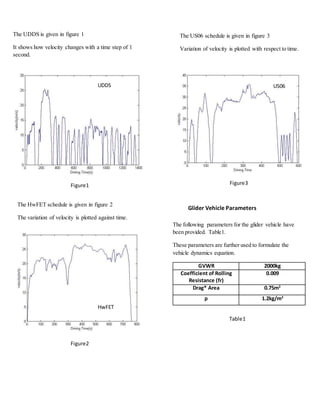
The UDDS is given in figure 1
It shows how velocity changes with a time step of 1
second.
.
Figure1
UDDS
The HwFET schedule is given in figure 2
The variation of velocity is plotted against time.
.
Figure2
HwFET
The US06 schedule is given in figure 3
Variation of velocity is plotted with respect to time.
.
Figure3
US06
Glider Vehicle Parameters
GVWR 2000kg
Coefficient of Rolling
Resistance (fr)
0.009
Drag* Area 0.75m2
ρ 1.2kg/m3
The following parameters for the glider vehicle have
been provided. Table1.
These parameters are further used to formulate the
vehicle dynamics equation.
Table1
Forming of Vehicle dynamics Equation
The energy requirement of the vehicle depends on the
road load.
The road load equation is given
Ftr=(m*g*fr)+(1/2*ρ *Cd*Af*v2
)+Finertia
--------- Equation 1
Where,
Ftr = Tractive Effort (N)
m = GVWR (kg)
ρ = Air Density (kg/m3
)
Af = Frontal Area of Vehicle (m2
)
Finertia = Inertia force (N) = m 𝑑𝑣/𝑑𝑡 (N)
V = Velocity (m/s)
Grade = 0%.
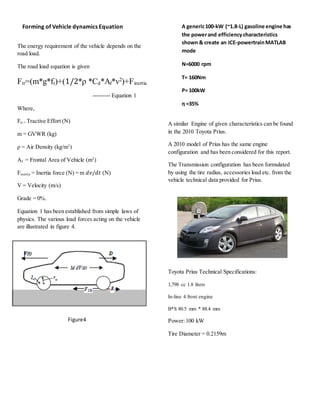
Equation 1 has been established from simple laws of
physics. The various load forces acting on the vehicle
are illustrated in figure 4.
Figure4
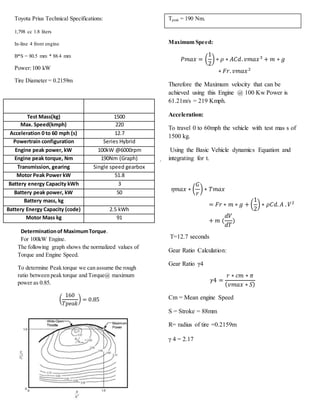
A similar Engine of given characteristics can be found
in the 2010 Toyota Prius.
A 2010 model of Prius has the same engine
configuration and has been considered for this report.
The Transmission configuration has been formulated
by using the tire radius, accessories load etc. from the
vehicle technical data provided for Prius.
A generic100‐kW (~1.8‐L) gasoline engine has
the powerand efficiency characteristics
shown & create an ICE‐powertrainMATLAB
mode
N=6000 rpm
T= 160Nm
P= 100kW
η =35%
Toyota Prius Technical Specifications:
1,798 cc 1.8 liters
In-line 4 front engine
B*S 80.5 mm * 88.4 mm
Power:100 kW
Tire Diameter = 0.2159m
.
Test Mass(kg) 1500
Max. Speed(kmph) 220
Acceleration 0 to 60 mph (s) 12.7
Powertrain configuration Series Hybrid
Engine peak power, kW 100kW @6000rpm
Engine peak torque, Nm 190Nm (Graph)
Transmission, gearing Single speed gearbox
Motor Peak Power kW 51.8
Battery energy Capacity kWh 3
Battery peak power, kW 50
Battery mass, kg
Battery Energy Capacity (code) 2.5 kWh
Motor Mass kg 91
Determinationof MaximumTorque.
For 100kW Engine.
Toyota Prius Technical Specifications:
1,798 cc 1.8 liters
In-line 4 front engine
B*S = 80.5 mm * 88.4 mm
Power:100 kW
Tire Diameter = 0.2159m
The following graph shows the normalized values of
Torque and Engine Speed.
To determine Peak torque we can assume the rough
ratio between peak torque and Torque@ maximum
power as 0.85.
(
160
𝑇𝑝𝑒𝑎𝑘
) = 0.85
Tpeak = 190 Nm.
Maximum Speed:
𝑃𝑚𝑎𝑥 = (
1
2
) ∗ 𝜌 ∗ 𝐴𝐶𝑑. 𝑣𝑚𝑎𝑥3
+ 𝑚 ∗ 𝑔
∗ 𝐹𝑟. 𝑣𝑚𝑎𝑥2
Therefore the Maximum velocity that can be
achieved using this Engine @ 100 Kw Power is
61.21m/s = 219 Kmph.
Acceleration:
To travel 0 to 60mph the vehicle with test mas s of
1500 kg.
Using the Basic Vehicle dynamics Equation and
integrating for t.
𝜂𝑚𝑎𝑥 ∗ (
𝐺
𝑟
) ∗ 𝑇𝑚𝑎𝑥
= 𝐹𝑟 ∗ 𝑚 ∗ 𝑔 + (
1
2
) ∗ 𝜌𝐶𝑑. 𝐴 . 𝑉2
+ 𝑚 (
𝑑𝑉
𝑑𝑇
)
T=12.7 seconds
Gear Ratio Calculation:
Gear Ratio γ4
𝛾4 =
𝑟 ∗ 𝑐𝑚 ∗ 𝜋
( 𝑣𝑚𝑎𝑥 ∗ 𝑆)
Cm = Mean engine Speed
S = Stroke = 88mm
R= radius of tire =0.2159m
γ 4 = 2.17
For other Gear Ratios using the relation:
𝛾4 = (
2
3
) 𝛾3
γ 3= 3.26
Similarly
γ 2= .4.9
γ 1 =7.3
From the Vehicle Technical data the engine operates
at maximum power of 100kW.
The codes can be validated by using a simple
relation and comparing the two values:
𝑃𝑒 = 𝑧 ∗ (
𝜋
16
) ∗ 𝐵2 ∗ 𝑝𝑚𝑒. 𝑐𝑚
Z= number of cylinders =4 given from specification
B = Bore (mm) = 80mm
Pme = Piston Mean effective pressure
Cm = Piston mean speed
Pe = 100.35 kW
Thus the relations used in coding are close enough to
the realistic values.
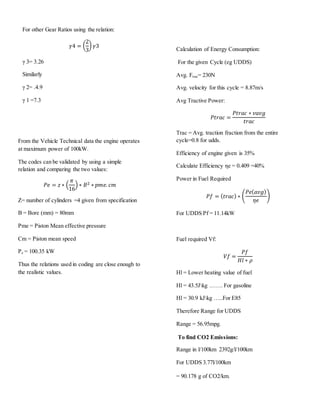
Calculation of Energy Consumption:
For the given Cycle (eg UDDS)
Avg. Ftrac= 230N
Avg. velocity for this cycle = 8.87m/s
Avg Tractive Power:
𝑃𝑡𝑟𝑎𝑐 =
𝑃𝑡𝑟𝑎𝑐 ∗ 𝑣𝑎𝑣𝑔
𝑡𝑟𝑎𝑐
Trac = Avg. traction fraction from the entire
cycle=0.8 for udds.
Efficiency of engine given is 35%
Calculate Efficiency ηe = 0.409 =40%
Power in Fuel Required
𝑃𝑓 = ( 𝑡𝑟𝑎𝑐) ∗ (
𝑃𝑒( 𝑎𝑣𝑔)
𝜂𝑒
)
For UDDS Pf = 11.14kW
Fuel required Vf:
𝑉𝑓 =
𝑃𝑓
𝐻𝑙 ∗ 𝜌
Hl = Lower heating value of fuel
Hl = 43.5Jkg ……. For gasoline
Hl = 30.9 kJkg …..For E85
Therefore Range for UDDS
Range = 56.95mpg.
To find CO2 Emissions:
Range in l/100km 2392g/l/100km
For UDDS 3.77l/100km
= 90.178 g of CO2/km.
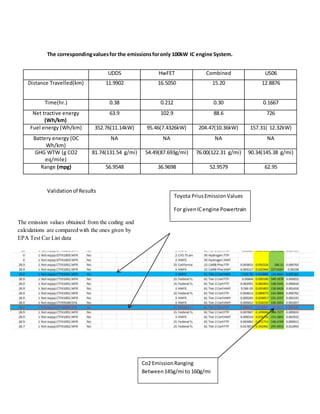
The correspondingvaluesfor the emissionsforonly 100kW IC engine System.
Validationof Results
UDDS HwFET Combined US06
Distance Travelled(km) 11.9902 16.5050 15.20 12.8876
Time(hr.) 0.38 0.212 0.30 0.1667
Net tractive energy
(Wh/km)
63.9 102.9 88.6 726
Fuel energy (Wh/km) 352.76(11.14kW) 95.46(7.4326kW) 204.47(10.36kW) 157.31( 12.32kW)
Battery energy (DC
Wh/km)
NA NA NA NA
GHG WTW (g CO2
eq/mile)
81.74(131.54 g/mi) 54.49(87.693g/mi) 76.00(122.31 g/mi) 90.34(145.38 g/mi)
Range (mpg) 56.9548 36.9698 52.9579 62.95
The emission values obtained from the coding and
calculations are compared with the ones given by
EPA Test Car List data
Toyota PriusEmissionValues
For givenICengine Powertrain
Co2 EmissionRanging
Between145g/mi to 160g/mi
CriteriaSatisfaction & Performance Targets. For 100KW IC Engine Vehicle
Performance/Utility Category Vehicle Modeling Design
Targets*
Achieved Targets
Energy consumption
(unadjusted energy use on
combined Federal Test
Procedure [FTP] city and
highway cycles)
Better than 370 Wh/km (600
Wh/mi) combined city and
highway (55%/45%,
respectively)
Energy Consumption Better
than 370Wh/km
GHG emissions (WTW
combined city and highway
cycles)
Less than 120 g of carbon
dioxide equivalent (CO2
eq)/km (200 g CO2 eq/mi)
Yes, all emissions well below
the limit ( refer above figure
for comparison with values
calculated)
Range Greater than 320 km (200 mi)
combined city and highway
Yes Range achieved in all
cases is greater than 320 km.
Maximum speed Greater than 135 kph (85
mph)
Yes maximum Speed is
greater than 135 km/h
Acceleration time of 0 to 97
kph (0 to 60 mph)
Less than 11 seconds 12.7
Highway grade ability (at
gross vehicle weight rating
[GVWR])
Greater than 3.5% grade at a
constant 97 kph (60 mph) for
20 minutes
Yes Grad ability greater than
3.5%
Part B: Downsizingof Engine:
Engine Downsizingis the way to make small enginesperformhigh.
Test Mass =2000 kg
Engine Power 150kW
UDDS
Distance Travelled(km) 11.9902
Time(hr.) 0.38
Net tractive energy (Wh/km) 66.4
Fuel energy (Wh/km) NA
Battery energy (DC Wh/km) 3
GHG WTW (g CO2 eq/mile) 83.1(131.54 g/mi)
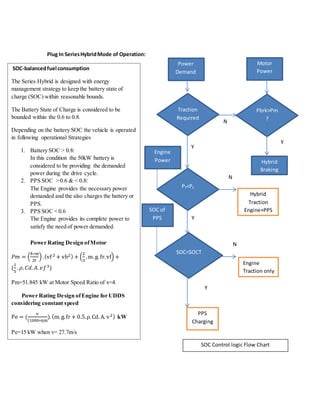
Plug In SeriesHybridMode of Operation:
References
SOC‐balancedfuel consumption
The Series Hybrid is designed with energy
management strategy to keep the battery state of
charge (SOC) within reasonable bounds.
The Battery State of Charge is considered to be
bounded within the 0.6 to 0.8.
Depending on the battery SOC the vehicle is operated
in following operational Strategies
1. Battery SOC > 0.8:
In this condition the 50kW battery is
considered to be providing the demanded
power during the drive cycle.
2. PPS SOC > 0.6 & < 0.8:
The Engine provides the necessary power
demanded and the also charges the battery or
PPS.
3. PPS SOC < 0.6
The Engine provides its complete power to
satisfy the need of power demanded.
Power Rating Design ofMotor
𝑃𝑚 = (
δ∗m
2t
).(vf 2 + vb2) + (
2
3
.m.g. fr.vf) +
(
1
5
. 𝜌. 𝐶𝑑. 𝐴. 𝑣𝑓3)
Pm=51.845 kW at Motor Speed Ratio of x=4.
Power Rating Design ofEngine for UDDS
considering constant speed
Pe = (
v
(1000∗ηm
).(m. g.fr + 0.5.ρ.Cd.A. v2) kW
Pe=15 kW when v= 27.7m/s
Traction
Required
?
Engine
Power
Y
N
PT<PE
SOC<SOCT
Y
SOC of
PPS
N
N
Power
Demand
Pbrk>Pm
?
Motor
Power
Y
Hybrid
Braking
Hybrid
Traction
Engine+PPS
PPS
Charging
Y
Engine
Traction only
SOC Control logic Flow Chart
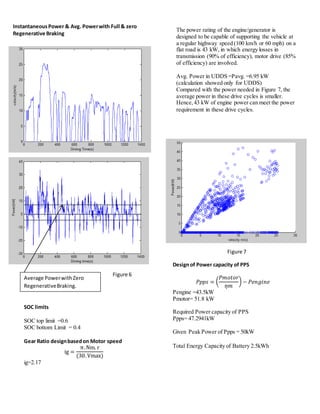
InstantaneousPower & Avg. Powerwith Full & zero
Regenerative Braking
Average PowerwithZero
RegenerativeBraking.
The power rating of the engine/generator is
designed to be capable of supporting the vehicle at
a regular highway speed (100 km/h or 60 mph) on a
flat road is 43 kW, in which energy losses in
transmission (90% of efficiency), motor drive (85%
of efficiency) are involved.
Avg. Power in UDDS =Pavg. =6.95 kW
(calculation showed only for UDDS)
Compared with the power needed in Figure 7, the
average power in these drive cycles is smaller.
Hence,43 kW of engine power can meet the power
requirement in these drive cycles.
Figure 6
Figure 7
Designof Power capacity of PPS
𝑃𝑝𝑝𝑠 = (
𝑃𝑚𝑜𝑡𝑜𝑟
𝜂𝑚
) − 𝑃𝑒𝑛𝑔𝑖𝑛𝑒
Pengine =43.5kW
Pmotor= 51.8 kW
Required Power capacity of PPS
Ppps= 47.2941kW
Given Peak Power of Ppps = 50kW
Total Energy Capacity of Battery 2.5kWh
SOC limits
SOC top limit =0.6
SOC bottom Limit = 0.4
Gear Ratio designbasedon Motor speed
ig =
π.Nm. r
(30.Vmax)
ig=2.17
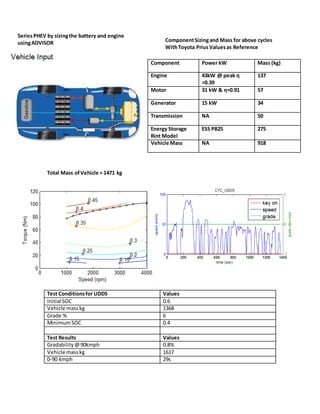
Total Mass ofVehicle = 1471 kg
Component Power kW Mass (kg)
Engine 43kW @ peak η
=0.39
137
Motor 31 kW & η=0.91 57
Generator 15 kW 34
Transmission NA 50
Energy Storage
Rint Model
ESS PB25 275
Vehicle Mass NA 918
Test Conditionsfor UDDS Values
Initial SOC 0.6
Vehicle masskg 1368
Grade % 6
MinimumSOC 0.4
Test Results Values
Gradability@90kmph 0.8%
Vehicle masskg 1617
0-90 kmph 29s
SeriesPHEV by sizingthe battery and engine
usingADVISOR ComponentSizingand Mass for above cycles
WithToyota PriusValuesas Reference
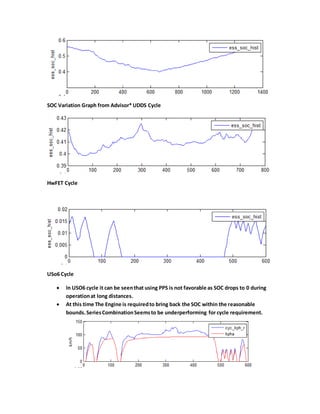
SOC Variation Graph from Advisor*UDDS Cycle
HwFET Cycle
USo6 Cycle
 In USO6 cycle it can be seenthat using PPS is not favorable as SOC drops to 0 during
operationat long distances.
 At this time The Engine is requiredto bring back the SOC within the reasonable
bounds.SeriesCombinationSeemsto be underperforming for cycle requirement.
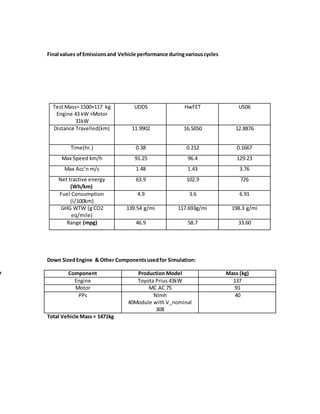
Final values ofEmissionsand Vehicle performance duringvariouscycles
Down SizedEngine & Other Componentsusedfor Simulation:
Component Production Model Mass (kg)
Engine Toyota Prius 43kW 137
Motor MC AC 75 91
PPs NImh
40Module with V_nominal
308
40
Total Vehicle Mass= 1471kg
Test Mass= 1500+117 kg
Engine 43 kW +Motor
31kW
UDDS HwFET US06
Distance Travelled(km) 11.9902 16.5050 12.8876
Time(hr.) 0.38 0.212 0.1667
Max Speed km/h 91.25 96.4 129.23
Max Acc’n m/s 1.48 1.43 3.76
Net tractive energy
(Wh/km)
63.9 102.9 726
Fuel Consumption
(l/100km)
4.9 3.6 6.91
GHG WTW (g CO2
eq/mile)
139.54 g/mi 117.693g/mi 198.3 g/mi
Range (mpg) 46.9 58.7 33.60
r
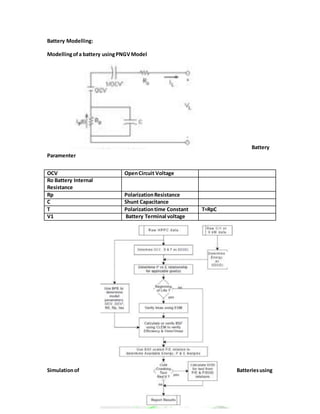
Battery Modelling:
Modellingofa battery usingPNGVModel
Battery
Paramenter
Simulationof Batteriesusing
OCV OpenCircuit Voltage
Ro Battery Internal
Resistance
Rp PolarizationResistance
C Shunt Capacitance
T Polarizationtime Constant T=RpC
V1 Battery Terminal voltage
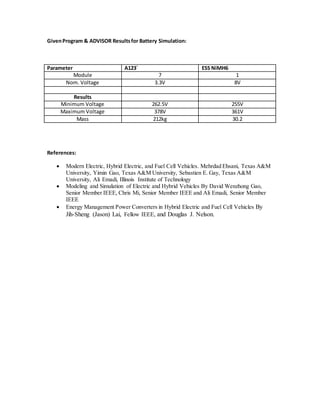
GivenProgram & ADVISOR Resultsfor Battery Simulation:
Parameter A123` ESS NiMH6
Module 7 1
Nom. Voltage 3.3V 8V
Results
Minimum Voltage 262.5V 255V
Maximum Voltage 378V 361V
Mass 212kg 30.2
References:
 Modern Electric, Hybrid Electric, and Fuel Cell Vehicles. Mehrdad Ehsani, Texas A&M
University, Yimin Gao, Texas A&M University, Sebastien E. Gay, Texas A&M
University, Ali Emadi, Illinois Institute of Technology
 Modeling and Simulation of Electric and Hybrid Vehicles By David Wenzhong Gao,
Senior Member IEEE, Chris Mi, Senior Member IEEE and Ali Emadi, Senior Member
IEEE
 Energy Management Power Converters in Hybrid Electric and Fuel Cell Vehicles By
Jih-Sheng (Jason) Lai, Fellow IEEE, and Douglas J. Nelson.

Plug-In Hybrid Simulation

  • 1.
    November 16, 2015 EVE5110 Plug-In Hybrid Electric Vehicle Siddhesh Ozarkar MS Mechanical Engineering Wayne State University, Detroit Abstract Energy requirement of a vehicle is a crucial step prior to design of the powertrain. An estimate of the required power is done by simulating the performance of the glider vehicle to complete specific drive cycles. These are also referred as the various energy requirements at the wheels. During new powertrain designing process commercially available computer programs can be utilized for the simulation of the drive cycles. This report focuses on the energy requirement of the glider vehicle subjected to the following mentioned drive cycles, UDDS, HwFET & US06. Introduction Powertrain design is an important step in overall vehicle development process. This report discusses important vehicle parameters derived for a glider vehicle. These parameters then can be used for benchmarking during the powertrain design process. The parameters are required to perform the sizing and selection of energy source (Internal Combustion Engine, Electric Drive, and Hybrid Power Vehicle). Powertrain the parameters are required to perform the sizing and selection of energy source (Internal Combustion Engine, Electric Drive, and Hybrid Power Vehicle). In this report basic vehicle dynamics and physics is considered to calculate energy requirements of a glider vehicle. Cases of constant linear accelerations & constant velocities are considered to calculate average power required at the wheels on a level surface and on graded slopes. Definitions The energy requirements of the vehicle are strongly dependent on the drive cycles for which it is being tested for. The Drive cycles used in the simulations are as follows; 1. Urban Dynamometer Driving Schedule (UDDS) 2. Highway Fuel Economy Driving Schedule (HwFET) 3. Supplemental FTP Driving Schedule (US06) These driving schedules are graphically establishes in upcoming figures.
  • 2.
    The UDDS isgiven in figure 1 It shows how velocity changes with a time step of 1 second. . Figure1 UDDS The HwFET schedule is given in figure 2 The variation of velocity is plotted against time. . Figure2 HwFET The US06 schedule is given in figure 3 Variation of velocity is plotted with respect to time. . Figure3 US06 Glider Vehicle Parameters GVWR 2000kg Coefficient of Rolling Resistance (fr) 0.009 Drag* Area 0.75m2 ρ 1.2kg/m3 The following parameters for the glider vehicle have been provided. Table1. These parameters are further used to formulate the vehicle dynamics equation. Table1
  • 3.
    Forming of Vehicledynamics Equation The energy requirement of the vehicle depends on the road load. The road load equation is given Ftr=(m*g*fr)+(1/2*ρ *Cd*Af*v2 )+Finertia --------- Equation 1 Where, Ftr = Tractive Effort (N) m = GVWR (kg) ρ = Air Density (kg/m3 ) Af = Frontal Area of Vehicle (m2 ) Finertia = Inertia force (N) = m 𝑑𝑣/𝑑𝑡 (N) V = Velocity (m/s) Grade = 0%. Equation 1 has been established from simple laws of physics. The various load forces acting on the vehicle are illustrated in figure 4. Figure4 A similar Engine of given characteristics can be found in the 2010 Toyota Prius. A 2010 model of Prius has the same engine configuration and has been considered for this report. The Transmission configuration has been formulated by using the tire radius, accessories load etc. from the vehicle technical data provided for Prius. A generic100‐kW (~1.8‐L) gasoline engine has the powerand efficiency characteristics shown & create an ICE‐powertrainMATLAB mode N=6000 rpm T= 160Nm P= 100kW η =35% Toyota Prius Technical Specifications: 1,798 cc 1.8 liters In-line 4 front engine B*S 80.5 mm * 88.4 mm Power:100 kW Tire Diameter = 0.2159m
  • 4.
    . Test Mass(kg) 1500 Max.Speed(kmph) 220 Acceleration 0 to 60 mph (s) 12.7 Powertrain configuration Series Hybrid Engine peak power, kW 100kW @6000rpm Engine peak torque, Nm 190Nm (Graph) Transmission, gearing Single speed gearbox Motor Peak Power kW 51.8 Battery energy Capacity kWh 3 Battery peak power, kW 50 Battery mass, kg Battery Energy Capacity (code) 2.5 kWh Motor Mass kg 91 Determinationof MaximumTorque. For 100kW Engine. Toyota Prius Technical Specifications: 1,798 cc 1.8 liters In-line 4 front engine B*S = 80.5 mm * 88.4 mm Power:100 kW Tire Diameter = 0.2159m The following graph shows the normalized values of Torque and Engine Speed. To determine Peak torque we can assume the rough ratio between peak torque and Torque@ maximum power as 0.85. ( 160 𝑇𝑝𝑒𝑎𝑘 ) = 0.85 Tpeak = 190 Nm. Maximum Speed: 𝑃𝑚𝑎𝑥 = ( 1 2 ) ∗ 𝜌 ∗ 𝐴𝐶𝑑. 𝑣𝑚𝑎𝑥3 + 𝑚 ∗ 𝑔 ∗ 𝐹𝑟. 𝑣𝑚𝑎𝑥2 Therefore the Maximum velocity that can be achieved using this Engine @ 100 Kw Power is 61.21m/s = 219 Kmph. Acceleration: To travel 0 to 60mph the vehicle with test mas s of 1500 kg. Using the Basic Vehicle dynamics Equation and integrating for t. 𝜂𝑚𝑎𝑥 ∗ ( 𝐺 𝑟 ) ∗ 𝑇𝑚𝑎𝑥 = 𝐹𝑟 ∗ 𝑚 ∗ 𝑔 + ( 1 2 ) ∗ 𝜌𝐶𝑑. 𝐴 . 𝑉2 + 𝑚 ( 𝑑𝑉 𝑑𝑇 ) T=12.7 seconds Gear Ratio Calculation: Gear Ratio γ4 𝛾4 = 𝑟 ∗ 𝑐𝑚 ∗ 𝜋 ( 𝑣𝑚𝑎𝑥 ∗ 𝑆) Cm = Mean engine Speed S = Stroke = 88mm R= radius of tire =0.2159m γ 4 = 2.17
  • 5.
    For other GearRatios using the relation: 𝛾4 = ( 2 3 ) 𝛾3 γ 3= 3.26 Similarly γ 2= .4.9 γ 1 =7.3 From the Vehicle Technical data the engine operates at maximum power of 100kW. The codes can be validated by using a simple relation and comparing the two values: 𝑃𝑒 = 𝑧 ∗ ( 𝜋 16 ) ∗ 𝐵2 ∗ 𝑝𝑚𝑒. 𝑐𝑚 Z= number of cylinders =4 given from specification B = Bore (mm) = 80mm Pme = Piston Mean effective pressure Cm = Piston mean speed Pe = 100.35 kW Thus the relations used in coding are close enough to the realistic values. Calculation of Energy Consumption: For the given Cycle (eg UDDS) Avg. Ftrac= 230N Avg. velocity for this cycle = 8.87m/s Avg Tractive Power: 𝑃𝑡𝑟𝑎𝑐 = 𝑃𝑡𝑟𝑎𝑐 ∗ 𝑣𝑎𝑣𝑔 𝑡𝑟𝑎𝑐 Trac = Avg. traction fraction from the entire cycle=0.8 for udds. Efficiency of engine given is 35% Calculate Efficiency ηe = 0.409 =40% Power in Fuel Required 𝑃𝑓 = ( 𝑡𝑟𝑎𝑐) ∗ ( 𝑃𝑒( 𝑎𝑣𝑔) 𝜂𝑒 ) For UDDS Pf = 11.14kW Fuel required Vf: 𝑉𝑓 = 𝑃𝑓 𝐻𝑙 ∗ 𝜌 Hl = Lower heating value of fuel Hl = 43.5Jkg ……. For gasoline Hl = 30.9 kJkg …..For E85 Therefore Range for UDDS Range = 56.95mpg. To find CO2 Emissions: Range in l/100km 2392g/l/100km For UDDS 3.77l/100km = 90.178 g of CO2/km.
  • 6.
    The correspondingvaluesfor theemissionsforonly 100kW IC engine System. Validationof Results UDDS HwFET Combined US06 Distance Travelled(km) 11.9902 16.5050 15.20 12.8876 Time(hr.) 0.38 0.212 0.30 0.1667 Net tractive energy (Wh/km) 63.9 102.9 88.6 726 Fuel energy (Wh/km) 352.76(11.14kW) 95.46(7.4326kW) 204.47(10.36kW) 157.31( 12.32kW) Battery energy (DC Wh/km) NA NA NA NA GHG WTW (g CO2 eq/mile) 81.74(131.54 g/mi) 54.49(87.693g/mi) 76.00(122.31 g/mi) 90.34(145.38 g/mi) Range (mpg) 56.9548 36.9698 52.9579 62.95 The emission values obtained from the coding and calculations are compared with the ones given by EPA Test Car List data Toyota PriusEmissionValues For givenICengine Powertrain Co2 EmissionRanging Between145g/mi to 160g/mi
  • 7.
    CriteriaSatisfaction & PerformanceTargets. For 100KW IC Engine Vehicle Performance/Utility Category Vehicle Modeling Design Targets* Achieved Targets Energy consumption (unadjusted energy use on combined Federal Test Procedure [FTP] city and highway cycles) Better than 370 Wh/km (600 Wh/mi) combined city and highway (55%/45%, respectively) Energy Consumption Better than 370Wh/km GHG emissions (WTW combined city and highway cycles) Less than 120 g of carbon dioxide equivalent (CO2 eq)/km (200 g CO2 eq/mi) Yes, all emissions well below the limit ( refer above figure for comparison with values calculated) Range Greater than 320 km (200 mi) combined city and highway Yes Range achieved in all cases is greater than 320 km. Maximum speed Greater than 135 kph (85 mph) Yes maximum Speed is greater than 135 km/h Acceleration time of 0 to 97 kph (0 to 60 mph) Less than 11 seconds 12.7 Highway grade ability (at gross vehicle weight rating [GVWR]) Greater than 3.5% grade at a constant 97 kph (60 mph) for 20 minutes Yes Grad ability greater than 3.5% Part B: Downsizingof Engine: Engine Downsizingis the way to make small enginesperformhigh. Test Mass =2000 kg Engine Power 150kW UDDS Distance Travelled(km) 11.9902 Time(hr.) 0.38 Net tractive energy (Wh/km) 66.4 Fuel energy (Wh/km) NA Battery energy (DC Wh/km) 3 GHG WTW (g CO2 eq/mile) 83.1(131.54 g/mi)
  • 8.
    Plug In SeriesHybridModeof Operation: References SOC‐balancedfuel consumption The Series Hybrid is designed with energy management strategy to keep the battery state of charge (SOC) within reasonable bounds. The Battery State of Charge is considered to be bounded within the 0.6 to 0.8. Depending on the battery SOC the vehicle is operated in following operational Strategies 1. Battery SOC > 0.8: In this condition the 50kW battery is considered to be providing the demanded power during the drive cycle. 2. PPS SOC > 0.6 & < 0.8: The Engine provides the necessary power demanded and the also charges the battery or PPS. 3. PPS SOC < 0.6 The Engine provides its complete power to satisfy the need of power demanded. Power Rating Design ofMotor 𝑃𝑚 = ( δ∗m 2t ).(vf 2 + vb2) + ( 2 3 .m.g. fr.vf) + ( 1 5 . 𝜌. 𝐶𝑑. 𝐴. 𝑣𝑓3) Pm=51.845 kW at Motor Speed Ratio of x=4. Power Rating Design ofEngine for UDDS considering constant speed Pe = ( v (1000∗ηm ).(m. g.fr + 0.5.ρ.Cd.A. v2) kW Pe=15 kW when v= 27.7m/s Traction Required ? Engine Power Y N PT<PE SOC<SOCT Y SOC of PPS N N Power Demand Pbrk>Pm ? Motor Power Y Hybrid Braking Hybrid Traction Engine+PPS PPS Charging Y Engine Traction only SOC Control logic Flow Chart
  • 9.
    InstantaneousPower & Avg.Powerwith Full & zero Regenerative Braking Average PowerwithZero RegenerativeBraking. The power rating of the engine/generator is designed to be capable of supporting the vehicle at a regular highway speed (100 km/h or 60 mph) on a flat road is 43 kW, in which energy losses in transmission (90% of efficiency), motor drive (85% of efficiency) are involved. Avg. Power in UDDS =Pavg. =6.95 kW (calculation showed only for UDDS) Compared with the power needed in Figure 7, the average power in these drive cycles is smaller. Hence,43 kW of engine power can meet the power requirement in these drive cycles. Figure 6 Figure 7 Designof Power capacity of PPS 𝑃𝑝𝑝𝑠 = ( 𝑃𝑚𝑜𝑡𝑜𝑟 𝜂𝑚 ) − 𝑃𝑒𝑛𝑔𝑖𝑛𝑒 Pengine =43.5kW Pmotor= 51.8 kW Required Power capacity of PPS Ppps= 47.2941kW Given Peak Power of Ppps = 50kW Total Energy Capacity of Battery 2.5kWh SOC limits SOC top limit =0.6 SOC bottom Limit = 0.4 Gear Ratio designbasedon Motor speed ig = π.Nm. r (30.Vmax) ig=2.17
  • 10.
    Total Mass ofVehicle= 1471 kg Component Power kW Mass (kg) Engine 43kW @ peak η =0.39 137 Motor 31 kW & η=0.91 57 Generator 15 kW 34 Transmission NA 50 Energy Storage Rint Model ESS PB25 275 Vehicle Mass NA 918 Test Conditionsfor UDDS Values Initial SOC 0.6 Vehicle masskg 1368 Grade % 6 MinimumSOC 0.4 Test Results Values Gradability@90kmph 0.8% Vehicle masskg 1617 0-90 kmph 29s SeriesPHEV by sizingthe battery and engine usingADVISOR ComponentSizingand Mass for above cycles WithToyota PriusValuesas Reference
  • 11.
    SOC Variation Graphfrom Advisor*UDDS Cycle HwFET Cycle USo6 Cycle  In USO6 cycle it can be seenthat using PPS is not favorable as SOC drops to 0 during operationat long distances.  At this time The Engine is requiredto bring back the SOC within the reasonable bounds.SeriesCombinationSeemsto be underperforming for cycle requirement.
  • 12.
    Final values ofEmissionsandVehicle performance duringvariouscycles Down SizedEngine & Other Componentsusedfor Simulation: Component Production Model Mass (kg) Engine Toyota Prius 43kW 137 Motor MC AC 75 91 PPs NImh 40Module with V_nominal 308 40 Total Vehicle Mass= 1471kg Test Mass= 1500+117 kg Engine 43 kW +Motor 31kW UDDS HwFET US06 Distance Travelled(km) 11.9902 16.5050 12.8876 Time(hr.) 0.38 0.212 0.1667 Max Speed km/h 91.25 96.4 129.23 Max Acc’n m/s 1.48 1.43 3.76 Net tractive energy (Wh/km) 63.9 102.9 726 Fuel Consumption (l/100km) 4.9 3.6 6.91 GHG WTW (g CO2 eq/mile) 139.54 g/mi 117.693g/mi 198.3 g/mi Range (mpg) 46.9 58.7 33.60 r
  • 13.
    Battery Modelling: Modellingofa batteryusingPNGVModel Battery Paramenter Simulationof Batteriesusing OCV OpenCircuit Voltage Ro Battery Internal Resistance Rp PolarizationResistance C Shunt Capacitance T Polarizationtime Constant T=RpC V1 Battery Terminal voltage
  • 14.
    GivenProgram & ADVISORResultsfor Battery Simulation: Parameter A123` ESS NiMH6 Module 7 1 Nom. Voltage 3.3V 8V Results Minimum Voltage 262.5V 255V Maximum Voltage 378V 361V Mass 212kg 30.2 References:  Modern Electric, Hybrid Electric, and Fuel Cell Vehicles. Mehrdad Ehsani, Texas A&M University, Yimin Gao, Texas A&M University, Sebastien E. Gay, Texas A&M University, Ali Emadi, Illinois Institute of Technology  Modeling and Simulation of Electric and Hybrid Vehicles By David Wenzhong Gao, Senior Member IEEE, Chris Mi, Senior Member IEEE and Ali Emadi, Senior Member IEEE  Energy Management Power Converters in Hybrid Electric and Fuel Cell Vehicles By Jih-Sheng (Jason) Lai, Fellow IEEE, and Douglas J. Nelson.