Drama
What Is Drama?
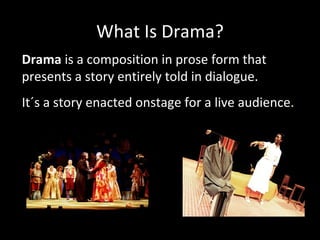
Drama is a composition in prose form that
presents a story entirely told in dialogue.
It´s a story enacted onstage for a live audience.
ORIGINS OF DRAMA
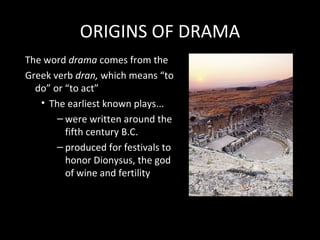
The word drama comes from the
Greek verb dran, which means “to
  do” or “to act”
   • The earliest known plays...
       – were written around the
         fifth century B.C.
       – produced for festivals to
         honor Dionysus, the god
         of wine and fertility
Dramatic Structure
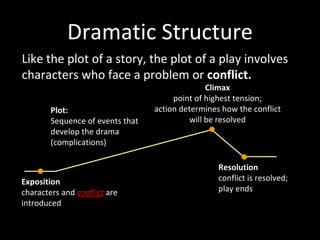
Like the plot of a story, the plot of a play involves
characters who face a problem or conflict.
                                                Climax
                                       point of highest tension;
        Plot:                     action determines how the conflict
        Sequence of events that            will be resolved
        develop the drama
        (complications)

                                                   Resolution
Exposition                                         conflict is resolved;
characters and conflict are                        play ends
introduced
Dramatic Structure
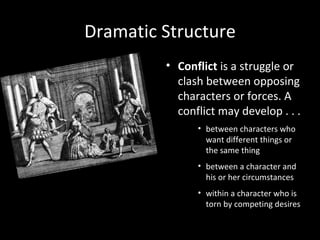
         • Conflict is a struggle or
           clash between opposing
           characters or forces. A
           conflict may develop . . .
               • between characters who
                 want different things or
                 the same thing
               • between a character and
                 his or her circumstances
               • within a character who is
                 torn by competing desires
FORMS OF DRAMA
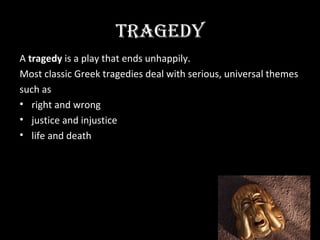
TRAGEDY
A tragedy is a play that ends unhappily.
Most classic Greek tragedies deal with serious, universal themes
such as
• right and wrong
• justice and injustice
• life and death
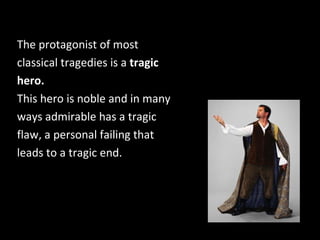
The protagonist of most
classical tragedies is a tragic
hero.
This hero is noble and in many
ways admirable has a tragic
flaw, a personal failing that
leads to a tragic end.
MELODRAMA
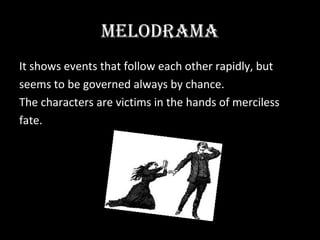
It shows events that follow each other rapidly, but
seems to be governed always by chance.
The characters are victims in the hands of merciless
fate.
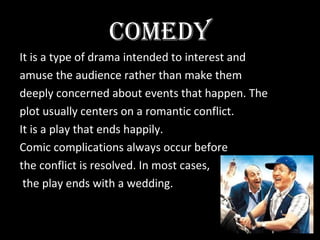
COMEDY
It is a type of drama intended to interest and
amuse the audience rather than make them
deeply concerned about events that happen. The
plot usually centers on a romantic conflict.
It is a play that ends happily.
Comic complications always occur before
the conflict is resolved. In most cases,
 the play ends with a wedding.
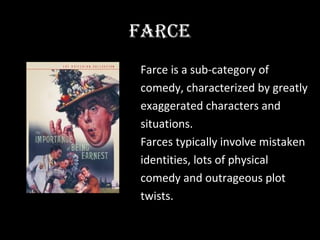
FARCE
Farce is a sub-category of
comedy, characterized by greatly
exaggerated characters and
situations.
Farces typically involve mistaken
identities, lots of physical
comedy and outrageous plot
twists.
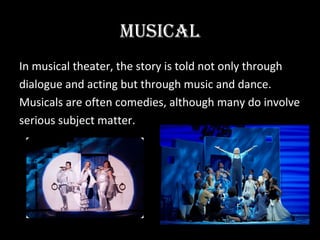
MusiCAL
In musical theater, the story is told not only through
dialogue and acting but through music and dance.
Musicals are often comedies, although many do involve
serious subject matter.
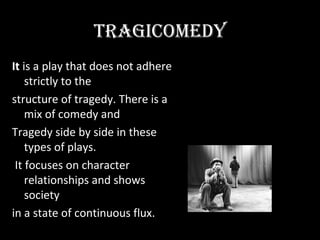
TRAGiCOMEDY
It is a play that does not adhere
    strictly to the
structure of tragedy. There is a
    mix of comedy and
Tragedy side by side in these
    types of plays.
 It focuses on character
    relationships and shows
    society
in a state of continuous flux.
HOMEWORK
• Find two or three examples of each genre of drama.
  Justify your answers.
Elements of Drama
There are three types of Drama
              Elements.
• Literary
• Technical
• Performance
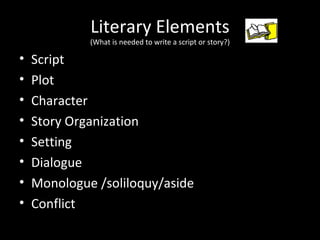
Literary Elements
             (What is needed to write a script or story?)

•   Script
•   Plot
•   Character
•   Story Organization
•   Setting
•   Dialogue
•   Monologue /soliloquy/aside
•   Conflict
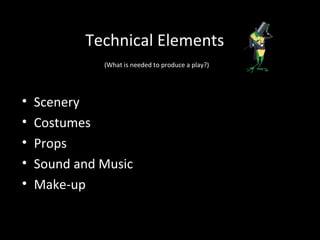
Technical Elements
              (What is needed to produce a play?)


•   Scenery
•   Costumes
•   Props
•   Sound and Music
•   Make-up
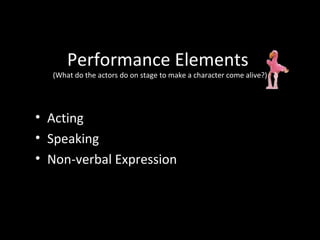
Performance Elements
  (What do the actors do on stage to make a character come alive?)


• Acting
• Speaking
• Non-verbal Expression
But…what do all these
    words mean?
All the elements of drama combine
 to make a good production. They
      are all important. Some
demonstrate more of one element
            than others.
Literary Elements
• Script?

• A script is the written words and directions of
  a play.
Literary Elements

• Plot?
• The plot is the storyline or arrangement of
  action.
Literary Elements

• Character?
• A character is a person portrayed in a drama.
Literary Elements

• Story Organization?
• The story organization is how a story is told –
  the beginning, middle and end.
Literary Elements


• Setting?
• The setting is where the action takes place.
Literary Elements

• Dialogue?
• A dialogue is a spoken conversation between
  two characters.
Literary Elements

• Monologue?
• A monologue is a long speech made by one
  person.
• Soliloquy? A character alone on stage reveals
  private thoughts.
• Aside? A character briefly expresses private
  thoughts to the audience that other
  characters on stage cannot hear.
Literary Elements

• Conflict?
• The internal or external struggle between
  opposing forces, ideas, or interests that create
  dramatic tension.
Technical Elements
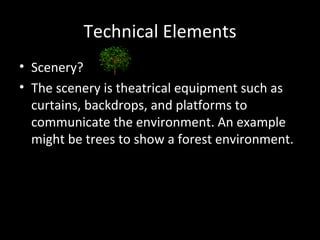
• Scenery?
• The scenery is theatrical equipment such as
  curtains, backdrops, and platforms to
  communicate the environment. An example
  might be trees to show a forest environment.
Technical Elements

• Props?
• Props are any article other than costumes or
  scenery used as part of a dramatic production.
  An example might be a table on the stage.
Technical Elements

• Sound and Music?
• Sound is the effect an audience hears during a
  show, like the sound of rain. And music – well,
  you know what music is!
Technical Elements


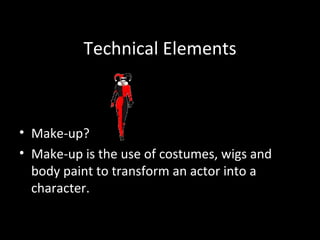
• Make-up?
• Make-up is the use of costumes, wigs and
  body paint to transform an actor into a
  character.
Performance Elements
• Acting?
Acting is how speaking and moving help to
  create characters.
Performance Elements

• Non-verbal Expression
Non-expression includes gestures, facial
  expressions, and movement.
Performance Elements

• Speaking
Speaking is vocal expression, projection,
  speaking style and diction.
Conclusion

A comedy ends happily after an amusing
series of problem.
Tragedy stresses human greatness, but
comedy emphasizes human faults and the
weaknesses of society

Drama class one

  • 1.
  • 2.
    What Is Drama? Dramais a composition in prose form that presents a story entirely told in dialogue. It´s a story enacted onstage for a live audience.
  • 3.
    ORIGINS OF DRAMA Theword drama comes from the Greek verb dran, which means “to do” or “to act” • The earliest known plays... – were written around the fifth century B.C. – produced for festivals to honor Dionysus, the god of wine and fertility
  • 4.
    Dramatic Structure Like theplot of a story, the plot of a play involves characters who face a problem or conflict. Climax point of highest tension; Plot: action determines how the conflict Sequence of events that will be resolved develop the drama (complications) Resolution Exposition conflict is resolved; characters and conflict are play ends introduced
  • 5.
    Dramatic Structure • Conflict is a struggle or clash between opposing characters or forces. A conflict may develop . . . • between characters who want different things or the same thing • between a character and his or her circumstances • within a character who is torn by competing desires
  • 6.
  • 7.
    TRAGEDY A tragedy isa play that ends unhappily. Most classic Greek tragedies deal with serious, universal themes such as • right and wrong • justice and injustice • life and death
  • 8.
    The protagonist ofmost classical tragedies is a tragic hero. This hero is noble and in many ways admirable has a tragic flaw, a personal failing that leads to a tragic end.
  • 9.
    MELODRAMA It shows eventsthat follow each other rapidly, but seems to be governed always by chance. The characters are victims in the hands of merciless fate.
  • 10.
    COMEDY It is atype of drama intended to interest and amuse the audience rather than make them deeply concerned about events that happen. The plot usually centers on a romantic conflict. It is a play that ends happily. Comic complications always occur before the conflict is resolved. In most cases, the play ends with a wedding.
  • 11.
    FARCE Farce is asub-category of comedy, characterized by greatly exaggerated characters and situations. Farces typically involve mistaken identities, lots of physical comedy and outrageous plot twists.
  • 12.
    MusiCAL In musical theater,the story is told not only through dialogue and acting but through music and dance. Musicals are often comedies, although many do involve serious subject matter.
  • 13.
    TRAGiCOMEDY It is aplay that does not adhere strictly to the structure of tragedy. There is a mix of comedy and Tragedy side by side in these types of plays. It focuses on character relationships and shows society in a state of continuous flux.
  • 14.
    HOMEWORK • Find twoor three examples of each genre of drama. Justify your answers.
  • 15.
  • 16.
    There are threetypes of Drama Elements. • Literary • Technical • Performance
  • 17.
    Literary Elements (What is needed to write a script or story?) • Script • Plot • Character • Story Organization • Setting • Dialogue • Monologue /soliloquy/aside • Conflict
  • 18.
    Technical Elements (What is needed to produce a play?) • Scenery • Costumes • Props • Sound and Music • Make-up
  • 19.
    Performance Elements (What do the actors do on stage to make a character come alive?) • Acting • Speaking • Non-verbal Expression
  • 20.
    But…what do allthese words mean?
  • 21.
    All the elementsof drama combine to make a good production. They are all important. Some demonstrate more of one element than others.
  • 22.
    Literary Elements • Script? •A script is the written words and directions of a play.
  • 23.
    Literary Elements • Plot? •The plot is the storyline or arrangement of action.
  • 24.
    Literary Elements • Character? •A character is a person portrayed in a drama.
  • 25.
    Literary Elements • StoryOrganization? • The story organization is how a story is told – the beginning, middle and end.
  • 26.
    Literary Elements • Setting? •The setting is where the action takes place.
  • 27.
    Literary Elements • Dialogue? •A dialogue is a spoken conversation between two characters.
  • 28.
    Literary Elements • Monologue? •A monologue is a long speech made by one person. • Soliloquy? A character alone on stage reveals private thoughts. • Aside? A character briefly expresses private thoughts to the audience that other characters on stage cannot hear.
  • 29.
    Literary Elements • Conflict? •The internal or external struggle between opposing forces, ideas, or interests that create dramatic tension.
  • 30.
    Technical Elements • Scenery? •The scenery is theatrical equipment such as curtains, backdrops, and platforms to communicate the environment. An example might be trees to show a forest environment.
  • 31.
    Technical Elements • Props? •Props are any article other than costumes or scenery used as part of a dramatic production. An example might be a table on the stage.
  • 32.
    Technical Elements • Soundand Music? • Sound is the effect an audience hears during a show, like the sound of rain. And music – well, you know what music is!
  • 33.
    Technical Elements • Make-up? •Make-up is the use of costumes, wigs and body paint to transform an actor into a character.
  • 34.
    Performance Elements • Acting? Actingis how speaking and moving help to create characters.
  • 35.
    Performance Elements • Non-verbalExpression Non-expression includes gestures, facial expressions, and movement.
  • 36.
    Performance Elements • Speaking Speakingis vocal expression, projection, speaking style and diction.
  • 37.
    Conclusion A comedy endshappily after an amusing series of problem. Tragedy stresses human greatness, but comedy emphasizes human faults and the weaknesses of society