Let’s Ponder
Teacher: Juan,what would you like to be when you
grow up?
Juan: Ma’am, I want to be happy!
Teacher: Juan, you did not understand my question.
Juan: Ma’am, you do not understand what life is all
about!
Inquire and Discover
Haveyou ever found yourself
wondering about the things
you experienced or where your
life is headed?
27.
Inquire and Discover
Haveyou ever encountered
situation where you had to
think about the “deeper”
questions in life?
28.
Throughout our lives,we have
wondered about many things which
lead us to ask a lot of questions. By
nature, human beings are inquisitive.
We ask questions to try and make
sense of our world and experiences.
29.
Young children asksimple and silly
questions.
•What is this?
•What does this do?
•Why are trees tall?
•Why is the sky so far away?
30.
As we growolder, our questions are influenced
by our experiences and circumstances.
• Why do I have to study?
• What do I need to do to get better grades?
• Why can’t I have more friends?
• What should I do to achieve my goals in life?
• Why did I fail?
• What can I do to be better?
31.
There are otherquestions that make us
pause and think.
• What is love?
• Is love worth giving up everything?
• Where can one find true happiness?
• Does the end justify the means?
• Why do good people suffer?
• Why is there injustice in this world?
32.
A big partof living is spent pondering many
questions, and our lives become more
meaningful because we search for answers to
these innumerable questions. This is the
essence of philosophy – the search for
answers to life’s questions.
33.
Where did Philosophyoriginate?
• Philosophy traces its roots in Ancient Greece in the 6th
Century
BCE.
• Greece was considered as the birthplace of philosophy
because it advocated for the life of reason and rational
thought.
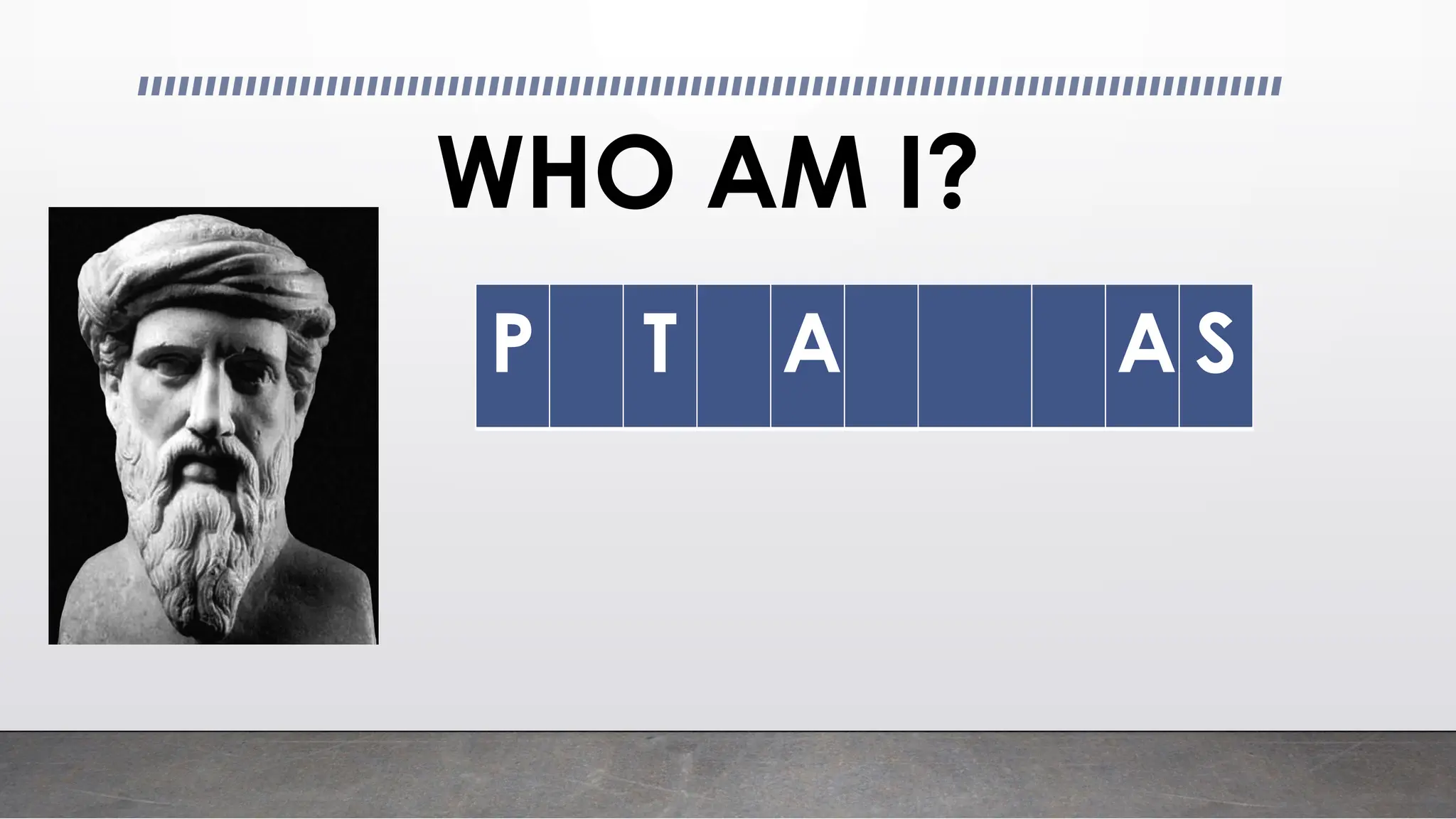
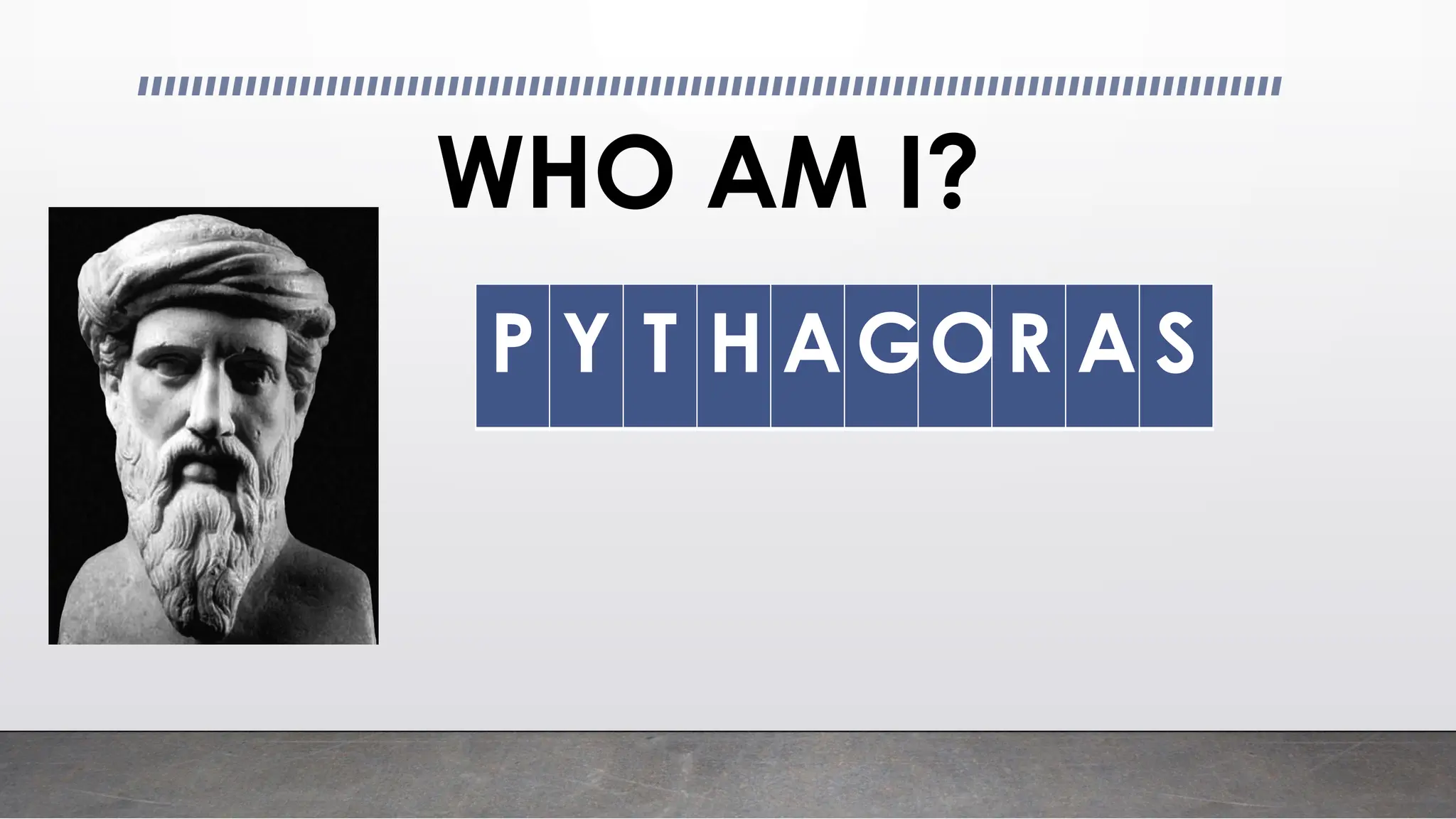
• The word philosophy was first coined by Pythagoras, a Greek
mathematician.
34.
What is Philosophy?
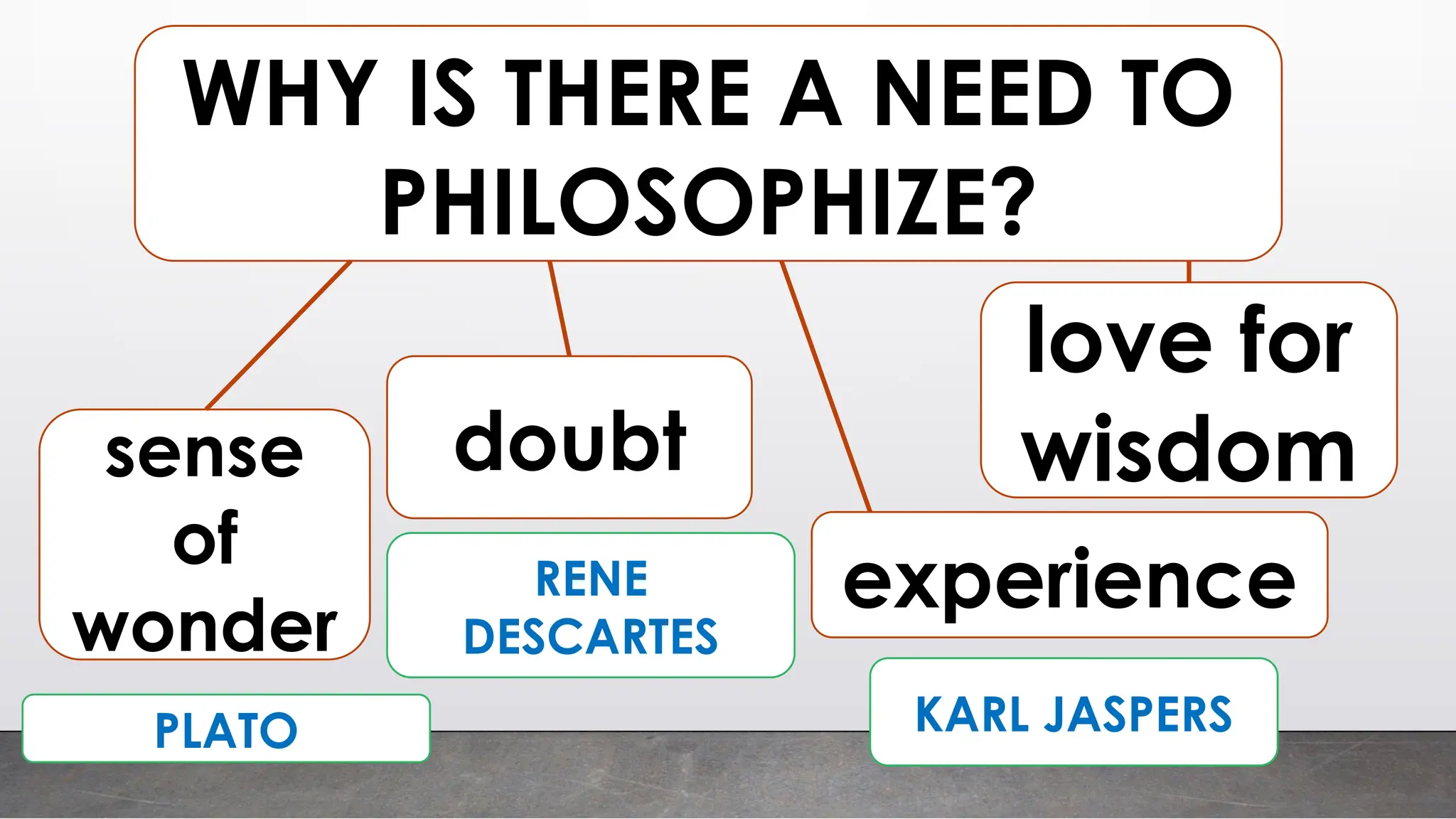
•Theword philosophy comes from
two Greek words: philos (love) and
sophia (wisdom).
35.
What is Philosophy?
•Philosophy means love of wisdom and they soon applied it to the study or discipline that uses
human reason to investigate the ultimate causes, reasons, and principles which govern all things.
• Philosophy is the study of general and fundamental questions about existence, knowledge,
values, reason, mind, and language.
• Philosophy in simple words is a way of thinking about the world, the universe, and society. It
works by asking very basic questions about the nature of human thought, the nature of the
universe, and the connections between them. The ideas in philosophy are often general and
abstract.
• Philosophy is the study of humans and the world by thinking and asking questions. It is a science
and an art. Philosophy tries to answer important questions by coming up with answers about real
things and asking "why?"
• People who engage in philosophy are called philosophers or “lovers of wisdom.”
36.
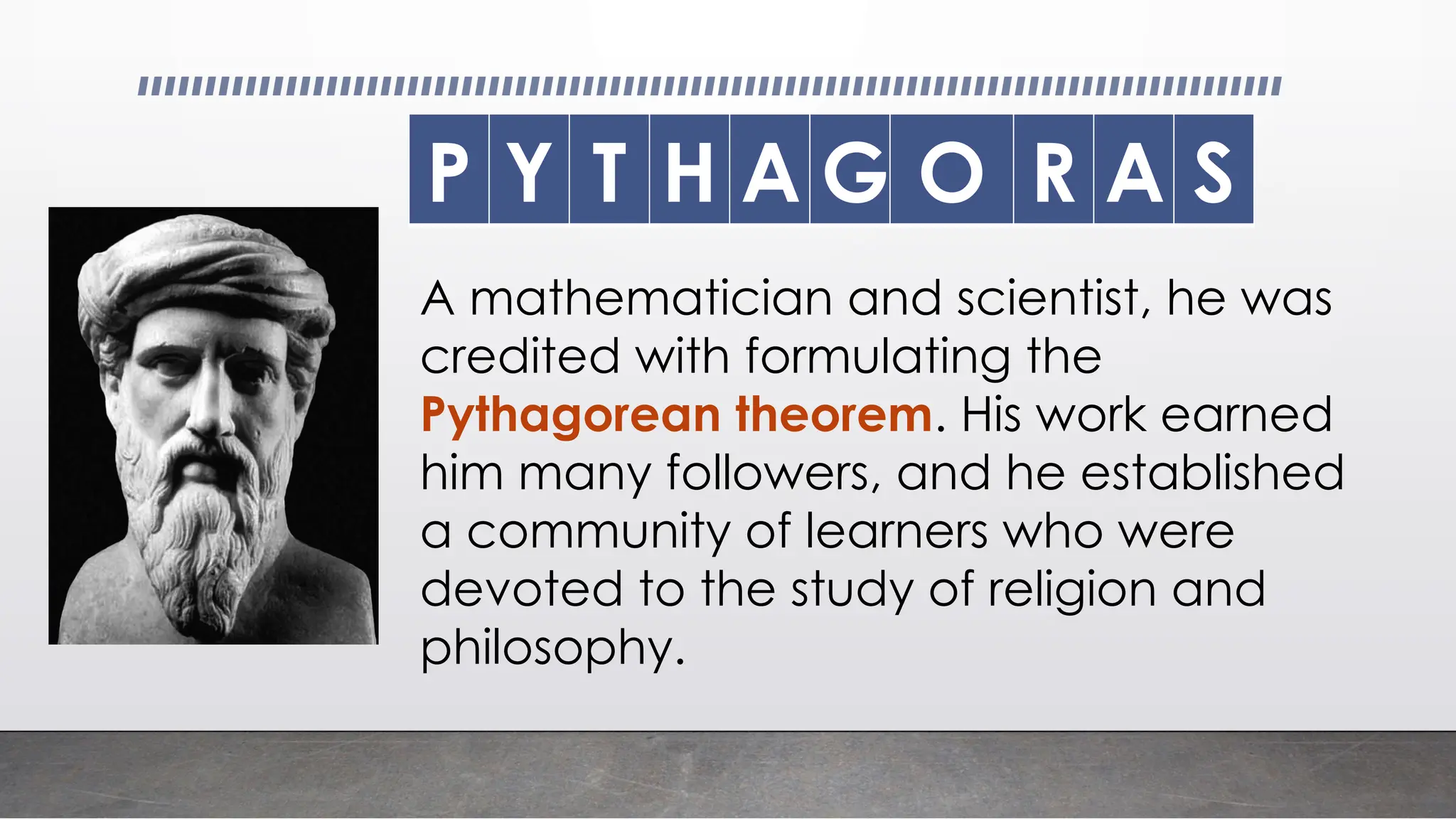
P Y TH A G O R A S
A mathematician and scientist, he was
credited with formulating the
Pythagorean theorem. His work earned
him many followers, and he established
a community of learners who were
devoted to the study of religion and
philosophy.
37.
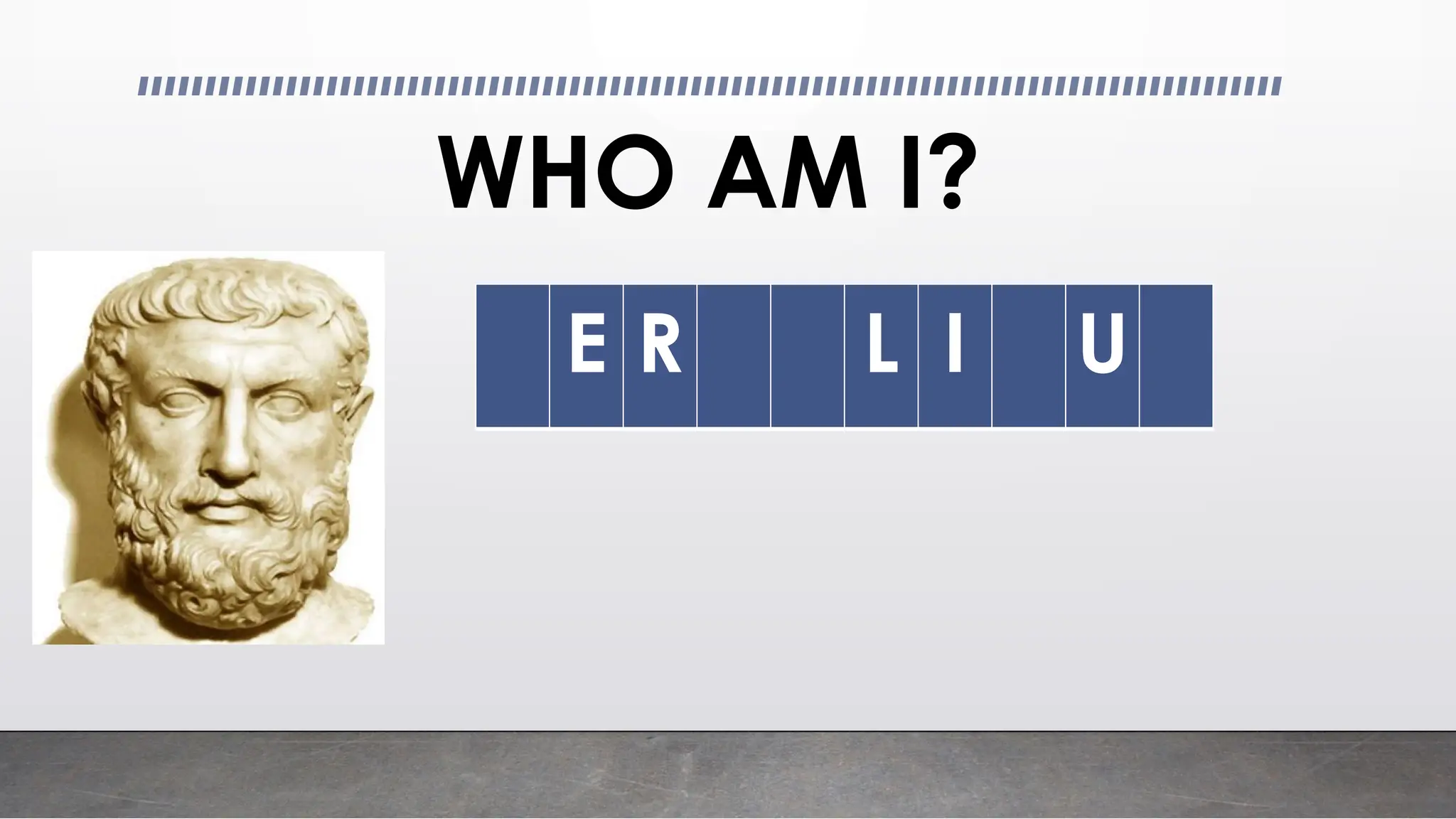
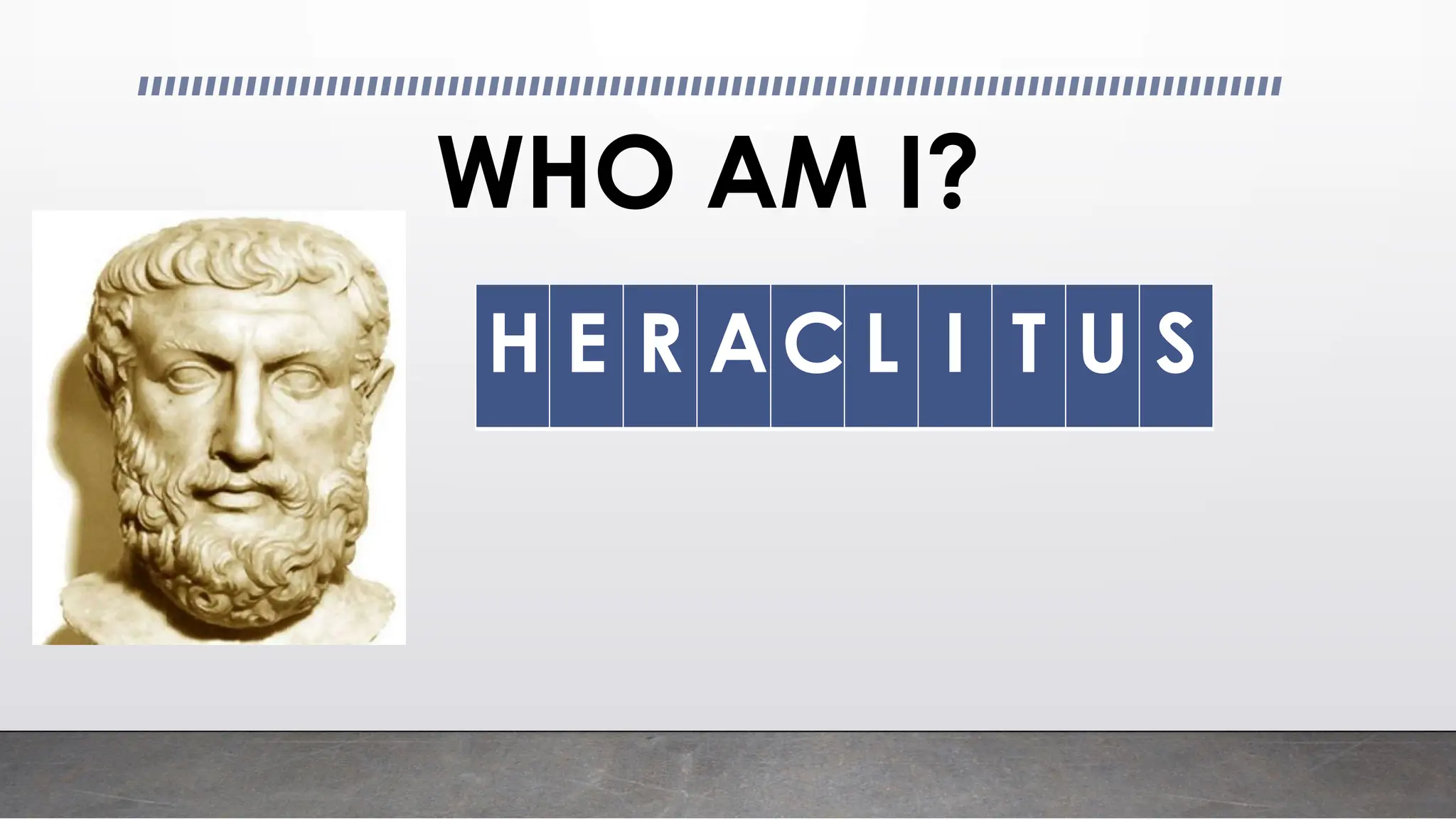
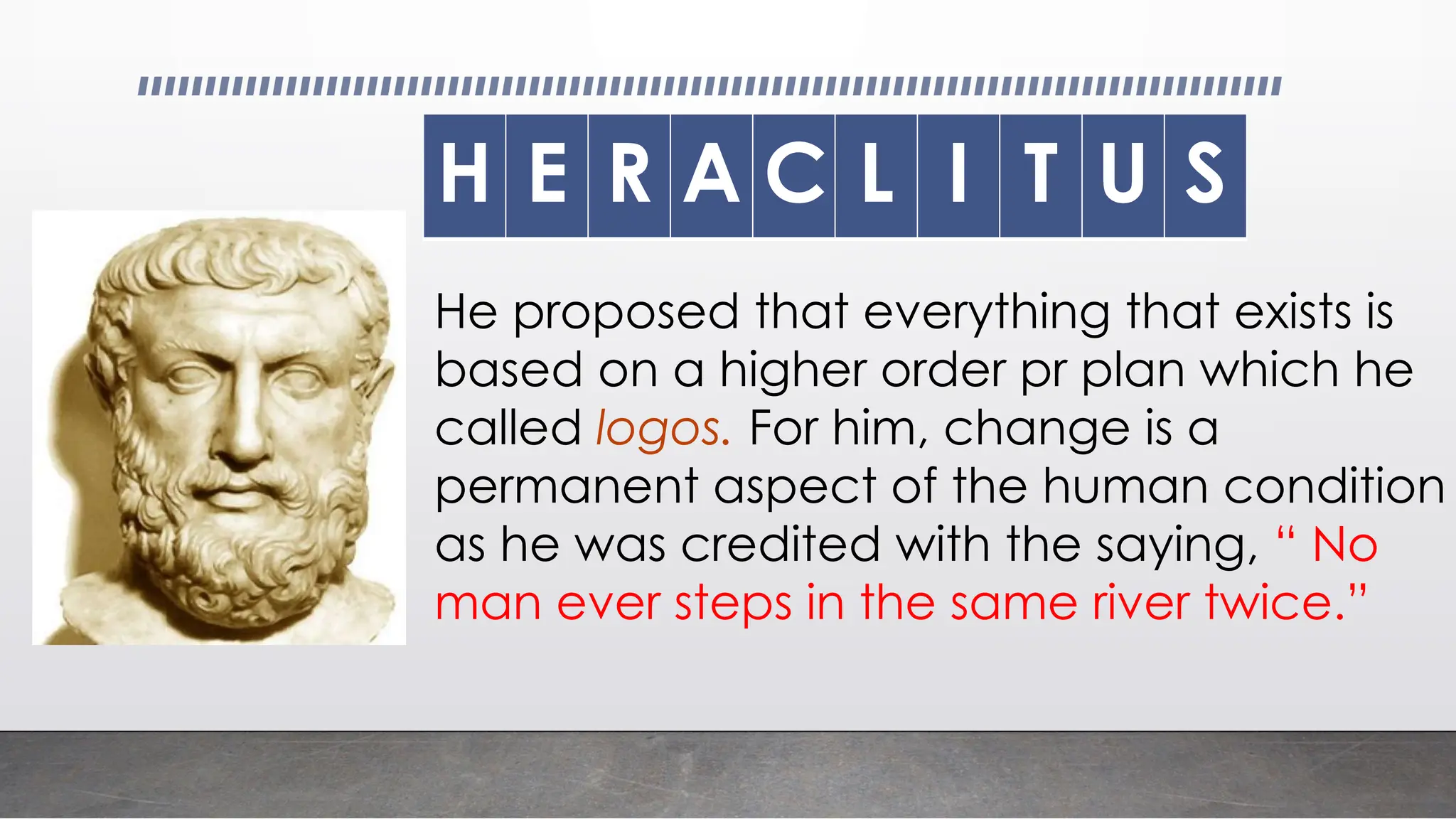
H E RA C L I T U S
He proposed that everything that exists is
based on a higher order pr plan which he
called logos. For him, change is a
permanent aspect of the human condition
as he was credited with the saying, “ No
man ever steps in the same river twice.”
38.
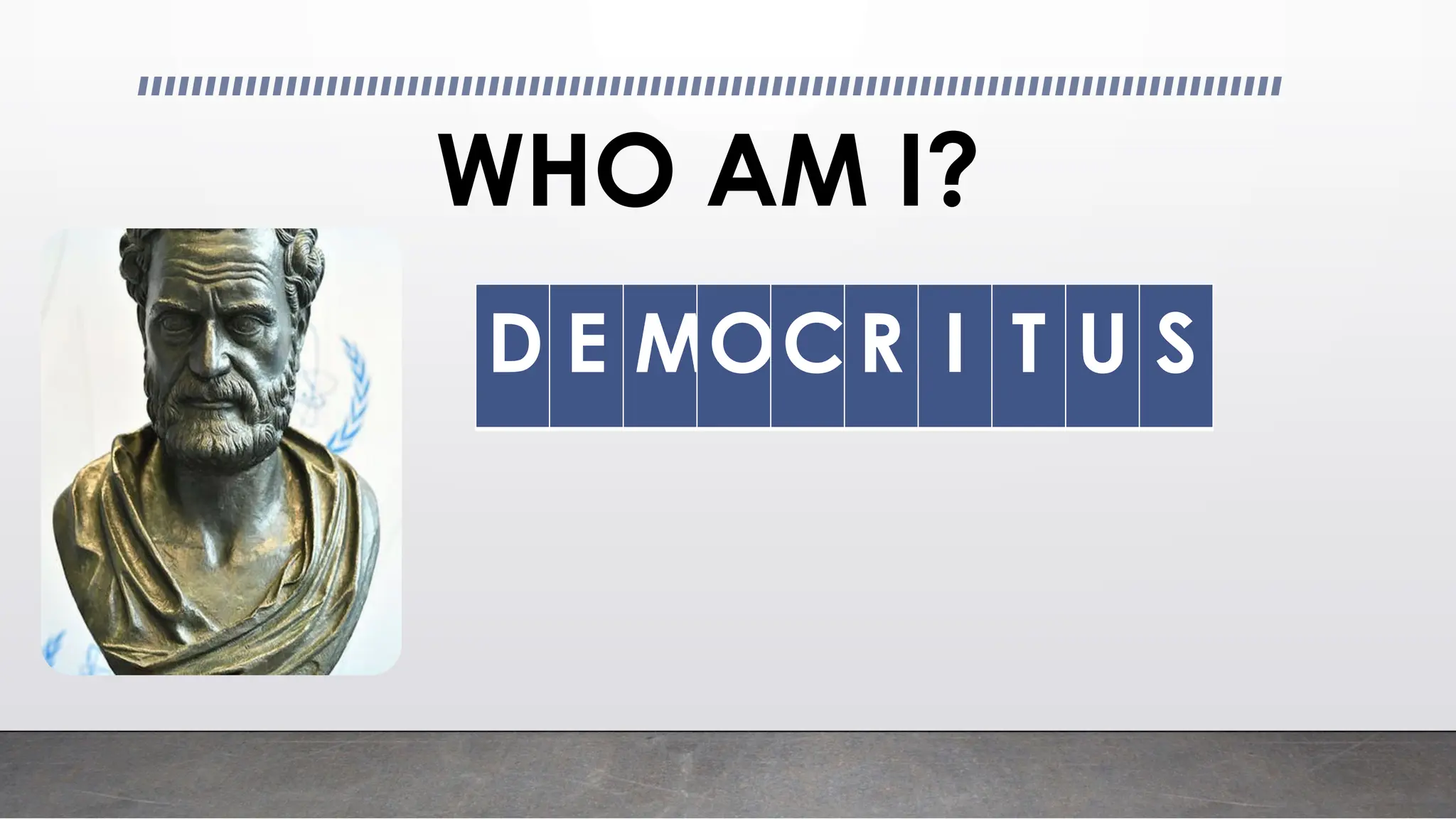
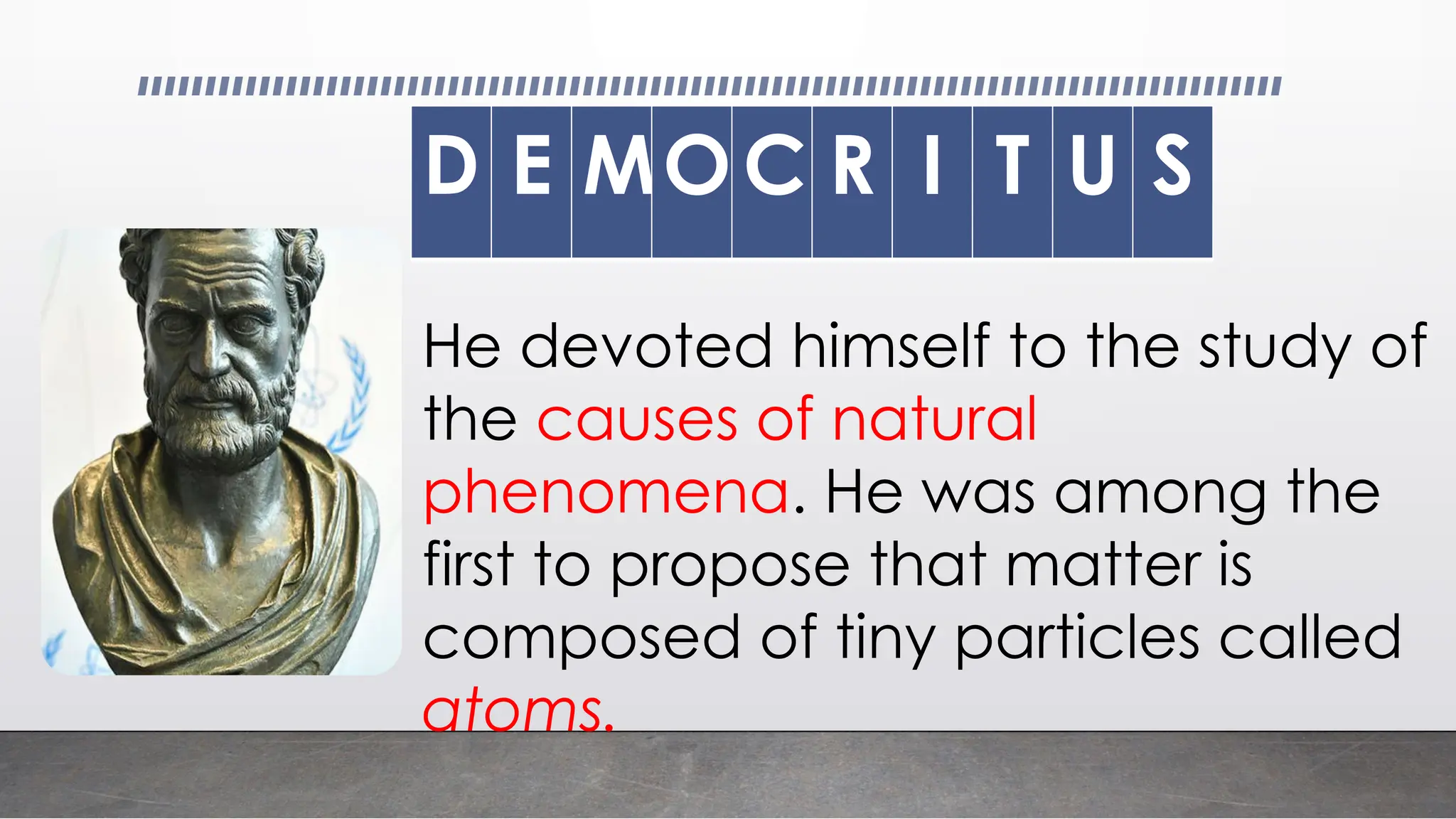
D E MOCR I T U S
He devoted himself to the study of
the causes of natural
phenomena. He was among the
first to propose that matter is
composed of tiny particles called
atoms.
39.
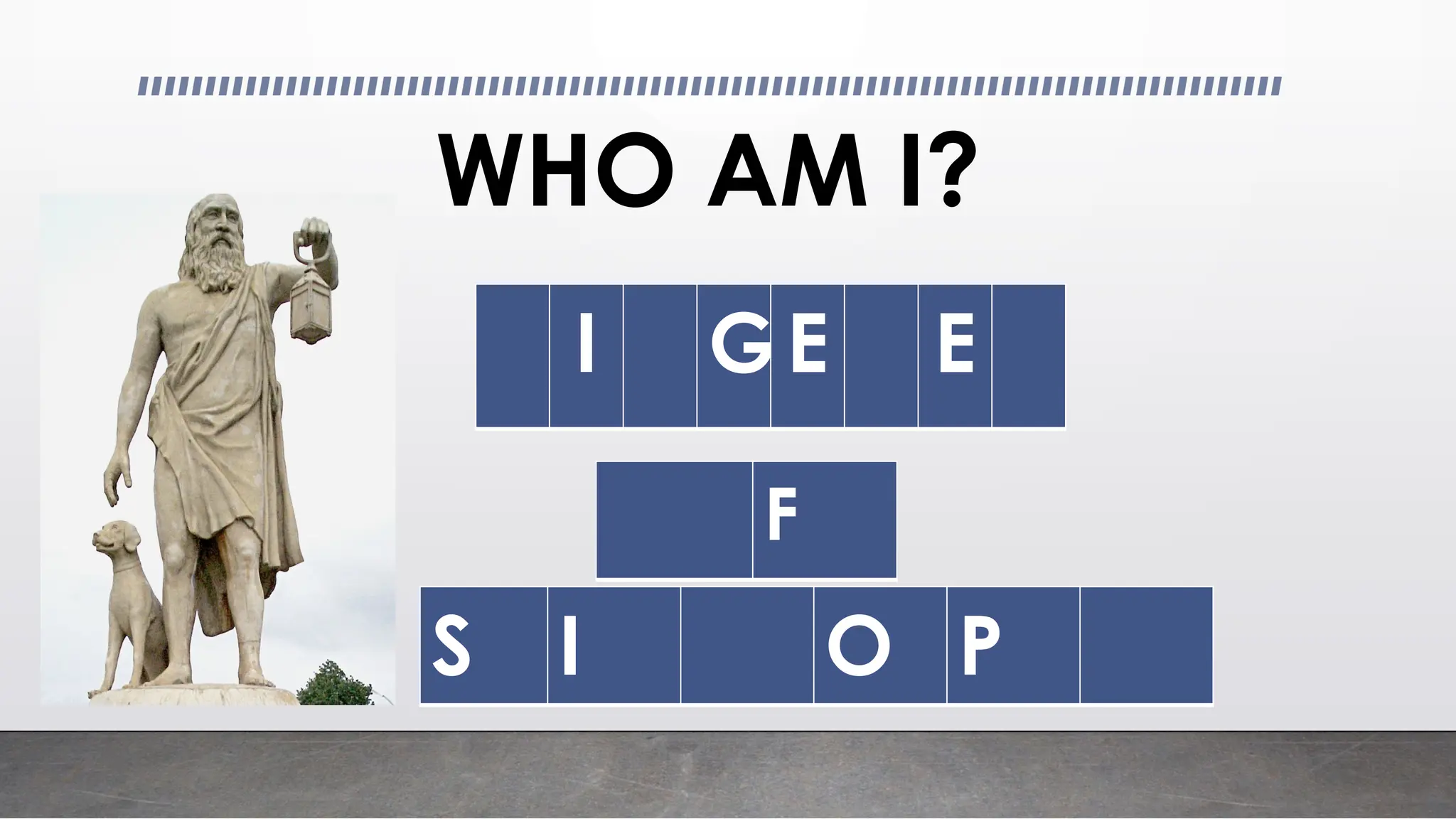
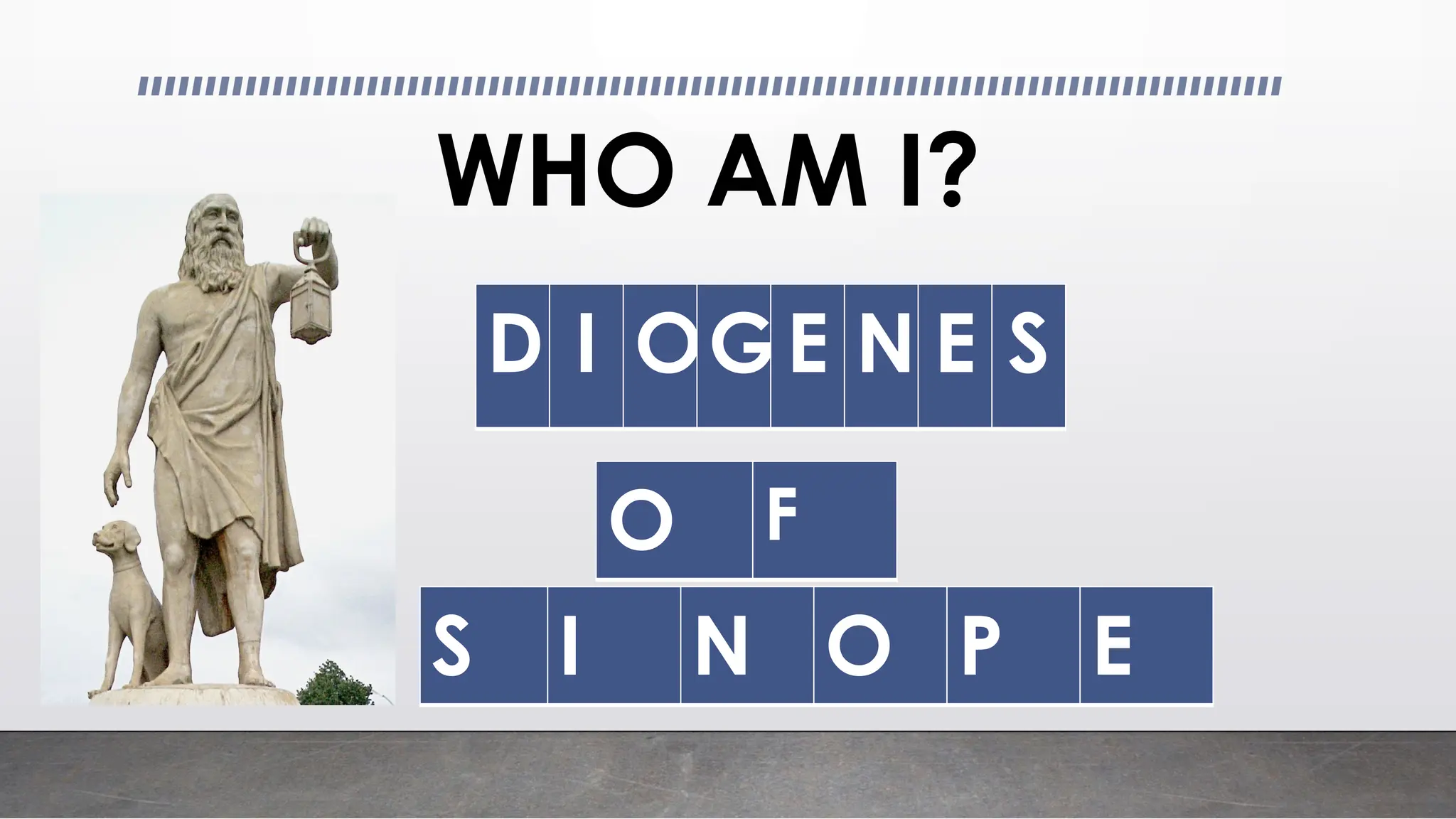
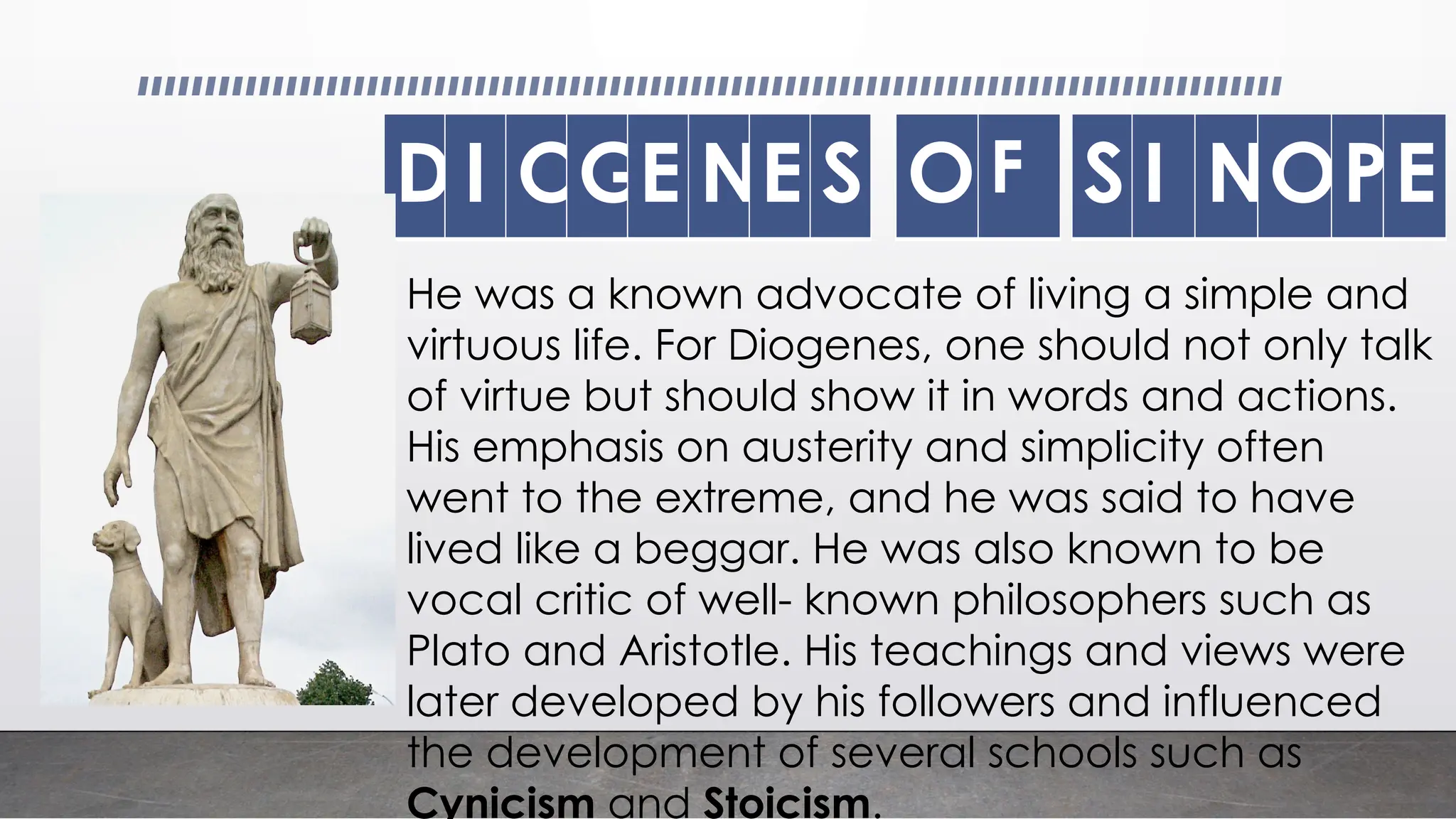
DI OGE NES O F S I NOPE
He was a known advocate of living a simple and
virtuous life. For Diogenes, one should not only talk
of virtue but should show it in words and actions.
His emphasis on austerity and simplicity often
went to the extreme, and he was said to have
lived like a beggar. He was also known to be
vocal critic of well- known philosophers such as
Plato and Aristotle. His teachings and views were
later developed by his followers and influenced
the development of several schools such as
Cynicism and Stoicism.
40.
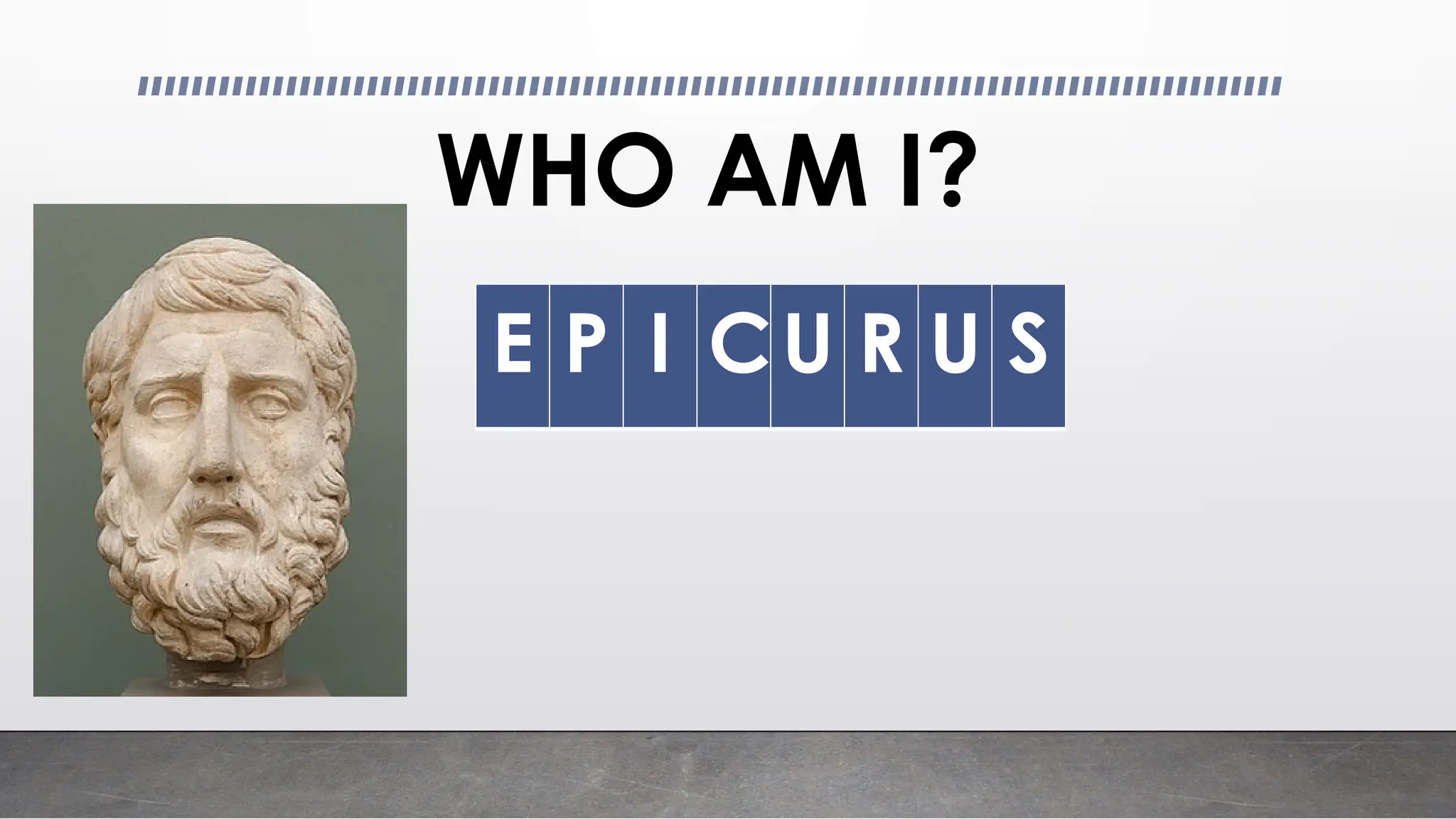
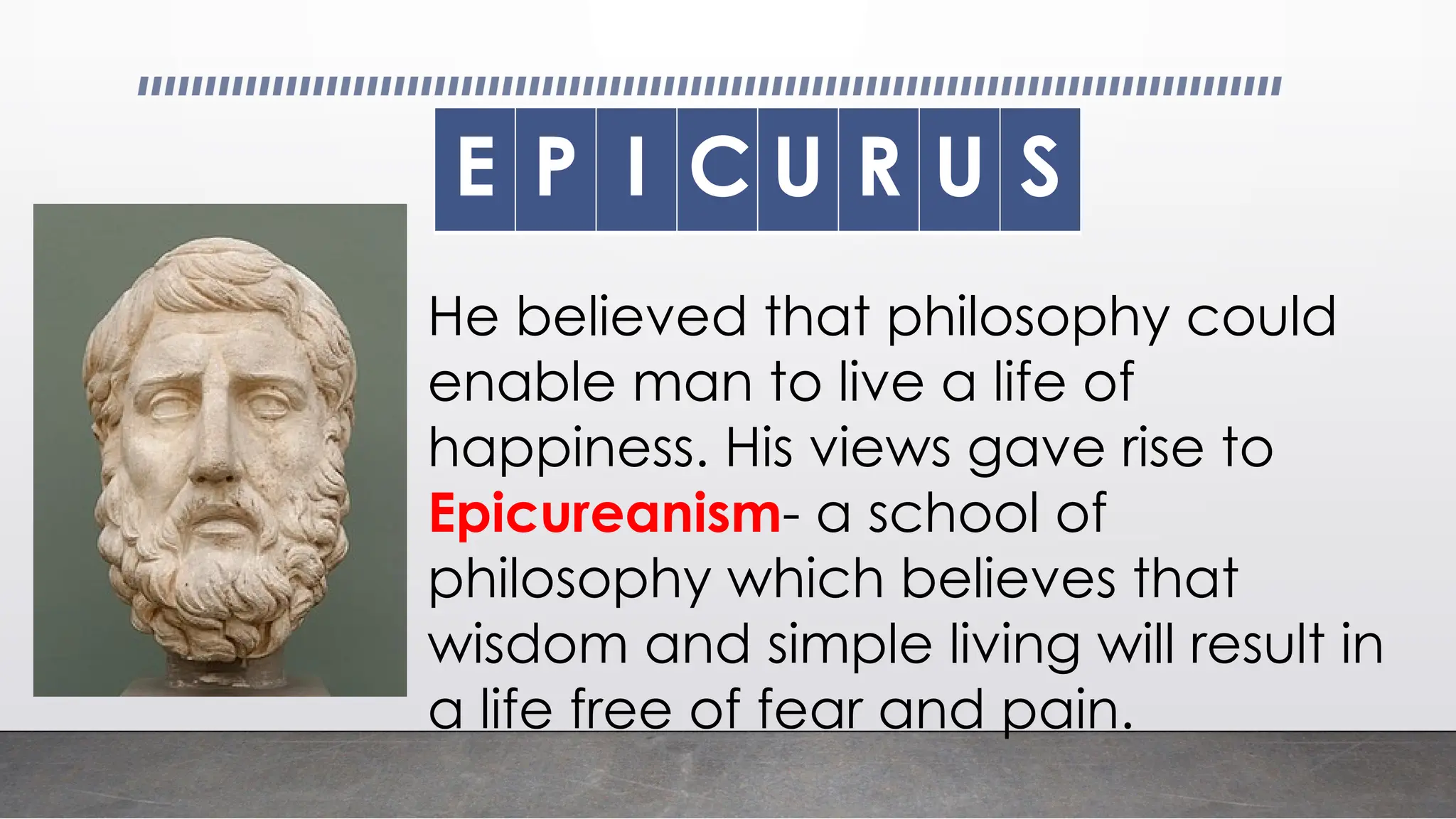
E P IC U R U S
He believed that philosophy could
enable man to live a life of
happiness. His views gave rise to
Epicureanism- a school of
philosophy which believes that
wisdom and simple living will result in
a life free of fear and pain.
41.
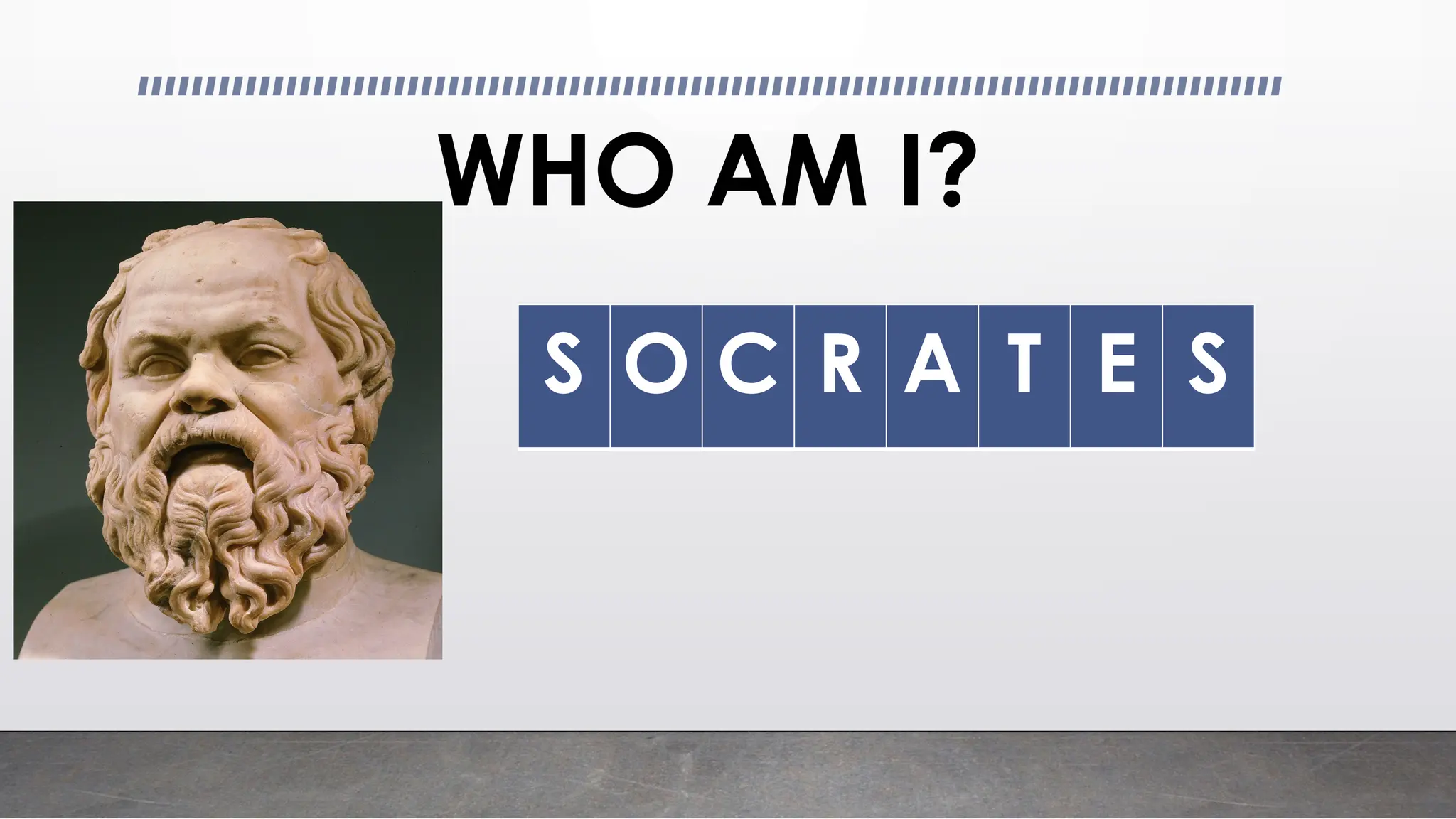
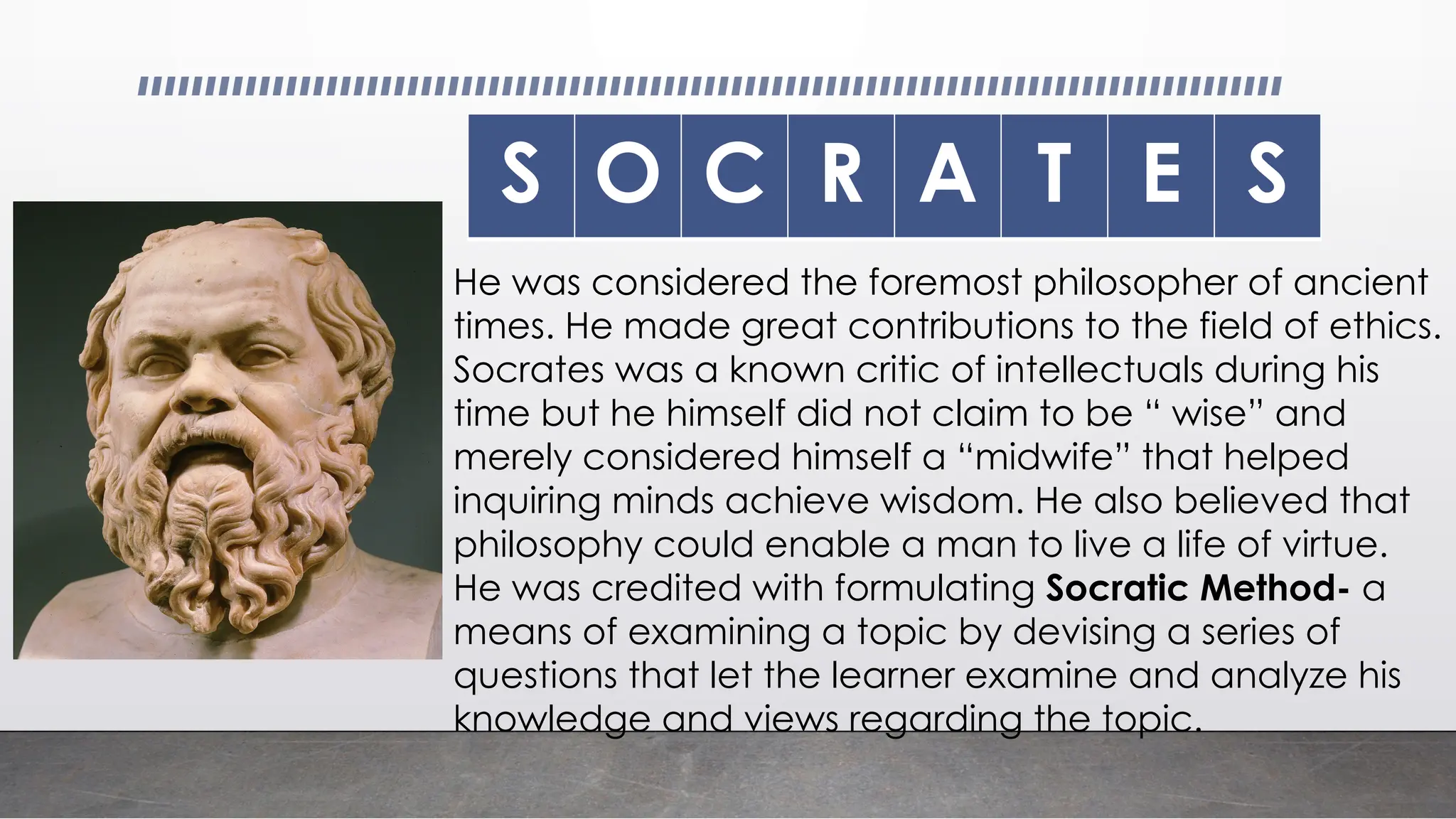
S O CR A T E S
He was considered the foremost philosopher of ancient
times. He made great contributions to the field of ethics.
Socrates was a known critic of intellectuals during his
time but he himself did not claim to be “ wise” and
merely considered himself a “midwife” that helped
inquiring minds achieve wisdom. He also believed that
philosophy could enable a man to live a life of virtue.
He was credited with formulating Socratic Method- a
means of examining a topic by devising a series of
questions that let the learner examine and analyze his
knowledge and views regarding the topic.
42.
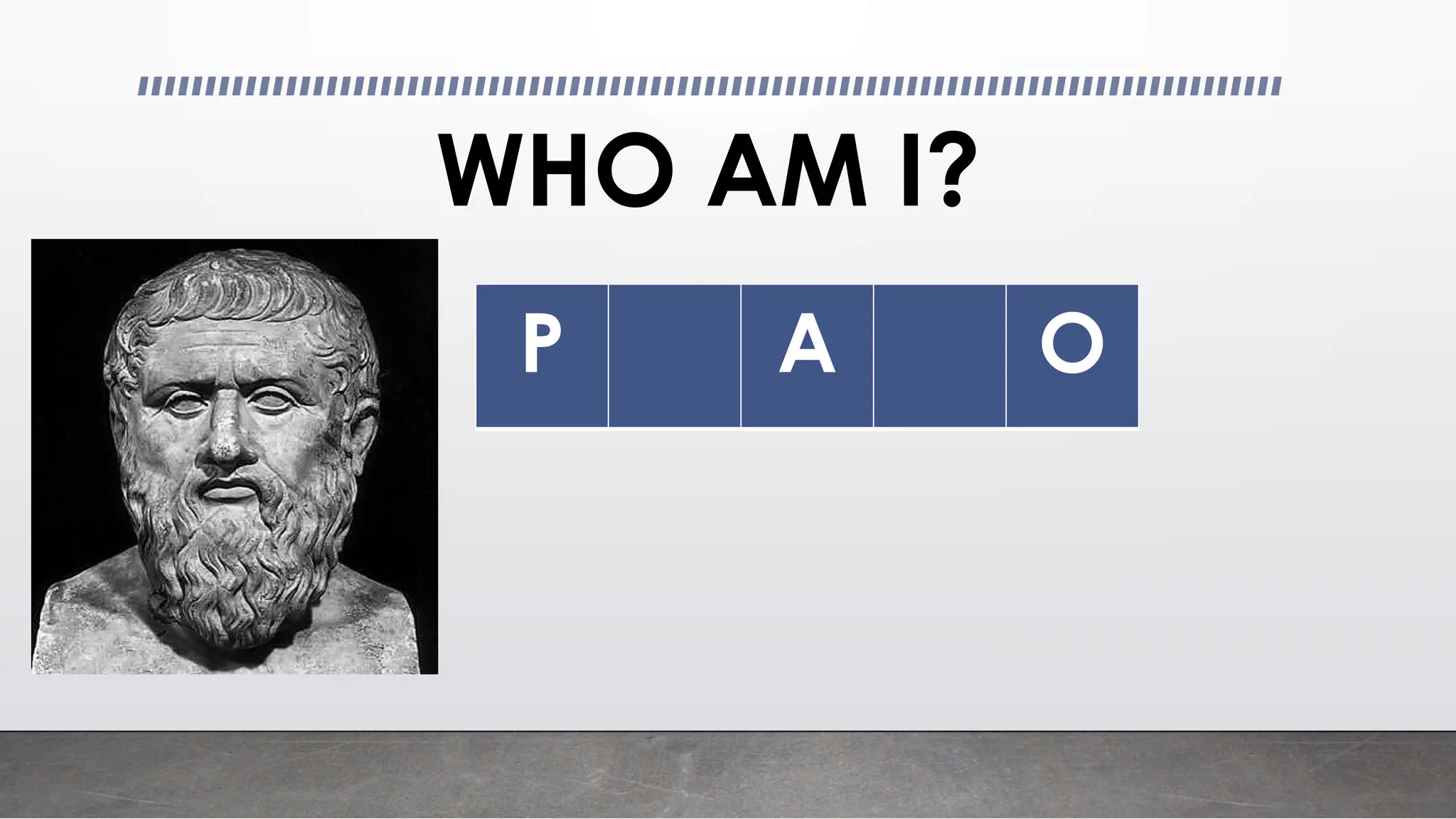
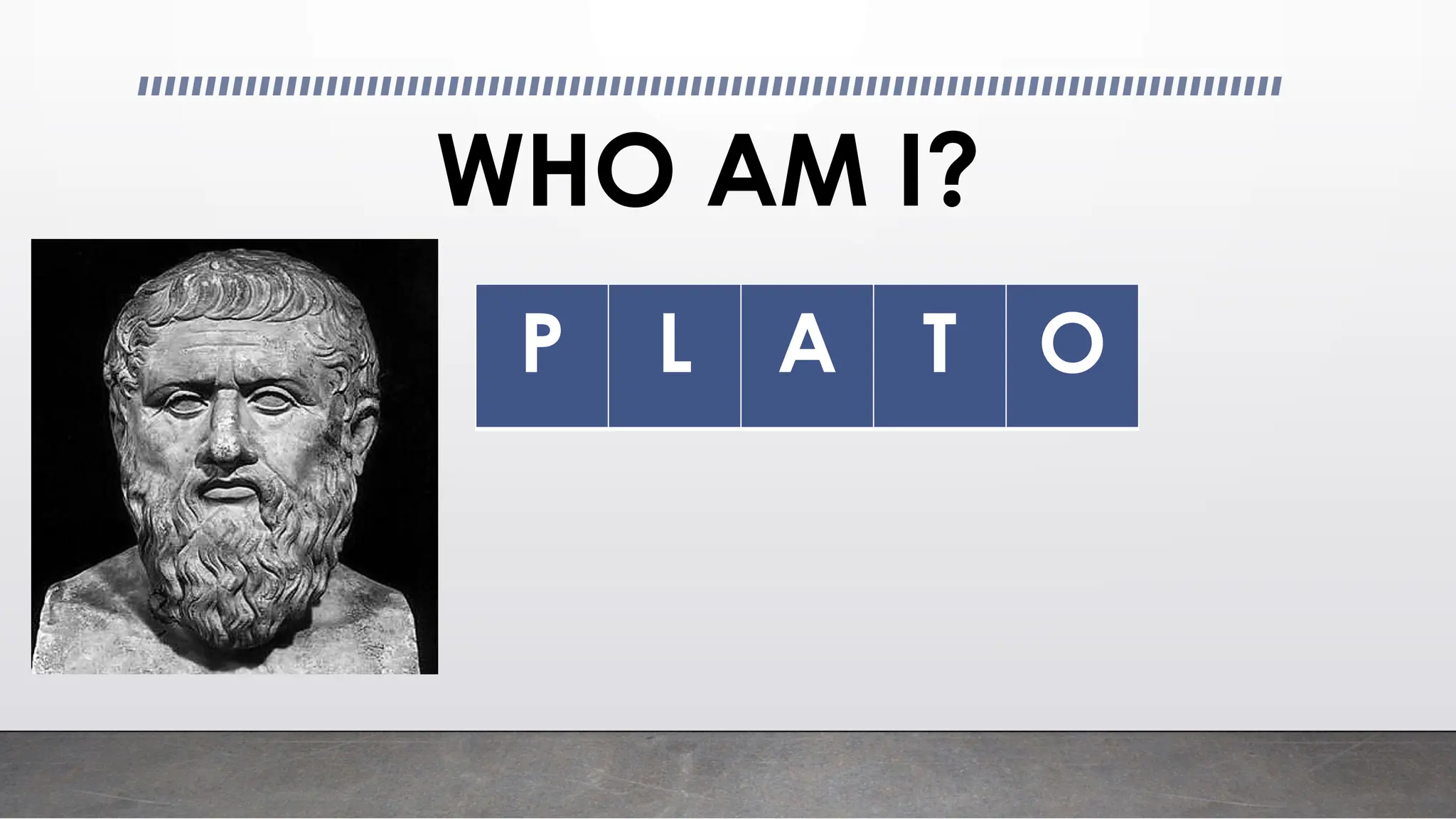
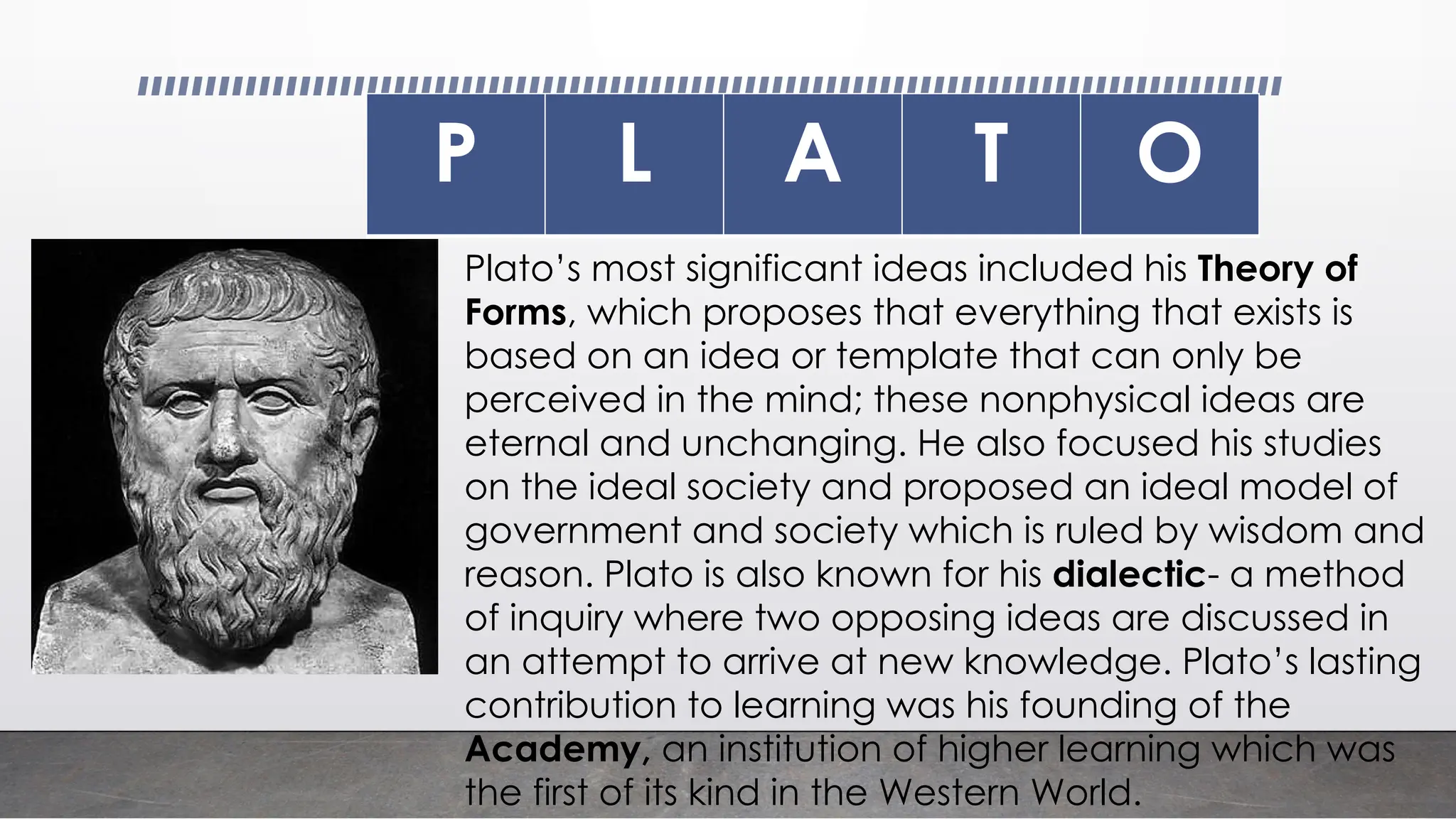
P L AT O
Plato’s most significant ideas included his Theory of
Forms, which proposes that everything that exists is
based on an idea or template that can only be
perceived in the mind; these nonphysical ideas are
eternal and unchanging. He also focused his studies
on the ideal society and proposed an ideal model of
government and society which is ruled by wisdom and
reason. Plato is also known for his dialectic- a method
of inquiry where two opposing ideas are discussed in
an attempt to arrive at new knowledge. Plato’s lasting
contribution to learning was his founding of the
Academy, an institution of higher learning which was
the first of its kind in the Western World.
43.
, A
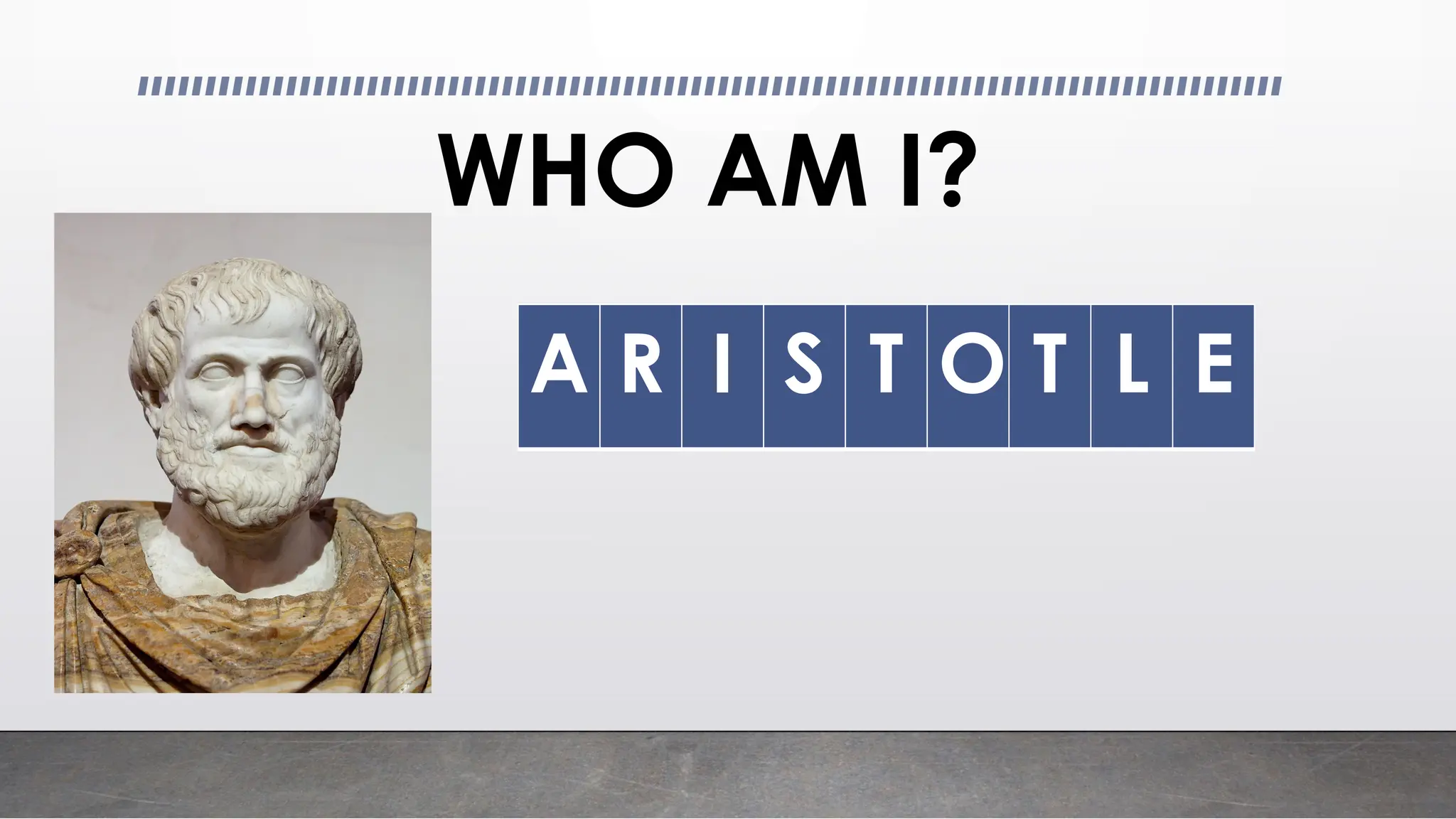
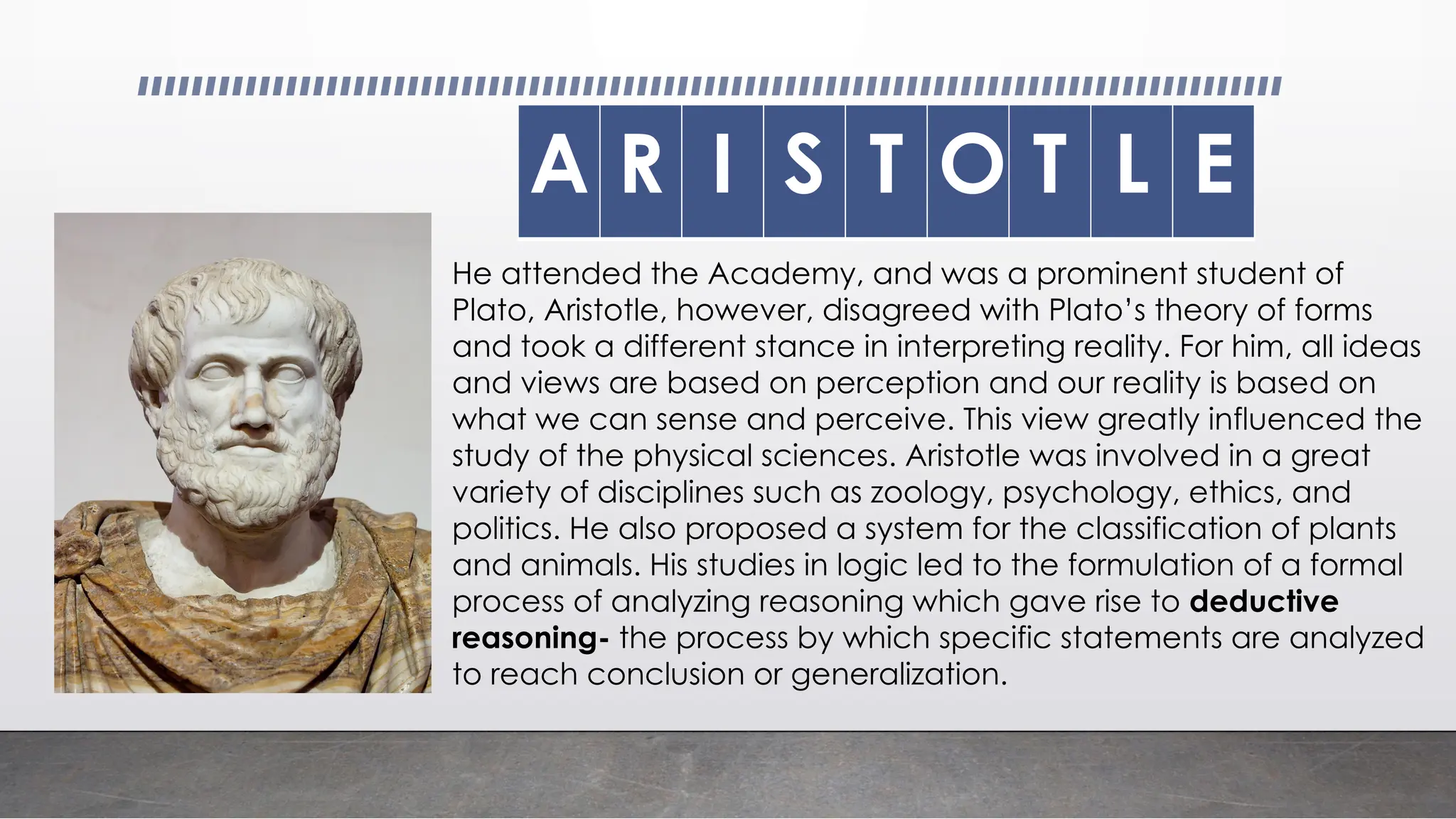
A RI S T O T L E
He attended the Academy, and was a prominent student of
Plato, Aristotle, however, disagreed with Plato’s theory of forms
and took a different stance in interpreting reality. For him, all ideas
and views are based on perception and our reality is based on
what we can sense and perceive. This view greatly influenced the
study of the physical sciences. Aristotle was involved in a great
variety of disciplines such as zoology, psychology, ethics, and
politics. He also proposed a system for the classification of plants
and animals. His studies in logic led to the formulation of a formal
process of analyzing reasoning which gave rise to deductive
reasoning- the process by which specific statements are analyzed
to reach conclusion or generalization.
44.
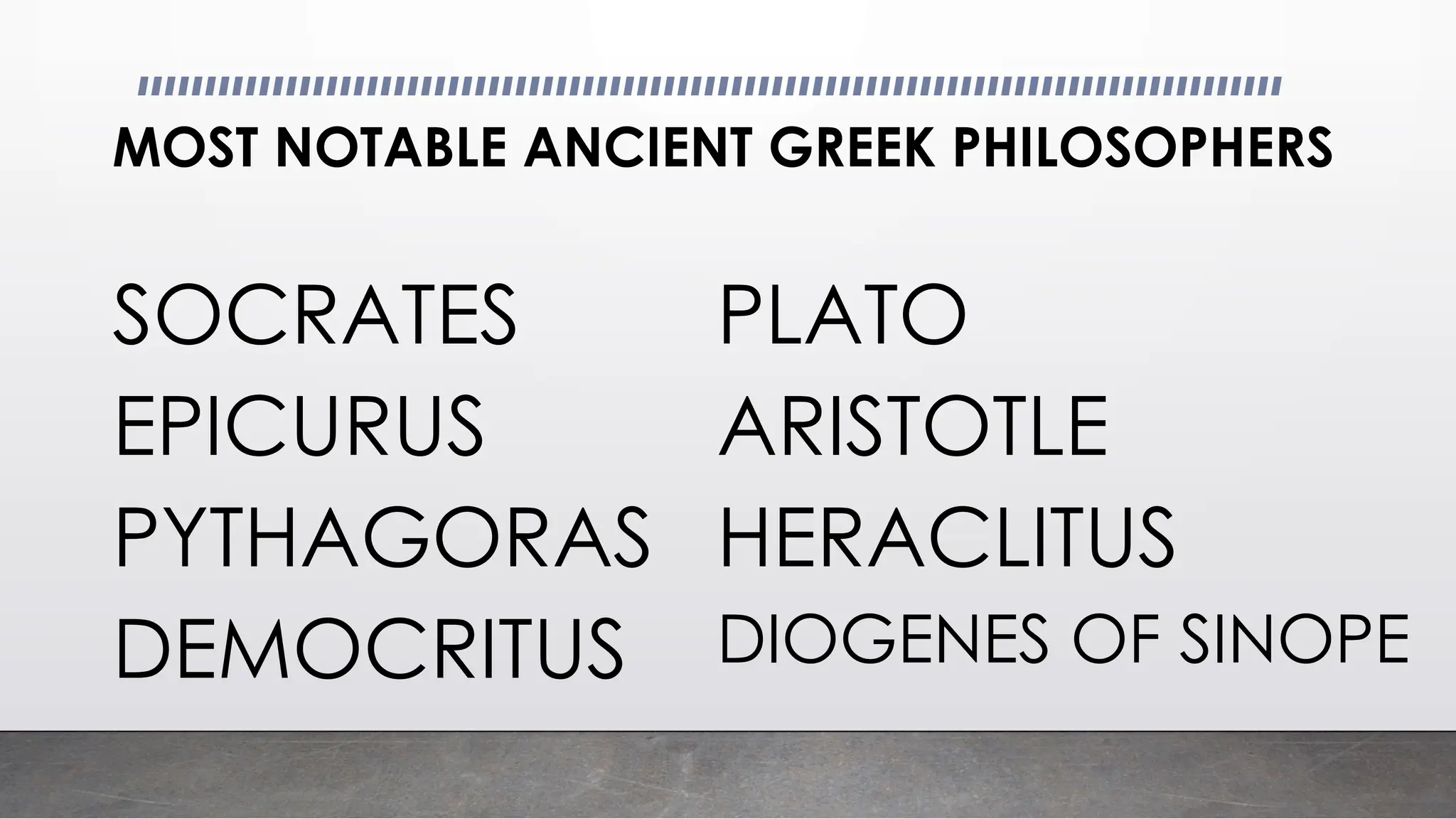
MOST NOTABLE ANCIENTGREEK PHILOSOPHERS
SOCRATES PLATO
EPICURUS ARISTOTLE
PYTHAGORAS HERACLITUS
DEMOCRITUS DIOGENES OF SINOPE
45.
Since ancient times,philosophers have been pondering some of the
most enduring questions regarding human existence.
• What is real? Are we able to perceive and understand reality and
everything in it?
• How do we know what we know? Are the things that we know
true?
• What is the ultimate cause of all things? What is the purpose in this
world?
• To what extent are our choices and actions considered “free”?
SOCRATES PERSPECTIVE
A philosopherdoes not seek knowledge to claim
ownership of it; and one who engages in
philosophy is not satisfied with figuring out the
answer to a question. He seeks to continue to
question, to probe, and to discuss in order to get
the bottom of things.
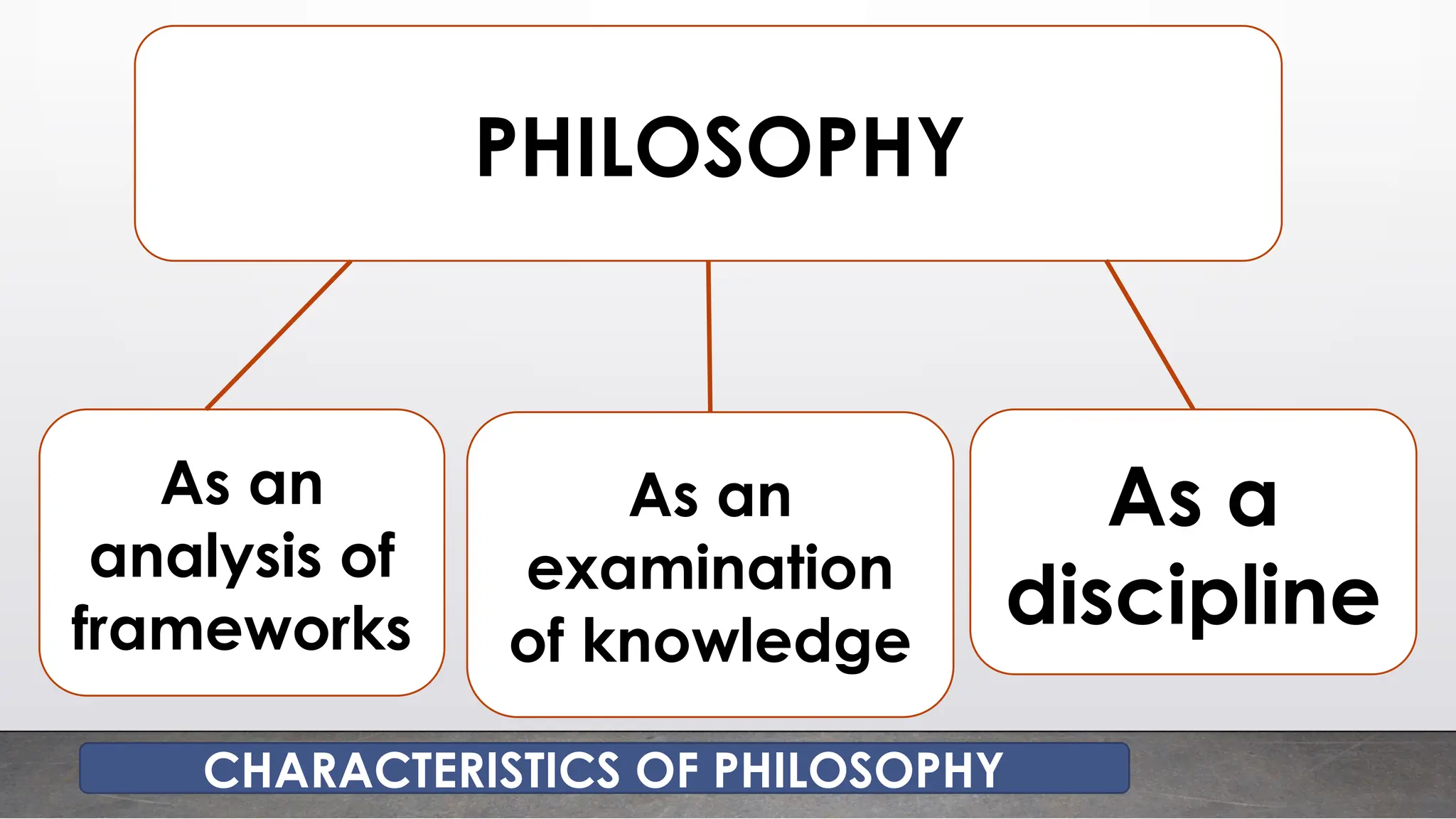
How do wecharacterize the study of
philosophy?
A way of analyzing frameworks
Framework - a way of thinking about
the world and is composed of the
views and beliefs of a person
52.
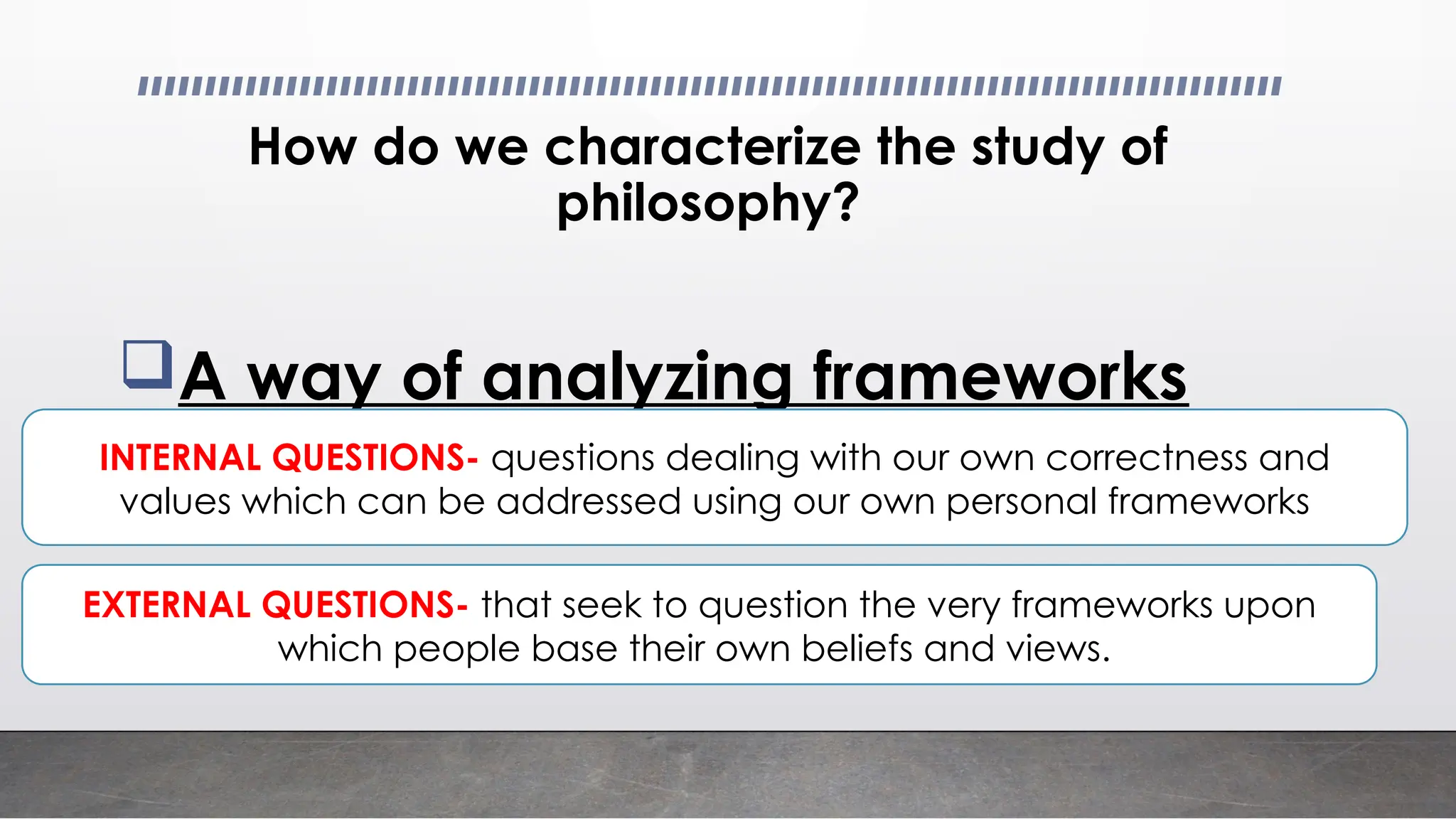
How do wecharacterize the study of
philosophy?
A way of analyzing frameworks
INTERNAL QUESTIONS- questions dealing with our own correctness and
values which can be addressed using our own personal frameworks
EXTERNAL QUESTIONS- that seek to question the very frameworks upon
which people base their own beliefs and views.
53.
How do wecharacterize the study of
philosophy?
An examination of a particular area of
knowledge
The central principle in philosophy is examination
and questioning, and this is often applied in the
analysis of the frameworks of other areas or sciences.
54.
How do wecharacterize the study of
philosophy?
A distinct area of knowledge with
its own goals, concerns, and way of
doing things
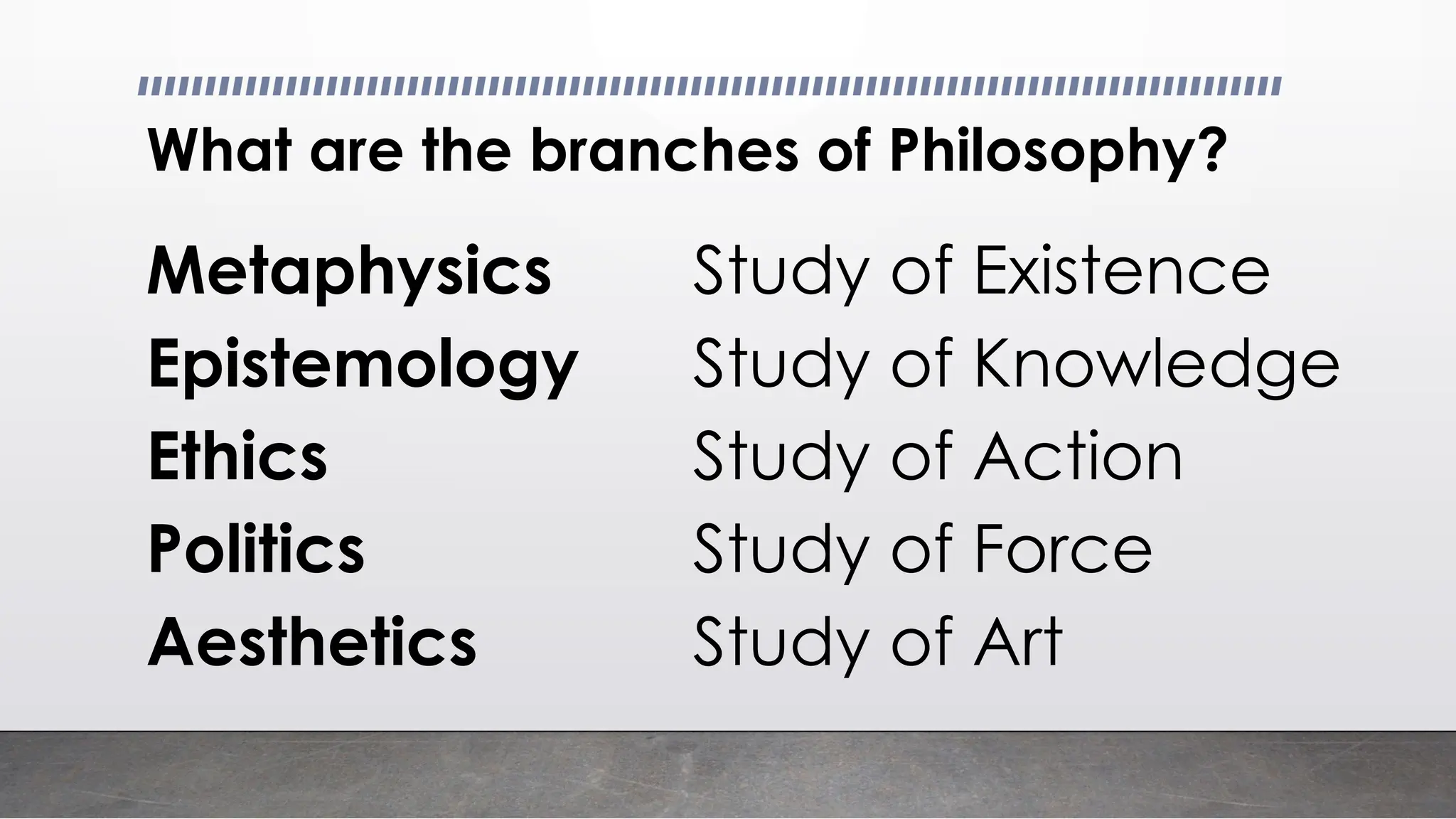
What are thebranches of Philosophy?
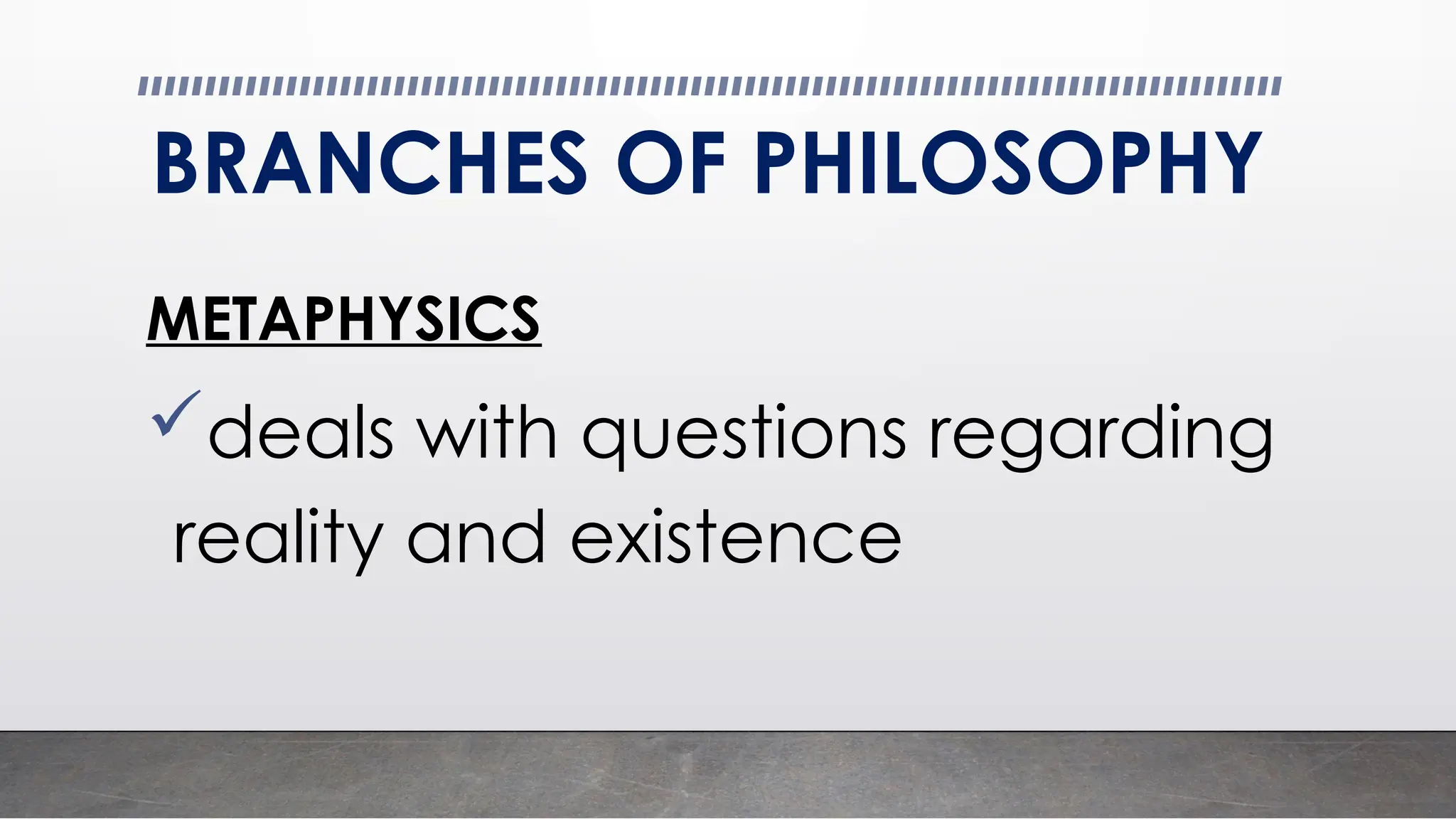
Metaphysics Study of Existence
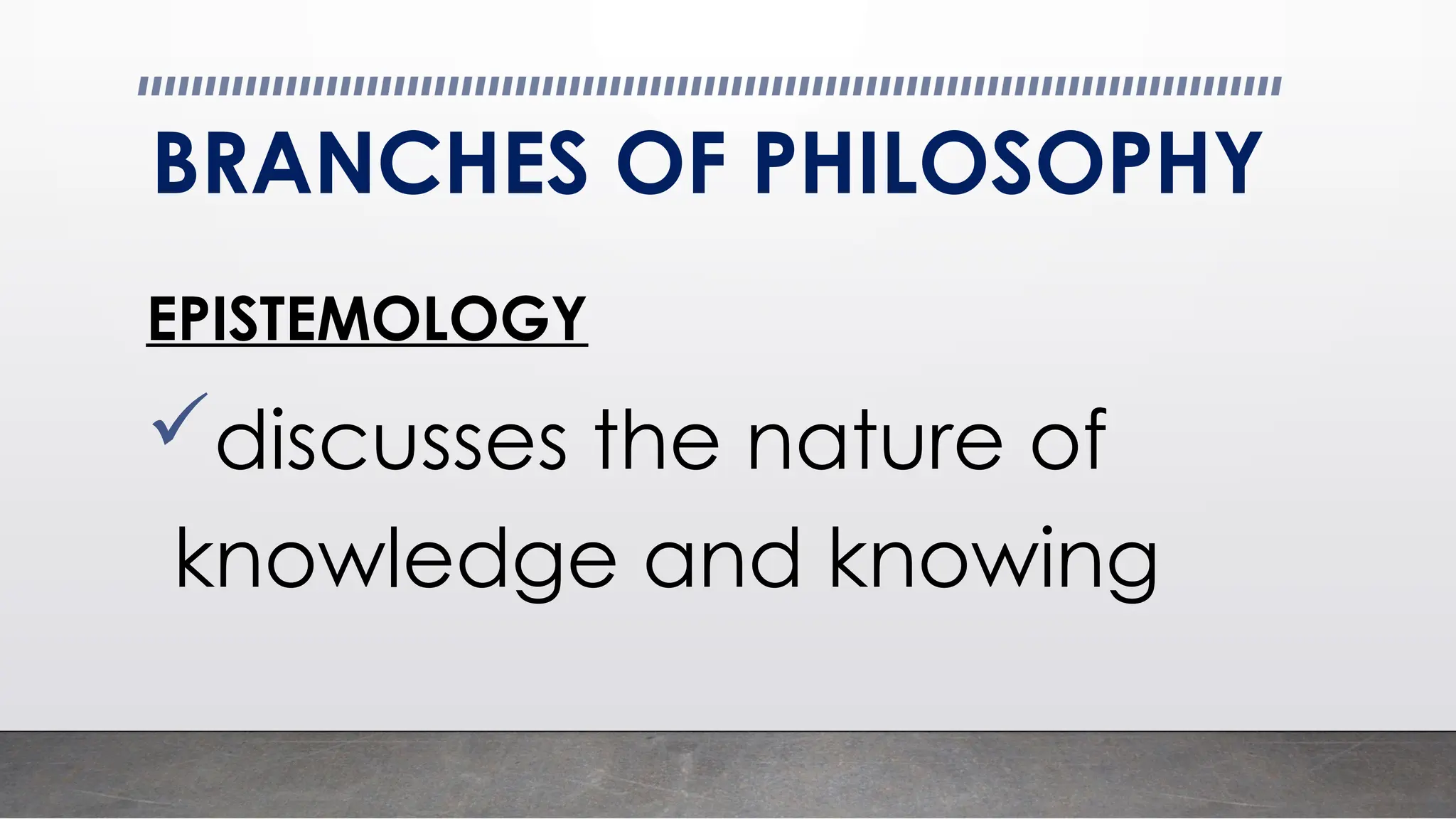
Epistemology Study of Knowledge
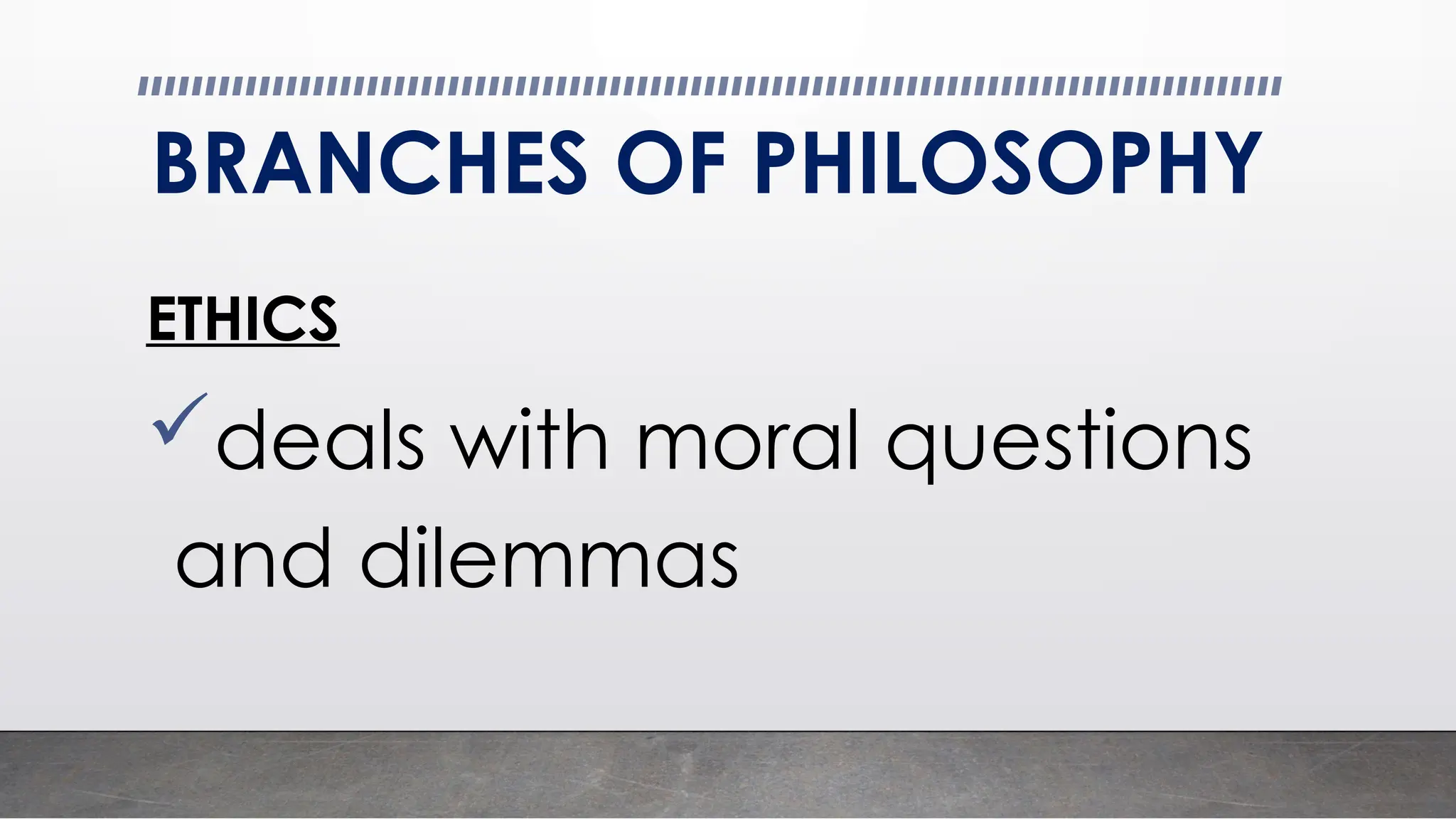
Ethics Study of Action
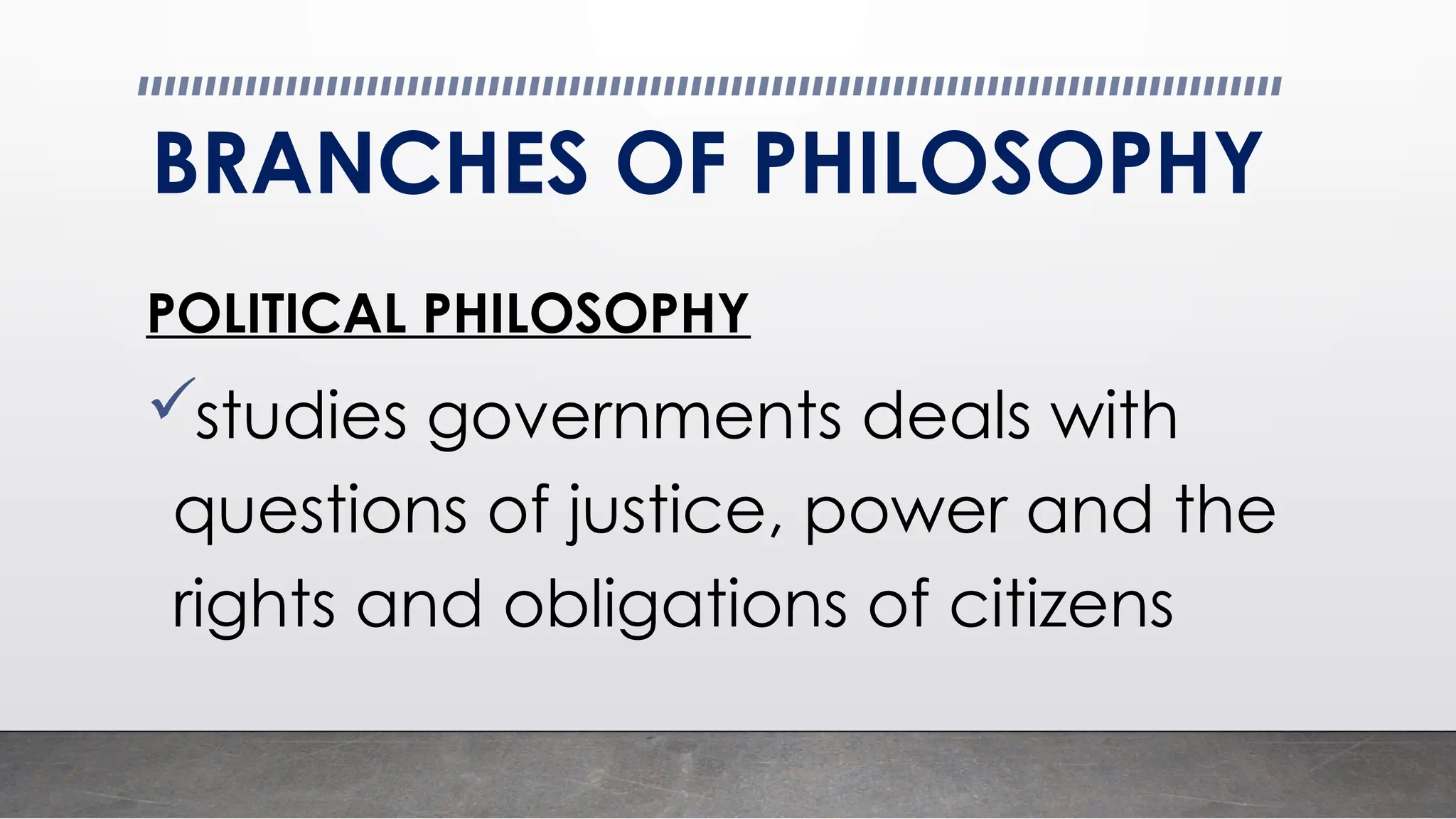
Politics Study of Force
Aesthetics Study of Art
62.
PHILOSOPHY OF THEHUMAN PERSON
An area in philosophy that understands the human
person from a philosophical perspective –
integrating and synthesizing the different branches
of philosophy and other fields of study to know the
truth about the human person
63.
IMPORTANT FACTS ABOUTPHILOSOPHIZING
1. Philosophy is a reflective and meditative
activity.
2. It has no designated subject matter of its own.
3. It is a method of mental exercise on any type of
experience.