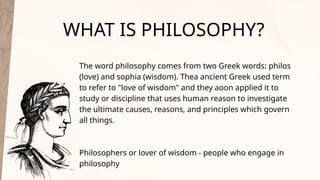
The word philosophycomes from two Greek words: philos
(love) and sophia (wisdom). Thea ancient Greek used term
to refer to "love of wisdom" and they aoon applied it to
study or discipline that uses human reason to investigate
the ultimate causes, reasons, and principles which govern
all things.
Philosophers or lover of wisdom - people who engage in
philosophy
WHAT IS PHILOSOPHY?
7.
Notable Greek
Philosophers
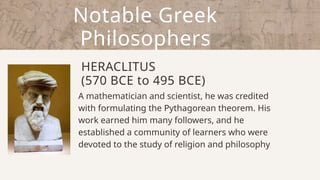
HERACLITUS
(570 BCEto 495 BCE)
A mathematician and scientist, he was credited
with formulating the Pythagorean theorem. His
work earned him many followers, and he
established a community of learners who were
devoted to the study of religion and philosophy
8.
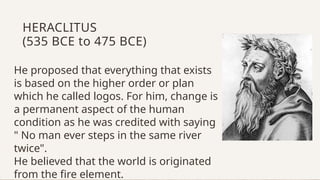
HERACLITUS
(535 BCE to475 BCE)
He proposed that everything that exists
is based on the higher order or plan
which he called logos. For him, change is
a permanent aspect of the human
condition as he was credited with saying
" No man ever steps in the same river
twice".
He believed that the world is originated
from the fire element.
9.
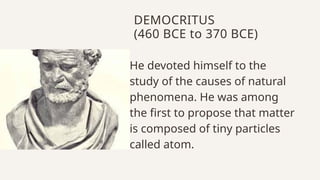
DEMOCRITUS
(460 BCE to370 BCE)
He devoted himself to the
study of the causes of natural
phenomena. He was among
the first to propose that matter
is composed of tiny particles
called atom.
10.
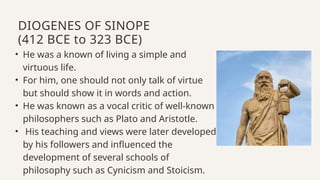
• He wasa known of living a simple and
virtuous life.
• For him, one should not only talk of virtue
but should show it in words and action.
• He was known as a vocal critic of well-known
philosophers such as Plato and Aristotle.
• His teaching and views were later developed
by his followers and influenced the
development of several schools of
philosophy such as Cynicism and Stoicism.
DIOGENES OF SINOPE
(412 BCE to 323 BCE)
11.
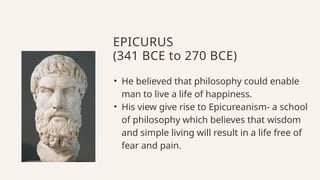
• He believedthat philosophy could enable
man to live a life of happiness.
• His view give rise to Epicureanism- a school
of philosophy which believes that wisdom
and simple living will result in a life free of
fear and pain.
EPICURUS
(341 BCE to 270 BCE)
12.
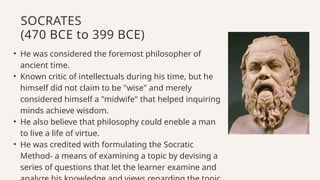
• He wasconsidered the foremost philosopher of
ancient time.
• Known critic of intellectuals during his time, but he
himself did not claim to be "wise" and merely
considered himself a "midwife" that helped inquiring
minds achieve wisdom.
• He also believe that philosophy could eneble a man
to live a life of virtue.
• He was credited with formulating the Socratic
Method- a means of examining a topic by devising a
series of questions that let the learner examine and
SOCRATES
(470 BCE to 399 BCE)
13.
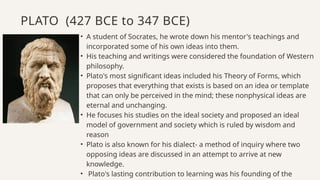
• A studentof Socrates, he wrote down his mentor's teachings and
incorporated some of his own ideas into them.
• His teaching and writings were considered the foundation of Western
philosophy.
• Plato's most significant ideas included his Theory of Forms, which
proposes that everything that exists is based on an idea or template
that can only be perceived in the mind; these nonphysical ideas are
eternal and unchanging.
• He focuses his studies on the ideal society and proposed an ideal
model of government and society which is ruled by wisdom and
reason
• Plato is also known for his dialect- a method of inquiry where two
opposing ideas are discussed in an attempt to arrive at new
knowledge.
• Plato's lasting contribution to learning was his founding of the
PLATO (427 BCE to 347 BCE)
14.
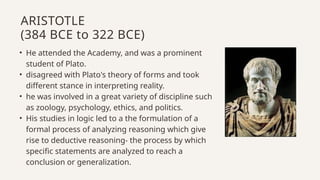
• He attendedthe Academy, and was a prominent
student of Plato.
• disagreed with Plato's theory of forms and took
different stance in interpreting reality.
• he was involved in a great variety of discipline such
as zoology, psychology, ethics, and politics.
• His studies in logic led to a the formulation of a
formal process of analyzing reasoning which give
rise to deductive reasoning- the process by which
specific statements are analyzed to reach a
conclusion or generalization.
ARISTOTLE
(384 BCE to 322 BCE)
28.
• Philosophy isa reflective activity-it tends to critically reflect on its own
methods and presuppositions, and it emphasizes its self-critical, reflective
nature
• Philosophy as a meditative activity- a type of meditation practice that helps
you organize the assortment of feelings rather than escaping from all of
them only to come back to a mess of scattered emotions.
This two is also an method of mental exercise on any type of experience.
• Philosophy is a distinct area of knowledge with its own goals, concerns and
ways of doing things.
• Philosophy does not limit itself to its own field. It makes sense of
information gathered from various fields of knowledge such as science,
psychology, economics, politics by integrating and synthesizing to have a
deeper and more complete understanding of reality.
31.
• We allhave the potential to philosophize since we have the
tendency to wonder and doubt. We possess the capacity to
reflect on our experiences, and we have a never ending need to
learn and discover.
• Plato traced man's need to philosophize to his sense of wonder
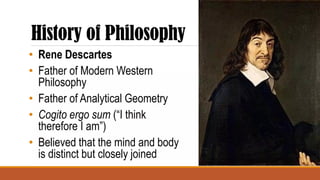
• French philosopher Rene Descartes traced the need to
philosophize to doubt
• Swiss-German philosopher Karl Japers saw the needs to
philosophize because of experience . Japers called there
experiences limit situations
• finally, the need to philosophize is driven by the love of wisdom.
Why is there a need to
philosophize?
32.
• To lovewisdom is to have an insatiable desire for truth.
• Philosopher does not seek knowledge to claim ownership, and
the one who engage in philosophy is not satisfied with figuring
out the answer to questions.
• They seeks to continue to questions to prove and to discuss in
order to get the bottom of the things.
• Through philosophy, we are expanding our knowledge and we
realize that learning is unceasing and there is a lot more to learn
and experience in life
• Socrates recognized for his motto “The unexamined life is not
worth living.
Why is there a need to
philosophize?