1
G. H. Raisoni College of Engineering , Nagpur
Department of First Year Engineering
Subject: Chemistry
TAE V: Technical Presentation
Topic: GREEN CHEMISTRY
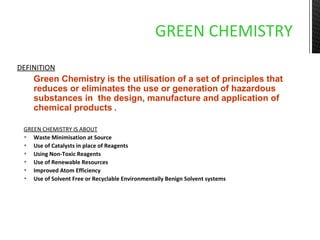
DEFINITION
Green Chemistry is the utilisation of a set of principles that
reduces or eliminates the use or generation of hazardous
substances in the design, manufacture and application of
chemical products .
GREEN CHEMISTRY IS ABOUT
• Waste Minimisation at Source
• Use of Catalysts in place of Reagents
• Using Non-Toxic Reagents
• Use of Renewable Resources
• Improved Atom Efficiency
• Use of Solvent Free or Recyclable Environmentally Benign Solvent systems
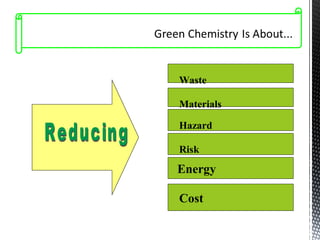
GREEN CHEMISTRY
Cost
Waste
Materials
Hazard
Risk
Energy
 Chemistry is undeniably a very
prominent part of our daily lives.
 Chemical developments also bring
new environmental problems and
harmful unexpected side effects,
which result in the need for
‘greener’ chemical products.
 A famous example is the pesticide
DDT.
Why do we
need
Green
Chemistry
?
 Green chemistry looks at pollution prevention on the molecular scale and
is an extremely important area of Chemistry due to the importance of
Chemistry in our world today and the implications it can show on our
environment.
 The Green Chemistry program supports the invention of more
environmentally friendly chemical processes which reduce or even
eliminate the generation of hazardous substances.
 This program works very closely with the twelve principles of Green
Chemistry.
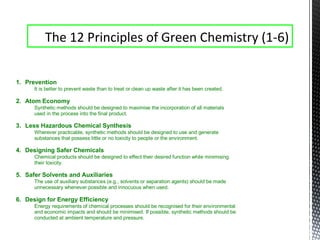
1. Prevention
It is better to prevent waste than to treat or clean up waste after it has been created.
2. Atom Economy
Synthetic methods should be designed to maximise the incorporation of all materials
used in the process into the final product.
3. Less Hazardous Chemical Synthesis
Wherever practicable, synthetic methods should be designed to use and generate
substances that possess little or no toxicity to people or the environment.
4. Designing Safer Chemicals
Chemical products should be designed to effect their desired function while minimising
their toxicity.
5. Safer Solvents and Auxiliaries
The use of auxiliary substances (e.g., solvents or separation agents) should be made
unnecessary whenever possible and innocuous when used.
6. Design for Energy Efficiency
Energy requirements of chemical processes should be recognised for their environmental
and economic impacts and should be minimised. If possible, synthetic methods should be
conducted at ambient temperature and pressure.
The 12 Principles of Green Chemistry (1-6)
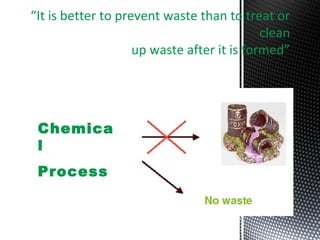
“It is better to prevent waste than to treat or
clean
up waste after it is formed”
Chemica
l
Process
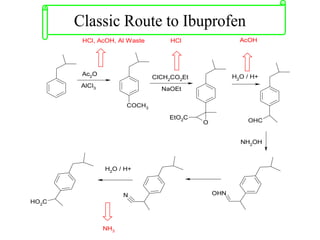
Classic Route to Ibuprofen
Ac2O
AlCl3
COCH3
HCl, AcOH, Al Waste
ClCH2CO2Et
NaOEt
O
EtO2C
HCl
H2O / H+
OHC
AcOH
NH2OH
OHNN
H2O / H+
HO2C
NH3
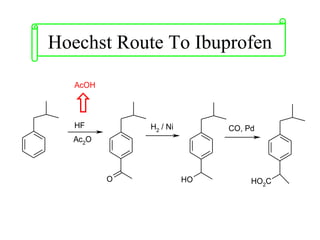
Hoechst Route To Ibuprofen
O
HF
AcOH
Ac2O
H2 / Ni
OH
CO, Pd
HO2C
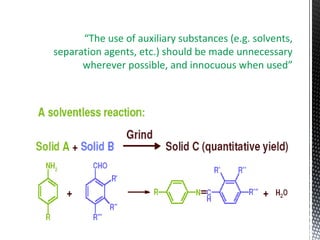
“The use of auxiliary substances (e.g. solvents,
separation agents, etc.) should be made unnecessary
wherever possible, and innocuous when used”
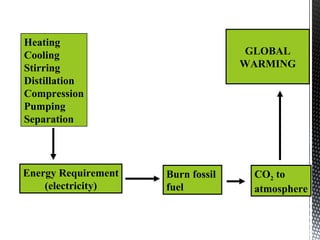
“Energy requirements should be recognized for their
environmental impacts and should be minimized.
Synthetic methods should be conducted at ambient
pressure and temperature”
Heating
Cooling
Stirring
Distillation
Compression
Pumping
Separation
Energy Requirement
(electricity)
Burn fossil
fuel
CO2 to
atmosphere
GLOBAL
WARMING
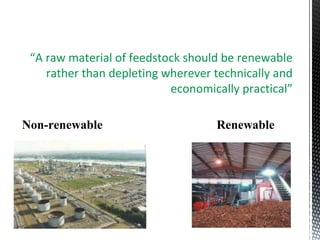
“A raw material of feedstock should be renewable
rather than depleting wherever technically and
economically practical”
Non-renewable Renewable
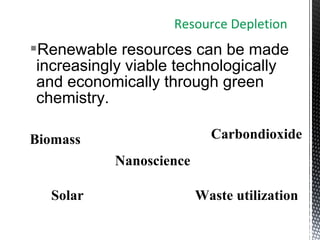
Renewable resources can be made
increasingly viable technologically
and economically through green
chemistry.
Resource Depletion
Biomass
Nanoscience
Solar
Carbondioxide
Waste utilization
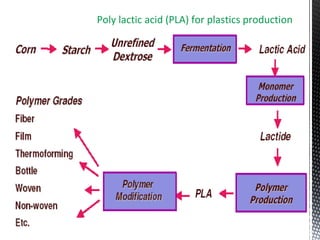
Poly lactic acid (PLA) for plastics production
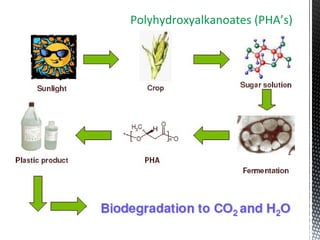
Polyhydroxyalkanoates (PHA’s)
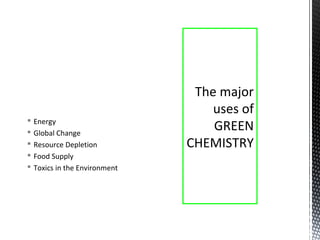
 Energy
 Global Change
 Resource Depletion
 Food Supply
 Toxics in the Environment
The major
uses of
GREEN
CHEMISTRY
The vast majority of the energy
generated in the world today is from
non-renewable sources that
damage the environment.
Carbon dioxide
 Depletion of Ozone layer
 Effects of mining, drilling, etc
 Toxics
Energy
Green Chemistry will be essential in
 developing the alternatives for energy generation (photovoltaics, hydrogen, fuel cells,
biobased fuels, etc.) as well as
 continue the path toward energy efficiency with catalysis and product design at the
forefront.
Energy
Concerns for climate change,
oceanic temperature, stratospheric
chemistry and global distillation can
be addressed through the
development and implementation of
green chemistry technologies.
Global Change
Due to the over
utilization of non-
renewable
resources,
natural resources
are being
depleted at an
unsustainable
rate.
Fossil fuels are
a central issue.
Resource Depletion
Renewable resources can be
made increasingly viable
technologically and
economically through green
chemistry.
 Biomass
 Nanoscience & technology
 Solar
 Carbon dioxide
 Chitin
 Waste utilization
Resource Depletion
While current food levels are sufficient, distribution is inadequate
 Agricultural methods are unsustainable
 Future food production intensity is needed.
 Green chemistry can address many food supply issues
Food Supply
 Green chemistry is developing:
 Pesticides which only affect target
organisms and degrade to innocuous
by-products.
 Fertilizers and fertilizer adjuvants that
are designed to minimize usage while
maximizing effectiveness.
 Methods of using agricultural wastes
for beneficial and profitable uses.
Food Supply
Substances that are toxic to
humans, the biosphere and all
that sustains it, are currently still
being released at a cost of life,
health and sustainability.
 One of green chemistry’s
greatest strengths is the ability
to design for reduced hazard.
Toxics in the Environment
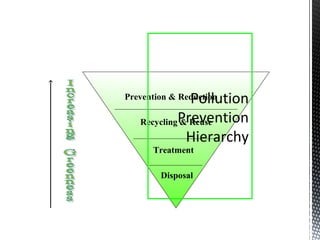
Prevention & Reduction
Recycling & Reuse
Treatment
Disposal
Pollution
Prevention
Hierarchy
Conclusion
Green chemistry Not a solution
to all environmental problems But
the most fundamental approach to
preventing pollution.
Thank you

Green chemistry

  • 1.
    1 G. H. RaisoniCollege of Engineering , Nagpur Department of First Year Engineering Subject: Chemistry TAE V: Technical Presentation Topic: GREEN CHEMISTRY
  • 2.
    DEFINITION Green Chemistry isthe utilisation of a set of principles that reduces or eliminates the use or generation of hazardous substances in the design, manufacture and application of chemical products . GREEN CHEMISTRY IS ABOUT • Waste Minimisation at Source • Use of Catalysts in place of Reagents • Using Non-Toxic Reagents • Use of Renewable Resources • Improved Atom Efficiency • Use of Solvent Free or Recyclable Environmentally Benign Solvent systems GREEN CHEMISTRY
  • 3.
  • 4.
     Chemistry isundeniably a very prominent part of our daily lives.  Chemical developments also bring new environmental problems and harmful unexpected side effects, which result in the need for ‘greener’ chemical products.  A famous example is the pesticide DDT. Why do we need Green Chemistry ?
  • 5.
     Green chemistrylooks at pollution prevention on the molecular scale and is an extremely important area of Chemistry due to the importance of Chemistry in our world today and the implications it can show on our environment.  The Green Chemistry program supports the invention of more environmentally friendly chemical processes which reduce or even eliminate the generation of hazardous substances.  This program works very closely with the twelve principles of Green Chemistry.
  • 6.
    1. Prevention It isbetter to prevent waste than to treat or clean up waste after it has been created. 2. Atom Economy Synthetic methods should be designed to maximise the incorporation of all materials used in the process into the final product. 3. Less Hazardous Chemical Synthesis Wherever practicable, synthetic methods should be designed to use and generate substances that possess little or no toxicity to people or the environment. 4. Designing Safer Chemicals Chemical products should be designed to effect their desired function while minimising their toxicity. 5. Safer Solvents and Auxiliaries The use of auxiliary substances (e.g., solvents or separation agents) should be made unnecessary whenever possible and innocuous when used. 6. Design for Energy Efficiency Energy requirements of chemical processes should be recognised for their environmental and economic impacts and should be minimised. If possible, synthetic methods should be conducted at ambient temperature and pressure. The 12 Principles of Green Chemistry (1-6)
  • 7.
    “It is betterto prevent waste than to treat or clean up waste after it is formed” Chemica l Process
  • 8.
    Classic Route toIbuprofen Ac2O AlCl3 COCH3 HCl, AcOH, Al Waste ClCH2CO2Et NaOEt O EtO2C HCl H2O / H+ OHC AcOH NH2OH OHNN H2O / H+ HO2C NH3
  • 9.
    Hoechst Route ToIbuprofen O HF AcOH Ac2O H2 / Ni OH CO, Pd HO2C
  • 10.
    “The use ofauxiliary substances (e.g. solvents, separation agents, etc.) should be made unnecessary wherever possible, and innocuous when used”
  • 11.
    “Energy requirements shouldbe recognized for their environmental impacts and should be minimized. Synthetic methods should be conducted at ambient pressure and temperature”
  • 12.
  • 13.
    “A raw materialof feedstock should be renewable rather than depleting wherever technically and economically practical” Non-renewable Renewable
  • 15.
    Renewable resources canbe made increasingly viable technologically and economically through green chemistry. Resource Depletion Biomass Nanoscience Solar Carbondioxide Waste utilization
  • 16.
    Poly lactic acid(PLA) for plastics production
  • 17.
  • 18.
     Energy  GlobalChange  Resource Depletion  Food Supply  Toxics in the Environment The major uses of GREEN CHEMISTRY
  • 19.
    The vast majorityof the energy generated in the world today is from non-renewable sources that damage the environment. Carbon dioxide  Depletion of Ozone layer  Effects of mining, drilling, etc  Toxics Energy
  • 20.
    Green Chemistry willbe essential in  developing the alternatives for energy generation (photovoltaics, hydrogen, fuel cells, biobased fuels, etc.) as well as  continue the path toward energy efficiency with catalysis and product design at the forefront. Energy
  • 21.
    Concerns for climatechange, oceanic temperature, stratospheric chemistry and global distillation can be addressed through the development and implementation of green chemistry technologies. Global Change
  • 22.
    Due to theover utilization of non- renewable resources, natural resources are being depleted at an unsustainable rate. Fossil fuels are a central issue. Resource Depletion
  • 23.
    Renewable resources canbe made increasingly viable technologically and economically through green chemistry.  Biomass  Nanoscience & technology  Solar  Carbon dioxide  Chitin  Waste utilization Resource Depletion
  • 24.
    While current foodlevels are sufficient, distribution is inadequate  Agricultural methods are unsustainable  Future food production intensity is needed.  Green chemistry can address many food supply issues Food Supply
  • 25.
     Green chemistryis developing:  Pesticides which only affect target organisms and degrade to innocuous by-products.  Fertilizers and fertilizer adjuvants that are designed to minimize usage while maximizing effectiveness.  Methods of using agricultural wastes for beneficial and profitable uses. Food Supply
  • 26.
    Substances that aretoxic to humans, the biosphere and all that sustains it, are currently still being released at a cost of life, health and sustainability.  One of green chemistry’s greatest strengths is the ability to design for reduced hazard. Toxics in the Environment
  • 27.
    Prevention & Reduction Recycling& Reuse Treatment Disposal Pollution Prevention Hierarchy
  • 28.
    Conclusion Green chemistry Nota solution to all environmental problems But the most fundamental approach to preventing pollution.
  • 29.