• Waste managementis all those activities and action
requiredto managewaste from its inception to its
final disposal.
• This includes amongstother things, collection,
transport, treatment and disposal of waste together
with monitoringand regulation.
• It alsoencompasses the legal and regulatory
framework the relates to waste management
encompassingguidanceonrecyclingetc.
• ‘Wastemanagement’shallmean“thecollection,
transport,recoveryanddisposal ofwaste,including
thesupervisionofsuchoperationsandaftercareof
disposalsites”
….EuropeanUnionDirective onwaste
• However the newer concepts of ‘Waste management’
talk about‘Reduce,ReuseandRecycleof waste’over
andabovewastedisposal.
• ENVIRONMENTAL EFFECTS:
 Surface water contamination
 Ground Water contamination
 Soil contamination
 Air contamination
• ECONOMIC EFFECTS:
 Municipal wellbeing
 Recycling revenue
• Saves limited natural
resources.
• Prevents greenhouse gas
emissions and water
pollutants.
• Saves energy.
• Provides raw materials for
industry and creates jobs
• Saves landfill space.
⦿ Make double sided copies.
⦿ Circulate memos, documents and periodicals.
⦿ Use durable cups and silverware.
⦿ Proof-read documents on the computer screen.
⦿Purchase merchandise with minimal packaging or
order in bulk.
⦿ Read periodicals online.
⦿ Send e-cards.
⦿Reduce your junk mail by writing to the Direct
Marketing Association at Mail Preference Service, PO
Box 9008, Farmingdale, NY 1
1735-9008.
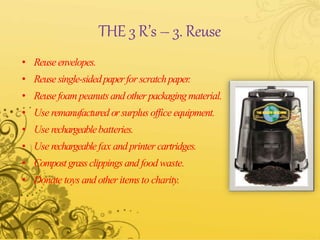
THE 3 R’s – 3. Reuse
• Reuseenvelopes.
• Reusesingle-sidedpaperfor scratchpaper.
• Reusefoam peanutsandother packagingmaterial.
• Use remanufactured orsurplus office equipment.
• Use rechargeablebatteries.
• Use rechargeablefax andprinter cartridges.
• Compostgrassclippings and food waste.
• Donate toys andother itemsto charity.
WASTEHIERARCHYCHART
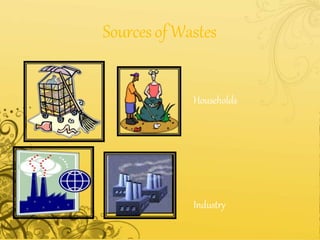
Sourcesof Wastes
Households
Industry
Sourcesof Wastes
Agriculture
Fisheries
11
Method of
disposal
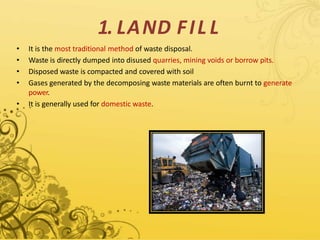
1. LAND FIL L
• It is the most traditional method of waste disposal.
• Waste is directly dumped into disused quarries, mining voids or borrow pits.
• Disposed waste is compacted and covered with soil
• Gases generated by the decomposing waste materials are often burnt to generate
power.
• It is generally used for domestic waste.
ADVANTAGES
⦁ site is a cheap waste disposal option for the local council.
⦁ Jobs will be created for local people.
⦁ Lots of different types of waste can be disposed of by landfill in comparison
to other waste disposal methods.
⦁ The gases given off by the landfill site could be collected and used for
generating power.
DISADVANTAGES
⦁ The site will look ugly while it is being used for landfill.
⦁ Dangerous gases are given off from landfill sites that cause local air pollution
and contribute to global warming.
⦁ Local streams could become polluted with toxins seeping through the ground
from the landfill site.
⦁ Once the site has been filled it might not be able to be used for
redevelopment as it might be too polluted.
LAND REQUIRED FOR DISPOSAL
OF MSW
EMMISION OF METHANE FROM
LANDFILL
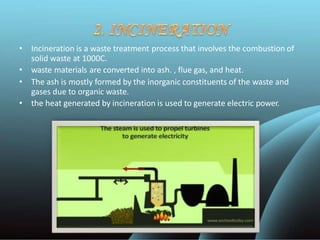
• Incineration is a waste treatment process that involves the combustion of
solid waste at 1000C.
• waste materials are converted into ash. , flue gas, and heat.
• The ash is mostly formed by the inorganic constituents of the waste and
gases due to organic waste.
• the heat generated by incineration is used to generate electric power.
ADVANTAGES
⦁ Minimum of land is needed compared to other disposal methods.
⦁ The weight of the waste is reduced to 25% of the initial value.
⦁ No risk of polluting local streams and ground waters as in landfills.
⦁ Incineration plants can be located close to residential areas.
⦁ Gases are used to generate power
DISADVANTAGES
⦁ Expensive
⦁ Required skilled labour.
⦁ The chemicals that would be released into the air could be strong pollutants and
may destroy ozone layer (major disadvantage).
⦁ high energy requirement.
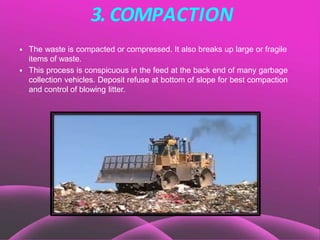
3. COMPACTION
⦁ The waste is compacted or compressed. It also breaks up large or fragile
items of waste.
⦁ This process is conspicuous in the feed at the back end of many garbage
collection vehicles. Deposit refuse at bottom of slope for best compaction
and control of blowing litter.
4. PYROLYSIS
• Pyrolysis is defined as thermal degradation of waste in the absence of air
to produce char, pyrolysis oil and syngas, e.g. the conversion of wood to
charcoal also it is defined as destructive distillation of waste in the
absence of oxygen. External source of heat is employed in this process.
MAKING
Biogas
• Biogas typically refers to a mixture of
different gases produced by the
breakdown of organic matter in the
absence of oxygen. Biogas can be
produced from raw materials such as
agricultural waste, manure,
municipal waste, plant material,
sewage, green waste or food waste.
It is a renewable energy source and
in many cases exerts a very small
carbon footprint.
PROBLEMS WITH PLASTIC
 Disposal of waste plastic is amajorproblem
 It is non-biodegradable
 Burning of these waste plastic bagscausesenvironmental polluti
on.
 It mainly consists of low-density polyethylene
 Tofind its utility in bituminous mixesfor roadconstruction, labo
ratory performancestudies wereconducted onbituminous mixes.
Laboratorystudies provedthat wasteplastic enhancesthepropert
y of themix.
 Improvement in properties of bituminousmix provides the solutio
n for auseful disposal of plastic waste.
MAKINGPLASTICROADS
Plastic use in road
construction is not new.
Recent studies in this direction
have shown some hope in
terms of using plastic-waste in
road construction i.e., Plastic
roads. Plastic roads mainly
use plastic carry-bags,
disposable cups and PET
bottles that are collected from
garbage dumps as an
important ingredient of the
construction material. When
mixed with hot bitumen,
plastics melt to form an oily
coat over the aggregate and
the mixture is laid on the road
surface like a normal tar road.
• ADVANTAGES :-
 No crackingorpotholes
 Resistanceto water
 Reducedcost of maintenance
 Reducedstresson bitumen which is not an unlimitedresourceeither.
• DISADVANTAGES :-
 Cleaningprocess-Toxicspresentin the co-mingledplastic waste would start leaching.
 During the roadlaying process-in the presenceof chlorinewill definitely release
noxiousHCLgas.
 After the roadlaying- It is opinedthat the first rainwill triggerleaching.As the
plasticswill merelyformasticky layer,(mechanicalabrasion).
 Thecomponentsof the road,onceit hasbeenlaid,arenot inert.
Solid Waste in India
• 7.2 million tonnes of hazardous waste
• One Sq km of additional landfill area every-year
• Rs 1600 crore for treatment & disposal of these wastes
• In addition to this industries discharge about 150 million tonnes of high
volume low hazard waste every year, which is mostly dumped on open
low lying land areas.
Growth of Solid Waste In India
• Waste is growing by leaps & bounds
• In 1981-91, population of Mumbai increased from 8.2 million to 12.3
million
• During the same period, municipal solid waste has grown from 3200
tonnes to 5355 tonne, an increase of 67%
• City like Bangalore produces 2000 tonnes of waste per annum.
• Waste collection is very low for all Indian cities.
WASTES PER INDIAN CITIES
Waste Collection in India
• Primarily by the city municipality
-No gradation of waste product e.g. bio-degradable, glasses, polybags, paper
shreds etc
-Dumps these wastes to the city outskirts
• Local raddiwala / kabadiwala
• -Collecting small iron pieces by magnets
-Collecting glass bottles
-Collecting paper for recycling
How solid waste affected us in recent years?
• In Mumbai (2005) clogged the sewage line due to large no. of plastic bags.
• Blast in the Bhusan Steel factory at Noida, caused due to imported scrap from
Iran
• Reduction in the number of migratory birds due to consumption of
contaminated foods
• animals dying on streets and farmland due to consumption of plastic bags, which
blocks the food movement in their stomach
INTERNATIONAL AWARENESS
REGARDING WASTE
• At the1992 Rio Conference,wastewasmadeoneof thepriorities of
Agenda21
• Agenda21isacomprehensiveplanofactiontobetakenglobally,
nationally andlocallyandwasadoptedbymorethan178Governments
at theUnitedNationsConferenceinRiodeJaneiro
• At theJohannesburgWorld SummitonSustainableDevelopmentin
2002, thefocuswason
• Initiatives toacceleratetheshift tosustainableconsumptionand
productionreductionof resourcedegradation,pollution andwaste.
INTERNATIONAL AWARENESS
REGARDING WASTE
• ImplementationplanadoptedbytheSummit,statedthepriorityto:
• "
Preventandminimizewaste& maximizereuse,recycling & useof
environmentallyfriendly alternativematerials,with theparticipation
of governmentauthorities
• allstakeholderstominimizeadverseeffectsontheenvironmentand
improveresourceefficiency, withfinancial,technical andother
assistancefor developingcountries.”
• This wouldincludeactions atall levelsto:
• Developwastemanagementsystems,with thehighestpriorityplacedon
wastepreventionandminimization,reuseandrecycling,and
environmentally sounddisposalfacilities,including technologyto
recapturetheenergycontainedinwaste.
• Promotewaste preventionandminimization by encouraging
productionofreusableconsumergoodsandbiodegradable
products.
WASTE MANAGEMENT POLICIES
• Environment protection act, 1986
• Hazardous waste rule 1989
• Bio-medical waste rule 1998
• Municipal solid waste rule 2000
• Waste management act 1996
• Solid waste policy in India 2006
DID YOU KNOW
• About 0.1 million tonnesof municipal solid waste is generated in India
everyday. That is approximately36.5 milliontonnesannually.
• Percapita waste generationin major Indian citiesrangesfrom 0.2 Kg
to 0.6 Kg.
• Differencein percapita waste generationbetween lower and higher
incomegroupsrangebetween 180 to 800gmperday.
• TheurbanlocalbodiesspendapproximatelyRs.500 to Rs.1500per
tonne onsolid waste for collection,transportation,treatment and
disposal.About 60-70%of this amount is spent oncollection,20-30%
ontransportationand lessthan 5%onfinal disposal.
• Calorificvalue of Indian solid waste is between 600 and 800 Kcal/Kg
and the densityof waste is between 330and 560Kg/m3.
DID YOU KNOW
• Waste collection efficiency in Indian cities ranges from 50% to 90%.
• Out of the total municipal waste collected, on an average 94% is dumped
on land and 5% is composted.
• Between 2000 and 2025 the waste composition of Indian garbage will
undergo the following changes:
• Organic Waste will go up from 40 percent to 60 percent
• Plastic will rise from 4% to 6%
• Metal will escalate from 1% to 4%
• Glass will increase from 2% to 3%
• Paper will climb from 5% to 15%
• Others (ash, sand, grit) will decrease from 47% to 12%
 It is found that with increase in the global pop
ulation and the rising demand for food and ot
her essentials, there has been a rise in the a
mount of waste being generated daily by eac
h household. Waste that is not properly mana
ged, especially excreta and other liquid and s
olid waste from households and the communi
ty, are a serious health hazard and lead to the
spread of infectious diseases.
Waste Management Methods.pptx

Waste Management Methods.pptx

  • 3.
    • Waste managementisall those activities and action requiredto managewaste from its inception to its final disposal. • This includes amongstother things, collection, transport, treatment and disposal of waste together with monitoringand regulation. • It alsoencompasses the legal and regulatory framework the relates to waste management encompassingguidanceonrecyclingetc.
  • 4.
    • ‘Wastemanagement’shallmean“thecollection, transport,recoveryanddisposal ofwaste,including thesupervisionofsuchoperationsandaftercareof disposalsites” ….EuropeanUnionDirectiveonwaste • However the newer concepts of ‘Waste management’ talk about‘Reduce,ReuseandRecycleof waste’over andabovewastedisposal.
  • 5.
    • ENVIRONMENTAL EFFECTS: Surface water contamination  Ground Water contamination  Soil contamination  Air contamination • ECONOMIC EFFECTS:  Municipal wellbeing  Recycling revenue
  • 6.
    • Saves limitednatural resources. • Prevents greenhouse gas emissions and water pollutants. • Saves energy. • Provides raw materials for industry and creates jobs • Saves landfill space.
  • 7.
    ⦿ Make doublesided copies. ⦿ Circulate memos, documents and periodicals. ⦿ Use durable cups and silverware. ⦿ Proof-read documents on the computer screen. ⦿Purchase merchandise with minimal packaging or order in bulk. ⦿ Read periodicals online. ⦿ Send e-cards. ⦿Reduce your junk mail by writing to the Direct Marketing Association at Mail Preference Service, PO Box 9008, Farmingdale, NY 1 1735-9008.
  • 8.
    THE 3 R’s– 3. Reuse • Reuseenvelopes. • Reusesingle-sidedpaperfor scratchpaper. • Reusefoam peanutsandother packagingmaterial. • Use remanufactured orsurplus office equipment. • Use rechargeablebatteries. • Use rechargeablefax andprinter cartridges. • Compostgrassclippings and food waste. • Donate toys andother itemsto charity.
  • 9.
  • 10.
  • 11.
  • 13.
  • 14.
    1. LAND FILL • It is the most traditional method of waste disposal. • Waste is directly dumped into disused quarries, mining voids or borrow pits. • Disposed waste is compacted and covered with soil • Gases generated by the decomposing waste materials are often burnt to generate power. • It is generally used for domestic waste.
  • 15.
    ADVANTAGES ⦁ site isa cheap waste disposal option for the local council. ⦁ Jobs will be created for local people. ⦁ Lots of different types of waste can be disposed of by landfill in comparison to other waste disposal methods. ⦁ The gases given off by the landfill site could be collected and used for generating power. DISADVANTAGES ⦁ The site will look ugly while it is being used for landfill. ⦁ Dangerous gases are given off from landfill sites that cause local air pollution and contribute to global warming. ⦁ Local streams could become polluted with toxins seeping through the ground from the landfill site. ⦁ Once the site has been filled it might not be able to be used for redevelopment as it might be too polluted.
  • 16.
    LAND REQUIRED FORDISPOSAL OF MSW EMMISION OF METHANE FROM LANDFILL
  • 17.
    • Incineration isa waste treatment process that involves the combustion of solid waste at 1000C. • waste materials are converted into ash. , flue gas, and heat. • The ash is mostly formed by the inorganic constituents of the waste and gases due to organic waste. • the heat generated by incineration is used to generate electric power.
  • 18.
    ADVANTAGES ⦁ Minimum ofland is needed compared to other disposal methods. ⦁ The weight of the waste is reduced to 25% of the initial value. ⦁ No risk of polluting local streams and ground waters as in landfills. ⦁ Incineration plants can be located close to residential areas. ⦁ Gases are used to generate power DISADVANTAGES ⦁ Expensive ⦁ Required skilled labour. ⦁ The chemicals that would be released into the air could be strong pollutants and may destroy ozone layer (major disadvantage). ⦁ high energy requirement.
  • 19.
    3. COMPACTION ⦁ Thewaste is compacted or compressed. It also breaks up large or fragile items of waste. ⦁ This process is conspicuous in the feed at the back end of many garbage collection vehicles. Deposit refuse at bottom of slope for best compaction and control of blowing litter.
  • 20.
    4. PYROLYSIS • Pyrolysisis defined as thermal degradation of waste in the absence of air to produce char, pyrolysis oil and syngas, e.g. the conversion of wood to charcoal also it is defined as destructive distillation of waste in the absence of oxygen. External source of heat is employed in this process.
  • 22.
    MAKING Biogas • Biogas typicallyrefers to a mixture of different gases produced by the breakdown of organic matter in the absence of oxygen. Biogas can be produced from raw materials such as agricultural waste, manure, municipal waste, plant material, sewage, green waste or food waste. It is a renewable energy source and in many cases exerts a very small carbon footprint.
  • 23.
    PROBLEMS WITH PLASTIC Disposal of waste plastic is amajorproblem  It is non-biodegradable  Burning of these waste plastic bagscausesenvironmental polluti on.  It mainly consists of low-density polyethylene  Tofind its utility in bituminous mixesfor roadconstruction, labo ratory performancestudies wereconducted onbituminous mixes. Laboratorystudies provedthat wasteplastic enhancesthepropert y of themix.  Improvement in properties of bituminousmix provides the solutio n for auseful disposal of plastic waste.
  • 24.
    MAKINGPLASTICROADS Plastic use inroad construction is not new. Recent studies in this direction have shown some hope in terms of using plastic-waste in road construction i.e., Plastic roads. Plastic roads mainly use plastic carry-bags, disposable cups and PET bottles that are collected from garbage dumps as an important ingredient of the construction material. When mixed with hot bitumen, plastics melt to form an oily coat over the aggregate and the mixture is laid on the road surface like a normal tar road.
  • 25.
    • ADVANTAGES :- No crackingorpotholes  Resistanceto water  Reducedcost of maintenance  Reducedstresson bitumen which is not an unlimitedresourceeither. • DISADVANTAGES :-  Cleaningprocess-Toxicspresentin the co-mingledplastic waste would start leaching.  During the roadlaying process-in the presenceof chlorinewill definitely release noxiousHCLgas.  After the roadlaying- It is opinedthat the first rainwill triggerleaching.As the plasticswill merelyformasticky layer,(mechanicalabrasion).  Thecomponentsof the road,onceit hasbeenlaid,arenot inert.
  • 26.
    Solid Waste inIndia • 7.2 million tonnes of hazardous waste • One Sq km of additional landfill area every-year • Rs 1600 crore for treatment & disposal of these wastes • In addition to this industries discharge about 150 million tonnes of high volume low hazard waste every year, which is mostly dumped on open low lying land areas. Growth of Solid Waste In India • Waste is growing by leaps & bounds • In 1981-91, population of Mumbai increased from 8.2 million to 12.3 million • During the same period, municipal solid waste has grown from 3200 tonnes to 5355 tonne, an increase of 67% • City like Bangalore produces 2000 tonnes of waste per annum. • Waste collection is very low for all Indian cities.
  • 27.
  • 28.
    Waste Collection inIndia • Primarily by the city municipality -No gradation of waste product e.g. bio-degradable, glasses, polybags, paper shreds etc -Dumps these wastes to the city outskirts • Local raddiwala / kabadiwala • -Collecting small iron pieces by magnets -Collecting glass bottles -Collecting paper for recycling How solid waste affected us in recent years? • In Mumbai (2005) clogged the sewage line due to large no. of plastic bags. • Blast in the Bhusan Steel factory at Noida, caused due to imported scrap from Iran • Reduction in the number of migratory birds due to consumption of contaminated foods • animals dying on streets and farmland due to consumption of plastic bags, which blocks the food movement in their stomach
  • 29.
    INTERNATIONAL AWARENESS REGARDING WASTE •At the1992 Rio Conference,wastewasmadeoneof thepriorities of Agenda21 • Agenda21isacomprehensiveplanofactiontobetakenglobally, nationally andlocallyandwasadoptedbymorethan178Governments at theUnitedNationsConferenceinRiodeJaneiro • At theJohannesburgWorld SummitonSustainableDevelopmentin 2002, thefocuswason • Initiatives toacceleratetheshift tosustainableconsumptionand productionreductionof resourcedegradation,pollution andwaste.
  • 30.
    INTERNATIONAL AWARENESS REGARDING WASTE •ImplementationplanadoptedbytheSummit,statedthepriorityto: • " Preventandminimizewaste& maximizereuse,recycling & useof environmentallyfriendly alternativematerials,with theparticipation of governmentauthorities • allstakeholderstominimizeadverseeffectsontheenvironmentand improveresourceefficiency, withfinancial,technical andother assistancefor developingcountries.” • This wouldincludeactions atall levelsto: • Developwastemanagementsystems,with thehighestpriorityplacedon wastepreventionandminimization,reuseandrecycling,and environmentally sounddisposalfacilities,including technologyto recapturetheenergycontainedinwaste.
  • 31.
    • Promotewaste preventionandminimizationby encouraging productionofreusableconsumergoodsandbiodegradable products.
  • 32.
    WASTE MANAGEMENT POLICIES •Environment protection act, 1986 • Hazardous waste rule 1989 • Bio-medical waste rule 1998 • Municipal solid waste rule 2000 • Waste management act 1996 • Solid waste policy in India 2006
  • 33.
    DID YOU KNOW •About 0.1 million tonnesof municipal solid waste is generated in India everyday. That is approximately36.5 milliontonnesannually. • Percapita waste generationin major Indian citiesrangesfrom 0.2 Kg to 0.6 Kg. • Differencein percapita waste generationbetween lower and higher incomegroupsrangebetween 180 to 800gmperday. • TheurbanlocalbodiesspendapproximatelyRs.500 to Rs.1500per tonne onsolid waste for collection,transportation,treatment and disposal.About 60-70%of this amount is spent oncollection,20-30% ontransportationand lessthan 5%onfinal disposal. • Calorificvalue of Indian solid waste is between 600 and 800 Kcal/Kg and the densityof waste is between 330and 560Kg/m3.
  • 34.
    DID YOU KNOW •Waste collection efficiency in Indian cities ranges from 50% to 90%. • Out of the total municipal waste collected, on an average 94% is dumped on land and 5% is composted. • Between 2000 and 2025 the waste composition of Indian garbage will undergo the following changes: • Organic Waste will go up from 40 percent to 60 percent • Plastic will rise from 4% to 6% • Metal will escalate from 1% to 4% • Glass will increase from 2% to 3% • Paper will climb from 5% to 15% • Others (ash, sand, grit) will decrease from 47% to 12%
  • 35.
     It isfound that with increase in the global pop ulation and the rising demand for food and ot her essentials, there has been a rise in the a mount of waste being generated daily by eac h household. Waste that is not properly mana ged, especially excreta and other liquid and s olid waste from households and the communi ty, are a serious health hazard and lead to the spread of infectious diseases.