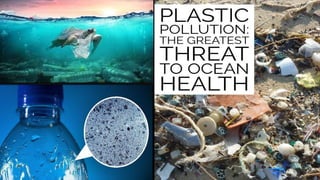
PLASTIC POLLUTION
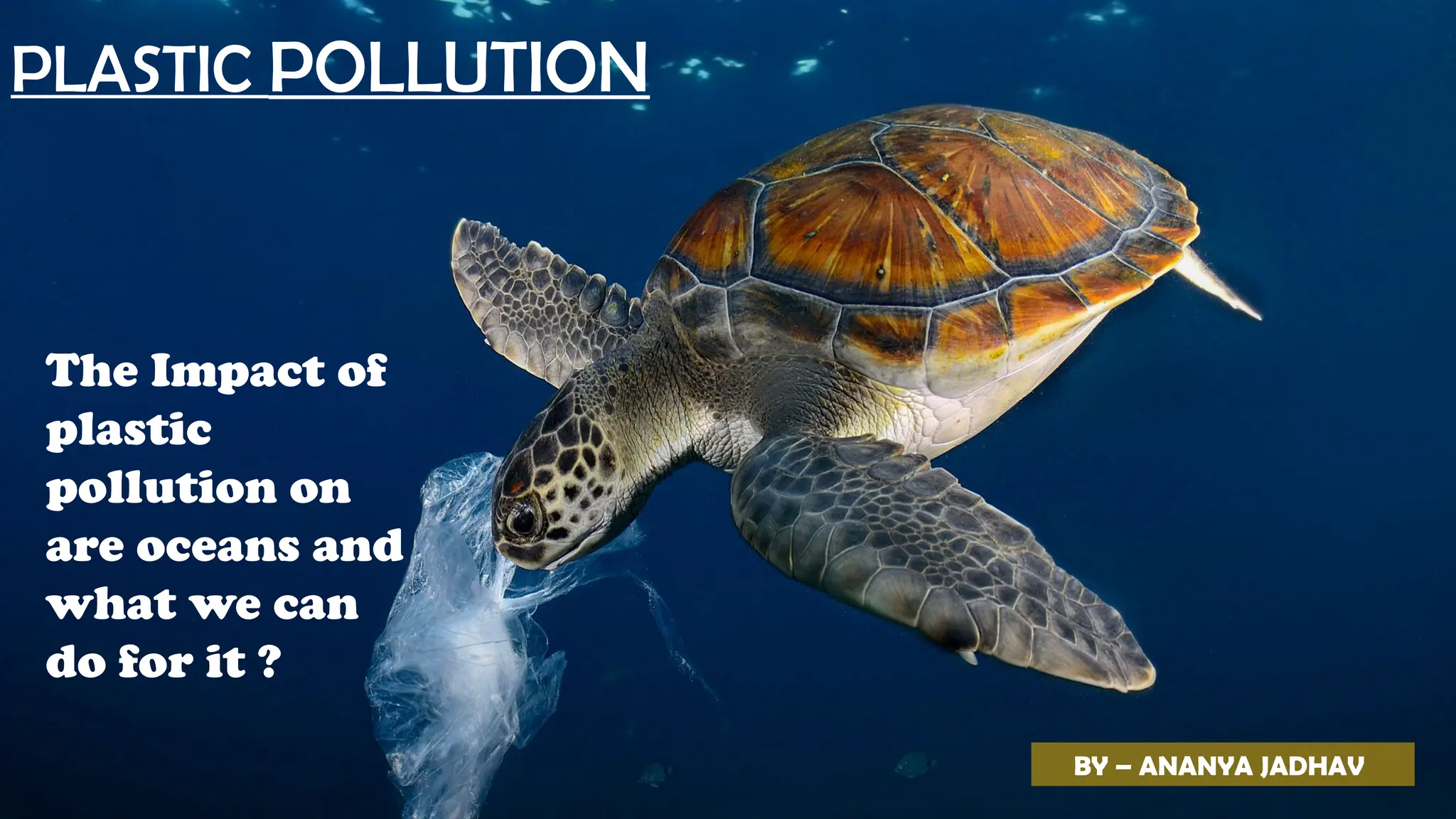
The Impact of
plastic
pollution on
are oceans and
what we can
do for it ?
BY – ANANYA JADHAV
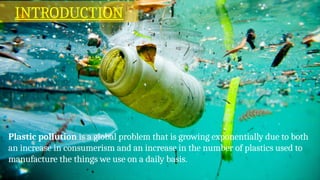
Plastic pollution is a global problem that is growing exponentially due to both
an increase in consumerism and an increase in the number of plastics used to
manufacture the things we use on a daily basis.
INTRODUCTION
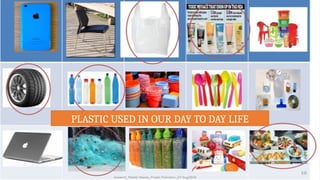
PLASTIC USED IN OUR DAY TO DAY LIFE
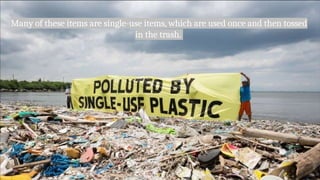
Many of these items are single-use items, which are used once and then tossed
in the trash.
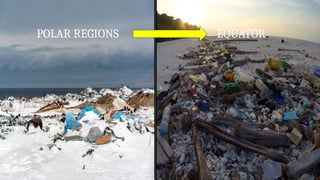
POLAR REGIONS EQUATOR
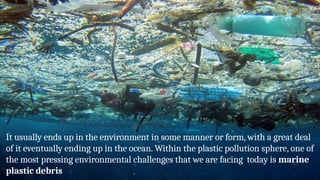
It usually ends up in the environment in some manner or form, with a great deal
of it eventually ending up in the ocean. Within the plastic pollution sphere, one of
the most pressing environmental challenges that we are facing today is marine
plastic debris
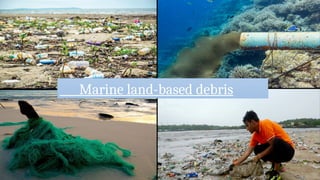
Marine land-based debris
“
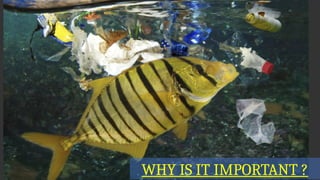
WHY IS IT IMPORTANT ?
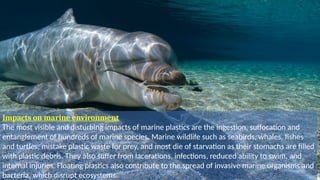
Impacts on marine environment
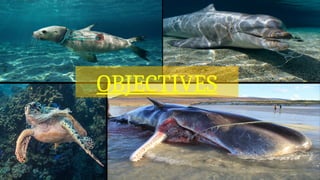
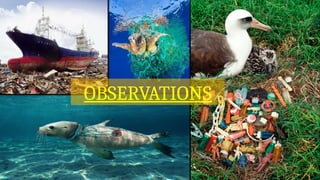
The most visible and disturbing impacts of marine plastics are the ingestion, suffocation and
entanglement of hundreds of marine species. Marine wildlife such as seabirds, whales, fishes
and turtles, mistake plastic waste for prey, and most die of starvation as their stomachs are filled
with plastic debris. They also suffer from lacerations, infections, reduced ability to swim, and
internal injuries. Floating plastics also contribute to the spread of invasive marine organisms and
bacteria, which disrupt ecosystems.
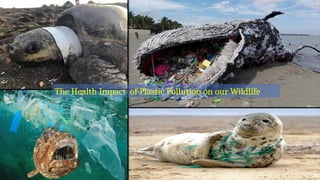
The Health Impact of Plastic Pollution on our Wildlife
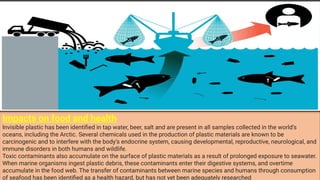
Impacts on food and health
Invisible plastic has been identified in tap water, beer, salt and are present in all samples collected in the world’s
oceans, including the Arctic. Several chemicals used in the production of plastic materials are known to be
carcinogenic and to interfere with the body’s endocrine system, causing developmental, reproductive, neurological, and
immune disorders in both humans and wildlife.
Toxic contaminants also accumulate on the surface of plastic materials as a result of prolonged exposure to seawater.
When marine organisms ingest plastic debris, these contaminants enter their digestive systems, and overtime
accumulate in the food web. The transfer of contaminants between marine species and humans through consumption
of seafood has been identified as a health hazard, but has not yet been adequately researched
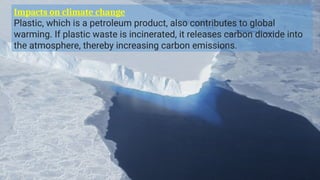
Impacts on climate change
Plastic, which is a petroleum product, also contributes to global
warming. If plastic waste is incinerated, it releases carbon dioxide into
the atmosphere, thereby increasing carbon emissions.
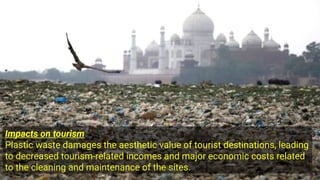
Impacts on tourism
Plastic waste damages the aesthetic value of tourist destinations, leading
to decreased tourism-related incomes and major economic costs related
to the cleaning and maintenance of the sites.
OBJECTIVES
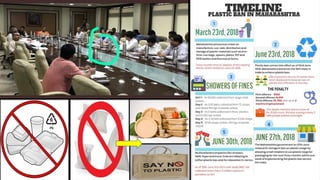
The government of India decided to ban single use plastics and take a number of measures
to recycle and reuse plastic, from 2 October 2019.
The Ministry of Drinking Water and Sanitation, Government of India, has requested
various governmental departments to avoid the use of plastic bottles to provide drinking
water during governmental meetings, etc., and to instead make arrangements for providing
drinking water that do not generate plastic waste
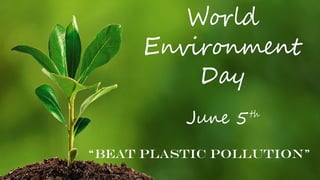
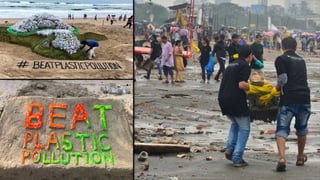
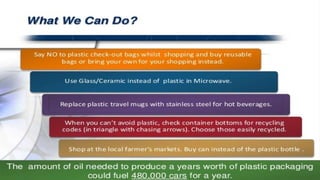
“BEAT PLASTIC POLLUTION”
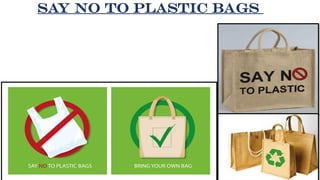
Say NO to Plastic Bags ​
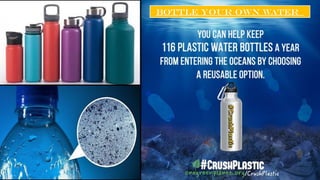
Bottle your Own Water
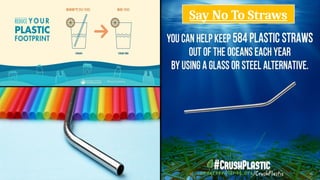
Say No To Straws
OBSERVATIONS
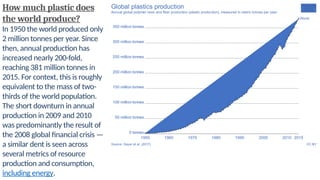
How much plastic does
the world produce?
In 1950 the world produced only
2 million tonnes per year. Since
then, annual production has
increased nearly 200-fold,
reaching 381 million tonnes in
2015. For context, this is roughly
equivalent to the mass of two-
thirds of the world population.
The short downturn in annual
production in 2009 and 2010
was predominantly the result of
the 2008 global financial crisis —
a similar dent is seen across
several metrics of resource
production and consumption,
including energy.
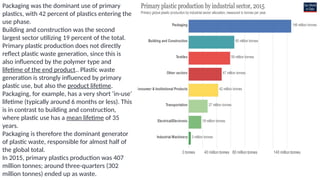
Packaging was the dominant use of primary
plastics, with 42 percent of plastics entering the
use phase.
Building and construction was the second
largest sector utilizing 19 percent of the total.
Primary plastic production does not directly
reflect plastic waste generation, since this is
also influenced by the polymer type and
lifetime of the end product.. Plastic waste
generation is strongly influenced by primary
plastic use, but also the product lifetime.
Packaging, for example, has a very short ‘in-use’
lifetime (typically around 6 months or less). This
is in contrast to building and construction,
where plastic use has a mean lifetime of 35
years.
Packaging is therefore the dominant generator
of plastic waste, responsible for almost half of
the global total.
In 2015, primary plastics production was 407
million tonnes; around three-quarters (302
million tonnes) ended up as waste.
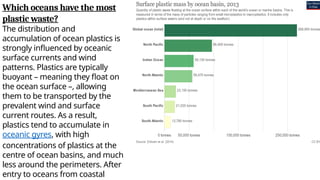
Which oceans have the most
plastic waste?
The distribution and
accumulation of ocean plastics is
strongly influenced by oceanic
surface currents and wind
patterns. Plastics are typically
buoyant – meaning they float on
the ocean surface –, allowing
them to be transported by the
prevalent wind and surface
current routes. As a result,
plastics tend to accumulate in
oceanic gyres, with high
concentrations of plastics at the
centre of ocean basins, and much
less around the perimeters. After
entry to oceans from coastal
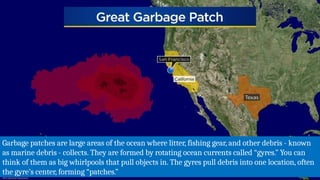
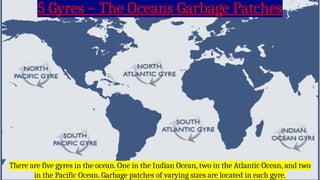
Garbage patches are large areas of the ocean where litter, fishing gear, and other debris - known
as marine debris - collects. They are formed by rotating ocean currents called “gyres.” You can
think of them as big whirlpools that pull objects in. The gyres pull debris into one location, often
the gyre’s center, forming “patches.”
5 Gyres – The Oceans Garbage Patches
There are five gyres in the ocean. One in the Indian Ocean, two in the Atlantic Ocean, and two
in the Pacific Ocean. Garbage patches of varying sizes are located in each gyre.
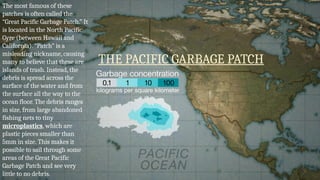
THE PACIFIC GARBAGE PATCH
The most famous of these
patches is often called the
“Great Pacific Garbage Patch.” It
is located in the North Pacific
Gyre (between Hawaii and
California). “Patch” is a
misleading nickname, causing
many to believe that these are
islands of trash. Instead, the
debris is spread across the
surface of the water and from
the surface all the way to the
ocean floor. The debris ranges
in size, from large abandoned
fishing nets to tiny
microplastics, which are
plastic pieces smaller than
5mm in size. This makes it
possible to sail through some
areas of the Great Pacific
Garbage Patch and see very
little to no debris.
Use a razor
with
disposable
baldes,
rather than
a
disposable
Make your
own
deodorant
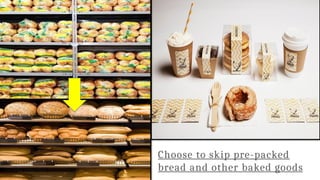
Choose to skip pre-packed
bread and other baked goods
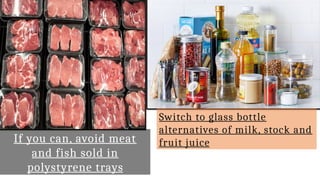
If you can, avoid meat
and fish sold in
polystyrene trays
Switch to glass bottle
alternatives of milk, stock and
fruit juice
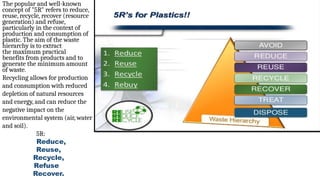
The popular and well-known
concept of "5R" refers to reduce,
reuse, recycle, recover (resource
generation) and refuse,
particularly in the context of
production and consumption of
plastic. The aim of the waste
hierarchy is to extract
the maximum practical
benefits from products and to
generate the minimum amount
of waste.
Recycling allows for production
and consumption with reduced
depletion of natural resources
and energy, and can reduce the
negative impact on the
environmental system (air, water
and soil).
5R:
Reduce,
Reuse,
Recycle,
Refuse
Recover.
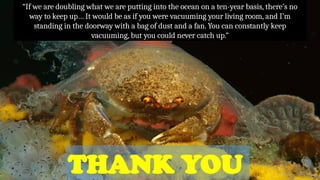
“If we are doubling what we are putting into the ocean on a ten-year basis, there’s no
way to keep up… It would be as if you were vacuuming your living room, and I’m
standing in the doorway with a bag of dust and a fan. You can constantly keep
vacuuming, but you could never catch up.”
THANK YOU

Plastic Pollution and its effects on oceans

  • 1.
    PLASTIC POLLUTION The Impactof plastic pollution on are oceans and what we can do for it ? BY – ANANYA JADHAV
  • 2.
    Plastic pollution isa global problem that is growing exponentially due to both an increase in consumerism and an increase in the number of plastics used to manufacture the things we use on a daily basis. INTRODUCTION
  • 3.
    PLASTIC USED INOUR DAY TO DAY LIFE
  • 4.
    Many of theseitems are single-use items, which are used once and then tossed in the trash.
  • 5.
  • 6.
    It usually endsup in the environment in some manner or form, with a great deal of it eventually ending up in the ocean. Within the plastic pollution sphere, one of the most pressing environmental challenges that we are facing today is marine plastic debris
  • 7.
  • 8.
    “ WHY IS ITIMPORTANT ?
  • 10.
    Impacts on marineenvironment The most visible and disturbing impacts of marine plastics are the ingestion, suffocation and entanglement of hundreds of marine species. Marine wildlife such as seabirds, whales, fishes and turtles, mistake plastic waste for prey, and most die of starvation as their stomachs are filled with plastic debris. They also suffer from lacerations, infections, reduced ability to swim, and internal injuries. Floating plastics also contribute to the spread of invasive marine organisms and bacteria, which disrupt ecosystems.
  • 11.
    The Health Impactof Plastic Pollution on our Wildlife
  • 12.
    Impacts on foodand health Invisible plastic has been identified in tap water, beer, salt and are present in all samples collected in the world’s oceans, including the Arctic. Several chemicals used in the production of plastic materials are known to be carcinogenic and to interfere with the body’s endocrine system, causing developmental, reproductive, neurological, and immune disorders in both humans and wildlife. Toxic contaminants also accumulate on the surface of plastic materials as a result of prolonged exposure to seawater. When marine organisms ingest plastic debris, these contaminants enter their digestive systems, and overtime accumulate in the food web. The transfer of contaminants between marine species and humans through consumption of seafood has been identified as a health hazard, but has not yet been adequately researched
  • 13.
    Impacts on climatechange Plastic, which is a petroleum product, also contributes to global warming. If plastic waste is incinerated, it releases carbon dioxide into the atmosphere, thereby increasing carbon emissions.
  • 14.
    Impacts on tourism Plasticwaste damages the aesthetic value of tourist destinations, leading to decreased tourism-related incomes and major economic costs related to the cleaning and maintenance of the sites.
  • 15.
  • 16.
    The government ofIndia decided to ban single use plastics and take a number of measures to recycle and reuse plastic, from 2 October 2019. The Ministry of Drinking Water and Sanitation, Government of India, has requested various governmental departments to avoid the use of plastic bottles to provide drinking water during governmental meetings, etc., and to instead make arrangements for providing drinking water that do not generate plastic waste
  • 18.
  • 20.
    Say NO toPlastic Bags ​
  • 21.
  • 22.
    Say No ToStraws
  • 24.
  • 25.
    How much plasticdoes the world produce? In 1950 the world produced only 2 million tonnes per year. Since then, annual production has increased nearly 200-fold, reaching 381 million tonnes in 2015. For context, this is roughly equivalent to the mass of two- thirds of the world population. The short downturn in annual production in 2009 and 2010 was predominantly the result of the 2008 global financial crisis — a similar dent is seen across several metrics of resource production and consumption, including energy.
  • 26.
    Packaging was thedominant use of primary plastics, with 42 percent of plastics entering the use phase. Building and construction was the second largest sector utilizing 19 percent of the total. Primary plastic production does not directly reflect plastic waste generation, since this is also influenced by the polymer type and lifetime of the end product.. Plastic waste generation is strongly influenced by primary plastic use, but also the product lifetime. Packaging, for example, has a very short ‘in-use’ lifetime (typically around 6 months or less). This is in contrast to building and construction, where plastic use has a mean lifetime of 35 years. Packaging is therefore the dominant generator of plastic waste, responsible for almost half of the global total. In 2015, primary plastics production was 407 million tonnes; around three-quarters (302 million tonnes) ended up as waste.
  • 27.
    Which oceans havethe most plastic waste? The distribution and accumulation of ocean plastics is strongly influenced by oceanic surface currents and wind patterns. Plastics are typically buoyant – meaning they float on the ocean surface –, allowing them to be transported by the prevalent wind and surface current routes. As a result, plastics tend to accumulate in oceanic gyres, with high concentrations of plastics at the centre of ocean basins, and much less around the perimeters. After entry to oceans from coastal
  • 28.
    Garbage patches arelarge areas of the ocean where litter, fishing gear, and other debris - known as marine debris - collects. They are formed by rotating ocean currents called “gyres.” You can think of them as big whirlpools that pull objects in. The gyres pull debris into one location, often the gyre’s center, forming “patches.”
  • 29.
    5 Gyres –The Oceans Garbage Patches There are five gyres in the ocean. One in the Indian Ocean, two in the Atlantic Ocean, and two in the Pacific Ocean. Garbage patches of varying sizes are located in each gyre.
  • 30.
    THE PACIFIC GARBAGEPATCH The most famous of these patches is often called the “Great Pacific Garbage Patch.” It is located in the North Pacific Gyre (between Hawaii and California). “Patch” is a misleading nickname, causing many to believe that these are islands of trash. Instead, the debris is spread across the surface of the water and from the surface all the way to the ocean floor. The debris ranges in size, from large abandoned fishing nets to tiny microplastics, which are plastic pieces smaller than 5mm in size. This makes it possible to sail through some areas of the Great Pacific Garbage Patch and see very little to no debris.
  • 31.
    Use a razor with disposable baldes, ratherthan a disposable Make your own deodorant
  • 32.
    Choose to skippre-packed bread and other baked goods
  • 33.
    If you can,avoid meat and fish sold in polystyrene trays Switch to glass bottle alternatives of milk, stock and fruit juice
  • 34.
    The popular andwell-known concept of "5R" refers to reduce, reuse, recycle, recover (resource generation) and refuse, particularly in the context of production and consumption of plastic. The aim of the waste hierarchy is to extract the maximum practical benefits from products and to generate the minimum amount of waste. Recycling allows for production and consumption with reduced depletion of natural resources and energy, and can reduce the negative impact on the environmental system (air, water and soil). 5R: Reduce, Reuse, Recycle, Refuse Recover.
  • 37.
    “If we aredoubling what we are putting into the ocean on a ten-year basis, there’s no way to keep up… It would be as if you were vacuuming your living room, and I’m standing in the doorway with a bag of dust and a fan. You can constantly keep vacuuming, but you could never catch up.” THANK YOU