PLASTERING AND
TILES
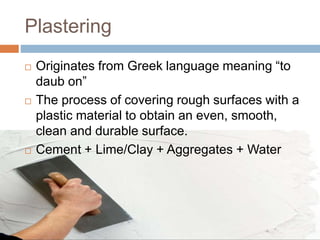
Plastering
 Originates from Greek language meaning “to
daub on”
 The process of covering rough surfaces with a
plastic material to obtain an even, smooth,
clean and durable surface.
 Cement + Lime/Clay + Aggregates + Water
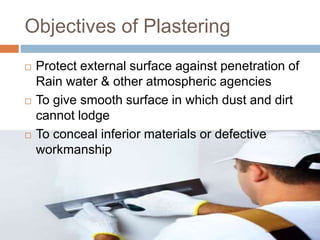
Objectives of Plastering
 Protect external surface against penetration of
Rain water & other atmospheric agencies
 To give smooth surface in which dust and dirt
cannot lodge
 To conceal inferior materials or defective
workmanship
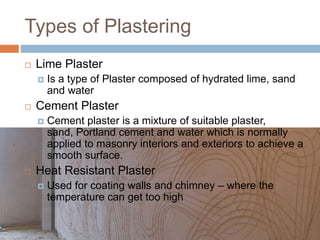
Types of Plastering
 Lime Plaster
 Is a type of Plaster composed of hydrated lime, sand
and water
 Cement Plaster
 Cement plaster is a mixture of suitable plaster,
sand, Portland cement and water which is normally
applied to masonry interiors and exteriors to achieve a
smooth surface.
 Heat Resistant Plaster
 Used for coating walls and chimney – where the
temperature can get too high
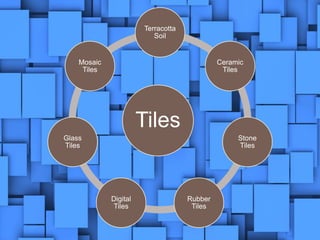
Tiles
Terracotta
Soil
Ceramic
Tiles
Stone
Tiles
Rubber
Tiles
Digital
Tiles
Glass
Tiles
Mosaic
Tiles
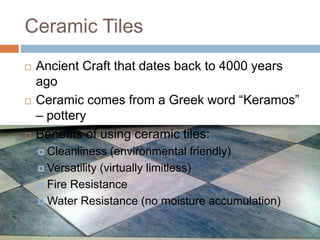
Ceramic Tiles
 Ancient Craft that dates back to 4000 years
ago
 Ceramic comes from a Greek word “Keramos”
– pottery
 Benefits of using ceramic tiles:
 Cleanliness (environmental friendly)
 Versatility (virtually limitless)
 Fire Resistance
 Water Resistance (no moisture accumulation)
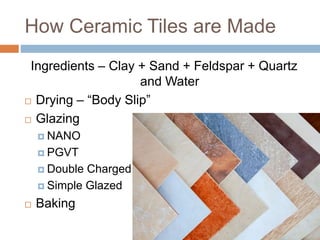
How Ceramic Tiles are Made
Ingredients – Clay + Sand + Feldspar + Quartz
and Water
 Drying – “Body Slip”
 Glazing
 NANO
 PGVT
 Double Charged
 Simple Glazed
 Baking
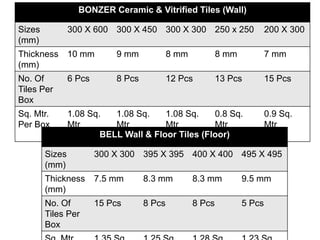
BONZER Ceramic & Vitrified Tiles (Wall)
Sizes
(mm)
300 X 600 300 X 450 300 X 300 250 x 250 200 X 300
Thickness
(mm)
10 mm 9 mm 8 mm 8 mm 7 mm
No. Of
Tiles Per
Box
6 Pcs 8 Pcs 12 Pcs 13 Pcs 15 Pcs
Sq. Mtr.
Per Box
1.08 Sq.
Mtr
1.08 Sq.
Mtr
1.08 Sq.
Mtr
0.8 Sq.
Mtr
0.9 Sq.
Mtr
BELL Wall & Floor Tiles (Floor)
Sizes
(mm)
300 X 300 395 X 395 400 X 400 495 X 495
Thickness
(mm)
7.5 mm 8.3 mm 8.3 mm 9.5 mm
No. Of
Tiles Per
Box
15 Pcs 8 Pcs 8 Pcs 5 Pcs
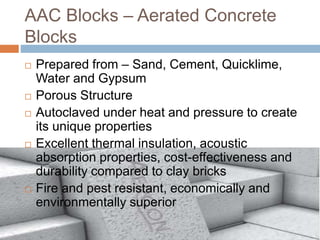
AAC Blocks – Aerated Concrete
Blocks
 Prepared from – Sand, Cement, Quicklime,
Water and Gypsum
 Porous Structure
 Autoclaved under heat and pressure to create
its unique properties
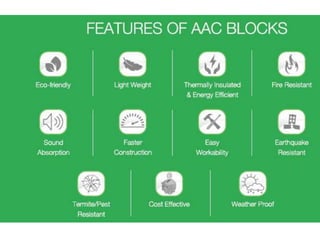
 Excellent thermal insulation, acoustic
absorption properties, cost-effectiveness and
durability compared to clay bricks
 Fire and pest resistant, economically and
environmentally superior
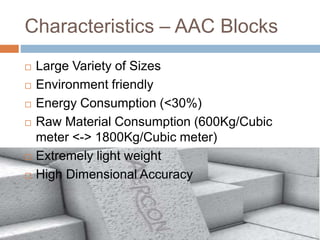
Characteristics – AAC Blocks
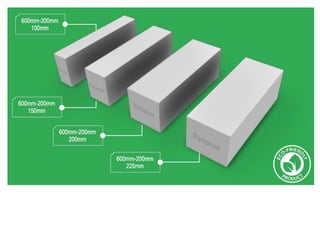
 Large Variety of Sizes
 Environment friendly
 Energy Consumption (<30%)
 Raw Material Consumption (600Kg/Cubic
meter <-> 1800Kg/Cubic meter)
 Extremely light weight
 High Dimensional Accuracy
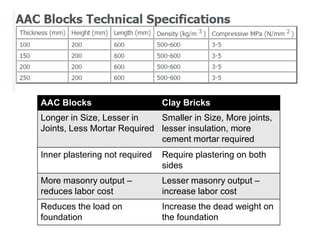
AAC Blocks Clay Bricks
Longer in Size, Lesser in
Joints, Less Mortar Required
Smaller in Size, More joints,
lesser insulation, more
cement mortar required
Inner plastering not required Require plastering on both
sides
More masonry output –
reduces labor cost
Lesser masonry output –
increase labor cost
Reduces the load on
foundation
Increase the dead weight on
the foundation
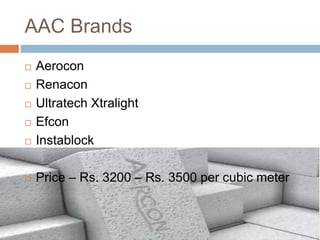
AAC Brands
 Aerocon
 Renacon
 Ultratech Xtralight
 Efcon
 Instablock
 Price – Rs. 3200 – Rs. 3500 per cubic meter
Cement
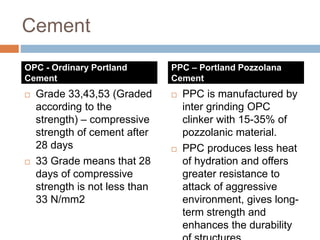
 Grade 33,43,53 (Graded
according to the
strength) – compressive
strength of cement after
28 days
 33 Grade means that 28
days of compressive
strength is not less than
33 N/mm2
 PPC is manufactured by
inter grinding OPC
clinker with 15-35% of
pozzolanic material.
 PPC produces less heat
of hydration and offers
greater resistance to
attack of aggressive
environment, gives long-
term strength and
enhances the durability
OPC - Ordinary Portland
Cement
PPC – Portland Pozzolana
Cement
Cement
 Ultratech Cement Limited
 Ambuja Cement
 Birla Cement
 JK Cement
 Hi-Bond Cement
 Price – Hi-Bond cement (OPC 53Grade) Rs.
280/Per Bag (50kg)
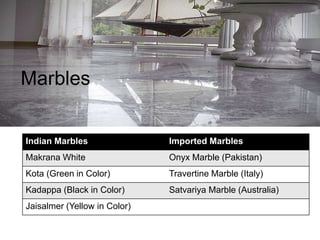
Marbles
Indian Marbles Imported Marbles
Makrana White Onyx Marble (Pakistan)
Kota (Green in Color) Travertine Marble (Italy)
Kadappa (Black in Color) Satvariya Marble (Australia)
Jaisalmer (Yellow in Color)
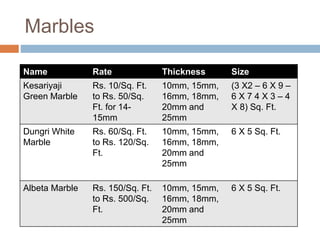
Marbles
Name Rate Thickness Size
Kesariyaji
Green Marble
Rs. 10/Sq. Ft.
to Rs. 50/Sq.
Ft. for 14-
15mm
10mm, 15mm,
16mm, 18mm,
20mm and
25mm
(3 X2 – 6 X 9 –
6 X 7 4 X 3 – 4
X 8) Sq. Ft.
Dungri White
Marble
Rs. 60/Sq. Ft.
to Rs. 120/Sq.
Ft.
10mm, 15mm,
16mm, 18mm,
20mm and
25mm
6 X 5 Sq. Ft.
Albeta Marble Rs. 150/Sq. Ft.
to Rs. 500/Sq.
Ft.
10mm, 15mm,
16mm, 18mm,
20mm and
25mm
6 X 5 Sq. Ft.
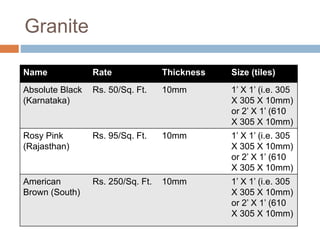
Granite
Name Rate Thickness Size (tiles)
Absolute Black
(Karnataka)
Rs. 50/Sq. Ft. 10mm 1’ X 1’ (i.e. 305
X 305 X 10mm)
or 2’ X 1’ (610
X 305 X 10mm)
Rosy Pink
(Rajasthan)
Rs. 95/Sq. Ft. 10mm 1’ X 1’ (i.e. 305
X 305 X 10mm)
or 2’ X 1’ (610
X 305 X 10mm)
American
Brown (South)
Rs. 250/Sq. Ft. 10mm 1’ X 1’ (i.e. 305
X 305 X 10mm)
or 2’ X 1’ (610
X 305 X 10mm)
Thank You

Plastering & tiles

  • 1.
  • 2.
    Plastering  Originates fromGreek language meaning “to daub on”  The process of covering rough surfaces with a plastic material to obtain an even, smooth, clean and durable surface.  Cement + Lime/Clay + Aggregates + Water
  • 3.
    Objectives of Plastering Protect external surface against penetration of Rain water & other atmospheric agencies  To give smooth surface in which dust and dirt cannot lodge  To conceal inferior materials or defective workmanship
  • 4.
    Types of Plastering Lime Plaster  Is a type of Plaster composed of hydrated lime, sand and water  Cement Plaster  Cement plaster is a mixture of suitable plaster, sand, Portland cement and water which is normally applied to masonry interiors and exteriors to achieve a smooth surface.  Heat Resistant Plaster  Used for coating walls and chimney – where the temperature can get too high
  • 5.
  • 6.
    Ceramic Tiles  AncientCraft that dates back to 4000 years ago  Ceramic comes from a Greek word “Keramos” – pottery  Benefits of using ceramic tiles:  Cleanliness (environmental friendly)  Versatility (virtually limitless)  Fire Resistance  Water Resistance (no moisture accumulation)
  • 7.
    How Ceramic Tilesare Made Ingredients – Clay + Sand + Feldspar + Quartz and Water  Drying – “Body Slip”  Glazing  NANO  PGVT  Double Charged  Simple Glazed  Baking
  • 8.
    BONZER Ceramic &Vitrified Tiles (Wall) Sizes (mm) 300 X 600 300 X 450 300 X 300 250 x 250 200 X 300 Thickness (mm) 10 mm 9 mm 8 mm 8 mm 7 mm No. Of Tiles Per Box 6 Pcs 8 Pcs 12 Pcs 13 Pcs 15 Pcs Sq. Mtr. Per Box 1.08 Sq. Mtr 1.08 Sq. Mtr 1.08 Sq. Mtr 0.8 Sq. Mtr 0.9 Sq. Mtr BELL Wall & Floor Tiles (Floor) Sizes (mm) 300 X 300 395 X 395 400 X 400 495 X 495 Thickness (mm) 7.5 mm 8.3 mm 8.3 mm 9.5 mm No. Of Tiles Per Box 15 Pcs 8 Pcs 8 Pcs 5 Pcs
  • 9.
    AAC Blocks –Aerated Concrete Blocks  Prepared from – Sand, Cement, Quicklime, Water and Gypsum  Porous Structure  Autoclaved under heat and pressure to create its unique properties  Excellent thermal insulation, acoustic absorption properties, cost-effectiveness and durability compared to clay bricks  Fire and pest resistant, economically and environmentally superior
  • 10.
    Characteristics – AACBlocks  Large Variety of Sizes  Environment friendly  Energy Consumption (<30%)  Raw Material Consumption (600Kg/Cubic meter <-> 1800Kg/Cubic meter)  Extremely light weight  High Dimensional Accuracy
  • 11.
    AAC Blocks ClayBricks Longer in Size, Lesser in Joints, Less Mortar Required Smaller in Size, More joints, lesser insulation, more cement mortar required Inner plastering not required Require plastering on both sides More masonry output – reduces labor cost Lesser masonry output – increase labor cost Reduces the load on foundation Increase the dead weight on the foundation
  • 13.
    AAC Brands  Aerocon Renacon  Ultratech Xtralight  Efcon  Instablock  Price – Rs. 3200 – Rs. 3500 per cubic meter
  • 15.
    Cement  Grade 33,43,53(Graded according to the strength) – compressive strength of cement after 28 days  33 Grade means that 28 days of compressive strength is not less than 33 N/mm2  PPC is manufactured by inter grinding OPC clinker with 15-35% of pozzolanic material.  PPC produces less heat of hydration and offers greater resistance to attack of aggressive environment, gives long- term strength and enhances the durability OPC - Ordinary Portland Cement PPC – Portland Pozzolana Cement
  • 16.
    Cement  Ultratech CementLimited  Ambuja Cement  Birla Cement  JK Cement  Hi-Bond Cement  Price – Hi-Bond cement (OPC 53Grade) Rs. 280/Per Bag (50kg)
  • 17.
    Marbles Indian Marbles ImportedMarbles Makrana White Onyx Marble (Pakistan) Kota (Green in Color) Travertine Marble (Italy) Kadappa (Black in Color) Satvariya Marble (Australia) Jaisalmer (Yellow in Color)
  • 18.
    Marbles Name Rate ThicknessSize Kesariyaji Green Marble Rs. 10/Sq. Ft. to Rs. 50/Sq. Ft. for 14- 15mm 10mm, 15mm, 16mm, 18mm, 20mm and 25mm (3 X2 – 6 X 9 – 6 X 7 4 X 3 – 4 X 8) Sq. Ft. Dungri White Marble Rs. 60/Sq. Ft. to Rs. 120/Sq. Ft. 10mm, 15mm, 16mm, 18mm, 20mm and 25mm 6 X 5 Sq. Ft. Albeta Marble Rs. 150/Sq. Ft. to Rs. 500/Sq. Ft. 10mm, 15mm, 16mm, 18mm, 20mm and 25mm 6 X 5 Sq. Ft.
  • 19.
    Granite Name Rate ThicknessSize (tiles) Absolute Black (Karnataka) Rs. 50/Sq. Ft. 10mm 1’ X 1’ (i.e. 305 X 305 X 10mm) or 2’ X 1’ (610 X 305 X 10mm) Rosy Pink (Rajasthan) Rs. 95/Sq. Ft. 10mm 1’ X 1’ (i.e. 305 X 305 X 10mm) or 2’ X 1’ (610 X 305 X 10mm) American Brown (South) Rs. 250/Sq. Ft. 10mm 1’ X 1’ (i.e. 305 X 305 X 10mm) or 2’ X 1’ (610 X 305 X 10mm)
  • 20.

Editor's Notes

  • #8 Feldspar are rock forming minerals that make up as much as 60% of earths crust Quartz is the second most abundant mineral in the Earth’s crust
  • #10 AAC BLOCKS  begins as a slurry mix of lime, sand, cement and water, and a small amount of rising agent. For reinforced panels, a welded steel cage element is placed into the molds prior to pouring in the slurry. Once the slurry is poured in, the mixture begins to foam and rise up completely around the reinforcing cage. Once the rising process is complete the cage and the AAC are completely integrated and ready to be placed into theautoclave for the curing process.
  • #12 Kg/Cubic meter
  • #16 Newton/Square milimeter