MECHANICAL
PLAQUE CONTROL
PLAQUE CONTROL
Plaque control is the removal of microbial
plaque and the prevention of its accumulation
on the teeth and adjacent gingival surfaces.
Plaque control also retards the formation of
calculus, that leads to resolution of gingival
inflammation.
MODE OF PLAQUE CONTROL
Mechanical plaque control
Tooth brushes
Manual tooth brush
Electrical tooth brush
Interdental cleansing aids
Dental floss
Wooden tips like stim-u-dent
Perioaid
Interdental brushes like
Proxa brush
Unitufted brush
Miniature bottle brush, rubber tip, oral
irrigation devices
TOOTH BRUSHES
ADA has described the range of dimensions of
acceptable brushes
1 to 1.25 inches
2-4 rows of bristles
5-12 tufts per row
Two kinds of bristle materials used in tooth
brushes
Natural bristles from hogs
Artificial filaments made prominently of nylon.
However in terms of Homogenecity of material,
uniformity of bristle size, resistance to fracture,
repulsion of water and debris, nylon filaments
are more superior.
Diameter of commonly used bristles.
Soft brushes 0.2 mm
Medium brushes 0.3 mm
Hard brushes 0.4 mm
 Blue dye on some of the bristles are available. If the
dye fades with use that can be helpful in reminding
patients to replace their tooth brushes.
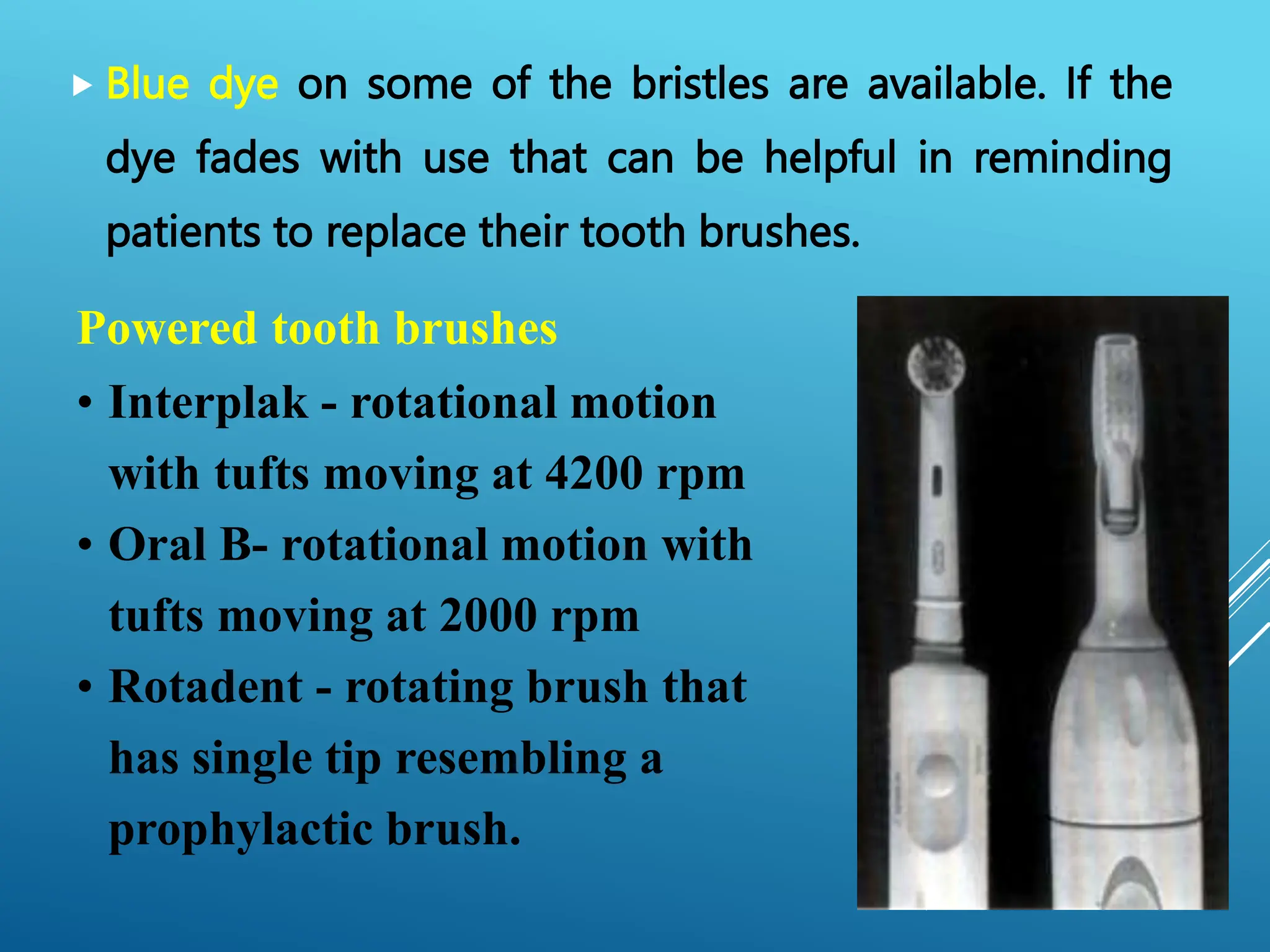
Powered tooth brushes
• Interplak - rotational motion
with tufts moving at 4200 rpm
• Oral B- rotational motion with
tufts moving at 2000 rpm
• Rotadent - rotating brush that
has single tip resembling a
prophylactic brush.
Motions
Back & Forth motion
Some with combination of both
Some with circular motion
Recommended for,
Small children
Hospitalized patients
Patients with orthodontic appliances.
TOOTH BRUSHING METHODS
Horizontal Scrub Technique:
Bristles are applied at 90 to the
tooth surface, moved back and
forth motion, which result in tooth
abrasion and gingival recession.
Fones Technique:
Brush is firmly pressed against the
teeth and gingiva. The bristles are at right
angles to the buccal surface and the handle
parallel with the occlusal plane.
Recommended for young children.
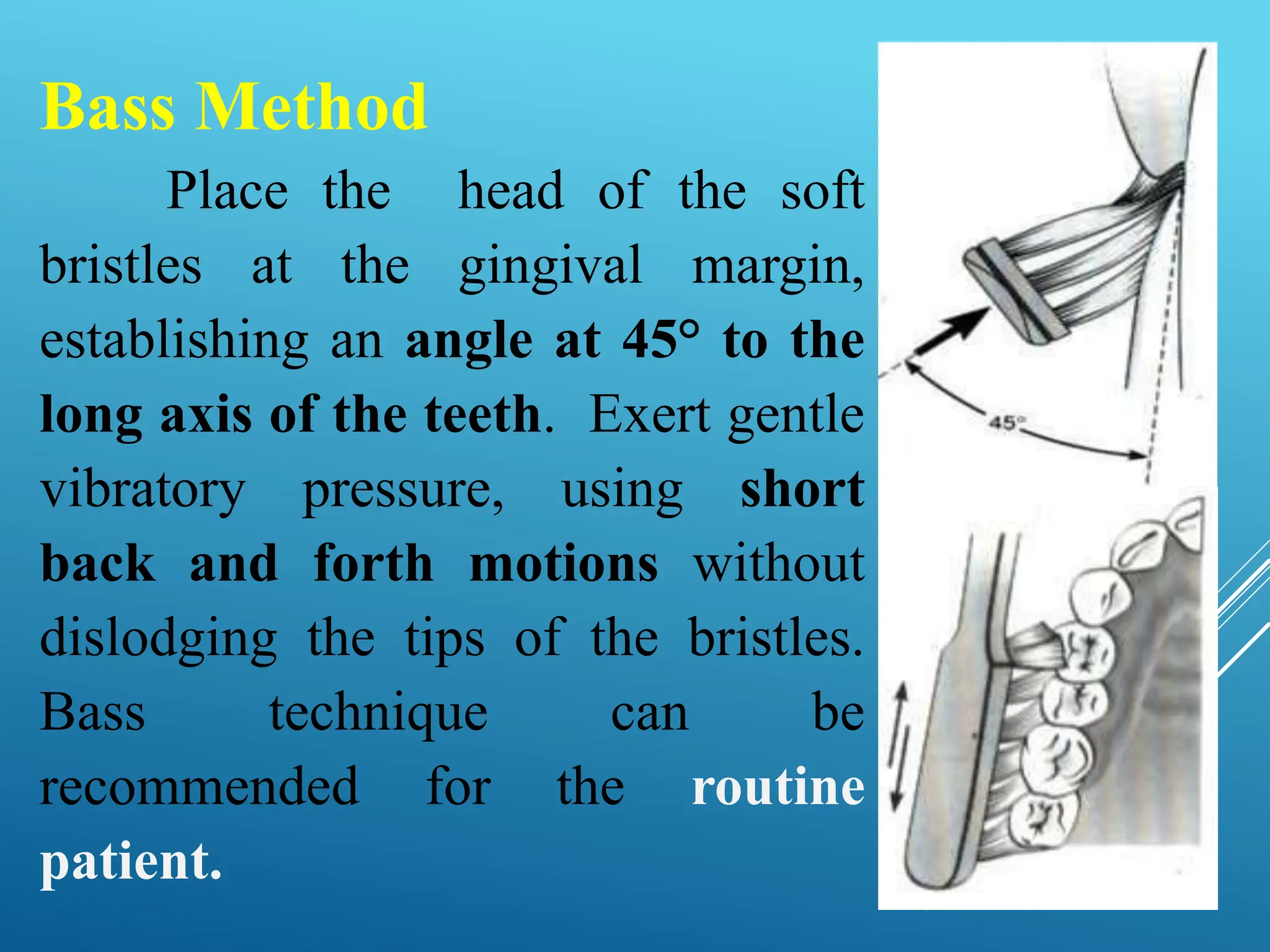
Bass Method
Place the head of the soft
bristles at the gingival margin,
establishing an angle at 45° to the
long axis of the teeth. Exert gentle
vibratory pressure, using short
back and forth motions without
dislodging the tips of the bristles.
Bass technique can be
recommended for the routine
patient.
Modified Stillman’s Method
The brush should be placed with the bristle
ends resting partly on the cervical portion of
the teeth and partly on the adjacent gingiva.
Pointing in an apical direction, at an oblique
angle to the long axis of the teeth.
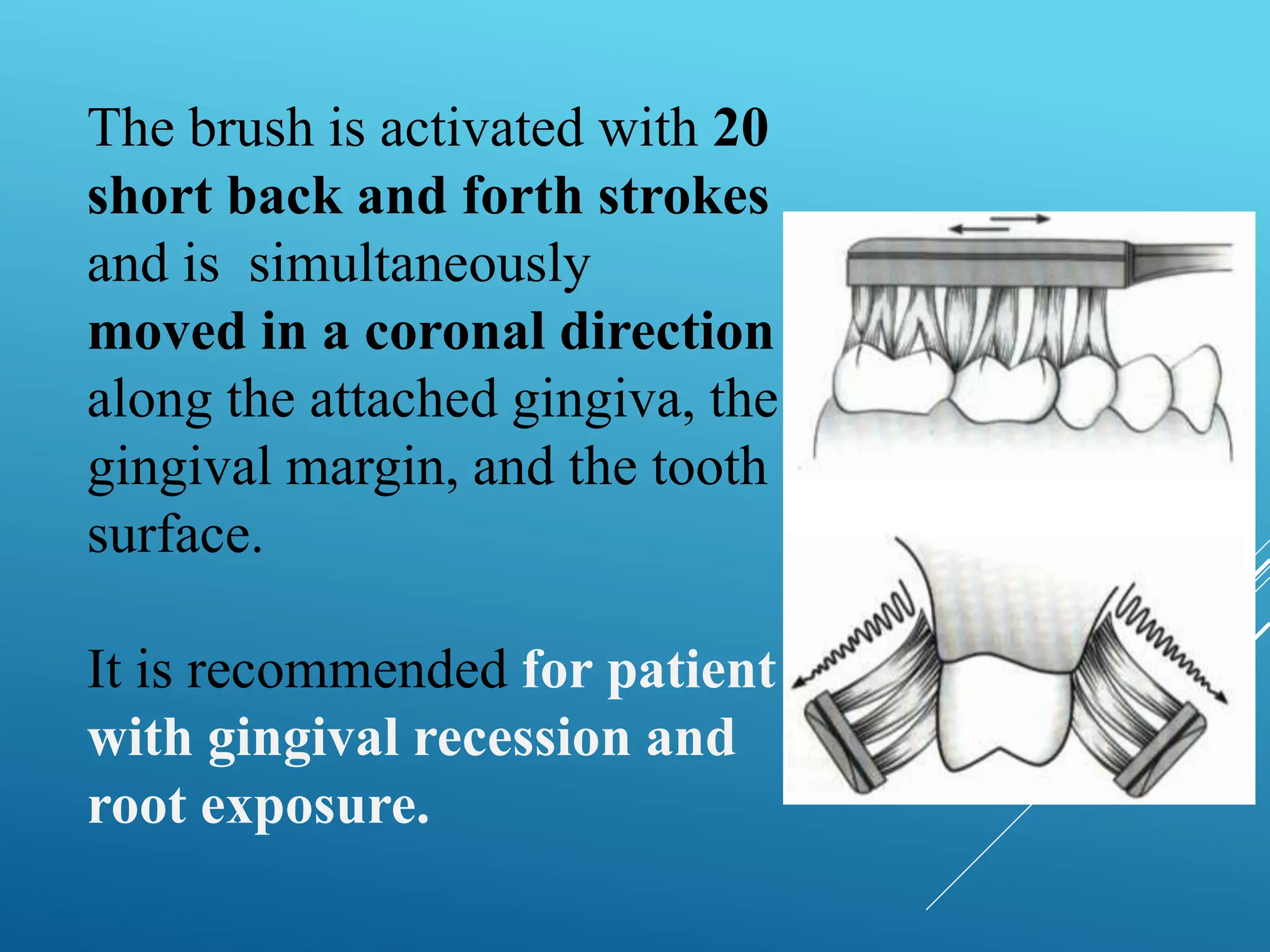
The brush is activated with 20
short back and forth strokes
and is simultaneously
moved in a coronal direction
along the attached gingiva, the
gingival margin, and the tooth
surface.
It is recommended for patient
with gingival recession and
root exposure.
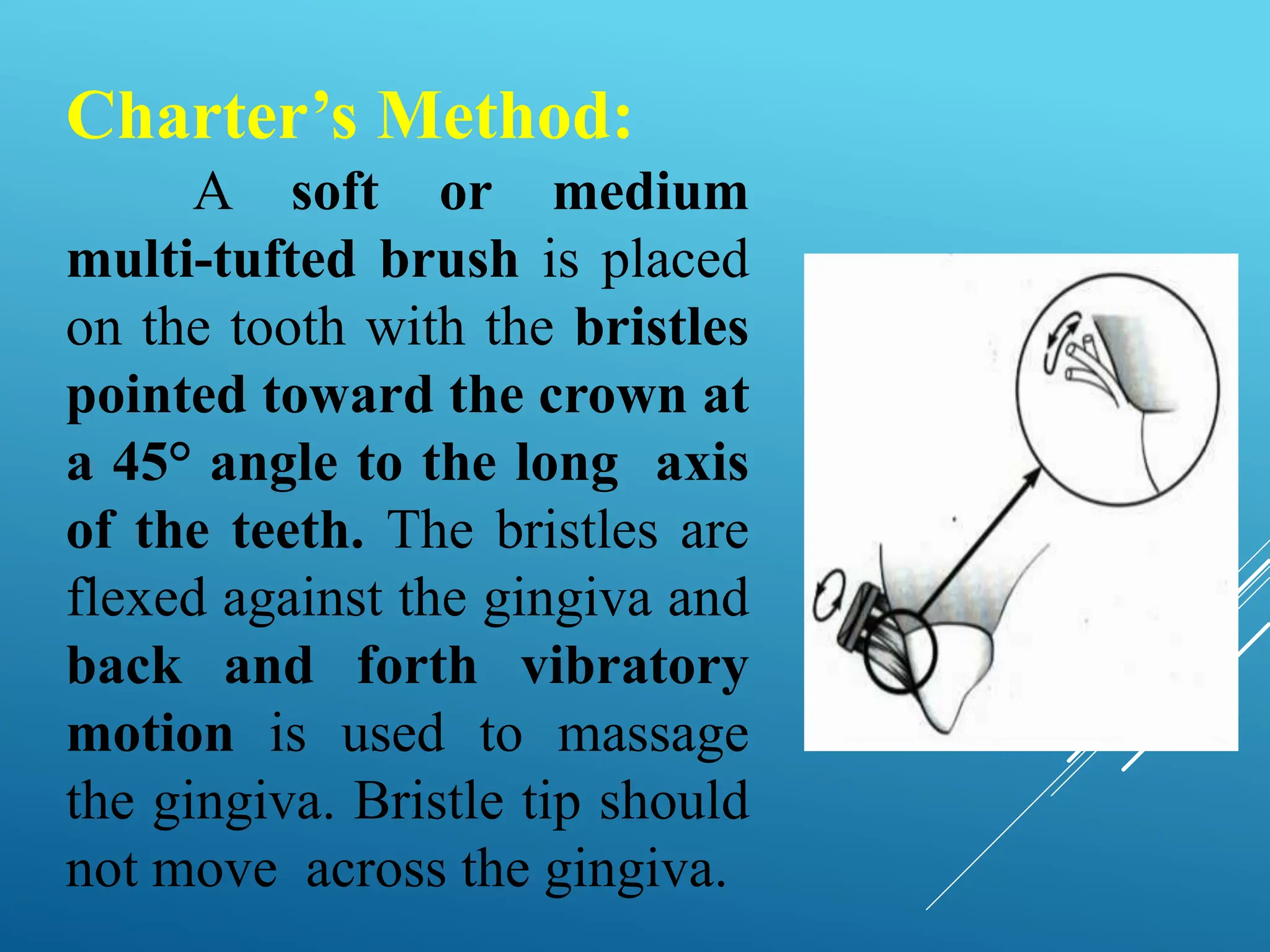
Charter’s Method:
A soft or medium
multi-tufted brush is placed
on the tooth with the bristles
pointed toward the crown at
a 45° angle to the long axis
of the teeth. The bristles are
flexed against the gingiva and
back and forth vibratory
motion is used to massage
the gingiva. Bristle tip should
not move across the gingiva.
To clean the occlusal surface, bristle tips
are placed in pit and fissures. This
technique is recommended for gentle
plaque removal and gingival massage
after periodontal surgical procedures.
INTERDENTAL CLEANING DEVICES
The purpose of interdental cleaning is to
remove plaque, not to dislodge fibrous threads of
food wedged in between two teeth.
Available as,
i) Dental floss
ii) Interdental cleaners such as wooden or
plastic tips
iii) Interdental brushes
Dental Floss:
Flossing is most widely recommended method of
removing plaque from the proximal tooth surface.
Twisted (or) non-twisted
bonded (or) non- bonded
waxed (or) unwaxed
Thick (or) thin
Floss must contact the proximal surface from line
angle to line angle to clean effectively.
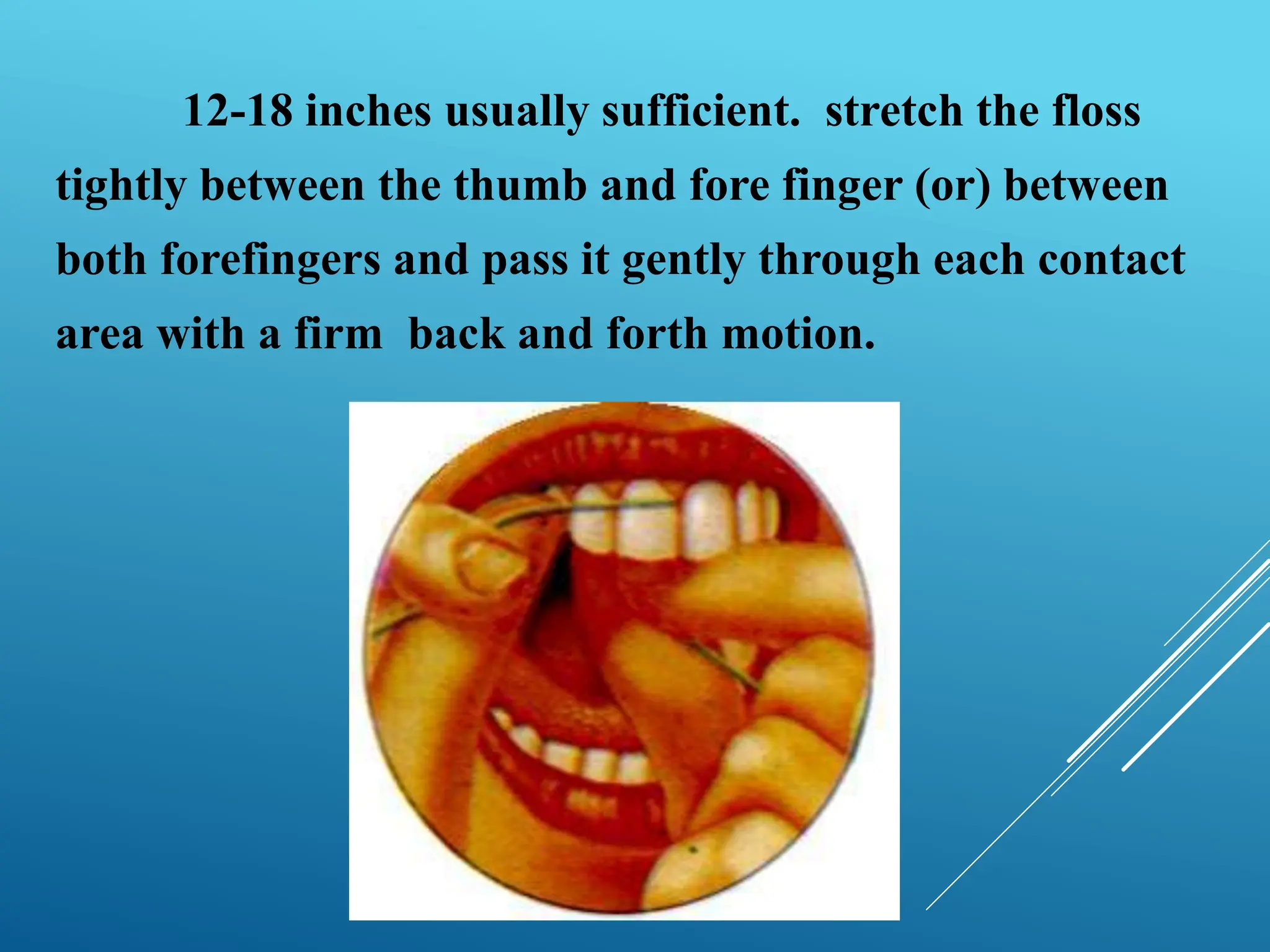
12-18 inches usually sufficient. stretch the floss
tightly between the thumb and fore finger (or) between
both forefingers and pass it gently through each contact
area with a firm back and forth motion.
Interdental brushes:
These are cone shaped brushes made of
bristles mounted to the handle,
Single tufted brushes
Small conical brushes.
These brushes are suitable for cleaning large
irregular (or) concave tooth surface adjacent to
wide interdental spaces.
Wooden tips:
Soft triangular wooden tooth picks are placed in
the interdental space in such a way that the base
resting on the gingiva and the sides are in contact
with the proximal tooth surface.
Wooden tooth picks can be attached to a
handle such as the perio aid and used on the
facial (or) lingual surface throughout the
mouth.
Oral Irrigation Devices
Irrigation can be used supra gingivally (or)
sub-gingivally.
Supra gingival irrigation:
It is performed with dilute antiseptic
chlorhexidine.
The common home use irrigator tip is a
plastic nozzle with a 90° bend at the tip,
attached to a pump to provide pulsating pressure.
Subgingival irrigation:
Performed in both dental office and by the
patient at home.
Particularly antimicrobial agents.
Irrigation done in dental office also called lavage
(or) flushing of the periodontal pocket after
scaling and root planing may be helpful in
reducing bleeding and pocket depths.
FREQUENCY OF PLAQUE CONTROL
i) Cleaning once a day with all necessary tools is
sufficient.
ii) Complete plaque removal at least once per day rather
than the frequency of brushing alone.
iii) However, poor performance of plaque removal can
be improved by brushing twice per day.
This presentation is on plaque control by various methods

This presentation is on plaque control by various methods

  • 1.
  • 2.
    PLAQUE CONTROL Plaque controlis the removal of microbial plaque and the prevention of its accumulation on the teeth and adjacent gingival surfaces. Plaque control also retards the formation of calculus, that leads to resolution of gingival inflammation.
  • 3.
    MODE OF PLAQUECONTROL Mechanical plaque control Tooth brushes Manual tooth brush Electrical tooth brush Interdental cleansing aids Dental floss Wooden tips like stim-u-dent Perioaid
  • 4.
    Interdental brushes like Proxabrush Unitufted brush Miniature bottle brush, rubber tip, oral irrigation devices
  • 5.
    TOOTH BRUSHES ADA hasdescribed the range of dimensions of acceptable brushes 1 to 1.25 inches 2-4 rows of bristles 5-12 tufts per row Two kinds of bristle materials used in tooth brushes Natural bristles from hogs Artificial filaments made prominently of nylon.
  • 6.
    However in termsof Homogenecity of material, uniformity of bristle size, resistance to fracture, repulsion of water and debris, nylon filaments are more superior. Diameter of commonly used bristles. Soft brushes 0.2 mm Medium brushes 0.3 mm Hard brushes 0.4 mm
  • 7.
     Blue dyeon some of the bristles are available. If the dye fades with use that can be helpful in reminding patients to replace their tooth brushes. Powered tooth brushes • Interplak - rotational motion with tufts moving at 4200 rpm • Oral B- rotational motion with tufts moving at 2000 rpm • Rotadent - rotating brush that has single tip resembling a prophylactic brush.
  • 8.
    Motions Back & Forthmotion Some with combination of both Some with circular motion Recommended for, Small children Hospitalized patients Patients with orthodontic appliances.
  • 9.
    TOOTH BRUSHING METHODS HorizontalScrub Technique: Bristles are applied at 90 to the tooth surface, moved back and forth motion, which result in tooth abrasion and gingival recession.
  • 10.
    Fones Technique: Brush isfirmly pressed against the teeth and gingiva. The bristles are at right angles to the buccal surface and the handle parallel with the occlusal plane. Recommended for young children.
  • 11.
    Bass Method Place thehead of the soft bristles at the gingival margin, establishing an angle at 45° to the long axis of the teeth. Exert gentle vibratory pressure, using short back and forth motions without dislodging the tips of the bristles. Bass technique can be recommended for the routine patient.
  • 12.
    Modified Stillman’s Method Thebrush should be placed with the bristle ends resting partly on the cervical portion of the teeth and partly on the adjacent gingiva. Pointing in an apical direction, at an oblique angle to the long axis of the teeth.
  • 13.
    The brush isactivated with 20 short back and forth strokes and is simultaneously moved in a coronal direction along the attached gingiva, the gingival margin, and the tooth surface. It is recommended for patient with gingival recession and root exposure.
  • 14.
    Charter’s Method: A softor medium multi-tufted brush is placed on the tooth with the bristles pointed toward the crown at a 45° angle to the long axis of the teeth. The bristles are flexed against the gingiva and back and forth vibratory motion is used to massage the gingiva. Bristle tip should not move across the gingiva.
  • 15.
    To clean theocclusal surface, bristle tips are placed in pit and fissures. This technique is recommended for gentle plaque removal and gingival massage after periodontal surgical procedures.
  • 16.
    INTERDENTAL CLEANING DEVICES Thepurpose of interdental cleaning is to remove plaque, not to dislodge fibrous threads of food wedged in between two teeth. Available as, i) Dental floss ii) Interdental cleaners such as wooden or plastic tips iii) Interdental brushes
  • 17.
    Dental Floss: Flossing ismost widely recommended method of removing plaque from the proximal tooth surface. Twisted (or) non-twisted bonded (or) non- bonded waxed (or) unwaxed Thick (or) thin Floss must contact the proximal surface from line angle to line angle to clean effectively.
  • 18.
    12-18 inches usuallysufficient. stretch the floss tightly between the thumb and fore finger (or) between both forefingers and pass it gently through each contact area with a firm back and forth motion.
  • 19.
    Interdental brushes: These arecone shaped brushes made of bristles mounted to the handle, Single tufted brushes Small conical brushes. These brushes are suitable for cleaning large irregular (or) concave tooth surface adjacent to wide interdental spaces.
  • 20.
    Wooden tips: Soft triangularwooden tooth picks are placed in the interdental space in such a way that the base resting on the gingiva and the sides are in contact with the proximal tooth surface. Wooden tooth picks can be attached to a handle such as the perio aid and used on the facial (or) lingual surface throughout the mouth.
  • 21.
    Oral Irrigation Devices Irrigationcan be used supra gingivally (or) sub-gingivally. Supra gingival irrigation: It is performed with dilute antiseptic chlorhexidine. The common home use irrigator tip is a plastic nozzle with a 90° bend at the tip, attached to a pump to provide pulsating pressure.
  • 22.
    Subgingival irrigation: Performed inboth dental office and by the patient at home. Particularly antimicrobial agents. Irrigation done in dental office also called lavage (or) flushing of the periodontal pocket after scaling and root planing may be helpful in reducing bleeding and pocket depths.
  • 23.
    FREQUENCY OF PLAQUECONTROL i) Cleaning once a day with all necessary tools is sufficient. ii) Complete plaque removal at least once per day rather than the frequency of brushing alone. iii) However, poor performance of plaque removal can be improved by brushing twice per day.