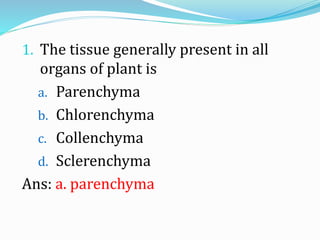
1. The tissue generally present in all
organs of plant is
a. Parenchyma
b. Chlorenchyma
c. Collenchyma
d. Sclerenchyma
Ans: a. parenchyma
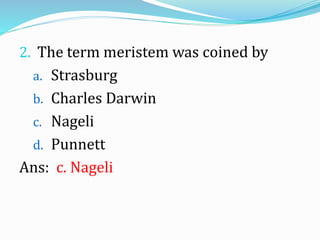
2. The term meristem was coined by
a. Strasburg
b. Charles Darwin
c. Nageli
d. Punnett
Ans: c. Nageli
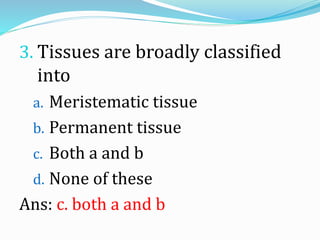
3. Tissues are broadly classified
into
a. Meristematic tissue
b. Permanent tissue
c. Both a and b
d. None of these
Ans: c. both a and b
4. The meristem which is present in
nodal region of plant is
a. Apical meristem
b. Intercalary meristem
c. Lateral meristem
d. None of these
Ans: b. intercalary meristem
5. Which one of following element is
not xylem
a. Tracheids
b. Sieve tubes
c. Vessels
d. Xylem fibres
Ans: b. Sieve tubes
6. Which of the following is not the part
of phloem
a. Vessels
b. Seive cells
c. Seive tubes
d. Phloem fibers
Ans: a. Vessels
7. Which one of the following is dead
cells
a. Parenchyma
b. Collenchyma
c. Sclerenchyma
d. Epidermis
Ans: c. Sclerenchyma
8. In root and stem tubers --------
parenchyma is present
a. Aerenchyma
b. Storage parenchyma
c. Palisade parenchyma
d. Spongy parenchyma
Ans: b. Storage parenchyma
9. Who is the father of histology
a. Stephan hales
b. R.C. Punnet
c. Charles Darwin
d. Xavier Bichat
Ans: d. Xavier Bichat
10. Well developed nucleus is present in
------ cell
a. Prokaryotic cell
b. Eukaryotic cell
c. Both a and b
d. None of these
Ans: b. Eukaryotic cell
11.Cell membrane is outermost
membrane of
a. Plant cell
b. Animal cell
c. Bacterial cell
d. Fungal cell
Ans: b. Animal cell
12.Vegetative growth is
continuously carried by ------
cell division
a. Mitosis
b. Meiosis
c. Both a and b
d. None of these
Ans: a. Mitosis
13.The function of sieve elements
are assisted by
a. Companion cells
b. Tracheids
c. Vessels
d. Fibers
Ans: a. Companion cells
14.The outermost region of stem
is covered by
a. Cork cells
b. Cambium
c. Pericycle
d. Secondary cortex
Ans: a. Cork cells
15.Protoxylem towards outside is
called
a. Exarch
b. Endarch
c. Mesarch
d. Centrarch
Ans: a. Exarch
16.Cambium is present between
the vascular bundle is called
a. Open
b. Closed
c. Both a and b
d. None of these
Ans: a. Open
17.The Greek word ‘xylos’ means
a. Stem
b. Wood
c. Seed
d. Naked
Ans: b. Wood
18.The lateral meristem are
a. Vascular cambium and procambium
b. Phelloderm and vascular cambium
c. Vascular cambium and cork
cambium
d. Protoderm and ground meristem
Ans: c. Vascular cambium and cork
cambium
19.The tissues developed by procambium
are
a. Primary xylem and secondary xylem
b. Primary phloem and secondary phloem
c. Primary xylem and primary phloem
d. Secondary xylem and secondary
Ans: c. Primary xylem and primary
phloem
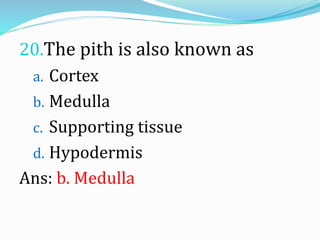
20.The pith is also known as
a. Cortex
b. Medulla
c. Supporting tissue
d. Hypodermis
Ans: b. Medulla
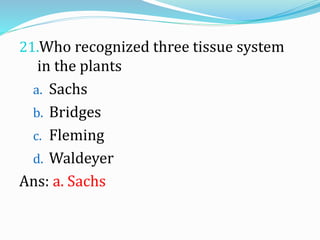
21.Who recognized three tissue system
in the plants
a. Sachs
b. Bridges
c. Fleming
d. Waldeyer
Ans: a. Sachs
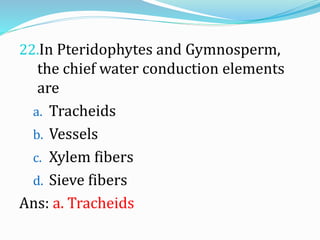
22.In Pteridophytes and Gymnosperm,
the chief water conduction elements
are
a. Tracheids
b. Vessels
c. Xylem fibers
d. Sieve fibers
Ans: a. Tracheids
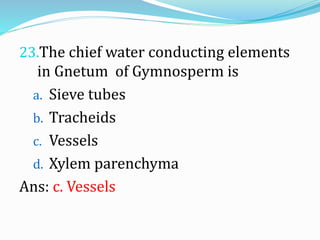
23.The chief water conducting elements
in Gnetum of Gymnosperm is
a. Sieve tubes
b. Tracheids
c. Vessels
d. Xylem parenchyma
Ans: c. Vessels
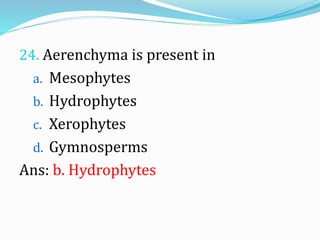
24. Aerenchyma is present in
a. Mesophytes
b. Hydrophytes
c. Xerophytes
d. Gymnosperms
Ans: b. Hydrophytes
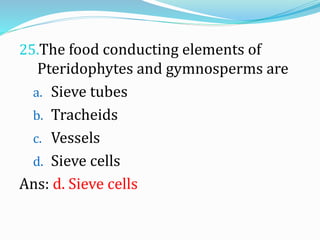
25.The food conducting elements of
Pteridophytes and gymnosperms are
a. Sieve tubes
b. Tracheids
c. Vessels
d. Sieve cells
Ans: d. Sieve cells
Plant anatomy mcq 1

Plant anatomy mcq 1

  • 2.
    1. The tissuegenerally present in all organs of plant is a. Parenchyma b. Chlorenchyma c. Collenchyma d. Sclerenchyma Ans: a. parenchyma
  • 3.
    2. The termmeristem was coined by a. Strasburg b. Charles Darwin c. Nageli d. Punnett Ans: c. Nageli
  • 4.
    3. Tissues arebroadly classified into a. Meristematic tissue b. Permanent tissue c. Both a and b d. None of these Ans: c. both a and b
  • 5.
    4. The meristemwhich is present in nodal region of plant is a. Apical meristem b. Intercalary meristem c. Lateral meristem d. None of these Ans: b. intercalary meristem
  • 6.
    5. Which oneof following element is not xylem a. Tracheids b. Sieve tubes c. Vessels d. Xylem fibres Ans: b. Sieve tubes
  • 7.
    6. Which ofthe following is not the part of phloem a. Vessels b. Seive cells c. Seive tubes d. Phloem fibers Ans: a. Vessels
  • 8.
    7. Which oneof the following is dead cells a. Parenchyma b. Collenchyma c. Sclerenchyma d. Epidermis Ans: c. Sclerenchyma
  • 9.
    8. In rootand stem tubers -------- parenchyma is present a. Aerenchyma b. Storage parenchyma c. Palisade parenchyma d. Spongy parenchyma Ans: b. Storage parenchyma
  • 10.
    9. Who isthe father of histology a. Stephan hales b. R.C. Punnet c. Charles Darwin d. Xavier Bichat Ans: d. Xavier Bichat
  • 11.
    10. Well developednucleus is present in ------ cell a. Prokaryotic cell b. Eukaryotic cell c. Both a and b d. None of these Ans: b. Eukaryotic cell
  • 12.
    11.Cell membrane isoutermost membrane of a. Plant cell b. Animal cell c. Bacterial cell d. Fungal cell Ans: b. Animal cell
  • 13.
    12.Vegetative growth is continuouslycarried by ------ cell division a. Mitosis b. Meiosis c. Both a and b d. None of these Ans: a. Mitosis
  • 14.
    13.The function ofsieve elements are assisted by a. Companion cells b. Tracheids c. Vessels d. Fibers Ans: a. Companion cells
  • 15.
    14.The outermost regionof stem is covered by a. Cork cells b. Cambium c. Pericycle d. Secondary cortex Ans: a. Cork cells
  • 16.
    15.Protoxylem towards outsideis called a. Exarch b. Endarch c. Mesarch d. Centrarch Ans: a. Exarch
  • 17.
    16.Cambium is presentbetween the vascular bundle is called a. Open b. Closed c. Both a and b d. None of these Ans: a. Open
  • 18.
    17.The Greek word‘xylos’ means a. Stem b. Wood c. Seed d. Naked Ans: b. Wood
  • 19.
    18.The lateral meristemare a. Vascular cambium and procambium b. Phelloderm and vascular cambium c. Vascular cambium and cork cambium d. Protoderm and ground meristem Ans: c. Vascular cambium and cork cambium
  • 20.
    19.The tissues developedby procambium are a. Primary xylem and secondary xylem b. Primary phloem and secondary phloem c. Primary xylem and primary phloem d. Secondary xylem and secondary Ans: c. Primary xylem and primary phloem
  • 21.
    20.The pith isalso known as a. Cortex b. Medulla c. Supporting tissue d. Hypodermis Ans: b. Medulla
  • 22.
    21.Who recognized threetissue system in the plants a. Sachs b. Bridges c. Fleming d. Waldeyer Ans: a. Sachs
  • 23.
    22.In Pteridophytes andGymnosperm, the chief water conduction elements are a. Tracheids b. Vessels c. Xylem fibers d. Sieve fibers Ans: a. Tracheids
  • 24.
    23.The chief waterconducting elements in Gnetum of Gymnosperm is a. Sieve tubes b. Tracheids c. Vessels d. Xylem parenchyma Ans: c. Vessels
  • 25.
    24. Aerenchyma ispresent in a. Mesophytes b. Hydrophytes c. Xerophytes d. Gymnosperms Ans: b. Hydrophytes
  • 26.
    25.The food conductingelements of Pteridophytes and gymnosperms are a. Sieve tubes b. Tracheids c. Vessels d. Sieve cells Ans: d. Sieve cells