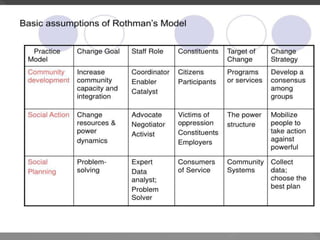
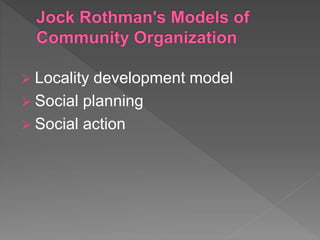
 Locality development model
 Social planning
 Social action
 It defined as a “process designed to improve
conditions of economic and social progress
for the whole community with its active
participations and the fullest possible
reliance on the community’s initiative”
 1. Democratic Procedures
 2. Voluntary Cooperation
 3. Self-help
 4. Development of Indigenous Leadership
 5. Education
 Emphasizes self-help and development of
community capabilities and cooperation
(empowerment).
 Increases participation and local leadership.
 The planner sees the community
overshadowed by the larger community
and therefore lacks relationships and
democratic problem-solving abilities.
 “Let’s meet and talk it over”
The strategy is to have a broad selection
of people get together to determine and
solve the community problems.“Let’s meet
and talk it over”
 This model emphasizes a technical
approach to solving social problems.
 Change is believed to require expert
planners, who, using technical abilities
and skills including the ability to
manipulate large bureaucratic
organizations, can bring about complex
changes.
 In this model, the planner usually
establishes, arranges and delivers
goods and services to people who
need them.
 SOCIAL PLANNING Emphasizes solving
community problems.
 Task oriented with the emphasis on
completing a concrete task and solving
problems.
 The planner sees the community as
having major social problems such as
physical or mental, housing, and or some
problems of interest to the planner.
 The planner gathers the facts and decides
what to do with it.“Let’s gather the facts and
solve the problem”.
 The change tactic is CONCENSUS or
CONFLICT.
 In this model, the role of the practitioner is
more technical by gathering data,
implementing programs and interacting with
bureaucracies.
 The clients are the consumers of services
 This model assumes that a
disadvantage segment of the
population needs to be organized, at
times in alliance with others, to make
adequate demands on the larger
society.
 This model Emphasize a
redistribution of power, resources
and relationship and changes in
basic institution (community
competence)Providing or
establishing new services, or getting
legislation passed.
 The planner views the community as
a system of privileges and power with
a disadvantaged population and the
problem is social injustice,
deprivation, and inequity or
exploitation at the hands of the
oppressors such as the “power
structures, big government or
society”
 The strategy is to identify the issues so
people know who is the enemy.
 Organize mass action to pressure
enemy.
 (Enemy may be an organization or
person)“Lets crystalize the issue,
organize mass action, and apply
pressure on the selected targets”.
 This model uses change tactic of conflict or
contrast, such as confrontation and direct
action or negotiation.
 The practitioner is an activist or plays an
advocacy role and organizes groups and
manipulates organizations and movements
to influence the political process.
 The power structure is viewed as an external
target of action or an oppressor to be
coerced or overturned.
 The boundary is a community segment that
is deprived.
 The clients are the victims of the system.

Rothman’s three models of Community Organisation

  • 3.
     Locality developmentmodel  Social planning  Social action
  • 4.
     It definedas a “process designed to improve conditions of economic and social progress for the whole community with its active participations and the fullest possible reliance on the community’s initiative”
  • 5.
     1. DemocraticProcedures  2. Voluntary Cooperation  3. Self-help  4. Development of Indigenous Leadership  5. Education
  • 6.
     Emphasizes self-helpand development of community capabilities and cooperation (empowerment).  Increases participation and local leadership.
  • 7.
     The plannersees the community overshadowed by the larger community and therefore lacks relationships and democratic problem-solving abilities.
  • 8.
     “Let’s meetand talk it over” The strategy is to have a broad selection of people get together to determine and solve the community problems.“Let’s meet and talk it over”
  • 9.
     This modelemphasizes a technical approach to solving social problems.  Change is believed to require expert planners, who, using technical abilities and skills including the ability to manipulate large bureaucratic organizations, can bring about complex changes.
  • 10.
     In thismodel, the planner usually establishes, arranges and delivers goods and services to people who need them.
  • 11.
     SOCIAL PLANNINGEmphasizes solving community problems.  Task oriented with the emphasis on completing a concrete task and solving problems.
  • 12.
     The plannersees the community as having major social problems such as physical or mental, housing, and or some problems of interest to the planner.
  • 13.
     The plannergathers the facts and decides what to do with it.“Let’s gather the facts and solve the problem”.  The change tactic is CONCENSUS or CONFLICT.
  • 14.
     In thismodel, the role of the practitioner is more technical by gathering data, implementing programs and interacting with bureaucracies.  The clients are the consumers of services
  • 15.
     This modelassumes that a disadvantage segment of the population needs to be organized, at times in alliance with others, to make adequate demands on the larger society.
  • 16.
     This modelEmphasize a redistribution of power, resources and relationship and changes in basic institution (community competence)Providing or establishing new services, or getting legislation passed.
  • 17.
     The plannerviews the community as a system of privileges and power with a disadvantaged population and the problem is social injustice, deprivation, and inequity or exploitation at the hands of the oppressors such as the “power structures, big government or society”
  • 18.
     The strategyis to identify the issues so people know who is the enemy.  Organize mass action to pressure enemy.  (Enemy may be an organization or person)“Lets crystalize the issue, organize mass action, and apply pressure on the selected targets”.
  • 19.
     This modeluses change tactic of conflict or contrast, such as confrontation and direct action or negotiation.  The practitioner is an activist or plays an advocacy role and organizes groups and manipulates organizations and movements to influence the political process.
  • 20.
     The powerstructure is viewed as an external target of action or an oppressor to be coerced or overturned.  The boundary is a community segment that is deprived.  The clients are the victims of the system.