Plan S Price Transparency Framework…
for publishers
Agenda
Introduction
• Welcome - Lorraine Estelle, Information Power
• Overview of requirement and frameworks - Alicia Wise,
Information Power
Publisher implementation experiences
• Georgie Field, PLOS
• Anna Kurek, Springer Nature
Discussion and questions
• Moderated by Lorraine Estelle
Overview
Plan S requirements
Sli.do poll - how are you feeling about the
Plan S price transparency requirements?
Share your thoughts at www.slido.com
using the event code #42715
FOAA Breakdown of publication services and fees -
https://www.fairopenaccess.org/foaa-breakdown-of-publication-services-and-fees/
Plan S Price
Transparency
Framework -
two parts
1. Implementation guide
https://www.informationpower.co.uk/the-plan-s-price-
transparency-framework-implementation-guide/
2. Data collection spreadsheet
https://www.informationpower.co.uk/the-plan-s-price-
transparency-framework-data-collection-spreadsheet/
The data collection spreadsheet is in three parts:
• Part 1 seeks to collect bibliographic metadata about
the journal, such as the journal name, ISSN etc, and
data on list prices and waiver and discount policies.
• Part 2 looks at contextual metadata such as
acceptance rate, frequency of publication and peer
review times.
• Part 3 focuses on price information, and eight
categories of service are identified. For each, the
publisher is asked to indicate what percentage of the
overall price relates to the different services provided.
Sponsors
Steering Group
Organisation Stakeholder type
Ivy Anderson University of California University/Library consortium
Chris Banks Imperial College London University
Rachel Bruce UKRI Funder
Liam Earney Jisc Collections Library consortium
Sarah Greaves Hindawi Publisher
Steven Inchcoombe Springer Nature Publisher
Robert Kiley Wellcome Funder
Jasmin Lange Brill Publisher
Falk Reckling FWF (Austrian Science Fund) Funder
Arthur Smith Cambridge University University
Pilot participants
• Annual Reviews
• Brill
• The Company of Biologists
• EMBO Press
• European Respiratory Society
• F1000 Research
• Hindawi
• IOP Publishing
• PLOS
• SpringerNature
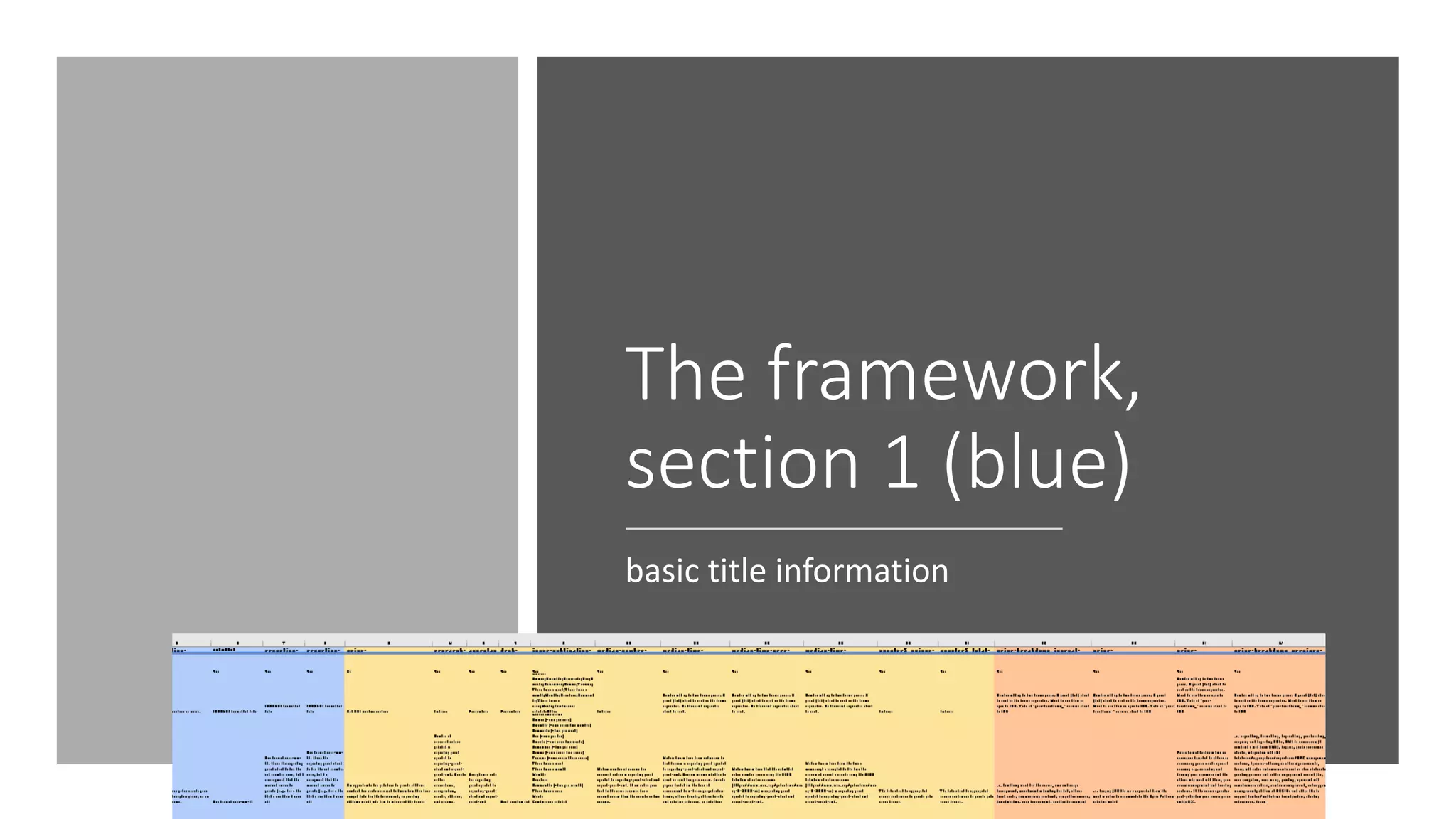
The framework,
section 1 (blue)
basic title information
• Columns B-E Title identifier (an ISSN or DOI)
• Column F To make the framework easier for publishers to implement, it is possible to group
titles that have less than + or – 5% variance in all data fields and to report averages. This field
is optional and is used to report which rows of data report such averages.
• Column G Discipline from https://read.oecd-ilibrary.org/science-and-technology/frascati-
manual-2015_9789264239012-en#page60 or choose from one of the following: all
disciplines, all STEM dsciplines, or all HSS disciplines.
• Column H Owner’s ROR ID
• Column I Publisher’s ROR ID
• Column J & K & L APC list price low value and high value (if there is a range, or else these
would be te same figures) and the currency in which list price is set
• Column M Link to a publicly available APC waiver or discount policy, or an indication there is
none
• Column N & O Subscription list price low value and high value (if there is a range, or else
these would be the same figures) and the currency in which list price is set
• Column Q Subscription list price for a typical member of the Association of American
Universities
• Column R Link to a publicly available subscription discount policy, or an indication there is
none
• Column S & T & U Date the information was submitted and the reporting period start and
end dates
The framework,
section 2 (orange)
contextual information
• Column V Link to any extra contextual information you would like to provide.
• Column W Number of research articles published, excluding author corrections,
corrigendum, errata, editorials, and reviews.
• Column X Acceptance rate
• Column Y Desk rejection rate
• Column Z Issue publication frequency
• Column AA Median number of reviews. If an article goes back to the same reviewer
for a second review, then this counts as two reviews. If reviews cascaded to the journal
with a paper, then count this as zero.
• Column AB Median time submission to first decision. Decision means whether to
reject or send for peer review. Include decisions based on assessment by in-house
prepublication teams, editorial boards, editorial boards and external referees,
subeditors, etc.
• Column AC Median days of peer review
• Column AD Median time acceptance to publication
• Column AE & AF Usage information: unique item requests and total item requests
(from COUNTER 5 or there is information in the implementation guide about how you
can calculate this if you have not implemented COUNTER
The framework,
section 3 (pink)
price and service information
These columns should
total 100% and
overheads and profits
distributed evenly
across them rather
than called out
separately
• Column Journal and community identify a need for the journal, its aims and scope development, investment in
funding for the field, editorial board costs, commissioning content, competitor analysis, benchmarking, policy
development, and portfolio development.
• Column AH Submission to first decision services that move an article from submission to a first decision about
whether to reject or send for peer review (e.g. triaging).
• Column AI Peer review services peer review activities including specialist reviews but please do not factor in time or
resources donated by editors or reviewers (i.e. recruiting and training peer reviewers and the editors who work with
them, peer review management and tracking systems). If the journal operates post-publication peer review, please
enter 0% in this column.
• Column AJ Acceptance to publication copyediting, formatting, typesetting, proofreading, assigning and depositing
DOIs, XML file conversion, tagging, quality assurance checks, integration with abstract and index
databases/aggregators/repositories/APC management systems, figure re-lettering or other improvements, dealing
with article enhancements such as video abstracts, proofing process and author engagement around this, issue
compilation, issue line up, printing, alignment with synchronous articles, vendor management, article pipeline
management; addition of ORCIDs and other IDs to support funder/institutional disambiguation, checking references,
design.
• Column AK Post-publication services handling ethical queries, provision of usage statistics, long-term preservation
and access, reader services, postage, inventory and stock control.
• Column AL Platform costs include development, hosting, support, and vendor management. One-off development
should be amortized over 3 years and figures for the relevant reporting period included.
• Column AM Sales & marketing sales teams, sales administration, legal costs for contracts, negotiations with
consortia and libraries, sales agents, invoicing, payments collection, debt recovery, bad debt write-offs, integration
with and promotion on social media networks, sponsorship.
• Column AN Author and customer support non-editorial author support and library customer support (e.g. helpdesk,
usage/impact/other reports, training, author queries about copyright or CC licenses.
Next steps
• cOAlition S considering other recommendations made by
Information Power:
• To commission an aggregation service
• To provide guidance re how to provide data in interim
• To develop an advocacy plan to promote awareness and use
• To consider providing an incentive for early implementation
• To consider establishing this approach as a formal standard
• To consider hosting a hackathon on using data
• cOAlition S foresees to provide details on where publishers
should deposit data in line with either of the Frameworks no
later than December 2021.
• From July 1st, 2022 only publishers who provide data in line with
one of the two endorsed price and service transparency
frameworks will be eligible to receive OA publication funds from
cOAlition S members. This covers funder contributions to any
model of financing open access publications including, but not
limited to, non-APC journals or platforms, article processing
charges (APCs), transformative agreements, and transformative
journals.
Publisher
implementation
experiences
Georgie Field, PLOS
Anna Kurek, Springer Nature
Sli.do poll – do you plan to implement the
transparency requirements and when?
vote at www.slido.com
using the event code #42715
Discussion and
questions
Moderated by Lorraine Estelle
Thank you very much
• Today’s participants
• The brilliant Georgie Field & Anna Kurek
• And all participating publishers and especially our pilot participants:
Annual Reviews, Brill, The Company of Biologists, EMBO Press,
European Respiratory Society, F1000 Research, Hindawi, IOP
Publishing, PLOS, and SpringerNature

Plan S Price Transparency requirements and framework

  • 1.
    Plan S PriceTransparency Framework… for publishers
  • 2.
    Agenda Introduction • Welcome -Lorraine Estelle, Information Power • Overview of requirement and frameworks - Alicia Wise, Information Power Publisher implementation experiences • Georgie Field, PLOS • Anna Kurek, Springer Nature Discussion and questions • Moderated by Lorraine Estelle
  • 3.
  • 4.
  • 5.
    Sli.do poll -how are you feeling about the Plan S price transparency requirements? Share your thoughts at www.slido.com using the event code #42715
  • 6.
    FOAA Breakdown ofpublication services and fees - https://www.fairopenaccess.org/foaa-breakdown-of-publication-services-and-fees/
  • 7.
    Plan S Price Transparency Framework- two parts 1. Implementation guide https://www.informationpower.co.uk/the-plan-s-price- transparency-framework-implementation-guide/ 2. Data collection spreadsheet https://www.informationpower.co.uk/the-plan-s-price- transparency-framework-data-collection-spreadsheet/ The data collection spreadsheet is in three parts: • Part 1 seeks to collect bibliographic metadata about the journal, such as the journal name, ISSN etc, and data on list prices and waiver and discount policies. • Part 2 looks at contextual metadata such as acceptance rate, frequency of publication and peer review times. • Part 3 focuses on price information, and eight categories of service are identified. For each, the publisher is asked to indicate what percentage of the overall price relates to the different services provided.
  • 8.
  • 9.
    Steering Group Organisation Stakeholdertype Ivy Anderson University of California University/Library consortium Chris Banks Imperial College London University Rachel Bruce UKRI Funder Liam Earney Jisc Collections Library consortium Sarah Greaves Hindawi Publisher Steven Inchcoombe Springer Nature Publisher Robert Kiley Wellcome Funder Jasmin Lange Brill Publisher Falk Reckling FWF (Austrian Science Fund) Funder Arthur Smith Cambridge University University
  • 10.
    Pilot participants • AnnualReviews • Brill • The Company of Biologists • EMBO Press • European Respiratory Society • F1000 Research • Hindawi • IOP Publishing • PLOS • SpringerNature
  • 11.
    The framework, section 1(blue) basic title information
  • 12.
    • Columns B-ETitle identifier (an ISSN or DOI) • Column F To make the framework easier for publishers to implement, it is possible to group titles that have less than + or – 5% variance in all data fields and to report averages. This field is optional and is used to report which rows of data report such averages. • Column G Discipline from https://read.oecd-ilibrary.org/science-and-technology/frascati- manual-2015_9789264239012-en#page60 or choose from one of the following: all disciplines, all STEM dsciplines, or all HSS disciplines. • Column H Owner’s ROR ID • Column I Publisher’s ROR ID • Column J & K & L APC list price low value and high value (if there is a range, or else these would be te same figures) and the currency in which list price is set • Column M Link to a publicly available APC waiver or discount policy, or an indication there is none • Column N & O Subscription list price low value and high value (if there is a range, or else these would be the same figures) and the currency in which list price is set • Column Q Subscription list price for a typical member of the Association of American Universities • Column R Link to a publicly available subscription discount policy, or an indication there is none • Column S & T & U Date the information was submitted and the reporting period start and end dates
  • 13.
    The framework, section 2(orange) contextual information
  • 14.
    • Column VLink to any extra contextual information you would like to provide. • Column W Number of research articles published, excluding author corrections, corrigendum, errata, editorials, and reviews. • Column X Acceptance rate • Column Y Desk rejection rate • Column Z Issue publication frequency • Column AA Median number of reviews. If an article goes back to the same reviewer for a second review, then this counts as two reviews. If reviews cascaded to the journal with a paper, then count this as zero. • Column AB Median time submission to first decision. Decision means whether to reject or send for peer review. Include decisions based on assessment by in-house prepublication teams, editorial boards, editorial boards and external referees, subeditors, etc. • Column AC Median days of peer review • Column AD Median time acceptance to publication • Column AE & AF Usage information: unique item requests and total item requests (from COUNTER 5 or there is information in the implementation guide about how you can calculate this if you have not implemented COUNTER
  • 15.
    The framework, section 3(pink) price and service information These columns should total 100% and overheads and profits distributed evenly across them rather than called out separately
  • 16.
    • Column Journaland community identify a need for the journal, its aims and scope development, investment in funding for the field, editorial board costs, commissioning content, competitor analysis, benchmarking, policy development, and portfolio development. • Column AH Submission to first decision services that move an article from submission to a first decision about whether to reject or send for peer review (e.g. triaging). • Column AI Peer review services peer review activities including specialist reviews but please do not factor in time or resources donated by editors or reviewers (i.e. recruiting and training peer reviewers and the editors who work with them, peer review management and tracking systems). If the journal operates post-publication peer review, please enter 0% in this column. • Column AJ Acceptance to publication copyediting, formatting, typesetting, proofreading, assigning and depositing DOIs, XML file conversion, tagging, quality assurance checks, integration with abstract and index databases/aggregators/repositories/APC management systems, figure re-lettering or other improvements, dealing with article enhancements such as video abstracts, proofing process and author engagement around this, issue compilation, issue line up, printing, alignment with synchronous articles, vendor management, article pipeline management; addition of ORCIDs and other IDs to support funder/institutional disambiguation, checking references, design. • Column AK Post-publication services handling ethical queries, provision of usage statistics, long-term preservation and access, reader services, postage, inventory and stock control. • Column AL Platform costs include development, hosting, support, and vendor management. One-off development should be amortized over 3 years and figures for the relevant reporting period included. • Column AM Sales & marketing sales teams, sales administration, legal costs for contracts, negotiations with consortia and libraries, sales agents, invoicing, payments collection, debt recovery, bad debt write-offs, integration with and promotion on social media networks, sponsorship. • Column AN Author and customer support non-editorial author support and library customer support (e.g. helpdesk, usage/impact/other reports, training, author queries about copyright or CC licenses.
  • 17.
    Next steps • cOAlitionS considering other recommendations made by Information Power: • To commission an aggregation service • To provide guidance re how to provide data in interim • To develop an advocacy plan to promote awareness and use • To consider providing an incentive for early implementation • To consider establishing this approach as a formal standard • To consider hosting a hackathon on using data • cOAlition S foresees to provide details on where publishers should deposit data in line with either of the Frameworks no later than December 2021. • From July 1st, 2022 only publishers who provide data in line with one of the two endorsed price and service transparency frameworks will be eligible to receive OA publication funds from cOAlition S members. This covers funder contributions to any model of financing open access publications including, but not limited to, non-APC journals or platforms, article processing charges (APCs), transformative agreements, and transformative journals.
  • 18.
  • 19.
    Sli.do poll –do you plan to implement the transparency requirements and when? vote at www.slido.com using the event code #42715
  • 20.
  • 21.
    Thank you verymuch • Today’s participants • The brilliant Georgie Field & Anna Kurek • And all participating publishers and especially our pilot participants: Annual Reviews, Brill, The Company of Biologists, EMBO Press, European Respiratory Society, F1000 Research, Hindawi, IOP Publishing, PLOS, and SpringerNature