Open Access funds:
Getting a Bigger Bang
for our Bucks
Glushko, Hampson, Moore & Yates -- Presented at Charleston Conference 2015
Presentation team
Crystal Hampson, Collection Services Librarian, University of Saskatchewan,
Elizabeth Yates, Head Liaison Services (Acting)/Scholarly Communications Librarian, Brock University
Patricia Moore, Systems Librarian - Digital Projects and Technologies, Carleton University
Bobby Glushko, Head, Scholarly Communications and Copyright Office, University of Toronto Libraries
2
Open Access funds:
Getting a Bigger Bang
for our Bucks
• Overview of Open Access
& the Canadian context
• Open Access Funds project
• Best practices from study
• Qualitative assessment
• A Contrarian view
• Alternatives
• Future Directions
3
CARL Open Access Working Group
CARL - Canadian Association of Research Libraries
29 university library members and two federal government libraries
“Provides leadership on behalf of Canada’s research libraries and enhances their capacity to advance research and higher education. It
promotes effective and sustainable scholarly communication, and public policy that enables broad access to scholarly information.”
Open Access Working Group (OAWG)
Began in summer 2011 - present form 2013
Reporting to the Research Dissemination Committee
“Provides coordinated Canadian leadership within a rapidly changing OA environment for issues of interest to CARL and CRKN
members. Responds to changes in OA actively, ensuring quick response to and participation in national and international
developments that arise from activities among associations, governments, research agencies, and publishers.”
4
We are at a confluence
 Technical ability to share
 Shifts in academic, research culture
 Push from funders, governments
 Open movement - from mashup
Why open now?
Photo: USGS REPORT ofr20131030
5
Open Access and Research Funding in Canada
Three major funding bodies - collectively referred to as Tri-Council or Tri-Agency
 CIHR Canadian Institutes of Health Research (CIHR)
 SSHRC Social Sciences and Humanities Research Council of Canada
 NSERC Natural Sciences and Engineering Research Council of Canada
“The objective of this policy is to improve access to the results of Agency-funded
research, and to increase the dissemination and exchange of research results. All
researchers, regardless of funding support, are encouraged to adhere to this policy.”
6
Tri-Council Policy on OA
In effect, May 2015
“Grant recipients are required to ensure that any peer-reviewed
journal publications arising from Agency-supported research are
freely accessible within 12 months of publication.”
http://www.science.gc.ca/default.asp?lang=En&n=F6765465-1
Compliance through:
 Deposit in open repositories
 Journals
*Must be final, post-peer review
7
Library Open Access Funds
“By setting aside resources for the express purpose
of encouraging authors to publish in open-access
journals, open-access funds demonstrate an institution’s
concrete support for reshaping the economics of
scholarly communication.”
-- Scholarly Publishing and Academic Resources Coalition
8
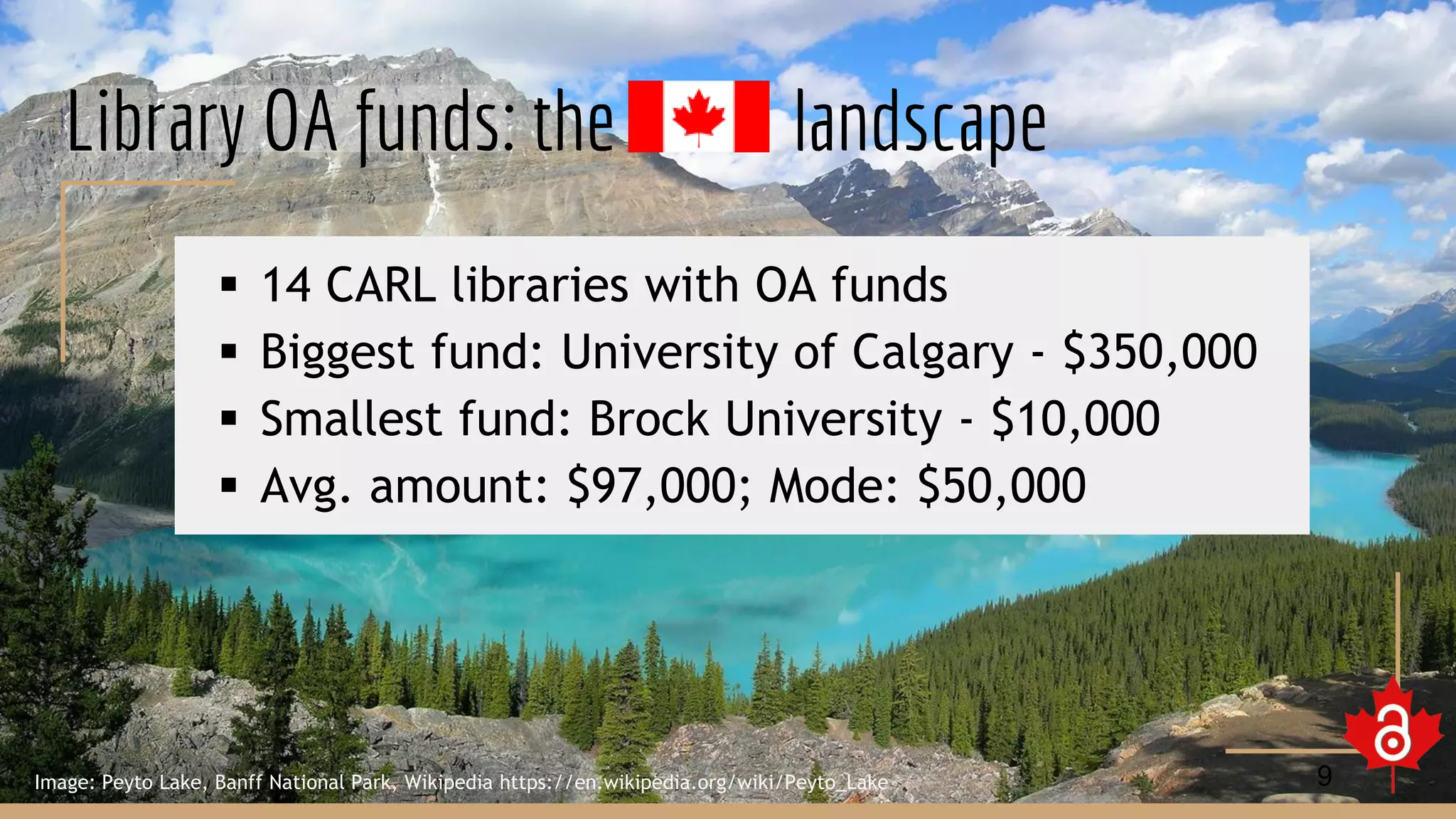
Library OA funds: the landscape
 14 CARL libraries with OA funds
 Biggest fund: University of Calgary - $350,000
 Smallest fund: Brock University - $10,000
 Avg. amount: $97,000; Mode: $50,000
Image: Peyto Lake, Banff National Park, Wikipedia https://en.wikipedia.org/wiki/Peyto_Lake 9
CARL Open Access Working Group: OA fund project
 Assess fund successes and challenges
 Clearly demonstrate return on investment
 Improve clarity when communicating with internal and
external stakeholders e.g. researchers, university
administrators, publishers
 Simplify for the process for institutions wishing to establish
new OA funds
10
Report partners:
Brian Cameron
Digital Initiatives Librarian
Ryerson University
Crystal Hampson
Collection Services Librarian
University of Saskatchewan
Jeanette Hatherill
Scholarly Communication Librarian
University of Ottawa Library
Julie Lavigne
Legal Studies Librarian
Carleton University
Rajiv Nariani
Science Librarian, Steacie Science & Engineering Library
York University
Joanne Paterson
Coordinator, Scholarship @Western
Metadata Management Librarian
Western University
Michael Shires
Collection Development and Liaison Librarian
University of Regina
Robert Tiessen
Books and Media Collection Development Librarian
University of Calgary Library
11
Best practice No. 1: eligibility criteria - applicants
Ensure eligibility criteria for applicants are transparent,
objective and can be adjusted as needed
Common criteria
 member of university community
 authors must use any grant funding before applying
 first-time applicants only OR one application per person
per fiscal year
 applicant must be paper’s first author
https://commons.wikimedia.org/wiki/File:Checklist_Noun_project_5166.svg
12
Best practice No. 2: eligibility criteria - material
Develop uniform criteria for openness
 Clearly define what’s meant by “fully open access”
 Quality control for business practices:
• DOAJ inclusion
• OASPA criteria
13
Best practice No. 3: enhance reuse & dissemination
 Clarify rights of authors and users:
• CC-BY
• No embargoes
 Facilitate automatic deposit in a repository
14
Best practice No. 4: document processes & practices
 Provide clear, easily accessible fund
documentation
 Monitor time spent on OA fund workflows
• consider outsourcing
15
OA Fund Assessment - Qualitative
 Assess against fund’s purpose
 Qualitative
• Gathered from recipients
• Support authors - e.g. timeliness, clarity of criteria, ease of use, etc.
• Support OA publishing - if not funded, would the article have been
published: gold, green, not OA?
16
SPARC Additional Measures
$ value of fund $ amount expended
# articles approved
# applications received
# applications rejected and reason for rejection
# payments reimbursed
# unique submitting authors
# unique successful authors
$ per author
# unique departments $ and # per department
# unique publishers $ and # per publisher
# unique journals $ per journal
OA Fund Assessment - Quantitative
17
OA Fund Assessment
 Track measures over time
 Use common measures
• Compare institutions
• Benchmark
• Aggregate reporting - national, international,
consortial
 Report to central body
18
Fund Changes - Institutional Context
 Serious financial challenges
• Budget reductions
• And, $CAD means costs +30%, before inflation
 9 of 14 institutions retained their OA fund in 2015-16
 A few hoped to increase the amount
 Five funds made changes
19
Changes Made to OA Funds
 Five funds made changes:
• One closed (may reconsider if $)
• One temporarily suspended
• One changed to one membership & self-archiving
• One stopped individual APCs - memberships, other
OA publishing models
• University of Toronto
20
Who on Campus Should Fund APCs?
 10 funded by library - 9 from collections budget
 2 funded jointly with other campus sources
 2 funded entirely by other campus sources
 Changed funds:
• 4 funded by library
• One joint fund - library no longer funding
 More secure if funded by university’s research office?
21
Toward Measuring Value for OA Fund Money...
 Competing within collections budget
 Cost per use
• OA: cost is perpetual, use is global
• Article level use metrics factored against APC as
cost per use metric
• Future best practice?
22
Gold OA Support Still High
 Two thirds chose to retain fund despite very serious
financial situation
 Of 5 that made changes:
 2 - memberships and other models of gold OA
 1 temporarily suspended
 1 will consider reinstating
 Commitment still high, models vary
23
The Contrarian View: Closing the OA Fund
Why has U of T been working to close
our open access fund?
24
The Contrarian View: Closing the OA Fund
Context:
U of T is HUGE
84,000 plus students
13,000 plus faculty
25
The Contrarian View: Closing the OA Fund
Issue one: Scale
No way to meaningfully support our faculty at scale
Diversity of faculties lead to structural inequalities
26
The Contrarian View: Closing the OA Fund
Issue two: Impact
Most of the funding went to large commercial publishers
Over-representation of STEM
Repeat Customers
27
The Contrarian View: Closing the OA Fund
Issue Three: Credible Alternatives
Canadian need to comply with Tri-Agency Open Access Mandates
Author funds cannot meet need
Green OA through mediated deposit
28
The Contrarian View: Closing the OA Fund
Issue Four: The Endless Drop in the Bucket
Communicate with 13,000 Faculty?!
Requests after funds are spent
29
The Contrarian View: Closing the OA Fund
Challenges:
OA Fund is popular
Library Commitments to the University
Anxiety over Tri-Agency Mandate
30
The Contrarian View: Closing the OA Fund
Solutions?
Memberships: Good but hard to evaluate
Mediated Deposit: Great! But hard to work retroactively
Support Homebrew Alternatives
31
The Contrarian View: Closing the OA Fund
Pushing back on Open Access?
Why do we support OA?
Glushko and Shoyama, A Theoretical Framework for Understanding Open
Access Initiatives
32
The Contrarian View: Closing the OA Fund
“the public good is essentially contested, that its evocation
is open to demagogic exploitation”
Jane Mansbridge
33
OA Funds and alternatives
 Infrastructure
 Repositories
 Grants restructured, revised
 Support for OA to publishers
 Standards for metrics, assessment, reporting
 Publishing
 Libraries as publishers
 Supporting green and hybrid, as well as gold
 Licensing and collection development
 Terms of use
 Highlighting OA resources
 Indexing support
34
Infrastructure changes
 National and International level funds
 Research funding bodies with OA-targeted resources
 OA-inclusive metrics, assessment tools
 OA workflows, standards & common practices
35
Mission - OA
 Partnership
 Advocacy
 Education
 Support
• Infrastructure
• Services
• Consultations
 Critical Review
OA is a tremendous opportunity,
but our OA initiatives need to be
consistent with library mandates,
strategic plans, professional ethos,
and best practices.
36
forecast - cloudy with a chance of participation
 OA and cloud
 Big data
 Cultural Shifts
• Funders
• Academics
• Publishers
Source: M. Hahnel, FigShare 2015
37
Thank you
Crystal Hampson Collection Services Librarian, University of Saskatchewan,
crystal.hampson@usask.ca
Elizabeth Yates Head Liaison Services (Acting)/Scholarly Communications Librarian, Brock University
eyates@brocku.ca Twitter: @LibraryWriteHer
Patricia Moore Systems Librarian - Digital Projects and Technologies, Carleton University
pat.moore@carleton.ca
Bobby Glushko Head, Scholarly Communications and Copyright Office, University of Toronto Libraries
bobby.glushko@utoronto.ca
38

Open Access Funds: Getting a Bigger Bang for Our Bucks

  • 1.
    Open Access funds: Gettinga Bigger Bang for our Bucks Glushko, Hampson, Moore & Yates -- Presented at Charleston Conference 2015
  • 2.
    Presentation team Crystal Hampson,Collection Services Librarian, University of Saskatchewan, Elizabeth Yates, Head Liaison Services (Acting)/Scholarly Communications Librarian, Brock University Patricia Moore, Systems Librarian - Digital Projects and Technologies, Carleton University Bobby Glushko, Head, Scholarly Communications and Copyright Office, University of Toronto Libraries 2
  • 3.
    Open Access funds: Gettinga Bigger Bang for our Bucks • Overview of Open Access & the Canadian context • Open Access Funds project • Best practices from study • Qualitative assessment • A Contrarian view • Alternatives • Future Directions 3
  • 4.
    CARL Open AccessWorking Group CARL - Canadian Association of Research Libraries 29 university library members and two federal government libraries “Provides leadership on behalf of Canada’s research libraries and enhances their capacity to advance research and higher education. It promotes effective and sustainable scholarly communication, and public policy that enables broad access to scholarly information.” Open Access Working Group (OAWG) Began in summer 2011 - present form 2013 Reporting to the Research Dissemination Committee “Provides coordinated Canadian leadership within a rapidly changing OA environment for issues of interest to CARL and CRKN members. Responds to changes in OA actively, ensuring quick response to and participation in national and international developments that arise from activities among associations, governments, research agencies, and publishers.” 4
  • 5.
    We are ata confluence  Technical ability to share  Shifts in academic, research culture  Push from funders, governments  Open movement - from mashup Why open now? Photo: USGS REPORT ofr20131030 5
  • 6.
    Open Access andResearch Funding in Canada Three major funding bodies - collectively referred to as Tri-Council or Tri-Agency  CIHR Canadian Institutes of Health Research (CIHR)  SSHRC Social Sciences and Humanities Research Council of Canada  NSERC Natural Sciences and Engineering Research Council of Canada “The objective of this policy is to improve access to the results of Agency-funded research, and to increase the dissemination and exchange of research results. All researchers, regardless of funding support, are encouraged to adhere to this policy.” 6
  • 7.
    Tri-Council Policy onOA In effect, May 2015 “Grant recipients are required to ensure that any peer-reviewed journal publications arising from Agency-supported research are freely accessible within 12 months of publication.” http://www.science.gc.ca/default.asp?lang=En&n=F6765465-1 Compliance through:  Deposit in open repositories  Journals *Must be final, post-peer review 7
  • 8.
    Library Open AccessFunds “By setting aside resources for the express purpose of encouraging authors to publish in open-access journals, open-access funds demonstrate an institution’s concrete support for reshaping the economics of scholarly communication.” -- Scholarly Publishing and Academic Resources Coalition 8
  • 9.
    Library OA funds:the landscape  14 CARL libraries with OA funds  Biggest fund: University of Calgary - $350,000  Smallest fund: Brock University - $10,000  Avg. amount: $97,000; Mode: $50,000 Image: Peyto Lake, Banff National Park, Wikipedia https://en.wikipedia.org/wiki/Peyto_Lake 9
  • 10.
    CARL Open AccessWorking Group: OA fund project  Assess fund successes and challenges  Clearly demonstrate return on investment  Improve clarity when communicating with internal and external stakeholders e.g. researchers, university administrators, publishers  Simplify for the process for institutions wishing to establish new OA funds 10
  • 11.
    Report partners: Brian Cameron DigitalInitiatives Librarian Ryerson University Crystal Hampson Collection Services Librarian University of Saskatchewan Jeanette Hatherill Scholarly Communication Librarian University of Ottawa Library Julie Lavigne Legal Studies Librarian Carleton University Rajiv Nariani Science Librarian, Steacie Science & Engineering Library York University Joanne Paterson Coordinator, Scholarship @Western Metadata Management Librarian Western University Michael Shires Collection Development and Liaison Librarian University of Regina Robert Tiessen Books and Media Collection Development Librarian University of Calgary Library 11
  • 12.
    Best practice No.1: eligibility criteria - applicants Ensure eligibility criteria for applicants are transparent, objective and can be adjusted as needed Common criteria  member of university community  authors must use any grant funding before applying  first-time applicants only OR one application per person per fiscal year  applicant must be paper’s first author https://commons.wikimedia.org/wiki/File:Checklist_Noun_project_5166.svg 12
  • 13.
    Best practice No.2: eligibility criteria - material Develop uniform criteria for openness  Clearly define what’s meant by “fully open access”  Quality control for business practices: • DOAJ inclusion • OASPA criteria 13
  • 14.
    Best practice No.3: enhance reuse & dissemination  Clarify rights of authors and users: • CC-BY • No embargoes  Facilitate automatic deposit in a repository 14
  • 15.
    Best practice No.4: document processes & practices  Provide clear, easily accessible fund documentation  Monitor time spent on OA fund workflows • consider outsourcing 15
  • 16.
    OA Fund Assessment- Qualitative  Assess against fund’s purpose  Qualitative • Gathered from recipients • Support authors - e.g. timeliness, clarity of criteria, ease of use, etc. • Support OA publishing - if not funded, would the article have been published: gold, green, not OA? 16
  • 17.
    SPARC Additional Measures $value of fund $ amount expended # articles approved # applications received # applications rejected and reason for rejection # payments reimbursed # unique submitting authors # unique successful authors $ per author # unique departments $ and # per department # unique publishers $ and # per publisher # unique journals $ per journal OA Fund Assessment - Quantitative 17
  • 18.
    OA Fund Assessment Track measures over time  Use common measures • Compare institutions • Benchmark • Aggregate reporting - national, international, consortial  Report to central body 18
  • 19.
    Fund Changes -Institutional Context  Serious financial challenges • Budget reductions • And, $CAD means costs +30%, before inflation  9 of 14 institutions retained their OA fund in 2015-16  A few hoped to increase the amount  Five funds made changes 19
  • 20.
    Changes Made toOA Funds  Five funds made changes: • One closed (may reconsider if $) • One temporarily suspended • One changed to one membership & self-archiving • One stopped individual APCs - memberships, other OA publishing models • University of Toronto 20
  • 21.
    Who on CampusShould Fund APCs?  10 funded by library - 9 from collections budget  2 funded jointly with other campus sources  2 funded entirely by other campus sources  Changed funds: • 4 funded by library • One joint fund - library no longer funding  More secure if funded by university’s research office? 21
  • 22.
    Toward Measuring Valuefor OA Fund Money...  Competing within collections budget  Cost per use • OA: cost is perpetual, use is global • Article level use metrics factored against APC as cost per use metric • Future best practice? 22
  • 23.
    Gold OA SupportStill High  Two thirds chose to retain fund despite very serious financial situation  Of 5 that made changes:  2 - memberships and other models of gold OA  1 temporarily suspended  1 will consider reinstating  Commitment still high, models vary 23
  • 24.
    The Contrarian View:Closing the OA Fund Why has U of T been working to close our open access fund? 24
  • 25.
    The Contrarian View:Closing the OA Fund Context: U of T is HUGE 84,000 plus students 13,000 plus faculty 25
  • 26.
    The Contrarian View:Closing the OA Fund Issue one: Scale No way to meaningfully support our faculty at scale Diversity of faculties lead to structural inequalities 26
  • 27.
    The Contrarian View:Closing the OA Fund Issue two: Impact Most of the funding went to large commercial publishers Over-representation of STEM Repeat Customers 27
  • 28.
    The Contrarian View:Closing the OA Fund Issue Three: Credible Alternatives Canadian need to comply with Tri-Agency Open Access Mandates Author funds cannot meet need Green OA through mediated deposit 28
  • 29.
    The Contrarian View:Closing the OA Fund Issue Four: The Endless Drop in the Bucket Communicate with 13,000 Faculty?! Requests after funds are spent 29
  • 30.
    The Contrarian View:Closing the OA Fund Challenges: OA Fund is popular Library Commitments to the University Anxiety over Tri-Agency Mandate 30
  • 31.
    The Contrarian View:Closing the OA Fund Solutions? Memberships: Good but hard to evaluate Mediated Deposit: Great! But hard to work retroactively Support Homebrew Alternatives 31
  • 32.
    The Contrarian View:Closing the OA Fund Pushing back on Open Access? Why do we support OA? Glushko and Shoyama, A Theoretical Framework for Understanding Open Access Initiatives 32
  • 33.
    The Contrarian View:Closing the OA Fund “the public good is essentially contested, that its evocation is open to demagogic exploitation” Jane Mansbridge 33
  • 34.
    OA Funds andalternatives  Infrastructure  Repositories  Grants restructured, revised  Support for OA to publishers  Standards for metrics, assessment, reporting  Publishing  Libraries as publishers  Supporting green and hybrid, as well as gold  Licensing and collection development  Terms of use  Highlighting OA resources  Indexing support 34
  • 35.
    Infrastructure changes  Nationaland International level funds  Research funding bodies with OA-targeted resources  OA-inclusive metrics, assessment tools  OA workflows, standards & common practices 35
  • 36.
    Mission - OA Partnership  Advocacy  Education  Support • Infrastructure • Services • Consultations  Critical Review OA is a tremendous opportunity, but our OA initiatives need to be consistent with library mandates, strategic plans, professional ethos, and best practices. 36
  • 37.
    forecast - cloudywith a chance of participation  OA and cloud  Big data  Cultural Shifts • Funders • Academics • Publishers Source: M. Hahnel, FigShare 2015 37
  • 38.
    Thank you Crystal HampsonCollection Services Librarian, University of Saskatchewan, crystal.hampson@usask.ca Elizabeth Yates Head Liaison Services (Acting)/Scholarly Communications Librarian, Brock University eyates@brocku.ca Twitter: @LibraryWriteHer Patricia Moore Systems Librarian - Digital Projects and Technologies, Carleton University pat.moore@carleton.ca Bobby Glushko Head, Scholarly Communications and Copyright Office, University of Toronto Libraries bobby.glushko@utoronto.ca 38