New Methods for Extending Access
Implications for Publishers and Library Collections & Services
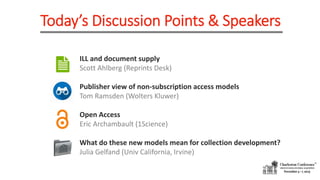
Today’s Discussion Points & Speakers
ILL and document supply
Scott Ahlberg (Reprints Desk)
Publisher view of non-subscription access models
Tom Ramsden (Wolters Kluwer)
Open Access
Eric Archambault (1Science)
What do these new models mean for collection development?
Julia Gelfand (Univ California, Irvine)
Why this topic?
Why discuss new methods for extending access?
ILL & Document Supply
> No library can afford to acquire or subscribe to everything
> Shifting research demands
> Budgetary constraints
= New access models needed
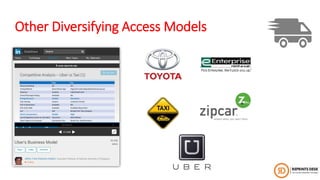
Other Diversifying Access Models
Acquisitions & ILL/DocDel:
Two sides of the same coin
> Balance low cost with maximum access
> Acquisitions: Persistent, ongoing access; High use titles
> ILL & document delivery: Demand-driven access; lower use titles
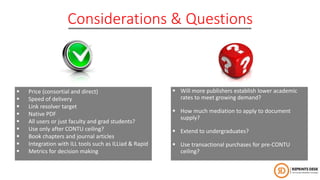
Considerations & Questions
 Price (consortial and direct)
 Speed of delivery
 Link resolver target
 Native PDF
 All users or just faculty and grad students?
 Use only after CONTU ceiling?
 Book chapters and journal articles
 Integration with ILL tools such as ILLiad & Rapid
 Metrics for decision making
 Will more publishers establish lower academic
rates to meet growing demand?
 How much mediation to apply to document
supply?
 Extend to undergraduates?
 Use transactional purchases for pre-CONTU
ceiling?
“The forces which made ILL and document delivery services
so critical for researchers are growing, not diminishing.
Materials budgets in libraries generally are not expanding;
there is still no way that academic libraries can afford to
permanently collect all the materials that a patron desires.
The number and variety of indexing databases that increase
awareness of resources continue to grow, thus exerting
pressure on ILL operations, whereas almost every other
type of library service has diminished.”
Wil Weston, from
Revisiting The Tao
of Resource
Sharing, The Serials
Librarian,, v. 69
issue 1, 2015
Publisher view of non-subscription access models
In the ever changing landscape of content
management and document delivery companies and
librarians are seeking to maximize their budgets and
in turn the publishing world continues to develop
alternative types of access models to grow revenue
and meet the needs of the customer.
One hurdle a number of publishers and vendors face
is that library budgets are historically divided into two
categories: Sub (journals and databases) and Non-
Sub (books and archives) and their budgets must be
allocated accordingly.
In the typical case the Sub pool of funds are usually
set aside at the beginning of the fiscal year while there
may be some non-sub money set aside in the event of
specific requests from faculty or students during the
year.
At the end of the fiscal year, if this money is not spent,
the library is typically in a “use it or lose it” situation
and more willing to spend on non-sub content.
Review of alternate acquisitions models
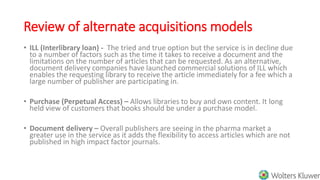
• ILL (Interlibrary loan) - The tried and true option but the service is in decline due
to a number of factors such as the time it takes to receive a document and the
limitations on the number of articles that can be requested. As an alternative,
document delivery companies have launched commercial solutions of ILL which
enables the requesting library to receive the article immediately for a fee which a
large number of publisher are participating in.
• Purchase (Perpetual Access) – Allows libraries to buy and own content. It long
held view of customers that books should be under a purchase model.
• Document delivery – Overall publishers are seeing in the pharma market a
greater use in the service as it adds the flexibility to access articles which are not
published in high impact factor journals.
Review of alternate acquisitions models
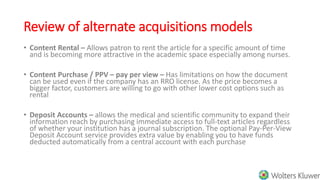
• Content Rental – Allows patron to rent the article for a specific amount of time
and is becoming more attractive in the academic space especially among nurses.
• Content Purchase / PPV – pay per view – Has limitations on how the document
can be used even if the company has an RRO license. As the price becomes a
bigger factor, customers are willing to go with other lower cost options such as
rental
• Deposit Accounts – allows the medical and scientific community to expand their
information reach by purchasing immediate access to full-text articles regardless
of whether your institution has a journal subscription. The optional Pay-Per-View
Deposit Account service provides extra value by enabling you to have funds
deducted automatically from a central account with each purchase
Review of alternate acquisitions models
• DDA / PPA – (Demand Driven / Patron Driven Acquisition) - is driven by the patron, with
the library setting the parameters of the “buy” / “triggers.” The Vendor determines what
‘triggers’ it will offer in its DDA/PDA model. Publisher’s and vendor’s opinions vary on the
model as on one hand it helps get content to new or lost customers while on the other
they are assuming all the risk with no guaranteed revenue.
• EBCM – (Evidenced Based Collection Management) – Not a traditional DDA / PPA model
in this case the librarian is making the purchase decisions based on usage as well as
collection development policies, subject specialist input and other criteria. This model
may offer a vendor a better margin and a purchase guarantee up front It also offers a
library more control, as librarian review “use” of all titles “as a whole” at the end of the
set time period, and can then use other collection metrics to make decisions about
purchases.
• Pay-as-you-Go – A service a number of publishers and vendors offer where you either
pay for the content over a series of days or based on usage over a selected time frame.
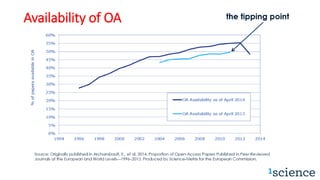
Availability of OA
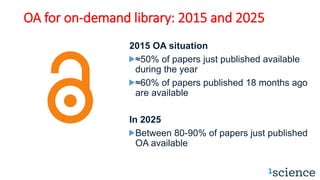
OA for on-demand library: 2015 and 2025
2015 OA situation
≈50% of papers just published available
during the year
≈60% of papers published 18 months ago
are available
In 2025
Between 80-90% of papers just published
OA available
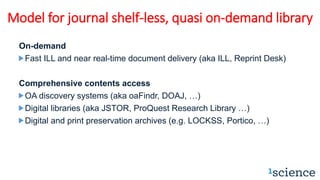
Model for journal shelf-less, quasi on-demand library
On-demand
Fast ILL and near real-time document delivery (aka ILL, Reprint Desk)
Comprehensive contents access
OA discovery systems (aka oaFindr, DOAJ, …)
Digital libraries (aka JSTOR, ProQuest Research Library …)
Digital and print preservation archives (e.g. LOCKSS, Portico, …)
Issues to Discovery of OA peer-reviewed papers
How do you facilitate discovery of all OA (green, hybrid, gold)
OA papers from more than 30,000 top-level domains
Crisscrossing of institutional repositories, mega repositories (e.g.
arXiv), gold aggregators(e.g. DOAJ), publishers, etc.
Multiple copies of articles
Link to documents
Self-updating
Distributed licensing and embargoes responsibilities
A New Way to Think About
Journal Collections
Julia Gelfand
University of California, Irvine Libraries
Charleston Conference 2015
jgelfand@uci.edu
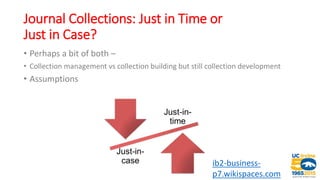
Journal Collections: Just in Time or
Just in Case?
• Perhaps a bit of both –
• Collection management vs collection building but still collection development
• Assumptions
ib2-business-
p7.wikispaces.com
ILL vs Document Delivery
• Libraries in business of sharing resources when it makes sense &
saves cents
• Already using third party providers for content:
• Full-text databases
• Big package deals – aggregators
• Document supply options – buy by the article as needed
• Responding to user needs without major financial commitment
• Specialized journals are truly specialized
http://rethinkingresourcesharing.org
Long Term Consequences
www.socialsciencespace.com
• Journal collection costs unsustainable – ratio of subscribed content to
books/other materials continues to soar
• Ability to shift as needs for content realign with academic program
changes
• OA landscape increasing
• Some libraries contributing to ACP charges
• Ability to respond to immediate requests at reasonable fees
• Publishers providing more content on demand
Impact of Ne oof New Directions(marialuisaaliotta.wordpress.com)
• Library collections redefined – not by subscription but by access
• Content is still king
• Publishers unite in distributing at the article level than via journal
• Libraries build collections that are more unique
• Subscriptions still critical for major needs, but likely reduced at more expensive tiers
• Reliance on more OA content as it increases & alternative access models
• Due to OA mandates, more dependency on repository content
• Usage and demand for content will shape future journal holdings
• Browsing changes landscape – perhaps less serendipity
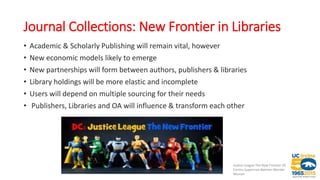
Journal Collections: New Frontier in Libraries
• Academic & Scholarly Publishing will remain vital, however
• New economic models likely to emerge
• New partnerships will form between authors, publishers & libraries
• Library holdings will be more elastic and incomplete
• Users will depend on multiple sourcing for their needs
• Publishers, Libraries and OA will influence & transform each other
Justice League The New Frontier DC
Comics Superman Batman Wonder
Woman
Discussion / Q&A

New Methods for Extending Access: Implications for Publishers and Library Collections & Services

  • 1.
    New Methods forExtending Access Implications for Publishers and Library Collections & Services
  • 2.
    Today’s Discussion Points& Speakers ILL and document supply Scott Ahlberg (Reprints Desk) Publisher view of non-subscription access models Tom Ramsden (Wolters Kluwer) Open Access Eric Archambault (1Science) What do these new models mean for collection development? Julia Gelfand (Univ California, Irvine)
  • 3.
    Why this topic? Whydiscuss new methods for extending access?
  • 4.
    ILL & DocumentSupply > No library can afford to acquire or subscribe to everything > Shifting research demands > Budgetary constraints = New access models needed
  • 5.
  • 6.
    Acquisitions & ILL/DocDel: Twosides of the same coin > Balance low cost with maximum access > Acquisitions: Persistent, ongoing access; High use titles > ILL & document delivery: Demand-driven access; lower use titles
  • 7.
    Considerations & Questions Price (consortial and direct)  Speed of delivery  Link resolver target  Native PDF  All users or just faculty and grad students?  Use only after CONTU ceiling?  Book chapters and journal articles  Integration with ILL tools such as ILLiad & Rapid  Metrics for decision making  Will more publishers establish lower academic rates to meet growing demand?  How much mediation to apply to document supply?  Extend to undergraduates?  Use transactional purchases for pre-CONTU ceiling?
  • 8.
    “The forces whichmade ILL and document delivery services so critical for researchers are growing, not diminishing. Materials budgets in libraries generally are not expanding; there is still no way that academic libraries can afford to permanently collect all the materials that a patron desires. The number and variety of indexing databases that increase awareness of resources continue to grow, thus exerting pressure on ILL operations, whereas almost every other type of library service has diminished.” Wil Weston, from Revisiting The Tao of Resource Sharing, The Serials Librarian,, v. 69 issue 1, 2015
  • 9.
    Publisher view ofnon-subscription access models
  • 10.
    In the everchanging landscape of content management and document delivery companies and librarians are seeking to maximize their budgets and in turn the publishing world continues to develop alternative types of access models to grow revenue and meet the needs of the customer. One hurdle a number of publishers and vendors face is that library budgets are historically divided into two categories: Sub (journals and databases) and Non- Sub (books and archives) and their budgets must be allocated accordingly. In the typical case the Sub pool of funds are usually set aside at the beginning of the fiscal year while there may be some non-sub money set aside in the event of specific requests from faculty or students during the year. At the end of the fiscal year, if this money is not spent, the library is typically in a “use it or lose it” situation and more willing to spend on non-sub content.
  • 11.
    Review of alternateacquisitions models • ILL (Interlibrary loan) - The tried and true option but the service is in decline due to a number of factors such as the time it takes to receive a document and the limitations on the number of articles that can be requested. As an alternative, document delivery companies have launched commercial solutions of ILL which enables the requesting library to receive the article immediately for a fee which a large number of publisher are participating in. • Purchase (Perpetual Access) – Allows libraries to buy and own content. It long held view of customers that books should be under a purchase model. • Document delivery – Overall publishers are seeing in the pharma market a greater use in the service as it adds the flexibility to access articles which are not published in high impact factor journals.
  • 12.
    Review of alternateacquisitions models • Content Rental – Allows patron to rent the article for a specific amount of time and is becoming more attractive in the academic space especially among nurses. • Content Purchase / PPV – pay per view – Has limitations on how the document can be used even if the company has an RRO license. As the price becomes a bigger factor, customers are willing to go with other lower cost options such as rental • Deposit Accounts – allows the medical and scientific community to expand their information reach by purchasing immediate access to full-text articles regardless of whether your institution has a journal subscription. The optional Pay-Per-View Deposit Account service provides extra value by enabling you to have funds deducted automatically from a central account with each purchase
  • 13.
    Review of alternateacquisitions models • DDA / PPA – (Demand Driven / Patron Driven Acquisition) - is driven by the patron, with the library setting the parameters of the “buy” / “triggers.” The Vendor determines what ‘triggers’ it will offer in its DDA/PDA model. Publisher’s and vendor’s opinions vary on the model as on one hand it helps get content to new or lost customers while on the other they are assuming all the risk with no guaranteed revenue. • EBCM – (Evidenced Based Collection Management) – Not a traditional DDA / PPA model in this case the librarian is making the purchase decisions based on usage as well as collection development policies, subject specialist input and other criteria. This model may offer a vendor a better margin and a purchase guarantee up front It also offers a library more control, as librarian review “use” of all titles “as a whole” at the end of the set time period, and can then use other collection metrics to make decisions about purchases. • Pay-as-you-Go – A service a number of publishers and vendors offer where you either pay for the content over a series of days or based on usage over a selected time frame.
  • 15.
  • 16.
    OA for on-demandlibrary: 2015 and 2025 2015 OA situation ≈50% of papers just published available during the year ≈60% of papers published 18 months ago are available In 2025 Between 80-90% of papers just published OA available
  • 17.
    Model for journalshelf-less, quasi on-demand library On-demand Fast ILL and near real-time document delivery (aka ILL, Reprint Desk) Comprehensive contents access OA discovery systems (aka oaFindr, DOAJ, …) Digital libraries (aka JSTOR, ProQuest Research Library …) Digital and print preservation archives (e.g. LOCKSS, Portico, …)
  • 18.
    Issues to Discoveryof OA peer-reviewed papers How do you facilitate discovery of all OA (green, hybrid, gold) OA papers from more than 30,000 top-level domains Crisscrossing of institutional repositories, mega repositories (e.g. arXiv), gold aggregators(e.g. DOAJ), publishers, etc. Multiple copies of articles Link to documents Self-updating Distributed licensing and embargoes responsibilities
  • 20.
    A New Wayto Think About Journal Collections Julia Gelfand University of California, Irvine Libraries Charleston Conference 2015 jgelfand@uci.edu
  • 21.
    Journal Collections: Justin Time or Just in Case? • Perhaps a bit of both – • Collection management vs collection building but still collection development • Assumptions ib2-business- p7.wikispaces.com
  • 22.
    ILL vs DocumentDelivery • Libraries in business of sharing resources when it makes sense & saves cents • Already using third party providers for content: • Full-text databases • Big package deals – aggregators • Document supply options – buy by the article as needed • Responding to user needs without major financial commitment • Specialized journals are truly specialized http://rethinkingresourcesharing.org
  • 23.
    Long Term Consequences www.socialsciencespace.com •Journal collection costs unsustainable – ratio of subscribed content to books/other materials continues to soar • Ability to shift as needs for content realign with academic program changes • OA landscape increasing • Some libraries contributing to ACP charges • Ability to respond to immediate requests at reasonable fees • Publishers providing more content on demand
  • 24.
    Impact of Neoof New Directions(marialuisaaliotta.wordpress.com) • Library collections redefined – not by subscription but by access • Content is still king • Publishers unite in distributing at the article level than via journal • Libraries build collections that are more unique • Subscriptions still critical for major needs, but likely reduced at more expensive tiers • Reliance on more OA content as it increases & alternative access models • Due to OA mandates, more dependency on repository content • Usage and demand for content will shape future journal holdings • Browsing changes landscape – perhaps less serendipity
  • 25.
    Journal Collections: NewFrontier in Libraries • Academic & Scholarly Publishing will remain vital, however • New economic models likely to emerge • New partnerships will form between authors, publishers & libraries • Library holdings will be more elastic and incomplete • Users will depend on multiple sourcing for their needs • Publishers, Libraries and OA will influence & transform each other Justice League The New Frontier DC Comics Superman Batman Wonder Woman
  • 26.

Editor's Notes

  • #4 1/ILL Alternative is an Option w/benefits 2/Paywall better way (buyer/seller) 3/Speed of delivery
  • #10 1/ILL Alternative is an Option w/benefits 2/Paywall better way (buyer/seller) 3/Speed of delivery