Knowledge Exchange Consensus: Monitoring of Open Access
Publications and Cost Data
Melanie Imming, Christian H. Thomasen, Birgit Schmidt
Knowledge Exchange
LIBER Conference – July 2017 Patras
Six key national agencies and bodies within Europe responsible for the
development of infrastructure and services to support the use ICT within
education and research.
German Research Foundation
Jisc, United Kingdom
Denmark’s Electronic Research Library
SURF, The Netherlands
CSC, Finland
CNRS, France
Knowledge Exchange
2
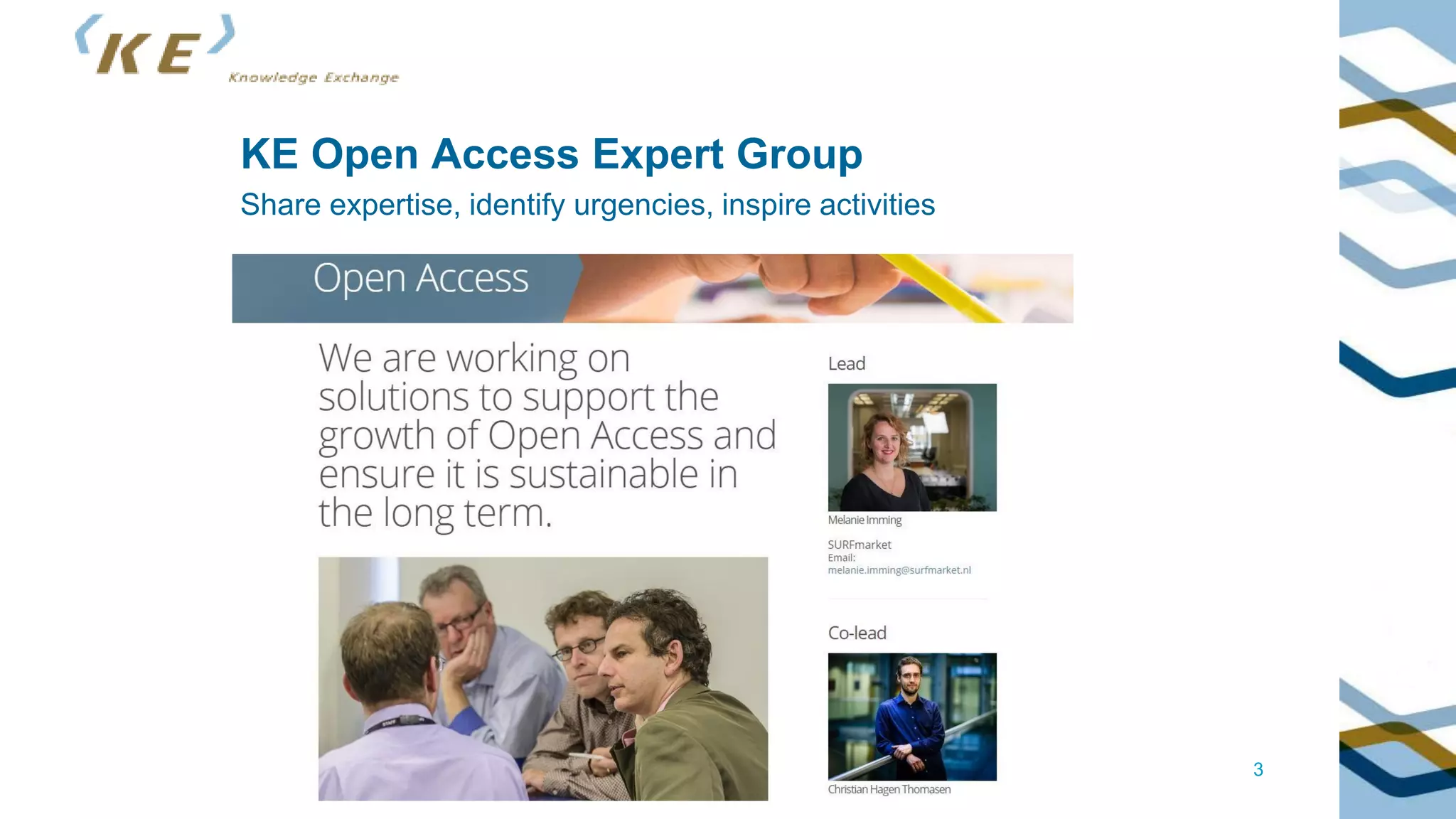
KE Open Access Expert Group
Share expertise, identify urgencies, inspire activities
3
4
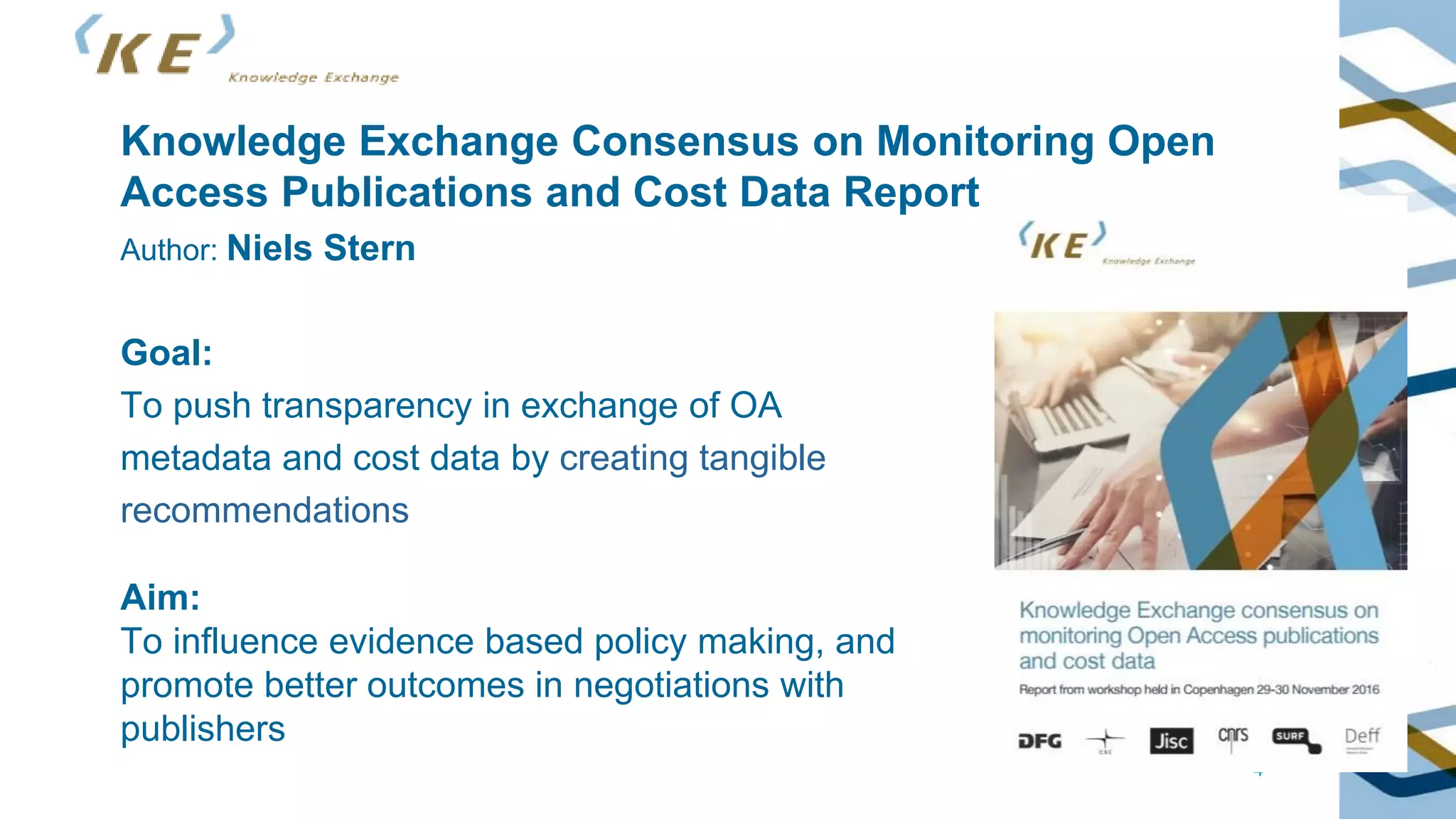
Knowledge Exchange Consensus on Monitoring Open
Access Publications and Cost Data Report
Author: Niels Stern
Goal:
To push transparency in exchange of OA
metadata and cost data by creating tangible
recommendations
Aim:
To influence evidence based policy making, and
promote better outcomes in negotiations with
publishers
5
Knowledge Exchange Consensus on Monitoring Open
Access Publications and Cost Data Report
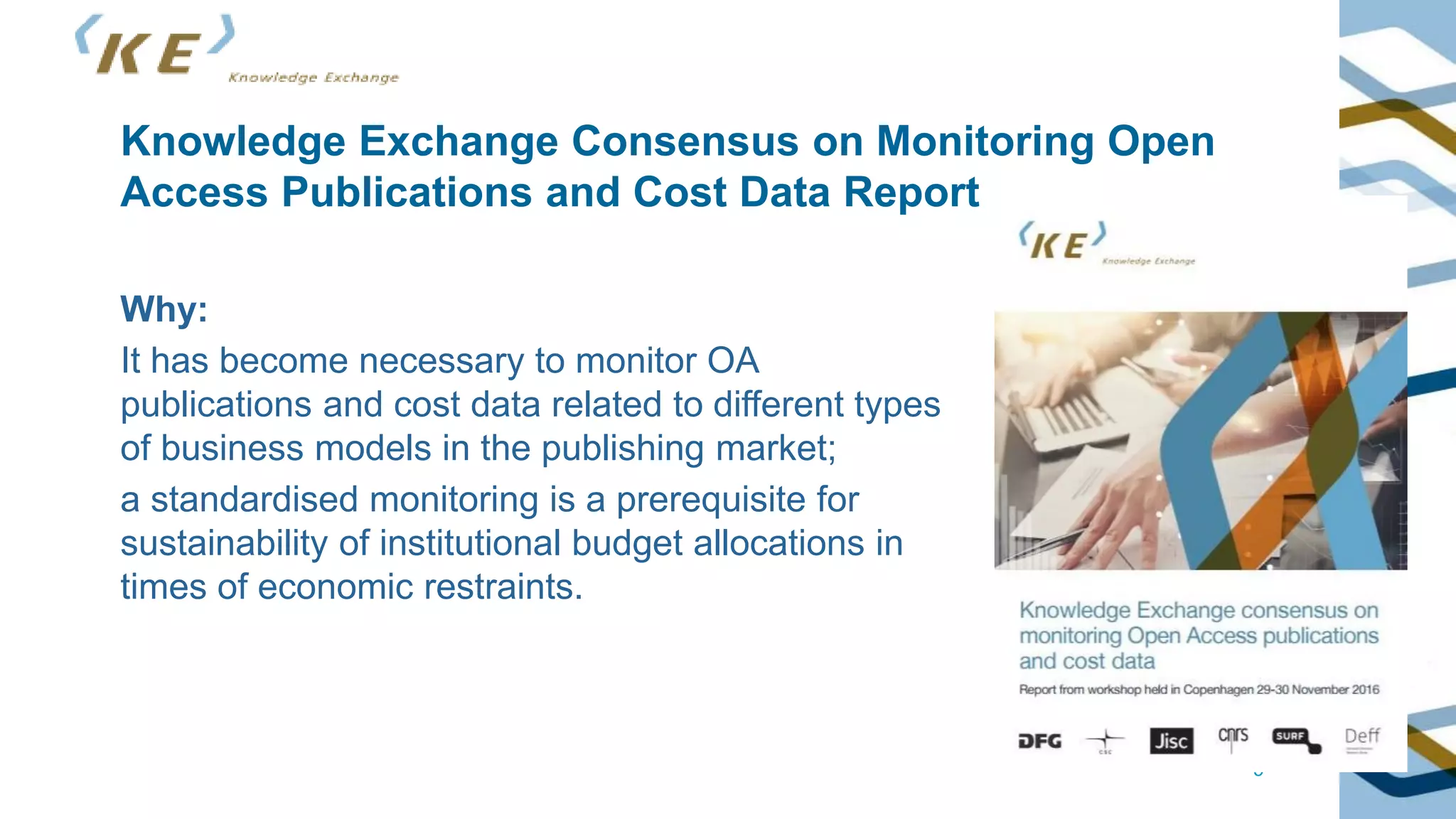
Why:
It has become necessary to monitor OA
publications and cost data related to different types
of business models in the publishing market;
a standardised monitoring is a prerequisite for
sustainability of institutional budget allocations in
times of economic restraints.
6
Knowledge Exchange Consensus on Monitoring Open
Access Publications and Cost Data Report
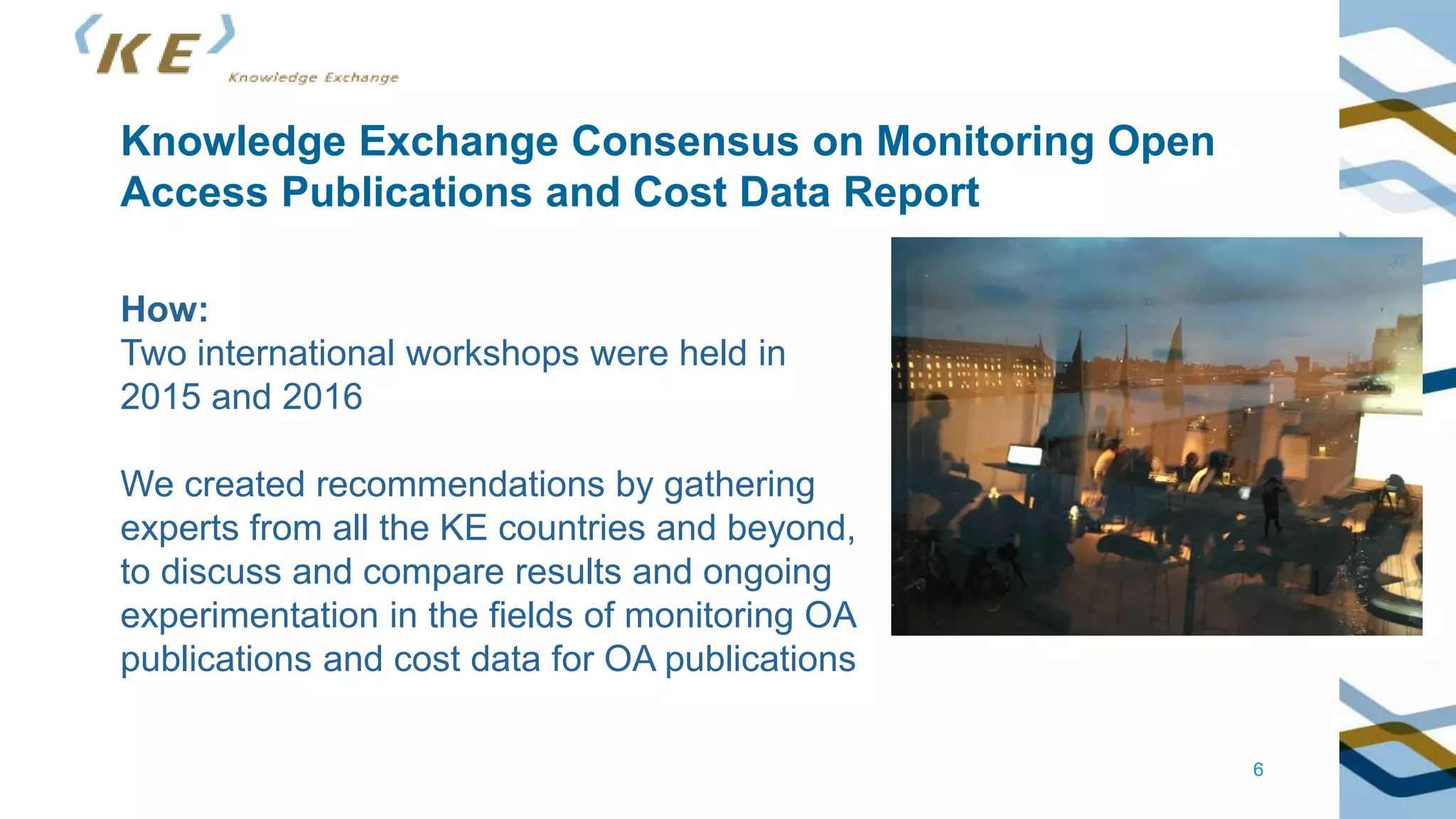
How:
Two international workshops were held in
2015 and 2016
We created recommendations by gathering
experts from all the KE countries and beyond,
to discuss and compare results and ongoing
experimentation in the fields of monitoring OA
publications and cost data for OA publications
7
Recommendations
In summary the recommendations on monitoring OA publications are:
1.
If new standards are needed they should be added to the existing
protocols
2.
With the standards and definitions in place, policies and agreements can
require publishers to deliver data in ways that make the workflows open
and transparent
8
Recommendations
In summary the recommendations on monitoring OA publications are:
3.
Current Research Information Systems (CRIS’s) can be used as sources
for monitoring OA publications and ensure that the monitoring data is
open through open API’s (application programming interface) so that
monitoring results can be validated, thus ensuring transparency and
reproducibility
4.
Finally, libraries should play an active role in this area
9
Recommendations
In summary the recommendations relating to monitoring on cost data
are:
1.
When monitoring OA cost data accounting systems and repositories
should be interoperable so that cost data at all levels can be easily
retrieved.
2.
Data should be open and shareable, thus the DOI becoming a key tool.
Publishers should be required to enter the needed data such as license,
DOI, corresponding author and APC in the publication metadata as well
as in the publications themselves.
10
Recommendations
In summary the recommendations relating to monitoring on cost data
are:
3.
Such requirements should be settled in contracts with the publishers
avoiding non-disclosure regulations at all time.
4.
A transparent overview of the Total Cost of Publication is a key concept
and it’s important for consortia as well as for HEI to be able to dissect
costs of publishing carefully, underlining that the APC does not cover all
costs of publication.
11
1.
Libraries should be very specific about their requirements from publishers and
use the contracts with publishers as instruments to obtain what is required.
They should act in common and work in larger consortia contexts and
cooperate across countries to present unified requirements to publishers (eg
Efficiency and Standards for [Open Access] Article Charges or ESAC)
2.
Libraries should collect as much data as possible and ensure the data is open
(via API) and findable, accessible, interoperable, and reusable (so-called
‘FAIR’ data)
Recommendations for libraries
It was evident from the conversations that libraries have a very important
and central role to play.
12
Recommendations for libraries
3.
Libraries could be used as centralised OA funding offices regarding payments
4.
Libraries should require transparency in all costs related to everything that has
to do with publishing and they should not enter into non-disclosure agreements
5.
Institutions should have processes that make it clear what the Total Costs of
Publication (TCP) are, including APC, administrative costs, infrastructural costs
and other costs like page and colour charges.
13
Next steps – beyond Copenhagen
The concrete result of this workshop was a large number of
recommendations.
These can be categorised and summarised and brought into further
discussions and action points on monitoring of OA publications and cost
data in different ways.
14
Next steps – beyond Copenhagen
The concrete result of this workshop was a large number of
recommendations.
These can be categorised and summarised and brought into further
discussions and action points on monitoring of OA publications and cost
data in different ways.
Any ideas on how we can take the library
recommendations further?
THANK YOU!
Acknowledgements
The work presented in these slides was performed by the contributions
and constructive discussions by all participants in the workshop series.
More information:
Melanie.imming@surfmarket.nl
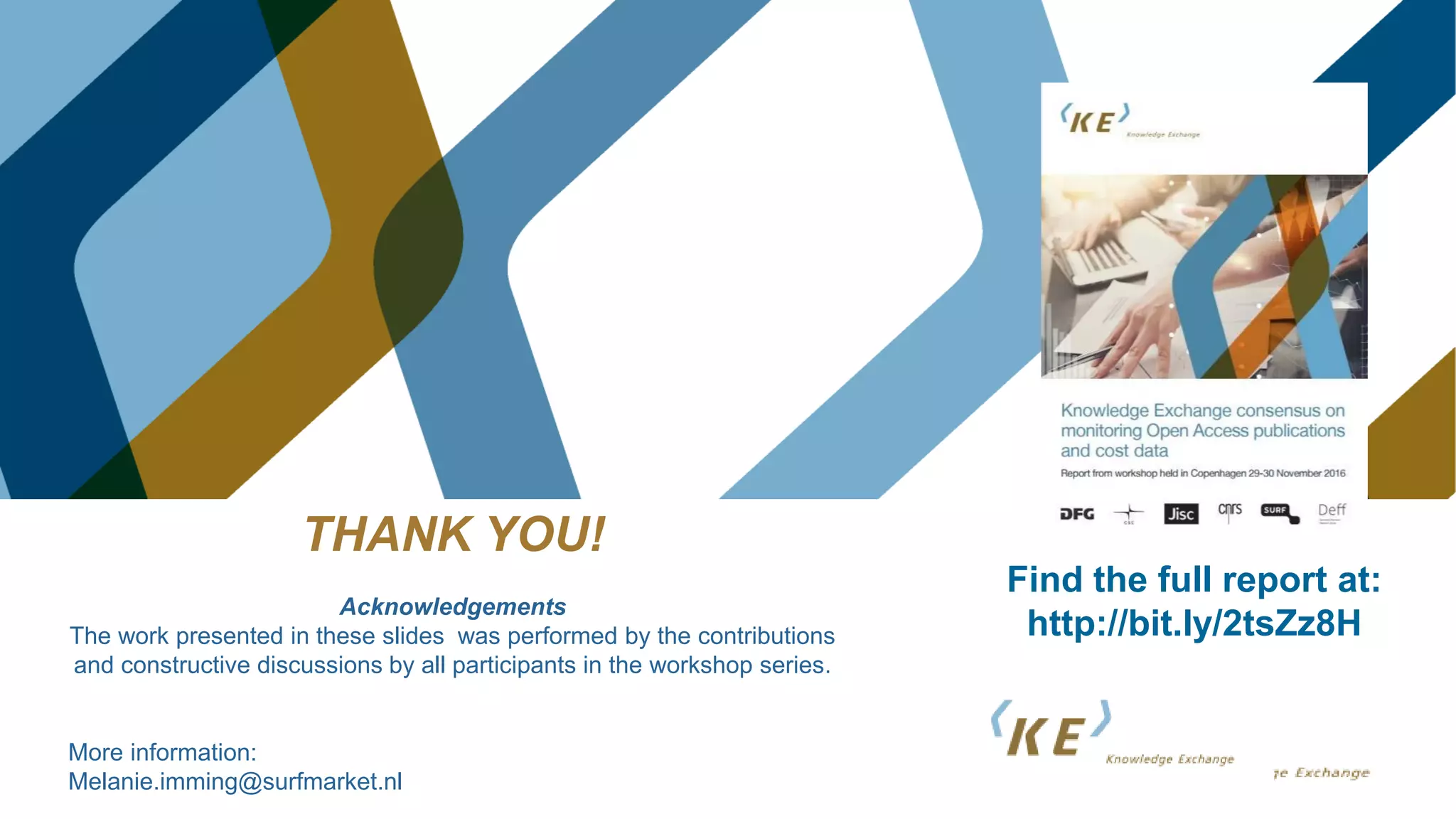
Find the full report at:
http://bit.ly/2tsZz8H
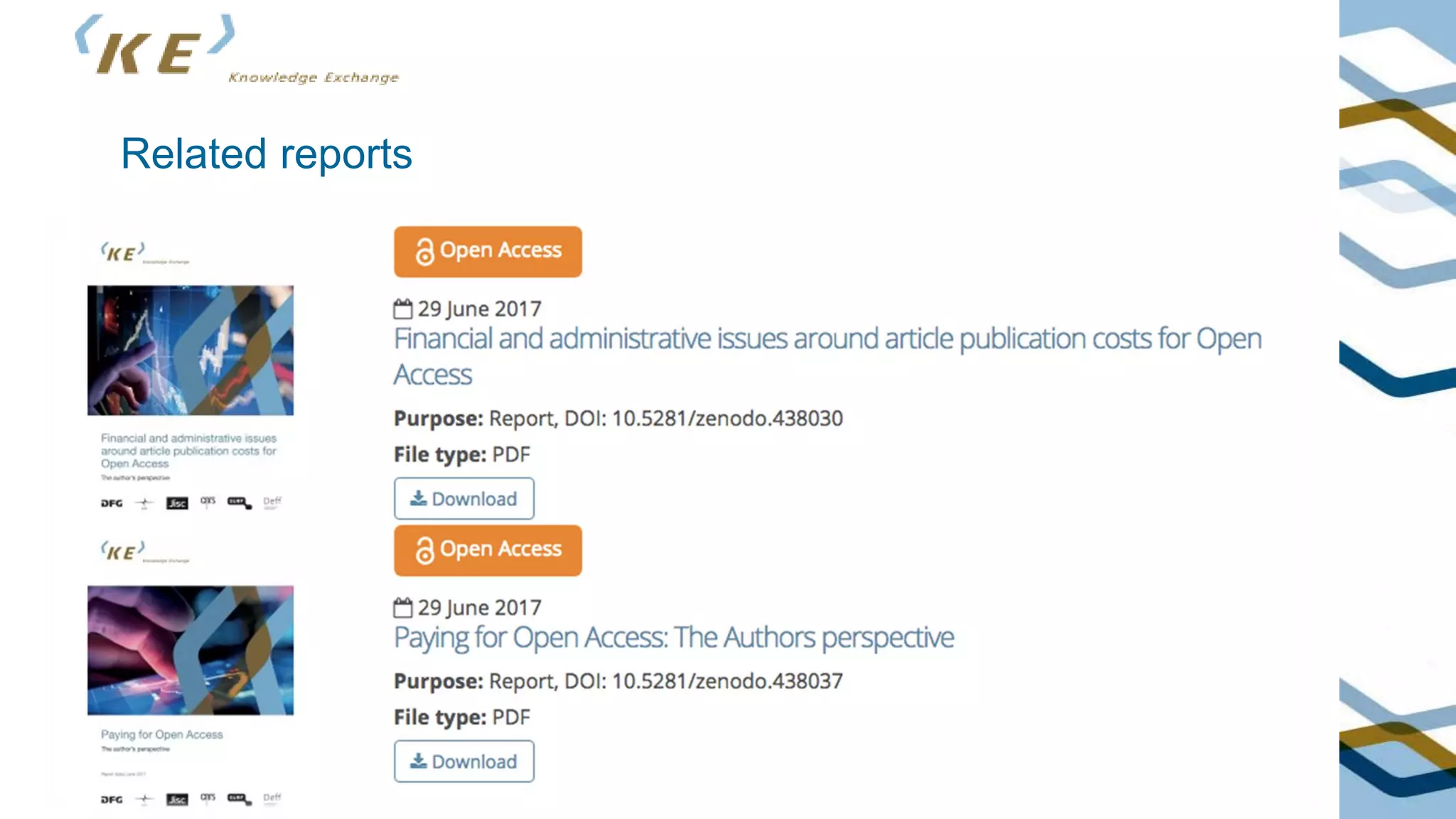
Related reports
16

Knowledge Exchange Consensus: Monitoring of Open Access Publications and Cost Data. Michael Svendsen, Royal Danish Library. Christian H. Thomasen, Knowledge Exchange, Denmark

  • 1.
    Knowledge Exchange Consensus:Monitoring of Open Access Publications and Cost Data Melanie Imming, Christian H. Thomasen, Birgit Schmidt Knowledge Exchange LIBER Conference – July 2017 Patras
  • 2.
    Six key nationalagencies and bodies within Europe responsible for the development of infrastructure and services to support the use ICT within education and research. German Research Foundation Jisc, United Kingdom Denmark’s Electronic Research Library SURF, The Netherlands CSC, Finland CNRS, France Knowledge Exchange 2
  • 3.
    KE Open AccessExpert Group Share expertise, identify urgencies, inspire activities 3
  • 4.
    4 Knowledge Exchange Consensuson Monitoring Open Access Publications and Cost Data Report Author: Niels Stern Goal: To push transparency in exchange of OA metadata and cost data by creating tangible recommendations Aim: To influence evidence based policy making, and promote better outcomes in negotiations with publishers
  • 5.
    5 Knowledge Exchange Consensuson Monitoring Open Access Publications and Cost Data Report Why: It has become necessary to monitor OA publications and cost data related to different types of business models in the publishing market; a standardised monitoring is a prerequisite for sustainability of institutional budget allocations in times of economic restraints.
  • 6.
    6 Knowledge Exchange Consensuson Monitoring Open Access Publications and Cost Data Report How: Two international workshops were held in 2015 and 2016 We created recommendations by gathering experts from all the KE countries and beyond, to discuss and compare results and ongoing experimentation in the fields of monitoring OA publications and cost data for OA publications
  • 7.
    7 Recommendations In summary therecommendations on monitoring OA publications are: 1. If new standards are needed they should be added to the existing protocols 2. With the standards and definitions in place, policies and agreements can require publishers to deliver data in ways that make the workflows open and transparent
  • 8.
    8 Recommendations In summary therecommendations on monitoring OA publications are: 3. Current Research Information Systems (CRIS’s) can be used as sources for monitoring OA publications and ensure that the monitoring data is open through open API’s (application programming interface) so that monitoring results can be validated, thus ensuring transparency and reproducibility 4. Finally, libraries should play an active role in this area
  • 9.
    9 Recommendations In summary therecommendations relating to monitoring on cost data are: 1. When monitoring OA cost data accounting systems and repositories should be interoperable so that cost data at all levels can be easily retrieved. 2. Data should be open and shareable, thus the DOI becoming a key tool. Publishers should be required to enter the needed data such as license, DOI, corresponding author and APC in the publication metadata as well as in the publications themselves.
  • 10.
    10 Recommendations In summary therecommendations relating to monitoring on cost data are: 3. Such requirements should be settled in contracts with the publishers avoiding non-disclosure regulations at all time. 4. A transparent overview of the Total Cost of Publication is a key concept and it’s important for consortia as well as for HEI to be able to dissect costs of publishing carefully, underlining that the APC does not cover all costs of publication.
  • 11.
    11 1. Libraries should bevery specific about their requirements from publishers and use the contracts with publishers as instruments to obtain what is required. They should act in common and work in larger consortia contexts and cooperate across countries to present unified requirements to publishers (eg Efficiency and Standards for [Open Access] Article Charges or ESAC) 2. Libraries should collect as much data as possible and ensure the data is open (via API) and findable, accessible, interoperable, and reusable (so-called ‘FAIR’ data) Recommendations for libraries It was evident from the conversations that libraries have a very important and central role to play.
  • 12.
    12 Recommendations for libraries 3. Librariescould be used as centralised OA funding offices regarding payments 4. Libraries should require transparency in all costs related to everything that has to do with publishing and they should not enter into non-disclosure agreements 5. Institutions should have processes that make it clear what the Total Costs of Publication (TCP) are, including APC, administrative costs, infrastructural costs and other costs like page and colour charges.
  • 13.
    13 Next steps –beyond Copenhagen The concrete result of this workshop was a large number of recommendations. These can be categorised and summarised and brought into further discussions and action points on monitoring of OA publications and cost data in different ways.
  • 14.
    14 Next steps –beyond Copenhagen The concrete result of this workshop was a large number of recommendations. These can be categorised and summarised and brought into further discussions and action points on monitoring of OA publications and cost data in different ways. Any ideas on how we can take the library recommendations further?
  • 15.
    THANK YOU! Acknowledgements The workpresented in these slides was performed by the contributions and constructive discussions by all participants in the workshop series. More information: Melanie.imming@surfmarket.nl Find the full report at: http://bit.ly/2tsZz8H
  • 16.