Roles
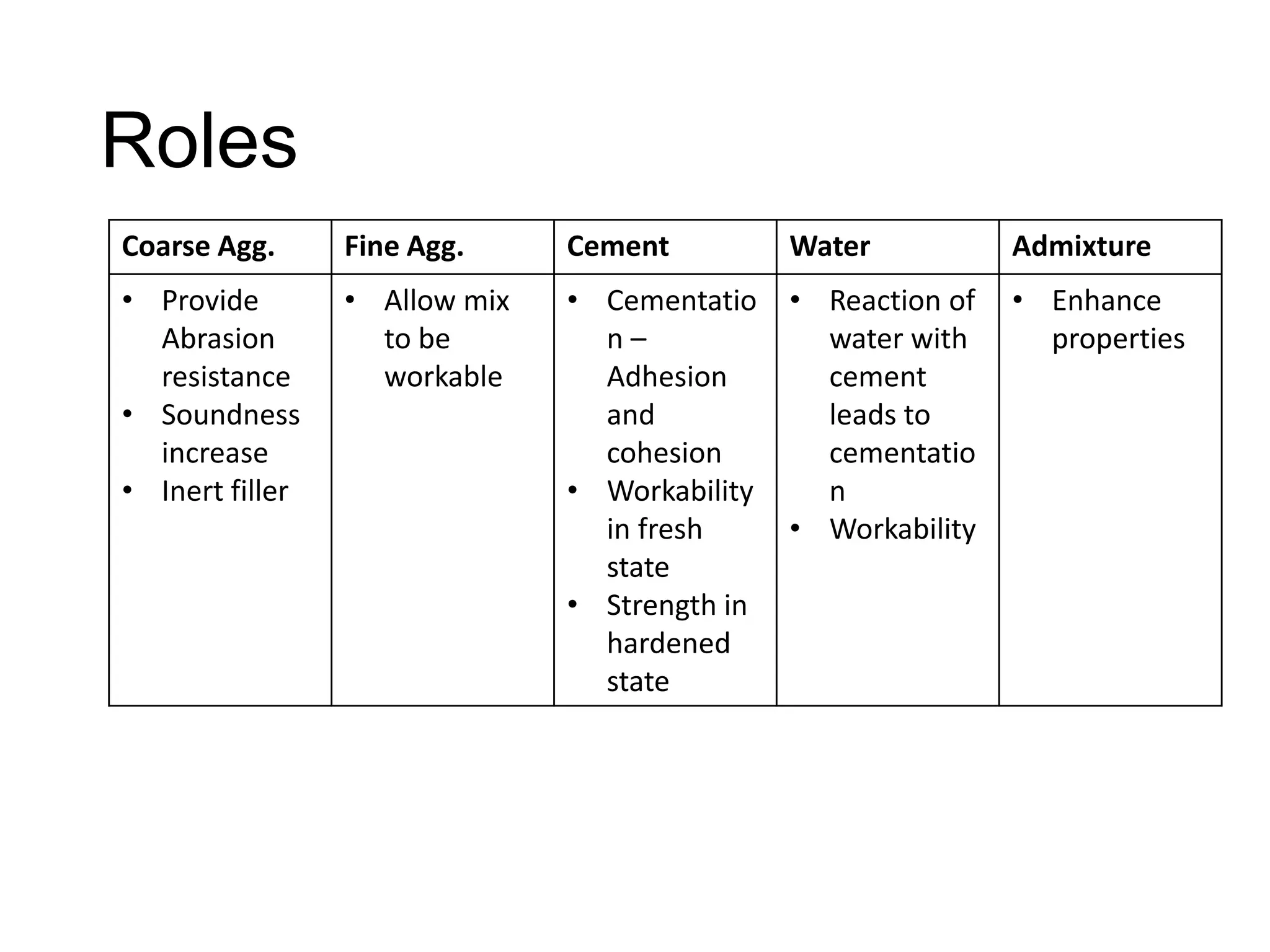
Coarse Agg.

Fine Agg.

Cement

Water

Admixture

• Provide
Abrasion
resistance
• Soundness
increase
• Inert filler

• Allow mix
to be
workable

• Cementatio
n–
Adhesion
and
cohesion
• Workability
in fresh
state
• Strength in
hardened
state

• Reaction of
water with
cement
leads to
cementatio
n
• Workability

• Enhance
properties
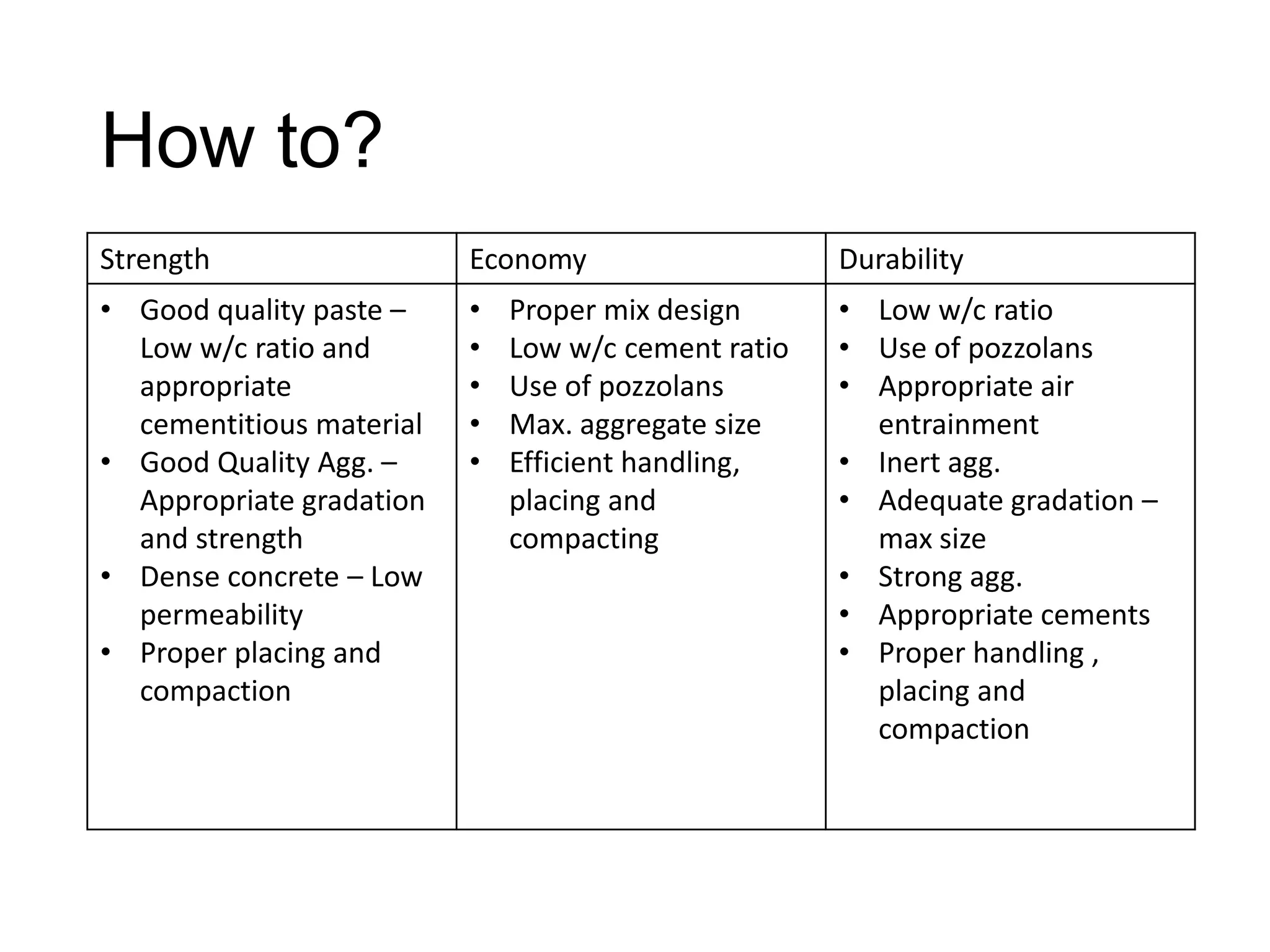
How to?
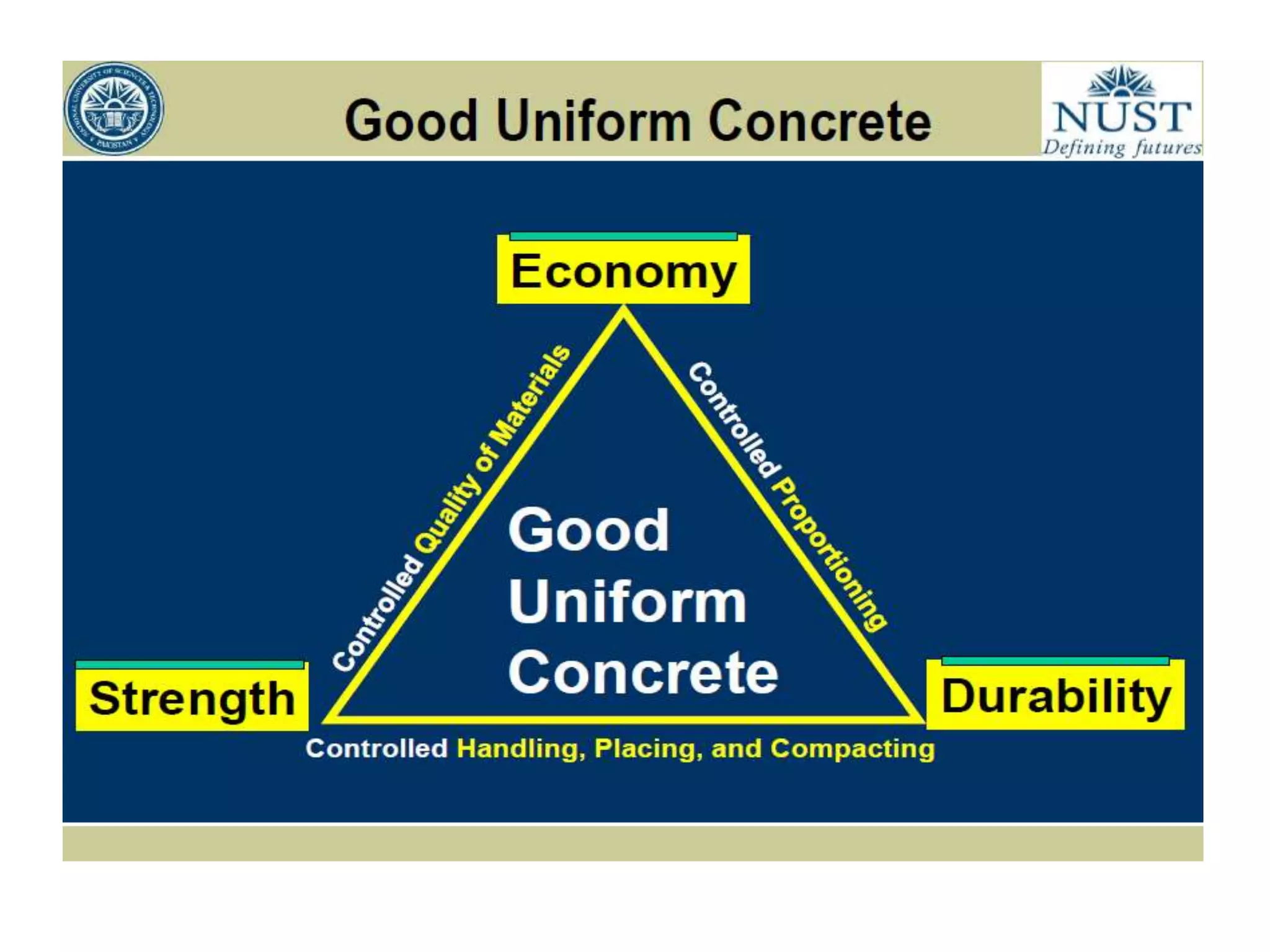
Strength

Economy

Durability

• Good quality paste –
Low w/c ratio and
appropriate
cementitious material
• Good Quality Agg. –
Appropriate gradation
and strength
• Dense concrete – Low
permeability
• Proper placing and
compaction

•
•
•
•
•

• Low w/c ratio
• Use of pozzolans
• Appropriate air
entrainment
• Inert agg.
• Adequate gradation –
max size
• Strong agg.
• Appropriate cements
• Proper handling ,
placing and
compaction

Proper mix design
Low w/c cement ratio
Use of pozzolans
Max. aggregate size
Efficient handling,
placing and
compacting
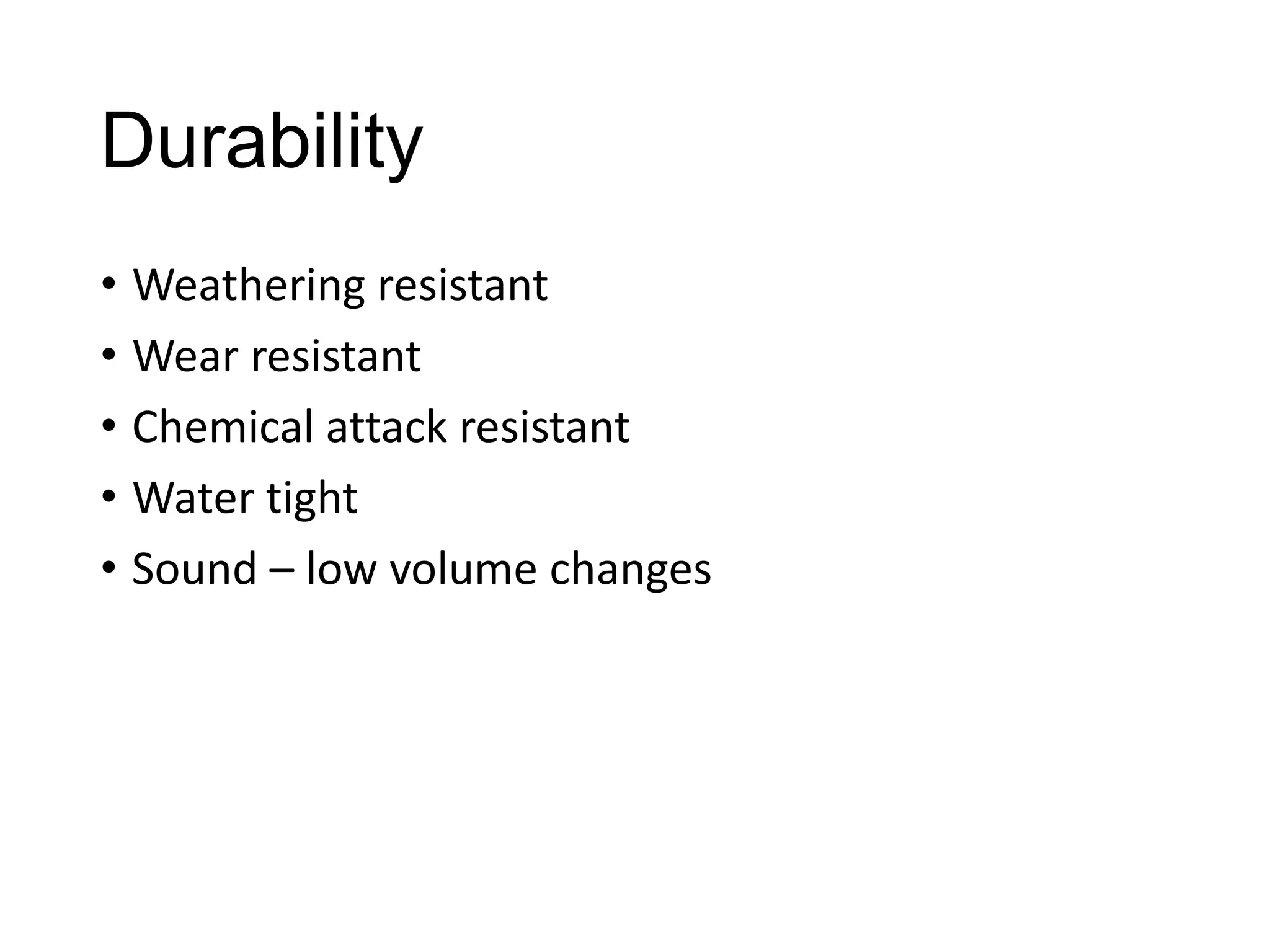
Durability
• Weathering resistant
• Wear resistant
• Chemical attack resistant
• Water tight
• Sound – low volume changes
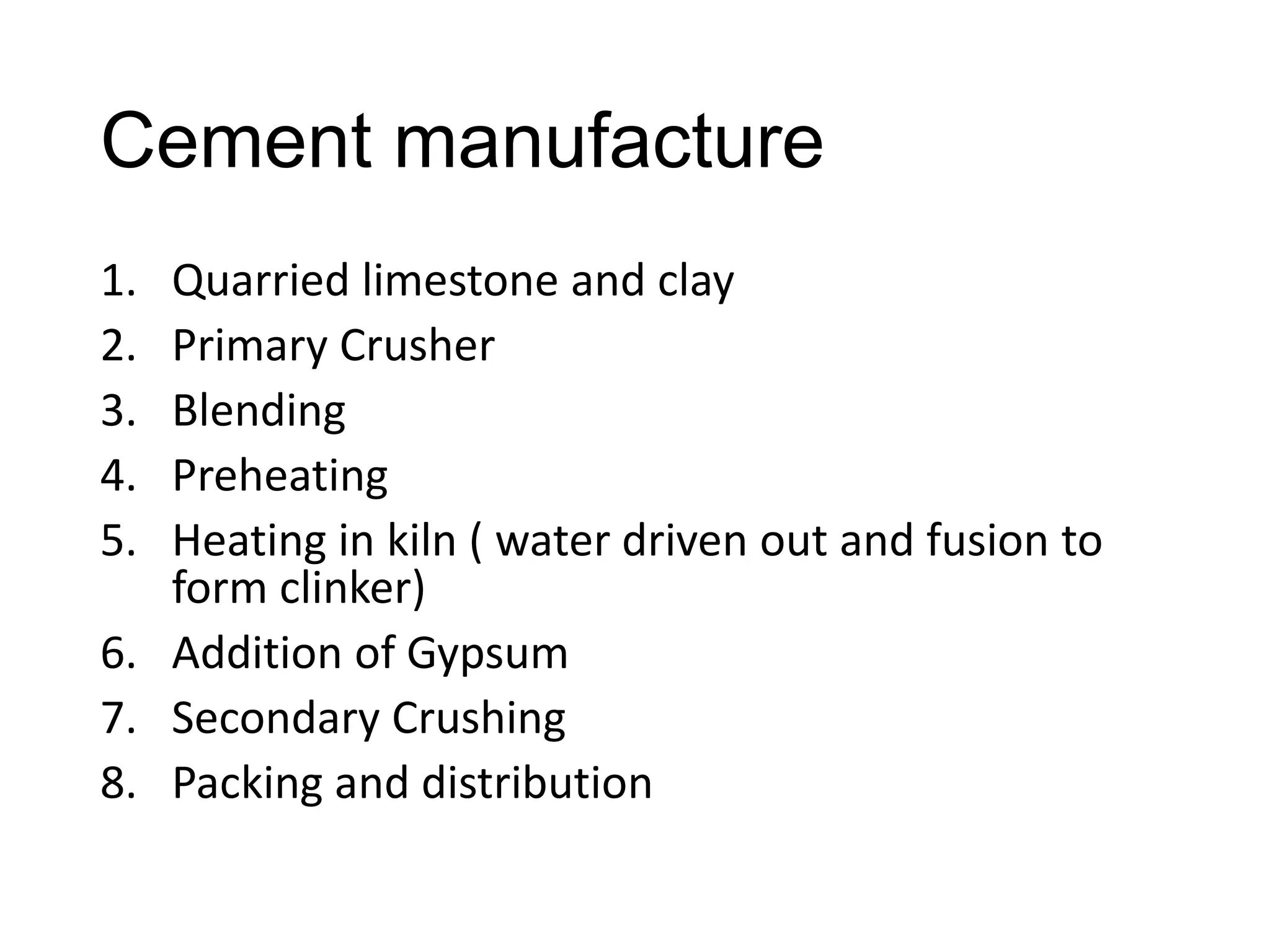
Cement manufacture
1.
2.
3.
4.
5.

Quarried limestone and clay
Primary Crusher
Blending
Preheating
Heating in kiln ( water driven out and fusion to
form clinker)
6. Addition of Gypsum
7. Secondary Crushing
8. Packing and distribution
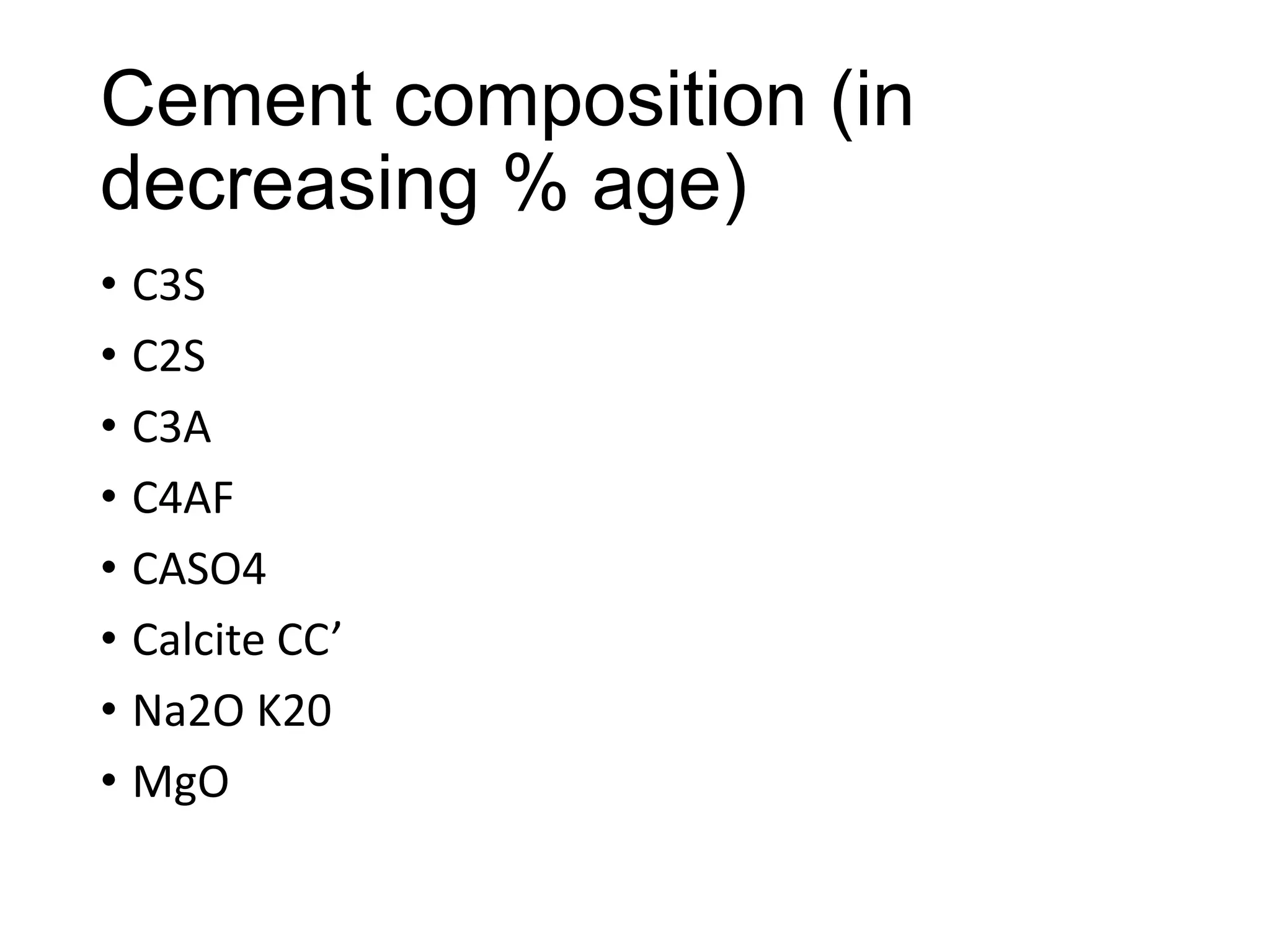
Cement composition (in
decreasing % age)
• C3S
• C2S
• C3A
• C4AF
• CASO4
• Calcite CC’
• Na2O K20
• MgO
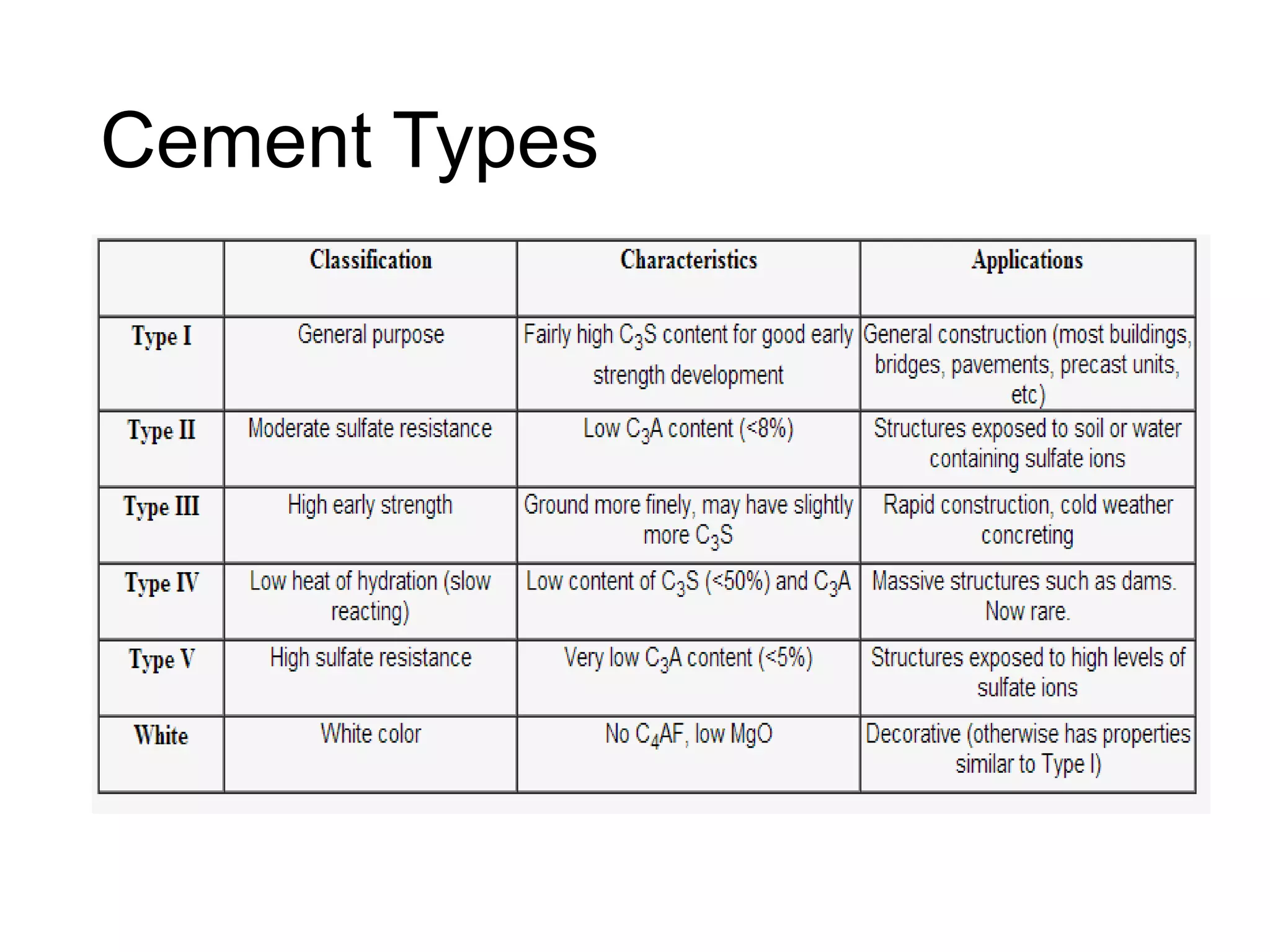
Cement Types
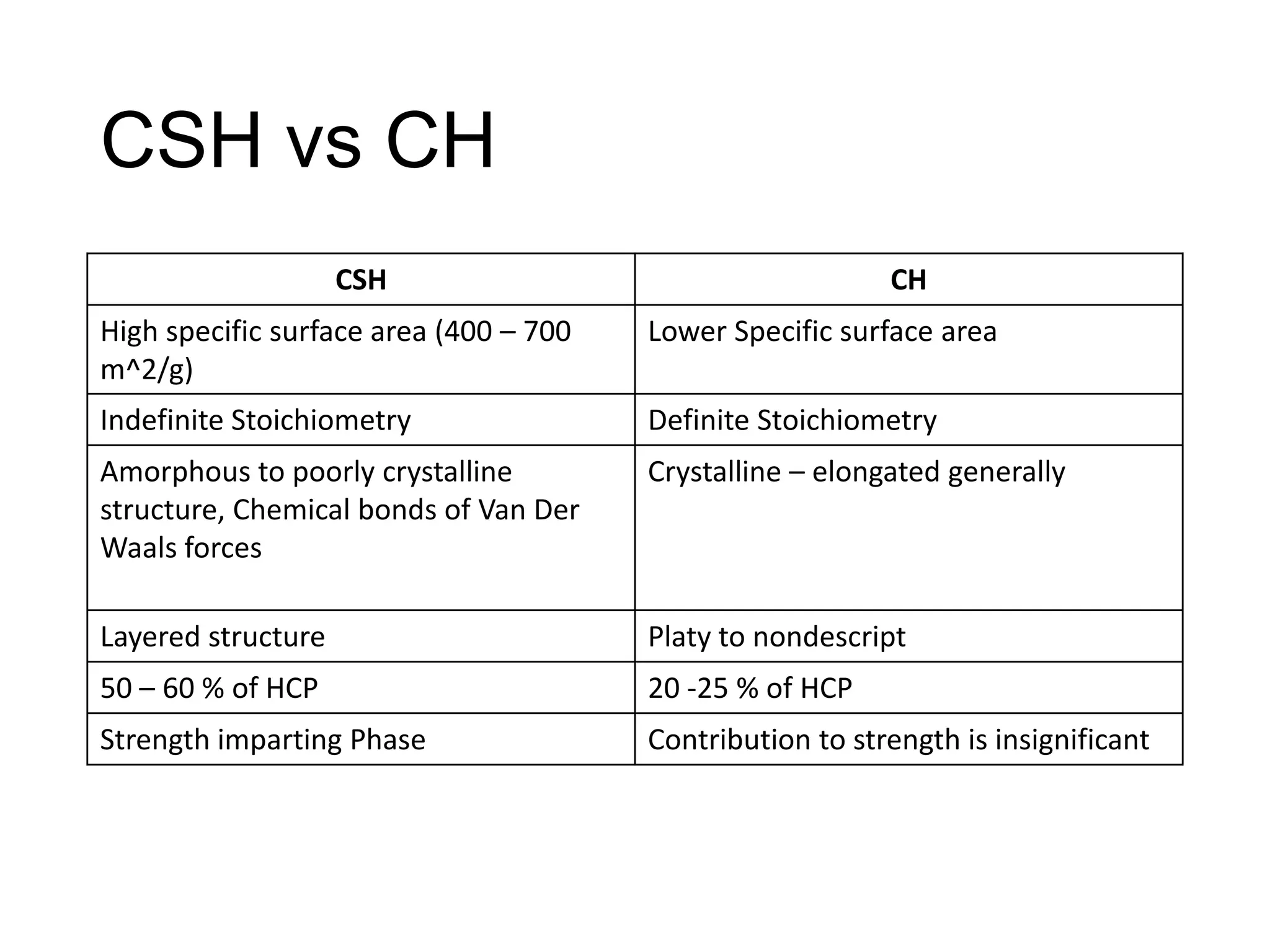
CSH vs CH
CSH

CH

High specific surface area (400 – 700
m^2/g)

Lower Specific surface area

Indefinite Stoichiometry

Definite Stoichiometry

Amorphous to poorly crystalline
structure, Chemical bonds of Van Der
Waals forces

Crystalline – elongated generally

Layered structure

Platy to nondescript

50 – 60 % of HCP

20 -25 % of HCP

Strength imparting Phase

Contribution to strength is insignificant
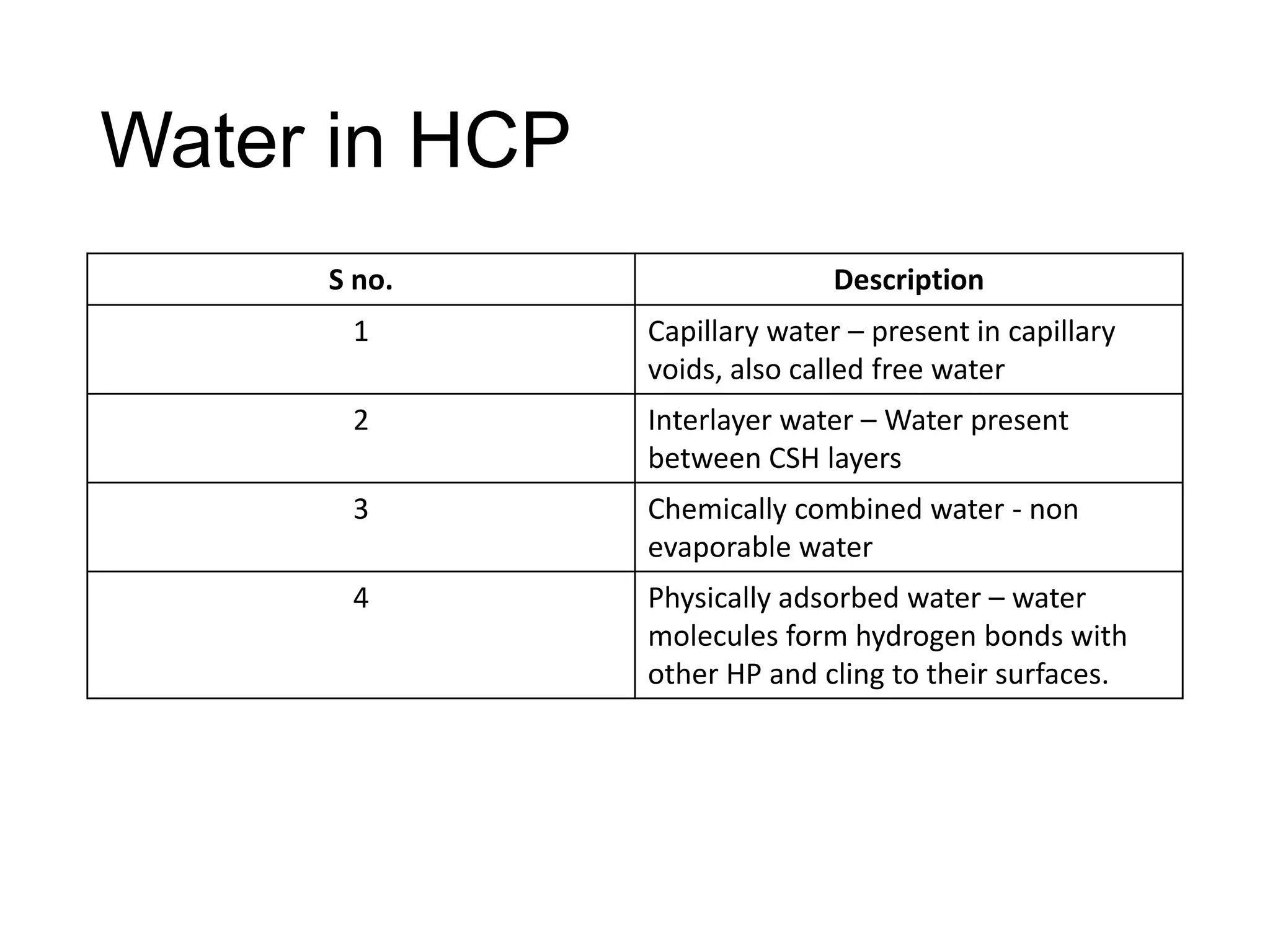
Water in HCP
S no.

Description

1

Capillary water – present in capillary
voids, also called free water

2

Interlayer water – Water present
between CSH layers

3

Chemically combined water - non
evaporable water

4

Physically adsorbed water – water
molecules form hydrogen bonds with
other HP and cling to their surfaces.
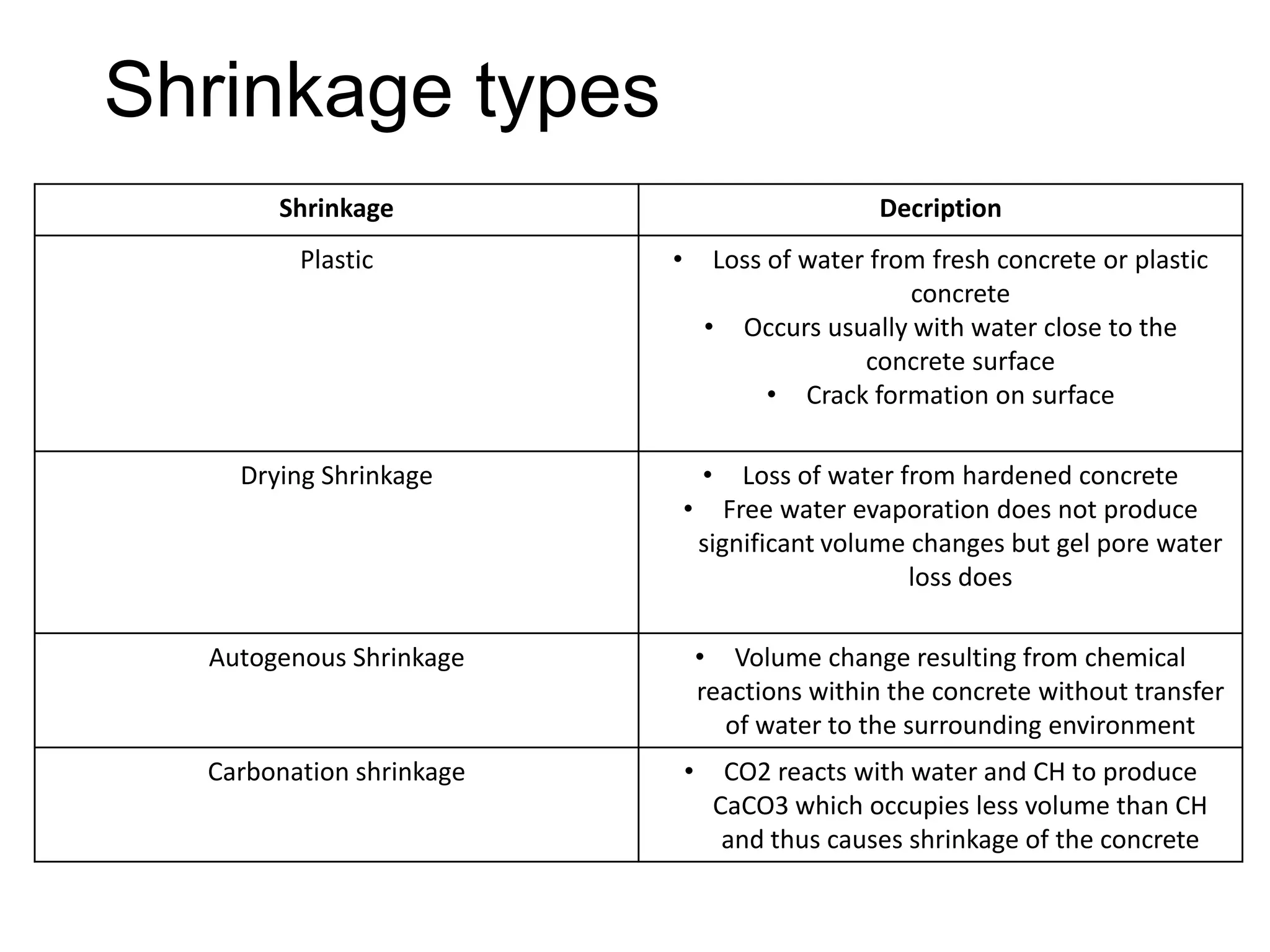
Shrinkage types
Shrinkage
Plastic

Decription
•

Loss of water from fresh concrete or plastic
concrete
• Occurs usually with water close to the
concrete surface
• Crack formation on surface
•

Drying Shrinkage

Loss of water from hardened concrete
• Free water evaporation does not produce
significant volume changes but gel pore water
loss does

Autogenous Shrinkage

• Volume change resulting from chemical
reactions within the concrete without transfer
of water to the surrounding environment

Carbonation shrinkage

•

CO2 reacts with water and CH to produce
CaCO3 which occupies less volume than CH
and thus causes shrinkage of the concrete
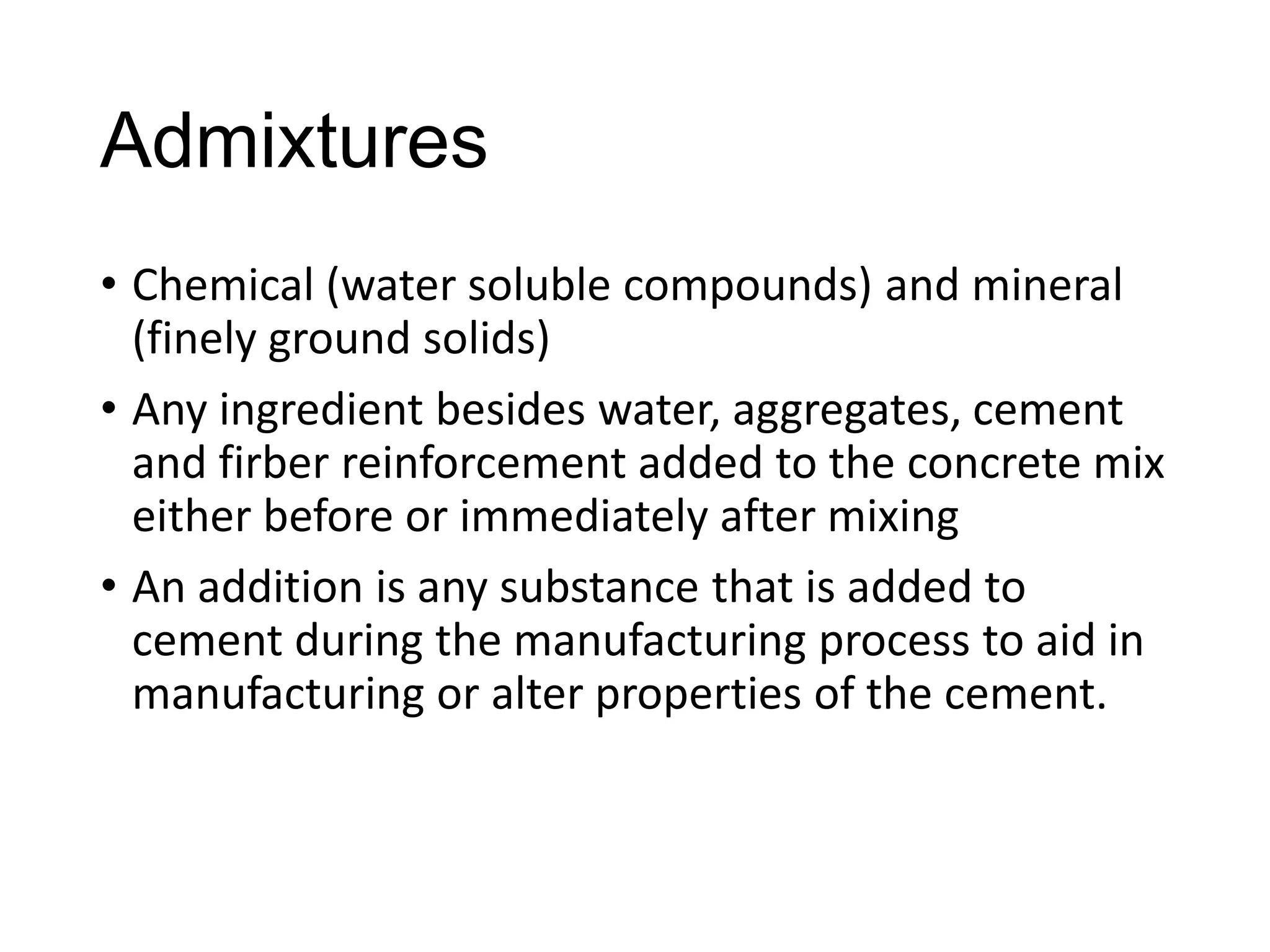
Admixtures
• Chemical (water soluble compounds) and mineral
(finely ground solids)
• Any ingredient besides water, aggregates, cement
and firber reinforcement added to the concrete mix
either before or immediately after mixing
• An addition is any substance that is added to
cement during the manufacturing process to aid in
manufacturing or alter properties of the cement.
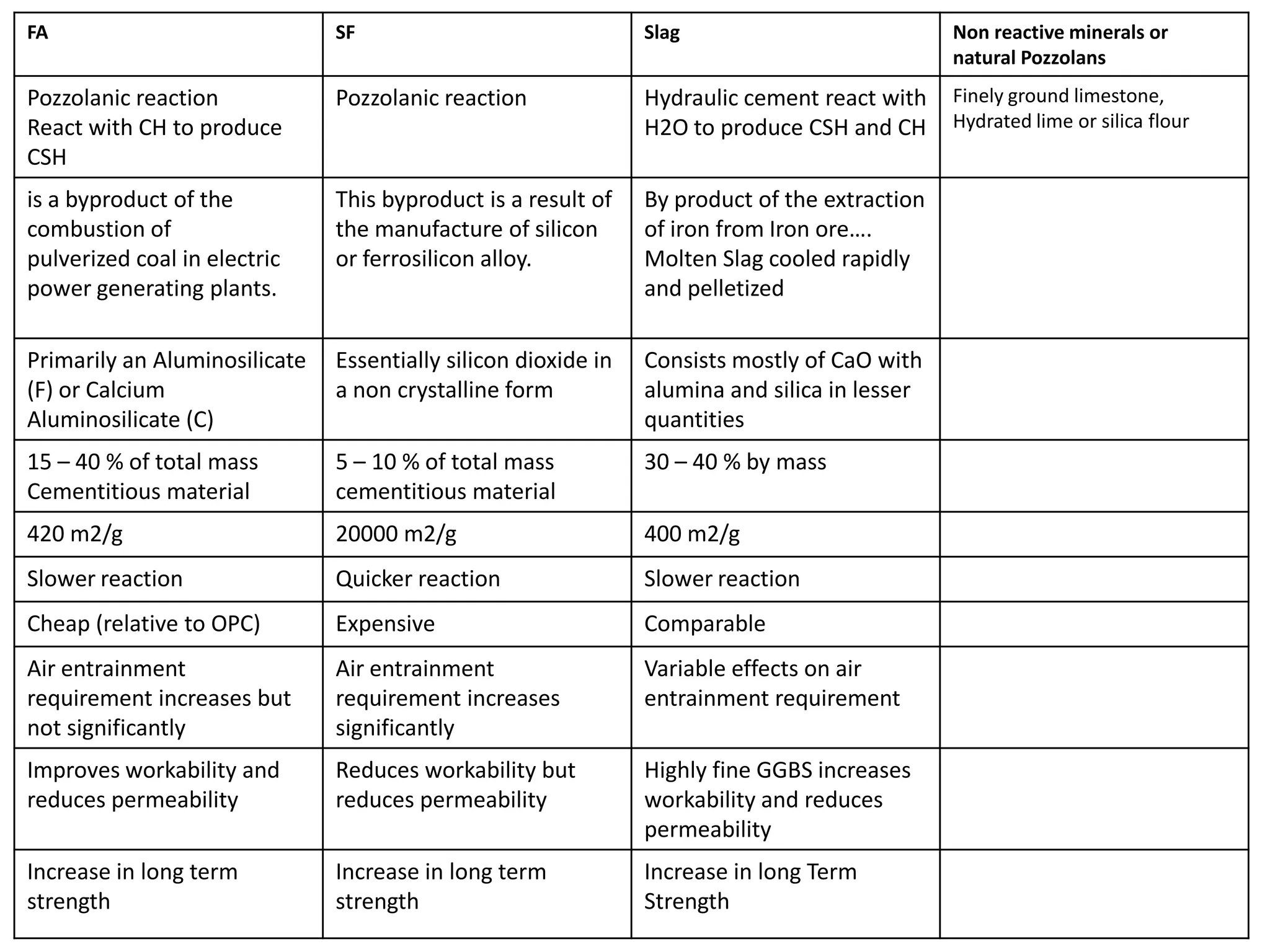
FA

SF

Slag

Non reactive minerals or
natural Pozzolans

Pozzolanic reaction
React with CH to produce
CSH

Pozzolanic reaction

Hydraulic cement react with
H2O to produce CSH and CH

Finely ground limestone,
Hydrated lime or silica flour

is a byproduct of the
combustion of
pulverized coal in electric
power generating plants.

This byproduct is a result of
the manufacture of silicon
or ferrosilicon alloy.

By product of the extraction
of iron from Iron ore….
Molten Slag cooled rapidly
and pelletized

Primarily an Aluminosilicate
(F) or Calcium
Aluminosilicate (C)

Essentially silicon dioxide in
a non crystalline form

Consists mostly of CaO with
alumina and silica in lesser
quantities

15 – 40 % of total mass
Cementitious material

5 – 10 % of total mass
cementitious material

30 – 40 % by mass

420 m2/g

20000 m2/g

400 m2/g

Slower reaction

Quicker reaction

Slower reaction

Cheap (relative to OPC)

Expensive

Comparable

Air entrainment
requirement increases but
not significantly

Air entrainment
requirement increases
significantly

Variable effects on air
entrainment requirement

Improves workability and
reduces permeability

Reduces workability but
reduces permeability

Highly fine GGBS increases
workability and reduces
permeability

Increase in long term
strength

Increase in long term
strength

Increase in long Term
Strength
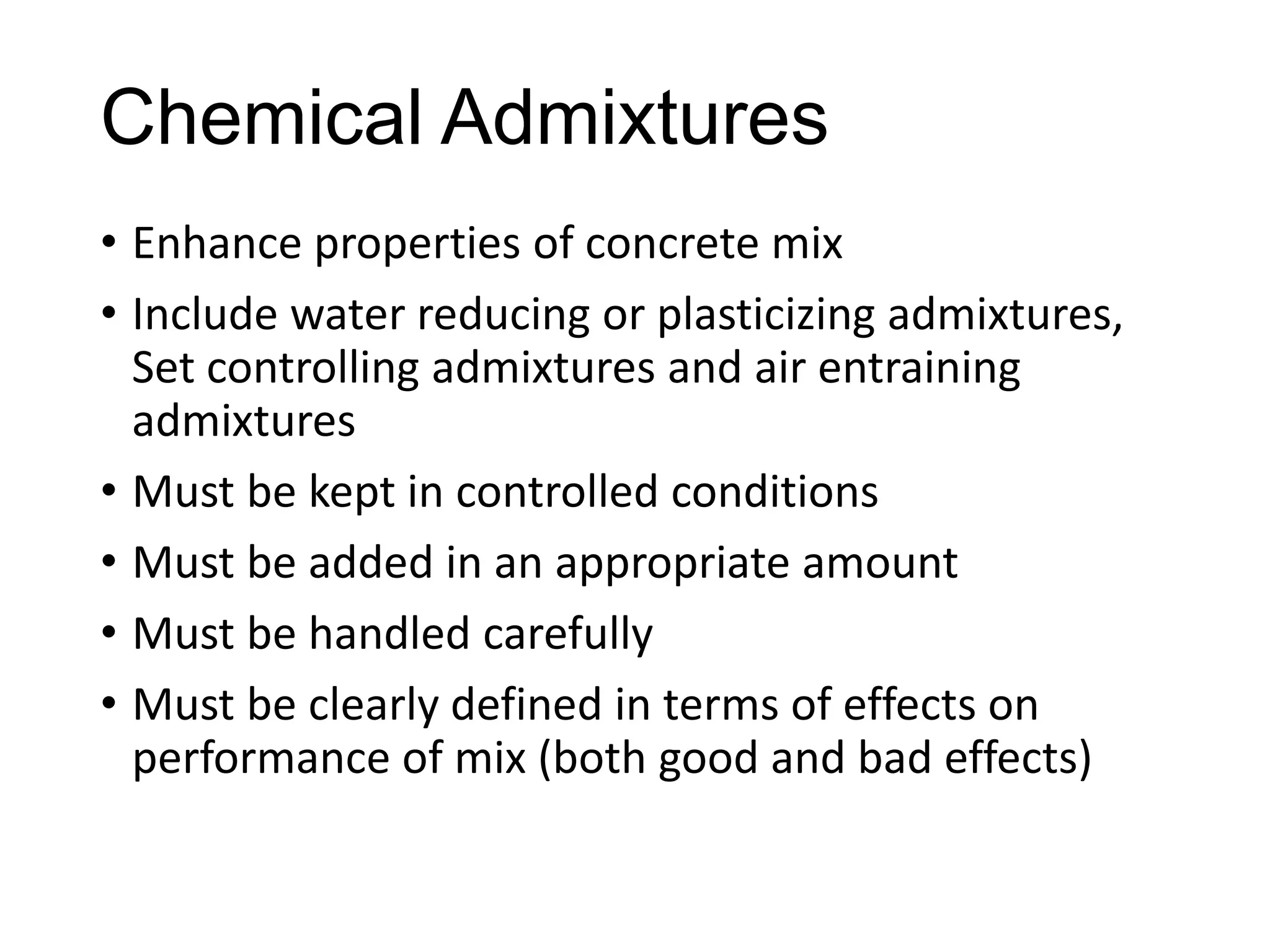
Chemical Admixtures
• Enhance properties of concrete mix
• Include water reducing or plasticizing admixtures,
Set controlling admixtures and air entraining
admixtures
• Must be kept in controlled conditions
• Must be added in an appropriate amount
• Must be handled carefully
• Must be clearly defined in terms of effects on
performance of mix (both good and bad effects)
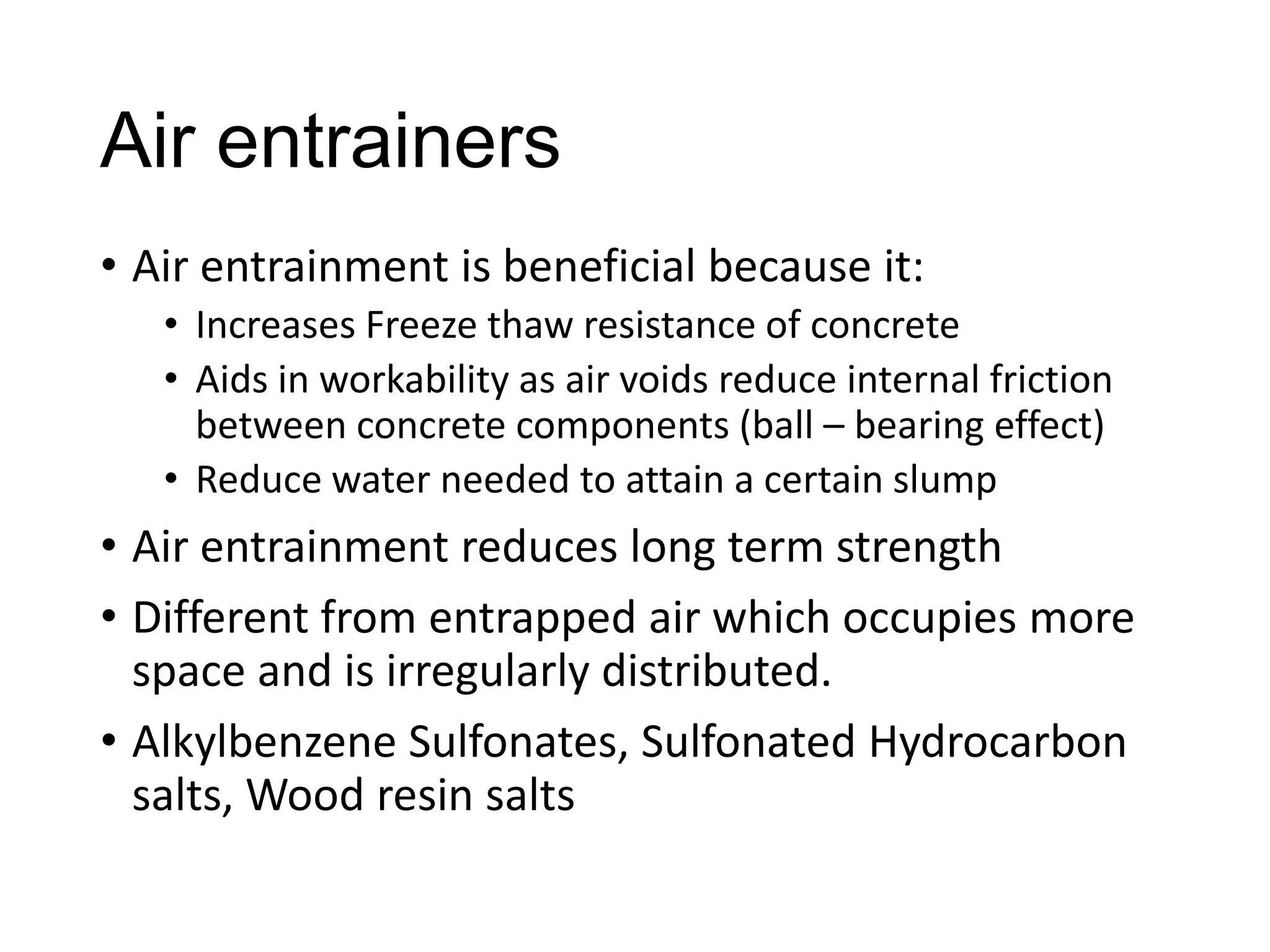
Air entrainers
• Air entrainment is beneficial because it:
• Increases Freeze thaw resistance of concrete
• Aids in workability as air voids reduce internal friction
between concrete components (ball – bearing effect)
• Reduce water needed to attain a certain slump

• Air entrainment reduces long term strength
• Different from entrapped air which occupies more
space and is irregularly distributed.
• Alkylbenzene Sulfonates, Sulfonated Hydrocarbon
salts, Wood resin salts
Air entrainment affected by:
• Use of pozzolans
• Use of other admixtures, Water reducing
admixtures reduce air entrainment
• Fines content
• Placing and compaction
LRWR and HRWR or SP
• SP are more efficient in interaction and reducing bleeding
than LRWR
• SP reduce wc by 15 – 30 % where as LRWR reduce wc by 5 –
10 %
• WR and SP benefits:
• Reduce water demand and increase slump for a constant w/c ratio,
workability increase
• Increase long term strength due to the decreased w/c ratio
• Decrease high early heat evolution and prevent thermal cracking
• Bleeding decreased due to low w/c ratio.

• Disadvantages:

• Reduce air entrainment
• Slump decrease accelerated
• SP can be incompatible with cements and can reduce of their mixes
workability
Examples
• SP : Sulfonated naphthalene formaldehyde
condesates, S melamine FC,
• LRWR: lignosulfates , Hydroxylated Carboxylic acids
• Set retarders : Lignosulfates , sugars
• Set accelerators : CaCl2 (causes corrosion, increase
in drying shrinkage and scaling and creep potential,
darkening of concrete) , Na2CO3, TEA (flash
setting), Calcium Formate,
How Ps work?
• Flocculation – Alumina and silica particles have
opposite charges and lock in water which becomes
adsorbed on their surfaces
• Plasticizers cause dispersion – Electrostatic or Steric
Stabilization; dispersion means alumina and silica
develop like charges and water is freed for
increasing workability.
Aggregate properties preferred
• Well graded
•
•
•
•

Rounded agg.
Max Agg size
Optimum contents of both fine and coarse
Better bond with softer , porous , mineralogically heterogenous
agg.
• Rough texture agg. more strong then Smooth
• Shape controls flexural strength
• Texture controls compressive strength

• Cement slurry percolation preferred
• Modulus of elasticity and thermal expansion similar to cement
paste
• Min impurities (organic loam, humus), min Coatings (fine agg,
salts ) and min. unsound particles (coal,mica,shale)
ASR
• Use of high alkali cement, Siliceous agg.
(Sandstone, Opaline shales, Chalcedonic Cherts)
• Alkali silica gel created that swells when it absorbs
water.
• Cracking occurs
• Prevention:
• Use of low alkali cements
• Use of lithium based admixtures
• Use of Pozzolans
ACR
• Carbonate rich agg. (dolomitic limestone)
• Rare
• Is an expansive reaction
Less fines?
• Increase water demand
• Affect bond of coarse agg. with paste
• Increase in Plastic shrinkage
Bulking of fines:
Increase in vol of fines due to moisture content
increase, surface tension of water prevents fines
from interacting or interlocking.
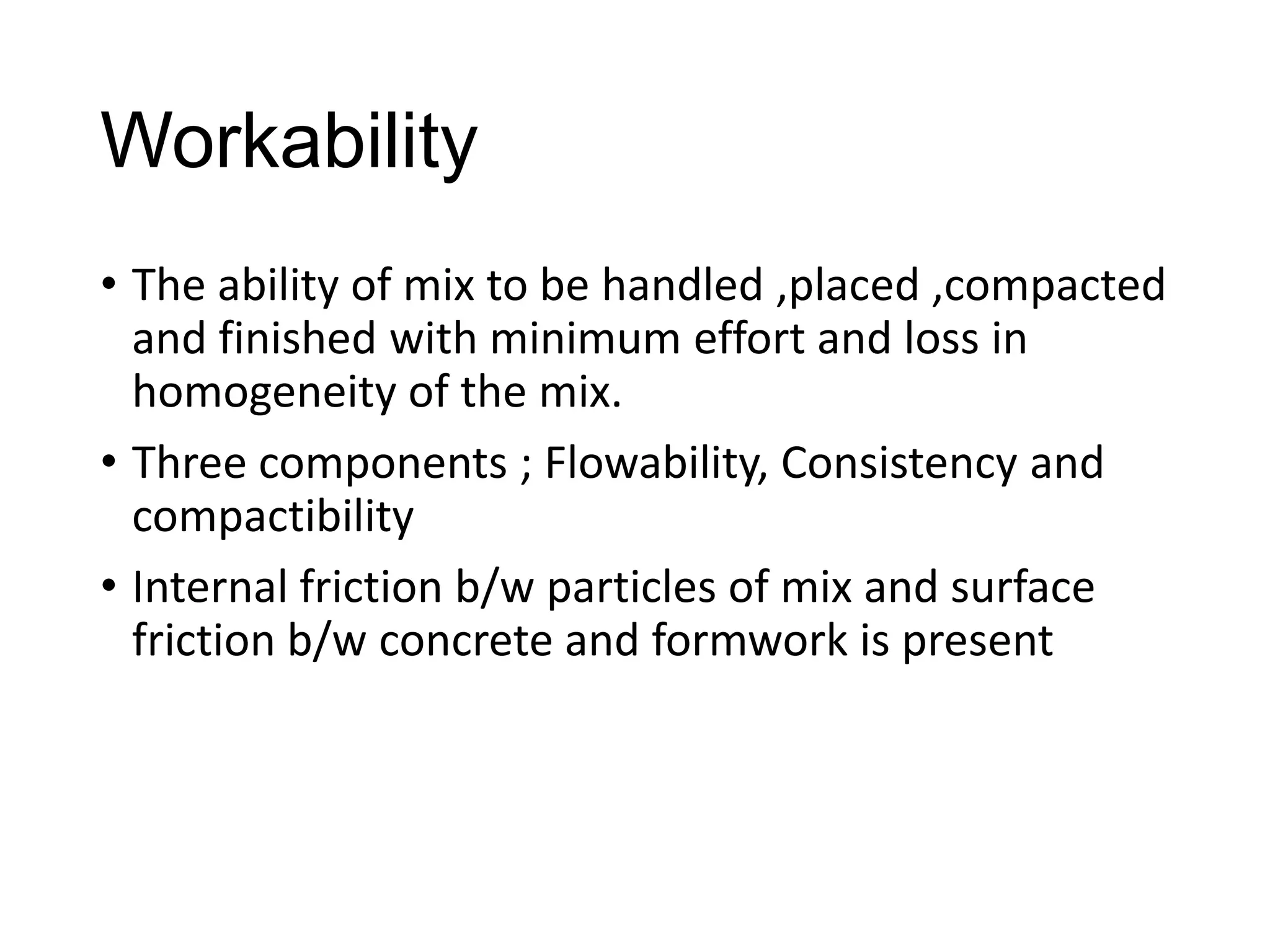
Workability
• The ability of mix to be handled ,placed ,compacted
and finished with minimum effort and loss in
homogeneity of the mix.
• Three components ; Flowability, Consistency and
compactibility
• Internal friction b/w particles of mix and surface
friction b/w concrete and formwork is present
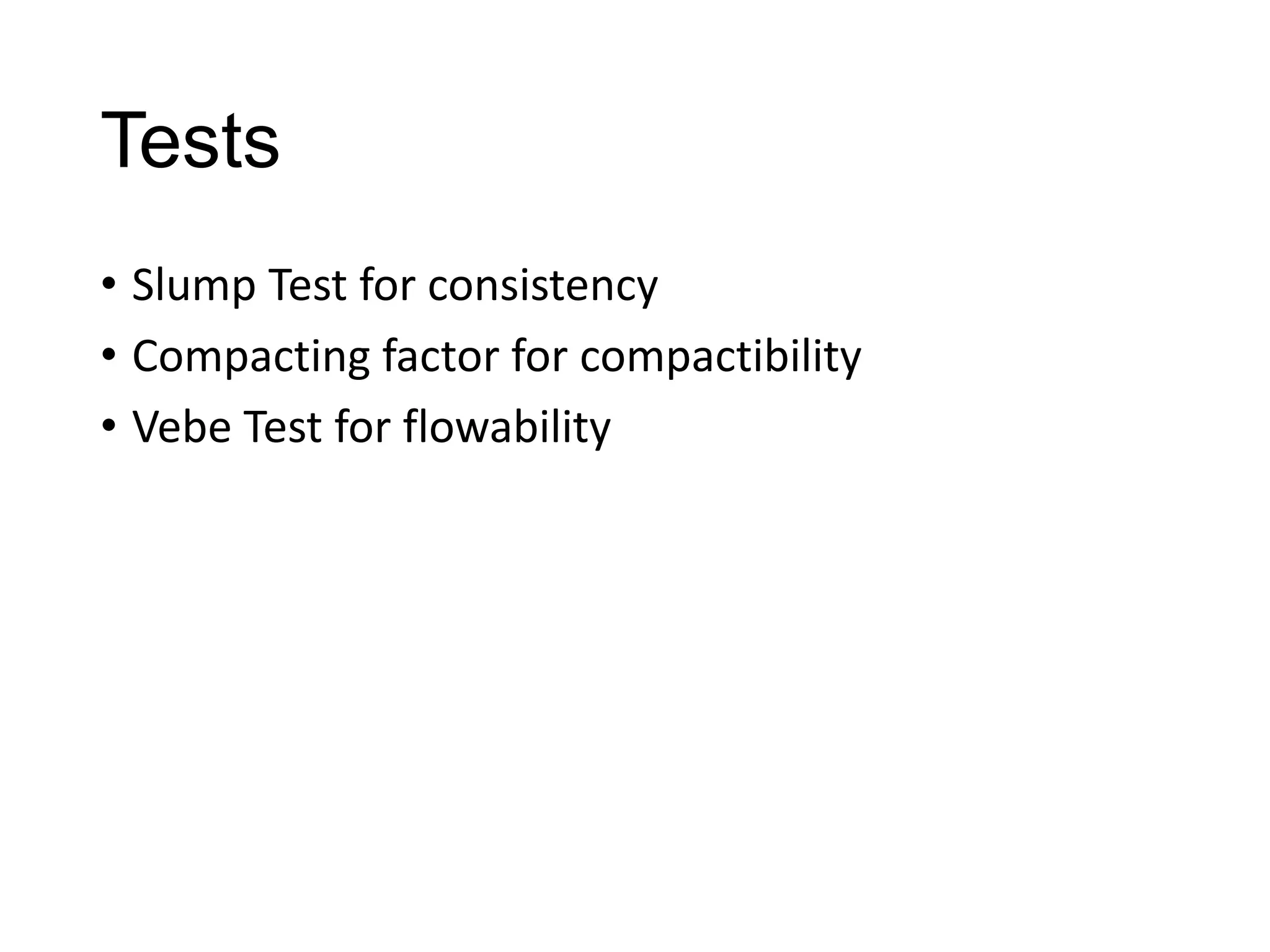
Tests
• Slump Test for consistency
• Compacting factor for compactibility
• Vebe Test for flowability
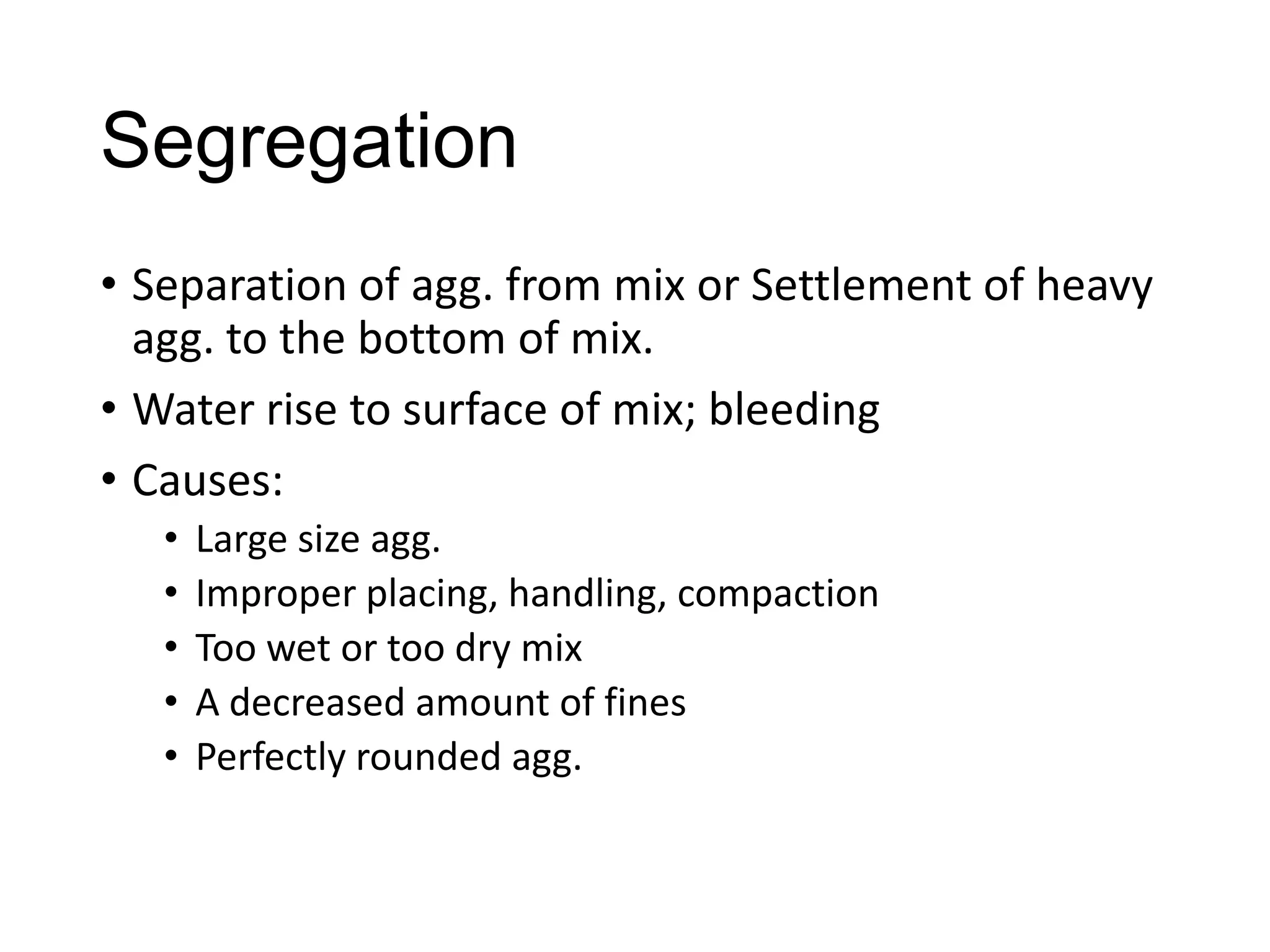
Segregation
• Separation of agg. from mix or Settlement of heavy
agg. to the bottom of mix.
• Water rise to surface of mix; bleeding
• Causes:
•
•
•
•
•

Large size agg.
Improper placing, handling, compaction
Too wet or too dry mix
A decreased amount of fines
Perfectly rounded agg.
Bleeding
• Heavy laitance accumulation giving an unsightly
appearance
• Plane of weakness on concrete surface
• Corrosion of rebar
• Increase in porosity of concrete, chemical attacks
• Weakening of bond between agg and paste
• Delay in finishing and cost increase
Control
• Proper mix design
• Proper placement, handling and compaction
• Use of pozzolans
• Use of highly fine cement
• Air entrainment
• Use of WR admixtures
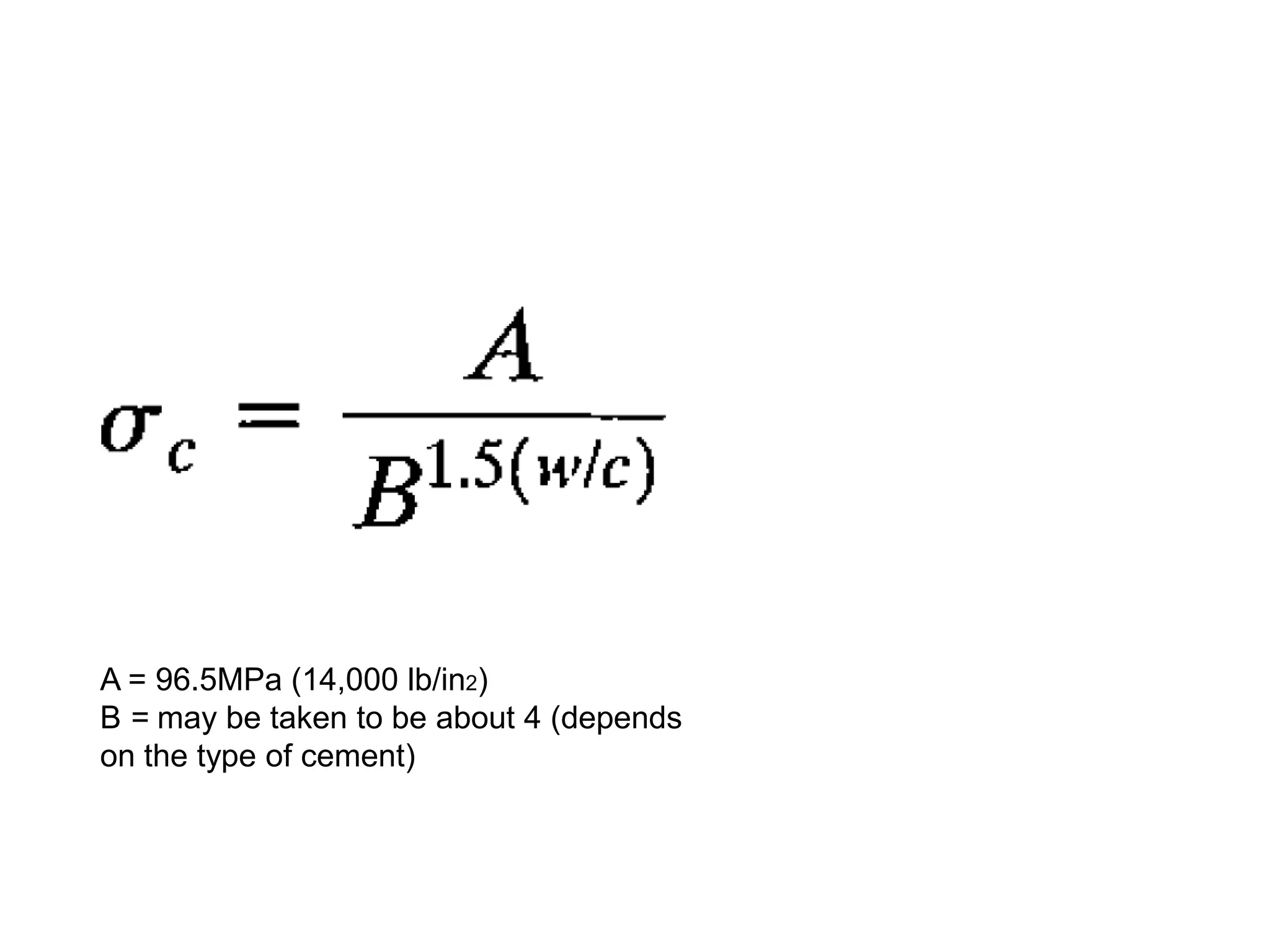
A = 96.5MPa (14,000 lb/in2)
B = may be taken to be about 4 (depends
on the type of cement)
Plain Concrete - General concepts

Plain Concrete - General concepts

  • 1.
    Roles Coarse Agg. Fine Agg. Cement Water Admixture •Provide Abrasion resistance • Soundness increase • Inert filler • Allow mix to be workable • Cementatio n– Adhesion and cohesion • Workability in fresh state • Strength in hardened state • Reaction of water with cement leads to cementatio n • Workability • Enhance properties
  • 3.
    How to? Strength Economy Durability • Goodquality paste – Low w/c ratio and appropriate cementitious material • Good Quality Agg. – Appropriate gradation and strength • Dense concrete – Low permeability • Proper placing and compaction • • • • • • Low w/c ratio • Use of pozzolans • Appropriate air entrainment • Inert agg. • Adequate gradation – max size • Strong agg. • Appropriate cements • Proper handling , placing and compaction Proper mix design Low w/c cement ratio Use of pozzolans Max. aggregate size Efficient handling, placing and compacting
  • 4.
    Durability • Weathering resistant •Wear resistant • Chemical attack resistant • Water tight • Sound – low volume changes
  • 5.
    Cement manufacture 1. 2. 3. 4. 5. Quarried limestoneand clay Primary Crusher Blending Preheating Heating in kiln ( water driven out and fusion to form clinker) 6. Addition of Gypsum 7. Secondary Crushing 8. Packing and distribution
  • 6.
    Cement composition (in decreasing% age) • C3S • C2S • C3A • C4AF • CASO4 • Calcite CC’ • Na2O K20 • MgO
  • 8.
  • 10.
    CSH vs CH CSH CH Highspecific surface area (400 – 700 m^2/g) Lower Specific surface area Indefinite Stoichiometry Definite Stoichiometry Amorphous to poorly crystalline structure, Chemical bonds of Van Der Waals forces Crystalline – elongated generally Layered structure Platy to nondescript 50 – 60 % of HCP 20 -25 % of HCP Strength imparting Phase Contribution to strength is insignificant
  • 11.
    Water in HCP Sno. Description 1 Capillary water – present in capillary voids, also called free water 2 Interlayer water – Water present between CSH layers 3 Chemically combined water - non evaporable water 4 Physically adsorbed water – water molecules form hydrogen bonds with other HP and cling to their surfaces.
  • 12.
    Shrinkage types Shrinkage Plastic Decription • Loss ofwater from fresh concrete or plastic concrete • Occurs usually with water close to the concrete surface • Crack formation on surface • Drying Shrinkage Loss of water from hardened concrete • Free water evaporation does not produce significant volume changes but gel pore water loss does Autogenous Shrinkage • Volume change resulting from chemical reactions within the concrete without transfer of water to the surrounding environment Carbonation shrinkage • CO2 reacts with water and CH to produce CaCO3 which occupies less volume than CH and thus causes shrinkage of the concrete
  • 13.
    Admixtures • Chemical (watersoluble compounds) and mineral (finely ground solids) • Any ingredient besides water, aggregates, cement and firber reinforcement added to the concrete mix either before or immediately after mixing • An addition is any substance that is added to cement during the manufacturing process to aid in manufacturing or alter properties of the cement.
  • 14.
    FA SF Slag Non reactive mineralsor natural Pozzolans Pozzolanic reaction React with CH to produce CSH Pozzolanic reaction Hydraulic cement react with H2O to produce CSH and CH Finely ground limestone, Hydrated lime or silica flour is a byproduct of the combustion of pulverized coal in electric power generating plants. This byproduct is a result of the manufacture of silicon or ferrosilicon alloy. By product of the extraction of iron from Iron ore…. Molten Slag cooled rapidly and pelletized Primarily an Aluminosilicate (F) or Calcium Aluminosilicate (C) Essentially silicon dioxide in a non crystalline form Consists mostly of CaO with alumina and silica in lesser quantities 15 – 40 % of total mass Cementitious material 5 – 10 % of total mass cementitious material 30 – 40 % by mass 420 m2/g 20000 m2/g 400 m2/g Slower reaction Quicker reaction Slower reaction Cheap (relative to OPC) Expensive Comparable Air entrainment requirement increases but not significantly Air entrainment requirement increases significantly Variable effects on air entrainment requirement Improves workability and reduces permeability Reduces workability but reduces permeability Highly fine GGBS increases workability and reduces permeability Increase in long term strength Increase in long term strength Increase in long Term Strength
  • 15.
    Chemical Admixtures • Enhanceproperties of concrete mix • Include water reducing or plasticizing admixtures, Set controlling admixtures and air entraining admixtures • Must be kept in controlled conditions • Must be added in an appropriate amount • Must be handled carefully • Must be clearly defined in terms of effects on performance of mix (both good and bad effects)
  • 16.
    Air entrainers • Airentrainment is beneficial because it: • Increases Freeze thaw resistance of concrete • Aids in workability as air voids reduce internal friction between concrete components (ball – bearing effect) • Reduce water needed to attain a certain slump • Air entrainment reduces long term strength • Different from entrapped air which occupies more space and is irregularly distributed. • Alkylbenzene Sulfonates, Sulfonated Hydrocarbon salts, Wood resin salts
  • 17.
    Air entrainment affectedby: • Use of pozzolans • Use of other admixtures, Water reducing admixtures reduce air entrainment • Fines content • Placing and compaction
  • 18.
    LRWR and HRWRor SP • SP are more efficient in interaction and reducing bleeding than LRWR • SP reduce wc by 15 – 30 % where as LRWR reduce wc by 5 – 10 % • WR and SP benefits: • Reduce water demand and increase slump for a constant w/c ratio, workability increase • Increase long term strength due to the decreased w/c ratio • Decrease high early heat evolution and prevent thermal cracking • Bleeding decreased due to low w/c ratio. • Disadvantages: • Reduce air entrainment • Slump decrease accelerated • SP can be incompatible with cements and can reduce of their mixes workability
  • 19.
    Examples • SP :Sulfonated naphthalene formaldehyde condesates, S melamine FC, • LRWR: lignosulfates , Hydroxylated Carboxylic acids • Set retarders : Lignosulfates , sugars • Set accelerators : CaCl2 (causes corrosion, increase in drying shrinkage and scaling and creep potential, darkening of concrete) , Na2CO3, TEA (flash setting), Calcium Formate,
  • 20.
    How Ps work? •Flocculation – Alumina and silica particles have opposite charges and lock in water which becomes adsorbed on their surfaces • Plasticizers cause dispersion – Electrostatic or Steric Stabilization; dispersion means alumina and silica develop like charges and water is freed for increasing workability.
  • 21.
    Aggregate properties preferred •Well graded • • • • Rounded agg. Max Agg size Optimum contents of both fine and coarse Better bond with softer , porous , mineralogically heterogenous agg. • Rough texture agg. more strong then Smooth • Shape controls flexural strength • Texture controls compressive strength • Cement slurry percolation preferred • Modulus of elasticity and thermal expansion similar to cement paste • Min impurities (organic loam, humus), min Coatings (fine agg, salts ) and min. unsound particles (coal,mica,shale)
  • 22.
    ASR • Use ofhigh alkali cement, Siliceous agg. (Sandstone, Opaline shales, Chalcedonic Cherts) • Alkali silica gel created that swells when it absorbs water. • Cracking occurs • Prevention: • Use of low alkali cements • Use of lithium based admixtures • Use of Pozzolans
  • 23.
    ACR • Carbonate richagg. (dolomitic limestone) • Rare • Is an expansive reaction
  • 24.
    Less fines? • Increasewater demand • Affect bond of coarse agg. with paste • Increase in Plastic shrinkage Bulking of fines: Increase in vol of fines due to moisture content increase, surface tension of water prevents fines from interacting or interlocking.
  • 25.
    Workability • The abilityof mix to be handled ,placed ,compacted and finished with minimum effort and loss in homogeneity of the mix. • Three components ; Flowability, Consistency and compactibility • Internal friction b/w particles of mix and surface friction b/w concrete and formwork is present
  • 27.
    Tests • Slump Testfor consistency • Compacting factor for compactibility • Vebe Test for flowability
  • 28.
    Segregation • Separation ofagg. from mix or Settlement of heavy agg. to the bottom of mix. • Water rise to surface of mix; bleeding • Causes: • • • • • Large size agg. Improper placing, handling, compaction Too wet or too dry mix A decreased amount of fines Perfectly rounded agg.
  • 29.
    Bleeding • Heavy laitanceaccumulation giving an unsightly appearance • Plane of weakness on concrete surface • Corrosion of rebar • Increase in porosity of concrete, chemical attacks • Weakening of bond between agg and paste • Delay in finishing and cost increase
  • 30.
    Control • Proper mixdesign • Proper placement, handling and compaction • Use of pozzolans • Use of highly fine cement • Air entrainment • Use of WR admixtures
  • 31.
    A = 96.5MPa(14,000 lb/in2) B = may be taken to be about 4 (depends on the type of cement)