Plague
History & Significance
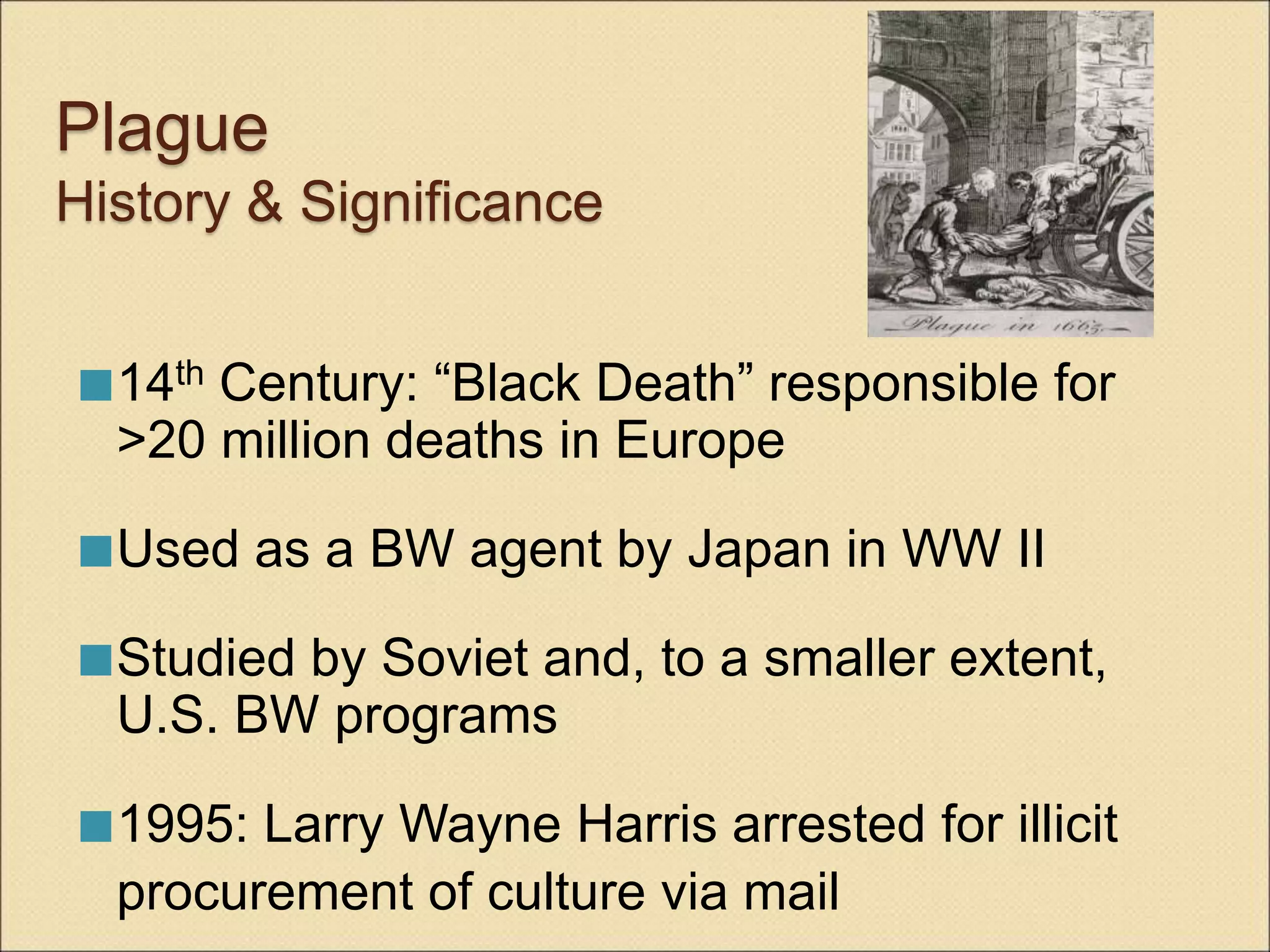
14th Century: “Black Death” responsible for
>20 million deaths in Europe
Used as a BW agent by Japan in WW II
Studied by Soviet and, to a smaller extent,
U.S. BW programs
1995: Larry Wayne Harris arrested for illicit
procurement of culture via mail
Plague
Epidemiology
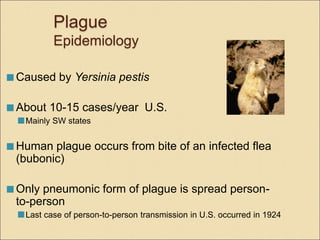
 Caused by Yersinia pestis
 About 10-15 cases/year U.S.
Mainly SW states
 Human plague occurs from bite of an infected flea
(bubonic)
 Only pneumonic form of plague is spread person-
to-person
Last case of person-to-person transmission in U.S. occurred in 1924
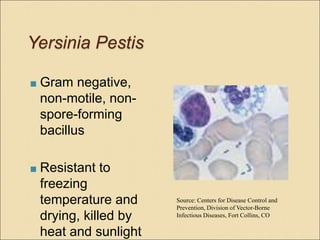
Yersinia Pestis
 Gram negative,
non-motile, non-
spore-forming
bacillus
 Resistant to
freezing
temperature and
drying, killed by
heat and sunlight
Source: Centers for Disease Control and
Prevention, Division of Vector-Borne
Infectious Diseases, Fort Collins, CO
Plague
Case Definition
 Characterized by fever, chills, headache,
malaise, prostration, & leukocytosis that
manifests in one or more of the following
clinical forms:
◦ Regional lymphadenitis (bubonic)
◦ Septicemia w/o evident bubo (septicemic)
◦ Plague pneumonia
◦ Pharyngitis & cervical lymphadenitis (pharyngeal)
MMWR 1997;46(RR-10)
Plague
Case Definition, cont.
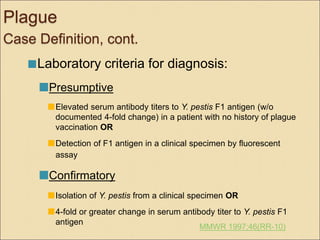
Laboratory criteria for diagnosis:
Presumptive
Elevated serum antibody titers to Y. pestis F1 antigen (w/o
documented 4-fold change) in a patient with no history of plague
vaccination OR
Detection of F1 antigen in a clinical specimen by fluorescent
assay
Confirmatory
Isolation of Y. pestis from a clinical specimen OR
4-fold or greater change in serum antibody titer to Y. pestis F1
antigen
MMWR 1997;46(RR-10)
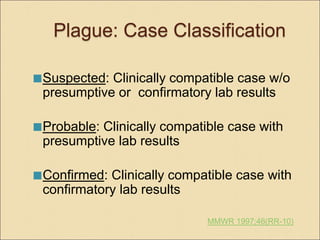
Plague: Case Classification
Suspected: Clinically compatible case w/o
presumptive or confirmatory lab results
Probable: Clinically compatible case with
presumptive lab results
Confirmed: Clinically compatible case with
confirmatory lab results
MMWR 1997;46(RR-10)
Plague
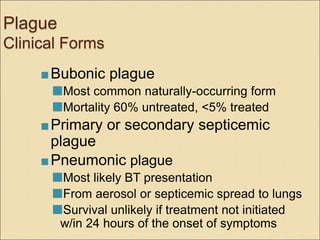
Clinical Forms
 Bubonic plague
Most common naturally-occurring form
Mortality 60% untreated, <5% treated
 Primary or secondary septicemic
plague
 Pneumonic plague
Most likely BT presentation
From aerosol or septicemic spread to lungs
Survival unlikely if treatment not initiated
w/in 24 hours of the onset of symptoms
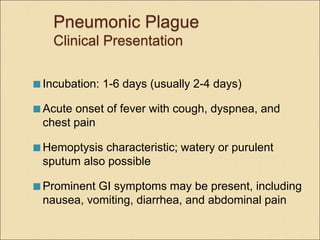
Pneumonic Plague
Clinical Presentation
 Incubation: 1-6 days (usually 2-4 days)
 Acute onset of fever with cough, dyspnea, and
chest pain
 Hemoptysis characteristic; watery or purulent
sputum also possible
 Prominent GI symptoms may be present, including
nausea, vomiting, diarrhea, and abdominal pain
Pneumonic Plague
Clinical Presentation
Other symptoms include headache, chills,
malaise, myalgias
Rarely, cervical bubo present
Rapid progression to respiratory failure &
shock
Bubonic Plague
 Incubation: 2-8 days
 Sudden onset nonspecific symptoms: fever, chills,
malaise, muscle aches, headache
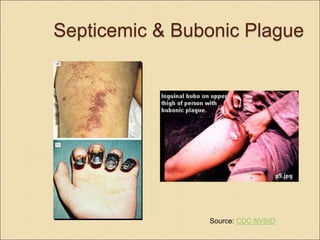
 Regional lymphadenitis (buboes)
Swollen, very painful lymph nodes
Typically inguinal, femoral, axillary, or cervical
Erythema overlying skin
May have surrounding edema
Concurrent with or shortly after onset of other symptoms
Septicemic & Bubonic Plague
Source: CDC NVBID
Plague
Infection Control
Person-to-person transmission via
respiratory droplets
Standard respiratory droplet precautions
Treatment = 10 days antibiotics
 Case isolation for at least the first 48 hrs of
antibiotic treatment
Bubonic plague - standard precautions
Plague
Infection Control
Antibiotic prophylaxis for close contacts
Duration: 7 days or duration of risk of
exposure + 7 days
Close contacts refusing prophylaxis:
Observe 7 days after last exposure and treat
if fever or cough develop
Bubonic contacts:
Observe 7d and treat if symptoms develop
Bacillus Species
 The genus Bacillus includes large aerobic,
spore-forming, Gram-positive rods occurring in chains.
 Most members of this genus are saprophytic organisms
prevalent in soil, water, air and on vegetation,
such as Bacillus subtilis & B. cereus .
 Some are insect pathogens, such as B. thuringiensis . This
organism is also capable of causing disease in humans.
 B. cereus can grow in foods and cause food poisoning by
producing either an enterotoxin (diarrhea) or an emetic toxin
(vomiting).
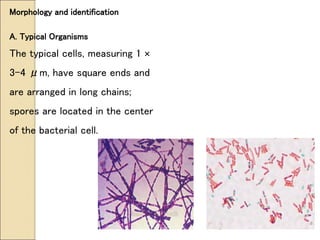
Morphology and identification
A. Typical Organisms
The typical cells, measuring 1 ×
3–4 μm, have square ends and
are arranged in long chains;
spores are located in the center
of the bacterial cell.
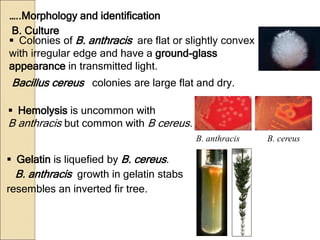
 Colonies of B. anthracis are flat or slightly convex
with irregular edge and have a ground-glass
appearance in transmitted light.
B. Culture
 Hemolysis is uncommon with
B anthracis but common with B cereus.
B. anthracis B. cereus
…..Morphology and identification
 Gelatin is liquefied by B. cereus.
B. anthracis growth in gelatin stabs
resembles an inverted fir tree.
Bacillus cereus colonies are large flat and dry.
Diagnostic Laboratory Tests
Specimens to be examined are fluid or pus from a local lesion, blood,
pleural fluid, and cerebrospinal fluid in inhalational anthrax
associated with sepsis and stool or other
intestinal contents in the case of gastrointestinal anthrax.
• Stained smears
Gram stain show chains of large gram-positive rods
 Culture
 When grown on blood agar plates, the
organisms produce Non-hemolytic gray to white,
tenacious colonies with a rough texture and a
ground-glass appearance. Comma-shaped
outgrowths (Medusa head, “curled hair”) may project
from the colony.
 In semisolid medium, anthrax bacilli are always non-
motile.
- Definitive identification requires lysis by a specific anthrax -
bacteriophage,
- Detection of the capsule by fluorescent antibody,
- identification of toxin genes by polymerase chain reaction
(PCR),
- Enzyme-linked immunoassay (ELISA)
Clinical laboratories that recover large gram-positive rods
from blood, cerebrospinal fluid, or suspicious skin lesions,
which phenotypically match the description of B anthracis
as mentioned, should immediately contact their public
health laboratory and send the organism for confirmation.
…..Diagnostic Laboratory Tests

plague, anthrax.ppt

  • 1.
    Plague History & Significance 14thCentury: “Black Death” responsible for >20 million deaths in Europe Used as a BW agent by Japan in WW II Studied by Soviet and, to a smaller extent, U.S. BW programs 1995: Larry Wayne Harris arrested for illicit procurement of culture via mail
  • 2.
    Plague Epidemiology  Caused byYersinia pestis  About 10-15 cases/year U.S. Mainly SW states  Human plague occurs from bite of an infected flea (bubonic)  Only pneumonic form of plague is spread person- to-person Last case of person-to-person transmission in U.S. occurred in 1924
  • 3.
    Yersinia Pestis  Gramnegative, non-motile, non- spore-forming bacillus  Resistant to freezing temperature and drying, killed by heat and sunlight Source: Centers for Disease Control and Prevention, Division of Vector-Borne Infectious Diseases, Fort Collins, CO
  • 4.
    Plague Case Definition  Characterizedby fever, chills, headache, malaise, prostration, & leukocytosis that manifests in one or more of the following clinical forms: ◦ Regional lymphadenitis (bubonic) ◦ Septicemia w/o evident bubo (septicemic) ◦ Plague pneumonia ◦ Pharyngitis & cervical lymphadenitis (pharyngeal) MMWR 1997;46(RR-10)
  • 5.
    Plague Case Definition, cont. Laboratorycriteria for diagnosis: Presumptive Elevated serum antibody titers to Y. pestis F1 antigen (w/o documented 4-fold change) in a patient with no history of plague vaccination OR Detection of F1 antigen in a clinical specimen by fluorescent assay Confirmatory Isolation of Y. pestis from a clinical specimen OR 4-fold or greater change in serum antibody titer to Y. pestis F1 antigen MMWR 1997;46(RR-10)
  • 6.
    Plague: Case Classification Suspected:Clinically compatible case w/o presumptive or confirmatory lab results Probable: Clinically compatible case with presumptive lab results Confirmed: Clinically compatible case with confirmatory lab results MMWR 1997;46(RR-10)
  • 7.
    Plague Clinical Forms  Bubonicplague Most common naturally-occurring form Mortality 60% untreated, <5% treated  Primary or secondary septicemic plague  Pneumonic plague Most likely BT presentation From aerosol or septicemic spread to lungs Survival unlikely if treatment not initiated w/in 24 hours of the onset of symptoms
  • 8.
    Pneumonic Plague Clinical Presentation Incubation: 1-6 days (usually 2-4 days)  Acute onset of fever with cough, dyspnea, and chest pain  Hemoptysis characteristic; watery or purulent sputum also possible  Prominent GI symptoms may be present, including nausea, vomiting, diarrhea, and abdominal pain
  • 9.
    Pneumonic Plague Clinical Presentation Othersymptoms include headache, chills, malaise, myalgias Rarely, cervical bubo present Rapid progression to respiratory failure & shock
  • 10.
    Bubonic Plague  Incubation:2-8 days  Sudden onset nonspecific symptoms: fever, chills, malaise, muscle aches, headache  Regional lymphadenitis (buboes) Swollen, very painful lymph nodes Typically inguinal, femoral, axillary, or cervical Erythema overlying skin May have surrounding edema Concurrent with or shortly after onset of other symptoms
  • 11.
    Septicemic & BubonicPlague Source: CDC NVBID
  • 12.
    Plague Infection Control Person-to-person transmissionvia respiratory droplets Standard respiratory droplet precautions Treatment = 10 days antibiotics  Case isolation for at least the first 48 hrs of antibiotic treatment Bubonic plague - standard precautions
  • 13.
    Plague Infection Control Antibiotic prophylaxisfor close contacts Duration: 7 days or duration of risk of exposure + 7 days Close contacts refusing prophylaxis: Observe 7 days after last exposure and treat if fever or cough develop Bubonic contacts: Observe 7d and treat if symptoms develop
  • 14.
    Bacillus Species  Thegenus Bacillus includes large aerobic, spore-forming, Gram-positive rods occurring in chains.  Most members of this genus are saprophytic organisms prevalent in soil, water, air and on vegetation, such as Bacillus subtilis & B. cereus .  Some are insect pathogens, such as B. thuringiensis . This organism is also capable of causing disease in humans.  B. cereus can grow in foods and cause food poisoning by producing either an enterotoxin (diarrhea) or an emetic toxin (vomiting).
  • 15.
    Morphology and identification A.Typical Organisms The typical cells, measuring 1 × 3–4 μm, have square ends and are arranged in long chains; spores are located in the center of the bacterial cell.
  • 16.
     Colonies ofB. anthracis are flat or slightly convex with irregular edge and have a ground-glass appearance in transmitted light. B. Culture  Hemolysis is uncommon with B anthracis but common with B cereus. B. anthracis B. cereus …..Morphology and identification  Gelatin is liquefied by B. cereus. B. anthracis growth in gelatin stabs resembles an inverted fir tree. Bacillus cereus colonies are large flat and dry.
  • 17.
    Diagnostic Laboratory Tests Specimensto be examined are fluid or pus from a local lesion, blood, pleural fluid, and cerebrospinal fluid in inhalational anthrax associated with sepsis and stool or other intestinal contents in the case of gastrointestinal anthrax. • Stained smears Gram stain show chains of large gram-positive rods  Culture  When grown on blood agar plates, the organisms produce Non-hemolytic gray to white, tenacious colonies with a rough texture and a ground-glass appearance. Comma-shaped outgrowths (Medusa head, “curled hair”) may project from the colony.  In semisolid medium, anthrax bacilli are always non- motile.
  • 18.
    - Definitive identificationrequires lysis by a specific anthrax - bacteriophage, - Detection of the capsule by fluorescent antibody, - identification of toxin genes by polymerase chain reaction (PCR), - Enzyme-linked immunoassay (ELISA) Clinical laboratories that recover large gram-positive rods from blood, cerebrospinal fluid, or suspicious skin lesions, which phenotypically match the description of B anthracis as mentioned, should immediately contact their public health laboratory and send the organism for confirmation. …..Diagnostic Laboratory Tests