We’ll look at---
   Definitions
 Consequences
 Research Tips
Definitions
Merriam-Webster Dictionary defines plagiarism as:
 to steal and pass off (the ideas or words of another) as
  one's own
 to use (another's production) without crediting the
  source
 to present as new and original an idea or product
  derived from an existing source.
Definitions
 We will cover these applications of plagiarism
  today.
 Most colleges and universities define what is
  considered plagiarism for their own institutions.
  You can often find this in the college catalog.
 Our own college catalog has a section on
  plagiarism and the consequences

 **http://www.plagiarism.org/plag_article_what_is_plagiarism.html
RHC Catalog
 Cheating/Plagiarism    Cheating is defined as obtaining or
  attempting to obtain credit for work by the use of any dishonest,
  deceptive, fraudulent, or unauthorized means. Helping
  someone commit an act of academic dishonesty is also
  considered cheating. Examples include, but are not limited to:
 1. Unacceptable exam behavior – communicating with fellow
  students, copying material from another student’s exam or
  allowing or using unauthorized materials, or any behavior that
  defeats the intent of an exam.
 2. Plagiarism – taking the work of anothere and offering it as
  one’s own without giving credit to that source, whether that
  material is paraphrased or copied in verbatim or near verbatim.
 **pg. 38, RHC Catalogue, 2011-12
RHC Catalog
 3. Unauthorized collaboration on a project,
  homework, or other assignment where an instructor
  expressly forbids such collaboration.
 4. Documentary falsification including forgery,
  altering of campus documents or records, tampering
  with grading procedures, fabricating lab assignments,
  or altering medical excuses.
RHC Catalog
 Consequences of cheating/plagiarism may include:

 1. Receive an “F” in the course.
 2. Receive a 0 on that assignment.
 3. Be referred to the Dean of Student Life for further
 disciplinary action.
Intentional Plagiarism
 Copy a friend's work [such as papers, tests]
 Buying or borrowing papers
 Cutting and pasting blocks of text without citing the
  source
 Publishing the work on the web without permission of
  the creator
Intentional Plagiarism… [or not]


                       http://www.pyrczak.com
                       /antiplagiarism/cartoons.
                       htm
Unintentional
 Incomplete or careless quoting or paraphrasing
 None/incomplete documentation
 Quoting too much from source
 No use of your own ideas
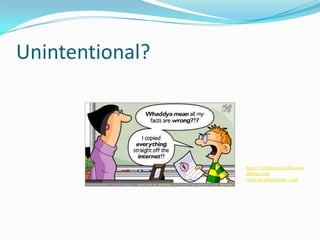
Unintentional?


                 http://vetahrix009.files.wor
                 dpress.com
                 /2011/01/plagiarism_3.gif
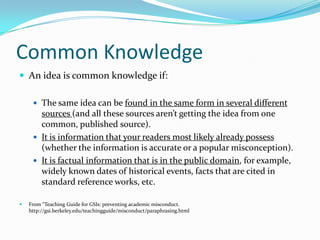
Common Knowledge
 An idea is common knowledge if:

      The same idea can be found in the same form in several different
       sources (and all these sources aren’t getting the idea from one
       common, published source).
      It is information that your readers most likely already possess
       (whether the information is accurate or a popular misconception).
      It is factual information that is in the public domain, for example,
       widely known dates of historical events, facts that are cited in
       standard reference works, etc.

   From “Teaching Guide for GSIs: preventing academic misconduct.
    http://gsi.berkeley.edu/teachingguide/misconduct/paraphrasing.html
Examples
 Common Knowledge:
    John F. Kennedy was elected President of the United
     States in 1960. [public fact, contained in many sources]

 Not Common Knowledge:
   According the American Family Leave Coalition’s new
    book, Family Issues and Congress, President Bush’s
    relationship with Congress has hindered family leave
    legislation (6). [information/opinion stated by an
    author]
Video
 Video on Unintentional Plagiarism [Cal Poly Pomona]:


 http://www.youtube.com/watch?v=jNVg_V_QsMQ
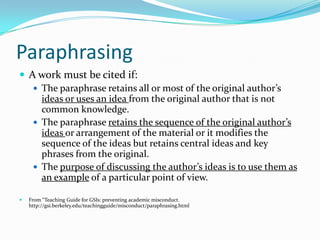
Paraphrasing
 A work must be cited if:
    The paraphrase retains all or most of the original author’s
     ideas or uses an idea from the original author that is not
     common knowledge.
    The paraphrase retains the sequence of the original author’s
     ideas or arrangement of the material or it modifies the
     sequence of the ideas but retains central ideas and key
     phrases from the original.
    The purpose of discussing the author’s ideas is to use them as
     an example of a particular point of view.

   From “Teaching Guide for GSIs: preventing academic misconduct.
    http://gsi.berkeley.edu/teachingguide/misconduct/paraphrasing.html
Exercise on Paraphrasing
 See below for short exercise on paraphrasing [UC
 Berkeley]

 http://gsi.berkeley.edu/teachingguide/misconduct/ex
 ercise.html
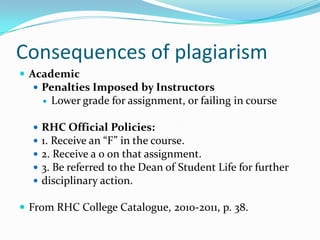
Consequences of plagiarism
 Academic
   Penalties Imposed by Instructors
         Lower grade for assignment, or failing in course

     RHC Official Policies:
     1. Receive an “F” in the course.
     2. Receive a 0 on that assignment.
     3. Be referred to the Dean of Student Life for further
     disciplinary action.

 From RHC College Catalogue, 2010-2011, p. 38.
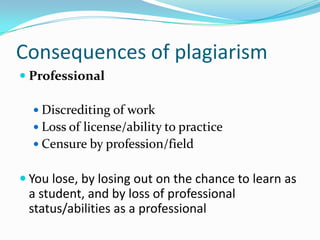
Consequences of plagiarism
 Professional

   Discrediting of work
   Loss of license/ability to practice
   Censure by profession/field


 You lose, by losing out on the chance to learn as
 a student, and by loss of professional
 status/abilities as a professional
Research Tips to Avoid Plagiarism
   Know the code of the institution you attend

        Be familiar with our RHC code [p. 38, RHC College Catalogue]

   Give credit where credit is due

        Exact words: use quotes for exact words of author
        Summaries: indicate sources of summarys of other’s ideas
        Paraphrases: indicate sources of paraphrase

   Common Knowledge must be distinguished from ideas of others:

   The Internet is common knowledge [not!]

   Avoid minor changes in wording from a source. Changing one or two words is not sufficient, you must rewrite in your
    own words

   Try to aim for creative work in your own words

   Use the documentation style required for the assignment

   Use MLA, APA or other required styles [see our guides here]

   Begin assignments early enough to avoid sloppy citing or referencing of sources
Exercise
 Take the short quiz below:


 http://dsa.csupomona.edu/judicialaffairs/plagquiz.asp
Questions?
 Other Sources for Plagiarism


 Vail Tutorial on Plagiarism and Academic Integrity
    http://www-apps.umuc.edu/vailtutor/index.html
 OWL Tutorial
    http://owl.english.purdue.edu/owl/resource/589/02/
 Cal Poly Pomona Tutorial on Plagiarism
    http://www.csupomona.edu/~library/spotlight/2011/oct
     ober/student_plagiarism.html

Plagiarism tutorial

  • 1.
    We’ll look at--- Definitions Consequences Research Tips
  • 2.
    Definitions Merriam-Webster Dictionary definesplagiarism as:  to steal and pass off (the ideas or words of another) as one's own  to use (another's production) without crediting the source  to present as new and original an idea or product derived from an existing source.
  • 3.
    Definitions  We willcover these applications of plagiarism today.  Most colleges and universities define what is considered plagiarism for their own institutions. You can often find this in the college catalog.  Our own college catalog has a section on plagiarism and the consequences  **http://www.plagiarism.org/plag_article_what_is_plagiarism.html
  • 4.
    RHC Catalog  Cheating/Plagiarism Cheating is defined as obtaining or attempting to obtain credit for work by the use of any dishonest, deceptive, fraudulent, or unauthorized means. Helping someone commit an act of academic dishonesty is also considered cheating. Examples include, but are not limited to:  1. Unacceptable exam behavior – communicating with fellow students, copying material from another student’s exam or allowing or using unauthorized materials, or any behavior that defeats the intent of an exam.  2. Plagiarism – taking the work of anothere and offering it as one’s own without giving credit to that source, whether that material is paraphrased or copied in verbatim or near verbatim.  **pg. 38, RHC Catalogue, 2011-12
  • 5.
    RHC Catalog  3.Unauthorized collaboration on a project, homework, or other assignment where an instructor expressly forbids such collaboration.  4. Documentary falsification including forgery, altering of campus documents or records, tampering with grading procedures, fabricating lab assignments, or altering medical excuses.
  • 6.
    RHC Catalog  Consequencesof cheating/plagiarism may include:   1. Receive an “F” in the course.  2. Receive a 0 on that assignment.  3. Be referred to the Dean of Student Life for further  disciplinary action.
  • 7.
    Intentional Plagiarism  Copya friend's work [such as papers, tests]  Buying or borrowing papers  Cutting and pasting blocks of text without citing the source  Publishing the work on the web without permission of the creator
  • 8.
    Intentional Plagiarism… [ornot] http://www.pyrczak.com /antiplagiarism/cartoons. htm
  • 9.
    Unintentional  Incomplete orcareless quoting or paraphrasing  None/incomplete documentation  Quoting too much from source  No use of your own ideas
  • 10.
    Unintentional? http://vetahrix009.files.wor dpress.com /2011/01/plagiarism_3.gif
  • 11.
    Common Knowledge  Anidea is common knowledge if:  The same idea can be found in the same form in several different sources (and all these sources aren’t getting the idea from one common, published source).  It is information that your readers most likely already possess (whether the information is accurate or a popular misconception).  It is factual information that is in the public domain, for example, widely known dates of historical events, facts that are cited in standard reference works, etc.  From “Teaching Guide for GSIs: preventing academic misconduct. http://gsi.berkeley.edu/teachingguide/misconduct/paraphrasing.html
  • 12.
    Examples  Common Knowledge:  John F. Kennedy was elected President of the United States in 1960. [public fact, contained in many sources]  Not Common Knowledge:  According the American Family Leave Coalition’s new book, Family Issues and Congress, President Bush’s relationship with Congress has hindered family leave legislation (6). [information/opinion stated by an author]
  • 13.
    Video  Video onUnintentional Plagiarism [Cal Poly Pomona]:  http://www.youtube.com/watch?v=jNVg_V_QsMQ
  • 14.
    Paraphrasing  A workmust be cited if:  The paraphrase retains all or most of the original author’s ideas or uses an idea from the original author that is not common knowledge.  The paraphrase retains the sequence of the original author’s ideas or arrangement of the material or it modifies the sequence of the ideas but retains central ideas and key phrases from the original.  The purpose of discussing the author’s ideas is to use them as an example of a particular point of view.  From “Teaching Guide for GSIs: preventing academic misconduct. http://gsi.berkeley.edu/teachingguide/misconduct/paraphrasing.html
  • 15.
    Exercise on Paraphrasing See below for short exercise on paraphrasing [UC Berkeley]  http://gsi.berkeley.edu/teachingguide/misconduct/ex ercise.html
  • 16.
    Consequences of plagiarism Academic  Penalties Imposed by Instructors  Lower grade for assignment, or failing in course  RHC Official Policies:  1. Receive an “F” in the course.  2. Receive a 0 on that assignment.  3. Be referred to the Dean of Student Life for further  disciplinary action.  From RHC College Catalogue, 2010-2011, p. 38.
  • 17.
    Consequences of plagiarism Professional  Discrediting of work  Loss of license/ability to practice  Censure by profession/field  You lose, by losing out on the chance to learn as a student, and by loss of professional status/abilities as a professional
  • 18.
    Research Tips toAvoid Plagiarism  Know the code of the institution you attend  Be familiar with our RHC code [p. 38, RHC College Catalogue]   Give credit where credit is due   Exact words: use quotes for exact words of author  Summaries: indicate sources of summarys of other’s ideas  Paraphrases: indicate sources of paraphrase   Common Knowledge must be distinguished from ideas of others:   The Internet is common knowledge [not!]   Avoid minor changes in wording from a source. Changing one or two words is not sufficient, you must rewrite in your own words   Try to aim for creative work in your own words   Use the documentation style required for the assignment   Use MLA, APA or other required styles [see our guides here]   Begin assignments early enough to avoid sloppy citing or referencing of sources
  • 19.
    Exercise  Take theshort quiz below:  http://dsa.csupomona.edu/judicialaffairs/plagquiz.asp
  • 20.
    Questions?  Other Sourcesfor Plagiarism  Vail Tutorial on Plagiarism and Academic Integrity  http://www-apps.umuc.edu/vailtutor/index.html  OWL Tutorial  http://owl.english.purdue.edu/owl/resource/589/02/  Cal Poly Pomona Tutorial on Plagiarism  http://www.csupomona.edu/~library/spotlight/2011/oct ober/student_plagiarism.html