Disha P Kariya
Research Scholar
Department of English M K Bhavanagar University
As per the Cambridge English Dictionary,
The process or practice of using another person’s ideas or work
and pretending that it is your own
As per the Merriam Webster Dictionary,
To steal and pass off (the ideas or words of another) as one’s own
Use another’s production without crediting the source
To commit literary theft : present as new and original an idea or
product derived from an existing source
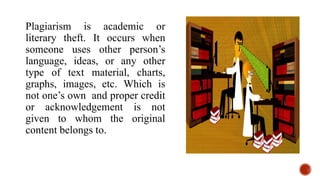
Plagiarism is academic or
literary theft. It occurs when
someone uses other person’s
language, ideas, or any other
type of text material, charts,
graphs, images, etc. Which is
not one’s own and proper credit
or acknowledgement is not
given to whom the original
content belongs to.
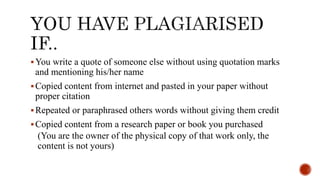
You write a quote of someone else without using quotation marks
and mentioning his/her name
Copied content from internet and pasted in your paper without
proper citation
Repeated or paraphrased others words without giving them credit
Copied content from a research paper or book you purchased
(You are the owner of the physical copy of that work only, the
content is not yours)
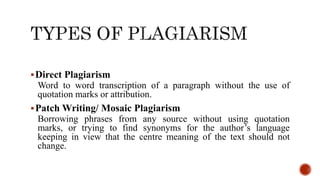
Direct Plagiarism
Word to word transcription of a paragraph without the use of
quotation marks or attribution.
Patch Writing/ Mosaic Plagiarism
Borrowing phrases from any source without using quotation
marks, or trying to find synonyms for the author’s language
keeping in view that the centre meaning of the text should not
change.
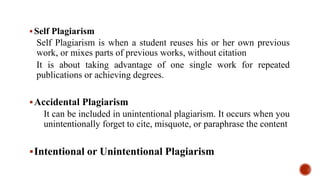
Self Plagiarism
Self Plagiarism is when a student reuses his or her own previous
work, or mixes parts of previous works, without citation
It is about taking advantage of one single work for repeated
publications or achieving degrees.
Accidental Plagiarism
It can be included in unintentional plagiarism. It occurs when you
unintentionally forget to cite, misquote, or paraphrase the content
Intentional or Unintentional Plagiarism
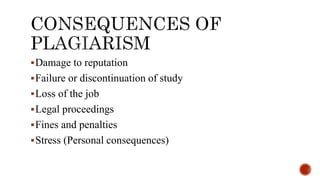
Damage to reputation
Failure or discontinuation of study
Loss of the job
Legal proceedings
Fines and penalties
Stress (Personal consequences)
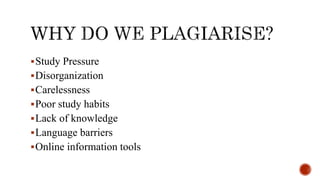
Study Pressure
Disorganization
Carelessness
Poor study habits
Lack of knowledge
Language barriers
Online information tools
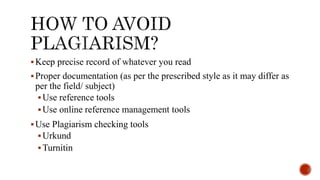
Keep precise record of whatever you read
Proper documentation (as per the prescribed style as it may differ as
per the field/ subject)
Use reference tools
Use online reference management tools
Use Plagiarism checking tools
Urkund
Turnitin
Semalty , Mona. “Module 7 Part 1: Plagiarism: Concept - Dr Mona SEMALTY (HNB
Garhwal University).” YouTube, 29 July 2019, youtu.be/AvtX9o5KQrk.
Barad, Dilip. “Avoid Plagiarism – Research in Digital Era.” Share and Discover
Knowledge on SlideShare, 7 Jan. 2022, www.slideshare.net/dilipbarad/avoid-
plagiarism-research-in-digital-era.
“Plagiarism and Academic Integrity .” MLA Handbook for Writers of Research
Papers, 7th ed., The Modern Language Association of America , New York , New
York , 2009, pp. 51–63.
Semalty M., Plagiarism: Concept, In Academic Writing, Semalty A. (Eds), BS
Publications, Hyderabad, India, 2021.
THANK
YOU

Plagiarism

  • 1.
    Disha P Kariya ResearchScholar Department of English M K Bhavanagar University
  • 2.
    As per theCambridge English Dictionary, The process or practice of using another person’s ideas or work and pretending that it is your own As per the Merriam Webster Dictionary, To steal and pass off (the ideas or words of another) as one’s own Use another’s production without crediting the source To commit literary theft : present as new and original an idea or product derived from an existing source
  • 3.
    Plagiarism is academicor literary theft. It occurs when someone uses other person’s language, ideas, or any other type of text material, charts, graphs, images, etc. Which is not one’s own and proper credit or acknowledgement is not given to whom the original content belongs to.
  • 4.
    You write aquote of someone else without using quotation marks and mentioning his/her name Copied content from internet and pasted in your paper without proper citation Repeated or paraphrased others words without giving them credit Copied content from a research paper or book you purchased (You are the owner of the physical copy of that work only, the content is not yours)
  • 5.
    Direct Plagiarism Word toword transcription of a paragraph without the use of quotation marks or attribution. Patch Writing/ Mosaic Plagiarism Borrowing phrases from any source without using quotation marks, or trying to find synonyms for the author’s language keeping in view that the centre meaning of the text should not change.
  • 6.
    Self Plagiarism Self Plagiarismis when a student reuses his or her own previous work, or mixes parts of previous works, without citation It is about taking advantage of one single work for repeated publications or achieving degrees. Accidental Plagiarism It can be included in unintentional plagiarism. It occurs when you unintentionally forget to cite, misquote, or paraphrase the content Intentional or Unintentional Plagiarism
  • 7.
    Damage to reputation Failureor discontinuation of study Loss of the job Legal proceedings Fines and penalties Stress (Personal consequences)
  • 8.
    Study Pressure Disorganization Carelessness Poor studyhabits Lack of knowledge Language barriers Online information tools
  • 9.
    Keep precise recordof whatever you read Proper documentation (as per the prescribed style as it may differ as per the field/ subject) Use reference tools Use online reference management tools Use Plagiarism checking tools Urkund Turnitin
  • 10.
    Semalty , Mona.“Module 7 Part 1: Plagiarism: Concept - Dr Mona SEMALTY (HNB Garhwal University).” YouTube, 29 July 2019, youtu.be/AvtX9o5KQrk. Barad, Dilip. “Avoid Plagiarism – Research in Digital Era.” Share and Discover Knowledge on SlideShare, 7 Jan. 2022, www.slideshare.net/dilipbarad/avoid- plagiarism-research-in-digital-era. “Plagiarism and Academic Integrity .” MLA Handbook for Writers of Research Papers, 7th ed., The Modern Language Association of America , New York , New York , 2009, pp. 51–63. Semalty M., Plagiarism: Concept, In Academic Writing, Semalty A. (Eds), BS Publications, Hyderabad, India, 2021.
  • 11.