LEKSHMI LAL S
LECTURER
NIGHTINGALE COLLEGE OF
NURSING
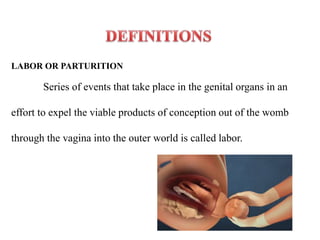
LABOR OR PARTURITION
Series of events that take place in the genital organs in an
effort to expel the viable products of conception out of the womb
through the vagina into the outer world is called labor.
PARTURITION AND PARTURIENT
Parturition is the process of giving
birth. Parturient is a women in labor
DELIVERY
It is the expulsion or extraction of a
viable fetus out of the womb.
Spontaneous in onset and at term.
With cephalic presentation
Without undue prolongation
Natural termination with minimal aids.
Without having any complications
Duration of <12 hrs in nulliparous women and <8 hrs in
multiparous women.
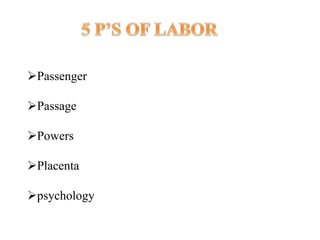
Passenger
Passage
Powers
Placenta
psychology
1. Gynecoid (the classic female type)
2. Android (resembling the male pelvis)
3. Anthropoid (resembling the pelvis of anthropoid apes)
4. Platypelloid (the flat pelvis)
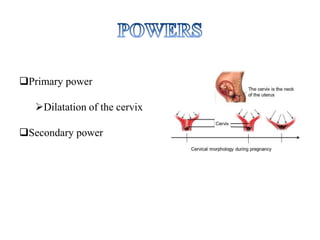
Primary power
Dilatation of the cervix
Secondary power
•PROSTAGLANDINS
•OXYTOCIN
•OESTROGEN AND PROGESTERONE
•ROLE OF THE FETUS
•INFLAMMATORY MEDIATORS
•MECHANICAL FACTORS
•PRODROMAL (PRE-LABOR) STAGE
Shelfing
Lightening
Cervical Ripening
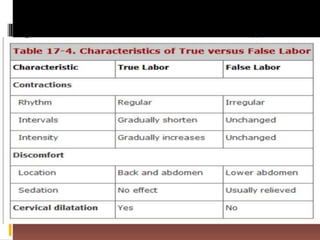
False Labor Pain
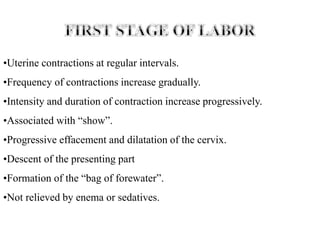
•Uterine contractions at regular intervals.
•Frequency of contractions increase gradually.
•Intensity and duration of contraction increase progressively.
•Associated with “show”.
•Progressive effacement and dilatation of the cervix.
•Descent of the presenting part
•Formation of the “bag of forewater”.
•Not relieved by enema or sedatives.
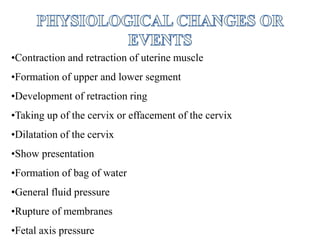
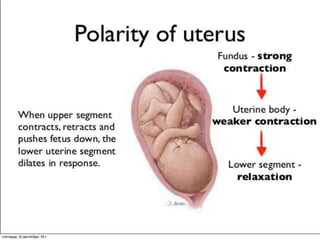
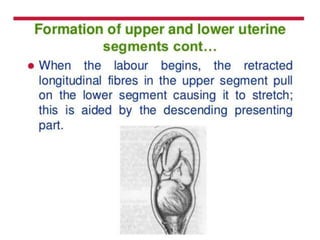
•Contraction and retraction of uterine muscle
•Formation of upper and lower segment
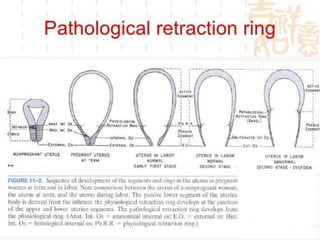
•Development of retraction ring
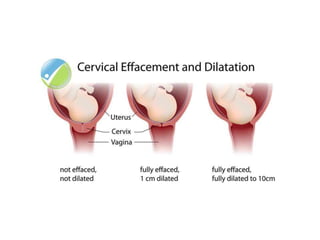
•Taking up of the cervix or effacement of the cervix
•Dilatation of the cervix
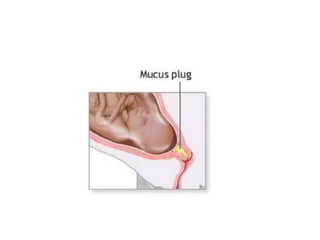
•Show presentation
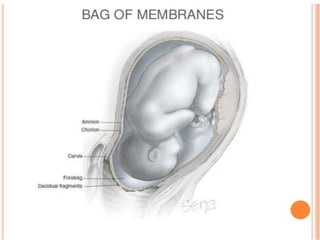
•Formation of bag of water
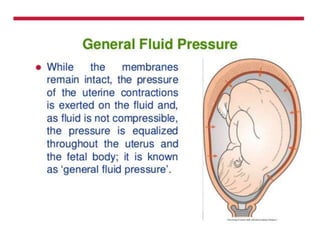
•General fluid pressure
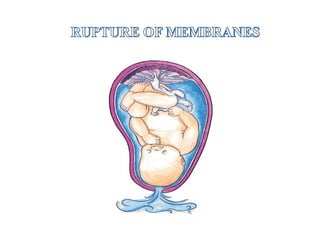
•Rupture of membranes
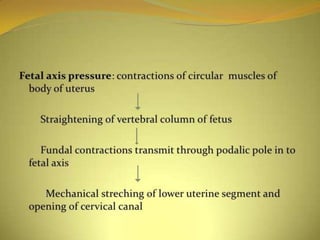
•Fetal axis pressure
PURPOSES
To conduct safe and clean delivery
To provide an adequate help and maintain comfortable to mother in labor
To prevent maternal and fetal complication eg:- maternal and fetal
distress, postpartum hemorrhage and injuries etc
To give a healthy, live and a normal birth of a baby.
To maintain normal delivery process with good guidance, maximum
observation with minimal assistance.
To identify deviation from normal and complications in early and take
corrective measures as necessary.
Non- interference with watchful expectancy so as to
prepare the patient for a smooth delivery in the second
stage
To monitor carefully the progress of labor, maternal
conditions and fetal behaviourso as to detect any
deviation from the normal at the earliest possible
movement.
Nursing care
 Hospital admission
 Perineal preparation
 Cleansing enema
 Check the uterine contractions
 Monitoring and recording color and amount of show
 Fetal monitoring
 Vital signs
 Patient should void
 Patient is NPO during labor
 Positioning during labor
 Prevention of infection
 Vaginal examination
 Artifical rupture of membranes
 Emotional support
Labour table with Mackintosh shhet
Suction machine
Oxygen cylinder with face mask, oxygen concentrator
24 hour water supply
Waste disposal system in place
24 hour electricity with backup
Attached toilet in the labour room
Designated Newborn corner (Radiant warmer, separate drug tray for the
baby, suction cannula, pedal suction machine/ mucus extractor, Ambu bag)
Flooring, walls, ceiling and lighting adequate.
Emergency drug tray with:
Oxytocin injection
Diazepam injection
Magnesium sulphate injection
Lignocaine hydrochloride injection
Nifedipine tablet
Normal delivery kits availability
Equipments for assisted vaccum delivery
Equipments for forceps delivery (outlet forceps)
Surgical set for episiotomy and mointor procedures available
Availability of gloves, sterilized cotton gauze, sterile syringes and needles,
drip sets and IV infusions.
1. Speculum
2. Artery forceps
3. Needle holder
4. Thumb forceps
5. Scissors- straight & curved
6. Cord tie
7. Gloves size 6, 6.5 & 7
8. Catgut
9. Xylocaine loaded syringe
10.Urinary catheter
11.Mop/ pad
1. Episiotomy scissors
2. Scissor straight
3. Sponge holding forceps
4. Vaginal speculum
5. Artery forceps straight
6. Artery forceps curved
7. Needle holder 7 inch
8. Gallipot
9. Kidney tray
10.Tissue forceps toothed
11.Instrument tray
1. Radiant warmer
2. Neonatal ambu bag with face mask
3. Mucous extractor
4. Infant tray with clean cloth for draping the baby
5. Oxygen cylinder with flow meter
6. Nasal catheter
7. Laryngoscope and endotracheal intubation tube
8. Paediatric stethoscope
9. Baby scale
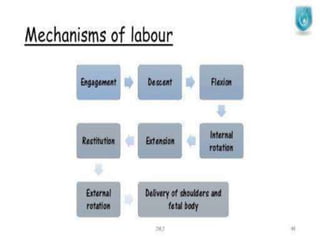
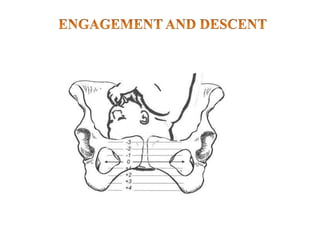
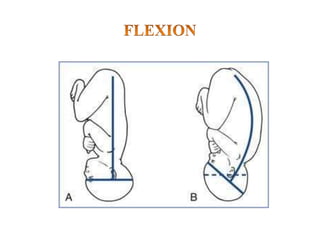
The series of movements that occur on the head in the
process of adaptation, during its journey through the pelvis is
called mechanism of labor.
The mechanism of labor is the positional movements that
the fetus undergoes to accommodate itself to the maternal
pelvis.
It is the manner in which the fetus adjusts itself to pass
through the parturient canal with minimal difficulty.
1. Descent takes place throughout the labor
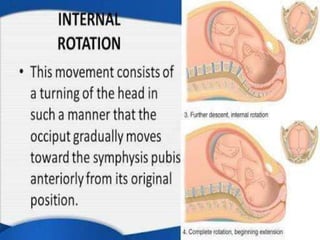
2. Whichever part leads and first meets the resistance of the
pelvic floor will rotate forward until it comes under the
symphysis pubis.
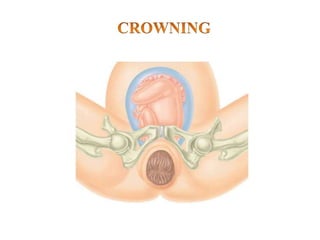
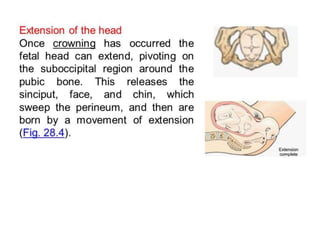
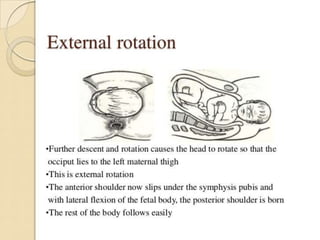
3. Whatever emerges from the pelvis will pivot around the pubic
bone
•Increased intensity of uterine contractions.
•Appearance of bearing down efforts.
•Urge to defecate with descent of the presenting part.
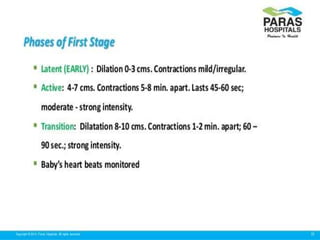
•Complete dilatation of the cervix as evidenced on
vaginal examination.
Vital signs
Uterine activity
Labor progress
Intake & output
General measures
Latent phase
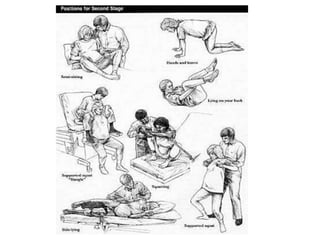
•The woman may be placed in a lateral or partial sitting or
other comfortable position.
•Encourage relaxation to conserve energy.
Descent phase
•Assist to bear down effectively.
•Assist to assume position of comfort that facilitate
descent.
•Encourage breathing during bearing down efforts.
•Help to relax between contractions and provide comfort
measures.
•Cleanse perineum immediately, if fecal material is
expelled.
Transitional phase
•Assist to patient during contractions to avoid rapid birth of head.
•Teach to gently bear down during contractions- slow gentle push.
Emotional support
•Keep informed of progress of fetal descent.
•Provide feedback for bearing down efforts.
•Explain the purpose, if any medication is given and reassure the
woman.
•Provide a quiet, calm environment and continuous nursing
presence.
•Never leave the patient alone once she has been transferred to the
delivery room.
•Encourage the patient to rest between contractions and to push with
contractions. Only one person should coach. Verbal encouragement and
physical contact help reassure and encourage the patient.
•Position the patient’s legs in the stirrups for the lithotomy position.
This is the most common position for the delivery.
•Prepare the patient’s perineum. A betadine scrub and water are used.
clean the perineum by washing the pubic area, down each thigh, down
each side of the labia, down the perineum and down the rectal area.
•Monitor the patient’s blood pressure and the fetal heart tones every 5
minutes and after contractions.
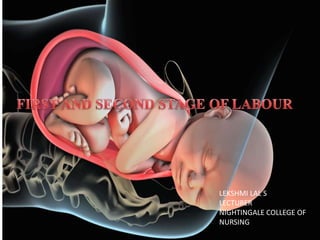
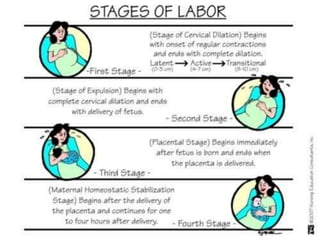
Stages of labour first and second

  • 1.
  • 2.
    LABOR OR PARTURITION Seriesof events that take place in the genital organs in an effort to expel the viable products of conception out of the womb through the vagina into the outer world is called labor.
  • 3.
    PARTURITION AND PARTURIENT Parturitionis the process of giving birth. Parturient is a women in labor DELIVERY It is the expulsion or extraction of a viable fetus out of the womb.
  • 4.
    Spontaneous in onsetand at term. With cephalic presentation Without undue prolongation Natural termination with minimal aids. Without having any complications Duration of <12 hrs in nulliparous women and <8 hrs in multiparous women.
  • 5.
  • 13.
    1. Gynecoid (theclassic female type) 2. Android (resembling the male pelvis) 3. Anthropoid (resembling the pelvis of anthropoid apes) 4. Platypelloid (the flat pelvis)
  • 14.
    Primary power Dilatation ofthe cervix Secondary power
  • 15.
    •PROSTAGLANDINS •OXYTOCIN •OESTROGEN AND PROGESTERONE •ROLEOF THE FETUS •INFLAMMATORY MEDIATORS •MECHANICAL FACTORS
  • 16.
  • 19.
    •Uterine contractions atregular intervals. •Frequency of contractions increase gradually. •Intensity and duration of contraction increase progressively. •Associated with “show”. •Progressive effacement and dilatation of the cervix. •Descent of the presenting part •Formation of the “bag of forewater”. •Not relieved by enema or sedatives.
  • 20.
    •Contraction and retractionof uterine muscle •Formation of upper and lower segment •Development of retraction ring •Taking up of the cervix or effacement of the cervix •Dilatation of the cervix •Show presentation •Formation of bag of water •General fluid pressure •Rupture of membranes •Fetal axis pressure
  • 33.
    PURPOSES To conduct safeand clean delivery To provide an adequate help and maintain comfortable to mother in labor To prevent maternal and fetal complication eg:- maternal and fetal distress, postpartum hemorrhage and injuries etc To give a healthy, live and a normal birth of a baby. To maintain normal delivery process with good guidance, maximum observation with minimal assistance. To identify deviation from normal and complications in early and take corrective measures as necessary.
  • 34.
    Non- interference withwatchful expectancy so as to prepare the patient for a smooth delivery in the second stage To monitor carefully the progress of labor, maternal conditions and fetal behaviourso as to detect any deviation from the normal at the earliest possible movement.
  • 35.
    Nursing care  Hospitaladmission  Perineal preparation  Cleansing enema  Check the uterine contractions  Monitoring and recording color and amount of show  Fetal monitoring  Vital signs
  • 36.
     Patient shouldvoid  Patient is NPO during labor  Positioning during labor  Prevention of infection  Vaginal examination  Artifical rupture of membranes  Emotional support
  • 40.
    Labour table withMackintosh shhet Suction machine Oxygen cylinder with face mask, oxygen concentrator 24 hour water supply Waste disposal system in place 24 hour electricity with backup Attached toilet in the labour room Designated Newborn corner (Radiant warmer, separate drug tray for the baby, suction cannula, pedal suction machine/ mucus extractor, Ambu bag) Flooring, walls, ceiling and lighting adequate.
  • 41.
    Emergency drug traywith: Oxytocin injection Diazepam injection Magnesium sulphate injection Lignocaine hydrochloride injection Nifedipine tablet Normal delivery kits availability Equipments for assisted vaccum delivery Equipments for forceps delivery (outlet forceps) Surgical set for episiotomy and mointor procedures available Availability of gloves, sterilized cotton gauze, sterile syringes and needles, drip sets and IV infusions.
  • 42.
    1. Speculum 2. Arteryforceps 3. Needle holder 4. Thumb forceps 5. Scissors- straight & curved 6. Cord tie 7. Gloves size 6, 6.5 & 7 8. Catgut 9. Xylocaine loaded syringe 10.Urinary catheter 11.Mop/ pad
  • 43.
    1. Episiotomy scissors 2.Scissor straight 3. Sponge holding forceps 4. Vaginal speculum 5. Artery forceps straight 6. Artery forceps curved 7. Needle holder 7 inch 8. Gallipot 9. Kidney tray 10.Tissue forceps toothed 11.Instrument tray
  • 44.
    1. Radiant warmer 2.Neonatal ambu bag with face mask 3. Mucous extractor 4. Infant tray with clean cloth for draping the baby 5. Oxygen cylinder with flow meter 6. Nasal catheter 7. Laryngoscope and endotracheal intubation tube 8. Paediatric stethoscope 9. Baby scale
  • 46.
    The series ofmovements that occur on the head in the process of adaptation, during its journey through the pelvis is called mechanism of labor. The mechanism of labor is the positional movements that the fetus undergoes to accommodate itself to the maternal pelvis. It is the manner in which the fetus adjusts itself to pass through the parturient canal with minimal difficulty.
  • 47.
    1. Descent takesplace throughout the labor 2. Whichever part leads and first meets the resistance of the pelvic floor will rotate forward until it comes under the symphysis pubis. 3. Whatever emerges from the pelvis will pivot around the pubic bone
  • 59.
    •Increased intensity ofuterine contractions. •Appearance of bearing down efforts. •Urge to defecate with descent of the presenting part. •Complete dilatation of the cervix as evidenced on vaginal examination.
  • 60.
    Vital signs Uterine activity Laborprogress Intake & output General measures
  • 61.
    Latent phase •The womanmay be placed in a lateral or partial sitting or other comfortable position. •Encourage relaxation to conserve energy. Descent phase •Assist to bear down effectively. •Assist to assume position of comfort that facilitate descent. •Encourage breathing during bearing down efforts. •Help to relax between contractions and provide comfort measures. •Cleanse perineum immediately, if fecal material is expelled.
  • 62.
    Transitional phase •Assist topatient during contractions to avoid rapid birth of head. •Teach to gently bear down during contractions- slow gentle push. Emotional support •Keep informed of progress of fetal descent. •Provide feedback for bearing down efforts. •Explain the purpose, if any medication is given and reassure the woman. •Provide a quiet, calm environment and continuous nursing presence.
  • 63.
    •Never leave thepatient alone once she has been transferred to the delivery room. •Encourage the patient to rest between contractions and to push with contractions. Only one person should coach. Verbal encouragement and physical contact help reassure and encourage the patient. •Position the patient’s legs in the stirrups for the lithotomy position. This is the most common position for the delivery. •Prepare the patient’s perineum. A betadine scrub and water are used. clean the perineum by washing the pubic area, down each thigh, down each side of the labia, down the perineum and down the rectal area. •Monitor the patient’s blood pressure and the fetal heart tones every 5 minutes and after contractions.