PITYRIASIS
Dr Javeria Khalid MBBS,RMP
PITYRIASIS VERSICOLOR
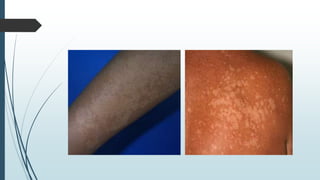
 Pityriasis versicolor is a common yeast infection of the skin, in which flaky
discolored patches (hypopigmented) appear on the chest and back.
 More frequent in hot and humid climates
CAUSES
 Pityriasis versicolor is caused by fungi Malassezia.
 Most common species
M globosa,
Less common
M restricta and M sympodialis.
DIAGNOSIS
 Wood lamp (black light) examination
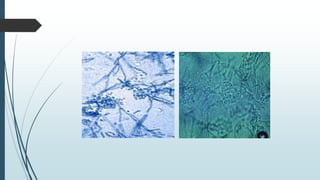
 Microscopy of a skin scraping (using potassium hydroxide (KOH) to remove
skin cells) — hyphae and yeast cells that resemble spaghetti and meatballs
 Fungal culture — this is usually reported to be negative, as it is quite difficult to
persuade the yeasts to grow in a laboratory
 Skin biopsy — fungal elements may be seen within the outer cells of the skin
(stratum corneum) on histopathology. Special stains may be required.
TREATMENT
 Topical measures
Selenium sulfide shampoo
Topical antifungal
 Systemic measures
Oral Anti fungal
 Exercise
Pityriasis Rosea
 Pityriasis rosea is a self-limiting rash, which resolves in about 6–10 weeks. It is
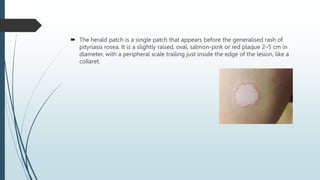
characterised by a large circular or oval "herald patch", usually found on the chest,
abdomen, or back.
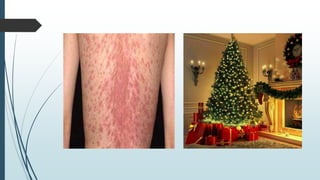
 The herald patch is followed some time later, typically two weeks or so, by the
development of smaller scaly oval red patches, resembling a Christmas tree,
distributed mainly on the chest and back.
 The herald patch is a single patch that appears before the generalised rash of
pityriasis rosea. It is a slightly raised, oval, salmon-pink or red plaque 2–5 cm in
diameter, with a peripheral scale trailing just inside the edge of the lesion, like a
collaret.
CAUSE
 The cause of pityriasis rosea is not known, but it is commonly believed to be
caused by a virus or bacteria
TREATMENT
 The goal of treatment for pityriasis rosea is to relieve symptoms associated with the
condition, such as itching.
Treatment may include:
 Medicated lotions and creams (to soothe the itching)
 Medicines by mouth (to ease the itching)
 Cool baths with or without oatmeal (to soothe the itching)
 Ultraviolet exposure (under a healthcare provider's supervision)
 Cool compresses (to soothe the affected skin)
There is no cure for pityriasis rosea. The condition will usually resolve on its own in
about 1 to 3 months. Normally, it does not return.
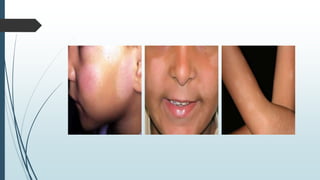
Pityriasis alba
 Pityriasis alba is a low-grade type of eczema/dermatitis mainly seen in children.
 The name describes its appearance: pityriasis refers to the characteristic fine scale,
and alba to its pale colour (hypopigmentation).
 Pityriasis alba is common worldwide with a prevalence in children of around 5%.
 The hypopigmentation of pityriasis alba is more prominent, and the condition
perhaps more common, in dark skin compared to white skin
PITYRIASIS.pptx
PITYRIASIS.pptx
PITYRIASIS.pptx

PITYRIASIS.pptx

  • 1.
  • 3.
    PITYRIASIS VERSICOLOR  Pityriasisversicolor is a common yeast infection of the skin, in which flaky discolored patches (hypopigmented) appear on the chest and back.  More frequent in hot and humid climates
  • 5.
    CAUSES  Pityriasis versicoloris caused by fungi Malassezia.  Most common species M globosa, Less common M restricta and M sympodialis.
  • 6.
    DIAGNOSIS  Wood lamp(black light) examination  Microscopy of a skin scraping (using potassium hydroxide (KOH) to remove skin cells) — hyphae and yeast cells that resemble spaghetti and meatballs  Fungal culture — this is usually reported to be negative, as it is quite difficult to persuade the yeasts to grow in a laboratory  Skin biopsy — fungal elements may be seen within the outer cells of the skin (stratum corneum) on histopathology. Special stains may be required.
  • 8.
    TREATMENT  Topical measures Seleniumsulfide shampoo Topical antifungal  Systemic measures Oral Anti fungal  Exercise
  • 9.
    Pityriasis Rosea  Pityriasisrosea is a self-limiting rash, which resolves in about 6–10 weeks. It is characterised by a large circular or oval "herald patch", usually found on the chest, abdomen, or back.  The herald patch is followed some time later, typically two weeks or so, by the development of smaller scaly oval red patches, resembling a Christmas tree, distributed mainly on the chest and back.
  • 10.
     The heraldpatch is a single patch that appears before the generalised rash of pityriasis rosea. It is a slightly raised, oval, salmon-pink or red plaque 2–5 cm in diameter, with a peripheral scale trailing just inside the edge of the lesion, like a collaret.
  • 12.
    CAUSE  The causeof pityriasis rosea is not known, but it is commonly believed to be caused by a virus or bacteria
  • 13.
    TREATMENT  The goalof treatment for pityriasis rosea is to relieve symptoms associated with the condition, such as itching. Treatment may include:  Medicated lotions and creams (to soothe the itching)  Medicines by mouth (to ease the itching)  Cool baths with or without oatmeal (to soothe the itching)  Ultraviolet exposure (under a healthcare provider's supervision)  Cool compresses (to soothe the affected skin) There is no cure for pityriasis rosea. The condition will usually resolve on its own in about 1 to 3 months. Normally, it does not return.
  • 14.
    Pityriasis alba  Pityriasisalba is a low-grade type of eczema/dermatitis mainly seen in children.  The name describes its appearance: pityriasis refers to the characteristic fine scale, and alba to its pale colour (hypopigmentation).  Pityriasis alba is common worldwide with a prevalence in children of around 5%.  The hypopigmentation of pityriasis alba is more prominent, and the condition perhaps more common, in dark skin compared to white skin