PITYRIASIS ROSEA
PITYRIASIS ROSEA
ETIOLOGY
EPIDEMIOLOGY
SYMPTOMS
DIAGNOSIS
DIFFERENTIAL
DIAGNOSIS
TREATMENT
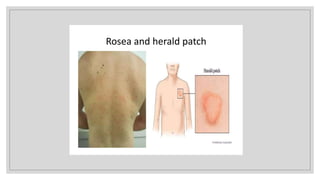
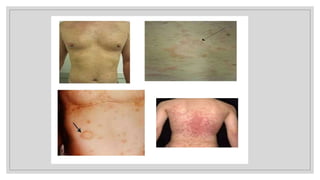
A patient presenting with a single, oval,
erythematous herald patch followed by
multiple smaller lesions on the trunk and
back, tell the diagnosis based on the
image and its management.
An acute, self-limited, exanthematous skin
disease characterized by the appearance of
slightly inflammatory, oval, papulosquamous
lesions on the trunk and proximal areas of the
extremities.
INTRODUCTION
Etiology
Unknown. A virus (HHV-739 more
frequently, HHV-6 less frequently)
has often been incriminated, but PR
is not contagious.
Epidemiology
Age: Usually between ages of 10–35
years.
Sex: No gender predilection.
Season: Incidence lowest in summer.
Morphology
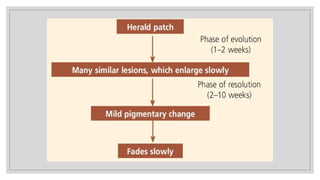
• Herald patch Is the first lesion of PR
and is seen in about 80% of patients.
• Oval lesions with wrinkled, salmon
pink cen- tre and collarette of scales at
the periphery.
• Scales are attached just within leading
edge and free towards the center
• Secondary lesions begin as scaly papules,
which enlarge to form oval annular
plaques similar to herald patch are
smaller, less scaly and less erythematous
than herald patch.
• Are arranged characteristically: the long
axis of patches runs downwards and
outwards from the spine, along the lines
of the ribs (fig tree or Christmas tree
appearance)
Sites of predilection
Trunk, along lines of cleavage.
Sometimes (in 20% of patients) lesions
occur predominantly on extremities and
neck (inverse pattern).
VARIANTS
• Inverse PR: When secondary eruption
is predominantly present on the
extremities and neck.
• Papular PR: When secondary eruption
is predominantly papular.
• Bullous PR: When secondary eruption
is predominantly vesicular.
Investigations
Serological testing to rule out syphilis
is advisable in patients diagnosed as
PR, as secondary syphilis can closely
resemble PR
Diagnosis
• Points for diagnosis PR is
characterized by: Presence of herald
patch (in 80% of patients).
• Eruption consisting of erythematous,
oval annular plaques with a peripheral
collarette of scales.
• Typical distribution on the trunk (fig
tree appearance)
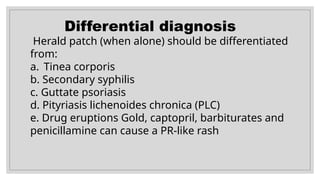
Differential diagnosis
Herald patch (when alone) should be differentiated
from:
a. Tinea corporis
b. Secondary syphilis
c. Guttate psoriasis
d. Pityriasis lichenoides chronica (PLC)
e. Drug eruptions Gold, captopril, barbiturates and
penicillamine can cause a PR-like rash
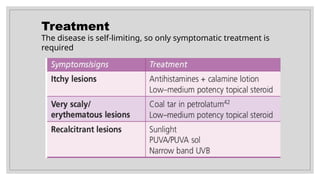
Treatment
The disease is self-limiting, so only symptomatic treatment is
required
• IADVL textbook of dermatology
• Illustrated Synopsis of Dermatology and Sexually
Transmitted Diseases Fourth Edition Neena Khanna
• Google images
BIBLIOGRAPHY
PITYRIASIS ROSEA CAUSES, MANAGEMENT.pptx

PITYRIASIS ROSEA CAUSES, MANAGEMENT.pptx

  • 1.
  • 2.
  • 3.
    A patient presentingwith a single, oval, erythematous herald patch followed by multiple smaller lesions on the trunk and back, tell the diagnosis based on the image and its management.
  • 5.
    An acute, self-limited,exanthematous skin disease characterized by the appearance of slightly inflammatory, oval, papulosquamous lesions on the trunk and proximal areas of the extremities. INTRODUCTION
  • 6.
    Etiology Unknown. A virus(HHV-739 more frequently, HHV-6 less frequently) has often been incriminated, but PR is not contagious.
  • 7.
    Epidemiology Age: Usually betweenages of 10–35 years. Sex: No gender predilection. Season: Incidence lowest in summer.
  • 9.
    Morphology • Herald patchIs the first lesion of PR and is seen in about 80% of patients. • Oval lesions with wrinkled, salmon pink cen- tre and collarette of scales at the periphery. • Scales are attached just within leading edge and free towards the center
  • 10.
    • Secondary lesionsbegin as scaly papules, which enlarge to form oval annular plaques similar to herald patch are smaller, less scaly and less erythematous than herald patch. • Are arranged characteristically: the long axis of patches runs downwards and outwards from the spine, along the lines of the ribs (fig tree or Christmas tree appearance)
  • 11.
    Sites of predilection Trunk,along lines of cleavage. Sometimes (in 20% of patients) lesions occur predominantly on extremities and neck (inverse pattern).
  • 12.
    VARIANTS • Inverse PR:When secondary eruption is predominantly present on the extremities and neck. • Papular PR: When secondary eruption is predominantly papular. • Bullous PR: When secondary eruption is predominantly vesicular.
  • 13.
    Investigations Serological testing torule out syphilis is advisable in patients diagnosed as PR, as secondary syphilis can closely resemble PR
  • 14.
    Diagnosis • Points fordiagnosis PR is characterized by: Presence of herald patch (in 80% of patients). • Eruption consisting of erythematous, oval annular plaques with a peripheral collarette of scales. • Typical distribution on the trunk (fig tree appearance)
  • 16.
    Differential diagnosis Herald patch(when alone) should be differentiated from: a. Tinea corporis b. Secondary syphilis c. Guttate psoriasis d. Pityriasis lichenoides chronica (PLC) e. Drug eruptions Gold, captopril, barbiturates and penicillamine can cause a PR-like rash
  • 17.
    Treatment The disease isself-limiting, so only symptomatic treatment is required
  • 18.
    • IADVL textbookof dermatology • Illustrated Synopsis of Dermatology and Sexually Transmitted Diseases Fourth Edition Neena Khanna • Google images BIBLIOGRAPHY