
PITOPS
Distributed and Serviced in EMEA by
Industrial Process Control Software
Welcome to Demo on…
From
What is PITOPS?
It is process control software for industries
and universities.
It identifies transfer functions.
It optimizes PID tuning parameters.
It can be used to design APC (Advanced
Process Control) inside the DCS or PLC.
It is an IndustrialTool for the Control Room
and aTrainingTool for Research and
Teaching in Colleges.
PITOPS is a Major New Invention
 Pitops identifies multivariable transfer functions
with closed-loop data in just minutes!
 Pitops tunes PIDs precisely meeting plant needs.
 Pitops can be used to develop APC (Advanced
Process Control) systems inside the DCS or PLC
much better and less expensive than MPC (model
predictive control).
PITOPS algorithm is
new and superior to
any other technology
from any competitor
Let’s Tune a
PID in 3
Minutes
PID Tuning Illustration
AI
Gas Phase
Reactor
AC
FC FI
PPM Gas
Composition
PPM Gas Composition
Cascade PID Controller
SP
(Setpoint)
Gas Flow Into
Reactor
Gas phase composition is controlled by a cascade PID analyzer controller (AC),
whose output (OP) manipulates the setpoint (SP) of a slave flow controller.
We illustrate the tuning of theAC which has slow and complex dynamics.
Gas Flow
Indicator
Slave Flow
Controller
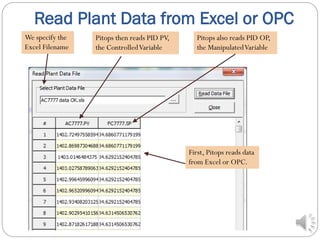
Read Plant Data from Excel or OPC
Pitops then reads PID PV,
the ControlledVariable
Pitops also reads PID OP,
the ManipulatedVariable
We specify the
Excel Filename
First, Pitops reads data
from Excel or OPC.
Select Transfer Function Order
Gas Composition
PV Data
AC Output Data
Next, we chose the
Model Order – First
Order in this case.
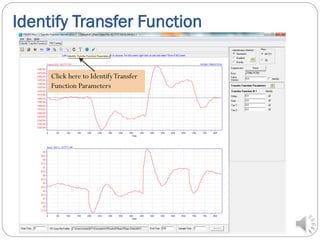
Identify Transfer Function
Click here to IdentifyTransfer
Function Parameters
Transfer Function Parameters
The BLUE trend is theTransfer
Function Model Prediction
See transfer Function
Parameters Identified:
DeadTime=18 minutes
Process Gain=32.8
Time Constant=35.8 minutes
Notice there are no step tests in the MV
(this is complete closed-loop data)
PID Tuning Optimization
First, set the CV range, in our example,
range of theAC (analyzer controller)
Next, set the MV range, the
output range of theAC
Now we proceed to PID
Tuning Optimization
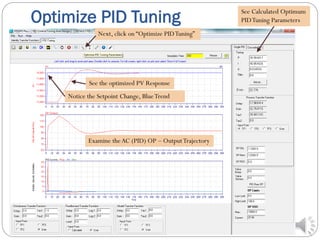
Optimize PID Tuning
Next, click on “Optimize PIDTuning”
Notice the Setpoint Change, BlueTrend
See the optimized PV Response
Examine theAC (PID) OP – OutputTrajectory
See Calculated Optimum
PIDTuning Parameters
The entire process of PID Tuning including
transfer function identification took…..
Only 3 Minutes and
10 Clicks
And it was so Easy, Fast and
Convenient!
No other competitor software,
technology or algorithm can match the
power, ease and functions of PITOPS
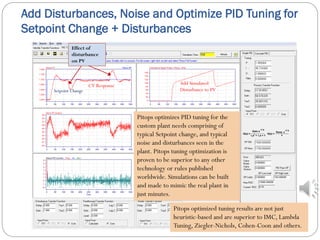
Add Disturbances, Noise and Optimize PID Tuning for
Setpoint Change + Disturbances
14
Add Simulated
Disturbance to PV
CV Response
Setpoint Change
PID Output
Effect of
disturbance
on PV
Pitops optimizes PID tuning for the
custom plant needs comprising of
typical Setpoint change, and typical
noise and disturbances seen in the
plant. Pitops tuning optimization is
proven to be superior to any other
technology or rules published
worldwide. Simulations can be built
and made to mimic the real plant in
just minutes.
Pitops optimized tuning results are not just
heuristic-based and are superior to IMC, Lambda
Tuning, Ziegler-Nichols, Cohen-Coon and others.
Multivariable
Identification
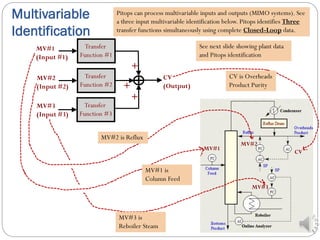
Pitops can process multivariable inputs and outputs (MIMO systems). See
a three input multivariable identification below. Pitops identifies Three
transfer functions simultaneously using complete Closed-Loop data.
MV#1
(Input #1)
+
Transfer
Function #1
Transfer
Function #2
Transfer
Function #3
MV#2
(Input #2)
MV#3
(Input #3)
CV
(Output)
+
+
MV#1
MV#3
MV#2
CV
MV#3 is
Reboiler Steam
MV#1 is
Column Feed
MV#2 is Reflux
CV is Overheads
Product Purity
See next slide showing plant data
and Pitops identification
Three Input Identification (continue above example)
Red Trend Shows Product Analysis (CV Data)
MV #1 Data (Column Feed)
MV #2 Data (Reflux)
MV #3 Data (Reboiler Steam)
Continuing above example, the blue trend Shows aThree-
InputTransfer Function Prediction Identified by Pitops
This Multivariable Closed-LoopTransfer Function
Identification is based on purely Closed-Loop Data (No
StepTests) – A Unique and Unmatched Function in Pitops
Three transfer functions
(2nd Order + DeadTime)
are simultaneously Identified
PITOPS works with Oscillatory Data
(Competitor tools FAIL with such data )
PITOPS Complete Closed-Loop Identification
Competitor software needs step tests on PID OP in manual mode
PID
Output
Or, competitor software needs step tests on Setpoint in Auto mode
Setpoint PID
PV
Only PITOPS can identify transfer functions without any step tests
Setpoint (no steps)
PID
PV
PITOPS ability to reject Unmeasured
Disturbances – New 3G Algorithm
Unmeasured disturbance causing PV to
erroneously go down
PV
PV
PITOPSTransfer Function
(Disturbance Rejected)
CompetitorTools
(Disturbance FoolsTransfer Fn.)
Correct
Error
PITOPS 3G
Technology
(Superior)
Conventional
ARMAX Method
(Obsolete)
PITOPS can Identify Control Valve Stiction
even with closed-loop data with multi-inputs
Multiple Cascades
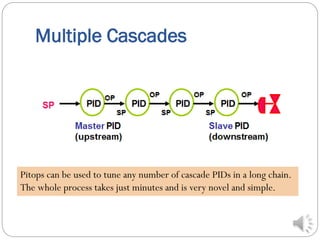
Pitops can be used to tune any number of cascade PIDs in a long chain.
The whole process takes just minutes and is very novel and simple.
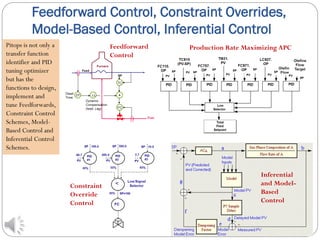
Feedforward Control, Constraint Overrides,
Model-Based Control, Inferential Control
Pitops is not only a
transfer function
identifier and PID
tuning optimizer
but has the
functions to design,
implement and
tune Feedforwards,
Constraint Control
Schemes, Model-
Based Control and
Inferential Control
Schemes.
Feedforward
Control
Production Rate Maximizing APC
Constraint
Override
Control
Inferential
and Model-
Based
Control
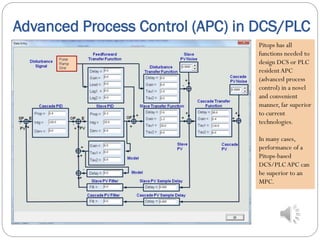
Advanced Process Control (APC) in DCS/PLC
Pitops has all
functions needed to
design DCS or PLC
resident APC
(advanced process
control) in a novel
and convenient
manner, far superior
to current
technologies.
In many cases,
performance of a
Pitops-based
DCS/PLCAPC can
be superior to an
MPC.
PITOPS is a Comprehensive Industrial
Process Control Solutions
 Pitops works with any DCS or PLC brand, vendor or model.
 Pitops can be applied to super-fast dynamics like compressors and
turbines at millisecond scan rates.
 Pitops works with all PID loops like Flow Control, Pressure Control, Level
Control andTemperature Control, etc.
 Pitops works with super-slow PID loops like Online Analyzer Controllers
scanning in minutes and with very slow settling times of over 5 hours.
 Pitops calculates ControlValve Stiction during Identification and includes
Stiction during PID Optimization.
 Pitops can be used on Nonlinear Processes.
 Pitops includes PID Output Rate of Change as an explicit constraint
during PID Optimization, a unique function unmatched by competitors.
 Pitops supports Gap Action and Deadband on PID simulation and
optimization.
PITOPS Unique Functions
 Works entirely in the simpler time domain (no need for Laplace and Z-domain knowledge).
Other products use Laplace, Poles/Zeros.
 Works with super-fast dynamics like compressors and turbines in milliseconds.
 Works with super-slow PID loops like OnlineAnalyzer Controllers scanning in minutes and with
very slow settling times of over 5 hours.
 Works with highly oscillatory data in closed-loop Auto/Cascade Modes.
 Identifies transfer functions even if data has large noise and unmeasured disturbances.
 Identifies ControlValve Stiction; includes stiction during PID tuning optimization.
 Works on MIMO (multiple input/multiple output) systems, multiple cascades, multiple
masters going to a selector and also Fan-Out PID systems.
 Requires far less data (1/5th or less) compared to competitor products.
 Can be used on Nonlinear Processes for Gain Scheduling/Adaptive Control.
 Includes PID Output Rate of Change as an explicit constraint during PID Optimization, a unique
function unmatched by competitors.
 Supports Gap Action and Deadband on PID simulation and optimization.
 Optimizes tuning based on SP change + Disturbances + Noise as exactly seen and
encountered in DCS/PLC – unmatched by competition.
 Takes 5 minutes to install, 2 hours to learn. User manual less than 60 pages!
 Allows changing transfer function & PID tuning parameters to simulate what-if cases.
Contact Yazzoom Today
Yazzoom
Sales &Technical Support
Yazzoom provides technical
consulting for all your PID,
Primary Control and
Advanced Control Problems
HQ: Ghent, Belgium
www.yazzoom.com
info@yazzoom.com
T/F: +32 53 39 77 10

PITOPS Industrial Process Control Software

  • 1.
    PITOPS Distributed and Servicedin EMEA by Industrial Process Control Software Welcome to Demo on… From
  • 2.
    What is PITOPS? Itis process control software for industries and universities. It identifies transfer functions. It optimizes PID tuning parameters. It can be used to design APC (Advanced Process Control) inside the DCS or PLC. It is an IndustrialTool for the Control Room and aTrainingTool for Research and Teaching in Colleges.
  • 3.
    PITOPS is aMajor New Invention  Pitops identifies multivariable transfer functions with closed-loop data in just minutes!  Pitops tunes PIDs precisely meeting plant needs.  Pitops can be used to develop APC (Advanced Process Control) systems inside the DCS or PLC much better and less expensive than MPC (model predictive control).
  • 4.
    PITOPS algorithm is newand superior to any other technology from any competitor
  • 5.
    Let’s Tune a PIDin 3 Minutes
  • 6.
    PID Tuning Illustration AI GasPhase Reactor AC FC FI PPM Gas Composition PPM Gas Composition Cascade PID Controller SP (Setpoint) Gas Flow Into Reactor Gas phase composition is controlled by a cascade PID analyzer controller (AC), whose output (OP) manipulates the setpoint (SP) of a slave flow controller. We illustrate the tuning of theAC which has slow and complex dynamics. Gas Flow Indicator Slave Flow Controller
  • 7.
    Read Plant Datafrom Excel or OPC Pitops then reads PID PV, the ControlledVariable Pitops also reads PID OP, the ManipulatedVariable We specify the Excel Filename First, Pitops reads data from Excel or OPC.
  • 8.
    Select Transfer FunctionOrder Gas Composition PV Data AC Output Data Next, we chose the Model Order – First Order in this case.
  • 9.
    Identify Transfer Function Clickhere to IdentifyTransfer Function Parameters
  • 10.
    Transfer Function Parameters TheBLUE trend is theTransfer Function Model Prediction See transfer Function Parameters Identified: DeadTime=18 minutes Process Gain=32.8 Time Constant=35.8 minutes Notice there are no step tests in the MV (this is complete closed-loop data)
  • 11.
    PID Tuning Optimization First,set the CV range, in our example, range of theAC (analyzer controller) Next, set the MV range, the output range of theAC Now we proceed to PID Tuning Optimization
  • 12.
    Optimize PID Tuning Next,click on “Optimize PIDTuning” Notice the Setpoint Change, BlueTrend See the optimized PV Response Examine theAC (PID) OP – OutputTrajectory See Calculated Optimum PIDTuning Parameters
  • 13.
    The entire processof PID Tuning including transfer function identification took….. Only 3 Minutes and 10 Clicks And it was so Easy, Fast and Convenient! No other competitor software, technology or algorithm can match the power, ease and functions of PITOPS
  • 14.
    Add Disturbances, Noiseand Optimize PID Tuning for Setpoint Change + Disturbances 14 Add Simulated Disturbance to PV CV Response Setpoint Change PID Output Effect of disturbance on PV Pitops optimizes PID tuning for the custom plant needs comprising of typical Setpoint change, and typical noise and disturbances seen in the plant. Pitops tuning optimization is proven to be superior to any other technology or rules published worldwide. Simulations can be built and made to mimic the real plant in just minutes. Pitops optimized tuning results are not just heuristic-based and are superior to IMC, Lambda Tuning, Ziegler-Nichols, Cohen-Coon and others.
  • 15.
    Multivariable Identification Pitops can processmultivariable inputs and outputs (MIMO systems). See a three input multivariable identification below. Pitops identifies Three transfer functions simultaneously using complete Closed-Loop data. MV#1 (Input #1) + Transfer Function #1 Transfer Function #2 Transfer Function #3 MV#2 (Input #2) MV#3 (Input #3) CV (Output) + + MV#1 MV#3 MV#2 CV MV#3 is Reboiler Steam MV#1 is Column Feed MV#2 is Reflux CV is Overheads Product Purity See next slide showing plant data and Pitops identification
  • 16.
    Three Input Identification(continue above example) Red Trend Shows Product Analysis (CV Data) MV #1 Data (Column Feed) MV #2 Data (Reflux) MV #3 Data (Reboiler Steam) Continuing above example, the blue trend Shows aThree- InputTransfer Function Prediction Identified by Pitops This Multivariable Closed-LoopTransfer Function Identification is based on purely Closed-Loop Data (No StepTests) – A Unique and Unmatched Function in Pitops Three transfer functions (2nd Order + DeadTime) are simultaneously Identified
  • 17.
    PITOPS works withOscillatory Data (Competitor tools FAIL with such data )
  • 18.
    PITOPS Complete Closed-LoopIdentification Competitor software needs step tests on PID OP in manual mode PID Output Or, competitor software needs step tests on Setpoint in Auto mode Setpoint PID PV Only PITOPS can identify transfer functions without any step tests Setpoint (no steps) PID PV
  • 19.
    PITOPS ability toreject Unmeasured Disturbances – New 3G Algorithm Unmeasured disturbance causing PV to erroneously go down PV PV PITOPSTransfer Function (Disturbance Rejected) CompetitorTools (Disturbance FoolsTransfer Fn.) Correct Error PITOPS 3G Technology (Superior) Conventional ARMAX Method (Obsolete)
  • 20.
    PITOPS can IdentifyControl Valve Stiction even with closed-loop data with multi-inputs
  • 21.
    Multiple Cascades Pitops canbe used to tune any number of cascade PIDs in a long chain. The whole process takes just minutes and is very novel and simple.
  • 22.
    Feedforward Control, ConstraintOverrides, Model-Based Control, Inferential Control Pitops is not only a transfer function identifier and PID tuning optimizer but has the functions to design, implement and tune Feedforwards, Constraint Control Schemes, Model- Based Control and Inferential Control Schemes. Feedforward Control Production Rate Maximizing APC Constraint Override Control Inferential and Model- Based Control
  • 23.
    Advanced Process Control(APC) in DCS/PLC Pitops has all functions needed to design DCS or PLC resident APC (advanced process control) in a novel and convenient manner, far superior to current technologies. In many cases, performance of a Pitops-based DCS/PLCAPC can be superior to an MPC.
  • 24.
    PITOPS is aComprehensive Industrial Process Control Solutions  Pitops works with any DCS or PLC brand, vendor or model.  Pitops can be applied to super-fast dynamics like compressors and turbines at millisecond scan rates.  Pitops works with all PID loops like Flow Control, Pressure Control, Level Control andTemperature Control, etc.  Pitops works with super-slow PID loops like Online Analyzer Controllers scanning in minutes and with very slow settling times of over 5 hours.  Pitops calculates ControlValve Stiction during Identification and includes Stiction during PID Optimization.  Pitops can be used on Nonlinear Processes.  Pitops includes PID Output Rate of Change as an explicit constraint during PID Optimization, a unique function unmatched by competitors.  Pitops supports Gap Action and Deadband on PID simulation and optimization.
  • 25.
    PITOPS Unique Functions Works entirely in the simpler time domain (no need for Laplace and Z-domain knowledge). Other products use Laplace, Poles/Zeros.  Works with super-fast dynamics like compressors and turbines in milliseconds.  Works with super-slow PID loops like OnlineAnalyzer Controllers scanning in minutes and with very slow settling times of over 5 hours.  Works with highly oscillatory data in closed-loop Auto/Cascade Modes.  Identifies transfer functions even if data has large noise and unmeasured disturbances.  Identifies ControlValve Stiction; includes stiction during PID tuning optimization.  Works on MIMO (multiple input/multiple output) systems, multiple cascades, multiple masters going to a selector and also Fan-Out PID systems.  Requires far less data (1/5th or less) compared to competitor products.  Can be used on Nonlinear Processes for Gain Scheduling/Adaptive Control.  Includes PID Output Rate of Change as an explicit constraint during PID Optimization, a unique function unmatched by competitors.  Supports Gap Action and Deadband on PID simulation and optimization.  Optimizes tuning based on SP change + Disturbances + Noise as exactly seen and encountered in DCS/PLC – unmatched by competition.  Takes 5 minutes to install, 2 hours to learn. User manual less than 60 pages!  Allows changing transfer function & PID tuning parameters to simulate what-if cases.
  • 26.
    Contact Yazzoom Today Yazzoom Sales&Technical Support Yazzoom provides technical consulting for all your PID, Primary Control and Advanced Control Problems HQ: Ghent, Belgium www.yazzoom.com info@yazzoom.com T/F: +32 53 39 77 10