Cross Country Pipe line
Objective -
To Understand.
 Various Aspects.
 Main features of Engineering.
 Construction Methodology.
 Involvement in Country.
What is a CCP?
 A CCP is primarily a transmission line for
transporting bulk quantity of fluids over large
distances. A CCP may cover distances of a
few thousand kilometres. For example, in
India, the CCP for LPG transportation from
Jamnagar in Gujarat to Loni in Punjab covers
a distance of about 1,300 km, whereas the
HBJ gas pipeline covers a distance of almost
2,300 km.
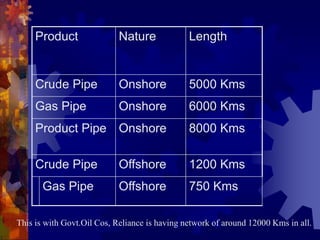
Product Nature Length
Crude Pipe Onshore 5000 Kms
Gas Pipe Onshore 6000 Kms
Product Pipe Onshore 8000 Kms
Crude Pipe Offshore 1200 Kms
Gas Pipe Offshore 750 Kms
This is with Govt.Oil Cos, Reliance is having network of around 12000 Kms in all.
Cross Country Pipe line -
 Need and Necessisity
 Economics
 Convenience
 Peculiar from Plant Piping.
 Products handled.
The need for CCP
 The conventional mode of transportation of
fluids before the advent of CCP was by sea,
rail or road transport. These modes are still in
use. However, wherever bulk transportation
on a continuous basis between two fixed
locations is required, a CCP is the most
economical mode.
 The reason is that the transportation by CCP
is continuous and so it reduces the quantity to
be transported, to a manageable level. The
transport by any other mode will involve bulk
quantity. The CCP transportation reduces the
risks since the quantity is small. The risk
involved in transportation by railcar, truck or
ship is very high.
Also, CCPs are generally provided with safety
devices, which are built into the system at the
design stage, e.g. safety relief valves etc.
Important
A CCP serves a great purpose in the
progress. The design, the material, the
fabrication, routing and installation must be
sound. Even the welding must be of the
highest standard. All these will then give a
safe and reliable pipeline. Remember: a
cross-country pipeline is a national asset.
Cross-country pipeline:
A national asset
Cross Country Pipe Line -
Terrains involved –
Lands, Sea, Rivers, Mountains, Marshy Lands
Private land, Public Land
Road Crossings, Railways Crossings
Transmission lines
Underground Pipes
Other underground Services
Special aspects -
 Specific consideration for Installation.
 Different from Plant piping
 Special Techniques – Design , Laying
Welding,Trenching, Maintenance
 Type of product – Water,Gas, Chemical
Onshore / Offshore, Submarine
 Feasibility and Economics
Transportation Means -
 Roadways - Trucks and Tankers.
 Railways - Goods Trains.
 Waterways –Ship / launcher/ Barge/ Boat
 Airways - Aircrafts.
These modes are having certain limitations
Limitations -
 Infrastructure facility till users Place.
 Condition of Roads and vehicle.
 Traffic hurdles and Congestion.
 Traffic Rules & Regulations, Permission.
 Permit/License/Octroi/ Toll / RTO etc.
 Manpower to run and maintain the system.
 Availability of fuel and its variable cost.
 Natural Calamities and pollution.
 Safety Security & Insurance of product.
 Transportation Time and Frequent delays.
The described modes are adapted as they are
feasible / possible / Economical.
with some preference and Restrictions.
However these are not convenient and not preferred
for Large Quantity & Continuous Supply of
Product transportation for long distance.
Hence the Need of Cross Country Pipeline.
Advantages -
Continuous Uninterrupted Supply is ensured.
No dependability on roadway,railways etc.
Least Manpower requirement.
Overcoming of transportation hassles.
Safe and pure availability of product.
Once installed then always available.
Economic transportation of product.
Desired quantity can be decided.
Shortest route is also sometimes Possible.
Covers two – Cities,states,Country,Continent.
Disadvantages / constraints –
Right of way acquisition.
High fire and Hazardous Potential.
Problem of Leakage and corrosion.
Uneconomical during Downtime Period.
Replacement, Repair, Rerouting is Costly.
Expert and Skilled manpower for Design,
laying Installation and maintenance.
Continuous requirement of CP System.
(Protection from Stray Currents).
 The technology is so much developed
that can overcome these constraints.
 Storage is also possible during Repairs
and Maintain ace of Pipe Line.
 Nowadays Govt. is making a provision
of Pipeline Corridors which reduces
acquisition hassles.
Cross Country Pipe Line -
Journey
Concept to Commissioning
Conceptual Aspects -
Product to be handled and Flow rate.
Size,Thickness and material of Pipe.
Selection of route and its feasibility.
Study and Understanding of soil involved.
Transmission and Traction involvement.
Bypass and branching as per customer.
Pumping and distribution points/ location.
Valve stations and CP stations.
Construction Methodology based on Terrain.
Pre- Project Activity -
 Collection of Data on Product.
 Route survey and Feasibility Study.
 Project Schedule.
 Finalisation of Optimum route.
 Salient features of Design Engineering
Basic Data Requirement -
Name/Qty/Quality of product.
Source of Supply and Location.
Details of Consumers and their Locations.
Storage facility at end users place.
Pumping facility at Suppliers end.
Unloading facility at receiving end.
Safety requirement of product.
Risk and hazards associated with product.
Route Survey and Analysis
 Spot-level survey
 Soil conditions
 Alignment map
 Cadestral survey
 Availability of construction Materials,
labour and facilities
 Soil resistivity survey
Project Schedule
 Preliminary survey/data collection
 Finalizing the route
 Cost estimates /budget sanctions
 Acquisition of ROW and land
 Basic engineering package
Project Schedule
 Detail engineering work.
 Construction work.
Civil / Mech./ Piping/ Electrical,
Marine crossing, River crossing.
Cathodic Protection.
 Testing/flushing/pigging.
 Commissioning and handover.
Project Finalisation -
 Estimation Cost with alternatives.
 Overall Completion time.
 Total length, size , material.
 Cost of operation per year.
 Cost of Maintenance per year.
 Hazard classification.
 Safety and disaster Management Plan.
 Total cost per Km.
 Shut down and stoppages factors.
 Security Measures.
Estimated Cost -
 ROW Acquisition
 Land Acquisition
 Statutory Permissions
 Basic and detailed engineering.
 Material Procurement.
 Construction cost
 Cathodic protection
 Testing and commissioning.
Other features -
 Rock Area
 Trenching area
 Road crossings
 Railway crossings
 No. of bends
 Submarine length if any
 Burried pipe line length
 No of valve stations
 No. of Diode stations etc.etc.
Detailed Engineering -
 Civil Engineering
 Trenching
 Sand Filling
 Back Filling
 Building Construction
 Foundations
 Concrete coating
 Test points and markers
 Infrastructure
Mechanical Engg. -
 Welding Procedures and Qualification.
 Equipment listing and Mobilisation.
 Piping Laying equipment & procedure
 String preparation and hydrotesting,
 Pipe laying/ pipe supports
Design Aspects -
 Cathodic Protection system.
 Diode stations& sacrificial Anode system.
 Insulation Flanges and valve stations.
 UPS installations.
 Specific features of sub marine sections.
 Road crossing and other crossing design.
 Bill of material preparation.
Planning and Organising -
 Appointment of Agencies.
 Organisational Set up and Team.
 Allocation of Duties and Responsibilities.
 Project Monitoring & Reporting System.
 Implementation of Packages.
 Timely payment to Agencies.
 Inventory Control System.
 Safety / Security System.
Management Information System
 Corrective actions and revisions.
 Alterations and Modifications.
 Report and data compilation.
 Preparation of As Built drawings.
 Material reconciliation.
 Data bank for future project.
Construction-
 Trenching
 Pipe-preparation in yard
 Stringing at site and welding
 Lowering
 Hydro testing
Construction-
 Testing
 Pigging
 Commissioning
 Cathodic protection
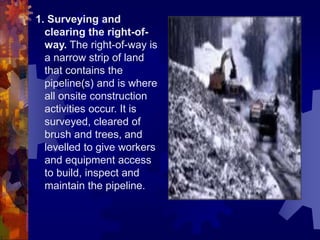
1. Surveying and clearing the right-of-way
2. Right-of-way preparation
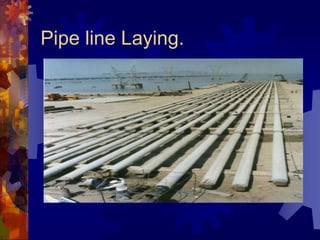
3. Hauling and stringing the pipe
4. Bending the pipe
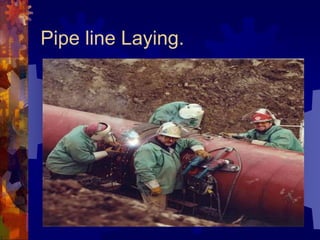
5. Welding
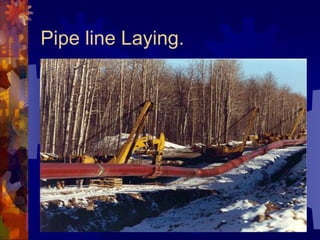
6. Digging the trench
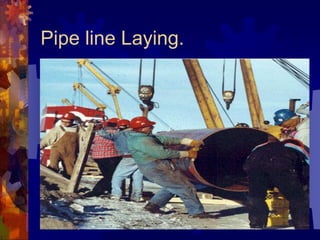
7. Lowering the pipe
8. Installing valves and special fittings
9. Crossings
10. Backfilling the trench
11. Testing
12. Cleaning up
1. Surveying and
clearing the right-of-
way. The right-of-way is
a narrow strip of land
that contains the
pipeline(s) and is where
all onsite construction
activities occur. It is
surveyed, cleared of
brush and trees, and
levelled to give workers
and equipment access
to build, inspect and
maintain the pipeline.
2. Right-of-way preparation. The right-of-
way will be graded, and ice and snow or
gravel pads will be built to allow for the
movement of ditchers, additional
equipment, materials and other pipeline
construction activities
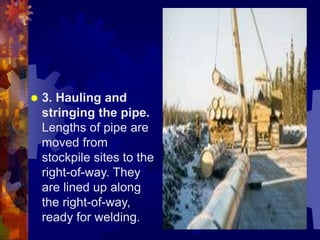
 3. Hauling and
stringing the pipe.
Lengths of pipe are
moved from
stockpile sites to the
right-of-way. They
are lined up along
the right-of-way,
ready for welding.
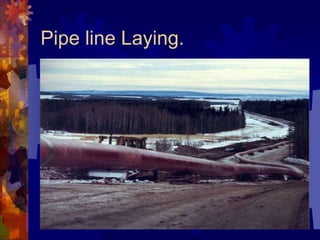
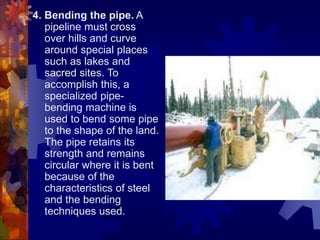
4. Bending the pipe. A
pipeline must cross
over hills and curve
around special places
such as lakes and
sacred sites. To
accomplish this, a
specialized pipe-
bending machine is
used to bend some pipe
to the shape of the land.
The pipe retains its
strength and remains
circular where it is bent
because of the
characteristics of steel
and the bending
techniques used.
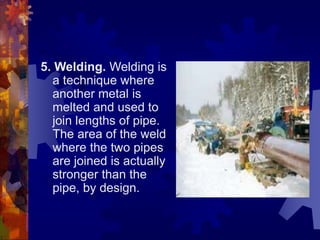
5. Welding. Welding is
a technique where
another metal is
melted and used to
join lengths of pipe.
The area of the weld
where the two pipes
are joined is actually
stronger than the
pipe, by design.
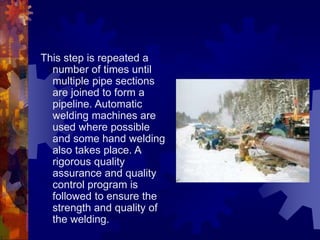
This step is repeated a
number of times until
multiple pipe sections
are joined to form a
pipeline. Automatic
welding machines are
used where possible
and some hand welding
also takes place. A
rigorous quality
assurance and quality
control program is
followed to ensure the
strength and quality of
the welding.
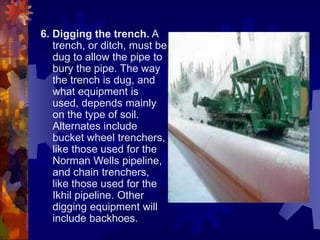
6. Digging the trench. A
trench, or ditch, must be
dug to allow the pipe to
bury the pipe. The way
the trench is dug, and
what equipment is
used, depends mainly
on the type of soil.
Alternates include
bucket wheel trenchers,
like those used for the
Norman Wells pipeline,
and chain trenchers,
like those used for the
Ikhil pipeline. Other
digging equipment will
include backhoes.
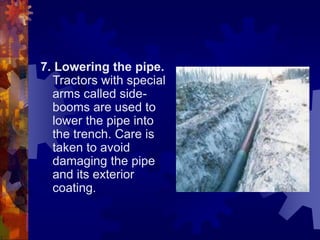
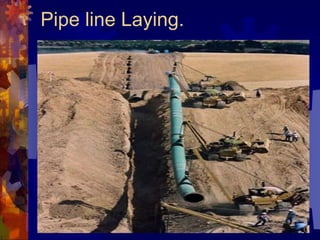
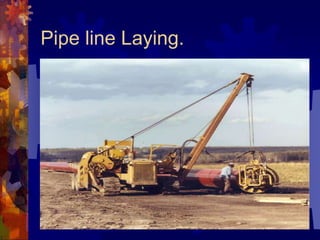
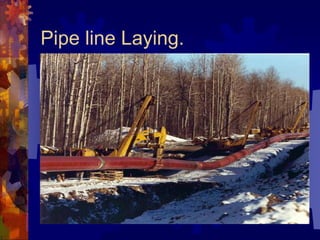
7. Lowering the pipe.
Tractors with special
arms called side-
booms are used to
lower the pipe into
the trench. Care is
taken to avoid
damaging the pipe
and its exterior
coating.
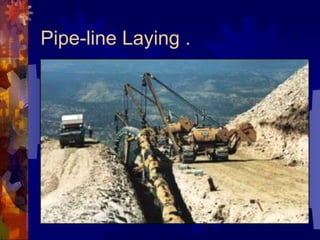
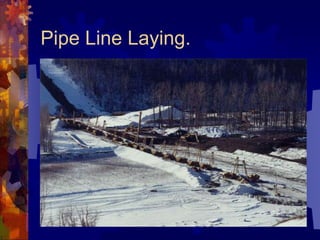
Pipe-line Laying .
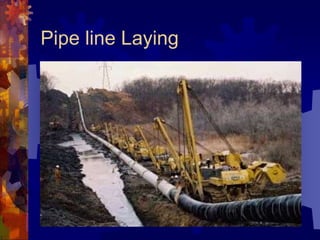
Pipe line Laying
Pipe line Laying.
Pipe line Laying.
Pipe line Laying.
Pipe line Laying.
Pipe line Laying.
Pipe line Laying.
Pipe line Laying.
Pipe line Laying.
Pipe Line Laying.
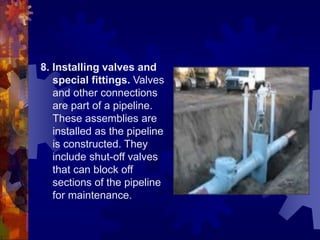
8. Installing valves and
special fittings. Valves
and other connections
are part of a pipeline.
These assemblies are
installed as the pipeline
is constructed. They
include shut-off valves
that can block off
sections of the pipeline
for maintenance.
9. Crossings. A pipeline will need to cross
rivers and streams, roads and other pipelines.
Plans are developed in advance. Water
crossings can be completed either by "open
cut" techniques or by horizontal directional
drilling. The selection of a crossing method
depends upon site specific criteria such as
fish habitat, water flow, and soil conditions
such as rocks and boulders. Generally,
horizontal directional drilling is selected for
major river crossings where local soil
conditions permit the technique.
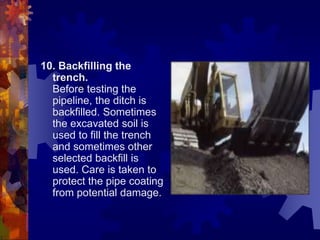
10. Backfilling the
trench.
Before testing the
pipeline, the ditch is
backfilled. Sometimes
the excavated soil is
used to fill the trench
and sometimes other
selected backfill is
used. Care is taken to
protect the pipe coating
from potential damage.
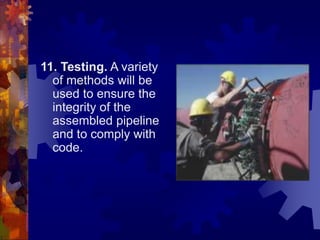
11. Testing. A variety
of methods will be
used to ensure the
integrity of the
assembled pipeline
and to comply with
code.
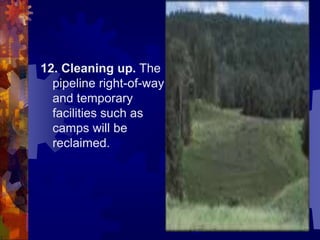
12. Cleaning up. The
pipeline right-of-way
and temporary
facilities such as
camps will be
reclaimed.
Cathodic protection (c.p)
Cathodic Protection
 Basic principle and phenomena
 Prevention of effects of induced EMF
 Diode station in the vicinity of rail-tracks
with electric traction
 Sacrificial Anode
 Normal subsoil corrosion
On-line installations
 Test Points
 Insulating Flanges
Additional Features of Piping.
Additional factors specific to
cross-country pipelines
 Pipeline supported on brackets attached
to a road or railway bridge
 Long expansions loops
 Erection stresses
 Corrosion allowance
Design codes followed for
cross-country piping
Specifications for coating and
wrapping over underground
pipes
 General Scope of Operation
 Limitations
 Inspection and Testing
 Handling and Placing
Pipeline - MIT.ppt for pipeline engineering

Pipeline - MIT.ppt for pipeline engineering

  • 1.
  • 2.
    Objective - To Understand. Various Aspects.  Main features of Engineering.  Construction Methodology.  Involvement in Country.
  • 3.
    What is aCCP?  A CCP is primarily a transmission line for transporting bulk quantity of fluids over large distances. A CCP may cover distances of a few thousand kilometres. For example, in India, the CCP for LPG transportation from Jamnagar in Gujarat to Loni in Punjab covers a distance of about 1,300 km, whereas the HBJ gas pipeline covers a distance of almost 2,300 km.
  • 4.
    Product Nature Length CrudePipe Onshore 5000 Kms Gas Pipe Onshore 6000 Kms Product Pipe Onshore 8000 Kms Crude Pipe Offshore 1200 Kms Gas Pipe Offshore 750 Kms This is with Govt.Oil Cos, Reliance is having network of around 12000 Kms in all.
  • 5.
    Cross Country Pipeline -  Need and Necessisity  Economics  Convenience  Peculiar from Plant Piping.  Products handled.
  • 6.
    The need forCCP  The conventional mode of transportation of fluids before the advent of CCP was by sea, rail or road transport. These modes are still in use. However, wherever bulk transportation on a continuous basis between two fixed locations is required, a CCP is the most economical mode.
  • 7.
     The reasonis that the transportation by CCP is continuous and so it reduces the quantity to be transported, to a manageable level. The transport by any other mode will involve bulk quantity. The CCP transportation reduces the risks since the quantity is small. The risk involved in transportation by railcar, truck or ship is very high. Also, CCPs are generally provided with safety devices, which are built into the system at the design stage, e.g. safety relief valves etc.
  • 8.
    Important A CCP servesa great purpose in the progress. The design, the material, the fabrication, routing and installation must be sound. Even the welding must be of the highest standard. All these will then give a safe and reliable pipeline. Remember: a cross-country pipeline is a national asset.
  • 9.
  • 10.
    Cross Country PipeLine - Terrains involved – Lands, Sea, Rivers, Mountains, Marshy Lands Private land, Public Land Road Crossings, Railways Crossings Transmission lines Underground Pipes Other underground Services
  • 11.
    Special aspects - Specific consideration for Installation.  Different from Plant piping  Special Techniques – Design , Laying Welding,Trenching, Maintenance  Type of product – Water,Gas, Chemical Onshore / Offshore, Submarine  Feasibility and Economics
  • 12.
    Transportation Means - Roadways - Trucks and Tankers.  Railways - Goods Trains.  Waterways –Ship / launcher/ Barge/ Boat  Airways - Aircrafts. These modes are having certain limitations
  • 13.
    Limitations -  Infrastructurefacility till users Place.  Condition of Roads and vehicle.  Traffic hurdles and Congestion.  Traffic Rules & Regulations, Permission.  Permit/License/Octroi/ Toll / RTO etc.  Manpower to run and maintain the system.  Availability of fuel and its variable cost.  Natural Calamities and pollution.  Safety Security & Insurance of product.  Transportation Time and Frequent delays.
  • 14.
    The described modesare adapted as they are feasible / possible / Economical. with some preference and Restrictions. However these are not convenient and not preferred for Large Quantity & Continuous Supply of Product transportation for long distance. Hence the Need of Cross Country Pipeline.
  • 15.
    Advantages - Continuous UninterruptedSupply is ensured. No dependability on roadway,railways etc. Least Manpower requirement. Overcoming of transportation hassles. Safe and pure availability of product. Once installed then always available. Economic transportation of product. Desired quantity can be decided. Shortest route is also sometimes Possible. Covers two – Cities,states,Country,Continent.
  • 16.
    Disadvantages / constraints– Right of way acquisition. High fire and Hazardous Potential. Problem of Leakage and corrosion. Uneconomical during Downtime Period. Replacement, Repair, Rerouting is Costly. Expert and Skilled manpower for Design, laying Installation and maintenance. Continuous requirement of CP System. (Protection from Stray Currents).
  • 17.
     The technologyis so much developed that can overcome these constraints.  Storage is also possible during Repairs and Maintain ace of Pipe Line.  Nowadays Govt. is making a provision of Pipeline Corridors which reduces acquisition hassles.
  • 18.
    Cross Country PipeLine - Journey Concept to Commissioning
  • 19.
    Conceptual Aspects - Productto be handled and Flow rate. Size,Thickness and material of Pipe. Selection of route and its feasibility. Study and Understanding of soil involved. Transmission and Traction involvement. Bypass and branching as per customer. Pumping and distribution points/ location. Valve stations and CP stations. Construction Methodology based on Terrain.
  • 20.
    Pre- Project Activity-  Collection of Data on Product.  Route survey and Feasibility Study.  Project Schedule.  Finalisation of Optimum route.  Salient features of Design Engineering
  • 21.
    Basic Data Requirement- Name/Qty/Quality of product. Source of Supply and Location. Details of Consumers and their Locations. Storage facility at end users place. Pumping facility at Suppliers end. Unloading facility at receiving end. Safety requirement of product. Risk and hazards associated with product.
  • 22.
    Route Survey andAnalysis  Spot-level survey  Soil conditions  Alignment map  Cadestral survey  Availability of construction Materials, labour and facilities  Soil resistivity survey
  • 23.
    Project Schedule  Preliminarysurvey/data collection  Finalizing the route  Cost estimates /budget sanctions  Acquisition of ROW and land  Basic engineering package
  • 24.
    Project Schedule  Detailengineering work.  Construction work. Civil / Mech./ Piping/ Electrical, Marine crossing, River crossing. Cathodic Protection.  Testing/flushing/pigging.  Commissioning and handover.
  • 25.
    Project Finalisation - Estimation Cost with alternatives.  Overall Completion time.  Total length, size , material.  Cost of operation per year.  Cost of Maintenance per year.  Hazard classification.  Safety and disaster Management Plan.  Total cost per Km.  Shut down and stoppages factors.  Security Measures.
  • 26.
    Estimated Cost - ROW Acquisition  Land Acquisition  Statutory Permissions  Basic and detailed engineering.  Material Procurement.  Construction cost  Cathodic protection  Testing and commissioning.
  • 27.
    Other features - Rock Area  Trenching area  Road crossings  Railway crossings  No. of bends  Submarine length if any  Burried pipe line length  No of valve stations  No. of Diode stations etc.etc.
  • 28.
    Detailed Engineering - Civil Engineering  Trenching  Sand Filling  Back Filling  Building Construction  Foundations  Concrete coating  Test points and markers  Infrastructure
  • 29.
    Mechanical Engg. - Welding Procedures and Qualification.  Equipment listing and Mobilisation.  Piping Laying equipment & procedure  String preparation and hydrotesting,  Pipe laying/ pipe supports
  • 30.
    Design Aspects - Cathodic Protection system.  Diode stations& sacrificial Anode system.  Insulation Flanges and valve stations.  UPS installations.  Specific features of sub marine sections.  Road crossing and other crossing design.  Bill of material preparation.
  • 31.
    Planning and Organising-  Appointment of Agencies.  Organisational Set up and Team.  Allocation of Duties and Responsibilities.  Project Monitoring & Reporting System.  Implementation of Packages.  Timely payment to Agencies.  Inventory Control System.  Safety / Security System.
  • 32.
    Management Information System Corrective actions and revisions.  Alterations and Modifications.  Report and data compilation.  Preparation of As Built drawings.  Material reconciliation.  Data bank for future project.
  • 33.
    Construction-  Trenching  Pipe-preparationin yard  Stringing at site and welding  Lowering  Hydro testing
  • 34.
    Construction-  Testing  Pigging Commissioning  Cathodic protection
  • 35.
    1. Surveying andclearing the right-of-way 2. Right-of-way preparation 3. Hauling and stringing the pipe 4. Bending the pipe 5. Welding 6. Digging the trench 7. Lowering the pipe 8. Installing valves and special fittings 9. Crossings 10. Backfilling the trench 11. Testing 12. Cleaning up
  • 36.
    1. Surveying and clearingthe right-of- way. The right-of-way is a narrow strip of land that contains the pipeline(s) and is where all onsite construction activities occur. It is surveyed, cleared of brush and trees, and levelled to give workers and equipment access to build, inspect and maintain the pipeline.
  • 37.
    2. Right-of-way preparation.The right-of- way will be graded, and ice and snow or gravel pads will be built to allow for the movement of ditchers, additional equipment, materials and other pipeline construction activities
  • 38.
     3. Haulingand stringing the pipe. Lengths of pipe are moved from stockpile sites to the right-of-way. They are lined up along the right-of-way, ready for welding.
  • 39.
    4. Bending thepipe. A pipeline must cross over hills and curve around special places such as lakes and sacred sites. To accomplish this, a specialized pipe- bending machine is used to bend some pipe to the shape of the land. The pipe retains its strength and remains circular where it is bent because of the characteristics of steel and the bending techniques used.
  • 40.
    5. Welding. Weldingis a technique where another metal is melted and used to join lengths of pipe. The area of the weld where the two pipes are joined is actually stronger than the pipe, by design.
  • 41.
    This step isrepeated a number of times until multiple pipe sections are joined to form a pipeline. Automatic welding machines are used where possible and some hand welding also takes place. A rigorous quality assurance and quality control program is followed to ensure the strength and quality of the welding.
  • 42.
    6. Digging thetrench. A trench, or ditch, must be dug to allow the pipe to bury the pipe. The way the trench is dug, and what equipment is used, depends mainly on the type of soil. Alternates include bucket wheel trenchers, like those used for the Norman Wells pipeline, and chain trenchers, like those used for the Ikhil pipeline. Other digging equipment will include backhoes.
  • 43.
    7. Lowering thepipe. Tractors with special arms called side- booms are used to lower the pipe into the trench. Care is taken to avoid damaging the pipe and its exterior coating.
  • 44.
  • 45.
  • 46.
  • 47.
  • 48.
  • 49.
  • 50.
  • 51.
  • 52.
  • 53.
  • 54.
  • 55.
    8. Installing valvesand special fittings. Valves and other connections are part of a pipeline. These assemblies are installed as the pipeline is constructed. They include shut-off valves that can block off sections of the pipeline for maintenance.
  • 56.
    9. Crossings. Apipeline will need to cross rivers and streams, roads and other pipelines. Plans are developed in advance. Water crossings can be completed either by "open cut" techniques or by horizontal directional drilling. The selection of a crossing method depends upon site specific criteria such as fish habitat, water flow, and soil conditions such as rocks and boulders. Generally, horizontal directional drilling is selected for major river crossings where local soil conditions permit the technique.
  • 57.
    10. Backfilling the trench. Beforetesting the pipeline, the ditch is backfilled. Sometimes the excavated soil is used to fill the trench and sometimes other selected backfill is used. Care is taken to protect the pipe coating from potential damage.
  • 58.
    11. Testing. Avariety of methods will be used to ensure the integrity of the assembled pipeline and to comply with code.
  • 59.
    12. Cleaning up.The pipeline right-of-way and temporary facilities such as camps will be reclaimed.
  • 60.
  • 61.
    Cathodic Protection  Basicprinciple and phenomena  Prevention of effects of induced EMF  Diode station in the vicinity of rail-tracks with electric traction  Sacrificial Anode  Normal subsoil corrosion
  • 62.
    On-line installations  TestPoints  Insulating Flanges
  • 63.
  • 64.
    Additional factors specificto cross-country pipelines  Pipeline supported on brackets attached to a road or railway bridge  Long expansions loops  Erection stresses  Corrosion allowance
  • 65.
    Design codes followedfor cross-country piping
  • 66.
    Specifications for coatingand wrapping over underground pipes  General Scope of Operation  Limitations  Inspection and Testing  Handling and Placing