PILE FOUNDATION
Basics for clarity
• Types of Foundation
• Functions and Importance of Different Pile Foundations.
• Some Instruments used for Driven and Bored Piles
• Test Carried Out on Piles
• Some IS( Indian standard) Codes Used.
By
GAURAV .U.PALIWAL
B.E(CIVIL)
grvplwl06@gmail.com
• A] SHALLOW FOUNDATION (depth ≤ width)
 Spread footing ( or simply footing).
 Strap footing.
 Combined footing.
 Mat or Raft footing.
• B] DEEP FOUNDATIONS (depth ≥ width)
 Pier foundation.
 Pile foundation.
 Well foundation.
PILE FOUNDATIONS are further classified
1]Based on the functions they perform.
2]Based on the Materials and Composition of
materials used for their construction.
 End bearing piles-
Transfer load through water
or soft soil to a suitable
bearing strata.
Friction piles- Transfer load to a
depth of friction load carrying
material by means of skin friction
along the length of pile.
Compaction piles- Compact
loose granular soil, thus increasing
there bearing capacity.
1] Classification based on function
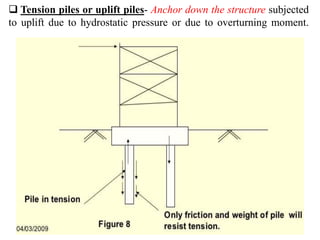
 Tension piles or uplift piles- Anchor down the structure subjected
to uplift due to hydrostatic pressure or due to overturning moment.
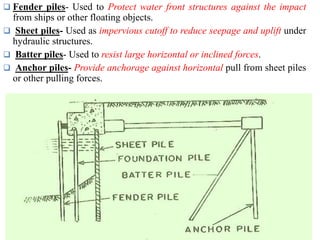
 Fender piles- Used to Protect water front structures against the impact
from ships or other floating objects.
 Sheet piles- Used as impervious cutoff to reduce seepage and uplift under
hydraulic structures.
 Batter piles- Used to resist large horizontal or inclined forces.
 Anchor piles- Provide anchorage against horizontal pull from sheet piles
or other pulling forces.
2]Classification based on materials and composition
 Concrete piles
(a) Precast
(b) Cast-in-situ (1) Driven piles : Cased or Uncased.
(2) Bored piles: Pressure piles and under
reamed piles.
 Timber piles
 Steel piles
(a) H-piles (b) Pipe piles (c) Sheet piles
 Composite piles
(a) Concrete and Timber (b) Concrete and steel
Precast piles
 Reinforced to withstand handling stresses.
 Require space for casting and storage.
 More time to set and cure before installation.
 Heavy equipments for handling and driving.
 Incur large cost in cutting of extra length or adding
more length.
Cast in situ
 They are installed by pre excavation therefore
eliminate most of the drawback occurred in precast
piles.
 Bored piles are those which are formed by forming
a bore hole in ground and then concreting it, either
with the help of casing tube or without casing tube.
 Bored piles have advantage over driven piles, in
those locations and situations where noise caused by
driven piles are to be avoided OR the strata of
adequate bearing capacity is so deep that it is
difficult to reach by driven piles.
 Cased Driven piles are suitable in practically all
ground conditions.
 Uncased Driven piles are cheaper than cased piles,
great skill is required, these piles are used only when
it is certain that
-Soil and water will not fall into the hole.
-And where the adjacent pile will not damage the
green concrete.
 Under reamed pile can be used in expansive soil,
it have a bulb(2-3 times the diameter of pile) at some
point in its length to anchor the foundation subjected
to alternate expansion and contraction.
 Concrete filled steel piles and steel H-piles are used
as long piles with high bearing capacity.
-But are rarely used unless they reach a strata of
very high supporting capacity.
-Their cost is very high.
 Timber piles have small bearing capacity, they can
damage due to hard driving and therefore should not
be driven through hard stratum and boulder.
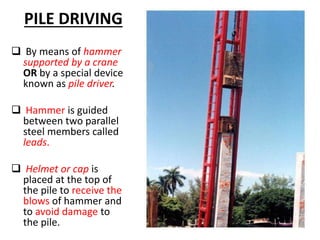
PILE DRIVING
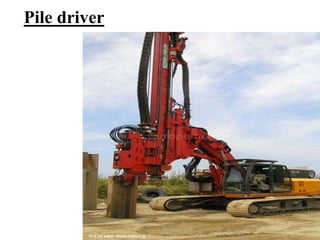
 By means of hammer
supported by a crane
OR by a special device
known as pile driver.
 Hammer is guided
between two parallel
steel members called
leads.
 Helmet or cap is
placed at the top of
the pile to receive the
blows of hammer and
to avoid damage to
the pile.
Pile driver
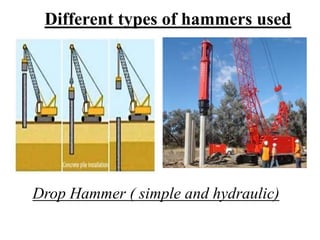
Different types of hammers used
Drop Hammer ( simple and hydraulic)
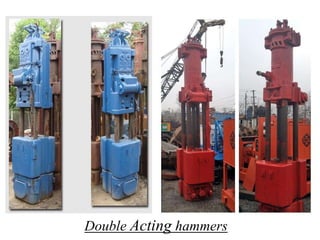
Double Acting hammers
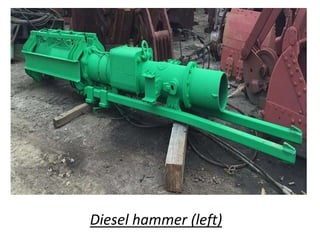
Diesel hammer (left)
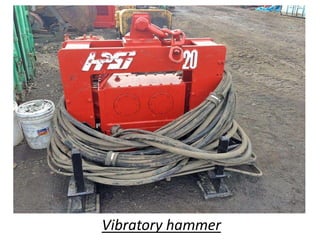
Vibratory hammer
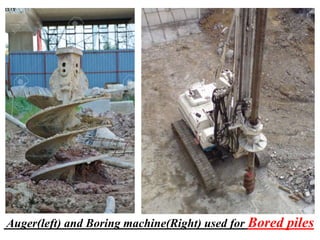
Auger(left) and Boring machine(Right) used for Bored piles
LOAD TESTS ON PILE FOUNDATION
STRESS TEST
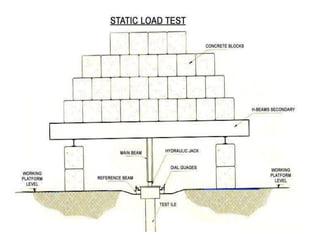
 Maintained load test (static vertical load test).
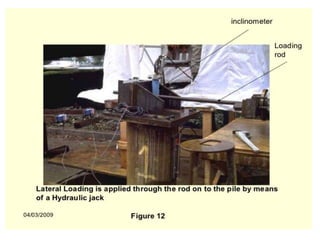
 Lateral load test.
 Constant rate of penetration test.
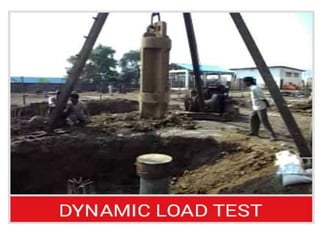
 Dynamic load test.
 Cyclic load test.
STRAIN TEST
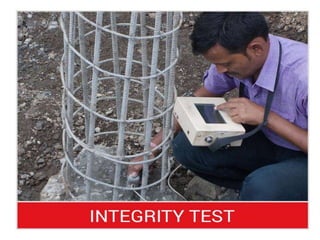
 Low strain integrity testing.
 High strain integrity testing.
• NOTE- Bored Piles and Driven Piles are the
most important type of piles that you will
come across.
- Understand properly the difference between
them.
- Watch out some videos of pile construction
for better clarity.
• IS 2911 : Part 1 : Sec 1 : 1979 Driven cast in-situ concrete piles
• IS 2911 : Part 1 : Sec 2 : 1979 Bored cast-in-situ piles
• IS 2911 : Part 1 : Sec 3 : 1979 Driven precast concrete piles
• IS 2911 : Part 1 : Sec 4 : 1984 Bored precast concrete piles
• IS 2911 : Part 2 : 1980 Timber piles
• IS 2911 : Part 3 : 1980 Under reamed piles
• IS 2911 : Part 4 : 1985 Load test on piles
• IS 5121 : 1969 Safety code for piling and other deep foundations
• IS 6426 : 1972 Specification for pile driving hammer
• IS 6427 : 1972 Glossary of Terms Relating to Pile Driving
Equipment
• IS 6428 : 1972 Specification for pile frame
• IS 9716 : 1981 Guide for lateral dynamic load test on piles
• IS 14362 : 1996 Pile boring equipment – General requirements
• IS 14593 : 1998 Bored cast-in-situ piles founded on rocks –
Guidelines
• IS 14893 : 2001 Non-Destructive Integrity Testing of Piles (NDT)
–Guidelines
THANK YOU

PILE FOUNDATION (basics)

  • 1.
    PILE FOUNDATION Basics forclarity • Types of Foundation • Functions and Importance of Different Pile Foundations. • Some Instruments used for Driven and Bored Piles • Test Carried Out on Piles • Some IS( Indian standard) Codes Used. By GAURAV .U.PALIWAL B.E(CIVIL) grvplwl06@gmail.com
  • 2.
    • A] SHALLOWFOUNDATION (depth ≤ width)  Spread footing ( or simply footing).  Strap footing.  Combined footing.  Mat or Raft footing. • B] DEEP FOUNDATIONS (depth ≥ width)  Pier foundation.  Pile foundation.  Well foundation.
  • 3.
    PILE FOUNDATIONS arefurther classified 1]Based on the functions they perform. 2]Based on the Materials and Composition of materials used for their construction.
  • 4.
     End bearingpiles- Transfer load through water or soft soil to a suitable bearing strata. Friction piles- Transfer load to a depth of friction load carrying material by means of skin friction along the length of pile. Compaction piles- Compact loose granular soil, thus increasing there bearing capacity. 1] Classification based on function
  • 5.
     Tension pilesor uplift piles- Anchor down the structure subjected to uplift due to hydrostatic pressure or due to overturning moment.
  • 6.
     Fender piles-Used to Protect water front structures against the impact from ships or other floating objects.  Sheet piles- Used as impervious cutoff to reduce seepage and uplift under hydraulic structures.  Batter piles- Used to resist large horizontal or inclined forces.  Anchor piles- Provide anchorage against horizontal pull from sheet piles or other pulling forces.
  • 7.
    2]Classification based onmaterials and composition  Concrete piles (a) Precast (b) Cast-in-situ (1) Driven piles : Cased or Uncased. (2) Bored piles: Pressure piles and under reamed piles.  Timber piles  Steel piles (a) H-piles (b) Pipe piles (c) Sheet piles  Composite piles (a) Concrete and Timber (b) Concrete and steel
  • 8.
    Precast piles  Reinforcedto withstand handling stresses.  Require space for casting and storage.  More time to set and cure before installation.  Heavy equipments for handling and driving.  Incur large cost in cutting of extra length or adding more length. Cast in situ  They are installed by pre excavation therefore eliminate most of the drawback occurred in precast piles.  Bored piles are those which are formed by forming a bore hole in ground and then concreting it, either with the help of casing tube or without casing tube.
  • 9.
     Bored pileshave advantage over driven piles, in those locations and situations where noise caused by driven piles are to be avoided OR the strata of adequate bearing capacity is so deep that it is difficult to reach by driven piles.  Cased Driven piles are suitable in practically all ground conditions.  Uncased Driven piles are cheaper than cased piles, great skill is required, these piles are used only when it is certain that -Soil and water will not fall into the hole. -And where the adjacent pile will not damage the green concrete.
  • 10.
     Under reamedpile can be used in expansive soil, it have a bulb(2-3 times the diameter of pile) at some point in its length to anchor the foundation subjected to alternate expansion and contraction.  Concrete filled steel piles and steel H-piles are used as long piles with high bearing capacity. -But are rarely used unless they reach a strata of very high supporting capacity. -Their cost is very high.  Timber piles have small bearing capacity, they can damage due to hard driving and therefore should not be driven through hard stratum and boulder.
  • 11.
    PILE DRIVING  Bymeans of hammer supported by a crane OR by a special device known as pile driver.  Hammer is guided between two parallel steel members called leads.  Helmet or cap is placed at the top of the pile to receive the blows of hammer and to avoid damage to the pile.
  • 12.
  • 13.
    Different types ofhammers used Drop Hammer ( simple and hydraulic)
  • 14.
  • 15.
  • 16.
  • 17.
    Auger(left) and Boringmachine(Right) used for Bored piles
  • 18.
    LOAD TESTS ONPILE FOUNDATION STRESS TEST  Maintained load test (static vertical load test).  Lateral load test.  Constant rate of penetration test.  Dynamic load test.  Cyclic load test. STRAIN TEST  Low strain integrity testing.  High strain integrity testing.
  • 23.
    • NOTE- BoredPiles and Driven Piles are the most important type of piles that you will come across. - Understand properly the difference between them. - Watch out some videos of pile construction for better clarity.
  • 24.
    • IS 2911: Part 1 : Sec 1 : 1979 Driven cast in-situ concrete piles • IS 2911 : Part 1 : Sec 2 : 1979 Bored cast-in-situ piles • IS 2911 : Part 1 : Sec 3 : 1979 Driven precast concrete piles • IS 2911 : Part 1 : Sec 4 : 1984 Bored precast concrete piles • IS 2911 : Part 2 : 1980 Timber piles • IS 2911 : Part 3 : 1980 Under reamed piles • IS 2911 : Part 4 : 1985 Load test on piles • IS 5121 : 1969 Safety code for piling and other deep foundations • IS 6426 : 1972 Specification for pile driving hammer • IS 6427 : 1972 Glossary of Terms Relating to Pile Driving Equipment • IS 6428 : 1972 Specification for pile frame • IS 9716 : 1981 Guide for lateral dynamic load test on piles • IS 14362 : 1996 Pile boring equipment – General requirements • IS 14593 : 1998 Bored cast-in-situ piles founded on rocks – Guidelines • IS 14893 : 2001 Non-Destructive Integrity Testing of Piles (NDT) –Guidelines
  • 25.