Picture Perception
     Abirami.V.
   AP/English, KCT
Perception is the process of
     attaining awareness or
      understanding of the
 environment by organizing and
       interpreting sensory
   information. All perception
 involves signals in the nervous
  system, which in turn result
from physical stimulation of the
          sense organs.
Perception is not the passive
receipt of these signals, but can
 be shaped by learning, memory
  and expectation. Perception
   involves these "top-down"
 effects as well as the " bottom-
    up" process of processing
         sensory input .
The "bottom-up" processing is
 basically low-level information
  that's used to build up higher-
level information (i.e - shapes for
        object recognition).
 The "top-down" processing refers
     to a person's concept and
  expectations (knowledge) that
       influence perception.
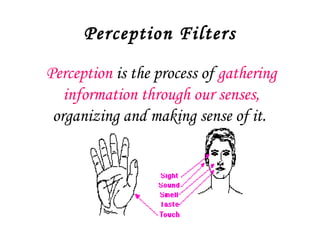
Perception Filters

Perception is the process of gathering
   information through our senses,
 organizing and making sense of it.
What Affects Perceptions?


Previous
experience
and
learning
What Affects Perceptions?

Attitudes
  and
Interests
What Affects Perceptions?

 Needs
  &
Feelings
What Affects Perceptions?


Current
Situation
People see things differently

 All people do
     not "see"
the same
thing when
looking at a
visual image.
Perception differs from individual
     to individual due to ...

•   Personal Differences
•   Socio-Economic Differences
•   Cultural Differences
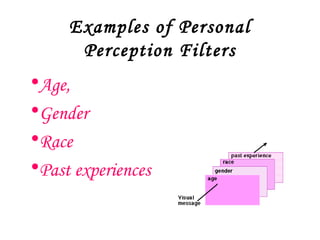
Examples of Personal
      Perception Filters
•Age,
•Gender
•Race
•Past experiences
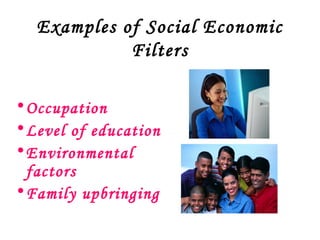
Examples of Social Economic
             Filters

• Occupation
• Level of education
• Environmental
  factors
• Family upbringing
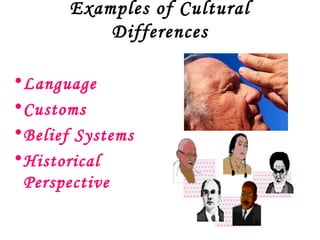
Examples of Cultural
           Differences

• Language
• Customs
• Belief Systems
• Historical
  Perspective
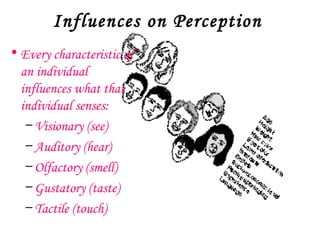
Influences on Perception
• Every characteristic of
  an individual
  influences what that
  individual senses:
   – Visionary (see)
   – Auditory (hear)
   – Olfactory (smell)
   – Gustatory (taste)
   – Tactile (touch)
How to Perceive a Picture
Usually we read an image as an entity in a
 given context, but when attempting to
 uncover its many layers of meaning
 and/or purpose it is also expedient to
 systematise and organise one’s reading of
 its formal elements in more phases
1. Presentation of formal data
            Presenting facts
  • Who is the artist/sender?
  • Does the picture have a title?
  • When was the picture made?
  • In what context was the picture made?
  • For what purpose was the picture made?
  • Which technique (painting, photograph,
    graphics, collage, or.. ?)
  • What dimensions?
2. Primary description
     Representational meaning
• Place, milieu,
• Persons, relations, gestures,
  mimic, action
• And the most significant details.
3. Formal analysis: The effect of
         formal choices
All visual elements involved in picture analysis
     will be discussed and illustrated further
• Persons, relations, gestures,
  mimic, action
• And the most significant details.
4. Interpretation: 
  (Denotation/Connotation)
• Attaching possible meanings to
  the visual elements and their
  interaction in the picture
• Attaching meaning to how
  visual elements interact with the
  viewer in a given context
• It is important to substantiate one’s
  interpretation of a given picture by drawing
  upon concrete observations from the description
  and analysis, from one's knowledge of the
  sender, the context and purpose of the picture.
• Contextual data, such as philosophical,
  religious or aesthetic currents or time-specific
  use of symbols, references to politics and
  cultural codes is, of course, an integral part of
  any interpretation.
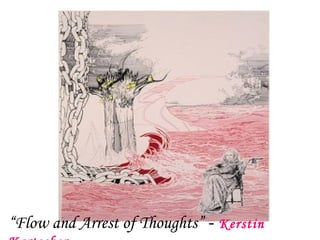
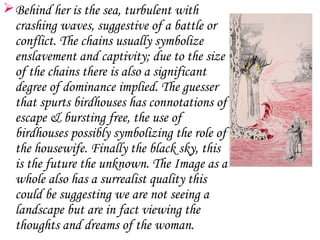
“Flow and Arrest of Thoughts” - Kerstin
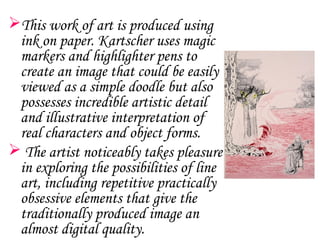
This work of art is produced using
 ink on paper. Kartscher uses magic
 markers and highlighter pens to
 create an image that could be easily
 viewed as a simple doodle but also
 possesses incredible artistic detail
 and illustrative interpretation of
 real characters and object forms.
 The artist noticeably takes pleasure
 in exploring the possibilities of line
 art, including repetitive practically
 obsessive elements that give the
 traditionally produced image an
 almost digital quality.
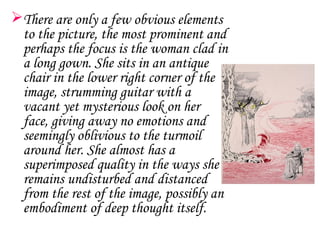
There are only a few obvious elements
 to the picture, the most prominent and
 perhaps the focus is the woman clad in
 a long gown. She sits in an antique
 chair in the lower right corner of the
 image, strumming guitar with a
 vacant yet mysterious look on her
 face, giving away no emotions and
 seemingly oblivious to the turmoil
 around her. She almost has a
 superimposed quality in the ways she
 remains undisturbed and distanced
 from the rest of the image, possibly an
 embodiment of deep thought itself.
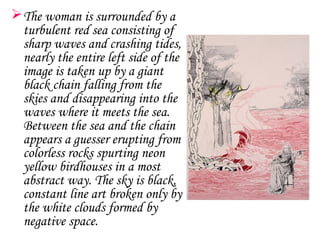
 The woman is surrounded by a
  turbulent red sea consisting of
  sharp waves and crashing tides,
  nearly the entire left side of the
  image is taken up by a giant
  black chain falling from the
  skies and disappearing into the
  waves where it meets the sea.
  Between the sea and the chain
  appears a guesser erupting from
  colorless rocks spurting neon
  yellow birdhouses in a most
  abstract way. The sky is black,
  constant line art broken only by
  the white clouds formed by
  negative space.
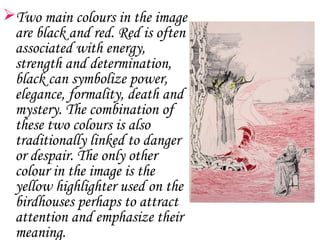
Two main colours in the image
 are black and red. Red is often
 associated with energy,
 strength and determination,
 black can symbolize power,
 elegance, formality, death and
 mystery. The combination of
 these two colours is also
 traditionally linked to danger
 or despair. The only other
 colour in the image is the
 yellow highlighter used on the
 birdhouses perhaps to attract
 attention and emphasize their
 meaning.
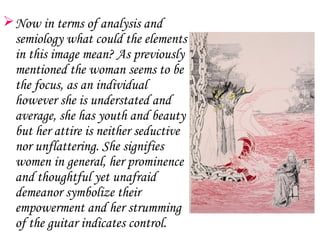
 Now in terms of analysis and
  semiology what could the elements
  in this image mean? As previously
  mentioned the woman seems to be
  the focus, as an individual
  however she is understated and
  average, she has youth and beauty
  but her attire is neither seductive
  nor unflattering. She signifies
  women in general, her prominence
  and thoughtful yet unafraid
  demeanor symbolize their
  empowerment and her strumming
  of the guitar indicates control.
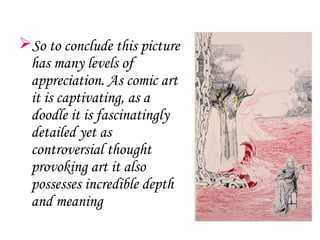
 Behind her is the sea, turbulent with
  crashing waves, suggestive of a battle or
  conflict. The chains usually symbolize
  enslavement and captivity; due to the size
  of the chains there is also a significant
  degree of dominance implied. The guesser
  that spurts birdhouses has connotations of
  escape & bursting free, the use of
  birdhouses possibly symbolizing the role of
  the housewife. Finally the black sky, this
  is the future the unknown. The Image as a
  whole also has a surrealist quality this
  could be suggesting we are not seeing a
  landscape but are in fact viewing the
  thoughts and dreams of the woman.
So to conclude this picture
 has many levels of
 appreciation. As comic art
 it is captivating, as a
 doodle it is fascinatingly
 detailed yet as
 controversial thought
 provoking art it also
 possesses incredible depth
 and meaning
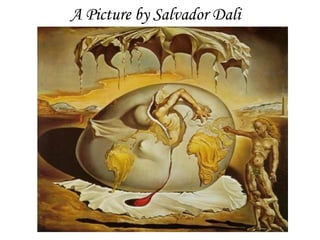
A Picture by Salvador Dali
This picture shows how the earth is the place where
 all life is born and how everything that is alive is
 because of the earth and how the picture is a tribute
 to this.
This picture shows how the United States is
 expanding around the world, due to the arm that is
 coming from the North American continent, and
 how their growth is hurting the world which is
 represented through the blood coming from the
 Earth, and how everyone else in the world is
 blaming the United States for the death that is
 occurring due to their expansion.
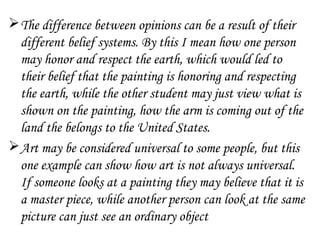
 The difference between opinions can be a result of their
  different belief systems. By this I mean how one person
  may honor and respect the earth, which would led to
  their belief that the painting is honoring and respecting
  the earth, while the other student may just view what is
  shown on the painting, how the arm is coming out of the
  land the belongs to the United States.
 Art may be considered universal to some people, but this
  one example can show how art is not always universal.
  If someone looks at a painting they may believe that it is
  a master piece, while another person can look at the same
  picture can just see an ordinary object
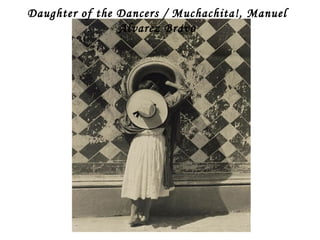
Daughter of the Dancers / Muchachita!, Manuel
                Alvarez Bravo
In this image, a young girl is seen from the
back looking into a circular window. The
girl wears a bright white dress, a shawl
draped over her shoulders and arms and a
hat with a circular brim on her back. The
girl wears no shoes and seems to be
standing on her toes to peer into the
window. The girl is standing in front of a
dramatically patterned plaster wall with
paint flaking from its surface. Her body
casts a distinct shadow on the wall,
indicating intense sunlight.
With her back to the camera, a girl in a bright white
cotton skirt peers into a circular black hole or
window cut into a patterned wall with peeling paint.
Her head is all but obscured by a wide-brimmed hat
that echoes the shape of the portal. She stands on her
toes ever so tentatively, her bare right foot
overlapping her left, as if she is trying to create her
own stepping stair. Her right hand disappears into
the void as she investigates the unseen contents
within. This photograph by Manuel Alvarez Bravo
establishes a contrast between her innocence and the
fearful unknown.
There is a striking contrast between the
intense light outside the building and the total
darkness revealed through the window. What
might this contrast represent?
Possibility 1:  This image invites a number of
interpretations. Some suggest that the image may be a
meditation on innocence: the girl in the white dress
representing the innocence of childhood, and the dark
interior representing the ending of innocence in the near
future. Although we have no idea what the girl sees inside
the building, there is a sense that it is something sinister
or off-limits. Despite this, the girl gazes with brave
Possibility 2: The girl in the white dress is
attired for festivity and dance but is left on the
outside and wanting in.  She calls to those inside
but is ignored and left out.  The peeling exterior
and hard cement under the girl’s feet speak of a
“hardness” to the world outside; a sense that is
accentuated by the harsh light and shadow.  The
contrasting dark window speaks of release, calm
and coolness from a hard world.
This image expresses many strong formal qualities.
Which of the elements and principles of art are
most strongly represented here?
There are many repetitions of shape in this image. For
instance, the shape of the window is reflected in the circular
shape of the hat brim. The pattern on the plaster wall also
consists of repeated shapes. The pattern is a complex
arrangement of squares and rectangles. Contrast is also
important in this image. The girl’s bright white dress is an
important contrast to the darkness inside the building.
Finally, the arrangement of pattern in the image and
the repetition of circular shapes create a composition
with balance and unity.

Picture perception

  • 1.
    Picture Perception Abirami.V. AP/English, KCT
  • 2.
    Perception is theprocess of attaining awareness or understanding of the environment by organizing and interpreting sensory information. All perception involves signals in the nervous system, which in turn result from physical stimulation of the sense organs.
  • 3.
    Perception is notthe passive receipt of these signals, but can be shaped by learning, memory and expectation. Perception involves these "top-down" effects as well as the " bottom- up" process of processing sensory input .
  • 4.
    The "bottom-up" processingis basically low-level information that's used to build up higher- level information (i.e - shapes for object recognition). The "top-down" processing refers to a person's concept and expectations (knowledge) that influence perception.
  • 5.
    Perception Filters Perception isthe process of gathering information through our senses, organizing and making sense of it.
  • 6.
  • 7.
  • 8.
  • 9.
  • 10.
    People see thingsdifferently All people do not "see" the same thing when looking at a visual image.
  • 11.
    Perception differs fromindividual to individual due to ... • Personal Differences • Socio-Economic Differences • Cultural Differences
  • 12.
    Examples of Personal Perception Filters •Age, •Gender •Race •Past experiences
  • 13.
    Examples of SocialEconomic Filters • Occupation • Level of education • Environmental factors • Family upbringing
  • 14.
    Examples of Cultural Differences • Language • Customs • Belief Systems • Historical Perspective
  • 15.
    Influences on Perception •Every characteristic of an individual influences what that individual senses: – Visionary (see) – Auditory (hear) – Olfactory (smell) – Gustatory (taste) – Tactile (touch)
  • 16.
    How to Perceivea Picture Usually we read an image as an entity in a given context, but when attempting to uncover its many layers of meaning and/or purpose it is also expedient to systematise and organise one’s reading of its formal elements in more phases
  • 17.
    1. Presentation offormal data Presenting facts • Who is the artist/sender? • Does the picture have a title? • When was the picture made? • In what context was the picture made? • For what purpose was the picture made? • Which technique (painting, photograph, graphics, collage, or.. ?) • What dimensions?
  • 18.
    2. Primary description Representational meaning • Place, milieu, • Persons, relations, gestures, mimic, action • And the most significant details.
  • 19.
    3. Formal analysis:The effect of formal choices All visual elements involved in picture analysis will be discussed and illustrated further • Persons, relations, gestures, mimic, action • And the most significant details.
  • 20.
    4. Interpretation:  (Denotation/Connotation) • Attaching possible meanings to the visual elements and their interaction in the picture • Attaching meaning to how visual elements interact with the viewer in a given context
  • 21.
    • It isimportant to substantiate one’s interpretation of a given picture by drawing upon concrete observations from the description and analysis, from one's knowledge of the sender, the context and purpose of the picture. • Contextual data, such as philosophical, religious or aesthetic currents or time-specific use of symbols, references to politics and cultural codes is, of course, an integral part of any interpretation.
  • 22.
    “Flow and Arrestof Thoughts” - Kerstin
  • 23.
    This work ofart is produced using ink on paper. Kartscher uses magic markers and highlighter pens to create an image that could be easily viewed as a simple doodle but also possesses incredible artistic detail and illustrative interpretation of real characters and object forms.  The artist noticeably takes pleasure in exploring the possibilities of line art, including repetitive practically obsessive elements that give the traditionally produced image an almost digital quality.
  • 24.
    There are onlya few obvious elements to the picture, the most prominent and perhaps the focus is the woman clad in a long gown. She sits in an antique chair in the lower right corner of the image, strumming guitar with a vacant yet mysterious look on her face, giving away no emotions and seemingly oblivious to the turmoil around her. She almost has a superimposed quality in the ways she remains undisturbed and distanced from the rest of the image, possibly an embodiment of deep thought itself.
  • 25.
     The womanis surrounded by a turbulent red sea consisting of sharp waves and crashing tides, nearly the entire left side of the image is taken up by a giant black chain falling from the skies and disappearing into the waves where it meets the sea. Between the sea and the chain appears a guesser erupting from colorless rocks spurting neon yellow birdhouses in a most abstract way. The sky is black, constant line art broken only by the white clouds formed by negative space.
  • 26.
    Two main coloursin the image are black and red. Red is often associated with energy, strength and determination, black can symbolize power, elegance, formality, death and mystery. The combination of these two colours is also traditionally linked to danger or despair. The only other colour in the image is the yellow highlighter used on the birdhouses perhaps to attract attention and emphasize their meaning.
  • 27.
     Now interms of analysis and semiology what could the elements in this image mean? As previously mentioned the woman seems to be the focus, as an individual however she is understated and average, she has youth and beauty but her attire is neither seductive nor unflattering. She signifies women in general, her prominence and thoughtful yet unafraid demeanor symbolize their empowerment and her strumming of the guitar indicates control.
  • 28.
     Behind heris the sea, turbulent with crashing waves, suggestive of a battle or conflict. The chains usually symbolize enslavement and captivity; due to the size of the chains there is also a significant degree of dominance implied. The guesser that spurts birdhouses has connotations of escape & bursting free, the use of birdhouses possibly symbolizing the role of the housewife. Finally the black sky, this is the future the unknown. The Image as a whole also has a surrealist quality this could be suggesting we are not seeing a landscape but are in fact viewing the thoughts and dreams of the woman.
  • 29.
    So to concludethis picture has many levels of appreciation. As comic art it is captivating, as a doodle it is fascinatingly detailed yet as controversial thought provoking art it also possesses incredible depth and meaning
  • 30.
    A Picture bySalvador Dali
  • 31.
    This picture showshow the earth is the place where all life is born and how everything that is alive is because of the earth and how the picture is a tribute to this. This picture shows how the United States is expanding around the world, due to the arm that is coming from the North American continent, and how their growth is hurting the world which is represented through the blood coming from the Earth, and how everyone else in the world is blaming the United States for the death that is occurring due to their expansion.
  • 32.
     The differencebetween opinions can be a result of their different belief systems. By this I mean how one person may honor and respect the earth, which would led to their belief that the painting is honoring and respecting the earth, while the other student may just view what is shown on the painting, how the arm is coming out of the land the belongs to the United States.  Art may be considered universal to some people, but this one example can show how art is not always universal. If someone looks at a painting they may believe that it is a master piece, while another person can look at the same picture can just see an ordinary object
  • 33.
    Daughter of theDancers / Muchachita!, Manuel Alvarez Bravo
  • 34.
    In this image,a young girl is seen from the back looking into a circular window. The girl wears a bright white dress, a shawl draped over her shoulders and arms and a hat with a circular brim on her back. The girl wears no shoes and seems to be standing on her toes to peer into the window. The girl is standing in front of a dramatically patterned plaster wall with paint flaking from its surface. Her body casts a distinct shadow on the wall, indicating intense sunlight.
  • 35.
    With her backto the camera, a girl in a bright white cotton skirt peers into a circular black hole or window cut into a patterned wall with peeling paint. Her head is all but obscured by a wide-brimmed hat that echoes the shape of the portal. She stands on her toes ever so tentatively, her bare right foot overlapping her left, as if she is trying to create her own stepping stair. Her right hand disappears into the void as she investigates the unseen contents within. This photograph by Manuel Alvarez Bravo establishes a contrast between her innocence and the fearful unknown.
  • 36.
    There is astriking contrast between the intense light outside the building and the total darkness revealed through the window. What might this contrast represent? Possibility 1:  This image invites a number of interpretations. Some suggest that the image may be a meditation on innocence: the girl in the white dress representing the innocence of childhood, and the dark interior representing the ending of innocence in the near future. Although we have no idea what the girl sees inside the building, there is a sense that it is something sinister or off-limits. Despite this, the girl gazes with brave
  • 37.
    Possibility 2: The girlin the white dress is attired for festivity and dance but is left on the outside and wanting in.  She calls to those inside but is ignored and left out.  The peeling exterior and hard cement under the girl’s feet speak of a “hardness” to the world outside; a sense that is accentuated by the harsh light and shadow.  The contrasting dark window speaks of release, calm and coolness from a hard world.
  • 38.
    This image expressesmany strong formal qualities. Which of the elements and principles of art are most strongly represented here? There are many repetitions of shape in this image. For instance, the shape of the window is reflected in the circular shape of the hat brim. The pattern on the plaster wall also consists of repeated shapes. The pattern is a complex arrangement of squares and rectangles. Contrast is also important in this image. The girl’s bright white dress is an important contrast to the darkness inside the building. Finally, the arrangement of pattern in the image and the repetition of circular shapes create a composition with balance and unity.