Brief Feasibility Report for Pickles Production Unit 
Small and Micro Enterprises can Start Pickles Unit 
http://www.ventureart.biz/ 
Dr. Zia Ahmed 
This is a brief report on Pickles Production Unit. Pickles are one of most universally used processed food. Pickles are oldest of all kinds of processed food. These are very small units can be structured for micro and small enterprises depending upon need. 
zia@milestonevision.com
1 zia@milestonevision.com | http://www.ventureart.biz/ 
Brief Feasibility Report for Pickles Production Unit 
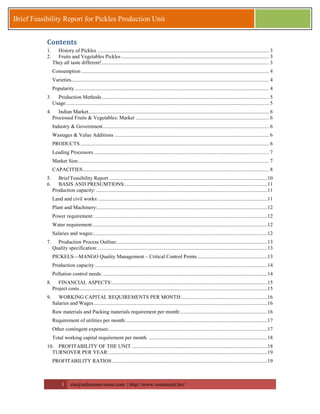
Contents 
1. History of Pickles .................................................................................................................................. 3 
2. Fruits and Vegetables Pickles ................................................................................................................ 3 
They all taste different!............................................................................................................................... 3 
Consumption .............................................................................................................................................. 4 
Varieties...................................................................................................................................................... 4 
Popularity ................................................................................................................................................... 4 
3. Production Methods ............................................................................................................................... 5 
Usage .......................................................................................................................................................... 5 
4. Indian Market......................................................................................................................................... 6 
Processed Fruits & Vegetables: Market ..................................................................................................... 6 
Industry & Government .............................................................................................................................. 6 
Wastages & Value Additions ..................................................................................................................... 6 
PRODUCTS ............................................................................................................................................... 6 
Leading Processors ..................................................................................................................................... 7 
Market Size ................................................................................................................................................. 7 
CAPACITIES ............................................................................................................................................. 8 
5. Brief Feasibility Report ........................................................................................................................10 
6. BASIS AND PRESUMTIONS: ............................................................................................................11 
Production capacity: ..................................................................................................................................11 
Land and civil works: ................................................................................................................................11 
Plant and Machinery: .................................................................................................................................12 
Power requirement: ...................................................................................................................................12 
Water requirement: ....................................................................................................................................12 
Salaries and wages: ....................................................................................................................................12 
7. Production Process Outline: ..................................................................................................................13 
Quality specification: .................................................................................................................................13 
PICKELS—MANGO Quality Management – Critical Control Points .....................................................13 
Production capacity ...................................................................................................................................14 
Pollution control needs: .............................................................................................................................14 
8. FINANCIAL ASPECTS: ......................................................................................................................15 
Project costs ...............................................................................................................................................15 
9. WORKING CAPITAL REQUIREMENTS PER MONTH: .................................................................16 
Salaries and Wages ....................................................................................................................................16 
Raw materials and Packing materials requirement per month: ..................................................................16 
Requirement of utilities per month: ...........................................................................................................17 
Other contingent expenses: ........................................................................................................................17 
Total working capital requirement per month. ..........................................................................................18 
10. PROFITABILITY OF THE UNIT .......................................................................................................18 
TURNOVER PER YEAR: ........................................................................................................................19 
PROFITABILITY RATIOS ......................................................................................................................19
2 zia@milestonevision.com | http://www.ventureart.biz/ 
Brief Feasibility Report for Pickles Production Unit 
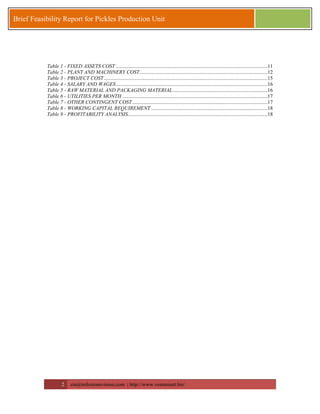
Table 1 - FIXED ASSETS COST ...................................................................................................................11 
Table 2 - PLANT AND MACHINERY COST .................................................................................................12 
Table 3 - PROJECT COST ............................................................................................................................15 
Table 4 - SALARY AND WAGES ...................................................................................................................16 
Table 5 - RAW MATERIAL AND PACKAGING MATERIAL ........................................................................16 
Table 6 - UTILITIES PER MONTH ..............................................................................................................17 
Table 7 - OTHER CONTINGENT COST.......................................................................................................17 
Table 8 - WORKING CAPITAL REQUIREMENT ........................................................................................18 
Table 9 - PROFITABILITY ANALYSIS..........................................................................................................18
3 zia@milestonevision.com | http://www.ventureart.biz/ 
Brief Feasibility Report for Pickles Production Unit 
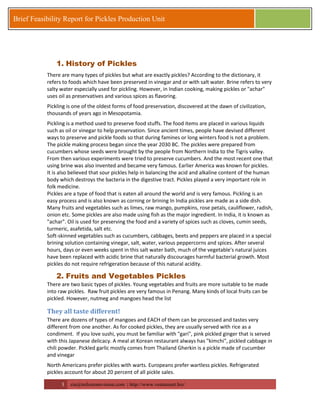
1. History of Pickles 
There are many types of pickles but what are exactly pickles? According to the dictionary, it refers to foods which have been preserved in vinegar and or with salt water. Brine refers to very salty water especially used for pickling. However, in Indian cooking, making pickles or "achar" uses oil as preservatives and various spices as flavoring. 
Pickling is one of the oldest forms of food preservation, discovered at the dawn of civilization, thousands of years ago in Mesopotamia. Pickling is a method used to preserve food stuffs. The food items are placed in various liquids such as oil or vinegar to help preservation. Since ancient times, people have devised different ways to preserve and pickle foods so that during famines or long winters food is not a problem. The pickle making process began since the year 2030 BC. The pickles were prepared from cucumbers whose seeds were brought by the people from Northern India to the Tigris valley. From then various experiments were tried to preserve cucumbers. And the most recent one that using brine was also invented and became very famous. Earlier America was known for pickles. It is also believed that sour pickles help in balancing the acid and alkaline content of the human body which destroys the bacteria in the digestive tract. Pickles played a very important role in folk medicine. Pickles are a type of food that is eaten all around the world and is very famous. Pickling is an easy process and is also known as corning or brining In India pickles are made as a side dish. Many fruits and vegetables such as limes, raw mango, pumpkins, rose petals, cauliflower, radish, onion etc. Some pickles are also made using fish as the major ingredient. In India, it is known as "achar". Oil is used for preserving the food and a variety of spices such as cloves, cumin seeds, turmeric, asafetida, salt etc. Soft-skinned vegetables such as cucumbers, cabbages, beets and peppers are placed in a special brining solution containing vinegar, salt, water, various peppercorns and spices. After several hours, days or even weeks spent in this salt water bath, much of the vegetable's natural juices have been replaced with acidic brine that naturally discourages harmful bacterial growth. Most pickles do not require refrigeration because of this natural acidity. 
2. Fruits and Vegetables Pickles 
There are two basic types of pickles. Young vegetables and fruits are more suitable to be made into raw pickles. Raw fruit pickles are very famous in Penang. Many kinds of local fruits can be pickled. However, nutmeg and mangoes head the list 
They all taste different! 
There are dozens of types of mangoes and EACH of them can be processed and tastes very different from one another. As for cooked pickles, they are usually served with rice as a condiment. If you love sushi, you must be familiar with "gari", pink pickled ginger that is served with this Japanese delicacy. A meal at Korean restaurant always has "kimchi", pickled cabbage in chili powder. Pickled garlic mostly comes from Thailand Gherkin is a pickle made of cucumber and vinegar 
North Americans prefer pickles with warts. Europeans prefer wartless pickles. Refrigerated pickles account for about 20 percent of all pickle sales.
4 zia@milestonevision.com | http://www.ventureart.biz/ 
Brief Feasibility Report for Pickles Production Unit 
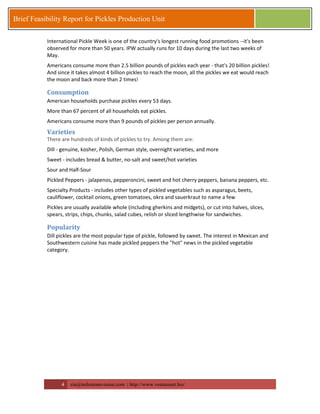
International Pickle Week is one of the country's longest running food promotions --it's been observed for more than 50 years. IPW actually runs for 10 days during the last two weeks of May. 
Americans consume more than 2.5 billion pounds of pickles each year - that's 20 billion pickles! And since it takes almost 4 billion pickles to reach the moon, all the pickles we eat would reach the moon and back more than 2 times! 
Consumption 
American households purchase pickles every 53 days. 
More than 67 percent of all households eat pickles. 
Americans consume more than 9 pounds of pickles per person annually. 
Varieties There are hundreds of kinds of pickles to try. Among them are: 
Dill - genuine, kosher, Polish, German style, overnight varieties, and more 
Sweet - includes bread & butter, no-salt and sweet/hot varieties 
Sour and Half-Sour 
Pickled Peppers - jalapenos, pepperoncini, sweet and hot cherry peppers, banana peppers, etc. 
Specialty Products - includes other types of pickled vegetables such as asparagus, beets, cauliflower, cocktail onions, green tomatoes, okra and sauerkraut to name a few 
Pickles are usually available whole (including gherkins and midgets), or cut into halves, slices, spears, strips, chips, chunks, salad cubes, relish or sliced lengthwise for sandwiches. 
Popularity 
Dill pickles are the most popular type of pickle, followed by sweet. The interest in Mexican and Southwestern cuisine has made pickled peppers the "hot" news in the pickled vegetable category.
5 zia@milestonevision.com | http://www.ventureart.biz/ 
Brief Feasibility Report for Pickles Production Unit 
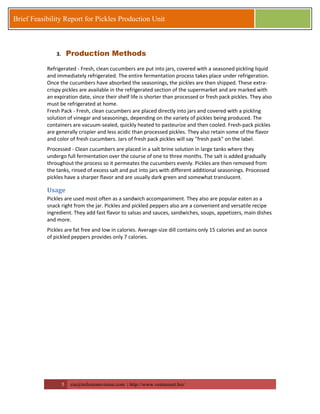
3. Production Methods 
Refrigerated - Fresh, clean cucumbers are put into jars, covered with a seasoned pickling liquid and immediately refrigerated. The entire fermentation process takes place under refrigeration. Once the cucumbers have absorbed the seasonings, the pickles are then shipped. These extra- crispy pickles are available in the refrigerated section of the supermarket and are marked with an expiration date, since their shelf life is shorter than processed or fresh pack pickles. They also must be refrigerated at home. 
Fresh Pack - Fresh, clean cucumbers are placed directly into jars and covered with a pickling solution of vinegar and seasonings, depending on the variety of pickles being produced. The containers are vacuum-sealed, quickly heated to pasteurize and then cooled. Fresh-pack pickles are generally crispier and less acidic than processed pickles. They also retain some of the flavor and color of fresh cucumbers. Jars of fresh pack pickles will say "fresh pack" on the label. 
Processed - Clean cucumbers are placed in a salt brine solution in large tanks where they undergo full fermentation over the course of one to three months. The salt is added gradually throughout the process so it permeates the cucumbers evenly. Pickles are then removed from the tanks, rinsed of excess salt and put into jars with different additional seasonings. Processed pickles have a sharper flavor and are usually dark green and somewhat translucent. 
Usage 
Pickles are used most often as a sandwich accompaniment. They also are popular eaten as a snack right from the jar. Pickles and pickled peppers also are a convenient and versatile recipe ingredient. They add fast flavor to salsas and sauces, sandwiches, soups, appetizers, main dishes and more. 
Pickles are fat free and low in calories. Average-size dill contains only 15 calories and an ounce of pickled peppers provides only 7 calories.
6 zia@milestonevision.com | http://www.ventureart.biz/ 
Brief Feasibility Report for Pickles Production Unit 
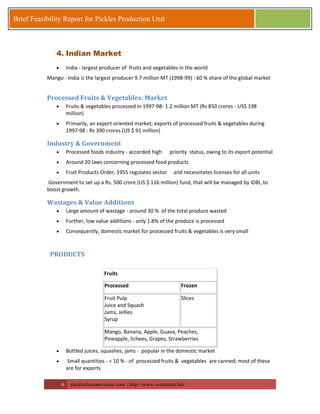
4. Indian Market 
 India - largest producer of fruits and vegetables in the world 
Mango - India is the largest producer 9.7 million MT (1998-99) : 60 % share of the global market 
Processed Fruits & Vegetables: Market 
 Fruits & vegetables processed in 1997-98- 1.2 million MT (Rs 850 crores - US$ 198 million) 
 Primarily, an export oriented market; exports of processed fruits & vegetables during 1997-98 : Rs 390 crores (US $ 91 million) 
Industry & Government 
 Processed foods industry - accorded high priority status, owing to its export potential 
 Around 20 laws concerning processed food products 
 Fruit Products Order, 1955 regulates sector and necessitates licenses for all units 
Government to set up a Rs. 500 crore (US $ 116 million) fund, that will be managed by IDBI, to boost growth. 
Wastages & Value Additions 
 Large amount of wastage - around 30 % of the total produce wasted 
 Further, low value additions - only 1.8% of the produce is processed 
 Consequently, domestic market for processed fruits & vegetables is very small 
PRODUCTS 
Fruits 
Processed 
Frozen 
Fruit Pulp Juice and Squash Jams, Jellies Syrup 
Slices 
Mango, Banana, Apple, Guava, Peaches, Pineapple, lichees, Grapes, Strawberries 
 Bottled juices, squashes, jams - popular in the domestic market 
 Small quantities - < 10 % - of processed fruits & vegetables are canned; most of these are for exports
7 zia@milestonevision.com | http://www.ventureart.biz/ 
Brief Feasibility Report for Pickles Production Unit 
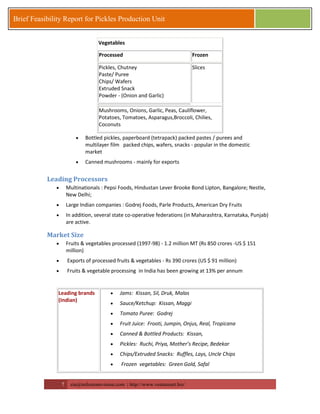
Vegetables 
Processed 
Frozen 
Pickles, Chutney Paste/ Puree Chips/ Wafers Extruded Snack Powder - (Onion and Garlic) 
Slices 
Mushrooms, Onions, Garlic, Peas, Cauliflower, Potatoes, Tomatoes, Asparagus,Broccoli, Chilies, Coconuts 
 Bottled pickles, paperboard (tetrapack) packed pastes / purees and multilayer film packed chips, wafers, snacks - popular in the domestic market 
 Canned mushrooms - mainly for exports 
Leading Processors 
 Multinationals : Pepsi Foods, Hindustan Lever Brooke Bond Lipton, Bangalore; Nestle, New Delhi; 
 Large Indian companies : Godrej Foods, Parle Products, American Dry Fruits 
 In addition, several state co-operative federations (in Maharashtra, Karnataka, Punjab) are active. 
Market Size 
 Fruits & vegetables processed (1997-98) - 1.2 million MT (Rs 850 crores -US $ 151 million) 
 Exports of processed fruits & vegetables - Rs 390 crores (US $ 91 million) 
 Fruits & vegetable processing in India has been growing at 13% per annum 
Leading brands (Indian) 
 Jams: Kissan, Sil, Druk, Malas 
 Sauce/Ketchup: Kissan, Maggi 
 Tomato Puree: Godrej 
 Fruit Juice: Frooti, Jumpin, Onjus, Real, Tropicana 
 Canned & Bottled Products: Kissan, 
 Pickles: Ruchi, Priya, Mother’s Recipe, Bedekar 
 Chips/Extruded Snacks: Ruffles, Lays, Uncle Chips 
 Frozen vegetables: Green Gold, Safal
8 zia@milestonevision.com | http://www.ventureart.biz/ 
Brief Feasibility Report for Pickles Production Unit 
CAPACITIES Industry Structure 
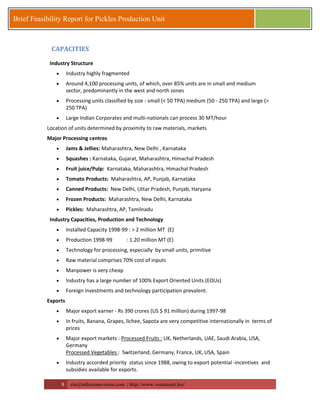
 Industry highly fragmented 
 Around 4,100 processing units, of which, over 85% units are in small and medium sector, predominantly in the west and north zones 
 Processing units classified by size - small (< 50 TPA) medium (50 - 250 TPA) and large (> 250 TPA) 
 Large Indian Corporates and multi-nationals can process 30 MT/hour 
Location of units determined by proximity to raw materials, markets 
Major Processing centres 
 Jams & Jellies: Maharashtra, New Delhi , Karnataka 
 Squashes : Karnataka, Gujarat, Maharashtra, Himachal Pradesh 
 Fruit juice/Pulp: Karnataka, Maharashtra, Himachal Pradesh 
 Tomato Products: Maharashtra, AP, Punjab, Karnataka 
 Canned Products: New Delhi, Uttar Pradesh, Punjab, Haryana 
 Frozen Products: Maharashtra, New Delhi, Karnataka 
 Pickles: Maharashtra, AP, Tamilnadu 
Industry Capacities, Production and Technology 
 Installed Capacity 1998-99 : > 2 million MT (E) 
 Production 1998-99 : 1.20 million MT (E) 
 Technology for processing, especially by small units, primitive 
 Raw material comprises 70% cost of inputs 
 Manpower is very cheap 
 Industry has a large number of 100% Export Oriented Units (EOUs) 
 Foreign investments and technology participation prevalent. 
Exports 
 Major export earner - Rs 390 crores (US $ 91 million) during 1997-98 
 In fruits, Banana, Grapes, lichee, Sapota are very competitive internationally in terms of prices 
 Major export markets : Processed Fruits : UK, Netherlands, UAE, Saudi Arabia, USA, Germany Processed Vegetables : Switzerland, Germany, France, UK, USA, Spain 
 Industry accorded priority status since 1988, owing to export potential -incentives and subsidies available for exports.
9 zia@milestonevision.com | http://www.ventureart.biz/ 
Brief Feasibility Report for Pickles Production Unit 
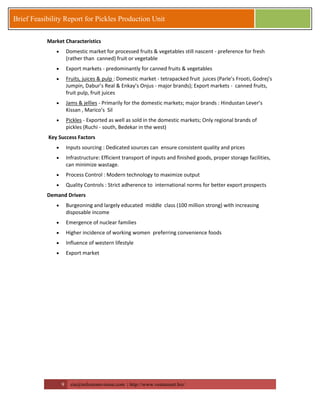
Market Characteristics 
 Domestic market for processed fruits & vegetables still nascent - preference for fresh (rather than canned) fruit or vegetable 
 Export markets - predominantly for canned fruits & vegetables 
 Fruits, juices & pulp : Domestic market - tetrapacked fruit juices (Parle’s Frooti, Godrej's Jumpin, Dabur’s Real & Enkay’s Onjus - major brands); Export markets - canned fruits, fruit pulp, fruit juices 
 Jams & jellies - Primarily for the domestic markets; major brands : Hindustan Lever’s Kissan , Marico’s Sil 
 Pickles - Exported as well as sold in the domestic markets; Only regional brands of pickles (Ruchi - south, Bedekar in the west) 
Key Success Factors 
 Inputs sourcing : Dedicated sources can ensure consistent quality and prices 
 Infrastructure: Efficient transport of inputs and finished goods, proper storage facilities, can minimize wastage. 
 Process Control : Modern technology to maximize output 
 Quality Controls : Strict adherence to international norms for better export prospects 
Demand Drivers 
 Burgeoning and largely educated middle class (100 million strong) with increasing disposable income 
 Emergence of nuclear families 
 Higher incidence of working women preferring convenience foods 
 Influence of western lifestyle 
 Export market
10 zia@milestonevision.com | http://www.ventureart.biz/ 
Brief Feasibility Report for Pickles Production Unit 
5. Brief Feasibility Report 
A. INTRODUCTION: 
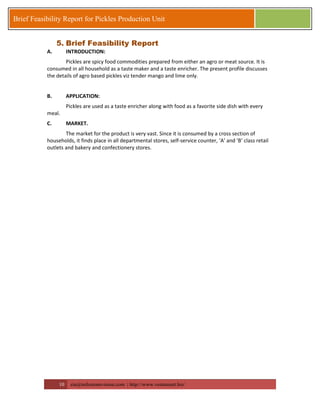
Pickles are spicy food commodities prepared from either an agro or meat source. It is consumed in all household as a taste maker and a taste enricher. The present profile discusses the details of agro based pickles viz tender mango and lime only. 
B. APPLICATION: 
Pickles are used as a taste enricher along with food as a favorite side dish with every meal. 
C. MARKET. 
The market for the product is very vast. Since it is consumed by a cross section of households, it finds place in all departmental stores, self-service counter, ‘A’ and ‘B’ class retail outlets and bakery and confectionery stores.
11 zia@milestonevision.com | http://www.ventureart.biz/ 
Brief Feasibility Report for Pickles Production Unit 
6. BASIS AND PRESUMTIONS: 
Production capacity: 
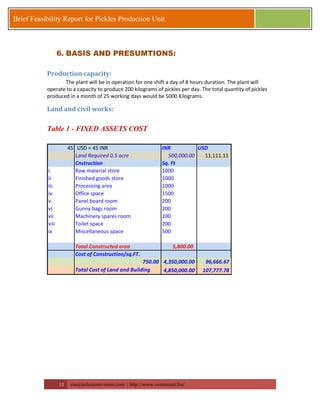
The plant will be in operation for one shift a day of 8 hours duration. The plant will 
operate to a capacity to produce 200 kilograms of pickles per day. The total quantity of pickles 
produced in a month of 25 working days would be 5000 Kilograms. 
Land and civil works: 
Table 1 - FIXED ASSETS COST 
45 USD = 45 INR INR USD 
Land Required 0.5 acre 500,000.00 11,111.11 
Cnstruction Sq. Ft 
i. Raw material store 1000 
ii. Finished goods store 1000 
iii. Processing area 1000 
iv. Office space 1500 
v. Panel board room 200 
vi. Gunny bags room 200 
vii Machinery spares room 200 
viii Toilet space 200 
ix Miscellaneous space 500 
Total Constructed area 5,800.00 
Cost of Construction/sq.FT. 
750.00 4,350,000.00 96,666.67 
Total Cost of Land and Building 4,850,000.00 107,777.78
12 zia@milestonevision.com | http://www.ventureart.biz/ 
Brief Feasibility Report for Pickles Production Unit 
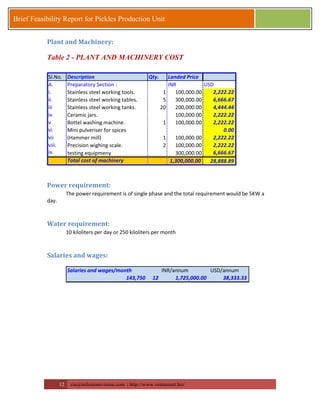
Plant and Machinery: 
Table 2 - PLANT AND MACHINERY COST 
Sl.No. Description Qty. Landed Price 
A. Preparatory Section : INR USD 
i. Stainless steel working tools. 1 100,000.00 2,222.22 
ii. Stainless steel working tables. 5 300,000.00 6,666.67 
iii Stainless steel working tanks. 20 200,000.00 4,444.44 
iv Ceramic jars. 100,000.00 2,222.22 
v Bottel washing machine. 1 100,000.00 2,222.22 
vi Mini pulveriser for spices 0.00 
vii (Hammer mill) 1 100,000.00 2,222.22 
viii. Precision wighing scale. 2 100,000.00 2,222.22 
ix. testing equipmeny 300,000.00 6,666.67 
Total cost of machinery 1,300,000.00 28,888.89 
Power requirement: 
The power requirement is of single phase and the total requirement would be 5KW a 
day. 
Water requirement: 
10 kiloliters per day or 250 kiloliters per month 
Salaries and wages: 
Salaries and wages/month INR/annum USD/annum 
143,750 12 1,725,000.00 38,333.33
13 zia@milestonevision.com | http://www.ventureart.biz/ 
Brief Feasibility Report for Pickles Production Unit 
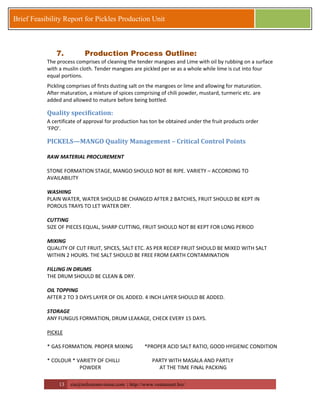
7. Production Process Outline: 
The process comprises of cleaning the tender mangoes and Lime with oil by rubbing on a surface with a muslin cloth. Tender mangoes are pickled per se as a whole while lime is cut into four equal portions. 
Pickling comprises of firsts dusting salt on the mangoes or lime and allowing for maturation. After maturation, a mixture of spices comprising of chili powder, mustard, turmeric etc. are added and allowed to mature before being bottled. 
Quality specification: 
A certificate of approval for production has ton be obtained under the fruit products order ‘FPO’. 
PICKELS—MANGO Quality Management – Critical Control Points 
RAW MATERIAL PROCUREMENT 
STONE FORMATION STAGE, MANGO SHOULD NOT BE RIPE. VARIETY – ACCORDING TO AVAILABILITY 
WASHING 
PLAIN WATER, WATER SHOULD BE CHANGED AFTER 2 BATCHES, FRUIT SHOULD BE KEPT IN POROUS TRAYS TO LET WATER DRY. 
CUTTING 
SIZE OF PIECES EQUAL, SHARP CUTTING, FRUIT SHOULD NOT BE KEPT FOR LONG PERIOD 
MIXING 
QUALITY OF CUT FRUIT, SPICES, SALT ETC. AS PER RECIEP FRUIT SHOULD BE MIXED WITH SALT WITHIN 2 HOURS. THE SALT SHOULD BE FREE FROM EARTH CONTAMINATION 
FILLING IN DRUMS 
THE DRUM SHOULD BE CLEAN & DRY. 
OIL TOPPING 
AFTER 2 TO 3 DAYS LAYER OF OIL ADDED. 4 INCH LAYER SHOULD BE ADDED. 
STORAGE 
ANY FUNGUS FORMATION, DRUM LEAKAGE, CHECK EVERY 15 DAYS. 
PICKLE 
* GAS FORMATION. PROPER MIXING *PROPER ACID SALT RATIO, GOOD HYGIENIC CONDITION 
* COLOUR * VARIETY OF CHILLI PARTY WITH MASALA AND PARTLY 
POWDER AT THE TIME FINAL PACKING
14 zia@milestonevision.com | http://www.ventureart.biz/ 
Brief Feasibility Report for Pickles Production Unit 
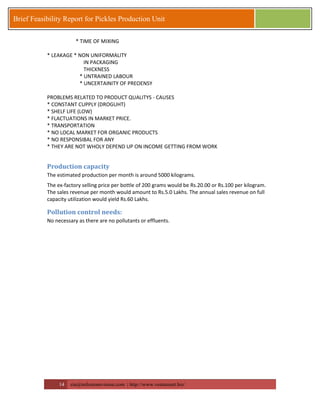
* TIME OF MIXING 
* LEAKAGE * NON UNIFORMALITY 
IN PACKAGING 
THICKNESS 
* UNTRAINED LABOUR 
* UNCERTAINITY OF PREOENSY 
PROBLEMS RELATED TO PRODUCT QUALITYS - CAUSES 
* CONSTANT CUPPLY (DROGUHT) 
* SHELF LIFE (LOW) 
* FLACTUATIONS IN MARKET PRICE. 
* TRANSPORTATION 
* NO LOCAL MARKET FOR ORGANIC PRODUCTS 
* NO RESPONSIBAL FOR ANY 
* THEY ARE NOT WHOLY DEPEND UP ON INCOME GETTING FROM WORK 
Production capacity 
The estimated production per month is around 5000 kilograms. 
The ex-factory selling price per bottle of 200 grams would be Rs.20.00 or Rs.100 per kilogram. The sales revenue per month would amount to Rs.5.0 Lakhs. The annual sales revenue on full capacity utilization would yield Rs.60 Lakhs. 
Pollution control needs: 
No necessary as there are no pollutants or effluents.
15 zia@milestonevision.com | http://www.ventureart.biz/ 
Brief Feasibility Report for Pickles Production Unit 
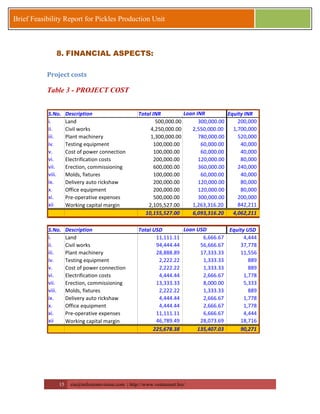
8. FINANCIAL ASPECTS: 
Project costs 
Table 3 - PROJECT COST 
S.No. Description Total INR Loan INR Equity INR 
i. Land 500,000.00 300,000.00 200,000 
ii. Civil works 4,250,000.00 2,550,000.00 1 ,700,000 
iii. Plant machinery 1,300,000.00 780,000.00 520,000 
iv. Testing equipment 1 00,000.00 60,000.00 40,000 
v. Cost of power connection 1 00,000.00 60,000.00 40,000 
vi. Electrification costs 2 00,000.00 120,000.00 80,000 
vii. Erection, commissioning 6 00,000.00 360,000.00 240,000 
viii. Molds, fixtures 1 00,000.00 60,000.00 40,000 
ix. Delivery auto rickshaw 2 00,000.00 120,000.00 80,000 
x. Office equipment 2 00,000.00 120,000.00 80,000 
xi. Pre-operative expenses 5 00,000.00 300,000.00 200,000 
xii Working capital margin 2,105,527.00 1,263,316.20 842,211 
10,155,527.00 6,093,316.20 4,062,211 
S.No. Description Total USD Loan USD Equity USD 
i. Land 11,111.11 6,666.67 4,444 
ii. Civil works 94,444.44 56,666.67 37,778 
iii. Plant machinery 28,888.89 17,333.33 11,556 
iv. Testing equipment 2,222.22 1,333.33 889 
v. Cost of power connection 2,222.22 1,333.33 889 
vi. Electrification costs 4,444.44 2,666.67 1,778 
vii. Erection, commissioning 13,333.33 8,000.00 5,333 
viii. Molds, fixtures 2,222.22 1,333.33 889 
ix. Delivery auto rickshaw 4,444.44 2,666.67 1,778 
x. Office equipment 4,444.44 2,666.67 1,778 
xi. Pre-operative expenses 11,111.11 6,666.67 4,444 
xii Working capital margin 46,789.49 28,073.69 18,716 
225,678.38 135,407.03 90,271
16 zia@milestonevision.com | http://www.ventureart.biz/ 
Brief Feasibility Report for Pickles Production Unit 
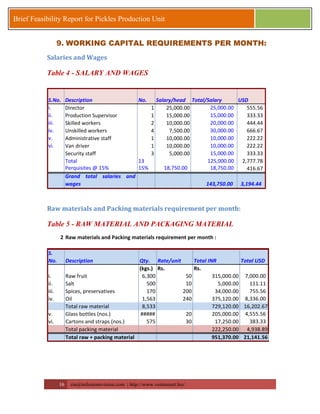
9. WORKING CAPITAL REQUIREMENTS PER MONTH: 
Salaries and Wages 
Table 4 - SALARY AND WAGES 
S.No. Description No. Salary/head Total/Salary USD 
i. Director 1 25,000.00 25,000.00 555.56 
ii. Production Supervisor 1 15,000.00 15,000.00 333.33 
iii. Skilled workers 2 10,000.00 20,000.00 444.44 
iv. Unskilled workers 4 7,500.00 30,000.00 666.67 
v. Administrative staff 1 10,000.00 10,000.00 222.22 
vi. Van driver 1 10,000.00 10,000.00 222.22 
Security staff 3 5,000.00 15,000.00 333.33 
Total 13 125,000.00 2 ,777.78 
Perquisites @ 15% 15% 18,750.00 18,750.00 416.67 
Grand total salaries and 
wages 143,750.00 3,194.44 
Raw materials and Packing materials requirement per month: 
Table 5 - RAW MATERIAL AND PACKAGING MATERIAL 
2 Raw materials and Packing materials requirement per month : 
S. 
No. Description Qty. Rate/unit Total INR Total USD 
(kgs.) Rs. Rs. 
i. Raw fruit 6,300 50 315,000.00 7 ,000.00 
ii. Salt 500 10 5,000.00 111.11 
iii. Spices, preservatives 170 200 34,000.00 755.56 
iv. Oil 1,563 240 375,120.00 8 ,336.00 
Total raw material 8,533 729,120.00 16,202.67 
v. Glass bottles (nos.) ##### 20 205,000.00 4 ,555.56 
vi. Cartons and straps (nos.) 575 30 17,250.00 383.33 
Total packing material 222,250.00 4,938.89 
Total raw + packing material 951,370.00 21,141.56
17 zia@milestonevision.com | http://www.ventureart.biz/ 
Brief Feasibility Report for Pickles Production Unit 
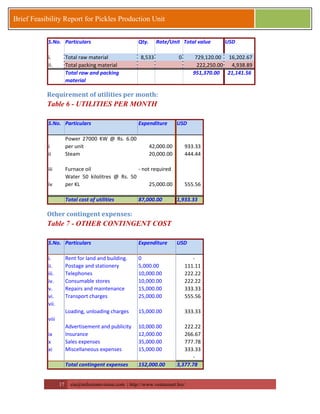
S.No. Particulars Qty. Rate/Unit Total value USD 
i. Total raw material 8,533 0 729,120.00 16,202.67 
ii. Total packing material 222,250.00 4,938.89 
Total raw and packing 
material 
951,370.00 21,141.56 
Requirement of utilities per month: 
Table 6 - UTILITIES PER MONTH 
S.No. Particulars Expenditure USD 
i 
Power 27000 KW @ Rs. 6.00 
per unit 42,000.00 933.33 
ii Steam 20,000.00 444.44 
iii Furnace oil - not required 
iv 
Water 50 kilolitres @ Rs. 50 
per KL 25,000.00 555.56 
Total cost of utilities 87,000.00 1,933.33 
Other contingent expenses: 
Table 7 - OTHER CONTINGENT COST 
S.No. Particulars Expenditure USD 
i. Rent for land and building. 0 - 
ii. Postage and stationery 5,000.00 111.11 
iii. Telephones 10,000.00 222.22 
iv. Consumable stores 10,000.00 222.22 
v. Repairs and maintenance 15,000.00 333.33 
vi. Transport charges 25,000.00 555.56 
vii. 
Loading, unloading charges 15,000.00 333.33 
viii 
Advertisement and publicity 10,000.00 222.22 
ix Insurance 12,000.00 266.67 
x Sales expenses 35,000.00 777.78 
xi Miscellaneous expenses 15,000.00 333.33 
- 
Total contingent expenses 152,000.00 3,377.78
18 zia@milestonevision.com | http://www.ventureart.biz/ 
Brief Feasibility Report for Pickles Production Unit 
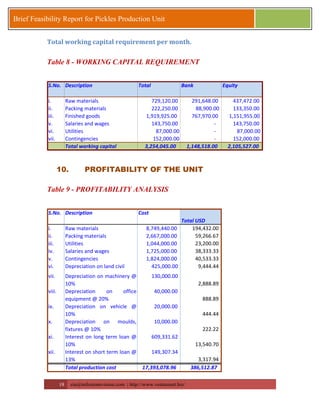
Total working capital requirement per month. 
Table 8 - WORKING CAPITAL REQUIREMENT 
S.No. Description Total Bank Equity 
i. Raw materials 729,120.00 291,648.00 437,472.00 
ii. Packing materials 222,250.00 88,900.00 133,350.00 
iii. Finished goods 1,919,925.00 767,970.00 1,151,955.00 
v. Salaries and wages 143,750.00 - 143,750.00 
vi. Utilities 87,000.00 - 87,000.00 
vii. Contingencies 152,000.00 - 152,000.00 
Total working capital 3,254,045.00 1,148,518.00 2,105,527.00 
10. PROFITABILITY OF THE UNIT 
Table 9 - PROFITABILITY ANALYSIS 
S.No. Description Cost 
Total USD 
i. Raw materials 8,749,440.00 194,432.00 
ii. Packing materials 2,667,000.00 59,266.67 
iii. Utilities 1,044,000.00 23,200.00 
iv. Salaries and wages 1,725,000.00 38,333.33 
v. Contingencies 1,824,000.00 40,533.33 
vi. Depreciation on land civil 
works @ 10% 
425,000.00 9,444.44 
vii. Depreciation on machinery @ 
10% 
130,000.00 
2,888.89 
viii. Depreciation on office 
equipment @ 20% 
40,000.00 
888.89 
ix. Depreciation on vehicle @ 
10% 
20,000.00 
444.44 
x. Depreciation on moulds, 
fixtures @ 10% 
10,000.00 
222.22 
xi. Interest on long term loan @ 
10% 
609,331.62 
13,540.70 
xii. Interest on short term loan @ 
13% 
149,307.34 
3,317.94 
Total production cost 17,393,078.96 386,512.87
19 zia@milestonevision.com | http://www.ventureart.biz/ 
Brief Feasibility Report for Pickles Production Unit 
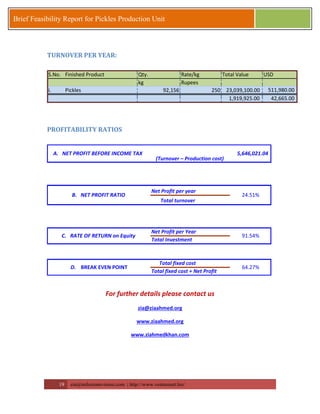
TURNOVER PER YEAR: 
S.No. Finished Product Qty. Rate/kg Total Value USD 
kg Rupees 
i. Pickles 92,156 250 23,039,100.00 511,980.00 
1,919,925.00 42,665.00 
PROFITABILITY RATIOS 
Net Profit per year 
Total turnover 
Net Profit per Year 
Total Investment 
Total fixed cost 
Total fixed cost + Net Profit 
A. NET PROFIT BEFORE INCOME TAX 5,646,021.04 
(Turnover – Production cost) 
C. RATE OF RETURN on Equity 91.54% 
D. BREAK EVEN POINT 64.27% 
B. NET PROFIT RATIO 24.51% 
For further details please contact us 
zia@ziaahmed.org 
www.ziaahmed.org 
www.ziahmedkhan.com

Pickles Brief Feasibility Report

  • 1.
    Brief Feasibility Reportfor Pickles Production Unit Small and Micro Enterprises can Start Pickles Unit http://www.ventureart.biz/ Dr. Zia Ahmed This is a brief report on Pickles Production Unit. Pickles are one of most universally used processed food. Pickles are oldest of all kinds of processed food. These are very small units can be structured for micro and small enterprises depending upon need. zia@milestonevision.com
  • 2.
    1 zia@milestonevision.com |http://www.ventureart.biz/ Brief Feasibility Report for Pickles Production Unit Contents 1. History of Pickles .................................................................................................................................. 3 2. Fruits and Vegetables Pickles ................................................................................................................ 3 They all taste different!............................................................................................................................... 3 Consumption .............................................................................................................................................. 4 Varieties...................................................................................................................................................... 4 Popularity ................................................................................................................................................... 4 3. Production Methods ............................................................................................................................... 5 Usage .......................................................................................................................................................... 5 4. Indian Market......................................................................................................................................... 6 Processed Fruits & Vegetables: Market ..................................................................................................... 6 Industry & Government .............................................................................................................................. 6 Wastages & Value Additions ..................................................................................................................... 6 PRODUCTS ............................................................................................................................................... 6 Leading Processors ..................................................................................................................................... 7 Market Size ................................................................................................................................................. 7 CAPACITIES ............................................................................................................................................. 8 5. Brief Feasibility Report ........................................................................................................................10 6. BASIS AND PRESUMTIONS: ............................................................................................................11 Production capacity: ..................................................................................................................................11 Land and civil works: ................................................................................................................................11 Plant and Machinery: .................................................................................................................................12 Power requirement: ...................................................................................................................................12 Water requirement: ....................................................................................................................................12 Salaries and wages: ....................................................................................................................................12 7. Production Process Outline: ..................................................................................................................13 Quality specification: .................................................................................................................................13 PICKELS—MANGO Quality Management – Critical Control Points .....................................................13 Production capacity ...................................................................................................................................14 Pollution control needs: .............................................................................................................................14 8. FINANCIAL ASPECTS: ......................................................................................................................15 Project costs ...............................................................................................................................................15 9. WORKING CAPITAL REQUIREMENTS PER MONTH: .................................................................16 Salaries and Wages ....................................................................................................................................16 Raw materials and Packing materials requirement per month: ..................................................................16 Requirement of utilities per month: ...........................................................................................................17 Other contingent expenses: ........................................................................................................................17 Total working capital requirement per month. ..........................................................................................18 10. PROFITABILITY OF THE UNIT .......................................................................................................18 TURNOVER PER YEAR: ........................................................................................................................19 PROFITABILITY RATIOS ......................................................................................................................19
  • 3.
    2 zia@milestonevision.com |http://www.ventureart.biz/ Brief Feasibility Report for Pickles Production Unit Table 1 - FIXED ASSETS COST ...................................................................................................................11 Table 2 - PLANT AND MACHINERY COST .................................................................................................12 Table 3 - PROJECT COST ............................................................................................................................15 Table 4 - SALARY AND WAGES ...................................................................................................................16 Table 5 - RAW MATERIAL AND PACKAGING MATERIAL ........................................................................16 Table 6 - UTILITIES PER MONTH ..............................................................................................................17 Table 7 - OTHER CONTINGENT COST.......................................................................................................17 Table 8 - WORKING CAPITAL REQUIREMENT ........................................................................................18 Table 9 - PROFITABILITY ANALYSIS..........................................................................................................18
  • 4.
    3 zia@milestonevision.com |http://www.ventureart.biz/ Brief Feasibility Report for Pickles Production Unit 1. History of Pickles There are many types of pickles but what are exactly pickles? According to the dictionary, it refers to foods which have been preserved in vinegar and or with salt water. Brine refers to very salty water especially used for pickling. However, in Indian cooking, making pickles or "achar" uses oil as preservatives and various spices as flavoring. Pickling is one of the oldest forms of food preservation, discovered at the dawn of civilization, thousands of years ago in Mesopotamia. Pickling is a method used to preserve food stuffs. The food items are placed in various liquids such as oil or vinegar to help preservation. Since ancient times, people have devised different ways to preserve and pickle foods so that during famines or long winters food is not a problem. The pickle making process began since the year 2030 BC. The pickles were prepared from cucumbers whose seeds were brought by the people from Northern India to the Tigris valley. From then various experiments were tried to preserve cucumbers. And the most recent one that using brine was also invented and became very famous. Earlier America was known for pickles. It is also believed that sour pickles help in balancing the acid and alkaline content of the human body which destroys the bacteria in the digestive tract. Pickles played a very important role in folk medicine. Pickles are a type of food that is eaten all around the world and is very famous. Pickling is an easy process and is also known as corning or brining In India pickles are made as a side dish. Many fruits and vegetables such as limes, raw mango, pumpkins, rose petals, cauliflower, radish, onion etc. Some pickles are also made using fish as the major ingredient. In India, it is known as "achar". Oil is used for preserving the food and a variety of spices such as cloves, cumin seeds, turmeric, asafetida, salt etc. Soft-skinned vegetables such as cucumbers, cabbages, beets and peppers are placed in a special brining solution containing vinegar, salt, water, various peppercorns and spices. After several hours, days or even weeks spent in this salt water bath, much of the vegetable's natural juices have been replaced with acidic brine that naturally discourages harmful bacterial growth. Most pickles do not require refrigeration because of this natural acidity. 2. Fruits and Vegetables Pickles There are two basic types of pickles. Young vegetables and fruits are more suitable to be made into raw pickles. Raw fruit pickles are very famous in Penang. Many kinds of local fruits can be pickled. However, nutmeg and mangoes head the list They all taste different! There are dozens of types of mangoes and EACH of them can be processed and tastes very different from one another. As for cooked pickles, they are usually served with rice as a condiment. If you love sushi, you must be familiar with "gari", pink pickled ginger that is served with this Japanese delicacy. A meal at Korean restaurant always has "kimchi", pickled cabbage in chili powder. Pickled garlic mostly comes from Thailand Gherkin is a pickle made of cucumber and vinegar North Americans prefer pickles with warts. Europeans prefer wartless pickles. Refrigerated pickles account for about 20 percent of all pickle sales.
  • 5.
    4 zia@milestonevision.com |http://www.ventureart.biz/ Brief Feasibility Report for Pickles Production Unit International Pickle Week is one of the country's longest running food promotions --it's been observed for more than 50 years. IPW actually runs for 10 days during the last two weeks of May. Americans consume more than 2.5 billion pounds of pickles each year - that's 20 billion pickles! And since it takes almost 4 billion pickles to reach the moon, all the pickles we eat would reach the moon and back more than 2 times! Consumption American households purchase pickles every 53 days. More than 67 percent of all households eat pickles. Americans consume more than 9 pounds of pickles per person annually. Varieties There are hundreds of kinds of pickles to try. Among them are: Dill - genuine, kosher, Polish, German style, overnight varieties, and more Sweet - includes bread & butter, no-salt and sweet/hot varieties Sour and Half-Sour Pickled Peppers - jalapenos, pepperoncini, sweet and hot cherry peppers, banana peppers, etc. Specialty Products - includes other types of pickled vegetables such as asparagus, beets, cauliflower, cocktail onions, green tomatoes, okra and sauerkraut to name a few Pickles are usually available whole (including gherkins and midgets), or cut into halves, slices, spears, strips, chips, chunks, salad cubes, relish or sliced lengthwise for sandwiches. Popularity Dill pickles are the most popular type of pickle, followed by sweet. The interest in Mexican and Southwestern cuisine has made pickled peppers the "hot" news in the pickled vegetable category.
  • 6.
    5 zia@milestonevision.com |http://www.ventureart.biz/ Brief Feasibility Report for Pickles Production Unit 3. Production Methods Refrigerated - Fresh, clean cucumbers are put into jars, covered with a seasoned pickling liquid and immediately refrigerated. The entire fermentation process takes place under refrigeration. Once the cucumbers have absorbed the seasonings, the pickles are then shipped. These extra- crispy pickles are available in the refrigerated section of the supermarket and are marked with an expiration date, since their shelf life is shorter than processed or fresh pack pickles. They also must be refrigerated at home. Fresh Pack - Fresh, clean cucumbers are placed directly into jars and covered with a pickling solution of vinegar and seasonings, depending on the variety of pickles being produced. The containers are vacuum-sealed, quickly heated to pasteurize and then cooled. Fresh-pack pickles are generally crispier and less acidic than processed pickles. They also retain some of the flavor and color of fresh cucumbers. Jars of fresh pack pickles will say "fresh pack" on the label. Processed - Clean cucumbers are placed in a salt brine solution in large tanks where they undergo full fermentation over the course of one to three months. The salt is added gradually throughout the process so it permeates the cucumbers evenly. Pickles are then removed from the tanks, rinsed of excess salt and put into jars with different additional seasonings. Processed pickles have a sharper flavor and are usually dark green and somewhat translucent. Usage Pickles are used most often as a sandwich accompaniment. They also are popular eaten as a snack right from the jar. Pickles and pickled peppers also are a convenient and versatile recipe ingredient. They add fast flavor to salsas and sauces, sandwiches, soups, appetizers, main dishes and more. Pickles are fat free and low in calories. Average-size dill contains only 15 calories and an ounce of pickled peppers provides only 7 calories.
  • 7.
    6 zia@milestonevision.com |http://www.ventureart.biz/ Brief Feasibility Report for Pickles Production Unit 4. Indian Market  India - largest producer of fruits and vegetables in the world Mango - India is the largest producer 9.7 million MT (1998-99) : 60 % share of the global market Processed Fruits & Vegetables: Market  Fruits & vegetables processed in 1997-98- 1.2 million MT (Rs 850 crores - US$ 198 million)  Primarily, an export oriented market; exports of processed fruits & vegetables during 1997-98 : Rs 390 crores (US $ 91 million) Industry & Government  Processed foods industry - accorded high priority status, owing to its export potential  Around 20 laws concerning processed food products  Fruit Products Order, 1955 regulates sector and necessitates licenses for all units Government to set up a Rs. 500 crore (US $ 116 million) fund, that will be managed by IDBI, to boost growth. Wastages & Value Additions  Large amount of wastage - around 30 % of the total produce wasted  Further, low value additions - only 1.8% of the produce is processed  Consequently, domestic market for processed fruits & vegetables is very small PRODUCTS Fruits Processed Frozen Fruit Pulp Juice and Squash Jams, Jellies Syrup Slices Mango, Banana, Apple, Guava, Peaches, Pineapple, lichees, Grapes, Strawberries  Bottled juices, squashes, jams - popular in the domestic market  Small quantities - < 10 % - of processed fruits & vegetables are canned; most of these are for exports
  • 8.
    7 zia@milestonevision.com |http://www.ventureart.biz/ Brief Feasibility Report for Pickles Production Unit Vegetables Processed Frozen Pickles, Chutney Paste/ Puree Chips/ Wafers Extruded Snack Powder - (Onion and Garlic) Slices Mushrooms, Onions, Garlic, Peas, Cauliflower, Potatoes, Tomatoes, Asparagus,Broccoli, Chilies, Coconuts  Bottled pickles, paperboard (tetrapack) packed pastes / purees and multilayer film packed chips, wafers, snacks - popular in the domestic market  Canned mushrooms - mainly for exports Leading Processors  Multinationals : Pepsi Foods, Hindustan Lever Brooke Bond Lipton, Bangalore; Nestle, New Delhi;  Large Indian companies : Godrej Foods, Parle Products, American Dry Fruits  In addition, several state co-operative federations (in Maharashtra, Karnataka, Punjab) are active. Market Size  Fruits & vegetables processed (1997-98) - 1.2 million MT (Rs 850 crores -US $ 151 million)  Exports of processed fruits & vegetables - Rs 390 crores (US $ 91 million)  Fruits & vegetable processing in India has been growing at 13% per annum Leading brands (Indian)  Jams: Kissan, Sil, Druk, Malas  Sauce/Ketchup: Kissan, Maggi  Tomato Puree: Godrej  Fruit Juice: Frooti, Jumpin, Onjus, Real, Tropicana  Canned & Bottled Products: Kissan,  Pickles: Ruchi, Priya, Mother’s Recipe, Bedekar  Chips/Extruded Snacks: Ruffles, Lays, Uncle Chips  Frozen vegetables: Green Gold, Safal
  • 9.
    8 zia@milestonevision.com |http://www.ventureart.biz/ Brief Feasibility Report for Pickles Production Unit CAPACITIES Industry Structure  Industry highly fragmented  Around 4,100 processing units, of which, over 85% units are in small and medium sector, predominantly in the west and north zones  Processing units classified by size - small (< 50 TPA) medium (50 - 250 TPA) and large (> 250 TPA)  Large Indian Corporates and multi-nationals can process 30 MT/hour Location of units determined by proximity to raw materials, markets Major Processing centres  Jams & Jellies: Maharashtra, New Delhi , Karnataka  Squashes : Karnataka, Gujarat, Maharashtra, Himachal Pradesh  Fruit juice/Pulp: Karnataka, Maharashtra, Himachal Pradesh  Tomato Products: Maharashtra, AP, Punjab, Karnataka  Canned Products: New Delhi, Uttar Pradesh, Punjab, Haryana  Frozen Products: Maharashtra, New Delhi, Karnataka  Pickles: Maharashtra, AP, Tamilnadu Industry Capacities, Production and Technology  Installed Capacity 1998-99 : > 2 million MT (E)  Production 1998-99 : 1.20 million MT (E)  Technology for processing, especially by small units, primitive  Raw material comprises 70% cost of inputs  Manpower is very cheap  Industry has a large number of 100% Export Oriented Units (EOUs)  Foreign investments and technology participation prevalent. Exports  Major export earner - Rs 390 crores (US $ 91 million) during 1997-98  In fruits, Banana, Grapes, lichee, Sapota are very competitive internationally in terms of prices  Major export markets : Processed Fruits : UK, Netherlands, UAE, Saudi Arabia, USA, Germany Processed Vegetables : Switzerland, Germany, France, UK, USA, Spain  Industry accorded priority status since 1988, owing to export potential -incentives and subsidies available for exports.
  • 10.
    9 zia@milestonevision.com |http://www.ventureart.biz/ Brief Feasibility Report for Pickles Production Unit Market Characteristics  Domestic market for processed fruits & vegetables still nascent - preference for fresh (rather than canned) fruit or vegetable  Export markets - predominantly for canned fruits & vegetables  Fruits, juices & pulp : Domestic market - tetrapacked fruit juices (Parle’s Frooti, Godrej's Jumpin, Dabur’s Real & Enkay’s Onjus - major brands); Export markets - canned fruits, fruit pulp, fruit juices  Jams & jellies - Primarily for the domestic markets; major brands : Hindustan Lever’s Kissan , Marico’s Sil  Pickles - Exported as well as sold in the domestic markets; Only regional brands of pickles (Ruchi - south, Bedekar in the west) Key Success Factors  Inputs sourcing : Dedicated sources can ensure consistent quality and prices  Infrastructure: Efficient transport of inputs and finished goods, proper storage facilities, can minimize wastage.  Process Control : Modern technology to maximize output  Quality Controls : Strict adherence to international norms for better export prospects Demand Drivers  Burgeoning and largely educated middle class (100 million strong) with increasing disposable income  Emergence of nuclear families  Higher incidence of working women preferring convenience foods  Influence of western lifestyle  Export market
  • 11.
    10 zia@milestonevision.com |http://www.ventureart.biz/ Brief Feasibility Report for Pickles Production Unit 5. Brief Feasibility Report A. INTRODUCTION: Pickles are spicy food commodities prepared from either an agro or meat source. It is consumed in all household as a taste maker and a taste enricher. The present profile discusses the details of agro based pickles viz tender mango and lime only. B. APPLICATION: Pickles are used as a taste enricher along with food as a favorite side dish with every meal. C. MARKET. The market for the product is very vast. Since it is consumed by a cross section of households, it finds place in all departmental stores, self-service counter, ‘A’ and ‘B’ class retail outlets and bakery and confectionery stores.
  • 12.
    11 zia@milestonevision.com |http://www.ventureart.biz/ Brief Feasibility Report for Pickles Production Unit 6. BASIS AND PRESUMTIONS: Production capacity: The plant will be in operation for one shift a day of 8 hours duration. The plant will operate to a capacity to produce 200 kilograms of pickles per day. The total quantity of pickles produced in a month of 25 working days would be 5000 Kilograms. Land and civil works: Table 1 - FIXED ASSETS COST 45 USD = 45 INR INR USD Land Required 0.5 acre 500,000.00 11,111.11 Cnstruction Sq. Ft i. Raw material store 1000 ii. Finished goods store 1000 iii. Processing area 1000 iv. Office space 1500 v. Panel board room 200 vi. Gunny bags room 200 vii Machinery spares room 200 viii Toilet space 200 ix Miscellaneous space 500 Total Constructed area 5,800.00 Cost of Construction/sq.FT. 750.00 4,350,000.00 96,666.67 Total Cost of Land and Building 4,850,000.00 107,777.78
  • 13.
    12 zia@milestonevision.com |http://www.ventureart.biz/ Brief Feasibility Report for Pickles Production Unit Plant and Machinery: Table 2 - PLANT AND MACHINERY COST Sl.No. Description Qty. Landed Price A. Preparatory Section : INR USD i. Stainless steel working tools. 1 100,000.00 2,222.22 ii. Stainless steel working tables. 5 300,000.00 6,666.67 iii Stainless steel working tanks. 20 200,000.00 4,444.44 iv Ceramic jars. 100,000.00 2,222.22 v Bottel washing machine. 1 100,000.00 2,222.22 vi Mini pulveriser for spices 0.00 vii (Hammer mill) 1 100,000.00 2,222.22 viii. Precision wighing scale. 2 100,000.00 2,222.22 ix. testing equipmeny 300,000.00 6,666.67 Total cost of machinery 1,300,000.00 28,888.89 Power requirement: The power requirement is of single phase and the total requirement would be 5KW a day. Water requirement: 10 kiloliters per day or 250 kiloliters per month Salaries and wages: Salaries and wages/month INR/annum USD/annum 143,750 12 1,725,000.00 38,333.33
  • 14.
    13 zia@milestonevision.com |http://www.ventureart.biz/ Brief Feasibility Report for Pickles Production Unit 7. Production Process Outline: The process comprises of cleaning the tender mangoes and Lime with oil by rubbing on a surface with a muslin cloth. Tender mangoes are pickled per se as a whole while lime is cut into four equal portions. Pickling comprises of firsts dusting salt on the mangoes or lime and allowing for maturation. After maturation, a mixture of spices comprising of chili powder, mustard, turmeric etc. are added and allowed to mature before being bottled. Quality specification: A certificate of approval for production has ton be obtained under the fruit products order ‘FPO’. PICKELS—MANGO Quality Management – Critical Control Points RAW MATERIAL PROCUREMENT STONE FORMATION STAGE, MANGO SHOULD NOT BE RIPE. VARIETY – ACCORDING TO AVAILABILITY WASHING PLAIN WATER, WATER SHOULD BE CHANGED AFTER 2 BATCHES, FRUIT SHOULD BE KEPT IN POROUS TRAYS TO LET WATER DRY. CUTTING SIZE OF PIECES EQUAL, SHARP CUTTING, FRUIT SHOULD NOT BE KEPT FOR LONG PERIOD MIXING QUALITY OF CUT FRUIT, SPICES, SALT ETC. AS PER RECIEP FRUIT SHOULD BE MIXED WITH SALT WITHIN 2 HOURS. THE SALT SHOULD BE FREE FROM EARTH CONTAMINATION FILLING IN DRUMS THE DRUM SHOULD BE CLEAN & DRY. OIL TOPPING AFTER 2 TO 3 DAYS LAYER OF OIL ADDED. 4 INCH LAYER SHOULD BE ADDED. STORAGE ANY FUNGUS FORMATION, DRUM LEAKAGE, CHECK EVERY 15 DAYS. PICKLE * GAS FORMATION. PROPER MIXING *PROPER ACID SALT RATIO, GOOD HYGIENIC CONDITION * COLOUR * VARIETY OF CHILLI PARTY WITH MASALA AND PARTLY POWDER AT THE TIME FINAL PACKING
  • 15.
    14 zia@milestonevision.com |http://www.ventureart.biz/ Brief Feasibility Report for Pickles Production Unit * TIME OF MIXING * LEAKAGE * NON UNIFORMALITY IN PACKAGING THICKNESS * UNTRAINED LABOUR * UNCERTAINITY OF PREOENSY PROBLEMS RELATED TO PRODUCT QUALITYS - CAUSES * CONSTANT CUPPLY (DROGUHT) * SHELF LIFE (LOW) * FLACTUATIONS IN MARKET PRICE. * TRANSPORTATION * NO LOCAL MARKET FOR ORGANIC PRODUCTS * NO RESPONSIBAL FOR ANY * THEY ARE NOT WHOLY DEPEND UP ON INCOME GETTING FROM WORK Production capacity The estimated production per month is around 5000 kilograms. The ex-factory selling price per bottle of 200 grams would be Rs.20.00 or Rs.100 per kilogram. The sales revenue per month would amount to Rs.5.0 Lakhs. The annual sales revenue on full capacity utilization would yield Rs.60 Lakhs. Pollution control needs: No necessary as there are no pollutants or effluents.
  • 16.
    15 zia@milestonevision.com |http://www.ventureart.biz/ Brief Feasibility Report for Pickles Production Unit 8. FINANCIAL ASPECTS: Project costs Table 3 - PROJECT COST S.No. Description Total INR Loan INR Equity INR i. Land 500,000.00 300,000.00 200,000 ii. Civil works 4,250,000.00 2,550,000.00 1 ,700,000 iii. Plant machinery 1,300,000.00 780,000.00 520,000 iv. Testing equipment 1 00,000.00 60,000.00 40,000 v. Cost of power connection 1 00,000.00 60,000.00 40,000 vi. Electrification costs 2 00,000.00 120,000.00 80,000 vii. Erection, commissioning 6 00,000.00 360,000.00 240,000 viii. Molds, fixtures 1 00,000.00 60,000.00 40,000 ix. Delivery auto rickshaw 2 00,000.00 120,000.00 80,000 x. Office equipment 2 00,000.00 120,000.00 80,000 xi. Pre-operative expenses 5 00,000.00 300,000.00 200,000 xii Working capital margin 2,105,527.00 1,263,316.20 842,211 10,155,527.00 6,093,316.20 4,062,211 S.No. Description Total USD Loan USD Equity USD i. Land 11,111.11 6,666.67 4,444 ii. Civil works 94,444.44 56,666.67 37,778 iii. Plant machinery 28,888.89 17,333.33 11,556 iv. Testing equipment 2,222.22 1,333.33 889 v. Cost of power connection 2,222.22 1,333.33 889 vi. Electrification costs 4,444.44 2,666.67 1,778 vii. Erection, commissioning 13,333.33 8,000.00 5,333 viii. Molds, fixtures 2,222.22 1,333.33 889 ix. Delivery auto rickshaw 4,444.44 2,666.67 1,778 x. Office equipment 4,444.44 2,666.67 1,778 xi. Pre-operative expenses 11,111.11 6,666.67 4,444 xii Working capital margin 46,789.49 28,073.69 18,716 225,678.38 135,407.03 90,271
  • 17.
    16 zia@milestonevision.com |http://www.ventureart.biz/ Brief Feasibility Report for Pickles Production Unit 9. WORKING CAPITAL REQUIREMENTS PER MONTH: Salaries and Wages Table 4 - SALARY AND WAGES S.No. Description No. Salary/head Total/Salary USD i. Director 1 25,000.00 25,000.00 555.56 ii. Production Supervisor 1 15,000.00 15,000.00 333.33 iii. Skilled workers 2 10,000.00 20,000.00 444.44 iv. Unskilled workers 4 7,500.00 30,000.00 666.67 v. Administrative staff 1 10,000.00 10,000.00 222.22 vi. Van driver 1 10,000.00 10,000.00 222.22 Security staff 3 5,000.00 15,000.00 333.33 Total 13 125,000.00 2 ,777.78 Perquisites @ 15% 15% 18,750.00 18,750.00 416.67 Grand total salaries and wages 143,750.00 3,194.44 Raw materials and Packing materials requirement per month: Table 5 - RAW MATERIAL AND PACKAGING MATERIAL 2 Raw materials and Packing materials requirement per month : S. No. Description Qty. Rate/unit Total INR Total USD (kgs.) Rs. Rs. i. Raw fruit 6,300 50 315,000.00 7 ,000.00 ii. Salt 500 10 5,000.00 111.11 iii. Spices, preservatives 170 200 34,000.00 755.56 iv. Oil 1,563 240 375,120.00 8 ,336.00 Total raw material 8,533 729,120.00 16,202.67 v. Glass bottles (nos.) ##### 20 205,000.00 4 ,555.56 vi. Cartons and straps (nos.) 575 30 17,250.00 383.33 Total packing material 222,250.00 4,938.89 Total raw + packing material 951,370.00 21,141.56
  • 18.
    17 zia@milestonevision.com |http://www.ventureart.biz/ Brief Feasibility Report for Pickles Production Unit S.No. Particulars Qty. Rate/Unit Total value USD i. Total raw material 8,533 0 729,120.00 16,202.67 ii. Total packing material 222,250.00 4,938.89 Total raw and packing material 951,370.00 21,141.56 Requirement of utilities per month: Table 6 - UTILITIES PER MONTH S.No. Particulars Expenditure USD i Power 27000 KW @ Rs. 6.00 per unit 42,000.00 933.33 ii Steam 20,000.00 444.44 iii Furnace oil - not required iv Water 50 kilolitres @ Rs. 50 per KL 25,000.00 555.56 Total cost of utilities 87,000.00 1,933.33 Other contingent expenses: Table 7 - OTHER CONTINGENT COST S.No. Particulars Expenditure USD i. Rent for land and building. 0 - ii. Postage and stationery 5,000.00 111.11 iii. Telephones 10,000.00 222.22 iv. Consumable stores 10,000.00 222.22 v. Repairs and maintenance 15,000.00 333.33 vi. Transport charges 25,000.00 555.56 vii. Loading, unloading charges 15,000.00 333.33 viii Advertisement and publicity 10,000.00 222.22 ix Insurance 12,000.00 266.67 x Sales expenses 35,000.00 777.78 xi Miscellaneous expenses 15,000.00 333.33 - Total contingent expenses 152,000.00 3,377.78
  • 19.
    18 zia@milestonevision.com |http://www.ventureart.biz/ Brief Feasibility Report for Pickles Production Unit Total working capital requirement per month. Table 8 - WORKING CAPITAL REQUIREMENT S.No. Description Total Bank Equity i. Raw materials 729,120.00 291,648.00 437,472.00 ii. Packing materials 222,250.00 88,900.00 133,350.00 iii. Finished goods 1,919,925.00 767,970.00 1,151,955.00 v. Salaries and wages 143,750.00 - 143,750.00 vi. Utilities 87,000.00 - 87,000.00 vii. Contingencies 152,000.00 - 152,000.00 Total working capital 3,254,045.00 1,148,518.00 2,105,527.00 10. PROFITABILITY OF THE UNIT Table 9 - PROFITABILITY ANALYSIS S.No. Description Cost Total USD i. Raw materials 8,749,440.00 194,432.00 ii. Packing materials 2,667,000.00 59,266.67 iii. Utilities 1,044,000.00 23,200.00 iv. Salaries and wages 1,725,000.00 38,333.33 v. Contingencies 1,824,000.00 40,533.33 vi. Depreciation on land civil works @ 10% 425,000.00 9,444.44 vii. Depreciation on machinery @ 10% 130,000.00 2,888.89 viii. Depreciation on office equipment @ 20% 40,000.00 888.89 ix. Depreciation on vehicle @ 10% 20,000.00 444.44 x. Depreciation on moulds, fixtures @ 10% 10,000.00 222.22 xi. Interest on long term loan @ 10% 609,331.62 13,540.70 xii. Interest on short term loan @ 13% 149,307.34 3,317.94 Total production cost 17,393,078.96 386,512.87
  • 20.
    19 zia@milestonevision.com |http://www.ventureart.biz/ Brief Feasibility Report for Pickles Production Unit TURNOVER PER YEAR: S.No. Finished Product Qty. Rate/kg Total Value USD kg Rupees i. Pickles 92,156 250 23,039,100.00 511,980.00 1,919,925.00 42,665.00 PROFITABILITY RATIOS Net Profit per year Total turnover Net Profit per Year Total Investment Total fixed cost Total fixed cost + Net Profit A. NET PROFIT BEFORE INCOME TAX 5,646,021.04 (Turnover – Production cost) C. RATE OF RETURN on Equity 91.54% D. BREAK EVEN POINT 64.27% B. NET PROFIT RATIO 24.51% For further details please contact us zia@ziaahmed.org www.ziaahmed.org www.ziahmedkhan.com