Inside Cover
The designation of geographical entities in this book, and the presentation of the
material, do not imply the expression of any opinion whatsoever on the part of
IUCN concerning the legal status of any country, territory, or area, or of its
authorities, or concerning the delimitation of its frontiers or boundaries.
Published by:
IUCN Pakistan
Copyright:
© 2011 IUCN, the International Union for Conservation of Nature and Natural
Resources.
Quetta - Integrated District Development Vision was developed by the Quetta
District Government, with technical assistance of IUCN Pakistan under its project
Balochistan Partnerships for Sustainable Development (BPSD) and financial
support by the Embassy of the Kingdom of the Netherlands (EKN).
Citation is encouraged. Reproduction and/or translation of this publication for
educational or other non-commercial purposes is authorised without prior written
permission from IUCN Pakistan, provided the source is fully acknowledged.
Reproduction of this publication for resale or other commercial purposes is
prohibited without prior written permission from IUCN Pakistan.
The opinions expressed in this document do not constitute an endorsement by
the EKN.
Citation:
Quetta District Government (2011). Quetta - Integrated District Development
Vision. IUCN Pakistan, Quetta, Pakistan. xiv+171 pp.
Research and development:
Abdul Latif Rao
Resource person:
Hamid Sarfraz
Facilitation:
Zabardast Khan Bangash, Mehboob Ali, Naseebullah Khan
Editors:
Hamid Sarfraz, Madiha Aijaz, Zeevar Scheik and Ajmal Kamal
Design:
Azhar Saeed, IUCN Pakistan
Cover photographs:
Saadullah Ayaz, Mumtaz Haider Khan and Azhar Saeed
Printed by:
Rosette Printers (Pvt) Limited
Available from:
IUCN Pakistan
Balochistan Programme Office
Marker Cottage, Zarghoon Road
Quetta, Pakistan
Tel: +92 (81) 2840450/51/52
Fax: +92 (81) 2820706
www.iucn.org/pakistan
iii
Quetta Integrated Development Vision
Contents
Abbreviations, Acronyms and Glossary . . . . . . . . . . . . . . . . . . . . . . . . . . . . . . . . .v
Executive Summary . . . . . . . . . . . . . . . . . . . . . . . . . . . . . . . . . . . . . . . . . . . . . . . .viii
1. Integrated District Development Vision (IDDV) . . . . . . . . . . . . . . . . . . . . .1
1.1. District Quetta . . . . . . . . . . . . . . . . . . . . . . . . . . . . . . . . . . . . . . . . . . . .1
1.2. Background . . . . . . . . . . . . . . . . . . . . . . . . . . . . . . . . . . . . . . . . . . . . . .2
1.3. Rationale . . . . . . . . . . . . . . . . . . . . . . . . . . . . . . . . . . . . . . . . . . . . . . . .5
1.4. The Process . . . . . . . . . . . . . . . . . . . . . . . . . . . . . . . . . . . . . . . . . . . . .6
1.5. Contents and Organization . . . . . . . . . . . . . . . . . . . . . . . . . . . . . . . . . .6
1.6. Concept of Sustainable Development . . . . . . . . . . . . . . . . . . . . . . . . .6
1.7. Vision of the District . . . . . . . . . . . . . . . . . . . . . . . . . . . . . . . . . . . . . . .7
1.8. Objectives . . . . . . . . . . . . . . . . . . . . . . . . . . . . . . . . . . . . . . . . . . . . . . .8
1.9. Principles . . . . . . . . . . . . . . . . . . . . . . . . . . . . . . . . . . . . . . . . . . . . . . . .8
2. Governance and Institutions . . . . . . . . . . . . . . . . . . . . . . . . . . . . . . . . . . . .9
2.1. Governance . . . . . . . . . . . . . . . . . . . . . . . . . . . . . . . . . . . . . . . . . . . . . .9
2.2. Devolution . . . . . . . . . . . . . . . . . . . . . . . . . . . . . . . . . . . . . . . . . . . . . .11
2.3. Political and Administrative Set-up . . . . . . . . . . . . . . . . . . . . . . . . . . .17
2.4. Key Issues . . . . . . . . . . . . . . . . . . . . . . . . . . . . . . . . . . . . . . . . . . . . . .20
2.5. Measures . . . . . . . . . . . . . . . . . . . . . . . . . . . . . . . . . . . . . . . . . . . . . . .21
3. Social Development and Urban Environment . . . . . . . . . . . . . . . . . . . . .23
3.1. Education . . . . . . . . . . . . . . . . . . . . . . . . . . . . . . . . . . . . . . . . . . . . . .23
3.2. Health-care . . . . . . . . . . . . . . . . . . . . . . . . . . . . . . . . . . . . . . . . . . . . .31
3.3. Environment . . . . . . . . . . . . . . . . . . . . . . . . . . . . . . . . . . . . . . . . . . . .42
3.4. Population . . . . . . . . . . . . . . . . . . . . . . . . . . . . . . . . . . . . . . . . . . . . . .47
3.5. Gender Mainstreaming . . . . . . . . . . . . . . . . . . . . . . . . . . . . . . . . . . . .50
3.6. Human Resource Development . . . . . . . . . . . . . . . . . . . . . . . . . . . . .52
3.7. Housing and Settlements . . . . . . . . . . . . . . . . . . . . . . . . . . . . . . . . . .54
3.8. Water and Sanitation . . . . . . . . . . . . . . . . . . . . . . . . . . . . . . . . . . . . . .63
3.9. Sanitation . . . . . . . . . . . . . . . . . . . . . . . . . . . . . . . . . . . . . . . . . . . . . .76
3.10. Poverty Reduction and Sustainable Livelihoods . . . . . . . . . . . . . . . .79
4. Natural Resources . . . . . . . . . . . . . . . . . . . . . . . . . . . . . . . . . . . . . . . . . . . .83
4.1. Key Issues . . . . . . . . . . . . . . . . . . . . . . . . . . . . . . . . . . . . . . . . . . . . . .84
4.2. Land Uses . . . . . . . . . . . . . . . . . . . . . . . . . . . . . . . . . . . . . . . . . . . . . .84
4.3. Climate . . . . . . . . . . . . . . . . . . . . . . . . . . . . . . . . . . . . . . . . . . . . . . . .86
4.4. Water . . . . . . . . . . . . . . . . . . . . . . . . . . . . . . . . . . . . . . . . . . . . . . . . . .89
4.5. Agriculture . . . . . . . . . . . . . . . . . . . . . . . . . . . . . . . . . . . . . . . . . . . . . .92
4.6. Livestock and Rangelands . . . . . . . . . . . . . . . . . . . . . . . . . . . . . . . .103
4.7. Forests . . . . . . . . . . . . . . . . . . . . . . . . . . . . . . . . . . . . . . . . . . . . . . . .117
4.8. Wildlife and Protected Areas . . . . . . . . . . . . . . . . . . . . . . . . . . . . . . .124
4.9. Wetlands and Fisheries . . . . . . . . . . . . . . . . . . . . . . . . . . . . . . . . . . .130
5. Economic Development . . . . . . . . . . . . . . . . . . . . . . . . . . . . . . . . . . . . . .131
5.1. Commerce and Trade . . . . . . . . . . . . . . . . . . . . . . . . . . . . . . . . . . . .132
5.2. Industry . . . . . . . . . . . . . . . . . . . . . . . . . . . . . . . . . . . . . . . . . . . . . . .132
5.3. Micro, Small and Medium Enterprises . . . . . . . . . . . . . . . . . . . . . . .134
5.4. Minerals and Mining . . . . . . . . . . . . . . . . . . . . . . . . . . . . . . . . . . . . .136
5.5. Energy . . . . . . . . . . . . . . . . . . . . . . . . . . . . . . . . . . . . . . . . . . . . . . . .139
5.6. Culture and Eco-tourism . . . . . . . . . . . . . . . . . . . . . . . . . . . . . . . . . .141
5.7. Communication and Other Infrastructure . . . . . . . . . . . . . . . . . . . . .145
5.8. Private Sector and Public-Private Partnerships . . . . . . . . . . . . . . . .146
6. Disaster Risk Management . . . . . . . . . . . . . . . . . . . . . . . . . . . . . . . . . . .147
6.1. Earthquake . . . . . . . . . . . . . . . . . . . . . . . . . . . . . . . . . . . . . . . . . . . .148
6.2. Drought . . . . . . . . . . . . . . . . . . . . . . . . . . . . . . . . . . . . . . . . . . . . . . .149
6.3. Flood . . . . . . . . . . . . . . . . . . . . . . . . . . . . . . . . . . . . . . . . . . . . . . . . .152
6.4. Fire (Urban and Rural) . . . . . . . . . . . . . . . . . . . . . . . . . . . . . . . . . . . .152
7. Information Management and Communication . . . . . . . . . . . . . . . . . . .153
7.1. Means of Communication . . . . . . . . . . . . . . . . . . . . . . . . . . . . . . . . .155
7.2. Key issues . . . . . . . . . . . . . . . . . . . . . . . . . . . . . . . . . . . . . . . . . . . . .156
7.3. Measures . . . . . . . . . . . . . . . . . . . . . . . . . . . . . . . . . . . . . . . . . . . . . .156
8. Implementation of IDDV . . . . . . . . . . . . . . . . . . . . . . . . . . . . . . . . . . . . . .159
8.1. Priority Programmes and Projects . . . . . . . . . . . . . . . . . . . . . . . . . .159
8.2. Key Stakeholders . . . . . . . . . . . . . . . . . . . . . . . . . . . . . . . . . . . . . . .161
8.3. Action Plan . . . . . . . . . . . . . . . . . . . . . . . . . . . . . . . . . . . . . . . . . . . .162
8.4. Financial Resources . . . . . . . . . . . . . . . . . . . . . . . . . . . . . . . . . . . . .162
8.5. Monitoring and Evaluation . . . . . . . . . . . . . . . . . . . . . . . . . . . . . . . .166
Bibliography . . . . . . . . . . . . . . . . . . . . . . . . . . . . . . . . . . . . . . . . . . . . . . . . . . . . .167
Annexes
Annex 1: UN Millennium Development Goals . . . . . . . . . . . . . . . . . . . . . . .170
Map of Quetta District . . . . . . . . . . . . . . . . . . . . . . . . . . . . . . . . . . . . . . . . .171
iv
Quetta Integrated Development Vision
ADB Asian Development Bank
AIDS Acquired Immune Deficiency Syndrome
ASL Above Sea Level
BADP Balochistan Area Development Programme
BCS Balochistan Conservation Strategy
BDA Balochistan Development Authority
BEMIS Balochistan Education Management Information System
BF&WD Balochistan Forest and Wildlife Department
BHU Basic Health Unit
BLGO 2001 Balochistan Local Government Ordinances, 2001
CCB Citizen Community Board
CDO Community Development Office
CSO Civil Society Organisation
DCO District Coordination Officer
DCR District Census Report
DPO District Police Officer
DTCE Devolution Trust for Community Empowerment
EDO Executive District Officer
EIA Environmental Impact Assessment
EMIS Education Management Information System
F&WD Forest and Wildlife Department
GIS Geographic Information System
GoB Government of Balochistan
GSP Geological Survey of Pakistan
Ha Hectare (S)
HIV Human Immunodeficiency Virus
HMIS Health Management Information System
IDDV Integrated District Development Vision
IT Information Technology
IUCN International Union for Conservation of Nature
IWRM Integrated Water Resources Management
Karez Underground gravity irrigation channel devised to tap
groundwater in arid regions. In Balochistan, karezat (plural of
karez) are constructed on a communal basis.
v
Quetta Integrated Development Vision
Abbreviations, Acronyms and Glossary
KP Khyber Pakhtunkhwa
LEPA Low Energy Precision Application
LEWS Livestock Early Warning System
LG Local Government
LGC Local Government Commission
LGU Local Government Units
LHV Lady Health Visitor
LPG Liquified Petroleum Gas
MAF Million Acre Feet
MCM Million Cubic Meters
MDGs Millennium Development Goals
MEAs Multilateral Environmental Agreements
MICS Multiple Indicators Cluster Survey
MNA Member National Assembly
MPA Member Provincial Assembly
NCHD National Commission for Human Development
NCS National Conservation Strategy
NEP National Environmental Policy
NGO Non-Governmental Organisation
NHA National Highway Authority
NIPS National Institute of Population Studies
NRB National Reconstruction Bureau
NRM Natural Resource Management
NWFP North West Frontier Province
P&DD Planning and Development Department
PCRWR Pakistan Council of Research in Water Resources
PFC Provincial Finance Commission
PHED Public Health Engineering Department
PRSP Poverty Reduction Strategy Paper
PSDP Public Sector Development Programme
QEMIS Quetta Education Management Information System
QWSEIP Quetta Water Supply and Environmental Improvement Project
RHC Rural Health Centre
Rs Pak Rupees
SC Steering Committee
SEA Strategic Environmental Assessment
SEP School Enhancement Programme
vi
Quetta Integrated Development Vision
SMEDA Small and Medium Enterprise Development Authority
SMEs Small and Medium Enterprises
SPDC Social Policy Development Centre
SWOT Strengths, Weaknesses, Opportunities and Threats
TMA Tehsil Municipal Administration
UC Union Council
UMB Urea Molasses Blocks
UN United Nations
UNDP United Nations Development Programme
UNEP United Nations Environmental Programme
UNESCO United Nations Educational, Scientific and Cultural Organization
UNICEF United Nations International Children»s Fund
UPE Universal Primary Education
USAID United States Agency for International Development
WB The World Bank
WCED World Commission on Environment and Development
WCS World Conservation Strategy
WEHAB Water, Education, Health, Agriculture and Biodiversity Programme
of WSSD
WHO World Health Organisation
WSSD World Summit for Sustainable Development
WTO World Trade Organisation
ZC Zila Council
vii
Quetta Integrated Development Vision
The Integrated District Development Vision (IDDV) of Quetta District has been
developed through a wide consultative process. The current situation, issues and
challenges, measures, opportunities and constraints have been discussed sector-
wise in the relevant chapters on governance, social sectors, natural resources,
economic development and disaster management.
The goals and objectives of the IDDV are to achieve conservation and sustainable
use of natural resources, sustainable development and environment protection in
the district. The priority sectors for Quetta District are water and sanitation,
population, health-care, education, housing and settlements, commerce and trade,
industry, mining, energy, forests, wildlife and protected areas, poverty eradication
and governance.
Quetta District is considered the jewel in the crown of Balochistan. Quetta City, the
headquarters of the district, is an old historical settlement that has seen phenomenal
growth in its area and population, especially after becoming the capital of the province.
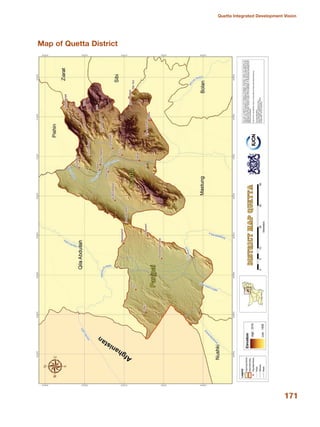
The district is bordered by Pishin, Mastung and Sibi districts on its north, south and
east respectively and also has common boundaries with Ziarat, Bolan and Nushki
districts. Quetta shares on the western side an international border with
Afghanistan. The geographical area of the district is 3,4991 sq. km. In 1998, its
population and population density were 759,941 and 286.42 per sq. km.
respectively. The population of the district is projected3 to become 1,026, 000 and
1,241,000 in 2011 and 2021 respectively.
The Quetta District comprises three administrative units, namely, Quetta City
(mainly an urban area, the largest in the province), Quetta Sadar (rural surroundings
of Quetta City in its east, north and west) and Panjpai tehsil (a rural area
sandwiched between Quetta City in the east, Mastung district in the south and
Afghanistan in the west).
Quetta City covers almost the entire Quetta valley; which is surrounded by hills on
three sides with a narrow opening in the north toward Kuchlak. The eastern part of
the city comprises of the largest cantonment in the province. Quetta has limitations
in terms of its expansion and flushing of the polluted air.
The district has many positive and negative resource attributes. The positive
attributes are its people, natural resources (including agriculture, watersheds,
forests, rangelands, protected areas, unique biodiversity and a range of economic
mineral deposits, especially coal and gas) and its strategic location. The negative
attributes include aridity, periodic droughts, fast depleting groundwater and
biodiversity, overgrazed and degraded rangelands, low productivity of the livestock,
rugged terrain in remote areas, to mention a few. The population density is very
high both in urban and rural areas except Panjpai tehsil.
Quetta City, as the capital and the largest settlement and cantonment in the
province, is the hub of tertiary education and health-care services as well as that of
viii
Quetta Integrated Development Vision
Executive Summary
1 According to map by Survey of Pakistan; according to the Quetta District Census Report (1998) the
area was 2,653 sq. km.
2 Government of Pakistan. Population Census Organisation. District Census Report (1998) Quetta.
Islamabad: PCO, Statistics Division, GoP, 2001.
3 Estimates by National Institute of Population Studies (NIPS), Islamabad.
ix
Quetta Integrated Development Vision
commerce and trade, and, as such, is the biggest
provider of jobs in the province.
The social indicators of Quetta District are the
highest in the province. The district is better served
than others in health-care, education, sports,
market, transport, sanitation facilities and power,
natural gas and other utility services. Quetta city is
accessible from all parts of the province and other
parts of Pakistan by national highways, other roads,
railways and air. Most parts of the district are
accessible despite the hilly terrain. The roads in the
remote areas of Quetta Sadar are mainly used for
transporting coal and other minerals from mines.
However, the district is facing serious multiple
challenges. There are issues of availability, quality
and cost of education and health-care services in
the district. Access to these services in the rural
areas is far inadequate, with Panjpai tehsil in
particular lagging behind other parts of the district
in this respect.
Urban development is fast-paced and unplanned.
Quetta is an over-populated city with an acute
shortage of drinking water and an abundance of
slums. The city«s physical and environmental
limitations hinder its expansion. The existing
infrastructure of water and sanitation, roads, parks
and open spaces and playgrounds is inadequate as
compared to the population which has grown
rapidly due to increasing rural-to-urban migration.
Building codes and regulations have not been
earnestly observed. A master plan for the city was
developed but was not implemented.
Environmental issues, such as incomplete and
unsafe disposal of solid waste and sewage as well
as traffic congestion and air pollution, remain a big
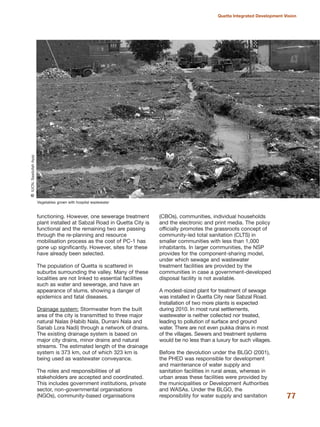
challenge. Vegetables are grown with untreated
sewerage water and sold and consumed by the
people of Quetta city.
Drinking water is scarce and groundwater is
depleting fast due to over-exploitation by the
population and by inefficient use in high-delta
agriculture, the lack of watershed management in
the catchment areas and housing schemes in active
water recharge zones. Groundwater pollution is also
a serious issue. The options for improvement
include: increasing water recharge, rain-water
harvesting, using efficient irrigation systems such as
Bubbler irrigation, and controlling water pollution.
Quetta Sadar is rich in mineral deposits, including
coal and natural gas, and most of these are being
exploited from the rural areas, not very far from
Quetta city. Quetta Sadar, mostly mountainous, is
also the catchment area of Quetta and other
valleys, which drain through many seasonal
streams and on which their groundwater resources
depend. It is, however, not perceived or managed
in this context.
Agriculture is the mainstay of people in the rural
areas and instrumental in economic gains. There
are orchards of many types of temperate fruits and
significant area is under cultivation of vegetables
but the agriculture is not sustainable due to
excessive and inefficient use of groundwater and
high use of agro-chemicals.
Livestock and rangelands are important for
subsistence and poverty reduction of people in the
rural areas, as it is necessary to meet the needs of
the population of Quetta City and the remaining
district for livestock products. The vast areas of
rangelands used for livestock herding are generally
overstocked and depleted, and have low
productivity. Dairy-farming, open-air slaughtering of
animals, poultry farming and production of animal
feed are widespread in the Quetta city.
The Juniper forests in the Zarghoon hills are next to
those in Ziarat district in terms of area and quality.
Scrub forests also exist in the district. The forests
constitute important watersheds for drinking and
irrigation water supply to Hanna and Urak villages,
Hanna lake, Spin Karez lake and Quetta
cantonment. Mainly bushy Juniper trees and broad-
leaved trees in streambeds and easier slopes are
grown in Hazarganji-Chiltan National Park. Out of
the two state forests in Panjpai tehsil, Koh-e-
Murdar is almost deforested and de-vegetated due
to over-exploitation and overgrazing.
There is a wide diversity of species of wild animals,
plants, habitats and ecosystems in the district. The
wildlife includes common leopard, endemic Chiltan
goat commonly known as Chiltan Markhor, Urial,
migratory and resident water-birds, reptiles,
amphibians and invertebrates. Hazarganji-Chiltan
National Park is one of the important protected
areas (PAs) of Pakistan. It has wildlife and other
biodiversity of global significance and is meant for
conservation of biodiversity and all other resources,
low-impact recreation, education and research.
Duzadara and Koh-e-Surko are the Game (Wildlife)
Sanctuaries for breeding wild animals and hunting
and other exploitative uses are prohibited there.
Karkhasa, now a part of the national park, Central
Zarghoon, Southern Takatu, Southern Malachi,
Hanna Lake, Spin Karez and Wail Tangi Dam are
other wildlife areas in the district.
Climate change has affected the natural resources,
people and economy of the area. The chilling
period required for producing quality temperate
fruits, such as apples and cherries, is less than it
used to be. Snowfall, rainfall and temperatures
have also been affected, resulting in longer and
more severe drought periods, far less availability of
water, and low productivity of agriculture and
rangelands, to mention a few.
The existing pillars of economic growth in the
district are commerce and trade, industry, mining,
agriculture livestock and service sectors. The
natural and cultural heritage of the district is rich
but the potential of eco-tourism and tourism has
not been realised, due mainly to insecurity, permit
policies for foreigners and lack of promotion of
tourist destinations. Most places of archaeological
significance in the district are buried under
ammunition depots.
Governance is as weak as elsewhere in the
province and the country. This is mainly due to
inherent system that privileges the rich, the
changing social values, influence of tribalism,
political interference, weak institutions,
incompetence of manpower, low-level use of
information technology, and lack of objectivity,
transparency and accountability.
The greater proportion of the issues and challenges
faced by the district relate to Quetta city, which is
grossly overpopulated due to in-migration from all
other, less resourceful parts of the province; and
also from other parts of Pakistan, mainly for
business and labour.
The problems common to all sectors in the district
include:
Lack of awareness and motivation where direct
and personal economic incentive is missing.
Preference for short-term measures and
personal gain as compared to long-term
policies and plans.
Weak governance, in particular lack of intra-
agency, cross-agency and sectoral
coordination, weak institutional capacities, and
individual incompetence in the public sector
agencies; inefficient use of human and
financial resource; weak compliance and
enforcement of law; and negative political
interference.
Lack of proactive and integrated planning and
management.
Discrimination against women and lack of
gender mainstreaming.
Low-level use of new technology in traditional
sectors and information technology, especially
use of traditional, inefficient irrigation methods.
The use of computers in the offices of the
public sector agencies is very low.
Lack of adequate and reliable data; lack of
database and information management
systems at the district level, with the exception
of education and health-care sectors, and lack
of information dissemination.
Imbalanced budgetary allocation among
different sectors, with very little share for
natural resource sectors.
A longer list of key issues in the district includes:
Issues of coverage and quality of education
and health-care.
Lack of urban planning and absence of a
master plan.
Insecurity due to militancy and insurgency in
the province against excesses and denial of
rights, as well as growing distance between
different ethnic groups.
Quetta city and district face food insecurity
due to deficiency in food items like pulses, milk
and chicken products, which are procured
from other parts of the country.
A political culture of agitations and strikes
prevails in Quetta city.
The ever-growing scarcity of drinking water in
Quetta city is one of the most serious issues.
Incomplete coverage and low quality of
municipal services including sanitation and
solid waste disposal. Hospital waste,
disorderly and polluting vehicle workshops and
washing stations need to be taken care of. The
traffic police and BEPA need to combat traffic
congestion and air, water and noise pollution.
Throwing garbage in Habib Nala (drain) and
other open drains.
Construction of residential and other structures
on the best water recharge areas.
Dairy farms in residential areas and
slaughtering of animals in the open.
Vegetables grown with untreated sewerage
water.x
Quetta Integrated Development Vision
xi
Quetta Integrated Development Vision
Issues of coverage and quality in education
and health-care sectors. Although Quetta is
better than all other districts in these sectors,
there is a lot of room for improvement.
The provincial capital is expected to establish,
maintain and provide tertiary level health-care
and education facilities not only to the
population of Quetta District, including the
increasing population of Quetta city, but also to
the people in the northern and central parts of
the province.
The district is seismically sensitive. A
devastating earthquake of 7.5 ML (Richter
scale) in 1935 caused 35,000 deaths4. Quetta
is affected by earthquakes more often than any
other district in the province. The district is
also affected by cyclical droughts.
The rural areas of the district, i.e. Quetta Sadar
and Panjpai, have not been integrated as yet
with Quetta City in regional planning, although
they are part of the region which supports and
is also dependent on Quetta City in various
ways.
Depletion and degradation of natural resources
including groundwater, watersheds, forests,
rangelands, wildlife and protected areas.
Excessive agricultural tubewells (both
sanctioned and unapproved) and subsidised
power tariffs give rise to water mining issues
and are a financial burden on the provincial
and federal governments and WAPDA. They
also create inequity since many users do not
pay for the utilities consumed.
Inefficient use of water, especially for irrigation
of high-delta orchards, vegetables and other
crops.
Lack of integrated management of Pishin Lora,
which is shared by the districts of Kalat,
Mastung, Quetta, Pishin, Qila Abdullah and
Noshki.
Economic development is fast but lacks
environmental considerations.
Mining is one of the pillars of growth but there
are issues of outdated methods, workers»
safety, occupational health, social security and
old-age benefits.
The power crisis has deepened with frequent
load-shedding and fluctuations in voltage,
affecting the productivity of industries and
SMEs, commerce and trade, human resources
in general and agriculture in particular.
The 2010-2011 budget of the provincial government
has been significantly enhanced as a result of a
substantial increase in the federal share. This trend
is likely to continue in the years to come and
provides a good opportunity to address the most
serious problems of the province. Quetta city with
its large population is riddled with multiple serious
problems. Because of depleting groundwater,
sustaining water-supply is one of the most
important issues that require urgent attention to
avoid the looming crisis and a long-term solution.
The Integrated District Development Vision (IDDV)
of Quetta has been developed, in this context,
through a wide consultative process. The current
situation, issues and challenges, measures,
opportunities and constraints have been discussed
sector-wise in the relevant chapters on governance,
social sectors, natural resources, economic
development and disaster management. Strengths,
weaknesses, opportunities and threats (SWOT)
have been assessed with regard to sustainable
development in the district and the inferences
drawn have been incorporated in this document.
The goals and objectives of the IDDV are to
achieve conservation and sustainable use of natural
resources, sustainable development and
environment protection in the district. The priority
sectors for Quetta District are water and sanitation,
population, health-care, education, housing and
settlements, commerce and trade, industry, mining,
energy, forests, wildlife and protected areas,
poverty eradication and governance. Millennium
Development Goals and targets focus on
eradicating poverty (MDG 1), achieving universal
primary education and gender equality (MDGs 2
and 3), improving mother and child health,
combating communicable diseases (MDGs 4, 5 and
6) and improving water and sanitation (MDG 7).
Water, agriculture, forests, rangelands, wildlife and
protected areas are the most important renewable
resources in the district. Fossil fuels and mineral
deposits are also there. Social services, i.e. health-
care, education and utilities, i.e. energy, transport,
communication infrastructure are by far the best in
the province. However, they still need to be
improved.
4 Government of Balochistan. Balochistan Disaster Management Authority. Balochistan Disaster Risk Management
Plan. Quetta: GoB, 2008.
The district, in particular Quetta City, is grossly
over-populated. Water scarcity is the most serious
concern as groundwater is depleting fast due to
over-exploitation, inefficient use of water for
orchards and agriculture; lack of watershed
management in the catchment areas and housing
on active water recharge zones. The forests,
rangelands, other watershed have degraded and
their productivity and environmental services have
reduced very much. Wildlife has declined in the
district; however, Hazarganji-Chiltan National Park
is an exception in this regard.
Consequently, the first priority is to halt and reverse
depletion and degradation of natural resources by
arranging and promoting the use of alternatives,
and development of existing resources. Further
development is also important for meeting the
future demands. The best achievement of the
people and the government would be to improve
the natural resources to their maximum potential for
sustainable management and use by them and
future generations.
The environmental conditions in the city have
deteriorated due to air, water, land and noise
pollution; incomplete and unsafe disposal of solid,
hospital and industrial wastes and sewage. Other
issues include traffic congestion, slaughtering of
animals in the open, establishment of dairy farms in
residential areas, removal of trees in the process of
widening of roads and conversion of open and
green spaces into built environment.
The priorities for development and implementation of
programmes and projects for the future are as under:
Governance
Improving security and addressing the issues
that have led to political insurgency.
Improving governance by strengthening
policies, laws, institutions, competencies,
planning, management and monitoring.
Establishing rule of law and improving
transparency and accountability.
Developing and implementing district plans for
all sectors.
Developing computer-based and GIS-
supported database of all sectors at the
district level; developing information
management and dissemination system;
improving availability and reliability of data and
information.
Improving information flow, in particular
horizontally, including all stakeholders.
Setting up and implementing a mechanism to
address people»s grievances.
Setting up a Steering Committee (of key
stakeholders) mechanism at the district level to
coordinate, disseminate, catalyse, support and
monitor the implementation of the IDDV.
Social Sectors
Improving cohesion and integration in society
focusing on common social and economic
development agenda.
Improving education, health-care and water
supply and sanitation sectors through
strengthening institutions, developing
competencies of staff, improving and adding
facilities, increasing budgets, providing
enabling environment, monitoring service
delivery and impact.
Mainstreaming equity and gender, and
eliminating gender disparity.
Natural Resources
Reconciliation of the district»s geographical
area with the Survey of Pakistan.
Determining land-use and un-reported land-
use with satellite images and ground-truthing
for future land-use planning, notwithstanding
the formal land-settlement exercise.
Land-use mapping and planning, as well as
assessment of natural resources in the district
using modern technology and methods.
Detailed delineation of sub-watersheds in the
district and evaluation of their potential for
forestry, agriculture, watershed management,
range management and water development.
(Surface water storage, hill torrent control,
rainwater harvesting and spate irrigation.)
Improving efficiency in the use of natural
resources (renewable and non-renewable
natural and energy resources) and reduction in
and safe disposal of wastes.
Rehabilitation of natural resources (water,
forests, livestock and rangelands and wildlife
and protected areas), enhancing their
productivity and sustainable use; andxii
Quetta Integrated Development Vision
xiii
Quetta Integrated Development Vision
achieving sustainability of water for agriculture,
industry, nature and other uses.
Making agriculture sustainable and modern
through the following:
Use of technology including the high
efficiency irrigation systems (e.g., land
levelling, on-farm water management and
Bubbler irrigation/drip irrigation) and
mechanisation appropriate to small land-
holdings and hilly terrain.
Greenhouse (tunnel) and off-season
vegetable production and organic farming.
Diversification of agriculture to include
low-delta fruit orchards, vegetables and
other agricultural crops in the valleys
where groundwater is depleting.
Improvement in the marketing of livestock,
fruits, vegetables, and medicinal and
aromatic plants.
Raising forest plantations, and encouraging
and supporting agro-forestry of multiple-
purpose trees for fodder, firewood, timber, soil
conservation, watershed, biodiversity and
carbon sequestration.
Setting up, planning and managing forests and
protected areas (wildlife areas) in the district on
scientific lines for conservation, sustainable
use and promotion of ecotourism.
Economic investment for improving rangelands
and livestock (improvement of breeds, feed
and health of animals) and supporting livestock
and poultry farming.
Evaluating grazing potential of rangelands of
the district and managing grazing accordingly.
Harnessing the potential of groundwater
recharge, rainwater harvesting.
Economic Development
Economic development through improving and
extending energy supply, commerce and trade,
mining, industry, tourism and SMEs for poverty
alleviation.
Controlling the spiralling high inflation and cost
of utilities.
Human resource development for alternative
sustainable livelihoods.
Urban and regional planning and implementation
to make Quetta city, its suburbs, neighbouring
towns, and big villages sustainable.
Upgradation of the existing towns and villages
and development of new planned medium-
level towns based on master plans.
Controlling air, water, soil, land and noise
pollution, and traffic congestion in Quetta city.
Exploring and developing agriculture and
livestock-based small and medium enterprises
(SMEs) for sustainable livelihoods and poverty
reduction (dairy development including animal
fattening for beef and meat, poultry farming,
bee-keeping, sericulture, preservation and
preparation of fruit and vegetable products,
wool based enterprises, large scale
handicrafts, and trade and commerce etc.).
Preservation and promotion of natural areas
and cultural sites for tourism.
Electrification of and energy development in
remote rural areas through dispersed
application of alternate energy sources
including biogas, solar PV, wind and solar
thermal; the latter would need wind data and
feasibility study.
Institutional strengthening of the Directorate
General of Minerals and Mining.
Exploration and promotion of mineral
exploitation and development of mining.
Improving power supply from the national grid.
Enhancing revenue generation at the district
level, especially through revival of octroi system.
Disasters
Establishment of early-warning systems for
drought by the federal government for the
district and other arid areas of the country.
Preparedness to reduce disaster risk, disaster
management to reduce damage and
rehabilitation for sustainability.
Establishing fodder tree groves, for use only
during drought periods.
Facilitating the use of appropriate designs and
construction materials for housing and other
infrastructure including dams, bridges, and
health-care, education and office buildings,
keeping in view the seismic sensitivity; facilitating
upgradation of existing houses as well.
Keeping and maintaining enough open green
spaces in Quetta City as green lungs of the
city.
The balanced growth model is appropriate for
Quetta District, despite the constraints of resources
and capacities. A balance between society,
economy and environment is crucial for sustainable
development. The balance between population and
resources is lacking and natural resources are
depleting due to past and present unsustainable
use. The real issue is of relative prioritisation and
sharing of financial resources. For example, major
investments in the public sector have been
allocated primarily to roads and other infrastructure
with very little or no investment on natural
resources and social sectors. A reprioritisation
needs to be made for future investment.
Improvement in both macroeconomic and
microeconomic conditions is important for the
sustainable development of the district. The former
creates an enabling environment for appropriate
economic growth (with participation and equity)
and the latter helps in the trickle-down effect,
which helps in equity and poverty-reduction.
Another related issue in this respect is that of scale,
e.g., corporate farming, which has the advantage of
using technology, and reducing costs of
production, transportation and marketing. The
appropriate options for communities in the district
are cooperative farming and shareholding in
corporate farming.
The policy and legal framework, approved by the
federal and provincial governments, create an
enabling environment and provide positive or
perverse economic incentives. An example of
perverse incentive is the subsidised flat tariff on
agricultural tubewells, a joint policy decision by the
federal and provincial governments and WAPDA
with short-term benefit to agriculturists but inequity
and long-term repercussions on the availability of
groundwater.
The implementing agencies will develop and
implement their flexible five-year plan:
Firstly, IDDV Action Plan to implement short-
term measures, coinciding with the Five Year
Plan 2010-2015 of the government.
Secondly, IDDV Action Plan for implementing
the medium-term measures and throw forward
in the various sectors during 2015 √ 2020.
Thirdly, IDDV Action Plan to implement the
long-term measures and the throw forward
during 2020 √ 2025
Implementation of the Action Plan will be monitored
annually and major constraints in implementation
will be identified and addressed. Its mid-term
impact on sustainability of the district will be
assessed in the third, eighth, and 13th year of
implementation in order to see its effectiveness and
impact, and course-correction. The IDDV may be
revised in 2025, in case the situation, issues and
options to address the issues have changed
significantly and additional opportunities have been
created by that time.
Implementation of this IDDV would require changes
in the management approach from ad hocism and
fire-fighting to pursuing the vision by providing
committed and effective leadership, involving all
stakeholders, enhancing capacities and
coordination; creating enabling environment,
motivating and providing economic incentives, and
generating and investing financial resources based
on clearly defined priorities. The district
administration would take the lead, implement its
agenda and coordinate, catalyse, support and
monitor implementation by other actors under the
guidance of the proposed IDDV Steering Committee.
Funds and institutional capacities will remain the
main constraint in the implementation of the IDDV.
The district generates significant revenue for
continuity but the major share is needed for
maintenance alone, apart from development
budget, which creates additional assets, capacities
and resources. The district has a great potential in
this regard. It is, therefore, important that the
district should get adequate allocations from the
revenue budget and share from the General Sales
Tax (GST) to avoid degeneration of its capacity to
raise revenue and enough development-budget to
maximise realisation of its development potential.
xiv
Quetta Integrated Development Vision
1
Dera Ismail Khan Integrated Development Vision
1. Integrated District
Development Vision (IDDV)
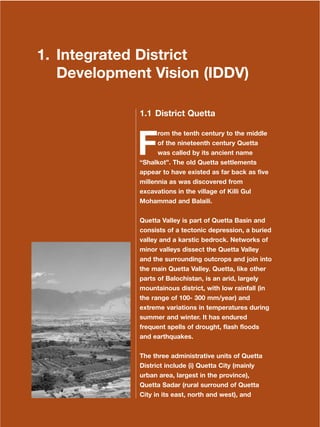
1.1 District Quetta
F
rom the tenth century to the middle
of the nineteenth century Quetta
was called by its ancient name
≈ShalkotΔ. The old Quetta settlements
appear to have existed as far back as five
millennia as was discovered from
excavations in the village of Killi Gul
Mohammad and Balaili.
Quetta Valley is part of Quetta Basin and
consists of a tectonic depression, a buried
valley and a karstic bedrock. Networks of
minor valleys dissect the Quetta Valley
and the surrounding outcrops and join into
the main Quetta Valley. Quetta, like other
parts of Balochistan, is an arid, largely
mountainous district, with low rainfall (in
the range of 100- 300 mm/year) and
extreme variations in temperatures during
summer and winter. It has endured
frequent spells of drought, flash floods
and earthquakes.
The three administrative units of Quetta
District include (i) Quetta City (mainly
urban area, largest in the province),
Quetta Sadar (rural surround of Quetta
City in its east, north and west), and
(iii) Panjpai tehsil (a rural area sandwiched
between Quetta City in the east, Mastung
District in the south and Afghanistan in the
west). Pishin, Mastung and Sibi Districts are
on it north, south and east respectively. Ziarat,
Bolan and Nushki districts touch its
boundaries on the north-east, south-east and
south-west respectively. Its western boundary
makes the international border with
Afghanistan.
Quetta City spreads almost on the entire
Quetta Valley which is surrounded by hills on
its three sides with narrow opening in the
north toward Kuchlak. The eastern part of the
city comprises of the Cantonment, the largest
in the province. The city has a limitation in
terms of its expansion and flushing of the air
pollution of the city.
Quetta City, being the provincial capital, is the
centre of tertiary education and health-care
services as well as the hub of commerce,
trade and employment. Quetta City is among
the largest centres of commerce and trade in
the country and is the biggest in the province.
Quetta is well-served by air, railways,
highways and black roads. It is well-
connected with the rest of the province and all
parts of the country.
Quetta Sadar is rich in mineral deposits, with
a large number of exploited coal mines in this
unit, especially in the eastern part.
Quetta District has the second largest area of
Juniper forest cover in the province (the
largest being in Ziarat District), water yield
from the hilly watersheds, wildlife and
protected areas including the famous
Hazarganji-Chiltan National Park, orchards of
almost all types of temperate fruits, significant
area under cultivation of vegetables, and vast
areas of rangelands for livestock herding.
Most parts of the district are accessible
despite its hilly terrain, thanks to the
construction of roads that are mainly meant
for transporting coal and other minerals from
mines, especially in Quetta Sadar. The social
indicators5 of Quetta City are the highest in
the province. Quetta Sadar and Panjpai tehsil
both have a good network of streams.
After the Soviet invasion of Afghanistan, there
used to be a heavy concentration of Afghan
refugees in five camps located in Panjpai
tehsil. The road network in this tehsil is
limited. There are two state forests and a very
large number of seasonal streams in Panjpal
tehsil.
The district has unique characteristics in
terms of its geography, location, soils, climate,
people and natural resources, and an
enormous potential for economic and social
development. However, there are also
challenges that impede the harnessing of its
potential.
1.2 Background
Ideally, a vision, in the context of the process
of development, is an expression of a
desirable future condition or situation which a
nation or a region envisages to attain and the
plausible course of action to be taken for its
achievements. It is the vision that works to
mobilise people and their resources - physical,
environmental and political - to achieve the
common goals. A true vision development
needs to be shared by a majority of
stakeholders. The shared vision imparts
courage and determination to achieve the
development goals. Thus, such a vision
provides hope, inspiration and motivation to
the people for working harder for its
realisation.
Planning proactively helps in achieving
development goals and objectives in a timely
and cost-effective way. It reduces problems,
because they are generally addressed in a
proactive mode. It helps in prioritisation of
issues, goals, objectives and investments. It
is, therefore, crucial that a vision is developed
for sustainable development of the district and
a destination, along with a route to approach
it, is decided and agreed upon through a wide
consultative process. In this regard, there is a
need for a short, medium and a long-term
plan, which is integrated and is developed
jointly by the citizens and other stakeholders.
This is the only way to harness local and
collective thinking, and to create a spirit of
collective responsibility and action.
It needs an exercise such as this one to
sufficiently clarify the roles and responsibilities
of various players in the process of planned
development of a district. The stakeholders
include the citizens of the district, all three
2
Quetta Integrated Development Vision
5 Literacy, enrolment, water and sanitation, skilled attendant at birth, contraceptive use, electricity etc.
levels of government, i.e. local, provincial and
federal, private sector, civil society
organisations, educational institutions,
research organisations, media and donors.
The present document was prepared as the
Balochistan Local Government Ordinance
(BLGO) 2001 had called for development and
approval of integrated development vision
(IDD) and various plans for each district.
Implementation and enforcement of the Fourth
and Sixth Schedules of the BLGO also
required a good understanding of the
situation, issues and the way forward.
Although the BLGO now stands repealed
(since January 2010) as a part of a change in
the system of local government, and things
seem to be in a flux, the utility and necessity
of the integrated development vision still
remains.
A district is not managed in isolation. Its
management is impacted by external factors
and dependence on the provincial and federal
governments as well as support from the
donors. In this age of globalisation, the district
has to have links with global regimes of
commerce and trade and has to comply with
and benefit from the various international
treaties and frameworks including the
multilateral environmental agreements (MEAs),
WTO and ISOs. Understanding and integration
of these frameworks is important for
sustainable management of the district.
1.2.1. Global relevant initiatives
International concern about non-sustainable
use of resources, and desire for combating
environmental degradation, and consequently
paving the way for sustainable development,
emerged from the appreciation of the World
Conservation Strategy (WCS) developed in
1980 by the IUCN and its partner agencies.
Meeting the Millennium
Development Goals (MDGs)
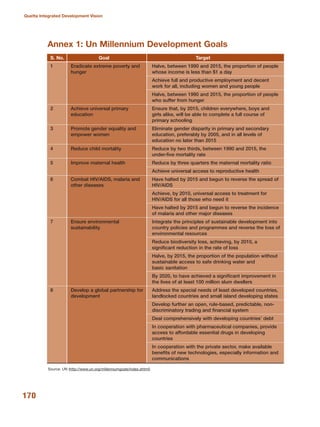
The Millennium Declaration signed by 189
countries has identified 8 Millennium
Development Goals or MDGs (Box 1) and 18
quantitative; time-bound targets to measure
achievement of these goals (Annex I) for all
nations of the world. These are more relevant
to the developing countries. Pakistan has
agreed to make efforts in order to meet these
goals in the specified time. These efforts are
to be made at the local level. Thus, these are
very relevant for the present IDDV as well.
Federal and provincial governments have
incorporated these goals and targets in their
policies and programmes - such as Mid-Term
Development Framework (MTDF) 2005-2010 -
and are trying to implement these through the
projects being or to be implemented in the
districts. The Poverty Reduction Strategy
Paper (PRSP) provides policy framework for
poverty reduction and achievement of the
targets of the MDGs in this regard. The PRSP
and the MDGs have provided the long-term
perspective for MTDF. All these efforts are
necessary to improve the well-being of people.
Agenda 21
According to Agenda 21 - one of the
important outputs of practical use of the
UNCED6 - integrated planning and
management is an eminently practical way to
meet future human requirements in a
sustainable manner. The essence of the
integrated approach finds expression in the
coordination of the sectoral planning and
management activities concerned with various
aspects of land-use and land resources.
1.2.2. National, provincial and
district level initiatives
Accepting the recommendations of the World
Conservation Strategy (WCS), Government of
3
Quetta Integrated Development Vision
Goal 1: Eradicate extreme poverty and hunger
Goal 2: Achieve universal primary eduation
Goal 3: Promote gender equiality and empower
wormen
Goal 4: Reduce child mortality
Goal 5: Improve maternal health
Goal 6: Combat HIV/AIDS, malaria and other
diseases
Goal 7: Ensure environmental sustainability
Goal 8: Develop a global partnership for
development
Box 1: Millennium Development
Goals (MDGs)
6 United Nations Conference on Environment and Development held in 1992 at Rio de Janeiro.
Pakistan (GOP) developed and approved, at
the federal cabinet level, the Pakistan National
Conservation Strategy (NCS) that had three
primary objectives: (i) conservation of natural
resources, (ii) sustainable development, and
(iii) improved efficiency in the use and
management of resource.
Seeing the usefulness of the consultative
process of development, and that of the NCS
itself, the Government of Balochistan (GOB)
developed the Balochistan Conservation
Strategy (BCS), with the technical assistance
of IUCN, and approved the same in 2000 for
implementation. The BCS aims at the well-
being of the people and ecosystems in
Balochistan. It provides a framework and a
strategic plan for the protection of
environment, conservation and sustainable
use of the natural resources and sustainable
development in the province of Balochistan.
Pakistan in the 21st century:
National Vision 2030
The emphasis of the National Vision 2030 is
on:
Economic Growth: To build a nation
whose development is measured by
economic growth as well as the quality of
life enjoyed by its people.
Society: To evolve into a tolerant and
productive society which is at peace with
itself and the outside world within a
framework of sovereignty and security.
Law: To establish rule of law as a bedrock
principle encompassing all spheres of life.
Role of the State: To encourage freedom
of enterprise and innovation in the
marketplace together with the state»s
responsibility for the provision of basic
services to all citizens, including
education, health-care, water-supply and
sanitation, shelter, and security under law.
Employment with special emphasis on
women»s rights: To make employment
and employability a central theme in
economic and social policies, with special
emphasis on the economic rights of
women.
Poverty Reduction: To eliminate abject
poverty and ensure social protection for
the weak and the vulnerable in society.
Education: To generate and absorb
knowledge and utilise technology for the
good of all while promoting social
sciences/humanities as an essential
branch of knowledge.
Economic Stability: To sustain an
average growth of 7 to 8 % in the long
term through effective investment and
saving strategies while maintaining
macroeconomic stability.
Economy: To take advantage of
globalisation through enhanced
competitiveness in a global economy
relating to commerce, manufacturing and
services, with increased diversity and
quality of content.
Brand Pakistan: To facilitate the emergence
of ≈Brand PakistanΔ, which will result in
several large conglomerates becoming
global players, and many more regional
hubs and centres established in Pakistan.
Governance: To re-design the structures
of the state and instruments of
government in terms of citizens»
participation, improved delivery of
services and good governance.
Demographic Transitions: To maximise
dividends from the demographic transition
in the coming years, while avoiding its
pitfalls.
Energy7: To manage the anticipated
growing competition for access and
ownership of resources and energy, both
regionally and globally.
Climate Change: To prepare for climate
change and its likely un-favourable
implications.
Natural Resources: To minimise wastage
of natural resources as an important tool
for preserving inter-generational equity.
Urban Growth: To prepare for the dynamics
and imperatives of growth of large cities,
4
Quetta Integrated Development Vision
7 Current per capita energy consumption is low (14 million BTUs as against 92 million BTUs for Malaysia). A target of
162,000 MW of power generation by 2030 is projected in the Energy Security Plan (2005) against the current supply
of less than 18,000 MW.
urban concentrations and expected internal
and international migration.
Education and Employment: To achieve
significant breakthroughs in the sectors of
education, employment and energy while
consolidating and expanding and
gathering momentum in infrastructure and
service sectors.
As the arena of action is mostly district, it is
important that the IDDV contribute in
assessing the situation regarding these high
objectives and in planning implementation of
the national vision at the district level.
1.3 Rationale
Section 18 of the BLGO required the Zila
Nazim to provide vision for wise development,
leadership and direction for efficient
functioning of the district government, and to
develop, with the assistance of the district
administration, strategies and timeframe for
accomplishment of the relevant goals
approved by the Zila Council. This provision
was made due to usefulness of
comprehensive and integrated planning and
management for a district. The Ordinance also
mandated establishment of a District
Mushavirat Committee ≈to crystallise vision for
integrated development of the district.8Δ
Although the ≈Devolution SystemΔ, as
embodied in the BLGO, has now stands
reversed, yet the need for such a framework
remains as the district is still the key
administrative unit of governance and
continues to be the main area of action and
implementation. The usefulness of
development and implementation of
sustainable development strategies or visions
was realised in some districts, e.g., Chitral
and Abbottabad, even before the ≈Devolution
SystemΔ was introduced in 2001.
Integrated district development visions
(IDDVs) were prepared by the district
governments of Dera Ismail Khan, Qila
Saifullah, Gwadar and Badin districts during
the period of ≈DevolutionΔ, with the technical
support of IUCN. In the latest initiative, IUCN
has helped develop the IDDVs of four districts,
namely Lasbela, Mastung, Pishin and Ziarat,
besides Quetta.
5
Quetta Integrated Development Vision
8 Government of Balochistan. Balochistan Local Government Ordinance 2001. Quetta: GoB, 2001. Section 140 (4) a.
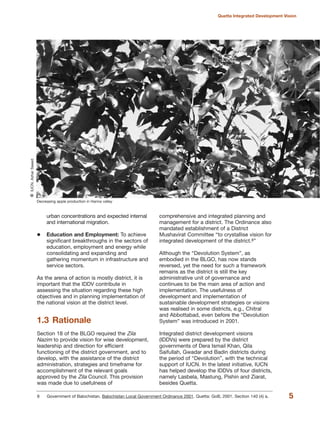
Decreasing apple production in Hanna valley
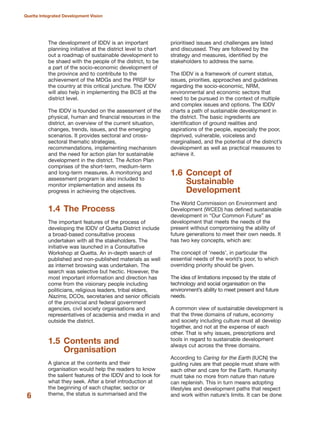
QIUCN,AzharSaeed
The development of IDDV is an important
planning initiative at the district level to chart
out a roadmap of sustainable development to
be shaed with the people of the district, to be
a part of the socio-economic development of
the province and to contribute to the
achievement of the MDGs and the PRSP for
the country at this critical juncture. The IDDV
will also help in implementing the BCS at the
district level.
The IDDV is founded on the assessment of the
physical, human and financial resources in the
district, an overview of the current situation,
changes, trends, issues, and the emerging
scenarios. It provides sectoral and cross-
sectoral thematic strategies,
recommendations, implementing mechanism
and the need for action plan for sustainable
development in the district. The Action Plan
comprises of the short-term, medium-term
and long-term measures. A monitoring and
assessment program is also included to
monitor implementation and assess its
progress in achieving the objectives.
1.4 The Process
The important features of the process of
developing the IDDV of Quetta District include
a broad-based consultative process
undertaken with all the stakeholders. The
initiative was launched in a Consultative
Workshop at Quetta. An in-depth search of
published and non-published materials as well
as internet browsing was undertaken. The
search was selective but hectic. However, the
most important information and direction has
come from the visionary people including
politicians, religious leaders, tribal elders,
Nazims, DCOs, secretaries and senior officials
of the provincial and federal government
agencies, civil society organisations and
representatives of academia and media in and
outside the district.
1.5 Contents and
Organisation
A glance at the contents and their
organisation would help the readers to know
the salient features of the IDDV and to look for
what they seek. After a brief introduction at
the beginning of each chapter, sector or
theme, the status is summarised and the
prioritised issues and challenges are listed
and discussed. They are followed by the
strategy and measures, identified by the
stakeholders to address the same.
The IDDV is a framework of current status,
issues, priorities, approaches and guidelines
regarding the socio-economic, NRM,
environmental and economic sectors that
need to be pursued in the context of multiple
and complex issues and options. The IDDV
charts a path of sustainable development in
the district. The basic ingredients are
identification of ground realities and
aspirations of the people, especially the poor,
deprived, vulnerable, voiceless and
marginalised, and the potential of the district»s
development as well as practical measures to
achieve it.
1.6 Concept of
Sustainable
Development
The World Commission on Environment and
Development (WCED) has defined sustainable
development in ≈Our Common FutureΔ as
development that meets the needs of the
present without compromising the ability of
future generations to meet their own needs. It
has two key concepts, which are:
The concept of «needs», in particular the
essential needs of the world»s poor, to which
overriding priority should be given.
The idea of limitations imposed by the state of
technology and social organisation on the
environment»s ability to meet present and future
needs.
A common view of sustainable development is
that the three domains of nature, economy
and society including culture must all develop
together, and not at the expense of each
other. That is why issues, prescriptions and
tools in regard to sustainable development
always cut across the three domains.
According to Caring for the Earth (IUCN) the
guiding rules are that people must share with
each other and care for the Earth. Humanity
must take no more from nature than nature
can replenish. This in turn means adopting
lifestyles and development paths that respect
and work within nature»s limits. It can be done6
Quetta Integrated Development Vision
without rejecting the many benefits that
modern technology has brought, if technology
also works within those limits.
Three basic principles that govern sustainable
development are economic, environmental
and social. Economically a system is
sustainable if it produces goods and services
on a continuous basis, and is capable of
setting aside imbalances. An environmentally
sustainable system must maintain a stable
resource base, avoid over-exploitation of
renewable resource systems and deplete non-
renewable resources only to the extent that
investment is made in adequate substitutes,
especially of renewable resources. A socially
sustainable system must achieve distributional
equity, gender equity, adequate provision of
social services including drinking water,
health-care and education, political
accountability and people»s participation in
decision-making.
1. The strategy for sustainable development
should aim to promote harmony among
human beings and between humanity and
nature. The pursuit of sustainable
development requires:
2. A political system that secures citizens»
participation in decision-making.
3. An economic system that is able to generate
surpluses and technical knowledge on a
self-reliant and sustained basis.
4. A social system that provides for solutions
for the tensions arising from
disharmonious development.
5. A production system that respects the
obligation to preserve the ecological base
for development.
6. A technological system that can search
continuously for new solutions.
7. An international system that fosters
sustainable patterns of trade and finance.
An administrative system that is flexible and
has the capacity for self- correction.
1.7 Vision of the District
The vision of the district should not only be in
line with the National Vision 2030 but it
should aim at contributing to the attainment
of the latter. As a result of the process of
cosultaions with citizens and public sector
representatives in Quetta District, and other
stakeholders, has been used to formulate the
following integrated development vision for
the district:
≈Quetta would be a district of aware,
informed, educated, peaceful, culturally
alive, gender-conscious, democratic,
progressive, skilful, honest, clean, healthy,
hardworking, capable, efficient, reliable and
responsible citizens who would enjoy justice,
equity, social services, basic facilities,
sustainable livelihoods, development
opportunities, healthy environment, security
and enabling conditions to contribute to
their district»s development and prosperity,
and better quality of life; and where cultural
and natural heritage as well as religious
values would be preserved, conservation
and sustainable use of natural resources
would be practiced, and poverty and
illiteracy would become historyΔ.
The vision is further elaborated by defining its
various elements below:
Adequate and efficient social services
and basic facilities, including safe
drinking water, sanitation, health-care,
education, and energy for lighting,
cooking and heating, for all citizens of
the district.
Planned, clean and sustainable housing,
settlements and other communication
infrastructure.
Sustainable agriculture, incorporating:
Low-delta fruit orchards, vegetables
and other ecologically suitable crops.
Water development and its efficient
use for the expansion of agriculture.
Improved rangelands, managed
sustainably and supporting healthy
livestock.
Conservation and sustainable use of
natural forests and raising of farmland
planting for meeting the needs of people
for wood and non-wood forest products
as well as for environmental services.
7
Quetta Integrated Development Vision
Sustainable livelihoods based on improved
agriculture, livestock and range
management on commercial lines,
expanded and value-added mining
including upgrading chromite and marble
products, commerce, trade and transport.
Mini, small and medium enterprises
(related to fruits and vegetables, poultry,
animal-fattening, milk-production, wool-
processing and products, bee-keeping,
sericulture, handicrafts, workshops of
automobiles and agricultural machinery,
sale and repair of communication
equipment and reusable waste.
Efficient and effective institutions with
competent and service-oriented
manpower.
1.8 Objectives
The objectives of the IDDV are to promote:
1. Planning, catalysing, promoting,
supporting and monitoring sustainable
development of Quetta District.
2. Conservation and sustainable use of
natural resources.
3. Environmental sustainability.
4. Poverty-reduction through sustainable
livelihoods and equity.
5. Human resource development.
6. Strengthening of institutional framework.
7. Improving the quality of life of citizens of
the district.
8. Filling in gender gaps and gender-
mainstreaming.
9. Improving access to information.
10. Bringing the district at par with and taking
it even ahead of other developed districts
of the province and country.
The attainment of the objectives would be
made possible by:
1. Government creating an enabling
environment for the institutions,
communities, private sector, civil society
organisations, academia and media for
playing their full role since it is essential
for the district to flourish socially,
economically, politically and culturally.
2. Making the natural resource-base robust
with halting and reversing degradation,
and further development.
3. Discovering and promoting alternative
sustainable livelihoods aimed at poverty-
reduction and reducing degradation of
natural resources.
4. Benefiting from the experiences of
community based initiatives in Gilgit-
Baltistan (GB), Chitral District and Torghar
(Qila Saifullah) which have been supported
by the civil society organisations working
there.
5. Taking advantage of training and
educational facilities at the provincial and
national level in developing the human
resource.
1.9 Principles
Following principles have been used in
developing the IDDV and they will be useful
during its implementation as well:
1. Consultation with and participation of
people, communities and all other
stakeholders in planning.
2. Joint responsibility and preference for the
betterment of present and future
generations of citizens.
3. People-friendly and environment-friendly
development.
4. Preference to long-term sustainable
development over short- and medium-
term gains only.
5. Integrated planning and management.
6. Gender-mainstreaming.
8
Quetta Integrated Development Vision
9
Dera Ismail Khan Integrated Development Vision
2. Governance and Institutions
2.1 Governance9
G
overnance covers the different
aspects of relations between the
state and civil society. It is the
process through which societies or
organisations make important decisions,
determine whom they involve and how
they make them accountable. Good
governance is about both achieving
desired results and achieving them in the
right way. According to CIDA, governance
means the manner in which power is
exercised by governments in the
management of social and economic
resources. ≈GoodΔ governance is the
exercise of power by various levels of
government that is effective, honest,
equitable, transparent and accountable.
Generally, governance includes
development and working of policy, legal
and institutional frameworks. Good
governance leads to positive
consequences, including trust, clear
direction, positive inputs from
stakeholders, good decisions, ability to
withstand crises and financial stability.
9 Institute on Governance. Governance. Canada. Available
http://iog.ca/en/about-us/governance.
good decisions, ability to withstand crises and
financial stability. The concept and practice of
governance of natural resource management
(NRM) is emerging as a popular debate in
many countries. This debate enshrines many
aspects including people, processes and
structures in a range of circumstances. Hence,
wider participation of all civil society segments
is crucial.
Some key characteristics of good governance
are given at Box 2:
UNDP Principles of Good Governance are
given at Box 3.
The progress in sustainable development
depends on flawless governance. The global
principles, for successful application, may
need some prioritisation for improvement in
governance keeping in view the local
conditions. The role of the Judiciary and
media is critical to monitor weaknesses in
governance. Civil societies can also play a
vital role in identifying the weaknesses and
helping in improving transparency and
accountability.
The government»s ability to ensure law and
order and provide services such as education
and health-care is vital for winning the hearts
and minds of the public, and restoring links
between the citizens and the state. However,
it is admitted that decades of
mismanagement, political manipulation and
corruption have rendered Pakistan»s civil
service incapable of providing effective
governance and basic public services. The
situation needs to be improved, and this
forms a part of the IDDV.
Transforming the civil service into an effective,
more flexible and responsive institution is
required. There is also need for modernising
bureaucratic rules, procedures and structures
and arranging training programmes for
inculcating a spirit of public service in the civil
servants. Accountability of officials must be
effective, impartial and transparent. Incentives
for corruption could be reduced significantly
with higher salaries and benefits, and better
conditions of employment.
10
Quetta Integrated Development Vision
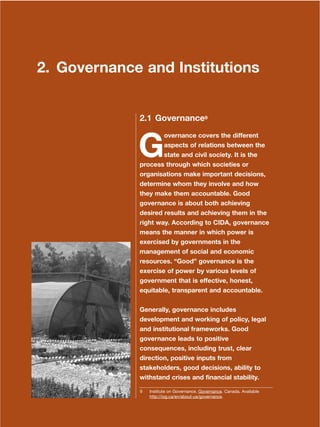
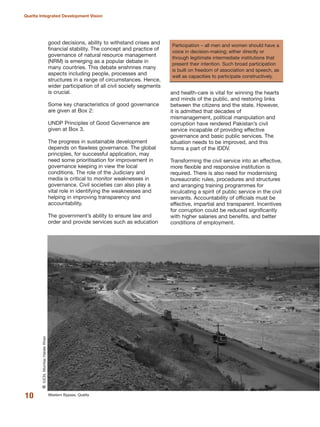
Western Bypass, Quetta
QIUCN,MumtazHaiderKhan Participation √ all men and women should have a
voice in decision-making; either directly or
through legitimate intermediate institutions that
present their intention. Such broad participation
is built on freedom of association and speech, as
well as capacities to participate constructively.
2.2 Devolution
It is critical to increase community»s
involvement in activities that contribute to the
social capital and provide a forum for all
residents to participate in establishing and
achieving the objectives of sustainable
development of the district. The Devolution
was the most significant change in the
governance system towards achieving
community participation. GOB enacted the
Balochistan Local Government Ordinance
(BLGO) 2001 and transferred some of the
functions and powers of the provincial
government to the local governments at
district, tehsil / town and union council levels.
The devolved system of local government
created under the BLGO had five main
objectives; (i) devolution of political power, (ii)
decentralisation of administrative authority, (iii)
distribution of resources to the districts, (iv)
de-concentration of management functions,
and (v) diffusion of power and authority. The
aim of the BLGO was to create a fully
participatory, responsible and accountable
local government system. This called for a
rather fundamental change in the governance
with redistribution of economic resources and
consequently social power.
The devolved system was supposed to use
proactive approach to involve people in
development through CCBs as participatory
development institutions for undertaking local
community development initiatives. These
could not be, however, formed or registered
during the first term of the district
government. Similarly, village and
neighbourhood councils, as grassroots
participatory planning institutions, could not
be formed in any district of the country10.
Under the devolved system of local
governments, the district government used to
be headed by the District Nazim and
supported by the District Coordination Officer
11
Quetta Integrated Development Vision
Efficiency, discipline and accountability.
Continuous monitoring and public
grievances» address system. District Criminal
Justice Coordination Committee to handle
the system of dispensation of justice and
ensure rule of law in the police and allied
institutions» working to execute the national
judicial policy; Like overseeing bodies at
district and provincial level to handle
complaints and allied issues.
Democratic control for police accountability.
Manned by elected MNAs/MPAs and
eminent persons from civil society, in
addition to government officers; Provide
policy guidance and redress complaints
against them; the democratic control also
protecting the police from extraneous
pressures. Such systems of over viewing
have been evolved elsewhere in the world
like the UK, India, Japan and Malaysia and
are successfully protecting public interests.
Suo moto actions by the superior judiciary,
writ jurisdiction of courts and checks of trial
courts.
Continuous accountability, under an
independent media regime.
Change in the mind-set of public servants
towards performing their duties and serving
the public.
Evolving institutional cooperation and
coordination.
Box 2: Characteristics of good
governance
Participation √ all men and women should have
a voice in decision-making; either directly or
through legitimate intermediate institutions that
represent their intention. Such broad participation
is built on freedom of association and speech, as
well as capacities to participate constructively.
Consensus orientation √ good governance
mediates differing interests to reach a broad
consensus on what is in the best interest of the
group and, where possible, on policies and
procedures.
Strategic vision √ leaders and the public have a
broad and long-term perspective on good
governance and human development, along with
a sense of what is needed for such development.
There is also an understanding of the historical,
cultural and social complexities in which that
perspective is grounded.
Box 3: The UNDP Principles of good
governance
10 Asian Development Bank, Department for International Development and World Bank. Devolution in Pakistan: An
Assessment and Recommendation for Action. Islamabad: ADB, DFID & WB, 2004, Page 24.
(DCO). The DCO»s job was to coordinate the
district level officers for coherent planning,
synergistic development, and effective and
efficient functioning of the district
administration. His other function was to
ensure that the official business in the district
was managed in accordance with the laws
and defined procedures. District Police Officer,
EDOs of Revenue, C&W, PHE, Education,
Health, Agriculture, Forests, Livestock and
Community Development led their respective
departments.
Tehsil Officer, Infrastructure and Services (TO
I&S) was responsible for water, sewerage,
drainage, sanitation, LG roads, streets and
street-lighting; fire-fighting and park services.
The PHED was devolved partially, the
provincial tier»s responsibility being for
projects of Rs. 5 million or more and of its
district office for projects of lower amounts.
The coordination between the two PHED parts
and theirs with the Tehsil Officer, Planning
(TOP) remained weak. The latter was
responsible for spatial planning and land-use
control; building control; and coordination of
development plans and projects with Union
Council Administrations, Village Councils and
other local governments.
The local government is a provincial subject
under the Constitution but it was included in
the Sixth Schedule of the Constitution
forbidding the provinces from making any
changes in the law without prior approval of
the President of Pakistan. The status stands
reversed after 31 December 2009 when the
subject stood transferred to the provinces
under the Constitution. The provinces are now
free to devise their own policies on their local
bodies. However, the federal government
wishes to develop consensus among the
provinces for a uniform system.
The devolved system could survive, against
odds, for less than eight years. Major
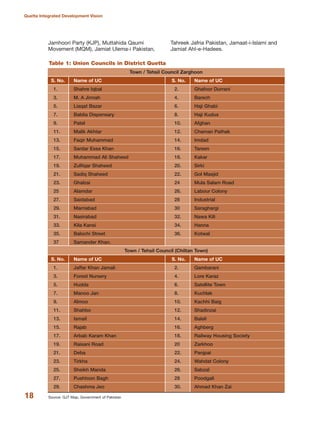
development projects in Quetta, even during
devolution, were implemented by the federal
and provincial governments» agencies without
the involvement of the district government.
The district government departments were
engaged in their routine activities and were
sidelined in major developments taking place
in the district.
International Crisis Group (ICG)11 (2010)
analysed the structure and functioning of
Pakistan»s civil bureaucracy, identified critical
flaws and suggested measures to make it
more accountable and able to provide
essential public services. According to ICG,
≈DevolutionΔ of power led to an increase in
administrative confusion and the breakdown
of service delivery at the district level. It led to
greater collusion between unscrupulous
district officials and corrupt police. Low
salaries, insecure tenure, and obsolete
accountability mechanisms spawned
widespread corruption and impunity.
Recruitments, postings and promotions were
increasingly made through other channels
instead of being based on merit. It identified
for Pakistan (though not specific to but
equally applicable to Quetta District) the
issues of mismatched skills, undue political
interference and lack of objectives or priorities
during the period of devolution.
Prior to Devolution, projects were identified,
selected and developed by the line
departments at the provincial level. The local
communities were neither consulted in
planning nor involved in implementation.
Participation of local community in planning
was the main purpose of Devolution. People
suggested projects to their councillors, who
approached the line departments and the
district government for their funding.
The change in the governance system was
very slow as the majority of stakeholders tried
to maintain the status quo. The failure of the
Devolution system had several reasons. It was
not supported; rather impediments were
created in devolution of administrative and
financial powers, devolving the function-and-
activities related budgets, and providing
technical guidance and supervision to the
devolved staff.
Management skills and professional or
technical skills are of different nature.
Generally, professionals were assigned to
managerial positions, e.g., posting of teachers
and doctors, who had no previous experience
in managing personnel, and allocating or
utilising budgets, as EDOs or district officers
of education and health, respectively.
Management structure and functions were
12
Quetta Integrated Development Vision
11 International Crisis Group. Reforming Pakistan»s Civil Service. Asia Report # 185, February 2010. Islamabad: ICG,
2010. Available http://www.crisisgroup.org/~/media/Files/asia/south-
asia/pakistan/185%20Reforming%20Pakistans%20Civil%20Service.ashx.
often mismatched. The government managers
were not responding to the concerns of the
representatives of the people.
The government managers faced the
interference of politicians in district affairs
constantly. Local government»s allocation of
budget to the social and natural resource
sectors was very low and actually precluded
the delivery of quality services and results
respectively.
Few local governments had clearly stated
objectives and priorities, which meant that the
resource allocation process lacked direction,
as did policy priorities of the provincial
government. Fund allocation was conceived as
a tool for political purposes for winning votes
and not to promote health-care and education
sectors or to sustain natural resources sectors
such as agriculture, forest and wildlife, and
livestock and rangelands. No attempts were
made to ensure that current budget allocations
were sustainable as defined in the ADP.
Financial management and procurement
systems within district governments were
bureaucratic and not transparent.
The councillors and Nazims were elected on a
non-party basis but with active, behind the
scene support from political parties, which
created confusion in the minds of voters. A
lack of basic qualification and necessary
experience did not allow the elected
representatives to perform as expected.
The Nazims and councillors prioritised the
short-term developments, e.g., street lights,
pavement of streets, stormwater and sewer
drains, water-supply, roads etc. even at the
expense of the programmes and activities of
the natural resources sectors. As a result, the
budgets of agriculture, livestock, forest and
wildlife departments were affected negatively
and even their regular functions came to a
standstill. They survived on the budget
meant for projects funded by provincial or
federal government or donors during the
Devolution period, even for their regular
maintenance works.
Although efforts were made to develop
capacities of Nazims and councillors to run
the business of the devolved local
governments but the system lacked continued
patronage and support of the provincial
government. Even otherwise, any new system
takes much longer, especially against odds, to
show its usefulness and results. The devolved
system changed the established system of
authority and decision-making in the
provincial and district governments.
Obviously, ready acceptance could not be
expected. Adoption and acceptance of the
new system required continuous support,
monitoring, adjustment and institutional
strengthening, but this did not happen.
The tenure of local councils in the devolved
system expired in October 2009, but there
was no legal and constitutional recourse
available with the provincial government to
dissolve the then existing local councils.
Therefore, the Provincial Assembly passed a
bill on January 5, 2010 for the enabling
powers to do so, which became a law on
signing by the Governor. Through an
Amendment Bill, a new Section 179-B was
inserted in the Local Government Ordinance,
2001. This section empowers the provincial
government to dissolve district, tehsil and
union councils. As a result, all Nazims, Naib
Nazims and other members of district, tehsil,
town and union councils ceased to hold their
respective offices and the Administrators
replaced Nazims to look after the local
governments at the various levels pending the
elections, which may be held on political-party
basis during 2011.
According to the amended law, the
government may from time to time issue 13
Quetta Integrated Development Vision
Suraj Ganj Baazar
QIUCN,MumtazHaiderKhan
directions to Administrators for performance
of their functions or exercise of powers. The
amendment drew criticism from Nazims and
councillors and one-day strike was observed
in mid-January 2010 in Quetta and some
other areas in Balochistan. Local governments
were dissolved by the GoB on 19 March 2010
and Administrators replaced the Nazims.
However, now that the GLBO has been
repealed, the district should aim for improving
the governance and delivery of services to
people with their participation under the new
system of provincial cum local government
administration.
2.2.1.Best practices resulting
from devolution
The devolved governments in various districts,
where the leadership was dynamic, developed
best practices. Spatial planning, both rural
and urban, comes under the purview of the
tehsil administration. The experiences of some
TMAs in the country are positive with regard
to the use of GIS facility and information
management12 in this regard. The replication
and introduction of such practices in other
districts is possible. Most of these are
included as measures.
2.2.2. Status of key elements of
governance and devolution
Policies and laws
The federal government makes policies and
laws regarding the subjects on the Federal
List, and the Concurrent List until the 18th
Amendment of the Constitution of Pakistan.
The provinces can make policies and laws of
the subjects on the provincial and recently
devolved Concurrent List. However, the
provincial governments have been reluntant to
make policies, even for the subjects in their
jurisdiction.
There are a few exceptions, e.g., the Forest
Policy (1999) and Forest Law (2002) of Khyber
Pakhtunkhwa and the Forest Statement (1997)
of Punjab. The provincial governments have,
however, been legislating on the subjects in
their jurisdiction and have been making
operational policies on specific issues, e.g.,
installation of tubewells to guard against
overexploitation of groundwater. The districts
implement the policies, whatever they may be,
but do not contribute at all in the making of
policies and provincial laws, although they are
meant for implementation at the district level.
It is crucial that the district-specific guidelines
are developed for effective implementation of
federal and provincial policies in the district.
The NCS and BCS are policy and strategy
documents regarding sustainable
development for Pakistan and Balochistan
respectively. These cover protection of
environment, conservation of natural
resources, and socio-economic well-being of
the people. Similarly, the IDDV fills in the
policy and strategy gap at the district level
and is credible, having been developed
through the consultative process. Policy
formulation, law enactments, IDDV
developments are major feat but their
implementation remains a real challenge.
Legislative cover, in most aspects, is
comprehensive in the country but its
enforcement is generally very weak. The
effective enforcement will help in
implementation of the law-related aspects of
the IDDV, e.g., pollution control; sustainable
use of groundwater; environment-friendly
mining, water, infrastructure and other
developments; sustainable use of natural
resources, workers» safety and occupational
health in the mining sector.
Need for coordination
Coordination is defined as ≈working
cooperatively to more effectively apply the
resources of several organisations for
achieving targets of common interestΔ.
Coordination among various levels of the
government, between line agencies and with
other stakeholders including civil society
organisations, private sector, academia and
media is very weak at present. The
government departments do not usually share
resources and information with others. The
vertical links are strong in the current
hierarchical structure and horizontal links are
missing. The coordination mechanisms
instituted for specific purposes also fail to
meet the objectives.
Need for planning at the district level
Planning in Pakistan is centralised at the
national and provincial levels. Medium-term
14
Quetta Integrated Development Vision
12 TMA Jaranwala, Faisalabad District, 2006. Available http://www.faisalabad.gov.pk/departments/tma_jaranwala.php.
Development Framework (MTDF) is a five-year
plan for 2005 - 2010 prepared by the federal
government. The provincial public sector
programme is prepared by the line
departments and is consolidated and
approved by the provincial Planning and
Development Department (P&DD). The MNAs
and MPAs also play an important role in
defining priorities for the federal and provincial
public sector development programmes
regarding their respective districts. However,
the District Development Working Party
(DDWP) was the approval forum for PC-1s of
the projects implemented with the funds
allocated to the districts.
The planning did not devolve to the district
level in the true sense even during the
Devolution period which lasted from 2001 to
2009. Planning at the district level is at
present very weak and for short-term, often
limited to one year period. As a result,
medium-term and long-term priorities are lost
as the horizon of thinking and planning is
narrow. Generally, the sort of planning done
at the district level is in a responsive way to
utilise the allocated budget. The concepts of
long-term vision and sustainable
development need to be introduced at the
district level.
The current 5-Year Plan of the federal
government was developed with input from
the provincial governments and other
stakeholders. However, it appears that the
district governments were not able to
participate in and provide input to this
exercise traditionally as well as due to
uncertainty of the system of local bodies.
Need to improve transparency and
accountability
Good governance and public accountability
are vital for effectiveness of any management
system but both are generally weak in the
public sector, including at the district level.
These aspects of governance improved to
certain extent during the Devolution period
regarding the development works carried out
through their elected councillors.
Good governance and public accountability
need to move beyond rhetoric in the country,
the province and the district. One of the
objectives of the devolved local government
system was to bring transparency and
accountability. The BCS had emphasised
devolution of power for accountability and this
was enshrined in the devolved system of local
governments. Providing information to the
masses about development plans,
15
Quetta Integrated Development Vision
A newly-built commercial building at Jinnah Road
QIUCN,MumtazHaiderKhan
programmes, projects, funding,
implementation methodology, process,
schedules, monitoring mechanism and how
they can participate or contribute can be an
important step forward to bring transparency
and public accountability.
The provision of non-intrusive monitoring of
government departments in the BLGO by the
peoples» representatives-led monitoring
committees was a useful instrument for
accountability but it was not used. The office
of District Ombudsman provided in the BLGO
was another measure in the same direction
but it was not set up in Quetta District, like
other districts. The district government needs
to take steps to ensure accountability and
transparency in the functioning of line
departments, TMAs etc.
The BLGO made provision for several house
committees responsible for ensuring good
governance and accountability of the district
government. The functioning of these legally
mandated committees, especially the
Mushavirat Committee and Monitoring
Committees, was necessary to ensure
transparency and accountability of the district
government. The District Council formed
these committees but these remained
dormant.
Need for information management
Information Management for the district
administration refers to the effective
collection, storage, access, use and
dissemination of information to support
government functions of policy-making,
planning and meeting the information needs of
the public, stakeholders and other users.
Information management is weak in the public
sector at all levels generally and at the district
and lower levels in particular. Inconsistencies
in the available data are common as well as in
the data and situation on the ground, partly
due to lack of updating of data. There are
wide gaps in district related information
needed for planning and management for their
own needs and for sharing with the other
departments and stakeholders.
There is need for a system for information-
need identification, collection, classification,
documentation and its presentation on annual
basis in the sector departments or centrally in
the province or any district. Management
Information Systems were, however,
established in the Education and Health
Departments at the provincial and district
levels and are functioning well. Information is
used generally as a tool for holding power and
is not shared readily.
Poor information management is the greatest
hurdle in situation analysis and development
planning. There is need for capacity-building
of line departments in collection and
management, use and presentation of
reliable data about their assets, services
and sectors.
Need for improved research and
development
Innovative approaches and research are
required to catch up with the contemporary
global society of the 21st century.
Organisations and researchers around the
world are known to have been creative
working with communities living in situations
of fragility and remoteness to find solutions to
ensure delivery of basic services, improve
governance and create opportunities of
livelihoods.
Innovation that utilise cutting-edge
technologies and communication tools can
help in improving service delivery or improving
citizen-government relationships through
enhanced transparency and accountability.
The delivery of basic social services (e.g., in
the health and education sectors) and
governance and accountability (e.g., budget
oversight and expenditure tracking) can be
improved with the use of communication
tools. Innovative research and practical
approaches for preventing violence and
reducing incentives for crime are also
required.
It is important to identify high-impact
approaches, and innovative solutions and
models that were tested and have potential
for scale up, and experiences of other places
for benefitting, establish collaboration, and
forge longer-term partnerships. Researchers in
universities and research organisations within
and outside Balochistan and Pakistan should
be encouraged to conduct research to provide
effective responses to the local situations in
Quetta District and Balochistan. Proposals
should present practical solutions in the short
run to address the root causes of issues and
long-term development needs, which is a
lasting route to achieving welfare of people,
and peace and security for them.
16
Quetta Integrated Development Vision
Revenue generation at the
district level
The relevant federal, provincial and local
government agencies generate revenue in the
district. The Municipal Corporation Quetta
generated about Rs. 350 million annually from
octroi charge before capping it in 1990s. The
corporation and municipal committees in the
district collect sanitation fee, property tax and
business licence tax. The municipal committee
and the PHED, both of which are supplying
water in the urban and rural areas respectively,
collect water charges. The concerned
provincial departments collect livestock cess,
agriculture cess, land revenue, property tax in
towns, vehicle registration tax, and mining
royalties. The federal agencies collect income
tax and customs duty. The revenue units are
tehsils for land revenue. The revenue resources
of Quetta District are high but depend mainly
on provincial allocations from the revenue and
development budgets as the district
establishes and maintains services for
requirement of the provincial capital.
2.3 Political and
Administrative Setup
In 1883, Quetta was formed into a separate
single administrative unit (Quetta-Pishin
district). In March 1883, the Khan of Kalat
leased Quetta to the British authorities. Due to
its geo-strategic importance, the British built
Quetta as a garrison town. It became a part of
Pakistan in 1947. Under One-Unit System
from 1955 to 1970, Quetta and Kalat were the
administrative units in West Pakistan. Quetta
became capital of Balochistan province in
1970. Until 1975, Quetta and Pishin were a
single administrative unit when Pishin was
separated.
Quetta District is divided into 3 National
Assembly and 10 Provincial Assembly
constituencies, and 4 Senate seats are
earmarked for the District. People elect their
representatives to local bodies. Religious and
tribal affiliations play a crucial role in electing
public representatives. The political parties in
Quetta District are Pakistan Peoples» Party
Parliamentarian (PPPP), Jamiat Ulema-i Islam
(JUI), Pakistan Muslim League (Q), Pakistan
Muslim League (N), Jamhoori Watan Party
(JWP), Pakhtunkhwa Milli Awami Party
(PMAP), Balochistan National Party (Mengal
Group), Balochistan National Party (Awami),
Balochistan National Movement (BNM),
Pakistan Workers Party (PWP), Pakistan
Tahreek-i-Insaaf (PTI), Balochistan National
Party (Bizenjo), Awami National Party (ANP),
Hazara Democratic Party (HDP), Kakar
17
Quetta Integrated Development Vision
Meezan Chowk, Quetta
QIUCN,MumtazHaiderKhan
Jamhoori Party (KJP), Muttahida Qaumi
Movement (MQM), Jamiat Ulema-i Pakistan,
Tahreek Jafria Pakistan, Jamaat-i-Islami and
Jamiat Ahl-e-Hadees.
18
Quetta Integrated Development Vision
Source: GJT Map, Government of Pakistan
Table 1: Union Councils in District Quetta
Town / Tehsil Council Zarghoon
S. No. Name of UC S. No. Name of UC
1. Shahre Iqbal 2. Ghafoor Durrani
3. M. A Jinnah 4. Barech
5. Liaqat Bazar 6. Haji Ghabi
7. Baldia Dispensary 8. Haji Kudus
9. Patel 10. Afghan
11. Malik Akhtar 12. Chaman Pathak
13. Faqir Muhammad 14. Imdad
15. Sardar Essa Khan 16. Tareen
17. Muhammad Ali Shaheed 18. Kakar
19. Zulfiqar Shaheed 20. Sirki
21. Sadiq Shaheed 22. Gol Masjid
23. Ghalzai 24 Mula Salam Road
25 Alamdar 26. Labour Colony
27. Saidabad 28 Industrial
29. Marriabad 30 Saraghargi
31. Nasirabad 32. Nawa Kili
33. Kila Kansi 34. Hanna
35. Balochi Street 36. Kotwal
37 Samander Khan.
Town / Tehsil Council (Chiltan Town)
S. No. Name of UC S. No. Name of UC
1. Jaffar Khan Jamali 2. Qambarani
3. Forest Nursery 4. Lore Karaz
5. Hudda 6. Satellite Town
7. Manoo Jan 8. Kuchlak
9. Almoo 10. Kachhi Baig
11. Shahbo 12. Shadinzai
13. Ismail 14. Baleli
15. Rajab 16. Aghberg
17. Arbab Karam Khan 18. Railway Housing Society
19. Raisani Road 20 Zarkhoo
21. Deba 22. Panjpai
23. Tirkha 24. Wahdat Colony
25. Sheikh Manda 26. Sabzal
27. Pushtoon Bagh 28 Poodgali
29. Chashma Jeo 30. Ahmad Khan Zai
The members of local bodies were nominated
and administrated by the Deputy
Commissioner during the British regime. After
independence of the country in 1947, the local
bodies remained inactive in Quetta District, as
elsewhere in the province, until the Basic
Democracies (BDs) Order of 1959. This
system created four tiers: (1) Union council, (2)
Tehsil council, (3) District council, and (4)
Divisional council. In urban areas, Town
Committees and Municipal Committees were
set up in place as the first two tiers.
The Quetta Municipal Corporation is
responsible for all municipal functions in
Quetta City. Quetta District consists of
Zarghoon Town and Chiltan Town (in Quetta
city), Quetta Sadr and Panjpai tehsil inclusive
of 67 union councils. The union councils in
district Quetta are given in Table 1.
The BDs system was replaced with the
Balochistan Local Government Ordinance,
1980. It comprised of Union Councils and
District Councils for rural areas and replaced
the former with Town or Municipal
Committees for urban areas.
The traditional decision-making was done by
the «Jirga» (informal council of elders) which
enjoyed the patronage of the government and
exercised semi-judicial powers in the past but
has now gradually weakened. Although
decision-making now is generally through
statutory law, the Jirga is still involved in
decision-making in rural areas.
On the initiative of the federal government the
Balochistan Local Government Ordinance,
2001 introduced the system of ≈DevolutionΔ
transferring many functions and powers of the
provincial government to the local
governments at three levels , i.e., union
council, tehsil or town level, and municipal or
district level. The civil divisions were abolished
and public representatives were made the
administrative heads at all tiers of local
governments.
The Balochistan judiciary in Quetta comprises
of Balochistan High Court, Quetta Bench of
Supreme Court , Quetta Bench of Federal
Shariat, Balochistan Service Tribunal,
Balochistan Labour Appellate Court, 2 District
and Sessions Judges, Special Judge Banking,
Special Judge Anti-Corruption, Presiding
Officer Labour Court, 5 Additional District and
Sessions Judges, 2 Accountability Courts, 2
Anti-Terrorist Courts, Member National
Industrial Relations Commission, 2 Senior Civil
Judges, 5 Civil Judges and 5 Judicial
Magistrates.
The district head during the devolved system
was Zila Nazim, supported by the District
Coordination Officer (DCO). After reversal of
the system to pre-Devolution status in
January 2010, DCO heads the district
administration and more recently the title,
powers and status of the Deputy
Commissioner have been revived and the
administrators will head the local bodies until
such time the elections are held. His roles
include that of District Magistrate, Collector
Revenue and coordinator of the functions of
all nation-building departments at the district
level for administration and effectiveness
purposes. The DC is generally the ex-officio
head of the various committees and forums in
the district. Generally, the departments are
headed by the district level officers and are
based at Quetta.
The district is divided into the areas with
urban and rural characters for maintenance of
law and order. The former are managed by the
Police and latter by the Levies under the
supervision of Tehsildars. The law and order
was managed by the Superintendent of Police
(SP), with minimal role of the Zila Nazim in the
devolved system and of the DCO in the
revived system. The number of police stations
in Quetta was 20 in 2007.
The security situation in the district has
remained unsatisfactory due to militancy in
the country and insurgency in the province for
rights. The crime rate is believed to have
increased, added to by the presence of
Afghan refugees in five Panjpai refugee camps
and other places in the district since 1979 and
the fact that despite strict security conditions
movement across the Pak-Afghan border for
locals of both sides is easy.
Prior to Devolution the District Council»s
domain was rural areas. Its income was
mainly from tax on real estate and license fees
on stone crushers, brick kilns and shop, which
was mainly used on supporting its set up and
looking after maintenance of shingle roads. In
the overall framework of regular activities and
development the role of the district council
was quite limited and is likely to remain
restricted in the future as well. However, the
role of the Quetta Municipal Corporation was
fairly wide and strong. 19
Quetta Integrated Development Vision
In Quetta District, there is a large number of
registered Non-Government Organisations
(NGOs), which are involved in various socio-
economic, NRM-related and cultural activities,
such as social organisation, awareness
raising, capacity building, introduction of
technology, education, health-care, poverty
alleviation, gender development and
environment protection, women and child
welfare including credit facilities for industrial
home activities, sports and drug abuse
control. The key ones include Balochistan
Rural Support Programme (BRSP), National
Commission for Human Development (NCHD),
Strengthening Participatory Organisation
(SPO), Society for Community Support for
Primary Education in Balochistan (SCSPEB),
World Wide Fund for Nature (WWF), OXFAM,
Taraqqi Foundation, BEEJ, APWA, MEHAK,
Society for Protection of Environment,
Balochistan Environmental Protection
Foundation etc. There is a large number of
CCBs, which were prepared during the
devolution period.
2.4 Key Issues
The key issues regarding governance and
devolution that need to be addressed are
summarised here:
Insecurity due to militancy and provincial
level insurgency against excesses and
denial of rights by the federal government
as well as eroded harmony between
different ethnic groups.
Weak governance, weak compliance and
enforcement of law and political
interference.
Need for an effective and efficient system
of local governments.
Need to find ways to ensure participation
of people in the planning, implementation
and activities of local bodies under the
envisioned law, as well as in the subject
areas that have reverted to the domain of
the provincial government is a big
challenge,
To improve the governance of natural
resources, in particular the state-owned
ones, build capacities (human and
financial resources, technical capacity for
planning, management and monitoring,
service delivery), bring transparency,
accountability, ensure participation of
communities, enforcement of laws, rules,
regulations and procedures, enforce
discipline among the staff of public sector
agencies, especially in remote rural areas.
To build institutional capacities and
service delivery in education and health-
care sectors. Improve the morale and
efficiency of the workers. Improve record-
keeping and optimum use of the existing
information to bolster performance of
individuals and institutions and improve
their service delivery.
To give women in rural areas a role in
decision-making in household, societal
affairs and politics.
To improve intra- and inter-departmental
and inter-agency coordination, by solving
problems of insufficient professional staff,
political interference and financial
constraints.
To simplify bureaucratic procedures to
avoid delays in service delivery, decision-
making, implementation of development
schemes and discourage graft and illegal
personal gains.
To solve the problem of frequent transfers
of heads of departments and other staff
which adversely affects the working of the
departments and implementation of
development schemes.
To strengthen the institutional capacity of
local governments by decentralised
decision-making and removal of
constraints in terms of financial, technical
and human resources.
The period of governance of local
governments through administrators is
likely to be long, pending decision and
law-making on the new system.
Uncertainty will prevail during this period
and the progress in regular work and
development is likely to remain slow.
Accountability of officials must be
effective, impartial and transparent.
Incentives for corruption could be reduced
significantly with higher salaries and
benefits, and better conditions of
employment.20
Quetta Integrated Development Vision
2.5 Measures to be taken
The measures to improve governance in the
district, using the UNDP Principles of Good
Governance (Box 2) and the Guidelines for
Good Governance (Box 3) include:
Developing the new local government
system in the light of experiences of
devolved system, including best practices,
and the devolution of authority from the
federal government to provincial
governments through the 18th
Amendment of the Constitution of
Pakistan.
Benefiting from the thinking presented in
≈The New Governance RegimeΔ paper
regarding the new system of local
governance.
Providing support of the people,
parliament, provincial assemblies and
governments to the judicial system.
Improving transparency, accountability
and efficiency by improving information
management and access; issuing hand-
outs regularly, launching programmes and
projects transparently and setting up
public grievance address system.
Establishing a central information system
with nodes to the departments and
monitoring system at the district level.
Improving intra- and inter-agency as well
as agencies» coordination with other
stakeholders including communities, NGOs
and the private sector for optimal and
effective delivery of services to the people.
Changing the mindset, aptitude and
attitude of government employees in
favour of public service and inculcating
professionalism in them.
Encouraging and responding positively
and actively to suo moto actions by the
superior judiciary and exercising checks
on trial courts.
Sustaining an independent media regime
for continuous accountability of public
sector organisations but also helping the
media in investigative journalism to
eliminate harassment.
Encouraging and supporting participation
of people at the grass roots in deciding
and implementing the development
agenda.
Improving information dissemination and
consultation on programme / project
activities by CSOs with the communities,
religious and political leadership of the
public sector agencies. CSOs are to
exercise cultural sensitivity in this regard.
Addressing marginalisation of females,
especially in rural areas, in decision-
making.
Encouraging and supporting the activities
of the CSOs as their partners in
development for delivery of social services
and basic facilities. Briefing the CSOs
periodically about the local government»s
programmes, projects and seek their
advice and participation.
Persuading the CSOs to change the self-
prioritised working and to adjust and
contribute to the plans, programmes and
projects of the local and provincial
governments. It does not mean, however,
that they should not develop and
implement on their own innovative
programmes and projects for long term
progress, impact and change.
Encouraging the CSOs to coordinate
amongst themselves to avoid duplication
of efforts and resolution of turf and credit
issues.
Setting up a feedback system and
corrective measures to ensure good
governance.
Improving salaries and service conditions
of public servants and civil servants.
Encouraging public servants to work with
missionary zeal for the welfare of the
district and its citizens.
Establishing a Citizens» Committee at the
district level for providing support to, and
undertaking accountability of, Police, on
the pattern of Karachi. Such a system of
citizens-Police coordination is practised in
the UK, India, Japan, Malaysia and many
other countries successfully for protecting
public interest. 21
Quetta Integrated Development Vision
Eradicating corruption from public sector
including Police, Revenue, Administration,
Judiciary and all other public sector
agencies .
Strengthening policies, laws, planning,
management and monitoring at the
provincial level.
Promoting cohesion and integration of
society and focusing on common
development agenda.
Enhancing revenue generation for the
district for performing its functions
effectively. The additional revenue sources
should include revival of octroi system,
receipt of share of Quetta District from
federal and provincial revenues including
GST or VAT; enhancement of charges for
services rendered to public and private
sectors, e.g., land acquisition and aim at
enhanced provincial, federal and donor
funds for development projects.
Introducing, promoting and ensuring
objectivity, transparency and
accountability.
Promoting justice and merit in all aspects
of life.
Encouraging the representation and
effective participation of women in local
bodies and provincial and national
assemblies.
22
Quetta Integrated Development Vision
23
Dera Ismail Khan Integrated Development Vision
3. Social Development and
Urban Environment
T
he social sectors discussed in this
chapter include education, health-
care, environment, human resource
development, provision of safe drinking
water, sanitation, population, gender
mainstreaming, housing and settlements,
poverty-reduction and sustainable
livelihoods and culture.
The district is ranked the highest amongst
the 30 districts in Balochistan13 in terms of
social indicators, meaning that the
provision of services and civic facilities in
the districts is relatively the best in the
province. However, there is a need to
further improve all areas of social services
and human resource development.
3.1 Education
The budget for education in the country
has never exceeded 2 percent of GNP and
even this meagre amount does not get
properly utilised for education. Often, the
leftover funds have to be transferred to
other sectors. It has hardly suprising, then,
that the literacy ratio in the country is
roughly 36 percentat present and even
13 Government of Balochistan. Planning and Development Department.
Multiple Indicator Cluster Survey, Quetta (2004). Quetta: P&DD, GoB, 2004.
Social Policy and Development Centre. Social Development in Pakistan:
Growth, Inequality and Poverty. Karachi: SPDC, 2001.
less in Balochistan. However, the status of
education in Quetta District is better than in all
other districts of the province.
The situation in the remote rural areas of the
district is still precarious. There is a high
dropout rate because of widespread poverty.
Parents engage their children in subsistence
or income-earning activities and even the
children who are enrolled are generally
admitted to schools late. Educating girl
children is generally not considered a priority.
Dropout rate is higher among girls as they
have to assist their mothers in household
work or due to societal restrictions. Lack of
parental attention during study also has an
adverse impact. Teachers in the rural areas
are generally untrained, indulge in
absenteeism and have little interest in
motivating students.
The provincial education department has the
main responsibility for the education system.
Private sector»s involvement is comparatively
low and more or less limited to urban areas of
the district. International donors have been
helping, through local NGOs, in creating an
enabling environment, especially for primary
education and girls» education in the rural areas.
In 2004, literacy rate for people of age 10
years and above was 59 percent for Quetta
Zarghoon and 49 percent for Quetta Chiltan.
Male literacy rate was 42 percent but that of
females was only 18 percent (MICS, 2004).
Thirty-three percent children aged 5-9 years
were enrolled in primary schools excluding
pre-class one (Kachhi). Ninety-three percent
students had access to village schools in
Quetta-Zarghoon and 90 percent in Quetta-
Chiltan, while 97 percent had access to
schools within two kilometres for Quetta-
Zarghoon and 96 percent for Quetta Chiltan.
The comparative ranking of Quetta-Zarghoon
and Quetta-Chiltan was 1st and 2nd in the
province respectively (SDPC, 2001 and MICS,
2004). Confidence Intervals for literacy rates
of age 10 years were 50 for Quetta-Zarghoon
and 41 for Quetta Chiltan.
Literacy rate14 for 10 years and above for
Quetta-Zarghoon was 59 percent (male 70
percent and female 46 percent) and 49
percent (male 63 percent, female 33 percent)
for Quetta-Chiltan. Literacy rate for 15 years
and above was 59 percent (male 70 percent,
female 46 percent) for Quetta-Zarghoon, and
50 percent (71 percent male, 43 percent
female) for Quetta-Chiltan. Literacy rate for
15-24 years was 68 percent (male 79 percent,
female 54 percent) for Quetta-Zarghoon and
63 percent (73 percent male, 50 percent
female) for Quetta-Chiltan.
The status of education is better in Quetta
District compared with all other districts but
still there is a lot of room for improvement,
especially in regard of quality of education.
Students from all parts of the province use
tertiary education and professional education
facilities at Quetta. There is low disparity
between male and female literacy rate in the
urban areas but high disparity in the rural
areas of the district. In district Quetta,
government-run primary, middle and high
schools are Urdu medium.
There are professional colleges, for example
agriculture college, law college, medical
college, college of dentistry, veterinary
college; technical schools, polytechnic
institutes, technical training institutes,
technical training centres, and vocational
training centres in the district. There are three
universities in the public sector: University of
Balochistan, Balochistan Women»s University
and the University of Information Technology.
Private sector is participating actively in
providing education in the district through
schools, colleges and even a university, but it
is obviously driven by the profit motive. The
open market and competition determine their
fees. The number of private primary schools is
78. The total number of private primary school
teachers is 1,215 (90.3 percent females) and
the number of middle school teachers was
1,347 (452 females and 895 males). Private
schools are generally English medium. There
is a private university called Preston
University. Madrasas for religious education
are common in both rural and urban areas.
The Balochistan Educational Management
Information System (BEMIS) with its node in
Quetta for the district (QMEIS) is functioning
but the latter is hardly used for decision-
making. Education statistics of Quetta District
for 2008-09 are given in Table 2.
24
Quetta Integrated Development Vision
14 Government of Balochistan. Planning and Development Department. Multiple Indicator Cluster Survey, Quetta
(2004). Quetta: P&DD, GoB, 2004.
Regarding primary enrolment and attendance
(for 5-9 years age group), in Quetta-Zarghoon
net enrolment was 47 percent (boys 52
percent, girls 41 percent), gross enrolment
was 79 percent (boys 89 percent, girls 66
percent), while in Quetta-Chiltan, net
enrolment was 47 percent (boys 56 percent,
girls 39 percent), gross enrolment was 92
percent (boys 112 percent, girls 70 percent).
Hundred percent of primary enrolled students
attended government schools. In Quetta-
Zarghoon, 24 percent among 10 to 14-year-
olds (boys 16 percent, girls 35 percent) never
got enrolled in school and in Quetta-Chiltan
the figure for this age group is 28 percent
(boys 18 percent, girls 39 percent).
Abnormalities in enrolment, especially in the case
of girls, have some deep-rooted causes like:
Parents» negative attitude toward girls»
enrolment in schools.
25
Quetta Integrated Development Vision
15 Two law colleges, Bolan Medical & Dental College, Agriculture College, Commerce College, Teachers Training
College, Polytechnic College for Female, Government College of Technology for Male.
Sources: BEMIS (2008-09) Quetta; Directorate of Education, Quetta; Development Statistics of Balochistan (2008); and Balochistan
Education Foundation (2007-08)
Table 2: Education statistics of Quetta District (2008-09)
Level Gender Education Enrolment Teaching Staff
Institutions (2008-09) (2007-08)
(2008-09) No. No.
No.
Boys 269 28,454 1,044
Primary Girls 148 16,933 690
Total 417 45,387 1,734
Boys 35 11,405 559
Middle Girls 35 11,101 642
Total 70 22,506 1,201
Boys 32 26,990 1,105
High Girls 28 34,638 1,440
Total 60 61,628 2,545
Boys 336 66,849 2,708
Total Girls 211 62,672 2,772
Total 547 129,521 5,480
Male - 2,097 76
Private Schools Female - 2,777 147
Total 54 4,874 223
Intermediate Colleges Male 3 6,035 64
(2007-08) Female 5 9,483 75
Total 8 15,518 139
Degree Colleges Male 2 2,388 256
(2007-08) Female 2 4,009 146
Total 4 6,397 402
Professional Colleges
(2008-09)15 - 9 - -
Coeducation 1 - -
Universities Female 1 - -
Total 2 - -
Shortage of female teachers and girls
schools.
Social, cultural and economic constraints.
Rural girls have to assist their mothers in
household work.
Enrolment in primary schools was 65,252,
out of which the number of girls was
23,403, i.e. less than 36 percent. The
enrolment in private primary schools was
37,656, i.e. only 28.6 percent for girls. The
schools in the private sector are profit-
oriented, most of these charging very high
fees and paying low salaries to their
teachers; however, the quality of
education in private schools is generally
considered better. These schools are
believed to be filling many gaps in the
public sector education facilities and
making good contribution in promoting
education.
Enrolment of boys and girls in different
grades in government schools in the
district during 2008-09 is shown in
Figure 1.
In 2008-09, enrolment of boys up to grade 7
was slightly higher than that of girls.
Thereafter, it has been about the same up to
grade 10. In 2002-08, there was a marginal
increase in overall enrolment but later the
girls» enrolment increased significantly, i.e., 6.9
percent, whereas enrolment of boys declined
by 5.58 percent during this period.
3.1.1 Key issues
Quetta District offers a range of
educational facilities, from primary to
university education but the main issue in
education is that of quality. The quality of
education in higher educational
institutions is also deteriorating due
supposedly to excessive involvement of
students in politics and insecurity which
create hostile work conditions and
environment for teachers.
Low quality of education and higher
dropout rate, due to the following reasons:
Poverty which forces people to
depend on public sector schools.
Deficiency of trained staff, especially
female teachers, in the rural areas.
Absence of incentives for hardworking
teachers.
Recruitment of untrained teachers,
mainly for providing employment.
Many single-teacher schools in some
villages
Absenteeism among teachers.
Poor state of buildings and non-
provision of teaching materials.
26
Quetta Integrated Development Vision
Source: BEMIS (2008-09), Quetta
Figue 1: Enrolment of boys and girls in different grades in government schools in
Quetta District (2008-09)
Lack of or weak monitoring.
Very low level of funding
Wide disparity between male and female
education in rural areas due to:
Social constraints and traditional
resistance to female education.
Work-sharing with mothers.
Non-availability of female teaching
staff.
Relatively fewer girls schools and
female teachers.
Lack of separate middle, high schools
for females in the rural areas.
Political interference in the matters of
opening of schools (which in many cases
is not based on the need of the area), and
appointments, postings and transfers of
teachers is common. As a result, merit
(qualifications, experience and talent) and
performance get disregarded in matters of
assessment and reward. Many posts
remain vacant for long and many
teachers, especially those posted in
remote areas and in particular female
teachers, do not attend their duties
regularly. There are single-teacher primary
schools as well in the remote rural areas
of the district. Such schools remain
disfunctional in case of absenteeism of
the lone teacher.
The learning and teaching environment,
particularly in the rural schools, is poor.
Teachers, especially female teachers, are
not willing to work in the rural areas due
to cultural constraints, lack of
accommodation and transport facilities
and incentives, and high cost and time
involved in travelling to and from work. As
they are unnabe to get their transfers
reversed, and do not face any risk of
losing theirs jobs, they normally indulge in
absenteeism. School buildings are not
properly maintained and desks and chairs
are either missing or broken. The situation
is aggravated by meagre maintenance
budgets, and it becomes very difficult for
the schools to operate. There is little
professional support from line managers
and there is severe lack of operational
funding.
Generally, teachers lack appropriate skills
to perform their jobs. Very small funds are 27
Quetta Integrated Development Vision
University of Balochistan, Quetta
QIUCN,MehboobAli
allocated for acquiring resource and
teaching materials for teachers. They are
rarely supplied with textbooks, much less
with teaching guides, copies of the
curriculum, or other resource materials for
teaching (UNESCO, 2003). Opportunities
for service training for teachers are rare,
and whatever little training is conducted,
often does not match the requirements.
Funds under the Education Sector Reform
Programme were allocated during
devolution period by the federal
government to the district governments
without any input from the provincial or
district governments for specific activities.
There was no flexibility with regard to
spending in terms of budget heads.
The culture of absenteeism pervades in
government schools, especially in the
rural areas, the reasons for which have
been mentioned earlier. Low salary is
probably not among them as the
government school teachers are better
paid than those working in private
schools.
Girls» schools are even fewer than boys»
schools in the rural areas, although the
latter are insufficient too. A large number
of children do not have access to
education at all. This rate is even higher
for girls. The dropout rate is high,
especially for girls, after primary and
middle classes. Hostels are not available
in the middle and high schools for non-
local students. Many schools are
sheltersless, i.e. they do not have
buildings, and the buildings of some other
schools are in dilapidated condition. The
lack of water or toilet facilities (or both)
and boundary wall is also a serious issue,
in particular for girls» schools. Equipment
and furniture in educational institutions is
lacking or insufficient, which demotivates
both teachers and students.
There is need for support and facilitation
from senior managers. There is little
dherence to regulations and procedures,
and monitoring is weak. The District
Education Plan needs to be developed
which has not been developed so far.
There are issues of both quantity and
quality in education sector in the district.
BEMIS is a good facility and the staff
handling it at the district level are
considered competent and efficient, but
its full potential is not being utilised in
planning and management. The data
regarding private educational institutions
is inconsistent in the district. The
contribution of the Balochistan
Environmental Foundation (BEF), in
improving the weak position of education
in the district, is not yet clearly visible.
There is need to tackle the problem of
political influence in opening government
schools without assessing the needs.
Although NCHD, NEF, Muslim Hands,
UNICEF, BEF are working in the field of
education; the coverage and quality of
education has not enhanced much; for
example no school exists in Killi Kambrani
or in many other areas.
Education has been declared as the
priority agenda of the provincial
government for achieving the targets of
the National Vision 2030 for the education
sector as well as MDG-2 and MDG-3
(discussed earlier). A study on
≈Educational GovernanceΔ is underway.
The provincial government is trying to
≈increasing net primary enrolment ratio,
net secondary enrolment ratio and
increasing youth literacy rate of 15-24
year-aged and public expenditure on
education as percentage of GDPΔ.
The targets are relevant to the district and
need implementation with enhanced
funding. Increasing access to education
for all children of school-going age and
improving the standard of education are
vital for the development of human capital
in the district.
3.1.2. Measures to be taken
The measures for implementing the national
vision and improving education quantitatively
and qualitatively in the district would include:
Creating incentives and motivation for
parents, teachers and students in order to
improve the enrolment and quality of
education.
Providing training and refresher courses to
teachers at provincial and national levels
on a regular basis; arranging training/
refresher courses for the local-literacy-28
Quetta Integrated Development Vision
enhancement-personnel at the provincial
headquarters on a regular basis; and
arranging intensive local and provincial
level training for the female teachers.
Establishing parent-teacher associations
(PTAs) in rural areas and involving them in
the management, improvement and
development of the physical and human
environment at the educational
institutions. The aim is to improve the
literacy rate and quality of education; to
mak the utilisation of the allocated funds
transparent by involving PTAs and CCBs,
CBOs, NGOs.
Consolidating several single-teacher
schools in an area into one multi-teacher
school in a village.
Making attendance of teachers obligatory
and showing zero tolerance for
absenteeism. All tiers of local bodies and
CSOs, CCBs, CBOs should try to raise
awareness among the communities,
through campaigns, about the need for
education and enrolling all boys and girls
of school-going age. Enrolment of girls in
boys» primary level schools must be
encouraged where there are no girls»
schools.
Developing a district education plan for
regular and technical education,
identifying the major areas of focus, for
both short and medium term, and seeking
the support of provincial and federal
governments» as well as private sector in
implementing the same.
Creating enabling environment and
incentives for the private sector for
providing relevant technical education in
the district for skill development and
producing skilled work force for meeting
the requirements of Quetta District.
Discouraging negative political
interference and seeking positive support
of the politicians in improving education in
the district for the young generation and
posterity.
Undertaking monitoring of all primary,
middle and secondary schools on a
regular basis. Bi-annual school
inspections, if carried out properly by
assistant education officers (AEOs), would
provide valuable information on the
quality of teaching in individual schools
and will improve delivery. The data
supplied by the educational units to EMIS
should be verified to assess the quality of
education.
Staff monitoring and targeting
absenteeism as an initial focus of
monitoring service. Performance-based
guidelines should be developed in
consultation with teachers and these
should be used in assessing the school
and staff as well as technical support
provided by the senior line managers.
Institutional strengthening and capacity
building in order to improve the education
system and enhance its efficacy.
Encouraging the teachers to compete for
courses offered by the Pakistan Science
Foundation, Higher Education
Commission and other national
organisations.
Collection of accurate and reliable
education-related data during the District
Population Census, 2011.
Starting a crash programme for achieving
the targets of MDG-2 and MDG-3 and
implementing the resolve of improving the
quality of education.
Providing environmental education at all
levels, i.e., from basic to higher levels.
Encouraging ulema to raise environmental
awareness, and incorporating
environmental education in the courses of
Deeni Madaris (religious schools).
Strengthening primary and secondary
school sections by improving the selection
criteria of teachers and upgrading their
status.
Arranging residential accommodation
and community support for teachers,
specifically for female teachers, since
good functioning of any school in the
village depends on teachers from
outside.
Providing extra financial benefits to
primary and secondary school teachers
posted in remote areas. 29
Quetta Integrated Development Vision
Teachers» trainings, guidance, supervision
and monitoring for improving the quality of
education.
Ensuring meritocracy in selection and
appointment of teachers in public sector
schools.
Implementing the District Education Plan.
Making the monitoring system effective by
providing budget, transport facility and
travel allowance to the monitoring staff of
the education department; undertaking
monitoring of all primary, middle and
secondary schools to verify the data
supplied by them for EMIS in order to
assess the quality of education.
Introducing regular courses in Deeni
Madaras for their mainstreaming.
Providing incentives and motivation to
students, parents and teachers; providing
cash incentives to poor parents and
promote and support incentives such as
free education, books, uniforms, hygiene
kits and even payment of stipend to
students as incentive for enrolment and
reducing dropout cases.
Freeing the education sector from political
influence at all levels.
Encouraging private sector to invest in
tertiary education, i.e., colleges and
universities; also, monitoring the
appropriateness of faculty, facilities, fees
and quality of education and results.
Strengthening QEMIS to enable it to
perform its role as decision support
system providing accurate, reliable and
current information and statistics.
Using QEMIS extensively for management
and improvement of education in the
district.
Providing additional schools and teachers,
especially for primary sections or girls»
schools; discouraging negative political
interference and encouraging positive
suport.
Monitoring and evaluating the work,
contribution and impact of the education
institutions in private sector on improving
the quality of education and extending the
coverage of education.
Constructing boarding houses for
students» and teachers» accommodation
in high schools and intermediate colleges
in rural areas.
Helping boys and girls with interest and
aptitude in getting higher education;
offering scholarships to outstanding
students, both male and female, who have
performed well in the secondary, higher
secondary and college education, for
higher residential education in reputed
institutions in other provinces; offering
honorarium to best teachers.
Encouraging the trend of higher enrolment
and low dropout of girls by:
Improving infrastructure with focus on
schools for girls; opening more female
schools in rural areas; constructing
boundary walls and toilets in all
female schools and separate toilets
for females in all colleges, if lacking.
Ensuring adequate number of trained
teachers.
Providing security, accommodation
and transport to non-local female
teachers posted in remote rural areas.
Resolving the issue of non-availability
of female teachers to work in the
remote areas by hiring retired local
veteran teachers or from the
neighbouring villages and Quetta City.
Relaxing the criteria of qualification
and age for female teachers for
appointment in the rural areas.
Combatting the social stigma
attached to female education and
employment of the educated females;
encouraging respect for female
students, working women and their
families.
Providing career incentives to
teachers for their attendance and
performance based on the
performance of the students in the
examinations; providing incentives for
in-service higher education or30
Quetta Integrated Development Vision
improving qualification; also,
encouraging teachers to compete for
courses offered by the Higher
Education Commission.
3.2 Health-care
Health is critical for making full use of the
mental and physical faculties by any
individual. Ill health reduces the efficiency,
potential, productivity, income and happiness,
rather puts financial burden and adds to
poverty of the poor. Therefore, it is the joint
responsibility of the state, employers, families
and individuals that they live a healthy life.
Similar to education, health-care is another
parameter of judging the development status
of nation.
≈Some years ago, issues like air pollution,
exposure to hazardous chemicals and heavy
metals, contaminated food and water,
sustainable urban transport, road safety, and
the contribution of the environment to
changing lifestyles were considered luxury
items on the political agendas of developing
countries. Not any more,Δ said Dr Margaret
Chan, WHO Director General at the launch in
2010 of WHO/UNDP first global project on
public health adaptation to climate change.
The status of health-care facilities is better in
Quetta District compared with all other
districts of the province but still there is lot of
scope for improvement. The provincial capital
is expected to establish, maintain and provide
tertiary level health-care and education
facilities not only for the population of the
entire district including Quetta District,
Generally, people from northern and central
parts of the province prefer to use these
facilities. People from southern districts,
especially Lasbela, Gwadar, Turbat and Kech,
prefer to use tertiary level health-care facilities
located in Karachi due to convenience,
although the costs are higher.
According to Multi Indicator Cluster Servey in
2004, 73 percent16 mothers received antenatal
care from a skilled health worker in Quetta-
Zarghoon Town and 77 percent in Quetta-
Chiltan Town. Fifty-five percent received birth
care from a skilled health worker in Quetta-
Zarghoon and 74 percent in Quetta-Chiltan.
Forty-eight percent married women had heard
about HIV/AIDS in Quetta-Zarghoon and 46
31
Quetta Integrated Development Vision
Administring health-care to people
16 Government of Balochistan. Planning and Development Department. Multiple Indicator Cluster Survey, Quetta
(2004). Quetta: P&DD, GoB, 2004.
percent in Quetta-Chiltan. Thirty-five percent
married women and their husbands were
using modern methods of contraception in
Quetta-Zarghoon and 60 percent in Quetta-
Chiltan. Thirty-one percent children of under
five years age were reported as underweight
for their age in Quetta-Zarghoon and 36
percent in Quetta-Chiltan
In Quetta-Zarghoon during 2001-2004, no
woman with a child consulted LHV, 17.2
percent visited government hospital/clinic, 35
percent private hospital/clinic, 1.8 percent
family welfare centre, 0.8 percent health
centre, 1.3 percent trained TBA, 18.1 percent
local dai (midwife) and 73.4 percent consulted
skilled worker for antenatal care. Only 0.6
percent women, with a child, consulted LHV,
24.4 percent visited government
hospital/clinic, 18.8 percent private
hospital/clinic, 4.5 percent family welfare
centre, 0.9 percent health centre, 1.7 percent
reported to trained TBA, 42.4 percent to local
dai, 2.8 percent to LHW, and 77.4 percent
consulted skilled worker for antenatal care in
Quetta-Chiltan.
In Quetta-Zarghoon, no woman with a child
born during 2001-2004consulted LHV, 21.6
percent visited government hospital/clinic,
33.5 percent private hospital/clinic; 5.5
percent consulted trained TBA, 33.4 percent
local dai, 4.5 percent non-health person and
55.4 percent skilled worker for birth care. 0.2
percent women, with a child born during
2001-2004 consulted LHV, 24.8 percent
visited government hospital/clinic, 19.2
percent private hospital/clinic, 4.2 percent
family welfare centre, 1.2 percent health
centres, 1.8 percent reported to trained TBA,
45 percent to the local dai, (midwife) 2.1
percent to LHW, 1.2 percent to non-health
persons and 73.6 percent consulted with
skilled workers for birth care in Quetta-Chiltan
For postnatal care, no woman with a child
born during 2001-2004, consulted LHV, 15.4
percent visited government hospital/clinic,
35.4 percent private hospital/clinic, 3.9
percent consulted trained TBA, 26.3 percent
local dai, 0.5 percent LHW, 13.5 percent non-
health person and 51.7 percent consulted a
skilled worker in Quetta-Zarghoon. 0.2 percent
women, with a child born during 2001-2004,
consulted LHV, 23.5 percent visited
government hospital/clinic, 18.4 percent
private hospital/clinic, 3.8 percent family
welfare centre, 1.9 percent consulted trained
TBA, 47.6 percent local dai (midwife), 1.8
percent LHW, 1.4 percent non-health person
and 66.4 percent consulted skilled worker in
Quetta-Chiltan.
Regarding contraceptive prevalence 35
percent married women used modern
contraceptives while 38 percent used other
methods. Ninety-four percent married women
knew how to avoid pregnancy while 43
percent had never used any method to avoid
pregnancy. Indirect total fertility rate was 7.13
32
Quetta Integrated Development Vision
Better health facilities ensure productivity and happiness
QIUCN,BalochistanProgrammeOffice
percent in Quetta-Zarghoon. In Quetta-
Chiltan, 60 percent married women used
modern contraceptives while 79 percent used
other methods. Ninety-six percent married
women knew how to avoid pregnancy while
74 percent had ever used any method to
avoid pregnancy. Indirect total fertility rate was
7.13 percent.
Only one percent of all women using modern
methods of contraception used female
sterilisation, 3 percent used pills, 1 percent
injections and 3 percent used condoms.
Overall, 10 percent used some kind of
contraceptives in the Quetta-Zarghoon and in
Quetta-Chiltan Towns
Of the average of children born, 0.52 were
born to women of age group 15-19 years,
2.32 to 20-24 years, 3.08 to 25-29 years, 4.6
to 30-34 years, 1.63 to 35-39 years, 6.52 to
40-44 years while for the age group of 45-49
mean children ever born was 7.07 in Quetta-
Zarghoon. In Quetta-Chiltan Town, 0.81 were
born to women of age 15-19 years, 1.82 to
20-24 years, 3.28 to 25-29 years, 4.77 to 30-
34 years, 7.4 to 35-39 years, 6.92 to 40-44
years while for the age group of 45-49 mean
children ever born was 7.05.
Underweight prevalence in the less than 5
years age group was 31 percent, the
population covered by LHWs was 26 percent
and the level of care seeking knowledge of
mothers was 90 percent in Quetta-Zarghoon.
In Quetta-Chiltan, underweight prevalence
was 36 percent, population covered by LHWs
was 23 percent and level of care seeking
knowledge of mother was 97 percent. Ninety-
two percent of children born were breast-fed 33
Quetta Integrated Development Vision
Source: Directorate of Health, Quetta
Table 3: Health programmes operating in Quetta District
Programme Focus of the Programme Facilities/Infrastructure/Results
Supported by WHO.
Target - 51,000.
Achievement - 81 percent.
Four health centres.
The Basic Health Units (BHUs)
are at Marriabad,
Pushtoonabad, Kechi Baig
and Rural Health Centre (RHC)
Kuchlak.
Supported by federal
government.
40 Lady Health Supervisor and
900 Lady Health Workers have
been trained.
Supported by Provincial
Health Department.
Supported by WHO.
Ten Centres are established.
Routine immunization against seven
vaccine prevented disease viz. BCG,
Polio, Diphtheria, Pertussis, Tetanus,
Hepatitis and Measles.
Diagnosis and treatment of TB patients
free of cost.
Training in health, education, family
planning services and minor treatment
to members of communities at their
door steps.
To collect blood samples for diagnosis
and treatment.
Information collection system regarding
Health facilities, at district, provincial
and national levels regarding health
problems, common and un-common
diseases.
Diagnosis and treatment of
leishmaniasis also called as sand fly
disease, Dum-Dum fever, espundia,
and kala azar, which is Hindi for ≈black
fever.Δ
EPI
TB Control Programme
National Programme
for Family Planning and
Primary Health Care for
District Quetta
Malaria Control
Programme
HMIS Programme
leishmaniasis (Saldana)
in Quetta-Zarghoon and 97 percent in Quetta-
Chiltan. Fifty-two percent children were
reported ill with some disease within two
weeks of birth, 27 percent had diarrhoea, 35
percent cough with difficult breathing, 13
percent with high fever, 33 percent were given
ORS/ORT. Eighty-nine percent consulted any
heath provider, 10 percent visited government
facility and only 10 percent admitted to
hospital in Quetta-Zarghoon. Thirty-five
percent children were reported ill with some
disease, 21 percent had diarrhoea, 20 percent
cough with difficult breathing, 6 percent high
fever and 59 percent were given ORS/ORT.
Ninety percent consulted any heath provider,
23 percent visited government facility and only
7 percent were admitted to hospital in Quetta-
Chiltan.
Regarding preventive health-care and child
protection, the level of user knowledge of
iodised salt was 75 percent while 17 percent
used any iodised salt, 67 percent were
immunised fully (12-23 months), nine percent
partially and 24 percent not immunised. The
BCG scar for children of age under 5 years
was 50 percent. Regarding protective health-
care of children, 0.2 percent of the registered
cases were of children of less than five years
of age in Quetta-Zarghoon. In Quetta-Chiltan,
the level of user knowledge of iodised salt
was 68 percent while 12 percent used
iodised salt; BCG scar for children of age
under five years was 52 percent. Regarding
protective health-care for children, 0.3
percent of the registered cases were of
children of less than five years of age. 2.4
percent had cough in a period of three
weeks, 106 were diagnosed for TB in one
year (per 100,000) in Quetta-Zarghoon. In
Quetta-Chiltan, 0.5 percent had cough in a
period of three weeks and 37 were
diagnosed for TB in one year (per 100,000)
The index of malicious communicable
disease is not known. Unhealthy lifestyles
and prevailing poverty, coupled with a lack of
awareness, has led to a rise in
communicable disease, which directly affects
economic and social development of society.
Control of communicable diseases has been
suffering due to an overall weak system,
deficient training of human resource, and
non-availability of the right persons. The
objective of reforms in this important area of
health-care is to take measures to control the
spread of communicable diseases and
address the constraints faced in disease
control including transforming existing
resources as a part of an efficient system of
controlling communicable disease and
preventing wastage and under-utilisation of
resources.
The common communicable diseases
affecting and disrupting livelihood activities in
Balochistan include malaria, acute respiratory
infections (ARI), ringworm, chickenpox,
rubella, scabies, measles, tuberculosis,
leishmaniasis disease. The drought of 1999 √
2001 contributed to the incidence of Crimean
Congo haemorrhagic fever (CCHF). The latter
disease was noticed first in September 2000
in Loralai district of the province where several
people succumbed to it.
The main hospitals in the district are
Sandeman Civil Hospital, Fatima Jinnah
34
Quetta Integrated Development Vision
Source: Aggregated PHC facility monthly report, District Health Information System, Quetta
Figue 2: Patients treated in government health facilities in Quetta District
35
Quetta Integrated Development Vision
Source: Aggregated PHC facility monthly report, District Health Information System, Quetta (2008)
Table 4: Patients attending OPD in government health failities in Quetta District
(2008) (cases from OPD Abstract Form)
Respiratory Diseases Cardiovascular Diseases
Acute (Upper) Respiratory Infections 100,374 Ischemic Heart Disease 39
Pneumonia < 5 years 3,973 Hypertension 16875
Pneumonia > 5 years 3,687 Skin Diseases
TB Suspects 2,887 Scabies 7197
Chronic Obstructive Pulmonary Diseases 594 Dermatitis 4157
Asthma 5,280 Coetaneous leishmaniasis 1248
Gastro Intestinal Disease Neuropsychiatric Diseases
Diarrhoea/Dysentery in <5 yrs. 34,108 Depression 687
Diarrhoea/Dysentery in > 5 yrs. 29,344 Drug Dependence 235
Enteric/Typhoid Fever 4,170 Epilepsy 112
Worm Infestations 1,859 Eye and ENT
Peptic Ulcer Diseases 1,634 Cataract 480
Cirrhosis of Liver 53 Trachoma 338
Urinary Tract Diseases Glaucoma 106
Urinary Tract Infections 11,909 Otitis Media 724
Nephritis/Nephrosis 159 Oral Diseases
Sexually Transmitted Infections 485 Dental Caries 5,349
Benign Enlargement of Prostrate 4 Injuries/Poisoning
Other Communicable Diseases Road traffic accidents 2,820
Suspected Malaria 13,607 Fractures 366
Suspected Meningitis 371 Burns 168
Fever due to other causes 42,832 Dog bite 27
Vaccine Preventable Diseases Snake bites (with signs/
symptoms of poisoning) 93
Suspected Measles 145 Miscellaneous Diseases
(Surveillance Importance)
Suspected Viral Hepatitis 761 Acute Flaccid Paralysis 1,372
Suspected Neo Natal Tetanus 2 Suspected HIV/AIDS 10
Any Other Usual Diseases
(Specify) 5,072
General and Chest Hospital, Helper Eye
Hospital, Police Line Hospital, Railway
Hospital and Leprosy Hospital.
The various health programmes operating in
the district include EPI, TB Control
Programme, National Programme for Family
Planning and Primary Health Care, Malaria
Control Programme, HMIS Programme and
leishmaniasis (Saldana) Programme. Some
additional information about these is given in
Table 3.
Data for PHC-Quetta regarding aggregated
Facility Report (out patients» attendance A-
Form OPD Register), human resources and
indoor attended cases are listed in Figure 2,
Table 4 and Figure 3.
8,705 follow-up cases17, 3,597 referred, 290
homeopathy and 1,008 cases of malnutrition
(children <5 years) were reported.
Total outdoor patient cases in Quetta District
in 2008 were 305,713.
17 Outpatient Attendance B-Form of OPD Register.
Regarding immunisation of children19 of less
than12 months, 8,504 received third penta-
valent vaccine, 7,695 received first measles
vaccine, 6,711 were fully immunised and
4,071 pregnant women received TT-2 vaccine.
Miscellaneous Health Services provided from
Government Health Facilities in Quetta District
(2008) are given in Table 5.
Health Sector Staff in the various health
facilities in the district (2008) is reported in
Table 6.
Health facilities and medical staff in Quetta
District during 2006-07, 2007-08 and 2008-09
are given in Table 7 and Table 8.
36
Quetta Integrated Development Vision
Source: From OPD Abstract Form of Quetta District (2008)
Figue 3: Incidence of diseases in Quetta District18 (2008)
18 Based on OPD attendance in government health facilities.
19 EPI Register of Quetta District (2010)
Scavenging child exposed to health risk
QIUCN,MehboobAli
There were 105 Pharmacists, 14 Drug
Inspectors, 3 Health Education Officers, LHV
and Mid Wives in Quetta District during
2008-0920.
There are private hospitals, clinics, local
medical practitioners, homeopathic clinics,
hakeems and quack. Health is on the agenda
of many NGOs but their involvement is mostly
in raising awareness, facilitating vaccination
and running of EPI centres, TB centres and
family welfare clinics. The international donors
have been supporting health-care services in
hospitals, basic health units, rural health
centres, MCH centres, EPI centres and family
planning clinics.
The number of outdoor patients treated in
Quetta District21 in 2007-08 were 429,493 new
cases (211,936 male and 217,557 female); in
2008-09 there were 502,210 new cases
(275,030 male and 227,180 female) and
67,094 old cases (243,469 male and 253,118
female) in 2007-08, and 68,682 old cases
(33,415 male and 35,267 female) in 2008-09.
Thus, the total number of new and old cases
37
Quetta Integrated Development Vision
20 Government of Balochistan. Planning and Development Department. Bureau of Statistics. Development Statistics of
Balochistan 2009. Quetta: GoB, 2009.
21 Government of Balochistan. Planning and Development Department. Bureau of Statistics. Development Statistics of
Balochistan 2009. Quetta: GoB, 2009.
Government of Balochistan. Planning and Development Department. Bureau of Statistics. Development Statistics of
Balochistan 2008. Quetta: GoB, 2008.
Source: Aggregated PHC facility monthly report, District Health Information System, Quetta
Table 5: Miscellaneous health services provided in Quetta District (2008)
Family Planning Services/ Commodities provided (From FP Register)
Total FP Visits 3,227 Condom Pieces 66,333 IUCD 1,526
COC cycles 5,018 DMPA injection 1,999 Tubal Ligation 2,318
POP cycles 3,965 Net-En Injection 1,555 Implants 1
Maternal and New-born Health (From Mother Health and Obstetric Registers)
First Antenatal Care visits 12,865 First Postnatal Care visit 3,806 Live births in the facility 1,002
(ANC-1) in the facility (PNC-1) in the facility
ANC-1 women with Bb. 1,017 Normal vaginal deliveries 1,128 Live births with LBW 199
< 10 g/dl in facility (<2.5 kg)
Antenatal Care Revisit in 7,782 Vacuum/Forceps 78 Stillbirths in the facility 63
the facility deliveries in facility
Neonatal deaths 81
Community Based data (From LHW Report)
Pregnant women newly 2,857 Infant deaths reported 33 <5 year diarrhoea cases 4,190
registered by LHW reported
Delivery by skilled 1,226 No. of modern FP 40,568 > 5 year ARI cases 5,107
persons reported method users reported
Community Meetings (From Community Meetings Register)
No. of community 639 No. of Participants Male 2,612 No. of Participants 3,311
meetings Female
Laboratory Investigation for Communicable Diseases
Malaria TB Viral Hepatitis and HIV
Slides examined 1,400 Slides for AFB Diagnosis 4,078 Patients screened 952
Slides MP +ive 110 Diagnosis slides with 547 Hepatitis B +ive 100
AFB +ive
Slides P. Falciparum +ive 39 Follow-up slides for AFB 704 Hepatitis C +ive 29
Follow-up slides with 10
AFB +ive
38
Quetta Integrated Development Vision
Table 6: Health Sector staff in Quetta District (2008)
Posts Sanctioned Vacant Contract General General
Duty in HF Duty Out HF
Senior Medical Officer 133 8 352 -
Medical Officer 234 4 8104
Women/Lady Medical Officer 270 12 9117 2
Dental Surgeon 24 1 - 11 -
Head Nurse - -
Staff Nurse/Charge Nurse 7 - - 5 -
Medical Assistant 1 - - - -
Sanitary Inspector 1 - - - -
Lab Assistants 15 - 36 -
Dental Assistant 7 - 9 -
X-Ray Assistant 4 - 13 -
Lady Health Visitor 232 18 14 154 -
Health Technician /Medical 272 13 1124 1
Technician
Dispenser 147 3 55 -
EPI Vaccinator 502 28 6151 58
CDC Supervisor 31 1 - 15 -
Midwife 233 35 2125 -
LHW 3333 136 664 387 167
Others 866 34 17 383 -
Table 7: Health facilities in Quetta District during 2006-07, 2007-08 and 2008-09
Facility 2006-07 2007-08 2008-09
No. Beds No. Beds No. Beds
Government
Hospital 4 1910 4 1910 6 2230
Dispensary 9 - 9 - 9 -
RHC 3 30 3 30 3 30
BHU 35 - 35 - 35 -
MCH 13 - 16 - 16 -
TB Clinic 1 - 1 - 1 -
Private
Hospital 36 906 46 1728 48 1579
Dispensary - - 8 28 8 28
Source: Development Statistics of Balochistan (2009)
Table 8: Health facilities in Quetta District during 2006-07, 2007-08 and 2008-09
Facility 2006-07 2007-08 2008-09
Staff Male Female Total Male Female Total Male Female Total
Doctors 270 176 446 520 296 816 575 296 871
Nurses 61 367 428 42 298 340 42 305 347
Source: Aggregated PHC facility monthly reports, District Health Information System, Quetta
Source: Development Statistics of Balochistan (2009)
was 496,587 (243,469 male and 253,118
female) in 2007-08 and 570,892 (308,445 male
and 262,447 female) in 2008-09. Number of
indoor patients treated in 2008-09 was
173,926 (87,263 male and 86,663 female)
while number of deaths was 84 (45 male and
39 female). Regarding malaria control
activities in 2007-08, 160,740 blood-slides
examined and 186 malaria cases treated out
of 186 diagnosed while in 2008-09, 14,303
slides were examined, diagnosing 230 cases
and all were treated. Immunisation coverage
in Quetta District during January-December
2009 is given in Table 9.
Mother and child health are very important.
New-borns are most vulnerable members of
any society. According to a recent research, a
new-born could be saved for less than $1 per
child by interventions such as tetanus
immunisation, clean deliveries, exclusive
(clean) breast-feeding and some antibiotics.
Quetta District has the best health
infrastructure in the province. There are six
government hospitals in Quetta District for an
estimated population of around 1.2 million22.
In addition, the Quetta hospitals serve a large
population of other districts in the province as
these hospitals are on the top of the referral
system. The health care system in the city has
a catchment area that crosses the Pak-
Afghan border. Focus is needed on improving
quality of services.
3.2.1 Key issues
The health-care coverage in the district is
robust. However, the facilities are
concentrated in Quetta City and its
suburbs. There is a marked difference in
health-care facilities in the rural areas.
Importance of mothers» nutrition is well
understood all over the world. It goes
beyond pregnancy or breast feeding
period to include the entire life of females,
but females are not treated at par with
males of the family in this male
dominated society. However, gender
disparity in health-care of females is less
in urban areas compared with the rural
areas of the district and urban areas of
other districts.
A large part of hospital waste is not
disposed of safely and is a source of
infectious and communicable diseases.
The district has a porous border with
Afghanistan and a large number of Afghan
refugees and their livestock have lived in
Quetta City, Kuchlak and other areas for a
long time. They are residing in at least five
refugee camps in Panjpai tehsil of Quetta.
The refugees have frequently visited
Afghanistan during this period and had
their relatives from there visit them in
Pakistan. They are an additional source of
infectious and communicable diseases.
The government-employed doctors also
practice privately to increase their income,
which affects their efficiency and
effectiveness in their government posts.
Residential facilities for doctors,
particularly for female health-care staff,
are lacking or are inadequate in rural
areas; and consequently female staff is,
unwilling to work there.
A monitoring and evaluation system is
lacking or at best very weak.
The staff of health-care facilities in remote
rural areas is generally absent from duty
since there are no good schools for their
children, no private practice, no
possibilities for professional growth and
39
Quetta Integrated Development Vision
22 Population estimates by National Institute of Population Studies, Islamabad (NIPS)
Source: Development Statistics of Balochistan (2009)
Table 9: Immunisation coverage in Quetta District during January-December 2009
BCG Panta1 Panta2 Panta3 OPV0 OPV1 OPV2 OPV3 Measles
Children 0-11 39,842 35,299 30,275 26,100 17,128 35,299 30,275 26,100 21,247
months
TT1 TT2 TT3 TT4 TT5 TT2+
Pregnant 17,971 12,346 4,355 0 0 16,701
Women
low likelihood of being discharged from
duty.
Medical staff working at government
health-care facilities has little or no say in
the allocation of funds for medicines and
other essential expenses. Supply of drugs
is, generally, irregular due to delays in
procurement.
Public representatives at the provincial
and national level have little interest in
health issues.
Lack of appropriate water and sanitation
facilities at the health-care facilities
Lack of awareness of the causes,
symptoms and gravity of hepatitis and
HIV-AIDS, such cases remaining non-
reported.
Lack of or inadequate preventive health
measures due to low priority and low
focus.
Inappropriate solid waste management
and partial coverage of sewage in Quetta
City, and lack of sewer or drains in parts
of the city as well as rural areas
contaminate water and spread water
borne diseases.
Use of water from dead storages, e.g.,
ponds, and recharge and storage dams
for drinking without treatment is unsafe
and is a cause of infectious diseases.
Many health-care facilities are in a state of
disrepair and need maintenance.
Health data is inadequate and less
credible.
Lack of awareness or training of the
hospital paramedical staff often results in
unsafe practices resulting in spread of
diseases.
Low level of inter sectoral coordination
among government institutions in health
and health related sectors, e.g.,
education, water and sanitation.
Low level of community involvement in
health schemes.
Low budgets in non-salary heads.
Ambulances, other vehicles and
equipment remain out of order for long
periods due to lack of or delays in major
repair.
3.2.2 Measures to be taken
Vision
A healthy population in the district; provision of
necessary health-care (preventive and curative)
for all; people from other parts of the province
benefitting from the tertiary health-care facilities
in the capital city; and achieving the targets of
MDG-5 ≈Improve maternal health and reduce
maternal mortality ratio by three quarters
between 1990 and 2015Δ; and achieving
targets of MDG-6 ≈Reverse the spread of
diseases, especially HIV/AIDS and malariaΔ.
Measures
Emphasising primary and preventive
health-care including vaccination,
preventive medicines, safe drinking water
and sanitation.
Launching awareness campaign for
creating an understanding of the
preventive health care links between a
healthy environment and a healthy
population and raising awareness of
mothers» nutrition beyond pregnancy or
breast feeding period to entire life span.
Undertaking urgent minor and major
repairs of buildings, equipment and
vehicles with provision of funds in
preference to constructing and procuring
new ones.
Encouraging and supporting education
and training of local women in health-care
services at various levels through
motivation at the community level;
involving elders and NGOs in convincing
the parents to allow their daughters to be
trained in health-care services and
providing economic incentives to
individuals.
Encouraging society to respect and
protect the female staff and their families
for providing health-care service to the
community; and devising a mechanism in
consultation with the community for
recognition and appreciation of the
services of female health-care staff, and
their parents for allowing their daughters
to work for the community.40
Quetta Integrated Development Vision
Appointment of health-care staff on all
vacant posts of professionals including
specialists
Improving coordination among
departments and agencies dealing with
various aspects of health; promote close
and effective coordination between the
district and provincial level health
department to take maximum advantage
of the guidance, cooperation, funds and
other inputs for the district.
Developing and exercising a zero
tolerance culture against absenteeism of
health staff.
Approaching public representatives at
various levels through civil society
organisations to pay greater attention to
health issues and efficient delivery of
health services.
Providing safe drinking water, separate
and clean toilets for males and females in
health-care facilities; and ensuring
cleanliness of all health-care facilities.
Eliminating quackery in health-care sector
from the district.
Discouraging negative political influence in
health-care sector at all levels.
Development and implementation of a
workable methodology for enhancing
professionalism in the health staff of all
categories in the public and private
sectors.
Increasing the working hours and
compensation offered for the same of the
health staff.
Expanding family planning services in the
district.
Providing more ambulances to cover
emergencies and epidemics.
Provision of accommodation for EPI cold
chain and medicine store.
Supporting and promoting homoeopathic
and herbal systems of medicine on a
sound and scientific basis, especially in
the rural areas of the district.
Controlling human-related communicable
diseases from across the Pakistan-
Afghanistan border.
Creating an enabling environment,
motivating and providing incentives to the
medical and paramedical staff to work in
the rural areas; these may include
economic incentives, additional allowance
or salary, security and facilities in terms of
transport and accommodation, especially
for the female staff.
Creating an enabling environment and
providing incentives to the private sector
for providing affordable health-care
services, especially at tertiary level. It is,
however, important t o ensure that the
private sector health-care facilities remain
within the financial reach of larger number
of citizens.
Consolidating health-care facilities at BHU
level in rural areas and dispersed
communities with complete facilities of
buildings, equipment, medicine, staff and
transport.
Promoting health insurance schemes in
public and private sectors with reputable
insurance companies by motivating them
to offer appropriate health insurance plans
and gradually expanding this concept to
other sections of the society.
Providing residential accommodation to
the doctors, paramedical and support
staff, both in remote areas as well as
urban areas or sufficient allowance in
urban areas to defray full expense on rent
without incurring personal financial loss.
Salaries and status of public sector
health-care staff is required to be at par
with that of such staff in private sector.
Ensuring safe disposal of solid waste and
industrial waste, and incineration of
hospital waste.
Increasing the non-salary budget in
accordance with the requirement of
District Health Department.
Not allowing any new hospital without
ensuring proper arrangement for disposal
of hospital waste.
41
Quetta Integrated Development Vision
3.3 Environment
Environmental sustainability is critical for
quality of people»s life, poverty-reduction and
sustainable development. Environmental
parameters, i.e., air pollution, water pollution,
land and soil pollution, noise pollution, solid
waste, hospital waste, industrial waste,
sewerage, hazardous substances, and
environmental issues relating to social, natural
resources and economic sectors have been
discussed in the respective sectors. The
discussion in this section focuses on the
overall environmental health in the district, its
impact on the people and the broader
approach to deal with environmental issues.
Balochistan Environmental Protection Agency
(BEPA) is mainly responsible for protecting
environment in the District. Its functions are
listed in Box 4.
In Balochistan, urban areas, Quetta city being
on top of the list, are a magnet to rural
immigrants who seek improved socio-
economic opportunities and access to
facilities and utilities. The percentage of the
population living in urban areas increased
from about 16 percent to 23 percent between
1951 and 1998 √ a rate of 4.8 percent per
annum as compared to an overall population
growth rate of 2.42 percent. Trends indicate
that the population of the province will reach
14 million by 2030, with 50 percent living in
urban areas.23 Many of these people will be
attracted to Quetta City, if opportunities are
not created in other urban areas.
The environmental problems in Quetta City
are serious. Significant decline in
environmental conditions over the past
quarter of a century is highly visible. The town
from being one of the cleanest and attractive
in the subcontinent has turned into a very
congested and polluted city. Amongst the key
reasons is rapid growth of population from a
town of thousands in 1947 to a congested
city in 2010.
Excessive Population
The process of urbanisation can be slowed
down or halted (at least in theory) but cannot
be reversed. Alleviating some of the factors
that motivate people to leave rural areas is
one option. It would mean providing jobs and
delivering services such as education, health-
care, communications, water and sanitation
and energy etc. in the rural areas to halt or
slow down out-migration. Measures, if taken,
in this direction will have a profound impact.
Dealing with population growth is a long-term
process, particularly in an area where the
culture-bound tradition of large families is
prevalent. The direct and indirect impacts of
overpopulation in Quetta City are visible in air,
water and noise pollution, scarcity of drinking
water, inadequacy of sanitation and
incomplete and unsafe disposal of solid,
hospital and industrial wastes.
Air pollution
Air pollution is a serious problem in Quetta
City. The atmosphere in the city is so polluted
that thick layers of the lethal substances like
carbon dioxide, lead particles, and unburned
hydrocarbons always exist in the environment.
Air pollution in and around Quetta City is
caused mainly by the rapidly increasing
number of vehicles, especially the smoke
emitting from rickshaw exhausts. The other
factors that are directly responsible for this
situation are a defective traffic management
42
Quetta Integrated Development Vision
To seek compliance of and enforce NEQS.
To ensure, guide and assist the proponents of
new projects in submission of Initial
Environmental Examination (IEE)/
Environmental Impact Assessment (EIA) to the
Director General, EPA for approval.
To ensure implementation of environmental
protection and preservation measures in all
development projects and to sensitise
government agencies on environmental issues.
To identify the needs for legislation in various
sectors of the environmental matters.
To provide information and guidance to the
public on environment.
To regulate motor vehicle emissions subject to
the provisions of the Pakistan Environmental
Protection Act, 1997 and the rules and
regulations made there-under.
To encourage the formation and working of
non-governmental organizations, to prevent
and combat pollution and promote sustainable
development.
To undertake regular monitoring of
environmental parameters, and publish Annual
Reports.
Box 4: Functions of BEPA
23 Government of Balochistan and IUCN. Balochistan Conservation Strategy. Quetta: IUCN, 2000.
system and declining road spaces in the wake
of flood of rapidly increasing vehicles. The
Quetta town and the urban facilities in it were
developed for a population of about
50,000√75,000 persons.
Across Quetta, PM10, and PM2.5 accounts for
approximately 33 percent and 10 percent of
TSP on an average without including PM2.5
concentration in the residential areas.
Consequently, the average ratio of PM2.5/
43
Quetta Integrated Development Vision
Source: Report on Ambient Air and Water Quality Investigation in Quetta City, 2007
Table 10: NOx concentration (in ppb) at different locations in Quetta City (Feb 2007)
Period Meezan Chowk Gawal Mandi Satellite Town
18-20 Feb 2004 12 28 20 11 24 18 18 42 27
13-15 May 2004 16 38 27 16 37 27 14 32 24
Source: Report on Ambient Air and Water Quality Investigation in Quetta February 2007
Table 11: NO2 at different localities in Quetta City (Feb 2007)
Location Absorbance Absorbance Exposure Distance NO2 Concentration
Sample (A) Sample (Ao) Time (Hrs.) form Main
Road (M) ppb ±g/m3
Coal Phatak near 0.386 0.196 25 5 31.24 29.07
Fire Brigade Station
Jinnah Town 0.506 0.196 24 500 53.39 100.38
EPA Balochistan 0.252 0.196 26 70 8.9 16.74
PAF junction chowk 0.418 0.196 26 3 35.3 66.36
(Western Bypass)
WASA Laboratory 0.423 0.196 26 15 36.09 67.85
(Western Bypass)
New Sabzi Mandi 0.251 0.196 25 20 9.09 17.1
(Bus Stand)
Hazargangi
Ghay Khan Chowk 0.4422 0.196 25 10 37.37 70.26
(Sariab Road)
Balochistan 0.334 0.196 25 700 22.82 42.9
University
Karachi Bus Stand 0.554 0.196 25 5 59.2 111.29
Manan Chowk, 0.573 0.196 24 0 64.94 122.08
Jinnah Road
Regal Chowk, 0.455 0.196 25 0 42.83 80.51
Jinnah Road
Junction Chowk, 0.506 0.196 25 5 51.26 96.37
Prince Road
Gawal Mandi Chowk, 0.387 0.196 26 10 30.37 57.09
Sirki Road
Sirki Road, 0.403 0.196 24 80 35.65 67.03
Industrial Area
Kasi Qila Chowk 0.28 0.196 24 3 31.69 59.58
Soraj Ganj Bazar 0.533 0.196 25 3 55.72 104.76
(Old Bus Stand)
Balochistan 0.329 0.196 24 20 22.91 43.07
Assembly Building
PM10 is about 36 percent. There is
considerable variation in these ratios24 among
cities. Brown pollution is non-existent due to
absence of polluting big industries. However, a
thick layer of black smoke (smog) is visible in
the Quetta Valley during winter. After rising
significantly, it has since reduced to some
extent following the closure of a coal-fired
power station and shifting of brick kilns from the
city to the surrounding areas of Yaro on the
border of Quetta-Pishin district following the
judgement of the Balochistan High Court. NOx
concentration (in ppb) at different locations in
the district during Feb 2007 is given in Table 10.
NO2 in different localities in Quetta City is
given in Table 11.
PM10 concentration25 in different localities in
Quetta City is given in Table 12.
Grey pollution is generated as people are still
using fuel wood in the areas where
gas connections have not yet been provided.
Municipal and industrial solid waste
Households in municipal areas collect their
solid waste at street level and throw it in
dustbins provided by the Municipal
Corporation and located on roads about one
km apart. From there, the permanent labour
force of the Corporation transports it by trucks
and tractors to a dumping site sutuated 16 km
outside Quetta City. The Corporation auctions
off solid waste to middlemen or directly to
farmers three months after dumping.
Problems faced are a lack of landfills and
huge volume of used non-degradable
polythene bags in solid waste, the latter being
a great nuisance for drainage and sewerage
systems, cleanliness in the city and in
agricultural fields, where solid waste is used
as manure.
Shortage of safe drinking water
Bacterial contamination is the major problem
with drinking water in Quetta. Water scarcity is
another major problem in the district.
According to the Balochistan Conservation
Strategy (2000) and WHO estimates, Quetta
will run out of water in the near future if water
supplies from outside the district are not
arranged. The ongoing development of Mangi
Dam and Halak Dam will somewhat ease the
situation but will not solve the problem for
long. The overpopulation and mismanagement
of water have resulted in shortage and
pollution of water.
Inadequate sanitation
The sewerage and drainage system is
inadequate in Quetta City and lacking in the
settlements in the rural areas. There are no sewer
drains in the Kachhi abadis in and around the city
and villages in the rural areas. The organic
contamination in wastewater from Quetta City is
44
Quetta Integrated Development Vision
Source: Report on Ambient Air and Water Quality Investigation in Quetta February 2007.
Table 12: PM10 concentration in different localities in Quetta City
Location TSP (mg) Total Sucked Average Concentration
Volume (M3) mg/m3 ±g/m3 Air Quality
Meezan Chowk 111.5 361.8 0.3082 308.226 Unhealthy27
Imdad Chowk 111.1 156.6 0.7094 709.45 Hazardous28
Sirki Road 95.8 304 0.3151 315.13 Unhealthy
Government Officers 26.3 207.6 0.1267 126.7 Unhealthy
Colony, Airport Road
24 Report on Ambient Air and Water Quality Investigation in Quetta, February 2007.
25 The notation PM10 is used to describe respirable particulates of 10 micrometers or less. National Environmental
Quality Standards (NEQS) for ambient air quality for respirable particulate matters PM10 concentration (effective
from Jan 2012) is 120 (±g/m3) for annual average and 150 (±g/m3) for 24 Hours.
26 It was as high as 334.93 ±g/m3 of a sample taken on 25 Feb 2004 by the Environmental Monitoring Laboratory,
Balochistan Environmental Protection Agency, Samungli Road, Quetta.
27 Increased respiratory symptoms and aggravation of lung disease, such as asthma, are possible respiratory effects in
general population (Pm10 range 255-354).
28 Serious risk of respiratory symptoms and aggravation of lung disease, such as asthma, and respiratory effect are
likely in general population. (Pm10 range 425-604).
very high as compared with the inorganic
contamination. The BOD and COD loading in the
wastewater of Quetta City are about 0.27:1
accompanied with very low concentration of
metals. This indicates that the major part of the
sewage is of domestic wastewater29.
3.3.1 Key issues
Deteriorating environment is a major problem
in Quetta District, in particular in Quetta City
and other urban areas. Following water
supply, the next largest challenge faced by
Quetta District is pollution due to urbanisation.
The issues faced in the district, especially
Quetta City include:
Emissions from motorised transport,
industries, dairy farms and human
population polluting the air and impacting
on the health of the people.
45
Quetta Integrated Development Vision
Source: Draft National Water Policy (2006)
Table 13: Environmental related issues, policies and strategies of water sector
Issues Policy Strategy
Water Quality
Deterioration in water quality
due to salts contamination
from agrochemicals,
municipal and industrial
effluents.
All users of water, public or private,
shall have the right to receive water
of specified quality at their premises
of use; and they shall concurrently
have the obligation not to degrade
water quality beyond the acceptable
limits.
Maintenance of water quality in
rivers, reservoirs, lakes, canals,
water bodies and coastal areas
including groundwater shall be a
national priority.
Strengthen, promote and support
public and private research
organizations and universities to
undertake studies and carry out
research to develop appropriate
technologies for issues related to
saline water agriculture, hydraulic
performance of channels, salinity
modelling etc.
Implementation of monitoring
programme which will:
Establish water quality
standards for water for
different uses and for surface
and groundwater.
Develop standards and
regulations.
Develop and implement
comprehensive programme
of water quality monitoring.
Standards of NEQS be
reviewed, updated and
enforced for agricultural
drainage, municipal, rural and
industrial wastewater
treatment and safe effluent
disposal
Undertake, encourage and
support Research and
Development (R&D) in
improving water management.
29 Report on Ambient Air and Water Quality Investigation in Quetta February, 2007.
Noise pollution from vehicles and
development activities.
Untreated industrial effluents and
sewerage.
Incomplete and unsafe disposed of solid
waste including used polythene bags,
industrial waste and hospital waste.
The issues of occupational health and
workers» safety in industries, SMEs, and
mines are affecting the safety and health
of the workers.
Spray of pesticides on vegetables and
orchards, polluting the soils, air and water.
Lack of or uncoordinated development
planning and implementation.
Inadequate housing and development of
slums (kachi abadis).
Weak compliance and enforcement of
laws.
Scarcity of water due to mismanagement
of freshwater resources and groundwater
recharge problems.
Contamination of water supplies due to
mixing of sewage with drinking water
because of leakage of sewer lines, and
broken conveyance and distribution pipes
of drinking water.
Growing of vegetables with untreated
sewage.
Vehicular air and noise pollution due to
lack of engine tuning, use of old vehicles
and traffic congestion.
Deforestation and devegetation in Quetta
City (reducing the green lungs of the city)
and in the wider district
The environment related water issue, policies
and strategies are given in
Table 13.
3.3.2 Measures to be taken
The goals of improvement in environmental
conditions in the district include reduction in
air, land, soil, noise and water pollution and
healthy environment for the people for
enjoying life and contributing optimum
productivity. The objectives of the air quality
management would be to minimise the risk to
public health from air pollution, improve
visibility and minimise the district»s
contribution to climate change.
Raising awareness of the environmental
issues among teachers, students, policy
makers, planners and masses.
Participatory planning, management and
implementation for addressing the
environmental issues, ensuring
environment-friendly development and
achieving environmental sustainability.
BEPA to monitor air and water pollution in
Quetta City and other urban areas, and
monitor water quality throughout the
district.
BEPA to seek compliance of and enforce
the National Environmental Quality
Standards (NEQS) for air, water and other
environmental parameters in case of
municipal effluents, industrial discharges
and development projects.
BEPA to issue environmental orders for all
violations of Pakistan Environmental
Protection Act (1997) and pursue cases in
the Environmental Tribunal.
Making the public sector and private
sector projects compliant with the
requirements of IEE and EIA under the EIA
Guidelines of the Pakistan Environmental
Protection Agency. BEPA should review
these through a wide consultation
process. There should not be any
exception, whatever the emergency or
priority; BEPA, however, should speed up
the review process.
Periodic checking of vehicles jointly by
BEPA and the traffic Police staff for
emissions and smoke.
Stringent annual/ biannual checking for
renewal of vehicles for safety and
emissions by the Motor Vehicle Examiner.
Cleaning and disinfecting overhead water
tanks used for public water supply.
Correcting leakage of sewer and drinking
water lines to avoid their mixing.46
Quetta Integrated Development Vision
Periodically checking silencers of
rickshaws, motorcycles and other vehicles
and get the same corrected to reduce the
high noise levels in many parts of Quetta
City.
Designating hospitals, courts, educational
institutions, government offices and public
parks as silence zones (by banning the
blowing of horns) and enforcing this
provision strictly.
BEPA to periodically survey new sources
of pollution.
Expediting the completion of the
remaining two sewerage treatment plants.
Supporting private sector and community-
led environmental improvement initiatives
as facilitator.
Extending the coverage of water and
sanitation to the remaining areas in Quetta
City and other settlements in the district.
Switching of the remaining autorickshaws
to CNG or phasing them out to reduce air
pollution.
Undertaking urban development planning,
e.g. de-novo master planning, of Quetta
City and its implementation.
Landfill site development for the proper
management and safe disposal of
domestic solid waste.
Enforcing safe collection, transportation
and incineration of all hospital waste
produced in the district.
3.4 Population
Population growth accompanied by change in
people»s lifestyles impact on the per capita
share of benefits from natural resources, food,
social services, basic facilities and resources
for development etc. There are close links
between population and Millennium
Development Goals (MGDs). It is important to
maintain a balance between the population at
any given time and the available resources
and requirement of labour force.
The area of Quetta District was 2,653 sq. km.
with population30 of 759,941 (412,064 males,
347,877 females) , sex ratio 118.5, population
density 286.4 per sq. km., urban population
74.4 percent, average household size 8.5
persons, population growth rate 4.13 percent
and population in 1981 was 381,566. Forty-
two percent population was below 15 years of
age, 56 percent between 15-64 years, 2
percent above 65 years, and 3.5 percent
population was above 60 years. An informal
47
Quetta Integrated Development Vision
Source: District Census Reports, Quetta √ 1961, 1972, 1981 and 1998
Table 14: Distribution of population in Quetta District (1998)
Admin - Unit Quetta District Quetta City Sub- Quetta Sadar Sub-
Division (Urban) Division (Rural)
Area (km2) 2,653 - -
Both Sexes (No.) 759,941 638,896 121,045
Male (No.) 412,064 346,527 65,537
Female (No.) 347,877 292,369 55,508
Sex Ratio 118.5 118.5 118.1
Population Density per km2 286.4 persons - -
Urban Proportion 74.4% 88.5% -
Average Household Size 8.5 8.4 8.7
Population 1981 321,592 59,974
1981- 98 Average Annual 4.13% 4.12% 4.21%
Growth Rate
33 Government of Pakistan. Population Census Organization. District Census Report (1998) Quetta. Islamabad: PCO,
Statistics Division, GoP, 2001.
estimate of the population of Quetta City
alone is 2.5 million31. Additional information on
population is contained in Table 14 and 15.
Quetta is the provincial capital and the biggest
city of Balochistan. The natural increase in
population and continuous heavy influx of the
Afghan population after 1979 has caused
unplanned and rapid growth and expansion32 of
the city on all sides and in surrounding villages.
The Census 1998 record for Quetta District
indicates a population of 759,941. Population
growth projections for Quetta are fluctuating
because of the uncertainty of people staying
in Quetta for a limited period of the year as
non-residents, refugees, seasonal workers
and tourists. For practical purposes, an
estimated population of about one million33 for
the year 2011 was noted owing to large influx
of Afghan and other in-migration in Quetta.
Moreover, some larger settlements in the
Pushtoon areas remained unaccounted for
due to boycott of 1998 Census. Taking an
average annual growth rate of 3 percent
(although it is much higher at present), the
expected population by the year 2025 will be
2,439,353.
Quetta District is mainly urban (nearly 74.4
percent of the population is urban and only
25.6 percent is rural)34. This is the highest
48
Quetta Integrated Development Vision
Source: District Census Reports, Quetta (1998)
Table 15: Distribution of population in Quetta District by localities (1998)
Population in Rural Localities by Settlement Size
Settlement size No. of Population by Sex
localities Both Sexes Male Female
Total 45
5,000 and above 11 132,608 71,574 61,034
2,000 - 4,999 12 37,694 19,902 17,792
1,000 - 1,999 12 18,103 9,481 8,622
500 - 999 7 5,772 3,038 2,734
200 - 499 2 591 288 303
Less than 200 1 36 22 14
Source: District Census Reports, Quetta √ 1961, 1972, 1981 and 1998
Figue 4: Population increase in Quetta District
31 Personal communication with Mr. Ghulam Qadir Lehri, Chief Coordinator, City District Government Quetta.
32 Quetta Water Supply and Environmental Improvement Project (QWSEIP).
33 Population of Quetta District has been projected as 1,026, 000 and 1,241,000 for 2011 and 2021 respectively by
NIPS but many knowledgeable persons consider it a very conservative estimate based on 1998 population data.
They pitch it twice the projected figure.
34 Government of Pakistan. Population Census Organization. District Census Report (1998) Quetta. Islamabad: PCO,
Statistics Division, GoP, 2001.
ratio of urban population in a district in the
province.
The average household size in 1998 was 8.5
with 3 persons per room, and 14.2 percent of
the population had only one room. As many
as 79.8 percent of households had access to
piped water, 5.5 percent were without latrine,
94.1 percent had electricity, 37.3 percent had
exposure to radio, 54.3 percent to TV and
32.6 percent to newspapers.
The total fertility rate in Quetta District35 in
2004 was 4.7, child-woman ratio 64.2,
women»s mean age at marriage 22.7 years;
22.4 percent females between ages 15-49
years or 66.4 percent of all females were
married while contraceptive prevalence rate
was 33.2 percent (25.6 percent urban and 7.6
percent rural).
Out of the total population of age 10 years
and above, 57.1 percent (male 67.3 percent,
female 44.5 percent) were literate; 33.0
percent (male 57.6 percent, female 2.7
percent) comprised labour force in the total
population with age 10 years and above. 7.0
percent of employed labour force was
engaged in agriculture. One and half percent
of the population was disabled while 74.7
percent of children under age 10 were
immunised.
3.4.1 Key issues
Quetta District, especially Quetta City, is
overpopulated and there is a great pressure
on all social services and utilities, and
challenges to District Administration and
Quetta Municipal Corporation to manage it.
The federal and provincial governments,
politicians, planners and masses do not seem
to take the population census seriously. The
census due in 2008 was delayed in the
country. The population data of Quetta District
are inconsistent, like other districts in
Balochistan There is more inconsistency in the
data of female population.
Unplanned growth in housing and commercial
infrastructure is taking place rapidly due to in-
migration; the trend of urbanisation is likely to
further accelerate in the district. Many rural
areas will acquire urban status without proper
planning or upgradation, resulting in
congestion, slum development and lack of
social services and basic facilities.
The full potential of population planning
programme in reducing the growth rate has
not been realised.
The population in rural areas still suffers from
lack or inadequate level of basic facilities and
lack of employment opportunities.
A comprehensive survey of drug addicts has
not been carried out in the district but it is
estimated that there are at least 6,500 drug
addicts in Quetta City. Charas is the most
commonly used drug. The use of drugs in the
district, in particular Quetta City, has
increased manifold. Habib Nala is the largest
den for drug-peddlers who display and use
heavy firearms to subdue those daring to stop
drugs and cleanse the Nala (drain) of this
menace. The security situation is extremely
bad due to militancy, targeted killing, ethnic
divides and insurgency.
3.4.2 Measures to be taken
Creating social harmony in society by
addressing the genuine grievances of the
aggrieved population or ethnic groups.
Raising awareness regarding the
importance of timely, complete, and
accurate census and for preparing the
masses to participate actively in the 2011
Census.
Seeking support of communities, elders,
politicians in the forthcoming population
census to make it complete and
comprehensive, including numeration of
female members; and providing full and
timely information to citizens about
launching, process and the procedures of
the census.
Making census data credible by associating
credible CSOs including their female
representatives in the enumeration process.
Encouraging employment of female
enumerators, especially in the rural areas
for collecting female-related information
during census.
49
Quetta Integrated Development Vision
35 Government of Balochistan. Planning and Development Department. Multiple Indicator Cluster Survey, Quetta
(2004). Quetta: P&DD, GoB, 2004.
Arranging exposure visits for the
progressive ulema and tribal elders
regarding family planning practices and
programmes in the predominantly Muslim
countries such as Malaysia, Turkey, Egypt
and Indonesia.
Improving equity and transparency in the
Benazir Income Support Programme and
other safety net programmes for the poor.
Encouraging adaptations and adjustments
in the current form of tribalism and
traditions by involving credible,
experienced and learned outsiders.
Creating work for people for using their
time gainfully in economic activities that
will also reduce poverty.
Convincing ulema to incorporate in their
sermons current affairs related to real life
situations and progressive ideas. They
may invite learned speakers from outside
to speak on topics of which they do not
have a complete understanding or grasp.
Promoting and safeguarding inter- and
intra-ethnic harmony.
Adapting and readjusting the Jirga system
to meet the needs of present times and
society.
Briefing the local influential persons
through formal and informal sessions on
trends and experiences in the Muslim
world and encouraging them to play their
positive role in taking the learning to their
spheres of influence for making the right
kind of transition.
Developing, printing and disseminating
literature; using the print and electronic
media for raising awareness and providing
information in Urdu and other local
languages; and using easily
understandable graphics/ pictorials for the
illiterate.
Discouraging revenge killing, promoting
legal options.
3.5 Gender Mainstreaming
Females are about half of the population of
the district. Their work productivity is as
important as that of males. Treating them
equally, integrating and involving them in
decision-making and helping them in
performing their potential roles, especially in
social sectors, is critical for problem solving
and sustainable development.
Generally, the current societal structure gives
a dominant role to men. The role of women
among the major ethnic groups of the district
is very limited. Women are obliged to live
within the traditional social and cultural
values. The practice of purdah (veil) is
prevalent. A woman»s role in society is
determined by the number of male children
she bears as well as the social and economic
status of her husband. The status of women
as compared to men is very low. Their social
and economic interaction is negligible.
Generally, women»s rights in matters of
property and inheritance are not recognised.
The people attach low importance to
education, especially that of females and mre
commonly in the remote areas. Many
discriminatory and illegal practices take place,
which are wrongly attributed to religion and
Islam.
Women»s roles are, however, changing
gradually. The number of women working in
the social sectors (education and health-care
in particular), NGOs and banks is increasing.
People»s attitude towards female education is
becoming favourable. The government has
institutionalised gender development. Donor
agencies now focus on gender equity. A large
number of women are taking part in social
welfare activities. Women are involved in
politics and becoming members of various
committees to mainstream women»s
development. Due to favourable working
environment, women choose mainly the
education and health-care sector for
employment. Few women working in the
government departments, conditions are
discouraging due to slow promotions and a
male-dominated environment. Education
among females is spreading very rapidly and
more and more girls, even from very
traditional households, are stepping out for
employment. However, women still perform all
the activities inside the house while men
perform all outside activities.
The President of Pakistan signed the law
≈Protection against Harassment of Women at
Workplace Bill 2009Δ on 29 January 2010. The
bill envisages enhanced punishment50
Quetta Integrated Development Vision
increasing it to three years in prison and a fine
of up to Rs. 500,000. It also proposes
penalties, including demotion, compulsory
retirement and dismissal from service. This
law was a major step to protect women from
harassment and make them feel more secure.
According to the President, the government
had also decided to distribute state-owned
agricultural land in command areas of new
dams among poor women free of cost. The
Benazir Income Support Programme and the
Smart Card launched by the government were
aimed at empowering women and eradicating
poverty.
Quetta District ranks average amongst the
districts in the country in terms of most
development indicators and achievement of
MDGs, especially in human development and
quality of life, and ranks higher among the
districts in the province. However, strong and
concerted efforts are required to improve its
ranking and achieving the targets of MDG 2
(universal primary education), MDG 3
(elimination of gender disparity in primary and
secondary education and literacy especially in
enrolment of girls in schools) and MDGs 4, 5
and 6 (female related health goals).
3.5.1 Key issues
Gender disparity and discrimination are
common in this male-dominated society
and these are entrenched in all walks of
life including the development
programmes and projects.
Inconsistent ownership and usufruct rights
of natural resources and unequal right of
development between the genders.
Male babies, children and adults get
preference over females throughout their
life. As a result, female babies, girls and
women suffer from malnutrition in poor
families.
Difficulties in filling-in gender gap and
gender mainstreaming due to strong local
traditions.
The vision of gender is that the relevant MDGs
targets are achieved, especially those relating
to universal primary education, reducing
gender discrimination, empowering women
and improving female health. Gender
mainstreaming is another goal.
51
Quetta Integrated Development Vision
Class in progress at a public school
QIUCN,MadihaAijaz
3.5.2 Measures to be taken
Identifying, assessing and acknowledging
the contribution of women in the overall
improvement of socio-economic
conditions of the family and the area.
Launching awareness campaign through
ulema (religious leaders), tribal elders,
CSOs and media against undesirable
practices such as male dominance, bias
against working women, marriage to
mediate rivalry, marriage only within close
families and discrimination against female
children and adults.
Raising awareness of youth to shun the
customs and traditions of gender
disparity that are against the tenets of
Islam.
Ensuring that the laws of the land and
societal and religious values get
precedence over tribal customs, if later
are contradictory; imparting Islamic
education in its true spirit and right
perspective to the adults and minors in
order to eradicate unlawful practices.
Providing support to women in
performing their existing roles and
encouraging them to learn, through
training, to take up new roles in socio-
economic development, micro, small and
medium enterprises.
Prohibiting forced marriages for
settlement of rivalries and disputes, and
retaining property within the family.
Discouraging local custom of wulvar.
Mainstreaming of gender and changing
the un-Islamic gender-biased practices.
Considering the role of women in the
management of natural resources and
environmental protection programmes and
ensuring sustainable development.
Encouraging women»s participation and
even their employment, especially in the
education and health-care sectors.
3.6 Human Resource
Development
Human capital is more important than financial
capital and other inputs in the process of
production and development. In Quetta,
industrial and mining sectors absorb 3.4
percent of labour force. The important
component of the resource-base development
of an industrial sector is the managerial and
skilled workers.
Many graduates from universities and colleges
lack the fundamentals to practice their subject
or trade. Such graduates have not been
professionally successful in high value-added
industrial enterprises. They are unable to meet
the staffing needs of industrial units or public
sector organisations at the district level
without getting the requisite skills. Those who
do not receive adequate education enter into
low-wage employment in small industrial and
service units, such as trade, transportation
and auto and engineering workshops. The
Balochistan government has made it
mandatory for local organisations to employ
75 percent of local labour in industrial units,
The people in the district are hard-working but
a large number of them lack skills for their
useful engagement in self or other
employment. This is an important area in
many respects, including poverty-reduction
and sustainable livelihoods, development of
SMEs, and for using their full potential in
sustainable development of the district.
In Quetta-Zarghoon Town, 77 percent of
population36 (85 percent male, 67 percent
female) had National Identity Cards (NICs), 16
percent (10+ years) were unemployed (16
percent male, 16 percent female), 12 percent
(15+ years) were unemployed (12 percent
male, 7 percent female), 62 percent (10-17
years) were unemployed (60 percent male, 79
female), and 28 percent (15-24 years) were
employed (22 percent male, 27 percent
female). The ratio of women non-agricultural
labour was 0.07. In Quetta-Chiltan, 71 percent
of population (82 percent male, 57 percent
female) had NICs, 23 percent (10+ years) were
unemployed (23 percent male, 29 percent
female), 27 percent (15+ years) were
unemployed (26 percent male, 49 percent
52
Quetta Integrated Development Vision
36 Government of Balochistan. Planning and Development Department. Multiple Indicator Cluster Survey, Quetta
(2004). Quetta: P&DD, GoB, 2004.
female), 54 percent (10-17 years) were
unemployed (53 percent male, 100 female), 54
percent (15-24 years) were employed (74
percent male, 55 percent female). The ratio of
women non-agricultural labour was 0.02.
Vision for HRM is that all persons of working
age in the district are appropriately skilled for
the envisaged futuristic sustainable
management and development of the district»s
resources and exploiting the potential; the
surplus labour force gains employment in the
province as well as in other development
centres in the country and abroad; local
skilled labour force prefers to stay in the
district to meet the requirement of all jobs
(skilled, technical and professional); and their
dependence on the existing dwindling natural
resources in the district is reduced to a level
of no concern by providing alternative
sustainable livelihoods.
The establishment of new industrial units will
require strengthening or even setting up new
professional colleges, universities, technical
training institutes and centres, vocational
centres, staffed by experienced professionals,
supported with teaching materials, equipment
and other facilities. This will also improve
opportunities for employment for the
graduates of technical training centres.
3.6.1 Key issues
Majority of work force is untrained and not
entrepreneurial.
Weak institutions and lack of competence
among the individuals.
Too many trainings funded, organised and
conducted by public sector institutions
and civil society organisations have not
helped to improve the quality of
performance and efficiency of the staff,
since either these were not work-related
or could not be used in the work
environment, which is not conducive.
Low exposure, especially of tribal leaders
and ulema, to job markets and the skills
required for self-employment.
Employment exchanges were a good
institutional source of matching the skills
required and available, thus helping the
unemployed persons and employees.
The vocational training centres and
technical training centres have not caught
up with the changing job markets for
adjusting their training areas or focus of
the existing ones for adjusting to the
present requirements of the market.
Agriculture and livestock need
modernisation but the skilled labour is not
available, especially in the livestock and
rangeland sectors.
Aptitude of the local labour force for
working in mines and industry is lacking.
3.6.2 Measures to be taken
Targeting human resource development at
three levels, i.e., for public sector
agencies, CSOs and CCBs, specific
livelihoods and specific SMEs for the work
force in the district including men and
women.
Training needs assessment (TNA) at the
provincial level for the district, province
and external markets for the present and
foreseeable future.
Assessment of ongoing training
programmes run by technical training
institutes/centres and vocational training
centres at the provincial level, and
exploring the possibility of meeting the
training needs with reorganisation,
restructuring or reform or setting up of new
ones for meeting the assessed needs.
Developing technical/ vocational training
plan in the light of information obtained
through TNA.
Developing a broader, wide-range, large-
scale and need-based, government-/
donor-/ private sector-funded crash
programme for human resource
development in the district.
Restructuring, reorganising and reforming
the existing technical training institutes/
centres and vocational training centres.
Implementing technical/vocational training
plan and crash programme earnestly in
collaboration with the potential employers
and with their partial funding and technical
contribution.
53
Quetta Integrated Development Vision
Developing skilled labour force at various
levels for modernising agriculture and
livestock, preferably within the district, in
technical training centres, vocational
training centres and agriculture and animal
husbandry colleges.
Linking trained persons with potential
employers.
Establishing new technical training centres
or vocational training centres, i.e., if the
existing ones cannot be reformed or
restructured.
Equipping the new need-based vocational
training centres with state-of-the-art
technology, expertise, management and
resources and relevant training
programmes.
3.7 Housing and
Settlements
Housing and settlements is one of the most
basic human requirements. There are a small
number of urban areas37 and large number of
rural areas in Balochistan compared to the
other provinces in the country. Quetta City is a
large metropolis whereas most of the other
settlements in the district, i.e., Quetta Sadar
and Panjpai tehsil are rural in character. In
Quetta, Cantonment lies in the north, on the
eastern side the Murdar Range has limited the
city»s expansion, while to the west Sariab Lora
and Chiltan Range are physical barriers.
Physical development outside the city has
proceeded along the Sariab Road and the
railway track. Small settlements (killis) are
scattered all over Quetta Valley.
The British paid special attention to develop
Quetta as a small and clean garrison town for
a population of about 50,000. The city
expanded to cover about 830 ha between
1951 and 1980, and its expansion continued
thereafter. Its population grew due to
migration from within and outside the province
and influx of Afghan refugees during 1980s.
New settlements in the form of housing
schemes emerged at Satellite Town, Jinnah
Town, Samungli Town, Model Town and
Shahbaz Town. Many Kachhi abadis (slums)
have also developed. In-migration continues
and Quetta City is now a grossly
overpopulated city of around one million38
people of different ethnic backgrounds.
However, many people believe that the
population of Quetta is over 2.5 million.
Financial, human and technical resources
have not been able to keep pace with the
rapid growth of the city and its population.
In accordance with Devolution Plan 2001, the
Quetta Municipal Corporation was abolished
and the whole Quetta District was
administratively divided into two towns, the
Zarghoon Town and Chiltan Town. Data for
housing units by tenure, material used in outer
walls and roofs and rural/urban in the district
is in Table 16.
In 200439, 68.9 percent people owned houses.
The mean value of an owned house was Rs.
680,000 in Quetta-Zarghoon Town. A total of
85.5 percent people owned houses in Quetta-
Chiltan Town the mean value of owned house
there was Rs. 200,000.
Ninety-eight percent housing units had
electricity, 95.3 percent gas connections, 94.6
percent water connections, 34.6 percent
telephones, 17.2 percent cable TV and 3.1
percent internet, while 0.3 percent had none
of these in Quetta-Zarghoon Town40; in
Quetta-Chiltan Town, 92.3 percent had
electricity, 77 percent had gas connections,
69.4 percent water connections, 20.1 percent
telephones, 8 percent cable TV, 0.5 percent
internet and 4.3 percent had none of these41.
Only 2.2 percent households possessed
airconditioners, 85.5 percent air coolers or
fans, 13.4 percent cooking ranges or
microwaves, 32.9 percent refrigerators or
freezers, 59 percent washing machines or
dryers, 44.9 percent sewing or knitting
machines, 24.5 percent radios, 46.8 percent
television sets, 39.2 percent bicycles, 17.9
54
Quetta Integrated Development Vision
37 The definition of urban area has been changing. See Balochistan Conservation Strategy (2000) for more details.
38 National Institute of Population Studies, 2010. Available http://www.nips.org.pk/.
39 Government of Balochistan. Planning and Development Department. Multiple Indicator Cluster Survey, Quetta
(2004). Quetta: P&DD, GoB, 2004.
43 Also includes a large number of union councils in the rural areas.
44 Also includes a large number of union councils in the rural areas.
percent motor cycles, 12.8 percent cars or
other vehicles, 4.9 percent computers, 7.3
percent mobile phones, 7.8 percent water
pumps and 15.1 percent did not possess any
of these in Quetta-Zarghoon Town.
Only 2.5 percent possessed airconditioners,
75.3 percent air coolers or fans, 41.7 percent
cooking ranges or microwaves, 26.8 percent
refrigerators or freezers, 56.7 percent washing
machines or dryers, 57.8 percent sewing or
knitting machines, 22.7 percent radios, 42.3
percent television sets, 48.6 percent bicycles,
17.7 percent motor cycles, 17.3 percent cars
or other vehicles, 2.4 percent computers, 4
percent mobile phones, 16.5 percent water
pumps and 6.6 percent did not possess any
of these in Quetta-Chiltan Town.
Solid Waste
Solid waste management is a system for
handling and collection, transportation,
processing, recycling and disposal of solid
waste material to reduce its effect on health,
environment and aesthetics and recover
resource from it. A study42 on solid waste
management in Quetta District was carried out
in 2009.
The huge population of Quetta is spread over
6 sq. km. The management of solid waste in
Quetta has become a gigantic problem for
the Municipal Administration. On an average,
about 950 metric tonnes of solid waste is
produced in Quetta daily. The lifting capacity
of both towns is 50-60 percent. The leftover
waste is removed partly during special
campaigns. Some of it, however,
accumulates here and there and small
particles pollute the air.
The total population of Zarghoon Town is
more than one million and its area is about 40
sq. km. The town is comprised of 37 union
councils including the ones in the rural areas.
The total solid waste generated in the
Zarghoon Town is about 600 tonnes and
composition of the solid waste is paper,
plastic and rubber, organic and vegetable,
glass and ceramics, ferrous metals,
aluminium, wood, fabrics, plants, grass and
garden waste. There are 30 Union Councils in
Chiltan Town Quetta, spread over 1,595
sq.km, stretching from Kuchlak to Zarghoon
and Panjpai. Most of the area of this
municipality is rural.
The status of solid waste management in
Chiltan Town Quetta from the study is
summarised below:
There is one Tehsil Municipal Officer
(TMO), under whom there are Tehsil
Officers (TOs). The available machinery
and staff with Chiltan Town is only
sufficient to cater the needs of 12 Union
Councils. Presently, municipal
administration of Chiltan Town is not able
55
Quetta Integrated Development Vision
42 Khetran, Muhammad Bashir, Athar Ali Shah, Shah Irfan Ahmed and Saira Atta. Solid Waste Management. Quetta:
National Institute of Management, 2009.
Source: District Census Report, 1998
Table 16: Housing Units by Tenure, Material used in Outer Walls, Roofs
Construction Material Used Housing Units By Tenure Housing Units
in Outer Walls Owned Rented Rent-Free Total Percent
Baked Bricks / Blocks / Stones 22,090 17,386 5,622 45,098 51.78
Unbaked Bricks / Earth Bound 27,728 8,445 3,500 39,673 45.55
Wood / Bamboo 644 765 209 1,618 1.86
Others 339 139 224 702 0.81
RCC / RBC 14,210 11,785 3,678 29,673 34.07
Cement / Iron Sheets 11,821 8,194 2,367 22,382 25.7
Wood / Bamboo 23,171 6,048 3,016 32,235 37.01
Others 1,599 708 494 2,801 3.22
Total 50,801 26,735 9,555 87,091 100
Percent 58.33 30.7 10.97 100
to provide the basic services to the
inhabitants of remaining 18 Union
Councils. Some of the Union Councils are
large and in every Union Council there are
several villages where there is no
sewerage and disposal of garbage system
available.
The number of housing units in 199843
was 65,677, while there had been 37,731
in 1981. The increase in housing units is
74.07 percent. Out of 65,677 housing
units, 13.03 percent are in the
Cantonment and 86.97 percent in the
municipal area.
The total solid waste generated in the
Chiltan Town is 450 tonnes, with a
requirement of raising it to 700-800 tonnes.
Available manpower in Chiltan Town is a
TMO, seven sanitary inspectors and 356
sweepers. The Town solid waste disposal
department has 23 vehicles and 210
containers
The sources of Income of municipalities
are meagre and restricted to grants from
federal government and donor agencies,
grants and GST share from provincial
government, their own resources
generated from rent of properties, khoka
fees, fine and forfeiture, map fee,
enlistment of contractors, parking fee,
hawker fee, road cutting fee and fee for
birth and death certificates etc. Octroi was
the major source of income in the past,
which was abolished in the late 1990s by
a decision of the federal government. The
solid waste issues in Chiltan Town, equally
applicable to Zarghoon Town are acute
shortage of funds and staff (sanitary
inspectors and workers). Continuous
wheel-jam and shutter-down strikes are
aggravating the situation, heavy traffic
hinders in the lifting of garbage after 7
a.m., and capacity of TMAs to lift solid
waste even once in 24 hours is very low.
According to the above study, the operational
human resources include 20 sanitary
inspectors, 24 supervisors, 450 sweepers, 50
coolies, 80 beldars and 27 drivers. Mechanical
support available and required for solid waste
management in the district is given in
Table 17.
56
Quetta Integrated Development Vision
43 Government of Pakistan. Population Census Organization. District Census Report (1998) Quetta. Islamabad: PCO,
Statistics Division, GoP, 2001.
Quetta valley
QIUCN,MumtazHaiderKhan
3.7.1 Key issues
Quetta City and its population are
expanding, which is putting great pressure
on the municipal services, resources and
staff.
Population has increased manifold but the
budget for municipal services has not
increased proportionately. As a result,
money being spent presently is only Rs.
15 per person while in past it was Rs.
155.
Adequate and safe supply of drinking
water and incomplete and weak sanitation
services are major issues of the sector in
the district.
Vegetables are grown in Quetta City with
untreated sewage.
Lack of land-use planning, urban and
regional planning, development planning
control and lack of their implementation
has resulted in excessive expansion of the
city and irregular and unplanned housing
and settlements.
Lack of planning and coordination in
physical developments in urban areas and
the region.
Commercial areas are increasing and
expanding.
Green belts around the city and inside the
neighbourhoods are required but lacking.
The green and open spaces and greenery
are reducing and the remaining are
threatened with allotment or
encroachment.
Water recharge of Quetta City aquifer has
reduced significantly due to housing on
active water recharge areas,as the
housing and other types of constructions
are taking place on best water recharge
areas.
The two rural tehsils of the district, i.e.,
Quetta Sadar and Panjpai, are treated as
a part of the region which supports Quetta
City in various ways.
Generally, the construction of houses in
rural areas takes place without planning.
There is an acute shortage of houses in
Quetta that is evident from the number of
housing schemes mushrooming in Quetta
Valley.
Development of slums continues, e.g., Killi
Kamran and Killi Mir Muhammad.
There is almost no planned development
particularly for low-income groups. This
factor alone has resulted in an enormous
growth of spontaneous settlements of
extra-local tenure such as Shaldra,
Pushtoonabad, Murriabad and Brewery
etc. In this particular area, infrastructure is
lacking and can only be provided properly
at the cost of high investment (WAPDA
Report 1990).
The data about the houses, hospitals and
clinics, offices and institutions, hotels and
restaurants, commercial places in the
jurisdiction of Zarghoon Town and many
areas of Chiltan Town are lacking.
There is a lack of political will,
commitment, credibility and community
participation.
57
Quetta Integrated Development Vision
Source: Khetran et al. (2009).
Table 17: Mechanical Support for Solid Waste Management in Quetta District
Mechanical Support Required Available Additional Requirement
Containers 210 40
Dust Bin 42 200
Container Holding Vehicles 15 15
Manual Vehicles 15 15
Loader 02 12
Excavator 02 04
Limited resources of income and revenue
generation, especially after abolishing
octroi and other taxes collected by local
municipal authorities and high
dependence on federal and provincial
government for releasing funds and
revenue collection; and inappropriate
priorities regarding expenditure.
There is lack of coordination with different
government departments, donor agencies
and stakeholders.
There is weak compliance and
enforcement of laws and regulations. The
polluter or violator is either not booked or
not at all or inadequately convicted and
there is very little role of the community in
remedying the problem.
Violations of house building code are
common.
The design of and material used in the
construction of houses in rural areas are
not of appropriate quality since these are
vulnerable in case of earthquakes, as
happened in the earthquake of 1935.
Hospital waste produced currently is
manifolds of the quantity that is
incinerated. Only two incinerators are
functional with incineration capacity of
100 kg/hour and other only 18 kg/hour in
Quetta City at present.
Prevalence of pollution (air, water, land,
soil, noise).
Traffic congestion due to existing roads
being inadequate for a very large number
of vehicles and difficulty in traffic control.
A large number of buses and rickshaws
are very old, but the fitness certificates of
vehicles are issued regardless of their unfit
condition.
A large number of un-registered rickshaws,
and rickshaws not operating on CNG.
Old buses and rickshaws in the city create
air and noise pollution.
Noise pollution is a serious problem in
Quetta City, Kuchlak and other towns in
the district, but it is not taken seriously by
the public and officials.
Overloading, standing passengers, rapidly
increasing fares, disgraceful travelling
conditions in public transport in urban
areas and for small distances.
Inadequate sanitation, unsafe disposal of
solid waste, hospital and industrial waste,
traffic congestion.
Vehicle workshops and washing stations
are creating pollution.
Dairy farms located in residential areas.
Slaughtering of animals in the open.
The key issues regarding solid waste
management are:
TMAs lack conceptual, planning and
management capacity to handle solid
waste, and vision and future strategy
using modern ways of efficient
collection, transportation, disposal,
reusing and recycling the municipal
solid waste.
TMAs have been unable to collect
and transport the total generated
solid waste to the dumping site. The
daily solid waste production in
Quetta is Quetta City while the
capacity for disposal limited to 450-
500 tonnes only; the remainder is left
undisposed. Some of it, including
solid waste from educational
institutions, is thrown into drains,
e.g., Habib Nala, which chokes the
drains. Dust particles remain
suspended in the air.
The number of containers and
dustbins installed is low.
The solid waste is removed once a
day from 7-00 to 8-00 a.m. It is stored
in open containers and transported in
an inappropriate manner to a dumping
site, which is spread on 65 acres and
located 16 km away from Quetta City.
The solid waste is dumped into open
trenches instead of proper landfill
sites, which provides breeding
grounds for insects and flies. It is
ultimately disposed of by burning,
which contributes to water
contamination and air pollution.
58
Quetta Integrated Development Vision
The waste from vehicle workshops is
both solid and liquid and difficult to
dispose of safely.
Solid waste management is a low
priority; budget allocations are very
low and quite inadequate. There is a
shortage of human resources,
machinery, vehicles and equipment as
well and there has been a reduction in
the number of street sanitation
workers (sweepers) from 1,100 to 550.
Low levels of priority and awareness
among solid waste managers,
generators, producers regarding its
impact on health, environment,
aesthetics, tourism and economic
investment; and low use of print and
electronic media.
Hospital waste is thrown into open
dustbins; and used syringes,
dressings, bottles etc. collected by
scavenging boys are reused,
spreading infectious and
communicable diseases.
ADB was willing to fund construction of
one slaughterhouse but issues of liability
for repayment and a conflict between the
Livestock Department and Municipal
Cooperation regarding operational issues
could not be resolved. Kuchlak and Almo
Chowk were proposed for the site of the
new slaughterhouse. Pakistan Air Force
has objected to these sites for
development of new slaughterhouse since
these would fall in the flying zone. One
slaughterhouse is functional and the other
is not44.
The number of beggars and child
labourers has increased manifold.
An affordable housing strategy for the district
should increase the supply and diversity of
modest-cost housing; eliminate homelessness
and respond to the needs of low-income
families. A layout of housing and settlement
strategy is given in Figure 5. The goals of the
land-use planning and transportations should
be to create compact urban areas, support a
sustainable economy, develop and protect the
green zone, develop complete and resilient
communities, and support sustainable
transportation choices that are environment-
and user-friendly, convenient and affordable.
The sustainability of a district«s economy
could be evaluated from its ability to provide
desirable quality of life to the people and for
attracting and retaining the labour force
required in the district, for commerce and
trade, industry, mining, orchards, vegetable
growing and poultry farming; maintain a
positive business environment; and ensure
continued investment in productive sectors
and urban infrastructure that support
economic productivity.
The goals of the solid waste management are
to minimise waste generation and maximise
reuse, recycling, material recovery (e.g.,
compost) and energy production, as the
quantity of solid waste is significant.
In terms of ecological health, the district will
be more sustainable if important ecological
areas are secured, protected and managed,
pollution and use of energy are reduced, and
green lungs of settlements are restored or
created and maintained.
3.7.2 Measures to be taken
Proper solid waste management (SWM) in
Quetta City is generally hampered by
technical, administrative and financial barriers;
in order to tackle the growing problem of
incomplete and inappropriate solid waste
management following measures would be
taken:
Adopting modern management
approaches and collecting complete
information and data about the sources of
generation of solid waste, its composition,
and ratio of generation per person and per
house.
Promoting the 3-R approach, i.e., reduce,
reuse and recycle waste.
Developing of accurate and reliable
database on solid waste generation,
location and composition in the
municipalities.
Providing the needed machinery,
equipment, personnel, training and funds.
59
Quetta Integrated Development Vision
44 Personal communication with Mr. Ghulam Qadir Lehri, Chief Coordinator, City District Government Quetta.
Facilitating private sector participation and
stewardship in SWM activities and
investments.
Developing and using proper landfills.
Fostering pilot demonstration projects in
solid waste management, reducing,
reusing, and recycling and composting
schemes.
Exploring the possibility of composting
and energy generation from bio-wastes.
Encouragement and support for collection
and segregation of solid waste by the
households and disposal of waste to a
collection point, from where the
responsible agency would collect,
transport and dump it in proper landfills.
Involving CCBs and CSOs in collection of
solid waste, hospital waste and industrial
waste.
Garbage collection and recycling by the
private sector, a recycling plant of solid
waste is being established in the private
sector. It would be useful to monitor,
evaluate and document its performance
and disseminate the information for
replication and scaling up, if successful.
60
Quetta Integrated Development Vision
Figue 5: Housing and settlements strategy
District Vision
Role and Mission
Values
Service and
Delivery
Sustainability in
Action
- Water
- Sewerage
- Solid Waste Disposal
- Zoning
- Parks and Sports
Complex
- Housing
- Commerce and
Trade Areas
- Non-polluting
industries
- Transport
- Master Plan
- Drinking Water
- Solid Waste
- Liquid Waste
- Air Quality
- Growth Management
- Housing
- Parks and Sport
Complex
- Ecological Heal
- Consultative
Mechanism
- Outreach
- Advocacy
- Education
Collaborative
Governance
Suite of Plans
Plans, Policy
and Regulations
Political
Leadership
Sustainability Principles
Measures and Targets
Approaching the shopkeepers to decrease
the use of polythene bags.
Prioritising and investing in safe drinking
water as one of the basic human needs.
Raising awareness about the need for
safe drinking water and sanitation to
control infectious diseases. Work with
media to disseminate messages regarding
the consequences of drinking unsafe
water and the options to address this
issue.
Persuading Ulema and media to raise
awareness through sermons, radio
programmes (essential tool for farmers
and pastoralists), newspaper (as means of
communication of information through
colourful graphics and cartoons) and TV
channels.
Awareness-raising of people against
defecating in the open.
Creating love for one»s street, ward,
village, town or city and care for their
maintenance and beautification.
Encouraging healthy activities for youth
and social activities for the inhabitants.
Levying and recovery of user charges,
imposing or enhancing user charges for
various municipal services to generate
income of the corporation and municipal
committees.
Promoting cloth bags to replace polythene
bags; creating livelihoods for the poor by
helping them to make and sell cheap cloth
bags and develop market for the same.
Phasing out polythene bags gradually.
Developing and providing:
Designs of affordable but safe houses
(against damage by earthquake).
Sample plans of mohallas/ wards.
Sample plans of small and big villages
and towns.
Street pavement and street lights,
manhole covers and strengthening
civil defence.
Ensuring strict compliance of the rules
regarding manufacturing, storing, using
and transporting explosive materials and
hazardous substances.
Composting of bio-degradable waste and
recycling of usable waste (metallic
articles, glass, wood, paper etc.).
Shifting one of the existing
slaughterhouses to an appropriate place
away from the flying zone of aircrafts, and
building more slaughterhouses within easy
reach of users to control open
slaughtering.
Sorting out issues regarding
slaughterhouses between the two
agencies at the level of the Chief
Secretary.
Using the Traffic Bureau and services of
engineers experienced in solving the
issues of traffic congestion and control.
Reducing the size of roundabouts to free
more space for movement of vehicles.
Developing and implementing an efficient,
speedy and effective fire prevention and
control system with strengthened
capacities.
Enhanced care in proper checking,
supervision and vigilance is required in
issuing vehicle fitness certificates.
Checking-stickers of green, yellow and
red colours are to be used that are
generated through a computerised system
indicating the level of fitness of the
vehicle, requirements of improvement and
interval of rechecking with date. It will help
the traffic police to exercise better control
on old and unfit vehicles. Sticker issuance
to be backed up by proper computer
database.
Registration of all unregistered rickshaws
and phasing out of petrol and mobile oil
operated rickshaws.
Maintaining green and open areas in and
establishing green belts around Quetta
City and other urban centres.
Searching for additional resources and
enhancing revenue.
61
Quetta Integrated Development Vision
Improving sanitation, solid waste and
hospital waste disposal, traffic
arrangement, by-passes, vegetable and
livestock markets, bus stands and truck
stands; phasing out animal-driven
carriages.
Reducing risks; improving fire fighting,
disaster risk management.
Improving neighbourhood harmony and
security among the various ethnic groups.
Improving social security networks.
Ensuring environment-friendly
development (use of IEE, EIA, SEA,
consultation and coordination).
Ensuring availability of credit for house-
building.
Providing additional labour, vehicles and
incinerators for safe disposal of hospital
waste.
Involvement of private sector in complete
and safe disposal of solid waste.
Increasing the motor vehicle tax with the
age of the vehicle, as a disincentive,
which will encourage phasing out of old
vehicles.
The companies and small enterprises that
make polythene bags need targeting for
banning the use of such bags.
Building and maintaining farm-to-market
and other access roads in rural areas.
Clustering and readjusting small villages
for providing infrastructure facilities and
utilities.
Improving livelihoods and introducing
alternative sustainable livelihoods.
Enhancing rural employment opportunities
both in farm and non-farm sectors.
Constructing and improving physical and
social infrastructure facilities (roads,
schools, health-care facilities). This is
essential to prevent further unplanned
growth of Quetta City and its suburbs.
Developing alternative sources of energy
including solar PV, solar thermal, wind and
biogas, especially for dispersed
application, i.e., scattered, small
settlements and houses that are more
than 20 km away from the national grid
and where electricity from the national
grid is not planned for the next 20 years.
Exploring the possibility of energy-
production from solid waste for Quetta
City.
Introducing some other safeguards in
settlements and housing, including:
Planning settlements for the next 50
years.
Avoiding conversion of fertile
agricultural land into housing and
settlements.
Planning and developing green belts
around settlements to contain their
abnormal growth.
Practicing zoning in settlements.
Planning for communal facilities,
roads, streets, utility services etc.
Providing guidelines for the use of
construction material and designing of
houses.
De-novo master planning of Quetta City
and its implementation, taking advantage
of the enhanced budget of the provincial
government due to significant increase in
the federal share.
Development and implementation of
master plans of the existing bigger
villages as new mid-level towns and
villages located within a reasonable
distance on all corners of Quetta City and
having potential for growth, and upgrading
the existing towns for planned growth; the
plans would include zoning into
residential, commercial, institutional, and
industrial areas.
Banning further expansion of housing and
settlements in Quetta City.
Managing all sewerage and industrial
wastewater (preferably treated) through
covered RCC pipes or galleries of
appropriate sizes with shafts or chambers62
Quetta Integrated Development Vision
at suitable distances for maintenance and
inspection. Open drains would be used
only for stormwater and non-toilet
domestic liquid wastes etc. Each house
should connect its toilets» wastewater
discharge pipe and the discharge pipe for
non-toilet wastewater and stormwater
with the respective sewerage and storm
water drains of WASA.
The 2010-2011 budget of the provincial
government has been enhanced
significantly due to significant increase in
the federal share. This is an opportunity to
undertake some of the long-term
measures as well. The heavy flood of
August 2010 that devastated the eastern
districts has been a major setback as well.
3.8 Water and Sanitation
Growing scarcity of drinking water in Quetta
City is one of the serious issues. Sanitation
system has also failed to cope with growth in
population and city. Old sewer lines have
outlived and a large number of these are
irreparable.
Ninety-eight percent households had
improved drinking water facility in Quetta-
Zarghoon in 2004 and 78 percent in Quetta-
Chiltan. Ninety-seven percent of households
were with adequate sanitary facilities in
Quetta-Zarghoon and 70 percent in Quetta-
Chiltan. A total of 77.7 percent of households
were with proper disposal of wastewater in
Quetta-Zarghoon and 33.7 in Quetta-Chiltan.
Data regarding availability and use of sanitary
means of excreta disposal reveals that 64.7
percent housing units were connected to
public sewer, 2.6 percent had septic system,
0.5 percent had pour flush toilet, 29.6 percent
had traditional pit (closed) latrine, 0.1 percent
had service of bucket latrine. The residents of
2.4 percent housing units used open places
for defecation and of 12.4 percent units gave
no response or were not available for
response in Quetta-Zarghoon.
In Quetta-Chiltan, 29.4 percent housing units
were connected to public sewer, 7.8 percent
had septic system, 0.2 percent had ventilated
improved pit latrine, 8 percent had pour flush
toilet, 24.2 percent had traditional pit latrine
and 0.6 percent had service of bucket latrine.
The residents of 29.9 percent housing units
used open places for defecation and 3.4
percent gave no response or were not
available for response.
63
Quetta Integrated Development Vision
Water scarcity - a big issue in Quetta
QIUCN,MehboobAli
3.8.1 Safe drinking water
The aquifers in Quetta Valley are located near
the foothills of the Murdar and Mian Ghundai
regions. In the north-west, there is the
Samungli-Baleli water gap, about 10 km wide,
which connects the Quetta Basin with Bostan-
Pishin plain. The drainage of the Quetta Basin
finds its way out through this gap and joins
the Pishin Lora River. To the north-west of
Quetta there is gap which connects Quetta to
Kach Basin. Rock formations range from
Jurassic to modern deposits with rocks types
consisting mostly of limestone and shale. It is
believed that there are possibilities of
groundwater entrapment in these fractured
systems45 due to the extensive faulting and
jointing in the area.
In December 1994, government of Balochistan
transferred the water supply system of Quetta
Municipal Corporation (QMC)to B-WASA along
with the staff and assets. After the unification of
two water supplies, WASA was made
responsible for the operation and maintenance
of 81 tubewells, reservoirs and a huge
undefined and unspecified water supply
network. The tubewells and distribution network
transferred to B-WASA from QMC were in
dilapidated and deteriorated condition. Since
1995-96, WASA through various development
programmes has considerably improved the
condition of water supply network.
During 1998-2004, the province of Balochistan
faced worst drought. Quetta, the capital of the
province, was greatly affected by it. People of
Quetta faced an acute shortage of water. In
2002, a huge water supply project was
launched for the people of Quetta District. An
interim PC-1, costing around Rs. 7,965
million, was approved by ECNEC which
envisages water supply (Rs. 3,286 million),
sewerage/drainage (Rs. 2,093 million), 2
storage dams (Rs. 1,744 million), sanitation
programme through NGOs (Rs. 238 million),
stormwater drainage (Rs 205 million) and
water recharge measures (Rs 300 million).
Before starting the project activities, the
existing water supply was inadequate in water
production and distribution through pumping
and storage for the rapidly expanding city of
Quetta. The supply in the year 2002 was
64
Quetta Integrated Development Vision
Drying Hanna Lake
QIUCN,MumtazHaiderKhan
45 Murray, K., Sagintayev, Z., Sultan, M., Khan, S. D., Becker, D. B., Becker, R., and Milewski, A. ≈An integrated
approach for the assessment and development of renewable groundwater resources in the Quetta valley, Pakistan.Δ
Geological Society of America Abstracts with Programs, 39(6), 154, 2008.
about 10 MGD @ 15 gallons per capita per
day. The shallow tubewells, drilled about 25-
30 years back, had lost the productivity and
needed replacement by deep-drilling to meet
the immediate requirement. The WASA water
supply network was mainly composed of old,
deteriorated, rusted, broken and under-
strength, asbestos cement, galvanised iron
and cast iron pipes. These pipes had outlived
their utility and were the main cause of heavy
leakage, wastage and contamination of
drinking water. The then storage capacity was
3.8 million gallons, which was inadequate and
needed enhancement. The system was
deficient in equipment, essential for the
control and management of water distribution.
Non-existence of water meters at the
transmission mains and delivery section was
also resulting in ineffective maintenance and
management programme.
The main water source for Quetta Valley is
groundwater pumped by karezat located
mainly in alluvial fans, but over-pumping by
tubewells has caused the water table to drop,
and has also caused salinity in certain areas.
Water scarcity for domestic use has been
forcing the government to address the urgent
need for development of groundwater
resources and over-exploiting them. We will
need to look for other options. Potential
resources are groundwater in unconsolidated
alluvial deposits, in fractured bedrock, and
from surface water sources outside the
district.
Drinking water is supplied from different
sources in the district: tubewells, handpumps,
wells, karezat and springs. Tubewells by far
have become the major source of water
supply, using PVC pipes that have an
advantage over iron pipes. The Public Heath
Engineering Department (PHED) is using them
for distribution of water in rural areas of
district Quetta. PHED claims that 75-80
percent of the rural population has been
provided with drinking water through piped or
tank schemes. The beneficiaries are 72
densely populated settlements in the district.
Water demand projection
The population/demand projection has been
worked out based on national growth rate (3
percent). In the year 2025, the requirement of
water supply will reach 49 MGD. In order to
cater to this projected requirement of water
supply, an additional quantity of 39 MGD is
required to be added to the existing
resources. Due to the non-availability of water
resources in and around Quetta, 20 gallons
per capita per day supply is considered as the
bare minimum sustainable demand, excluding
the extravagant use of water for gardening,
airconditioning etc., although this supply is
extremely meagre as compared to the water
supply ratios in other cities of Pakistan, which
varies from 55-150 gallons per capita per day.
However, the water demand of industrial
estate is to be catered to using independent
and separate water supply sources.
Similarly, along with the augmentation of
water resources, there is an essential need of
safe wastewater disposal system and its
further use for agriculture after treatment, in
order to add contribution to strategy of
groundwater balance and further to provide
water for agricultural and gardening use very
cheaply. Area, population growth and
domestic water demand for Quetta urban is
given in Table 18.
Water supply in Quetta City (2008) is given in
Table 19.
According to PHED, 75-80 percent of the total
population in the rural area of the district has
access to potable water supplied by PHED,
while 20-25 percent of the population is
getting water from other sources for which
information is not available. Out of the 72
PHED water schemes, 18 schemes handed
over to the communities, seven are non-
functional while 33 managed by PHED.
Despite achievements by the sector during
the years to meet these basic needs, there
remains a tremendous backlog in terms of 60
percent unserved people, mostly poor and
marginalised citizens living in squalid,
unhealthy environments in the peri-urban
areas. Access to adequate safe water supply
and sanitation is not only a fundamental need
and human right; it also has considerable
health and economic benefits to households
and communities. However, the lack of
access to safe water contributes to deaths
and illnesses, especially among children.
Thus, improving access to water is a crucial
element in reducing under-five mortality and
morbidity, particularly for the most vulnerable
groups.
Making water accessible also means that the
considerable time women and children, mostly
girls, spend fetching water throughout the 65
Quetta Integrated Development Vision
province can be used more effectively on
other tasks like children attending schools,
better household care practices and improving
economic productivity, key components in
alleviating poverty. Expanding agriculture and
manufacturing businesses use more water
and contribute to the pollution of valuable
sources of surface and groundwater. The
over-extraction of groundwater has lowered
water tables in all parts of the province apart
from contaminating water supply.
Some of the lessons46 that are emerging
through a focus on fresh water relate to
technology choices and support to technology
development, promotion of catchment
protection, small checkdams, storage
reservoirs, and rainwater harvesting in
addition to boring of wells.
Scarcity and misuse of fresh water pose a
serious and growing threat to sustainable
development and protection of the
66
Quetta Integrated Development Vision
Source: Murray et al, 2008.
Table 18: Quetta urbanpopulation growth and domestic water demand
Year Growth Rate Population Per Capita Demand Total Water Demand
(percent) (million) (gpd) (mcm/year)
1951 - 0.08 - -
1961 3.24 0.11 - -
1972 3.46 0.16 - -
1981 6.83 0.29 - -
1998 3.95 0.56 - -
2005 3.00 0.69 30.00 34.35
2010 2.70 0.79 35.00 45.88
2020 2.40 1.00 40.00 66.37
2030 2.10 1.23 40.00 81.64
2040 1.80 1.47 40.00 97.57
2050 1.80 1.76 40.00 116.84
Source: Murray et al, 2008.
Table 19: Water Supply in Quetta City (2008)
Organization Functional Tube Non-Functional Supply
wells Tube wells
BWASA 80/88 7 43,500 connections, 90 percent of
population
QDA 8 700 connections Samungli,
Chaman and Chiltan Housing Schemes
Military Engineering 17 5 Cantonment, Water is received from
Services Urak
Cantonment Board 7 689 connections, Civilians Residents in
Cantonment, Housing schemes include
Jinnah, Tophi, Shahbaz Towns
Pakistan Railways 12 8 Railway Colonies
PTCL 1 250 connections, Postal colony
C&W 2 C&W Colony, Wahdat Colony
Total 125/135 150
46 Environment Foundation Balochistan.
environment. Human health and welfare, food
security, industrial development and the
ecosystem on which they depend, are all at a
risk, unless water and land resources are
managed more effectively in the present
decade and beyond compared to the situation
in the past.
Quetta is under the adverse impact of
climatic change. The rapid rate of
urbanisation towards the piedmont plains has
drastically reduced the recharge capacity of
underground water reservoirs. The long
drought spell of 1998-2004 over the region,
high effect of evaporation and scarcity of
water devastated the agriculture and livestock
in the district.
Quetta is mainly dependent on the
underground water reservoirs except for about
3 MGD water supplies from Wali Tangi Dam,
Spin Karez for Cantonment area, water is
recharged primarily in the mountains and
nallas, alluvial fans and plains. The geological
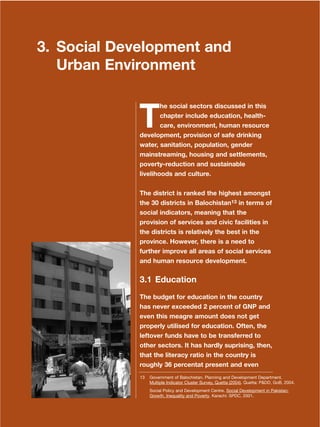
condition of the valley favours the formation of
underground water reservoirs. The availability
of surface water in Quetta is very limited and
directly dependent on the precipitation and
surface run-off of the catchment area. The
over-extraction of water from the shallow
tubewells of alluvium both for agriculture and
domestic use has resulted in a negative water
balance with extraction of over 70 cusecs and
recharge of around 30 cusecs. The continued
dry spell for the last 45 years has further
aggravated the situation.
The outcome of several studies for
improvement of water supply resources in
Quetta are summarised as under:
Water loss reduction and leakage control
through the process of replacement of
damaged/broken.
Unspecified pipelines for saving of about
30-35 percent potable drinking water.
Complete ban on agriculture tubewells
and provision of recycled wastewater to
farmers.
Construction of drinking water supply
dams and recharge measures.
Development of water resources in newly
identified hard rock/limestone aquifer.
The provincial government launched Quetta
Water Supply and Environmental Improvement
Project (QWSEIP) in December 2004 for
improving the supply of drinking water and
sanitation in Quetta City with a revised cost of
Rs. 17,092.60 million. Area of responsibility
increased from 370 sq km to 3,070 sq km (from
Quetta Town to Quetta District including Army,
PAF and Cantonment) due to revision of PC-1
as per decision of the Provincial Government.
The present availability47 of water is 20 MGD
against the demand of 30 MGD. The supply
would enhance to 36 MGD after completion of
QWSEIP. The objectives48 of QWSEIP are:
Rehabilitation and expansion of
distribution network to new areas.
Establishment of effective monitoring and
metering of the system.
Increasing reservoir capacity by 8 MGD
and providing equitable distribution.
Increasing B-WASA revenue.
Rehabilitate existing sewerage network
and increasing sewerage system coverage
from 12.5 percent to 60 percent of
population.
Construction of storage dams.
Construction of wastewater recycling
plants to irrigate 1500 hectares of land.
Rehabilitation of drainage system.
Procurement of sewerage / drainage
maintenance equipment.
Actual date of commencement of QWSEIP
project was December 2004 while dates of
completion as per original PC-1 and revised
PC-1 are December 2009 and June 2015
respectively. During the investigation phase, it
was concluded that there exists a potential in
hard rock and alluvial aquifers, potable water
quality is available with control mining in hard
rock and alluvial aquifers and that there exists
a hydraulic connectivity between hard rock
and alluvium. Keeping in view these findings
of investigation, 12 hard rock and 54 alluvium
tubewells were drilled.
67
Quetta Integrated Development Vision
47 Availability of water is calculated of 16 hours per day running of tubewells
48 Lt. Col (Rtd.) Hafeez-Ullah Awan TI(M), Project Director/EDO QWSEIP/WASA Quetta.
Based on the current availability of water
resources, it can be presumed that if the
additional resources are not developed, the
availability of water will reduce further, which will
aggravate the situation with the passage of time.
The negative water balance due to continuous
over-mining of alluvium tubewells has underlined
the need to develop new water resources.
Hard rock tubewells: Eighty-five test bores
were drilled, out of which 57 bores were found
successful and developed as tubewells
(Takhtani nallah area, Spezand, Darawaza area
and other potential sites). Because of these test
holes, the long-term yield of this basin is about
13.68 MGD from the hard rock aquifer, which
can be extracted from 57 productive wells.
68
Quetta Integrated Development Vision
Source: Presentation to Chief Minister by QWSEIP (2009)
Table 20: Implementation status of emergency works, QWSEIP (july 2009)
Sr. Work Done Availability of No. of Tube Remarks
No. Water (MGD) wells/Pipeline
length
1 Karkhasa 1.1 4 No. During investigation
phase
2 Mian Ghundai 1.4 4 No. During investigation
phase
3 Dara Manda 1.15 4 No. During investigation
phase
4 Replacement of rusted pipeline 26 km
5 Energisation of Alluvium Tube Wells 3.3 54 No.
6 Installation of Tube wells 0.4 6 No. Army-4, Killi
Kotwal-1, Crises
Management Cell-1
7 Expansion of water supply Killi Jaded
distribution network Sariab 7.81 km
Energisation of
Hard Rock Well
Field
Source: Presentation to Chief Minister by QWSEIP (2009)
Table 21: Completd Works handed over to WASA by July 2009 (QWSEIP)
Sr. Work Nature No/km Remarks
No.
1 Pipe line laid for Rehabilitation and Expansion works 1152 km
2 Total Successful Hard Rock 56 Nos. 256 Nos.
Tube wells Alluvium 200 Nos.
3 Hard Rock Handed over to WASA 27 Nos. 8 US MGD
Handed over to Army 9 Nos. 2 US MGD
Dasht Well Field to be 9 Nos. 3 US MGD (Expected
energised (Disputed) Quantum of water)
Quetta Valley Well 11 Nos. 4 US MGD (Expected
Field to be Energised Quantum of water)
Alluvium Handed over to WASA 122 Nos. 8.5 US MGD
Quetta Valley Tube 41 Nos. 3.8 US MGD (Expected
Wells to be Energised Quantum of water)
Handed over to Army, 30 Nos. 1.5 US MGD
CBQ, Health, and
Education.
To be Energised Army, 7 Nos. 0.67 US MGD
CBQ, Health, (Expected Quantum
Education. of water
Tube wells
Drilled and
Energised
Surface water: Halak and Mangi dams are
proposed in phase-2 of this project to
augment the water supply. The additional 10.7
MGD surface water will be added to give relief
to the groundwater potential which is under
severe strain. It will further remain as an
alternativee source of water to cater for the
demand of water for Quetta until the year
2025.
Refurbishment of existing tubewells of
alluvium: The present water supply system
comprised of 48 very old shallow tubewells
(QMC system) transferred to B-WASA in
December 1994. Since then, several measures
for the improvement of the system have been
taken, including replacement of shallow bores
with deep bores. The existing water supply
system of PHED is also in a frail condition and
needs refurbishment. Under the revised
project, 268 tubewells are proposed to be
installed in alluvium aquifer. The expected
yield from these 268 tubewells is 14.62 MGD.
The works under Package-A (water supply,
sewerage, stormwater, delay action and
check-dams carried out by the project) are
given in Table 20.
Completed works handed over to WASA in
2009 and before are given in Table 21.
After the completion of the rehabilitation of
rusted/damaged water supply pipelines and
laying of sewerage system, the quality of
supplied water will further improve.
A sewerage treatment plant was installed at
Sabzal Road near the end of 2009 and is
functional. The work on the other two
treatment plants is going on. The works
relating to stormwater drainage were almost
completed. Recharge measures for
Akhtarabad delay action dam are in progress.
Forest Department has not been involved in
improving the management of watersheds.
The package-B for construction of Mangi and
Halak dams costing Rs. 1,744 million is under
implementation. The storage dam specific
information is in Table 22.
Detailed designing of Mangi and Halak Dams
was complete and work was expected to start
by Frontier Works Organisation (FWO) in late
2009.
Progress of Major works of Package-A and B
of QWSEIP (PC-1) up to July 2009 is in Table
23.
The construction of three sewerage treatment
plants of 11.2 MGD capacity in Quetta City
was envisaged under the QWSEIP. The one at
Sabzal Road (1.8 MGD capacity) was
completed in 2009 and is operational after
initial set back. The work on the other two,
i.e., at University of Balochistan (2.4 MGD
capacity) and Samungli Road (7 MGD
capacity) is going on.
Water quality
In order to determine the acceptable water
quality for domestic use, 80 samples from
both alluvial and hard rock wells were
collected and tested chemically and physically
in the laboratories of WASA and Pakistan
Institute of Nuclear Science and Technology
(PINSTECH), Nilore, Islamabad. The analysis
was carried out separately for alluvial wells
and for each range of hard rock wells. Based
on these studies, it can be concluded that in 69
Quetta Integrated Development Vision
Source: Presentation to Chief Minister by QWSEIP (2009)
Table 22: The Storage Dam Specific Information
Mangi Dam Halak Dam
Location 67o29.8» East 30o21.6» North 67o24.20» East 30o11.29» North
(60 km East of Quetta) (72 km East of Quetta)
Catchment Area 1217 Sq. KM (470 Sq. Miles) 134 Sq. KM (470 Sq. Miles)
Dam Type Concrete Gravity Dam Concrete Gravity Dam
Maximum Height 61 m (200 ft.) 47.5 m
Gross Storage 36.43 MCM (29550 Ac ft.) 6.57 MCM (5330 Ac ft.)
Live Storage 31.74 MCM (25740 Ac ft.) 5.91 MCM (4790 Ac ft.)
Gross Storage 4.69 MCM (3800 Ac ft.) 0.50 MCM (535 Ac ft.)
Pumping Main 8 million Gallon per day
70
Quetta Integrated Development Vision
Source: Presentation to Chief Minister by QWSEIP (2009)
Table 23: Progress of Major works of Package-A and B up to July 2009
Description/Component Unit Quantity Progress
Package-A: water (resource + supply)
(a) Rehabilitation work
Replacement of damaged rusted pipe km 370 365 completed
Rehabilitation of existing tubewells in Quetta city No. 60 20649(drilled)
(b) expansion works
Laying of pipe line km. 349 825
Reservoir No. 5250 351
Energisation of hard rock tubewell 40 5652
Sewerage
Laying of sewer lines km 251 5.8253
Conversion of drains into PCC sewers km 510
Construction of waste water recycling plants No. 4 01
Storm water drainage component (details in Schemes Lump sum 12,50054 m
following table) (27000)
Miscellaneous works enhancement of water Work on Akhtarabad check dam is in progress
recharge measures and other five schemes were deleted from revised
pc-i as per decision of pre-CDWP
Mass awareness for water conservation and Pilot project on mass awareness completed.
low cost sanitation for kachi abadis Pilot project on sanitation 80 percent completed.
Remaining balance has been reallocated for water
supply component
Package-B
Construction of storage dams at Mangi and Halak No. 255
49 Successful 200, Failure 6, For WASA 163, for MES, CBQ, Health and Education Department etc. 37 No.; energised
and links up with WASA/Cant. System 153 (WASA 122 and Cant. 30) and to be energised (47)
50 17 overhead hot pressed steel tanks to be imported from England 32 ground reservoirs to be constructed of RCC
type/ work on four sites started
51 one each at Mehmood Mina, Marriabad (Mominabad) and Killi Badazai
52 27 tubewells handed over to WASA and 9 tubewells handed over to army to be energised 20 tubewells including 9
of Dasht well-field.
53 Further detail design is awaited from NESPAK which it failed to provide due to their poor performance, insufficient
staff and equipment.
54 Completed schemes include Saraghurgai flood protection works, Construction of gabion wall at Madrassa Achozai.
Construction of protection wall around four tubewells at Karkhasa, Storm water drain of Usmanabad, Noorzai
Colony on left and right banks of Kasi Nullah in Pushtoonabad, Storm water drain at killi Mehrabzai. Raga Baliozai
and Jamali in Kuchlak, Flood drain from Jaffar Khan Jamali Road to Pishin stop. Storm water drains in Circuit House
to Habib nalluh Zarghoon Road, Storm water channel for killi Siddique in Kuchlak, Flood protection of Hanna Urak
Valley, Lining of Durrani Nullah.
In-progress schemes include Storm water drains killi Bangulzai, Mustafaabad, Sariab Road Quetta, Construction of
storm water channel on Badini nullah for protection of killi kechi baig, Sariab road., Storm water drains from Science
college to secretariat chowk, Storm water drains from Imdad Chowk to Secretariat Chowk and Pishin Stop (Left
side)
55 The design completed in March 2007. Construction work not yet started for want of approval of Revised Cost
Rs. 8,279 million
71
Quetta Integrated Development Vision
general quality of the groundwater of Quetta
Valley is acceptable for drinking purposes.
The analysis of groundwater samples taken
from 21 sites in Quetta Valley in December
2007 was undertaken for their contents of
major, minor and trace elements56 (Fig. 7).
These sites included wells, tubewells and
spring. A Land-Sat image showing
concentration of Arsenic (As) and Selenium
(Se) in the drinking water in the Quetta Valley
in 2007 proportionate to size of the circles
revealed elevated levels of some trace
elements57, i.e., Nitrate, Cr, Ni, As, Se and Ti.
The high concentration of arsenic is
poisonous and low-level, long-term exposure
to arsenic may lead to increased risk of
cancer. Satellite images showing circles of
concentration of Arsenic (As) and Selenium
(Se) proportionate to the size of the circle are
shown in Figure 6.
Source: WASA and Pakistan Institute of
Nuclear Science and Technology (PINSTECH),
NILORE, Islamabad Clean Drinking Water
Programme: The federal government»s
scheme of Water Filtration Plants58 consists
of three phases. The first phase, which was
planned for the tehsil level, started in 2005,
and had been completed in 2006. The second
phase is under execution at the Union Council
level and will be completed by the end of
current year. So far, 390 plants have been
installed in the different part of the province.
The third phase is on village level, for villages
having population of one thousand or more.
The scheme is in its conceptual stage and will
be initiated after completion of the second
phase. The locations of filtration plants
installed in Quetta District in the first phase
(Tehsil Level) and second phase (UC level) are
listed in Table 24.
Figue 6: Satellite images showing concentration of Arsenic (As) and Selenium (Se)
Source: WASA and Pakistan Institute of Nuclear Science and Technology (PINSTECH), NILORE, Islamabad (2007)
56 Using ICP (AES) and ICP (MS) for the determination of major (Ca, K, Mg, Na, Si, Cl- and SO4 ), and minor and trace
elements (Fe, Mn, B, Ba, Li, Sr, Li, Be, B, V, Cr, Mn, Co, Ni, Cu, Zn, Ga, As, Se, Rb, Sr, Y, Ag, Cd, Cs, Ba, La, Ce, Pr,
Nd145, Nd146, Sm, Eu, Gd, Dy, Ho, Er, Tm, Yb, Lu, Tl, Pb, Th, U).
57 Murray, K., Sagintayev, Z., Sultan, M., Khan, S. D., Becker, D. B., Becker, R., and Milewski, A. ≈An integrated
approach for the assessment and development of renewable groundwater resources in the Quetta valley, Pakistan.Δ
Geological Society of America Abstracts with Programs, 39(6), 154, 2008.
58 Clean Drinking Water Initiatives (CDWI) Project 2005-06.
According to the relevant federal agency,
almost all installed plants are operational and
being maintained by the Public Health
Engineering Department (PHED) as the
executing agency in the government of
Balochistan.
The PHE Department has contracted two
firms for Operation and Maintenance (O&M) of
the installed plants at tehsil level, but the firm
that installed the plants at the UC level is
responsible for their O&M for a period of three
years post-installation. The O&M requires
change of media, change of membrane (filter),
and chlorine dozing, hourly backwash system
(installed for every plant).
The federal government»s commitment for
funds for O&M of the installed plants is for
three years. Thereafter, the provincial
government is expected to take responsibility
for their O&M. The monthly expenditure of one
plant is Rs. 12,500 which includes the
operator»s monthly salary of Rs. 5,000.
3.8.2 Key issues
Inadequate availability of water. A crisis of
acute shortage of water in Quetta city is
on the horizon, if water supply is not
arranged from outside the district to
supply water to the thickly populated area.
With limited resources it is difficult to
combat the present situation. In the year
2000 supply of water by a division was to
70 percent of the covered population,
which has gone down to 50 percent of the
covered population. Twenty percent
households, which were getting water
previously, are now deprived of potable
drinking water due to the less discharge of
tubewells. The existing tubewells are
mostly at the depth of 400 feet.
Poorly designed/ dilapidated distribution
network.
Inadequate coverage of population.
Inadequate reservoir capacity.
Poor revenue collection.
Inadequate coverage of sewerage system.
Dilapidated condition of existing sewerage
system.
Inadequate waste water treatment, i.e.,
only one treatment plant out of three has
been installed and is operating.
Poorly maintained drainage system.
Five percent citizens depend on water
from ponds and other unhygienic sources,
especially in remote rural areas.
Pollution of ground and surface water
through sewerage and agro chemicals.
Forty-eight community schemes were
handed over to WASA in 2001, and the
remaining schemes were also notified for
handing over, but WASA did not take over
these schemes due to financial
constraints.
The required budget for proper functioning
of WASA is not provided by the GOB as
grant-in-aid due to payment of electricity
charges of QESCO. WASA is facing
difficulty in the supply of regular drinking
water to the inhabitants of Quetta due to
disconnection by QESCO of electricity of
tubewells.
The water rights of the alluvial aquifer, of
which WASA is the owner, the law and
order situation/ political environment does
not allow to charge rent from the private
tubewells which are functioning 24 hours
on fixed flat rate as per policy of the
government. Due to the reason the
abstraction from aquifer is double of the
allowable abstraction which is causing
high depletion of groundwater in the
valley.
Although the costs of water supply may
be considerable and the benefits are
higher but following issues were raised by
the communities regarding PHED
schemes. The consequences of the
dropping water table for those who fetch
water could be:
More time will be needed to bring
water from distant areas.
It will further burden the life of
females, who fetch water.
It will badly affect the ecological
balance and agricultural development
in the district.72
Quetta Integrated Development Vision
73
Quetta Integrated Development Vision
Source: Deputy Project Director: CDWA Ministry of Special Initiatives, Islamabad
Table 24: Water Filtration Plants installed in Quetta District (2005-10)
Phase-I (Tehsil Level 2005-06) water filtration plants installed in Quetta District
S. No. Chiltan Town Panjpai
1 At Water Supply T/Well No-2 Killi Ali Zai Masjid Road near High School Killi Panjpai
Phase-II (UC Level 2007√10) water filtration plants installed in Quetta District
S. No. Zarghoon Town - Locations in UCs Chiltan Town - Locations in UCs
1 Quary Road Eid Gah Jail Road Huddah
2 Nursing Hostel Civil Hospital Inscomb Road Samungli Housing Scheme WASA Tube Well
3 Mali Bagh Office WASA Mano Jan Road
4 Veterinary Hospital Mechongy Road Railway Colony Joint Road
5 Patel Road Tube Well Killi Alam Khan
6 Gawalmandi Office Shahbo
7 Tail Godown T/W Killi Ismail
8 Yazdan Khan School Killi Tarkha New Tube Well
9 Sadiq Shaheed Library Shahzman Street
10 Hashim Khan Ghilzai Trust Nichari Road Qurban Ali Bagh Reisani Road
11 Toghi Road Qaid Abad School Killi Shah Mohammad
12 Khartar T/W Central School
13 Sardar Nisar Tube Well Stop No. 1 at Bandr Tube Well
14 Dispensary T/W WSS Chowkal Muhammad Murad
15 Kasi Killa Kharoot Abad Phed Tube Well
16 Civil Defence Office Dial Bagh Haji Allah Gul Masjid
17 Kasi Grave Yard Old T/W Killi Ibrahim/Bangulzai
18 Durrani Bagh New WSS Chashma Jeo Jadeed-2
19 Saeedabad Killi Naik Mohammad
20 Allah Dina Road T/W Bangalzai
21 Haji Ghabi Road T/W New Gafoor Town
22 Nasrullah Chowk Block No. 5 Near Public Park
23 Tareen Road T/W WSS Zarkhoo
24 T&T Colony WSS Kechi Baig
25 Barginza Villa WSS Hazara Town Block-1
26 Taroo Chowk Railway Housing Society
27 Govt Boys School Prince Road Saznar Khail Kuchlak
28 Maulana Noor Mohammad WSS Panjpai Town
29 Mitha Chowk Usman Abad Police Line
30 QDA T/W
31 Jamal Abdul Baqi
32 Sirki Kalan/Jatoi Colony
33 WSS Malaizai Nasiran
34 WSS Killi Nasiran
35 Killi Babri Hanna
36 WSS Killi Umer Road WASA Office
37 Ismail Colony, Rehmat Colony Sirki Road
The practice of sending accumulated bills.
Particularly the first bill is sent after a very
long time.
Some of the beneficiaries were not
prepared to pay their share in the utility
bills.
Sometimes the community as a whole
refuses to pay. This is due to lack of social
responsibility and due to the presence of
certain groups within the communities
pursuing their interests.
There have been many cases of illegal
connections in the District.
The Public Health Engineering Department
(PHED ) of Quetta District has been
requesting time to time for replacement of
dried tubewells and requesting for the
funds of repair and maintenance of
schemes run by PHED and for the
schemes run by community as per
demand.
Groundwater is depleting fast in the
district generally and very fast in Quetta
Valley.
Water filtration plants were installed at UC
and tehsil levels, and will be installed at
the village level in the third phase starting
from July 2010 but a large number of
these are said to be non-functional. This is
partly due to lack of maintenance and
partly because of lack of a comprehensive
awareness raising programme and
participation of communities in this
programme.
Poor quality of drinking water in Panjpai
tehsil.
Lack of funding for water recharge
programmes and projects.
3.8.3 Vision
Safe drinking water is a basic human need
and the government is obligated to provide
this facility to its citizens under the MDGs by
the year 2015. A target of MDG 7 is to arrange
access to safe drinking water within 2
kilometres or a point so close that one could
go and come back within half an hour. Only a
third of the population of the district has
access to safe drinking water at present. The
target of access to improved drinking water to
56 percent of population by 2015 is
challenging and is very difficult to be met.
However, maximum efforts will be put to
accomplish as much as possible. Containing
demand, efficient use, water recharge and
controlling water pollution will be focused.
3.8.4 Measures to be taken
Improved supply of safe drinking water as
a strategic priority to avert the looming
crisis.
Access for all where the facility of water
supply is common.
Construction of water supply overhead
tanks in urban areas and big villages.
Construction of pukka tubewell delivery
tanks to avoid pollution of drinking water.
Working with media and all other possible
sources to disseminate the consequences
of drinking unsafe water and the options
to address this issue.
Allocating more funds to PHED for repair
and maintenance of tubewells for reviving
the water supply in the rural areas.
Persuading the Revenue Department to
make the transfer of property conditional
to providing the NOC of WASA for
clearance of water charges.
Advocacy and actions at higher levels to
influence policy-making towards
sustainable management of water
resources at the community level.
Collection of royalty of water from private
tubewell-owners in Quetta Valley.
Raising community awareness about their
freshwater resource potential and
sustainable rates of extraction.
Putting in place community mechanisms,
including building institutions and
capacities at the local level to manage
freshwater resources.
Conservation of water by stopping
leakages and wastage from
transportation, distribution and supply
lines.74
Quetta Integrated Development Vision
Control of pipeline losses and illegal
connections.
Using an awareness campaign, incentives
and alternatives to ensure efficient use of
available water by agricultural, industrial
and domestic users.
Exploring the possibility of rooftop
rainwater harvesting during monsoon and
winter months and, if found feasible,
introducing it.
Ensuring supply of safe drinking water near
the points of consumption in the rural areas.
Investing on the watersheds from where
the city is getting its water supply is
lacking, e.g., the watersheds of Hanna
and karez reservoir, Wali Tangi Dam,
Mangi Dam and Halak Dam.
Withdrawing the subsidised flat rate tariff
on private agricultural tubewells,
especially in Quetta Valley.
Collecting user charges in accordance
with the quantity of water supplied.
Charges may be calculated by water
supply duration or even by metering in
areas of higher consumption and of
commercial nature, e.g., ice factories,
hospitals, shopping malls, hotels and
restaurants, swimming pools etc.
Conserving water and increasing recharge
in the watersheds of Quetta District
prioritising the watersheds of Quetta City.
Developing and implementing an aquifer
recharge plan in Quetta District, especially
in Quetta Valley, on SOS basis to recover
groundwater losses. As hardrock water
sources are difficult to recharge compared
to gravel aquifers, the selection of suitable
areas for watershed programme is critical
for success.
Completing the installation of the
remaining two sewerage treatment plants
and installing additional plants to recycle
the entire sewage of Quetta City for
recycling water for green spaces, urban
parks, urban forestry, agriculture and
lawns.
Banning installation of new tubewells for
agriculture and water pumping.
Monitoring of water quality.
Controlling tubewell-dependent agriculture
in Quetta Valley, with compensation to the
owners of existing tubewells and
prohibiting installation of new ones by
enacting and enforcing a land-use and
development planning control.
Restricting and finally controlling tubewell-
dependent agricultural activities in the
watersheds and basin areas of Quetta
District which add to the recharge of
water for the priority use for water supply
to the city for domestic use.
Attaching high priority to investment in the
improvement of sanitation.
Timely and quality completion of ≈Quetta
Water and Environment Improvement
ProjectΔ.
Providing adequate budget to WASA and
PHED for their proper functioning.
Making additional efforts in view of
growing population and urbanisation to
meet the target to cover the remaining
population. Exploring the potential of
lifting water from the nearest point of
River Indus-fed canal system in
Balochistan for Quetta City. Arranging
water in the required quantity and of the
desired quality from permanent source(s)
outside the district in addition to the
Mangi and Halak dams. The potential of
pumping water from the nearest point of a
permanent canal from Indus River system
needs exploring in this regard; this may be
expensive but will have to be decided
upon and implemented sooner rather than
later not only for filling in the current gap
in demand and present supply but also for
the increasing demand, including that for
areas and households still without piped
water supply. It is also important for
avoiding paying higher costs later on due
to escalation.
Halting further increase in water demand
by containing in-migration and further
expansion of housing and settlements in
the Quetta Valley, including putting a
moratorium on construction of any
building in the foothills and other active
recharge areas. This will not only stop the
increase in demand for health-care, 75
Quetta Integrated Development Vision
education, water and sanitation, transport
and other services and employment but
also for increasing the recharge to the
ever-declining groundwater resources.
Seeking compliance of and enforcing
national environmental quality standards
(NEQS) for municipal and industrial
discharges and recovering costs of
treatment where they are above NEQS
limits. Increasing water recharge by
managing watersheds and the active
water recharge areas at the foot hills in
the Quetta Valley.
De-novo master planning of Quetta City
and its implementation, taking advantage
of the enhanced budget of the provincial
government due to significant increase in
the federal share.
Construction of water recharge dams with
built in mechanism of recharging the
aquifer.
3.9 Sanitation
The National Sanitation Policy (NSP) in
Pakistan, approved by the federal government
in 2006-07, is focused on the safe disposal of
excreta, using latrines, creating an open-
defecation-free environment, safe disposal of
liquid and solid waste and promoting health
and hygiene practices. In order to support the
implementation of guidelines, effective
institutional and financial frameworks are
envisaged. Sanitation programmes are linked
with environment, housing, water and regional
planning policies and programmes.
The federal government provides incentives
for the implementation of the NSP, e.g.,
rewards for open-defecation-free
tehsils/towns, the cleanest tehsils/towns
having 100 percent sanitation coverage and
the cleanest industrial estates or clusters.
The Quetta Municipal Corporation (QMC),
Cantonment Board and WASA are responsible
for disposal of waste and provision of
sanitation facilities in Quetta City. PHED is
involved in water supply but not in sanitation
in the rural areas. QMC plays an active and
major role in providing and managing
sanitation facilities in Quetta City. Solid waste
is collected at the house level. Scavengers
(garbage-collectors) sort out, pick and sell the
re-usable or recyclable materials such as
paper, glass, wood, metals from the waste as
their livelihood. The market for such materials
is well-developed. The municipal employees
load the solid waste collected from dustbins
on trucks and tractor-fitted carriages. There
are 1,000 permanent employees equipped
with 22 trucks and 3 tractors. The collected
garbage and solid waste is dumped in
trenched places located at a distance of about
16 km from Quetta City. The solid waste is
auctioned, after every three months of
dumping, for use by the farmers for
agriculture.
In the Cantonment area, the responsibility for
safe disposal of solid waste lies with the
Cantonment Board Quetta. The Board has
190 permanent workers (65 percent male and
35 percent female) and trucks which carry the
waste to a dumping ground located 8 km
away along Quetta-Kach Road. However,
sanitation conditions in the rural areas and
slums in Quetta are very poor. There is no
drainage system and the poor conditions are
a constant threat to the health of the people.
Solid Waste: The Municipal Corporation is
capable of disposing of only 75 percent of the
solid waste generated in Quetta City. What is
required is the involvement of private sector
on commercial basis and community
participation through awareness programmes
for complete and safe disposal of solid waste.
Sewerage facilities: The existing system of
Quetta consists of 60,000 metres long piped
sewerage system in the inner town of Quetta,
3,790 metres long old city network and
railway compound network and 31,550 metres
long cantonment sewerage system. All the
collection networks have separate systems
discharging in the natural creeks (storm water
drains) or Nalas including Durrani Nala, Habib
Nala, Kansi Nala and Sariab Nala which drain
into Lora Nadi ultimately becoming Pishin
Lora in the north-west of Quetta.
A partial network was laid under Quetta
Sewerage and Sanitation Project with the help
of Dutch government and GoB is to cater the
piped sewerage requirements for a population
of 150,000 only. The related wastewater flows
were estimated at 120 L/s (1,618 GPM) in
total.
A sewerage treatment plant of the
Cantonment Board has now stopped76
Quetta Integrated Development Vision
functioning. However, one sewerage treatment
plant installed at Sabzal Road in Quetta City is
functional and the remaining two are passing
through the re-planning and resource
mobilisation process as the cost of PC-1 has
gone up significantly. However, sites for these
have already been selected.
The population of Quetta is scattered in
suburbs surrounding the valley. Many of these
localities are not linked to essential facilities
such as water and sewerage, and have an
appearance of slums, showing a danger of
epidemics and fatal diseases.
Drainage system: Stormwater from the built
area of the city is transmitted to three major
natural Nalas (Habib Nala, Durrani Nala and
Sariab Lora Nadi) through a network of drains.
The existing drainage system is based on
major city drains, minor drains and natural
streams. The estimated length of the drainage
system is 373 km, out of which 323 km is
being used as wastewater conveyance.
The roles and responsibilities of all
stakeholders are accepted and coordinated.
This includes government institutions, private
sector, non-governmental organisations
(NGOs), community-based organisations
(CBOs), communities, individual households
and the electronic and print media. The policy
officially promotes the grassroots concept of
community-led total sanitation (CLTS) in
smaller communities with less than 1,000
inhabitants. In larger communities, the NSP
provides for the component-sharing model,
under which sewage and wastewater
treatment facilities are provided by the
communities in case a government-developed
disposal facility is not available.
A modest-sized plant for treatment of sewage
was installed in Quetta City near Sabzal Road.
Installation of two more plants is expected
during 2010. In most rural settlements,
wastewater is neither collected nor treated,
leading to pollution of surface and ground
water. There are not even pukka drains in most
of the villages. Sewers and treatment systems
would be no less than a luxury for such villages.
Before the devolution under the BLGO (2001),
the PHED was responsible for development
and maintenance of water supply and
sanitation facilities in rural areas, whereas in
urban areas these facilities were provided by
the municipalities or Development Authorities
and WASAs. Under the BLGO, the
responsibility for water supply and sanitation 77
Quetta Integrated Development Vision
Vegetables grown with hospital wastewater
QIUCN,SaadullahAyaz
was devolved to Tehsil Municipal
Administrations (TMAs), and PHED was
expected to support them. The envisaged
decentralisation did not happen fully.
Consequently, the supply-driven schemes
continued.
The hygienic and sanitation conditions
prevailing in the district are not satisfactory as
the Quetta City has grown significantly without
planning and without extending the sanitation
infrastructure accordingly. Zarghoon Road,
Prince Road, Meconghy Road, Liaquat Bazar
in particular, and other areas in general get
flooded in heavy rains. It is due to lack of
awareness and social and civic responsibility
in the people. The existing toilet and drainage
facilities are quite inadequate.
The use of flush systems in the Cantonment
area is almost 100 percent. All houses in the
new housing schemes, e.g., Jinnah, Shahbaz,
Samungli and Chaman Housing Schemes
have flush system installed in toilets. A
growing number of households in the town are
said to have linked their flush system with
septic tanks. However, wastewater from most
houses is disposed of through open drains
and discharged through Habib Nala into
Quetta Lora. The Habib Nala remains dumped
with solid waste despite periodic cleaning by
the municipal staff.
Wastewater remains stagnant outside the
houses or in depressions, breeding
mosquitoes and creating health hazard.
3.9.1 Key issues
Throwing of garbage in Habib Nala and
lack of maintenance of the sewer system
including drains like Habib Nala to control
pollution of groundwater.
Inadequate treatment and re-cycling of
sewsage for re-use in agriculture, city
parks and lawns.
The used polythene bags are thrown out
in open and are a great hazard to
cleanliness, water quality and human
health, aggravating the problem of solid
waste and choking the sewer lines and
drains.
Illegal water connections are a menace to
PHED and WASA in terms of theft of
water, loss of revenue, poor sanitation etc.
Incomplete and inadequate sewerage
system, resulting in sewage oozing out of
gutters.
Stormwater drains are insufficient or
choked in Quetta City, causing flooding of
streets and roads during rains.
Vegetables grown with untreated sewage.
Manhole covers made of steel are
generally stolen; even manhole covers
made of cement are missing sometimes,
leaving them open and resulting in death
of children, even adults.
Lack of toilets in significant proportion of
households in rural areas and schools and
at public places.
Dirty washrooms in many official buildings
due to lack of proper maintenance.
Practice of separate washrooms for
officers and other staff for this reason.
Regular maintenance of drains is lacking.
3.9.2 Measures to be taken
The vision of sanitation includes toilets in all
houses, complete coverage of sanitation
facilities, safe disposal and treatment of
sewage and industrial discharges in urban and
rural areas of the district.
Encouraging CSOs and CCBs in raising
awareness of the people against defecation
in open, improving the disposal of waste
water, washing hands and personal
hygiene to avoid the incidence of a large
number of diseases including diarrhoea,
hepatitis, malaria, polio etc.; and training
them in building improved latrines on self-
help or collective communal initiative basis
and involving them in construction of
drains and sewer lines.
Regular maintenance of Habib Nala and
other drains.
Regulating and monitoring industries and
vehicle wash stations for their discharges
to meet NEQS and collecting charges for
treatment of their discharges, if above the
permissible limits.
Constructing and maintaining public
toilets in shopping areas and other public78
Quetta Integrated Development Vision
places visited by people. Imposing and
recovering fines from those found
defecating in the open in Quetta city.
Educating public about toilet use and
hygiene.
Monitoring that the sewer lines of houses
are not connected with the storm water
drains.
Improving latrines, supply of water, open
drains in small settlements and sewerage
system with treatment plant(s) in towns
and big villages.
Providing financial assistance for building
septic tanks, improved latrines in localities
of low-income groups and in rural areas to
reduce pollution of groundwater.
Quality and timely completion of the
QWSEIP.
Using treated water for growing
vegetables, irrigating orchards ad crops
and for urban parks and lawns.
Complete coverage of population in the
district for safe drinking water, and safe
disposal of sewage and industrial
discharges.
Up-gradation of all urban areas and big
villages through master planning and
implementation for WatSan.
3.10 Poverty-reduction
and Sustainable
Livelihoods
3.10.1 Poverty-reduction
The poor are distinguishable from the non-
poor through a conventional measure of
poverty line. The poor are those whose
income or consumption falls below this
minimum standard. Calculations based on
different approaches estimate poverty in
Balochistan to range between 14.8 percent
and 29.2 percent. The calorie-based approach
(based on the consumption of 2,250 calories
per person per day) indicates that poverty has
declined somewhat and is slightly lower than
the national average. The basic needs
approach, based on distribution of
expenditure, shows a similar trend. However,
in terms of distribution of income, the trend is
reverse, indicating that the situation has
worsened. The gap between the rich and the
poor is getting wider. The problem with using
any one indicator, such as income or
consumption, is that it paints only a partial
picture and obscures the real magnitude of
what constitutes poverty.59
For their livelihood the poor rely heavily on
natural resources but the access to and
control over natural assets and resources are
extremely skewed against them. This is a
fundamental cause of poverty as well as an
effect of it. This has important policy
implications60.
Injudicious resource capitalisation is the
cause, and its solution lies with the
governments (federal, provincial or district),
which unfortunately are influenced by the
same elite.
3.10.2 Sustainable livelihoods
There is a difference between creating a
livelihood and a job. Livelihood is ≈means of
living or supporting lifeΔ. Job is a ≈specific
piece of work (task, chore, duty) done for
moneyΔ. The concept of livelihood touches all
dimensions of production and consumption,
work and rest, self-care and community
needs. The IDDV encompasses all these
aspects of livelihood.
3.10.3 Key issues
Capitalisation of major portion of
resources by a minority group.
Undefined rights of the poor to use and
develop natural resources.
Negligence in focusing towards poor and
poverty-reduction.
Over-exploitation of the dwindling natural
resources, impacting the poor the most.
79
Quetta Integrated Development Vision
59 Government of Balochistan and IUCN. Balochistan Conservation Strategy. Quetta: IUCN, 2000.
60 Government of Balochistan. Planning and Development Department. Between Hope and Despair: Pakistan
Participatory Poverty Assessment Balochistan Report. Quetta: P&DD, GoB, 2003. Available
http://www.dfid.gov.uk/pubs/files/ppa-balochistan.pdf.
Low resource productivity.
Degraded and depleted natural resources,
including groundwater, land, soils,
rangelands, livestock, forests and wildlife.
Wastage of low quality fruits during the
season.
Low literacy and education.
Unskilled human resource.
Natural disasters, such as drought, flood
and earthquake.
Fewer job opportunities and mismatch in
labour market and the nature of jobs.
Lack of district-specific data regarding
employment.
Political interference and lack of
consideration of merit in filling in public
sector positions.
Lack of awareness, expertise,
entrepreneurship and microcredit for
micro, small and medium enterprises.
The issue of child labour. Children provide
labour in workshops, restaurants,
households, businesses and are even
forced to beg.
The number of professional beggars has
increased manifold. They are a great
nuisance to the public.
3.10.4 Measures to be taken
The vision is to promote alternative
sustainable livelihoods and reduce poverty in
the district for social and economic well-being
of the people of Quetta District.
Collecting data on human resources and
existing livelihoods and exploring the
potential of sustainable alternative
livelihoods.
Human resource development focussing
on poverty-reduction and skill-
development keeping in view the existing
and potential livelihoods.
Facilitating access to micro-credit
(especially to women) to support self-
employment.
80
Quetta Integrated Development Vision
A glimpse into consultative process at the district level
QIUCN,BalochistanProgrammeOffice
Supporting the existing micro enterprises,
such as handicrafts and woodwork,
through technological and economic
incentives and supporting the setting up
of micro enterprises, including agriculture
and livestock-related value addition, e.g.,
food processing (preparation of jams,
jellies, pickles at home for local and other
markets, using low quality fruits and
vegetables), and handicrafts (such as
knitting, sewing, embroidery).
Providing the micro enterprises with
access to state-of-the-art technology and
local modifications.
Supporting community development and
involvement through social organisation,
capacity building for planning and
management, joint and cooperative
enterprise development, management and
marketing.
Encouraging women through incentives
and training to take up commercial poultry
farming, bee-keeping, sericulture,
handicrafts, adopting careers in education
and health-care sectors and garment or
pharmaceutical factories; these
occupations have potential but are lacking
in the district.
Documenting and disseminating
successful local and outside examples,
and supporting the district successful
initiatives in scaling up and replicating
best practices demonstrated by private
sector companies, public sector agencies
or civil society organisations.
Providing opportunities to selected
trainers from receptive communities for
exposure to successful experiences.
Promoting awareness and business
details of the potential micro and SMEs
including the sustainable livelihood based
on local resources and traditional
knowledge.
Developing and implementing a Human
Resource Development Plan and a
Sustainable Livelihood Plan for the
district.
Providing training to farmers in livestock
and poultry farming.
Encouraging the processing and use of
various local raw materials for value
addition; and facilitating links with the
outside markets.
Ensuring merit-based employment in
public sector agencies.
Providing economic incentives for
sustainable use of natural resources, e.g.,
technology-intensive efficient irrigation
systems.
Promoting sustainable collection of wild
plants and products and cultivation of
local medicinal, aromatic and economic
plants.
Encouraging and supporting production,
processing, grading and marketing of
honey on a commercial scale.
Launching programmes like Khushhal
Pakistan Programme, after necessary
modifications in the light of the past
experience, to enhance livelihoods.
Revival of previous arrangement of
confining professional beggars and
destitute people to a facility.
The potential of the following SMEs will be
explored in the district to introduce and
support livelihood programmes:
Fruit and vegetable grading, packing,
preservation, processing, other value
addition and marketing.
Efficient irrigation techniques and
related technology, including land-
levelling, on farm water management,
drip/bubbler and sprinkler irrigation.
Agriculture engineering including
repair of agricultural machinery
including tubewell machinery etc.
Solar, wind and biogas energy, fuel-
efficient cooking, heating stoves and
cheap insulation of houses.
Livestock and poultry feed including
urea molasses blocks and urea-
treated straw.
Handicrafts including woollen carpets,
rugs and other articles. 81
Quetta Integrated Development Vision
Exploring potential for other occupations
and products such as repair of household
equipment, automobile repair; solar, wind,
biogas energy; fuel efficient cooking and
heating stoves, and cheap insulation of
houses; refrigeration and cold storage;
bee-keeping or apiculture; sericulture;
poultry farming; livestock and poultry feed
including urea molasses blocks; basket
making from mulberry twigs; dairy
farming; use of computers and internet;
handicrafts including woollen carpets,
rugs and other articles; composting;
cooking and baking, interior decoration
etc.
Identifying, encouraging and supporting
appropriate potential small and medium
enterprises by creating enabling
environment, providing technology, and
credit and development of skilled
manpower.
Settlement of land-ownership and
usufruct rights.
Supporting in accessing markets, value
addition and innovative product
enterprises.
Enhancing ownership or access of the
poor to natural resources and assets.
Reducing vulnerability and providing
adequate social protection to the poor.
Eliminating discrimination based on
gender, ethnicity or caste; and ensuring
equal access to justice for all regardless
of gender or social status.
Arranging technical and vocational training
for producing skilled work force for the
feasible small and medium enterprises.
Developing farm to market roads.
Obtaining and using raw materials
including wool and other livestock
products from the neighbouring areas of
Afghanistan.
Discouraging and controlling child labour
and facilitating their schooling.
Exploring and developing micro, small,
medium and large enterprises including
dairy development, poultry farming, bee-
keeping, sericulture, preservation and
preparation of fruit and vegetable
products, wool-based products, large-
scale handicrafts, trade and commerce
and upgradation of chromite etc.
82
Quetta Integrated Development Vision
83
Dera Ismail Khan Integrated Development Vision
4. Natural Resoures
N
atural resources sustain life by
providing water, air, food and other
products for local consumption
and trade. The rural communities,
especially the poor, depend heavily on
natural resources for subsistence. Low
productivity due to mismanagement and
natural disasters, such as drought, affect
them badly. Thus, the resources and their
sustainable management are critical to the
populace of Quetta District, which has
both rural and urban characteristics. The
key elements of natural resources
discussed here include climate, area and
land-use, water, drought, agriculture,
livestock and rangelands, forests and
wetlands, and fisheries. The nature-based
eco-tourism, although relevant here as
well, will be separately discussed in
Section 5.6. In recent years, combating the
depletion of natural resources and moving
to sustainable development has been a
major focus of development agencies.
The district has many positive and
negative resource attributes. The positive
attributes are its people, natural resources
(including agriculture, watersheds, forests,
rangelands, protected areas, unique
biodiversity and a range of economic
mineral deposits, especially coal and gas)
and its strategic location. The negative
attributes include aridity, periodic droughts,
fast depleting groundwater and biodiversity,
overgrazed and degraded rangelands, low
productivity of livestock, rugged terrain in
remote areas, to mention a few. The
population density is very high both in urban
and rural areas except Panjpai tehsil.
Consequently, the first priority is to halt and
reverse depletion and degradation of natural
resources by arranging and promoting the use
of alternatives, and development of existing
resources. Further development is also
important for meeting the future demands.
The best achievement of the people and the
district government would be to improve the
natural resources to their maximum potential
for sustainable management and use by them
and future generations.
4.1 Key Issues
Extreme aridity and periodical drought.
Fast depleting groundwater as a result of
indiscriminate water mining and
mismanagement due to inappropriate
subsidy on power supply for agriculture
and injudicious and inefficient use of
groundwater resources, and reduced
recharge due to de-vegetation and
changing the land-use of active recharge
zones.
Overgrazed, depleted and low-productivity
rangelands and livestock due to lack of
management of rangelands and invest for
maintaining productivity.
Decline in wildlife populations and
degradation of wildlife habitats and
ecosystems.
Deforestation and degradation of forest
vegetation in the designated state forests
and outer countryside due to over-
exploitation, lack of management and
investment.
Poverty of communities dependent on
natural resources for their livelihood.
Lack of research, GIS-based information
databases, GIS Coordinators.
Paltry funding for natural resources
including agriculture, livestock and
rangelands, forests, wildlife and protected
areas sectors.
Inefficient use of resources including
water, firewood, gas and electricity.
The sector-specific key issues are
discussed in detail in the later sections in
this chapter.
4.2 Land Uses
Land-use depends on the socio-economic
conditions. It determines how much and how
well the use and status of the natural
resources are in a particular region.
The total geographical area of Quetta
District has been given differently by
different sources. According to the
Development Statistics of Balochistan61 it is
168,800 ha, as per District Census Report62
it is 265,300 ha, and as per Survey of
Pakistan63 it is 3,499 km2 (349,900 ha). The
latter is believed to be a more reliable
source. The reported area out of former is
147,803 ha, which is almost 42.24 percent of
the total area. It means that the land-use
statistics of about 57.8 percent area of the
district are lacking. However, the land-use
statistics used by the Government of
Balochistan are reproduced in Table 25.
State forest spread on 4,872.3 ha area has
been converted to other uses since the area
has been transferred to various agencies
including Balochistan University, Labour
Department, Pakistan Air Force, a CNG
Company and SOS village. The details are
given in Section 4.7.
Although Quetta District is heavily urbanised
in the context of Balochistan and its
geographical limitations, the official land-
use statistics indicate only a proportion of
14.8 percent of the area as not available for
84
Quetta Integrated Development Vision
61 Government of Balochistan. Planning and Development Department. Bureau of Statistics. Development Statistics of
Balochistan 2009. Quetta: GoB, 2009.
62 Government of Pakistan. Population Census Organization. District Census Report (1998) Quetta. Islamabad: PCO,
Statistics Division, GoP, 2001.
63 Quetta District. Map. Survey of Pakistan, Islamabad, 2007.
cultivation. It is safe to assume that, in
addition, a large part of the not-reported
area is also not cultivable. More than 16
percent is reported as cultivable waste,
which means that the area for agriculture
could be expanded to this extent, given the
availability of the required inputs, mainly
irrigation water. A combination of the
climate, water and land development can
bring it under cultivation for growing
deciduous fruits, vegetables and crops.
However, shortage of water is a constraint
to further expansion of sustainable
agriculture.
In today»s world, knowing the extent of land-
uses does not depend on formal land
settlement process or even on manual survey.
It can be found with the help of satellite
images and detailed maps can be prepared
with high accuracy, which can be achieved
through ground truthing.
4.2.1 Key issues
Considering incomplete information about
and discrepancy in figures of the total
geographical area of the district as well as
discrepancy in the figures for land-uses,
these statistics cannot be fully relied upon.
About 57.8 percent of the geographical
area still seems to be unreported.
Although livestock grazing is a major
activity in the district, yet the exact area
and location of rangelands are not
available.
Details of the cultivable waste area are not
available for planning.
The area of tree cover, and suitable tree-
less area, notwithstanding the notified
forest area, is not known for planning and
supporting its management, preferably in
collaboration with the communities.
85
Quetta Integrated Development Vision
Source: Bureau of Statistics, GoB (2008 and 2009); Agriculture Statistics (1994-95)Source: Bureau of Statistics, GoB (2008 and 2009); Agriculture Statistics (1994-95)
Table 25: Land Use Statistics for Quetta
Land Use Year 200964 Agriculture Statistics
(1994-95)
Area Percentage Area Percentage
(ha) of reported (ha) of reported
area area
Total geographical area 168,800 100 265,287 100
Reported area 147,803 87.6 139,821 52.70
Total Cultivated area 11,097 7.5 39,709 14.96
Un-cultivated area 136,706 92.5 43,375 16.36
Potential for agriculture 83,084 31.39
Cultivable waste 34,271 23.2 43,300 25.65
Arable land suitable for cultivation 39,700 26.86 39,700 23.52
Not available for cultivation 21,853 14.8 21,853 8.23
Area under water logging and salination 200 0.07
Forest 80,58265 54.5 34,684 13.07
Rangelands
Wildlife Protected Areas 29,772
Undesignated Wetlands and Water storages
Housing and settlements, Industry,
Communication Infrastructure etc.
64 Government of Balochistan. Planning and Development Department. Bureau of Statistics. Development Statistics of
Balochistan 2009. Quetta: GoB, 2009.
65 As per notifications (Table 29), the notified forest area is 79,045 ha.
Transfer of the notified areas of
rangelands without trees to the Forest and
Wildlife Department as forest areas, which
further complicates the situation.
Forest areas are converted to other land-
uses and have been transferred to public
sector agencies and also a private
company.
Land-use planning and development
planning controls are not followed in the
district.
The land record in the district is
maintained manually as automation has
not been introduced yet.
4.2.2 Measures to be taken
Resolving the discrepancy in the
geographical area of the district with the
help of the Survey of Pakistan.
Obtaining the digitised survey sheet maps
of the district from the Survey of Pakistan
or getting one digitised locally in a public
sector GIS facility.
Preparing the GIS-based maps of land-
use in the district with the help of
appropriate land satellite images to get
complete, accurate and comprehensive
inventory of natural resources and land-
use in the district for planning and policy
decisions and use by other users.
Ensuring settlement of the entire
geographical area of the district, in
addition to land consolidation and
completion of land records, and
introducing automation in this process.
4.3 Climate
Climate is one of the key elements that
influences all renewable resources, housing
and settlement patterns, and lifestyles and
productivity of people in many ways. The
climate of the district is arid, temperate with
low precipitation in winter and higher
evapotranspiration in summer. The total of
mean monthly precipitation for the years
1961-2004 is 247 mm and it mainly falls
between January and March. The average
annual rainfall for Quetta city is 226 mm,
whereas in the Hanna area, the average is
about 312 mm. The altitude in the district
varies from 5,577 ft (1,700 metres) to 10,500 ft
(3,200 metres). Therefore the weather is
extremely dry. The winter is very cold and
minimum temperature ranges between -2.3 °C
and 20.4 °C. Summer is relatively mild and the
maximum temperature ranges between 11.3
°C and 36.2 °C. June, July and August are
generally the hottest months. The district lies
outside the range of the monsoon currents
and rainfall is scanty and irregular.
Precipitation is highly unreliable and mostly
available when plants are in dormant
condition.
86
Quetta Integrated Development Vision
Source: IUCN (2006) and GoB (2009)
Figue 7: Monthly Mean Temperature of Quetta in 2008 and Monthly Average Mean
Temperature 1961-2004
The monthly mean temperature of Quetta in
200866 and monthly average mean
temperature 1961-200467 is given in
Figure 7.
The month-wise rainfall during 2007 and mean
annual rainfall during 1961-2004 of the district
is given in Figure 8.
Total annual rainfall during 2007 was 227.9
mm and total monthly average rainfall during
1961-2004 was 247 mm.
Reliable meteorological data form the basis
for weather forecasting, for the analysis of
weather patterns, assessment of trends,
nature of climate change and as a basis for
modelling climate variables. Balochistan
urgently needs a comprehensive network of
stations that meet the standards of the World
Meteorological Organisation and are geared to
the needs of the province. The most pressing
needs are in the agriculture sector and for
water basin management. The needs clearly
go beyond supplying users with data sets on
87
Quetta Integrated Development Vision
Source: IUCN (2006) and Regional Meteorological Centre, Karachi (2007).
Figue 8: Monthly rainfall during 2007 and monthly mean annual rainfall during
1961-2004 in Quetta District
Source: IUCN (2006)
Figue 9: Monthly mean RH, DS and (ETO) in Quetta City during 1961-2004
66 Government of Balochistan. Planning and Development Department. Bureau of Statistics. Development Statistics of
Balochistan 2009. Quetta: GoB, 2009.
67 IUCN. Water Requirements of major crops for different agro-climatic zones of Balochistan. Quetta: IUCN, 2006.
variables such as precipitation and
temperature. The agricultural community
needs detailed forecasts for the short-term
(daily/weekly), medium-term (monthly) and
long-term (seasonal).
Monthly mean relative humidity (RH), daily
sunshine (DS) and evapotranspiration
coefficient (ETo) during 1961-2004 in Quetta
City is shown in Figure 9, and the mean
monthly wind speed is given in Figure 10.
4.3.1 Key issues
There is only one weather station in the
district, i.e., in Quetta City, which is
inadequate as the weather conditions in
Zarghoon hilly areas and Panjpai tehsil are
quite different.
Rainfall is low and unreliable, with periodic
droughts for short or long periods.
Livelihoods are affected by droughts.
Climate of Quetta City has warmed up as
a result of climate change.
4.3.2 Measures to be taken
The vision of the climate for the district in the
short-term is of generating comprehensive
weather and climate data in usable form for
different applications, i.e., weather forecast,
long-term trends and projections for
agriculture, informing the situations of water,
drought, flood, windstorm, cold wave, heat
wave, rescue, relief, and rehabilitation after
disasters. Two additional weather stations are
required in this regard, one in central
Zarghoon and the other one in Panjpai tehsil,
besides the existing one in Quetta City. The
data and information will be placed on the
website of the Meteorological Department for
users. In the long term, emissions will be
reduced in order to contribute to the national
and international efforts of reducing global
warming; and adaptation measures will be
taken to minimise the impact of global
warming on natural resources and human
beings.
The Meteorological Department to upload
all information and data regarding
weather, snowfall, climate, windstorm,
excessive heat and cold events, drought,
earthquakes, cyclones, floods, and other
relevant disasters on its website.
Generating, managing and disseminating
comprehensive weather, climate and
disasters data, in usable forms, for
different applications (weather forecast
and long-term trends and projections for
agriculture, water, drought, flood,
windstorm, cold wave, heat wave, relief
and rehabilitation after disasters) for
dissemination to the users through the
website of Meteorological Department.
The Meteorological Department to expand
its services to Zarghoon hilly areas and
Panjpai tehsils for recording and
predicting weather parameters of data to
88
Quetta Integrated Development Vision
Source: IUCN (2006)
Figue 10: Mean Monthly Wind Speed in Quetta District during 1961-2004
show its real usefulness to the great
majority of the people who depend on
natural resources.
The Meteorological Department and the
provincial government may work together
to establish two additional met stations in
the district using Remote Sensing
Technology. These stations would be
located at appropriate and representative
sites in central Zarghoon and Panjpai
tehsil. In this age of information and
technology, remote data collection and
computer-based management and
dissemination has become easy and
reliable for most parameters.
Adaptation of the management practices
in the natural resource sectors to climate
change.
4.4 Water
Water is life. Quetta District lies in the arid
region where water resources are expected to
be limited. Water is under great stress in the
district mainly due to fast depletion of
groundwater due to over-exploitation for high
delta and extended orchards, and vegetable
and crop cultivation and significantly reduced
recharge due to deforestation and de-
vegetation and construction of housing on
active recharge areas. The local groundwater
resources cannot even sustain the existing
population, agriculture, industry and nature in
the district for long. However, expansion and
developments continue unabatedly.
Quetta District largely falls in Pishin-Lora
Basin68. The population in the entire basin
was 2.179 million in 1998, of which about 45
percent lived in Quetta City and 31 percent in
Pishin; the remaining lived in Mastung and
Kalat districts. The alluvium in the basin
catchment area occupies about 40 percent.
The Bostan-Lora in Pishin-Lora basin drains
the catchment areas of Kolpur, Quetta and
Kuchlak. Figures for water balance of Bostan-
Lora are not available.
Surface and ground water balance of Pishin
Lora (in an average year) is in Table 26.
The future of Balochistan province is likely to
be dominated by increasing pressure on
water, both driven by the increasing
population (set to increase by over 50 percent
by the year 2025), rising urbanisation (the
urban population is expected to double in the
next 25 years) and increased contribution of
the agriculture sector in provision of livelihood
to the large population.
The most critical management challenge in the
arid areas is how to deal with the short periods
of too much water and flooding on one hand
and, on the other, long periods of too little or
no water due to low rainfall, as normally
perceived. The other aspects are unsustainable
management, overuse of the available
rainwater and groundwater as well as lack of
capacity for water harvesting and recharging.
The domestic water supply sub-sector will
require significant investment and
improvements in the management, efficiency
and equity of availability and service delivery.
Increased storage of floodwater will be
required around the urban areas like Quetta
City to recharge the groundwater through
construction of dams. This must be matched
by increasing efficiency of water use in the
irrigation, industrial as well as urban and rural
potable water supplies.
The water supply pipeline losses in Quetta
City are around 40 percent due to leaky
pipelines. In Quetta City, the galvanised iron or
steel pipes were used for water supply, which
are sensitive to corrosion, freezing, and
thawing during the winter season.
89
Quetta Integrated Development Vision
Source: Water for Balochistan Policy Briefings (4) 6.
Table 26: Surface and groundwatr balance of Pishin Lora (in an average year)
(billion m3) Pishin People Livestock Agriculture Nature Total Balance
Lora
Surface Flows 0.302 0.010 0.014 0.115 0.030 0.169 0.133
Average Recharge 0.170 0.024 0.029 0.513 - 0.566 -0.396
68 Javaid, Ijaz, and Shahid Ahmad. Conjunctive Water Use and Management for Minor Perennial Irrigation Schemes in
Balochistan √ Key Issues and Revised Strategy for Investment. Water for Balochistan Policy Briefings (4) 6. Quetta:
Supporting Public Resource Management in Balochistan, Pakistan, 2008.
Assigning higher priority to water conservation
measures including installation of water
meters for domestic water supply in urban
centres /towns is necessary so that
consumers pay for the volume of water
consumed by them. Ensuring high quality
standards for construction under the schemes
being implemented for Quetta City is critical in
view of severe mining of groundwater.
The only options to improve the situation are
Integrated Water Resources Management
(IWRM), judicious and efficient use of water,
enhancing water recharge significantly, and
arranging additional water supplies for
drinking from sources outside the district.
Otherwise, the consequences will be grave for
the survival of city, which will turn
unsustainable and poverty will increase in the
rural areas.
There are 10 minor perennial irrigation
schemes (MPIs) in Quetta. Water conveyance
losses usually occur in main and field
channels. Headworks or water intakes often
operate poorly. Some of the structures have
completed the end of their useful life. Others
are designed inadequately and some are
partially completed. There is a considerable
scope to increase irrigation supplies through
rehabilitation or expanding the capacity of
these schemes. There is a large potential of
saving water through improvement of main
and field channels and levelling of fields. It will
have direct impact on improving water
productivity in the MPISs.
Agricultural Planning Directorate (APD)69,
Department of Agriculture, Balochistan, was
established in 1992-93 under the Directorate
General of Agriculture Extension at Quetta.
Currently, the APD does not have any
approved Annual Work Plan and planning
activity is being hardly undertaken, except the
formulation of PC-1s on the requisition made
by other Directorates of Agriculture. Currently,
the APD is much below the requirement,
hence needs thorough review of the situation
for institutional reforms by clearly articulating
the mission, mandate and objectives, while
restructuring it to make it knowledge-based
planning institution of high performance.
4.4.1 Key issues
Inefficient use of water for agriculture is
the most serious problem in the district.
Rapid groundwater depletion is continuing
unabatedly due to mining by tubewells,
especially in the orchard areas. There is
reduced recharge due to de-vegetation of
the countryside, especially for fuel wood,
90
Quetta Integrated Development Vision
Water conservation in Hanna valley.
QIUCN,SaadullahAyaz
69 Javaid, Ijaz, and Shahid Ahmad. Conjunctive Water Use and Management for Minor Perennial Irrigation Schemes in
Balochistan √ Key Issues and Revised Strategy for Investment. Water for Balochistan Policy Briefings (4) 6. Quetta:
Supporting Public Resource Management in Balochistan, Pakistan, 2008.
which is the main source of cooking and
heating in the district.
The subsidy on power supply to tubewells
is against the principles of equity as only a
small percentage of population, who are
already better off, benefit from it. The
pastoralists and the farmers practicing
rain-fed farming (sailaba and khushkaba)
and those using diesel pumps are kept
out of this benevolence.
Water pollution is also a serious problem
due to incomplete drainage, sewerage
and treatment of municipal wastewater
and industrial discharges from Quetta City
and use of agro-chemicals in orchards
and on vegetables and other crops in
Quetta Valley and rural areas.
The Balochistan Water Policy, developed
with the technical assistance provided by
ADP, requires approval by the Provincial
Cabinet.
The other key issues in the district are:
Low efficiency and productivity of
irrigation water and diminishing
groundwater.
Rapid groundwater depletion,
especially in Quetta Valley, due to
mining by tubewells, inefficient use of
water for agriculture, water pollution
due to untreated sewerage and agro-
chemicals; and reduced recharge due
to de-vegetation.
Installation of tubewells is not
monitored and controlled.
4.4.2 Measures to be taken
Groundwater of the district is highly valuable.
It has to be used judiciously. This could be
ensured only through precise land levelling,
detailed soil investigations, and accurate
calculation of water requirements for crops.
Ideally, the best use of limited water should be
based on soil and crop requirements, instead
of traditional use of water based on land
ownership and water rights to optimise the
use of valuable water. The farmers would also
need help in identifying suitable low delta
crops and water requirements of all crops and
fruit trees.
In order to improve the physical and social
capital of the district in a sustainable manner,
while restoring environmental degradation,
incentives will have to be provided by the
provincial and federal governments. At the
same time the existing incentives e.g.
subsidised flat rate of electricity will have to
be adjusted, e.g., by shifting to efficient
irrigation technology, for the long-term benefit
of the people.
IWRM is more critical for Quetta District to
pursue than for some others. This approach
includes ≈a process that promotes the
coordinated development and management of
water, land and related resources in order to
maximise the resultant economic and social
welfare in an equitable manner without
compromising the sustainability of vital
ecosystemsΔ. All practitioners agree that this
requires a consultative process, engaging the
community as well as other stakeholders. The
kind of consultative process spelled out in the
IWRM agenda has been used in developing
the IDDV of Quetta District.
Promoting efficient use of available water
by agricultural, industrial and domestic
users through an awareness campaign,
incentives and alternatives.
Supporting the subsidy replacement of
basin and border irrigation methods with
efficient technology-intensive irrigation
methods such as drip / bubbler or spray
irrigation.
Awareness-raising with comprehensive
information on all disadvantages and
implications of inefficient use and
adopting technology-intensive, efficient
irrigation systems.
Motivating communities to construct
check-dams for checking soil erosion,
recharge water and plant trees.
Broadening the mandate of the District
Water Management Committee beyond
tubewells to all aspects of water in the
district.
Timely and quality completion of the
ΔQuetta Water and Environment
Improvement ProjectΔ; controlling pipeline
losses and illegal connections;
maintenance of the sewer system
including drains like Habib Nala to control 91
Quetta Integrated Development Vision
pollution of groundwater; and treatment of
sewage water and its reuse for agriculture,
urban parks or lawns in the city.
Installing meters and introducing a slab
system of subsidy. Alternatively, shifting
subsidy on electricity to efficient irrigation
methods.
Prohibiting installation of tubewells in
Quetta valley for agriculture and strictly
controlling installation of tubewells in the
rural areas of the district.
Encouraging rainwater harvesting and
supporting improvements in irrigation
practices.
Approval of the Balochistan Water Policy
by the Provincial Cabinet.
Conserving water and increasing recharge
in the watersheds of Quetta District,
prioritising the watersheds of Quetta
Valley.
Introducing and supporting the improved
soil and water conservation techniques
such as land levelling, irrigation according
to requirements and growing low-delta
orchards and crops.
Controlling tubewell-dependent agriculture
in Quetta Valley, with compensation to the
owners of existing tubewells and
prohibiting installation of new ones by
enacting and enforcing a land-use and
development planning control.
Restricting and finally controlling
tubewell-dependent agricultural activities
in the watersheds and basin areas of
Quetta District which add to the
recharge of water for the priority use for
water supply to the city for domestic
use.
Collecting user charges in accordance
with the quantity of water supplied.
Charges may be calculated by water
supply duration or even by metering in
areas of higher consumption and of
commercial nature, e.g., ice factories,
hospitals, shopping malls, hotels and
restaurants, swimming pools etc.
Developing storage and effective recharge
dams, wherever feasible, to meet the
needs of water for drinking and
agricultural purposes.
Exploring alternative sources of drinking
water for Quetta City, in addition to the
existing initiatives such as Mangi Dam.
These may be expensive but will have to
be decided upon and implemented sooner
rather than later, not only for filling in the
current gap in demand and supply but
also to meet the increasing demand,
including that for areas and households
that are still without piped water supply. It
is also important in order to avoid paying
higher costs later on due to escalation.
Exercising effective control on land-use
planning and development planning.
Limiting further expansion of the city not
only to stop the increase in demand for
health-care, education, water and
sanitation, transport and other services
and employment but also for increasing
the recharge to the ever-declining
groundwater resources.
4.5 Agriculture
Agriculture in the district is the mainstay of the
rural population and is characterised by its
commercial temperate fruit orchards and
vegetables for marketing. The district is
grossly deficient in meeting its requirements of
cereals, pulses etc. for humans and
wheatstraw for livestock, which are procured
from other parts of the country.
Soils: The soils are generally loam to coarse
textured (sandy loam) in Quetta and other
valleys, plains and depressions in the district.
Drainage is good due to gradient and coarse
textured soils. The organic content is from
medium in Quetta Valley and plains to very
low on slopes and in eroded soils. Forest soils
have layers of humus. The water absorption
capacity depends on texture, structure and
organic matter in the soils. Generally, it is
medium to low. However, the outer fringes of
Quetta and other valleys have active recharge
zones. The pebble-studded fans and streams
have high water absorption capacity.
Development of lands on the slopes for
cultivation requires a long time and heavy
investment as the soils are shallow, gravelly
(studded with big and small boulders), and the
lands are not levelled. Soils of the developed92
Quetta Integrated Development Vision
fields after some years of cultivation and use
of manure become very productive. No area is
affected by alkalinity or water-logging,
although some of the soils are saline.
Orchards: Many temperate fruits, including
apricot, apple, plum, peach, grapes, almond
etc., are grown in the district. Water
requirement of apple is very high. Apple trees
in the district do not get the required length of
chilling temperatures during winter; hence, the
quality is not as good as of those from Ziarat
and Kan Mehtarzai.
4.5.1 Floriculture70
Flowers are a symbol of love, affection,
aesthetic sense and have a great social,
cultural and economic value. Floriculture
encompasses growing of and using cut
flowers, raising nurseries of ornamental plants,
ornamental gardening and landscaping. It is
comparatively a new agricultural activity in the
province to attract the farmers although the
research and promotion of it started in the
1980s. Various flowering plants were
introduced at different places in the province
for growing cut flowers from seeds, bulbs,
corms, rhizomes, tubers etc. Private sector
has come forward in this business but this
enterprise is still in its infancy in the province.
The Agriculture Department is growing flowers
for demonstration and sale at Quetta and
setting up floral shops in the divisional
headquarters of the province for sale of cut
flowers. The floral shop at Quetta is almost
ready and the ones at Kuchlak and Kalat are
in progress. The development of sales points
is meant to provide a marketing chain to the
growers. Development and promotion of a
floriculture strategy is required for the province
and the potential districts including Quetta
District. It will also require promotion of the
technique of growing flowers in plastic
tunnels.
Quetta District has the advantage of its
location for demonstration, expertise, skilled
labour and market. The district also hosts
many hotels and provincial offices of private
sector companies and public sector
organisations, which would like to purchase
and use cut flowers.
Floriculture can improve the socio-economic
conditions of farmers if they start growing cut
flowers and raising nurseries of forest, fruit
93
Quetta Integrated Development Vision
Agriculture is the mainstay of the district»s rural population
QIUCN,BalochistanProgrammeOffice
70 Government of Balochistan. Agriculture Department. Directorate of Crop Reporting Services. Agriculture Statistics of
Balochistan 2008-09. Quetta: GoB, 2009.
and ornamental plants on farmlands. The total
area under flower cultivation in the district was
11.3 ha, which comprised of roses (3.94 ha,
131700 sticks), gladiolus (3.44 ha, 540500
sticks), tuberose (0.26 ha, 26000 sticks),
marigold (1.82 ha, 119500 kg) and statice
(1.82 ha, 49250 sticks)71.
4.5.2 Key issues
Floriculture is not a traditional practice in
the district. Only a small number of
farmers in the district know the techniques
of growing, harvesting and marketing as
well as its economics.
The expertise in floriculture in the
department, especially of its extension
staff, is limited and so is the scope, which
is confined to cut flowers and does not
cover other aspects of landscaping.
Flowers are a perishable commodity and
require swift and certain markets.
Floriculture requires exacting inputs,
investment, skills, intensive working and
turnover, which needs a progressive mindset
and risk-taking attitude, which is rare.
4.5.3 Measures to be taken
Development and implementation of a
floriculture promotion strategy for the
province, including the Quetta District.
Awareness-raising in providing business-
related information to and capacity
building of farmers, nursery-growers,
amateurs and professionals.
Arranging exposure visits of interested
farmers of the district to the ornamental
nurseries and cut flower growing fields in
Quetta Agricultural Farm and Pattoki.
Promoting the use of cut flowers, garland
flowers and flower petals in the district. It
will complement tourism promotion as
well.
Facilitating procurement, multiplication
and marketing of flower seeds, bulbs, and
ornamental plants, herbs, shrubs and
trees.
Regularly providing technical advice and
service to growers.
Arranging flower shows, flower
arrangement shows, garden and lawn
competitions.
Facilitating farmers» access to credit from
development financial institutions.
4.5.4 Potential for Expansion of
Agriculture
Agriculture is the main pillar of economic
growth in the rural areas of the district.
Cultivable land is available but availability of
water is a serious constraint in realising the
full potential of growing temperate fruit
orchards and early and late winter vegetables.
Agricultural Marketing: Quetta is one of the
two largest agricultural markets in the
province. A proper agricultural market was
established in Quetta City in the recent past.
The provincial agricultural marketing services
are also based in Quetta City. The optimum
potential of improving marketing exists in
improving coordination and collaboration
between the two and dissemination of
accurate and timely marketing information in
order to help farmers make profitable
marketing decisions regarding what to
produce, where to market the produce, and
what price to expect.
Quetta City is a good and exclusive market in
the province for certain produce, e.g., cherry
and other temperate fruits, and is well
connected with the markets in other cities
such as Faisalabad, Lahore, Multan, Karachi
and Islamabad, and even with foreign
markets, e.g., Dubai.
There are two options exercised by the
farmers for marketing fruits from their
orchards: (1) post-harvesting sale of the fruit
on the trees (sometimes at the flowering
stage) and (2) sale of the harvested fruit and
vegetables in the market by the owner. Both
systems have their pros and cons. Sometimes
transporting and selling at distant markets
results in losses, especially in case of
perishable fruits and vegetables, when the
destination market gets flooded with fruits and
vegetables and demand reduces. There are
94
Quetta Integrated Development Vision
71 Government of Balochistan. Agriculture Department. Directorate of Crop Reporting Services. Agriculture Statistics of
Balochistan 2008-09. Quetta: GoB, 2009.
95
Quetta Integrated Development Vision
three options to reduce vulnerability of farmers
from the imperfect system of marketing: (1)
food processing at Quetta (some enterprises
are already doing it but they are not enough);
(2) construction of a cold storage (such
facilities exist in Quetta City but more are
required); and (3) developing specialised local
markets similar to the existing markets for dry
fruits and cherries.
GoB»s Directorate of Agriculture, Economics
and Marketing is planning to develop a
database system at the provincial level. The
Directorate of Agriculture Services and Crop
Reporting has set up an on-line information
system, which is now analysing supply and
demand in order to distinguish those crops,
which are continuously facing marketing
problems (i.e., more or less production than
demand, especially of perishable commodities
such as tomatoes, onions, other vegetables
and fruits). However, forecasting of future
demand to guide farmers in their production
planning is one of the most difficult tasks and
will need further time and effort in its outreach.
In the scenario of sustaining Quetta City by
meeting its water requirement, it is crucial that
land-use within and in the catchment areas of
Quetta Valley is rationalised for obtaining the
maximum yield of water. This, however, is a
serious challenge and requires complex
futuristic exercise, innovative policy, legal,
institutional, financial and monitoring
frameworks based on a compensation system
acceptable to landowners and users of land-
based resources. Considering the present
weak capacities in planning, implementation
and monitoring, this idea may be parked for
the time being for exploration over the long
term, when all other options to get the
required additional quantity of drinking water
are exhausted. However, it is important that
watershed management programmes in the
catchment areas of Quetta Valley as well as in
the catchment areas of Mangi and Halak
dams must start soon. A programme for land-
use planning, development planning control
and improvement in land and water use
practices must be designed and implemented,
short of interventions which would need
compensation for compliance.
There are two cropping seasons in Quetta
District: Rabi and Kharif. Important Rabi crops
include wheat, barley, vegetables and fodder.
Main produce of Kharif are farm fruits, melons
(also grown un-irrigated), vegetables, potato,
fodder, onion etc., which are cash crops. Rural
women participate in agricultural activities
from their houses.
Nearly 35 percent population of District Quetta
depends on agriculture. They suffered heavy
losses during the drought period of 1998-
2004.
There are different figures of the total
geographical area of Quetta District (e.g.
168,800 ha, 265,300 ha and 349,900 ha) as
mentioned in Section 4.1. According to
Agricultural Statistics of Balochistan (2008-
09), total geographical area of Quetta District
is 168,800 ha and the reported area is
147,803 ha. Total cultivated area is 13,184 ha
(3,530 ha current fallow and 9,654 ha net
sown). Total cropped area is 9,964 ha (310 ha
sown more than once). Total un-cultivated
area is 134,619 ha (cultivable waste 32,184 ha
and not available for cultivation 82,150 ha).
Source: Agricultural Statistics of Balochistan (2008-09)
Table 27: Area and Production of Fruits in Quetta District (2008-09)
Area (ha) Production (tonnes) Average Yield (kg/ha)
Apple 1,360 3,497 2,571
Apricot 569 6,926 12,172
Grapes 1,496 9,741 6,511
Peach 530 5,230 9,868
Plum 576 6,606 11,469
Pear 43 295 6,860
Pomegranate 2 26 13,000
Cherry 14 48 3,429
Other fruits 5 44 8,800
In 2008-0972, out of the total irrigated area of
9,814 ha, 6,972 ha was irrigated by tubewells
and 2,842 by karezes, springs and other
sources. Out of the total of 751 electric
tubewells, 141 are owned by government
while 610 by farmers.
During 2008-09, due to non-functioning of
wells and abandoning of diesel-operated
tubewells, the total irrigated area dropped by
2,647 ha (21.2 percent).
The area and production of fruits and
vegetables in the district during 2008-09 is
given in Table 27.
Production of Fruits in Quetta District during
2008-09 is given in Figure 11.
Production of Vegetables in Quetta District
during (2008-09) given in Table 28.
Production of Rabi Vegetables in Quetta
District during 2008-09 is given in Figure 12.
96
Quetta Integrated Development Vision
Source: Agricultural Statistics of Balochistan (2008-09)
Figue 11: Production of Fruits in Quetta District (2008-09)
72 Government of Balochistan. Agriculture Department. Directorate of Crop Reporting Services. Agriculture Statistics of
Balochistan 2008-09. Quetta: GoB, 2009.
Source: Agricultural Statistics of Balochistan (2008-09)a
Table 28: Production ofVegetables in Quetta District during (2008-09)
Vegetables Area Production Yield Vegetables Area Production Yield
(ha) (tonnes) (kg/ha) (ha) (tonnes) (kg/ha)
Rabi Vegetables Kharif Vegetables
Spinach 55 898 16327 Tomatoes 150 1213 8087
Cauliflower 40 583 14575 Potato 58 870 15000
Cabbage 32 544 17000 Pumpkin 60 594 9900
Turnip 40 521 13025 Lady Finger 45 254 5644
Radish 22 388 17636 Brinjal 20 174 8700
Carrot 13 230 17692 Bottle Gourd 10 106 10600
Broad Beans 18 174 9667 Luffa 20 100 5000
Peas 10 80 8000 Bitter Gourd 10 76 7600
Others 20 280 14000 Cucumber 10 68 6800
Tinda 5 27 5400
Others 30 168 5600
Production of Kharif Vegetables in Quetta
District during 2008-09 is given in Figure 13.
The area, production and yield of major Rabi
and Kharif crops in the district during 2008-09
are given in Figure 14 and Figure 15,
respectively.
Comparison of average yield of Rabi crops for
the years 2007-08 and 2008-09 for Quetta
District is given in Figure 16.
Comparison of average yield of Kharif crops
for the years 2007-08 and 2008-09 for Quetta
District is given in Figure 17.
The agricultural machinery in the district is
shown in Figure 18.
The major sources of irrigation in the district
are tubewells, wells and canal. The area
irrigated by each of these sources is shown in
Figure 19.
A project ≈Refugee Affected Hosting AreaΔ
(RAHA) is being implemented in Panjpai
tehsil in collaboration with the local
communities, and which is promoting
cultivation of almond as well as gapes,
pistachio and other low-delta high-value
crops for rehabilitation of natural resources
97
Quetta Integrated Development Vision
Source: Agricultural Statistics of Balochistan (2008-09)
Figue 12: Production of Rabi Vegetables in Quetta District (2008-09)
Source: Agricultural Statistics of Balochistan (2008-09)
Figue 13: Production of Kharif Vegetables in Quetta District (2008-09)
98
Quetta Integrated Development Vision
Source: Agricultural Statistics of Balochistan (2008-09)
Figue 14: Area, production and yield of major Rabi crops in Quetta District (2008-09)
Source: Agricultural Statistics of Balochistan (2008-09)
Figue 15: Area, production and yield of major Kharif crops in Quetta District (2008-09)
Source: Agricultural Statistics of Balochistan 2007-08 and 2008-09
Figue 16: Comparaison of average yield of Rabi crops in Quetta District
(2007-08 2008-09)
99
Quetta Integrated Development Vision
Source: Agricultural Statistics of Balochistan 2007-08 and 2008-09
Figue 17: Comparison of average yield of Kharif crops in Quetta District
(2007-08 and 2008-09)
Source: Agricultural Statistics of Balochistan (2008-09)
Figue 18: Agriculture Machinery in District Quetta (2008-09)
Source: Agricultural Statistics of Balochistan (2008-09)
Figue 19: Comparaison of average yield of Rabi crops in Quetta District
(2007-08 2008-09)
including agriculture. It is also trying to
change the cropping pattern.
4.5.5 Key issues
The quality, timely supply and proper use
of pesticides and fertilisers, and weak
agricultural extension services are
amongst the major concerns.
Difficulties in supply and high costs of
agricultural inputs (fertilisers, pesticides,
credit, improved seeds and farming
machinery and equipment).
Availability of water is the major constraint
in developing and expanding agriculture in
the district. Development of water and
land, especially on slopes, requires a long
time, great effort and investment, which is
difficult to manage without credit and
heavy agricultural machinery.
The traditional irrigation systems, such as
karez and wells, are ineffective due to
depletion of groundwater by tubewells
installed to get quicker and short-term
benefits, with no regard to sustainability.
Deforestation of Juniper forests for
extending cultivation (orchards and crops)
and fuel wood, e.g., Urak Valley.
There is high wastage of water in the
agriculture sector due to use of traditional
methods of irrigation, over-watering of
orchards and crops, growing high-delta
fruit orchards, vegetables and crops and
subsidised flat rate of electricity.
Long hours of load-shedding of electricity
and fluctuations in voltage, causing
inefficient irrigation and damage to
machinery.
Fast-moving waters or flash floods and
wind cause land and soil erosion in
agricultural lands. Erosion of top soils and
fields developed along the banks of
streams is a problem.
Water pollution due to run-off of agro-
chemicals (pesticides and fertilisers).
Low area under fodder to meet the needs
of livestock. Future land-use should
enhance cultivation of fodder significantly
for dairy farms.
Weak coordination between extension and
research and other units of the Agriculture
Department.
Post-harvest losses.
Extreme aridity and long and short periods
of drought.
Inefficient and unsustainable use of
groundwater.
Excessive irrigation and growing of high-
delta fruits, vegetable and other crops
resulting in rapid depletion of
groundwater. Farmers» resistance to
shifting to low-delta fruits. The Agriculture
Department has already started an
initiative in this regard.
Reluctance on the part of farmers to use
efficient technology-intensive irrigation
systems and greenhouses for cultivation
of high-value and off-season vegetables.
Not using the full potential of rainwater
harvesting and spate irrigation. Farmers
should take initiatives with support from
the government.
Poor management of land resources and
inappropriate agricultural practices,
resulting in loss of fertile topsoil, depleting
fertility and deteriorating soil structure.
Non-utilisation of the potential of agro-
based SMEs for value-addition and
improving livelihoods.
Imperfect agricultural marketing system,
e.g., a long chain of middlemen.
Lack of adequate and reliable agricultural
data.
Inadequacy or lack of maintenance of
transport vehicles for staff, bulldozers,
pesticide spray machines, hand-pressure
pumps etc. Funds should be provided for
maintenance of existing, replacement of
old and procurement of new equipment.
Inadequate budget for operations but
equally significant wastage and non-
priority and non- work-related
expenditure.
Inefficient water management and use.100
Quetta Integrated Development Vision
4.5.6 Measures to be taken
Focus on enhancing availability of water for
irrigation through storage, recharging and
rainwater harvesting; improving cost-effective
supply, quality and efficiency of inputs;
reducing post-harvest losses; increasing
scales of production; modernisation of
agriculture, in particular for efficient irrigation
systems, e.g., bubbler, drip or sprinkler and
use of PVC pipes, in place of open water
courses; prohibiting vegetable growing with
untreated sewage; improving marketing gains
of farmers by eliminating middlemen; and
enhancing intra- and inter-agency
coordination in agriculture sector; institutional
strengthening; and skill development of
farmers and farm workers.
Improving supply and quality of seeds and
other agricultural inputs such as
machinery, equipment, fertiliser, pesticides
and credit, and their efficient use in order
to increase per unit yield of land and
corresponding incomes.
Enhancing input of manure, compost and
fertilisers.
Improving extension service and arranging
study/ exposure visits of farmers to other
areas where improved techniques,
technologies and practices have been
adopted successfully.
Training sessions for farmers and farm
workers by agricultural experts for
enhancing their skills and knowledge.
Promoting agro-forestry through extension
staff, in collaboration with the Forest
Department, to provide planting material
and technical support to farmers.
Ensuring intra- and inter-agency
coordination.
Dissemination of accurate and timely
market intelligence is vital for helping
farmers make good marketing decisions.
Maintaining topsoils in agricultural lands
through effective measures to counter
wind and water erosion.
Promoting cultivation of medicinal plants,
such as local cumin and condiments, from
other parts of the province/country.
Expanding rain-fed farming with spate
irrigation.
Promoting high-value low-delta crops.
Developing and implementing a zoning
plan for crops and fruits, based on the
existing information about climate, soils
and water availability, and refining it later
on after collecting primary data to fill in
the gaps in it. Te zoning should include
leguminous fodder crops in the cropping
pattern as well.
Correlating the local soil classification with
the scientific classification, in
collaboration with the Soil Survey of
Pakistan.
Government to protect the rights of
tenants through legislative measures.
Shifting from high-delta fruit orchards and
crops to low-delta fruit orchards and
crops. The Agriculture Department has
already started an initiative in this regard.
The Agriculture Department to provide
training in food processing and introduce
food technology in order to minimise post-
harvest losses of fruits and create
additional jobs.
Promoting and supporting change in
cropping pattern to include floriculture
and viticulture, i.e., production of grapes.
More emphasis on rainwater harvesting
and spate irrigation.
Limiting the area of high-delta fruit
orchards (e.g., apple), vegetables (e.g.,
onion, radish, spinach) and crops.
Research and promotion of cultivation of
low-delta fruit orchards, vegetables and
crops.
Promotion of tissue culture, although
technology has advanced further in this
field.
Promoting integrated pest management
(IPM).
Technically supporting farmers in reducing
post-harvest losses.
101
Quetta Integrated Development Vision
Promoting floriculture in rural areas and
landscaping in urban areas.
Registration of fruit and floriculture
nurseries with the Agriculture Department
for providing technical support and
monitoring quality of planting stock.
Capacity-building of nursery growers,
farmers and other persons involved in
agriculture-related activities.
Promoting disease-free and true-to-type
planting stock of fruit plants.
Trying grafting of olive plants, as has been
successfully done in Loralai, Zhob and
Khuzdar.
Introducing hybrid variety of tomato.
Advocacy for legislation to prohibit bad
agricultural practices.
Establishing an Advisory Technical
Committee of senior professionals in the
Agriculture Department to provide
technical direction and guidance; suggest
improvements in professionalism and
intra- and inter-agency coordination; and
promote integrated planning and
management for creating synergic impact
of the Department»s efforts. The
Committee may include representatives of
all directorates of research and extension.
It would also be useful if the Committee
meets prominent progressive farmers from
different parts of the province twice a
year, i.e., in January and July, to enrich its
experience regarding ground realities.
Facilitating farmers» access to credit.
Placing the right man at the right place to
maximise contribution from the human
resources of the department.
Establishing market intelligence system for
farmers throughout the province,
especially at the approved places , i.e.,
Quetta (where it is established but needs
strengthening) and linking it with other
places within the province and outside ,
Khuzdar, Uthal (Lasbela), Qila Saifullah,
Barkhan, Nasirabad and Panjgur.
Improving and enhancing efficient use of
water for irrigation through land-levelling,
on-farm water management and use of
technology-intensive irrigation methods
such as bubbler / drip irrigation and spray
or LEPA irrigation. These systems would
be popularised through subsidy,
availability of materials, technical support,
demonstration and necessary training to
operate these efficiently. In this regard, the
Agriculture Department should pursue the
concept papers developed and submitted
by it, and mobilise financial resources
through development of PC-1s.
Promoting agro-based cottage and small
industries.
Federal Quarantine Department, with
support from the provincial staff of
Agriculture Economics and Marketing
Directorate, to improve plant quarantine at
the entry posts and informal routes along
Pak-Afghan and Pak-Iran borders,
Gwadar seaport, Quetta and Gwadar
international airports. The Agriculture
Department to exercise vigilance on plant
materials brought in the province from
other parts of Pakistan. The necessity for
quarantine has emerged after the
infestation of Dubas bug on dates in
Panjgur district, which may get more
serious in future. The Agriculture
Department also needs legal authority to
receive quarantine fee in that case to
defray its costs for the service.
Promotion of organic farming and
expansion of off-season vegetables using
plastic tunnels.
Detailed soil investigations to manage the
prime agricultural lands under high-value
crops for optimising inputs of water,
fertilisers etc. To get optimum yields.
Expanding agro-based SMEs.
Enhancing availability of water for
irrigation through storage, recharge and
rainwater harvesting.
Enhancing agriculture-related livelihoods
through small and medium enterprises
(SMEs) to reduce poverty.
Improvement in marketing system to
reduce the influence of middlemen and
get appropriate prices of produce for
farmers.102
Quetta Integrated Development Vision
Expansion of arid agriculture is possible
by harnessing and harvesting the water of
hill torrents. Mapping of surface drainage
of the entire district including inflow from
the adjoining districts, if any, would help in
planning appropriate sites of storage and
recharge dams.
Promoting expansion of fruit-processing in
private sector with technical support and
information on technology, sources, costs
and credit sources.
Experimenting cooperative farming, by
integrating small holdings into bigger
farms to be managed collectively, in a
suitable area where socio-economic
dynamics would support its application.
its results, experiences and impacts would
be monitored, documented and
disseminated.
Availability of water being a critical factor,
working out crop yields in terms of units
of water applied. The priority for such
information is for areas where
groundwater is used.
Promotion of tourism in Hanna and Urak
as a sustainable livelihood for reducing
the pressure on irrigation water for
orchards.
The water issues, policy and strategy relating
to agriculture sector at the operational level
are given in Table 29.
4.6 Livestock and
Rangelands
Livestock and rangelands are important for
the people of the district for subsistence,
reducing poverty and enhancing livelihood. A
large workforce and households in the district
are engaged in livestock-rearing. The district
has great potential in this regard but this
sector, especially in case of rangelands, has
not received adequate attention. As many as
26.3 percent households in the rural areas
own livestock. A significant percentage of
workforce and households in the district are
engaged in livestock rearing. Generally, sheep
and goats are grazed in the rangelands in the
rural areas.
The importance of livestock and rangelands
as a major source of livelihood has decreased
due to engagement of large number of people
in commerce and trade, growing orchards and
vegetable cropping with irrigation. The district
also suffers from drought periodically. The
recent long drought of 1998√2004 resulted in
mortality of livestock, degradation of
rangelands and losses to the livestock
dependent households.
Unfortunately, the subjects of livestock and
rangelands are separated in the Rules of
Business of the Government of Balochistan.
Livestock is with the Livestock Department
whereas Forest and Wildlife Department is
assigned the subject of rangelands. The
coordination between the two is almost non-
existent. The livestock sector is informal and
disorganised in the district as elsewhere in the
province. The concept of commercialisation is
limited to dairy-farming in Quetta City and its
suburbs and that too has not been translated
into action so far. As a result, the full potential
of livestock and rangeland resources has not
been realised.
4.6.1 Livestock
Livestock is an important sector for the
country»s economy. It is also an important
sector for the district although direct
dependence of the population in the district
on livestock has reduced significantly due to
urbanisation. However, the rural population in
the district depends upon livestock-rearing to
a large extent. It is a source of income for the
owners and meets the nutritional
requirements of the population. Livestock
plays an important role in subsistence and
livelihood. Livestock includes cattle, buffalos,
sheep, goats, camels, horses, mules etc.
Poultry is also grouped with the livestock.
Livestock produces milk, meat, beef, hides,
wool, hair and other products as well as
income for the people. One salient feature of
livestock sector in the district is that dairies
have been established in large numbers in
Quetta City and its suburbs. The other
characteristic is that grazing in rangelands is
largely sedentary and there is very little
transhumance.
The Livestock and Dairy Development
Department provides animal health-care and
production extension facilities to livestock
103
Quetta Integrated Development Vision
104
Quetta Integrated Development Vision
Table 29: Water issues, policy and strategy regarding agricultre sector at
operational level
Issues Policy Strategy
Water Quality
Enhancing Availability of Water
Depleting reservoirs
Inadequate storages
Traditional methods of
irrigation, e.g., flood irrigation.
High delta fruit orchards,
vegetables and crops with
tubewell irrigation causing
depletion of ground water
Low crop yields and cropping
intensity
Augmentation of capacities of
existing reservoirs (such as Pechi),
and mitigation of sedimentation
Rainwater harvesting and other
conservation measures
Promote better irrigation practices
at farm level
Promote high efficiency irrigation
systems (long term sustainability
of agriculture will increase and
increase in cost of production is
justifiable if the cost of water
saved is accounted for)
Promote low delta and discourage
high delta fruit orchards,
vegetables and crops in tubewell
irrigated areas, causing depletion
of ground water
Judicious use of water
Easy and timely supply of quality
inputs at affordable price
Introduction of and support to
technology
Enhance capacity of existing
reservoirs
Undertake Watershed
Management, check dams, soil
conservation measures and in-
corporation of sluicing devices
in new dams.
Construction of new small dams
may also be undertaken
wherever feasible keeping in
view the requirements of Mangi
Dam
Support rainwater harvesting
and spate irrigation
Furrow and border irrigation and
land levelling
Land levelling
Prepare pilot projects, ensure
timely implementation and
adequate funding for the above
and high efficiency irrigation
system
Educate, undertake, encourage
and support R&D in improved
irrigation practices.
Support high efficiency irrigation
systems (e.g., bubbler, drip and
sprinkler technically and with
subsidy)
Promote low delta and
discourage high delta fruit
orchards, vegetables
Discourage high delta fruit
orchards, vegetables and crops
Promote better operational
practices , e.g., seed
certification, farm
mechanization, integrated pest
management (IPM), manure,
fertilizers, etc. coupled with
judicious use of water.
Ensuring timely availability of
quality inputs at affordable price
to farmers
Introduction of support to plastic
tunnel technology for growing
off season vegetables
Improving Irrigation Practices
105
Quetta Integrated Development Vision
Issues Policy Strategy
Lack of modern irrigation
techniques and low irrigation
efficiencies
Low efficiency in conveyance
of water (conveyance losses)
Lack of irrigation
infrastructure for existing
areas and irrigation of new
areas
Excessive Pumping
(Lop-sided pumping)
Promote use of high technical and
modern irrigation techniques
Promote and support higher
efficiency in conveyance and use
of irrigation water
Promote beneficiaries participation
in maintenance
Establish local water system
maintenance Fund
Developing new storage dams
keeping in view the requirement of
Mangi Dam
Avoid excessive pumping, and
optimise groundwater exploitation
Introduce and support with
subsidy sprinkler, drip and , e.g.,
bubbler, drip and sprinkler
irrigation system
Undertake demonstration
projects for promotion and
dissemination of drip, sprinkler
irrigation practice.
Indigenization, manufacture/
marketing of high tech. irrigation
system at affordable prices and
easy access to farmers
Preference to PVC pipe (instead
of watercourse) and then to
concrete lining over brick lining
Promote, silt clearance, lining
and periodic rehabilitation of
water conveyance infrastructure
giving priority to high filling and
sandy reaches.
Ensure sustainability of
infrastructure through adequate
funding for O and M.
Encourage formation of Farmers
Organizations for O and M of
irrigation systems.
Introduce assessment and
collection system for water
users» committee (of
beneficiaries) Fund for financing
maintenance of the irrigation
infrastructure.
Explore appropriate sites for
new storage dams after detailed
studies, considering the impact
of any new site in Ziarat Tehsil
on Mangi Dam.
Develop the new sites and
commit adequate funding.
Replace subsidy on electricity
tariff with subsidy on high
efficiency irrigation system
Improve power availability and
fluctuation in voltage
Delineate areas with falling
water table for restricting
uncontrolled abstraction.
Undertake monitoring to ensure
sustainable use of groundwater
from individual tubewells for
improved aquifer management.
Enhancing Irrigation Infrastructure and sustainability
Improving Groundwater Irrigation
farmers to increase the productivity of animals
and uplifti their socio-economic status. The
mortality rate in kids, lambs, newly-born
calves and adult sheep, goats and cattle has
reduced due to mass vaccination and
treatment, drenching and dipping (against
endo and ecto parasites) programmes
extended in veterinary hospitals and
dispensaries in the district.
Low animal productivity is mainly due to
low-productivity breeds, and forage and
feed shortages generally. It is reduced
further during low-rainfall years due to
inadequate supply and quality of feed.
Straw and other agro-industrial by-products
as a basal feed for ruminants during fodder
scarcity season is an option. Cereal straws
are deficient in critical nutrients and need
supplementation. Urea treatment was
suitable in the farming system in the
province, which improves the crude protein
content and digestibility of wheat straw and
thus increases animal»s feed intake. Feeding
the urea molasses blocks (UMB) is another
option. UMBs and urea treated straw were
supplied on subsidised cost during the
drought period, and trainings were imparted
in preparing it.
There were three, six and five veterinary
hospitals73 and 14, 10 and 11 veterinary
dispensaries in Quetta District during 2004-05,
2005-06 and 2006-07, respectively. Total
106
Quetta Integrated Development Vision
Issues Policy Strategy
Under-utilization of potential
of Hill Torrents
Arranging Funds
Lack of investment
Pumping should not exceed
recharge. In this regard, promote
groundwater recharge, soil
conservation measures and
construction of check/delay action
dams for sustainability of ground
water, wherever feasible
technically and economically.
The potential of hill torrents shall
be exploited fully to supplement
surface water irrigation
Arrange funding from indigenous
and international sources for
various programmes (high
efficiency irrigation systems,
watershed, range management,
plantation) and various structures
including storage and recharge
dams, check dams, ponds, water
retaining structure for rainwater
harvesting and hill torrents»
management structures for flood
control.
Launch watershed, range
management and planting
programmes and development
of water recharge structures in
the district
Control deforestation and de-
vegetation.
Prepare a groundwater Atlas for
Ziarat District
Enforce groundwater control
regulations to prohibit mining.
Develop Feasibility for
Harnessing Hill Torrents in
Sanjawi Tehsil.
Develop projects in Hill Torrent
Areas to supplement water
availability and alleviate poverty.
Feasibility studies, a master
water plan for the district,
development of projects for
funding by the provincial and
federal governments and
bilateral and multilateral donors
and international organizations
directly or through international
organizations, e.g., IUCN).
Implementation of an IDA
assisted provincial Small Scale
Irrigation Project through PSDP
2010-11 is under progress
Harnessing Hill Torrents Irrigation
Source: Draft National Water Policy Water and Power (2006)
73 Directorate of Animal Husbandry, Quetta.
207,188 animals were treated, 226,262
vaccinated and 1,942 castrated in 200774.
The total livestock population75 of 326,222
animals during 2005-06 included 11,244
cattle, 25,547 buffaloes, 163,799 sheep,
120,384 goats, 1,377 camels, 297 horses (211
above three years, 86 below three years), 106
mules (more than three years of age) and
3,468 asses (2871 more than three years, 598
below three years). While the number of
poultry birds were 128,331 (16,287 cocks,
63,199 hens, 48,625 chickens, 220 birds).
Livestock population in Quetta District (2006)
is given in Figure 20.
The cattle by sex, age and herd size in the
district are given in Figure 21:
Milk cows/buffaloes by sex, age and herd size
in the district is in Figure 22.
Population of buffaloes by sex, age and herd
size in the district are in Figure 23.
Population of sheep and goats in Quetta
District are given in Figure 24.
The number of cattle by sex and breed in the
district is given in Figure 25.
Foreign/Cross Breed were 7,619 in number
(1,495 male and 6,124 female). Out of 11,244
cattle, 498 male were of age more than three
years (214 for breeding and 284 others) while
1,737 were below three years of age; 6,331
female cattle were of age more than three
years (5,657 were in milk, 480 were dry and
195 were not yet calved) while 2,678 were
below three years of age.
The number of buffaloes by sex and breed in
the district during 2006 are given in Figure 26.
Out of 25,547 buffaloes, 333 males were of
age more than three years (203 for breeding
and 130 others) while 1,510 were below three
years of age; 20,866 female buffaloes were of
age more than three years (19,649 in milk, 935
dry and 282 were not yet calved); while 2,838
female buffaloes were below three years of
age. Sheep by sex, age and breed in the
District are given in Figure 27.
Out of 163,799 sheep, 110,037 were of age
more than three years (32,729 male, 77,308
female) while 53,763 were below one year of
age.
Goats by Sex, Age and Breed in the District
are given in Figure 28.
107
Quetta Integrated Development Vision
74 Livestock Department, Quetta.
75 Government of Pakistan. Agriculture Census Organization. Livestock Census 2006. Islamabad: ACO, Statistics
Division, GoP, 2007.
Source: Balochistan Livestock Census, 2006
Figue 20: Livestock population in Quetta District (2006)
108
Quetta Integrated Development Vision
Source: Livestock Census, 2006
Figue 21: Cattle by sex, age and herd size in Quetta District
Source: Livestock Census, 2006
Figue 22: Milk cows/buffaloes by herd size in Quetta District
Source: Livestock Census, 2006
Figue 23: Population of buffaloes by sex, and herd size in the District
109
Quetta Integrated Development Vision
Source: Livestock Census, 2006
Figue 24: Population of sheep and goats in Quetta District
Source: Livestock Census, 2006
Figue 25: Number of cattle by sex and breed in Quetta District (2006)
Source: Balochistan Livestock Census (2006)
Figue 26: Number of buffaloes by breedin Lasbela District (2006)
Out of 120,384 goats, 70,944 were male and
16,306 female; 54,637 were of age more than
one year (40,988 in milk, 11,315 milking for
human beings, 8,152 were dry and 5,497 were
not yet lambed); 49,441 goats were of age
below one year.
Out of total 1,377 camels, 492 were male (377
above three years and 115 below three years
of age); 885 were female (641 above three
years while 245 of age below three years).
Work animals for agricultural and other
purposes included 617 camels, 193 horses,
2,211 asses and 52 mules during twelve
months before Livestock Census 2006.
Veterinary coverage of cattle, buffaloes,
sheep, goats and camels during last twelve
months before Livestock Census 2006 is
given in Figure 29.
Out of 6,331 cows, 2,718 (42.93 percent) and
out of 20,866 buffaloes, 46 (0.22 percent)
were artificially inseminated during twelve
months before Livestock Census 2006. The
reasons for low ratio of artificial insemination
are disliking (40.02 percent), AI centre being110
Quetta Integrated Development Vision
Source: Balochistan Livestock Census 2006
Figue 27: Number of sheep by breed in Lasbela District (2006)
Source: Balochistan Livestock Census 2006
Figue 28: Goat improved breeds and their numbers in Quetta District
located far away (0.71 percent), process being
very expensive (0.47 percent), results being
not satisfactory (8.4 percent) and artificial
insemination service not being satisfactory
(0.06 percent).
Total animals slaughtered in the district were
90,705 (40,093 in slaughterhouses, including
13,207 buffaloes/cattle, 13,800 sheep and
13,086 goats; and 50,612 in the open,
including 20,112 buffaloes/cattle, 13,800
sheep and 16,700 goats during 2006-0776).
4.6.2 Key issues
All three main elements of livestock and
rangeland sector, i.e., breed, feed and health,
are weak. Therefore, the productivity of range-
dependent animals is low.
Breed
A large number of unproductive livestock.
Less than sufficient benefits from facilities
of artificial insemination (AI) centres due to
poor results of AI in the past and social
reservations about AI. Culling of less
productive animals (used as status symbol
and handy cash).
Lack of conscious gene-pool
conservation.
Lack of sires of better breeds for
improved breeding.
Feed
Less fodder production due to preference
for orchards, vegetables and other cash
crops rather than fodder.
Forage yield in rangelands less than
potential because of overgrazing,
degradation and lack of grazing
management (rotational and deferred
rotational grazing, early spring and late
grazing at the time of ripening of seeds) or
investment (re-seeding, seeding,
development of water points, placement
of salt licks).
Lack of introduction of high-yield fodder
species.
With the influx of Afghan refugees in the
province, the number of animals also
increased and, with drought conditions,
added pressure to the veterinary services
and the rangelands in Quetta District, in
particular in Panjpai tehsil.
111
Quetta Integrated Development Vision
Source: Balochistan Livestock Census 2006
Figue 29: Annual veterinary coverage of livestock in Quetta District (2006)
76 Government of Pakistan. Agriculture Census Organization. Livestock Census 2006. Islamabad: ACO, Statistics
Division, GoP, 2007.
Livestock from other districts of the
province use the rangelands and
veterinary services of Quetta District. The
local herds, therefore, suffer.
Erosion of native and endemic gene-pool
of livestock.
Health
Lake of awareness and skills among
farmers regarding diseases, vaccination
and treatment of animals.
Health-care facilities for livestock √ both
preventive (vaccination) and cure √ are
inadequate.
Transmission of contagious diseases from
the livestock of Afghan pawindas and
other herds passing through or staging in
the district for grazing.
Lake of mobile facility for staff in case of
emergency relief cases/ outbreak such as
Congo virus control, haemorrhagic
septicaemia (HS) and bird flu etc.
Lack of well-equipped laboratory.
Feed
Over-grazing and degradation of
rangelands due to lack of grazing-
management and excessive number of
low-productivity animals.
Periodic droughts, sometimes long and
protracted.
Less area under fodder cultivation.
Damage to Juniper Forests
Use of branches of Juniper trees for
making temporary pens during open
grazing in summer.
Trampling and foraging of young
regeneration of Junipers and other
vegetation by livestock.
Slaughtering
Slaughtering in the open in contravention
to laws.
Only one of two slaughterhouses is
functional.
ADB is willing to fund construction of a
slaughterhouse but there are issues still
to be resolved. Liability is the core issue
in the conflict between the Livestock
Department and the Quetta Municipal
Corporation. Khuchlak and Almo Chowk
were proposed as possible sites for
development of new slaughterhouses.
However, Pakistan Air Force has
objected to these sites since these lie in
the flying zone.
The slaughterhouses, an old one, a new
one and a planned one, are a bone of
contention between the Livestock
Department and the Quetta Municipal
Corporation, since they are a source of
income. One of the two existing
slaughterhouses is operational. Shifting of
a slaughterhouse to Almo Chowk or
Kuchlak was proposed but Pakistan Air
Force objected to it, as slaughterhouses
attract birds, which are a hazard to the
aircrafts landing or taking off. More than
these two slaughterhouses are required in
order to meet the requirements of different
parts of the city to discourage
slaughtering in the open.
Value addition
Lack of value-addition of livestock
products, e.g., wool, hides, skins, horns
and hoofs.
Lack of commercial production of meat
for marketing in the country and abroad.
Miscellaneous
Imperfect livestock marketing.
Not making biogas from livestock dung
and urine and using the slurry as manure.
Cold climate is no more a constraint in
getting fermentation of animal refuge.
Lack of reliable climatic data (spatial and
temporal) to adapt to management of
rangelands, in particular grazing, re-
seeding and drought aspects of it.
Absence of any early warning system of
drought.
Smuggling of goats to Iran is causing hike
in prices of milk and meat.
4.6.3 Measures to be taken
Launching programmes in the district for
improvement in breed, feed (including range-112
Quetta Integrated Development Vision
management), health-care, disease/parasite
control, commercial meat production and
marketing; commercialisation of range-based
livestock, with involvement of local
communities, on sound scientific basis;
integrated planning and management of
livestock, rangelands, forests, agriculture and
water; reliable data-collection and
management at the Union Council level and
using it for planning, management and
monitoring; improvement of rangelands,
cultivation of improved /high yielding fodder
crops and varieties and over more area and
use of animal feed (urea-molasses blocks,
urea-treated straw or of feed mills); and
public-private-community partnership in
livestock and range improvement,
management and marketing programmes.
Extending preventive cover, including
vaccination against infectious and
communicable diseases, precautions
against worms and ticks, and curative
treatment including de-worming, which is
important for the health of livestock.
Deputing veterinary assistants on the
established migratory routes for
vaccination against and treatment of
diseases especially the infectious and
communicable diseases.
Introducing high-yield grass varieties
(benefitting from Loralai project
experience in this regard), and introducing
and supporting high-protein urea-
molasses blocks for winter feeding and
drought periods.
Improvement of breeds while ensuring
conservation of indigenous gene-pool of
the livestock in the district from among
the best animals.
Increasing the quota of medicines.
Supporting fattening programmes for beef
and meat production and export.
Improving coordination between the
Livestock, Forest and Wildlife, and
Agriculture Departments for improvement
of livestock and rangelands. Launching
joint livestock and rangeland projects,
interventions and activities, for
implementation by joint teams.
Improving coordination between the
Livestock Department and Quetta
Municipal Corporation regarding
slaughterhouses, and seeking resolution
of the ongoing conflict between the two at
the level of the Chief Secretary.
Arranging refresher courses/ trainings for
the staff to equip them with the current
advancements in knowledge and
practices.
Arranging training for farmers regarding
management, grazing, diseases and
marketing of livestock; poultry diseases
and farming; preparation of cost-effective
rations for dairy cattle and buffaloes,
poultry and sheep/goats.
Shifting one of the slaughterhouses and
adding more at suitable sites (avoiding the
flying zone) to control slaughtering in the
open.
Expediting shifting of dairy farms from
residential areas of Quetta City by
implementing the policy of allotment of
plots for Gawala Colony in Chashma
Achozai area for dairy farms.
Regulating existing dairies,
slaughterhouses and poultry farms for
environmental safeguards and
supporting them for moving out from
residential areas to suburbs of Quetta
City, and encouraging establishment of
additional dairy farms and poultry farms
there.
Maintenance of the existing kacha civil
veterinary dispensaries in the district.
Establishing new veterinary dispensaries
in the densely-populated livestock areas
of the district and in the merged areas of
Mastung district, e.g., Zarkhu.
Facilitatig mobilisation of veterinary staff
by providing motorcycles to them.
Distribution of genetically-improved
breeding rams on subsidised rates.
Continuation of rural poultry birds scheme
for women.
Arranging field days, trainings,
workshops and seminars for livestock
farmers to help them improve their
livestock production. 113
Quetta Integrated Development Vision
Proviing funds for the remaining/
replaceable equipment of the operation
theatre at the Civil Veterinary Hospital,
Quetta.
Providing mobile veterinary vans for
vaccinations and handling of emergency
situations in pandemics and a well-
equipped laboratory and equipment for an
operation theatre.
Taking measures to improve marketing
and supporting speedy marketing of
livestock to reduce losses during drought.
Providing technical support in value-
addition of animal products.
Maintaining suitable ratio between
livestock and forage in the rangelands.
Preserving the best selected native and
endemic gene-pool while improving
breeds and reducing animal numbers to
balance the animal to range forage ratio.
Increasing the number of veterinary
hospitals and locating those at the outer
rim of the city.
Establishment of hide/ skin market.
Establishment of mutton, poultry and
vegetable markets under one roof in
different areas of Quetta City.
Coopertating with the federal government
in the setting up of an early warning
system for drought.
Providing funds for laboratory, and space,
furnishing and equipment for extension
work.
Establishing a legal regime for regulating
and controlling livestock-related activities
in the district and generating revenue to
support such work including the following:
Establishing a market committee for
supervising and monitoring livestock
food items and collection of license
fees.
Registration of meat, milk and poultry
shops against license fees, and their
monitoring.
Registration of veterinary drug stores
to seek compliance of and enforce the
Drug Act,
Registration of businesses of hide/
skin, wool/ hair and other animal by-
products against license fees.
Inspection of the health of export
animals and their vaccination against
fee for issuing Health/Vaccination
certificates
Establishing livestock disease monitoring
and vaccination centres at the entry points
to the district to control the spread of
contagious diseases and charging fixed
amounts for vaccination.
Seeking Compliance of and enforcing the
≈Animal Cruelty ActΔ, and imposing and
collecting deterrent fines.
4.6.4 Poultry
Poultry provides protein as well as income.
Poultry is farmed on a commercial scale,
though domestic poultry-keeping is also
popular in the rural areas of the district. It is
the main source of eggs and also white meat
for the population in Quetta District since
much less fish is eaten. Poultry is, however,
vulnerable to diseases and farm-
mismanagement. In case of domestic poultry-
keeping, eggs and meat are generally used for
family members and guests while surplus
eggs and birds are sold and women can use
the income thus generated. Chicken and eggs
produced under free-range system (desi) fetch
higher prices as compared with farm-bred
chicken and eggs.
There is a government-owned and many
privately-owned poultry farms in the district.
There were 12,8331 poultry birds (16,287
cocks, 63,199 hens, 48,625 chicken and 219
ducks /drakes/ ducklings) in Quetta District in
2006. Flock sizes of poultry birds in the
district are given in Figure 30.
4.6.5 Key issues
Prevalence of poultry diseases including
New Castle disease (rani khet), bird flu
etc.
Lack of knowledge of poultry diseases
and preventive and curative measures on114
Quetta Integrated Development Vision
the part of women in rural areas who
generally keep the poultry birds.
Weak extension service regarding poultry.
Lack of specific poultry farm data.
Poor quality of medicines smuggled in
from a neighbouring country.
Poor hygienic conditions in poultry shops.
Prices of chicks, feed and medicines.
Very cold climatic conditions during
winter.
4.6.6 Measures to be taken
The vision of poultry in the district is that it
should develop farming not only to be self-
sufficient but also to be able to supply to the
neighbouring districts, which are deficient and
are likely to remain so as compared to Quetta
District.
Supporting women through incentives
(parent stock, vaccination, disease-control
kits), training them in disease-
identification, vaccination and treatment,
and encouraging them to raise more
poultry birds in their homes.
Providing training to farmers in poultry
farming, and facilitating and supporting
them in exposure visits and access to
credit.
Helping interested persons technically in
setting up commercial poultry farms in the
private sector at appropriate places (away
from the residential areas).
Producing poultry products in the district
to meet the demand in the district and
supply to the neighbouring districts.
4.6.7 Rangelands
A rangeland is an open area with indigenous
vegetation where animals feed directly on the
forage. One of the major land-uses in Quetta
Sadar and Panjpai tehsil is livestock-grazing
on rangelands. Almost all cultivable wastes
and areas not suitable for cultivation and most
of the unreported areas are rangelands.
Therefore, rangelands are a big resource.
Most of the livestock in the district depend on
rangelands and are important for the
livelihood of local people. Rangelands are also
the principal watersheds for the water-starved
Quetta Valley and plains. Other products of
rangelands include medicinal plants, firewood
and wildlife. Significant areas of rangelands in
the district have been converted for use in
agriculture, housing and settlements,
communications and other infrastructure
sectors. A considerably larger area is destined
to conversion due to further developments in
the water and other sectors mentioned above. 115
Quetta Integrated Development Vision
Source: Balochistan Livestock Census 2006
Figue 30: Flock sizes of poultry birds in Quetta District
The productivity potential of rangelands in the
district is high due to comparatively better
precipitation. However, rangelands have
degraded due to overgrazing, and lack of
inputs and management. The long drought
during the six-year period of 1998-2004
aggravated the situation due to heavy
degradation. The productivity of rangelands
has declined, so has their water-recharge
capacity and their ecological character as
habitats of wildlife.
4.6.8 Key issues
Traditional knowledge is very important
but the grazers do not know the sound
and innovative ways of grazing and
livestock management. The pastoralists
need to know the carrying capacity of
rangelands for their sustainable use.
Unfortunately, data on carrying capacity is
not available.
No research on grazing-management,
livestock-forage ratio (which is assumed
as adverse) and high-yield fodder species
has been undertaken locally.
Overgrazing of rangelands and grubbing
of bushes for fuel, resulting in their
depletion and forage shortage.
Disappearance of traditional community
institutions for natural resource
management, resulting in the tragedy of
commons.
The general perception of rangelands as
wastelands and lack of awareness on the
part of communities, political leaders and
decision-makers regarding the loss and
degradation of rangelands and
consequences of such a situation.
Lack of coordination among the range
resource related agencies, especially
Forest and Wildlife Department and
Livestock Department and other
stakeholders.
Lack of investment in maintaining
productivity and ecological functions of
rangelands.
4.6.9 Measures to be taken
Discouraging and reducing gradually the
open free grazing of livestock, replacing it
with rotational and deferred rotational
grazing in accordance with the carrying
capacity of the rangelands and well-
established forests (ban on
grazing/browsing in the regeneration areas
and plantations until they are fully
established, on early spring and late
grazing at the time of ripening of seeds)
and investment (re-seeding, seeding,
development of water points, and
placement of salt licks).
Improving coordination among key public
sector agencies and other stakeholder
agencies.
Creating awareness about the issues
related to ranglands and their
management.
Advocacy for prioritisation of rangelands
for investment in order to rehabilitate
them (increasing productivity), economic
incentives to communities and
sustainable management through
integrated planning.
Institutional strengthening of Forest and
Wildlife department and Livestock
Department in integrated planning and
management of livestock and rangelands,
and training of staff.
Training of pastoralists in proper use of
rangelands.
Improvement and sustainable
management of rangelands. Developing
rangelands, including water points, salt
licks in the district. This will also help in
enhancing recharge of water, conservation
of biodiversity, especially the palatable
plant species and the dependent species
of all forms of wild animals.
Developing fodder-tree grooves as
reserves for use only during the drought
period.
Mobilisation, organisation (including
revival of local level-institutions),
motivation, participation and capacity-
building of communities in planning and
management of livestock and rangelands.
Improving and managing water
recharge/storage/harvesting and
spreading structures that will help in116
Quetta Integrated Development Vision
improvement of palatable and nutritious
vegetation in rangelands.
Undertaking and using ecological zoning
of rangelands in the district for planning,
management and development of
rangelands.
Identifying and mapping through satellite
remote sensing (SRS) techniques, and
disseminating the exact areas of
productive rangelands.
Keeping track of status and carrying
capacities of various rangelands in the
district.
Using remote sensing technology and
employing vegetation indices in
determining the carrying capacity of
rangelands in the various zones.
Conducting further research on fodder
species of trees and shrubs, their planting,
yield and nutrition value etc.
Establishing replicable models of livestock
and rangeland management and
documenting and disseminating the same
for scaling up and replication.
Federal government to establish early
warning information systems (EWIS) for
forecasting unusual weather conditions
and drought.
4.7 Forests
The Juniper forests in Quetta District are
second to such forests in Ziarat district in
terms of area and quality. These forests form
part of the largest chunk of Juniper forests of
a single Juniper species (Juniperus excelsa)
in the world and are of global importance.
There are scrub forests in the district as well
as some grasslands (without trees), which
have been designated as state forests. The
actual area of forest cover out of the
designated area is low. However, Quetta is
forest-rich compared to most other districts in
Balochistan. The few districts, which will
excel or compare favourably, are Ziarat, Zhob
and Lasbela. Juniper forests are very
important for meeting the local needs for
timber, fuel wood, and other non-timber
forest products and for environmental
services. These forests are degrading due to
overexploitation. However, the rate of
degradation has declined in the forests
situated near the settlements to which natural
gas has been supplied.
Total forest area in Quetta District is 79,045
ha. This includes Maselakh S.F. (28,231 ha),
Southern Maselakh S.F. (18,324 ha), Spin
Karez (7,257 ha), Central Zarghoon S.F.
(6,944 ha), Khur, Tur, Tagha (6,216 ha),
Karkhasa (4,047 ha), Southern Takatu (2,894
ha), Zarghoon North S.F. (2,331 ha), Mazar
S.F. (881 ha), Chiltan (782 ha), Mari Chak S.F.
(741 ha), Babri (394 ha) and Dhobi Ghat S.F.
(4 ha).
According to Development Statistics of
Balochistan (2009), the coniferous and scrub
forests in the district are 43,029 acres and
42,518 acres respectively, with a total of
85,547 acres. Two designated state forests
have been assigned to wildlife fully or partially
and designated as protected areas under the
Balochistan Wildlife Act, 1974. This is mainly
Chiltan S.F. (27,421 ha including part of
Karkhasa S.F.) and designated as national
park. The land-use of the NP is for wildlife
and protected areas instead of forest.
Duzadara and Koh-e-Surko (2,351 ha) has
been designated as game sanctuary but this
area is not in the list of designated forest
areas.
There is inconsistency in the figures of forest
area from different sources. The forest area in
Development Statistics of Balochistan 2009 is
shown as 80,582 ha (85,547 acres), whereas
the area accounted for from the notifications
(Table 30) is 79,045 ha. The area of Chiltan
S.F. and Karkhasa S.F. (27,421 ha) has been
designated and assigned to wildlife as a
protected area. Therefore, the forest area is
now 51,624 ha. All forests included in this
figure do not necessarily have forest trees.
Therefore, the wooded area would be a small
percentage of this.
The forest area figures need updating after
further scrutiny since the boundaries of the
districts have changed, e.g., Zarkhu S.F. has
been transferred from Mastung district to
Quetta District. There is also confusion about
the placement of Southern Maslakh S.F. and
Southern Takatu S.F. in Pishin district or
Quetta District.
There is a tendency to convert forest lands
into other land-uses. An area of 4,872.3 ha 117
Quetta Integrated Development Vision
118
Quetta Integrated Development Vision
Table 30: Forests in Quetta District
Forest
Karkhasa
Spin Karez
Khur
Tur
Tagha
Southern
Takatu
Babri
Maselakh
S.F.
Southern
Maselakh
S.F.
Notified
Area
15
square
miles or
10,000
acres
approxi
mately.
17,933
acres or
28
square
miles.
15,130
acres or
24
square
miles
7,150
acres or
11
square
miles
973
acres
69,760
acres or
109
square
miles
70.75 sq.
miles
Equivale
nt Area
(ha)
4,047
7,257
6,216
2,894
394
2,8231
18,324
Remarks in
Notification
At present
almost
completely
devoid of
tree growth.
-
Legal Status/
Notification
State Forest/
NO. 39F.C./998.F.
dated
the 4th April, 1944.
State Forest/
Notification NO. F.
/12(41)/1416/Fts.
Dated the 29th
June 1945
State Forest/
NO. 575-F
Dated the 13th
January 1911
effective from the
1st April 1911
State Forest/
No. 13/44/F.
C/75/F. dated
the 8th January
1946
State Forest/ No.
1940. Dated the
15th August 1904.
State Forest/ No.
2586/9/51-FC
dated
the 23rd July 1951
State Forest/ No.
2586/9/51-FC
the 25th Sept.
1951.
Rights admitted
Subject to the permission of
and declaration by the Forest
Dept., that dry wood, zeera
and grazing are available to
certain individuals.
All previous rights eliminated.
The Dumars, Bazais and Kasis
of the neighbouring villages
and hamlets will be permitted
by Forest Department to graze
their own domestic cattle in
case of fodder famine, and to
remove dead wood for
domestic use only. Camels will
not be permitted to graze.
Forest Guard for protection
and labour for works to be
recruited from local Dumars,
Bazais and Kasis
1. Removal of dead fallen
wood for bona fide domestic
use.
2. First choice of labour and
contractors within this area to
the tribes concerned
proportionately.
3. New karezes and chashmas
will be the property of right
holders.
S.
No.
1.
2.
3.
4.
5.
6.
7.
8.
9.
Forest Area
119
Quetta Integrated Development Vision
Forest
Dhobi Ghat
SF
Mazar S.F.
Zarghun
North S.F.
Central
Zarghun S.F
Mari Chak
S.F.
Chiltan
Total
Notified
Area
10 acres
2,176
5,760
acres
13,520
*3,640
17,160
acres
1,830
acres
1932
acres
Equivale
nt Area
(ha)
4
881
2,331
6,944
741
782
79,045
Remarks in
Notification
3 acres
added and
then 13
acres given
up for
railway
purposes
Notification
effective
from 15th
November
1890.
Legal Status/
Notification
State Forest/ No.
5776, dated 22nd
October 1890,
HAGG in
Balochistan
1940, dated 5th
April 1906
No. 5776 dated
22nd October
1890.
A.G.G In
Balochistan.
State Forest/. No.
407 dated 20th
January 1891.
State Forest/No.
3502 dated 6th
July 1893
State Forest/No.
227-F. dated the
27th Sept. 1929.
Rights admitted
A public road across
The residents of Hanna under
the Maliks Baz, Ghafur and
Maruf have permission.
To graze their cattle (camels
and goats excluded)
To take dry fuel for their bona
fide personal use free
To have timber for building
purposes and for agricultural
implements free on
application
To take such Juniper bark as
hangs loose from the bole of
the trees free for roofing their
houses on application
To collect dry fuel for sale at
the discretion of Forest Officer
and subject to the payment of
the price
To use the Nari Road through
the Mazar Forest.
S.
No.
10.
11.
12.
13.
14.
15.
Forest Area
Source: Balochistan Forest and Wildllife Department (2010)
state forests in Quetta District has been
transferred to various agencies. These
transfers77 are 4.05 ha and 0.28 ha of Zangi
Lora S.F. to the Balochistan University and a
CNG station, respectively; 9.71 ha and, 2.02
ha of Woodcock Nursery S.F. to the Labour
Department and SOS Village, respectively;
and 4,856.24 ha of Maslakh S.F. to Pak Air
Force. The entire land (13 acres) of Dhobi
Ghat S.F. was transferred to the Railways.
In order to arrest the trend of transferring
forest lands for non-forestry purposes, it is
essential that extraordinary measures are
taken so that forests are saved from further
reduction in area and are scientifically
managed to perform diverse productive,
protective and environmental functions.
Forest and Wildlife Department may move a
summary to the Chief Minister proposing the
following actions:
Imposing restrictions on transfer of forest
lands for non-forestry uses.
Withdrawing powers of de-notification
under the Balochistan Forest Regulations
(1890) and Pakistan Forest Act (1927) and
any other provincial law until the existing
legislation is amended.
Withdrawing the powers of the provincial
Board of Revenue to transfer forest land
to any agency and to vest these powers in
the Cabinet in case such transfers are
unavoidable and alternate land is not
available.
The Law Department may be advised to
frame suitable legislation prohibiting
transfer of forests land for non-forestry
uses.
Annual auditing of forest lands including
extent of encroachments be considered.
Provincial Board of Revenue may transfer
the ownership of additional lands to
Forest and Wildlife Department for
forestry, range management and wildlife
management, and enter such transfer in
mutation documents so that the
ownership in respect of transfer rests with
the Department, which is the custodian of
such lands. The Revenue Department
should complete the mutation of the
lands already transferred to the
Department for the above-mentioned
purposes.
The Forest and Wildlife Department should
also ensure that the lands transferred to it are
affectively used for the three purposes
mentioned above.
The land area of the Forest Nursery along
Samungli Road has been converted into
BEPA office building. The Forest Department
now maintains a forest nursery at Baleli
Road.
The urban forestry in Quetta City is limited to
a few urban parks and plantation on a few
roadsides. The beautiful chinar trees on
Zarghoon Road were felled for widening of
road. Quetta ash and Persian pine were the
choice species for roadside planting. Quetta
City needs large green areas as lungs of the
city as well as for rescuing the population
during earthquakes and other disasters.
The flora of the Juniper forests of Quetta
District resembles closely that of Ziarat
district. The flora of western parts of Quetta
Sadar and Panjpai tehsil resembles that of
Mastung and Pishin. There are more than
225 species of plants in Quetta District. The
vegetation in Hazarganji-Chiltan NP includes
bushy Juniper, Pistacia khinjuk, Tamarix
gallica, Khanjal (Pistacia cabalica), mash
monk (Prunus eburnea) and archin (Prunus
amyydalis), Arundo donax, Calligonum
polygonoides, Artemisia maritime, Haloxylon
salicornicum, H. griffithi, Salsola spp.
Cumin, wild onion and tulips also grow there
and the vegetation also includes some
medicinal and aromatic plants, e.g., black
cumin, Asa foetida (heeng), Paganum
harmala.
The vegetation cover in the district is generally
sparse. However, on the gentle slopes of the
hills and mountains, especially on the northern
slopes and in the streams, it is thick and well-
developed, where undamaged. It is also
relatively better in the state forests where
protected. Out of the above mentioned
vegetations, Carum bulbo castanum (Zeera
120
Quetta Integrated Development Vision
77 WWF-P. ≈Conversion of Forests to Non-Forestry Uses in Pakistan.Δ
(http://www.wwfpak.org/newsroom/250610_shockingforestland.php).
siyah) is fetching high value in the market.
Further, Ephedra (Huma) and Sicymbrium
sopihia (Khakshir) are found in large quantities
and have medicinal value. A major proportion
of the above-mentioned vegetation is
marketed. This vegetation, having medicinal
value, is largely used by villagers, as they
believe that the use of these vegetations has
no side effects. Moreover, they are easily
available and cheap. Wood is not available for
timber purpose; the only type of wood
available for fire is Pistachio Khinjuk and
temarex.
Planting and maintenance activities as well as
nursery-raising of the Forest and Wildlife
Department have been quashed due to
paucity of funds, and the protection of natural
forests is suffering due to weak law
enforcement. The Department is not
undertaking watershed-management and
range- management activities, again, due to
low priority and non-allocation of funds.
Briefly, the forestry sector is almost dormant
in Quetta District.
4.7.1. Key issues
Forestry appears to be a low-priority
sector for the government of Balochistan,
the political will seems weak and there is
no budget for forestry activities in the
district, but there is a great demand by
the masses for plantations on state lands.
Rapid growth in human and livestock
populations and very slow rate of growth
of Juniper trees.
Juniper and scrub forests in the district
are being over-exploited for firewood,
timber and grazing, and are degrading
continuously with the passage of time.
These are being used excessively as
rangelands for herding livestock, as the
second best source of subsistence and
livelihood for the people in rural areas
after agriculture.
Lack of regeneration due to change in the
climatic, adaphic and biological conditions
compared with the conditions of their
origin.
Lack of scientific management of forest
resources.
Infestation of fungal diseases.
Encroachment of forest lands,
deforestation and conversion for
agriculture including orchards and crops.
Currently, agro-forestry is negligible in the
district as forest trees compete with fruit
trees, especially in irrigated areas.
Consequently, almost the entire pressure
for firewood, in areas where there is no
supply of natural gas, is on forests,
rangelands and vegetation in the outer
countryside.
The existing parks and limited plantations
in Quetta are not in good condition; rather
these are under stress due to lowering of
groundwater table.
There should be separate block allocation
for beautification, raising ornamental
plantations and uplifting the environment
of Quetta District.
There should be an independent authority
to negotiate with the commercial
enterprises to develop important
roundabouts (chowks) for aesthetic
purposes.
Thirty-five percent of the reported area is
under forest land-use (area of Hazarganji-
Chiltan National Park is excluded from
forest area). In view of the expectation of
further urbanisation of the district, it is of
great importance to protect the existing
forests and even to undertake and
promote tree plantation.
In order to enhance forest protection, the
Forestry Department needs to be
strengthened. Also, NGOs should increase
their role in the field. Creating awareness
among the population involved and
promoting community participation is
something to which the NGOs should give
priority in this respect.
Protected areas as Hazarganji show how
the vegetation can regenerate when an
area is free from interference from humans
and animals.
Lack of awareness of the systems,
methods and economics of agro-forestry
as compared to other land-uses.
There is not much information available
about the state forests in Panjpai tehsil. 121
Quetta Integrated Development Vision
Some designated forests are without tree
cover.
The existing forest nursery is quite
inadequate for providing planting stock to
the farmers, government departments,
education institutions, army and others.
Agro-forestry has not been an attraction
due to the availability of alternatives such
as vegetation in the state forests,
rangelands and the wider countryside
(which unfortunately has degraded and is
unable to support even the existing
demand of the increasing population); and
competition with fruit plants. Agro-forestry
is negligible in the district as forest trees
compete with fruit trees, especially in
irrigated areas. Currently, most of the
domestic energy need in the district is
being met by fuel wood, which is
becoming scarce.
4.7.2 Measures to be taken
The Forest Biodiversity Vision 2030 enshrines
that ≈By 2030, Pakistan will be managing all
types of forests on ecosystem approach,
enabling them to perform potential functions
of conserving biodiversity, providing
sustainable livelihood to dependent
communities....Δ This vision is very relevant for
Quetta District.
None of the forests in the district or even in
the province (whether state-owned, communal
or privately-held) is capable of sustained
exploitation of wood on a commercial scale.
Rather, these are serving to meet the
subsistence requirements of local
communities for forest products, irrespective
of legal rights. Conservation of biodiversity
and sustainability of forests do not receive any
consideration from the communities. The only
aspect of forest management exercised by the
Forest Department is ≈protectionΔ through the
Balochistan Forest Regulation, 1890, enforced
ineffectively by low-paid and ill-equipped
junior forest staff, getting little political support
from their seniors.
The aspects related to biodiversity and
environment (water recharge, soil
conservation, safeguard against floods,
countryside recreation and tourism, carbon
sequestration) and meeting subsistence needs
of local communities are more important than
wood and Non-Wood Forest Products (NWFP)
for commercial exploitation or local
livelihoods. However, these aspects could
receive priority, attention and acceptance if
the communities had access to alternatives of
wood and NWFP from forests to meet the
ever-increasing demand.
Participation of local communities in forest
management is crucial for their sustainability.
It is only recently that community participation
has been started by the GEF/UNDP-funded
Juniper Conservation Project in Ziarat district
and is envisioned for replication by other
projects there and in Quetta District.
The key Strategic Measures for realising
Forest Biodiversity Vision are presented in Box
5.
Expanding nurseries in public sector and
supporting nurseries in private sector for
supply of planting material throughout the
year.
Promoting agro-forestry in the district by
raising awareness through forestry
campaigns, supply of planting stock and
technical support.
Motivating communities to construct
check-dams to conserve water and soil
and plant forest trees for fuel and fodder.
Controlling cutting of trees and other
vegetation from the forest areas for
marketing, and regulating removal of
wood on sustainable basis by local
communities for meeting their local needs
and practicing efficient use;
Development of nurseries of appropriate
multipurpose species for planting in state
forests, other potential areas around the
orchards, along stream banks, roads,
railways as wells as agro-forestry.
Maintaining and extending urban forestry.
Institutional strengthening of the Forest
and Wildlife Department and reorientation
of its staff.
Replicating the Ziarat Juniper
conservation model developed by IUCN
with GEF/ UNDP funding.
Promoting farmland planting with
economic incentives, technical support122
Quetta Integrated Development Vision
and mobilisation of farming communities
for raising multiple-purpose tree
plantations for energy, fodder, soil
conservation, biodiversity, carbon
sequestration etc.
Management planning of forests of Quetta
District for objectives including
biodiversity conservation, and maintaining
environmental services, grazing,
ecotourism, wild medicinal and aromatic
plants, soil and water conservation etc..
Launching watershed and range
management programmes.
Promoting forest and PAs based
ecotourism.
Implementing the forest management plan
developed in the short-term for improving
management of forests with participation
of local communities.
Increasing the extent of forest vegetation
to meet the existing and latent needs of
the district by supporting the local
communities and farmers in raising and
managing forest plantations on communal
lands, along the stream and river banks
around the storage and recharge dams,
on the borders of fields etc.
Motivating communities to participate in
the management, development and
sustainable use of the state forests and
forest vegetation in the wider country side.
123
Quetta Integrated Development Vision
All forests will be managed for biodiversity values and environmental functions, accommodating the
subsistence use by the local communities to the extent of sustained productive capacity.
Alien invasive species will be discouraged and eradicated, where possible.
Major revenues from natural forests will generate from non-wood forest products, ecotourism, water
production, carbon sequestration and protected areas.
Ecology of degraded forests will be restored by planting with maximum number of species and by
employing improved techniques of regeneration and protection.
Sustained supplies of timber and fuel-wood will be largely met from farm forestry, raised with
maximum number of native species.
Role of the private sector, NGOs, CBOs and communities will be enhanced significantly under a
proper legal cover.
A management plan, for all juniper and other forests will be developed and implemented.
Concepts and practices of ecosystem approaches will be promoted in forest management
Capacity building of the forest staff and all other stakeholders will be undertaken to reorient them to
the new ways of managing the forests and to effectively perform their role in this regard.
Capacity building of forest staff and local people on participatory management, through site
specific and need based training programmes.
Alternate sources of livelihood will be promoted for the forest dependent communities.
Energy efficiency will be improved by promoting fuel efficient stoves, and by supporting alternate
energy sources , e.g., biogas.
Import of timber from out-side the district will be encouraged and local taxes will not be imposed
on the same.
Vision 2030 on forest biodiversity conservation is unachievable unless the whole paradigm of forest
management is centred on participatory planning and decision-making.
Social mobilisation and. supporting village organizations for participatory forest management
including control on illegal cutting, grazing etc. through legal cover and formal agreements; and
developing and implementing village participatory forest management plans for the areas outside
state forests.
Provincial policies and laws need amending accordingly.
Box 5: Key Strategic Measures for realizing Forest Biodiversity Vision 2030
Exercising control on land-use planning
and development planning.
Encouraging alternate sources of cooking
and heating including farmland planting,
getting supplies of firewood from Sindh to
reduce pressure on the Juniper forest.
Launching watershed management in the
district, the construction cost of the dams
should include the cost of watershed
management and taking all relevant
strategic measures in this regard.
4.8.Wildlife and
Protected Areas
Wildlife and protected areas are important
reservoirs of genetic diversity. They meet the
conservation, recreation, educational and
cultural needs of the society. The Juniper
ecosystem is quite unique. Its vastness in
Quetta and the adjoining Ziarat district reveals
the significance of biodiversity in the area.
Using the Juniper forest as the best example
of less-stressed Juniper forest as a World
Heritage Site has been on the cards for a long
time. The other ecosystems found in the
district include broad-leaved, wetland
ecosystem, although limited to water
reservoirs and seasonal streams as well as a
diversity of agricultural ecosystems with their
associated plant and animal species.
Hazarganji-Chiltan National Park, a protected
area (PA) of global significance due to viable
population of endemic Chiltan goat (markhor)
largely lies in the district.
4.8.1 Wildlife
The district is rich in biodiversity, especially
wild fauna including the national bird, i.e.,
chakur and the endemic Chiltan goat, which
has restricted range in Hazarganji-Chiltan
National Park only. The other key mammal
species include urial (Ovis orientalis), leopard,
wolf, hyena, Pallas»s cat (Felis manul),
porcupine fox, jackal, hare etc. Perhaps
chinkara (Gazella bennetti) no more exists in
the district. The avifauna include golden eagle,
hawk, falcons, shikra, bearded vulture,
warblers, rock nuthatch chakur (Alectoris
chukar), houbara bustard (Chlamydotis
undulata macqueenil) , see-see, grey
partridge, sand grouse spp., blue rock pigeon,
ducks, coots, waders and other resident and
migratory birds. The diversity of reptiles is
high but representation of amphibians and
invertebrates is low.
4.8.2 Protected Areas
A list of protected areas in Quetta District is
given in Table 31.
Part of Karkhasa is now a part of the national
park but is situated in the north, at a
distance of about 10 km from Quetta. It is a
16 km long narrow valley having a variety of
flora, such as ephedra, artimisea and
sophora. Hazarganji-Chiltan National Park is
only 15 km from Quetta City and attracts
many visitors. The facilities for the visitors
include a museum, wildlife watching,
especially Chiltan goat watching in early
morning and evening hours, and
accommodation in rest houses.
The conservation and increase in the
population of Chiltan goat in this national park
is a success story. This was mainly the result
of the interest by local communities, untiring
efforts of the local game officials, keen interest
taken by the Forest and Wildlife Department,
political commitment shown through funding
and interest of senior officers, and technical
support provided by the WWF-Pakistan. Due
to its global significance, the Hazarganji-
Chiltan National Park was visited in 1990 by
the Duke of Edinburgh in his capacity as the
President of WWF International.
The Management Plan of the national park
was developed by WWF-Pakistan on a
contractual arrangement with the Forest and
Wildlife Department, but unfortunately it has
not yet been implemented.
4.8.3 Key issues
Wildlife is depleted largely due to the loss
of habitat and excessive exploitation
through hunting in almost all areas of the
district except Hazarganji-Chiltan National
Park where the depleting populations
have increased due to conservation
efforts. The key issues facing the wildlife
and PAs in the district include:
The main causes for such widespread
destruction and degradation range from
rapid growth in human population to
consequential changes in land-use with
expansion of settlements and agriculture124
Quetta Integrated Development Vision
and development infrastructure, causing
threats to habitats and species. The vital
need of planning and managing these
inevitable changes with least adverse
impacts on biodiversity, wildlife and
protected areas (PAs) is ignored.
Over exploitation of species is a major
problem, especially due to illegal and
unwise hunting, killing and trapping.
Excessive use of agro chemicals in
orchards, vegetables, introduction of plant
species without trials and invasive alien
plant species by default is another
problem.
Long-term vision, goals and management
objectives of these resources, i.e., 125
Quetta Integrated Development Vision
Source: Frisina et al. 1998; Groombridge 1988; IUCN 1997; WWF-P 1997
Table 31: A list of Protected Areas in Quetta District
Name District Location/ Established Established Current Notes
Area (Ha) in (year) to Protect Status
National Park
Hazaganji- Quetta 29o59»N 1980 Chiltan
Chiltan NP and 66o24»E Markhor
Mastung 27421 ha
Game (Wildlife) Sanctuaries
Duzadara Quetta 2351 ha 1999
and
Koh-e-Surko
Created from
two forest
management
areas that had
been
extensively
grazed. Trees
and shrubs
used for fuel.
Contains the
only viable
population of
Chiltan
Markhor in
Balochistan
(IUCN:
Vulnerable)
Management
Plan
submitted by
WWF-P to
GoB, 1997
Notified
Owes its success to
the involvement of
the community
surrounding the park.
Hazarganji State
Forest declared in
1980 (2267 ha)
Shahwani Tribe
granted access to
Chiltan Shrine and to
collect shina fruit.
(Pistacea Khinjik)
British used the area
for grass and fodder
production. Chiltan
designated State
Forest in 1964.
Last Urial Short in
1970s
Settlement of tribe
on boundary of park
in 1992 led to illegal
hunting, fuel wood
collection and
grazing in northern
parts of the park.
The Area (2351 ha) of
existing Duzdara and
Koh-e-=Surko Game
Reserve is likely to
be included in this
national park.
Negotiation is being
held with the
community for
inclusion of this area
into the Hazarganji-
Chiltan National Park.
conservation and sustainable use, are
lacking, and their treatment, at best, is ad-
hoc and unscientific. The focus of the
Forest and Wildlife Department (BF&WD)
has been on protection of trees and game
species in the wild. The other plant and
animal life were relegated to low priority.
Sound scientific planning and
management of wildlife and PAs has been
generally lacking.
There is no specific provincial biodiversity,
wildlife and PAs policy to provide
comprehensive direction or guidance in
this area. The Biodiversity Action Plan for
Pakistan (2000) and the National Forest
Biodiversity Vision 2006 of the Ministry of
Environment are, however, useful. The
1974 wildlife law is outdated but it has
been revised recently and is expected to
be enacted by the Provincial Assembly in
the near future.
The punitive wildlife protection approach
failed in halting the decline of wildlife and
degradation of PAs due to alienation of
local communities and lack of enabling
provisions in it as well as weak
enforcement of law.
The institutional framework is generally
inadequate and specifically inappropriate
and weak. The capacity of the BF&WD in
undertaking education, training, research,
survey, assessment, planning,
management and monitoring of
biodiversity, wildlife and PAs is very
weak.
Inter- and intra-agency coordination and
interaction with the non-state
stakeholders (NGOs, communities, private
sector, research and educational
institutions as well as support seeking
interaction with the media) are generally
weak.
The existing use regime of PAs (NP and
Game Sanctuary) in Quetta District, as in
other parts of the province, is not in
accordance with the 1974 wildlife law. The
existing categories of PAs are insufficient
to accommodate such legally invalid but
otherwise acceptable uses, within
sustainability limits, for ensuring
community participation and support.
The current and potential social,
economic, environment and cultural
value of biodiversity, wildlife and PAs
are not recognised widely. The low
provincial funding, due to little political
will and consequent low priority for
wildlife, has remained a significant
126
Quetta Integrated Development Vision
Dwindling camel population
QIUCN,AzharSaeed
constraint. The words ≈biodiversity and
protected areasΔ are still unfamiliar to
the masses and politicians and thus
have not attracted the attention of
decision-makers and investment
planners.
4.8.4 Measures to be taken
The vision for the district regarding wildlife
and PAs is that the mandate and the entire
working of the Balochistan Forest and Wildlife
Department are changed in the light of the
National Forestry Vision 2030, since
commercial forestry is neither possible nor
practiced in the province or district. The
forests and rangelands are to be managed in
order to meet the subsistence needs of local
communities (mainly firewood, grazing and
water), and for environmental services
(including water recharge, soil conservation,
biodiversity conservation, ecotourism and
carbon sequestration which is saleable in the
international market).
The vision in the context of wildlife and
protected areas is to protect and enhance the
natural environment by:
Protecting, restoring and enhancing
natural ecosystems.
Exercising extraordinary care with
ecosystems that contain species which
are rare or endangered or are critical to
living systems.
Allowing extraneous material to be
introduced to ecosystems only in such
forms and quantities as can be absorbed
by the receiving systems without material
harm.
Using renewable resources at no greater
rate than they can be replenished.
The following strategic priorities will be
pursued to visualise the vision:
Safeguarding against damaging
developments: Environmental and biodiversity
safeguards in land-use change are required to
arrest further loss or degradation of species
and habitats as the landscape in the district is
susceptible to changes from rapid growth in
population (requiring expansion of
settlements) and the deteriorating food
security situation in the province. Thus, the
use of environmental assessment tools such
as the strategic environmental assessment
(SEA) of policies, plans and programmes; and
the initial environmental examination (IEE) and
environmental impact assessment (EIA) of
projects needs to be complied with. BUFFED,
as the key agency to safeguard biodiversity,
wildlife, wetlands and PAs in the province and
district against the onslaught of damaging
developments, will be active in playing its
proactive role in this regard in collaboration
with the BEPA and the development
agencies.
Promoting sustainable use and best practices:
It is critical to gradually minimise and
ultimately eliminate over-exploitation and other
detrimental practices. Awareness raising of all
user, stakeholder, development agencies, local
communities, teachers, students and
academia, media, politicians, decision-makers
and planners can help in this regard besides
creating demand for conservation and support
for its high priority. Best practice field models
will be established and promoted for
replication through documentation and
dissemination with economic incentives and
technical support.
Improving coordination: Inter- and intra-
agency coordination will improve by changing
the composition and mandate of the Wildlife
Management Board and making it functional
to support the efforts.
Improving institutional framework: The
institutional framework in Quetta District
cannot be seen in isolation from what it is in
the province and other districts. The
conservation-related institutional framework in
the province requires overhauling and
improvement of structure, strengthening,
capacity-enhancement, commitment,
motivation, objectivity and accountability of
staff at all levels. The key positions of the
wildlife staff will be filled with technical
persons. Specialists in the various aspects of
biodiversity, wildlife, wetlands and PAs will be
recruited in the BF&WD to incorporate
scientific approach in planning and
management and support wildlife
conservation and PA management in the
district.
Management and programme review of the
BF&WD: The BF&WD will revisit its mandate,
develop a long-term vision, goals, objectives
and action plan for 5-10 years for the 127
Quetta Integrated Development Vision
province and districts, identify the need for
human and financial resources for
implementing the same, and then assess and
adjust its management and programme
accordingly.
Building capacities of BF&WD and other key
organisations: This would require multi-
faceted approach including competency
development of individuals through education
and training and strengthening of BF&WD as
well as other key stakeholder organisations
with focus on natural resource management,
planning, development and finance,
education, training and research, and
organisations concerned with development of
water, energy, industry, communications and
other infrastructure.
The BF&WD including its staff in the districts
should be strengthened in conducting
scientific surveys and studies, wildlife and
wetland inventory, resource planning,
management and assessment for in-situ
conservation and sustainable use of protected
areas and species, communication and
awareness raising, social mobilisation and
community participation, programme and
project planning, management and monitoring
etc.
Strengthening planning and management: The
GIS-based database for wetlands, proposed
to be developed by the Pakistan Wetland
Programme (PWP) at the provincial level,
could be expanded for other ecosystems and
the requirements of districts should be
considered for promoting sound scientific
planning, management and monitoring of the
conservation resources. The management
plans of PAs, the recovery, and the re-
introduction plans of the endangered and
wiped out species could benefit from such a
database.
Participation of local communities will be
encouraged and supported with economic
incentives. Public-private partnership and
partnership with relevant research institutions
would be established for mutual benefit.
Poverty reduction through sustainable
alternate livelihoods, promotion of sustainable
alternatives of relevant natural resources (if the
use exceeds the production capacities), and
gender will be the other guiding principles in
planning and management of programmes
and projects.
Although over-exploitation and illegal hunting
is a major problem in the province, hunters
and others involved in these offences are not
approached through feasible options of
forming hunters» associations. Keeping them
out is not helpful due to weak enforcement of
law. Hunters» associations will be formed and
supported to seek their cooperation in
sustainable use.
The Biodiversity Action Plan for Pakistan
provides the basis for action to address issues
related to biodiversity. It sets out steps to
promote conservation and sustainable use of
biodiversity.
Key measures for conservation for biodiversity
include a comprehensive education and
awareness programme; community-based
sustainable use programmes; and developing
institutional capacity to manage biodiversity
including development of a biodiversity
database.
Early approval of the draft Balochistan
Wildlife and Protected Areas Act, 2010, by
the Provincial Cabinet and Provincial
Assembly.
Institutional strengthening and
development of competencies of staff in
planning, management, assessment and
monitoring of wildlife and protected areas
for creating a strong and effective set up
for wildlife and PAs.
Raising awareness of communities,
teachers, students, staff of relevant public
sector agencies and masses about the
importance of wildlife and PAs, causes of
decline and degradation of these, their
roles in conservation and the expected
benefits.
Controlling hunting, trapping and
capturing of wildlife, and its illegal trade.
Improving intra- and inter-agency
coordination and with other stakeholders
including communities, private sector,
NGOs, CBOs, CCBs, academia and
media.
Forest and Wildlife Department to activate
the GIS node of PWP regarding wetland
database to link with the National Council
for Conservation of Wildlife (NCCW), PWP,
128
Quetta Integrated Development Vision
WWF-Pakistan and expand it to cover
other ecosystems, PAs, habitats and
species.
Expediting the negotiation process with
the community for early consent for
merging Duzdara Game (Wildlife)
Sanctuary with the Hazarganji-Chiltan
National Park.
Controlling land-use changes of critical
habitats in the district through control of
land-use planning and development
planning, ensuring EIAs of projects and
other development activities, Strategic
Environmental Assessment (SEA) of
policies and programmes and improving
coordination as well as the processes of
consultation; conducting EIAs of all big
projects and other developments that
are likely to impact forests, wildlife and
PAs adversely, so that their possible
negative impacts could be eliminated or
mitigated.
Ensuring participation of local
communities in planning and
management including sustainable
consumptive use and benefit-sharing,
e.g., from ecotourism.
Supporting the communities in replicating
the Torghar conservation experience, i.e.,
community participation, through social
mobilisation, organisation, awareness-
raising, capacity-building and economic
incentives (community-based trophy-
hunting.
Enhancing funding for conservation of
wildlife and PAs.
Implementation of the management plan
of Hazarganji-Chiltan National Park;
monitoring and refining of the plan.
Development and implementation of
management plan of Juniper forests and
institutional strengthening and capacity-
building of their staff.
Creating demand for conservation and
enhancing political will and support of
masses for conservation of nature by
introducing and enhancing direct and
indirect benefits of wildlife and PAs.
129
Quetta Integrated Development Vision
Hanna Lake
QIUCN,MumtazHaiderKhan
130
Quetta Integrated Development Vision
Establishing additional protected areas on
the state-owned biodiversity-rich areas for
extending the network of PAs.
Using the tools of information technology,
GIS database and websites, and
introducing work-related automation.
Promoting wildlife and PAs related
ecotourism.
4.9 Wetlands and Fisheries
There are no permanent natural water bodies
in the district. Many small- and medium-sized
reservoirs were developed for water storage
or recharge. The medium-sized ones are
called ≈lakesΔ, although this is a misnomer.
Some of these reservoirs are also used for
recreation. Resident aquatic birds and
migratory water birds use some of these for
staging during their migration in th direction of
southeast and return migration twards
northwest.
The significant wetlands in the district,
especially for migratory water birds, include
Hanna Lake, Spin Karez Lake and Wali Tangi
Dam, but there is no commercial fishing there.
The fish fauna of Karezes has endemism but it
is not of economic importance. Generally,
most of it has been wiped out or declined due
to drying of Karezes.
The fish fauna of Karezes has not been
studied fully and should be studied before it
becomes extinct. Large number of people
visits Hanna Lake and use mechanical boats.
There is, therefore, some degree of
disturbance to the migratory water birds
during staging in winter and spring, and low
level of oil pollution from boats.
The role and support of visitors can be
enhanced significantly for conservation of
wetland resources by explaining the
importance of wetlands and conveying
appropriate messages to them for raising their
awareness and enhancing their enjoyment. A
code of conduct for visitors would also be
useful.
131
Dera Ismail Khan Integrated Development Vision
5. Economic Development
T
he economy of Quetta District is
dependent on commerce and trade,
transport, agriculture; fruit orchards
and vegetables, mining, livestock and
domestic tourism (the last two have
considerably reduced due to urbanisation
and insecurity, respectively). The process
of rapid development induced through
incentives is often accompanied by lapses
and oversight of the regulatory controls,
which lead to over-exploitation of
resources, environmental degradation and
marginalisation of some sections of
population. Quetta District is no exception
to this.
The WB-ADB-GoB (2008)78 identified the
pillars, sectors and areas of growth in
Balochistan. These include (1) natural
resources, (2) value-addition in industrial
hubs and support services in urban areas,
and (3) business environment which can be
enhanced with transport, education and
information. Agriculture, poultry and
tourism are the other important potential
sectors of growth and sources of livelihood
and poverty-reduction in the district.
78 Government of Balochistan, World Bank and ADB. Balochistan
Economic Report. Quetta: GoB, 2007.
5.1 Commerce and Trade
Quetta City is the largest commerce and trade
centre in Balochistan and one of the largest in
the country. Its watershed is not only the
province and the country but also the
neighbouring countries of Iran and
Afghanistan as well as international markets.
The rapid growth of the city is due to many
reasons but commerce and trade heads the
list for business as well as employment.
5.2 Industry
Markers Ice Factory, and Markers Alkaloid
Limited in the private sector, and Bolan Textile
Mill in the public sector were among the
earlier investments in the industrial sector in
Quetta City. However, the latter could not
survive due to expensive transportation of
cotton from a distance (not grown locally),
lack of local skilled labour and
mismanagement. There are ghee and edible
oil mills, flour mills, cold storages, ice
factories, food-processing and beverage
factories, and a large number of SMEs in the
informal sector in the city.
Main industries in the district in 2009 are given
in Table 32.
5.2.1 Key issues
Haphazard growth of industry in the city in
the absence of a proactively-planned
industrial estate.
Lack of trained local labour.
Unavailability of raw materials at
reasonable distances.
Lack of the required initial investment,
high risks and fear of unknown, and low
profitability vis-a-vis commerce and trade.
132
Quetta Integrated Development Vision
Table 32: Industries in Quetta District (2009)
S. Name of Industry Location Status Type Remarks
No.
1. M/s Mohkam Wood Industry S.I.E., Sirki Road, Quetta Unregistered
2. M/s Naz Furnitures S.I.E. -do- Unregistered
3. M/s Nurband Wood Industry S.I.E. -do- Unregistered
4. M/s Ghazavi Floor Mills S.I.E. -do- Registered
5. M/s Nadeem Flour Mills S.I.E. -do- Registered
6. M/s Adil Floor Mills S.I.E. -do- Registered
7. M/s Madina Floor Mills S.I.E. -do- Unregistered
8. M/s Masood and Company S.I.E. -do- Registered
9. M/s Dittu and Sons S.I.E. -do- Registered
10. M/s Quetta Plastic Factory S.I.E. -do- Unregistered
11. M/s Trans Balochistan S.I.E. -do- Unregistered
Enterprises
12. M/s Kharan Marble Factory S.I.E. -do- Unregistered
13. M/s Haji Naseer Shaheed S.I.E. ? Unregistered
Flour Mills
14. M/s Chiltan Ghee Mills S.I.E. -do- Registered
15. M/s Iqbal Brothers S.I.E. -do- Unregistered
16. M/s National PVC Pipe Factory S.I.E. -do- Unregistered
17. M/s Sharakat PVC Pipe Factory S.I.E. -do- Unregistered
18. M/s Super Slice Bread S.I.E. -do- Registered
19 M/s Fresh Food Industry S.I.E., Sirki Road, Quetta Registered
20 M/s Quetta Distillery Quarry Road, Quetta Registered
133
Quetta Integrated Development Vision
Source: Balochistan Directorate of Industries and Commerce (2009)
S. Name of Industry Location Status Type Remarks
No.
21 M/s Farooq Ghee Mills P.No. D-276-278 Registered
22 M/s Ishaq Flour Mills Sariab Road, Quetta Registered
23 M/s Zia-ud-Din Flour Mills P.No. A-7-9 Q.I.E. Registered
24 M/s Jalil Food Industries Sabzal Road Quetta Registered
25 M/s Halim and Sons Sariab Road Quetta Registered Ghee/Oil Operating
26 M/s Haji Mohammad Shafi Tin Mansafi Road Quetta Registered Tin Plates
Container
27 M/s Clifton Food Industries Kirani Road Quetta Registered Bread Operating
28 M/s Iqra Flour Mill Western By-Pass Quetta Registered Flour Operating
29 M/s Bolan Beverages (Pvt) Ltd P.No. Q.I.E Registered Beverages Operating
30 M/s Farooq Beverages (Pvt) Ltd Arbab Karam Khan Road Registered Beverages Operating
31 M/s Bolan Steel Industries Kirani Road Quetta Registered Steel Operating
32 M/s Habib Arkady P.No. A-25-26 Q.I.E Registered Dextrose Operating
33 M/s Chiltan Flour Mill P.No. B-81-83 Q.I.E Registered Flour Operating
34 M/s Habibullah Power Station Chaman Road Quetta Registered Power Operating
Generation
35 M/s Merck Marker (Pvt) Ltd Jail Road Quetta Registered Pharmaceutical Operating
36 M/s Bolan RCC Pipe Quetta Chaman Road Quetta Unregistered RCC Pipe Operating
37 M/s Mohakam Soap Factory Kansi Road Quetta Unregistered Soap Operating
38 M/s Farooq Flour Mill Arbab Karam Khan Road Unregistered Flour Operating
Quetta
39 M/s Hajvairy Steel Mill Phase-IV Q.I.T.E Registered Steel Operating
40 M/s Bolan Mining Enterprises Model Town Quetta Registered Barites Operating
41 M/s Dar Steel Mill Phase-IV Q.I.T.E Unregistered Steel Operating
42 M/s Agha Flour Mill Link Road Hazarganji, Unregistered Flour Operating
Sariab Road Quetta
43 M/s Bilal Flour Mill Phase-IV Q.I.T.E Unregistered Flour Operating
44 M/s Ahmed Flour Mill P.No. B-13 Q.I.T.E Unregistered Flour Operating
45 M/s Insaf Flour Mill P.No. B-5 Q.I.T.E Unregistered Flour Operating
46 M/s Iqbal Flour Mill P.No. B-9 Q.I.T.E Unregistered Flour Operating
47 M/s Habib Sultan Flour Mill P.No. A-19 Q.I.T.E Quetta Unregistered Flour Operating
48 M/s Quetta Flour Mill P.No. A-10 Q.I.T.E Quetta Unregistered Flour Operating
49 M/s Pakistan Flour Mill Western By Pass Quetta Unregistered Flour Operating
50 M/s Quetta Chemical (Pvt) Ltd P.No. A-3 Q.I.T.E Quetta Unregistered Ghee/Oil Operating
51 M/s Mehran Ghee Mill P.No. B-6 Q.I.T.E Quetta Unregistered Ghee/Oil Operating
52 M/s Yawar Ghee Mill P.No. C-64 Q.I.T.E Quetta Unregistered Ghee/Oil Operating
53 M/s Shaheen (Serela) Cement Spezand Road Quetta Unregistered Cement Operating
Kolpur Darwaza
54 M/s Shukrana Feed Mill Sariab Road Quetta Unregistered Feed Operating
55 M/s Ghazi Steel Mill Phase IV Q.I.T.E Quetta Unregistered Steel Operating
A high level of insecurity.
Strike culture in the city.
Environmental issues including air, noise,
soil, land and water pollution.
Workers» safety and occupational health
issues.
Health-care and other facilities expected
through the social security system and
Employees Old Age Benefits schemes are
available to permanent workers, leaving out
a significant number of contractual labour.
The water-related issues, policies and
strategies regarding industries are given in
Table 33.
5.2.2 Measures to be taken
As per law, pursuing industries for
treatment of industrial effluents and air
emissions to keep these within
permissible NEQS limits; safe disposal of
solid waste; contributing to social welfare
as corporate social responsibility (CSR),
safety at workplace, social security and
old age benefits for workers.
Regular periodic monitoring by the
Balochistan EPA to validate safe disposal
of industrial solid waste and compliance
of NEQS.
Monitoring of workers» safety and
occupational health conditions as well as
efficient delivery of social security facilities
and old age benefits to the workers of
industries by the Labour Department and
Mining Directorate.
Using the industry and services/utilities
related policies to keep the industries
competitive and attractive for new
investors.
5.3 Micro, Small and
Medium Enterprises
According to WB-ADB-GoB (2008), a major
global re-structuring is underway in the
manufacturing as well as services sector. This
has taken the form of relocation of
manufacturing, design, and service activities
to places where cost-reduction can be
achieved without compromising reliability.
Such activities are generally undertaken by
small and medium enterprises (SMEs), which
comprise the bulk of any nation»s economic
units and contribute significantly to
employment.
The contribution of small and medium
industries (SMEs) to Pakistan»s economy,
employment-absorption, and poverty-
alleviation can be gauged from the fact that
90 percent of all private sector manufacturing
134
Quetta Integrated Development Vision
Source: Draft National Water Policy (2006).a
Table 33: Water related issues, policies and strategies regarding industries
Issues Policy Strategy
Inadequate water Ensure adequate supplies of water Review, enhance and incorporate water for
supply for industries for industry on priority basis to industry needs in all future planning.
promote industrial development
and economics growth.
Unauthorised ground Curb unauthorised groundwater Review existing legislation and enact
water extraction extraction by industries. amended regulation laws related to water
pumping, licenses etc.
Disposal of Industrial Enforce measure for treatment of Promote industrial expansion on larger
effluent without industrial wastewater (under EPAs) industrial estates to simplify wastewater
treatment to protect water bodies and treatment and monitoring of
effective monitoring. effluent disposal.
Enforce effective implementation of
effluent disposal standards.
Promote community participation to check
water pollution.
units employ less than 99 persons. Their
impact is extremely high in the manufacturing
sector, even when most of this may be
employment-generation at «subsistence
levels». They contribute seven percent to GDP,
and produce 25 percent of exported
manufactures. However, low investments in
technical and managerial skills, coupled with
an unfavourable legal, regulatory, and taxation
environment, prevents the SMEs from
achieving their actual growth potential for
employment, income-generation, and poverty-
reduction.
In the 1980s-90s, it was shown that
manufacturing could be undertaken anywhere;
now designing can also be done anywhere.
These activities are ideally suited for SMEs if
they can become partners in an internationally
accepted supply chain. This is the peril, but
this is also the promise of the present
globalisation. The WB»s vision of Pakistani
SMEs is to evolve these into major global
players and conglomerates through this
activity, offering complete end-to-end services
in the supply chain, whether as manufacturers
of piece parts and systems, or providers of IT-
enabled services.
The key ingredient needed to make SMEs
competitive is enhanced technical and
organisational capacity. Earlier attempts in this
direction in Pakistan and elsewhere were not
very successful, partly due to limited
conceptualisation of technology and its role in
development, and lack of practical experience
in project implementation and delivery
mechanisms.
National Vision 2030 proposes to overcome
the serious inability of SMEs to adapt and
improve through training in skills and better
managerial practices and technological levels
(Box 6) for interacting positively with large
modern companies in Pakistan or abroad.
In Quetta District, fruits, vegetables, livestock
produce and minerals offer the highest
potential for setting up SMEs and industries.
There were 154 cooperative societies79 in
Quetta District in 2006-07 having 6,950
members, Rs.3.331 million as share capital,
135
Quetta Integrated Development Vision
79 Registrar Cooperative Societies, Quetta.
National Vision 2030 proposes to overcome the serious deficit of SMEs to adapt and improve
hardware and processes, by increasing their internal and external efficiencies through training in skills
and better managerial practices and technological levels. The purpose is to bring them at a plane
where they can interact positively with large modern companies in Pakistan or abroad, or even the
modern SMEs in the Newly Industrialised Countries (NICs).
The mechanism whereby technology and business skills are delivered or embedded in an SME is of
paramount importance. This change management (training, skill development, and adaptation of
technology) has been institutionalised in a series of clusters and training programmes across the
country, since low-income, small- and micro-enterprises in developing countries always tend to under-
invest in innovation relative to the social optimum.
Business networking and trust will be enhanced through better contract enforcement, as part of the
overall enabling environment. Instruments for micro- credit and information technology will further
help fill the gap in the SME sector, viz-a-viz networking and match-making for markets and
technology.
Since women outnumber men in farming and dairy activities, it will be essential to prepare female
trainers for extension services in order to improve the capacity of rural women. An important initiative
is the recently launched AHAN project (Aik Hunar-Aik Nagar or «One» product √ «One» village) which is
expected to provide an important instrument for upgrade of skills and marketing of village enterprises.
It will further improve the linkages with the small farmer, who generally stays away from large industry.
Non-farm activities and incomes will be further strengthened through encouragement of co-
operatives, which can promote small-scale industry thus helping poor non-farm households to
improve their livelihood. The initiative for more efficient use of water for agriculture (land levelling, or
drip/sprinkler irrigation) is one example of new activities which will require a higher set of skills for
operation and maintenance, and are therefore eminently suitable for seeding of new rural micro-
businesses. Community development will follow community mobilisation.
Box 6: National Vision 2030 Regarding SMEs
and Rs.30.214 million as working capital.
These are comprised of provincial cooperative
bank, central non-credit societies, agricultural
cooperative societies and non-agricultural
cooperative societies.
5.3.1 Key issues
Lack of information regarding potential,
technology and costs.
The lack of or low technical and
managerial skills and entrepreneurial
capacities.
Unfavourable policy, regulatory, taxation
and bureaucratic environment is
prohibitive in achieving growth, enhancing
employment and income generation, and
reducing poverty.
Lack of credit facilities or difficulties
involved in accessing it.
Competing with the well-established
enterprises with advantages of location,
skilled labour availability, access to credit,
and information about technology and
market chains is difficult unless heavy
public sector support and patronage
becomes available.
Security situation in the district is
unsatisfactory.
5.3.2 Measures to be taken
The National Vision 2030 will be implemented,
which proposes to overcome the serious
inability of SMEs to adapt and improve by
increasing the internal and external
efficiencies of SMEs through training in skills,
better managerial practices and technological
levels, enhancing networking and trust
through better contract enforcement for
interacting positively with large modern
companies in Pakistan or abroad. The focus in
the district will, however, be on promoting
SMEs, mainly for increasing the production of
raw products and for value-addition, in
mechanisation of agriculture, mining, poultry
farming, ecotourism, value-addition in
agriculture and livestock products, handicrafts
etc. In this regard, the steps required to be
taken are identification of the types of SMEs;
preparation of their technical and economic
feasibilities; support to such ventures and
developing and implementing feasible action
plans. The way forward can be worked out in
collaboration with SMEDA.
Increasing investment in developing technical
expertise and skills for modernisation of
agriculture, livestock and mining sectors, and
development of SMEs in the district.
Using instruments of micro-credit and
information technology to further help fill the
gap in the SME sector, i.e., networking and
match-making for markets and technology.
The initiative for more efficient use of
water for agriculture (land-levelling, or
bubbler irrigation) is one example of new
activities that will require a higher set of
skills for operation and maintenance, and
are therefore eminently suitable for
seeding of new rural micro-businesses.
Improving the security situation in the
district.
Conducting a comprehensive study for
setting up SMEs.
Ensuring comprehensive EIAs of all
industrial and most SMEs projects and
implementation of mitigation measures.
Developing, after proactive planning and
managing the settlements, roadside
facilities and SMEs to avoid unplanned
growth and related environmental and
other issues.
5.4 Minerals and Mining
The WB-ADB-GoB (2008) in the Balochistan
Economic Report have assessed the mineral
and mining in Quetta District as one of the
pillars of economic growth.
5.4.1 Minerals
The mineral resources found in the district
include coal, marble, fluorite, limestone,
building stone and clay. Coal mining activity
has been in operation at Sorange for the past
hundred years. Only male labour, mostly from
Khyber Pakhtunkhwa is involved in mining of
coal. It is marketed through middlemen
(commission agents) who transport it to Sindh
and Punjab where it is used in brick kilns.
Private sector is actively involved in the
mining sector. The district has not yet136
Quetta Integrated Development Vision
exhausted its potential of exploring and
exploiting coal reserves and a comprehensive
survey needs to be carried out.
Mineral concessions in the district (as of 30
June 2009) are given in Table 34.
5.4.2 Mining
It is believed that the mining sector has
considerable potential; however, its potential
role in the economy of the district has not
been fully realised. The sector has thus been
limited to extraction of those minerals that can
be located and exploited with little effort.
Minerals found in the district are coal,
marble, fluorite, limestone and ordinary
stone. Other construction materials such as
clay, sand and gravel deposits are also found
in the district.
Fluorite mining by the private sector is often
carried out on a sporadic basis to supply
small tonnages only, as and when the
opportunity arises. Royalties are payable on
any mineral that is mined, and hence the
lessees of the mines declare only a part of the
production to avoid payment of full royalty.
This leads to reduced government revenue
and discrepancies in statistics.
Minerals and rocks are being used in local
industries and for other domestic purposes.
Potential exists for large-scale export of
certain mineral commodities like marble,
building stones, provided export markets
could be developed. Enormous resources
exist for local consumption in the form of
cement raw material and aggregates for use in
the construction industry.
Although the mining industry could generate
as many jobs as currently existing, little has
changed in the mining sector since
preparation of the Environmental Profile of
Balochistan80 which raised concern about
water and air pollution caused by coal mining.
Remedies were proposed including the
treatment and management of the coal waste
and sulphur dioxide emissions, as well as the
preparation of EIA (Environmental Impact
Assessment) Reports of the potential mining
developments.
The development of major mines and the lack
of attention to water management may
preclude other mining operations in the basin
in terms of both water availability and
economics.
5.4.3 Key Issues
Like other sectors, the lack of funds for
exploration and proper feasibility studies
is one of the main constraints.
The mandate of the Mines and Minerals
Department is presently less focused on
mining and more on royalty collection.
Exploitation is becoming more difficult and
expensive, as the base of coal reserves is
horizontal and narrow.
Mining is done in traditional ways. Mostly,
labourers collect the minerals with the
help of a trolley, a pickaxe and a hoe, and
use a generator for pulling and loading.
Very few mine-owners use the latest
technology.
137
Quetta Integrated Development Vision
80 van Gils, H. A. M. J. (editor) and M. Shabbir Baig (editor). Environmental Profile Balochistan Pakistan. Enschede:
ITC, 1992.
Source: Balochistan Directorate General of Minerals, Quetta.
Table 34: Prospecting licences number and mining leases number in Quetta District
S. Minerals Prospecting Licences Mining leases Total
No. No. Area (acres) No. Area (acres) No. Area (acres)
1. Coal 34 30124.66 47 31754.13 81 67878.79
2. Limestone 20 1803.40 9 581.60 29 2385.00
3. Ordinary stone 0 0 3 92.20 3 92.20
4. Marble 5 2729.51 1 50 6 2779.51
5. Fluorite 1 1000 0 0 1 1000
Total 60 35657.57 60 32477.93 120 68135.50
Minerals and mining remained a provincial
subject, as it was not devolved under the
previous, now defunct, local bodies
system. The current environment does not
enable exploitation of the great potential
of mining in the district, which could be
further improved by the provincial and
federal governments.
Research and management data is put in
the manual files and shelved without any
analysis and not used as a basis for policy
and management decisions. Accounts are
still prepared manually and are not
computerised. Licences for exploration
and mining are thus granted on an ad-hoc
basis.
MIFA at the provincial and MIFV at the
federal level are yet to be established. The
National Mineral Policy and the AUSAID-
funded report about the re-organisation of
the department and its systems have not
been implemented.
Geologists and other professionals feel
frustrated as mining engineers at
decision-making level dominate the
department. Some impacts of this are said
to be a lack of monitoring of the leases,
that the relevant expertise in the provincial
department is not being fully utilised, and
that the decisions, regarding licences,
exploration and royalty rates for example,
are not based on sound scientific
knowledge. The impact of it is on both
rational management regimes and the
revenue of the provincial government. The
auction system, although well-conceived,
is said to have failed to yield the intended
results due to faulty implementation.
Extraction of marble blocks results in
wastage and increase in transportation
cost.
Although Quetta District has an obvious
potential for mining, most of the area is as
yet unexplored. The main bottlenecks in
exploitation and development of minerals
are the lack of infrastructure and the high
cost of estimating the reserves and
preparing feasibility reports.
Most of the minerals are sold in raw form.
Value-addition is not done, limiting the
employment and income-generation
opportunities.
Often, the mine-owners do not get a fair
price due to distantly located markets.
Incomplete documentation of the
quantities of minerals extracted; the
production of minerals is grossly under-
reported to avoid paying full royalty.
Scarcity of skilled labour; local labour is
not skilled in mining and is not easily
available.
Poor safety and occupational health
condition, and a lack of social security
and old age benefits to the workers.
Damage to human or animal life,
landscape, soil erosion, silting of streams
etc. could occur from untreated mines.
5.4.4 Measures to be taken
Establishing computer-based system for
data and information management in the
Directorate General of Mines and
Minerals, Quetta.
Developing proper GIS database to
support development and implementation
of mineral-based plans.
Encouraging the mine-owners to
contribute in the context of their corporate
social responsibility (CSR) in raising
awareness about and improving
education, health-care, livelihoods and
environment.
Addressing occupational health, workers»
safety and environmental issues.
Monitoring production and realising full
royalty.
Providing and arranging technical support,
electricity, monitoring, credit
Using new technology and safety
measures shall be applied in the mining
sector.
It is imperative to adopt a modern mining
strategy. Steps will be taken to promote
public and private sector cooperation with
teamwork spirit, resolving obstacles faced
by the mining sector. Sustainable mining
strategy shall focus on modernising the
provincial mineral directorate and update138
Quetta Integrated Development Vision
data on each mineral with helpful maps
for entrepreneurs.
Establishing Mining Export Processing
Zone in Quetta District for the minerals
mined in Quetta and the adjoining
districts, including marble, lead and zinc,
magnetite, etc.
Cutting and transportation of marble
sheets at the mining sites will be more
economical and will provide jobs to the
local people. Wastage in marble extraction
will be minimised with the use of
appropriate technology.
Promoting value addition instead of
marketing the raw mineral.
Creating enabling environment for foreign
investors.
Using technology for improving efficiency
and quality of extracted materials.
Value-addition instead of marketing the
raw mineral.
Further exploration of minerals and non-
mineral deposits.
Exploring the scope for utilising limestone
by cement factories.
Undertaking complete geological survey
of the district, especially of the mineral-
rich area, with modern equipment and
techniques.
Promoting large-scale commercial mining
of several other minerals that are found in
the district.
Treating abandoned quarry sites for safety,
landscaping, and disposal of waste and
loose materials.
Developing marble and dimension stones
(granite and limestone) mining
systematically to add a new dimension to
the economy of the district.
5.5 Energy
At the national level, current per capita
electricity consumption (14 million BTUs as
against 92 million BTUs for Malaysia) is low in
Pakistan. A target of 162,000 MW of power-
generation by 2030 was projected in the
Energy Security Plan (2005-2030) against the 139
Quetta Integrated Development Vision
Coal mining site near Quetta
QIUCN,BalochistanProgrammeOffice
effective supply of less than 18,000 MW
currently to meet the short fall.
The energy-related problems that were
experienced, especially during 2008 - 2010,
include:
Load-shedding, breakdown of power
conveyance and generation systems.
Steep rise in power tariff and prices of
fossil fuels.
The public, industries, tubewell-owning
farmers, traders, transporters, commuters and
others face great inconvenience because of
unprecedented load-shedding, and its
multiplier effects on the prices for all
commodities, utilities and services.
5.5.1 Oil and Gas
Potential gas deposits exist on the eastern
part of Quetta Sadar. Gas exploration began
in the late 1990s in Quetta Sadar and in the
adjoining Torshore area of Harnai district, with
success in the latter.
Quetta City and its suburbs are supplied with
natural gas. There are a total of 72,86781 gas
connections, out of which 71,188 are
domestic, 1,613 commercial and 66 industrial
connections. Fuel wood, cylinder gas and
animal dung are used as other sources of
energy, especially in the remote rural areas of
the district.
5.5.2 Power
A Coastal Power Plant has been set up in
Quetta under private ownership and is
producing electricity, which is supplied to the
national grid. This is a gas-fired plant which is
comparatively clean.
The major sources of energy are used for
light, fuel and power for industry as well as
tubewells for agricultural and drinking water
purposes. Since the electricity is being
provided from the national grid in all parts of
the district, there has been an acute shortage
of power due to huge demand-supply gap in
the country, hence frequent and long periods
of load-shedding and fluctuations in power
supply. Militants and insurgents, frequently
damage power pylons and transmission lines,
affecting the supply of power to consumers of
ll kinds. As a result, efficiency and production
of industry, SMEs and human resource suffer.
The machinery and equipment operated with
electricity are damaged. The agricultural
production is also adversely affected.
Supply of power to agriculture tubewells is on
a subsidised flat rate. This has many
implications. It is against equity as only the
privileged people benefit from it; there is
burden on the financial exchequer of the
provincial government and motivation to the
owners to mine groundwater, which already
stands depleted seriously.
Out of 193,588 consumers82 of electricity in
the district in 2007-08, 139,803 were
domestic, 49,739 commercial, 1,341
industrial, 2,485 agricultural and 220 others.
Out of 195,007 consumers83 of electricity in
the district in 2008-09, 140,649 were
domestic, 50,272 commercial, 1,289
industrial, 2439 agricultural and 358 others.
The coverage of electricity in the Quetta
District is reasonable. There is acute shortage
of electricity. Farmers and other users have
been experiencing long periods of load-
shedding of electricity in the district during
summer of 2006 onwards, partly due to
damage to transmission infrastructure outside
the district. Fuel wood is the main source for
cooking and heating, and kerosene for
lighting, in remote rural areas which have not
been supplied electricity so far.
These are two important constraints for
extension of the coverage of electricity
through the national grid (1) the countrywide
gap in supply and demand of power and (2)
the rural areas are relegated in power supply
throughout the country. There is limited use of
LPG cylinders due to deficiency in supply and
140
Quetta Integrated Development Vision
81. Government of Balochistan. Planning and Development Department. Bureau of Statistics. Development Statistics of
Balochistan 2008. Quetta: GoB, 2008.
82. Government of Balochistan. Planning and Development Department. Bureau of Statistics. Development Statistics of
Balochistan 2008. Quetta: GoB, 2008.
83. Government of Balochistan. Planning and Development Department. Bureau of Statistics. Development Statistics of
Balochistan 2009. Quetta: GoB, 2009.
un-affordability because of high cost.
Kerosene and electricity are used for lighting
only. Kerosene is expensive. A limited number
of households and businesses use electric
generators during load shedding, which is
common. Agricultural tubewells suffer the
most.
5.5.3 Key issues
Inadequate coverage of electricity and
frequent load-shedding and fluctuation in
voltage in the district as elsewhere.
High cost of LPG cylinders is a constraint
due to which people in the rural areas
without electricity, cannot afford LPG.
Growing pressure on forest and rangeland
vegetation resulting in dwindling status of
energy sources for cooking and heating.
Lack of progress towards developing
alternative energy.
Besides other factors, shortage of energy
has not allowed the development of SMEs
in the district.
There are conveyance losses, theft and
inefficient use of electricity by the
consumers. Public sector agencies and
commercial entities default in payment of
power and gas bills. Efficiency of work
force and entities has gone down due to
load-shedding.
Interest and visibility of oil and gas
exploration companies in the province and
district is low.
5.5.4 Measures to be taken
From a long-term environmental and
economic perspective, appropriate energy
goals for the district are meeting shortfall of
power and fossil fuel, LPG and CNG;
conservation of energy; and identification and
use of new renewable sources of energy,
especially solar.
The district depends on power supply from
QESCO system, which needs beefing up.
There is great potential for exploiting solar
energy due to long sun hours. Wind energy
could also be explored in potential areas in
the district.
Promoting efficient use of energy (tuning
of vehicles, tubewells, efficient cooking
stoves, saver bulbs etc.).
Promoting the use of and arrange regular
supply of LPG cylinders in the urban areas
through regulated marketing mechanism
that is monitored.
Introducing metering of electrical
tubewells and adopt a slab system of tariff
on the electricity consumed, with limited,
reasonable subsidy. Alternatively, instead
of subsidising electricity for tubewells,
subsidy would be given to the
procurement and use of efficient
technology-intensive irrigation systems.
Improving electricity coverage from the
national grid and reduce load-shedding
and fluctuation in voltage.
Reducing the use of fuel-wood to reduce
pressure on the natural vegetation in the
forest areas by promoting fuel-efficient
stoves and alternatives such as coal and
coal dust bricks.
Encouraging exploration of gas and oil in
the district.
Promoting and subsidising development
alternate energy sources including off-grid
solar PV, wind energy for rural
electrification, solar thermal for heavy
load, especially for dispersed application,
and biogas for cooking and heating in the
rural areas.
Raising fuel wood plantations and
undertaking agro-forestry on farmlands.
5.6 Culture and Ecotourism
5.6.1 Culture
There are some mounds and karezes of
ancient time in the district. The most
important archaeological site is a Quetta Miri
(a mass of indurate clay). The base of Miri is
183 metres long by 122 metres wide and rises
24.4 metres above the plane. The Miri is now
used as an Arsenal. Among other noticeable
mounds are the one between Katir and
Kuchlak, known as the Kasiano Dozakh, Tor
Ghund near Baleli and Tor Wasi between
Panjpai and Muhammad Khel. Besides, some
141
Quetta Integrated Development Vision
142
Quetta Integrated Development Vision
Source: GoB and IUCN (2000)
Table 35: Most Important Archeological Sites in Quetta District
S. No. Name of Site Period Legal Status Area Salient Features / Location of
the Sites
1 Kill Gul Neolithic/ Protected 98.6x45.2m Located 3 km northwest of Quetta
Mohammad Bronze age Height: 8m City on the left side of the road
leading to Chaman
Discovered in 1949 and excavated
in 1950.
Cultural materials recovered were
painted pottery, bone spatula, and
terracotta humped bull figurines.
2 Kechi Beg Early Bronze Protected 45.72x22.86m Located 8 km south of Quetta
age Height: 4.52m City on the road leading to Sibi
Excavated in 1950
Various pottery types contained
bio-chrome, monochrome, and
polychrome painted designs.
3 Damb Early Bronze Protected 140x105m Located 13 km southwest of
Saddat Age Height: 14m Quetta Town
Excavated in 1950
Yielded mud-brick walls on stone
foundation
Cultural materials were painted
pottery, bone implements, beads,
scrapers, cores, and terracotta
figurines of humans and animals.
4 Ahmad Bronze age Protected 45.72x12.2m Located 5 km south of Quetta
Khanzai Height: 3.5m Town
Excavated in 1950
Yielded painted pottery of Bronze
Age, including beads of lapis lazuli
and chalcedony
5 Quetta 1878 and Unprotected _ Built of mud brick and partially
Residency 1936 with burnt bricks
It was the residence of the
Assistant Governor General of
Balochistan during British Rule.
Now used as Governor House.
karezes of archaeological interest can be
found at Kirani, Sariab and Kechi Baig.
The most important archaeological sites in the
district are listed in Table 35.
5.6.2 Handicrafts
Embroidery is a prominent activity for women.
It is not only an economic activity, but also a
traditional heritage of this district. Quetta,
being a multi-lingual and multi-cultural city, is
the custodian of traditional heritage of
Pushtoon, Baloch, Brahuis, Hazaras, Punjabis,
Parsis, Hindus, Christians etc., therefore a
variety of handicrafts can be seen here.
The traditional handicrafts include embroidery
work on kameez and shalwar for children and
women as well as embroidery on caps and
bed covers, pillow covers etc. Traditional
handicraft activities also include making
143
Quetta Integrated Development Vision
woollen sweaters. Mirror work and
embroidered jackets, shirts, hand bags are
common traditional items.
To popularise the traditional handicrafts in this
area, the relevant government agencies and
NGOs working for betterment of women have
taken a keen interest and started a number of
programmes for training of girls and women.
The programmes also include sevral carpet-
weaving centres. The women who are
engaged in embroidery work sell their finished
work to the local shopkeepers.
Women make handicrafts, both within and
outside their houses. There is also an
opportunity to sell their ware outside the
district through NGOs. In this connection,
exhibitions are held periodically in Quetta,
Karachi, Lahore, Islamabad and other places.
5.6.3 Nature and ecotourism
Balochistan is the fruit basket of Pakistan.
Almost all temperate fruits are grown in
Quetta District. The fruit-laden orchards and
their spring blossoms are an attractive sight.
The Quetta Valley is surrounded by mountains.
The Hazarganji-Chiltan National Park is a
major eco-tourism attraction in the district.
This is one of the most outstanding national
parks of Pakistan. It has given protection to
this globally endangered endemic animal
species called the Chiltan Markhor. There is a
splash of colours during the spring season
when most of the plants including wild tulips
are in full bloom. The park is easily accessible
from Quetta City and attracts many visitors
that include nature lovers, students, scientists
and researchers. The best time of the year to
visit is from March to September.
The Hazarganji-Chiltan National Park has a
cultural significance as well. ≈HazarganjiΔ
literally means ≈a thousand treasuresΔ. Legend
has it that in the folds of these mountains,
there are over a thousand treasures lie buried,
reminding people of the passage of great
armies down the corridors of history. The area
is mountainous with precipitous slopes
divided by ravines. Tourists can stay at the
rest houses of Hazarganji-Chiltan Park.
Other important wildlife and Protected Areas
(PAs) include Takatu, Central Zarghoon,
Karkhasa and Hanna Lake and Spin Karez
Lake for water birds. The diversity of species,
both terrestrial and aquatic, is high and
includes leopard, Chiltan goat, markhor, urial,
terrestrial and water birds, waders, reptiles,
amphibians and invertebrates.
The outer countryside and outdoor
recreational resources also include Hanna
Lake, Spin Karez, Karkhasa, orchards of
Hanna-Urak, Central Zarghun Forest cum Wali
Tangi Dam and Askari urban Park. Shopping
of a range of merchandise in Quetta is an
attractive proposition. Great tourist attractions
such as Ziarat, Bolan Pass and Chaman are
within easy reach from Quetta. From Quetta,
other tourism spots like Bund Khushdil Khan
and Ziarat are also easily accessible.
Quetta is famous for its traditional cuisine,
particularly Sajji (roasted goat), Khadda kabab
(goat roasted in a pit), Roash (fried meat),
Chappal Kabab (made of minced meat),
Afghani Naan etc.
Maintenance and use of archaeological sites
with proper interpretation and promotion,
offering packages of archaeological, other
cultural properties and natural sites to tourists
would be very helpful. These cultural
properties and other tourism resources would
be preserved, interpreted and promoted for
tourism.
There is a wide scope for the tourism industry
in Quetta District and Balochistan as a whole.
What is needed is to exploit the tourism
potential of this area. The government,
through the Pakistan Tourism Development
Corporation (PTDC), has tried to introduce
Quetta and other tourist spots in Balochistan
to potentially interested tourists in and outside
Pakistan. For this purpose, attractive
pamphlets with complete information are
available free of cost. The PTDC offices
provide information and assistance if needed.
5.6.4 Key issues
There is a sense of insecurity and a
negative image of the region due to
insurgency.
Lack of tourism-related infrastructure and
facilities.
Lack of promotion of tourism assets.
The requirement of NOC/ visit permit,
issued by the provincial Home
Department, for foreign nationals to visit
places outside Quetta City is also a
negative factor and validates the concerns
of the foreigners about the likely security
situation.
Most visitors make day trips, which does
not contribute to significant income to the
local people.
The National Vision 2030 aims to exploit
the great potential of cultural, natural and
religious tourism of the country to its
optimum level for employment
generation. Quetta will adopt and
implement this vision. The district wants
tourism to be the fifth largest income
earner for the local people after
commerce and trade, agriculture,
livestock and mining by 2020.
5.6.5 Measures to be taken
Preserving, interpreting and promoting
tourism of ecologically-attractive areas
and cultural properties, and other
elements like handicrafts, folklore in the
district.
Improving the security conditions in the
district and province.
Opening the province and the district to
domestic and foreign tourists and do
away with the requirement of visit permits.
There is no possibility of promoting
tourism as long as this condition is there.
Conducting research and developing
information packages on the district»s
archae
Developing and promoting community-
based tourism for enhancing the income
of the local people.
Encouraging the private sector to develop
tourism infrastructure including lodges
and eating-places and other tourist
facilities.
Identifying and interpreting caves and
carvings as other tourist attractions.
Improving roads and develoing tourist
infrastructure including accommodation,
and arranging evening cultural events to
motivate them to stay overnight or even
for several days.
Selecting and training local educated
young persons as tour guides and linking
144
Quetta Integrated Development Vision
A view of the street plantation in Quetta
QIUCN,MumtazHaiderKhan
them with the national and international
companies; also training receptionists,
cooks and other personnel linked with
tourism.
Development and implementation of
codes of conduct for visitors,
communities, tour guides and tour
companies, and transporters.
Identification and planning of sites for
development of tourist facilities and
preparing projects for investment by the
private sector or, alternatively, PTDC, if the
private sector does not come forward.
Seeking support of the federal and
provincial governments for providing
incentives to private sector for
development of tourist facilities.
Supporting and nurturing sports and local
cultural activities in educational institutions.
Promoting community- based84 tourism;
involvement of local communities in
tourism management and their
participation in touris-related occupations.
Creating awareness and love for nature
and natural phenomena, such as the
Juniper forests in Zarghoon, by sensitising
visitors about them.
5.7 Communication and
Other Infrastructure
It is true that development in any area follows
the development of communications
infrastructure that makes the area accessible.
The district enjoys a strategic location. As a
result, it would be growing as a hub of
transport system that links the provinces of
Punjab and PK with Balochistan. There has
been good progress on road development in
the district during the last five years.
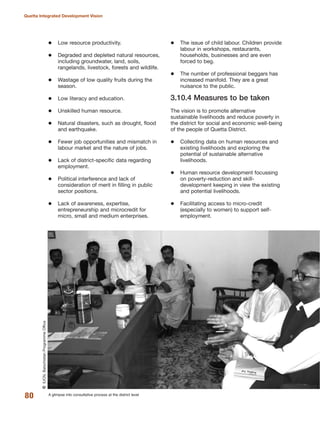
5.7.1 Highways and Roads
Quetta is linked by air, road and railways with
all parts of the province, the country and
regional neighbours. A network of metalled
roads links all major towns and villages of
the district. Three major national highways,
i.e., Karachi-Quetta, Quetta-Jacobabad and
Quetta-Qila Saifullah National Highways,
serve Quetta. In addition, there are metalled
and shingle roads in most parts of the
district.
During 2005-06 total road length was 996 km
in Quetta District (594 km black-topped and
402 km shingle) while during 2006-07 total
road length was 1,066 km (664 km black-
topped and 402 km shingle)85. National
highways are the responsibility of the National
Highway Authority (NHA). The maintenance of
provincial roads is the responsibility of the
C&W Department.
An initiative of rail link from Gwadar to
Mastung, Quetta and onward to China is on
the anvil. This mega-development is
necessary for the optimum use of the Gwadar
Port. However, this development should be
environment-friendly.
5.7.2 Key issues
Although this sector consumes the
maximum public sector budget, the road
conditions are less than satisfactory.
All urban-based key issues and
measures have been discussed above in
Section 3.7.
5.7.3 Measures to be taken
Ensuring comprehensive EIA and
implementation of mitigation measures for
all infrastructure development.
Ensuring that settlements do not grow
along the highways, railways and roads.
The measures regarding transport in
urban areas are discussed in the
Section 3.7. above.
Maximising benefits of the envisioned
mega-projects of communication
infrastructure, i.e., improvement of
national highways and the broad-gauge
145
Quetta Integrated Development Vision
84. Community provides accommodation, meals, tour guides, porters, and pack animals against reasonable charges as
well as opportunity to the tourists to interact with the community and enjoy their culture √ folklore, music, songs,
dance, etc.
85. Communication and Works Department, Government of Balochistan, Quetta.
railways by using EIA and participating
actively in their designing and planning.
5.8 Private Sector and
Public-Private
Partnerships
According to WB-ADB-GoB (2008), the revival
of private sector investment is a major
element of the National Vision 2030, in the
environment of deregulation, liberalisation and
privatisation. Notwithstanding a host of tax
concessions and incentives provided to the
private sector, it remains shy and fails to make
investment in the domestic economy of the
right quality and magnitude.
On the other hand, private sector is inhibited
in its investment initiatives by diverse factors
such as high prices of utilities, many
administrative barriers to investment such as
corruption and red tape, and higher costs of
inputs resulting from the ubiquitous imposition
of 15 percent GST.
In this context, privatisation of strategic assets
in energy may need to be re-examined, and
separation of ownership from responsible
corporate management practices must be
reinforced. Public-private partnerships in
Pakistan have been successful in
telecommunications (privatisation and
management transfers) and in highways
(construction and/or toll collection). It can be
extremely effective in sanitation and waste
collection.
New models for partnership are being
experimented within Pakistan at present. A
policy and operational framework for fostering
public-private partnerships is gradually
evolving in order to facilitate provision of
resources, technical expertise, outreach and
financial mechanisms. Private sector should
be regulated to the extent that its initiative is
not stifled, while the state should focus on
institutional arrangements, performance-
assessment, licencing and accreditation of
service delivery facilities, and quality
assurance mechanisms.
Recent studies suggest that governance in the
Pakistani private sector needs considerable
improvement. Social accountability,
observation of international norms in labour
laws and right of association, and complying
with environmental standards will need to be
widely accepted and enforced in a speedy
manner.
146
Quetta Integrated Development Vision
147
Dera Ismail Khan Integrated Development Vision
6. Disaster Risk Management
G
overnment of Balochistan has
established Provincial Disaster
Management Authority (PDMA)
and a Disaster Risk Management Plan
(2008) has been developed.
Quetta, like other parts of Balochistan, is
an arid, largely mountainous district. The
main five hazards that pose potential
threats to the population in Balochistan
are droughts, floods, earthquakes,
communicable diseases, and landslides
and mudslides. For Quetta, drought, flood
and earthquake (which can also trigger
landslides) pose dangers.
Earthquakes occur with high level of
relative severity as compared to other
hazards in Quetta whereas fire has
medium level of relative severity.
Droughts, locust/pest attacks, crises and
transport accidents have low level of
relative severity while industrial mining
accidents have very low relative severity.
At present, guidelines on the relative
severity of floods are neither available nor
worked out for Quetta. The existing
emergency response machinery and
equipment are not enough to meet a big
disaster in Quetta.
Index for severity of drought in Quetta District
is 2 (low) and index for diversity of livelihoods
is 3 (medium). Relative severity of various
earthquake-related hazards in district Quetta
is 5 (very high), of fire 3 (medium), of
locust/pest attack 2 (low), of a crisis situation
2 (low), of an industrial mine accident 1 (very
low) and of transport accidents 2 (low). As far
as emergency response machinery/equipment
in Quetta District is concerned, there were 25
ambulances, 4 fire brigades, 2 graders, 8
tractors, 8 trucks and 37 water-tanker.
(Disaster Risk Management Plan-2008, PDMA
Government of Balochistan)
6.1 Earthquake
Quetta District is seismically sensitive and
prone to earthquakes. Relative severity of
earthquake in the district (Panjpai) is 5 (very
high). The district lies in the active seismic
region, therefore earthquakes occur from
time to time. Ground acceleration factor is
high because Quetta Valley is in a very
hazardous zone and can have major negative
impacts.
The worst earthquake occurred in May 1935,
when a large part of Quetta town was
destroyed and 60,000 people died. In the
morning of 31 May 1935 at 02.33 am local
time (PST), the powerful earthquake
devastated Quetta town and the adjoining
areas in which most of the fatalities occurred
in Quetta alone. Tremors were felt over much
of the areas what now constitutes Pakistan
and as far as Agra in India. The epicentre of
the earthquake was 4 kilometres South West
of Ali Jaan in Balochistan.
On the 28 November 1945, at 05:26 PST,
another earthquake measuring 8.6 on the
Richter scale hit Balochistan. The epicentre
was 97.6 km SSW of Pasni in Balochistan.
The quake triggered a huge tsunami that
caused great damage to the entire Makran
coastal region.
148
Quetta Integrated Development Vision
Design: Mumtaz Haider Khan, IUCN. Source: Balochistan Disaster Risk Management Plan (2008)
Figue 31: Earthquake density of Balochistan
Recently, the earthquake of magnitude 7.1 on
the Richter scale in February 1997 hit Quetta
hard.86 The earthquake density of Balochistan
is shown in Figure 31.
The recorded earthquake incidences in Quetta
District87 with year and Intensity at R/Scale
are 1935 (7), 1935 (7.5), 1941 (5), 1955 (6),
1975 (5.4), 1978 (5.4), 1987 (5.6), 1990 (5.8 -
6.1), 1992 (5.7), 1993 (5.7), 1995 (5.2), 1996
(5.3), 1997 (5-6.2), 1998 (5.3), 2000 (6), 2006
(4), 2007 (3.5), 2008 (6.4), 2009 (5.1 and 5.7),
2009 (3.4), 2010 (2.2, 3.7, 3.1, 3.4, 3.9, 3.1,
2.4, 2.7).
Earthquakes strike suddenly, violently and
without warning. Identifying potential hazards
ahead of time and advance planning can
reduce the dangers of serious injury or loss of
life from an earthquake. Repairing deep
plaster cracks in ceilings and foundations,
anchoring overhead lighting fixtures to the
ceiling, and following local seismic building
standards, will help reduce the impact of
earthquakes.
Balochistan Disaster Risk Management Plan
will be implemented and the necessary
arrangements will be made in accordance with
the procedure set in the Plan. The following
actions will be taken at district level:
Implementation of code of conduct for
construction activities in Quetta District so
that seismic issues are adressed in the
design before the start of activity.
Conducting awareness-raising campaigns.
Training of government officials, civil
defence volunteers, CBOs, NGOs,
community activists and other groups in
the district.
Introducing a course at the school level in
which the following contents should be
covered:
What to do during an earthquake?
What to do after an earthquake?
Identification of safe places, indoors
and outdoors.
Safety and evacuation procedure.
Emergency communication plan.
Who to contact in case of separation
(a real possibility during the day when
adults are at work and children are at
school)?
Developing a plan for reuniting after the
disaster.
Fire-fighting drills, and installing and using
extinguishers.
6.2 Drought
A drought is a period of time when there is not
enough water to support agricultural, urban,
human, or environmental water needs.
Drought usually refers to an extended period
of below-normal rainfall, but can also be
caused by drying bores or lakes, or anything
that reduces the amount of liquid water
available. Although what is considered
≈normalΔ varies from one region to another,
drought is a recurring feature of nearly all of
the world»s climatic regions. The effects of
drought vary greatly, depending on
agricultural, urban and environmental water
needs of a particular area. Drought originates
from a deficiency of precipitation over an
extended period, usually a season or more.
This deficiency results in a water shortage for
some livelihood activity to a community group,
or environmental sector.
Precipitation in Balochistan is shown in
Figure 32.
Balochistan is an arid region with occasional
rain events. It has a history of droughts but
the recent droughts (1997-2002) were the
longest dry spells in many years. The district
of Quetta has low severity index level (2) as
compared to Kalat, Chagai, Naukundi and
Zhob which have been severely affected by
drought on many occasions. However,
compared to these districts, the level of
awareness to mitigate the drought is much
higher in Quetta due to presence of a number
of interventions and NGOs.
149
Quetta Integrated Development Vision
86. IUCN. Preliminary Environmental Assessment of the Earthquake in Pakistan: IUCN Field Mission Report. Islamabad:
IUCN, 2005.
87. Meteorological Department, Quetta Station.
150
Quetta Integrated Development Vision
Design: Mumtaz Haider Khan, IUCN. Source: Balochistan Disaster Risk Management Plan (2008)
Figue 32: Precipitation in Balochistan
The consequences of the drought can be
following.
Increase in inflation rate and rise in food
prices.
In remote rural areas, a very low level of
food intake causes different diseases
and malnutrition to affected
populations.
Poor health of livestock due to shortage of
fodder, which negatively impacts on the
economy of rural areas of the district.
Nearly 80 percent destruction in apple
trees and orchards
Migration of people from drought-affected
areas.
The drought also contributed to the
incidence of Crimean Congo
Haemorrhagic Fever (CCHF).
Managing long periods of drought, their socio-
economic impacts, and introducing and
managing integrated water resource
management (IWRM) are the main challenges
faced by the people in Quetta District.
There is no early warning system for drought in
place at the provincial or even national level.
There are several technological options, which
can help in forecasting, early warning and
appropriate management of disaster to reduce
the impact of drought. There is no system or
practice of preparedness to minimise losses,
manage drought and rehabilitate the affected
people. The minimum elements for
preparedness include drinking water and food
for human beings and livestock, prevention
and control of human and livestock diseases,
fodder tree reserves and adjustment strategy.
The management of losses from the last
drought is a current priority.
Data on temperature, precipitation, run-off,
recharge, soil moisture and groundwater is
needed to determine the intensity of drought,
which should be collected by the relevant
agencies. This involves great effort but in this
age of information technology, data collection
has become easy and its results reliable with
the help of satellite technology.
6.2.1 Key issues
Lack of data, its interpretation and early
warning system.
Lack of strategy and plan to reduce
damage, manage drought related relief,
and undertake rehabilitation in the district.
Alternative means and options are non-
existent.
Facilities for speedy processing and
marketing of livestock products and
refrigeration of large quantities of meat are
lacking currently.
6.2.2 Measures to be taken
Balochistan Disaster Risk Management
Plan to be implemented and necessary
arrangements made in accordance with the
procedure set in the Plan. The following
actions will be taken at the district level:
Drought monitoring at the district
level. It is a continuous observation of
rainfall situation and comparison with
the existing water needs of a
particular sector of a society.
Application of water supply
conservation at the district level.
Water can be conserved through
rainwater harvesting, which can be
used for agricultural purposes during
dry conditions.
Land-use planning. Low-delta fruit
orchards and crops should be grown
in drought-prone areas.
Livelihood planning. A section of a
society which is likely to be least
affected by droughts should be
advised to live there.
Awareness-raising at a massive level, and
training of the staff involved in extension
work and community on the following
topics:
How to respond to the drought?
Water conservation techniques at
home level.
Introduction and support to efficient,
technology-based irrigation systems,
e.g., bubbler, drip, sprinkler
irrigation.
Building capacity of public sector
organisations, grazers, farmers, private
sector, CSOs, CCBs in preparation for
drought, coordination, information
dissemination, relief and rehabilitation.
Reducing damage or losses through
preparedness. Planning relief and
rehabilitation in advance, and
implementing and monitoring while in
progress.
Raising fodder-tree groves at appropriate
sites strictly for use only during drought
period.
Providing livestock pens and water points
within the grazing areas and at the
makeshifts sites to tide over the drought
period.
Helping and supporting marketing of
livestock to reduce losses from drought.
Fixing rational purchase prices to motivate
the owners to sell their livestock which
they cannot afford to maintain or which is
likely to die because of drought
Arranging for mobile slaughter and
refrigerated storage vans.
Coordinating o the district level with GoP
to establish a satellite monitoring system
for Balochistan, Sindh, southern KP and
southern Punjab for monitoring and early
warning of drought situation, interpretation
of data and dissemination of information
to those who need it.
Strengthening GIS facility at the provincial
headquarters to prepare district-wise
Climatic Moisture Index (CMI) and Soil
Moisture Index (SMI) maps with the help
of remote sensing and GIS facilities.
Establishing a Drought Emergency Fund
at the district, provincial and national
levels. 151
Quetta Integrated Development Vision
6.3 Flood
There is a low level index of flood for Quetta.
Flood impacts can be local, affecting a
neighbourhood or a community, or very large,
affecting entire river basins. Some floods
develop slowly, sometimes over a period of
days. However, flash floods can develop
quickly, sometimes in just a few minutes and
without any visible signs of rain. Flash floods
often have a dangerous wall of roaring water
that carries rocks, mud, and other debris and
can sweep away most things that come in its
path. Overland flooding occurs outside a
defined river or stream, such as when a levee
is breached, but still can be destructive.
Flooding can also occur when a dam breaks,
producing effects similar to flash floods. Even
very small streams, gullies, creeks, culverts,
dry streambeds, or low-lying ground that
appears harmless in dry weather can flood.
The Disaster Management Plan of Balochistan
will be implemented and the necessary
arrangements made in accordance with the
procedures set in the Plan. Additionally, the
following actions will be taken at the district
level:
Awareness-raising campaigns for the
inhabitants of gullies to avoid building in
floodplain unless elevation and
reinforcement are used.
Providing relevant training to CBOs,
government officials, community activists
and other groups in the district.
Arranging for regular training and periodic
drills of emergency preparedness and
response team at the district level for
potential hazard of flood, especially in
gullies of Quetta.
6.4 Fire Crisis
(Urban and Rural)
Urbanisation in most parts of the province,
settlements exposed to fire hazards from gas
or electricity and the lack of awareness and
training in fire safety pose a denger of fire
which may result in considerable loss of life
and property. The need for awareness on fire
safety and fire-fighting and first-aid for burns
is literally a matter of life and death and is
urgently needed. Quetta needs an effective
fire control programme including construction
of fire escapes in all buildings, particularly in
high-rises.
Crisis situations/sabotage can be brought
about by unpredictable incidents that
degenerate to uncontrollable proportions
causing chaos and mayhem. Such a situation
may result from incidents, such as bomb-
blast, bomb-scare, hostage-taking, riots and
demonstrations or civil unrest, crowds and
stampede, terrorist attack and refugee influx.
The frequency of sabotage incidents in
Balochistan, especially those related to
bomb-blast, landmines, hand grenade and
rocket fire, is common in the districts of
Quetta.
152
Quetta Integrated Development Vision
153
Dera Ismail Khan Integrated Development Vision
7. Information Management
and Communication
D
ecision-making is based on the
quantum and quality of relevant
information available. That
information might come from different
sources √ radio, television, newspapers, or
discussions with family, friends, colleagues
and advisors. It might involve information
acquired over a long time, in the course of
education, research, management or from
experience in the past.
Decision-makers must weigh a great deal
of information, considering what is
reliable, what to disregard, and whose
opinion to trust. Whether buying livestock
or a new car, the process is much the
same, but the sources of information
might be quite different. In the first case,
the opinions of people skilled in livestock
breeding might be very important. The
experience and knowledge of skilled,
though uneducated people might be more
valuable than research reports and
databases. The second case might
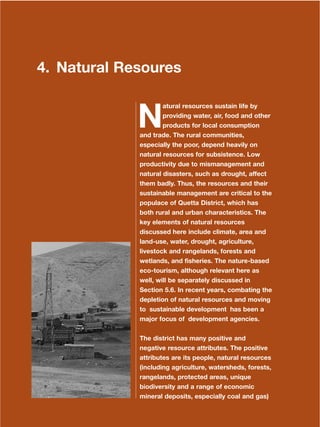
depend on comparative statistics of cost,
performance and reliability, supplemented
by the opinions of other car owners and
personal preferences. The tactics are
quite different.
Information is of many kinds, e.g., relating to
social sectors, NRM sectors, environmental
parameters, sustainable development;
policies, plans, programmes and projects;
statistics, data, research papers and studies;
positions of the federal, provincial and local
governments on any controversial issue;
information needed by people in their daily
life, such as laws, rules, regulations, orders,
public sector systems, procedures and the
various forms and other formalities with which
they have to deal with.
The opportunities of livelihood including
technology and employment as well as
availability of credit and its terms are some of
the other needs of the people. It is important
that the people get all kinds of relevant
information for their needs as well as for
transparency and accountability in the public
sector.
At the provincial level, spatial/temporal data
manipulation and decision-making systems
such as BEMIS88 and BHMIS89 do exist, but
these need to be used optimally and
extended to the district level. In addition,
collection of relevant and reliable data is
crucial to make the best use of the system.
These key agencies are now coming up with
targeted policy documents aligned with
MDGs.
It is difficult to provide information without
having developed computer-based GIS
systems. Computerisation has become crucial
for efficiency, accuracy, cost-effectiveness,
and developing the management information
systems that help in appropriate and speedy
decision-making. Fortunately, its cost is
getting affordable day by day. It can
strengthen institutions and enhance their
efficiency.
Geographic Information Systems (GIS) offer a
set of amazing tools to bring efficiency in
decision-making and transparency, and
demonstrating public accountability. All over
the world, the contribution of this technology
on the municipal level has shown amazing
results in handling diverse data at various
scales and on various levels of
generalisation. Even in Pakistan, the initial
results of the pilot projects which used the
GIS facility have produced amazing results.
The GIS system of TMA, Jaranwala, is one
such example.
In order to evolve GIS into a real Decision
Support System, it must have as many data
layers as needed. GIS application can help in
sustainable development, sustainable
management of natural resources and
environment-protection; and planning,
management and M&E of programmes and
projects.
In order to computerise and handle the
enormous data at the provincial level, a basic
Geographic Information System was
established to meet the overall needs of the
province. The Area Development Programme,
Balochistan (ADPB) inherited a system from
FAO projects on natural resources. This
system can be used at the district level by
networking90.
Efficiency of the district administration could
be enhanced manifold by using the GIS
facility. All district maps would be digitised
and printed, and thematic data linked to the
maps, improving efficiency and quality of
decision making and performance of local
governments.
The trend of classification of documents
must change so that the information could
be used for policy-making, planning and
management, and also for the sake of
transparency. The systems and procedures
need to be looked into for substantial change
for improvement.
It is important that the information
disseminated is free of party politics for
establishing its credibility. It would help if
the bulletin and other products relating to
information have a standard design and
corporate entity for visibility and
recognition.
154
Quetta Integrated Development Vision
88. Balochistan Educational Information System. Available
http://www.balochistan.gov.pk/New%20Folder/BDSSP/BDSSP-
Data/Education/Strenthening%20of%20MIS%20Edu.pdf.
89. Balochistan Health Information System. Available http://57.69.14.59/evaldatabase/files/PAK_99-800_Part2.pdf.
90. ADPB, Volume 1, 1998.
Consumers require and should have access to
the following information for demanding
quality services:
What they should be entitled to in terms
of service delivery from different tiers of
governments, including the types,
standards, and funds allocated to service
delivery, and their performance in the
district?
Their role in ensuring service delivery,
including participation in user
committees and other mechanisms and
what to do if services are not adequately
delivered, including where and how to
complain.
The role of public representatives in
service delivery and their responsibility for
education, health and water and sanitation
services in particular.
To achieve this, all levels of government, be
they federal, provincial or local, play a role in
ensuring that the masses are well-informed of
their rights.
Facilities such as schools, health-care centres
etc. will be required to display public
information on the services they are supposed
to deliver, including the names and
attendance of staff members, e.g., teachers
and doctors, as well as monthly revenues and
expenditure.
The district will publish its plans and budgets
and their transfers to service providers, sector
expenditure, and performance reports, and
use the local media as a vehicle for presenting
and discussing local issues relating to service
delivery.
Encouraging the establishment of independent
district-level radio station(s) as the local mass
media is crucial in keeping the people of the
district informed about what is happening and
seeking their participation and feedback as
well as in making local accountability work.
Creating demand for standard services and
related information is to create a direct link
between user fees, local taxation and service
delivery. This can be done by:
Retaining user fees and spending them
locally by their respective service
providers, guided by the user committee.
Providing information on how user fees
and local revenues are spent, and
encouraging the payers to ask how their
user fees are being spent.
Subsidising many of the costs of
accessing the services directly.
7.1 Means of
Communication
Today»s means of information, e.g., telephone,
mobile phone, print media, electronic media
and the internet are necessary to fulfil the
communication needs of modern government
agencies and business enterprises. The
coverage of telecommunication facilities has
improved in the district thanks to the strong
involvement of private sector. Telephone and
internet services are provided by PTCL in the
main towns of the district and in some
adjacent localities. According to Development
Statistics of Balochistan (2008), by the end of
year 2007, there were sixteen auto, one
optical fibre and thirteen WLL exchanges in
Quetta District. The number of auto
exchanges was fifteen with 49,611
connections during 2008-0991. There were a
total of 65,495 connections in the district
(56,167 automatic, 902 optical fibre and 8,246
WLL connections).92 Radio is very popular in
villages and remote areas as a source of
information and entertainment.
Ufone, Mobilink, Warid, Zong and Telenor
networks provide the mobile services to a
wide area in the district. The number of post
offices in the district93 has increased from 70
in 2000-01 to 75 in 2006-07.
155
Quetta Integrated Development Vision
91. Government of Balochistan. Planning and Development Department. Bureau of Statistics. Development Statistics of
Balochistan 2009. Quetta: GoB, 2009.
92. General Manager, PTCL Quetta Region.
93. Development Statistics of Balochistan 2008 (Postmaster General Office Quetta)
156
Quetta Integrated Development Vision
7.2 Key issues
The public sector agencies do not
proactively or directly provide information
to the public on their policies, plans,
programmes, projects and the
cooperation required from the public.
Participation and contribution of
stakeholders and people in programmes
and projects suffers due to not sharing the
information. There is also the major issue
of lack of transparency in the working of
the public sector agencies due to non-
sharing of information.
Underlying the problem of poor
information management is the weak
demand for information, because
implementers and managers have limited
capacity and incentive to use this
information. Firstly, this is due to limited
managerial skills and secondly, to the fact
that managers have little real autonomy to
make decisions or incentive to perform,
and therefore, to use information
effectively.
The data produced for public
consumption is not readily available.
Most of the information is in English,
which automatically excludes the
masses and therefore their critical
participation.
Lack of integrated databases and
information management systems at the
district level
There is low usage of computers and little
utilisation of GIS technology at the district
level.
Tendency to hold information and not to
share horizontally in the organisations and
with other stakeholders.
Non-utilisation of data and information in
planning and implementation.
The credibility of government agencies
regarding accuracy of information is often
questioned. Rumours arise in the absence
of timely and accurate information from
the government agencies.
7.3 Measures to be taken
Free flow of all kinds of relevant
information in a proactive way from the
government agencies to the masses,
specific target groups and other users is
envisioned. A comprehensive computer-
based information system and database
will be set up. A communication strategy
will be developed through a wide
consultative process and implemented.
Filling-in the information gap between the
government and the masses and
continuously updating them. District level
departments to develop and regularly
disseminate targeted information through
periodic bulletins at suitable intervals.
Extending coverage and access to radio,
especially in the remote rural areas, for
providing information and raising
awareness among grazers, farmers and
other citizens. Broadcasting and
telecasting relevant Pushto and Urdu
programmes from radio and TV.
District administration will develop and
distribute information materials and
periodic bulletins regularly at short
intervals.
Translating the Integrated District
Development Vision (IDDV) of Quetta
District into Urdu and distributing its
copies to the key stakeholders,
implementing agencies, and federal
ministries and agencies.
Promoting, introducing and expanding e-
mail service in the areas where electricity
and telephone facilities are available.
Promoting the use of newspapers as a
means of communicating information,
making these interesting with pictorials,
graphics, cartoons etc.
Promoting electronic and print media,
especially radio and Urdu newspapers.
Pasting bulletins in public sector
institutions such as schools, colleges,
hospitals and other health-care facilities,
bus-stands, courts, post offices and
markets.
Distribution of bulletins with newspapers.
Development and maintenance of an
official district website for all local
governments in the district.
Identifying key areas of information to be
disseminated, and developing and
operating the system.
Preparing for dealing with the likely crisis
of depletion of groundwater; active
participation in the Population Census of
the district in 2008; designing and
planning mega and large projects;
opportunities for employment; SMEs,
environmental issues, technology and
other innovations; common heritage and
common future; and campaign against
social evils.
Developing and operating GIS-based
information systems at the district level
and dissemination of all kinds of
information.
Fulfilling the information needs of all target
groups and stakeholders.
Promoting and using information
technology, and setting up information
management system by extending the
systems already setup at the provincial
level such as BEMIS and BHMIS.
Establishing information centres at the
district, tehsil and union council levels.
Using health management information
system (HMIS) data to take timely
decisions regarding drug procurement and
supply to health-care facilities, health
education on current pandemics, as well
as staff of health facilities. The lack of
reliable water and sanitation data is a
major hurdle in service delivery.
Extending coverage of TV transmission
and supplying TV sets for common
meeting places of remote communities
(separately for men and women) on
157
Quetta Integrated Development Vision
Traffic congestion in Quetta
QIUCN,MehboobAli
subsidised prices or even free of cost for
communal use.
Promoting community organisations to
manage local broadcasting units in remote
areas.
Running information booths at social and
cultural events.
Information dissemination may prioritise
the current issues facing the district, such
as the likely crisis of depletion of
groundwater; active participation in the
population census of the district in 2010;
current programmes and projects,
suggestions regarding designing and
planning new programmes and projects;
opportunities of employment;
opportunities and development of SMEs,
environmental issues, technology and
other innovations; common heritage and
common future; and campaign against the
social evils.
158
Quetta Integrated Development Vision
159
Dera Ismail Khan Integrated Development Vision
8. Implementation of IDDV
T
he real value of this document is in
implementation by all implementing
agencies and stakeholders.
8.1 Priority Programmes and
Projects
The priorities for development and
implementation of programmes and
projects are:
8.1.1 Governance
Improving security and addressing the
issues that have led to insurgency.
Improving governance by
strengthening policies, laws,
institutions, competencies, planning,
management and monitoring, and
establishing rule of law and improving
transparency and accountability.
Developing a computer based and GIS-
supported database of all sectors and
an information management and
dissemination system at the district
level; improving availability and
reliability of data and information.
Improving information flow, in
particular horizontally including all
stakeholders and masses.
Setting up and implementing a
mechanism to address grievance.
Setting up a Steering Committee (of key
stakeholders) at the district level to
coordinate, disseminate, catalyse, support
and monitor the implantation of IDDV and
assess its impact for course correction.
Developing and implementing district
plans for all sectors.
8.1.2 Social Sectors
Improving cohesion and integration in
society, focusing on common social and
economic development agenda.
Improving education and health-care
sectors trough strengthening institutions,
developing competencies of staff,
improving and adding facilities,
increasing budgets, providing enabling
environment, monitoring service delivery
and impact.
Mainstreaming equity and gender, and
eliminating gender disparity.
8.1.3 Natural Resources
Reconciliation of the acuurate
geographical area of the district with the
Survey of Pakistan.
Determining the land-uses, and the
extent to which they remain unreported,
using the satellite images and ground
truthing for future planning,
notwithstanding the formal land-
settlement exercise.
Land-use mapping and planning as well
as assessment of natural resources in the
district using modern technology and
methods.
Detailed delineation of sub-watersheds in
the district and evaluation of their
potential for forestry, agriculture,
watershed management, range
management and water development
(developing surface water storage, hill
torrent control, rainwater harvesting and
spate irrigation.
Improving efficiency in the use of natural
resources (renewable and non-renewable
natural and energy resources) and
reduction in and safe disposal of wastes.
Rehabilitation of natural resources (water,
forests, livestock and rangelands, and
wildlife and protected areas), enhancing
their productivity and their sustainable
use; and achieving sustainability of water
for domestic, agricultural, industrial and
other uses.
Making agriculture sustainable and
modern through:
Use of technology including high-
efficiency irrigation systems (e.g.,
land levelling, on-farm water
management and bubbler
irrigation/drip irrigation) and
mechanisation appropriate to small
land holdings and hilly terrain.
Greenhouse (plastic tunnel) and off-
season vegetable production and
organic farming.
Diversifying agriculture to include low-
delta fruit orchards, vegetables and
other agricultural crops, floriculture
and viticulture, especially in the
valleys where groundwater is
depleting.
Improving marketing of livestock,
fruits, vegetables, and medicinal and
aromatic plants.
Raising forest plantations, and
encouraging and supporting agro-forestry
of multiple purpose trees for fodder,
firewood, timber, soil conservation,
watershed, biodiversity conservation and
carbon sequestration.
Setting up, planning and managing forests
and protected areas (wildlife areas) in
Quetta District scientifically for
conservation, sustainable use and
ecotourism.
Economic investment for improving
rangelands and livestock (improvement of
breeds, feed and health of animals) and
supporting livestock and poultry farming.
Evaluating grazing potential of rangelands
of the district and managing grazing
accordingly.160
Quetta Integrated Development Vision
Harnessing the potential of groundwater
recharge, rainwater harvesting.
8.1.4 Economic Development
Improving and extending energy supply,
commerce and trade, mining, industry,
tourism and SMEs for poverty
alleviation.
Controlling the spiralling high inflation and
cost of utilities.
Human resource development for
alternative sustainable livelihoods.
Urban and regional planning and
implimentation to make Quetta City, its
suburbs, towns, and big villages
sustainable.
Upgradation of the existing towns,
villages, and development of new planned
medium level towns based on the master
plans.
Controlling air, water, soil, land and noise
pollution, and traffic congestion in
Quetta City.
Exploring and developing agriculture and
livestock-based small and medium
enterprises (SMEs) for sustainable
livelihoods and poverty-reduction (dairy
development including animal fattening for
beef and meat, poultry farming, bee-
keeping, sericulture, preservation and
preparation of fruit and vegetable
products, wool-based products, large-
scale handicrafts, and trade and
commerce.
Preservation, interpretation and promotion
of natural areas and cultural sites for
tourism.
Electrification and energy development in
remote rural areas through dispersed
application of alternate energy sources
including biogas, solar PV, wind and solar
thermal; the latter would need wind data
and feasibility studies.
Institutional strengthening of the
Directorate General of Minerals and
Mining.
Exploration and promotion of exploitation
of minerals and development of mining.
Improving power supply from the national
grid.
Enhancing revenue generation at the
district level, especially through revival of
octroi system.
8.1.5 Disasters
Coordinating in the stablishment of early-
warning systems for drought by the
federal government for Balochistan and
other arid areas of the country.
Preparedness to reduce disaster risks,
planning disaster management to reduce
damage and rehabilitation for
sustainability.
Establishing fodder-tree groves for use
only during drought periods.
Facilitating the use of appropriate designs
and construction materials for housing
and other infrastructure including dams,
bridges, and health, education and office
buildings, keeping in view the seismic
sensitivity.
Facilitating upgradation of existing
houses.
Keeping and maintaining enough open
green spaces in Quetta City as green
lungs of the city and for camping during
disaster.
8.2 Key Stakeholders
District Administration
Provincial Departments working at the
district and provincial level
District Council
Union Councils
Federal Agencies √ WAPDA, National
Highway Authority (NHA), PCRWR, Sui
Southern Gas Company (SSGC),
Meteorological Department, Benazir
Income Support Programme, Waseela-e-
Haq, SMEDA, Zarai Taraqqiati Bank
161
Quetta Integrated Development Vision
162
Quetta Integrated Development Vision
Civil Society Organisations
International Organisations, like IUCN
Communities
Private Sector (mining, agriculture,
livestock, poultry, water, transport,
businesses, tourism)
Media (print and electronic)
Academia (education and research
organisations)
Indirect Stakeholders
Transporters from outside
Fruit and vegetable related SME investors
from outside
Traders of livestock
Other traders from outside
8.3 Action Plan
The district would work closely with the
Planning and Development Department,
Planning Commission, other provincial and
federal agencies, communities, CSOs and
private sector in developing, resourcing and
implementing district-based programmes and
projects (listed in 8.8 below) for
implementation of the IDDV. It would focus on
human resource development and would
make use of the various federal and provincial
programmes and projects in this regard.
8.3.1 Dissemination of IDDV and
Action Plan
The Action Plan will be communicated to all
implementing agencies and milestones will be
worked out in consultations with them. The
donors are expected to support the
programmes, projects and priorities of the
IDDV, since these constitute a home-grown
agenda developed through a wide
consultative process.
8.3.2 Institutional Arrangements
The district administration would involve all
stakeholders in the implementation of the
IDDV. An IDDV Steering Committee (IDDV-SC)
will be established to oversee and guide,
coordinate, catalyse, support and monitor
implementation of IDDV. The IDDV-SC will be
headed by the DCO and composed of public
sector representatives including the local,
provincial and federal governments;
politicians, religious leaders, tribal chiefs; the
private sector including the Kissan
Committee, mining, livestock, poultry, tourism,
trade, transport; and civil society
organisations, academia and media. The
Steering Committee would meet quarterly in
the early days of its working and every six
months later on or as the need be. The
Committe will nominate its secretary for
coordination of implementation and
monitoring.
A Management Committee will be formed by
the SC which will be headed by an official
nominated by the SC and will comprise of
the representative of key implementing
agencies for sorting out implementation
problems and ensuring coordination,
monitoring and feedback. The business of
this Committee will be reported to the
Steering Committee.
These committees will develop their Terms of
Reference (ToR) and Rules of Business for
systematic working.
The district administration would seek the
assistance of credible and interested
international organisations, such as IUCN, to
help facilitate implementation of IDDV
including the promotion of best practises of
governance, and planning and management
of natural resources.
8.4 Financial Resources
8.4.1 Public Sector
Development Programmes
A summary of the Public Sector Development
Programme (PSDP) allocations (original) to the
district during the three-year period from
2008-09 to 2010-11 is presented in Figure 33,
which shows the investments made in various
sectors and indicates comparative priorities of
investment of the provincial government for
those sectors.
The sequence of investment in sectors in
2008-09 in the descending order is: Roads,
Education, PP&H, Irrigation, Health-care,
Sports, Culture and Tourism, Youth Affairs,
Culture, Women Development and Forestry.
The sequence of investment in sectors in
2009-10 in the descending order is: Roads,
Education, Urban P&D, PHE, Health, PP&H,
Sports, Culture and Tourism, Youth Affairs,
Power, Irrigation, Social Welfare and WD and
Forestry and the sequence of investment in
sectors in 2010-11 in the descending order is:
Roads, Education, Urban P&D, PHE, Local
government, Health, PP&H, Culture, Sports
and Tourism, Youth Affairs, Labour and MP,
Social Welfare and WD and Irrigation.
A comparative analysis of actual total PSDP
fund allocation (for years 2008, 2009 and
2010) in different sectors for Quetta District is
given in Figure 34.
Other 316.978 million include Labour and
MP (60 million), Social Welfare and WD (55
million), Power (52.67 million), Forestry (38.739
million), Environment (36.635 million), Women
163
Quetta Integrated Development Vision
Source: Public Sector Development Programmes
Figue 33: Actual PSDP allocations to Quetta District (2008-09 to 2010-2011)
Source: Balochistan PSDP 2008-09, 2009-10 and 2010-11 (Original)
Figue 34: Combined Actual PSDP allocation (2008, 2009 and 2010) for Quetta
District
Development (29 million) and Agriculture (24
million).
Comparison of PSDP»s five high investments
in the district in 2010-2011 is shown in Figure
35.
A comparison of PSDP»s low-level
investments in Quetta District in 2010-2011 is
shown in Figure 36.
A comparison of actual provincial PSDP fund
allocation in different sectors for the years
2008-09, 2009-10 and 2010-11 is given in
Figure 37.
The above allocations shown in the various
Tables and Figures do not include allocations
for other schemes worth Rs. 4,082.411 million
(2008-09), Rs. 3,910.098 million (2009-10) and
Rs. 5,872.753 million (2010-11).
164
Quetta Integrated Development Vision
Source: Balochistan PSDP 2010-11 (Original)
Figue 35: Comparison of PSDP»s Five High Investments in Quetta District in 2010-11
Source: Balochistan PSDP 2010-11 (Original)
Figue 36: Comparison of PSDP»s Low Investment in Quetta District in 2010-11
Provincial allocation is worth Rs. 510.984
million for completion of all incomplete
schemes in the province for 2010-11. The
allocation figures for the incomplete schemes
for 2010-11 of Quetta District are not available
on P&DD website.
8.4.2 Resource Mobilisation and
Efficient Use
The district administration will approach the
provincial and federal governments for funds
by using the Public Sector Development
Program (PSDP) mechanism. It is important to
make the best use of the funds received from
various sources for the various programmes
and projects including human resource
development programme.
The donors and international agencies
which have been supporting their relevant
programmes and projects of their interest in
Balochistan include UNDP, ADB, WB, EKN,
USAID, GEF, EU, UNICEF, JICA, Kuwait
Fund, CIDA, DFID, FAO, IUCN, WWF-P and
these may be interested in funding different
parts of IDDV that match with their
priorities.
Donors should support the programmes,
projects and priorities of the IDDV, since these
constitute a home-grown agenda developed
through a wide consultative process. However,
the constraints faced in this regard include lack
of ideas and good concept papers and project
proposals, efficient and prudent use and timely
utilisation of funds. For example, a grant of
Rs.100 million meant for sanitation was not
used in the past and had to be surrendered.
Quetta District requires a greater share of
income from RGST/VAT based on population,
area and revenue-generating capacity lost due
to abolition of octroi, being the district that
meets the requirements for tertiary health-
care, education, market and transport services
for the entire province and hosts the provincial
government.
Financial resources and their efficiency will be
enhanced by tapping the following sources
and approach:
Efficient and prudent use of funds.
Stringent control on public spending,
punitive measures for misappropriation of
funds, if any. 165
Quetta Integrated Development Vision
Source: Balochistan PSDP 2008-09, 2009-10 and 2010-11
Figue 37: Sectoral PSDP allcation (2008-09, 2009-10 and 2010-11) for Balochistan
Balancing the budget between salaries of
staff and activities.
Mega projects funding and grants from
the federal government.
Donor funding (grants and soft loans)
directly or through the government system
or CSOs.
The District Administration, in consultation
with the provincial government, would also try
to raise revenue through taxes, levies, rents
and user charges.
8.5 Monitoring and
Evaluation
The implementing agencies will work out the
Action Plans with implementation milestones,
in consultation with key stakeholders and
under the supervision of the Steering
Committee. These agencies will be supported.
The implementation of the Action Plan will be
monitored annually and major constraints in
implementation will be identified and
addressed.
Lessons learned and best practices will be
identified, documented and disseminated for
replication and scaling up.
Indicators of sustainability will be decided by
the implementing agencies in consultation
with key stakeholders. Its mid-term impact on
sustainability of the district will be assessed in
the 3rd, 8th, and 13th year of implementation
in order to see the effectiveness and impact of
IDDV, and course correction. The IDDV may
be revised in 2025, in case the situation,
issues, options to address the issues change
significantly and additional opportunities are
created by that time.
Monitoring and evaluation will focus on the
following:
Documenting, disseminating and using
the lessons learned and promoting the
best practices.
Monitoring of the implementation of the
IDDV.
Impact assessment of the implementation
of IDDV.
Developing and implementing monitoring
framework for programmes and projects
of all sectors in the district.
The result of monitoring and assessment
will be reported to the Steering Committee
for further guidance or adjustment.
166
Quetta Integrated Development Vision
167
Dera Ismail Khan Integrated Development Vision
Bibliography94
Asian Development Bank, Department for International Development and
World Bank. Devolution in Pakistan: An Assessment and
Recommendation for Action. Islamabad: ADB, DFID & WB, 2004.
Balochistan Educational Management Information System. Available
http://www.balochistan.gov.pk/New%20Folder/BDSSP/BDSSP-
Data/Education/Strenthening%20of%20MIS%20Edu.pdf.
Balochistan Health Management Information System. Available
http://57.69.14.59/evaldatabase/files/PAK_99-800_Part2.pdf.
Camilleri, Joseph A. and Jim Falk. Worlds in Transition. Glasgow: Edward
Elgar, 2010.
Government of Balochistan and IUCN. Balochistan Conservation Strategy.
Quetta: IUCN, 2000.
World Bank, Asian Development Bank and Government of Balochistan.
Balochistan Economic Report. Quetta: GoB, 2008.
Government of Balochistan. Agriculture Department. Directorate of Crop
Reporting Services. Agriculture Statistics of Balochistan 2005-06.
Quetta: GoB, 2006.
Government of Balochistan. Agriculture Department. Directorate of Crop
Reporting Services. Agriculture Statistics of Balochistan 2006-07.
Quetta: GoB, 2007.
Government of Balochistan. Agriculture Department. Directorate of Crop
Reporting Services. Agriculture Statistics of Balochistan 2007-08.
Quetta: GoB, 2008.
Government of Balochistan. Agriculture Department. Directorate of Crop
Reporting Services. Agriculture Statistics of Balochistan 2008-09.
Quetta: GoB, 2009.
Government of Balochistan. Balochistan Disaster Management Authority.
Balochistan Disaster Risk Management Plan. Quetta: GoB, 2008.
Government of Balochistan. Balochistan Environmental Protection Agency.
Ambient Air Monitoring Data. Quetta: Environmental Monitoring
Laboratory, GoB.
Government of Balochistan. Balochistan Local Government Ordinance
2001. Quetta: GoB, 2001.
Government of Balochistan. Department of Education. Balochistan School
Census 2008-2009. Quetta: BEMIS, GoB, 2009.
Government of Balochistan. Department of Health. Balochistan Health
Institutions Databases. Quetta: HMIS, GoB.
Government of Balochistan. Planning and Development Department,
Federal Bureau of Statistics and UNICEF. District Based Multiple
Indicator Cluster Survey 2004. Quetta: GoB, 2004.
Government of Balochistan. Planning and Development Department.
Bureau of Statistics. Development Statistics of Balochistan 2007.
Quetta: GoB, 2007.
94. According to MLA style.
Government of Balochistan. Planning and Development Department.
Bureau of Statistics. Development Statistics of Balochistan 2008.
Quetta: GoB, 2008.
Government of Balochistan. Planning and Development Department.
Bureau of Statistics. Development Statistics of Balochistan 2009.
Quetta: GoB, 2009.
Government of Balochistan. Planning and Development Department.
Between Hope and Despair: Pakistan Participatory Poverty
Assessment Balochistan Report. Quetta: P&DD, GoB, 2003. Available
http://www.dfid.gov.uk/pubs/files/ppa-balochistan.pdf.
Government of Balochistan. Planning and Development Department. Public
Sector Development Program 2007-08. Quetta: GoB, 2007.
Government of Balochistan. Planning and Development Department. Public
Sector Development Program 2008-09. Quetta: GoB, 2008.
Government of Balochistan. Planning and Development Department. Public
Sector Development Program 2009-10. Quetta: GoB, 2009.
Government of Balochistan. Planning and Development Department. Public
Sector Development Program 2010-11. Quetta: GoB, 2010.
Government of Balochistan. The Balochistan Gazette. Balochistan
Provincial Assembly Secretariat Notification, 9 January 2010. Quetta:
GoB, 2010.
Government of Pakistan. Agriculture Census Organisation. Livestock
Census 2006. Islamabad: ACO, Statistics Division, GoP, 2007.
Government of Pakistan. National Health Information Resource Centre.
Health Management Information System. Islamabad: GoP, 2008.
Government of Pakistan. Population Census Organisation. District Census
Report (1998) Quetta. Islamabad: PCO, Statistics Division, GoP, 2001.
Institute on Governance. Governance. Canada. Available
http://iog.ca/en/about-us/governance.
International Crisis Group. Reforming Pakistan»s Civil Service. Asia Report
# 185, 16 February 2010. Islamabad: ICG, 2010. Available
http://www.crisisgroup.org/~/media/Files/asia/south-
asia/pakistan/185%20Reforming%20Pakistans%20Civil%20Service.as
hx.
IUCN. BCS - Report on Consultation Meetings held in Ziarat District.
Quetta: IUCN, 1998.
IUCN. Preliminary Environmental Assessment of the Earthquake in
Pakistan: IUCN Field Mission Report. Islamabad: IUCN, 2005.
IUCN. Water requirements of major crops for different agro-climatic zones
of Balochistan. Quetta: IUCN, 2006.
Jamil, Rehan Rafay, and Zia Hashmi. Engaging Communities-Making
Environmental Sustainability a Reality in Pakistan. Islamabad: UNDP,
2009.
Javaid, Ijaz, and Shahid Ahmad. Conjunctive Water Use and Management
for Minor Perennial Irrigation Schemes in Balochistan √ Key Issues and
Revised Strategy for Investment. Water for Balochistan Policy Briefings
(4) 6. Quetta: Supporting Public Resource Management in Balochistan,
Pakistan, 2008.
168
Quetta Integrated Development Vision
Kahlown, Muhammad Akram, Abdul Majeed, and Muhammad Aslam Tahir.
Water Quality Status in Pakistan. Islamabad: PCRWR, Ministry of
Science and Technology, GoP, 2002.
Khetran, Muhammad Bashir, Athar Ali Shah, Shah Irfan Ahmed and Saira
Atta. Solid Waste Management. Quetta: National Institute of
Management, 2009.
Lisa, Mona, and M. Q. J. ≈Geo-seismological Study of the Ziarat
(Balochistan) Earthquake of 28 October 2008.Δ Current Science 98
(2010): n.p.
Murray, K., Sagintayev, Z., Sultan, M., Khan, S. D., Becker, D. B., Becker,
R., and Milewski, A. ≈An integrated approach for the assessment and
development of renewable groundwater resources in the Quetta valley,
Pakistan.Δ Geological Society of America Abstracts with Programs,
39(6), 154, 2008.
Rana, A. N. Seismo-Tectonic Investigations of Gogai-Ziarat Earthquake in
Balochistan. Quetta: Geological Survey of Pakistan, 2008.
Social Policy and Development Centre. Social Development in Pakistan:
Growth, Inequality and Poverty. Karachi: SPDC, 2001.
van Gils, H. A. M. J. (editor) and M. Shabbir Baig (editor). Environmental
Profile Balochistan Pakistan. Enschede: ITC, 1992.
Water Resource Management. Seminar, Quetta: July, 2002. Environment
Foundation Balochistan.
Williamson, Tim, Masroor Ahmad and Smantha Smith. Improving Devolved
Social Service Delivery in NWFP and Punjab. Islamabad: ADB and
DFID, 2005.
169
Quetta Integrated Development Vision
170
Quetta Integrated Development Vision
Source: UN (http://www.un.org/millenniumgoals/index.shtml).
S. No. Goal Target
1 Eradicate extreme poverty and Halve, between 1990 and 2015, the proportion of people
hunger whose income is less than $1 a day
Achieve full and productive employment and decent
work for all, including women and young people
Halve, between 1990 and 2015, the proportion of people
who suffer from hunger
2 Achieve universal primary Ensure that, by 2015, children everywhere, boys and
education girls alike, will be able to complete a full course of
primary schooling
3 Promote gender equality and Eliminate gender disparity in primary and secondary
empower women education, preferably by 2005, and in all levels of
education no later than 2015
4 Reduce child mortality Reduce by two thirds, between 1990 and 2015, the
under-five mortality rate
5 Improve maternal health Reduce by three quarters the maternal mortality ratio
Achieve universal access to reproductive health
6 Combat HIV/AIDS, malaria and Have halted by 2015 and begun to reverse the spread of
other diseases HIV/AIDS
Achieve, by 2010, universal access to treatment for
HIV/AIDS for all those who need it
Have halted by 2015 and begun to reverse the incidence
of malaria and other major diseases
7 Ensure environmental Integrate the principles of sustainable development into
sustainability country policies and programmes and reverse the loss of
environmental resources
Reduce biodiversity loss, achieving, by 2010, a
significant reduction in the rate of loss
Halve, by 2015, the proportion of the population without
sustainable access to safe drinking water and
basic sanitation
By 2020, to have achieved a significant improvement in
the lives of at least 100 million slum dwellers
8 Develop a global partnership for Address the special needs of least developed countries,
development landlocked countries and small island developing states
Develop further an open, rule-based, predictable, non-
discriminatory trading and financial system
Deal comprehensively with developing countries» debt
In cooperation with pharmaceutical companies, provide
access to affordable essential drugs in developing
countries
In cooperation with the private sector, make available
benefits of new technologies, especially information and
communications
Annex 1: Un Millennium Development Goals
171
Quetta Integrated Development Vision
Map of Quetta District
Quetta - Integrated Development Vision

Quetta - Integrated Development Vision

  • 1.
  • 2.
    The designation ofgeographical entities in this book, and the presentation of the material, do not imply the expression of any opinion whatsoever on the part of IUCN concerning the legal status of any country, territory, or area, or of its authorities, or concerning the delimitation of its frontiers or boundaries. Published by: IUCN Pakistan Copyright: © 2011 IUCN, the International Union for Conservation of Nature and Natural Resources. Quetta - Integrated District Development Vision was developed by the Quetta District Government, with technical assistance of IUCN Pakistan under its project Balochistan Partnerships for Sustainable Development (BPSD) and financial support by the Embassy of the Kingdom of the Netherlands (EKN). Citation is encouraged. Reproduction and/or translation of this publication for educational or other non-commercial purposes is authorised without prior written permission from IUCN Pakistan, provided the source is fully acknowledged. Reproduction of this publication for resale or other commercial purposes is prohibited without prior written permission from IUCN Pakistan. The opinions expressed in this document do not constitute an endorsement by the EKN. Citation: Quetta District Government (2011). Quetta - Integrated District Development Vision. IUCN Pakistan, Quetta, Pakistan. xiv+171 pp. Research and development: Abdul Latif Rao Resource person: Hamid Sarfraz Facilitation: Zabardast Khan Bangash, Mehboob Ali, Naseebullah Khan Editors: Hamid Sarfraz, Madiha Aijaz, Zeevar Scheik and Ajmal Kamal Design: Azhar Saeed, IUCN Pakistan Cover photographs: Saadullah Ayaz, Mumtaz Haider Khan and Azhar Saeed Printed by: Rosette Printers (Pvt) Limited Available from: IUCN Pakistan Balochistan Programme Office Marker Cottage, Zarghoon Road Quetta, Pakistan Tel: +92 (81) 2840450/51/52 Fax: +92 (81) 2820706 www.iucn.org/pakistan
  • 3.
    iii Quetta Integrated DevelopmentVision Contents Abbreviations, Acronyms and Glossary . . . . . . . . . . . . . . . . . . . . . . . . . . . . . . . . .v Executive Summary . . . . . . . . . . . . . . . . . . . . . . . . . . . . . . . . . . . . . . . . . . . . . . . .viii 1. Integrated District Development Vision (IDDV) . . . . . . . . . . . . . . . . . . . . .1 1.1. District Quetta . . . . . . . . . . . . . . . . . . . . . . . . . . . . . . . . . . . . . . . . . . . .1 1.2. Background . . . . . . . . . . . . . . . . . . . . . . . . . . . . . . . . . . . . . . . . . . . . . .2 1.3. Rationale . . . . . . . . . . . . . . . . . . . . . . . . . . . . . . . . . . . . . . . . . . . . . . . .5 1.4. The Process . . . . . . . . . . . . . . . . . . . . . . . . . . . . . . . . . . . . . . . . . . . . .6 1.5. Contents and Organization . . . . . . . . . . . . . . . . . . . . . . . . . . . . . . . . . .6 1.6. Concept of Sustainable Development . . . . . . . . . . . . . . . . . . . . . . . . .6 1.7. Vision of the District . . . . . . . . . . . . . . . . . . . . . . . . . . . . . . . . . . . . . . .7 1.8. Objectives . . . . . . . . . . . . . . . . . . . . . . . . . . . . . . . . . . . . . . . . . . . . . . .8 1.9. Principles . . . . . . . . . . . . . . . . . . . . . . . . . . . . . . . . . . . . . . . . . . . . . . . .8 2. Governance and Institutions . . . . . . . . . . . . . . . . . . . . . . . . . . . . . . . . . . . .9 2.1. Governance . . . . . . . . . . . . . . . . . . . . . . . . . . . . . . . . . . . . . . . . . . . . . .9 2.2. Devolution . . . . . . . . . . . . . . . . . . . . . . . . . . . . . . . . . . . . . . . . . . . . . .11 2.3. Political and Administrative Set-up . . . . . . . . . . . . . . . . . . . . . . . . . . .17 2.4. Key Issues . . . . . . . . . . . . . . . . . . . . . . . . . . . . . . . . . . . . . . . . . . . . . .20 2.5. Measures . . . . . . . . . . . . . . . . . . . . . . . . . . . . . . . . . . . . . . . . . . . . . . .21 3. Social Development and Urban Environment . . . . . . . . . . . . . . . . . . . . .23 3.1. Education . . . . . . . . . . . . . . . . . . . . . . . . . . . . . . . . . . . . . . . . . . . . . .23 3.2. Health-care . . . . . . . . . . . . . . . . . . . . . . . . . . . . . . . . . . . . . . . . . . . . .31 3.3. Environment . . . . . . . . . . . . . . . . . . . . . . . . . . . . . . . . . . . . . . . . . . . .42 3.4. Population . . . . . . . . . . . . . . . . . . . . . . . . . . . . . . . . . . . . . . . . . . . . . .47 3.5. Gender Mainstreaming . . . . . . . . . . . . . . . . . . . . . . . . . . . . . . . . . . . .50 3.6. Human Resource Development . . . . . . . . . . . . . . . . . . . . . . . . . . . . .52 3.7. Housing and Settlements . . . . . . . . . . . . . . . . . . . . . . . . . . . . . . . . . .54 3.8. Water and Sanitation . . . . . . . . . . . . . . . . . . . . . . . . . . . . . . . . . . . . . .63 3.9. Sanitation . . . . . . . . . . . . . . . . . . . . . . . . . . . . . . . . . . . . . . . . . . . . . .76 3.10. Poverty Reduction and Sustainable Livelihoods . . . . . . . . . . . . . . . .79 4. Natural Resources . . . . . . . . . . . . . . . . . . . . . . . . . . . . . . . . . . . . . . . . . . . .83 4.1. Key Issues . . . . . . . . . . . . . . . . . . . . . . . . . . . . . . . . . . . . . . . . . . . . . .84 4.2. Land Uses . . . . . . . . . . . . . . . . . . . . . . . . . . . . . . . . . . . . . . . . . . . . . .84 4.3. Climate . . . . . . . . . . . . . . . . . . . . . . . . . . . . . . . . . . . . . . . . . . . . . . . .86 4.4. Water . . . . . . . . . . . . . . . . . . . . . . . . . . . . . . . . . . . . . . . . . . . . . . . . . .89 4.5. Agriculture . . . . . . . . . . . . . . . . . . . . . . . . . . . . . . . . . . . . . . . . . . . . . .92 4.6. Livestock and Rangelands . . . . . . . . . . . . . . . . . . . . . . . . . . . . . . . .103 4.7. Forests . . . . . . . . . . . . . . . . . . . . . . . . . . . . . . . . . . . . . . . . . . . . . . . .117
  • 4.
    4.8. Wildlife andProtected Areas . . . . . . . . . . . . . . . . . . . . . . . . . . . . . . .124 4.9. Wetlands and Fisheries . . . . . . . . . . . . . . . . . . . . . . . . . . . . . . . . . . .130 5. Economic Development . . . . . . . . . . . . . . . . . . . . . . . . . . . . . . . . . . . . . .131 5.1. Commerce and Trade . . . . . . . . . . . . . . . . . . . . . . . . . . . . . . . . . . . .132 5.2. Industry . . . . . . . . . . . . . . . . . . . . . . . . . . . . . . . . . . . . . . . . . . . . . . .132 5.3. Micro, Small and Medium Enterprises . . . . . . . . . . . . . . . . . . . . . . .134 5.4. Minerals and Mining . . . . . . . . . . . . . . . . . . . . . . . . . . . . . . . . . . . . .136 5.5. Energy . . . . . . . . . . . . . . . . . . . . . . . . . . . . . . . . . . . . . . . . . . . . . . . .139 5.6. Culture and Eco-tourism . . . . . . . . . . . . . . . . . . . . . . . . . . . . . . . . . .141 5.7. Communication and Other Infrastructure . . . . . . . . . . . . . . . . . . . . .145 5.8. Private Sector and Public-Private Partnerships . . . . . . . . . . . . . . . .146 6. Disaster Risk Management . . . . . . . . . . . . . . . . . . . . . . . . . . . . . . . . . . .147 6.1. Earthquake . . . . . . . . . . . . . . . . . . . . . . . . . . . . . . . . . . . . . . . . . . . .148 6.2. Drought . . . . . . . . . . . . . . . . . . . . . . . . . . . . . . . . . . . . . . . . . . . . . . .149 6.3. Flood . . . . . . . . . . . . . . . . . . . . . . . . . . . . . . . . . . . . . . . . . . . . . . . . .152 6.4. Fire (Urban and Rural) . . . . . . . . . . . . . . . . . . . . . . . . . . . . . . . . . . . .152 7. Information Management and Communication . . . . . . . . . . . . . . . . . . .153 7.1. Means of Communication . . . . . . . . . . . . . . . . . . . . . . . . . . . . . . . . .155 7.2. Key issues . . . . . . . . . . . . . . . . . . . . . . . . . . . . . . . . . . . . . . . . . . . . .156 7.3. Measures . . . . . . . . . . . . . . . . . . . . . . . . . . . . . . . . . . . . . . . . . . . . . .156 8. Implementation of IDDV . . . . . . . . . . . . . . . . . . . . . . . . . . . . . . . . . . . . . .159 8.1. Priority Programmes and Projects . . . . . . . . . . . . . . . . . . . . . . . . . .159 8.2. Key Stakeholders . . . . . . . . . . . . . . . . . . . . . . . . . . . . . . . . . . . . . . .161 8.3. Action Plan . . . . . . . . . . . . . . . . . . . . . . . . . . . . . . . . . . . . . . . . . . . .162 8.4. Financial Resources . . . . . . . . . . . . . . . . . . . . . . . . . . . . . . . . . . . . .162 8.5. Monitoring and Evaluation . . . . . . . . . . . . . . . . . . . . . . . . . . . . . . . .166 Bibliography . . . . . . . . . . . . . . . . . . . . . . . . . . . . . . . . . . . . . . . . . . . . . . . . . . . . .167 Annexes Annex 1: UN Millennium Development Goals . . . . . . . . . . . . . . . . . . . . . . .170 Map of Quetta District . . . . . . . . . . . . . . . . . . . . . . . . . . . . . . . . . . . . . . . . .171 iv Quetta Integrated Development Vision
  • 5.
    ADB Asian DevelopmentBank AIDS Acquired Immune Deficiency Syndrome ASL Above Sea Level BADP Balochistan Area Development Programme BCS Balochistan Conservation Strategy BDA Balochistan Development Authority BEMIS Balochistan Education Management Information System BF&WD Balochistan Forest and Wildlife Department BHU Basic Health Unit BLGO 2001 Balochistan Local Government Ordinances, 2001 CCB Citizen Community Board CDO Community Development Office CSO Civil Society Organisation DCO District Coordination Officer DCR District Census Report DPO District Police Officer DTCE Devolution Trust for Community Empowerment EDO Executive District Officer EIA Environmental Impact Assessment EMIS Education Management Information System F&WD Forest and Wildlife Department GIS Geographic Information System GoB Government of Balochistan GSP Geological Survey of Pakistan Ha Hectare (S) HIV Human Immunodeficiency Virus HMIS Health Management Information System IDDV Integrated District Development Vision IT Information Technology IUCN International Union for Conservation of Nature IWRM Integrated Water Resources Management Karez Underground gravity irrigation channel devised to tap groundwater in arid regions. In Balochistan, karezat (plural of karez) are constructed on a communal basis. v Quetta Integrated Development Vision Abbreviations, Acronyms and Glossary
  • 6.
    KP Khyber Pakhtunkhwa LEPALow Energy Precision Application LEWS Livestock Early Warning System LG Local Government LGC Local Government Commission LGU Local Government Units LHV Lady Health Visitor LPG Liquified Petroleum Gas MAF Million Acre Feet MCM Million Cubic Meters MDGs Millennium Development Goals MEAs Multilateral Environmental Agreements MICS Multiple Indicators Cluster Survey MNA Member National Assembly MPA Member Provincial Assembly NCHD National Commission for Human Development NCS National Conservation Strategy NEP National Environmental Policy NGO Non-Governmental Organisation NHA National Highway Authority NIPS National Institute of Population Studies NRB National Reconstruction Bureau NRM Natural Resource Management NWFP North West Frontier Province P&DD Planning and Development Department PCRWR Pakistan Council of Research in Water Resources PFC Provincial Finance Commission PHED Public Health Engineering Department PRSP Poverty Reduction Strategy Paper PSDP Public Sector Development Programme QEMIS Quetta Education Management Information System QWSEIP Quetta Water Supply and Environmental Improvement Project RHC Rural Health Centre Rs Pak Rupees SC Steering Committee SEA Strategic Environmental Assessment SEP School Enhancement Programme vi Quetta Integrated Development Vision
  • 7.
    SMEDA Small andMedium Enterprise Development Authority SMEs Small and Medium Enterprises SPDC Social Policy Development Centre SWOT Strengths, Weaknesses, Opportunities and Threats TMA Tehsil Municipal Administration UC Union Council UMB Urea Molasses Blocks UN United Nations UNDP United Nations Development Programme UNEP United Nations Environmental Programme UNESCO United Nations Educational, Scientific and Cultural Organization UNICEF United Nations International Children»s Fund UPE Universal Primary Education USAID United States Agency for International Development WB The World Bank WCED World Commission on Environment and Development WCS World Conservation Strategy WEHAB Water, Education, Health, Agriculture and Biodiversity Programme of WSSD WHO World Health Organisation WSSD World Summit for Sustainable Development WTO World Trade Organisation ZC Zila Council vii Quetta Integrated Development Vision
  • 8.
    The Integrated DistrictDevelopment Vision (IDDV) of Quetta District has been developed through a wide consultative process. The current situation, issues and challenges, measures, opportunities and constraints have been discussed sector- wise in the relevant chapters on governance, social sectors, natural resources, economic development and disaster management. The goals and objectives of the IDDV are to achieve conservation and sustainable use of natural resources, sustainable development and environment protection in the district. The priority sectors for Quetta District are water and sanitation, population, health-care, education, housing and settlements, commerce and trade, industry, mining, energy, forests, wildlife and protected areas, poverty eradication and governance. Quetta District is considered the jewel in the crown of Balochistan. Quetta City, the headquarters of the district, is an old historical settlement that has seen phenomenal growth in its area and population, especially after becoming the capital of the province. The district is bordered by Pishin, Mastung and Sibi districts on its north, south and east respectively and also has common boundaries with Ziarat, Bolan and Nushki districts. Quetta shares on the western side an international border with Afghanistan. The geographical area of the district is 3,4991 sq. km. In 1998, its population and population density were 759,941 and 286.42 per sq. km. respectively. The population of the district is projected3 to become 1,026, 000 and 1,241,000 in 2011 and 2021 respectively. The Quetta District comprises three administrative units, namely, Quetta City (mainly an urban area, the largest in the province), Quetta Sadar (rural surroundings of Quetta City in its east, north and west) and Panjpai tehsil (a rural area sandwiched between Quetta City in the east, Mastung district in the south and Afghanistan in the west). Quetta City covers almost the entire Quetta valley; which is surrounded by hills on three sides with a narrow opening in the north toward Kuchlak. The eastern part of the city comprises of the largest cantonment in the province. Quetta has limitations in terms of its expansion and flushing of the polluted air. The district has many positive and negative resource attributes. The positive attributes are its people, natural resources (including agriculture, watersheds, forests, rangelands, protected areas, unique biodiversity and a range of economic mineral deposits, especially coal and gas) and its strategic location. The negative attributes include aridity, periodic droughts, fast depleting groundwater and biodiversity, overgrazed and degraded rangelands, low productivity of the livestock, rugged terrain in remote areas, to mention a few. The population density is very high both in urban and rural areas except Panjpai tehsil. Quetta City, as the capital and the largest settlement and cantonment in the province, is the hub of tertiary education and health-care services as well as that of viii Quetta Integrated Development Vision Executive Summary 1 According to map by Survey of Pakistan; according to the Quetta District Census Report (1998) the area was 2,653 sq. km. 2 Government of Pakistan. Population Census Organisation. District Census Report (1998) Quetta. Islamabad: PCO, Statistics Division, GoP, 2001. 3 Estimates by National Institute of Population Studies (NIPS), Islamabad.
  • 9.
    ix Quetta Integrated DevelopmentVision commerce and trade, and, as such, is the biggest provider of jobs in the province. The social indicators of Quetta District are the highest in the province. The district is better served than others in health-care, education, sports, market, transport, sanitation facilities and power, natural gas and other utility services. Quetta city is accessible from all parts of the province and other parts of Pakistan by national highways, other roads, railways and air. Most parts of the district are accessible despite the hilly terrain. The roads in the remote areas of Quetta Sadar are mainly used for transporting coal and other minerals from mines. However, the district is facing serious multiple challenges. There are issues of availability, quality and cost of education and health-care services in the district. Access to these services in the rural areas is far inadequate, with Panjpai tehsil in particular lagging behind other parts of the district in this respect. Urban development is fast-paced and unplanned. Quetta is an over-populated city with an acute shortage of drinking water and an abundance of slums. The city«s physical and environmental limitations hinder its expansion. The existing infrastructure of water and sanitation, roads, parks and open spaces and playgrounds is inadequate as compared to the population which has grown rapidly due to increasing rural-to-urban migration. Building codes and regulations have not been earnestly observed. A master plan for the city was developed but was not implemented. Environmental issues, such as incomplete and unsafe disposal of solid waste and sewage as well as traffic congestion and air pollution, remain a big challenge. Vegetables are grown with untreated sewerage water and sold and consumed by the people of Quetta city. Drinking water is scarce and groundwater is depleting fast due to over-exploitation by the population and by inefficient use in high-delta agriculture, the lack of watershed management in the catchment areas and housing schemes in active water recharge zones. Groundwater pollution is also a serious issue. The options for improvement include: increasing water recharge, rain-water harvesting, using efficient irrigation systems such as Bubbler irrigation, and controlling water pollution. Quetta Sadar is rich in mineral deposits, including coal and natural gas, and most of these are being exploited from the rural areas, not very far from Quetta city. Quetta Sadar, mostly mountainous, is also the catchment area of Quetta and other valleys, which drain through many seasonal streams and on which their groundwater resources depend. It is, however, not perceived or managed in this context. Agriculture is the mainstay of people in the rural areas and instrumental in economic gains. There are orchards of many types of temperate fruits and significant area is under cultivation of vegetables but the agriculture is not sustainable due to excessive and inefficient use of groundwater and high use of agro-chemicals. Livestock and rangelands are important for subsistence and poverty reduction of people in the rural areas, as it is necessary to meet the needs of the population of Quetta City and the remaining district for livestock products. The vast areas of rangelands used for livestock herding are generally overstocked and depleted, and have low productivity. Dairy-farming, open-air slaughtering of animals, poultry farming and production of animal feed are widespread in the Quetta city. The Juniper forests in the Zarghoon hills are next to those in Ziarat district in terms of area and quality. Scrub forests also exist in the district. The forests constitute important watersheds for drinking and irrigation water supply to Hanna and Urak villages, Hanna lake, Spin Karez lake and Quetta cantonment. Mainly bushy Juniper trees and broad- leaved trees in streambeds and easier slopes are grown in Hazarganji-Chiltan National Park. Out of the two state forests in Panjpai tehsil, Koh-e- Murdar is almost deforested and de-vegetated due to over-exploitation and overgrazing. There is a wide diversity of species of wild animals, plants, habitats and ecosystems in the district. The wildlife includes common leopard, endemic Chiltan goat commonly known as Chiltan Markhor, Urial, migratory and resident water-birds, reptiles, amphibians and invertebrates. Hazarganji-Chiltan National Park is one of the important protected areas (PAs) of Pakistan. It has wildlife and other biodiversity of global significance and is meant for conservation of biodiversity and all other resources, low-impact recreation, education and research. Duzadara and Koh-e-Surko are the Game (Wildlife) Sanctuaries for breeding wild animals and hunting and other exploitative uses are prohibited there. Karkhasa, now a part of the national park, Central Zarghoon, Southern Takatu, Southern Malachi, Hanna Lake, Spin Karez and Wail Tangi Dam are other wildlife areas in the district. Climate change has affected the natural resources, people and economy of the area. The chilling
  • 10.
    period required forproducing quality temperate fruits, such as apples and cherries, is less than it used to be. Snowfall, rainfall and temperatures have also been affected, resulting in longer and more severe drought periods, far less availability of water, and low productivity of agriculture and rangelands, to mention a few. The existing pillars of economic growth in the district are commerce and trade, industry, mining, agriculture livestock and service sectors. The natural and cultural heritage of the district is rich but the potential of eco-tourism and tourism has not been realised, due mainly to insecurity, permit policies for foreigners and lack of promotion of tourist destinations. Most places of archaeological significance in the district are buried under ammunition depots. Governance is as weak as elsewhere in the province and the country. This is mainly due to inherent system that privileges the rich, the changing social values, influence of tribalism, political interference, weak institutions, incompetence of manpower, low-level use of information technology, and lack of objectivity, transparency and accountability. The greater proportion of the issues and challenges faced by the district relate to Quetta city, which is grossly overpopulated due to in-migration from all other, less resourceful parts of the province; and also from other parts of Pakistan, mainly for business and labour. The problems common to all sectors in the district include: Lack of awareness and motivation where direct and personal economic incentive is missing. Preference for short-term measures and personal gain as compared to long-term policies and plans. Weak governance, in particular lack of intra- agency, cross-agency and sectoral coordination, weak institutional capacities, and individual incompetence in the public sector agencies; inefficient use of human and financial resource; weak compliance and enforcement of law; and negative political interference. Lack of proactive and integrated planning and management. Discrimination against women and lack of gender mainstreaming. Low-level use of new technology in traditional sectors and information technology, especially use of traditional, inefficient irrigation methods. The use of computers in the offices of the public sector agencies is very low. Lack of adequate and reliable data; lack of database and information management systems at the district level, with the exception of education and health-care sectors, and lack of information dissemination. Imbalanced budgetary allocation among different sectors, with very little share for natural resource sectors. A longer list of key issues in the district includes: Issues of coverage and quality of education and health-care. Lack of urban planning and absence of a master plan. Insecurity due to militancy and insurgency in the province against excesses and denial of rights, as well as growing distance between different ethnic groups. Quetta city and district face food insecurity due to deficiency in food items like pulses, milk and chicken products, which are procured from other parts of the country. A political culture of agitations and strikes prevails in Quetta city. The ever-growing scarcity of drinking water in Quetta city is one of the most serious issues. Incomplete coverage and low quality of municipal services including sanitation and solid waste disposal. Hospital waste, disorderly and polluting vehicle workshops and washing stations need to be taken care of. The traffic police and BEPA need to combat traffic congestion and air, water and noise pollution. Throwing garbage in Habib Nala (drain) and other open drains. Construction of residential and other structures on the best water recharge areas. Dairy farms in residential areas and slaughtering of animals in the open. Vegetables grown with untreated sewerage water.x Quetta Integrated Development Vision
  • 11.
    xi Quetta Integrated DevelopmentVision Issues of coverage and quality in education and health-care sectors. Although Quetta is better than all other districts in these sectors, there is a lot of room for improvement. The provincial capital is expected to establish, maintain and provide tertiary level health-care and education facilities not only to the population of Quetta District, including the increasing population of Quetta city, but also to the people in the northern and central parts of the province. The district is seismically sensitive. A devastating earthquake of 7.5 ML (Richter scale) in 1935 caused 35,000 deaths4. Quetta is affected by earthquakes more often than any other district in the province. The district is also affected by cyclical droughts. The rural areas of the district, i.e. Quetta Sadar and Panjpai, have not been integrated as yet with Quetta City in regional planning, although they are part of the region which supports and is also dependent on Quetta City in various ways. Depletion and degradation of natural resources including groundwater, watersheds, forests, rangelands, wildlife and protected areas. Excessive agricultural tubewells (both sanctioned and unapproved) and subsidised power tariffs give rise to water mining issues and are a financial burden on the provincial and federal governments and WAPDA. They also create inequity since many users do not pay for the utilities consumed. Inefficient use of water, especially for irrigation of high-delta orchards, vegetables and other crops. Lack of integrated management of Pishin Lora, which is shared by the districts of Kalat, Mastung, Quetta, Pishin, Qila Abdullah and Noshki. Economic development is fast but lacks environmental considerations. Mining is one of the pillars of growth but there are issues of outdated methods, workers» safety, occupational health, social security and old-age benefits. The power crisis has deepened with frequent load-shedding and fluctuations in voltage, affecting the productivity of industries and SMEs, commerce and trade, human resources in general and agriculture in particular. The 2010-2011 budget of the provincial government has been significantly enhanced as a result of a substantial increase in the federal share. This trend is likely to continue in the years to come and provides a good opportunity to address the most serious problems of the province. Quetta city with its large population is riddled with multiple serious problems. Because of depleting groundwater, sustaining water-supply is one of the most important issues that require urgent attention to avoid the looming crisis and a long-term solution. The Integrated District Development Vision (IDDV) of Quetta has been developed, in this context, through a wide consultative process. The current situation, issues and challenges, measures, opportunities and constraints have been discussed sector-wise in the relevant chapters on governance, social sectors, natural resources, economic development and disaster management. Strengths, weaknesses, opportunities and threats (SWOT) have been assessed with regard to sustainable development in the district and the inferences drawn have been incorporated in this document. The goals and objectives of the IDDV are to achieve conservation and sustainable use of natural resources, sustainable development and environment protection in the district. The priority sectors for Quetta District are water and sanitation, population, health-care, education, housing and settlements, commerce and trade, industry, mining, energy, forests, wildlife and protected areas, poverty eradication and governance. Millennium Development Goals and targets focus on eradicating poverty (MDG 1), achieving universal primary education and gender equality (MDGs 2 and 3), improving mother and child health, combating communicable diseases (MDGs 4, 5 and 6) and improving water and sanitation (MDG 7). Water, agriculture, forests, rangelands, wildlife and protected areas are the most important renewable resources in the district. Fossil fuels and mineral deposits are also there. Social services, i.e. health- care, education and utilities, i.e. energy, transport, communication infrastructure are by far the best in the province. However, they still need to be improved. 4 Government of Balochistan. Balochistan Disaster Management Authority. Balochistan Disaster Risk Management Plan. Quetta: GoB, 2008.
  • 12.
    The district, inparticular Quetta City, is grossly over-populated. Water scarcity is the most serious concern as groundwater is depleting fast due to over-exploitation, inefficient use of water for orchards and agriculture; lack of watershed management in the catchment areas and housing on active water recharge zones. The forests, rangelands, other watershed have degraded and their productivity and environmental services have reduced very much. Wildlife has declined in the district; however, Hazarganji-Chiltan National Park is an exception in this regard. Consequently, the first priority is to halt and reverse depletion and degradation of natural resources by arranging and promoting the use of alternatives, and development of existing resources. Further development is also important for meeting the future demands. The best achievement of the people and the government would be to improve the natural resources to their maximum potential for sustainable management and use by them and future generations. The environmental conditions in the city have deteriorated due to air, water, land and noise pollution; incomplete and unsafe disposal of solid, hospital and industrial wastes and sewage. Other issues include traffic congestion, slaughtering of animals in the open, establishment of dairy farms in residential areas, removal of trees in the process of widening of roads and conversion of open and green spaces into built environment. The priorities for development and implementation of programmes and projects for the future are as under: Governance Improving security and addressing the issues that have led to political insurgency. Improving governance by strengthening policies, laws, institutions, competencies, planning, management and monitoring. Establishing rule of law and improving transparency and accountability. Developing and implementing district plans for all sectors. Developing computer-based and GIS- supported database of all sectors at the district level; developing information management and dissemination system; improving availability and reliability of data and information. Improving information flow, in particular horizontally, including all stakeholders. Setting up and implementing a mechanism to address people»s grievances. Setting up a Steering Committee (of key stakeholders) mechanism at the district level to coordinate, disseminate, catalyse, support and monitor the implementation of the IDDV. Social Sectors Improving cohesion and integration in society focusing on common social and economic development agenda. Improving education, health-care and water supply and sanitation sectors through strengthening institutions, developing competencies of staff, improving and adding facilities, increasing budgets, providing enabling environment, monitoring service delivery and impact. Mainstreaming equity and gender, and eliminating gender disparity. Natural Resources Reconciliation of the district»s geographical area with the Survey of Pakistan. Determining land-use and un-reported land- use with satellite images and ground-truthing for future land-use planning, notwithstanding the formal land-settlement exercise. Land-use mapping and planning, as well as assessment of natural resources in the district using modern technology and methods. Detailed delineation of sub-watersheds in the district and evaluation of their potential for forestry, agriculture, watershed management, range management and water development. (Surface water storage, hill torrent control, rainwater harvesting and spate irrigation.) Improving efficiency in the use of natural resources (renewable and non-renewable natural and energy resources) and reduction in and safe disposal of wastes. Rehabilitation of natural resources (water, forests, livestock and rangelands and wildlife and protected areas), enhancing their productivity and sustainable use; andxii Quetta Integrated Development Vision
  • 13.
    xiii Quetta Integrated DevelopmentVision achieving sustainability of water for agriculture, industry, nature and other uses. Making agriculture sustainable and modern through the following: Use of technology including the high efficiency irrigation systems (e.g., land levelling, on-farm water management and Bubbler irrigation/drip irrigation) and mechanisation appropriate to small land- holdings and hilly terrain. Greenhouse (tunnel) and off-season vegetable production and organic farming. Diversification of agriculture to include low-delta fruit orchards, vegetables and other agricultural crops in the valleys where groundwater is depleting. Improvement in the marketing of livestock, fruits, vegetables, and medicinal and aromatic plants. Raising forest plantations, and encouraging and supporting agro-forestry of multiple- purpose trees for fodder, firewood, timber, soil conservation, watershed, biodiversity and carbon sequestration. Setting up, planning and managing forests and protected areas (wildlife areas) in the district on scientific lines for conservation, sustainable use and promotion of ecotourism. Economic investment for improving rangelands and livestock (improvement of breeds, feed and health of animals) and supporting livestock and poultry farming. Evaluating grazing potential of rangelands of the district and managing grazing accordingly. Harnessing the potential of groundwater recharge, rainwater harvesting. Economic Development Economic development through improving and extending energy supply, commerce and trade, mining, industry, tourism and SMEs for poverty alleviation. Controlling the spiralling high inflation and cost of utilities. Human resource development for alternative sustainable livelihoods. Urban and regional planning and implementation to make Quetta city, its suburbs, neighbouring towns, and big villages sustainable. Upgradation of the existing towns and villages and development of new planned medium- level towns based on master plans. Controlling air, water, soil, land and noise pollution, and traffic congestion in Quetta city. Exploring and developing agriculture and livestock-based small and medium enterprises (SMEs) for sustainable livelihoods and poverty reduction (dairy development including animal fattening for beef and meat, poultry farming, bee-keeping, sericulture, preservation and preparation of fruit and vegetable products, wool based enterprises, large scale handicrafts, and trade and commerce etc.). Preservation and promotion of natural areas and cultural sites for tourism. Electrification of and energy development in remote rural areas through dispersed application of alternate energy sources including biogas, solar PV, wind and solar thermal; the latter would need wind data and feasibility study. Institutional strengthening of the Directorate General of Minerals and Mining. Exploration and promotion of mineral exploitation and development of mining. Improving power supply from the national grid. Enhancing revenue generation at the district level, especially through revival of octroi system. Disasters Establishment of early-warning systems for drought by the federal government for the district and other arid areas of the country. Preparedness to reduce disaster risk, disaster management to reduce damage and rehabilitation for sustainability. Establishing fodder tree groves, for use only during drought periods.
  • 14.
    Facilitating the useof appropriate designs and construction materials for housing and other infrastructure including dams, bridges, and health-care, education and office buildings, keeping in view the seismic sensitivity; facilitating upgradation of existing houses as well. Keeping and maintaining enough open green spaces in Quetta City as green lungs of the city. The balanced growth model is appropriate for Quetta District, despite the constraints of resources and capacities. A balance between society, economy and environment is crucial for sustainable development. The balance between population and resources is lacking and natural resources are depleting due to past and present unsustainable use. The real issue is of relative prioritisation and sharing of financial resources. For example, major investments in the public sector have been allocated primarily to roads and other infrastructure with very little or no investment on natural resources and social sectors. A reprioritisation needs to be made for future investment. Improvement in both macroeconomic and microeconomic conditions is important for the sustainable development of the district. The former creates an enabling environment for appropriate economic growth (with participation and equity) and the latter helps in the trickle-down effect, which helps in equity and poverty-reduction. Another related issue in this respect is that of scale, e.g., corporate farming, which has the advantage of using technology, and reducing costs of production, transportation and marketing. The appropriate options for communities in the district are cooperative farming and shareholding in corporate farming. The policy and legal framework, approved by the federal and provincial governments, create an enabling environment and provide positive or perverse economic incentives. An example of perverse incentive is the subsidised flat tariff on agricultural tubewells, a joint policy decision by the federal and provincial governments and WAPDA with short-term benefit to agriculturists but inequity and long-term repercussions on the availability of groundwater. The implementing agencies will develop and implement their flexible five-year plan: Firstly, IDDV Action Plan to implement short- term measures, coinciding with the Five Year Plan 2010-2015 of the government. Secondly, IDDV Action Plan for implementing the medium-term measures and throw forward in the various sectors during 2015 √ 2020. Thirdly, IDDV Action Plan to implement the long-term measures and the throw forward during 2020 √ 2025 Implementation of the Action Plan will be monitored annually and major constraints in implementation will be identified and addressed. Its mid-term impact on sustainability of the district will be assessed in the third, eighth, and 13th year of implementation in order to see its effectiveness and impact, and course-correction. The IDDV may be revised in 2025, in case the situation, issues and options to address the issues have changed significantly and additional opportunities have been created by that time. Implementation of this IDDV would require changes in the management approach from ad hocism and fire-fighting to pursuing the vision by providing committed and effective leadership, involving all stakeholders, enhancing capacities and coordination; creating enabling environment, motivating and providing economic incentives, and generating and investing financial resources based on clearly defined priorities. The district administration would take the lead, implement its agenda and coordinate, catalyse, support and monitor implementation by other actors under the guidance of the proposed IDDV Steering Committee. Funds and institutional capacities will remain the main constraint in the implementation of the IDDV. The district generates significant revenue for continuity but the major share is needed for maintenance alone, apart from development budget, which creates additional assets, capacities and resources. The district has a great potential in this regard. It is, therefore, important that the district should get adequate allocations from the revenue budget and share from the General Sales Tax (GST) to avoid degeneration of its capacity to raise revenue and enough development-budget to maximise realisation of its development potential. xiv Quetta Integrated Development Vision
  • 15.
    1 Dera Ismail KhanIntegrated Development Vision 1. Integrated District Development Vision (IDDV) 1.1 District Quetta F rom the tenth century to the middle of the nineteenth century Quetta was called by its ancient name ≈ShalkotΔ. The old Quetta settlements appear to have existed as far back as five millennia as was discovered from excavations in the village of Killi Gul Mohammad and Balaili. Quetta Valley is part of Quetta Basin and consists of a tectonic depression, a buried valley and a karstic bedrock. Networks of minor valleys dissect the Quetta Valley and the surrounding outcrops and join into the main Quetta Valley. Quetta, like other parts of Balochistan, is an arid, largely mountainous district, with low rainfall (in the range of 100- 300 mm/year) and extreme variations in temperatures during summer and winter. It has endured frequent spells of drought, flash floods and earthquakes. The three administrative units of Quetta District include (i) Quetta City (mainly urban area, largest in the province), Quetta Sadar (rural surround of Quetta City in its east, north and west), and
  • 16.
    (iii) Panjpai tehsil(a rural area sandwiched between Quetta City in the east, Mastung District in the south and Afghanistan in the west). Pishin, Mastung and Sibi Districts are on it north, south and east respectively. Ziarat, Bolan and Nushki districts touch its boundaries on the north-east, south-east and south-west respectively. Its western boundary makes the international border with Afghanistan. Quetta City spreads almost on the entire Quetta Valley which is surrounded by hills on its three sides with narrow opening in the north toward Kuchlak. The eastern part of the city comprises of the Cantonment, the largest in the province. The city has a limitation in terms of its expansion and flushing of the air pollution of the city. Quetta City, being the provincial capital, is the centre of tertiary education and health-care services as well as the hub of commerce, trade and employment. Quetta City is among the largest centres of commerce and trade in the country and is the biggest in the province. Quetta is well-served by air, railways, highways and black roads. It is well- connected with the rest of the province and all parts of the country. Quetta Sadar is rich in mineral deposits, with a large number of exploited coal mines in this unit, especially in the eastern part. Quetta District has the second largest area of Juniper forest cover in the province (the largest being in Ziarat District), water yield from the hilly watersheds, wildlife and protected areas including the famous Hazarganji-Chiltan National Park, orchards of almost all types of temperate fruits, significant area under cultivation of vegetables, and vast areas of rangelands for livestock herding. Most parts of the district are accessible despite its hilly terrain, thanks to the construction of roads that are mainly meant for transporting coal and other minerals from mines, especially in Quetta Sadar. The social indicators5 of Quetta City are the highest in the province. Quetta Sadar and Panjpai tehsil both have a good network of streams. After the Soviet invasion of Afghanistan, there used to be a heavy concentration of Afghan refugees in five camps located in Panjpai tehsil. The road network in this tehsil is limited. There are two state forests and a very large number of seasonal streams in Panjpal tehsil. The district has unique characteristics in terms of its geography, location, soils, climate, people and natural resources, and an enormous potential for economic and social development. However, there are also challenges that impede the harnessing of its potential. 1.2 Background Ideally, a vision, in the context of the process of development, is an expression of a desirable future condition or situation which a nation or a region envisages to attain and the plausible course of action to be taken for its achievements. It is the vision that works to mobilise people and their resources - physical, environmental and political - to achieve the common goals. A true vision development needs to be shared by a majority of stakeholders. The shared vision imparts courage and determination to achieve the development goals. Thus, such a vision provides hope, inspiration and motivation to the people for working harder for its realisation. Planning proactively helps in achieving development goals and objectives in a timely and cost-effective way. It reduces problems, because they are generally addressed in a proactive mode. It helps in prioritisation of issues, goals, objectives and investments. It is, therefore, crucial that a vision is developed for sustainable development of the district and a destination, along with a route to approach it, is decided and agreed upon through a wide consultative process. In this regard, there is a need for a short, medium and a long-term plan, which is integrated and is developed jointly by the citizens and other stakeholders. This is the only way to harness local and collective thinking, and to create a spirit of collective responsibility and action. It needs an exercise such as this one to sufficiently clarify the roles and responsibilities of various players in the process of planned development of a district. The stakeholders include the citizens of the district, all three 2 Quetta Integrated Development Vision 5 Literacy, enrolment, water and sanitation, skilled attendant at birth, contraceptive use, electricity etc.
  • 17.
    levels of government,i.e. local, provincial and federal, private sector, civil society organisations, educational institutions, research organisations, media and donors. The present document was prepared as the Balochistan Local Government Ordinance (BLGO) 2001 had called for development and approval of integrated development vision (IDD) and various plans for each district. Implementation and enforcement of the Fourth and Sixth Schedules of the BLGO also required a good understanding of the situation, issues and the way forward. Although the BLGO now stands repealed (since January 2010) as a part of a change in the system of local government, and things seem to be in a flux, the utility and necessity of the integrated development vision still remains. A district is not managed in isolation. Its management is impacted by external factors and dependence on the provincial and federal governments as well as support from the donors. In this age of globalisation, the district has to have links with global regimes of commerce and trade and has to comply with and benefit from the various international treaties and frameworks including the multilateral environmental agreements (MEAs), WTO and ISOs. Understanding and integration of these frameworks is important for sustainable management of the district. 1.2.1. Global relevant initiatives International concern about non-sustainable use of resources, and desire for combating environmental degradation, and consequently paving the way for sustainable development, emerged from the appreciation of the World Conservation Strategy (WCS) developed in 1980 by the IUCN and its partner agencies. Meeting the Millennium Development Goals (MDGs) The Millennium Declaration signed by 189 countries has identified 8 Millennium Development Goals or MDGs (Box 1) and 18 quantitative; time-bound targets to measure achievement of these goals (Annex I) for all nations of the world. These are more relevant to the developing countries. Pakistan has agreed to make efforts in order to meet these goals in the specified time. These efforts are to be made at the local level. Thus, these are very relevant for the present IDDV as well. Federal and provincial governments have incorporated these goals and targets in their policies and programmes - such as Mid-Term Development Framework (MTDF) 2005-2010 - and are trying to implement these through the projects being or to be implemented in the districts. The Poverty Reduction Strategy Paper (PRSP) provides policy framework for poverty reduction and achievement of the targets of the MDGs in this regard. The PRSP and the MDGs have provided the long-term perspective for MTDF. All these efforts are necessary to improve the well-being of people. Agenda 21 According to Agenda 21 - one of the important outputs of practical use of the UNCED6 - integrated planning and management is an eminently practical way to meet future human requirements in a sustainable manner. The essence of the integrated approach finds expression in the coordination of the sectoral planning and management activities concerned with various aspects of land-use and land resources. 1.2.2. National, provincial and district level initiatives Accepting the recommendations of the World Conservation Strategy (WCS), Government of 3 Quetta Integrated Development Vision Goal 1: Eradicate extreme poverty and hunger Goal 2: Achieve universal primary eduation Goal 3: Promote gender equiality and empower wormen Goal 4: Reduce child mortality Goal 5: Improve maternal health Goal 6: Combat HIV/AIDS, malaria and other diseases Goal 7: Ensure environmental sustainability Goal 8: Develop a global partnership for development Box 1: Millennium Development Goals (MDGs) 6 United Nations Conference on Environment and Development held in 1992 at Rio de Janeiro.
  • 18.
    Pakistan (GOP) developedand approved, at the federal cabinet level, the Pakistan National Conservation Strategy (NCS) that had three primary objectives: (i) conservation of natural resources, (ii) sustainable development, and (iii) improved efficiency in the use and management of resource. Seeing the usefulness of the consultative process of development, and that of the NCS itself, the Government of Balochistan (GOB) developed the Balochistan Conservation Strategy (BCS), with the technical assistance of IUCN, and approved the same in 2000 for implementation. The BCS aims at the well- being of the people and ecosystems in Balochistan. It provides a framework and a strategic plan for the protection of environment, conservation and sustainable use of the natural resources and sustainable development in the province of Balochistan. Pakistan in the 21st century: National Vision 2030 The emphasis of the National Vision 2030 is on: Economic Growth: To build a nation whose development is measured by economic growth as well as the quality of life enjoyed by its people. Society: To evolve into a tolerant and productive society which is at peace with itself and the outside world within a framework of sovereignty and security. Law: To establish rule of law as a bedrock principle encompassing all spheres of life. Role of the State: To encourage freedom of enterprise and innovation in the marketplace together with the state»s responsibility for the provision of basic services to all citizens, including education, health-care, water-supply and sanitation, shelter, and security under law. Employment with special emphasis on women»s rights: To make employment and employability a central theme in economic and social policies, with special emphasis on the economic rights of women. Poverty Reduction: To eliminate abject poverty and ensure social protection for the weak and the vulnerable in society. Education: To generate and absorb knowledge and utilise technology for the good of all while promoting social sciences/humanities as an essential branch of knowledge. Economic Stability: To sustain an average growth of 7 to 8 % in the long term through effective investment and saving strategies while maintaining macroeconomic stability. Economy: To take advantage of globalisation through enhanced competitiveness in a global economy relating to commerce, manufacturing and services, with increased diversity and quality of content. Brand Pakistan: To facilitate the emergence of ≈Brand PakistanΔ, which will result in several large conglomerates becoming global players, and many more regional hubs and centres established in Pakistan. Governance: To re-design the structures of the state and instruments of government in terms of citizens» participation, improved delivery of services and good governance. Demographic Transitions: To maximise dividends from the demographic transition in the coming years, while avoiding its pitfalls. Energy7: To manage the anticipated growing competition for access and ownership of resources and energy, both regionally and globally. Climate Change: To prepare for climate change and its likely un-favourable implications. Natural Resources: To minimise wastage of natural resources as an important tool for preserving inter-generational equity. Urban Growth: To prepare for the dynamics and imperatives of growth of large cities, 4 Quetta Integrated Development Vision 7 Current per capita energy consumption is low (14 million BTUs as against 92 million BTUs for Malaysia). A target of 162,000 MW of power generation by 2030 is projected in the Energy Security Plan (2005) against the current supply of less than 18,000 MW.
  • 19.
    urban concentrations andexpected internal and international migration. Education and Employment: To achieve significant breakthroughs in the sectors of education, employment and energy while consolidating and expanding and gathering momentum in infrastructure and service sectors. As the arena of action is mostly district, it is important that the IDDV contribute in assessing the situation regarding these high objectives and in planning implementation of the national vision at the district level. 1.3 Rationale Section 18 of the BLGO required the Zila Nazim to provide vision for wise development, leadership and direction for efficient functioning of the district government, and to develop, with the assistance of the district administration, strategies and timeframe for accomplishment of the relevant goals approved by the Zila Council. This provision was made due to usefulness of comprehensive and integrated planning and management for a district. The Ordinance also mandated establishment of a District Mushavirat Committee ≈to crystallise vision for integrated development of the district.8Δ Although the ≈Devolution SystemΔ, as embodied in the BLGO, has now stands reversed, yet the need for such a framework remains as the district is still the key administrative unit of governance and continues to be the main area of action and implementation. The usefulness of development and implementation of sustainable development strategies or visions was realised in some districts, e.g., Chitral and Abbottabad, even before the ≈Devolution SystemΔ was introduced in 2001. Integrated district development visions (IDDVs) were prepared by the district governments of Dera Ismail Khan, Qila Saifullah, Gwadar and Badin districts during the period of ≈DevolutionΔ, with the technical support of IUCN. In the latest initiative, IUCN has helped develop the IDDVs of four districts, namely Lasbela, Mastung, Pishin and Ziarat, besides Quetta. 5 Quetta Integrated Development Vision 8 Government of Balochistan. Balochistan Local Government Ordinance 2001. Quetta: GoB, 2001. Section 140 (4) a. Decreasing apple production in Hanna valley QIUCN,AzharSaeed
  • 20.
    The development ofIDDV is an important planning initiative at the district level to chart out a roadmap of sustainable development to be shaed with the people of the district, to be a part of the socio-economic development of the province and to contribute to the achievement of the MDGs and the PRSP for the country at this critical juncture. The IDDV will also help in implementing the BCS at the district level. The IDDV is founded on the assessment of the physical, human and financial resources in the district, an overview of the current situation, changes, trends, issues, and the emerging scenarios. It provides sectoral and cross- sectoral thematic strategies, recommendations, implementing mechanism and the need for action plan for sustainable development in the district. The Action Plan comprises of the short-term, medium-term and long-term measures. A monitoring and assessment program is also included to monitor implementation and assess its progress in achieving the objectives. 1.4 The Process The important features of the process of developing the IDDV of Quetta District include a broad-based consultative process undertaken with all the stakeholders. The initiative was launched in a Consultative Workshop at Quetta. An in-depth search of published and non-published materials as well as internet browsing was undertaken. The search was selective but hectic. However, the most important information and direction has come from the visionary people including politicians, religious leaders, tribal elders, Nazims, DCOs, secretaries and senior officials of the provincial and federal government agencies, civil society organisations and representatives of academia and media in and outside the district. 1.5 Contents and Organisation A glance at the contents and their organisation would help the readers to know the salient features of the IDDV and to look for what they seek. After a brief introduction at the beginning of each chapter, sector or theme, the status is summarised and the prioritised issues and challenges are listed and discussed. They are followed by the strategy and measures, identified by the stakeholders to address the same. The IDDV is a framework of current status, issues, priorities, approaches and guidelines regarding the socio-economic, NRM, environmental and economic sectors that need to be pursued in the context of multiple and complex issues and options. The IDDV charts a path of sustainable development in the district. The basic ingredients are identification of ground realities and aspirations of the people, especially the poor, deprived, vulnerable, voiceless and marginalised, and the potential of the district»s development as well as practical measures to achieve it. 1.6 Concept of Sustainable Development The World Commission on Environment and Development (WCED) has defined sustainable development in ≈Our Common FutureΔ as development that meets the needs of the present without compromising the ability of future generations to meet their own needs. It has two key concepts, which are: The concept of «needs», in particular the essential needs of the world»s poor, to which overriding priority should be given. The idea of limitations imposed by the state of technology and social organisation on the environment»s ability to meet present and future needs. A common view of sustainable development is that the three domains of nature, economy and society including culture must all develop together, and not at the expense of each other. That is why issues, prescriptions and tools in regard to sustainable development always cut across the three domains. According to Caring for the Earth (IUCN) the guiding rules are that people must share with each other and care for the Earth. Humanity must take no more from nature than nature can replenish. This in turn means adopting lifestyles and development paths that respect and work within nature»s limits. It can be done6 Quetta Integrated Development Vision
  • 21.
    without rejecting themany benefits that modern technology has brought, if technology also works within those limits. Three basic principles that govern sustainable development are economic, environmental and social. Economically a system is sustainable if it produces goods and services on a continuous basis, and is capable of setting aside imbalances. An environmentally sustainable system must maintain a stable resource base, avoid over-exploitation of renewable resource systems and deplete non- renewable resources only to the extent that investment is made in adequate substitutes, especially of renewable resources. A socially sustainable system must achieve distributional equity, gender equity, adequate provision of social services including drinking water, health-care and education, political accountability and people»s participation in decision-making. 1. The strategy for sustainable development should aim to promote harmony among human beings and between humanity and nature. The pursuit of sustainable development requires: 2. A political system that secures citizens» participation in decision-making. 3. An economic system that is able to generate surpluses and technical knowledge on a self-reliant and sustained basis. 4. A social system that provides for solutions for the tensions arising from disharmonious development. 5. A production system that respects the obligation to preserve the ecological base for development. 6. A technological system that can search continuously for new solutions. 7. An international system that fosters sustainable patterns of trade and finance. An administrative system that is flexible and has the capacity for self- correction. 1.7 Vision of the District The vision of the district should not only be in line with the National Vision 2030 but it should aim at contributing to the attainment of the latter. As a result of the process of cosultaions with citizens and public sector representatives in Quetta District, and other stakeholders, has been used to formulate the following integrated development vision for the district: ≈Quetta would be a district of aware, informed, educated, peaceful, culturally alive, gender-conscious, democratic, progressive, skilful, honest, clean, healthy, hardworking, capable, efficient, reliable and responsible citizens who would enjoy justice, equity, social services, basic facilities, sustainable livelihoods, development opportunities, healthy environment, security and enabling conditions to contribute to their district»s development and prosperity, and better quality of life; and where cultural and natural heritage as well as religious values would be preserved, conservation and sustainable use of natural resources would be practiced, and poverty and illiteracy would become historyΔ. The vision is further elaborated by defining its various elements below: Adequate and efficient social services and basic facilities, including safe drinking water, sanitation, health-care, education, and energy for lighting, cooking and heating, for all citizens of the district. Planned, clean and sustainable housing, settlements and other communication infrastructure. Sustainable agriculture, incorporating: Low-delta fruit orchards, vegetables and other ecologically suitable crops. Water development and its efficient use for the expansion of agriculture. Improved rangelands, managed sustainably and supporting healthy livestock. Conservation and sustainable use of natural forests and raising of farmland planting for meeting the needs of people for wood and non-wood forest products as well as for environmental services. 7 Quetta Integrated Development Vision
  • 22.
    Sustainable livelihoods basedon improved agriculture, livestock and range management on commercial lines, expanded and value-added mining including upgrading chromite and marble products, commerce, trade and transport. Mini, small and medium enterprises (related to fruits and vegetables, poultry, animal-fattening, milk-production, wool- processing and products, bee-keeping, sericulture, handicrafts, workshops of automobiles and agricultural machinery, sale and repair of communication equipment and reusable waste. Efficient and effective institutions with competent and service-oriented manpower. 1.8 Objectives The objectives of the IDDV are to promote: 1. Planning, catalysing, promoting, supporting and monitoring sustainable development of Quetta District. 2. Conservation and sustainable use of natural resources. 3. Environmental sustainability. 4. Poverty-reduction through sustainable livelihoods and equity. 5. Human resource development. 6. Strengthening of institutional framework. 7. Improving the quality of life of citizens of the district. 8. Filling in gender gaps and gender- mainstreaming. 9. Improving access to information. 10. Bringing the district at par with and taking it even ahead of other developed districts of the province and country. The attainment of the objectives would be made possible by: 1. Government creating an enabling environment for the institutions, communities, private sector, civil society organisations, academia and media for playing their full role since it is essential for the district to flourish socially, economically, politically and culturally. 2. Making the natural resource-base robust with halting and reversing degradation, and further development. 3. Discovering and promoting alternative sustainable livelihoods aimed at poverty- reduction and reducing degradation of natural resources. 4. Benefiting from the experiences of community based initiatives in Gilgit- Baltistan (GB), Chitral District and Torghar (Qila Saifullah) which have been supported by the civil society organisations working there. 5. Taking advantage of training and educational facilities at the provincial and national level in developing the human resource. 1.9 Principles Following principles have been used in developing the IDDV and they will be useful during its implementation as well: 1. Consultation with and participation of people, communities and all other stakeholders in planning. 2. Joint responsibility and preference for the betterment of present and future generations of citizens. 3. People-friendly and environment-friendly development. 4. Preference to long-term sustainable development over short- and medium- term gains only. 5. Integrated planning and management. 6. Gender-mainstreaming. 8 Quetta Integrated Development Vision
  • 23.
    9 Dera Ismail KhanIntegrated Development Vision 2. Governance and Institutions 2.1 Governance9 G overnance covers the different aspects of relations between the state and civil society. It is the process through which societies or organisations make important decisions, determine whom they involve and how they make them accountable. Good governance is about both achieving desired results and achieving them in the right way. According to CIDA, governance means the manner in which power is exercised by governments in the management of social and economic resources. ≈GoodΔ governance is the exercise of power by various levels of government that is effective, honest, equitable, transparent and accountable. Generally, governance includes development and working of policy, legal and institutional frameworks. Good governance leads to positive consequences, including trust, clear direction, positive inputs from stakeholders, good decisions, ability to withstand crises and financial stability. 9 Institute on Governance. Governance. Canada. Available http://iog.ca/en/about-us/governance.
  • 24.
    good decisions, abilityto withstand crises and financial stability. The concept and practice of governance of natural resource management (NRM) is emerging as a popular debate in many countries. This debate enshrines many aspects including people, processes and structures in a range of circumstances. Hence, wider participation of all civil society segments is crucial. Some key characteristics of good governance are given at Box 2: UNDP Principles of Good Governance are given at Box 3. The progress in sustainable development depends on flawless governance. The global principles, for successful application, may need some prioritisation for improvement in governance keeping in view the local conditions. The role of the Judiciary and media is critical to monitor weaknesses in governance. Civil societies can also play a vital role in identifying the weaknesses and helping in improving transparency and accountability. The government»s ability to ensure law and order and provide services such as education and health-care is vital for winning the hearts and minds of the public, and restoring links between the citizens and the state. However, it is admitted that decades of mismanagement, political manipulation and corruption have rendered Pakistan»s civil service incapable of providing effective governance and basic public services. The situation needs to be improved, and this forms a part of the IDDV. Transforming the civil service into an effective, more flexible and responsive institution is required. There is also need for modernising bureaucratic rules, procedures and structures and arranging training programmes for inculcating a spirit of public service in the civil servants. Accountability of officials must be effective, impartial and transparent. Incentives for corruption could be reduced significantly with higher salaries and benefits, and better conditions of employment. 10 Quetta Integrated Development Vision Western Bypass, Quetta QIUCN,MumtazHaiderKhan Participation √ all men and women should have a voice in decision-making; either directly or through legitimate intermediate institutions that present their intention. Such broad participation is built on freedom of association and speech, as well as capacities to participate constructively.
  • 25.
    2.2 Devolution It iscritical to increase community»s involvement in activities that contribute to the social capital and provide a forum for all residents to participate in establishing and achieving the objectives of sustainable development of the district. The Devolution was the most significant change in the governance system towards achieving community participation. GOB enacted the Balochistan Local Government Ordinance (BLGO) 2001 and transferred some of the functions and powers of the provincial government to the local governments at district, tehsil / town and union council levels. The devolved system of local government created under the BLGO had five main objectives; (i) devolution of political power, (ii) decentralisation of administrative authority, (iii) distribution of resources to the districts, (iv) de-concentration of management functions, and (v) diffusion of power and authority. The aim of the BLGO was to create a fully participatory, responsible and accountable local government system. This called for a rather fundamental change in the governance with redistribution of economic resources and consequently social power. The devolved system was supposed to use proactive approach to involve people in development through CCBs as participatory development institutions for undertaking local community development initiatives. These could not be, however, formed or registered during the first term of the district government. Similarly, village and neighbourhood councils, as grassroots participatory planning institutions, could not be formed in any district of the country10. Under the devolved system of local governments, the district government used to be headed by the District Nazim and supported by the District Coordination Officer 11 Quetta Integrated Development Vision Efficiency, discipline and accountability. Continuous monitoring and public grievances» address system. District Criminal Justice Coordination Committee to handle the system of dispensation of justice and ensure rule of law in the police and allied institutions» working to execute the national judicial policy; Like overseeing bodies at district and provincial level to handle complaints and allied issues. Democratic control for police accountability. Manned by elected MNAs/MPAs and eminent persons from civil society, in addition to government officers; Provide policy guidance and redress complaints against them; the democratic control also protecting the police from extraneous pressures. Such systems of over viewing have been evolved elsewhere in the world like the UK, India, Japan and Malaysia and are successfully protecting public interests. Suo moto actions by the superior judiciary, writ jurisdiction of courts and checks of trial courts. Continuous accountability, under an independent media regime. Change in the mind-set of public servants towards performing their duties and serving the public. Evolving institutional cooperation and coordination. Box 2: Characteristics of good governance Participation √ all men and women should have a voice in decision-making; either directly or through legitimate intermediate institutions that represent their intention. Such broad participation is built on freedom of association and speech, as well as capacities to participate constructively. Consensus orientation √ good governance mediates differing interests to reach a broad consensus on what is in the best interest of the group and, where possible, on policies and procedures. Strategic vision √ leaders and the public have a broad and long-term perspective on good governance and human development, along with a sense of what is needed for such development. There is also an understanding of the historical, cultural and social complexities in which that perspective is grounded. Box 3: The UNDP Principles of good governance 10 Asian Development Bank, Department for International Development and World Bank. Devolution in Pakistan: An Assessment and Recommendation for Action. Islamabad: ADB, DFID & WB, 2004, Page 24.
  • 26.
    (DCO). The DCO»sjob was to coordinate the district level officers for coherent planning, synergistic development, and effective and efficient functioning of the district administration. His other function was to ensure that the official business in the district was managed in accordance with the laws and defined procedures. District Police Officer, EDOs of Revenue, C&W, PHE, Education, Health, Agriculture, Forests, Livestock and Community Development led their respective departments. Tehsil Officer, Infrastructure and Services (TO I&S) was responsible for water, sewerage, drainage, sanitation, LG roads, streets and street-lighting; fire-fighting and park services. The PHED was devolved partially, the provincial tier»s responsibility being for projects of Rs. 5 million or more and of its district office for projects of lower amounts. The coordination between the two PHED parts and theirs with the Tehsil Officer, Planning (TOP) remained weak. The latter was responsible for spatial planning and land-use control; building control; and coordination of development plans and projects with Union Council Administrations, Village Councils and other local governments. The local government is a provincial subject under the Constitution but it was included in the Sixth Schedule of the Constitution forbidding the provinces from making any changes in the law without prior approval of the President of Pakistan. The status stands reversed after 31 December 2009 when the subject stood transferred to the provinces under the Constitution. The provinces are now free to devise their own policies on their local bodies. However, the federal government wishes to develop consensus among the provinces for a uniform system. The devolved system could survive, against odds, for less than eight years. Major development projects in Quetta, even during devolution, were implemented by the federal and provincial governments» agencies without the involvement of the district government. The district government departments were engaged in their routine activities and were sidelined in major developments taking place in the district. International Crisis Group (ICG)11 (2010) analysed the structure and functioning of Pakistan»s civil bureaucracy, identified critical flaws and suggested measures to make it more accountable and able to provide essential public services. According to ICG, ≈DevolutionΔ of power led to an increase in administrative confusion and the breakdown of service delivery at the district level. It led to greater collusion between unscrupulous district officials and corrupt police. Low salaries, insecure tenure, and obsolete accountability mechanisms spawned widespread corruption and impunity. Recruitments, postings and promotions were increasingly made through other channels instead of being based on merit. It identified for Pakistan (though not specific to but equally applicable to Quetta District) the issues of mismatched skills, undue political interference and lack of objectives or priorities during the period of devolution. Prior to Devolution, projects were identified, selected and developed by the line departments at the provincial level. The local communities were neither consulted in planning nor involved in implementation. Participation of local community in planning was the main purpose of Devolution. People suggested projects to their councillors, who approached the line departments and the district government for their funding. The change in the governance system was very slow as the majority of stakeholders tried to maintain the status quo. The failure of the Devolution system had several reasons. It was not supported; rather impediments were created in devolution of administrative and financial powers, devolving the function-and- activities related budgets, and providing technical guidance and supervision to the devolved staff. Management skills and professional or technical skills are of different nature. Generally, professionals were assigned to managerial positions, e.g., posting of teachers and doctors, who had no previous experience in managing personnel, and allocating or utilising budgets, as EDOs or district officers of education and health, respectively. Management structure and functions were 12 Quetta Integrated Development Vision 11 International Crisis Group. Reforming Pakistan»s Civil Service. Asia Report # 185, February 2010. Islamabad: ICG, 2010. Available http://www.crisisgroup.org/~/media/Files/asia/south- asia/pakistan/185%20Reforming%20Pakistans%20Civil%20Service.ashx.
  • 27.
    often mismatched. Thegovernment managers were not responding to the concerns of the representatives of the people. The government managers faced the interference of politicians in district affairs constantly. Local government»s allocation of budget to the social and natural resource sectors was very low and actually precluded the delivery of quality services and results respectively. Few local governments had clearly stated objectives and priorities, which meant that the resource allocation process lacked direction, as did policy priorities of the provincial government. Fund allocation was conceived as a tool for political purposes for winning votes and not to promote health-care and education sectors or to sustain natural resources sectors such as agriculture, forest and wildlife, and livestock and rangelands. No attempts were made to ensure that current budget allocations were sustainable as defined in the ADP. Financial management and procurement systems within district governments were bureaucratic and not transparent. The councillors and Nazims were elected on a non-party basis but with active, behind the scene support from political parties, which created confusion in the minds of voters. A lack of basic qualification and necessary experience did not allow the elected representatives to perform as expected. The Nazims and councillors prioritised the short-term developments, e.g., street lights, pavement of streets, stormwater and sewer drains, water-supply, roads etc. even at the expense of the programmes and activities of the natural resources sectors. As a result, the budgets of agriculture, livestock, forest and wildlife departments were affected negatively and even their regular functions came to a standstill. They survived on the budget meant for projects funded by provincial or federal government or donors during the Devolution period, even for their regular maintenance works. Although efforts were made to develop capacities of Nazims and councillors to run the business of the devolved local governments but the system lacked continued patronage and support of the provincial government. Even otherwise, any new system takes much longer, especially against odds, to show its usefulness and results. The devolved system changed the established system of authority and decision-making in the provincial and district governments. Obviously, ready acceptance could not be expected. Adoption and acceptance of the new system required continuous support, monitoring, adjustment and institutional strengthening, but this did not happen. The tenure of local councils in the devolved system expired in October 2009, but there was no legal and constitutional recourse available with the provincial government to dissolve the then existing local councils. Therefore, the Provincial Assembly passed a bill on January 5, 2010 for the enabling powers to do so, which became a law on signing by the Governor. Through an Amendment Bill, a new Section 179-B was inserted in the Local Government Ordinance, 2001. This section empowers the provincial government to dissolve district, tehsil and union councils. As a result, all Nazims, Naib Nazims and other members of district, tehsil, town and union councils ceased to hold their respective offices and the Administrators replaced Nazims to look after the local governments at the various levels pending the elections, which may be held on political-party basis during 2011. According to the amended law, the government may from time to time issue 13 Quetta Integrated Development Vision Suraj Ganj Baazar QIUCN,MumtazHaiderKhan
  • 28.
    directions to Administratorsfor performance of their functions or exercise of powers. The amendment drew criticism from Nazims and councillors and one-day strike was observed in mid-January 2010 in Quetta and some other areas in Balochistan. Local governments were dissolved by the GoB on 19 March 2010 and Administrators replaced the Nazims. However, now that the GLBO has been repealed, the district should aim for improving the governance and delivery of services to people with their participation under the new system of provincial cum local government administration. 2.2.1.Best practices resulting from devolution The devolved governments in various districts, where the leadership was dynamic, developed best practices. Spatial planning, both rural and urban, comes under the purview of the tehsil administration. The experiences of some TMAs in the country are positive with regard to the use of GIS facility and information management12 in this regard. The replication and introduction of such practices in other districts is possible. Most of these are included as measures. 2.2.2. Status of key elements of governance and devolution Policies and laws The federal government makes policies and laws regarding the subjects on the Federal List, and the Concurrent List until the 18th Amendment of the Constitution of Pakistan. The provinces can make policies and laws of the subjects on the provincial and recently devolved Concurrent List. However, the provincial governments have been reluntant to make policies, even for the subjects in their jurisdiction. There are a few exceptions, e.g., the Forest Policy (1999) and Forest Law (2002) of Khyber Pakhtunkhwa and the Forest Statement (1997) of Punjab. The provincial governments have, however, been legislating on the subjects in their jurisdiction and have been making operational policies on specific issues, e.g., installation of tubewells to guard against overexploitation of groundwater. The districts implement the policies, whatever they may be, but do not contribute at all in the making of policies and provincial laws, although they are meant for implementation at the district level. It is crucial that the district-specific guidelines are developed for effective implementation of federal and provincial policies in the district. The NCS and BCS are policy and strategy documents regarding sustainable development for Pakistan and Balochistan respectively. These cover protection of environment, conservation of natural resources, and socio-economic well-being of the people. Similarly, the IDDV fills in the policy and strategy gap at the district level and is credible, having been developed through the consultative process. Policy formulation, law enactments, IDDV developments are major feat but their implementation remains a real challenge. Legislative cover, in most aspects, is comprehensive in the country but its enforcement is generally very weak. The effective enforcement will help in implementation of the law-related aspects of the IDDV, e.g., pollution control; sustainable use of groundwater; environment-friendly mining, water, infrastructure and other developments; sustainable use of natural resources, workers» safety and occupational health in the mining sector. Need for coordination Coordination is defined as ≈working cooperatively to more effectively apply the resources of several organisations for achieving targets of common interestΔ. Coordination among various levels of the government, between line agencies and with other stakeholders including civil society organisations, private sector, academia and media is very weak at present. The government departments do not usually share resources and information with others. The vertical links are strong in the current hierarchical structure and horizontal links are missing. The coordination mechanisms instituted for specific purposes also fail to meet the objectives. Need for planning at the district level Planning in Pakistan is centralised at the national and provincial levels. Medium-term 14 Quetta Integrated Development Vision 12 TMA Jaranwala, Faisalabad District, 2006. Available http://www.faisalabad.gov.pk/departments/tma_jaranwala.php.
  • 29.
    Development Framework (MTDF)is a five-year plan for 2005 - 2010 prepared by the federal government. The provincial public sector programme is prepared by the line departments and is consolidated and approved by the provincial Planning and Development Department (P&DD). The MNAs and MPAs also play an important role in defining priorities for the federal and provincial public sector development programmes regarding their respective districts. However, the District Development Working Party (DDWP) was the approval forum for PC-1s of the projects implemented with the funds allocated to the districts. The planning did not devolve to the district level in the true sense even during the Devolution period which lasted from 2001 to 2009. Planning at the district level is at present very weak and for short-term, often limited to one year period. As a result, medium-term and long-term priorities are lost as the horizon of thinking and planning is narrow. Generally, the sort of planning done at the district level is in a responsive way to utilise the allocated budget. The concepts of long-term vision and sustainable development need to be introduced at the district level. The current 5-Year Plan of the federal government was developed with input from the provincial governments and other stakeholders. However, it appears that the district governments were not able to participate in and provide input to this exercise traditionally as well as due to uncertainty of the system of local bodies. Need to improve transparency and accountability Good governance and public accountability are vital for effectiveness of any management system but both are generally weak in the public sector, including at the district level. These aspects of governance improved to certain extent during the Devolution period regarding the development works carried out through their elected councillors. Good governance and public accountability need to move beyond rhetoric in the country, the province and the district. One of the objectives of the devolved local government system was to bring transparency and accountability. The BCS had emphasised devolution of power for accountability and this was enshrined in the devolved system of local governments. Providing information to the masses about development plans, 15 Quetta Integrated Development Vision A newly-built commercial building at Jinnah Road QIUCN,MumtazHaiderKhan
  • 30.
    programmes, projects, funding, implementationmethodology, process, schedules, monitoring mechanism and how they can participate or contribute can be an important step forward to bring transparency and public accountability. The provision of non-intrusive monitoring of government departments in the BLGO by the peoples» representatives-led monitoring committees was a useful instrument for accountability but it was not used. The office of District Ombudsman provided in the BLGO was another measure in the same direction but it was not set up in Quetta District, like other districts. The district government needs to take steps to ensure accountability and transparency in the functioning of line departments, TMAs etc. The BLGO made provision for several house committees responsible for ensuring good governance and accountability of the district government. The functioning of these legally mandated committees, especially the Mushavirat Committee and Monitoring Committees, was necessary to ensure transparency and accountability of the district government. The District Council formed these committees but these remained dormant. Need for information management Information Management for the district administration refers to the effective collection, storage, access, use and dissemination of information to support government functions of policy-making, planning and meeting the information needs of the public, stakeholders and other users. Information management is weak in the public sector at all levels generally and at the district and lower levels in particular. Inconsistencies in the available data are common as well as in the data and situation on the ground, partly due to lack of updating of data. There are wide gaps in district related information needed for planning and management for their own needs and for sharing with the other departments and stakeholders. There is need for a system for information- need identification, collection, classification, documentation and its presentation on annual basis in the sector departments or centrally in the province or any district. Management Information Systems were, however, established in the Education and Health Departments at the provincial and district levels and are functioning well. Information is used generally as a tool for holding power and is not shared readily. Poor information management is the greatest hurdle in situation analysis and development planning. There is need for capacity-building of line departments in collection and management, use and presentation of reliable data about their assets, services and sectors. Need for improved research and development Innovative approaches and research are required to catch up with the contemporary global society of the 21st century. Organisations and researchers around the world are known to have been creative working with communities living in situations of fragility and remoteness to find solutions to ensure delivery of basic services, improve governance and create opportunities of livelihoods. Innovation that utilise cutting-edge technologies and communication tools can help in improving service delivery or improving citizen-government relationships through enhanced transparency and accountability. The delivery of basic social services (e.g., in the health and education sectors) and governance and accountability (e.g., budget oversight and expenditure tracking) can be improved with the use of communication tools. Innovative research and practical approaches for preventing violence and reducing incentives for crime are also required. It is important to identify high-impact approaches, and innovative solutions and models that were tested and have potential for scale up, and experiences of other places for benefitting, establish collaboration, and forge longer-term partnerships. Researchers in universities and research organisations within and outside Balochistan and Pakistan should be encouraged to conduct research to provide effective responses to the local situations in Quetta District and Balochistan. Proposals should present practical solutions in the short run to address the root causes of issues and long-term development needs, which is a lasting route to achieving welfare of people, and peace and security for them. 16 Quetta Integrated Development Vision
  • 31.
    Revenue generation atthe district level The relevant federal, provincial and local government agencies generate revenue in the district. The Municipal Corporation Quetta generated about Rs. 350 million annually from octroi charge before capping it in 1990s. The corporation and municipal committees in the district collect sanitation fee, property tax and business licence tax. The municipal committee and the PHED, both of which are supplying water in the urban and rural areas respectively, collect water charges. The concerned provincial departments collect livestock cess, agriculture cess, land revenue, property tax in towns, vehicle registration tax, and mining royalties. The federal agencies collect income tax and customs duty. The revenue units are tehsils for land revenue. The revenue resources of Quetta District are high but depend mainly on provincial allocations from the revenue and development budgets as the district establishes and maintains services for requirement of the provincial capital. 2.3 Political and Administrative Setup In 1883, Quetta was formed into a separate single administrative unit (Quetta-Pishin district). In March 1883, the Khan of Kalat leased Quetta to the British authorities. Due to its geo-strategic importance, the British built Quetta as a garrison town. It became a part of Pakistan in 1947. Under One-Unit System from 1955 to 1970, Quetta and Kalat were the administrative units in West Pakistan. Quetta became capital of Balochistan province in 1970. Until 1975, Quetta and Pishin were a single administrative unit when Pishin was separated. Quetta District is divided into 3 National Assembly and 10 Provincial Assembly constituencies, and 4 Senate seats are earmarked for the District. People elect their representatives to local bodies. Religious and tribal affiliations play a crucial role in electing public representatives. The political parties in Quetta District are Pakistan Peoples» Party Parliamentarian (PPPP), Jamiat Ulema-i Islam (JUI), Pakistan Muslim League (Q), Pakistan Muslim League (N), Jamhoori Watan Party (JWP), Pakhtunkhwa Milli Awami Party (PMAP), Balochistan National Party (Mengal Group), Balochistan National Party (Awami), Balochistan National Movement (BNM), Pakistan Workers Party (PWP), Pakistan Tahreek-i-Insaaf (PTI), Balochistan National Party (Bizenjo), Awami National Party (ANP), Hazara Democratic Party (HDP), Kakar 17 Quetta Integrated Development Vision Meezan Chowk, Quetta QIUCN,MumtazHaiderKhan
  • 32.
    Jamhoori Party (KJP),Muttahida Qaumi Movement (MQM), Jamiat Ulema-i Pakistan, Tahreek Jafria Pakistan, Jamaat-i-Islami and Jamiat Ahl-e-Hadees. 18 Quetta Integrated Development Vision Source: GJT Map, Government of Pakistan Table 1: Union Councils in District Quetta Town / Tehsil Council Zarghoon S. No. Name of UC S. No. Name of UC 1. Shahre Iqbal 2. Ghafoor Durrani 3. M. A Jinnah 4. Barech 5. Liaqat Bazar 6. Haji Ghabi 7. Baldia Dispensary 8. Haji Kudus 9. Patel 10. Afghan 11. Malik Akhtar 12. Chaman Pathak 13. Faqir Muhammad 14. Imdad 15. Sardar Essa Khan 16. Tareen 17. Muhammad Ali Shaheed 18. Kakar 19. Zulfiqar Shaheed 20. Sirki 21. Sadiq Shaheed 22. Gol Masjid 23. Ghalzai 24 Mula Salam Road 25 Alamdar 26. Labour Colony 27. Saidabad 28 Industrial 29. Marriabad 30 Saraghargi 31. Nasirabad 32. Nawa Kili 33. Kila Kansi 34. Hanna 35. Balochi Street 36. Kotwal 37 Samander Khan. Town / Tehsil Council (Chiltan Town) S. No. Name of UC S. No. Name of UC 1. Jaffar Khan Jamali 2. Qambarani 3. Forest Nursery 4. Lore Karaz 5. Hudda 6. Satellite Town 7. Manoo Jan 8. Kuchlak 9. Almoo 10. Kachhi Baig 11. Shahbo 12. Shadinzai 13. Ismail 14. Baleli 15. Rajab 16. Aghberg 17. Arbab Karam Khan 18. Railway Housing Society 19. Raisani Road 20 Zarkhoo 21. Deba 22. Panjpai 23. Tirkha 24. Wahdat Colony 25. Sheikh Manda 26. Sabzal 27. Pushtoon Bagh 28 Poodgali 29. Chashma Jeo 30. Ahmad Khan Zai
  • 33.
    The members oflocal bodies were nominated and administrated by the Deputy Commissioner during the British regime. After independence of the country in 1947, the local bodies remained inactive in Quetta District, as elsewhere in the province, until the Basic Democracies (BDs) Order of 1959. This system created four tiers: (1) Union council, (2) Tehsil council, (3) District council, and (4) Divisional council. In urban areas, Town Committees and Municipal Committees were set up in place as the first two tiers. The Quetta Municipal Corporation is responsible for all municipal functions in Quetta City. Quetta District consists of Zarghoon Town and Chiltan Town (in Quetta city), Quetta Sadr and Panjpai tehsil inclusive of 67 union councils. The union councils in district Quetta are given in Table 1. The BDs system was replaced with the Balochistan Local Government Ordinance, 1980. It comprised of Union Councils and District Councils for rural areas and replaced the former with Town or Municipal Committees for urban areas. The traditional decision-making was done by the «Jirga» (informal council of elders) which enjoyed the patronage of the government and exercised semi-judicial powers in the past but has now gradually weakened. Although decision-making now is generally through statutory law, the Jirga is still involved in decision-making in rural areas. On the initiative of the federal government the Balochistan Local Government Ordinance, 2001 introduced the system of ≈DevolutionΔ transferring many functions and powers of the provincial government to the local governments at three levels , i.e., union council, tehsil or town level, and municipal or district level. The civil divisions were abolished and public representatives were made the administrative heads at all tiers of local governments. The Balochistan judiciary in Quetta comprises of Balochistan High Court, Quetta Bench of Supreme Court , Quetta Bench of Federal Shariat, Balochistan Service Tribunal, Balochistan Labour Appellate Court, 2 District and Sessions Judges, Special Judge Banking, Special Judge Anti-Corruption, Presiding Officer Labour Court, 5 Additional District and Sessions Judges, 2 Accountability Courts, 2 Anti-Terrorist Courts, Member National Industrial Relations Commission, 2 Senior Civil Judges, 5 Civil Judges and 5 Judicial Magistrates. The district head during the devolved system was Zila Nazim, supported by the District Coordination Officer (DCO). After reversal of the system to pre-Devolution status in January 2010, DCO heads the district administration and more recently the title, powers and status of the Deputy Commissioner have been revived and the administrators will head the local bodies until such time the elections are held. His roles include that of District Magistrate, Collector Revenue and coordinator of the functions of all nation-building departments at the district level for administration and effectiveness purposes. The DC is generally the ex-officio head of the various committees and forums in the district. Generally, the departments are headed by the district level officers and are based at Quetta. The district is divided into the areas with urban and rural characters for maintenance of law and order. The former are managed by the Police and latter by the Levies under the supervision of Tehsildars. The law and order was managed by the Superintendent of Police (SP), with minimal role of the Zila Nazim in the devolved system and of the DCO in the revived system. The number of police stations in Quetta was 20 in 2007. The security situation in the district has remained unsatisfactory due to militancy in the country and insurgency in the province for rights. The crime rate is believed to have increased, added to by the presence of Afghan refugees in five Panjpai refugee camps and other places in the district since 1979 and the fact that despite strict security conditions movement across the Pak-Afghan border for locals of both sides is easy. Prior to Devolution the District Council»s domain was rural areas. Its income was mainly from tax on real estate and license fees on stone crushers, brick kilns and shop, which was mainly used on supporting its set up and looking after maintenance of shingle roads. In the overall framework of regular activities and development the role of the district council was quite limited and is likely to remain restricted in the future as well. However, the role of the Quetta Municipal Corporation was fairly wide and strong. 19 Quetta Integrated Development Vision
  • 34.
    In Quetta District,there is a large number of registered Non-Government Organisations (NGOs), which are involved in various socio- economic, NRM-related and cultural activities, such as social organisation, awareness raising, capacity building, introduction of technology, education, health-care, poverty alleviation, gender development and environment protection, women and child welfare including credit facilities for industrial home activities, sports and drug abuse control. The key ones include Balochistan Rural Support Programme (BRSP), National Commission for Human Development (NCHD), Strengthening Participatory Organisation (SPO), Society for Community Support for Primary Education in Balochistan (SCSPEB), World Wide Fund for Nature (WWF), OXFAM, Taraqqi Foundation, BEEJ, APWA, MEHAK, Society for Protection of Environment, Balochistan Environmental Protection Foundation etc. There is a large number of CCBs, which were prepared during the devolution period. 2.4 Key Issues The key issues regarding governance and devolution that need to be addressed are summarised here: Insecurity due to militancy and provincial level insurgency against excesses and denial of rights by the federal government as well as eroded harmony between different ethnic groups. Weak governance, weak compliance and enforcement of law and political interference. Need for an effective and efficient system of local governments. Need to find ways to ensure participation of people in the planning, implementation and activities of local bodies under the envisioned law, as well as in the subject areas that have reverted to the domain of the provincial government is a big challenge, To improve the governance of natural resources, in particular the state-owned ones, build capacities (human and financial resources, technical capacity for planning, management and monitoring, service delivery), bring transparency, accountability, ensure participation of communities, enforcement of laws, rules, regulations and procedures, enforce discipline among the staff of public sector agencies, especially in remote rural areas. To build institutional capacities and service delivery in education and health- care sectors. Improve the morale and efficiency of the workers. Improve record- keeping and optimum use of the existing information to bolster performance of individuals and institutions and improve their service delivery. To give women in rural areas a role in decision-making in household, societal affairs and politics. To improve intra- and inter-departmental and inter-agency coordination, by solving problems of insufficient professional staff, political interference and financial constraints. To simplify bureaucratic procedures to avoid delays in service delivery, decision- making, implementation of development schemes and discourage graft and illegal personal gains. To solve the problem of frequent transfers of heads of departments and other staff which adversely affects the working of the departments and implementation of development schemes. To strengthen the institutional capacity of local governments by decentralised decision-making and removal of constraints in terms of financial, technical and human resources. The period of governance of local governments through administrators is likely to be long, pending decision and law-making on the new system. Uncertainty will prevail during this period and the progress in regular work and development is likely to remain slow. Accountability of officials must be effective, impartial and transparent. Incentives for corruption could be reduced significantly with higher salaries and benefits, and better conditions of employment.20 Quetta Integrated Development Vision
  • 35.
    2.5 Measures tobe taken The measures to improve governance in the district, using the UNDP Principles of Good Governance (Box 2) and the Guidelines for Good Governance (Box 3) include: Developing the new local government system in the light of experiences of devolved system, including best practices, and the devolution of authority from the federal government to provincial governments through the 18th Amendment of the Constitution of Pakistan. Benefiting from the thinking presented in ≈The New Governance RegimeΔ paper regarding the new system of local governance. Providing support of the people, parliament, provincial assemblies and governments to the judicial system. Improving transparency, accountability and efficiency by improving information management and access; issuing hand- outs regularly, launching programmes and projects transparently and setting up public grievance address system. Establishing a central information system with nodes to the departments and monitoring system at the district level. Improving intra- and inter-agency as well as agencies» coordination with other stakeholders including communities, NGOs and the private sector for optimal and effective delivery of services to the people. Changing the mindset, aptitude and attitude of government employees in favour of public service and inculcating professionalism in them. Encouraging and responding positively and actively to suo moto actions by the superior judiciary and exercising checks on trial courts. Sustaining an independent media regime for continuous accountability of public sector organisations but also helping the media in investigative journalism to eliminate harassment. Encouraging and supporting participation of people at the grass roots in deciding and implementing the development agenda. Improving information dissemination and consultation on programme / project activities by CSOs with the communities, religious and political leadership of the public sector agencies. CSOs are to exercise cultural sensitivity in this regard. Addressing marginalisation of females, especially in rural areas, in decision- making. Encouraging and supporting the activities of the CSOs as their partners in development for delivery of social services and basic facilities. Briefing the CSOs periodically about the local government»s programmes, projects and seek their advice and participation. Persuading the CSOs to change the self- prioritised working and to adjust and contribute to the plans, programmes and projects of the local and provincial governments. It does not mean, however, that they should not develop and implement on their own innovative programmes and projects for long term progress, impact and change. Encouraging the CSOs to coordinate amongst themselves to avoid duplication of efforts and resolution of turf and credit issues. Setting up a feedback system and corrective measures to ensure good governance. Improving salaries and service conditions of public servants and civil servants. Encouraging public servants to work with missionary zeal for the welfare of the district and its citizens. Establishing a Citizens» Committee at the district level for providing support to, and undertaking accountability of, Police, on the pattern of Karachi. Such a system of citizens-Police coordination is practised in the UK, India, Japan, Malaysia and many other countries successfully for protecting public interest. 21 Quetta Integrated Development Vision
  • 36.
    Eradicating corruption frompublic sector including Police, Revenue, Administration, Judiciary and all other public sector agencies . Strengthening policies, laws, planning, management and monitoring at the provincial level. Promoting cohesion and integration of society and focusing on common development agenda. Enhancing revenue generation for the district for performing its functions effectively. The additional revenue sources should include revival of octroi system, receipt of share of Quetta District from federal and provincial revenues including GST or VAT; enhancement of charges for services rendered to public and private sectors, e.g., land acquisition and aim at enhanced provincial, federal and donor funds for development projects. Introducing, promoting and ensuring objectivity, transparency and accountability. Promoting justice and merit in all aspects of life. Encouraging the representation and effective participation of women in local bodies and provincial and national assemblies. 22 Quetta Integrated Development Vision
  • 37.
    23 Dera Ismail KhanIntegrated Development Vision 3. Social Development and Urban Environment T he social sectors discussed in this chapter include education, health- care, environment, human resource development, provision of safe drinking water, sanitation, population, gender mainstreaming, housing and settlements, poverty-reduction and sustainable livelihoods and culture. The district is ranked the highest amongst the 30 districts in Balochistan13 in terms of social indicators, meaning that the provision of services and civic facilities in the districts is relatively the best in the province. However, there is a need to further improve all areas of social services and human resource development. 3.1 Education The budget for education in the country has never exceeded 2 percent of GNP and even this meagre amount does not get properly utilised for education. Often, the leftover funds have to be transferred to other sectors. It has hardly suprising, then, that the literacy ratio in the country is roughly 36 percentat present and even 13 Government of Balochistan. Planning and Development Department. Multiple Indicator Cluster Survey, Quetta (2004). Quetta: P&DD, GoB, 2004. Social Policy and Development Centre. Social Development in Pakistan: Growth, Inequality and Poverty. Karachi: SPDC, 2001.
  • 38.
    less in Balochistan.However, the status of education in Quetta District is better than in all other districts of the province. The situation in the remote rural areas of the district is still precarious. There is a high dropout rate because of widespread poverty. Parents engage their children in subsistence or income-earning activities and even the children who are enrolled are generally admitted to schools late. Educating girl children is generally not considered a priority. Dropout rate is higher among girls as they have to assist their mothers in household work or due to societal restrictions. Lack of parental attention during study also has an adverse impact. Teachers in the rural areas are generally untrained, indulge in absenteeism and have little interest in motivating students. The provincial education department has the main responsibility for the education system. Private sector»s involvement is comparatively low and more or less limited to urban areas of the district. International donors have been helping, through local NGOs, in creating an enabling environment, especially for primary education and girls» education in the rural areas. In 2004, literacy rate for people of age 10 years and above was 59 percent for Quetta Zarghoon and 49 percent for Quetta Chiltan. Male literacy rate was 42 percent but that of females was only 18 percent (MICS, 2004). Thirty-three percent children aged 5-9 years were enrolled in primary schools excluding pre-class one (Kachhi). Ninety-three percent students had access to village schools in Quetta-Zarghoon and 90 percent in Quetta- Chiltan, while 97 percent had access to schools within two kilometres for Quetta- Zarghoon and 96 percent for Quetta Chiltan. The comparative ranking of Quetta-Zarghoon and Quetta-Chiltan was 1st and 2nd in the province respectively (SDPC, 2001 and MICS, 2004). Confidence Intervals for literacy rates of age 10 years were 50 for Quetta-Zarghoon and 41 for Quetta Chiltan. Literacy rate14 for 10 years and above for Quetta-Zarghoon was 59 percent (male 70 percent and female 46 percent) and 49 percent (male 63 percent, female 33 percent) for Quetta-Chiltan. Literacy rate for 15 years and above was 59 percent (male 70 percent, female 46 percent) for Quetta-Zarghoon, and 50 percent (71 percent male, 43 percent female) for Quetta-Chiltan. Literacy rate for 15-24 years was 68 percent (male 79 percent, female 54 percent) for Quetta-Zarghoon and 63 percent (73 percent male, 50 percent female) for Quetta-Chiltan. The status of education is better in Quetta District compared with all other districts but still there is a lot of room for improvement, especially in regard of quality of education. Students from all parts of the province use tertiary education and professional education facilities at Quetta. There is low disparity between male and female literacy rate in the urban areas but high disparity in the rural areas of the district. In district Quetta, government-run primary, middle and high schools are Urdu medium. There are professional colleges, for example agriculture college, law college, medical college, college of dentistry, veterinary college; technical schools, polytechnic institutes, technical training institutes, technical training centres, and vocational training centres in the district. There are three universities in the public sector: University of Balochistan, Balochistan Women»s University and the University of Information Technology. Private sector is participating actively in providing education in the district through schools, colleges and even a university, but it is obviously driven by the profit motive. The open market and competition determine their fees. The number of private primary schools is 78. The total number of private primary school teachers is 1,215 (90.3 percent females) and the number of middle school teachers was 1,347 (452 females and 895 males). Private schools are generally English medium. There is a private university called Preston University. Madrasas for religious education are common in both rural and urban areas. The Balochistan Educational Management Information System (BEMIS) with its node in Quetta for the district (QMEIS) is functioning but the latter is hardly used for decision- making. Education statistics of Quetta District for 2008-09 are given in Table 2. 24 Quetta Integrated Development Vision 14 Government of Balochistan. Planning and Development Department. Multiple Indicator Cluster Survey, Quetta (2004). Quetta: P&DD, GoB, 2004.
  • 39.
    Regarding primary enrolmentand attendance (for 5-9 years age group), in Quetta-Zarghoon net enrolment was 47 percent (boys 52 percent, girls 41 percent), gross enrolment was 79 percent (boys 89 percent, girls 66 percent), while in Quetta-Chiltan, net enrolment was 47 percent (boys 56 percent, girls 39 percent), gross enrolment was 92 percent (boys 112 percent, girls 70 percent). Hundred percent of primary enrolled students attended government schools. In Quetta- Zarghoon, 24 percent among 10 to 14-year- olds (boys 16 percent, girls 35 percent) never got enrolled in school and in Quetta-Chiltan the figure for this age group is 28 percent (boys 18 percent, girls 39 percent). Abnormalities in enrolment, especially in the case of girls, have some deep-rooted causes like: Parents» negative attitude toward girls» enrolment in schools. 25 Quetta Integrated Development Vision 15 Two law colleges, Bolan Medical & Dental College, Agriculture College, Commerce College, Teachers Training College, Polytechnic College for Female, Government College of Technology for Male. Sources: BEMIS (2008-09) Quetta; Directorate of Education, Quetta; Development Statistics of Balochistan (2008); and Balochistan Education Foundation (2007-08) Table 2: Education statistics of Quetta District (2008-09) Level Gender Education Enrolment Teaching Staff Institutions (2008-09) (2007-08) (2008-09) No. No. No. Boys 269 28,454 1,044 Primary Girls 148 16,933 690 Total 417 45,387 1,734 Boys 35 11,405 559 Middle Girls 35 11,101 642 Total 70 22,506 1,201 Boys 32 26,990 1,105 High Girls 28 34,638 1,440 Total 60 61,628 2,545 Boys 336 66,849 2,708 Total Girls 211 62,672 2,772 Total 547 129,521 5,480 Male - 2,097 76 Private Schools Female - 2,777 147 Total 54 4,874 223 Intermediate Colleges Male 3 6,035 64 (2007-08) Female 5 9,483 75 Total 8 15,518 139 Degree Colleges Male 2 2,388 256 (2007-08) Female 2 4,009 146 Total 4 6,397 402 Professional Colleges (2008-09)15 - 9 - - Coeducation 1 - - Universities Female 1 - - Total 2 - -
  • 40.
    Shortage of femaleteachers and girls schools. Social, cultural and economic constraints. Rural girls have to assist their mothers in household work. Enrolment in primary schools was 65,252, out of which the number of girls was 23,403, i.e. less than 36 percent. The enrolment in private primary schools was 37,656, i.e. only 28.6 percent for girls. The schools in the private sector are profit- oriented, most of these charging very high fees and paying low salaries to their teachers; however, the quality of education in private schools is generally considered better. These schools are believed to be filling many gaps in the public sector education facilities and making good contribution in promoting education. Enrolment of boys and girls in different grades in government schools in the district during 2008-09 is shown in Figure 1. In 2008-09, enrolment of boys up to grade 7 was slightly higher than that of girls. Thereafter, it has been about the same up to grade 10. In 2002-08, there was a marginal increase in overall enrolment but later the girls» enrolment increased significantly, i.e., 6.9 percent, whereas enrolment of boys declined by 5.58 percent during this period. 3.1.1 Key issues Quetta District offers a range of educational facilities, from primary to university education but the main issue in education is that of quality. The quality of education in higher educational institutions is also deteriorating due supposedly to excessive involvement of students in politics and insecurity which create hostile work conditions and environment for teachers. Low quality of education and higher dropout rate, due to the following reasons: Poverty which forces people to depend on public sector schools. Deficiency of trained staff, especially female teachers, in the rural areas. Absence of incentives for hardworking teachers. Recruitment of untrained teachers, mainly for providing employment. Many single-teacher schools in some villages Absenteeism among teachers. Poor state of buildings and non- provision of teaching materials. 26 Quetta Integrated Development Vision Source: BEMIS (2008-09), Quetta Figue 1: Enrolment of boys and girls in different grades in government schools in Quetta District (2008-09)
  • 41.
    Lack of orweak monitoring. Very low level of funding Wide disparity between male and female education in rural areas due to: Social constraints and traditional resistance to female education. Work-sharing with mothers. Non-availability of female teaching staff. Relatively fewer girls schools and female teachers. Lack of separate middle, high schools for females in the rural areas. Political interference in the matters of opening of schools (which in many cases is not based on the need of the area), and appointments, postings and transfers of teachers is common. As a result, merit (qualifications, experience and talent) and performance get disregarded in matters of assessment and reward. Many posts remain vacant for long and many teachers, especially those posted in remote areas and in particular female teachers, do not attend their duties regularly. There are single-teacher primary schools as well in the remote rural areas of the district. Such schools remain disfunctional in case of absenteeism of the lone teacher. The learning and teaching environment, particularly in the rural schools, is poor. Teachers, especially female teachers, are not willing to work in the rural areas due to cultural constraints, lack of accommodation and transport facilities and incentives, and high cost and time involved in travelling to and from work. As they are unnabe to get their transfers reversed, and do not face any risk of losing theirs jobs, they normally indulge in absenteeism. School buildings are not properly maintained and desks and chairs are either missing or broken. The situation is aggravated by meagre maintenance budgets, and it becomes very difficult for the schools to operate. There is little professional support from line managers and there is severe lack of operational funding. Generally, teachers lack appropriate skills to perform their jobs. Very small funds are 27 Quetta Integrated Development Vision University of Balochistan, Quetta QIUCN,MehboobAli
  • 42.
    allocated for acquiringresource and teaching materials for teachers. They are rarely supplied with textbooks, much less with teaching guides, copies of the curriculum, or other resource materials for teaching (UNESCO, 2003). Opportunities for service training for teachers are rare, and whatever little training is conducted, often does not match the requirements. Funds under the Education Sector Reform Programme were allocated during devolution period by the federal government to the district governments without any input from the provincial or district governments for specific activities. There was no flexibility with regard to spending in terms of budget heads. The culture of absenteeism pervades in government schools, especially in the rural areas, the reasons for which have been mentioned earlier. Low salary is probably not among them as the government school teachers are better paid than those working in private schools. Girls» schools are even fewer than boys» schools in the rural areas, although the latter are insufficient too. A large number of children do not have access to education at all. This rate is even higher for girls. The dropout rate is high, especially for girls, after primary and middle classes. Hostels are not available in the middle and high schools for non- local students. Many schools are sheltersless, i.e. they do not have buildings, and the buildings of some other schools are in dilapidated condition. The lack of water or toilet facilities (or both) and boundary wall is also a serious issue, in particular for girls» schools. Equipment and furniture in educational institutions is lacking or insufficient, which demotivates both teachers and students. There is need for support and facilitation from senior managers. There is little dherence to regulations and procedures, and monitoring is weak. The District Education Plan needs to be developed which has not been developed so far. There are issues of both quantity and quality in education sector in the district. BEMIS is a good facility and the staff handling it at the district level are considered competent and efficient, but its full potential is not being utilised in planning and management. The data regarding private educational institutions is inconsistent in the district. The contribution of the Balochistan Environmental Foundation (BEF), in improving the weak position of education in the district, is not yet clearly visible. There is need to tackle the problem of political influence in opening government schools without assessing the needs. Although NCHD, NEF, Muslim Hands, UNICEF, BEF are working in the field of education; the coverage and quality of education has not enhanced much; for example no school exists in Killi Kambrani or in many other areas. Education has been declared as the priority agenda of the provincial government for achieving the targets of the National Vision 2030 for the education sector as well as MDG-2 and MDG-3 (discussed earlier). A study on ≈Educational GovernanceΔ is underway. The provincial government is trying to ≈increasing net primary enrolment ratio, net secondary enrolment ratio and increasing youth literacy rate of 15-24 year-aged and public expenditure on education as percentage of GDPΔ. The targets are relevant to the district and need implementation with enhanced funding. Increasing access to education for all children of school-going age and improving the standard of education are vital for the development of human capital in the district. 3.1.2. Measures to be taken The measures for implementing the national vision and improving education quantitatively and qualitatively in the district would include: Creating incentives and motivation for parents, teachers and students in order to improve the enrolment and quality of education. Providing training and refresher courses to teachers at provincial and national levels on a regular basis; arranging training/ refresher courses for the local-literacy-28 Quetta Integrated Development Vision
  • 43.
    enhancement-personnel at theprovincial headquarters on a regular basis; and arranging intensive local and provincial level training for the female teachers. Establishing parent-teacher associations (PTAs) in rural areas and involving them in the management, improvement and development of the physical and human environment at the educational institutions. The aim is to improve the literacy rate and quality of education; to mak the utilisation of the allocated funds transparent by involving PTAs and CCBs, CBOs, NGOs. Consolidating several single-teacher schools in an area into one multi-teacher school in a village. Making attendance of teachers obligatory and showing zero tolerance for absenteeism. All tiers of local bodies and CSOs, CCBs, CBOs should try to raise awareness among the communities, through campaigns, about the need for education and enrolling all boys and girls of school-going age. Enrolment of girls in boys» primary level schools must be encouraged where there are no girls» schools. Developing a district education plan for regular and technical education, identifying the major areas of focus, for both short and medium term, and seeking the support of provincial and federal governments» as well as private sector in implementing the same. Creating enabling environment and incentives for the private sector for providing relevant technical education in the district for skill development and producing skilled work force for meeting the requirements of Quetta District. Discouraging negative political interference and seeking positive support of the politicians in improving education in the district for the young generation and posterity. Undertaking monitoring of all primary, middle and secondary schools on a regular basis. Bi-annual school inspections, if carried out properly by assistant education officers (AEOs), would provide valuable information on the quality of teaching in individual schools and will improve delivery. The data supplied by the educational units to EMIS should be verified to assess the quality of education. Staff monitoring and targeting absenteeism as an initial focus of monitoring service. Performance-based guidelines should be developed in consultation with teachers and these should be used in assessing the school and staff as well as technical support provided by the senior line managers. Institutional strengthening and capacity building in order to improve the education system and enhance its efficacy. Encouraging the teachers to compete for courses offered by the Pakistan Science Foundation, Higher Education Commission and other national organisations. Collection of accurate and reliable education-related data during the District Population Census, 2011. Starting a crash programme for achieving the targets of MDG-2 and MDG-3 and implementing the resolve of improving the quality of education. Providing environmental education at all levels, i.e., from basic to higher levels. Encouraging ulema to raise environmental awareness, and incorporating environmental education in the courses of Deeni Madaris (religious schools). Strengthening primary and secondary school sections by improving the selection criteria of teachers and upgrading their status. Arranging residential accommodation and community support for teachers, specifically for female teachers, since good functioning of any school in the village depends on teachers from outside. Providing extra financial benefits to primary and secondary school teachers posted in remote areas. 29 Quetta Integrated Development Vision
  • 44.
    Teachers» trainings, guidance,supervision and monitoring for improving the quality of education. Ensuring meritocracy in selection and appointment of teachers in public sector schools. Implementing the District Education Plan. Making the monitoring system effective by providing budget, transport facility and travel allowance to the monitoring staff of the education department; undertaking monitoring of all primary, middle and secondary schools to verify the data supplied by them for EMIS in order to assess the quality of education. Introducing regular courses in Deeni Madaras for their mainstreaming. Providing incentives and motivation to students, parents and teachers; providing cash incentives to poor parents and promote and support incentives such as free education, books, uniforms, hygiene kits and even payment of stipend to students as incentive for enrolment and reducing dropout cases. Freeing the education sector from political influence at all levels. Encouraging private sector to invest in tertiary education, i.e., colleges and universities; also, monitoring the appropriateness of faculty, facilities, fees and quality of education and results. Strengthening QEMIS to enable it to perform its role as decision support system providing accurate, reliable and current information and statistics. Using QEMIS extensively for management and improvement of education in the district. Providing additional schools and teachers, especially for primary sections or girls» schools; discouraging negative political interference and encouraging positive suport. Monitoring and evaluating the work, contribution and impact of the education institutions in private sector on improving the quality of education and extending the coverage of education. Constructing boarding houses for students» and teachers» accommodation in high schools and intermediate colleges in rural areas. Helping boys and girls with interest and aptitude in getting higher education; offering scholarships to outstanding students, both male and female, who have performed well in the secondary, higher secondary and college education, for higher residential education in reputed institutions in other provinces; offering honorarium to best teachers. Encouraging the trend of higher enrolment and low dropout of girls by: Improving infrastructure with focus on schools for girls; opening more female schools in rural areas; constructing boundary walls and toilets in all female schools and separate toilets for females in all colleges, if lacking. Ensuring adequate number of trained teachers. Providing security, accommodation and transport to non-local female teachers posted in remote rural areas. Resolving the issue of non-availability of female teachers to work in the remote areas by hiring retired local veteran teachers or from the neighbouring villages and Quetta City. Relaxing the criteria of qualification and age for female teachers for appointment in the rural areas. Combatting the social stigma attached to female education and employment of the educated females; encouraging respect for female students, working women and their families. Providing career incentives to teachers for their attendance and performance based on the performance of the students in the examinations; providing incentives for in-service higher education or30 Quetta Integrated Development Vision
  • 45.
    improving qualification; also, encouragingteachers to compete for courses offered by the Higher Education Commission. 3.2 Health-care Health is critical for making full use of the mental and physical faculties by any individual. Ill health reduces the efficiency, potential, productivity, income and happiness, rather puts financial burden and adds to poverty of the poor. Therefore, it is the joint responsibility of the state, employers, families and individuals that they live a healthy life. Similar to education, health-care is another parameter of judging the development status of nation. ≈Some years ago, issues like air pollution, exposure to hazardous chemicals and heavy metals, contaminated food and water, sustainable urban transport, road safety, and the contribution of the environment to changing lifestyles were considered luxury items on the political agendas of developing countries. Not any more,Δ said Dr Margaret Chan, WHO Director General at the launch in 2010 of WHO/UNDP first global project on public health adaptation to climate change. The status of health-care facilities is better in Quetta District compared with all other districts of the province but still there is lot of scope for improvement. The provincial capital is expected to establish, maintain and provide tertiary level health-care and education facilities not only for the population of the entire district including Quetta District, Generally, people from northern and central parts of the province prefer to use these facilities. People from southern districts, especially Lasbela, Gwadar, Turbat and Kech, prefer to use tertiary level health-care facilities located in Karachi due to convenience, although the costs are higher. According to Multi Indicator Cluster Servey in 2004, 73 percent16 mothers received antenatal care from a skilled health worker in Quetta- Zarghoon Town and 77 percent in Quetta- Chiltan Town. Fifty-five percent received birth care from a skilled health worker in Quetta- Zarghoon and 74 percent in Quetta-Chiltan. Forty-eight percent married women had heard about HIV/AIDS in Quetta-Zarghoon and 46 31 Quetta Integrated Development Vision Administring health-care to people 16 Government of Balochistan. Planning and Development Department. Multiple Indicator Cluster Survey, Quetta (2004). Quetta: P&DD, GoB, 2004.
  • 46.
    percent in Quetta-Chiltan.Thirty-five percent married women and their husbands were using modern methods of contraception in Quetta-Zarghoon and 60 percent in Quetta- Chiltan. Thirty-one percent children of under five years age were reported as underweight for their age in Quetta-Zarghoon and 36 percent in Quetta-Chiltan In Quetta-Zarghoon during 2001-2004, no woman with a child consulted LHV, 17.2 percent visited government hospital/clinic, 35 percent private hospital/clinic, 1.8 percent family welfare centre, 0.8 percent health centre, 1.3 percent trained TBA, 18.1 percent local dai (midwife) and 73.4 percent consulted skilled worker for antenatal care. Only 0.6 percent women, with a child, consulted LHV, 24.4 percent visited government hospital/clinic, 18.8 percent private hospital/clinic, 4.5 percent family welfare centre, 0.9 percent health centre, 1.7 percent reported to trained TBA, 42.4 percent to local dai, 2.8 percent to LHW, and 77.4 percent consulted skilled worker for antenatal care in Quetta-Chiltan. In Quetta-Zarghoon, no woman with a child born during 2001-2004consulted LHV, 21.6 percent visited government hospital/clinic, 33.5 percent private hospital/clinic; 5.5 percent consulted trained TBA, 33.4 percent local dai, 4.5 percent non-health person and 55.4 percent skilled worker for birth care. 0.2 percent women, with a child born during 2001-2004 consulted LHV, 24.8 percent visited government hospital/clinic, 19.2 percent private hospital/clinic, 4.2 percent family welfare centre, 1.2 percent health centres, 1.8 percent reported to trained TBA, 45 percent to the local dai, (midwife) 2.1 percent to LHW, 1.2 percent to non-health persons and 73.6 percent consulted with skilled workers for birth care in Quetta-Chiltan For postnatal care, no woman with a child born during 2001-2004, consulted LHV, 15.4 percent visited government hospital/clinic, 35.4 percent private hospital/clinic, 3.9 percent consulted trained TBA, 26.3 percent local dai, 0.5 percent LHW, 13.5 percent non- health person and 51.7 percent consulted a skilled worker in Quetta-Zarghoon. 0.2 percent women, with a child born during 2001-2004, consulted LHV, 23.5 percent visited government hospital/clinic, 18.4 percent private hospital/clinic, 3.8 percent family welfare centre, 1.9 percent consulted trained TBA, 47.6 percent local dai (midwife), 1.8 percent LHW, 1.4 percent non-health person and 66.4 percent consulted skilled worker in Quetta-Chiltan. Regarding contraceptive prevalence 35 percent married women used modern contraceptives while 38 percent used other methods. Ninety-four percent married women knew how to avoid pregnancy while 43 percent had never used any method to avoid pregnancy. Indirect total fertility rate was 7.13 32 Quetta Integrated Development Vision Better health facilities ensure productivity and happiness QIUCN,BalochistanProgrammeOffice
  • 47.
    percent in Quetta-Zarghoon.In Quetta- Chiltan, 60 percent married women used modern contraceptives while 79 percent used other methods. Ninety-six percent married women knew how to avoid pregnancy while 74 percent had ever used any method to avoid pregnancy. Indirect total fertility rate was 7.13 percent. Only one percent of all women using modern methods of contraception used female sterilisation, 3 percent used pills, 1 percent injections and 3 percent used condoms. Overall, 10 percent used some kind of contraceptives in the Quetta-Zarghoon and in Quetta-Chiltan Towns Of the average of children born, 0.52 were born to women of age group 15-19 years, 2.32 to 20-24 years, 3.08 to 25-29 years, 4.6 to 30-34 years, 1.63 to 35-39 years, 6.52 to 40-44 years while for the age group of 45-49 mean children ever born was 7.07 in Quetta- Zarghoon. In Quetta-Chiltan Town, 0.81 were born to women of age 15-19 years, 1.82 to 20-24 years, 3.28 to 25-29 years, 4.77 to 30- 34 years, 7.4 to 35-39 years, 6.92 to 40-44 years while for the age group of 45-49 mean children ever born was 7.05. Underweight prevalence in the less than 5 years age group was 31 percent, the population covered by LHWs was 26 percent and the level of care seeking knowledge of mothers was 90 percent in Quetta-Zarghoon. In Quetta-Chiltan, underweight prevalence was 36 percent, population covered by LHWs was 23 percent and level of care seeking knowledge of mother was 97 percent. Ninety- two percent of children born were breast-fed 33 Quetta Integrated Development Vision Source: Directorate of Health, Quetta Table 3: Health programmes operating in Quetta District Programme Focus of the Programme Facilities/Infrastructure/Results Supported by WHO. Target - 51,000. Achievement - 81 percent. Four health centres. The Basic Health Units (BHUs) are at Marriabad, Pushtoonabad, Kechi Baig and Rural Health Centre (RHC) Kuchlak. Supported by federal government. 40 Lady Health Supervisor and 900 Lady Health Workers have been trained. Supported by Provincial Health Department. Supported by WHO. Ten Centres are established. Routine immunization against seven vaccine prevented disease viz. BCG, Polio, Diphtheria, Pertussis, Tetanus, Hepatitis and Measles. Diagnosis and treatment of TB patients free of cost. Training in health, education, family planning services and minor treatment to members of communities at their door steps. To collect blood samples for diagnosis and treatment. Information collection system regarding Health facilities, at district, provincial and national levels regarding health problems, common and un-common diseases. Diagnosis and treatment of leishmaniasis also called as sand fly disease, Dum-Dum fever, espundia, and kala azar, which is Hindi for ≈black fever.Δ EPI TB Control Programme National Programme for Family Planning and Primary Health Care for District Quetta Malaria Control Programme HMIS Programme leishmaniasis (Saldana)
  • 48.
    in Quetta-Zarghoon and97 percent in Quetta- Chiltan. Fifty-two percent children were reported ill with some disease within two weeks of birth, 27 percent had diarrhoea, 35 percent cough with difficult breathing, 13 percent with high fever, 33 percent were given ORS/ORT. Eighty-nine percent consulted any heath provider, 10 percent visited government facility and only 10 percent admitted to hospital in Quetta-Zarghoon. Thirty-five percent children were reported ill with some disease, 21 percent had diarrhoea, 20 percent cough with difficult breathing, 6 percent high fever and 59 percent were given ORS/ORT. Ninety percent consulted any heath provider, 23 percent visited government facility and only 7 percent were admitted to hospital in Quetta- Chiltan. Regarding preventive health-care and child protection, the level of user knowledge of iodised salt was 75 percent while 17 percent used any iodised salt, 67 percent were immunised fully (12-23 months), nine percent partially and 24 percent not immunised. The BCG scar for children of age under 5 years was 50 percent. Regarding protective health- care of children, 0.2 percent of the registered cases were of children of less than five years of age in Quetta-Zarghoon. In Quetta-Chiltan, the level of user knowledge of iodised salt was 68 percent while 12 percent used iodised salt; BCG scar for children of age under five years was 52 percent. Regarding protective health-care for children, 0.3 percent of the registered cases were of children of less than five years of age. 2.4 percent had cough in a period of three weeks, 106 were diagnosed for TB in one year (per 100,000) in Quetta-Zarghoon. In Quetta-Chiltan, 0.5 percent had cough in a period of three weeks and 37 were diagnosed for TB in one year (per 100,000) The index of malicious communicable disease is not known. Unhealthy lifestyles and prevailing poverty, coupled with a lack of awareness, has led to a rise in communicable disease, which directly affects economic and social development of society. Control of communicable diseases has been suffering due to an overall weak system, deficient training of human resource, and non-availability of the right persons. The objective of reforms in this important area of health-care is to take measures to control the spread of communicable diseases and address the constraints faced in disease control including transforming existing resources as a part of an efficient system of controlling communicable disease and preventing wastage and under-utilisation of resources. The common communicable diseases affecting and disrupting livelihood activities in Balochistan include malaria, acute respiratory infections (ARI), ringworm, chickenpox, rubella, scabies, measles, tuberculosis, leishmaniasis disease. The drought of 1999 √ 2001 contributed to the incidence of Crimean Congo haemorrhagic fever (CCHF). The latter disease was noticed first in September 2000 in Loralai district of the province where several people succumbed to it. The main hospitals in the district are Sandeman Civil Hospital, Fatima Jinnah 34 Quetta Integrated Development Vision Source: Aggregated PHC facility monthly report, District Health Information System, Quetta Figue 2: Patients treated in government health facilities in Quetta District
  • 49.
    35 Quetta Integrated DevelopmentVision Source: Aggregated PHC facility monthly report, District Health Information System, Quetta (2008) Table 4: Patients attending OPD in government health failities in Quetta District (2008) (cases from OPD Abstract Form) Respiratory Diseases Cardiovascular Diseases Acute (Upper) Respiratory Infections 100,374 Ischemic Heart Disease 39 Pneumonia < 5 years 3,973 Hypertension 16875 Pneumonia > 5 years 3,687 Skin Diseases TB Suspects 2,887 Scabies 7197 Chronic Obstructive Pulmonary Diseases 594 Dermatitis 4157 Asthma 5,280 Coetaneous leishmaniasis 1248 Gastro Intestinal Disease Neuropsychiatric Diseases Diarrhoea/Dysentery in <5 yrs. 34,108 Depression 687 Diarrhoea/Dysentery in > 5 yrs. 29,344 Drug Dependence 235 Enteric/Typhoid Fever 4,170 Epilepsy 112 Worm Infestations 1,859 Eye and ENT Peptic Ulcer Diseases 1,634 Cataract 480 Cirrhosis of Liver 53 Trachoma 338 Urinary Tract Diseases Glaucoma 106 Urinary Tract Infections 11,909 Otitis Media 724 Nephritis/Nephrosis 159 Oral Diseases Sexually Transmitted Infections 485 Dental Caries 5,349 Benign Enlargement of Prostrate 4 Injuries/Poisoning Other Communicable Diseases Road traffic accidents 2,820 Suspected Malaria 13,607 Fractures 366 Suspected Meningitis 371 Burns 168 Fever due to other causes 42,832 Dog bite 27 Vaccine Preventable Diseases Snake bites (with signs/ symptoms of poisoning) 93 Suspected Measles 145 Miscellaneous Diseases (Surveillance Importance) Suspected Viral Hepatitis 761 Acute Flaccid Paralysis 1,372 Suspected Neo Natal Tetanus 2 Suspected HIV/AIDS 10 Any Other Usual Diseases (Specify) 5,072 General and Chest Hospital, Helper Eye Hospital, Police Line Hospital, Railway Hospital and Leprosy Hospital. The various health programmes operating in the district include EPI, TB Control Programme, National Programme for Family Planning and Primary Health Care, Malaria Control Programme, HMIS Programme and leishmaniasis (Saldana) Programme. Some additional information about these is given in Table 3. Data for PHC-Quetta regarding aggregated Facility Report (out patients» attendance A- Form OPD Register), human resources and indoor attended cases are listed in Figure 2, Table 4 and Figure 3. 8,705 follow-up cases17, 3,597 referred, 290 homeopathy and 1,008 cases of malnutrition (children <5 years) were reported. Total outdoor patient cases in Quetta District in 2008 were 305,713. 17 Outpatient Attendance B-Form of OPD Register.
  • 50.
    Regarding immunisation ofchildren19 of less than12 months, 8,504 received third penta- valent vaccine, 7,695 received first measles vaccine, 6,711 were fully immunised and 4,071 pregnant women received TT-2 vaccine. Miscellaneous Health Services provided from Government Health Facilities in Quetta District (2008) are given in Table 5. Health Sector Staff in the various health facilities in the district (2008) is reported in Table 6. Health facilities and medical staff in Quetta District during 2006-07, 2007-08 and 2008-09 are given in Table 7 and Table 8. 36 Quetta Integrated Development Vision Source: From OPD Abstract Form of Quetta District (2008) Figue 3: Incidence of diseases in Quetta District18 (2008) 18 Based on OPD attendance in government health facilities. 19 EPI Register of Quetta District (2010) Scavenging child exposed to health risk QIUCN,MehboobAli
  • 51.
    There were 105Pharmacists, 14 Drug Inspectors, 3 Health Education Officers, LHV and Mid Wives in Quetta District during 2008-0920. There are private hospitals, clinics, local medical practitioners, homeopathic clinics, hakeems and quack. Health is on the agenda of many NGOs but their involvement is mostly in raising awareness, facilitating vaccination and running of EPI centres, TB centres and family welfare clinics. The international donors have been supporting health-care services in hospitals, basic health units, rural health centres, MCH centres, EPI centres and family planning clinics. The number of outdoor patients treated in Quetta District21 in 2007-08 were 429,493 new cases (211,936 male and 217,557 female); in 2008-09 there were 502,210 new cases (275,030 male and 227,180 female) and 67,094 old cases (243,469 male and 253,118 female) in 2007-08, and 68,682 old cases (33,415 male and 35,267 female) in 2008-09. Thus, the total number of new and old cases 37 Quetta Integrated Development Vision 20 Government of Balochistan. Planning and Development Department. Bureau of Statistics. Development Statistics of Balochistan 2009. Quetta: GoB, 2009. 21 Government of Balochistan. Planning and Development Department. Bureau of Statistics. Development Statistics of Balochistan 2009. Quetta: GoB, 2009. Government of Balochistan. Planning and Development Department. Bureau of Statistics. Development Statistics of Balochistan 2008. Quetta: GoB, 2008. Source: Aggregated PHC facility monthly report, District Health Information System, Quetta Table 5: Miscellaneous health services provided in Quetta District (2008) Family Planning Services/ Commodities provided (From FP Register) Total FP Visits 3,227 Condom Pieces 66,333 IUCD 1,526 COC cycles 5,018 DMPA injection 1,999 Tubal Ligation 2,318 POP cycles 3,965 Net-En Injection 1,555 Implants 1 Maternal and New-born Health (From Mother Health and Obstetric Registers) First Antenatal Care visits 12,865 First Postnatal Care visit 3,806 Live births in the facility 1,002 (ANC-1) in the facility (PNC-1) in the facility ANC-1 women with Bb. 1,017 Normal vaginal deliveries 1,128 Live births with LBW 199 < 10 g/dl in facility (<2.5 kg) Antenatal Care Revisit in 7,782 Vacuum/Forceps 78 Stillbirths in the facility 63 the facility deliveries in facility Neonatal deaths 81 Community Based data (From LHW Report) Pregnant women newly 2,857 Infant deaths reported 33 <5 year diarrhoea cases 4,190 registered by LHW reported Delivery by skilled 1,226 No. of modern FP 40,568 > 5 year ARI cases 5,107 persons reported method users reported Community Meetings (From Community Meetings Register) No. of community 639 No. of Participants Male 2,612 No. of Participants 3,311 meetings Female Laboratory Investigation for Communicable Diseases Malaria TB Viral Hepatitis and HIV Slides examined 1,400 Slides for AFB Diagnosis 4,078 Patients screened 952 Slides MP +ive 110 Diagnosis slides with 547 Hepatitis B +ive 100 AFB +ive Slides P. Falciparum +ive 39 Follow-up slides for AFB 704 Hepatitis C +ive 29 Follow-up slides with 10 AFB +ive
  • 52.
    38 Quetta Integrated DevelopmentVision Table 6: Health Sector staff in Quetta District (2008) Posts Sanctioned Vacant Contract General General Duty in HF Duty Out HF Senior Medical Officer 133 8 352 - Medical Officer 234 4 8104 Women/Lady Medical Officer 270 12 9117 2 Dental Surgeon 24 1 - 11 - Head Nurse - - Staff Nurse/Charge Nurse 7 - - 5 - Medical Assistant 1 - - - - Sanitary Inspector 1 - - - - Lab Assistants 15 - 36 - Dental Assistant 7 - 9 - X-Ray Assistant 4 - 13 - Lady Health Visitor 232 18 14 154 - Health Technician /Medical 272 13 1124 1 Technician Dispenser 147 3 55 - EPI Vaccinator 502 28 6151 58 CDC Supervisor 31 1 - 15 - Midwife 233 35 2125 - LHW 3333 136 664 387 167 Others 866 34 17 383 - Table 7: Health facilities in Quetta District during 2006-07, 2007-08 and 2008-09 Facility 2006-07 2007-08 2008-09 No. Beds No. Beds No. Beds Government Hospital 4 1910 4 1910 6 2230 Dispensary 9 - 9 - 9 - RHC 3 30 3 30 3 30 BHU 35 - 35 - 35 - MCH 13 - 16 - 16 - TB Clinic 1 - 1 - 1 - Private Hospital 36 906 46 1728 48 1579 Dispensary - - 8 28 8 28 Source: Development Statistics of Balochistan (2009) Table 8: Health facilities in Quetta District during 2006-07, 2007-08 and 2008-09 Facility 2006-07 2007-08 2008-09 Staff Male Female Total Male Female Total Male Female Total Doctors 270 176 446 520 296 816 575 296 871 Nurses 61 367 428 42 298 340 42 305 347 Source: Aggregated PHC facility monthly reports, District Health Information System, Quetta Source: Development Statistics of Balochistan (2009)
  • 53.
    was 496,587 (243,469male and 253,118 female) in 2007-08 and 570,892 (308,445 male and 262,447 female) in 2008-09. Number of indoor patients treated in 2008-09 was 173,926 (87,263 male and 86,663 female) while number of deaths was 84 (45 male and 39 female). Regarding malaria control activities in 2007-08, 160,740 blood-slides examined and 186 malaria cases treated out of 186 diagnosed while in 2008-09, 14,303 slides were examined, diagnosing 230 cases and all were treated. Immunisation coverage in Quetta District during January-December 2009 is given in Table 9. Mother and child health are very important. New-borns are most vulnerable members of any society. According to a recent research, a new-born could be saved for less than $1 per child by interventions such as tetanus immunisation, clean deliveries, exclusive (clean) breast-feeding and some antibiotics. Quetta District has the best health infrastructure in the province. There are six government hospitals in Quetta District for an estimated population of around 1.2 million22. In addition, the Quetta hospitals serve a large population of other districts in the province as these hospitals are on the top of the referral system. The health care system in the city has a catchment area that crosses the Pak- Afghan border. Focus is needed on improving quality of services. 3.2.1 Key issues The health-care coverage in the district is robust. However, the facilities are concentrated in Quetta City and its suburbs. There is a marked difference in health-care facilities in the rural areas. Importance of mothers» nutrition is well understood all over the world. It goes beyond pregnancy or breast feeding period to include the entire life of females, but females are not treated at par with males of the family in this male dominated society. However, gender disparity in health-care of females is less in urban areas compared with the rural areas of the district and urban areas of other districts. A large part of hospital waste is not disposed of safely and is a source of infectious and communicable diseases. The district has a porous border with Afghanistan and a large number of Afghan refugees and their livestock have lived in Quetta City, Kuchlak and other areas for a long time. They are residing in at least five refugee camps in Panjpai tehsil of Quetta. The refugees have frequently visited Afghanistan during this period and had their relatives from there visit them in Pakistan. They are an additional source of infectious and communicable diseases. The government-employed doctors also practice privately to increase their income, which affects their efficiency and effectiveness in their government posts. Residential facilities for doctors, particularly for female health-care staff, are lacking or are inadequate in rural areas; and consequently female staff is, unwilling to work there. A monitoring and evaluation system is lacking or at best very weak. The staff of health-care facilities in remote rural areas is generally absent from duty since there are no good schools for their children, no private practice, no possibilities for professional growth and 39 Quetta Integrated Development Vision 22 Population estimates by National Institute of Population Studies, Islamabad (NIPS) Source: Development Statistics of Balochistan (2009) Table 9: Immunisation coverage in Quetta District during January-December 2009 BCG Panta1 Panta2 Panta3 OPV0 OPV1 OPV2 OPV3 Measles Children 0-11 39,842 35,299 30,275 26,100 17,128 35,299 30,275 26,100 21,247 months TT1 TT2 TT3 TT4 TT5 TT2+ Pregnant 17,971 12,346 4,355 0 0 16,701 Women
  • 54.
    low likelihood ofbeing discharged from duty. Medical staff working at government health-care facilities has little or no say in the allocation of funds for medicines and other essential expenses. Supply of drugs is, generally, irregular due to delays in procurement. Public representatives at the provincial and national level have little interest in health issues. Lack of appropriate water and sanitation facilities at the health-care facilities Lack of awareness of the causes, symptoms and gravity of hepatitis and HIV-AIDS, such cases remaining non- reported. Lack of or inadequate preventive health measures due to low priority and low focus. Inappropriate solid waste management and partial coverage of sewage in Quetta City, and lack of sewer or drains in parts of the city as well as rural areas contaminate water and spread water borne diseases. Use of water from dead storages, e.g., ponds, and recharge and storage dams for drinking without treatment is unsafe and is a cause of infectious diseases. Many health-care facilities are in a state of disrepair and need maintenance. Health data is inadequate and less credible. Lack of awareness or training of the hospital paramedical staff often results in unsafe practices resulting in spread of diseases. Low level of inter sectoral coordination among government institutions in health and health related sectors, e.g., education, water and sanitation. Low level of community involvement in health schemes. Low budgets in non-salary heads. Ambulances, other vehicles and equipment remain out of order for long periods due to lack of or delays in major repair. 3.2.2 Measures to be taken Vision A healthy population in the district; provision of necessary health-care (preventive and curative) for all; people from other parts of the province benefitting from the tertiary health-care facilities in the capital city; and achieving the targets of MDG-5 ≈Improve maternal health and reduce maternal mortality ratio by three quarters between 1990 and 2015Δ; and achieving targets of MDG-6 ≈Reverse the spread of diseases, especially HIV/AIDS and malariaΔ. Measures Emphasising primary and preventive health-care including vaccination, preventive medicines, safe drinking water and sanitation. Launching awareness campaign for creating an understanding of the preventive health care links between a healthy environment and a healthy population and raising awareness of mothers» nutrition beyond pregnancy or breast feeding period to entire life span. Undertaking urgent minor and major repairs of buildings, equipment and vehicles with provision of funds in preference to constructing and procuring new ones. Encouraging and supporting education and training of local women in health-care services at various levels through motivation at the community level; involving elders and NGOs in convincing the parents to allow their daughters to be trained in health-care services and providing economic incentives to individuals. Encouraging society to respect and protect the female staff and their families for providing health-care service to the community; and devising a mechanism in consultation with the community for recognition and appreciation of the services of female health-care staff, and their parents for allowing their daughters to work for the community.40 Quetta Integrated Development Vision
  • 55.
    Appointment of health-carestaff on all vacant posts of professionals including specialists Improving coordination among departments and agencies dealing with various aspects of health; promote close and effective coordination between the district and provincial level health department to take maximum advantage of the guidance, cooperation, funds and other inputs for the district. Developing and exercising a zero tolerance culture against absenteeism of health staff. Approaching public representatives at various levels through civil society organisations to pay greater attention to health issues and efficient delivery of health services. Providing safe drinking water, separate and clean toilets for males and females in health-care facilities; and ensuring cleanliness of all health-care facilities. Eliminating quackery in health-care sector from the district. Discouraging negative political influence in health-care sector at all levels. Development and implementation of a workable methodology for enhancing professionalism in the health staff of all categories in the public and private sectors. Increasing the working hours and compensation offered for the same of the health staff. Expanding family planning services in the district. Providing more ambulances to cover emergencies and epidemics. Provision of accommodation for EPI cold chain and medicine store. Supporting and promoting homoeopathic and herbal systems of medicine on a sound and scientific basis, especially in the rural areas of the district. Controlling human-related communicable diseases from across the Pakistan- Afghanistan border. Creating an enabling environment, motivating and providing incentives to the medical and paramedical staff to work in the rural areas; these may include economic incentives, additional allowance or salary, security and facilities in terms of transport and accommodation, especially for the female staff. Creating an enabling environment and providing incentives to the private sector for providing affordable health-care services, especially at tertiary level. It is, however, important t o ensure that the private sector health-care facilities remain within the financial reach of larger number of citizens. Consolidating health-care facilities at BHU level in rural areas and dispersed communities with complete facilities of buildings, equipment, medicine, staff and transport. Promoting health insurance schemes in public and private sectors with reputable insurance companies by motivating them to offer appropriate health insurance plans and gradually expanding this concept to other sections of the society. Providing residential accommodation to the doctors, paramedical and support staff, both in remote areas as well as urban areas or sufficient allowance in urban areas to defray full expense on rent without incurring personal financial loss. Salaries and status of public sector health-care staff is required to be at par with that of such staff in private sector. Ensuring safe disposal of solid waste and industrial waste, and incineration of hospital waste. Increasing the non-salary budget in accordance with the requirement of District Health Department. Not allowing any new hospital without ensuring proper arrangement for disposal of hospital waste. 41 Quetta Integrated Development Vision
  • 56.
    3.3 Environment Environmental sustainabilityis critical for quality of people»s life, poverty-reduction and sustainable development. Environmental parameters, i.e., air pollution, water pollution, land and soil pollution, noise pollution, solid waste, hospital waste, industrial waste, sewerage, hazardous substances, and environmental issues relating to social, natural resources and economic sectors have been discussed in the respective sectors. The discussion in this section focuses on the overall environmental health in the district, its impact on the people and the broader approach to deal with environmental issues. Balochistan Environmental Protection Agency (BEPA) is mainly responsible for protecting environment in the District. Its functions are listed in Box 4. In Balochistan, urban areas, Quetta city being on top of the list, are a magnet to rural immigrants who seek improved socio- economic opportunities and access to facilities and utilities. The percentage of the population living in urban areas increased from about 16 percent to 23 percent between 1951 and 1998 √ a rate of 4.8 percent per annum as compared to an overall population growth rate of 2.42 percent. Trends indicate that the population of the province will reach 14 million by 2030, with 50 percent living in urban areas.23 Many of these people will be attracted to Quetta City, if opportunities are not created in other urban areas. The environmental problems in Quetta City are serious. Significant decline in environmental conditions over the past quarter of a century is highly visible. The town from being one of the cleanest and attractive in the subcontinent has turned into a very congested and polluted city. Amongst the key reasons is rapid growth of population from a town of thousands in 1947 to a congested city in 2010. Excessive Population The process of urbanisation can be slowed down or halted (at least in theory) but cannot be reversed. Alleviating some of the factors that motivate people to leave rural areas is one option. It would mean providing jobs and delivering services such as education, health- care, communications, water and sanitation and energy etc. in the rural areas to halt or slow down out-migration. Measures, if taken, in this direction will have a profound impact. Dealing with population growth is a long-term process, particularly in an area where the culture-bound tradition of large families is prevalent. The direct and indirect impacts of overpopulation in Quetta City are visible in air, water and noise pollution, scarcity of drinking water, inadequacy of sanitation and incomplete and unsafe disposal of solid, hospital and industrial wastes. Air pollution Air pollution is a serious problem in Quetta City. The atmosphere in the city is so polluted that thick layers of the lethal substances like carbon dioxide, lead particles, and unburned hydrocarbons always exist in the environment. Air pollution in and around Quetta City is caused mainly by the rapidly increasing number of vehicles, especially the smoke emitting from rickshaw exhausts. The other factors that are directly responsible for this situation are a defective traffic management 42 Quetta Integrated Development Vision To seek compliance of and enforce NEQS. To ensure, guide and assist the proponents of new projects in submission of Initial Environmental Examination (IEE)/ Environmental Impact Assessment (EIA) to the Director General, EPA for approval. To ensure implementation of environmental protection and preservation measures in all development projects and to sensitise government agencies on environmental issues. To identify the needs for legislation in various sectors of the environmental matters. To provide information and guidance to the public on environment. To regulate motor vehicle emissions subject to the provisions of the Pakistan Environmental Protection Act, 1997 and the rules and regulations made there-under. To encourage the formation and working of non-governmental organizations, to prevent and combat pollution and promote sustainable development. To undertake regular monitoring of environmental parameters, and publish Annual Reports. Box 4: Functions of BEPA 23 Government of Balochistan and IUCN. Balochistan Conservation Strategy. Quetta: IUCN, 2000.
  • 57.
    system and decliningroad spaces in the wake of flood of rapidly increasing vehicles. The Quetta town and the urban facilities in it were developed for a population of about 50,000√75,000 persons. Across Quetta, PM10, and PM2.5 accounts for approximately 33 percent and 10 percent of TSP on an average without including PM2.5 concentration in the residential areas. Consequently, the average ratio of PM2.5/ 43 Quetta Integrated Development Vision Source: Report on Ambient Air and Water Quality Investigation in Quetta City, 2007 Table 10: NOx concentration (in ppb) at different locations in Quetta City (Feb 2007) Period Meezan Chowk Gawal Mandi Satellite Town 18-20 Feb 2004 12 28 20 11 24 18 18 42 27 13-15 May 2004 16 38 27 16 37 27 14 32 24 Source: Report on Ambient Air and Water Quality Investigation in Quetta February 2007 Table 11: NO2 at different localities in Quetta City (Feb 2007) Location Absorbance Absorbance Exposure Distance NO2 Concentration Sample (A) Sample (Ao) Time (Hrs.) form Main Road (M) ppb ±g/m3 Coal Phatak near 0.386 0.196 25 5 31.24 29.07 Fire Brigade Station Jinnah Town 0.506 0.196 24 500 53.39 100.38 EPA Balochistan 0.252 0.196 26 70 8.9 16.74 PAF junction chowk 0.418 0.196 26 3 35.3 66.36 (Western Bypass) WASA Laboratory 0.423 0.196 26 15 36.09 67.85 (Western Bypass) New Sabzi Mandi 0.251 0.196 25 20 9.09 17.1 (Bus Stand) Hazargangi Ghay Khan Chowk 0.4422 0.196 25 10 37.37 70.26 (Sariab Road) Balochistan 0.334 0.196 25 700 22.82 42.9 University Karachi Bus Stand 0.554 0.196 25 5 59.2 111.29 Manan Chowk, 0.573 0.196 24 0 64.94 122.08 Jinnah Road Regal Chowk, 0.455 0.196 25 0 42.83 80.51 Jinnah Road Junction Chowk, 0.506 0.196 25 5 51.26 96.37 Prince Road Gawal Mandi Chowk, 0.387 0.196 26 10 30.37 57.09 Sirki Road Sirki Road, 0.403 0.196 24 80 35.65 67.03 Industrial Area Kasi Qila Chowk 0.28 0.196 24 3 31.69 59.58 Soraj Ganj Bazar 0.533 0.196 25 3 55.72 104.76 (Old Bus Stand) Balochistan 0.329 0.196 24 20 22.91 43.07 Assembly Building
  • 58.
    PM10 is about36 percent. There is considerable variation in these ratios24 among cities. Brown pollution is non-existent due to absence of polluting big industries. However, a thick layer of black smoke (smog) is visible in the Quetta Valley during winter. After rising significantly, it has since reduced to some extent following the closure of a coal-fired power station and shifting of brick kilns from the city to the surrounding areas of Yaro on the border of Quetta-Pishin district following the judgement of the Balochistan High Court. NOx concentration (in ppb) at different locations in the district during Feb 2007 is given in Table 10. NO2 in different localities in Quetta City is given in Table 11. PM10 concentration25 in different localities in Quetta City is given in Table 12. Grey pollution is generated as people are still using fuel wood in the areas where gas connections have not yet been provided. Municipal and industrial solid waste Households in municipal areas collect their solid waste at street level and throw it in dustbins provided by the Municipal Corporation and located on roads about one km apart. From there, the permanent labour force of the Corporation transports it by trucks and tractors to a dumping site sutuated 16 km outside Quetta City. The Corporation auctions off solid waste to middlemen or directly to farmers three months after dumping. Problems faced are a lack of landfills and huge volume of used non-degradable polythene bags in solid waste, the latter being a great nuisance for drainage and sewerage systems, cleanliness in the city and in agricultural fields, where solid waste is used as manure. Shortage of safe drinking water Bacterial contamination is the major problem with drinking water in Quetta. Water scarcity is another major problem in the district. According to the Balochistan Conservation Strategy (2000) and WHO estimates, Quetta will run out of water in the near future if water supplies from outside the district are not arranged. The ongoing development of Mangi Dam and Halak Dam will somewhat ease the situation but will not solve the problem for long. The overpopulation and mismanagement of water have resulted in shortage and pollution of water. Inadequate sanitation The sewerage and drainage system is inadequate in Quetta City and lacking in the settlements in the rural areas. There are no sewer drains in the Kachhi abadis in and around the city and villages in the rural areas. The organic contamination in wastewater from Quetta City is 44 Quetta Integrated Development Vision Source: Report on Ambient Air and Water Quality Investigation in Quetta February 2007. Table 12: PM10 concentration in different localities in Quetta City Location TSP (mg) Total Sucked Average Concentration Volume (M3) mg/m3 ±g/m3 Air Quality Meezan Chowk 111.5 361.8 0.3082 308.226 Unhealthy27 Imdad Chowk 111.1 156.6 0.7094 709.45 Hazardous28 Sirki Road 95.8 304 0.3151 315.13 Unhealthy Government Officers 26.3 207.6 0.1267 126.7 Unhealthy Colony, Airport Road 24 Report on Ambient Air and Water Quality Investigation in Quetta, February 2007. 25 The notation PM10 is used to describe respirable particulates of 10 micrometers or less. National Environmental Quality Standards (NEQS) for ambient air quality for respirable particulate matters PM10 concentration (effective from Jan 2012) is 120 (±g/m3) for annual average and 150 (±g/m3) for 24 Hours. 26 It was as high as 334.93 ±g/m3 of a sample taken on 25 Feb 2004 by the Environmental Monitoring Laboratory, Balochistan Environmental Protection Agency, Samungli Road, Quetta. 27 Increased respiratory symptoms and aggravation of lung disease, such as asthma, are possible respiratory effects in general population (Pm10 range 255-354). 28 Serious risk of respiratory symptoms and aggravation of lung disease, such as asthma, and respiratory effect are likely in general population. (Pm10 range 425-604).
  • 59.
    very high ascompared with the inorganic contamination. The BOD and COD loading in the wastewater of Quetta City are about 0.27:1 accompanied with very low concentration of metals. This indicates that the major part of the sewage is of domestic wastewater29. 3.3.1 Key issues Deteriorating environment is a major problem in Quetta District, in particular in Quetta City and other urban areas. Following water supply, the next largest challenge faced by Quetta District is pollution due to urbanisation. The issues faced in the district, especially Quetta City include: Emissions from motorised transport, industries, dairy farms and human population polluting the air and impacting on the health of the people. 45 Quetta Integrated Development Vision Source: Draft National Water Policy (2006) Table 13: Environmental related issues, policies and strategies of water sector Issues Policy Strategy Water Quality Deterioration in water quality due to salts contamination from agrochemicals, municipal and industrial effluents. All users of water, public or private, shall have the right to receive water of specified quality at their premises of use; and they shall concurrently have the obligation not to degrade water quality beyond the acceptable limits. Maintenance of water quality in rivers, reservoirs, lakes, canals, water bodies and coastal areas including groundwater shall be a national priority. Strengthen, promote and support public and private research organizations and universities to undertake studies and carry out research to develop appropriate technologies for issues related to saline water agriculture, hydraulic performance of channels, salinity modelling etc. Implementation of monitoring programme which will: Establish water quality standards for water for different uses and for surface and groundwater. Develop standards and regulations. Develop and implement comprehensive programme of water quality monitoring. Standards of NEQS be reviewed, updated and enforced for agricultural drainage, municipal, rural and industrial wastewater treatment and safe effluent disposal Undertake, encourage and support Research and Development (R&D) in improving water management. 29 Report on Ambient Air and Water Quality Investigation in Quetta February, 2007.
  • 60.
    Noise pollution fromvehicles and development activities. Untreated industrial effluents and sewerage. Incomplete and unsafe disposed of solid waste including used polythene bags, industrial waste and hospital waste. The issues of occupational health and workers» safety in industries, SMEs, and mines are affecting the safety and health of the workers. Spray of pesticides on vegetables and orchards, polluting the soils, air and water. Lack of or uncoordinated development planning and implementation. Inadequate housing and development of slums (kachi abadis). Weak compliance and enforcement of laws. Scarcity of water due to mismanagement of freshwater resources and groundwater recharge problems. Contamination of water supplies due to mixing of sewage with drinking water because of leakage of sewer lines, and broken conveyance and distribution pipes of drinking water. Growing of vegetables with untreated sewage. Vehicular air and noise pollution due to lack of engine tuning, use of old vehicles and traffic congestion. Deforestation and devegetation in Quetta City (reducing the green lungs of the city) and in the wider district The environment related water issue, policies and strategies are given in Table 13. 3.3.2 Measures to be taken The goals of improvement in environmental conditions in the district include reduction in air, land, soil, noise and water pollution and healthy environment for the people for enjoying life and contributing optimum productivity. The objectives of the air quality management would be to minimise the risk to public health from air pollution, improve visibility and minimise the district»s contribution to climate change. Raising awareness of the environmental issues among teachers, students, policy makers, planners and masses. Participatory planning, management and implementation for addressing the environmental issues, ensuring environment-friendly development and achieving environmental sustainability. BEPA to monitor air and water pollution in Quetta City and other urban areas, and monitor water quality throughout the district. BEPA to seek compliance of and enforce the National Environmental Quality Standards (NEQS) for air, water and other environmental parameters in case of municipal effluents, industrial discharges and development projects. BEPA to issue environmental orders for all violations of Pakistan Environmental Protection Act (1997) and pursue cases in the Environmental Tribunal. Making the public sector and private sector projects compliant with the requirements of IEE and EIA under the EIA Guidelines of the Pakistan Environmental Protection Agency. BEPA should review these through a wide consultation process. There should not be any exception, whatever the emergency or priority; BEPA, however, should speed up the review process. Periodic checking of vehicles jointly by BEPA and the traffic Police staff for emissions and smoke. Stringent annual/ biannual checking for renewal of vehicles for safety and emissions by the Motor Vehicle Examiner. Cleaning and disinfecting overhead water tanks used for public water supply. Correcting leakage of sewer and drinking water lines to avoid their mixing.46 Quetta Integrated Development Vision
  • 61.
    Periodically checking silencersof rickshaws, motorcycles and other vehicles and get the same corrected to reduce the high noise levels in many parts of Quetta City. Designating hospitals, courts, educational institutions, government offices and public parks as silence zones (by banning the blowing of horns) and enforcing this provision strictly. BEPA to periodically survey new sources of pollution. Expediting the completion of the remaining two sewerage treatment plants. Supporting private sector and community- led environmental improvement initiatives as facilitator. Extending the coverage of water and sanitation to the remaining areas in Quetta City and other settlements in the district. Switching of the remaining autorickshaws to CNG or phasing them out to reduce air pollution. Undertaking urban development planning, e.g. de-novo master planning, of Quetta City and its implementation. Landfill site development for the proper management and safe disposal of domestic solid waste. Enforcing safe collection, transportation and incineration of all hospital waste produced in the district. 3.4 Population Population growth accompanied by change in people»s lifestyles impact on the per capita share of benefits from natural resources, food, social services, basic facilities and resources for development etc. There are close links between population and Millennium Development Goals (MGDs). It is important to maintain a balance between the population at any given time and the available resources and requirement of labour force. The area of Quetta District was 2,653 sq. km. with population30 of 759,941 (412,064 males, 347,877 females) , sex ratio 118.5, population density 286.4 per sq. km., urban population 74.4 percent, average household size 8.5 persons, population growth rate 4.13 percent and population in 1981 was 381,566. Forty- two percent population was below 15 years of age, 56 percent between 15-64 years, 2 percent above 65 years, and 3.5 percent population was above 60 years. An informal 47 Quetta Integrated Development Vision Source: District Census Reports, Quetta √ 1961, 1972, 1981 and 1998 Table 14: Distribution of population in Quetta District (1998) Admin - Unit Quetta District Quetta City Sub- Quetta Sadar Sub- Division (Urban) Division (Rural) Area (km2) 2,653 - - Both Sexes (No.) 759,941 638,896 121,045 Male (No.) 412,064 346,527 65,537 Female (No.) 347,877 292,369 55,508 Sex Ratio 118.5 118.5 118.1 Population Density per km2 286.4 persons - - Urban Proportion 74.4% 88.5% - Average Household Size 8.5 8.4 8.7 Population 1981 321,592 59,974 1981- 98 Average Annual 4.13% 4.12% 4.21% Growth Rate 33 Government of Pakistan. Population Census Organization. District Census Report (1998) Quetta. Islamabad: PCO, Statistics Division, GoP, 2001.
  • 62.
    estimate of thepopulation of Quetta City alone is 2.5 million31. Additional information on population is contained in Table 14 and 15. Quetta is the provincial capital and the biggest city of Balochistan. The natural increase in population and continuous heavy influx of the Afghan population after 1979 has caused unplanned and rapid growth and expansion32 of the city on all sides and in surrounding villages. The Census 1998 record for Quetta District indicates a population of 759,941. Population growth projections for Quetta are fluctuating because of the uncertainty of people staying in Quetta for a limited period of the year as non-residents, refugees, seasonal workers and tourists. For practical purposes, an estimated population of about one million33 for the year 2011 was noted owing to large influx of Afghan and other in-migration in Quetta. Moreover, some larger settlements in the Pushtoon areas remained unaccounted for due to boycott of 1998 Census. Taking an average annual growth rate of 3 percent (although it is much higher at present), the expected population by the year 2025 will be 2,439,353. Quetta District is mainly urban (nearly 74.4 percent of the population is urban and only 25.6 percent is rural)34. This is the highest 48 Quetta Integrated Development Vision Source: District Census Reports, Quetta (1998) Table 15: Distribution of population in Quetta District by localities (1998) Population in Rural Localities by Settlement Size Settlement size No. of Population by Sex localities Both Sexes Male Female Total 45 5,000 and above 11 132,608 71,574 61,034 2,000 - 4,999 12 37,694 19,902 17,792 1,000 - 1,999 12 18,103 9,481 8,622 500 - 999 7 5,772 3,038 2,734 200 - 499 2 591 288 303 Less than 200 1 36 22 14 Source: District Census Reports, Quetta √ 1961, 1972, 1981 and 1998 Figue 4: Population increase in Quetta District 31 Personal communication with Mr. Ghulam Qadir Lehri, Chief Coordinator, City District Government Quetta. 32 Quetta Water Supply and Environmental Improvement Project (QWSEIP). 33 Population of Quetta District has been projected as 1,026, 000 and 1,241,000 for 2011 and 2021 respectively by NIPS but many knowledgeable persons consider it a very conservative estimate based on 1998 population data. They pitch it twice the projected figure. 34 Government of Pakistan. Population Census Organization. District Census Report (1998) Quetta. Islamabad: PCO, Statistics Division, GoP, 2001.
  • 63.
    ratio of urbanpopulation in a district in the province. The average household size in 1998 was 8.5 with 3 persons per room, and 14.2 percent of the population had only one room. As many as 79.8 percent of households had access to piped water, 5.5 percent were without latrine, 94.1 percent had electricity, 37.3 percent had exposure to radio, 54.3 percent to TV and 32.6 percent to newspapers. The total fertility rate in Quetta District35 in 2004 was 4.7, child-woman ratio 64.2, women»s mean age at marriage 22.7 years; 22.4 percent females between ages 15-49 years or 66.4 percent of all females were married while contraceptive prevalence rate was 33.2 percent (25.6 percent urban and 7.6 percent rural). Out of the total population of age 10 years and above, 57.1 percent (male 67.3 percent, female 44.5 percent) were literate; 33.0 percent (male 57.6 percent, female 2.7 percent) comprised labour force in the total population with age 10 years and above. 7.0 percent of employed labour force was engaged in agriculture. One and half percent of the population was disabled while 74.7 percent of children under age 10 were immunised. 3.4.1 Key issues Quetta District, especially Quetta City, is overpopulated and there is a great pressure on all social services and utilities, and challenges to District Administration and Quetta Municipal Corporation to manage it. The federal and provincial governments, politicians, planners and masses do not seem to take the population census seriously. The census due in 2008 was delayed in the country. The population data of Quetta District are inconsistent, like other districts in Balochistan There is more inconsistency in the data of female population. Unplanned growth in housing and commercial infrastructure is taking place rapidly due to in- migration; the trend of urbanisation is likely to further accelerate in the district. Many rural areas will acquire urban status without proper planning or upgradation, resulting in congestion, slum development and lack of social services and basic facilities. The full potential of population planning programme in reducing the growth rate has not been realised. The population in rural areas still suffers from lack or inadequate level of basic facilities and lack of employment opportunities. A comprehensive survey of drug addicts has not been carried out in the district but it is estimated that there are at least 6,500 drug addicts in Quetta City. Charas is the most commonly used drug. The use of drugs in the district, in particular Quetta City, has increased manifold. Habib Nala is the largest den for drug-peddlers who display and use heavy firearms to subdue those daring to stop drugs and cleanse the Nala (drain) of this menace. The security situation is extremely bad due to militancy, targeted killing, ethnic divides and insurgency. 3.4.2 Measures to be taken Creating social harmony in society by addressing the genuine grievances of the aggrieved population or ethnic groups. Raising awareness regarding the importance of timely, complete, and accurate census and for preparing the masses to participate actively in the 2011 Census. Seeking support of communities, elders, politicians in the forthcoming population census to make it complete and comprehensive, including numeration of female members; and providing full and timely information to citizens about launching, process and the procedures of the census. Making census data credible by associating credible CSOs including their female representatives in the enumeration process. Encouraging employment of female enumerators, especially in the rural areas for collecting female-related information during census. 49 Quetta Integrated Development Vision 35 Government of Balochistan. Planning and Development Department. Multiple Indicator Cluster Survey, Quetta (2004). Quetta: P&DD, GoB, 2004.
  • 64.
    Arranging exposure visitsfor the progressive ulema and tribal elders regarding family planning practices and programmes in the predominantly Muslim countries such as Malaysia, Turkey, Egypt and Indonesia. Improving equity and transparency in the Benazir Income Support Programme and other safety net programmes for the poor. Encouraging adaptations and adjustments in the current form of tribalism and traditions by involving credible, experienced and learned outsiders. Creating work for people for using their time gainfully in economic activities that will also reduce poverty. Convincing ulema to incorporate in their sermons current affairs related to real life situations and progressive ideas. They may invite learned speakers from outside to speak on topics of which they do not have a complete understanding or grasp. Promoting and safeguarding inter- and intra-ethnic harmony. Adapting and readjusting the Jirga system to meet the needs of present times and society. Briefing the local influential persons through formal and informal sessions on trends and experiences in the Muslim world and encouraging them to play their positive role in taking the learning to their spheres of influence for making the right kind of transition. Developing, printing and disseminating literature; using the print and electronic media for raising awareness and providing information in Urdu and other local languages; and using easily understandable graphics/ pictorials for the illiterate. Discouraging revenge killing, promoting legal options. 3.5 Gender Mainstreaming Females are about half of the population of the district. Their work productivity is as important as that of males. Treating them equally, integrating and involving them in decision-making and helping them in performing their potential roles, especially in social sectors, is critical for problem solving and sustainable development. Generally, the current societal structure gives a dominant role to men. The role of women among the major ethnic groups of the district is very limited. Women are obliged to live within the traditional social and cultural values. The practice of purdah (veil) is prevalent. A woman»s role in society is determined by the number of male children she bears as well as the social and economic status of her husband. The status of women as compared to men is very low. Their social and economic interaction is negligible. Generally, women»s rights in matters of property and inheritance are not recognised. The people attach low importance to education, especially that of females and mre commonly in the remote areas. Many discriminatory and illegal practices take place, which are wrongly attributed to religion and Islam. Women»s roles are, however, changing gradually. The number of women working in the social sectors (education and health-care in particular), NGOs and banks is increasing. People»s attitude towards female education is becoming favourable. The government has institutionalised gender development. Donor agencies now focus on gender equity. A large number of women are taking part in social welfare activities. Women are involved in politics and becoming members of various committees to mainstream women»s development. Due to favourable working environment, women choose mainly the education and health-care sector for employment. Few women working in the government departments, conditions are discouraging due to slow promotions and a male-dominated environment. Education among females is spreading very rapidly and more and more girls, even from very traditional households, are stepping out for employment. However, women still perform all the activities inside the house while men perform all outside activities. The President of Pakistan signed the law ≈Protection against Harassment of Women at Workplace Bill 2009Δ on 29 January 2010. The bill envisages enhanced punishment50 Quetta Integrated Development Vision
  • 65.
    increasing it tothree years in prison and a fine of up to Rs. 500,000. It also proposes penalties, including demotion, compulsory retirement and dismissal from service. This law was a major step to protect women from harassment and make them feel more secure. According to the President, the government had also decided to distribute state-owned agricultural land in command areas of new dams among poor women free of cost. The Benazir Income Support Programme and the Smart Card launched by the government were aimed at empowering women and eradicating poverty. Quetta District ranks average amongst the districts in the country in terms of most development indicators and achievement of MDGs, especially in human development and quality of life, and ranks higher among the districts in the province. However, strong and concerted efforts are required to improve its ranking and achieving the targets of MDG 2 (universal primary education), MDG 3 (elimination of gender disparity in primary and secondary education and literacy especially in enrolment of girls in schools) and MDGs 4, 5 and 6 (female related health goals). 3.5.1 Key issues Gender disparity and discrimination are common in this male-dominated society and these are entrenched in all walks of life including the development programmes and projects. Inconsistent ownership and usufruct rights of natural resources and unequal right of development between the genders. Male babies, children and adults get preference over females throughout their life. As a result, female babies, girls and women suffer from malnutrition in poor families. Difficulties in filling-in gender gap and gender mainstreaming due to strong local traditions. The vision of gender is that the relevant MDGs targets are achieved, especially those relating to universal primary education, reducing gender discrimination, empowering women and improving female health. Gender mainstreaming is another goal. 51 Quetta Integrated Development Vision Class in progress at a public school QIUCN,MadihaAijaz
  • 66.
    3.5.2 Measures tobe taken Identifying, assessing and acknowledging the contribution of women in the overall improvement of socio-economic conditions of the family and the area. Launching awareness campaign through ulema (religious leaders), tribal elders, CSOs and media against undesirable practices such as male dominance, bias against working women, marriage to mediate rivalry, marriage only within close families and discrimination against female children and adults. Raising awareness of youth to shun the customs and traditions of gender disparity that are against the tenets of Islam. Ensuring that the laws of the land and societal and religious values get precedence over tribal customs, if later are contradictory; imparting Islamic education in its true spirit and right perspective to the adults and minors in order to eradicate unlawful practices. Providing support to women in performing their existing roles and encouraging them to learn, through training, to take up new roles in socio- economic development, micro, small and medium enterprises. Prohibiting forced marriages for settlement of rivalries and disputes, and retaining property within the family. Discouraging local custom of wulvar. Mainstreaming of gender and changing the un-Islamic gender-biased practices. Considering the role of women in the management of natural resources and environmental protection programmes and ensuring sustainable development. Encouraging women»s participation and even their employment, especially in the education and health-care sectors. 3.6 Human Resource Development Human capital is more important than financial capital and other inputs in the process of production and development. In Quetta, industrial and mining sectors absorb 3.4 percent of labour force. The important component of the resource-base development of an industrial sector is the managerial and skilled workers. Many graduates from universities and colleges lack the fundamentals to practice their subject or trade. Such graduates have not been professionally successful in high value-added industrial enterprises. They are unable to meet the staffing needs of industrial units or public sector organisations at the district level without getting the requisite skills. Those who do not receive adequate education enter into low-wage employment in small industrial and service units, such as trade, transportation and auto and engineering workshops. The Balochistan government has made it mandatory for local organisations to employ 75 percent of local labour in industrial units, The people in the district are hard-working but a large number of them lack skills for their useful engagement in self or other employment. This is an important area in many respects, including poverty-reduction and sustainable livelihoods, development of SMEs, and for using their full potential in sustainable development of the district. In Quetta-Zarghoon Town, 77 percent of population36 (85 percent male, 67 percent female) had National Identity Cards (NICs), 16 percent (10+ years) were unemployed (16 percent male, 16 percent female), 12 percent (15+ years) were unemployed (12 percent male, 7 percent female), 62 percent (10-17 years) were unemployed (60 percent male, 79 female), and 28 percent (15-24 years) were employed (22 percent male, 27 percent female). The ratio of women non-agricultural labour was 0.07. In Quetta-Chiltan, 71 percent of population (82 percent male, 57 percent female) had NICs, 23 percent (10+ years) were unemployed (23 percent male, 29 percent female), 27 percent (15+ years) were unemployed (26 percent male, 49 percent 52 Quetta Integrated Development Vision 36 Government of Balochistan. Planning and Development Department. Multiple Indicator Cluster Survey, Quetta (2004). Quetta: P&DD, GoB, 2004.
  • 67.
    female), 54 percent(10-17 years) were unemployed (53 percent male, 100 female), 54 percent (15-24 years) were employed (74 percent male, 55 percent female). The ratio of women non-agricultural labour was 0.02. Vision for HRM is that all persons of working age in the district are appropriately skilled for the envisaged futuristic sustainable management and development of the district»s resources and exploiting the potential; the surplus labour force gains employment in the province as well as in other development centres in the country and abroad; local skilled labour force prefers to stay in the district to meet the requirement of all jobs (skilled, technical and professional); and their dependence on the existing dwindling natural resources in the district is reduced to a level of no concern by providing alternative sustainable livelihoods. The establishment of new industrial units will require strengthening or even setting up new professional colleges, universities, technical training institutes and centres, vocational centres, staffed by experienced professionals, supported with teaching materials, equipment and other facilities. This will also improve opportunities for employment for the graduates of technical training centres. 3.6.1 Key issues Majority of work force is untrained and not entrepreneurial. Weak institutions and lack of competence among the individuals. Too many trainings funded, organised and conducted by public sector institutions and civil society organisations have not helped to improve the quality of performance and efficiency of the staff, since either these were not work-related or could not be used in the work environment, which is not conducive. Low exposure, especially of tribal leaders and ulema, to job markets and the skills required for self-employment. Employment exchanges were a good institutional source of matching the skills required and available, thus helping the unemployed persons and employees. The vocational training centres and technical training centres have not caught up with the changing job markets for adjusting their training areas or focus of the existing ones for adjusting to the present requirements of the market. Agriculture and livestock need modernisation but the skilled labour is not available, especially in the livestock and rangeland sectors. Aptitude of the local labour force for working in mines and industry is lacking. 3.6.2 Measures to be taken Targeting human resource development at three levels, i.e., for public sector agencies, CSOs and CCBs, specific livelihoods and specific SMEs for the work force in the district including men and women. Training needs assessment (TNA) at the provincial level for the district, province and external markets for the present and foreseeable future. Assessment of ongoing training programmes run by technical training institutes/centres and vocational training centres at the provincial level, and exploring the possibility of meeting the training needs with reorganisation, restructuring or reform or setting up of new ones for meeting the assessed needs. Developing technical/ vocational training plan in the light of information obtained through TNA. Developing a broader, wide-range, large- scale and need-based, government-/ donor-/ private sector-funded crash programme for human resource development in the district. Restructuring, reorganising and reforming the existing technical training institutes/ centres and vocational training centres. Implementing technical/vocational training plan and crash programme earnestly in collaboration with the potential employers and with their partial funding and technical contribution. 53 Quetta Integrated Development Vision
  • 68.
    Developing skilled labourforce at various levels for modernising agriculture and livestock, preferably within the district, in technical training centres, vocational training centres and agriculture and animal husbandry colleges. Linking trained persons with potential employers. Establishing new technical training centres or vocational training centres, i.e., if the existing ones cannot be reformed or restructured. Equipping the new need-based vocational training centres with state-of-the-art technology, expertise, management and resources and relevant training programmes. 3.7 Housing and Settlements Housing and settlements is one of the most basic human requirements. There are a small number of urban areas37 and large number of rural areas in Balochistan compared to the other provinces in the country. Quetta City is a large metropolis whereas most of the other settlements in the district, i.e., Quetta Sadar and Panjpai tehsil are rural in character. In Quetta, Cantonment lies in the north, on the eastern side the Murdar Range has limited the city»s expansion, while to the west Sariab Lora and Chiltan Range are physical barriers. Physical development outside the city has proceeded along the Sariab Road and the railway track. Small settlements (killis) are scattered all over Quetta Valley. The British paid special attention to develop Quetta as a small and clean garrison town for a population of about 50,000. The city expanded to cover about 830 ha between 1951 and 1980, and its expansion continued thereafter. Its population grew due to migration from within and outside the province and influx of Afghan refugees during 1980s. New settlements in the form of housing schemes emerged at Satellite Town, Jinnah Town, Samungli Town, Model Town and Shahbaz Town. Many Kachhi abadis (slums) have also developed. In-migration continues and Quetta City is now a grossly overpopulated city of around one million38 people of different ethnic backgrounds. However, many people believe that the population of Quetta is over 2.5 million. Financial, human and technical resources have not been able to keep pace with the rapid growth of the city and its population. In accordance with Devolution Plan 2001, the Quetta Municipal Corporation was abolished and the whole Quetta District was administratively divided into two towns, the Zarghoon Town and Chiltan Town. Data for housing units by tenure, material used in outer walls and roofs and rural/urban in the district is in Table 16. In 200439, 68.9 percent people owned houses. The mean value of an owned house was Rs. 680,000 in Quetta-Zarghoon Town. A total of 85.5 percent people owned houses in Quetta- Chiltan Town the mean value of owned house there was Rs. 200,000. Ninety-eight percent housing units had electricity, 95.3 percent gas connections, 94.6 percent water connections, 34.6 percent telephones, 17.2 percent cable TV and 3.1 percent internet, while 0.3 percent had none of these in Quetta-Zarghoon Town40; in Quetta-Chiltan Town, 92.3 percent had electricity, 77 percent had gas connections, 69.4 percent water connections, 20.1 percent telephones, 8 percent cable TV, 0.5 percent internet and 4.3 percent had none of these41. Only 2.2 percent households possessed airconditioners, 85.5 percent air coolers or fans, 13.4 percent cooking ranges or microwaves, 32.9 percent refrigerators or freezers, 59 percent washing machines or dryers, 44.9 percent sewing or knitting machines, 24.5 percent radios, 46.8 percent television sets, 39.2 percent bicycles, 17.9 54 Quetta Integrated Development Vision 37 The definition of urban area has been changing. See Balochistan Conservation Strategy (2000) for more details. 38 National Institute of Population Studies, 2010. Available http://www.nips.org.pk/. 39 Government of Balochistan. Planning and Development Department. Multiple Indicator Cluster Survey, Quetta (2004). Quetta: P&DD, GoB, 2004. 43 Also includes a large number of union councils in the rural areas. 44 Also includes a large number of union councils in the rural areas.
  • 69.
    percent motor cycles,12.8 percent cars or other vehicles, 4.9 percent computers, 7.3 percent mobile phones, 7.8 percent water pumps and 15.1 percent did not possess any of these in Quetta-Zarghoon Town. Only 2.5 percent possessed airconditioners, 75.3 percent air coolers or fans, 41.7 percent cooking ranges or microwaves, 26.8 percent refrigerators or freezers, 56.7 percent washing machines or dryers, 57.8 percent sewing or knitting machines, 22.7 percent radios, 42.3 percent television sets, 48.6 percent bicycles, 17.7 percent motor cycles, 17.3 percent cars or other vehicles, 2.4 percent computers, 4 percent mobile phones, 16.5 percent water pumps and 6.6 percent did not possess any of these in Quetta-Chiltan Town. Solid Waste Solid waste management is a system for handling and collection, transportation, processing, recycling and disposal of solid waste material to reduce its effect on health, environment and aesthetics and recover resource from it. A study42 on solid waste management in Quetta District was carried out in 2009. The huge population of Quetta is spread over 6 sq. km. The management of solid waste in Quetta has become a gigantic problem for the Municipal Administration. On an average, about 950 metric tonnes of solid waste is produced in Quetta daily. The lifting capacity of both towns is 50-60 percent. The leftover waste is removed partly during special campaigns. Some of it, however, accumulates here and there and small particles pollute the air. The total population of Zarghoon Town is more than one million and its area is about 40 sq. km. The town is comprised of 37 union councils including the ones in the rural areas. The total solid waste generated in the Zarghoon Town is about 600 tonnes and composition of the solid waste is paper, plastic and rubber, organic and vegetable, glass and ceramics, ferrous metals, aluminium, wood, fabrics, plants, grass and garden waste. There are 30 Union Councils in Chiltan Town Quetta, spread over 1,595 sq.km, stretching from Kuchlak to Zarghoon and Panjpai. Most of the area of this municipality is rural. The status of solid waste management in Chiltan Town Quetta from the study is summarised below: There is one Tehsil Municipal Officer (TMO), under whom there are Tehsil Officers (TOs). The available machinery and staff with Chiltan Town is only sufficient to cater the needs of 12 Union Councils. Presently, municipal administration of Chiltan Town is not able 55 Quetta Integrated Development Vision 42 Khetran, Muhammad Bashir, Athar Ali Shah, Shah Irfan Ahmed and Saira Atta. Solid Waste Management. Quetta: National Institute of Management, 2009. Source: District Census Report, 1998 Table 16: Housing Units by Tenure, Material used in Outer Walls, Roofs Construction Material Used Housing Units By Tenure Housing Units in Outer Walls Owned Rented Rent-Free Total Percent Baked Bricks / Blocks / Stones 22,090 17,386 5,622 45,098 51.78 Unbaked Bricks / Earth Bound 27,728 8,445 3,500 39,673 45.55 Wood / Bamboo 644 765 209 1,618 1.86 Others 339 139 224 702 0.81 RCC / RBC 14,210 11,785 3,678 29,673 34.07 Cement / Iron Sheets 11,821 8,194 2,367 22,382 25.7 Wood / Bamboo 23,171 6,048 3,016 32,235 37.01 Others 1,599 708 494 2,801 3.22 Total 50,801 26,735 9,555 87,091 100 Percent 58.33 30.7 10.97 100
  • 70.
    to provide thebasic services to the inhabitants of remaining 18 Union Councils. Some of the Union Councils are large and in every Union Council there are several villages where there is no sewerage and disposal of garbage system available. The number of housing units in 199843 was 65,677, while there had been 37,731 in 1981. The increase in housing units is 74.07 percent. Out of 65,677 housing units, 13.03 percent are in the Cantonment and 86.97 percent in the municipal area. The total solid waste generated in the Chiltan Town is 450 tonnes, with a requirement of raising it to 700-800 tonnes. Available manpower in Chiltan Town is a TMO, seven sanitary inspectors and 356 sweepers. The Town solid waste disposal department has 23 vehicles and 210 containers The sources of Income of municipalities are meagre and restricted to grants from federal government and donor agencies, grants and GST share from provincial government, their own resources generated from rent of properties, khoka fees, fine and forfeiture, map fee, enlistment of contractors, parking fee, hawker fee, road cutting fee and fee for birth and death certificates etc. Octroi was the major source of income in the past, which was abolished in the late 1990s by a decision of the federal government. The solid waste issues in Chiltan Town, equally applicable to Zarghoon Town are acute shortage of funds and staff (sanitary inspectors and workers). Continuous wheel-jam and shutter-down strikes are aggravating the situation, heavy traffic hinders in the lifting of garbage after 7 a.m., and capacity of TMAs to lift solid waste even once in 24 hours is very low. According to the above study, the operational human resources include 20 sanitary inspectors, 24 supervisors, 450 sweepers, 50 coolies, 80 beldars and 27 drivers. Mechanical support available and required for solid waste management in the district is given in Table 17. 56 Quetta Integrated Development Vision 43 Government of Pakistan. Population Census Organization. District Census Report (1998) Quetta. Islamabad: PCO, Statistics Division, GoP, 2001. Quetta valley QIUCN,MumtazHaiderKhan
  • 71.
    3.7.1 Key issues QuettaCity and its population are expanding, which is putting great pressure on the municipal services, resources and staff. Population has increased manifold but the budget for municipal services has not increased proportionately. As a result, money being spent presently is only Rs. 15 per person while in past it was Rs. 155. Adequate and safe supply of drinking water and incomplete and weak sanitation services are major issues of the sector in the district. Vegetables are grown in Quetta City with untreated sewage. Lack of land-use planning, urban and regional planning, development planning control and lack of their implementation has resulted in excessive expansion of the city and irregular and unplanned housing and settlements. Lack of planning and coordination in physical developments in urban areas and the region. Commercial areas are increasing and expanding. Green belts around the city and inside the neighbourhoods are required but lacking. The green and open spaces and greenery are reducing and the remaining are threatened with allotment or encroachment. Water recharge of Quetta City aquifer has reduced significantly due to housing on active water recharge areas,as the housing and other types of constructions are taking place on best water recharge areas. The two rural tehsils of the district, i.e., Quetta Sadar and Panjpai, are treated as a part of the region which supports Quetta City in various ways. Generally, the construction of houses in rural areas takes place without planning. There is an acute shortage of houses in Quetta that is evident from the number of housing schemes mushrooming in Quetta Valley. Development of slums continues, e.g., Killi Kamran and Killi Mir Muhammad. There is almost no planned development particularly for low-income groups. This factor alone has resulted in an enormous growth of spontaneous settlements of extra-local tenure such as Shaldra, Pushtoonabad, Murriabad and Brewery etc. In this particular area, infrastructure is lacking and can only be provided properly at the cost of high investment (WAPDA Report 1990). The data about the houses, hospitals and clinics, offices and institutions, hotels and restaurants, commercial places in the jurisdiction of Zarghoon Town and many areas of Chiltan Town are lacking. There is a lack of political will, commitment, credibility and community participation. 57 Quetta Integrated Development Vision Source: Khetran et al. (2009). Table 17: Mechanical Support for Solid Waste Management in Quetta District Mechanical Support Required Available Additional Requirement Containers 210 40 Dust Bin 42 200 Container Holding Vehicles 15 15 Manual Vehicles 15 15 Loader 02 12 Excavator 02 04
  • 72.
    Limited resources ofincome and revenue generation, especially after abolishing octroi and other taxes collected by local municipal authorities and high dependence on federal and provincial government for releasing funds and revenue collection; and inappropriate priorities regarding expenditure. There is lack of coordination with different government departments, donor agencies and stakeholders. There is weak compliance and enforcement of laws and regulations. The polluter or violator is either not booked or not at all or inadequately convicted and there is very little role of the community in remedying the problem. Violations of house building code are common. The design of and material used in the construction of houses in rural areas are not of appropriate quality since these are vulnerable in case of earthquakes, as happened in the earthquake of 1935. Hospital waste produced currently is manifolds of the quantity that is incinerated. Only two incinerators are functional with incineration capacity of 100 kg/hour and other only 18 kg/hour in Quetta City at present. Prevalence of pollution (air, water, land, soil, noise). Traffic congestion due to existing roads being inadequate for a very large number of vehicles and difficulty in traffic control. A large number of buses and rickshaws are very old, but the fitness certificates of vehicles are issued regardless of their unfit condition. A large number of un-registered rickshaws, and rickshaws not operating on CNG. Old buses and rickshaws in the city create air and noise pollution. Noise pollution is a serious problem in Quetta City, Kuchlak and other towns in the district, but it is not taken seriously by the public and officials. Overloading, standing passengers, rapidly increasing fares, disgraceful travelling conditions in public transport in urban areas and for small distances. Inadequate sanitation, unsafe disposal of solid waste, hospital and industrial waste, traffic congestion. Vehicle workshops and washing stations are creating pollution. Dairy farms located in residential areas. Slaughtering of animals in the open. The key issues regarding solid waste management are: TMAs lack conceptual, planning and management capacity to handle solid waste, and vision and future strategy using modern ways of efficient collection, transportation, disposal, reusing and recycling the municipal solid waste. TMAs have been unable to collect and transport the total generated solid waste to the dumping site. The daily solid waste production in Quetta is Quetta City while the capacity for disposal limited to 450- 500 tonnes only; the remainder is left undisposed. Some of it, including solid waste from educational institutions, is thrown into drains, e.g., Habib Nala, which chokes the drains. Dust particles remain suspended in the air. The number of containers and dustbins installed is low. The solid waste is removed once a day from 7-00 to 8-00 a.m. It is stored in open containers and transported in an inappropriate manner to a dumping site, which is spread on 65 acres and located 16 km away from Quetta City. The solid waste is dumped into open trenches instead of proper landfill sites, which provides breeding grounds for insects and flies. It is ultimately disposed of by burning, which contributes to water contamination and air pollution. 58 Quetta Integrated Development Vision
  • 73.
    The waste fromvehicle workshops is both solid and liquid and difficult to dispose of safely. Solid waste management is a low priority; budget allocations are very low and quite inadequate. There is a shortage of human resources, machinery, vehicles and equipment as well and there has been a reduction in the number of street sanitation workers (sweepers) from 1,100 to 550. Low levels of priority and awareness among solid waste managers, generators, producers regarding its impact on health, environment, aesthetics, tourism and economic investment; and low use of print and electronic media. Hospital waste is thrown into open dustbins; and used syringes, dressings, bottles etc. collected by scavenging boys are reused, spreading infectious and communicable diseases. ADB was willing to fund construction of one slaughterhouse but issues of liability for repayment and a conflict between the Livestock Department and Municipal Cooperation regarding operational issues could not be resolved. Kuchlak and Almo Chowk were proposed for the site of the new slaughterhouse. Pakistan Air Force has objected to these sites for development of new slaughterhouse since these would fall in the flying zone. One slaughterhouse is functional and the other is not44. The number of beggars and child labourers has increased manifold. An affordable housing strategy for the district should increase the supply and diversity of modest-cost housing; eliminate homelessness and respond to the needs of low-income families. A layout of housing and settlement strategy is given in Figure 5. The goals of the land-use planning and transportations should be to create compact urban areas, support a sustainable economy, develop and protect the green zone, develop complete and resilient communities, and support sustainable transportation choices that are environment- and user-friendly, convenient and affordable. The sustainability of a district«s economy could be evaluated from its ability to provide desirable quality of life to the people and for attracting and retaining the labour force required in the district, for commerce and trade, industry, mining, orchards, vegetable growing and poultry farming; maintain a positive business environment; and ensure continued investment in productive sectors and urban infrastructure that support economic productivity. The goals of the solid waste management are to minimise waste generation and maximise reuse, recycling, material recovery (e.g., compost) and energy production, as the quantity of solid waste is significant. In terms of ecological health, the district will be more sustainable if important ecological areas are secured, protected and managed, pollution and use of energy are reduced, and green lungs of settlements are restored or created and maintained. 3.7.2 Measures to be taken Proper solid waste management (SWM) in Quetta City is generally hampered by technical, administrative and financial barriers; in order to tackle the growing problem of incomplete and inappropriate solid waste management following measures would be taken: Adopting modern management approaches and collecting complete information and data about the sources of generation of solid waste, its composition, and ratio of generation per person and per house. Promoting the 3-R approach, i.e., reduce, reuse and recycle waste. Developing of accurate and reliable database on solid waste generation, location and composition in the municipalities. Providing the needed machinery, equipment, personnel, training and funds. 59 Quetta Integrated Development Vision 44 Personal communication with Mr. Ghulam Qadir Lehri, Chief Coordinator, City District Government Quetta.
  • 74.
    Facilitating private sectorparticipation and stewardship in SWM activities and investments. Developing and using proper landfills. Fostering pilot demonstration projects in solid waste management, reducing, reusing, and recycling and composting schemes. Exploring the possibility of composting and energy generation from bio-wastes. Encouragement and support for collection and segregation of solid waste by the households and disposal of waste to a collection point, from where the responsible agency would collect, transport and dump it in proper landfills. Involving CCBs and CSOs in collection of solid waste, hospital waste and industrial waste. Garbage collection and recycling by the private sector, a recycling plant of solid waste is being established in the private sector. It would be useful to monitor, evaluate and document its performance and disseminate the information for replication and scaling up, if successful. 60 Quetta Integrated Development Vision Figue 5: Housing and settlements strategy District Vision Role and Mission Values Service and Delivery Sustainability in Action - Water - Sewerage - Solid Waste Disposal - Zoning - Parks and Sports Complex - Housing - Commerce and Trade Areas - Non-polluting industries - Transport - Master Plan - Drinking Water - Solid Waste - Liquid Waste - Air Quality - Growth Management - Housing - Parks and Sport Complex - Ecological Heal - Consultative Mechanism - Outreach - Advocacy - Education Collaborative Governance Suite of Plans Plans, Policy and Regulations Political Leadership Sustainability Principles Measures and Targets
  • 75.
    Approaching the shopkeepersto decrease the use of polythene bags. Prioritising and investing in safe drinking water as one of the basic human needs. Raising awareness about the need for safe drinking water and sanitation to control infectious diseases. Work with media to disseminate messages regarding the consequences of drinking unsafe water and the options to address this issue. Persuading Ulema and media to raise awareness through sermons, radio programmes (essential tool for farmers and pastoralists), newspaper (as means of communication of information through colourful graphics and cartoons) and TV channels. Awareness-raising of people against defecating in the open. Creating love for one»s street, ward, village, town or city and care for their maintenance and beautification. Encouraging healthy activities for youth and social activities for the inhabitants. Levying and recovery of user charges, imposing or enhancing user charges for various municipal services to generate income of the corporation and municipal committees. Promoting cloth bags to replace polythene bags; creating livelihoods for the poor by helping them to make and sell cheap cloth bags and develop market for the same. Phasing out polythene bags gradually. Developing and providing: Designs of affordable but safe houses (against damage by earthquake). Sample plans of mohallas/ wards. Sample plans of small and big villages and towns. Street pavement and street lights, manhole covers and strengthening civil defence. Ensuring strict compliance of the rules regarding manufacturing, storing, using and transporting explosive materials and hazardous substances. Composting of bio-degradable waste and recycling of usable waste (metallic articles, glass, wood, paper etc.). Shifting one of the existing slaughterhouses to an appropriate place away from the flying zone of aircrafts, and building more slaughterhouses within easy reach of users to control open slaughtering. Sorting out issues regarding slaughterhouses between the two agencies at the level of the Chief Secretary. Using the Traffic Bureau and services of engineers experienced in solving the issues of traffic congestion and control. Reducing the size of roundabouts to free more space for movement of vehicles. Developing and implementing an efficient, speedy and effective fire prevention and control system with strengthened capacities. Enhanced care in proper checking, supervision and vigilance is required in issuing vehicle fitness certificates. Checking-stickers of green, yellow and red colours are to be used that are generated through a computerised system indicating the level of fitness of the vehicle, requirements of improvement and interval of rechecking with date. It will help the traffic police to exercise better control on old and unfit vehicles. Sticker issuance to be backed up by proper computer database. Registration of all unregistered rickshaws and phasing out of petrol and mobile oil operated rickshaws. Maintaining green and open areas in and establishing green belts around Quetta City and other urban centres. Searching for additional resources and enhancing revenue. 61 Quetta Integrated Development Vision
  • 76.
    Improving sanitation, solidwaste and hospital waste disposal, traffic arrangement, by-passes, vegetable and livestock markets, bus stands and truck stands; phasing out animal-driven carriages. Reducing risks; improving fire fighting, disaster risk management. Improving neighbourhood harmony and security among the various ethnic groups. Improving social security networks. Ensuring environment-friendly development (use of IEE, EIA, SEA, consultation and coordination). Ensuring availability of credit for house- building. Providing additional labour, vehicles and incinerators for safe disposal of hospital waste. Involvement of private sector in complete and safe disposal of solid waste. Increasing the motor vehicle tax with the age of the vehicle, as a disincentive, which will encourage phasing out of old vehicles. The companies and small enterprises that make polythene bags need targeting for banning the use of such bags. Building and maintaining farm-to-market and other access roads in rural areas. Clustering and readjusting small villages for providing infrastructure facilities and utilities. Improving livelihoods and introducing alternative sustainable livelihoods. Enhancing rural employment opportunities both in farm and non-farm sectors. Constructing and improving physical and social infrastructure facilities (roads, schools, health-care facilities). This is essential to prevent further unplanned growth of Quetta City and its suburbs. Developing alternative sources of energy including solar PV, solar thermal, wind and biogas, especially for dispersed application, i.e., scattered, small settlements and houses that are more than 20 km away from the national grid and where electricity from the national grid is not planned for the next 20 years. Exploring the possibility of energy- production from solid waste for Quetta City. Introducing some other safeguards in settlements and housing, including: Planning settlements for the next 50 years. Avoiding conversion of fertile agricultural land into housing and settlements. Planning and developing green belts around settlements to contain their abnormal growth. Practicing zoning in settlements. Planning for communal facilities, roads, streets, utility services etc. Providing guidelines for the use of construction material and designing of houses. De-novo master planning of Quetta City and its implementation, taking advantage of the enhanced budget of the provincial government due to significant increase in the federal share. Development and implementation of master plans of the existing bigger villages as new mid-level towns and villages located within a reasonable distance on all corners of Quetta City and having potential for growth, and upgrading the existing towns for planned growth; the plans would include zoning into residential, commercial, institutional, and industrial areas. Banning further expansion of housing and settlements in Quetta City. Managing all sewerage and industrial wastewater (preferably treated) through covered RCC pipes or galleries of appropriate sizes with shafts or chambers62 Quetta Integrated Development Vision
  • 77.
    at suitable distancesfor maintenance and inspection. Open drains would be used only for stormwater and non-toilet domestic liquid wastes etc. Each house should connect its toilets» wastewater discharge pipe and the discharge pipe for non-toilet wastewater and stormwater with the respective sewerage and storm water drains of WASA. The 2010-2011 budget of the provincial government has been enhanced significantly due to significant increase in the federal share. This is an opportunity to undertake some of the long-term measures as well. The heavy flood of August 2010 that devastated the eastern districts has been a major setback as well. 3.8 Water and Sanitation Growing scarcity of drinking water in Quetta City is one of the serious issues. Sanitation system has also failed to cope with growth in population and city. Old sewer lines have outlived and a large number of these are irreparable. Ninety-eight percent households had improved drinking water facility in Quetta- Zarghoon in 2004 and 78 percent in Quetta- Chiltan. Ninety-seven percent of households were with adequate sanitary facilities in Quetta-Zarghoon and 70 percent in Quetta- Chiltan. A total of 77.7 percent of households were with proper disposal of wastewater in Quetta-Zarghoon and 33.7 in Quetta-Chiltan. Data regarding availability and use of sanitary means of excreta disposal reveals that 64.7 percent housing units were connected to public sewer, 2.6 percent had septic system, 0.5 percent had pour flush toilet, 29.6 percent had traditional pit (closed) latrine, 0.1 percent had service of bucket latrine. The residents of 2.4 percent housing units used open places for defecation and of 12.4 percent units gave no response or were not available for response in Quetta-Zarghoon. In Quetta-Chiltan, 29.4 percent housing units were connected to public sewer, 7.8 percent had septic system, 0.2 percent had ventilated improved pit latrine, 8 percent had pour flush toilet, 24.2 percent had traditional pit latrine and 0.6 percent had service of bucket latrine. The residents of 29.9 percent housing units used open places for defecation and 3.4 percent gave no response or were not available for response. 63 Quetta Integrated Development Vision Water scarcity - a big issue in Quetta QIUCN,MehboobAli
  • 78.
    3.8.1 Safe drinkingwater The aquifers in Quetta Valley are located near the foothills of the Murdar and Mian Ghundai regions. In the north-west, there is the Samungli-Baleli water gap, about 10 km wide, which connects the Quetta Basin with Bostan- Pishin plain. The drainage of the Quetta Basin finds its way out through this gap and joins the Pishin Lora River. To the north-west of Quetta there is gap which connects Quetta to Kach Basin. Rock formations range from Jurassic to modern deposits with rocks types consisting mostly of limestone and shale. It is believed that there are possibilities of groundwater entrapment in these fractured systems45 due to the extensive faulting and jointing in the area. In December 1994, government of Balochistan transferred the water supply system of Quetta Municipal Corporation (QMC)to B-WASA along with the staff and assets. After the unification of two water supplies, WASA was made responsible for the operation and maintenance of 81 tubewells, reservoirs and a huge undefined and unspecified water supply network. The tubewells and distribution network transferred to B-WASA from QMC were in dilapidated and deteriorated condition. Since 1995-96, WASA through various development programmes has considerably improved the condition of water supply network. During 1998-2004, the province of Balochistan faced worst drought. Quetta, the capital of the province, was greatly affected by it. People of Quetta faced an acute shortage of water. In 2002, a huge water supply project was launched for the people of Quetta District. An interim PC-1, costing around Rs. 7,965 million, was approved by ECNEC which envisages water supply (Rs. 3,286 million), sewerage/drainage (Rs. 2,093 million), 2 storage dams (Rs. 1,744 million), sanitation programme through NGOs (Rs. 238 million), stormwater drainage (Rs 205 million) and water recharge measures (Rs 300 million). Before starting the project activities, the existing water supply was inadequate in water production and distribution through pumping and storage for the rapidly expanding city of Quetta. The supply in the year 2002 was 64 Quetta Integrated Development Vision Drying Hanna Lake QIUCN,MumtazHaiderKhan 45 Murray, K., Sagintayev, Z., Sultan, M., Khan, S. D., Becker, D. B., Becker, R., and Milewski, A. ≈An integrated approach for the assessment and development of renewable groundwater resources in the Quetta valley, Pakistan.Δ Geological Society of America Abstracts with Programs, 39(6), 154, 2008.
  • 79.
    about 10 MGD@ 15 gallons per capita per day. The shallow tubewells, drilled about 25- 30 years back, had lost the productivity and needed replacement by deep-drilling to meet the immediate requirement. The WASA water supply network was mainly composed of old, deteriorated, rusted, broken and under- strength, asbestos cement, galvanised iron and cast iron pipes. These pipes had outlived their utility and were the main cause of heavy leakage, wastage and contamination of drinking water. The then storage capacity was 3.8 million gallons, which was inadequate and needed enhancement. The system was deficient in equipment, essential for the control and management of water distribution. Non-existence of water meters at the transmission mains and delivery section was also resulting in ineffective maintenance and management programme. The main water source for Quetta Valley is groundwater pumped by karezat located mainly in alluvial fans, but over-pumping by tubewells has caused the water table to drop, and has also caused salinity in certain areas. Water scarcity for domestic use has been forcing the government to address the urgent need for development of groundwater resources and over-exploiting them. We will need to look for other options. Potential resources are groundwater in unconsolidated alluvial deposits, in fractured bedrock, and from surface water sources outside the district. Drinking water is supplied from different sources in the district: tubewells, handpumps, wells, karezat and springs. Tubewells by far have become the major source of water supply, using PVC pipes that have an advantage over iron pipes. The Public Heath Engineering Department (PHED) is using them for distribution of water in rural areas of district Quetta. PHED claims that 75-80 percent of the rural population has been provided with drinking water through piped or tank schemes. The beneficiaries are 72 densely populated settlements in the district. Water demand projection The population/demand projection has been worked out based on national growth rate (3 percent). In the year 2025, the requirement of water supply will reach 49 MGD. In order to cater to this projected requirement of water supply, an additional quantity of 39 MGD is required to be added to the existing resources. Due to the non-availability of water resources in and around Quetta, 20 gallons per capita per day supply is considered as the bare minimum sustainable demand, excluding the extravagant use of water for gardening, airconditioning etc., although this supply is extremely meagre as compared to the water supply ratios in other cities of Pakistan, which varies from 55-150 gallons per capita per day. However, the water demand of industrial estate is to be catered to using independent and separate water supply sources. Similarly, along with the augmentation of water resources, there is an essential need of safe wastewater disposal system and its further use for agriculture after treatment, in order to add contribution to strategy of groundwater balance and further to provide water for agricultural and gardening use very cheaply. Area, population growth and domestic water demand for Quetta urban is given in Table 18. Water supply in Quetta City (2008) is given in Table 19. According to PHED, 75-80 percent of the total population in the rural area of the district has access to potable water supplied by PHED, while 20-25 percent of the population is getting water from other sources for which information is not available. Out of the 72 PHED water schemes, 18 schemes handed over to the communities, seven are non- functional while 33 managed by PHED. Despite achievements by the sector during the years to meet these basic needs, there remains a tremendous backlog in terms of 60 percent unserved people, mostly poor and marginalised citizens living in squalid, unhealthy environments in the peri-urban areas. Access to adequate safe water supply and sanitation is not only a fundamental need and human right; it also has considerable health and economic benefits to households and communities. However, the lack of access to safe water contributes to deaths and illnesses, especially among children. Thus, improving access to water is a crucial element in reducing under-five mortality and morbidity, particularly for the most vulnerable groups. Making water accessible also means that the considerable time women and children, mostly girls, spend fetching water throughout the 65 Quetta Integrated Development Vision
  • 80.
    province can beused more effectively on other tasks like children attending schools, better household care practices and improving economic productivity, key components in alleviating poverty. Expanding agriculture and manufacturing businesses use more water and contribute to the pollution of valuable sources of surface and groundwater. The over-extraction of groundwater has lowered water tables in all parts of the province apart from contaminating water supply. Some of the lessons46 that are emerging through a focus on fresh water relate to technology choices and support to technology development, promotion of catchment protection, small checkdams, storage reservoirs, and rainwater harvesting in addition to boring of wells. Scarcity and misuse of fresh water pose a serious and growing threat to sustainable development and protection of the 66 Quetta Integrated Development Vision Source: Murray et al, 2008. Table 18: Quetta urbanpopulation growth and domestic water demand Year Growth Rate Population Per Capita Demand Total Water Demand (percent) (million) (gpd) (mcm/year) 1951 - 0.08 - - 1961 3.24 0.11 - - 1972 3.46 0.16 - - 1981 6.83 0.29 - - 1998 3.95 0.56 - - 2005 3.00 0.69 30.00 34.35 2010 2.70 0.79 35.00 45.88 2020 2.40 1.00 40.00 66.37 2030 2.10 1.23 40.00 81.64 2040 1.80 1.47 40.00 97.57 2050 1.80 1.76 40.00 116.84 Source: Murray et al, 2008. Table 19: Water Supply in Quetta City (2008) Organization Functional Tube Non-Functional Supply wells Tube wells BWASA 80/88 7 43,500 connections, 90 percent of population QDA 8 700 connections Samungli, Chaman and Chiltan Housing Schemes Military Engineering 17 5 Cantonment, Water is received from Services Urak Cantonment Board 7 689 connections, Civilians Residents in Cantonment, Housing schemes include Jinnah, Tophi, Shahbaz Towns Pakistan Railways 12 8 Railway Colonies PTCL 1 250 connections, Postal colony C&W 2 C&W Colony, Wahdat Colony Total 125/135 150 46 Environment Foundation Balochistan.
  • 81.
    environment. Human healthand welfare, food security, industrial development and the ecosystem on which they depend, are all at a risk, unless water and land resources are managed more effectively in the present decade and beyond compared to the situation in the past. Quetta is under the adverse impact of climatic change. The rapid rate of urbanisation towards the piedmont plains has drastically reduced the recharge capacity of underground water reservoirs. The long drought spell of 1998-2004 over the region, high effect of evaporation and scarcity of water devastated the agriculture and livestock in the district. Quetta is mainly dependent on the underground water reservoirs except for about 3 MGD water supplies from Wali Tangi Dam, Spin Karez for Cantonment area, water is recharged primarily in the mountains and nallas, alluvial fans and plains. The geological condition of the valley favours the formation of underground water reservoirs. The availability of surface water in Quetta is very limited and directly dependent on the precipitation and surface run-off of the catchment area. The over-extraction of water from the shallow tubewells of alluvium both for agriculture and domestic use has resulted in a negative water balance with extraction of over 70 cusecs and recharge of around 30 cusecs. The continued dry spell for the last 45 years has further aggravated the situation. The outcome of several studies for improvement of water supply resources in Quetta are summarised as under: Water loss reduction and leakage control through the process of replacement of damaged/broken. Unspecified pipelines for saving of about 30-35 percent potable drinking water. Complete ban on agriculture tubewells and provision of recycled wastewater to farmers. Construction of drinking water supply dams and recharge measures. Development of water resources in newly identified hard rock/limestone aquifer. The provincial government launched Quetta Water Supply and Environmental Improvement Project (QWSEIP) in December 2004 for improving the supply of drinking water and sanitation in Quetta City with a revised cost of Rs. 17,092.60 million. Area of responsibility increased from 370 sq km to 3,070 sq km (from Quetta Town to Quetta District including Army, PAF and Cantonment) due to revision of PC-1 as per decision of the Provincial Government. The present availability47 of water is 20 MGD against the demand of 30 MGD. The supply would enhance to 36 MGD after completion of QWSEIP. The objectives48 of QWSEIP are: Rehabilitation and expansion of distribution network to new areas. Establishment of effective monitoring and metering of the system. Increasing reservoir capacity by 8 MGD and providing equitable distribution. Increasing B-WASA revenue. Rehabilitate existing sewerage network and increasing sewerage system coverage from 12.5 percent to 60 percent of population. Construction of storage dams. Construction of wastewater recycling plants to irrigate 1500 hectares of land. Rehabilitation of drainage system. Procurement of sewerage / drainage maintenance equipment. Actual date of commencement of QWSEIP project was December 2004 while dates of completion as per original PC-1 and revised PC-1 are December 2009 and June 2015 respectively. During the investigation phase, it was concluded that there exists a potential in hard rock and alluvial aquifers, potable water quality is available with control mining in hard rock and alluvial aquifers and that there exists a hydraulic connectivity between hard rock and alluvium. Keeping in view these findings of investigation, 12 hard rock and 54 alluvium tubewells were drilled. 67 Quetta Integrated Development Vision 47 Availability of water is calculated of 16 hours per day running of tubewells 48 Lt. Col (Rtd.) Hafeez-Ullah Awan TI(M), Project Director/EDO QWSEIP/WASA Quetta.
  • 82.
    Based on thecurrent availability of water resources, it can be presumed that if the additional resources are not developed, the availability of water will reduce further, which will aggravate the situation with the passage of time. The negative water balance due to continuous over-mining of alluvium tubewells has underlined the need to develop new water resources. Hard rock tubewells: Eighty-five test bores were drilled, out of which 57 bores were found successful and developed as tubewells (Takhtani nallah area, Spezand, Darawaza area and other potential sites). Because of these test holes, the long-term yield of this basin is about 13.68 MGD from the hard rock aquifer, which can be extracted from 57 productive wells. 68 Quetta Integrated Development Vision Source: Presentation to Chief Minister by QWSEIP (2009) Table 20: Implementation status of emergency works, QWSEIP (july 2009) Sr. Work Done Availability of No. of Tube Remarks No. Water (MGD) wells/Pipeline length 1 Karkhasa 1.1 4 No. During investigation phase 2 Mian Ghundai 1.4 4 No. During investigation phase 3 Dara Manda 1.15 4 No. During investigation phase 4 Replacement of rusted pipeline 26 km 5 Energisation of Alluvium Tube Wells 3.3 54 No. 6 Installation of Tube wells 0.4 6 No. Army-4, Killi Kotwal-1, Crises Management Cell-1 7 Expansion of water supply Killi Jaded distribution network Sariab 7.81 km Energisation of Hard Rock Well Field Source: Presentation to Chief Minister by QWSEIP (2009) Table 21: Completd Works handed over to WASA by July 2009 (QWSEIP) Sr. Work Nature No/km Remarks No. 1 Pipe line laid for Rehabilitation and Expansion works 1152 km 2 Total Successful Hard Rock 56 Nos. 256 Nos. Tube wells Alluvium 200 Nos. 3 Hard Rock Handed over to WASA 27 Nos. 8 US MGD Handed over to Army 9 Nos. 2 US MGD Dasht Well Field to be 9 Nos. 3 US MGD (Expected energised (Disputed) Quantum of water) Quetta Valley Well 11 Nos. 4 US MGD (Expected Field to be Energised Quantum of water) Alluvium Handed over to WASA 122 Nos. 8.5 US MGD Quetta Valley Tube 41 Nos. 3.8 US MGD (Expected Wells to be Energised Quantum of water) Handed over to Army, 30 Nos. 1.5 US MGD CBQ, Health, and Education. To be Energised Army, 7 Nos. 0.67 US MGD CBQ, Health, (Expected Quantum Education. of water Tube wells Drilled and Energised
  • 83.
    Surface water: Halakand Mangi dams are proposed in phase-2 of this project to augment the water supply. The additional 10.7 MGD surface water will be added to give relief to the groundwater potential which is under severe strain. It will further remain as an alternativee source of water to cater for the demand of water for Quetta until the year 2025. Refurbishment of existing tubewells of alluvium: The present water supply system comprised of 48 very old shallow tubewells (QMC system) transferred to B-WASA in December 1994. Since then, several measures for the improvement of the system have been taken, including replacement of shallow bores with deep bores. The existing water supply system of PHED is also in a frail condition and needs refurbishment. Under the revised project, 268 tubewells are proposed to be installed in alluvium aquifer. The expected yield from these 268 tubewells is 14.62 MGD. The works under Package-A (water supply, sewerage, stormwater, delay action and check-dams carried out by the project) are given in Table 20. Completed works handed over to WASA in 2009 and before are given in Table 21. After the completion of the rehabilitation of rusted/damaged water supply pipelines and laying of sewerage system, the quality of supplied water will further improve. A sewerage treatment plant was installed at Sabzal Road near the end of 2009 and is functional. The work on the other two treatment plants is going on. The works relating to stormwater drainage were almost completed. Recharge measures for Akhtarabad delay action dam are in progress. Forest Department has not been involved in improving the management of watersheds. The package-B for construction of Mangi and Halak dams costing Rs. 1,744 million is under implementation. The storage dam specific information is in Table 22. Detailed designing of Mangi and Halak Dams was complete and work was expected to start by Frontier Works Organisation (FWO) in late 2009. Progress of Major works of Package-A and B of QWSEIP (PC-1) up to July 2009 is in Table 23. The construction of three sewerage treatment plants of 11.2 MGD capacity in Quetta City was envisaged under the QWSEIP. The one at Sabzal Road (1.8 MGD capacity) was completed in 2009 and is operational after initial set back. The work on the other two, i.e., at University of Balochistan (2.4 MGD capacity) and Samungli Road (7 MGD capacity) is going on. Water quality In order to determine the acceptable water quality for domestic use, 80 samples from both alluvial and hard rock wells were collected and tested chemically and physically in the laboratories of WASA and Pakistan Institute of Nuclear Science and Technology (PINSTECH), Nilore, Islamabad. The analysis was carried out separately for alluvial wells and for each range of hard rock wells. Based on these studies, it can be concluded that in 69 Quetta Integrated Development Vision Source: Presentation to Chief Minister by QWSEIP (2009) Table 22: The Storage Dam Specific Information Mangi Dam Halak Dam Location 67o29.8» East 30o21.6» North 67o24.20» East 30o11.29» North (60 km East of Quetta) (72 km East of Quetta) Catchment Area 1217 Sq. KM (470 Sq. Miles) 134 Sq. KM (470 Sq. Miles) Dam Type Concrete Gravity Dam Concrete Gravity Dam Maximum Height 61 m (200 ft.) 47.5 m Gross Storage 36.43 MCM (29550 Ac ft.) 6.57 MCM (5330 Ac ft.) Live Storage 31.74 MCM (25740 Ac ft.) 5.91 MCM (4790 Ac ft.) Gross Storage 4.69 MCM (3800 Ac ft.) 0.50 MCM (535 Ac ft.) Pumping Main 8 million Gallon per day
  • 84.
    70 Quetta Integrated DevelopmentVision Source: Presentation to Chief Minister by QWSEIP (2009) Table 23: Progress of Major works of Package-A and B up to July 2009 Description/Component Unit Quantity Progress Package-A: water (resource + supply) (a) Rehabilitation work Replacement of damaged rusted pipe km 370 365 completed Rehabilitation of existing tubewells in Quetta city No. 60 20649(drilled) (b) expansion works Laying of pipe line km. 349 825 Reservoir No. 5250 351 Energisation of hard rock tubewell 40 5652 Sewerage Laying of sewer lines km 251 5.8253 Conversion of drains into PCC sewers km 510 Construction of waste water recycling plants No. 4 01 Storm water drainage component (details in Schemes Lump sum 12,50054 m following table) (27000) Miscellaneous works enhancement of water Work on Akhtarabad check dam is in progress recharge measures and other five schemes were deleted from revised pc-i as per decision of pre-CDWP Mass awareness for water conservation and Pilot project on mass awareness completed. low cost sanitation for kachi abadis Pilot project on sanitation 80 percent completed. Remaining balance has been reallocated for water supply component Package-B Construction of storage dams at Mangi and Halak No. 255 49 Successful 200, Failure 6, For WASA 163, for MES, CBQ, Health and Education Department etc. 37 No.; energised and links up with WASA/Cant. System 153 (WASA 122 and Cant. 30) and to be energised (47) 50 17 overhead hot pressed steel tanks to be imported from England 32 ground reservoirs to be constructed of RCC type/ work on four sites started 51 one each at Mehmood Mina, Marriabad (Mominabad) and Killi Badazai 52 27 tubewells handed over to WASA and 9 tubewells handed over to army to be energised 20 tubewells including 9 of Dasht well-field. 53 Further detail design is awaited from NESPAK which it failed to provide due to their poor performance, insufficient staff and equipment. 54 Completed schemes include Saraghurgai flood protection works, Construction of gabion wall at Madrassa Achozai. Construction of protection wall around four tubewells at Karkhasa, Storm water drain of Usmanabad, Noorzai Colony on left and right banks of Kasi Nullah in Pushtoonabad, Storm water drain at killi Mehrabzai. Raga Baliozai and Jamali in Kuchlak, Flood drain from Jaffar Khan Jamali Road to Pishin stop. Storm water drains in Circuit House to Habib nalluh Zarghoon Road, Storm water channel for killi Siddique in Kuchlak, Flood protection of Hanna Urak Valley, Lining of Durrani Nullah. In-progress schemes include Storm water drains killi Bangulzai, Mustafaabad, Sariab Road Quetta, Construction of storm water channel on Badini nullah for protection of killi kechi baig, Sariab road., Storm water drains from Science college to secretariat chowk, Storm water drains from Imdad Chowk to Secretariat Chowk and Pishin Stop (Left side) 55 The design completed in March 2007. Construction work not yet started for want of approval of Revised Cost Rs. 8,279 million
  • 85.
    71 Quetta Integrated DevelopmentVision general quality of the groundwater of Quetta Valley is acceptable for drinking purposes. The analysis of groundwater samples taken from 21 sites in Quetta Valley in December 2007 was undertaken for their contents of major, minor and trace elements56 (Fig. 7). These sites included wells, tubewells and spring. A Land-Sat image showing concentration of Arsenic (As) and Selenium (Se) in the drinking water in the Quetta Valley in 2007 proportionate to size of the circles revealed elevated levels of some trace elements57, i.e., Nitrate, Cr, Ni, As, Se and Ti. The high concentration of arsenic is poisonous and low-level, long-term exposure to arsenic may lead to increased risk of cancer. Satellite images showing circles of concentration of Arsenic (As) and Selenium (Se) proportionate to the size of the circle are shown in Figure 6. Source: WASA and Pakistan Institute of Nuclear Science and Technology (PINSTECH), NILORE, Islamabad Clean Drinking Water Programme: The federal government»s scheme of Water Filtration Plants58 consists of three phases. The first phase, which was planned for the tehsil level, started in 2005, and had been completed in 2006. The second phase is under execution at the Union Council level and will be completed by the end of current year. So far, 390 plants have been installed in the different part of the province. The third phase is on village level, for villages having population of one thousand or more. The scheme is in its conceptual stage and will be initiated after completion of the second phase. The locations of filtration plants installed in Quetta District in the first phase (Tehsil Level) and second phase (UC level) are listed in Table 24. Figue 6: Satellite images showing concentration of Arsenic (As) and Selenium (Se) Source: WASA and Pakistan Institute of Nuclear Science and Technology (PINSTECH), NILORE, Islamabad (2007) 56 Using ICP (AES) and ICP (MS) for the determination of major (Ca, K, Mg, Na, Si, Cl- and SO4 ), and minor and trace elements (Fe, Mn, B, Ba, Li, Sr, Li, Be, B, V, Cr, Mn, Co, Ni, Cu, Zn, Ga, As, Se, Rb, Sr, Y, Ag, Cd, Cs, Ba, La, Ce, Pr, Nd145, Nd146, Sm, Eu, Gd, Dy, Ho, Er, Tm, Yb, Lu, Tl, Pb, Th, U). 57 Murray, K., Sagintayev, Z., Sultan, M., Khan, S. D., Becker, D. B., Becker, R., and Milewski, A. ≈An integrated approach for the assessment and development of renewable groundwater resources in the Quetta valley, Pakistan.Δ Geological Society of America Abstracts with Programs, 39(6), 154, 2008. 58 Clean Drinking Water Initiatives (CDWI) Project 2005-06.
  • 86.
    According to therelevant federal agency, almost all installed plants are operational and being maintained by the Public Health Engineering Department (PHED) as the executing agency in the government of Balochistan. The PHE Department has contracted two firms for Operation and Maintenance (O&M) of the installed plants at tehsil level, but the firm that installed the plants at the UC level is responsible for their O&M for a period of three years post-installation. The O&M requires change of media, change of membrane (filter), and chlorine dozing, hourly backwash system (installed for every plant). The federal government»s commitment for funds for O&M of the installed plants is for three years. Thereafter, the provincial government is expected to take responsibility for their O&M. The monthly expenditure of one plant is Rs. 12,500 which includes the operator»s monthly salary of Rs. 5,000. 3.8.2 Key issues Inadequate availability of water. A crisis of acute shortage of water in Quetta city is on the horizon, if water supply is not arranged from outside the district to supply water to the thickly populated area. With limited resources it is difficult to combat the present situation. In the year 2000 supply of water by a division was to 70 percent of the covered population, which has gone down to 50 percent of the covered population. Twenty percent households, which were getting water previously, are now deprived of potable drinking water due to the less discharge of tubewells. The existing tubewells are mostly at the depth of 400 feet. Poorly designed/ dilapidated distribution network. Inadequate coverage of population. Inadequate reservoir capacity. Poor revenue collection. Inadequate coverage of sewerage system. Dilapidated condition of existing sewerage system. Inadequate waste water treatment, i.e., only one treatment plant out of three has been installed and is operating. Poorly maintained drainage system. Five percent citizens depend on water from ponds and other unhygienic sources, especially in remote rural areas. Pollution of ground and surface water through sewerage and agro chemicals. Forty-eight community schemes were handed over to WASA in 2001, and the remaining schemes were also notified for handing over, but WASA did not take over these schemes due to financial constraints. The required budget for proper functioning of WASA is not provided by the GOB as grant-in-aid due to payment of electricity charges of QESCO. WASA is facing difficulty in the supply of regular drinking water to the inhabitants of Quetta due to disconnection by QESCO of electricity of tubewells. The water rights of the alluvial aquifer, of which WASA is the owner, the law and order situation/ political environment does not allow to charge rent from the private tubewells which are functioning 24 hours on fixed flat rate as per policy of the government. Due to the reason the abstraction from aquifer is double of the allowable abstraction which is causing high depletion of groundwater in the valley. Although the costs of water supply may be considerable and the benefits are higher but following issues were raised by the communities regarding PHED schemes. The consequences of the dropping water table for those who fetch water could be: More time will be needed to bring water from distant areas. It will further burden the life of females, who fetch water. It will badly affect the ecological balance and agricultural development in the district.72 Quetta Integrated Development Vision
  • 87.
    73 Quetta Integrated DevelopmentVision Source: Deputy Project Director: CDWA Ministry of Special Initiatives, Islamabad Table 24: Water Filtration Plants installed in Quetta District (2005-10) Phase-I (Tehsil Level 2005-06) water filtration plants installed in Quetta District S. No. Chiltan Town Panjpai 1 At Water Supply T/Well No-2 Killi Ali Zai Masjid Road near High School Killi Panjpai Phase-II (UC Level 2007√10) water filtration plants installed in Quetta District S. No. Zarghoon Town - Locations in UCs Chiltan Town - Locations in UCs 1 Quary Road Eid Gah Jail Road Huddah 2 Nursing Hostel Civil Hospital Inscomb Road Samungli Housing Scheme WASA Tube Well 3 Mali Bagh Office WASA Mano Jan Road 4 Veterinary Hospital Mechongy Road Railway Colony Joint Road 5 Patel Road Tube Well Killi Alam Khan 6 Gawalmandi Office Shahbo 7 Tail Godown T/W Killi Ismail 8 Yazdan Khan School Killi Tarkha New Tube Well 9 Sadiq Shaheed Library Shahzman Street 10 Hashim Khan Ghilzai Trust Nichari Road Qurban Ali Bagh Reisani Road 11 Toghi Road Qaid Abad School Killi Shah Mohammad 12 Khartar T/W Central School 13 Sardar Nisar Tube Well Stop No. 1 at Bandr Tube Well 14 Dispensary T/W WSS Chowkal Muhammad Murad 15 Kasi Killa Kharoot Abad Phed Tube Well 16 Civil Defence Office Dial Bagh Haji Allah Gul Masjid 17 Kasi Grave Yard Old T/W Killi Ibrahim/Bangulzai 18 Durrani Bagh New WSS Chashma Jeo Jadeed-2 19 Saeedabad Killi Naik Mohammad 20 Allah Dina Road T/W Bangalzai 21 Haji Ghabi Road T/W New Gafoor Town 22 Nasrullah Chowk Block No. 5 Near Public Park 23 Tareen Road T/W WSS Zarkhoo 24 T&T Colony WSS Kechi Baig 25 Barginza Villa WSS Hazara Town Block-1 26 Taroo Chowk Railway Housing Society 27 Govt Boys School Prince Road Saznar Khail Kuchlak 28 Maulana Noor Mohammad WSS Panjpai Town 29 Mitha Chowk Usman Abad Police Line 30 QDA T/W 31 Jamal Abdul Baqi 32 Sirki Kalan/Jatoi Colony 33 WSS Malaizai Nasiran 34 WSS Killi Nasiran 35 Killi Babri Hanna 36 WSS Killi Umer Road WASA Office 37 Ismail Colony, Rehmat Colony Sirki Road
  • 88.
    The practice ofsending accumulated bills. Particularly the first bill is sent after a very long time. Some of the beneficiaries were not prepared to pay their share in the utility bills. Sometimes the community as a whole refuses to pay. This is due to lack of social responsibility and due to the presence of certain groups within the communities pursuing their interests. There have been many cases of illegal connections in the District. The Public Health Engineering Department (PHED ) of Quetta District has been requesting time to time for replacement of dried tubewells and requesting for the funds of repair and maintenance of schemes run by PHED and for the schemes run by community as per demand. Groundwater is depleting fast in the district generally and very fast in Quetta Valley. Water filtration plants were installed at UC and tehsil levels, and will be installed at the village level in the third phase starting from July 2010 but a large number of these are said to be non-functional. This is partly due to lack of maintenance and partly because of lack of a comprehensive awareness raising programme and participation of communities in this programme. Poor quality of drinking water in Panjpai tehsil. Lack of funding for water recharge programmes and projects. 3.8.3 Vision Safe drinking water is a basic human need and the government is obligated to provide this facility to its citizens under the MDGs by the year 2015. A target of MDG 7 is to arrange access to safe drinking water within 2 kilometres or a point so close that one could go and come back within half an hour. Only a third of the population of the district has access to safe drinking water at present. The target of access to improved drinking water to 56 percent of population by 2015 is challenging and is very difficult to be met. However, maximum efforts will be put to accomplish as much as possible. Containing demand, efficient use, water recharge and controlling water pollution will be focused. 3.8.4 Measures to be taken Improved supply of safe drinking water as a strategic priority to avert the looming crisis. Access for all where the facility of water supply is common. Construction of water supply overhead tanks in urban areas and big villages. Construction of pukka tubewell delivery tanks to avoid pollution of drinking water. Working with media and all other possible sources to disseminate the consequences of drinking unsafe water and the options to address this issue. Allocating more funds to PHED for repair and maintenance of tubewells for reviving the water supply in the rural areas. Persuading the Revenue Department to make the transfer of property conditional to providing the NOC of WASA for clearance of water charges. Advocacy and actions at higher levels to influence policy-making towards sustainable management of water resources at the community level. Collection of royalty of water from private tubewell-owners in Quetta Valley. Raising community awareness about their freshwater resource potential and sustainable rates of extraction. Putting in place community mechanisms, including building institutions and capacities at the local level to manage freshwater resources. Conservation of water by stopping leakages and wastage from transportation, distribution and supply lines.74 Quetta Integrated Development Vision
  • 89.
    Control of pipelinelosses and illegal connections. Using an awareness campaign, incentives and alternatives to ensure efficient use of available water by agricultural, industrial and domestic users. Exploring the possibility of rooftop rainwater harvesting during monsoon and winter months and, if found feasible, introducing it. Ensuring supply of safe drinking water near the points of consumption in the rural areas. Investing on the watersheds from where the city is getting its water supply is lacking, e.g., the watersheds of Hanna and karez reservoir, Wali Tangi Dam, Mangi Dam and Halak Dam. Withdrawing the subsidised flat rate tariff on private agricultural tubewells, especially in Quetta Valley. Collecting user charges in accordance with the quantity of water supplied. Charges may be calculated by water supply duration or even by metering in areas of higher consumption and of commercial nature, e.g., ice factories, hospitals, shopping malls, hotels and restaurants, swimming pools etc. Conserving water and increasing recharge in the watersheds of Quetta District prioritising the watersheds of Quetta City. Developing and implementing an aquifer recharge plan in Quetta District, especially in Quetta Valley, on SOS basis to recover groundwater losses. As hardrock water sources are difficult to recharge compared to gravel aquifers, the selection of suitable areas for watershed programme is critical for success. Completing the installation of the remaining two sewerage treatment plants and installing additional plants to recycle the entire sewage of Quetta City for recycling water for green spaces, urban parks, urban forestry, agriculture and lawns. Banning installation of new tubewells for agriculture and water pumping. Monitoring of water quality. Controlling tubewell-dependent agriculture in Quetta Valley, with compensation to the owners of existing tubewells and prohibiting installation of new ones by enacting and enforcing a land-use and development planning control. Restricting and finally controlling tubewell- dependent agricultural activities in the watersheds and basin areas of Quetta District which add to the recharge of water for the priority use for water supply to the city for domestic use. Attaching high priority to investment in the improvement of sanitation. Timely and quality completion of ≈Quetta Water and Environment Improvement ProjectΔ. Providing adequate budget to WASA and PHED for their proper functioning. Making additional efforts in view of growing population and urbanisation to meet the target to cover the remaining population. Exploring the potential of lifting water from the nearest point of River Indus-fed canal system in Balochistan for Quetta City. Arranging water in the required quantity and of the desired quality from permanent source(s) outside the district in addition to the Mangi and Halak dams. The potential of pumping water from the nearest point of a permanent canal from Indus River system needs exploring in this regard; this may be expensive but will have to be decided upon and implemented sooner rather than later not only for filling in the current gap in demand and present supply but also for the increasing demand, including that for areas and households still without piped water supply. It is also important for avoiding paying higher costs later on due to escalation. Halting further increase in water demand by containing in-migration and further expansion of housing and settlements in the Quetta Valley, including putting a moratorium on construction of any building in the foothills and other active recharge areas. This will not only stop the increase in demand for health-care, 75 Quetta Integrated Development Vision
  • 90.
    education, water andsanitation, transport and other services and employment but also for increasing the recharge to the ever-declining groundwater resources. Seeking compliance of and enforcing national environmental quality standards (NEQS) for municipal and industrial discharges and recovering costs of treatment where they are above NEQS limits. Increasing water recharge by managing watersheds and the active water recharge areas at the foot hills in the Quetta Valley. De-novo master planning of Quetta City and its implementation, taking advantage of the enhanced budget of the provincial government due to significant increase in the federal share. Construction of water recharge dams with built in mechanism of recharging the aquifer. 3.9 Sanitation The National Sanitation Policy (NSP) in Pakistan, approved by the federal government in 2006-07, is focused on the safe disposal of excreta, using latrines, creating an open- defecation-free environment, safe disposal of liquid and solid waste and promoting health and hygiene practices. In order to support the implementation of guidelines, effective institutional and financial frameworks are envisaged. Sanitation programmes are linked with environment, housing, water and regional planning policies and programmes. The federal government provides incentives for the implementation of the NSP, e.g., rewards for open-defecation-free tehsils/towns, the cleanest tehsils/towns having 100 percent sanitation coverage and the cleanest industrial estates or clusters. The Quetta Municipal Corporation (QMC), Cantonment Board and WASA are responsible for disposal of waste and provision of sanitation facilities in Quetta City. PHED is involved in water supply but not in sanitation in the rural areas. QMC plays an active and major role in providing and managing sanitation facilities in Quetta City. Solid waste is collected at the house level. Scavengers (garbage-collectors) sort out, pick and sell the re-usable or recyclable materials such as paper, glass, wood, metals from the waste as their livelihood. The market for such materials is well-developed. The municipal employees load the solid waste collected from dustbins on trucks and tractor-fitted carriages. There are 1,000 permanent employees equipped with 22 trucks and 3 tractors. The collected garbage and solid waste is dumped in trenched places located at a distance of about 16 km from Quetta City. The solid waste is auctioned, after every three months of dumping, for use by the farmers for agriculture. In the Cantonment area, the responsibility for safe disposal of solid waste lies with the Cantonment Board Quetta. The Board has 190 permanent workers (65 percent male and 35 percent female) and trucks which carry the waste to a dumping ground located 8 km away along Quetta-Kach Road. However, sanitation conditions in the rural areas and slums in Quetta are very poor. There is no drainage system and the poor conditions are a constant threat to the health of the people. Solid Waste: The Municipal Corporation is capable of disposing of only 75 percent of the solid waste generated in Quetta City. What is required is the involvement of private sector on commercial basis and community participation through awareness programmes for complete and safe disposal of solid waste. Sewerage facilities: The existing system of Quetta consists of 60,000 metres long piped sewerage system in the inner town of Quetta, 3,790 metres long old city network and railway compound network and 31,550 metres long cantonment sewerage system. All the collection networks have separate systems discharging in the natural creeks (storm water drains) or Nalas including Durrani Nala, Habib Nala, Kansi Nala and Sariab Nala which drain into Lora Nadi ultimately becoming Pishin Lora in the north-west of Quetta. A partial network was laid under Quetta Sewerage and Sanitation Project with the help of Dutch government and GoB is to cater the piped sewerage requirements for a population of 150,000 only. The related wastewater flows were estimated at 120 L/s (1,618 GPM) in total. A sewerage treatment plant of the Cantonment Board has now stopped76 Quetta Integrated Development Vision
  • 91.
    functioning. However, onesewerage treatment plant installed at Sabzal Road in Quetta City is functional and the remaining two are passing through the re-planning and resource mobilisation process as the cost of PC-1 has gone up significantly. However, sites for these have already been selected. The population of Quetta is scattered in suburbs surrounding the valley. Many of these localities are not linked to essential facilities such as water and sewerage, and have an appearance of slums, showing a danger of epidemics and fatal diseases. Drainage system: Stormwater from the built area of the city is transmitted to three major natural Nalas (Habib Nala, Durrani Nala and Sariab Lora Nadi) through a network of drains. The existing drainage system is based on major city drains, minor drains and natural streams. The estimated length of the drainage system is 373 km, out of which 323 km is being used as wastewater conveyance. The roles and responsibilities of all stakeholders are accepted and coordinated. This includes government institutions, private sector, non-governmental organisations (NGOs), community-based organisations (CBOs), communities, individual households and the electronic and print media. The policy officially promotes the grassroots concept of community-led total sanitation (CLTS) in smaller communities with less than 1,000 inhabitants. In larger communities, the NSP provides for the component-sharing model, under which sewage and wastewater treatment facilities are provided by the communities in case a government-developed disposal facility is not available. A modest-sized plant for treatment of sewage was installed in Quetta City near Sabzal Road. Installation of two more plants is expected during 2010. In most rural settlements, wastewater is neither collected nor treated, leading to pollution of surface and ground water. There are not even pukka drains in most of the villages. Sewers and treatment systems would be no less than a luxury for such villages. Before the devolution under the BLGO (2001), the PHED was responsible for development and maintenance of water supply and sanitation facilities in rural areas, whereas in urban areas these facilities were provided by the municipalities or Development Authorities and WASAs. Under the BLGO, the responsibility for water supply and sanitation 77 Quetta Integrated Development Vision Vegetables grown with hospital wastewater QIUCN,SaadullahAyaz
  • 92.
    was devolved toTehsil Municipal Administrations (TMAs), and PHED was expected to support them. The envisaged decentralisation did not happen fully. Consequently, the supply-driven schemes continued. The hygienic and sanitation conditions prevailing in the district are not satisfactory as the Quetta City has grown significantly without planning and without extending the sanitation infrastructure accordingly. Zarghoon Road, Prince Road, Meconghy Road, Liaquat Bazar in particular, and other areas in general get flooded in heavy rains. It is due to lack of awareness and social and civic responsibility in the people. The existing toilet and drainage facilities are quite inadequate. The use of flush systems in the Cantonment area is almost 100 percent. All houses in the new housing schemes, e.g., Jinnah, Shahbaz, Samungli and Chaman Housing Schemes have flush system installed in toilets. A growing number of households in the town are said to have linked their flush system with septic tanks. However, wastewater from most houses is disposed of through open drains and discharged through Habib Nala into Quetta Lora. The Habib Nala remains dumped with solid waste despite periodic cleaning by the municipal staff. Wastewater remains stagnant outside the houses or in depressions, breeding mosquitoes and creating health hazard. 3.9.1 Key issues Throwing of garbage in Habib Nala and lack of maintenance of the sewer system including drains like Habib Nala to control pollution of groundwater. Inadequate treatment and re-cycling of sewsage for re-use in agriculture, city parks and lawns. The used polythene bags are thrown out in open and are a great hazard to cleanliness, water quality and human health, aggravating the problem of solid waste and choking the sewer lines and drains. Illegal water connections are a menace to PHED and WASA in terms of theft of water, loss of revenue, poor sanitation etc. Incomplete and inadequate sewerage system, resulting in sewage oozing out of gutters. Stormwater drains are insufficient or choked in Quetta City, causing flooding of streets and roads during rains. Vegetables grown with untreated sewage. Manhole covers made of steel are generally stolen; even manhole covers made of cement are missing sometimes, leaving them open and resulting in death of children, even adults. Lack of toilets in significant proportion of households in rural areas and schools and at public places. Dirty washrooms in many official buildings due to lack of proper maintenance. Practice of separate washrooms for officers and other staff for this reason. Regular maintenance of drains is lacking. 3.9.2 Measures to be taken The vision of sanitation includes toilets in all houses, complete coverage of sanitation facilities, safe disposal and treatment of sewage and industrial discharges in urban and rural areas of the district. Encouraging CSOs and CCBs in raising awareness of the people against defecation in open, improving the disposal of waste water, washing hands and personal hygiene to avoid the incidence of a large number of diseases including diarrhoea, hepatitis, malaria, polio etc.; and training them in building improved latrines on self- help or collective communal initiative basis and involving them in construction of drains and sewer lines. Regular maintenance of Habib Nala and other drains. Regulating and monitoring industries and vehicle wash stations for their discharges to meet NEQS and collecting charges for treatment of their discharges, if above the permissible limits. Constructing and maintaining public toilets in shopping areas and other public78 Quetta Integrated Development Vision
  • 93.
    places visited bypeople. Imposing and recovering fines from those found defecating in the open in Quetta city. Educating public about toilet use and hygiene. Monitoring that the sewer lines of houses are not connected with the storm water drains. Improving latrines, supply of water, open drains in small settlements and sewerage system with treatment plant(s) in towns and big villages. Providing financial assistance for building septic tanks, improved latrines in localities of low-income groups and in rural areas to reduce pollution of groundwater. Quality and timely completion of the QWSEIP. Using treated water for growing vegetables, irrigating orchards ad crops and for urban parks and lawns. Complete coverage of population in the district for safe drinking water, and safe disposal of sewage and industrial discharges. Up-gradation of all urban areas and big villages through master planning and implementation for WatSan. 3.10 Poverty-reduction and Sustainable Livelihoods 3.10.1 Poverty-reduction The poor are distinguishable from the non- poor through a conventional measure of poverty line. The poor are those whose income or consumption falls below this minimum standard. Calculations based on different approaches estimate poverty in Balochistan to range between 14.8 percent and 29.2 percent. The calorie-based approach (based on the consumption of 2,250 calories per person per day) indicates that poverty has declined somewhat and is slightly lower than the national average. The basic needs approach, based on distribution of expenditure, shows a similar trend. However, in terms of distribution of income, the trend is reverse, indicating that the situation has worsened. The gap between the rich and the poor is getting wider. The problem with using any one indicator, such as income or consumption, is that it paints only a partial picture and obscures the real magnitude of what constitutes poverty.59 For their livelihood the poor rely heavily on natural resources but the access to and control over natural assets and resources are extremely skewed against them. This is a fundamental cause of poverty as well as an effect of it. This has important policy implications60. Injudicious resource capitalisation is the cause, and its solution lies with the governments (federal, provincial or district), which unfortunately are influenced by the same elite. 3.10.2 Sustainable livelihoods There is a difference between creating a livelihood and a job. Livelihood is ≈means of living or supporting lifeΔ. Job is a ≈specific piece of work (task, chore, duty) done for moneyΔ. The concept of livelihood touches all dimensions of production and consumption, work and rest, self-care and community needs. The IDDV encompasses all these aspects of livelihood. 3.10.3 Key issues Capitalisation of major portion of resources by a minority group. Undefined rights of the poor to use and develop natural resources. Negligence in focusing towards poor and poverty-reduction. Over-exploitation of the dwindling natural resources, impacting the poor the most. 79 Quetta Integrated Development Vision 59 Government of Balochistan and IUCN. Balochistan Conservation Strategy. Quetta: IUCN, 2000. 60 Government of Balochistan. Planning and Development Department. Between Hope and Despair: Pakistan Participatory Poverty Assessment Balochistan Report. Quetta: P&DD, GoB, 2003. Available http://www.dfid.gov.uk/pubs/files/ppa-balochistan.pdf.
  • 94.
    Low resource productivity. Degradedand depleted natural resources, including groundwater, land, soils, rangelands, livestock, forests and wildlife. Wastage of low quality fruits during the season. Low literacy and education. Unskilled human resource. Natural disasters, such as drought, flood and earthquake. Fewer job opportunities and mismatch in labour market and the nature of jobs. Lack of district-specific data regarding employment. Political interference and lack of consideration of merit in filling in public sector positions. Lack of awareness, expertise, entrepreneurship and microcredit for micro, small and medium enterprises. The issue of child labour. Children provide labour in workshops, restaurants, households, businesses and are even forced to beg. The number of professional beggars has increased manifold. They are a great nuisance to the public. 3.10.4 Measures to be taken The vision is to promote alternative sustainable livelihoods and reduce poverty in the district for social and economic well-being of the people of Quetta District. Collecting data on human resources and existing livelihoods and exploring the potential of sustainable alternative livelihoods. Human resource development focussing on poverty-reduction and skill- development keeping in view the existing and potential livelihoods. Facilitating access to micro-credit (especially to women) to support self- employment. 80 Quetta Integrated Development Vision A glimpse into consultative process at the district level QIUCN,BalochistanProgrammeOffice
  • 95.
    Supporting the existingmicro enterprises, such as handicrafts and woodwork, through technological and economic incentives and supporting the setting up of micro enterprises, including agriculture and livestock-related value addition, e.g., food processing (preparation of jams, jellies, pickles at home for local and other markets, using low quality fruits and vegetables), and handicrafts (such as knitting, sewing, embroidery). Providing the micro enterprises with access to state-of-the-art technology and local modifications. Supporting community development and involvement through social organisation, capacity building for planning and management, joint and cooperative enterprise development, management and marketing. Encouraging women through incentives and training to take up commercial poultry farming, bee-keeping, sericulture, handicrafts, adopting careers in education and health-care sectors and garment or pharmaceutical factories; these occupations have potential but are lacking in the district. Documenting and disseminating successful local and outside examples, and supporting the district successful initiatives in scaling up and replicating best practices demonstrated by private sector companies, public sector agencies or civil society organisations. Providing opportunities to selected trainers from receptive communities for exposure to successful experiences. Promoting awareness and business details of the potential micro and SMEs including the sustainable livelihood based on local resources and traditional knowledge. Developing and implementing a Human Resource Development Plan and a Sustainable Livelihood Plan for the district. Providing training to farmers in livestock and poultry farming. Encouraging the processing and use of various local raw materials for value addition; and facilitating links with the outside markets. Ensuring merit-based employment in public sector agencies. Providing economic incentives for sustainable use of natural resources, e.g., technology-intensive efficient irrigation systems. Promoting sustainable collection of wild plants and products and cultivation of local medicinal, aromatic and economic plants. Encouraging and supporting production, processing, grading and marketing of honey on a commercial scale. Launching programmes like Khushhal Pakistan Programme, after necessary modifications in the light of the past experience, to enhance livelihoods. Revival of previous arrangement of confining professional beggars and destitute people to a facility. The potential of the following SMEs will be explored in the district to introduce and support livelihood programmes: Fruit and vegetable grading, packing, preservation, processing, other value addition and marketing. Efficient irrigation techniques and related technology, including land- levelling, on farm water management, drip/bubbler and sprinkler irrigation. Agriculture engineering including repair of agricultural machinery including tubewell machinery etc. Solar, wind and biogas energy, fuel- efficient cooking, heating stoves and cheap insulation of houses. Livestock and poultry feed including urea molasses blocks and urea- treated straw. Handicrafts including woollen carpets, rugs and other articles. 81 Quetta Integrated Development Vision
  • 96.
    Exploring potential forother occupations and products such as repair of household equipment, automobile repair; solar, wind, biogas energy; fuel efficient cooking and heating stoves, and cheap insulation of houses; refrigeration and cold storage; bee-keeping or apiculture; sericulture; poultry farming; livestock and poultry feed including urea molasses blocks; basket making from mulberry twigs; dairy farming; use of computers and internet; handicrafts including woollen carpets, rugs and other articles; composting; cooking and baking, interior decoration etc. Identifying, encouraging and supporting appropriate potential small and medium enterprises by creating enabling environment, providing technology, and credit and development of skilled manpower. Settlement of land-ownership and usufruct rights. Supporting in accessing markets, value addition and innovative product enterprises. Enhancing ownership or access of the poor to natural resources and assets. Reducing vulnerability and providing adequate social protection to the poor. Eliminating discrimination based on gender, ethnicity or caste; and ensuring equal access to justice for all regardless of gender or social status. Arranging technical and vocational training for producing skilled work force for the feasible small and medium enterprises. Developing farm to market roads. Obtaining and using raw materials including wool and other livestock products from the neighbouring areas of Afghanistan. Discouraging and controlling child labour and facilitating their schooling. Exploring and developing micro, small, medium and large enterprises including dairy development, poultry farming, bee- keeping, sericulture, preservation and preparation of fruit and vegetable products, wool-based products, large- scale handicrafts, trade and commerce and upgradation of chromite etc. 82 Quetta Integrated Development Vision
  • 97.
    83 Dera Ismail KhanIntegrated Development Vision 4. Natural Resoures N atural resources sustain life by providing water, air, food and other products for local consumption and trade. The rural communities, especially the poor, depend heavily on natural resources for subsistence. Low productivity due to mismanagement and natural disasters, such as drought, affect them badly. Thus, the resources and their sustainable management are critical to the populace of Quetta District, which has both rural and urban characteristics. The key elements of natural resources discussed here include climate, area and land-use, water, drought, agriculture, livestock and rangelands, forests and wetlands, and fisheries. The nature-based eco-tourism, although relevant here as well, will be separately discussed in Section 5.6. In recent years, combating the depletion of natural resources and moving to sustainable development has been a major focus of development agencies. The district has many positive and negative resource attributes. The positive attributes are its people, natural resources (including agriculture, watersheds, forests, rangelands, protected areas, unique biodiversity and a range of economic mineral deposits, especially coal and gas)
  • 98.
    and its strategiclocation. The negative attributes include aridity, periodic droughts, fast depleting groundwater and biodiversity, overgrazed and degraded rangelands, low productivity of livestock, rugged terrain in remote areas, to mention a few. The population density is very high both in urban and rural areas except Panjpai tehsil. Consequently, the first priority is to halt and reverse depletion and degradation of natural resources by arranging and promoting the use of alternatives, and development of existing resources. Further development is also important for meeting the future demands. The best achievement of the people and the district government would be to improve the natural resources to their maximum potential for sustainable management and use by them and future generations. 4.1 Key Issues Extreme aridity and periodical drought. Fast depleting groundwater as a result of indiscriminate water mining and mismanagement due to inappropriate subsidy on power supply for agriculture and injudicious and inefficient use of groundwater resources, and reduced recharge due to de-vegetation and changing the land-use of active recharge zones. Overgrazed, depleted and low-productivity rangelands and livestock due to lack of management of rangelands and invest for maintaining productivity. Decline in wildlife populations and degradation of wildlife habitats and ecosystems. Deforestation and degradation of forest vegetation in the designated state forests and outer countryside due to over- exploitation, lack of management and investment. Poverty of communities dependent on natural resources for their livelihood. Lack of research, GIS-based information databases, GIS Coordinators. Paltry funding for natural resources including agriculture, livestock and rangelands, forests, wildlife and protected areas sectors. Inefficient use of resources including water, firewood, gas and electricity. The sector-specific key issues are discussed in detail in the later sections in this chapter. 4.2 Land Uses Land-use depends on the socio-economic conditions. It determines how much and how well the use and status of the natural resources are in a particular region. The total geographical area of Quetta District has been given differently by different sources. According to the Development Statistics of Balochistan61 it is 168,800 ha, as per District Census Report62 it is 265,300 ha, and as per Survey of Pakistan63 it is 3,499 km2 (349,900 ha). The latter is believed to be a more reliable source. The reported area out of former is 147,803 ha, which is almost 42.24 percent of the total area. It means that the land-use statistics of about 57.8 percent area of the district are lacking. However, the land-use statistics used by the Government of Balochistan are reproduced in Table 25. State forest spread on 4,872.3 ha area has been converted to other uses since the area has been transferred to various agencies including Balochistan University, Labour Department, Pakistan Air Force, a CNG Company and SOS village. The details are given in Section 4.7. Although Quetta District is heavily urbanised in the context of Balochistan and its geographical limitations, the official land- use statistics indicate only a proportion of 14.8 percent of the area as not available for 84 Quetta Integrated Development Vision 61 Government of Balochistan. Planning and Development Department. Bureau of Statistics. Development Statistics of Balochistan 2009. Quetta: GoB, 2009. 62 Government of Pakistan. Population Census Organization. District Census Report (1998) Quetta. Islamabad: PCO, Statistics Division, GoP, 2001. 63 Quetta District. Map. Survey of Pakistan, Islamabad, 2007.
  • 99.
    cultivation. It issafe to assume that, in addition, a large part of the not-reported area is also not cultivable. More than 16 percent is reported as cultivable waste, which means that the area for agriculture could be expanded to this extent, given the availability of the required inputs, mainly irrigation water. A combination of the climate, water and land development can bring it under cultivation for growing deciduous fruits, vegetables and crops. However, shortage of water is a constraint to further expansion of sustainable agriculture. In today»s world, knowing the extent of land- uses does not depend on formal land settlement process or even on manual survey. It can be found with the help of satellite images and detailed maps can be prepared with high accuracy, which can be achieved through ground truthing. 4.2.1 Key issues Considering incomplete information about and discrepancy in figures of the total geographical area of the district as well as discrepancy in the figures for land-uses, these statistics cannot be fully relied upon. About 57.8 percent of the geographical area still seems to be unreported. Although livestock grazing is a major activity in the district, yet the exact area and location of rangelands are not available. Details of the cultivable waste area are not available for planning. The area of tree cover, and suitable tree- less area, notwithstanding the notified forest area, is not known for planning and supporting its management, preferably in collaboration with the communities. 85 Quetta Integrated Development Vision Source: Bureau of Statistics, GoB (2008 and 2009); Agriculture Statistics (1994-95)Source: Bureau of Statistics, GoB (2008 and 2009); Agriculture Statistics (1994-95) Table 25: Land Use Statistics for Quetta Land Use Year 200964 Agriculture Statistics (1994-95) Area Percentage Area Percentage (ha) of reported (ha) of reported area area Total geographical area 168,800 100 265,287 100 Reported area 147,803 87.6 139,821 52.70 Total Cultivated area 11,097 7.5 39,709 14.96 Un-cultivated area 136,706 92.5 43,375 16.36 Potential for agriculture 83,084 31.39 Cultivable waste 34,271 23.2 43,300 25.65 Arable land suitable for cultivation 39,700 26.86 39,700 23.52 Not available for cultivation 21,853 14.8 21,853 8.23 Area under water logging and salination 200 0.07 Forest 80,58265 54.5 34,684 13.07 Rangelands Wildlife Protected Areas 29,772 Undesignated Wetlands and Water storages Housing and settlements, Industry, Communication Infrastructure etc. 64 Government of Balochistan. Planning and Development Department. Bureau of Statistics. Development Statistics of Balochistan 2009. Quetta: GoB, 2009. 65 As per notifications (Table 29), the notified forest area is 79,045 ha.
  • 100.
    Transfer of thenotified areas of rangelands without trees to the Forest and Wildlife Department as forest areas, which further complicates the situation. Forest areas are converted to other land- uses and have been transferred to public sector agencies and also a private company. Land-use planning and development planning controls are not followed in the district. The land record in the district is maintained manually as automation has not been introduced yet. 4.2.2 Measures to be taken Resolving the discrepancy in the geographical area of the district with the help of the Survey of Pakistan. Obtaining the digitised survey sheet maps of the district from the Survey of Pakistan or getting one digitised locally in a public sector GIS facility. Preparing the GIS-based maps of land- use in the district with the help of appropriate land satellite images to get complete, accurate and comprehensive inventory of natural resources and land- use in the district for planning and policy decisions and use by other users. Ensuring settlement of the entire geographical area of the district, in addition to land consolidation and completion of land records, and introducing automation in this process. 4.3 Climate Climate is one of the key elements that influences all renewable resources, housing and settlement patterns, and lifestyles and productivity of people in many ways. The climate of the district is arid, temperate with low precipitation in winter and higher evapotranspiration in summer. The total of mean monthly precipitation for the years 1961-2004 is 247 mm and it mainly falls between January and March. The average annual rainfall for Quetta city is 226 mm, whereas in the Hanna area, the average is about 312 mm. The altitude in the district varies from 5,577 ft (1,700 metres) to 10,500 ft (3,200 metres). Therefore the weather is extremely dry. The winter is very cold and minimum temperature ranges between -2.3 °C and 20.4 °C. Summer is relatively mild and the maximum temperature ranges between 11.3 °C and 36.2 °C. June, July and August are generally the hottest months. The district lies outside the range of the monsoon currents and rainfall is scanty and irregular. Precipitation is highly unreliable and mostly available when plants are in dormant condition. 86 Quetta Integrated Development Vision Source: IUCN (2006) and GoB (2009) Figue 7: Monthly Mean Temperature of Quetta in 2008 and Monthly Average Mean Temperature 1961-2004
  • 101.
    The monthly meantemperature of Quetta in 200866 and monthly average mean temperature 1961-200467 is given in Figure 7. The month-wise rainfall during 2007 and mean annual rainfall during 1961-2004 of the district is given in Figure 8. Total annual rainfall during 2007 was 227.9 mm and total monthly average rainfall during 1961-2004 was 247 mm. Reliable meteorological data form the basis for weather forecasting, for the analysis of weather patterns, assessment of trends, nature of climate change and as a basis for modelling climate variables. Balochistan urgently needs a comprehensive network of stations that meet the standards of the World Meteorological Organisation and are geared to the needs of the province. The most pressing needs are in the agriculture sector and for water basin management. The needs clearly go beyond supplying users with data sets on 87 Quetta Integrated Development Vision Source: IUCN (2006) and Regional Meteorological Centre, Karachi (2007). Figue 8: Monthly rainfall during 2007 and monthly mean annual rainfall during 1961-2004 in Quetta District Source: IUCN (2006) Figue 9: Monthly mean RH, DS and (ETO) in Quetta City during 1961-2004 66 Government of Balochistan. Planning and Development Department. Bureau of Statistics. Development Statistics of Balochistan 2009. Quetta: GoB, 2009. 67 IUCN. Water Requirements of major crops for different agro-climatic zones of Balochistan. Quetta: IUCN, 2006.
  • 102.
    variables such asprecipitation and temperature. The agricultural community needs detailed forecasts for the short-term (daily/weekly), medium-term (monthly) and long-term (seasonal). Monthly mean relative humidity (RH), daily sunshine (DS) and evapotranspiration coefficient (ETo) during 1961-2004 in Quetta City is shown in Figure 9, and the mean monthly wind speed is given in Figure 10. 4.3.1 Key issues There is only one weather station in the district, i.e., in Quetta City, which is inadequate as the weather conditions in Zarghoon hilly areas and Panjpai tehsil are quite different. Rainfall is low and unreliable, with periodic droughts for short or long periods. Livelihoods are affected by droughts. Climate of Quetta City has warmed up as a result of climate change. 4.3.2 Measures to be taken The vision of the climate for the district in the short-term is of generating comprehensive weather and climate data in usable form for different applications, i.e., weather forecast, long-term trends and projections for agriculture, informing the situations of water, drought, flood, windstorm, cold wave, heat wave, rescue, relief, and rehabilitation after disasters. Two additional weather stations are required in this regard, one in central Zarghoon and the other one in Panjpai tehsil, besides the existing one in Quetta City. The data and information will be placed on the website of the Meteorological Department for users. In the long term, emissions will be reduced in order to contribute to the national and international efforts of reducing global warming; and adaptation measures will be taken to minimise the impact of global warming on natural resources and human beings. The Meteorological Department to upload all information and data regarding weather, snowfall, climate, windstorm, excessive heat and cold events, drought, earthquakes, cyclones, floods, and other relevant disasters on its website. Generating, managing and disseminating comprehensive weather, climate and disasters data, in usable forms, for different applications (weather forecast and long-term trends and projections for agriculture, water, drought, flood, windstorm, cold wave, heat wave, relief and rehabilitation after disasters) for dissemination to the users through the website of Meteorological Department. The Meteorological Department to expand its services to Zarghoon hilly areas and Panjpai tehsils for recording and predicting weather parameters of data to 88 Quetta Integrated Development Vision Source: IUCN (2006) Figue 10: Mean Monthly Wind Speed in Quetta District during 1961-2004
  • 103.
    show its realusefulness to the great majority of the people who depend on natural resources. The Meteorological Department and the provincial government may work together to establish two additional met stations in the district using Remote Sensing Technology. These stations would be located at appropriate and representative sites in central Zarghoon and Panjpai tehsil. In this age of information and technology, remote data collection and computer-based management and dissemination has become easy and reliable for most parameters. Adaptation of the management practices in the natural resource sectors to climate change. 4.4 Water Water is life. Quetta District lies in the arid region where water resources are expected to be limited. Water is under great stress in the district mainly due to fast depletion of groundwater due to over-exploitation for high delta and extended orchards, and vegetable and crop cultivation and significantly reduced recharge due to deforestation and de- vegetation and construction of housing on active recharge areas. The local groundwater resources cannot even sustain the existing population, agriculture, industry and nature in the district for long. However, expansion and developments continue unabatedly. Quetta District largely falls in Pishin-Lora Basin68. The population in the entire basin was 2.179 million in 1998, of which about 45 percent lived in Quetta City and 31 percent in Pishin; the remaining lived in Mastung and Kalat districts. The alluvium in the basin catchment area occupies about 40 percent. The Bostan-Lora in Pishin-Lora basin drains the catchment areas of Kolpur, Quetta and Kuchlak. Figures for water balance of Bostan- Lora are not available. Surface and ground water balance of Pishin Lora (in an average year) is in Table 26. The future of Balochistan province is likely to be dominated by increasing pressure on water, both driven by the increasing population (set to increase by over 50 percent by the year 2025), rising urbanisation (the urban population is expected to double in the next 25 years) and increased contribution of the agriculture sector in provision of livelihood to the large population. The most critical management challenge in the arid areas is how to deal with the short periods of too much water and flooding on one hand and, on the other, long periods of too little or no water due to low rainfall, as normally perceived. The other aspects are unsustainable management, overuse of the available rainwater and groundwater as well as lack of capacity for water harvesting and recharging. The domestic water supply sub-sector will require significant investment and improvements in the management, efficiency and equity of availability and service delivery. Increased storage of floodwater will be required around the urban areas like Quetta City to recharge the groundwater through construction of dams. This must be matched by increasing efficiency of water use in the irrigation, industrial as well as urban and rural potable water supplies. The water supply pipeline losses in Quetta City are around 40 percent due to leaky pipelines. In Quetta City, the galvanised iron or steel pipes were used for water supply, which are sensitive to corrosion, freezing, and thawing during the winter season. 89 Quetta Integrated Development Vision Source: Water for Balochistan Policy Briefings (4) 6. Table 26: Surface and groundwatr balance of Pishin Lora (in an average year) (billion m3) Pishin People Livestock Agriculture Nature Total Balance Lora Surface Flows 0.302 0.010 0.014 0.115 0.030 0.169 0.133 Average Recharge 0.170 0.024 0.029 0.513 - 0.566 -0.396 68 Javaid, Ijaz, and Shahid Ahmad. Conjunctive Water Use and Management for Minor Perennial Irrigation Schemes in Balochistan √ Key Issues and Revised Strategy for Investment. Water for Balochistan Policy Briefings (4) 6. Quetta: Supporting Public Resource Management in Balochistan, Pakistan, 2008.
  • 104.
    Assigning higher priorityto water conservation measures including installation of water meters for domestic water supply in urban centres /towns is necessary so that consumers pay for the volume of water consumed by them. Ensuring high quality standards for construction under the schemes being implemented for Quetta City is critical in view of severe mining of groundwater. The only options to improve the situation are Integrated Water Resources Management (IWRM), judicious and efficient use of water, enhancing water recharge significantly, and arranging additional water supplies for drinking from sources outside the district. Otherwise, the consequences will be grave for the survival of city, which will turn unsustainable and poverty will increase in the rural areas. There are 10 minor perennial irrigation schemes (MPIs) in Quetta. Water conveyance losses usually occur in main and field channels. Headworks or water intakes often operate poorly. Some of the structures have completed the end of their useful life. Others are designed inadequately and some are partially completed. There is a considerable scope to increase irrigation supplies through rehabilitation or expanding the capacity of these schemes. There is a large potential of saving water through improvement of main and field channels and levelling of fields. It will have direct impact on improving water productivity in the MPISs. Agricultural Planning Directorate (APD)69, Department of Agriculture, Balochistan, was established in 1992-93 under the Directorate General of Agriculture Extension at Quetta. Currently, the APD does not have any approved Annual Work Plan and planning activity is being hardly undertaken, except the formulation of PC-1s on the requisition made by other Directorates of Agriculture. Currently, the APD is much below the requirement, hence needs thorough review of the situation for institutional reforms by clearly articulating the mission, mandate and objectives, while restructuring it to make it knowledge-based planning institution of high performance. 4.4.1 Key issues Inefficient use of water for agriculture is the most serious problem in the district. Rapid groundwater depletion is continuing unabatedly due to mining by tubewells, especially in the orchard areas. There is reduced recharge due to de-vegetation of the countryside, especially for fuel wood, 90 Quetta Integrated Development Vision Water conservation in Hanna valley. QIUCN,SaadullahAyaz 69 Javaid, Ijaz, and Shahid Ahmad. Conjunctive Water Use and Management for Minor Perennial Irrigation Schemes in Balochistan √ Key Issues and Revised Strategy for Investment. Water for Balochistan Policy Briefings (4) 6. Quetta: Supporting Public Resource Management in Balochistan, Pakistan, 2008.
  • 105.
    which is themain source of cooking and heating in the district. The subsidy on power supply to tubewells is against the principles of equity as only a small percentage of population, who are already better off, benefit from it. The pastoralists and the farmers practicing rain-fed farming (sailaba and khushkaba) and those using diesel pumps are kept out of this benevolence. Water pollution is also a serious problem due to incomplete drainage, sewerage and treatment of municipal wastewater and industrial discharges from Quetta City and use of agro-chemicals in orchards and on vegetables and other crops in Quetta Valley and rural areas. The Balochistan Water Policy, developed with the technical assistance provided by ADP, requires approval by the Provincial Cabinet. The other key issues in the district are: Low efficiency and productivity of irrigation water and diminishing groundwater. Rapid groundwater depletion, especially in Quetta Valley, due to mining by tubewells, inefficient use of water for agriculture, water pollution due to untreated sewerage and agro- chemicals; and reduced recharge due to de-vegetation. Installation of tubewells is not monitored and controlled. 4.4.2 Measures to be taken Groundwater of the district is highly valuable. It has to be used judiciously. This could be ensured only through precise land levelling, detailed soil investigations, and accurate calculation of water requirements for crops. Ideally, the best use of limited water should be based on soil and crop requirements, instead of traditional use of water based on land ownership and water rights to optimise the use of valuable water. The farmers would also need help in identifying suitable low delta crops and water requirements of all crops and fruit trees. In order to improve the physical and social capital of the district in a sustainable manner, while restoring environmental degradation, incentives will have to be provided by the provincial and federal governments. At the same time the existing incentives e.g. subsidised flat rate of electricity will have to be adjusted, e.g., by shifting to efficient irrigation technology, for the long-term benefit of the people. IWRM is more critical for Quetta District to pursue than for some others. This approach includes ≈a process that promotes the coordinated development and management of water, land and related resources in order to maximise the resultant economic and social welfare in an equitable manner without compromising the sustainability of vital ecosystemsΔ. All practitioners agree that this requires a consultative process, engaging the community as well as other stakeholders. The kind of consultative process spelled out in the IWRM agenda has been used in developing the IDDV of Quetta District. Promoting efficient use of available water by agricultural, industrial and domestic users through an awareness campaign, incentives and alternatives. Supporting the subsidy replacement of basin and border irrigation methods with efficient technology-intensive irrigation methods such as drip / bubbler or spray irrigation. Awareness-raising with comprehensive information on all disadvantages and implications of inefficient use and adopting technology-intensive, efficient irrigation systems. Motivating communities to construct check-dams for checking soil erosion, recharge water and plant trees. Broadening the mandate of the District Water Management Committee beyond tubewells to all aspects of water in the district. Timely and quality completion of the ΔQuetta Water and Environment Improvement ProjectΔ; controlling pipeline losses and illegal connections; maintenance of the sewer system including drains like Habib Nala to control 91 Quetta Integrated Development Vision
  • 106.
    pollution of groundwater;and treatment of sewage water and its reuse for agriculture, urban parks or lawns in the city. Installing meters and introducing a slab system of subsidy. Alternatively, shifting subsidy on electricity to efficient irrigation methods. Prohibiting installation of tubewells in Quetta valley for agriculture and strictly controlling installation of tubewells in the rural areas of the district. Encouraging rainwater harvesting and supporting improvements in irrigation practices. Approval of the Balochistan Water Policy by the Provincial Cabinet. Conserving water and increasing recharge in the watersheds of Quetta District, prioritising the watersheds of Quetta Valley. Introducing and supporting the improved soil and water conservation techniques such as land levelling, irrigation according to requirements and growing low-delta orchards and crops. Controlling tubewell-dependent agriculture in Quetta Valley, with compensation to the owners of existing tubewells and prohibiting installation of new ones by enacting and enforcing a land-use and development planning control. Restricting and finally controlling tubewell-dependent agricultural activities in the watersheds and basin areas of Quetta District which add to the recharge of water for the priority use for water supply to the city for domestic use. Collecting user charges in accordance with the quantity of water supplied. Charges may be calculated by water supply duration or even by metering in areas of higher consumption and of commercial nature, e.g., ice factories, hospitals, shopping malls, hotels and restaurants, swimming pools etc. Developing storage and effective recharge dams, wherever feasible, to meet the needs of water for drinking and agricultural purposes. Exploring alternative sources of drinking water for Quetta City, in addition to the existing initiatives such as Mangi Dam. These may be expensive but will have to be decided upon and implemented sooner rather than later, not only for filling in the current gap in demand and supply but also to meet the increasing demand, including that for areas and households that are still without piped water supply. It is also important in order to avoid paying higher costs later on due to escalation. Exercising effective control on land-use planning and development planning. Limiting further expansion of the city not only to stop the increase in demand for health-care, education, water and sanitation, transport and other services and employment but also for increasing the recharge to the ever-declining groundwater resources. 4.5 Agriculture Agriculture in the district is the mainstay of the rural population and is characterised by its commercial temperate fruit orchards and vegetables for marketing. The district is grossly deficient in meeting its requirements of cereals, pulses etc. for humans and wheatstraw for livestock, which are procured from other parts of the country. Soils: The soils are generally loam to coarse textured (sandy loam) in Quetta and other valleys, plains and depressions in the district. Drainage is good due to gradient and coarse textured soils. The organic content is from medium in Quetta Valley and plains to very low on slopes and in eroded soils. Forest soils have layers of humus. The water absorption capacity depends on texture, structure and organic matter in the soils. Generally, it is medium to low. However, the outer fringes of Quetta and other valleys have active recharge zones. The pebble-studded fans and streams have high water absorption capacity. Development of lands on the slopes for cultivation requires a long time and heavy investment as the soils are shallow, gravelly (studded with big and small boulders), and the lands are not levelled. Soils of the developed92 Quetta Integrated Development Vision
  • 107.
    fields after someyears of cultivation and use of manure become very productive. No area is affected by alkalinity or water-logging, although some of the soils are saline. Orchards: Many temperate fruits, including apricot, apple, plum, peach, grapes, almond etc., are grown in the district. Water requirement of apple is very high. Apple trees in the district do not get the required length of chilling temperatures during winter; hence, the quality is not as good as of those from Ziarat and Kan Mehtarzai. 4.5.1 Floriculture70 Flowers are a symbol of love, affection, aesthetic sense and have a great social, cultural and economic value. Floriculture encompasses growing of and using cut flowers, raising nurseries of ornamental plants, ornamental gardening and landscaping. It is comparatively a new agricultural activity in the province to attract the farmers although the research and promotion of it started in the 1980s. Various flowering plants were introduced at different places in the province for growing cut flowers from seeds, bulbs, corms, rhizomes, tubers etc. Private sector has come forward in this business but this enterprise is still in its infancy in the province. The Agriculture Department is growing flowers for demonstration and sale at Quetta and setting up floral shops in the divisional headquarters of the province for sale of cut flowers. The floral shop at Quetta is almost ready and the ones at Kuchlak and Kalat are in progress. The development of sales points is meant to provide a marketing chain to the growers. Development and promotion of a floriculture strategy is required for the province and the potential districts including Quetta District. It will also require promotion of the technique of growing flowers in plastic tunnels. Quetta District has the advantage of its location for demonstration, expertise, skilled labour and market. The district also hosts many hotels and provincial offices of private sector companies and public sector organisations, which would like to purchase and use cut flowers. Floriculture can improve the socio-economic conditions of farmers if they start growing cut flowers and raising nurseries of forest, fruit 93 Quetta Integrated Development Vision Agriculture is the mainstay of the district»s rural population QIUCN,BalochistanProgrammeOffice 70 Government of Balochistan. Agriculture Department. Directorate of Crop Reporting Services. Agriculture Statistics of Balochistan 2008-09. Quetta: GoB, 2009.
  • 108.
    and ornamental plantson farmlands. The total area under flower cultivation in the district was 11.3 ha, which comprised of roses (3.94 ha, 131700 sticks), gladiolus (3.44 ha, 540500 sticks), tuberose (0.26 ha, 26000 sticks), marigold (1.82 ha, 119500 kg) and statice (1.82 ha, 49250 sticks)71. 4.5.2 Key issues Floriculture is not a traditional practice in the district. Only a small number of farmers in the district know the techniques of growing, harvesting and marketing as well as its economics. The expertise in floriculture in the department, especially of its extension staff, is limited and so is the scope, which is confined to cut flowers and does not cover other aspects of landscaping. Flowers are a perishable commodity and require swift and certain markets. Floriculture requires exacting inputs, investment, skills, intensive working and turnover, which needs a progressive mindset and risk-taking attitude, which is rare. 4.5.3 Measures to be taken Development and implementation of a floriculture promotion strategy for the province, including the Quetta District. Awareness-raising in providing business- related information to and capacity building of farmers, nursery-growers, amateurs and professionals. Arranging exposure visits of interested farmers of the district to the ornamental nurseries and cut flower growing fields in Quetta Agricultural Farm and Pattoki. Promoting the use of cut flowers, garland flowers and flower petals in the district. It will complement tourism promotion as well. Facilitating procurement, multiplication and marketing of flower seeds, bulbs, and ornamental plants, herbs, shrubs and trees. Regularly providing technical advice and service to growers. Arranging flower shows, flower arrangement shows, garden and lawn competitions. Facilitating farmers» access to credit from development financial institutions. 4.5.4 Potential for Expansion of Agriculture Agriculture is the main pillar of economic growth in the rural areas of the district. Cultivable land is available but availability of water is a serious constraint in realising the full potential of growing temperate fruit orchards and early and late winter vegetables. Agricultural Marketing: Quetta is one of the two largest agricultural markets in the province. A proper agricultural market was established in Quetta City in the recent past. The provincial agricultural marketing services are also based in Quetta City. The optimum potential of improving marketing exists in improving coordination and collaboration between the two and dissemination of accurate and timely marketing information in order to help farmers make profitable marketing decisions regarding what to produce, where to market the produce, and what price to expect. Quetta City is a good and exclusive market in the province for certain produce, e.g., cherry and other temperate fruits, and is well connected with the markets in other cities such as Faisalabad, Lahore, Multan, Karachi and Islamabad, and even with foreign markets, e.g., Dubai. There are two options exercised by the farmers for marketing fruits from their orchards: (1) post-harvesting sale of the fruit on the trees (sometimes at the flowering stage) and (2) sale of the harvested fruit and vegetables in the market by the owner. Both systems have their pros and cons. Sometimes transporting and selling at distant markets results in losses, especially in case of perishable fruits and vegetables, when the destination market gets flooded with fruits and vegetables and demand reduces. There are 94 Quetta Integrated Development Vision 71 Government of Balochistan. Agriculture Department. Directorate of Crop Reporting Services. Agriculture Statistics of Balochistan 2008-09. Quetta: GoB, 2009.
  • 109.
    95 Quetta Integrated DevelopmentVision three options to reduce vulnerability of farmers from the imperfect system of marketing: (1) food processing at Quetta (some enterprises are already doing it but they are not enough); (2) construction of a cold storage (such facilities exist in Quetta City but more are required); and (3) developing specialised local markets similar to the existing markets for dry fruits and cherries. GoB»s Directorate of Agriculture, Economics and Marketing is planning to develop a database system at the provincial level. The Directorate of Agriculture Services and Crop Reporting has set up an on-line information system, which is now analysing supply and demand in order to distinguish those crops, which are continuously facing marketing problems (i.e., more or less production than demand, especially of perishable commodities such as tomatoes, onions, other vegetables and fruits). However, forecasting of future demand to guide farmers in their production planning is one of the most difficult tasks and will need further time and effort in its outreach. In the scenario of sustaining Quetta City by meeting its water requirement, it is crucial that land-use within and in the catchment areas of Quetta Valley is rationalised for obtaining the maximum yield of water. This, however, is a serious challenge and requires complex futuristic exercise, innovative policy, legal, institutional, financial and monitoring frameworks based on a compensation system acceptable to landowners and users of land- based resources. Considering the present weak capacities in planning, implementation and monitoring, this idea may be parked for the time being for exploration over the long term, when all other options to get the required additional quantity of drinking water are exhausted. However, it is important that watershed management programmes in the catchment areas of Quetta Valley as well as in the catchment areas of Mangi and Halak dams must start soon. A programme for land- use planning, development planning control and improvement in land and water use practices must be designed and implemented, short of interventions which would need compensation for compliance. There are two cropping seasons in Quetta District: Rabi and Kharif. Important Rabi crops include wheat, barley, vegetables and fodder. Main produce of Kharif are farm fruits, melons (also grown un-irrigated), vegetables, potato, fodder, onion etc., which are cash crops. Rural women participate in agricultural activities from their houses. Nearly 35 percent population of District Quetta depends on agriculture. They suffered heavy losses during the drought period of 1998- 2004. There are different figures of the total geographical area of Quetta District (e.g. 168,800 ha, 265,300 ha and 349,900 ha) as mentioned in Section 4.1. According to Agricultural Statistics of Balochistan (2008- 09), total geographical area of Quetta District is 168,800 ha and the reported area is 147,803 ha. Total cultivated area is 13,184 ha (3,530 ha current fallow and 9,654 ha net sown). Total cropped area is 9,964 ha (310 ha sown more than once). Total un-cultivated area is 134,619 ha (cultivable waste 32,184 ha and not available for cultivation 82,150 ha). Source: Agricultural Statistics of Balochistan (2008-09) Table 27: Area and Production of Fruits in Quetta District (2008-09) Area (ha) Production (tonnes) Average Yield (kg/ha) Apple 1,360 3,497 2,571 Apricot 569 6,926 12,172 Grapes 1,496 9,741 6,511 Peach 530 5,230 9,868 Plum 576 6,606 11,469 Pear 43 295 6,860 Pomegranate 2 26 13,000 Cherry 14 48 3,429 Other fruits 5 44 8,800
  • 110.
    In 2008-0972, outof the total irrigated area of 9,814 ha, 6,972 ha was irrigated by tubewells and 2,842 by karezes, springs and other sources. Out of the total of 751 electric tubewells, 141 are owned by government while 610 by farmers. During 2008-09, due to non-functioning of wells and abandoning of diesel-operated tubewells, the total irrigated area dropped by 2,647 ha (21.2 percent). The area and production of fruits and vegetables in the district during 2008-09 is given in Table 27. Production of Fruits in Quetta District during 2008-09 is given in Figure 11. Production of Vegetables in Quetta District during (2008-09) given in Table 28. Production of Rabi Vegetables in Quetta District during 2008-09 is given in Figure 12. 96 Quetta Integrated Development Vision Source: Agricultural Statistics of Balochistan (2008-09) Figue 11: Production of Fruits in Quetta District (2008-09) 72 Government of Balochistan. Agriculture Department. Directorate of Crop Reporting Services. Agriculture Statistics of Balochistan 2008-09. Quetta: GoB, 2009. Source: Agricultural Statistics of Balochistan (2008-09)a Table 28: Production ofVegetables in Quetta District during (2008-09) Vegetables Area Production Yield Vegetables Area Production Yield (ha) (tonnes) (kg/ha) (ha) (tonnes) (kg/ha) Rabi Vegetables Kharif Vegetables Spinach 55 898 16327 Tomatoes 150 1213 8087 Cauliflower 40 583 14575 Potato 58 870 15000 Cabbage 32 544 17000 Pumpkin 60 594 9900 Turnip 40 521 13025 Lady Finger 45 254 5644 Radish 22 388 17636 Brinjal 20 174 8700 Carrot 13 230 17692 Bottle Gourd 10 106 10600 Broad Beans 18 174 9667 Luffa 20 100 5000 Peas 10 80 8000 Bitter Gourd 10 76 7600 Others 20 280 14000 Cucumber 10 68 6800 Tinda 5 27 5400 Others 30 168 5600
  • 111.
    Production of KharifVegetables in Quetta District during 2008-09 is given in Figure 13. The area, production and yield of major Rabi and Kharif crops in the district during 2008-09 are given in Figure 14 and Figure 15, respectively. Comparison of average yield of Rabi crops for the years 2007-08 and 2008-09 for Quetta District is given in Figure 16. Comparison of average yield of Kharif crops for the years 2007-08 and 2008-09 for Quetta District is given in Figure 17. The agricultural machinery in the district is shown in Figure 18. The major sources of irrigation in the district are tubewells, wells and canal. The area irrigated by each of these sources is shown in Figure 19. A project ≈Refugee Affected Hosting AreaΔ (RAHA) is being implemented in Panjpai tehsil in collaboration with the local communities, and which is promoting cultivation of almond as well as gapes, pistachio and other low-delta high-value crops for rehabilitation of natural resources 97 Quetta Integrated Development Vision Source: Agricultural Statistics of Balochistan (2008-09) Figue 12: Production of Rabi Vegetables in Quetta District (2008-09) Source: Agricultural Statistics of Balochistan (2008-09) Figue 13: Production of Kharif Vegetables in Quetta District (2008-09)
  • 112.
    98 Quetta Integrated DevelopmentVision Source: Agricultural Statistics of Balochistan (2008-09) Figue 14: Area, production and yield of major Rabi crops in Quetta District (2008-09) Source: Agricultural Statistics of Balochistan (2008-09) Figue 15: Area, production and yield of major Kharif crops in Quetta District (2008-09) Source: Agricultural Statistics of Balochistan 2007-08 and 2008-09 Figue 16: Comparaison of average yield of Rabi crops in Quetta District (2007-08 2008-09)
  • 113.
    99 Quetta Integrated DevelopmentVision Source: Agricultural Statistics of Balochistan 2007-08 and 2008-09 Figue 17: Comparison of average yield of Kharif crops in Quetta District (2007-08 and 2008-09) Source: Agricultural Statistics of Balochistan (2008-09) Figue 18: Agriculture Machinery in District Quetta (2008-09) Source: Agricultural Statistics of Balochistan (2008-09) Figue 19: Comparaison of average yield of Rabi crops in Quetta District (2007-08 2008-09)
  • 114.
    including agriculture. Itis also trying to change the cropping pattern. 4.5.5 Key issues The quality, timely supply and proper use of pesticides and fertilisers, and weak agricultural extension services are amongst the major concerns. Difficulties in supply and high costs of agricultural inputs (fertilisers, pesticides, credit, improved seeds and farming machinery and equipment). Availability of water is the major constraint in developing and expanding agriculture in the district. Development of water and land, especially on slopes, requires a long time, great effort and investment, which is difficult to manage without credit and heavy agricultural machinery. The traditional irrigation systems, such as karez and wells, are ineffective due to depletion of groundwater by tubewells installed to get quicker and short-term benefits, with no regard to sustainability. Deforestation of Juniper forests for extending cultivation (orchards and crops) and fuel wood, e.g., Urak Valley. There is high wastage of water in the agriculture sector due to use of traditional methods of irrigation, over-watering of orchards and crops, growing high-delta fruit orchards, vegetables and crops and subsidised flat rate of electricity. Long hours of load-shedding of electricity and fluctuations in voltage, causing inefficient irrigation and damage to machinery. Fast-moving waters or flash floods and wind cause land and soil erosion in agricultural lands. Erosion of top soils and fields developed along the banks of streams is a problem. Water pollution due to run-off of agro- chemicals (pesticides and fertilisers). Low area under fodder to meet the needs of livestock. Future land-use should enhance cultivation of fodder significantly for dairy farms. Weak coordination between extension and research and other units of the Agriculture Department. Post-harvest losses. Extreme aridity and long and short periods of drought. Inefficient and unsustainable use of groundwater. Excessive irrigation and growing of high- delta fruits, vegetable and other crops resulting in rapid depletion of groundwater. Farmers» resistance to shifting to low-delta fruits. The Agriculture Department has already started an initiative in this regard. Reluctance on the part of farmers to use efficient technology-intensive irrigation systems and greenhouses for cultivation of high-value and off-season vegetables. Not using the full potential of rainwater harvesting and spate irrigation. Farmers should take initiatives with support from the government. Poor management of land resources and inappropriate agricultural practices, resulting in loss of fertile topsoil, depleting fertility and deteriorating soil structure. Non-utilisation of the potential of agro- based SMEs for value-addition and improving livelihoods. Imperfect agricultural marketing system, e.g., a long chain of middlemen. Lack of adequate and reliable agricultural data. Inadequacy or lack of maintenance of transport vehicles for staff, bulldozers, pesticide spray machines, hand-pressure pumps etc. Funds should be provided for maintenance of existing, replacement of old and procurement of new equipment. Inadequate budget for operations but equally significant wastage and non- priority and non- work-related expenditure. Inefficient water management and use.100 Quetta Integrated Development Vision
  • 115.
    4.5.6 Measures tobe taken Focus on enhancing availability of water for irrigation through storage, recharging and rainwater harvesting; improving cost-effective supply, quality and efficiency of inputs; reducing post-harvest losses; increasing scales of production; modernisation of agriculture, in particular for efficient irrigation systems, e.g., bubbler, drip or sprinkler and use of PVC pipes, in place of open water courses; prohibiting vegetable growing with untreated sewage; improving marketing gains of farmers by eliminating middlemen; and enhancing intra- and inter-agency coordination in agriculture sector; institutional strengthening; and skill development of farmers and farm workers. Improving supply and quality of seeds and other agricultural inputs such as machinery, equipment, fertiliser, pesticides and credit, and their efficient use in order to increase per unit yield of land and corresponding incomes. Enhancing input of manure, compost and fertilisers. Improving extension service and arranging study/ exposure visits of farmers to other areas where improved techniques, technologies and practices have been adopted successfully. Training sessions for farmers and farm workers by agricultural experts for enhancing their skills and knowledge. Promoting agro-forestry through extension staff, in collaboration with the Forest Department, to provide planting material and technical support to farmers. Ensuring intra- and inter-agency coordination. Dissemination of accurate and timely market intelligence is vital for helping farmers make good marketing decisions. Maintaining topsoils in agricultural lands through effective measures to counter wind and water erosion. Promoting cultivation of medicinal plants, such as local cumin and condiments, from other parts of the province/country. Expanding rain-fed farming with spate irrigation. Promoting high-value low-delta crops. Developing and implementing a zoning plan for crops and fruits, based on the existing information about climate, soils and water availability, and refining it later on after collecting primary data to fill in the gaps in it. Te zoning should include leguminous fodder crops in the cropping pattern as well. Correlating the local soil classification with the scientific classification, in collaboration with the Soil Survey of Pakistan. Government to protect the rights of tenants through legislative measures. Shifting from high-delta fruit orchards and crops to low-delta fruit orchards and crops. The Agriculture Department has already started an initiative in this regard. The Agriculture Department to provide training in food processing and introduce food technology in order to minimise post- harvest losses of fruits and create additional jobs. Promoting and supporting change in cropping pattern to include floriculture and viticulture, i.e., production of grapes. More emphasis on rainwater harvesting and spate irrigation. Limiting the area of high-delta fruit orchards (e.g., apple), vegetables (e.g., onion, radish, spinach) and crops. Research and promotion of cultivation of low-delta fruit orchards, vegetables and crops. Promotion of tissue culture, although technology has advanced further in this field. Promoting integrated pest management (IPM). Technically supporting farmers in reducing post-harvest losses. 101 Quetta Integrated Development Vision
  • 116.
    Promoting floriculture inrural areas and landscaping in urban areas. Registration of fruit and floriculture nurseries with the Agriculture Department for providing technical support and monitoring quality of planting stock. Capacity-building of nursery growers, farmers and other persons involved in agriculture-related activities. Promoting disease-free and true-to-type planting stock of fruit plants. Trying grafting of olive plants, as has been successfully done in Loralai, Zhob and Khuzdar. Introducing hybrid variety of tomato. Advocacy for legislation to prohibit bad agricultural practices. Establishing an Advisory Technical Committee of senior professionals in the Agriculture Department to provide technical direction and guidance; suggest improvements in professionalism and intra- and inter-agency coordination; and promote integrated planning and management for creating synergic impact of the Department»s efforts. The Committee may include representatives of all directorates of research and extension. It would also be useful if the Committee meets prominent progressive farmers from different parts of the province twice a year, i.e., in January and July, to enrich its experience regarding ground realities. Facilitating farmers» access to credit. Placing the right man at the right place to maximise contribution from the human resources of the department. Establishing market intelligence system for farmers throughout the province, especially at the approved places , i.e., Quetta (where it is established but needs strengthening) and linking it with other places within the province and outside , Khuzdar, Uthal (Lasbela), Qila Saifullah, Barkhan, Nasirabad and Panjgur. Improving and enhancing efficient use of water for irrigation through land-levelling, on-farm water management and use of technology-intensive irrigation methods such as bubbler / drip irrigation and spray or LEPA irrigation. These systems would be popularised through subsidy, availability of materials, technical support, demonstration and necessary training to operate these efficiently. In this regard, the Agriculture Department should pursue the concept papers developed and submitted by it, and mobilise financial resources through development of PC-1s. Promoting agro-based cottage and small industries. Federal Quarantine Department, with support from the provincial staff of Agriculture Economics and Marketing Directorate, to improve plant quarantine at the entry posts and informal routes along Pak-Afghan and Pak-Iran borders, Gwadar seaport, Quetta and Gwadar international airports. The Agriculture Department to exercise vigilance on plant materials brought in the province from other parts of Pakistan. The necessity for quarantine has emerged after the infestation of Dubas bug on dates in Panjgur district, which may get more serious in future. The Agriculture Department also needs legal authority to receive quarantine fee in that case to defray its costs for the service. Promotion of organic farming and expansion of off-season vegetables using plastic tunnels. Detailed soil investigations to manage the prime agricultural lands under high-value crops for optimising inputs of water, fertilisers etc. To get optimum yields. Expanding agro-based SMEs. Enhancing availability of water for irrigation through storage, recharge and rainwater harvesting. Enhancing agriculture-related livelihoods through small and medium enterprises (SMEs) to reduce poverty. Improvement in marketing system to reduce the influence of middlemen and get appropriate prices of produce for farmers.102 Quetta Integrated Development Vision
  • 117.
    Expansion of aridagriculture is possible by harnessing and harvesting the water of hill torrents. Mapping of surface drainage of the entire district including inflow from the adjoining districts, if any, would help in planning appropriate sites of storage and recharge dams. Promoting expansion of fruit-processing in private sector with technical support and information on technology, sources, costs and credit sources. Experimenting cooperative farming, by integrating small holdings into bigger farms to be managed collectively, in a suitable area where socio-economic dynamics would support its application. its results, experiences and impacts would be monitored, documented and disseminated. Availability of water being a critical factor, working out crop yields in terms of units of water applied. The priority for such information is for areas where groundwater is used. Promotion of tourism in Hanna and Urak as a sustainable livelihood for reducing the pressure on irrigation water for orchards. The water issues, policy and strategy relating to agriculture sector at the operational level are given in Table 29. 4.6 Livestock and Rangelands Livestock and rangelands are important for the people of the district for subsistence, reducing poverty and enhancing livelihood. A large workforce and households in the district are engaged in livestock-rearing. The district has great potential in this regard but this sector, especially in case of rangelands, has not received adequate attention. As many as 26.3 percent households in the rural areas own livestock. A significant percentage of workforce and households in the district are engaged in livestock rearing. Generally, sheep and goats are grazed in the rangelands in the rural areas. The importance of livestock and rangelands as a major source of livelihood has decreased due to engagement of large number of people in commerce and trade, growing orchards and vegetable cropping with irrigation. The district also suffers from drought periodically. The recent long drought of 1998√2004 resulted in mortality of livestock, degradation of rangelands and losses to the livestock dependent households. Unfortunately, the subjects of livestock and rangelands are separated in the Rules of Business of the Government of Balochistan. Livestock is with the Livestock Department whereas Forest and Wildlife Department is assigned the subject of rangelands. The coordination between the two is almost non- existent. The livestock sector is informal and disorganised in the district as elsewhere in the province. The concept of commercialisation is limited to dairy-farming in Quetta City and its suburbs and that too has not been translated into action so far. As a result, the full potential of livestock and rangeland resources has not been realised. 4.6.1 Livestock Livestock is an important sector for the country»s economy. It is also an important sector for the district although direct dependence of the population in the district on livestock has reduced significantly due to urbanisation. However, the rural population in the district depends upon livestock-rearing to a large extent. It is a source of income for the owners and meets the nutritional requirements of the population. Livestock plays an important role in subsistence and livelihood. Livestock includes cattle, buffalos, sheep, goats, camels, horses, mules etc. Poultry is also grouped with the livestock. Livestock produces milk, meat, beef, hides, wool, hair and other products as well as income for the people. One salient feature of livestock sector in the district is that dairies have been established in large numbers in Quetta City and its suburbs. The other characteristic is that grazing in rangelands is largely sedentary and there is very little transhumance. The Livestock and Dairy Development Department provides animal health-care and production extension facilities to livestock 103 Quetta Integrated Development Vision
  • 118.
    104 Quetta Integrated DevelopmentVision Table 29: Water issues, policy and strategy regarding agricultre sector at operational level Issues Policy Strategy Water Quality Enhancing Availability of Water Depleting reservoirs Inadequate storages Traditional methods of irrigation, e.g., flood irrigation. High delta fruit orchards, vegetables and crops with tubewell irrigation causing depletion of ground water Low crop yields and cropping intensity Augmentation of capacities of existing reservoirs (such as Pechi), and mitigation of sedimentation Rainwater harvesting and other conservation measures Promote better irrigation practices at farm level Promote high efficiency irrigation systems (long term sustainability of agriculture will increase and increase in cost of production is justifiable if the cost of water saved is accounted for) Promote low delta and discourage high delta fruit orchards, vegetables and crops in tubewell irrigated areas, causing depletion of ground water Judicious use of water Easy and timely supply of quality inputs at affordable price Introduction of and support to technology Enhance capacity of existing reservoirs Undertake Watershed Management, check dams, soil conservation measures and in- corporation of sluicing devices in new dams. Construction of new small dams may also be undertaken wherever feasible keeping in view the requirements of Mangi Dam Support rainwater harvesting and spate irrigation Furrow and border irrigation and land levelling Land levelling Prepare pilot projects, ensure timely implementation and adequate funding for the above and high efficiency irrigation system Educate, undertake, encourage and support R&D in improved irrigation practices. Support high efficiency irrigation systems (e.g., bubbler, drip and sprinkler technically and with subsidy) Promote low delta and discourage high delta fruit orchards, vegetables Discourage high delta fruit orchards, vegetables and crops Promote better operational practices , e.g., seed certification, farm mechanization, integrated pest management (IPM), manure, fertilizers, etc. coupled with judicious use of water. Ensuring timely availability of quality inputs at affordable price to farmers Introduction of support to plastic tunnel technology for growing off season vegetables Improving Irrigation Practices
  • 119.
    105 Quetta Integrated DevelopmentVision Issues Policy Strategy Lack of modern irrigation techniques and low irrigation efficiencies Low efficiency in conveyance of water (conveyance losses) Lack of irrigation infrastructure for existing areas and irrigation of new areas Excessive Pumping (Lop-sided pumping) Promote use of high technical and modern irrigation techniques Promote and support higher efficiency in conveyance and use of irrigation water Promote beneficiaries participation in maintenance Establish local water system maintenance Fund Developing new storage dams keeping in view the requirement of Mangi Dam Avoid excessive pumping, and optimise groundwater exploitation Introduce and support with subsidy sprinkler, drip and , e.g., bubbler, drip and sprinkler irrigation system Undertake demonstration projects for promotion and dissemination of drip, sprinkler irrigation practice. Indigenization, manufacture/ marketing of high tech. irrigation system at affordable prices and easy access to farmers Preference to PVC pipe (instead of watercourse) and then to concrete lining over brick lining Promote, silt clearance, lining and periodic rehabilitation of water conveyance infrastructure giving priority to high filling and sandy reaches. Ensure sustainability of infrastructure through adequate funding for O and M. Encourage formation of Farmers Organizations for O and M of irrigation systems. Introduce assessment and collection system for water users» committee (of beneficiaries) Fund for financing maintenance of the irrigation infrastructure. Explore appropriate sites for new storage dams after detailed studies, considering the impact of any new site in Ziarat Tehsil on Mangi Dam. Develop the new sites and commit adequate funding. Replace subsidy on electricity tariff with subsidy on high efficiency irrigation system Improve power availability and fluctuation in voltage Delineate areas with falling water table for restricting uncontrolled abstraction. Undertake monitoring to ensure sustainable use of groundwater from individual tubewells for improved aquifer management. Enhancing Irrigation Infrastructure and sustainability Improving Groundwater Irrigation
  • 120.
    farmers to increasethe productivity of animals and uplifti their socio-economic status. The mortality rate in kids, lambs, newly-born calves and adult sheep, goats and cattle has reduced due to mass vaccination and treatment, drenching and dipping (against endo and ecto parasites) programmes extended in veterinary hospitals and dispensaries in the district. Low animal productivity is mainly due to low-productivity breeds, and forage and feed shortages generally. It is reduced further during low-rainfall years due to inadequate supply and quality of feed. Straw and other agro-industrial by-products as a basal feed for ruminants during fodder scarcity season is an option. Cereal straws are deficient in critical nutrients and need supplementation. Urea treatment was suitable in the farming system in the province, which improves the crude protein content and digestibility of wheat straw and thus increases animal»s feed intake. Feeding the urea molasses blocks (UMB) is another option. UMBs and urea treated straw were supplied on subsidised cost during the drought period, and trainings were imparted in preparing it. There were three, six and five veterinary hospitals73 and 14, 10 and 11 veterinary dispensaries in Quetta District during 2004-05, 2005-06 and 2006-07, respectively. Total 106 Quetta Integrated Development Vision Issues Policy Strategy Under-utilization of potential of Hill Torrents Arranging Funds Lack of investment Pumping should not exceed recharge. In this regard, promote groundwater recharge, soil conservation measures and construction of check/delay action dams for sustainability of ground water, wherever feasible technically and economically. The potential of hill torrents shall be exploited fully to supplement surface water irrigation Arrange funding from indigenous and international sources for various programmes (high efficiency irrigation systems, watershed, range management, plantation) and various structures including storage and recharge dams, check dams, ponds, water retaining structure for rainwater harvesting and hill torrents» management structures for flood control. Launch watershed, range management and planting programmes and development of water recharge structures in the district Control deforestation and de- vegetation. Prepare a groundwater Atlas for Ziarat District Enforce groundwater control regulations to prohibit mining. Develop Feasibility for Harnessing Hill Torrents in Sanjawi Tehsil. Develop projects in Hill Torrent Areas to supplement water availability and alleviate poverty. Feasibility studies, a master water plan for the district, development of projects for funding by the provincial and federal governments and bilateral and multilateral donors and international organizations directly or through international organizations, e.g., IUCN). Implementation of an IDA assisted provincial Small Scale Irrigation Project through PSDP 2010-11 is under progress Harnessing Hill Torrents Irrigation Source: Draft National Water Policy Water and Power (2006) 73 Directorate of Animal Husbandry, Quetta.
  • 121.
    207,188 animals weretreated, 226,262 vaccinated and 1,942 castrated in 200774. The total livestock population75 of 326,222 animals during 2005-06 included 11,244 cattle, 25,547 buffaloes, 163,799 sheep, 120,384 goats, 1,377 camels, 297 horses (211 above three years, 86 below three years), 106 mules (more than three years of age) and 3,468 asses (2871 more than three years, 598 below three years). While the number of poultry birds were 128,331 (16,287 cocks, 63,199 hens, 48,625 chickens, 220 birds). Livestock population in Quetta District (2006) is given in Figure 20. The cattle by sex, age and herd size in the district are given in Figure 21: Milk cows/buffaloes by sex, age and herd size in the district is in Figure 22. Population of buffaloes by sex, age and herd size in the district are in Figure 23. Population of sheep and goats in Quetta District are given in Figure 24. The number of cattle by sex and breed in the district is given in Figure 25. Foreign/Cross Breed were 7,619 in number (1,495 male and 6,124 female). Out of 11,244 cattle, 498 male were of age more than three years (214 for breeding and 284 others) while 1,737 were below three years of age; 6,331 female cattle were of age more than three years (5,657 were in milk, 480 were dry and 195 were not yet calved) while 2,678 were below three years of age. The number of buffaloes by sex and breed in the district during 2006 are given in Figure 26. Out of 25,547 buffaloes, 333 males were of age more than three years (203 for breeding and 130 others) while 1,510 were below three years of age; 20,866 female buffaloes were of age more than three years (19,649 in milk, 935 dry and 282 were not yet calved); while 2,838 female buffaloes were below three years of age. Sheep by sex, age and breed in the District are given in Figure 27. Out of 163,799 sheep, 110,037 were of age more than three years (32,729 male, 77,308 female) while 53,763 were below one year of age. Goats by Sex, Age and Breed in the District are given in Figure 28. 107 Quetta Integrated Development Vision 74 Livestock Department, Quetta. 75 Government of Pakistan. Agriculture Census Organization. Livestock Census 2006. Islamabad: ACO, Statistics Division, GoP, 2007. Source: Balochistan Livestock Census, 2006 Figue 20: Livestock population in Quetta District (2006)
  • 122.
    108 Quetta Integrated DevelopmentVision Source: Livestock Census, 2006 Figue 21: Cattle by sex, age and herd size in Quetta District Source: Livestock Census, 2006 Figue 22: Milk cows/buffaloes by herd size in Quetta District Source: Livestock Census, 2006 Figue 23: Population of buffaloes by sex, and herd size in the District
  • 123.
    109 Quetta Integrated DevelopmentVision Source: Livestock Census, 2006 Figue 24: Population of sheep and goats in Quetta District Source: Livestock Census, 2006 Figue 25: Number of cattle by sex and breed in Quetta District (2006) Source: Balochistan Livestock Census (2006) Figue 26: Number of buffaloes by breedin Lasbela District (2006)
  • 124.
    Out of 120,384goats, 70,944 were male and 16,306 female; 54,637 were of age more than one year (40,988 in milk, 11,315 milking for human beings, 8,152 were dry and 5,497 were not yet lambed); 49,441 goats were of age below one year. Out of total 1,377 camels, 492 were male (377 above three years and 115 below three years of age); 885 were female (641 above three years while 245 of age below three years). Work animals for agricultural and other purposes included 617 camels, 193 horses, 2,211 asses and 52 mules during twelve months before Livestock Census 2006. Veterinary coverage of cattle, buffaloes, sheep, goats and camels during last twelve months before Livestock Census 2006 is given in Figure 29. Out of 6,331 cows, 2,718 (42.93 percent) and out of 20,866 buffaloes, 46 (0.22 percent) were artificially inseminated during twelve months before Livestock Census 2006. The reasons for low ratio of artificial insemination are disliking (40.02 percent), AI centre being110 Quetta Integrated Development Vision Source: Balochistan Livestock Census 2006 Figue 27: Number of sheep by breed in Lasbela District (2006) Source: Balochistan Livestock Census 2006 Figue 28: Goat improved breeds and their numbers in Quetta District
  • 125.
    located far away(0.71 percent), process being very expensive (0.47 percent), results being not satisfactory (8.4 percent) and artificial insemination service not being satisfactory (0.06 percent). Total animals slaughtered in the district were 90,705 (40,093 in slaughterhouses, including 13,207 buffaloes/cattle, 13,800 sheep and 13,086 goats; and 50,612 in the open, including 20,112 buffaloes/cattle, 13,800 sheep and 16,700 goats during 2006-0776). 4.6.2 Key issues All three main elements of livestock and rangeland sector, i.e., breed, feed and health, are weak. Therefore, the productivity of range- dependent animals is low. Breed A large number of unproductive livestock. Less than sufficient benefits from facilities of artificial insemination (AI) centres due to poor results of AI in the past and social reservations about AI. Culling of less productive animals (used as status symbol and handy cash). Lack of conscious gene-pool conservation. Lack of sires of better breeds for improved breeding. Feed Less fodder production due to preference for orchards, vegetables and other cash crops rather than fodder. Forage yield in rangelands less than potential because of overgrazing, degradation and lack of grazing management (rotational and deferred rotational grazing, early spring and late grazing at the time of ripening of seeds) or investment (re-seeding, seeding, development of water points, placement of salt licks). Lack of introduction of high-yield fodder species. With the influx of Afghan refugees in the province, the number of animals also increased and, with drought conditions, added pressure to the veterinary services and the rangelands in Quetta District, in particular in Panjpai tehsil. 111 Quetta Integrated Development Vision Source: Balochistan Livestock Census 2006 Figue 29: Annual veterinary coverage of livestock in Quetta District (2006) 76 Government of Pakistan. Agriculture Census Organization. Livestock Census 2006. Islamabad: ACO, Statistics Division, GoP, 2007.
  • 126.
    Livestock from otherdistricts of the province use the rangelands and veterinary services of Quetta District. The local herds, therefore, suffer. Erosion of native and endemic gene-pool of livestock. Health Lake of awareness and skills among farmers regarding diseases, vaccination and treatment of animals. Health-care facilities for livestock √ both preventive (vaccination) and cure √ are inadequate. Transmission of contagious diseases from the livestock of Afghan pawindas and other herds passing through or staging in the district for grazing. Lake of mobile facility for staff in case of emergency relief cases/ outbreak such as Congo virus control, haemorrhagic septicaemia (HS) and bird flu etc. Lack of well-equipped laboratory. Feed Over-grazing and degradation of rangelands due to lack of grazing- management and excessive number of low-productivity animals. Periodic droughts, sometimes long and protracted. Less area under fodder cultivation. Damage to Juniper Forests Use of branches of Juniper trees for making temporary pens during open grazing in summer. Trampling and foraging of young regeneration of Junipers and other vegetation by livestock. Slaughtering Slaughtering in the open in contravention to laws. Only one of two slaughterhouses is functional. ADB is willing to fund construction of a slaughterhouse but there are issues still to be resolved. Liability is the core issue in the conflict between the Livestock Department and the Quetta Municipal Corporation. Khuchlak and Almo Chowk were proposed as possible sites for development of new slaughterhouses. However, Pakistan Air Force has objected to these sites since these lie in the flying zone. The slaughterhouses, an old one, a new one and a planned one, are a bone of contention between the Livestock Department and the Quetta Municipal Corporation, since they are a source of income. One of the two existing slaughterhouses is operational. Shifting of a slaughterhouse to Almo Chowk or Kuchlak was proposed but Pakistan Air Force objected to it, as slaughterhouses attract birds, which are a hazard to the aircrafts landing or taking off. More than these two slaughterhouses are required in order to meet the requirements of different parts of the city to discourage slaughtering in the open. Value addition Lack of value-addition of livestock products, e.g., wool, hides, skins, horns and hoofs. Lack of commercial production of meat for marketing in the country and abroad. Miscellaneous Imperfect livestock marketing. Not making biogas from livestock dung and urine and using the slurry as manure. Cold climate is no more a constraint in getting fermentation of animal refuge. Lack of reliable climatic data (spatial and temporal) to adapt to management of rangelands, in particular grazing, re- seeding and drought aspects of it. Absence of any early warning system of drought. Smuggling of goats to Iran is causing hike in prices of milk and meat. 4.6.3 Measures to be taken Launching programmes in the district for improvement in breed, feed (including range-112 Quetta Integrated Development Vision
  • 127.
    management), health-care, disease/parasite control,commercial meat production and marketing; commercialisation of range-based livestock, with involvement of local communities, on sound scientific basis; integrated planning and management of livestock, rangelands, forests, agriculture and water; reliable data-collection and management at the Union Council level and using it for planning, management and monitoring; improvement of rangelands, cultivation of improved /high yielding fodder crops and varieties and over more area and use of animal feed (urea-molasses blocks, urea-treated straw or of feed mills); and public-private-community partnership in livestock and range improvement, management and marketing programmes. Extending preventive cover, including vaccination against infectious and communicable diseases, precautions against worms and ticks, and curative treatment including de-worming, which is important for the health of livestock. Deputing veterinary assistants on the established migratory routes for vaccination against and treatment of diseases especially the infectious and communicable diseases. Introducing high-yield grass varieties (benefitting from Loralai project experience in this regard), and introducing and supporting high-protein urea- molasses blocks for winter feeding and drought periods. Improvement of breeds while ensuring conservation of indigenous gene-pool of the livestock in the district from among the best animals. Increasing the quota of medicines. Supporting fattening programmes for beef and meat production and export. Improving coordination between the Livestock, Forest and Wildlife, and Agriculture Departments for improvement of livestock and rangelands. Launching joint livestock and rangeland projects, interventions and activities, for implementation by joint teams. Improving coordination between the Livestock Department and Quetta Municipal Corporation regarding slaughterhouses, and seeking resolution of the ongoing conflict between the two at the level of the Chief Secretary. Arranging refresher courses/ trainings for the staff to equip them with the current advancements in knowledge and practices. Arranging training for farmers regarding management, grazing, diseases and marketing of livestock; poultry diseases and farming; preparation of cost-effective rations for dairy cattle and buffaloes, poultry and sheep/goats. Shifting one of the slaughterhouses and adding more at suitable sites (avoiding the flying zone) to control slaughtering in the open. Expediting shifting of dairy farms from residential areas of Quetta City by implementing the policy of allotment of plots for Gawala Colony in Chashma Achozai area for dairy farms. Regulating existing dairies, slaughterhouses and poultry farms for environmental safeguards and supporting them for moving out from residential areas to suburbs of Quetta City, and encouraging establishment of additional dairy farms and poultry farms there. Maintenance of the existing kacha civil veterinary dispensaries in the district. Establishing new veterinary dispensaries in the densely-populated livestock areas of the district and in the merged areas of Mastung district, e.g., Zarkhu. Facilitatig mobilisation of veterinary staff by providing motorcycles to them. Distribution of genetically-improved breeding rams on subsidised rates. Continuation of rural poultry birds scheme for women. Arranging field days, trainings, workshops and seminars for livestock farmers to help them improve their livestock production. 113 Quetta Integrated Development Vision
  • 128.
    Proviing funds forthe remaining/ replaceable equipment of the operation theatre at the Civil Veterinary Hospital, Quetta. Providing mobile veterinary vans for vaccinations and handling of emergency situations in pandemics and a well- equipped laboratory and equipment for an operation theatre. Taking measures to improve marketing and supporting speedy marketing of livestock to reduce losses during drought. Providing technical support in value- addition of animal products. Maintaining suitable ratio between livestock and forage in the rangelands. Preserving the best selected native and endemic gene-pool while improving breeds and reducing animal numbers to balance the animal to range forage ratio. Increasing the number of veterinary hospitals and locating those at the outer rim of the city. Establishment of hide/ skin market. Establishment of mutton, poultry and vegetable markets under one roof in different areas of Quetta City. Coopertating with the federal government in the setting up of an early warning system for drought. Providing funds for laboratory, and space, furnishing and equipment for extension work. Establishing a legal regime for regulating and controlling livestock-related activities in the district and generating revenue to support such work including the following: Establishing a market committee for supervising and monitoring livestock food items and collection of license fees. Registration of meat, milk and poultry shops against license fees, and their monitoring. Registration of veterinary drug stores to seek compliance of and enforce the Drug Act, Registration of businesses of hide/ skin, wool/ hair and other animal by- products against license fees. Inspection of the health of export animals and their vaccination against fee for issuing Health/Vaccination certificates Establishing livestock disease monitoring and vaccination centres at the entry points to the district to control the spread of contagious diseases and charging fixed amounts for vaccination. Seeking Compliance of and enforcing the ≈Animal Cruelty ActΔ, and imposing and collecting deterrent fines. 4.6.4 Poultry Poultry provides protein as well as income. Poultry is farmed on a commercial scale, though domestic poultry-keeping is also popular in the rural areas of the district. It is the main source of eggs and also white meat for the population in Quetta District since much less fish is eaten. Poultry is, however, vulnerable to diseases and farm- mismanagement. In case of domestic poultry- keeping, eggs and meat are generally used for family members and guests while surplus eggs and birds are sold and women can use the income thus generated. Chicken and eggs produced under free-range system (desi) fetch higher prices as compared with farm-bred chicken and eggs. There is a government-owned and many privately-owned poultry farms in the district. There were 12,8331 poultry birds (16,287 cocks, 63,199 hens, 48,625 chicken and 219 ducks /drakes/ ducklings) in Quetta District in 2006. Flock sizes of poultry birds in the district are given in Figure 30. 4.6.5 Key issues Prevalence of poultry diseases including New Castle disease (rani khet), bird flu etc. Lack of knowledge of poultry diseases and preventive and curative measures on114 Quetta Integrated Development Vision
  • 129.
    the part ofwomen in rural areas who generally keep the poultry birds. Weak extension service regarding poultry. Lack of specific poultry farm data. Poor quality of medicines smuggled in from a neighbouring country. Poor hygienic conditions in poultry shops. Prices of chicks, feed and medicines. Very cold climatic conditions during winter. 4.6.6 Measures to be taken The vision of poultry in the district is that it should develop farming not only to be self- sufficient but also to be able to supply to the neighbouring districts, which are deficient and are likely to remain so as compared to Quetta District. Supporting women through incentives (parent stock, vaccination, disease-control kits), training them in disease- identification, vaccination and treatment, and encouraging them to raise more poultry birds in their homes. Providing training to farmers in poultry farming, and facilitating and supporting them in exposure visits and access to credit. Helping interested persons technically in setting up commercial poultry farms in the private sector at appropriate places (away from the residential areas). Producing poultry products in the district to meet the demand in the district and supply to the neighbouring districts. 4.6.7 Rangelands A rangeland is an open area with indigenous vegetation where animals feed directly on the forage. One of the major land-uses in Quetta Sadar and Panjpai tehsil is livestock-grazing on rangelands. Almost all cultivable wastes and areas not suitable for cultivation and most of the unreported areas are rangelands. Therefore, rangelands are a big resource. Most of the livestock in the district depend on rangelands and are important for the livelihood of local people. Rangelands are also the principal watersheds for the water-starved Quetta Valley and plains. Other products of rangelands include medicinal plants, firewood and wildlife. Significant areas of rangelands in the district have been converted for use in agriculture, housing and settlements, communications and other infrastructure sectors. A considerably larger area is destined to conversion due to further developments in the water and other sectors mentioned above. 115 Quetta Integrated Development Vision Source: Balochistan Livestock Census 2006 Figue 30: Flock sizes of poultry birds in Quetta District
  • 130.
    The productivity potentialof rangelands in the district is high due to comparatively better precipitation. However, rangelands have degraded due to overgrazing, and lack of inputs and management. The long drought during the six-year period of 1998-2004 aggravated the situation due to heavy degradation. The productivity of rangelands has declined, so has their water-recharge capacity and their ecological character as habitats of wildlife. 4.6.8 Key issues Traditional knowledge is very important but the grazers do not know the sound and innovative ways of grazing and livestock management. The pastoralists need to know the carrying capacity of rangelands for their sustainable use. Unfortunately, data on carrying capacity is not available. No research on grazing-management, livestock-forage ratio (which is assumed as adverse) and high-yield fodder species has been undertaken locally. Overgrazing of rangelands and grubbing of bushes for fuel, resulting in their depletion and forage shortage. Disappearance of traditional community institutions for natural resource management, resulting in the tragedy of commons. The general perception of rangelands as wastelands and lack of awareness on the part of communities, political leaders and decision-makers regarding the loss and degradation of rangelands and consequences of such a situation. Lack of coordination among the range resource related agencies, especially Forest and Wildlife Department and Livestock Department and other stakeholders. Lack of investment in maintaining productivity and ecological functions of rangelands. 4.6.9 Measures to be taken Discouraging and reducing gradually the open free grazing of livestock, replacing it with rotational and deferred rotational grazing in accordance with the carrying capacity of the rangelands and well- established forests (ban on grazing/browsing in the regeneration areas and plantations until they are fully established, on early spring and late grazing at the time of ripening of seeds) and investment (re-seeding, seeding, development of water points, and placement of salt licks). Improving coordination among key public sector agencies and other stakeholder agencies. Creating awareness about the issues related to ranglands and their management. Advocacy for prioritisation of rangelands for investment in order to rehabilitate them (increasing productivity), economic incentives to communities and sustainable management through integrated planning. Institutional strengthening of Forest and Wildlife department and Livestock Department in integrated planning and management of livestock and rangelands, and training of staff. Training of pastoralists in proper use of rangelands. Improvement and sustainable management of rangelands. Developing rangelands, including water points, salt licks in the district. This will also help in enhancing recharge of water, conservation of biodiversity, especially the palatable plant species and the dependent species of all forms of wild animals. Developing fodder-tree grooves as reserves for use only during the drought period. Mobilisation, organisation (including revival of local level-institutions), motivation, participation and capacity- building of communities in planning and management of livestock and rangelands. Improving and managing water recharge/storage/harvesting and spreading structures that will help in116 Quetta Integrated Development Vision
  • 131.
    improvement of palatableand nutritious vegetation in rangelands. Undertaking and using ecological zoning of rangelands in the district for planning, management and development of rangelands. Identifying and mapping through satellite remote sensing (SRS) techniques, and disseminating the exact areas of productive rangelands. Keeping track of status and carrying capacities of various rangelands in the district. Using remote sensing technology and employing vegetation indices in determining the carrying capacity of rangelands in the various zones. Conducting further research on fodder species of trees and shrubs, their planting, yield and nutrition value etc. Establishing replicable models of livestock and rangeland management and documenting and disseminating the same for scaling up and replication. Federal government to establish early warning information systems (EWIS) for forecasting unusual weather conditions and drought. 4.7 Forests The Juniper forests in Quetta District are second to such forests in Ziarat district in terms of area and quality. These forests form part of the largest chunk of Juniper forests of a single Juniper species (Juniperus excelsa) in the world and are of global importance. There are scrub forests in the district as well as some grasslands (without trees), which have been designated as state forests. The actual area of forest cover out of the designated area is low. However, Quetta is forest-rich compared to most other districts in Balochistan. The few districts, which will excel or compare favourably, are Ziarat, Zhob and Lasbela. Juniper forests are very important for meeting the local needs for timber, fuel wood, and other non-timber forest products and for environmental services. These forests are degrading due to overexploitation. However, the rate of degradation has declined in the forests situated near the settlements to which natural gas has been supplied. Total forest area in Quetta District is 79,045 ha. This includes Maselakh S.F. (28,231 ha), Southern Maselakh S.F. (18,324 ha), Spin Karez (7,257 ha), Central Zarghoon S.F. (6,944 ha), Khur, Tur, Tagha (6,216 ha), Karkhasa (4,047 ha), Southern Takatu (2,894 ha), Zarghoon North S.F. (2,331 ha), Mazar S.F. (881 ha), Chiltan (782 ha), Mari Chak S.F. (741 ha), Babri (394 ha) and Dhobi Ghat S.F. (4 ha). According to Development Statistics of Balochistan (2009), the coniferous and scrub forests in the district are 43,029 acres and 42,518 acres respectively, with a total of 85,547 acres. Two designated state forests have been assigned to wildlife fully or partially and designated as protected areas under the Balochistan Wildlife Act, 1974. This is mainly Chiltan S.F. (27,421 ha including part of Karkhasa S.F.) and designated as national park. The land-use of the NP is for wildlife and protected areas instead of forest. Duzadara and Koh-e-Surko (2,351 ha) has been designated as game sanctuary but this area is not in the list of designated forest areas. There is inconsistency in the figures of forest area from different sources. The forest area in Development Statistics of Balochistan 2009 is shown as 80,582 ha (85,547 acres), whereas the area accounted for from the notifications (Table 30) is 79,045 ha. The area of Chiltan S.F. and Karkhasa S.F. (27,421 ha) has been designated and assigned to wildlife as a protected area. Therefore, the forest area is now 51,624 ha. All forests included in this figure do not necessarily have forest trees. Therefore, the wooded area would be a small percentage of this. The forest area figures need updating after further scrutiny since the boundaries of the districts have changed, e.g., Zarkhu S.F. has been transferred from Mastung district to Quetta District. There is also confusion about the placement of Southern Maslakh S.F. and Southern Takatu S.F. in Pishin district or Quetta District. There is a tendency to convert forest lands into other land-uses. An area of 4,872.3 ha 117 Quetta Integrated Development Vision
  • 132.
    118 Quetta Integrated DevelopmentVision Table 30: Forests in Quetta District Forest Karkhasa Spin Karez Khur Tur Tagha Southern Takatu Babri Maselakh S.F. Southern Maselakh S.F. Notified Area 15 square miles or 10,000 acres approxi mately. 17,933 acres or 28 square miles. 15,130 acres or 24 square miles 7,150 acres or 11 square miles 973 acres 69,760 acres or 109 square miles 70.75 sq. miles Equivale nt Area (ha) 4,047 7,257 6,216 2,894 394 2,8231 18,324 Remarks in Notification At present almost completely devoid of tree growth. - Legal Status/ Notification State Forest/ NO. 39F.C./998.F. dated the 4th April, 1944. State Forest/ Notification NO. F. /12(41)/1416/Fts. Dated the 29th June 1945 State Forest/ NO. 575-F Dated the 13th January 1911 effective from the 1st April 1911 State Forest/ No. 13/44/F. C/75/F. dated the 8th January 1946 State Forest/ No. 1940. Dated the 15th August 1904. State Forest/ No. 2586/9/51-FC dated the 23rd July 1951 State Forest/ No. 2586/9/51-FC the 25th Sept. 1951. Rights admitted Subject to the permission of and declaration by the Forest Dept., that dry wood, zeera and grazing are available to certain individuals. All previous rights eliminated. The Dumars, Bazais and Kasis of the neighbouring villages and hamlets will be permitted by Forest Department to graze their own domestic cattle in case of fodder famine, and to remove dead wood for domestic use only. Camels will not be permitted to graze. Forest Guard for protection and labour for works to be recruited from local Dumars, Bazais and Kasis 1. Removal of dead fallen wood for bona fide domestic use. 2. First choice of labour and contractors within this area to the tribes concerned proportionately. 3. New karezes and chashmas will be the property of right holders. S. No. 1. 2. 3. 4. 5. 6. 7. 8. 9. Forest Area
  • 133.
    119 Quetta Integrated DevelopmentVision Forest Dhobi Ghat SF Mazar S.F. Zarghun North S.F. Central Zarghun S.F Mari Chak S.F. Chiltan Total Notified Area 10 acres 2,176 5,760 acres 13,520 *3,640 17,160 acres 1,830 acres 1932 acres Equivale nt Area (ha) 4 881 2,331 6,944 741 782 79,045 Remarks in Notification 3 acres added and then 13 acres given up for railway purposes Notification effective from 15th November 1890. Legal Status/ Notification State Forest/ No. 5776, dated 22nd October 1890, HAGG in Balochistan 1940, dated 5th April 1906 No. 5776 dated 22nd October 1890. A.G.G In Balochistan. State Forest/. No. 407 dated 20th January 1891. State Forest/No. 3502 dated 6th July 1893 State Forest/No. 227-F. dated the 27th Sept. 1929. Rights admitted A public road across The residents of Hanna under the Maliks Baz, Ghafur and Maruf have permission. To graze their cattle (camels and goats excluded) To take dry fuel for their bona fide personal use free To have timber for building purposes and for agricultural implements free on application To take such Juniper bark as hangs loose from the bole of the trees free for roofing their houses on application To collect dry fuel for sale at the discretion of Forest Officer and subject to the payment of the price To use the Nari Road through the Mazar Forest. S. No. 10. 11. 12. 13. 14. 15. Forest Area Source: Balochistan Forest and Wildllife Department (2010)
  • 134.
    state forests inQuetta District has been transferred to various agencies. These transfers77 are 4.05 ha and 0.28 ha of Zangi Lora S.F. to the Balochistan University and a CNG station, respectively; 9.71 ha and, 2.02 ha of Woodcock Nursery S.F. to the Labour Department and SOS Village, respectively; and 4,856.24 ha of Maslakh S.F. to Pak Air Force. The entire land (13 acres) of Dhobi Ghat S.F. was transferred to the Railways. In order to arrest the trend of transferring forest lands for non-forestry purposes, it is essential that extraordinary measures are taken so that forests are saved from further reduction in area and are scientifically managed to perform diverse productive, protective and environmental functions. Forest and Wildlife Department may move a summary to the Chief Minister proposing the following actions: Imposing restrictions on transfer of forest lands for non-forestry uses. Withdrawing powers of de-notification under the Balochistan Forest Regulations (1890) and Pakistan Forest Act (1927) and any other provincial law until the existing legislation is amended. Withdrawing the powers of the provincial Board of Revenue to transfer forest land to any agency and to vest these powers in the Cabinet in case such transfers are unavoidable and alternate land is not available. The Law Department may be advised to frame suitable legislation prohibiting transfer of forests land for non-forestry uses. Annual auditing of forest lands including extent of encroachments be considered. Provincial Board of Revenue may transfer the ownership of additional lands to Forest and Wildlife Department for forestry, range management and wildlife management, and enter such transfer in mutation documents so that the ownership in respect of transfer rests with the Department, which is the custodian of such lands. The Revenue Department should complete the mutation of the lands already transferred to the Department for the above-mentioned purposes. The Forest and Wildlife Department should also ensure that the lands transferred to it are affectively used for the three purposes mentioned above. The land area of the Forest Nursery along Samungli Road has been converted into BEPA office building. The Forest Department now maintains a forest nursery at Baleli Road. The urban forestry in Quetta City is limited to a few urban parks and plantation on a few roadsides. The beautiful chinar trees on Zarghoon Road were felled for widening of road. Quetta ash and Persian pine were the choice species for roadside planting. Quetta City needs large green areas as lungs of the city as well as for rescuing the population during earthquakes and other disasters. The flora of the Juniper forests of Quetta District resembles closely that of Ziarat district. The flora of western parts of Quetta Sadar and Panjpai tehsil resembles that of Mastung and Pishin. There are more than 225 species of plants in Quetta District. The vegetation in Hazarganji-Chiltan NP includes bushy Juniper, Pistacia khinjuk, Tamarix gallica, Khanjal (Pistacia cabalica), mash monk (Prunus eburnea) and archin (Prunus amyydalis), Arundo donax, Calligonum polygonoides, Artemisia maritime, Haloxylon salicornicum, H. griffithi, Salsola spp. Cumin, wild onion and tulips also grow there and the vegetation also includes some medicinal and aromatic plants, e.g., black cumin, Asa foetida (heeng), Paganum harmala. The vegetation cover in the district is generally sparse. However, on the gentle slopes of the hills and mountains, especially on the northern slopes and in the streams, it is thick and well- developed, where undamaged. It is also relatively better in the state forests where protected. Out of the above mentioned vegetations, Carum bulbo castanum (Zeera 120 Quetta Integrated Development Vision 77 WWF-P. ≈Conversion of Forests to Non-Forestry Uses in Pakistan.Δ (http://www.wwfpak.org/newsroom/250610_shockingforestland.php).
  • 135.
    siyah) is fetchinghigh value in the market. Further, Ephedra (Huma) and Sicymbrium sopihia (Khakshir) are found in large quantities and have medicinal value. A major proportion of the above-mentioned vegetation is marketed. This vegetation, having medicinal value, is largely used by villagers, as they believe that the use of these vegetations has no side effects. Moreover, they are easily available and cheap. Wood is not available for timber purpose; the only type of wood available for fire is Pistachio Khinjuk and temarex. Planting and maintenance activities as well as nursery-raising of the Forest and Wildlife Department have been quashed due to paucity of funds, and the protection of natural forests is suffering due to weak law enforcement. The Department is not undertaking watershed-management and range- management activities, again, due to low priority and non-allocation of funds. Briefly, the forestry sector is almost dormant in Quetta District. 4.7.1. Key issues Forestry appears to be a low-priority sector for the government of Balochistan, the political will seems weak and there is no budget for forestry activities in the district, but there is a great demand by the masses for plantations on state lands. Rapid growth in human and livestock populations and very slow rate of growth of Juniper trees. Juniper and scrub forests in the district are being over-exploited for firewood, timber and grazing, and are degrading continuously with the passage of time. These are being used excessively as rangelands for herding livestock, as the second best source of subsistence and livelihood for the people in rural areas after agriculture. Lack of regeneration due to change in the climatic, adaphic and biological conditions compared with the conditions of their origin. Lack of scientific management of forest resources. Infestation of fungal diseases. Encroachment of forest lands, deforestation and conversion for agriculture including orchards and crops. Currently, agro-forestry is negligible in the district as forest trees compete with fruit trees, especially in irrigated areas. Consequently, almost the entire pressure for firewood, in areas where there is no supply of natural gas, is on forests, rangelands and vegetation in the outer countryside. The existing parks and limited plantations in Quetta are not in good condition; rather these are under stress due to lowering of groundwater table. There should be separate block allocation for beautification, raising ornamental plantations and uplifting the environment of Quetta District. There should be an independent authority to negotiate with the commercial enterprises to develop important roundabouts (chowks) for aesthetic purposes. Thirty-five percent of the reported area is under forest land-use (area of Hazarganji- Chiltan National Park is excluded from forest area). In view of the expectation of further urbanisation of the district, it is of great importance to protect the existing forests and even to undertake and promote tree plantation. In order to enhance forest protection, the Forestry Department needs to be strengthened. Also, NGOs should increase their role in the field. Creating awareness among the population involved and promoting community participation is something to which the NGOs should give priority in this respect. Protected areas as Hazarganji show how the vegetation can regenerate when an area is free from interference from humans and animals. Lack of awareness of the systems, methods and economics of agro-forestry as compared to other land-uses. There is not much information available about the state forests in Panjpai tehsil. 121 Quetta Integrated Development Vision
  • 136.
    Some designated forestsare without tree cover. The existing forest nursery is quite inadequate for providing planting stock to the farmers, government departments, education institutions, army and others. Agro-forestry has not been an attraction due to the availability of alternatives such as vegetation in the state forests, rangelands and the wider countryside (which unfortunately has degraded and is unable to support even the existing demand of the increasing population); and competition with fruit plants. Agro-forestry is negligible in the district as forest trees compete with fruit trees, especially in irrigated areas. Currently, most of the domestic energy need in the district is being met by fuel wood, which is becoming scarce. 4.7.2 Measures to be taken The Forest Biodiversity Vision 2030 enshrines that ≈By 2030, Pakistan will be managing all types of forests on ecosystem approach, enabling them to perform potential functions of conserving biodiversity, providing sustainable livelihood to dependent communities....Δ This vision is very relevant for Quetta District. None of the forests in the district or even in the province (whether state-owned, communal or privately-held) is capable of sustained exploitation of wood on a commercial scale. Rather, these are serving to meet the subsistence requirements of local communities for forest products, irrespective of legal rights. Conservation of biodiversity and sustainability of forests do not receive any consideration from the communities. The only aspect of forest management exercised by the Forest Department is ≈protectionΔ through the Balochistan Forest Regulation, 1890, enforced ineffectively by low-paid and ill-equipped junior forest staff, getting little political support from their seniors. The aspects related to biodiversity and environment (water recharge, soil conservation, safeguard against floods, countryside recreation and tourism, carbon sequestration) and meeting subsistence needs of local communities are more important than wood and Non-Wood Forest Products (NWFP) for commercial exploitation or local livelihoods. However, these aspects could receive priority, attention and acceptance if the communities had access to alternatives of wood and NWFP from forests to meet the ever-increasing demand. Participation of local communities in forest management is crucial for their sustainability. It is only recently that community participation has been started by the GEF/UNDP-funded Juniper Conservation Project in Ziarat district and is envisioned for replication by other projects there and in Quetta District. The key Strategic Measures for realising Forest Biodiversity Vision are presented in Box 5. Expanding nurseries in public sector and supporting nurseries in private sector for supply of planting material throughout the year. Promoting agro-forestry in the district by raising awareness through forestry campaigns, supply of planting stock and technical support. Motivating communities to construct check-dams to conserve water and soil and plant forest trees for fuel and fodder. Controlling cutting of trees and other vegetation from the forest areas for marketing, and regulating removal of wood on sustainable basis by local communities for meeting their local needs and practicing efficient use; Development of nurseries of appropriate multipurpose species for planting in state forests, other potential areas around the orchards, along stream banks, roads, railways as wells as agro-forestry. Maintaining and extending urban forestry. Institutional strengthening of the Forest and Wildlife Department and reorientation of its staff. Replicating the Ziarat Juniper conservation model developed by IUCN with GEF/ UNDP funding. Promoting farmland planting with economic incentives, technical support122 Quetta Integrated Development Vision
  • 137.
    and mobilisation offarming communities for raising multiple-purpose tree plantations for energy, fodder, soil conservation, biodiversity, carbon sequestration etc. Management planning of forests of Quetta District for objectives including biodiversity conservation, and maintaining environmental services, grazing, ecotourism, wild medicinal and aromatic plants, soil and water conservation etc.. Launching watershed and range management programmes. Promoting forest and PAs based ecotourism. Implementing the forest management plan developed in the short-term for improving management of forests with participation of local communities. Increasing the extent of forest vegetation to meet the existing and latent needs of the district by supporting the local communities and farmers in raising and managing forest plantations on communal lands, along the stream and river banks around the storage and recharge dams, on the borders of fields etc. Motivating communities to participate in the management, development and sustainable use of the state forests and forest vegetation in the wider country side. 123 Quetta Integrated Development Vision All forests will be managed for biodiversity values and environmental functions, accommodating the subsistence use by the local communities to the extent of sustained productive capacity. Alien invasive species will be discouraged and eradicated, where possible. Major revenues from natural forests will generate from non-wood forest products, ecotourism, water production, carbon sequestration and protected areas. Ecology of degraded forests will be restored by planting with maximum number of species and by employing improved techniques of regeneration and protection. Sustained supplies of timber and fuel-wood will be largely met from farm forestry, raised with maximum number of native species. Role of the private sector, NGOs, CBOs and communities will be enhanced significantly under a proper legal cover. A management plan, for all juniper and other forests will be developed and implemented. Concepts and practices of ecosystem approaches will be promoted in forest management Capacity building of the forest staff and all other stakeholders will be undertaken to reorient them to the new ways of managing the forests and to effectively perform their role in this regard. Capacity building of forest staff and local people on participatory management, through site specific and need based training programmes. Alternate sources of livelihood will be promoted for the forest dependent communities. Energy efficiency will be improved by promoting fuel efficient stoves, and by supporting alternate energy sources , e.g., biogas. Import of timber from out-side the district will be encouraged and local taxes will not be imposed on the same. Vision 2030 on forest biodiversity conservation is unachievable unless the whole paradigm of forest management is centred on participatory planning and decision-making. Social mobilisation and. supporting village organizations for participatory forest management including control on illegal cutting, grazing etc. through legal cover and formal agreements; and developing and implementing village participatory forest management plans for the areas outside state forests. Provincial policies and laws need amending accordingly. Box 5: Key Strategic Measures for realizing Forest Biodiversity Vision 2030
  • 138.
    Exercising control onland-use planning and development planning. Encouraging alternate sources of cooking and heating including farmland planting, getting supplies of firewood from Sindh to reduce pressure on the Juniper forest. Launching watershed management in the district, the construction cost of the dams should include the cost of watershed management and taking all relevant strategic measures in this regard. 4.8.Wildlife and Protected Areas Wildlife and protected areas are important reservoirs of genetic diversity. They meet the conservation, recreation, educational and cultural needs of the society. The Juniper ecosystem is quite unique. Its vastness in Quetta and the adjoining Ziarat district reveals the significance of biodiversity in the area. Using the Juniper forest as the best example of less-stressed Juniper forest as a World Heritage Site has been on the cards for a long time. The other ecosystems found in the district include broad-leaved, wetland ecosystem, although limited to water reservoirs and seasonal streams as well as a diversity of agricultural ecosystems with their associated plant and animal species. Hazarganji-Chiltan National Park, a protected area (PA) of global significance due to viable population of endemic Chiltan goat (markhor) largely lies in the district. 4.8.1 Wildlife The district is rich in biodiversity, especially wild fauna including the national bird, i.e., chakur and the endemic Chiltan goat, which has restricted range in Hazarganji-Chiltan National Park only. The other key mammal species include urial (Ovis orientalis), leopard, wolf, hyena, Pallas»s cat (Felis manul), porcupine fox, jackal, hare etc. Perhaps chinkara (Gazella bennetti) no more exists in the district. The avifauna include golden eagle, hawk, falcons, shikra, bearded vulture, warblers, rock nuthatch chakur (Alectoris chukar), houbara bustard (Chlamydotis undulata macqueenil) , see-see, grey partridge, sand grouse spp., blue rock pigeon, ducks, coots, waders and other resident and migratory birds. The diversity of reptiles is high but representation of amphibians and invertebrates is low. 4.8.2 Protected Areas A list of protected areas in Quetta District is given in Table 31. Part of Karkhasa is now a part of the national park but is situated in the north, at a distance of about 10 km from Quetta. It is a 16 km long narrow valley having a variety of flora, such as ephedra, artimisea and sophora. Hazarganji-Chiltan National Park is only 15 km from Quetta City and attracts many visitors. The facilities for the visitors include a museum, wildlife watching, especially Chiltan goat watching in early morning and evening hours, and accommodation in rest houses. The conservation and increase in the population of Chiltan goat in this national park is a success story. This was mainly the result of the interest by local communities, untiring efforts of the local game officials, keen interest taken by the Forest and Wildlife Department, political commitment shown through funding and interest of senior officers, and technical support provided by the WWF-Pakistan. Due to its global significance, the Hazarganji- Chiltan National Park was visited in 1990 by the Duke of Edinburgh in his capacity as the President of WWF International. The Management Plan of the national park was developed by WWF-Pakistan on a contractual arrangement with the Forest and Wildlife Department, but unfortunately it has not yet been implemented. 4.8.3 Key issues Wildlife is depleted largely due to the loss of habitat and excessive exploitation through hunting in almost all areas of the district except Hazarganji-Chiltan National Park where the depleting populations have increased due to conservation efforts. The key issues facing the wildlife and PAs in the district include: The main causes for such widespread destruction and degradation range from rapid growth in human population to consequential changes in land-use with expansion of settlements and agriculture124 Quetta Integrated Development Vision
  • 139.
    and development infrastructure,causing threats to habitats and species. The vital need of planning and managing these inevitable changes with least adverse impacts on biodiversity, wildlife and protected areas (PAs) is ignored. Over exploitation of species is a major problem, especially due to illegal and unwise hunting, killing and trapping. Excessive use of agro chemicals in orchards, vegetables, introduction of plant species without trials and invasive alien plant species by default is another problem. Long-term vision, goals and management objectives of these resources, i.e., 125 Quetta Integrated Development Vision Source: Frisina et al. 1998; Groombridge 1988; IUCN 1997; WWF-P 1997 Table 31: A list of Protected Areas in Quetta District Name District Location/ Established Established Current Notes Area (Ha) in (year) to Protect Status National Park Hazaganji- Quetta 29o59»N 1980 Chiltan Chiltan NP and 66o24»E Markhor Mastung 27421 ha Game (Wildlife) Sanctuaries Duzadara Quetta 2351 ha 1999 and Koh-e-Surko Created from two forest management areas that had been extensively grazed. Trees and shrubs used for fuel. Contains the only viable population of Chiltan Markhor in Balochistan (IUCN: Vulnerable) Management Plan submitted by WWF-P to GoB, 1997 Notified Owes its success to the involvement of the community surrounding the park. Hazarganji State Forest declared in 1980 (2267 ha) Shahwani Tribe granted access to Chiltan Shrine and to collect shina fruit. (Pistacea Khinjik) British used the area for grass and fodder production. Chiltan designated State Forest in 1964. Last Urial Short in 1970s Settlement of tribe on boundary of park in 1992 led to illegal hunting, fuel wood collection and grazing in northern parts of the park. The Area (2351 ha) of existing Duzdara and Koh-e-=Surko Game Reserve is likely to be included in this national park. Negotiation is being held with the community for inclusion of this area into the Hazarganji- Chiltan National Park.
  • 140.
    conservation and sustainableuse, are lacking, and their treatment, at best, is ad- hoc and unscientific. The focus of the Forest and Wildlife Department (BF&WD) has been on protection of trees and game species in the wild. The other plant and animal life were relegated to low priority. Sound scientific planning and management of wildlife and PAs has been generally lacking. There is no specific provincial biodiversity, wildlife and PAs policy to provide comprehensive direction or guidance in this area. The Biodiversity Action Plan for Pakistan (2000) and the National Forest Biodiversity Vision 2006 of the Ministry of Environment are, however, useful. The 1974 wildlife law is outdated but it has been revised recently and is expected to be enacted by the Provincial Assembly in the near future. The punitive wildlife protection approach failed in halting the decline of wildlife and degradation of PAs due to alienation of local communities and lack of enabling provisions in it as well as weak enforcement of law. The institutional framework is generally inadequate and specifically inappropriate and weak. The capacity of the BF&WD in undertaking education, training, research, survey, assessment, planning, management and monitoring of biodiversity, wildlife and PAs is very weak. Inter- and intra-agency coordination and interaction with the non-state stakeholders (NGOs, communities, private sector, research and educational institutions as well as support seeking interaction with the media) are generally weak. The existing use regime of PAs (NP and Game Sanctuary) in Quetta District, as in other parts of the province, is not in accordance with the 1974 wildlife law. The existing categories of PAs are insufficient to accommodate such legally invalid but otherwise acceptable uses, within sustainability limits, for ensuring community participation and support. The current and potential social, economic, environment and cultural value of biodiversity, wildlife and PAs are not recognised widely. The low provincial funding, due to little political will and consequent low priority for wildlife, has remained a significant 126 Quetta Integrated Development Vision Dwindling camel population QIUCN,AzharSaeed
  • 141.
    constraint. The words≈biodiversity and protected areasΔ are still unfamiliar to the masses and politicians and thus have not attracted the attention of decision-makers and investment planners. 4.8.4 Measures to be taken The vision for the district regarding wildlife and PAs is that the mandate and the entire working of the Balochistan Forest and Wildlife Department are changed in the light of the National Forestry Vision 2030, since commercial forestry is neither possible nor practiced in the province or district. The forests and rangelands are to be managed in order to meet the subsistence needs of local communities (mainly firewood, grazing and water), and for environmental services (including water recharge, soil conservation, biodiversity conservation, ecotourism and carbon sequestration which is saleable in the international market). The vision in the context of wildlife and protected areas is to protect and enhance the natural environment by: Protecting, restoring and enhancing natural ecosystems. Exercising extraordinary care with ecosystems that contain species which are rare or endangered or are critical to living systems. Allowing extraneous material to be introduced to ecosystems only in such forms and quantities as can be absorbed by the receiving systems without material harm. Using renewable resources at no greater rate than they can be replenished. The following strategic priorities will be pursued to visualise the vision: Safeguarding against damaging developments: Environmental and biodiversity safeguards in land-use change are required to arrest further loss or degradation of species and habitats as the landscape in the district is susceptible to changes from rapid growth in population (requiring expansion of settlements) and the deteriorating food security situation in the province. Thus, the use of environmental assessment tools such as the strategic environmental assessment (SEA) of policies, plans and programmes; and the initial environmental examination (IEE) and environmental impact assessment (EIA) of projects needs to be complied with. BUFFED, as the key agency to safeguard biodiversity, wildlife, wetlands and PAs in the province and district against the onslaught of damaging developments, will be active in playing its proactive role in this regard in collaboration with the BEPA and the development agencies. Promoting sustainable use and best practices: It is critical to gradually minimise and ultimately eliminate over-exploitation and other detrimental practices. Awareness raising of all user, stakeholder, development agencies, local communities, teachers, students and academia, media, politicians, decision-makers and planners can help in this regard besides creating demand for conservation and support for its high priority. Best practice field models will be established and promoted for replication through documentation and dissemination with economic incentives and technical support. Improving coordination: Inter- and intra- agency coordination will improve by changing the composition and mandate of the Wildlife Management Board and making it functional to support the efforts. Improving institutional framework: The institutional framework in Quetta District cannot be seen in isolation from what it is in the province and other districts. The conservation-related institutional framework in the province requires overhauling and improvement of structure, strengthening, capacity-enhancement, commitment, motivation, objectivity and accountability of staff at all levels. The key positions of the wildlife staff will be filled with technical persons. Specialists in the various aspects of biodiversity, wildlife, wetlands and PAs will be recruited in the BF&WD to incorporate scientific approach in planning and management and support wildlife conservation and PA management in the district. Management and programme review of the BF&WD: The BF&WD will revisit its mandate, develop a long-term vision, goals, objectives and action plan for 5-10 years for the 127 Quetta Integrated Development Vision
  • 142.
    province and districts,identify the need for human and financial resources for implementing the same, and then assess and adjust its management and programme accordingly. Building capacities of BF&WD and other key organisations: This would require multi- faceted approach including competency development of individuals through education and training and strengthening of BF&WD as well as other key stakeholder organisations with focus on natural resource management, planning, development and finance, education, training and research, and organisations concerned with development of water, energy, industry, communications and other infrastructure. The BF&WD including its staff in the districts should be strengthened in conducting scientific surveys and studies, wildlife and wetland inventory, resource planning, management and assessment for in-situ conservation and sustainable use of protected areas and species, communication and awareness raising, social mobilisation and community participation, programme and project planning, management and monitoring etc. Strengthening planning and management: The GIS-based database for wetlands, proposed to be developed by the Pakistan Wetland Programme (PWP) at the provincial level, could be expanded for other ecosystems and the requirements of districts should be considered for promoting sound scientific planning, management and monitoring of the conservation resources. The management plans of PAs, the recovery, and the re- introduction plans of the endangered and wiped out species could benefit from such a database. Participation of local communities will be encouraged and supported with economic incentives. Public-private partnership and partnership with relevant research institutions would be established for mutual benefit. Poverty reduction through sustainable alternate livelihoods, promotion of sustainable alternatives of relevant natural resources (if the use exceeds the production capacities), and gender will be the other guiding principles in planning and management of programmes and projects. Although over-exploitation and illegal hunting is a major problem in the province, hunters and others involved in these offences are not approached through feasible options of forming hunters» associations. Keeping them out is not helpful due to weak enforcement of law. Hunters» associations will be formed and supported to seek their cooperation in sustainable use. The Biodiversity Action Plan for Pakistan provides the basis for action to address issues related to biodiversity. It sets out steps to promote conservation and sustainable use of biodiversity. Key measures for conservation for biodiversity include a comprehensive education and awareness programme; community-based sustainable use programmes; and developing institutional capacity to manage biodiversity including development of a biodiversity database. Early approval of the draft Balochistan Wildlife and Protected Areas Act, 2010, by the Provincial Cabinet and Provincial Assembly. Institutional strengthening and development of competencies of staff in planning, management, assessment and monitoring of wildlife and protected areas for creating a strong and effective set up for wildlife and PAs. Raising awareness of communities, teachers, students, staff of relevant public sector agencies and masses about the importance of wildlife and PAs, causes of decline and degradation of these, their roles in conservation and the expected benefits. Controlling hunting, trapping and capturing of wildlife, and its illegal trade. Improving intra- and inter-agency coordination and with other stakeholders including communities, private sector, NGOs, CBOs, CCBs, academia and media. Forest and Wildlife Department to activate the GIS node of PWP regarding wetland database to link with the National Council for Conservation of Wildlife (NCCW), PWP, 128 Quetta Integrated Development Vision
  • 143.
    WWF-Pakistan and expandit to cover other ecosystems, PAs, habitats and species. Expediting the negotiation process with the community for early consent for merging Duzdara Game (Wildlife) Sanctuary with the Hazarganji-Chiltan National Park. Controlling land-use changes of critical habitats in the district through control of land-use planning and development planning, ensuring EIAs of projects and other development activities, Strategic Environmental Assessment (SEA) of policies and programmes and improving coordination as well as the processes of consultation; conducting EIAs of all big projects and other developments that are likely to impact forests, wildlife and PAs adversely, so that their possible negative impacts could be eliminated or mitigated. Ensuring participation of local communities in planning and management including sustainable consumptive use and benefit-sharing, e.g., from ecotourism. Supporting the communities in replicating the Torghar conservation experience, i.e., community participation, through social mobilisation, organisation, awareness- raising, capacity-building and economic incentives (community-based trophy- hunting. Enhancing funding for conservation of wildlife and PAs. Implementation of the management plan of Hazarganji-Chiltan National Park; monitoring and refining of the plan. Development and implementation of management plan of Juniper forests and institutional strengthening and capacity- building of their staff. Creating demand for conservation and enhancing political will and support of masses for conservation of nature by introducing and enhancing direct and indirect benefits of wildlife and PAs. 129 Quetta Integrated Development Vision Hanna Lake QIUCN,MumtazHaiderKhan
  • 144.
    130 Quetta Integrated DevelopmentVision Establishing additional protected areas on the state-owned biodiversity-rich areas for extending the network of PAs. Using the tools of information technology, GIS database and websites, and introducing work-related automation. Promoting wildlife and PAs related ecotourism. 4.9 Wetlands and Fisheries There are no permanent natural water bodies in the district. Many small- and medium-sized reservoirs were developed for water storage or recharge. The medium-sized ones are called ≈lakesΔ, although this is a misnomer. Some of these reservoirs are also used for recreation. Resident aquatic birds and migratory water birds use some of these for staging during their migration in th direction of southeast and return migration twards northwest. The significant wetlands in the district, especially for migratory water birds, include Hanna Lake, Spin Karez Lake and Wali Tangi Dam, but there is no commercial fishing there. The fish fauna of Karezes has endemism but it is not of economic importance. Generally, most of it has been wiped out or declined due to drying of Karezes. The fish fauna of Karezes has not been studied fully and should be studied before it becomes extinct. Large number of people visits Hanna Lake and use mechanical boats. There is, therefore, some degree of disturbance to the migratory water birds during staging in winter and spring, and low level of oil pollution from boats. The role and support of visitors can be enhanced significantly for conservation of wetland resources by explaining the importance of wetlands and conveying appropriate messages to them for raising their awareness and enhancing their enjoyment. A code of conduct for visitors would also be useful.
  • 145.
    131 Dera Ismail KhanIntegrated Development Vision 5. Economic Development T he economy of Quetta District is dependent on commerce and trade, transport, agriculture; fruit orchards and vegetables, mining, livestock and domestic tourism (the last two have considerably reduced due to urbanisation and insecurity, respectively). The process of rapid development induced through incentives is often accompanied by lapses and oversight of the regulatory controls, which lead to over-exploitation of resources, environmental degradation and marginalisation of some sections of population. Quetta District is no exception to this. The WB-ADB-GoB (2008)78 identified the pillars, sectors and areas of growth in Balochistan. These include (1) natural resources, (2) value-addition in industrial hubs and support services in urban areas, and (3) business environment which can be enhanced with transport, education and information. Agriculture, poultry and tourism are the other important potential sectors of growth and sources of livelihood and poverty-reduction in the district. 78 Government of Balochistan, World Bank and ADB. Balochistan Economic Report. Quetta: GoB, 2007.
  • 146.
    5.1 Commerce andTrade Quetta City is the largest commerce and trade centre in Balochistan and one of the largest in the country. Its watershed is not only the province and the country but also the neighbouring countries of Iran and Afghanistan as well as international markets. The rapid growth of the city is due to many reasons but commerce and trade heads the list for business as well as employment. 5.2 Industry Markers Ice Factory, and Markers Alkaloid Limited in the private sector, and Bolan Textile Mill in the public sector were among the earlier investments in the industrial sector in Quetta City. However, the latter could not survive due to expensive transportation of cotton from a distance (not grown locally), lack of local skilled labour and mismanagement. There are ghee and edible oil mills, flour mills, cold storages, ice factories, food-processing and beverage factories, and a large number of SMEs in the informal sector in the city. Main industries in the district in 2009 are given in Table 32. 5.2.1 Key issues Haphazard growth of industry in the city in the absence of a proactively-planned industrial estate. Lack of trained local labour. Unavailability of raw materials at reasonable distances. Lack of the required initial investment, high risks and fear of unknown, and low profitability vis-a-vis commerce and trade. 132 Quetta Integrated Development Vision Table 32: Industries in Quetta District (2009) S. Name of Industry Location Status Type Remarks No. 1. M/s Mohkam Wood Industry S.I.E., Sirki Road, Quetta Unregistered 2. M/s Naz Furnitures S.I.E. -do- Unregistered 3. M/s Nurband Wood Industry S.I.E. -do- Unregistered 4. M/s Ghazavi Floor Mills S.I.E. -do- Registered 5. M/s Nadeem Flour Mills S.I.E. -do- Registered 6. M/s Adil Floor Mills S.I.E. -do- Registered 7. M/s Madina Floor Mills S.I.E. -do- Unregistered 8. M/s Masood and Company S.I.E. -do- Registered 9. M/s Dittu and Sons S.I.E. -do- Registered 10. M/s Quetta Plastic Factory S.I.E. -do- Unregistered 11. M/s Trans Balochistan S.I.E. -do- Unregistered Enterprises 12. M/s Kharan Marble Factory S.I.E. -do- Unregistered 13. M/s Haji Naseer Shaheed S.I.E. ? Unregistered Flour Mills 14. M/s Chiltan Ghee Mills S.I.E. -do- Registered 15. M/s Iqbal Brothers S.I.E. -do- Unregistered 16. M/s National PVC Pipe Factory S.I.E. -do- Unregistered 17. M/s Sharakat PVC Pipe Factory S.I.E. -do- Unregistered 18. M/s Super Slice Bread S.I.E. -do- Registered 19 M/s Fresh Food Industry S.I.E., Sirki Road, Quetta Registered 20 M/s Quetta Distillery Quarry Road, Quetta Registered
  • 147.
    133 Quetta Integrated DevelopmentVision Source: Balochistan Directorate of Industries and Commerce (2009) S. Name of Industry Location Status Type Remarks No. 21 M/s Farooq Ghee Mills P.No. D-276-278 Registered 22 M/s Ishaq Flour Mills Sariab Road, Quetta Registered 23 M/s Zia-ud-Din Flour Mills P.No. A-7-9 Q.I.E. Registered 24 M/s Jalil Food Industries Sabzal Road Quetta Registered 25 M/s Halim and Sons Sariab Road Quetta Registered Ghee/Oil Operating 26 M/s Haji Mohammad Shafi Tin Mansafi Road Quetta Registered Tin Plates Container 27 M/s Clifton Food Industries Kirani Road Quetta Registered Bread Operating 28 M/s Iqra Flour Mill Western By-Pass Quetta Registered Flour Operating 29 M/s Bolan Beverages (Pvt) Ltd P.No. Q.I.E Registered Beverages Operating 30 M/s Farooq Beverages (Pvt) Ltd Arbab Karam Khan Road Registered Beverages Operating 31 M/s Bolan Steel Industries Kirani Road Quetta Registered Steel Operating 32 M/s Habib Arkady P.No. A-25-26 Q.I.E Registered Dextrose Operating 33 M/s Chiltan Flour Mill P.No. B-81-83 Q.I.E Registered Flour Operating 34 M/s Habibullah Power Station Chaman Road Quetta Registered Power Operating Generation 35 M/s Merck Marker (Pvt) Ltd Jail Road Quetta Registered Pharmaceutical Operating 36 M/s Bolan RCC Pipe Quetta Chaman Road Quetta Unregistered RCC Pipe Operating 37 M/s Mohakam Soap Factory Kansi Road Quetta Unregistered Soap Operating 38 M/s Farooq Flour Mill Arbab Karam Khan Road Unregistered Flour Operating Quetta 39 M/s Hajvairy Steel Mill Phase-IV Q.I.T.E Registered Steel Operating 40 M/s Bolan Mining Enterprises Model Town Quetta Registered Barites Operating 41 M/s Dar Steel Mill Phase-IV Q.I.T.E Unregistered Steel Operating 42 M/s Agha Flour Mill Link Road Hazarganji, Unregistered Flour Operating Sariab Road Quetta 43 M/s Bilal Flour Mill Phase-IV Q.I.T.E Unregistered Flour Operating 44 M/s Ahmed Flour Mill P.No. B-13 Q.I.T.E Unregistered Flour Operating 45 M/s Insaf Flour Mill P.No. B-5 Q.I.T.E Unregistered Flour Operating 46 M/s Iqbal Flour Mill P.No. B-9 Q.I.T.E Unregistered Flour Operating 47 M/s Habib Sultan Flour Mill P.No. A-19 Q.I.T.E Quetta Unregistered Flour Operating 48 M/s Quetta Flour Mill P.No. A-10 Q.I.T.E Quetta Unregistered Flour Operating 49 M/s Pakistan Flour Mill Western By Pass Quetta Unregistered Flour Operating 50 M/s Quetta Chemical (Pvt) Ltd P.No. A-3 Q.I.T.E Quetta Unregistered Ghee/Oil Operating 51 M/s Mehran Ghee Mill P.No. B-6 Q.I.T.E Quetta Unregistered Ghee/Oil Operating 52 M/s Yawar Ghee Mill P.No. C-64 Q.I.T.E Quetta Unregistered Ghee/Oil Operating 53 M/s Shaheen (Serela) Cement Spezand Road Quetta Unregistered Cement Operating Kolpur Darwaza 54 M/s Shukrana Feed Mill Sariab Road Quetta Unregistered Feed Operating 55 M/s Ghazi Steel Mill Phase IV Q.I.T.E Quetta Unregistered Steel Operating
  • 148.
    A high levelof insecurity. Strike culture in the city. Environmental issues including air, noise, soil, land and water pollution. Workers» safety and occupational health issues. Health-care and other facilities expected through the social security system and Employees Old Age Benefits schemes are available to permanent workers, leaving out a significant number of contractual labour. The water-related issues, policies and strategies regarding industries are given in Table 33. 5.2.2 Measures to be taken As per law, pursuing industries for treatment of industrial effluents and air emissions to keep these within permissible NEQS limits; safe disposal of solid waste; contributing to social welfare as corporate social responsibility (CSR), safety at workplace, social security and old age benefits for workers. Regular periodic monitoring by the Balochistan EPA to validate safe disposal of industrial solid waste and compliance of NEQS. Monitoring of workers» safety and occupational health conditions as well as efficient delivery of social security facilities and old age benefits to the workers of industries by the Labour Department and Mining Directorate. Using the industry and services/utilities related policies to keep the industries competitive and attractive for new investors. 5.3 Micro, Small and Medium Enterprises According to WB-ADB-GoB (2008), a major global re-structuring is underway in the manufacturing as well as services sector. This has taken the form of relocation of manufacturing, design, and service activities to places where cost-reduction can be achieved without compromising reliability. Such activities are generally undertaken by small and medium enterprises (SMEs), which comprise the bulk of any nation»s economic units and contribute significantly to employment. The contribution of small and medium industries (SMEs) to Pakistan»s economy, employment-absorption, and poverty- alleviation can be gauged from the fact that 90 percent of all private sector manufacturing 134 Quetta Integrated Development Vision Source: Draft National Water Policy (2006).a Table 33: Water related issues, policies and strategies regarding industries Issues Policy Strategy Inadequate water Ensure adequate supplies of water Review, enhance and incorporate water for supply for industries for industry on priority basis to industry needs in all future planning. promote industrial development and economics growth. Unauthorised ground Curb unauthorised groundwater Review existing legislation and enact water extraction extraction by industries. amended regulation laws related to water pumping, licenses etc. Disposal of Industrial Enforce measure for treatment of Promote industrial expansion on larger effluent without industrial wastewater (under EPAs) industrial estates to simplify wastewater treatment to protect water bodies and treatment and monitoring of effective monitoring. effluent disposal. Enforce effective implementation of effluent disposal standards. Promote community participation to check water pollution.
  • 149.
    units employ lessthan 99 persons. Their impact is extremely high in the manufacturing sector, even when most of this may be employment-generation at «subsistence levels». They contribute seven percent to GDP, and produce 25 percent of exported manufactures. However, low investments in technical and managerial skills, coupled with an unfavourable legal, regulatory, and taxation environment, prevents the SMEs from achieving their actual growth potential for employment, income-generation, and poverty- reduction. In the 1980s-90s, it was shown that manufacturing could be undertaken anywhere; now designing can also be done anywhere. These activities are ideally suited for SMEs if they can become partners in an internationally accepted supply chain. This is the peril, but this is also the promise of the present globalisation. The WB»s vision of Pakistani SMEs is to evolve these into major global players and conglomerates through this activity, offering complete end-to-end services in the supply chain, whether as manufacturers of piece parts and systems, or providers of IT- enabled services. The key ingredient needed to make SMEs competitive is enhanced technical and organisational capacity. Earlier attempts in this direction in Pakistan and elsewhere were not very successful, partly due to limited conceptualisation of technology and its role in development, and lack of practical experience in project implementation and delivery mechanisms. National Vision 2030 proposes to overcome the serious inability of SMEs to adapt and improve through training in skills and better managerial practices and technological levels (Box 6) for interacting positively with large modern companies in Pakistan or abroad. In Quetta District, fruits, vegetables, livestock produce and minerals offer the highest potential for setting up SMEs and industries. There were 154 cooperative societies79 in Quetta District in 2006-07 having 6,950 members, Rs.3.331 million as share capital, 135 Quetta Integrated Development Vision 79 Registrar Cooperative Societies, Quetta. National Vision 2030 proposes to overcome the serious deficit of SMEs to adapt and improve hardware and processes, by increasing their internal and external efficiencies through training in skills and better managerial practices and technological levels. The purpose is to bring them at a plane where they can interact positively with large modern companies in Pakistan or abroad, or even the modern SMEs in the Newly Industrialised Countries (NICs). The mechanism whereby technology and business skills are delivered or embedded in an SME is of paramount importance. This change management (training, skill development, and adaptation of technology) has been institutionalised in a series of clusters and training programmes across the country, since low-income, small- and micro-enterprises in developing countries always tend to under- invest in innovation relative to the social optimum. Business networking and trust will be enhanced through better contract enforcement, as part of the overall enabling environment. Instruments for micro- credit and information technology will further help fill the gap in the SME sector, viz-a-viz networking and match-making for markets and technology. Since women outnumber men in farming and dairy activities, it will be essential to prepare female trainers for extension services in order to improve the capacity of rural women. An important initiative is the recently launched AHAN project (Aik Hunar-Aik Nagar or «One» product √ «One» village) which is expected to provide an important instrument for upgrade of skills and marketing of village enterprises. It will further improve the linkages with the small farmer, who generally stays away from large industry. Non-farm activities and incomes will be further strengthened through encouragement of co- operatives, which can promote small-scale industry thus helping poor non-farm households to improve their livelihood. The initiative for more efficient use of water for agriculture (land levelling, or drip/sprinkler irrigation) is one example of new activities which will require a higher set of skills for operation and maintenance, and are therefore eminently suitable for seeding of new rural micro- businesses. Community development will follow community mobilisation. Box 6: National Vision 2030 Regarding SMEs
  • 150.
    and Rs.30.214 millionas working capital. These are comprised of provincial cooperative bank, central non-credit societies, agricultural cooperative societies and non-agricultural cooperative societies. 5.3.1 Key issues Lack of information regarding potential, technology and costs. The lack of or low technical and managerial skills and entrepreneurial capacities. Unfavourable policy, regulatory, taxation and bureaucratic environment is prohibitive in achieving growth, enhancing employment and income generation, and reducing poverty. Lack of credit facilities or difficulties involved in accessing it. Competing with the well-established enterprises with advantages of location, skilled labour availability, access to credit, and information about technology and market chains is difficult unless heavy public sector support and patronage becomes available. Security situation in the district is unsatisfactory. 5.3.2 Measures to be taken The National Vision 2030 will be implemented, which proposes to overcome the serious inability of SMEs to adapt and improve by increasing the internal and external efficiencies of SMEs through training in skills, better managerial practices and technological levels, enhancing networking and trust through better contract enforcement for interacting positively with large modern companies in Pakistan or abroad. The focus in the district will, however, be on promoting SMEs, mainly for increasing the production of raw products and for value-addition, in mechanisation of agriculture, mining, poultry farming, ecotourism, value-addition in agriculture and livestock products, handicrafts etc. In this regard, the steps required to be taken are identification of the types of SMEs; preparation of their technical and economic feasibilities; support to such ventures and developing and implementing feasible action plans. The way forward can be worked out in collaboration with SMEDA. Increasing investment in developing technical expertise and skills for modernisation of agriculture, livestock and mining sectors, and development of SMEs in the district. Using instruments of micro-credit and information technology to further help fill the gap in the SME sector, i.e., networking and match-making for markets and technology. The initiative for more efficient use of water for agriculture (land-levelling, or bubbler irrigation) is one example of new activities that will require a higher set of skills for operation and maintenance, and are therefore eminently suitable for seeding of new rural micro-businesses. Improving the security situation in the district. Conducting a comprehensive study for setting up SMEs. Ensuring comprehensive EIAs of all industrial and most SMEs projects and implementation of mitigation measures. Developing, after proactive planning and managing the settlements, roadside facilities and SMEs to avoid unplanned growth and related environmental and other issues. 5.4 Minerals and Mining The WB-ADB-GoB (2008) in the Balochistan Economic Report have assessed the mineral and mining in Quetta District as one of the pillars of economic growth. 5.4.1 Minerals The mineral resources found in the district include coal, marble, fluorite, limestone, building stone and clay. Coal mining activity has been in operation at Sorange for the past hundred years. Only male labour, mostly from Khyber Pakhtunkhwa is involved in mining of coal. It is marketed through middlemen (commission agents) who transport it to Sindh and Punjab where it is used in brick kilns. Private sector is actively involved in the mining sector. The district has not yet136 Quetta Integrated Development Vision
  • 151.
    exhausted its potentialof exploring and exploiting coal reserves and a comprehensive survey needs to be carried out. Mineral concessions in the district (as of 30 June 2009) are given in Table 34. 5.4.2 Mining It is believed that the mining sector has considerable potential; however, its potential role in the economy of the district has not been fully realised. The sector has thus been limited to extraction of those minerals that can be located and exploited with little effort. Minerals found in the district are coal, marble, fluorite, limestone and ordinary stone. Other construction materials such as clay, sand and gravel deposits are also found in the district. Fluorite mining by the private sector is often carried out on a sporadic basis to supply small tonnages only, as and when the opportunity arises. Royalties are payable on any mineral that is mined, and hence the lessees of the mines declare only a part of the production to avoid payment of full royalty. This leads to reduced government revenue and discrepancies in statistics. Minerals and rocks are being used in local industries and for other domestic purposes. Potential exists for large-scale export of certain mineral commodities like marble, building stones, provided export markets could be developed. Enormous resources exist for local consumption in the form of cement raw material and aggregates for use in the construction industry. Although the mining industry could generate as many jobs as currently existing, little has changed in the mining sector since preparation of the Environmental Profile of Balochistan80 which raised concern about water and air pollution caused by coal mining. Remedies were proposed including the treatment and management of the coal waste and sulphur dioxide emissions, as well as the preparation of EIA (Environmental Impact Assessment) Reports of the potential mining developments. The development of major mines and the lack of attention to water management may preclude other mining operations in the basin in terms of both water availability and economics. 5.4.3 Key Issues Like other sectors, the lack of funds for exploration and proper feasibility studies is one of the main constraints. The mandate of the Mines and Minerals Department is presently less focused on mining and more on royalty collection. Exploitation is becoming more difficult and expensive, as the base of coal reserves is horizontal and narrow. Mining is done in traditional ways. Mostly, labourers collect the minerals with the help of a trolley, a pickaxe and a hoe, and use a generator for pulling and loading. Very few mine-owners use the latest technology. 137 Quetta Integrated Development Vision 80 van Gils, H. A. M. J. (editor) and M. Shabbir Baig (editor). Environmental Profile Balochistan Pakistan. Enschede: ITC, 1992. Source: Balochistan Directorate General of Minerals, Quetta. Table 34: Prospecting licences number and mining leases number in Quetta District S. Minerals Prospecting Licences Mining leases Total No. No. Area (acres) No. Area (acres) No. Area (acres) 1. Coal 34 30124.66 47 31754.13 81 67878.79 2. Limestone 20 1803.40 9 581.60 29 2385.00 3. Ordinary stone 0 0 3 92.20 3 92.20 4. Marble 5 2729.51 1 50 6 2779.51 5. Fluorite 1 1000 0 0 1 1000 Total 60 35657.57 60 32477.93 120 68135.50
  • 152.
    Minerals and miningremained a provincial subject, as it was not devolved under the previous, now defunct, local bodies system. The current environment does not enable exploitation of the great potential of mining in the district, which could be further improved by the provincial and federal governments. Research and management data is put in the manual files and shelved without any analysis and not used as a basis for policy and management decisions. Accounts are still prepared manually and are not computerised. Licences for exploration and mining are thus granted on an ad-hoc basis. MIFA at the provincial and MIFV at the federal level are yet to be established. The National Mineral Policy and the AUSAID- funded report about the re-organisation of the department and its systems have not been implemented. Geologists and other professionals feel frustrated as mining engineers at decision-making level dominate the department. Some impacts of this are said to be a lack of monitoring of the leases, that the relevant expertise in the provincial department is not being fully utilised, and that the decisions, regarding licences, exploration and royalty rates for example, are not based on sound scientific knowledge. The impact of it is on both rational management regimes and the revenue of the provincial government. The auction system, although well-conceived, is said to have failed to yield the intended results due to faulty implementation. Extraction of marble blocks results in wastage and increase in transportation cost. Although Quetta District has an obvious potential for mining, most of the area is as yet unexplored. The main bottlenecks in exploitation and development of minerals are the lack of infrastructure and the high cost of estimating the reserves and preparing feasibility reports. Most of the minerals are sold in raw form. Value-addition is not done, limiting the employment and income-generation opportunities. Often, the mine-owners do not get a fair price due to distantly located markets. Incomplete documentation of the quantities of minerals extracted; the production of minerals is grossly under- reported to avoid paying full royalty. Scarcity of skilled labour; local labour is not skilled in mining and is not easily available. Poor safety and occupational health condition, and a lack of social security and old age benefits to the workers. Damage to human or animal life, landscape, soil erosion, silting of streams etc. could occur from untreated mines. 5.4.4 Measures to be taken Establishing computer-based system for data and information management in the Directorate General of Mines and Minerals, Quetta. Developing proper GIS database to support development and implementation of mineral-based plans. Encouraging the mine-owners to contribute in the context of their corporate social responsibility (CSR) in raising awareness about and improving education, health-care, livelihoods and environment. Addressing occupational health, workers» safety and environmental issues. Monitoring production and realising full royalty. Providing and arranging technical support, electricity, monitoring, credit Using new technology and safety measures shall be applied in the mining sector. It is imperative to adopt a modern mining strategy. Steps will be taken to promote public and private sector cooperation with teamwork spirit, resolving obstacles faced by the mining sector. Sustainable mining strategy shall focus on modernising the provincial mineral directorate and update138 Quetta Integrated Development Vision
  • 153.
    data on eachmineral with helpful maps for entrepreneurs. Establishing Mining Export Processing Zone in Quetta District for the minerals mined in Quetta and the adjoining districts, including marble, lead and zinc, magnetite, etc. Cutting and transportation of marble sheets at the mining sites will be more economical and will provide jobs to the local people. Wastage in marble extraction will be minimised with the use of appropriate technology. Promoting value addition instead of marketing the raw mineral. Creating enabling environment for foreign investors. Using technology for improving efficiency and quality of extracted materials. Value-addition instead of marketing the raw mineral. Further exploration of minerals and non- mineral deposits. Exploring the scope for utilising limestone by cement factories. Undertaking complete geological survey of the district, especially of the mineral- rich area, with modern equipment and techniques. Promoting large-scale commercial mining of several other minerals that are found in the district. Treating abandoned quarry sites for safety, landscaping, and disposal of waste and loose materials. Developing marble and dimension stones (granite and limestone) mining systematically to add a new dimension to the economy of the district. 5.5 Energy At the national level, current per capita electricity consumption (14 million BTUs as against 92 million BTUs for Malaysia) is low in Pakistan. A target of 162,000 MW of power- generation by 2030 was projected in the Energy Security Plan (2005-2030) against the 139 Quetta Integrated Development Vision Coal mining site near Quetta QIUCN,BalochistanProgrammeOffice
  • 154.
    effective supply ofless than 18,000 MW currently to meet the short fall. The energy-related problems that were experienced, especially during 2008 - 2010, include: Load-shedding, breakdown of power conveyance and generation systems. Steep rise in power tariff and prices of fossil fuels. The public, industries, tubewell-owning farmers, traders, transporters, commuters and others face great inconvenience because of unprecedented load-shedding, and its multiplier effects on the prices for all commodities, utilities and services. 5.5.1 Oil and Gas Potential gas deposits exist on the eastern part of Quetta Sadar. Gas exploration began in the late 1990s in Quetta Sadar and in the adjoining Torshore area of Harnai district, with success in the latter. Quetta City and its suburbs are supplied with natural gas. There are a total of 72,86781 gas connections, out of which 71,188 are domestic, 1,613 commercial and 66 industrial connections. Fuel wood, cylinder gas and animal dung are used as other sources of energy, especially in the remote rural areas of the district. 5.5.2 Power A Coastal Power Plant has been set up in Quetta under private ownership and is producing electricity, which is supplied to the national grid. This is a gas-fired plant which is comparatively clean. The major sources of energy are used for light, fuel and power for industry as well as tubewells for agricultural and drinking water purposes. Since the electricity is being provided from the national grid in all parts of the district, there has been an acute shortage of power due to huge demand-supply gap in the country, hence frequent and long periods of load-shedding and fluctuations in power supply. Militants and insurgents, frequently damage power pylons and transmission lines, affecting the supply of power to consumers of ll kinds. As a result, efficiency and production of industry, SMEs and human resource suffer. The machinery and equipment operated with electricity are damaged. The agricultural production is also adversely affected. Supply of power to agriculture tubewells is on a subsidised flat rate. This has many implications. It is against equity as only the privileged people benefit from it; there is burden on the financial exchequer of the provincial government and motivation to the owners to mine groundwater, which already stands depleted seriously. Out of 193,588 consumers82 of electricity in the district in 2007-08, 139,803 were domestic, 49,739 commercial, 1,341 industrial, 2,485 agricultural and 220 others. Out of 195,007 consumers83 of electricity in the district in 2008-09, 140,649 were domestic, 50,272 commercial, 1,289 industrial, 2439 agricultural and 358 others. The coverage of electricity in the Quetta District is reasonable. There is acute shortage of electricity. Farmers and other users have been experiencing long periods of load- shedding of electricity in the district during summer of 2006 onwards, partly due to damage to transmission infrastructure outside the district. Fuel wood is the main source for cooking and heating, and kerosene for lighting, in remote rural areas which have not been supplied electricity so far. These are two important constraints for extension of the coverage of electricity through the national grid (1) the countrywide gap in supply and demand of power and (2) the rural areas are relegated in power supply throughout the country. There is limited use of LPG cylinders due to deficiency in supply and 140 Quetta Integrated Development Vision 81. Government of Balochistan. Planning and Development Department. Bureau of Statistics. Development Statistics of Balochistan 2008. Quetta: GoB, 2008. 82. Government of Balochistan. Planning and Development Department. Bureau of Statistics. Development Statistics of Balochistan 2008. Quetta: GoB, 2008. 83. Government of Balochistan. Planning and Development Department. Bureau of Statistics. Development Statistics of Balochistan 2009. Quetta: GoB, 2009.
  • 155.
    un-affordability because ofhigh cost. Kerosene and electricity are used for lighting only. Kerosene is expensive. A limited number of households and businesses use electric generators during load shedding, which is common. Agricultural tubewells suffer the most. 5.5.3 Key issues Inadequate coverage of electricity and frequent load-shedding and fluctuation in voltage in the district as elsewhere. High cost of LPG cylinders is a constraint due to which people in the rural areas without electricity, cannot afford LPG. Growing pressure on forest and rangeland vegetation resulting in dwindling status of energy sources for cooking and heating. Lack of progress towards developing alternative energy. Besides other factors, shortage of energy has not allowed the development of SMEs in the district. There are conveyance losses, theft and inefficient use of electricity by the consumers. Public sector agencies and commercial entities default in payment of power and gas bills. Efficiency of work force and entities has gone down due to load-shedding. Interest and visibility of oil and gas exploration companies in the province and district is low. 5.5.4 Measures to be taken From a long-term environmental and economic perspective, appropriate energy goals for the district are meeting shortfall of power and fossil fuel, LPG and CNG; conservation of energy; and identification and use of new renewable sources of energy, especially solar. The district depends on power supply from QESCO system, which needs beefing up. There is great potential for exploiting solar energy due to long sun hours. Wind energy could also be explored in potential areas in the district. Promoting efficient use of energy (tuning of vehicles, tubewells, efficient cooking stoves, saver bulbs etc.). Promoting the use of and arrange regular supply of LPG cylinders in the urban areas through regulated marketing mechanism that is monitored. Introducing metering of electrical tubewells and adopt a slab system of tariff on the electricity consumed, with limited, reasonable subsidy. Alternatively, instead of subsidising electricity for tubewells, subsidy would be given to the procurement and use of efficient technology-intensive irrigation systems. Improving electricity coverage from the national grid and reduce load-shedding and fluctuation in voltage. Reducing the use of fuel-wood to reduce pressure on the natural vegetation in the forest areas by promoting fuel-efficient stoves and alternatives such as coal and coal dust bricks. Encouraging exploration of gas and oil in the district. Promoting and subsidising development alternate energy sources including off-grid solar PV, wind energy for rural electrification, solar thermal for heavy load, especially for dispersed application, and biogas for cooking and heating in the rural areas. Raising fuel wood plantations and undertaking agro-forestry on farmlands. 5.6 Culture and Ecotourism 5.6.1 Culture There are some mounds and karezes of ancient time in the district. The most important archaeological site is a Quetta Miri (a mass of indurate clay). The base of Miri is 183 metres long by 122 metres wide and rises 24.4 metres above the plane. The Miri is now used as an Arsenal. Among other noticeable mounds are the one between Katir and Kuchlak, known as the Kasiano Dozakh, Tor Ghund near Baleli and Tor Wasi between Panjpai and Muhammad Khel. Besides, some 141 Quetta Integrated Development Vision
  • 156.
    142 Quetta Integrated DevelopmentVision Source: GoB and IUCN (2000) Table 35: Most Important Archeological Sites in Quetta District S. No. Name of Site Period Legal Status Area Salient Features / Location of the Sites 1 Kill Gul Neolithic/ Protected 98.6x45.2m Located 3 km northwest of Quetta Mohammad Bronze age Height: 8m City on the left side of the road leading to Chaman Discovered in 1949 and excavated in 1950. Cultural materials recovered were painted pottery, bone spatula, and terracotta humped bull figurines. 2 Kechi Beg Early Bronze Protected 45.72x22.86m Located 8 km south of Quetta age Height: 4.52m City on the road leading to Sibi Excavated in 1950 Various pottery types contained bio-chrome, monochrome, and polychrome painted designs. 3 Damb Early Bronze Protected 140x105m Located 13 km southwest of Saddat Age Height: 14m Quetta Town Excavated in 1950 Yielded mud-brick walls on stone foundation Cultural materials were painted pottery, bone implements, beads, scrapers, cores, and terracotta figurines of humans and animals. 4 Ahmad Bronze age Protected 45.72x12.2m Located 5 km south of Quetta Khanzai Height: 3.5m Town Excavated in 1950 Yielded painted pottery of Bronze Age, including beads of lapis lazuli and chalcedony 5 Quetta 1878 and Unprotected _ Built of mud brick and partially Residency 1936 with burnt bricks It was the residence of the Assistant Governor General of Balochistan during British Rule. Now used as Governor House. karezes of archaeological interest can be found at Kirani, Sariab and Kechi Baig. The most important archaeological sites in the district are listed in Table 35. 5.6.2 Handicrafts Embroidery is a prominent activity for women. It is not only an economic activity, but also a traditional heritage of this district. Quetta, being a multi-lingual and multi-cultural city, is the custodian of traditional heritage of Pushtoon, Baloch, Brahuis, Hazaras, Punjabis, Parsis, Hindus, Christians etc., therefore a variety of handicrafts can be seen here. The traditional handicrafts include embroidery work on kameez and shalwar for children and women as well as embroidery on caps and bed covers, pillow covers etc. Traditional handicraft activities also include making
  • 157.
    143 Quetta Integrated DevelopmentVision woollen sweaters. Mirror work and embroidered jackets, shirts, hand bags are common traditional items. To popularise the traditional handicrafts in this area, the relevant government agencies and NGOs working for betterment of women have taken a keen interest and started a number of programmes for training of girls and women. The programmes also include sevral carpet- weaving centres. The women who are engaged in embroidery work sell their finished work to the local shopkeepers. Women make handicrafts, both within and outside their houses. There is also an opportunity to sell their ware outside the district through NGOs. In this connection, exhibitions are held periodically in Quetta, Karachi, Lahore, Islamabad and other places. 5.6.3 Nature and ecotourism Balochistan is the fruit basket of Pakistan. Almost all temperate fruits are grown in Quetta District. The fruit-laden orchards and their spring blossoms are an attractive sight. The Quetta Valley is surrounded by mountains. The Hazarganji-Chiltan National Park is a major eco-tourism attraction in the district. This is one of the most outstanding national parks of Pakistan. It has given protection to this globally endangered endemic animal species called the Chiltan Markhor. There is a splash of colours during the spring season when most of the plants including wild tulips are in full bloom. The park is easily accessible from Quetta City and attracts many visitors that include nature lovers, students, scientists and researchers. The best time of the year to visit is from March to September. The Hazarganji-Chiltan National Park has a cultural significance as well. ≈HazarganjiΔ literally means ≈a thousand treasuresΔ. Legend has it that in the folds of these mountains, there are over a thousand treasures lie buried, reminding people of the passage of great armies down the corridors of history. The area is mountainous with precipitous slopes divided by ravines. Tourists can stay at the rest houses of Hazarganji-Chiltan Park. Other important wildlife and Protected Areas (PAs) include Takatu, Central Zarghoon, Karkhasa and Hanna Lake and Spin Karez Lake for water birds. The diversity of species, both terrestrial and aquatic, is high and includes leopard, Chiltan goat, markhor, urial, terrestrial and water birds, waders, reptiles, amphibians and invertebrates. The outer countryside and outdoor recreational resources also include Hanna Lake, Spin Karez, Karkhasa, orchards of Hanna-Urak, Central Zarghun Forest cum Wali Tangi Dam and Askari urban Park. Shopping of a range of merchandise in Quetta is an attractive proposition. Great tourist attractions such as Ziarat, Bolan Pass and Chaman are within easy reach from Quetta. From Quetta, other tourism spots like Bund Khushdil Khan and Ziarat are also easily accessible. Quetta is famous for its traditional cuisine, particularly Sajji (roasted goat), Khadda kabab (goat roasted in a pit), Roash (fried meat), Chappal Kabab (made of minced meat), Afghani Naan etc. Maintenance and use of archaeological sites with proper interpretation and promotion, offering packages of archaeological, other cultural properties and natural sites to tourists would be very helpful. These cultural properties and other tourism resources would be preserved, interpreted and promoted for tourism. There is a wide scope for the tourism industry in Quetta District and Balochistan as a whole. What is needed is to exploit the tourism potential of this area. The government, through the Pakistan Tourism Development Corporation (PTDC), has tried to introduce Quetta and other tourist spots in Balochistan to potentially interested tourists in and outside Pakistan. For this purpose, attractive pamphlets with complete information are available free of cost. The PTDC offices provide information and assistance if needed. 5.6.4 Key issues There is a sense of insecurity and a negative image of the region due to insurgency. Lack of tourism-related infrastructure and facilities. Lack of promotion of tourism assets. The requirement of NOC/ visit permit, issued by the provincial Home Department, for foreign nationals to visit
  • 158.
    places outside QuettaCity is also a negative factor and validates the concerns of the foreigners about the likely security situation. Most visitors make day trips, which does not contribute to significant income to the local people. The National Vision 2030 aims to exploit the great potential of cultural, natural and religious tourism of the country to its optimum level for employment generation. Quetta will adopt and implement this vision. The district wants tourism to be the fifth largest income earner for the local people after commerce and trade, agriculture, livestock and mining by 2020. 5.6.5 Measures to be taken Preserving, interpreting and promoting tourism of ecologically-attractive areas and cultural properties, and other elements like handicrafts, folklore in the district. Improving the security conditions in the district and province. Opening the province and the district to domestic and foreign tourists and do away with the requirement of visit permits. There is no possibility of promoting tourism as long as this condition is there. Conducting research and developing information packages on the district»s archae Developing and promoting community- based tourism for enhancing the income of the local people. Encouraging the private sector to develop tourism infrastructure including lodges and eating-places and other tourist facilities. Identifying and interpreting caves and carvings as other tourist attractions. Improving roads and develoing tourist infrastructure including accommodation, and arranging evening cultural events to motivate them to stay overnight or even for several days. Selecting and training local educated young persons as tour guides and linking 144 Quetta Integrated Development Vision A view of the street plantation in Quetta QIUCN,MumtazHaiderKhan
  • 159.
    them with thenational and international companies; also training receptionists, cooks and other personnel linked with tourism. Development and implementation of codes of conduct for visitors, communities, tour guides and tour companies, and transporters. Identification and planning of sites for development of tourist facilities and preparing projects for investment by the private sector or, alternatively, PTDC, if the private sector does not come forward. Seeking support of the federal and provincial governments for providing incentives to private sector for development of tourist facilities. Supporting and nurturing sports and local cultural activities in educational institutions. Promoting community- based84 tourism; involvement of local communities in tourism management and their participation in touris-related occupations. Creating awareness and love for nature and natural phenomena, such as the Juniper forests in Zarghoon, by sensitising visitors about them. 5.7 Communication and Other Infrastructure It is true that development in any area follows the development of communications infrastructure that makes the area accessible. The district enjoys a strategic location. As a result, it would be growing as a hub of transport system that links the provinces of Punjab and PK with Balochistan. There has been good progress on road development in the district during the last five years. 5.7.1 Highways and Roads Quetta is linked by air, road and railways with all parts of the province, the country and regional neighbours. A network of metalled roads links all major towns and villages of the district. Three major national highways, i.e., Karachi-Quetta, Quetta-Jacobabad and Quetta-Qila Saifullah National Highways, serve Quetta. In addition, there are metalled and shingle roads in most parts of the district. During 2005-06 total road length was 996 km in Quetta District (594 km black-topped and 402 km shingle) while during 2006-07 total road length was 1,066 km (664 km black- topped and 402 km shingle)85. National highways are the responsibility of the National Highway Authority (NHA). The maintenance of provincial roads is the responsibility of the C&W Department. An initiative of rail link from Gwadar to Mastung, Quetta and onward to China is on the anvil. This mega-development is necessary for the optimum use of the Gwadar Port. However, this development should be environment-friendly. 5.7.2 Key issues Although this sector consumes the maximum public sector budget, the road conditions are less than satisfactory. All urban-based key issues and measures have been discussed above in Section 3.7. 5.7.3 Measures to be taken Ensuring comprehensive EIA and implementation of mitigation measures for all infrastructure development. Ensuring that settlements do not grow along the highways, railways and roads. The measures regarding transport in urban areas are discussed in the Section 3.7. above. Maximising benefits of the envisioned mega-projects of communication infrastructure, i.e., improvement of national highways and the broad-gauge 145 Quetta Integrated Development Vision 84. Community provides accommodation, meals, tour guides, porters, and pack animals against reasonable charges as well as opportunity to the tourists to interact with the community and enjoy their culture √ folklore, music, songs, dance, etc. 85. Communication and Works Department, Government of Balochistan, Quetta.
  • 160.
    railways by usingEIA and participating actively in their designing and planning. 5.8 Private Sector and Public-Private Partnerships According to WB-ADB-GoB (2008), the revival of private sector investment is a major element of the National Vision 2030, in the environment of deregulation, liberalisation and privatisation. Notwithstanding a host of tax concessions and incentives provided to the private sector, it remains shy and fails to make investment in the domestic economy of the right quality and magnitude. On the other hand, private sector is inhibited in its investment initiatives by diverse factors such as high prices of utilities, many administrative barriers to investment such as corruption and red tape, and higher costs of inputs resulting from the ubiquitous imposition of 15 percent GST. In this context, privatisation of strategic assets in energy may need to be re-examined, and separation of ownership from responsible corporate management practices must be reinforced. Public-private partnerships in Pakistan have been successful in telecommunications (privatisation and management transfers) and in highways (construction and/or toll collection). It can be extremely effective in sanitation and waste collection. New models for partnership are being experimented within Pakistan at present. A policy and operational framework for fostering public-private partnerships is gradually evolving in order to facilitate provision of resources, technical expertise, outreach and financial mechanisms. Private sector should be regulated to the extent that its initiative is not stifled, while the state should focus on institutional arrangements, performance- assessment, licencing and accreditation of service delivery facilities, and quality assurance mechanisms. Recent studies suggest that governance in the Pakistani private sector needs considerable improvement. Social accountability, observation of international norms in labour laws and right of association, and complying with environmental standards will need to be widely accepted and enforced in a speedy manner. 146 Quetta Integrated Development Vision
  • 161.
    147 Dera Ismail KhanIntegrated Development Vision 6. Disaster Risk Management G overnment of Balochistan has established Provincial Disaster Management Authority (PDMA) and a Disaster Risk Management Plan (2008) has been developed. Quetta, like other parts of Balochistan, is an arid, largely mountainous district. The main five hazards that pose potential threats to the population in Balochistan are droughts, floods, earthquakes, communicable diseases, and landslides and mudslides. For Quetta, drought, flood and earthquake (which can also trigger landslides) pose dangers. Earthquakes occur with high level of relative severity as compared to other hazards in Quetta whereas fire has medium level of relative severity. Droughts, locust/pest attacks, crises and transport accidents have low level of relative severity while industrial mining accidents have very low relative severity. At present, guidelines on the relative severity of floods are neither available nor worked out for Quetta. The existing emergency response machinery and equipment are not enough to meet a big disaster in Quetta.
  • 162.
    Index for severityof drought in Quetta District is 2 (low) and index for diversity of livelihoods is 3 (medium). Relative severity of various earthquake-related hazards in district Quetta is 5 (very high), of fire 3 (medium), of locust/pest attack 2 (low), of a crisis situation 2 (low), of an industrial mine accident 1 (very low) and of transport accidents 2 (low). As far as emergency response machinery/equipment in Quetta District is concerned, there were 25 ambulances, 4 fire brigades, 2 graders, 8 tractors, 8 trucks and 37 water-tanker. (Disaster Risk Management Plan-2008, PDMA Government of Balochistan) 6.1 Earthquake Quetta District is seismically sensitive and prone to earthquakes. Relative severity of earthquake in the district (Panjpai) is 5 (very high). The district lies in the active seismic region, therefore earthquakes occur from time to time. Ground acceleration factor is high because Quetta Valley is in a very hazardous zone and can have major negative impacts. The worst earthquake occurred in May 1935, when a large part of Quetta town was destroyed and 60,000 people died. In the morning of 31 May 1935 at 02.33 am local time (PST), the powerful earthquake devastated Quetta town and the adjoining areas in which most of the fatalities occurred in Quetta alone. Tremors were felt over much of the areas what now constitutes Pakistan and as far as Agra in India. The epicentre of the earthquake was 4 kilometres South West of Ali Jaan in Balochistan. On the 28 November 1945, at 05:26 PST, another earthquake measuring 8.6 on the Richter scale hit Balochistan. The epicentre was 97.6 km SSW of Pasni in Balochistan. The quake triggered a huge tsunami that caused great damage to the entire Makran coastal region. 148 Quetta Integrated Development Vision Design: Mumtaz Haider Khan, IUCN. Source: Balochistan Disaster Risk Management Plan (2008) Figue 31: Earthquake density of Balochistan
  • 163.
    Recently, the earthquakeof magnitude 7.1 on the Richter scale in February 1997 hit Quetta hard.86 The earthquake density of Balochistan is shown in Figure 31. The recorded earthquake incidences in Quetta District87 with year and Intensity at R/Scale are 1935 (7), 1935 (7.5), 1941 (5), 1955 (6), 1975 (5.4), 1978 (5.4), 1987 (5.6), 1990 (5.8 - 6.1), 1992 (5.7), 1993 (5.7), 1995 (5.2), 1996 (5.3), 1997 (5-6.2), 1998 (5.3), 2000 (6), 2006 (4), 2007 (3.5), 2008 (6.4), 2009 (5.1 and 5.7), 2009 (3.4), 2010 (2.2, 3.7, 3.1, 3.4, 3.9, 3.1, 2.4, 2.7). Earthquakes strike suddenly, violently and without warning. Identifying potential hazards ahead of time and advance planning can reduce the dangers of serious injury or loss of life from an earthquake. Repairing deep plaster cracks in ceilings and foundations, anchoring overhead lighting fixtures to the ceiling, and following local seismic building standards, will help reduce the impact of earthquakes. Balochistan Disaster Risk Management Plan will be implemented and the necessary arrangements will be made in accordance with the procedure set in the Plan. The following actions will be taken at district level: Implementation of code of conduct for construction activities in Quetta District so that seismic issues are adressed in the design before the start of activity. Conducting awareness-raising campaigns. Training of government officials, civil defence volunteers, CBOs, NGOs, community activists and other groups in the district. Introducing a course at the school level in which the following contents should be covered: What to do during an earthquake? What to do after an earthquake? Identification of safe places, indoors and outdoors. Safety and evacuation procedure. Emergency communication plan. Who to contact in case of separation (a real possibility during the day when adults are at work and children are at school)? Developing a plan for reuniting after the disaster. Fire-fighting drills, and installing and using extinguishers. 6.2 Drought A drought is a period of time when there is not enough water to support agricultural, urban, human, or environmental water needs. Drought usually refers to an extended period of below-normal rainfall, but can also be caused by drying bores or lakes, or anything that reduces the amount of liquid water available. Although what is considered ≈normalΔ varies from one region to another, drought is a recurring feature of nearly all of the world»s climatic regions. The effects of drought vary greatly, depending on agricultural, urban and environmental water needs of a particular area. Drought originates from a deficiency of precipitation over an extended period, usually a season or more. This deficiency results in a water shortage for some livelihood activity to a community group, or environmental sector. Precipitation in Balochistan is shown in Figure 32. Balochistan is an arid region with occasional rain events. It has a history of droughts but the recent droughts (1997-2002) were the longest dry spells in many years. The district of Quetta has low severity index level (2) as compared to Kalat, Chagai, Naukundi and Zhob which have been severely affected by drought on many occasions. However, compared to these districts, the level of awareness to mitigate the drought is much higher in Quetta due to presence of a number of interventions and NGOs. 149 Quetta Integrated Development Vision 86. IUCN. Preliminary Environmental Assessment of the Earthquake in Pakistan: IUCN Field Mission Report. Islamabad: IUCN, 2005. 87. Meteorological Department, Quetta Station.
  • 164.
    150 Quetta Integrated DevelopmentVision Design: Mumtaz Haider Khan, IUCN. Source: Balochistan Disaster Risk Management Plan (2008) Figue 32: Precipitation in Balochistan The consequences of the drought can be following. Increase in inflation rate and rise in food prices. In remote rural areas, a very low level of food intake causes different diseases and malnutrition to affected populations. Poor health of livestock due to shortage of fodder, which negatively impacts on the economy of rural areas of the district. Nearly 80 percent destruction in apple trees and orchards Migration of people from drought-affected areas. The drought also contributed to the incidence of Crimean Congo Haemorrhagic Fever (CCHF). Managing long periods of drought, their socio- economic impacts, and introducing and managing integrated water resource management (IWRM) are the main challenges faced by the people in Quetta District. There is no early warning system for drought in place at the provincial or even national level. There are several technological options, which can help in forecasting, early warning and appropriate management of disaster to reduce the impact of drought. There is no system or practice of preparedness to minimise losses, manage drought and rehabilitate the affected people. The minimum elements for preparedness include drinking water and food for human beings and livestock, prevention and control of human and livestock diseases, fodder tree reserves and adjustment strategy. The management of losses from the last drought is a current priority. Data on temperature, precipitation, run-off, recharge, soil moisture and groundwater is
  • 165.
    needed to determinethe intensity of drought, which should be collected by the relevant agencies. This involves great effort but in this age of information technology, data collection has become easy and its results reliable with the help of satellite technology. 6.2.1 Key issues Lack of data, its interpretation and early warning system. Lack of strategy and plan to reduce damage, manage drought related relief, and undertake rehabilitation in the district. Alternative means and options are non- existent. Facilities for speedy processing and marketing of livestock products and refrigeration of large quantities of meat are lacking currently. 6.2.2 Measures to be taken Balochistan Disaster Risk Management Plan to be implemented and necessary arrangements made in accordance with the procedure set in the Plan. The following actions will be taken at the district level: Drought monitoring at the district level. It is a continuous observation of rainfall situation and comparison with the existing water needs of a particular sector of a society. Application of water supply conservation at the district level. Water can be conserved through rainwater harvesting, which can be used for agricultural purposes during dry conditions. Land-use planning. Low-delta fruit orchards and crops should be grown in drought-prone areas. Livelihood planning. A section of a society which is likely to be least affected by droughts should be advised to live there. Awareness-raising at a massive level, and training of the staff involved in extension work and community on the following topics: How to respond to the drought? Water conservation techniques at home level. Introduction and support to efficient, technology-based irrigation systems, e.g., bubbler, drip, sprinkler irrigation. Building capacity of public sector organisations, grazers, farmers, private sector, CSOs, CCBs in preparation for drought, coordination, information dissemination, relief and rehabilitation. Reducing damage or losses through preparedness. Planning relief and rehabilitation in advance, and implementing and monitoring while in progress. Raising fodder-tree groves at appropriate sites strictly for use only during drought period. Providing livestock pens and water points within the grazing areas and at the makeshifts sites to tide over the drought period. Helping and supporting marketing of livestock to reduce losses from drought. Fixing rational purchase prices to motivate the owners to sell their livestock which they cannot afford to maintain or which is likely to die because of drought Arranging for mobile slaughter and refrigerated storage vans. Coordinating o the district level with GoP to establish a satellite monitoring system for Balochistan, Sindh, southern KP and southern Punjab for monitoring and early warning of drought situation, interpretation of data and dissemination of information to those who need it. Strengthening GIS facility at the provincial headquarters to prepare district-wise Climatic Moisture Index (CMI) and Soil Moisture Index (SMI) maps with the help of remote sensing and GIS facilities. Establishing a Drought Emergency Fund at the district, provincial and national levels. 151 Quetta Integrated Development Vision
  • 166.
    6.3 Flood There isa low level index of flood for Quetta. Flood impacts can be local, affecting a neighbourhood or a community, or very large, affecting entire river basins. Some floods develop slowly, sometimes over a period of days. However, flash floods can develop quickly, sometimes in just a few minutes and without any visible signs of rain. Flash floods often have a dangerous wall of roaring water that carries rocks, mud, and other debris and can sweep away most things that come in its path. Overland flooding occurs outside a defined river or stream, such as when a levee is breached, but still can be destructive. Flooding can also occur when a dam breaks, producing effects similar to flash floods. Even very small streams, gullies, creeks, culverts, dry streambeds, or low-lying ground that appears harmless in dry weather can flood. The Disaster Management Plan of Balochistan will be implemented and the necessary arrangements made in accordance with the procedures set in the Plan. Additionally, the following actions will be taken at the district level: Awareness-raising campaigns for the inhabitants of gullies to avoid building in floodplain unless elevation and reinforcement are used. Providing relevant training to CBOs, government officials, community activists and other groups in the district. Arranging for regular training and periodic drills of emergency preparedness and response team at the district level for potential hazard of flood, especially in gullies of Quetta. 6.4 Fire Crisis (Urban and Rural) Urbanisation in most parts of the province, settlements exposed to fire hazards from gas or electricity and the lack of awareness and training in fire safety pose a denger of fire which may result in considerable loss of life and property. The need for awareness on fire safety and fire-fighting and first-aid for burns is literally a matter of life and death and is urgently needed. Quetta needs an effective fire control programme including construction of fire escapes in all buildings, particularly in high-rises. Crisis situations/sabotage can be brought about by unpredictable incidents that degenerate to uncontrollable proportions causing chaos and mayhem. Such a situation may result from incidents, such as bomb- blast, bomb-scare, hostage-taking, riots and demonstrations or civil unrest, crowds and stampede, terrorist attack and refugee influx. The frequency of sabotage incidents in Balochistan, especially those related to bomb-blast, landmines, hand grenade and rocket fire, is common in the districts of Quetta. 152 Quetta Integrated Development Vision
  • 167.
    153 Dera Ismail KhanIntegrated Development Vision 7. Information Management and Communication D ecision-making is based on the quantum and quality of relevant information available. That information might come from different sources √ radio, television, newspapers, or discussions with family, friends, colleagues and advisors. It might involve information acquired over a long time, in the course of education, research, management or from experience in the past. Decision-makers must weigh a great deal of information, considering what is reliable, what to disregard, and whose opinion to trust. Whether buying livestock or a new car, the process is much the same, but the sources of information might be quite different. In the first case, the opinions of people skilled in livestock breeding might be very important. The experience and knowledge of skilled, though uneducated people might be more valuable than research reports and databases. The second case might depend on comparative statistics of cost, performance and reliability, supplemented by the opinions of other car owners and personal preferences. The tactics are quite different.
  • 168.
    Information is ofmany kinds, e.g., relating to social sectors, NRM sectors, environmental parameters, sustainable development; policies, plans, programmes and projects; statistics, data, research papers and studies; positions of the federal, provincial and local governments on any controversial issue; information needed by people in their daily life, such as laws, rules, regulations, orders, public sector systems, procedures and the various forms and other formalities with which they have to deal with. The opportunities of livelihood including technology and employment as well as availability of credit and its terms are some of the other needs of the people. It is important that the people get all kinds of relevant information for their needs as well as for transparency and accountability in the public sector. At the provincial level, spatial/temporal data manipulation and decision-making systems such as BEMIS88 and BHMIS89 do exist, but these need to be used optimally and extended to the district level. In addition, collection of relevant and reliable data is crucial to make the best use of the system. These key agencies are now coming up with targeted policy documents aligned with MDGs. It is difficult to provide information without having developed computer-based GIS systems. Computerisation has become crucial for efficiency, accuracy, cost-effectiveness, and developing the management information systems that help in appropriate and speedy decision-making. Fortunately, its cost is getting affordable day by day. It can strengthen institutions and enhance their efficiency. Geographic Information Systems (GIS) offer a set of amazing tools to bring efficiency in decision-making and transparency, and demonstrating public accountability. All over the world, the contribution of this technology on the municipal level has shown amazing results in handling diverse data at various scales and on various levels of generalisation. Even in Pakistan, the initial results of the pilot projects which used the GIS facility have produced amazing results. The GIS system of TMA, Jaranwala, is one such example. In order to evolve GIS into a real Decision Support System, it must have as many data layers as needed. GIS application can help in sustainable development, sustainable management of natural resources and environment-protection; and planning, management and M&E of programmes and projects. In order to computerise and handle the enormous data at the provincial level, a basic Geographic Information System was established to meet the overall needs of the province. The Area Development Programme, Balochistan (ADPB) inherited a system from FAO projects on natural resources. This system can be used at the district level by networking90. Efficiency of the district administration could be enhanced manifold by using the GIS facility. All district maps would be digitised and printed, and thematic data linked to the maps, improving efficiency and quality of decision making and performance of local governments. The trend of classification of documents must change so that the information could be used for policy-making, planning and management, and also for the sake of transparency. The systems and procedures need to be looked into for substantial change for improvement. It is important that the information disseminated is free of party politics for establishing its credibility. It would help if the bulletin and other products relating to information have a standard design and corporate entity for visibility and recognition. 154 Quetta Integrated Development Vision 88. Balochistan Educational Information System. Available http://www.balochistan.gov.pk/New%20Folder/BDSSP/BDSSP- Data/Education/Strenthening%20of%20MIS%20Edu.pdf. 89. Balochistan Health Information System. Available http://57.69.14.59/evaldatabase/files/PAK_99-800_Part2.pdf. 90. ADPB, Volume 1, 1998.
  • 169.
    Consumers require andshould have access to the following information for demanding quality services: What they should be entitled to in terms of service delivery from different tiers of governments, including the types, standards, and funds allocated to service delivery, and their performance in the district? Their role in ensuring service delivery, including participation in user committees and other mechanisms and what to do if services are not adequately delivered, including where and how to complain. The role of public representatives in service delivery and their responsibility for education, health and water and sanitation services in particular. To achieve this, all levels of government, be they federal, provincial or local, play a role in ensuring that the masses are well-informed of their rights. Facilities such as schools, health-care centres etc. will be required to display public information on the services they are supposed to deliver, including the names and attendance of staff members, e.g., teachers and doctors, as well as monthly revenues and expenditure. The district will publish its plans and budgets and their transfers to service providers, sector expenditure, and performance reports, and use the local media as a vehicle for presenting and discussing local issues relating to service delivery. Encouraging the establishment of independent district-level radio station(s) as the local mass media is crucial in keeping the people of the district informed about what is happening and seeking their participation and feedback as well as in making local accountability work. Creating demand for standard services and related information is to create a direct link between user fees, local taxation and service delivery. This can be done by: Retaining user fees and spending them locally by their respective service providers, guided by the user committee. Providing information on how user fees and local revenues are spent, and encouraging the payers to ask how their user fees are being spent. Subsidising many of the costs of accessing the services directly. 7.1 Means of Communication Today»s means of information, e.g., telephone, mobile phone, print media, electronic media and the internet are necessary to fulfil the communication needs of modern government agencies and business enterprises. The coverage of telecommunication facilities has improved in the district thanks to the strong involvement of private sector. Telephone and internet services are provided by PTCL in the main towns of the district and in some adjacent localities. According to Development Statistics of Balochistan (2008), by the end of year 2007, there were sixteen auto, one optical fibre and thirteen WLL exchanges in Quetta District. The number of auto exchanges was fifteen with 49,611 connections during 2008-0991. There were a total of 65,495 connections in the district (56,167 automatic, 902 optical fibre and 8,246 WLL connections).92 Radio is very popular in villages and remote areas as a source of information and entertainment. Ufone, Mobilink, Warid, Zong and Telenor networks provide the mobile services to a wide area in the district. The number of post offices in the district93 has increased from 70 in 2000-01 to 75 in 2006-07. 155 Quetta Integrated Development Vision 91. Government of Balochistan. Planning and Development Department. Bureau of Statistics. Development Statistics of Balochistan 2009. Quetta: GoB, 2009. 92. General Manager, PTCL Quetta Region. 93. Development Statistics of Balochistan 2008 (Postmaster General Office Quetta)
  • 170.
    156 Quetta Integrated DevelopmentVision 7.2 Key issues The public sector agencies do not proactively or directly provide information to the public on their policies, plans, programmes, projects and the cooperation required from the public. Participation and contribution of stakeholders and people in programmes and projects suffers due to not sharing the information. There is also the major issue of lack of transparency in the working of the public sector agencies due to non- sharing of information. Underlying the problem of poor information management is the weak demand for information, because implementers and managers have limited capacity and incentive to use this information. Firstly, this is due to limited managerial skills and secondly, to the fact that managers have little real autonomy to make decisions or incentive to perform, and therefore, to use information effectively. The data produced for public consumption is not readily available. Most of the information is in English, which automatically excludes the masses and therefore their critical participation. Lack of integrated databases and information management systems at the district level There is low usage of computers and little utilisation of GIS technology at the district level. Tendency to hold information and not to share horizontally in the organisations and with other stakeholders. Non-utilisation of data and information in planning and implementation. The credibility of government agencies regarding accuracy of information is often questioned. Rumours arise in the absence of timely and accurate information from the government agencies. 7.3 Measures to be taken Free flow of all kinds of relevant information in a proactive way from the government agencies to the masses, specific target groups and other users is envisioned. A comprehensive computer- based information system and database will be set up. A communication strategy will be developed through a wide consultative process and implemented. Filling-in the information gap between the government and the masses and continuously updating them. District level departments to develop and regularly disseminate targeted information through periodic bulletins at suitable intervals. Extending coverage and access to radio, especially in the remote rural areas, for providing information and raising awareness among grazers, farmers and other citizens. Broadcasting and telecasting relevant Pushto and Urdu programmes from radio and TV. District administration will develop and distribute information materials and periodic bulletins regularly at short intervals. Translating the Integrated District Development Vision (IDDV) of Quetta District into Urdu and distributing its copies to the key stakeholders, implementing agencies, and federal ministries and agencies. Promoting, introducing and expanding e- mail service in the areas where electricity and telephone facilities are available. Promoting the use of newspapers as a means of communicating information, making these interesting with pictorials, graphics, cartoons etc. Promoting electronic and print media, especially radio and Urdu newspapers. Pasting bulletins in public sector institutions such as schools, colleges, hospitals and other health-care facilities, bus-stands, courts, post offices and markets.
  • 171.
    Distribution of bulletinswith newspapers. Development and maintenance of an official district website for all local governments in the district. Identifying key areas of information to be disseminated, and developing and operating the system. Preparing for dealing with the likely crisis of depletion of groundwater; active participation in the Population Census of the district in 2008; designing and planning mega and large projects; opportunities for employment; SMEs, environmental issues, technology and other innovations; common heritage and common future; and campaign against social evils. Developing and operating GIS-based information systems at the district level and dissemination of all kinds of information. Fulfilling the information needs of all target groups and stakeholders. Promoting and using information technology, and setting up information management system by extending the systems already setup at the provincial level such as BEMIS and BHMIS. Establishing information centres at the district, tehsil and union council levels. Using health management information system (HMIS) data to take timely decisions regarding drug procurement and supply to health-care facilities, health education on current pandemics, as well as staff of health facilities. The lack of reliable water and sanitation data is a major hurdle in service delivery. Extending coverage of TV transmission and supplying TV sets for common meeting places of remote communities (separately for men and women) on 157 Quetta Integrated Development Vision Traffic congestion in Quetta QIUCN,MehboobAli
  • 172.
    subsidised prices oreven free of cost for communal use. Promoting community organisations to manage local broadcasting units in remote areas. Running information booths at social and cultural events. Information dissemination may prioritise the current issues facing the district, such as the likely crisis of depletion of groundwater; active participation in the population census of the district in 2010; current programmes and projects, suggestions regarding designing and planning new programmes and projects; opportunities of employment; opportunities and development of SMEs, environmental issues, technology and other innovations; common heritage and common future; and campaign against the social evils. 158 Quetta Integrated Development Vision
  • 173.
    159 Dera Ismail KhanIntegrated Development Vision 8. Implementation of IDDV T he real value of this document is in implementation by all implementing agencies and stakeholders. 8.1 Priority Programmes and Projects The priorities for development and implementation of programmes and projects are: 8.1.1 Governance Improving security and addressing the issues that have led to insurgency. Improving governance by strengthening policies, laws, institutions, competencies, planning, management and monitoring, and establishing rule of law and improving transparency and accountability. Developing a computer based and GIS- supported database of all sectors and an information management and dissemination system at the district level; improving availability and reliability of data and information. Improving information flow, in particular horizontally including all stakeholders and masses.
  • 174.
    Setting up andimplementing a mechanism to address grievance. Setting up a Steering Committee (of key stakeholders) at the district level to coordinate, disseminate, catalyse, support and monitor the implantation of IDDV and assess its impact for course correction. Developing and implementing district plans for all sectors. 8.1.2 Social Sectors Improving cohesion and integration in society, focusing on common social and economic development agenda. Improving education and health-care sectors trough strengthening institutions, developing competencies of staff, improving and adding facilities, increasing budgets, providing enabling environment, monitoring service delivery and impact. Mainstreaming equity and gender, and eliminating gender disparity. 8.1.3 Natural Resources Reconciliation of the acuurate geographical area of the district with the Survey of Pakistan. Determining the land-uses, and the extent to which they remain unreported, using the satellite images and ground truthing for future planning, notwithstanding the formal land- settlement exercise. Land-use mapping and planning as well as assessment of natural resources in the district using modern technology and methods. Detailed delineation of sub-watersheds in the district and evaluation of their potential for forestry, agriculture, watershed management, range management and water development (developing surface water storage, hill torrent control, rainwater harvesting and spate irrigation. Improving efficiency in the use of natural resources (renewable and non-renewable natural and energy resources) and reduction in and safe disposal of wastes. Rehabilitation of natural resources (water, forests, livestock and rangelands, and wildlife and protected areas), enhancing their productivity and their sustainable use; and achieving sustainability of water for domestic, agricultural, industrial and other uses. Making agriculture sustainable and modern through: Use of technology including high- efficiency irrigation systems (e.g., land levelling, on-farm water management and bubbler irrigation/drip irrigation) and mechanisation appropriate to small land holdings and hilly terrain. Greenhouse (plastic tunnel) and off- season vegetable production and organic farming. Diversifying agriculture to include low- delta fruit orchards, vegetables and other agricultural crops, floriculture and viticulture, especially in the valleys where groundwater is depleting. Improving marketing of livestock, fruits, vegetables, and medicinal and aromatic plants. Raising forest plantations, and encouraging and supporting agro-forestry of multiple purpose trees for fodder, firewood, timber, soil conservation, watershed, biodiversity conservation and carbon sequestration. Setting up, planning and managing forests and protected areas (wildlife areas) in Quetta District scientifically for conservation, sustainable use and ecotourism. Economic investment for improving rangelands and livestock (improvement of breeds, feed and health of animals) and supporting livestock and poultry farming. Evaluating grazing potential of rangelands of the district and managing grazing accordingly.160 Quetta Integrated Development Vision
  • 175.
    Harnessing the potentialof groundwater recharge, rainwater harvesting. 8.1.4 Economic Development Improving and extending energy supply, commerce and trade, mining, industry, tourism and SMEs for poverty alleviation. Controlling the spiralling high inflation and cost of utilities. Human resource development for alternative sustainable livelihoods. Urban and regional planning and implimentation to make Quetta City, its suburbs, towns, and big villages sustainable. Upgradation of the existing towns, villages, and development of new planned medium level towns based on the master plans. Controlling air, water, soil, land and noise pollution, and traffic congestion in Quetta City. Exploring and developing agriculture and livestock-based small and medium enterprises (SMEs) for sustainable livelihoods and poverty-reduction (dairy development including animal fattening for beef and meat, poultry farming, bee- keeping, sericulture, preservation and preparation of fruit and vegetable products, wool-based products, large- scale handicrafts, and trade and commerce. Preservation, interpretation and promotion of natural areas and cultural sites for tourism. Electrification and energy development in remote rural areas through dispersed application of alternate energy sources including biogas, solar PV, wind and solar thermal; the latter would need wind data and feasibility studies. Institutional strengthening of the Directorate General of Minerals and Mining. Exploration and promotion of exploitation of minerals and development of mining. Improving power supply from the national grid. Enhancing revenue generation at the district level, especially through revival of octroi system. 8.1.5 Disasters Coordinating in the stablishment of early- warning systems for drought by the federal government for Balochistan and other arid areas of the country. Preparedness to reduce disaster risks, planning disaster management to reduce damage and rehabilitation for sustainability. Establishing fodder-tree groves for use only during drought periods. Facilitating the use of appropriate designs and construction materials for housing and other infrastructure including dams, bridges, and health, education and office buildings, keeping in view the seismic sensitivity. Facilitating upgradation of existing houses. Keeping and maintaining enough open green spaces in Quetta City as green lungs of the city and for camping during disaster. 8.2 Key Stakeholders District Administration Provincial Departments working at the district and provincial level District Council Union Councils Federal Agencies √ WAPDA, National Highway Authority (NHA), PCRWR, Sui Southern Gas Company (SSGC), Meteorological Department, Benazir Income Support Programme, Waseela-e- Haq, SMEDA, Zarai Taraqqiati Bank 161 Quetta Integrated Development Vision
  • 176.
    162 Quetta Integrated DevelopmentVision Civil Society Organisations International Organisations, like IUCN Communities Private Sector (mining, agriculture, livestock, poultry, water, transport, businesses, tourism) Media (print and electronic) Academia (education and research organisations) Indirect Stakeholders Transporters from outside Fruit and vegetable related SME investors from outside Traders of livestock Other traders from outside 8.3 Action Plan The district would work closely with the Planning and Development Department, Planning Commission, other provincial and federal agencies, communities, CSOs and private sector in developing, resourcing and implementing district-based programmes and projects (listed in 8.8 below) for implementation of the IDDV. It would focus on human resource development and would make use of the various federal and provincial programmes and projects in this regard. 8.3.1 Dissemination of IDDV and Action Plan The Action Plan will be communicated to all implementing agencies and milestones will be worked out in consultations with them. The donors are expected to support the programmes, projects and priorities of the IDDV, since these constitute a home-grown agenda developed through a wide consultative process. 8.3.2 Institutional Arrangements The district administration would involve all stakeholders in the implementation of the IDDV. An IDDV Steering Committee (IDDV-SC) will be established to oversee and guide, coordinate, catalyse, support and monitor implementation of IDDV. The IDDV-SC will be headed by the DCO and composed of public sector representatives including the local, provincial and federal governments; politicians, religious leaders, tribal chiefs; the private sector including the Kissan Committee, mining, livestock, poultry, tourism, trade, transport; and civil society organisations, academia and media. The Steering Committee would meet quarterly in the early days of its working and every six months later on or as the need be. The Committe will nominate its secretary for coordination of implementation and monitoring. A Management Committee will be formed by the SC which will be headed by an official nominated by the SC and will comprise of the representative of key implementing agencies for sorting out implementation problems and ensuring coordination, monitoring and feedback. The business of this Committee will be reported to the Steering Committee. These committees will develop their Terms of Reference (ToR) and Rules of Business for systematic working. The district administration would seek the assistance of credible and interested international organisations, such as IUCN, to help facilitate implementation of IDDV including the promotion of best practises of governance, and planning and management of natural resources. 8.4 Financial Resources 8.4.1 Public Sector Development Programmes A summary of the Public Sector Development Programme (PSDP) allocations (original) to the district during the three-year period from 2008-09 to 2010-11 is presented in Figure 33, which shows the investments made in various sectors and indicates comparative priorities of investment of the provincial government for those sectors.
  • 177.
    The sequence ofinvestment in sectors in 2008-09 in the descending order is: Roads, Education, PP&H, Irrigation, Health-care, Sports, Culture and Tourism, Youth Affairs, Culture, Women Development and Forestry. The sequence of investment in sectors in 2009-10 in the descending order is: Roads, Education, Urban P&D, PHE, Health, PP&H, Sports, Culture and Tourism, Youth Affairs, Power, Irrigation, Social Welfare and WD and Forestry and the sequence of investment in sectors in 2010-11 in the descending order is: Roads, Education, Urban P&D, PHE, Local government, Health, PP&H, Culture, Sports and Tourism, Youth Affairs, Labour and MP, Social Welfare and WD and Irrigation. A comparative analysis of actual total PSDP fund allocation (for years 2008, 2009 and 2010) in different sectors for Quetta District is given in Figure 34. Other 316.978 million include Labour and MP (60 million), Social Welfare and WD (55 million), Power (52.67 million), Forestry (38.739 million), Environment (36.635 million), Women 163 Quetta Integrated Development Vision Source: Public Sector Development Programmes Figue 33: Actual PSDP allocations to Quetta District (2008-09 to 2010-2011) Source: Balochistan PSDP 2008-09, 2009-10 and 2010-11 (Original) Figue 34: Combined Actual PSDP allocation (2008, 2009 and 2010) for Quetta District
  • 178.
    Development (29 million)and Agriculture (24 million). Comparison of PSDP»s five high investments in the district in 2010-2011 is shown in Figure 35. A comparison of PSDP»s low-level investments in Quetta District in 2010-2011 is shown in Figure 36. A comparison of actual provincial PSDP fund allocation in different sectors for the years 2008-09, 2009-10 and 2010-11 is given in Figure 37. The above allocations shown in the various Tables and Figures do not include allocations for other schemes worth Rs. 4,082.411 million (2008-09), Rs. 3,910.098 million (2009-10) and Rs. 5,872.753 million (2010-11). 164 Quetta Integrated Development Vision Source: Balochistan PSDP 2010-11 (Original) Figue 35: Comparison of PSDP»s Five High Investments in Quetta District in 2010-11 Source: Balochistan PSDP 2010-11 (Original) Figue 36: Comparison of PSDP»s Low Investment in Quetta District in 2010-11
  • 179.
    Provincial allocation isworth Rs. 510.984 million for completion of all incomplete schemes in the province for 2010-11. The allocation figures for the incomplete schemes for 2010-11 of Quetta District are not available on P&DD website. 8.4.2 Resource Mobilisation and Efficient Use The district administration will approach the provincial and federal governments for funds by using the Public Sector Development Program (PSDP) mechanism. It is important to make the best use of the funds received from various sources for the various programmes and projects including human resource development programme. The donors and international agencies which have been supporting their relevant programmes and projects of their interest in Balochistan include UNDP, ADB, WB, EKN, USAID, GEF, EU, UNICEF, JICA, Kuwait Fund, CIDA, DFID, FAO, IUCN, WWF-P and these may be interested in funding different parts of IDDV that match with their priorities. Donors should support the programmes, projects and priorities of the IDDV, since these constitute a home-grown agenda developed through a wide consultative process. However, the constraints faced in this regard include lack of ideas and good concept papers and project proposals, efficient and prudent use and timely utilisation of funds. For example, a grant of Rs.100 million meant for sanitation was not used in the past and had to be surrendered. Quetta District requires a greater share of income from RGST/VAT based on population, area and revenue-generating capacity lost due to abolition of octroi, being the district that meets the requirements for tertiary health- care, education, market and transport services for the entire province and hosts the provincial government. Financial resources and their efficiency will be enhanced by tapping the following sources and approach: Efficient and prudent use of funds. Stringent control on public spending, punitive measures for misappropriation of funds, if any. 165 Quetta Integrated Development Vision Source: Balochistan PSDP 2008-09, 2009-10 and 2010-11 Figue 37: Sectoral PSDP allcation (2008-09, 2009-10 and 2010-11) for Balochistan
  • 180.
    Balancing the budgetbetween salaries of staff and activities. Mega projects funding and grants from the federal government. Donor funding (grants and soft loans) directly or through the government system or CSOs. The District Administration, in consultation with the provincial government, would also try to raise revenue through taxes, levies, rents and user charges. 8.5 Monitoring and Evaluation The implementing agencies will work out the Action Plans with implementation milestones, in consultation with key stakeholders and under the supervision of the Steering Committee. These agencies will be supported. The implementation of the Action Plan will be monitored annually and major constraints in implementation will be identified and addressed. Lessons learned and best practices will be identified, documented and disseminated for replication and scaling up. Indicators of sustainability will be decided by the implementing agencies in consultation with key stakeholders. Its mid-term impact on sustainability of the district will be assessed in the 3rd, 8th, and 13th year of implementation in order to see the effectiveness and impact of IDDV, and course correction. The IDDV may be revised in 2025, in case the situation, issues, options to address the issues change significantly and additional opportunities are created by that time. Monitoring and evaluation will focus on the following: Documenting, disseminating and using the lessons learned and promoting the best practices. Monitoring of the implementation of the IDDV. Impact assessment of the implementation of IDDV. Developing and implementing monitoring framework for programmes and projects of all sectors in the district. The result of monitoring and assessment will be reported to the Steering Committee for further guidance or adjustment. 166 Quetta Integrated Development Vision
  • 181.
    167 Dera Ismail KhanIntegrated Development Vision Bibliography94 Asian Development Bank, Department for International Development and World Bank. Devolution in Pakistan: An Assessment and Recommendation for Action. Islamabad: ADB, DFID & WB, 2004. Balochistan Educational Management Information System. Available http://www.balochistan.gov.pk/New%20Folder/BDSSP/BDSSP- Data/Education/Strenthening%20of%20MIS%20Edu.pdf. Balochistan Health Management Information System. Available http://57.69.14.59/evaldatabase/files/PAK_99-800_Part2.pdf. Camilleri, Joseph A. and Jim Falk. Worlds in Transition. Glasgow: Edward Elgar, 2010. Government of Balochistan and IUCN. Balochistan Conservation Strategy. Quetta: IUCN, 2000. World Bank, Asian Development Bank and Government of Balochistan. Balochistan Economic Report. Quetta: GoB, 2008. Government of Balochistan. Agriculture Department. Directorate of Crop Reporting Services. Agriculture Statistics of Balochistan 2005-06. Quetta: GoB, 2006. Government of Balochistan. Agriculture Department. Directorate of Crop Reporting Services. Agriculture Statistics of Balochistan 2006-07. Quetta: GoB, 2007. Government of Balochistan. Agriculture Department. Directorate of Crop Reporting Services. Agriculture Statistics of Balochistan 2007-08. Quetta: GoB, 2008. Government of Balochistan. Agriculture Department. Directorate of Crop Reporting Services. Agriculture Statistics of Balochistan 2008-09. Quetta: GoB, 2009. Government of Balochistan. Balochistan Disaster Management Authority. Balochistan Disaster Risk Management Plan. Quetta: GoB, 2008. Government of Balochistan. Balochistan Environmental Protection Agency. Ambient Air Monitoring Data. Quetta: Environmental Monitoring Laboratory, GoB. Government of Balochistan. Balochistan Local Government Ordinance 2001. Quetta: GoB, 2001. Government of Balochistan. Department of Education. Balochistan School Census 2008-2009. Quetta: BEMIS, GoB, 2009. Government of Balochistan. Department of Health. Balochistan Health Institutions Databases. Quetta: HMIS, GoB. Government of Balochistan. Planning and Development Department, Federal Bureau of Statistics and UNICEF. District Based Multiple Indicator Cluster Survey 2004. Quetta: GoB, 2004. Government of Balochistan. Planning and Development Department. Bureau of Statistics. Development Statistics of Balochistan 2007. Quetta: GoB, 2007. 94. According to MLA style.
  • 182.
    Government of Balochistan.Planning and Development Department. Bureau of Statistics. Development Statistics of Balochistan 2008. Quetta: GoB, 2008. Government of Balochistan. Planning and Development Department. Bureau of Statistics. Development Statistics of Balochistan 2009. Quetta: GoB, 2009. Government of Balochistan. Planning and Development Department. Between Hope and Despair: Pakistan Participatory Poverty Assessment Balochistan Report. Quetta: P&DD, GoB, 2003. Available http://www.dfid.gov.uk/pubs/files/ppa-balochistan.pdf. Government of Balochistan. Planning and Development Department. Public Sector Development Program 2007-08. Quetta: GoB, 2007. Government of Balochistan. Planning and Development Department. Public Sector Development Program 2008-09. Quetta: GoB, 2008. Government of Balochistan. Planning and Development Department. Public Sector Development Program 2009-10. Quetta: GoB, 2009. Government of Balochistan. Planning and Development Department. Public Sector Development Program 2010-11. Quetta: GoB, 2010. Government of Balochistan. The Balochistan Gazette. Balochistan Provincial Assembly Secretariat Notification, 9 January 2010. Quetta: GoB, 2010. Government of Pakistan. Agriculture Census Organisation. Livestock Census 2006. Islamabad: ACO, Statistics Division, GoP, 2007. Government of Pakistan. National Health Information Resource Centre. Health Management Information System. Islamabad: GoP, 2008. Government of Pakistan. Population Census Organisation. District Census Report (1998) Quetta. Islamabad: PCO, Statistics Division, GoP, 2001. Institute on Governance. Governance. Canada. Available http://iog.ca/en/about-us/governance. International Crisis Group. Reforming Pakistan»s Civil Service. Asia Report # 185, 16 February 2010. Islamabad: ICG, 2010. Available http://www.crisisgroup.org/~/media/Files/asia/south- asia/pakistan/185%20Reforming%20Pakistans%20Civil%20Service.as hx. IUCN. BCS - Report on Consultation Meetings held in Ziarat District. Quetta: IUCN, 1998. IUCN. Preliminary Environmental Assessment of the Earthquake in Pakistan: IUCN Field Mission Report. Islamabad: IUCN, 2005. IUCN. Water requirements of major crops for different agro-climatic zones of Balochistan. Quetta: IUCN, 2006. Jamil, Rehan Rafay, and Zia Hashmi. Engaging Communities-Making Environmental Sustainability a Reality in Pakistan. Islamabad: UNDP, 2009. Javaid, Ijaz, and Shahid Ahmad. Conjunctive Water Use and Management for Minor Perennial Irrigation Schemes in Balochistan √ Key Issues and Revised Strategy for Investment. Water for Balochistan Policy Briefings (4) 6. Quetta: Supporting Public Resource Management in Balochistan, Pakistan, 2008. 168 Quetta Integrated Development Vision
  • 183.
    Kahlown, Muhammad Akram,Abdul Majeed, and Muhammad Aslam Tahir. Water Quality Status in Pakistan. Islamabad: PCRWR, Ministry of Science and Technology, GoP, 2002. Khetran, Muhammad Bashir, Athar Ali Shah, Shah Irfan Ahmed and Saira Atta. Solid Waste Management. Quetta: National Institute of Management, 2009. Lisa, Mona, and M. Q. J. ≈Geo-seismological Study of the Ziarat (Balochistan) Earthquake of 28 October 2008.Δ Current Science 98 (2010): n.p. Murray, K., Sagintayev, Z., Sultan, M., Khan, S. D., Becker, D. B., Becker, R., and Milewski, A. ≈An integrated approach for the assessment and development of renewable groundwater resources in the Quetta valley, Pakistan.Δ Geological Society of America Abstracts with Programs, 39(6), 154, 2008. Rana, A. N. Seismo-Tectonic Investigations of Gogai-Ziarat Earthquake in Balochistan. Quetta: Geological Survey of Pakistan, 2008. Social Policy and Development Centre. Social Development in Pakistan: Growth, Inequality and Poverty. Karachi: SPDC, 2001. van Gils, H. A. M. J. (editor) and M. Shabbir Baig (editor). Environmental Profile Balochistan Pakistan. Enschede: ITC, 1992. Water Resource Management. Seminar, Quetta: July, 2002. Environment Foundation Balochistan. Williamson, Tim, Masroor Ahmad and Smantha Smith. Improving Devolved Social Service Delivery in NWFP and Punjab. Islamabad: ADB and DFID, 2005. 169 Quetta Integrated Development Vision
  • 184.
    170 Quetta Integrated DevelopmentVision Source: UN (http://www.un.org/millenniumgoals/index.shtml). S. No. Goal Target 1 Eradicate extreme poverty and Halve, between 1990 and 2015, the proportion of people hunger whose income is less than $1 a day Achieve full and productive employment and decent work for all, including women and young people Halve, between 1990 and 2015, the proportion of people who suffer from hunger 2 Achieve universal primary Ensure that, by 2015, children everywhere, boys and education girls alike, will be able to complete a full course of primary schooling 3 Promote gender equality and Eliminate gender disparity in primary and secondary empower women education, preferably by 2005, and in all levels of education no later than 2015 4 Reduce child mortality Reduce by two thirds, between 1990 and 2015, the under-five mortality rate 5 Improve maternal health Reduce by three quarters the maternal mortality ratio Achieve universal access to reproductive health 6 Combat HIV/AIDS, malaria and Have halted by 2015 and begun to reverse the spread of other diseases HIV/AIDS Achieve, by 2010, universal access to treatment for HIV/AIDS for all those who need it Have halted by 2015 and begun to reverse the incidence of malaria and other major diseases 7 Ensure environmental Integrate the principles of sustainable development into sustainability country policies and programmes and reverse the loss of environmental resources Reduce biodiversity loss, achieving, by 2010, a significant reduction in the rate of loss Halve, by 2015, the proportion of the population without sustainable access to safe drinking water and basic sanitation By 2020, to have achieved a significant improvement in the lives of at least 100 million slum dwellers 8 Develop a global partnership for Address the special needs of least developed countries, development landlocked countries and small island developing states Develop further an open, rule-based, predictable, non- discriminatory trading and financial system Deal comprehensively with developing countries» debt In cooperation with pharmaceutical companies, provide access to affordable essential drugs in developing countries In cooperation with the private sector, make available benefits of new technologies, especially information and communications Annex 1: Un Millennium Development Goals
  • 185.
    171 Quetta Integrated DevelopmentVision Map of Quetta District