THEORY OF RELATIVITY
DINESH. V
Assistant Professor
HOD of Physics
Govt. First Grade College, Sagar -577401
E-mail: dinu.v18@gmail.com
Theory of Relativity
Physics 100
Chapt 18
Albert
Einstein
watching a light flash go by
c
v
The man on earth sees c =
(& agrees with Maxwell)
2k
k
watching a light flash go by
c
v
If the man on the rocket sees c-v,
he disagrees with Maxwell
Do Maxwell’s Eqns only work in
one reference frame?
If so, this would be the rest frame
of the luminiferous Aether.
If so, the speed of light should chan
ge throughout the year
upstream,
light moves
slower
downstream,
light moves
faster “Aether wind”
Michelson-Morley
No aether wind detected: 1907 Nobel Prize
Einstein’s hypotheses:
1. The laws of nature are equally valid
in every inertial reference frame.
Including
Maxwell’s eqns
2. The speed of light in empty space is
same for all inertial observers, regard-
less of their velocity or the velocity of
the source of light.
All observers see light flashes go b
y them with the same speed
c
v
Both guys see the light flash
travel with velocity = c
No matter how fast t
he guy on the rocket
is moving!!
Even when the light flash is travelin
g in an opposite direction
c
v
Both guys see the light flash
travel past with velocity = c
Gunfight viewed by observer at rest
Bang
! Bang
!
He sees both shots
fired simultaneously
Viewed by a moving observer
Bang
! Bang
!
He sees cowboy shoot
1st & cowgirl shoot later
Viewed by an observer in the
opposite direction
Viewed by a moving observer
Bang
!Bang
!
He sees cowgirl shoot
1st & cowboy shoot later
Time depends of state of motion
of the observer!!
Events that occur simultaneously
according to one observer can occur a
t different times for other observ
ers
Light clock
Seen from the ground
Events
x
y
x
t
(x1,t1)
x
(x2,t2)
x1 x2
Same events, different observers
x
y
x
t
(x1,t1)
x
(x2,t2)
x1 x2
x’
y’
x1’
(x1’,t1’)
y’
x’
x1’ x2’
(x2’,t2’)
t’ t’
Prior to Einstein, everyone agreed
the distance between events depends
upon the observer, but not the time.
dist’
dist
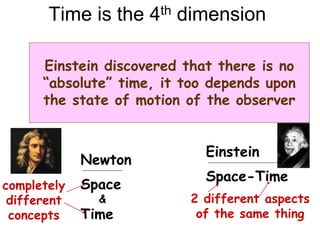
Time is the 4th dimension
Einstein discovered that there is no
“absolute” time, it too depends upon
the state of motion of the observer
Newton
Space
&
Time
Einstein
Space-Time
completely
different
concepts
2 different aspects
of the same thing
How are the times seen
by 2 different observe
rs related?
We can figure this out with
simple HS-level math
( + a little effort)
Catch ball on a rocket ship
w=4m
t=1s
v= =4m/s
w
t
Event 1: boy throws the ball
Event 2: girl catches the ball
Seen from earth
w=4m
v0t=3m
v= = 5m/s
d
tt=1s
V0=3m/s
V0=3m/s
Location of the 2
events is different
Elapsed time is
the same
The ball appears
to travel faster
Flash a light on a rocket ship
w
t0
c=
w
t0
Event 1: boy flashes the light
Event 2: light flash reaches the girl
Seen from earth
w
vt
c= =d
tt=?
V
V
Speed has to
Be the same
Dist is longer
Time must be
longer
(vt)2+w2
t
How is t related to t0?
c = (vt)2+w2
t
t= time on Earth clock
c =
w
t0
t0 = time on moving clock
ct = (vt)2+w2
(ct)2 = (vt)2+w2
ct0 = w
(ct)2 = (vt)2+(ct0)2  (ct)2-(vt)2= (ct0)2  (c2-v2)t2= c2t0
2
 t2 = t0
2c2
c2 – v2
 t2 = t0
21
1 – v2/c2
 t = t0
1
1 – v2/c2
this is called g
 t = g t0
Properties of g = 1
1 – v2/c2
1
1 – (0.01c)2/c2g =
Suppose v = 0.01c (i.e. 1% of c)
1
1 – (0.01)2c2/c2
=
1
1 – (0.01)2g =
1
1 – 0.0001
= 1
0.9999
=
g = 1.00005
Properties of g = (cont’d)1
1 – v2/c2
1
1 – (0.1c)2/c2g =
Suppose v = 0.1c (i.e. 10% of c)
1
1 – (0.1)2c2/c2
=
1
1 – (0.1)2g =
1
1 – 0.01
= 1
0.99
=
g = 1.005
Let’s make a chart
v g =1/(1-v2/c2)
0.01 c 1.00005
0.1 c 1.005
Other values of g = 1
1 – v2/c2
1
1 – (0.5c)2/c2g =
Suppose v = 0.5c (i.e. 50% of c)
1
1 – (0.5)2c2/c2
=
1
1 – (0.5)2g =
1
1 – (0.25)
= 1
0.75
=
g = 1.15
Enter into chart
v g =1/(1-v2/c2)
0.01 c 1.00005
0.1 c 1.005
0.5c 1.15
Other values of g = 1
1 – v2/c2
1
1 – (0.6c)2/c2g =
Suppose v = 0.6c (i.e. 60% of c)
1
1 – (0.6)2c2/c2
=
1
1 – (0.6)2g =
1
1 – (0.36)
= 1
0.64
=
g = 1.25
Back to the chart
v g =1/(1-v2/c2)
0.01 c 1.00005
0.1 c 1.005
0.5c 1.15
0.6c 1.25
Other values of g = 1
1 – v2/c2
1
1 – (0.8c)2/c2g =
Suppose v = 0.8c (i.e. 80% of c)
1
1 – (0.8)2c2/c2
=
1
1 – (0.8)2g =
1
1 – (0.64)
= 1
0.36
=
g = 1.67
Enter into the chart
v g =1/(1-v2/c2)
0.01 c 1.00005
0.1 c 1.005
0.5c 1.15
0.6c 1.25
0.8c 1.67
Other values of g = 1
1 – v2/c2
1
1 – (0.9c)2/c2g =
Suppose v = 0.9c (i.e.90% of c)
1
1 – (0.9)2c2/c2
=
1
1 – (0.9)2g =
1
1 – 0.81
= 1
0.19
=
g = 2.29
update chart
v g =1/(1-v2/c2)
0.01 c 1.00005
0.1 c 1.005
0.5c 1.15
0.6c 1.25
0.8c 1.67
0.9c 2.29
Other values of g = 1
1 – v2/c2
1
1 – (0.99c)2/c2g =
Suppose v = 0.99c (i.e.99% of c)
1
1 – (0.99)2c2/c2
=
1
1 – (0.99)2g =
1
1 – 0.98
= 1
0.02
=
g = 7.07
Enter into chart
v g =1/(1-v2/c2)
0.01 c 1.00005
0.1 c 1.005
0.5c 1.15
0.6c 1.25
0.8c 1.67
0.9c 2.29
0.99c 7.07
Other values of g = 1
1 – v2/c2
1
1 – (c)2/c2g =
Suppose v = c
1
1 – c2/c2
=
1
1 – 12g =
1
0
= 1
0
=
g =  Infinity!!!
update chart
v g =1/(1-v2/c2)
0.01 c 1.00005
0.1 c 1.005
0.5c 1.15
0.6c 1.25
0.8c 1.67
0.9c 2.29
0.99c 7.07
1.00c 
Other values of g = 1
1 – v2/c2
1
1 – (1.1c)2/c2g =
Suppose v = 1.1c
1
1 – (1.1)2c2/c2
=
1
1 – (1.1)2g =
1
1-1.21
= 1
-0.21
=
g = ??? Imaginary number!!!
Complete the chart
v g =1/(1-v2/c2)
0.01 c 1.00005
0.1 c 1.005
0.5c 1.15
0.6c 1.25
0.8c 1.67
0.9c 2.29
0.99c 7.07
1.00c 
Larger than c Imaginary number
Plot results:
1
1 – v2/c2
g =
v=c
x x
x
x
x

Never-neverland
Moving clocks run slower
t
t0
t = g t0
t = t0
1
1 – v2/c2
v
g >1  t > t0
Length contraction
man on
rocket
Time = t0 =t/g
Length = vt0
L0
v
time=t
L0 = vt
=vt/g =L0/g
Moving objects appear shorter
L = L0/g
g >1  L < L0
Length measured when
object is at rest
V=0.1cV=0.86cV=0.99cV=0.9999c
Length contraction
mass:
m0
a
F=m0a
change in v
time
Ft0
m0
change in v =
time=t0
t=gt0
Ft
change in v
m =
= m0
mass
increases!!
t0
= gm0
Ft0
change in v
m0 =
gFt0
change in v=
m = g m0
by a factor g
Relativistic mass increase
m0 = mass of an object when it
is at rest  “rest mass”
m = g m0
mass of a moving
object increases
by the g factor
as vc, m
as an object moves
faster, it gets
harder & harder
to accelerate
g
v=c
summary
• Moving clocks run slow
• Moving objects appear shorter
• Moving object’s mass increases
Plot results:
1
1 – v2/c2
g =
v=c
x x
x
x
x

Never-neverland
Twin paradox
Twin brother
& sister
She will travel to
a-centauri (a near-
by star on a special
rocket ship v = 0.9cHe will stay home
& study Phys 100
a-centauri
Light year
distance light travels in 1 year
dist = v x time
1cyr = 3x10⁸m/s x 3.2x10⁷ s
= 9.6 x 10¹⁵ m
We will just use cyr units
& not worry about meters
= c yr
Time on the boy’s clock
tout =
d0
v
4.3 cyr
0.9c
= = 4.8 yrs
According to the boy
& his clock on Earth:
tback =
d0
v
4.3 cyr
0.9c
= = 4.8 yrs
ttotal = tout+tback = 9.6yrs
What does the boy see on her cloc
k?
tout =
tout
g
4.8 yrs
2.3
= = 2.1 yrs
According to the boy
her clock runs slower
tback =
tback
g
4.8 yr
2.3
= = 2.1 yrs
ttotal = tout+tback = 4.2yrs
So, according to the boy:
his clock her clock
out: 4.8yrs 2.1yrs
back: 4.8yrs 2.1yrs
total: 9.6yrs 4.2yrs
But, according to the gi
rl, the boy’s clock is mov
ing &, so, it must be run
ning slower
tout =
tout
g
2.1 yrs
2.3
= = 0.9 yrs
According to her, the
boy’s clock on Earth says:
tback =
tback
g
2.1 yrs
2.3
= = 0.9 yrs
ttotal = tout+tback = 1.8yrs
Her clock advances 4.2 yrs
& she sees his clock advance
only 1.8 yrs,
She should think he has aged l
ess than her!!
As seen by him
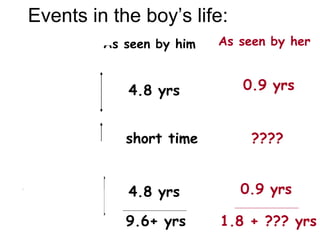
Events in the boy’s life:
As seen by her
She leaves
She arrives
& starts turn
Finishes turn
& heads home
She returns
4.8 yrs
4.8 yrs
short time
9.6+ yrs
0.9 yrs
????
0.9 yrs
1.8 + ??? yrs
turning around as seen by her
He sees her
start to turn
He sees her
finish turning
According to her, these
2 events occur very,very
far apart from each other
Time interval between 2 events depends
on the state of motion of the observer
Gunfight viewed by observer at rest
Bang
! Bang
!
He sees both shots
fired simultaneously
Viewed by a moving observer
Bang
! Bang
!
He sees cowboy shoot
1st & cowgirl shoot later
as seen by him
In fact, ???? = 7.8+ years
as seen by her
She leaves
She arrives
& starts turn
Finishes turn
& heads home
She returns
4.8 yrs
4.8 yrs
short time
9.6+ yrs
0.9 yrs
???
0.9 yrs
1.8 + ???yrs
7.8+ yrs
9.6+ yrs
No paradox: both twins agree
The twin that
“turned around”
is younger
Ladder & Barn Door paradox
1m
2m
???
ladder
Stan & Ollie puzzle over how
to get a 2m long ladder thru
a 1m wide barn door
Ollie remembers Phys 100 & the
theory of relativity
1m
2m
ladder
Stan, pick up
the ladder &
run very fast
tree
View from Ollie’s ref. frame
1m
2m/g
Push, St
an!
V=0.9c
(g=2.3)Ollie Stan
View from Stan’s ref. frame
2m
1m/g
V=0.9c
(g=2.3)
Ollie Stan
But it does
n’t fit, Olli
e!!
If Stan pushes both ends of the
ladder simultaneously, Ollie sees the
two ends move at different times:
1mToo soo
n Stan!
V=0.9c
(g=2.3)Ollie StanStan
Too late
Stan!
Fermilab proton accelerator
2km
V=0.9999995c
g=1000
Stanford electron accelerator
g=100,000
v=0.99999999995 c
status
Einstein’s theory of “special relativity” has be
en carefully tested in many very precise ex
periments and found to be valid.
Time is truly the 4th dimension of space & ti
me.
test
g=29.3

Physics relativity

  • 1.
    THEORY OF RELATIVITY DINESH.V Assistant Professor HOD of Physics Govt. First Grade College, Sagar -577401 E-mail: dinu.v18@gmail.com
  • 2.
    Theory of Relativity Physics100 Chapt 18 Albert Einstein
  • 3.
    watching a lightflash go by c v The man on earth sees c = (& agrees with Maxwell) 2k k
  • 4.
    watching a lightflash go by c v If the man on the rocket sees c-v, he disagrees with Maxwell
  • 5.
    Do Maxwell’s Eqnsonly work in one reference frame? If so, this would be the rest frame of the luminiferous Aether.
  • 6.
    If so, thespeed of light should chan ge throughout the year upstream, light moves slower downstream, light moves faster “Aether wind”
  • 7.
    Michelson-Morley No aether winddetected: 1907 Nobel Prize
  • 8.
    Einstein’s hypotheses: 1. Thelaws of nature are equally valid in every inertial reference frame. Including Maxwell’s eqns 2. The speed of light in empty space is same for all inertial observers, regard- less of their velocity or the velocity of the source of light.
  • 9.
    All observers seelight flashes go b y them with the same speed c v Both guys see the light flash travel with velocity = c No matter how fast t he guy on the rocket is moving!!
  • 10.
    Even when thelight flash is travelin g in an opposite direction c v Both guys see the light flash travel past with velocity = c
  • 11.
    Gunfight viewed byobserver at rest Bang ! Bang ! He sees both shots fired simultaneously
  • 12.
    Viewed by amoving observer
  • 13.
    Viewed by amoving observer Bang ! Bang ! He sees cowboy shoot 1st & cowgirl shoot later
  • 14.
    Viewed by anobserver in the opposite direction
  • 15.
    Viewed by amoving observer Bang !Bang ! He sees cowgirl shoot 1st & cowboy shoot later
  • 16.
    Time depends ofstate of motion of the observer!! Events that occur simultaneously according to one observer can occur a t different times for other observ ers
  • 17.
  • 18.
  • 19.
  • 20.
    Same events, differentobservers x y x t (x1,t1) x (x2,t2) x1 x2 x’ y’ x1’ (x1’,t1’) y’ x’ x1’ x2’ (x2’,t2’) t’ t’ Prior to Einstein, everyone agreed the distance between events depends upon the observer, but not the time. dist’ dist
  • 21.
    Time is the4th dimension Einstein discovered that there is no “absolute” time, it too depends upon the state of motion of the observer Newton Space & Time Einstein Space-Time completely different concepts 2 different aspects of the same thing
  • 22.
    How are thetimes seen by 2 different observe rs related? We can figure this out with simple HS-level math ( + a little effort)
  • 23.
    Catch ball ona rocket ship w=4m t=1s v= =4m/s w t Event 1: boy throws the ball Event 2: girl catches the ball
  • 24.
    Seen from earth w=4m v0t=3m v== 5m/s d tt=1s V0=3m/s V0=3m/s Location of the 2 events is different Elapsed time is the same The ball appears to travel faster
  • 25.
    Flash a lighton a rocket ship w t0 c= w t0 Event 1: boy flashes the light Event 2: light flash reaches the girl
  • 26.
    Seen from earth w vt c==d tt=? V V Speed has to Be the same Dist is longer Time must be longer (vt)2+w2 t
  • 27.
    How is trelated to t0? c = (vt)2+w2 t t= time on Earth clock c = w t0 t0 = time on moving clock ct = (vt)2+w2 (ct)2 = (vt)2+w2 ct0 = w (ct)2 = (vt)2+(ct0)2  (ct)2-(vt)2= (ct0)2  (c2-v2)t2= c2t0 2  t2 = t0 2c2 c2 – v2  t2 = t0 21 1 – v2/c2  t = t0 1 1 – v2/c2 this is called g  t = g t0
  • 28.
    Properties of g= 1 1 – v2/c2 1 1 – (0.01c)2/c2g = Suppose v = 0.01c (i.e. 1% of c) 1 1 – (0.01)2c2/c2 = 1 1 – (0.01)2g = 1 1 – 0.0001 = 1 0.9999 = g = 1.00005
  • 29.
    Properties of g= (cont’d)1 1 – v2/c2 1 1 – (0.1c)2/c2g = Suppose v = 0.1c (i.e. 10% of c) 1 1 – (0.1)2c2/c2 = 1 1 – (0.1)2g = 1 1 – 0.01 = 1 0.99 = g = 1.005
  • 30.
    Let’s make achart v g =1/(1-v2/c2) 0.01 c 1.00005 0.1 c 1.005
  • 31.
    Other values ofg = 1 1 – v2/c2 1 1 – (0.5c)2/c2g = Suppose v = 0.5c (i.e. 50% of c) 1 1 – (0.5)2c2/c2 = 1 1 – (0.5)2g = 1 1 – (0.25) = 1 0.75 = g = 1.15
  • 32.
    Enter into chart vg =1/(1-v2/c2) 0.01 c 1.00005 0.1 c 1.005 0.5c 1.15
  • 33.
    Other values ofg = 1 1 – v2/c2 1 1 – (0.6c)2/c2g = Suppose v = 0.6c (i.e. 60% of c) 1 1 – (0.6)2c2/c2 = 1 1 – (0.6)2g = 1 1 – (0.36) = 1 0.64 = g = 1.25
  • 34.
    Back to thechart v g =1/(1-v2/c2) 0.01 c 1.00005 0.1 c 1.005 0.5c 1.15 0.6c 1.25
  • 35.
    Other values ofg = 1 1 – v2/c2 1 1 – (0.8c)2/c2g = Suppose v = 0.8c (i.e. 80% of c) 1 1 – (0.8)2c2/c2 = 1 1 – (0.8)2g = 1 1 – (0.64) = 1 0.36 = g = 1.67
  • 36.
    Enter into thechart v g =1/(1-v2/c2) 0.01 c 1.00005 0.1 c 1.005 0.5c 1.15 0.6c 1.25 0.8c 1.67
  • 37.
    Other values ofg = 1 1 – v2/c2 1 1 – (0.9c)2/c2g = Suppose v = 0.9c (i.e.90% of c) 1 1 – (0.9)2c2/c2 = 1 1 – (0.9)2g = 1 1 – 0.81 = 1 0.19 = g = 2.29
  • 38.
    update chart v g=1/(1-v2/c2) 0.01 c 1.00005 0.1 c 1.005 0.5c 1.15 0.6c 1.25 0.8c 1.67 0.9c 2.29
  • 39.
    Other values ofg = 1 1 – v2/c2 1 1 – (0.99c)2/c2g = Suppose v = 0.99c (i.e.99% of c) 1 1 – (0.99)2c2/c2 = 1 1 – (0.99)2g = 1 1 – 0.98 = 1 0.02 = g = 7.07
  • 40.
    Enter into chart vg =1/(1-v2/c2) 0.01 c 1.00005 0.1 c 1.005 0.5c 1.15 0.6c 1.25 0.8c 1.67 0.9c 2.29 0.99c 7.07
  • 41.
    Other values ofg = 1 1 – v2/c2 1 1 – (c)2/c2g = Suppose v = c 1 1 – c2/c2 = 1 1 – 12g = 1 0 = 1 0 = g =  Infinity!!!
  • 42.
    update chart v g=1/(1-v2/c2) 0.01 c 1.00005 0.1 c 1.005 0.5c 1.15 0.6c 1.25 0.8c 1.67 0.9c 2.29 0.99c 7.07 1.00c 
  • 43.
    Other values ofg = 1 1 – v2/c2 1 1 – (1.1c)2/c2g = Suppose v = 1.1c 1 1 – (1.1)2c2/c2 = 1 1 – (1.1)2g = 1 1-1.21 = 1 -0.21 = g = ??? Imaginary number!!!
  • 44.
    Complete the chart vg =1/(1-v2/c2) 0.01 c 1.00005 0.1 c 1.005 0.5c 1.15 0.6c 1.25 0.8c 1.67 0.9c 2.29 0.99c 7.07 1.00c  Larger than c Imaginary number
  • 45.
    Plot results: 1 1 –v2/c2 g = v=c x x x x x  Never-neverland
  • 46.
    Moving clocks runslower t t0 t = g t0 t = t0 1 1 – v2/c2 v g >1  t > t0
  • 47.
    Length contraction man on rocket Time= t0 =t/g Length = vt0 L0 v time=t L0 = vt =vt/g =L0/g
  • 48.
    Moving objects appearshorter L = L0/g g >1  L < L0 Length measured when object is at rest V=0.1cV=0.86cV=0.99cV=0.9999c
  • 49.
  • 50.
    mass: m0 a F=m0a change in v time Ft0 m0 changein v = time=t0 t=gt0 Ft change in v m = = m0 mass increases!! t0 = gm0 Ft0 change in v m0 = gFt0 change in v= m = g m0 by a factor g
  • 51.
    Relativistic mass increase m0= mass of an object when it is at rest  “rest mass” m = g m0 mass of a moving object increases by the g factor as vc, m as an object moves faster, it gets harder & harder to accelerate g v=c
  • 52.
    summary • Moving clocksrun slow • Moving objects appear shorter • Moving object’s mass increases
  • 53.
    Plot results: 1 1 –v2/c2 g = v=c x x x x x  Never-neverland
  • 54.
    Twin paradox Twin brother &sister She will travel to a-centauri (a near- by star on a special rocket ship v = 0.9cHe will stay home & study Phys 100 a-centauri
  • 55.
    Light year distance lighttravels in 1 year dist = v x time 1cyr = 3x10⁸m/s x 3.2x10⁷ s = 9.6 x 10¹⁵ m We will just use cyr units & not worry about meters = c yr
  • 56.
    Time on theboy’s clock tout = d0 v 4.3 cyr 0.9c = = 4.8 yrs According to the boy & his clock on Earth: tback = d0 v 4.3 cyr 0.9c = = 4.8 yrs ttotal = tout+tback = 9.6yrs
  • 57.
    What does theboy see on her cloc k? tout = tout g 4.8 yrs 2.3 = = 2.1 yrs According to the boy her clock runs slower tback = tback g 4.8 yr 2.3 = = 2.1 yrs ttotal = tout+tback = 4.2yrs
  • 58.
    So, according tothe boy: his clock her clock out: 4.8yrs 2.1yrs back: 4.8yrs 2.1yrs total: 9.6yrs 4.2yrs
  • 59.
    But, according tothe gi rl, the boy’s clock is mov ing &, so, it must be run ning slower tout = tout g 2.1 yrs 2.3 = = 0.9 yrs According to her, the boy’s clock on Earth says: tback = tback g 2.1 yrs 2.3 = = 0.9 yrs ttotal = tout+tback = 1.8yrs
  • 60.
    Her clock advances4.2 yrs & she sees his clock advance only 1.8 yrs, She should think he has aged l ess than her!!
  • 61.
    As seen byhim Events in the boy’s life: As seen by her She leaves She arrives & starts turn Finishes turn & heads home She returns 4.8 yrs 4.8 yrs short time 9.6+ yrs 0.9 yrs ???? 0.9 yrs 1.8 + ??? yrs
  • 62.
    turning around asseen by her He sees her start to turn He sees her finish turning According to her, these 2 events occur very,very far apart from each other Time interval between 2 events depends on the state of motion of the observer
  • 63.
    Gunfight viewed byobserver at rest Bang ! Bang ! He sees both shots fired simultaneously
  • 64.
    Viewed by amoving observer
  • 65.
    Viewed by amoving observer Bang ! Bang ! He sees cowboy shoot 1st & cowgirl shoot later
  • 66.
    as seen byhim In fact, ???? = 7.8+ years as seen by her She leaves She arrives & starts turn Finishes turn & heads home She returns 4.8 yrs 4.8 yrs short time 9.6+ yrs 0.9 yrs ??? 0.9 yrs 1.8 + ???yrs 7.8+ yrs 9.6+ yrs
  • 67.
    No paradox: bothtwins agree The twin that “turned around” is younger
  • 68.
    Ladder & BarnDoor paradox 1m 2m ??? ladder Stan & Ollie puzzle over how to get a 2m long ladder thru a 1m wide barn door
  • 69.
    Ollie remembers Phys100 & the theory of relativity 1m 2m ladder Stan, pick up the ladder & run very fast tree
  • 70.
    View from Ollie’sref. frame 1m 2m/g Push, St an! V=0.9c (g=2.3)Ollie Stan
  • 71.
    View from Stan’sref. frame 2m 1m/g V=0.9c (g=2.3) Ollie Stan But it does n’t fit, Olli e!!
  • 72.
    If Stan pushesboth ends of the ladder simultaneously, Ollie sees the two ends move at different times: 1mToo soo n Stan! V=0.9c (g=2.3)Ollie StanStan Too late Stan!
  • 73.
  • 74.
  • 75.
    status Einstein’s theory of“special relativity” has be en carefully tested in many very precise ex periments and found to be valid. Time is truly the 4th dimension of space & ti me.
  • 76.