ASSIGMENT ON MECHANICS
Submitted by: Submitted to:
Name: Md Jahid Hasan Name: Jebun Naher Sikta
ID: 152-15-558 Dep: of Natural Science
Sec: A Daffodil International Univercity
Q: 1 . Show that projectile motion is a parabolic motion.
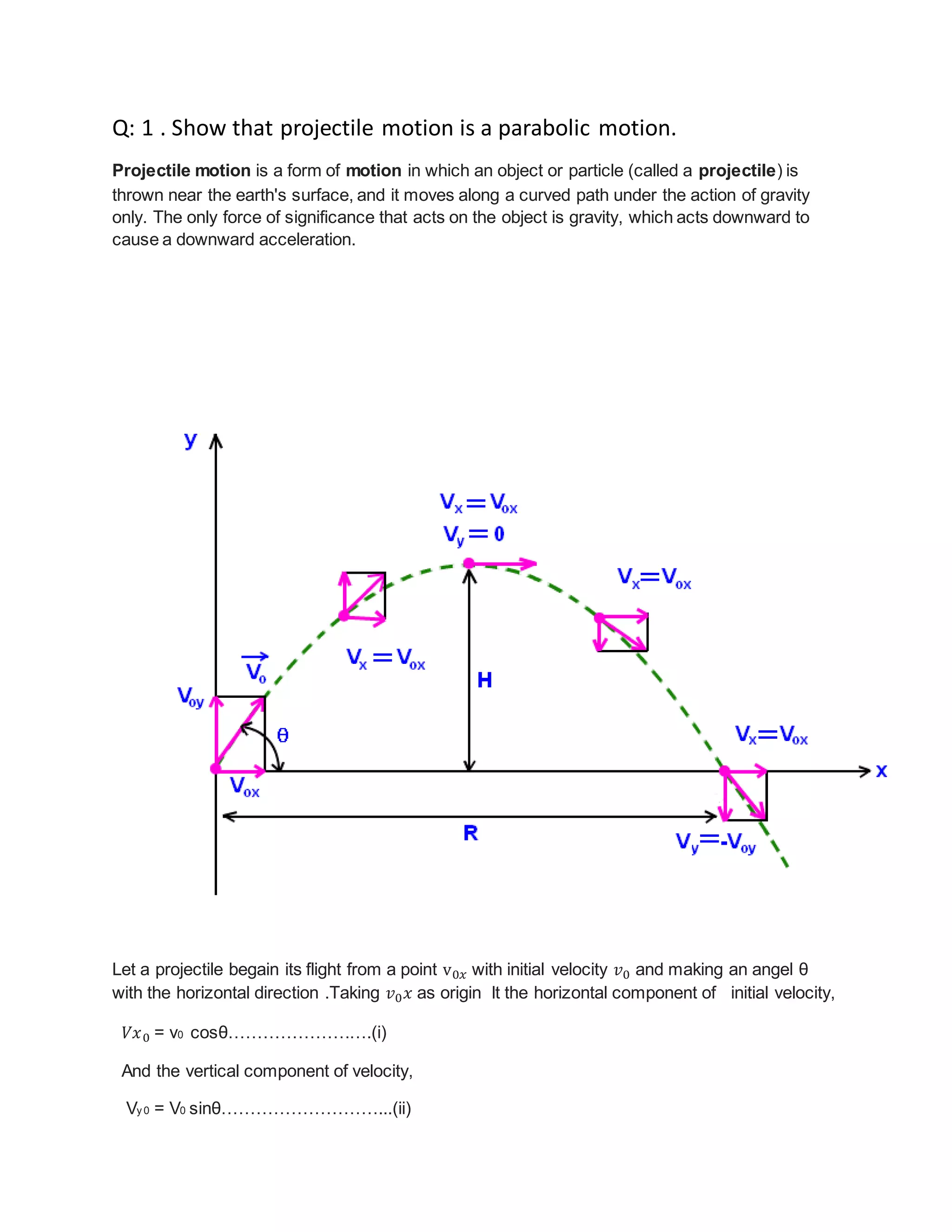
Projectile motion is a form of motion in which an object or particle (called a projectile) is
thrown near the earth's surface, and it moves along a curved path under the action of gravity
only. The only force of significance that acts on the object is gravity, which acts downward to
cause a downward acceleration.
Let a projectile begain its flight from a point v0𝑥 with initial velocity 𝑣0 and making an angel θ
with the horizontal direction .Taking 𝑣0 𝑥 as origin lt the horizontal component of initial velocity,
𝑉𝑥0 = v0 cosθ…………………….(i)
And the vertical component of velocity,
Vy 0 = V0 sinθ………………………...(ii)
At a later time when t = t , let the objects velocity is V̅
Now horizontal component of V̅ , is given as ,
Vx = vx0 + ax t
=) Vx = Vx0 [ since ax = 0 horzontaley ]
Vx =V0 COSθ [using can (i)……….(iii)
Horizontal displacement ,
X=0 M=V0 cosθ t [since vx=
𝑥
𝑡
t = 𝑋
𝑉𝑜 𝑐𝑜𝑠𝜃⁄ … …… …… …(𝑖𝑣) =) x = vx t ]
Now , he vertical component of the velocity
Vy = vy 0 + ay tx
Vy =V0 sinθ – gt [ay = - g]
So the vertical displacement at t = t
y = y0 + vy 0t +
1
2
ay 𝑡2
or, y = 0 + v0 sinθ + t -
1
2
g𝑡2
= v0 sinθ t -
1
2
g𝑡2
y = v0 sinθ .
𝑥
V0 cosθ
-
1
2
g (
𝑋
V0 cosθ
)2
= x tan𝜃 -
1
2
g 𝑥2/v02 𝑐𝑜𝑠2θ
= x tanθ – 𝑔𝑥2/ 2v02 𝑐𝑜𝑠2θ
tanθ = b and
𝑔
2v02 𝑐𝑜𝑠2θ
= c as constants
now can be written as
y = bx - c𝑥2
this is an equation of a parabola.hence the path of motion of a projectile is parabolic.
Q: 2 . statement and proof work-energey theorem
The energy associated with the work done by the net force does not disappear after the
net force is removed (or becomes zero), it is transformed into the Kinetic Energy of
the body. We call this the Work-Energy Theorem.
Proof :
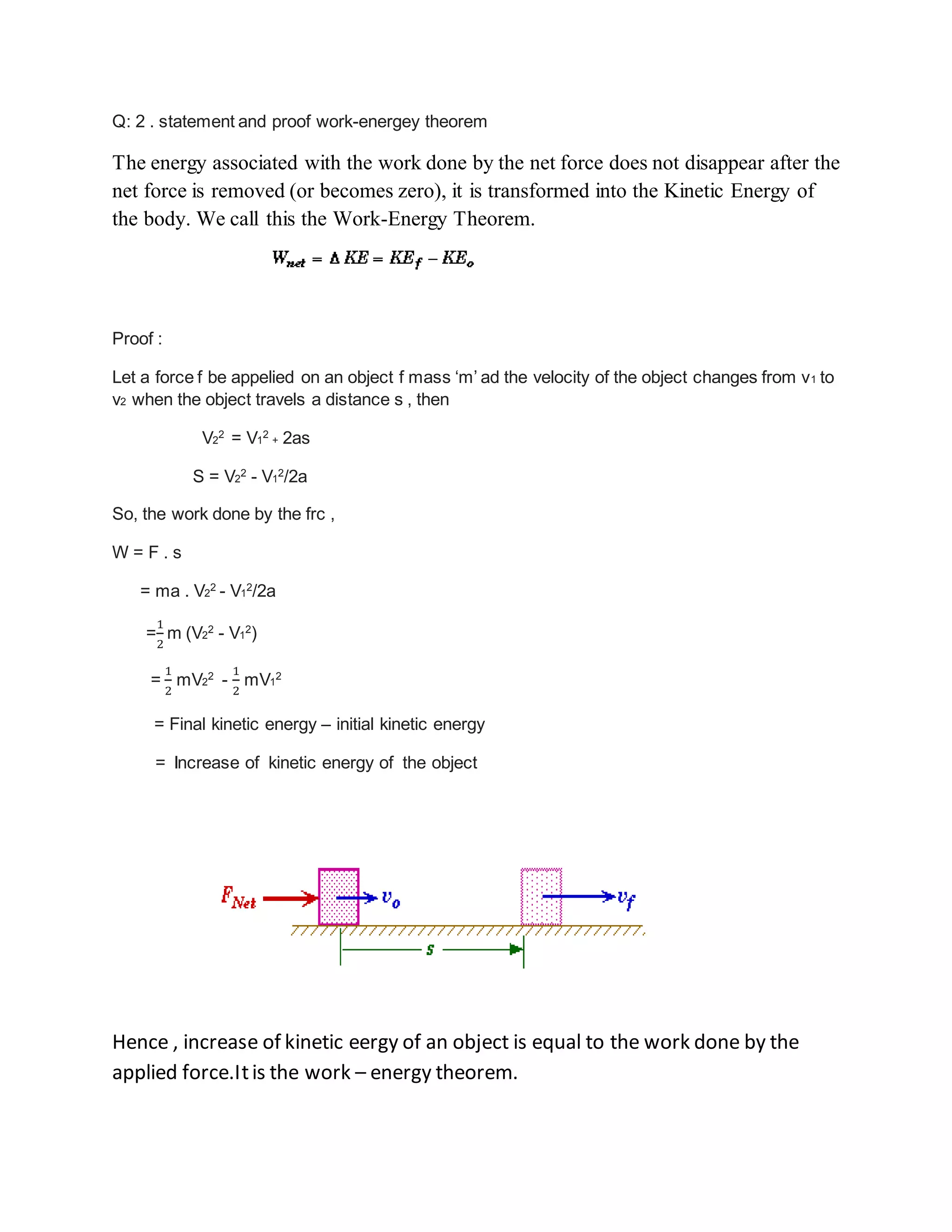
Let a force f be appelied on an object f mass ‘m’ ad the velocity of the object changes from v1 to
v2 when the object travels a distance s , then
V2
2
= V1
2
+ 2as
S = V2
2
- V1
2
/2a
So, the work done by the frc ,
W = F . s
= ma . V2
2
- V1
2
/2a
=
1
2
m (V2
2
- V1
2
)
=
1
2
mV2
2
-
1
2
mV1
2
= Final kinetic energy – initial kinetic energy
= Increase of kinetic energy of the object
Hence , increase of kinetic eergy of an object is equal to the work done by the
applied force.Itis the work – energy theorem.
Q: 3.State zeroth,1st
, 2nd
law of thermodynamics.
Zeroth law of thermodynamics:
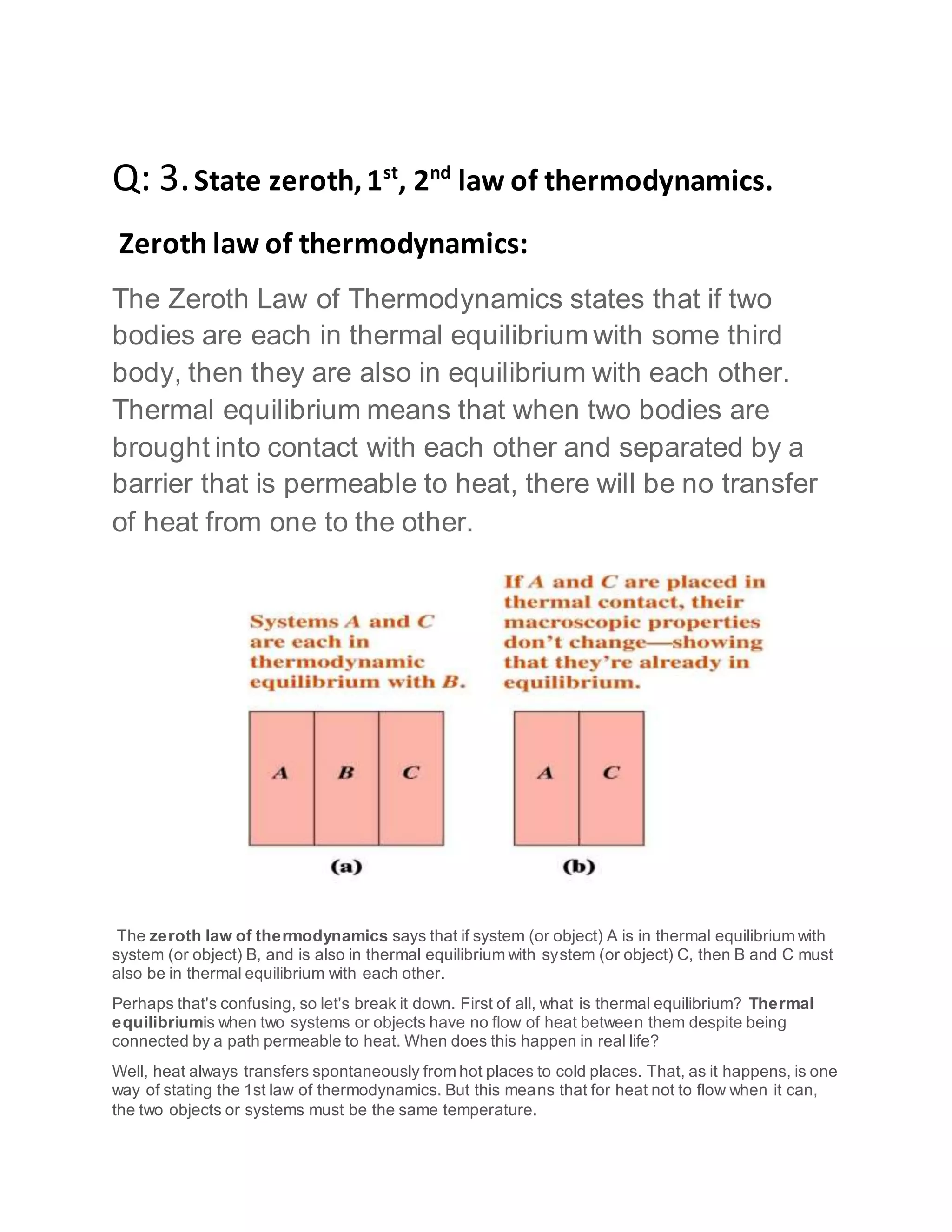
The Zeroth Law of Thermodynamics states that if two
bodies are each in thermal equilibrium with some third
body, then they are also in equilibrium with each other.
Thermal equilibrium means that when two bodies are
brought into contact with each other and separated by a
barrier that is permeable to heat, there will be no transfer
of heat from one to the other.
The zeroth law of thermodynamics says that if system (or object) A is in thermal equilibrium with
system (or object) B, and is also in thermal equilibrium with system (or object) C, then B and C must
also be in thermal equilibrium with each other.
Perhaps that's confusing, so let's break it down. First of all, what is thermal equilibrium? Thermal
equilibriumis when two systems or objects have no flow of heat between them despite being
connected by a path permeable to heat. When does this happen in real life?
Well, heat always transfers spontaneously from hot places to cold places. That, as it happens, is one
way of stating the 1st law of thermodynamics. But this means that for heat not to flow when it can,
the two objects or systems must be the same temperature.
So we can restate the zeroth law of thermodynamics like this: if system (or object) A is the same
temperature as system (or object) B, and is also the same temperature as system (or object) C, then
B and C must also be the same temperature.
Written like that, suddenly the zeroth law becomes really obvious. Of course, if object A is the same
temperature as B and C, then B and C are the same temperature as each other.
1st
law of thermodynamics:
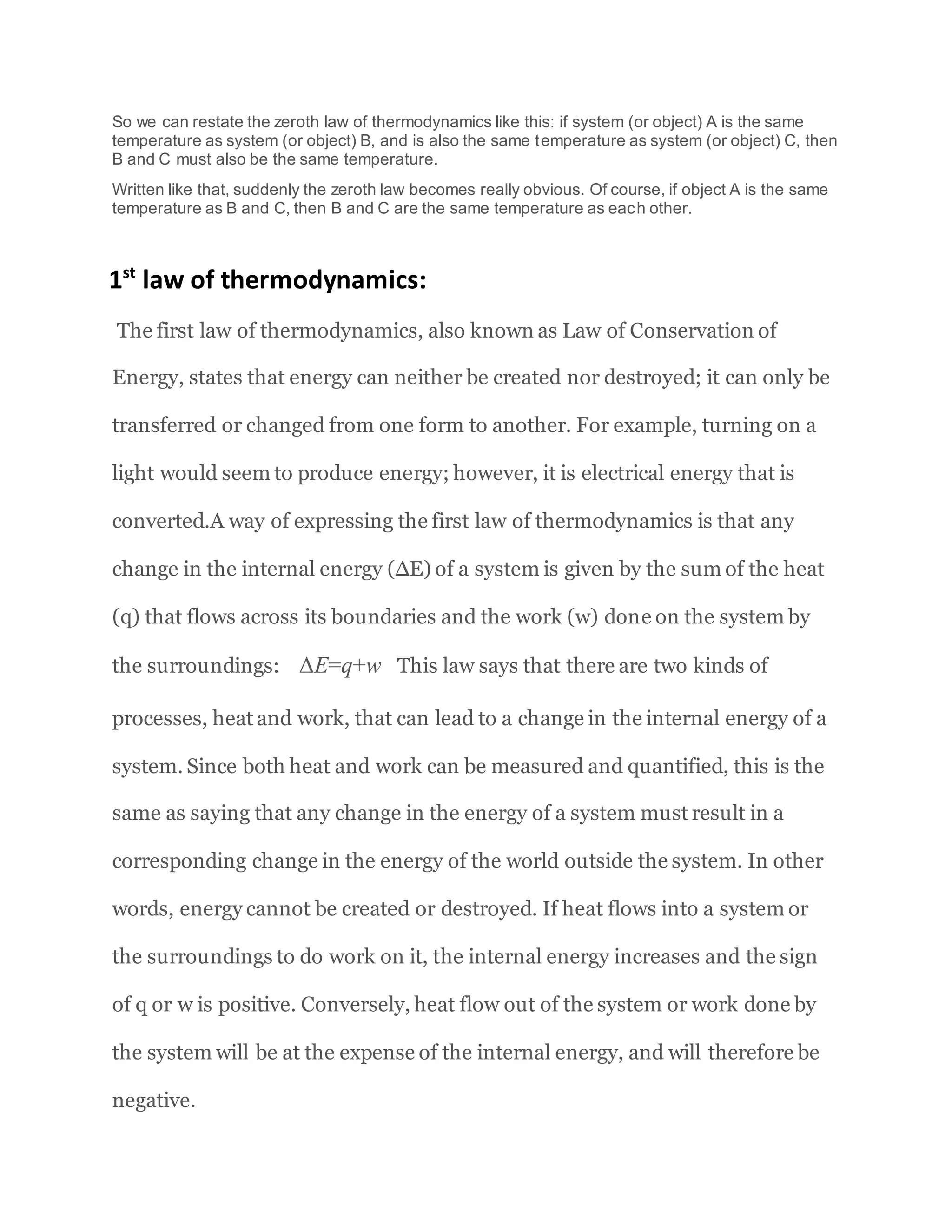
The first law of thermodynamics, also known as Law of Conservation of
Energy, states that energy can neither be created nor destroyed; it can only be
transferred or changed from one form to another. For example, turning on a
light would seem to produce energy; however, it is electrical energy that is
converted.A way of expressing the first law of thermodynamics is that any
change in the internal energy (∆E) of a system is given by the sum of the heat
(q) that flows across its boundaries and the work (w) done on the system by
the surroundings: ΔE=q+w This law says that there are two kinds of
processes, heat and work, that can lead to a change in the internal energy of a
system. Since both heat and work can be measured and quantified, this is the
same as saying that any change in the energy of a system must result in a
corresponding change in the energy of the world outside the system. In other
words, energy cannot be created or destroyed. If heat flows into a system or
the surroundings to do work on it, the internal energy increases and the sign
of q or w is positive. Conversely, heat flow out of the system or work done by
the system will be at the expense of the internal energy, and will therefore be
negative.
2nd
law of thermodynamics:
The secondlaw of thermodynamics says that the entropy of any isolated
system not in thermal equilibrium almost always increases. Isolated systems
spontaneously evolve towards thermal equilibrium—the state of maximum
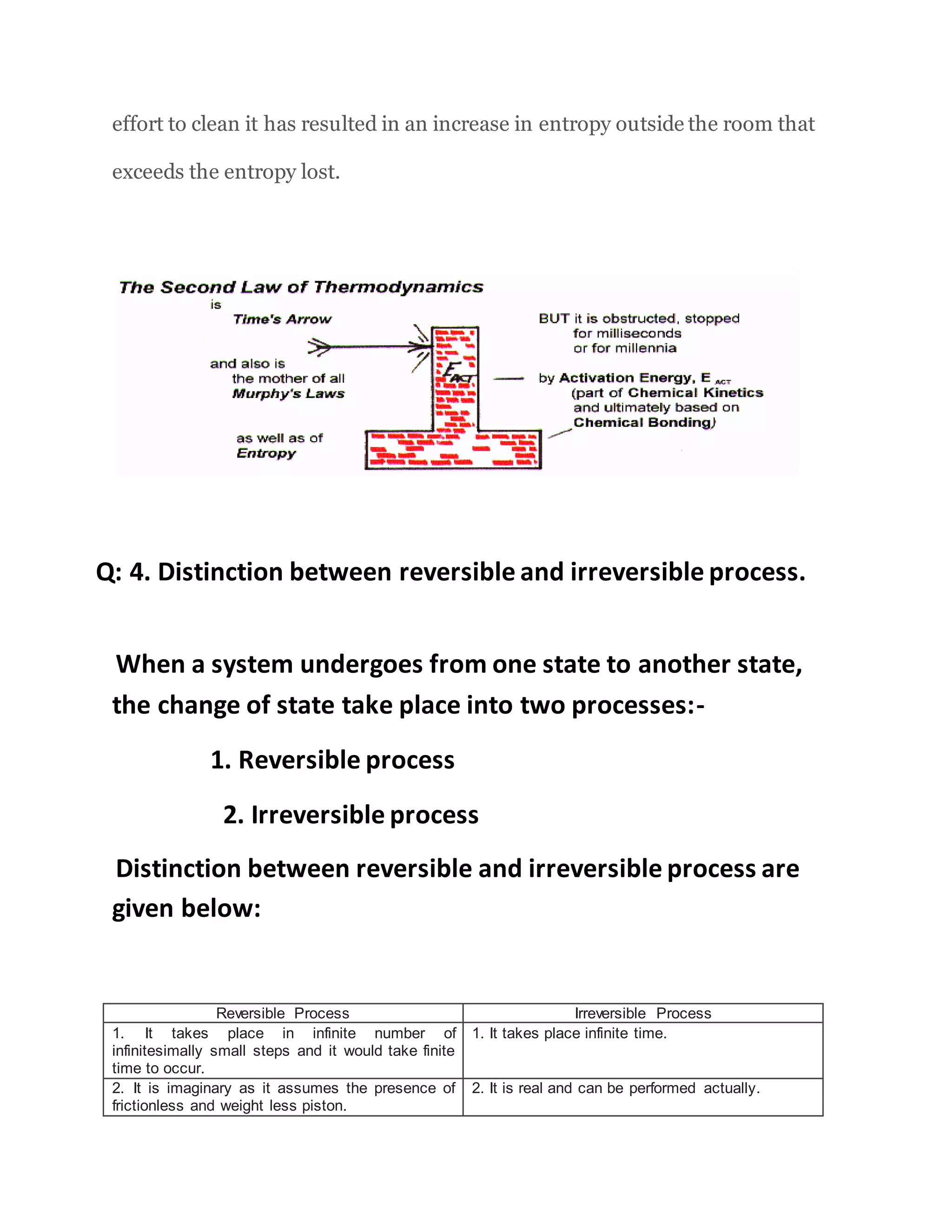
entropy of the system. More simply put: the entropy of the world only
increases and never decreases.A simple application of the second law of
thermodynamics is that a room, if not cleaned and tidied, will invariably
become more messy and disorderly with time - regardless of how careful one
is to keep it clean. When the room is cleaned, its entropy decreases, but the
effort to clean it has resulted in an increase in entropy outside the room that
exceeds the entropy lost.
Q: 4. Distinction between reversible and irreversible process.
When a system undergoes from one state to another state,
the change of state take place into two processes:-
1. Reversible process
2. Irreversible process
Distinction between reversible and irreversible process are
given below:
Reversible Process Irreversible Process
1. It takes place in infinite number of
infinitesimally small steps and it would take finite
time to occur.
1. It takes place infinite time.
2. It is imaginary as it assumes the presence of
frictionless and weight less piston.
2. It is real and can be performed actually.
3. It is in equilibrium state at all stage of the
operation.
It is in equilibrium state only at the initial and final
stage of the operation.
4. All changes are reversed when the process is
carried out in reversible direction.
4. After this type of process has occurred all
changes do not return to the initial stage by
themselves.
5. It is extremely slow. 5. It proceeds at measureable speed.
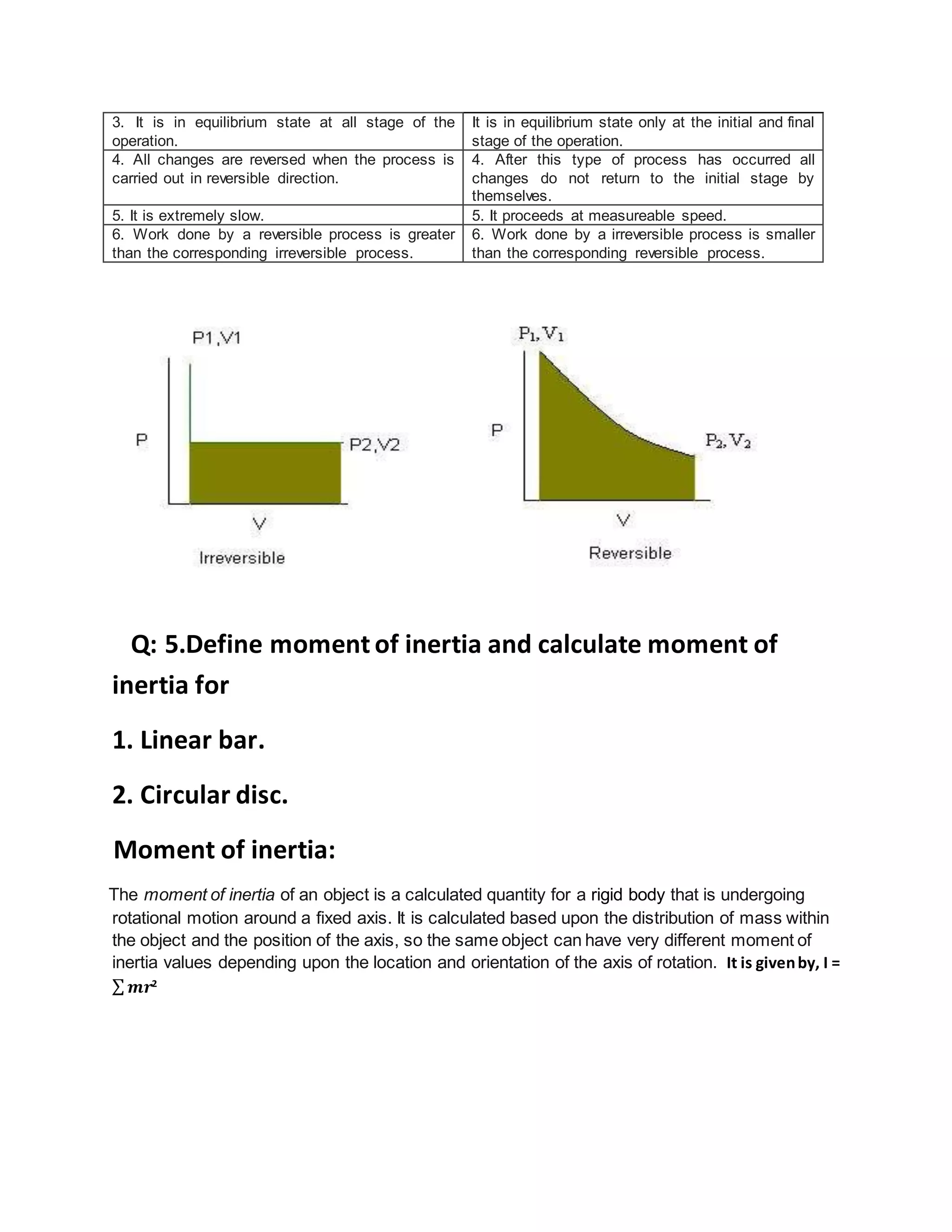
6. Work done by a reversible process is greater
than the corresponding irreversible process.
6. Work done by a irreversible process is smaller
than the corresponding reversible process.
Q: 5.Define moment of inertia and calculate moment of
inertia for
1. Linear bar.
2. Circular disc.
Moment of inertia:
The moment of inertia of an object is a calculated quantity for a rigid body that is undergoing
rotational motion around a fixed axis. It is calculated based upon the distribution of mass within
the object and the position of the axis, so the same object can have very different moment of
inertia values depending upon the location and orientation of the axis of rotation. It is givenby, I =
∑ 𝒎𝒓2
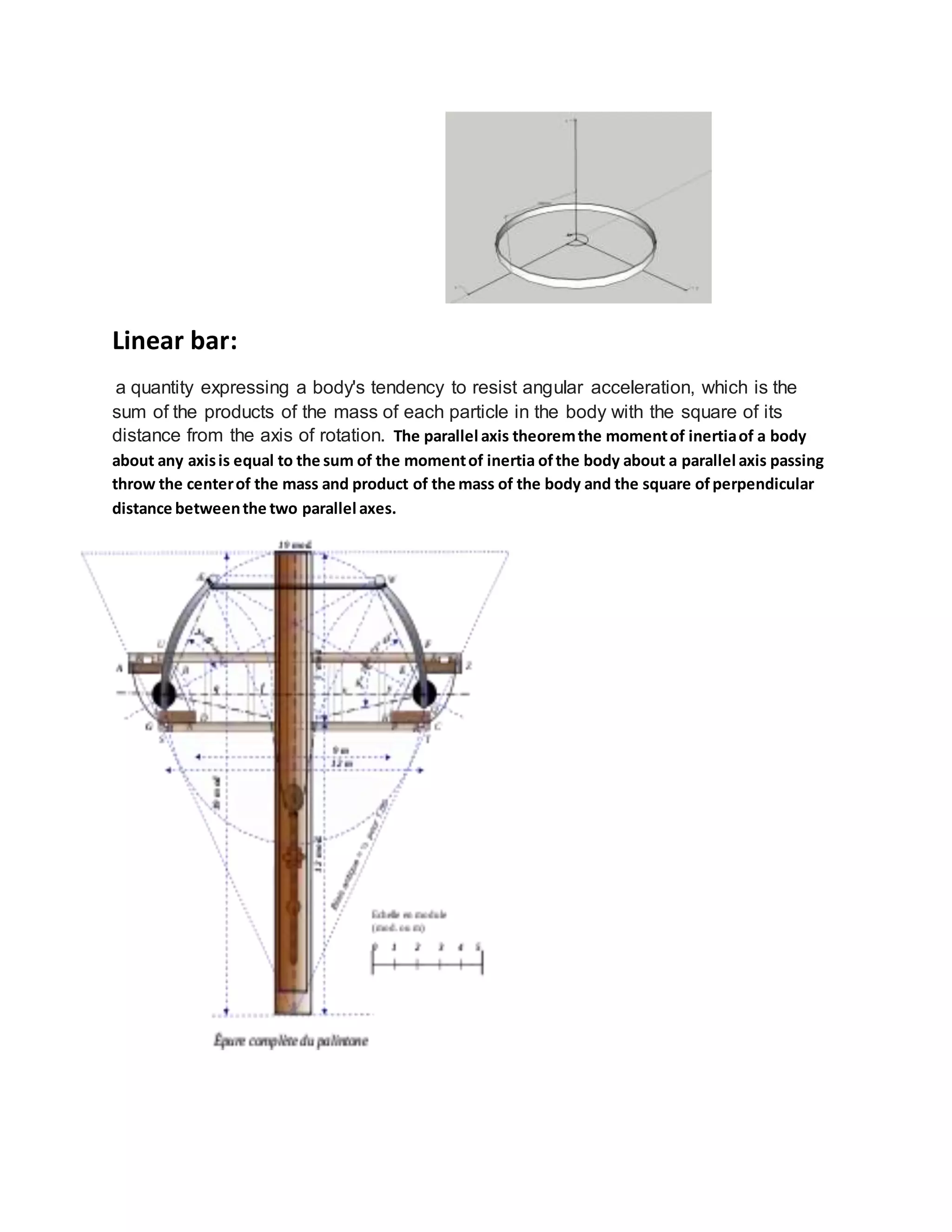
Linear bar:
a quantity expressing a body's tendency to resist angular acceleration, which is the
sum of the products of the mass of each particle in the body with the square of its
distance from the axis of rotation. The parallel axis theoremthe momentof inertiaof a body
about any axisis equal to the sum of the momentof inertia ofthe body about a parallel axis passing
throw the centerof the mass and product of the mass of the body and the square ofperpendicular
distance betweenthe two parallel axes.
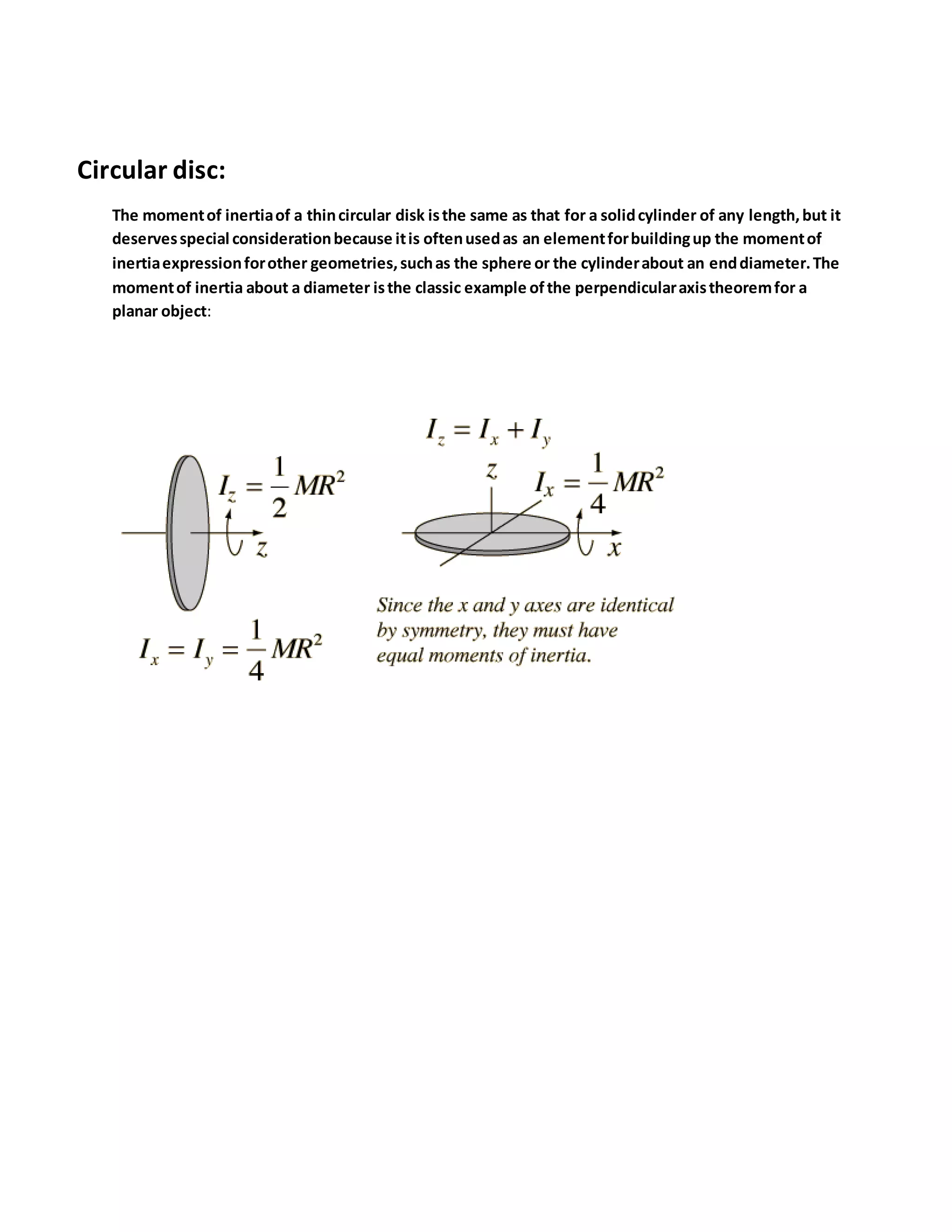
Circular disc:
The momentof inertiaof a thincircular disk isthe same as that for a solidcylinder of any length,but it
deservesspecial considerationbecause itis oftenusedas an elementforbuildingup the momentof
inertiaexpressionforother geometries,suchas the sphere or the cylinderabout an enddiameter.The
momentof inertia about a diameter isthe classic example ofthe perpendicularaxistheoremfor a
planar object:

Assigment on mechanics.. jahid hasan

  • 1.
    ASSIGMENT ON MECHANICS Submittedby: Submitted to: Name: Md Jahid Hasan Name: Jebun Naher Sikta ID: 152-15-558 Dep: of Natural Science Sec: A Daffodil International Univercity
  • 2.
    Q: 1 .Show that projectile motion is a parabolic motion. Projectile motion is a form of motion in which an object or particle (called a projectile) is thrown near the earth's surface, and it moves along a curved path under the action of gravity only. The only force of significance that acts on the object is gravity, which acts downward to cause a downward acceleration. Let a projectile begain its flight from a point v0𝑥 with initial velocity 𝑣0 and making an angel θ with the horizontal direction .Taking 𝑣0 𝑥 as origin lt the horizontal component of initial velocity, 𝑉𝑥0 = v0 cosθ…………………….(i) And the vertical component of velocity, Vy 0 = V0 sinθ………………………...(ii)
  • 3.
    At a latertime when t = t , let the objects velocity is V̅ Now horizontal component of V̅ , is given as , Vx = vx0 + ax t =) Vx = Vx0 [ since ax = 0 horzontaley ] Vx =V0 COSθ [using can (i)……….(iii) Horizontal displacement , X=0 M=V0 cosθ t [since vx= 𝑥 𝑡 t = 𝑋 𝑉𝑜 𝑐𝑜𝑠𝜃⁄ … …… …… …(𝑖𝑣) =) x = vx t ] Now , he vertical component of the velocity Vy = vy 0 + ay tx Vy =V0 sinθ – gt [ay = - g] So the vertical displacement at t = t y = y0 + vy 0t + 1 2 ay 𝑡2 or, y = 0 + v0 sinθ + t - 1 2 g𝑡2 = v0 sinθ t - 1 2 g𝑡2 y = v0 sinθ . 𝑥 V0 cosθ - 1 2 g ( 𝑋 V0 cosθ )2 = x tan𝜃 - 1 2 g 𝑥2/v02 𝑐𝑜𝑠2θ = x tanθ – 𝑔𝑥2/ 2v02 𝑐𝑜𝑠2θ tanθ = b and 𝑔 2v02 𝑐𝑜𝑠2θ = c as constants now can be written as y = bx - c𝑥2 this is an equation of a parabola.hence the path of motion of a projectile is parabolic.
  • 4.
    Q: 2 .statement and proof work-energey theorem The energy associated with the work done by the net force does not disappear after the net force is removed (or becomes zero), it is transformed into the Kinetic Energy of the body. We call this the Work-Energy Theorem. Proof : Let a force f be appelied on an object f mass ‘m’ ad the velocity of the object changes from v1 to v2 when the object travels a distance s , then V2 2 = V1 2 + 2as S = V2 2 - V1 2 /2a So, the work done by the frc , W = F . s = ma . V2 2 - V1 2 /2a = 1 2 m (V2 2 - V1 2 ) = 1 2 mV2 2 - 1 2 mV1 2 = Final kinetic energy – initial kinetic energy = Increase of kinetic energy of the object Hence , increase of kinetic eergy of an object is equal to the work done by the applied force.Itis the work – energy theorem.
  • 5.
    Q: 3.State zeroth,1st ,2nd law of thermodynamics. Zeroth law of thermodynamics: The Zeroth Law of Thermodynamics states that if two bodies are each in thermal equilibrium with some third body, then they are also in equilibrium with each other. Thermal equilibrium means that when two bodies are brought into contact with each other and separated by a barrier that is permeable to heat, there will be no transfer of heat from one to the other. The zeroth law of thermodynamics says that if system (or object) A is in thermal equilibrium with system (or object) B, and is also in thermal equilibrium with system (or object) C, then B and C must also be in thermal equilibrium with each other. Perhaps that's confusing, so let's break it down. First of all, what is thermal equilibrium? Thermal equilibriumis when two systems or objects have no flow of heat between them despite being connected by a path permeable to heat. When does this happen in real life? Well, heat always transfers spontaneously from hot places to cold places. That, as it happens, is one way of stating the 1st law of thermodynamics. But this means that for heat not to flow when it can, the two objects or systems must be the same temperature.
  • 6.
    So we canrestate the zeroth law of thermodynamics like this: if system (or object) A is the same temperature as system (or object) B, and is also the same temperature as system (or object) C, then B and C must also be the same temperature. Written like that, suddenly the zeroth law becomes really obvious. Of course, if object A is the same temperature as B and C, then B and C are the same temperature as each other. 1st law of thermodynamics: The first law of thermodynamics, also known as Law of Conservation of Energy, states that energy can neither be created nor destroyed; it can only be transferred or changed from one form to another. For example, turning on a light would seem to produce energy; however, it is electrical energy that is converted.A way of expressing the first law of thermodynamics is that any change in the internal energy (∆E) of a system is given by the sum of the heat (q) that flows across its boundaries and the work (w) done on the system by the surroundings: ΔE=q+w This law says that there are two kinds of processes, heat and work, that can lead to a change in the internal energy of a system. Since both heat and work can be measured and quantified, this is the same as saying that any change in the energy of a system must result in a corresponding change in the energy of the world outside the system. In other words, energy cannot be created or destroyed. If heat flows into a system or the surroundings to do work on it, the internal energy increases and the sign of q or w is positive. Conversely, heat flow out of the system or work done by the system will be at the expense of the internal energy, and will therefore be negative.
  • 7.
    2nd law of thermodynamics: Thesecondlaw of thermodynamics says that the entropy of any isolated system not in thermal equilibrium almost always increases. Isolated systems spontaneously evolve towards thermal equilibrium—the state of maximum entropy of the system. More simply put: the entropy of the world only increases and never decreases.A simple application of the second law of thermodynamics is that a room, if not cleaned and tidied, will invariably become more messy and disorderly with time - regardless of how careful one is to keep it clean. When the room is cleaned, its entropy decreases, but the
  • 8.
    effort to cleanit has resulted in an increase in entropy outside the room that exceeds the entropy lost. Q: 4. Distinction between reversible and irreversible process. When a system undergoes from one state to another state, the change of state take place into two processes:- 1. Reversible process 2. Irreversible process Distinction between reversible and irreversible process are given below: Reversible Process Irreversible Process 1. It takes place in infinite number of infinitesimally small steps and it would take finite time to occur. 1. It takes place infinite time. 2. It is imaginary as it assumes the presence of frictionless and weight less piston. 2. It is real and can be performed actually.
  • 9.
    3. It isin equilibrium state at all stage of the operation. It is in equilibrium state only at the initial and final stage of the operation. 4. All changes are reversed when the process is carried out in reversible direction. 4. After this type of process has occurred all changes do not return to the initial stage by themselves. 5. It is extremely slow. 5. It proceeds at measureable speed. 6. Work done by a reversible process is greater than the corresponding irreversible process. 6. Work done by a irreversible process is smaller than the corresponding reversible process. Q: 5.Define moment of inertia and calculate moment of inertia for 1. Linear bar. 2. Circular disc. Moment of inertia: The moment of inertia of an object is a calculated quantity for a rigid body that is undergoing rotational motion around a fixed axis. It is calculated based upon the distribution of mass within the object and the position of the axis, so the same object can have very different moment of inertia values depending upon the location and orientation of the axis of rotation. It is givenby, I = ∑ 𝒎𝒓2
  • 10.
    Linear bar: a quantityexpressing a body's tendency to resist angular acceleration, which is the sum of the products of the mass of each particle in the body with the square of its distance from the axis of rotation. The parallel axis theoremthe momentof inertiaof a body about any axisis equal to the sum of the momentof inertia ofthe body about a parallel axis passing throw the centerof the mass and product of the mass of the body and the square ofperpendicular distance betweenthe two parallel axes.
  • 11.
    Circular disc: The momentofinertiaof a thincircular disk isthe same as that for a solidcylinder of any length,but it deservesspecial considerationbecause itis oftenusedas an elementforbuildingup the momentof inertiaexpressionforother geometries,suchas the sphere or the cylinderabout an enddiameter.The momentof inertia about a diameter isthe classic example ofthe perpendicularaxistheoremfor a planar object: