PHYSICS
FUNDAMENTAL & DERIVED QUANTITIES
BY: SALAHDEEN HI
TUTOR,EDUCATION AND E-LEARNING CONSULTANT
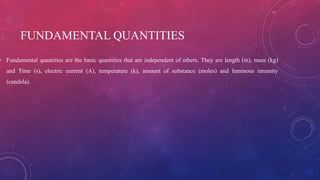
FUNDAMENTAL QUANTITIES
• Fundamental quantities are the basic quantities that are independent of others. They are length (m), mass (kg)
and Time (s), electric current (A), temperature (k), amount of substance (moles) and luminous intensity
(candela).
DERIVED QUANTITIES
• Derived quantities are those obtained by simple combination of basic quantities e.g. Area, Volume,
Density, Velocity, Acceleration, Force, energy, work, power, momentum, pressure, electric charge,
electric potential etc.
S/N QUANTITY DERIVATION DIMENSION UNIT
1. Area length x breadth L
2
m
2
2. Volume length x breadth x heights L
3
m
3
3. Density mass ÷ volume ML
-3
Kg/m
3
4. Speed or velocity distance ÷ time LT
-1
m/s
5. Acceleration change in velocity÷ time LT
-2
m/s
2
6. Force Mass x acceleration M LT
-2
N
7. Weight Mass x acceleration due to gravity MLT
-2
N
8. Momentum mass x velocity M LT
-1
kgm/s
9. Impulse force x time M LT
-1
NS
10. Pressure Force ÷ Area M L
-1
T
-2
Pa or NM
2
11. Energy or work force x distance M L
2
T
-2
J or Nm
12. Power Work ÷ time M L
2
T
-1
W or Nm/s
FOR MORE ENQUIRY
salahdeenishola@gmail.com
Whatsapp:+2348023455893
I also offer online teaching
THANKS

PHYSICS: Fundamental and Derived Quantities

  • 1.
    PHYSICS FUNDAMENTAL & DERIVEDQUANTITIES BY: SALAHDEEN HI TUTOR,EDUCATION AND E-LEARNING CONSULTANT
  • 2.
    FUNDAMENTAL QUANTITIES • Fundamentalquantities are the basic quantities that are independent of others. They are length (m), mass (kg) and Time (s), electric current (A), temperature (k), amount of substance (moles) and luminous intensity (candela).
  • 3.
    DERIVED QUANTITIES • Derivedquantities are those obtained by simple combination of basic quantities e.g. Area, Volume, Density, Velocity, Acceleration, Force, energy, work, power, momentum, pressure, electric charge, electric potential etc.
  • 4.
    S/N QUANTITY DERIVATIONDIMENSION UNIT 1. Area length x breadth L 2 m 2 2. Volume length x breadth x heights L 3 m 3 3. Density mass ÷ volume ML -3 Kg/m 3 4. Speed or velocity distance ÷ time LT -1 m/s 5. Acceleration change in velocity÷ time LT -2 m/s 2 6. Force Mass x acceleration M LT -2 N 7. Weight Mass x acceleration due to gravity MLT -2 N 8. Momentum mass x velocity M LT -1 kgm/s 9. Impulse force x time M LT -1 NS 10. Pressure Force ÷ Area M L -1 T -2 Pa or NM 2 11. Energy or work force x distance M L 2 T -2 J or Nm 12. Power Work ÷ time M L 2 T -1 W or Nm/s
  • 5.
  • 6.