Prepared by
Iffat Jahan Shammee
Dept. of Disaster
Science and
Management
University of Dhaka
Reference:
[Daniel_A.__Crowl]_Understanding_Explosions
What is explosion?
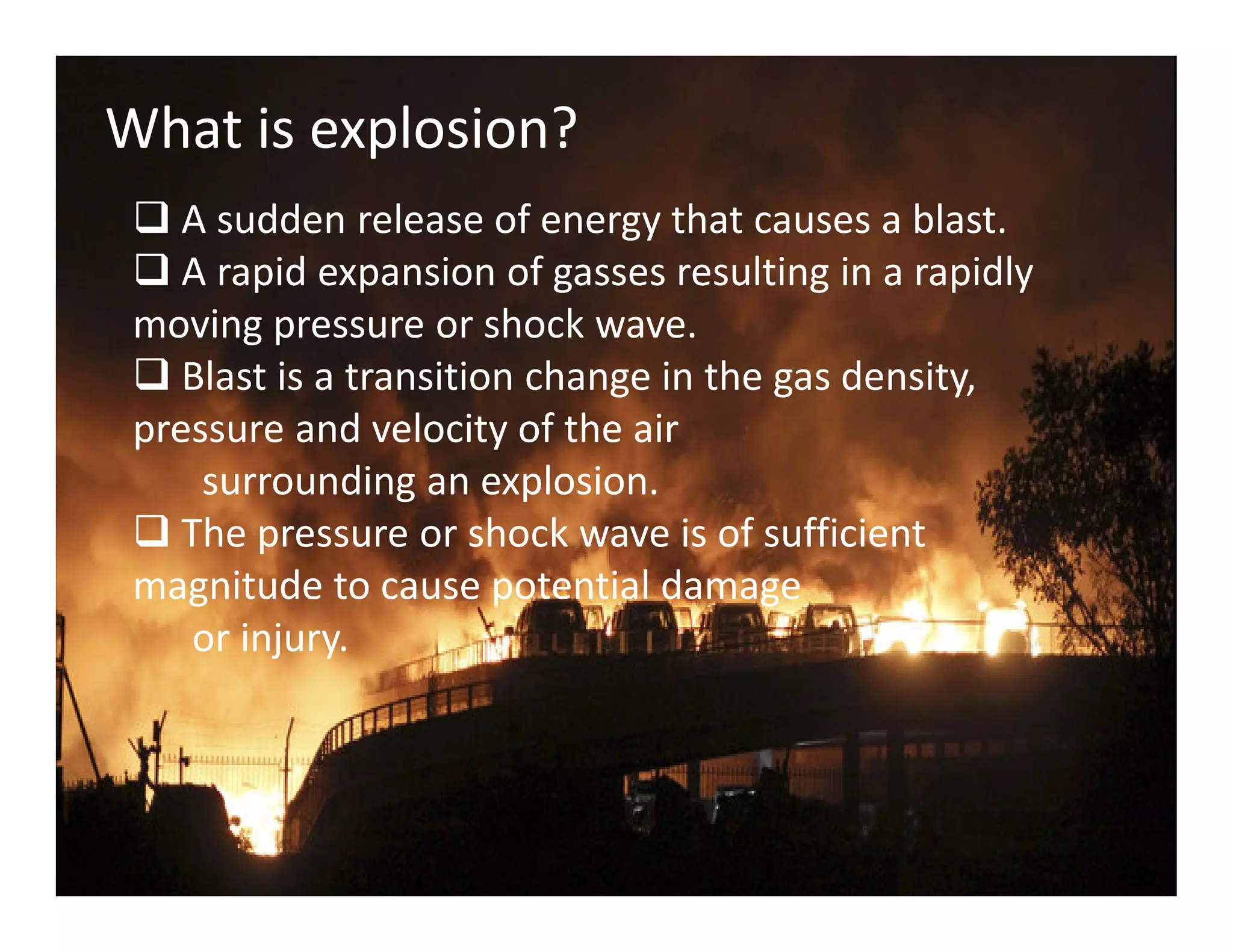
A sudden release of energy that causes a blast.
A rapid expansion of gasses resulting in a rapidly
moving pressure or shock wave.
Blast is a transition change in the gas density,
pressure and velocity of the air
surrounding an explosion.surrounding an explosion.
The pressure or shock wave is of sufficient
magnitude to cause potential damage
or injury.
1. Sudden release of energy
2. Rapidly moving blast or shock wave2. Rapidly moving blast or shock wave
3. Blast magnitude large enough to be
potentially hazardous.
Explosion
Physical
Explosion
Chemical
explosion
Vessel rupture
Uniform
reaction
Propagating
reaction
Thermal
runaway
reaction
Deflagration
Detonation
Vessel rupture
Pressure
vessel
rupture
BLEVE
Rapid phase
transition
Physical explosion :
• occurs due to sudden release of mechanical
energy.
• doesn’t involve a chemical reaction .
•Includes vessel rupture , boiling liquid
expanding vapor pressure(BLEVE) and rapid
phase transition explosion .phase transition explosion .
•The mechanical energy contained by the
material in the vessel is released .
•Ex – catastrophic failure of a compressed
cylinder , volcanic eruption or even mixing of
two liquids at different temperature.
Vessel rupture explosion : occurs when a process
vessel containing pressurized material fails suddenly
.
Failure can be due to number of mechanism like –
mechanical failure , corrosion , heat exposure ,
cyclical failure etc .
Boiling liquid expanding vapor explosion (BLEVE) :
occurs when a vessel containing a liquefied gas stored
above it’s normal boiling point fails catastrophically .
The vessel failure results in a sudden flashing of the liquid
into vapor , with subsequent damage due to the rapidly
expanding vapor , ejection of liquid and vessel contents
and fragment impact.and fragment impact.
A fireball may result if the material is combustible.
Rapid phase transition explosion :
Occurs when a material is exposed to heat source , causing
a rapid phase change and resulting change in material
volume.
Chemical explosion :
An explosion which requires a chemical
reaction , which could be combustion
reaction , a decomposing reaction or some
other rapid exothermic reaction.
Uniform reaction :
•A reaction that occurs uniformly through
space in a reaction mass. Ex – reaction occurs
in a continuous stirred tank reactor(CSTR).
•Explosion caused by this type reaction is
runaway reaction or thermal runaway.
Runaway reaction :
Occurs when the heat released by the
reaction exceeds the heat removal ,reaction exceeds the heat removal ,
resulting in a temperature and
pressure increase which may be
sufficient to rupture the process
containment.
Propagating reaction :
•A reaction which propagates spatially
through the reaction mass. Ex – the
combustion of a flammable vapor in pipeline,
a vapor cloud explosion , the decomposition
of an unstable solid.of an unstable solid.
•This reaction classified as detonation or
deflagration , depending on the speed at
which the reaction front propagates through
the un-reacted mass.
Detonation reaction :
Reaction front moves equal to or faster
than the speed of sound in the un-reacted
medium.
Reaction front moves primarily by
compressive heating of the un-reacted gassescompressive heating of the un-reacted gasses
ahead of the reaction front.
Deflagration :
Reaction front moves at a speed less than the
speed of sound.
In this type of reaction , reaction front
propagates primarily by the conduction and
diffusion of energy and free radical speciesdiffusion of energy and free radical species
into the un-reacted medium.
Deflagration is more common than
detonation in explosions of flammable vapors.
A deflagration to denotation transition(DDT)
is possible under certain circumstances.
Chemical explosion can occur in either the
vapor , liquid or solid phases. Chemical explosions
which occur in the liquid or solid phases are
sometimes called Condensed Phase Explosions.
These are significant due
to high density energy into high density energy in
the material.
Explosion depends on some factors :
1. the materials initial condition of use and
storage
2. the way in which the material is released
3. how the material is dispersed and mixed3. how the material is dispersed and mixed
with air
4. when and how the material is ignited
The energy of the explosion is dissipated by a
variety of mechanism –
•Projectiles
•Thermal radiation
•Acoustic energy or
•Physical transition of equipment•Physical transition of equipment
Damage is mainly caused by the dissipating
energy.
Pressure wave : If the explosion occurs in a gas ,
the energy causes the gas to expand rapidly ,
forcing back the surrounding gas and initiating a
pressure wave which moves rapidly outward from
the blast source .
The energy carried by this wave results in a damageThe energy carried by this wave results in a damage
to the surroundings.
Much damages done in chemical plants by this
wave.
Overpressure : the pressure over ambient that
results from an explosion .
Peak-overpressure : the maximum pressure
over ambient in a blast or shockwave .
Blast wave :a pressure wave propagating in air.Blast wave :a pressure wave propagating in air.
Shockwave :
A high pressure wave that radiates from the
surface of an explosion that has detonated
which moves through a gas.
The shockwave in open air is followed by a
strong wind. The pressure increase in the
shockwave is so rapid that the process isshockwave is so rapid that the process is
almost adiabatic.
If the shockwave is caused by the reaction , it
is due to stoichiometric effects or thermal
expansion.
If the pressure front has a very abrupt
pressure change as a function of distance at a
fixed time and as a function of time at a fixed
location , it’s called shockwave or shock front.
Occurs from high explosives like TNT or from
sudden rupture of a pressure vessel.
Occurs from high explosives like TNT or from
sudden rupture of a pressure vessel.
Involves a very abrupt , almost instantaneous
change in pressure
Fig – 1 : A typical shockwave at aFig – 1 : A typical shockwave at a
fixed time
Fig – 2 : Shockwave pressure at a fixed
location
A blast wave , on the other hand is used to
more generally to include both shock
waves and pressure waves that do not an
abrupt pressure change , such as wouldabrupt pressure change , such as would
occur from the combustion of a flammable
gas.
• t1 = arrival time
a small but limit time.
exists before the shock front
travels from it’s explosive
origin to the affected
location.
overpressure is observed.
•t2 = pressure started going
under ambient.under ambient.
•T2- t1 = overpressure or positive phase duration
•T3 = maximum under-pressure(below ambient)
•T2 – t4 = under-pressure period or negative pressure period
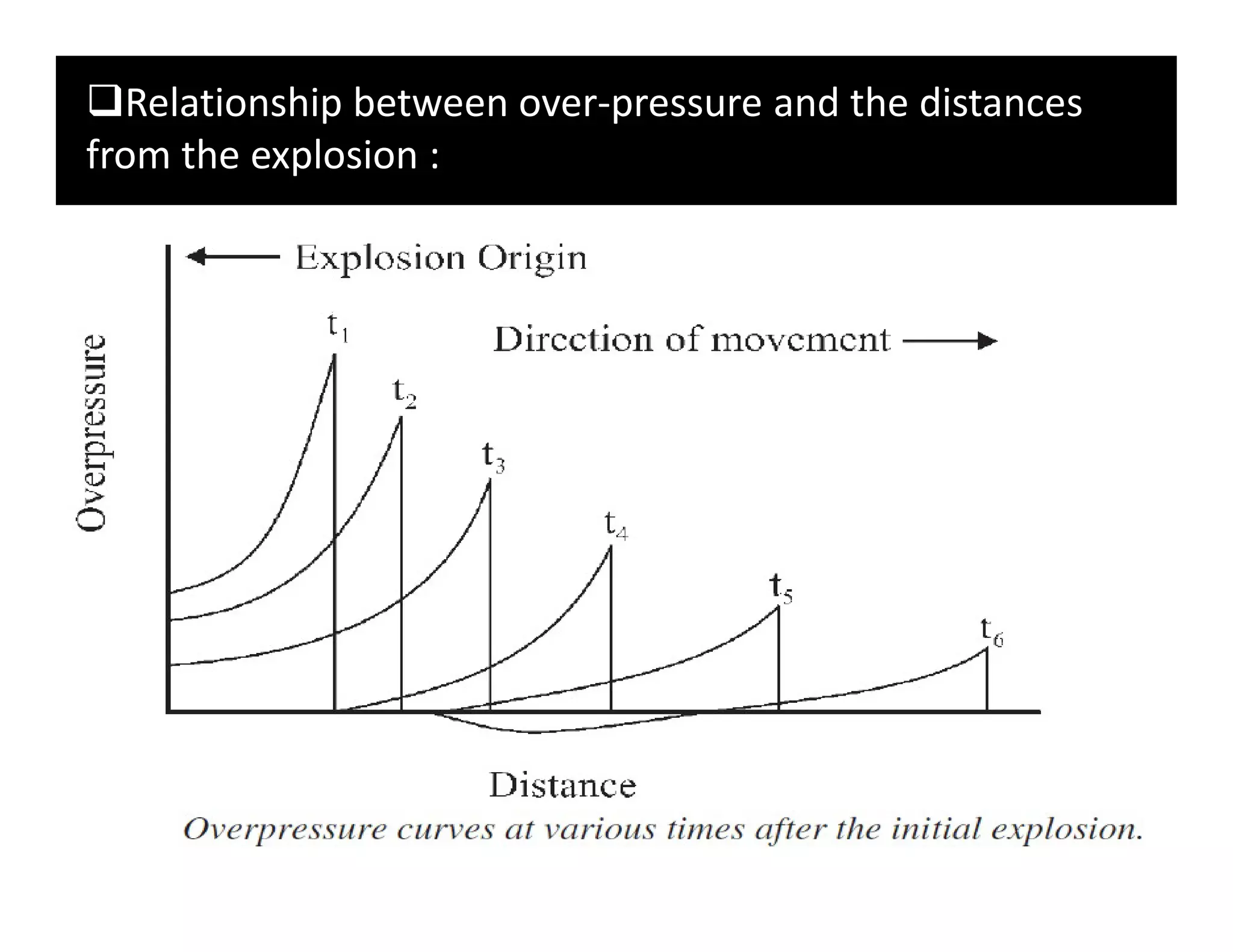
Relationship between over-pressure and the distances
from the explosion :
1.The peak over-pressure at the front decreases
and the duration of the blast wave increases
with distance.
The last curve(t6) shows negative pressure ,
negative phase is longer then positive phase.
Damages from blast wave depends upon –Damages from blast wave depends upon –
• The shape , duration and magnitude of blast
wave.
•The standoff distance between the explosion and
a receptor.
•The orientation and size of receptor.
•The type of construction of receptor.
Detonation :
-Reaction front is propagated by a strong pressure
wave which compress the un-reacted material
ahead of the reaction front , raising it’s
temperature above it’s auto-ignition temperature
which occurs very rapidly , resulting in abrupt
pressure change or shock wave in front of thepressure change or shock wave in front of the
reaction front.
- shock wave propagates above the sonic velocity.
Deflagration :
-energy transmission occurs from reaction to un-
reacted zone by heat conduction and molecular
diffusion.
-Relatively slow processes which propagates the-Relatively slow processes which propagates the
reaction front at a speed less than the sonic velocity.
Physical differences between detonation and
deflagration :
• Distance between reaction front and shock
front.
• The velocity of reaction front
• The velocity of shock front• The velocity of shock front
• The duration of staying pressure
• The amount of max pressure
• The damages occurred by them.
• If a combustion occurs in inter-connected vessels , this
occurs if the combustion is a deflagration and is due to the
pressure front much faster than the reaction front.
The pressure piling:
Deflagration to denotation transition(DDT):
More common in pipelines and channel
Due to the geometric nature of pipes and channels
, energy from the deflagration can accumulate in the
pressure wave. If enough energy accumulates , the
, energy from the deflagration can accumulate in the
pressure wave. If enough energy accumulates , the
resulting adiabatic compression of the gas might
lead to auto-ignition and initiation of detonation.
Most common in chemical plants.
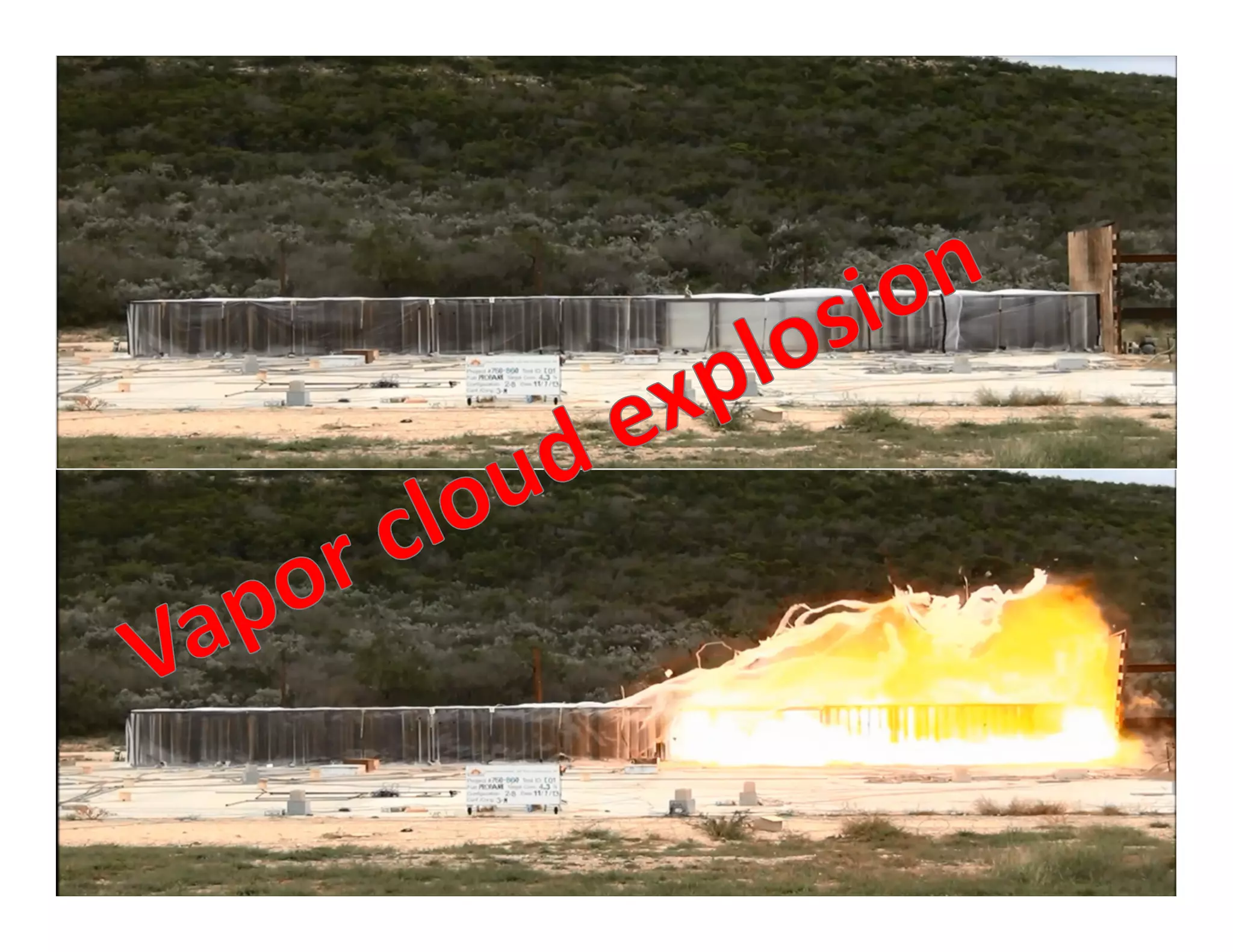
Vapor cloud explosion :
- Results from propagating reaction
-Occurs when a large quantity of flammable vapor
gas is released , mixes with air and is subsequently
ignited.ignited.
- vapor or gas fuel usually released due to the loss
of process containment
-May also originate from liquid stored under
pressure to maintain liquid state.
•The method and quantity of release will affect
the degree of mixing with air and the size of
the cloud.
•The combustion of vapor completely in the
open air typically will result in a flash fireopen air typically will result in a flash fire
without significant over pressure.
•In most cases , it is a deflagration reaction.
Four types of methods are used for estimation of
overpressure as a function of distance –
1. TNT Equivalency
Estimation of overpressure
1. TNT Equivalency
2. TNO Multi-energy
3. Baker-Strehlow
4. Compositional Fluid Dynamics(CFD)
TNT equivalency is most common method.
TNT Equivalency method :
-Simple method for equating a known
energy of a combustible fuel to an
equivalent mass of TNT.
-Approach is based assumption that an
exploding fuel mass will behave like
exploding TNT on the equivalent energy
gas.
The equivalent mass is measured by this
equation
1g TNT = 1100 cal
Advantages and procedures of
calculating
Fig : a runaway
reactor
Causes of transferring a uniform reaction to
runaway reaction :
Loss of temperature control , including
inadequate cooling or excessive heating.
After initiating runaway reaction , the highAfter initiating runaway reaction , the high
pressure and blasting of the reactor might
occur within minutes or take hours depending
on the particular reactive system ,heat
transfer , vessels’ shape etc.
Condensed pressure explosion
-Occurs when a solid or liquid material
explodes directly from the bulk state. A
common example is -TNT explosion.
-Due to exposure to shock temperature ,-Due to exposure to shock temperature ,
pressure and contamination
-Primary effects are thermal radiation and
direct flame contact .
-Ex – peroxide and nitrate material
explosion.
Ignition sources
Ignition refers to the process or phenomena of
initiating burning which leads to explosion.
Most of the ignition source can be controlledMost of the ignition source can be controlled
under proper management.
Most common is static electricity.
Are the main causes of chemical explosions.
Ignition sources and occurring damages(%) :
Static electricity :
Several types of discharges are
possible with static electricity.
A spark occurs when charge movesA spark occurs when charge moves
through the air between two
Conductors.
A brush discharge occurs between a
conductor and non-conductor.
The total amount of energy released in
the reaction is called the Heat of
Explosion.
Heat of Explosion = Formation heat of
the reactants – Formation heat of thethe reactants – Formation heat of the
products.
Explosives:
Any substance or device that can be made to
produce a volume of rapidly expanding gas in
an extremely brief period.
The explosive behavior of a materialThe explosive behavior of a material
depends on many variables .Like -
•Physical state(soil, liquid or gas : powder or
mist).
•Physical properties(heat capacity , vapor
pressure , heat of combustion).
•Reactivity.
Three fundamental types of explosives:
1.Mechanical
2.Chemical
3.Nuclear
Classification based on physical state -
1. Solid
2. Liquid2. Liquid
3. Gaseous
Classification based on reactivity –
1. Primary explosives
2. Secondary explosives
ExplosionsExplosions
Tianjin explosion:
Occurrence : explosion occurred in a container
storage station.
Where : Binhai New Area of Tianjin
When : Wednesday , 12 august , 2015
Fatalities : about 173 deaths , 8 missing , and 797Fatalities : about 173 deaths , 8 missing , and 797
non-fatal injuries
Losses : 304 buildings , 12428 cars and 7533
containers were badly destroyed
Environmental damage : 320.6 tons of sodium
cyanide and large amount of other chemicals were
dispersed.
AZF Fertilizer Plant Explosion :
Occurrence : 2 to 120 tons of ammonium nitrate
detonated.
Where : AZoto Fertilisant (AZF) fertilizer plant in
Toulouse , France
When : 21st September , 2001
Magnitude : 3.4 o Richter scaleMagnitude : 3.4 o Richter scale
Fatalities : 31 were killed , >30 seriously injured
Environmental damage : nitric acid produced from
explosion was mixed with river
Loss : a large part of the plant’s 70 ha was devasteted
West Fertilizer explosion and fire
Accident : west fertilizer explosion and fire ,
FGAN explosion occurred
Where : west , TX
When : 17 April , 2013
Where : west , TX
When : 17th April , 2013
Fatalities : 14 fatally injured , >100 injuries
loss : WFC facility completely destroyed ,
wide spread damage , more than 150 offsite
buildings were damaged
Why case study is important in disaster
management…..???
In order to prevent explosion
,,first we have to know which
places are vulnerable for
explosion……explosion……
Explosion effects :
Thermal exposure :
depends on duration and nature
Thermal radiation may be reflected partially,
absorbed or pass through to other materials.
Thermal radiation is a radiation absorbed by aThermal radiation is a radiation absorbed by a
material that produces heat resulting in damage
to material.
The absorbed radiation depends on color and
nature of material.
Wood – based construction material will fail
due to combustion , steel fail due to thermal
lowering of the yield stress .
World Trade Centre towers collapsed on
September 11 , 2001, due to this .September 11 , 2001, due to this .
• Overpressure exposure :
- causes body translation
- Fast compression and decompression of
human body results in transmission of
pressure waves that damages air
containing organs ( lungs, ears , sinusescontaining organs ( lungs, ears , sinuses
and orbital bones near the sinus
cavities) and interfaces between tissues
of varying density .
- Causes structural damages.
Details on Chemical Explosion

Details on Chemical Explosion

  • 1.
    Prepared by Iffat JahanShammee Dept. of Disaster Science and Management University of Dhaka
  • 2.
  • 3.
    What is explosion? Asudden release of energy that causes a blast. A rapid expansion of gasses resulting in a rapidly moving pressure or shock wave. Blast is a transition change in the gas density, pressure and velocity of the air surrounding an explosion.surrounding an explosion. The pressure or shock wave is of sufficient magnitude to cause potential damage or injury.
  • 4.
    1. Sudden releaseof energy 2. Rapidly moving blast or shock wave2. Rapidly moving blast or shock wave 3. Blast magnitude large enough to be potentially hazardous.
  • 5.
  • 6.
    Physical explosion : •occurs due to sudden release of mechanical energy. • doesn’t involve a chemical reaction . •Includes vessel rupture , boiling liquid expanding vapor pressure(BLEVE) and rapid phase transition explosion .phase transition explosion . •The mechanical energy contained by the material in the vessel is released . •Ex – catastrophic failure of a compressed cylinder , volcanic eruption or even mixing of two liquids at different temperature.
  • 7.
    Vessel rupture explosion: occurs when a process vessel containing pressurized material fails suddenly . Failure can be due to number of mechanism like – mechanical failure , corrosion , heat exposure , cyclical failure etc .
  • 8.
    Boiling liquid expandingvapor explosion (BLEVE) : occurs when a vessel containing a liquefied gas stored above it’s normal boiling point fails catastrophically . The vessel failure results in a sudden flashing of the liquid into vapor , with subsequent damage due to the rapidly expanding vapor , ejection of liquid and vessel contents and fragment impact.and fragment impact. A fireball may result if the material is combustible. Rapid phase transition explosion : Occurs when a material is exposed to heat source , causing a rapid phase change and resulting change in material volume.
  • 9.
    Chemical explosion : Anexplosion which requires a chemical reaction , which could be combustion reaction , a decomposing reaction or some other rapid exothermic reaction. Uniform reaction : •A reaction that occurs uniformly through space in a reaction mass. Ex – reaction occurs in a continuous stirred tank reactor(CSTR).
  • 11.
    •Explosion caused bythis type reaction is runaway reaction or thermal runaway. Runaway reaction : Occurs when the heat released by the reaction exceeds the heat removal ,reaction exceeds the heat removal , resulting in a temperature and pressure increase which may be sufficient to rupture the process containment.
  • 12.
    Propagating reaction : •Areaction which propagates spatially through the reaction mass. Ex – the combustion of a flammable vapor in pipeline, a vapor cloud explosion , the decomposition of an unstable solid.of an unstable solid. •This reaction classified as detonation or deflagration , depending on the speed at which the reaction front propagates through the un-reacted mass.
  • 13.
    Detonation reaction : Reactionfront moves equal to or faster than the speed of sound in the un-reacted medium. Reaction front moves primarily by compressive heating of the un-reacted gassescompressive heating of the un-reacted gasses ahead of the reaction front.
  • 15.
    Deflagration : Reaction frontmoves at a speed less than the speed of sound. In this type of reaction , reaction front propagates primarily by the conduction and diffusion of energy and free radical speciesdiffusion of energy and free radical species into the un-reacted medium. Deflagration is more common than detonation in explosions of flammable vapors. A deflagration to denotation transition(DDT) is possible under certain circumstances.
  • 16.
    Chemical explosion canoccur in either the vapor , liquid or solid phases. Chemical explosions which occur in the liquid or solid phases are sometimes called Condensed Phase Explosions. These are significant due to high density energy into high density energy in the material.
  • 17.
    Explosion depends onsome factors : 1. the materials initial condition of use and storage 2. the way in which the material is released 3. how the material is dispersed and mixed3. how the material is dispersed and mixed with air 4. when and how the material is ignited
  • 19.
    The energy ofthe explosion is dissipated by a variety of mechanism – •Projectiles •Thermal radiation •Acoustic energy or •Physical transition of equipment•Physical transition of equipment Damage is mainly caused by the dissipating energy.
  • 20.
    Pressure wave :If the explosion occurs in a gas , the energy causes the gas to expand rapidly , forcing back the surrounding gas and initiating a pressure wave which moves rapidly outward from the blast source . The energy carried by this wave results in a damageThe energy carried by this wave results in a damage to the surroundings. Much damages done in chemical plants by this wave.
  • 21.
    Overpressure : thepressure over ambient that results from an explosion . Peak-overpressure : the maximum pressure over ambient in a blast or shockwave . Blast wave :a pressure wave propagating in air.Blast wave :a pressure wave propagating in air.
  • 22.
    Shockwave : A highpressure wave that radiates from the surface of an explosion that has detonated which moves through a gas. The shockwave in open air is followed by a strong wind. The pressure increase in the shockwave is so rapid that the process isshockwave is so rapid that the process is almost adiabatic. If the shockwave is caused by the reaction , it is due to stoichiometric effects or thermal expansion.
  • 23.
    If the pressurefront has a very abrupt pressure change as a function of distance at a fixed time and as a function of time at a fixed location , it’s called shockwave or shock front. Occurs from high explosives like TNT or from sudden rupture of a pressure vessel. Occurs from high explosives like TNT or from sudden rupture of a pressure vessel. Involves a very abrupt , almost instantaneous change in pressure
  • 25.
    Fig – 1: A typical shockwave at aFig – 1 : A typical shockwave at a fixed time Fig – 2 : Shockwave pressure at a fixed location
  • 26.
    A blast wave, on the other hand is used to more generally to include both shock waves and pressure waves that do not an abrupt pressure change , such as wouldabrupt pressure change , such as would occur from the combustion of a flammable gas.
  • 27.
    • t1 =arrival time a small but limit time. exists before the shock front travels from it’s explosive origin to the affected location. overpressure is observed. •t2 = pressure started going under ambient.under ambient. •T2- t1 = overpressure or positive phase duration •T3 = maximum under-pressure(below ambient) •T2 – t4 = under-pressure period or negative pressure period
  • 28.
    Relationship between over-pressureand the distances from the explosion :
  • 29.
    1.The peak over-pressureat the front decreases and the duration of the blast wave increases with distance. The last curve(t6) shows negative pressure , negative phase is longer then positive phase. Damages from blast wave depends upon –Damages from blast wave depends upon – • The shape , duration and magnitude of blast wave. •The standoff distance between the explosion and a receptor. •The orientation and size of receptor. •The type of construction of receptor.
  • 31.
    Detonation : -Reaction frontis propagated by a strong pressure wave which compress the un-reacted material ahead of the reaction front , raising it’s temperature above it’s auto-ignition temperature which occurs very rapidly , resulting in abrupt pressure change or shock wave in front of thepressure change or shock wave in front of the reaction front. - shock wave propagates above the sonic velocity.
  • 32.
    Deflagration : -energy transmissionoccurs from reaction to un- reacted zone by heat conduction and molecular diffusion. -Relatively slow processes which propagates the-Relatively slow processes which propagates the reaction front at a speed less than the sonic velocity.
  • 33.
    Physical differences betweendetonation and deflagration :
  • 34.
    • Distance betweenreaction front and shock front. • The velocity of reaction front • The velocity of shock front• The velocity of shock front • The duration of staying pressure • The amount of max pressure • The damages occurred by them.
  • 36.
    • If acombustion occurs in inter-connected vessels , this occurs if the combustion is a deflagration and is due to the pressure front much faster than the reaction front. The pressure piling:
  • 37.
    Deflagration to denotationtransition(DDT): More common in pipelines and channel Due to the geometric nature of pipes and channels , energy from the deflagration can accumulate in the pressure wave. If enough energy accumulates , the , energy from the deflagration can accumulate in the pressure wave. If enough energy accumulates , the resulting adiabatic compression of the gas might lead to auto-ignition and initiation of detonation. Most common in chemical plants.
  • 38.
    Vapor cloud explosion: - Results from propagating reaction -Occurs when a large quantity of flammable vapor gas is released , mixes with air and is subsequently ignited.ignited. - vapor or gas fuel usually released due to the loss of process containment -May also originate from liquid stored under pressure to maintain liquid state.
  • 42.
    •The method andquantity of release will affect the degree of mixing with air and the size of the cloud. •The combustion of vapor completely in the open air typically will result in a flash fireopen air typically will result in a flash fire without significant over pressure. •In most cases , it is a deflagration reaction.
  • 44.
    Four types ofmethods are used for estimation of overpressure as a function of distance – 1. TNT Equivalency Estimation of overpressure 1. TNT Equivalency 2. TNO Multi-energy 3. Baker-Strehlow 4. Compositional Fluid Dynamics(CFD) TNT equivalency is most common method.
  • 45.
    TNT Equivalency method: -Simple method for equating a known energy of a combustible fuel to an equivalent mass of TNT. -Approach is based assumption that an exploding fuel mass will behave like exploding TNT on the equivalent energy gas.
  • 46.
    The equivalent massis measured by this equation 1g TNT = 1100 cal
  • 48.
  • 49.
    Fig : arunaway reactor
  • 50.
    Causes of transferringa uniform reaction to runaway reaction : Loss of temperature control , including inadequate cooling or excessive heating. After initiating runaway reaction , the highAfter initiating runaway reaction , the high pressure and blasting of the reactor might occur within minutes or take hours depending on the particular reactive system ,heat transfer , vessels’ shape etc.
  • 53.
    Condensed pressure explosion -Occurswhen a solid or liquid material explodes directly from the bulk state. A common example is -TNT explosion. -Due to exposure to shock temperature ,-Due to exposure to shock temperature , pressure and contamination -Primary effects are thermal radiation and direct flame contact . -Ex – peroxide and nitrate material explosion.
  • 54.
    Ignition sources Ignition refersto the process or phenomena of initiating burning which leads to explosion. Most of the ignition source can be controlledMost of the ignition source can be controlled under proper management. Most common is static electricity. Are the main causes of chemical explosions.
  • 55.
    Ignition sources andoccurring damages(%) :
  • 56.
    Static electricity : Severaltypes of discharges are possible with static electricity. A spark occurs when charge movesA spark occurs when charge moves through the air between two Conductors.
  • 57.
    A brush dischargeoccurs between a conductor and non-conductor.
  • 58.
    The total amountof energy released in the reaction is called the Heat of Explosion. Heat of Explosion = Formation heat of the reactants – Formation heat of thethe reactants – Formation heat of the products.
  • 59.
    Explosives: Any substance ordevice that can be made to produce a volume of rapidly expanding gas in an extremely brief period. The explosive behavior of a materialThe explosive behavior of a material depends on many variables .Like - •Physical state(soil, liquid or gas : powder or mist). •Physical properties(heat capacity , vapor pressure , heat of combustion). •Reactivity.
  • 60.
    Three fundamental typesof explosives: 1.Mechanical 2.Chemical 3.Nuclear Classification based on physical state - 1. Solid 2. Liquid2. Liquid 3. Gaseous Classification based on reactivity – 1. Primary explosives 2. Secondary explosives
  • 61.
  • 63.
    Tianjin explosion: Occurrence :explosion occurred in a container storage station. Where : Binhai New Area of Tianjin When : Wednesday , 12 august , 2015 Fatalities : about 173 deaths , 8 missing , and 797Fatalities : about 173 deaths , 8 missing , and 797 non-fatal injuries Losses : 304 buildings , 12428 cars and 7533 containers were badly destroyed Environmental damage : 320.6 tons of sodium cyanide and large amount of other chemicals were dispersed.
  • 75.
    AZF Fertilizer PlantExplosion : Occurrence : 2 to 120 tons of ammonium nitrate detonated. Where : AZoto Fertilisant (AZF) fertilizer plant in Toulouse , France When : 21st September , 2001 Magnitude : 3.4 o Richter scaleMagnitude : 3.4 o Richter scale Fatalities : 31 were killed , >30 seriously injured Environmental damage : nitric acid produced from explosion was mixed with river Loss : a large part of the plant’s 70 ha was devasteted
  • 78.
    West Fertilizer explosionand fire Accident : west fertilizer explosion and fire , FGAN explosion occurred Where : west , TX When : 17 April , 2013 Where : west , TX When : 17th April , 2013 Fatalities : 14 fatally injured , >100 injuries loss : WFC facility completely destroyed , wide spread damage , more than 150 offsite buildings were damaged
  • 95.
    Why case studyis important in disaster management…..???
  • 97.
    In order toprevent explosion ,,first we have to know which places are vulnerable for explosion……explosion……
  • 100.
    Explosion effects : Thermalexposure : depends on duration and nature Thermal radiation may be reflected partially, absorbed or pass through to other materials. Thermal radiation is a radiation absorbed by aThermal radiation is a radiation absorbed by a material that produces heat resulting in damage to material. The absorbed radiation depends on color and nature of material.
  • 102.
    Wood – basedconstruction material will fail due to combustion , steel fail due to thermal lowering of the yield stress . World Trade Centre towers collapsed on September 11 , 2001, due to this .September 11 , 2001, due to this .
  • 103.
    • Overpressure exposure: - causes body translation - Fast compression and decompression of human body results in transmission of pressure waves that damages air containing organs ( lungs, ears , sinusescontaining organs ( lungs, ears , sinuses and orbital bones near the sinus cavities) and interfaces between tissues of varying density . - Causes structural damages.